Can two people book a private Rwenzori trek? Yes. See per-person prices, your guide team, best routes, deposit terms and how to reserve your dates.
Sooner or later, almost every enquiry about a Rwenzori expedition arrives at the same quiet, slightly apologetic sentence: there are only two of us, so do we have to wait until a group forms? It is a fair worry. On a mountain as remote and as logistically demanding as the Rwenzori Mountains, it is natural to assume that the machinery of an expedition, the guides, the porters, the cooks and the permits, only starts turning once enough trekkers have signed up. The answer, which I would rather give you before anything else, is that you do not have to wait for anyone. You can book a private Rwenzori trek for just two people, on dates that suit the two of you, on any route we operate, and it is one of the most common ways our guides walk the mountain.
What follows is the fullest account I can give of how a two-person private trek really works: what the word private means on a mountain where trekking alone is against the rules, who walks with you and what they carry, what our published prices mean for a party of two, which routes suit a pair best, how deposits and cancellations work, how far ahead to book, and the preparation decisions that separate a good expedition from a great one. I have written it the way I would talk to a couple across a table in Kasese the evening before they set off, because that is where these conversations usually happen and where honest answers matter most.
If you are still weighing a private booking against a shared departure, our comparison of group versus private Rwenzori treks sets both formats side by side. This guide goes deeper on a narrower question: everything that changes, and everything that stays exactly the same, when the party is two.
The Short Answer: Yes, Two People Can Trek the Rwenzori Privately
Yes. Two trekkers can book a fully private Rwenzori expedition, and there is no minimum number of people required for a trek to run. Our seven-day Margherita Peak climb states plainly that parties range from one to twelve people, that we accept solo climbers, couples and small groups, and that private, exclusive treks are available simply by asking for one in your booking request. Our published prices, across almost every itinerary, are quoted per person for parties of one or two trekkers, which tells you something important about how the mountain works. A pair is not an awkward middle case that we tolerate until a larger group appears. A pair is one of the standard units around which our pricing, staffing and daily rhythm are built.
It is worth being precise about the word private, because on the Rwenzori it does not mean what it means on a European hut-to-hut path. A private Rwenzori trek does not mean the two of you walking into the mountains alone, and no legitimate operator can offer you that. Unguided trekking is prohibited inside Rwenzori Mountains National Park, and every party must be accompanied by a licensed guide from the trailhead onward, a rule we explain in full in our article on whether guides are mandatory for Rwenzori trekking. What private means is that the guide and porter team walking with you belongs to the two of you alone. You are not slotted onto a scheduled departure alongside strangers, you do not share a guide’s attention with a third or fourth trekker, and the decisions that shape each day, when to leave camp, how long to linger at a viewpoint, when to slow down, are made between you and your lead guide rather than negotiated across a group.
There is also a legal and administrative layer beneath every booking that you never have to touch. The Uganda Wildlife Authority, which manages the park, charges entry fees, a rescue levy and hut fees per person per day, and on our treks those are bundled into your price and handled for you, as our step-by-step guide to UWA permit booking for Rwenzori treks and our overview of park entrance fees and permits explain. For a party of two, it simply means we secure permit dates, a guide allocation and a porter team for exactly two people.
Who Walks With You: The Private Team Behind a Two-Person Trek
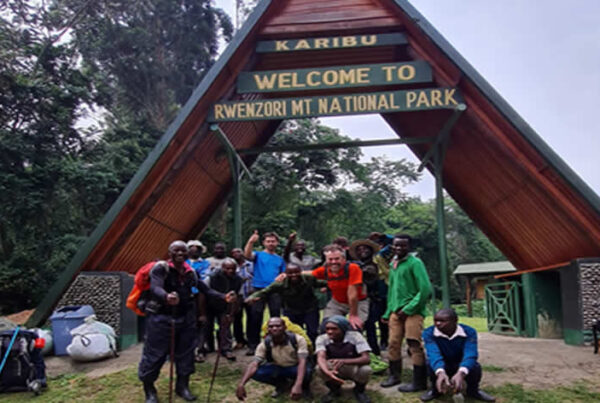
The first thing that surprises people about a private trek for two is the size of the team. Two trekkers do not mean two trekkers and a guide. The Rwenzori has no roads inside the park and no huts that a vehicle can reach, so everything your expedition needs, your main packs, the food, the cooking equipment, the emergency kit and the technical gear for the glacier, is carried in on human shoulders. On the seven-day Central Circuit, a party of two would typically travel with a lead guide, two assistant guides and between four and six porters, before you count the cooks who feed you along the way. Every guide and porter on our treks is a certified Bakonzo mountain professional whose family has lived on these slopes for generations, and the full guide to Rwenzori porters and guides explains how the team is structured and what each member does. If you want to understand why the porter numbers matter so much, our piece on how many porters you actually need and the account of a day in the life of a Rwenzori porter will change how you feel about the people carrying your bags.
Your lead guide is a trained mountaineer, not merely a trail guide. He or she carries first aid certification and altitude-management training, is with you from the first day to the last, and knows this mountain across seasons, its hut conditions, its weather behaviour and its evacuation routes in a way that no generalist safari operator can. On the summit routes, the package also includes a Uganda Wildlife Authority ranger guide, and assistant guides join the lead guide on technical routes. Our booking guide covering what is included sets out every component of the team and the package in detail.
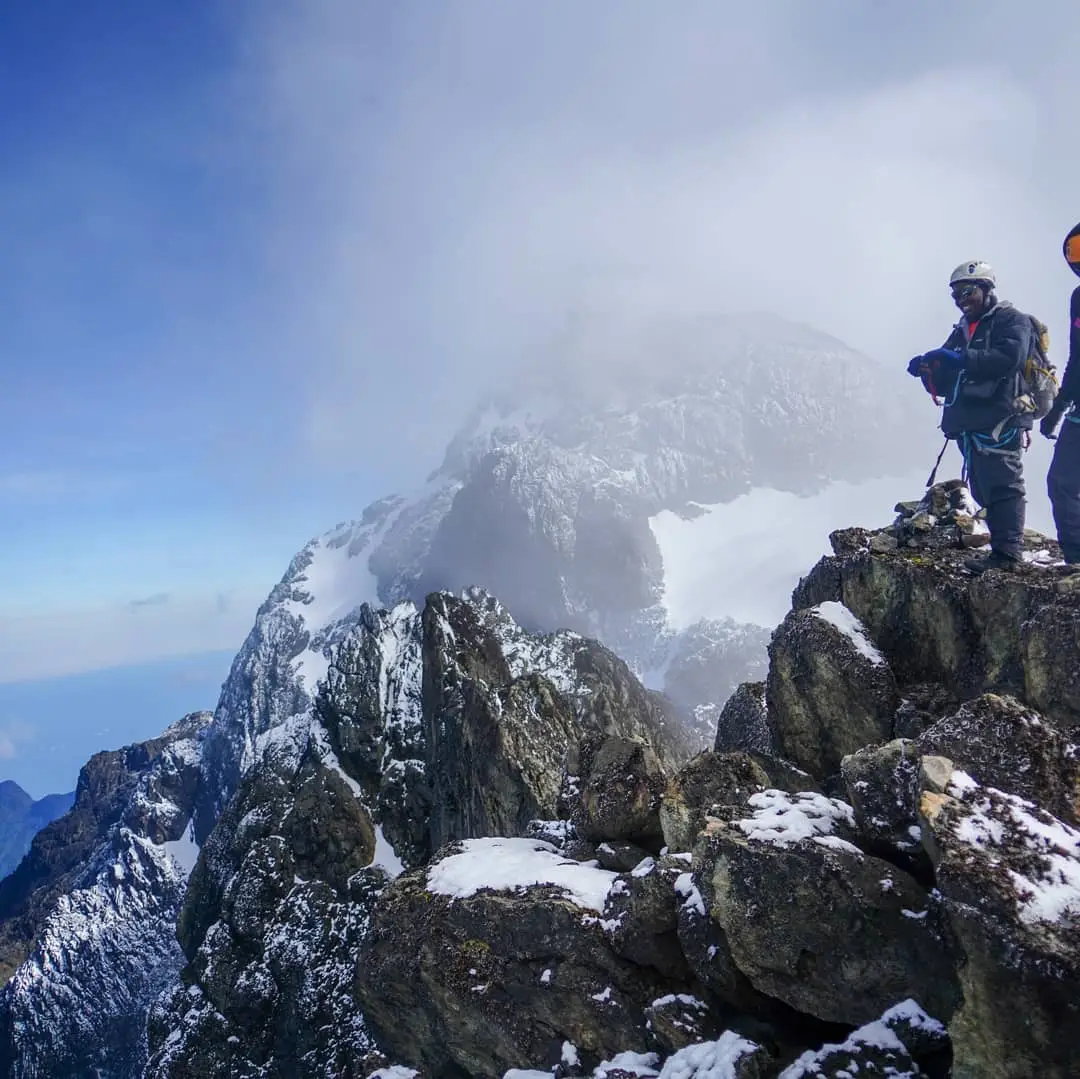
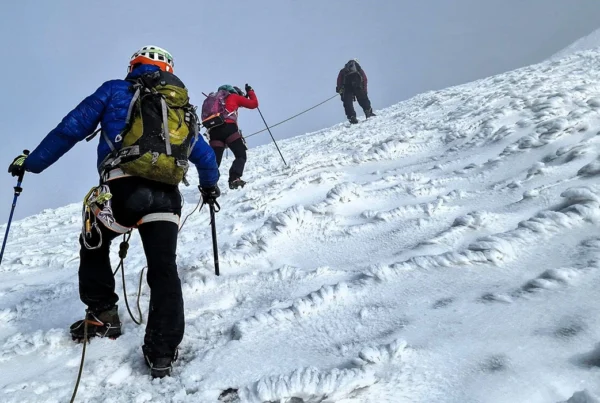
With only two trekkers, the ratio of guiding attention to clients on summit day is exceptionally good, and this is where a private trek pays its greatest dividend. The glacier crossing above Elena Camp involves crampons, ropes and fixed ladders over crevasses on the Stanley Plateau, and our own itinerary notes that smaller groups receive more personalised guide attention during exactly this section. A guide with two clients can fit both pairs of crampons, check both harnesses, watch both of you move on the ice, and read the small signs, a change in breathing, a lengthening silence, a stumble that was not there an hour ago, that tell an experienced mountaineer how someone is really coping. If you want to know what the terrain itself demands, our articles on how technical the climb to Margherita Peak really is, on crossing the Rwenzori glacier and on the final push to the summit describe it honestly.
Privacy does not loosen safety. If anything, it sharpens it. The decision to continue to the summit is always made on weather, visibility and how the two of you are moving, and your guides monitor you daily for altitude symptoms and will enforce a descent if those symptoms worsen. The principles behind that discipline are laid out in our altitude acclimatization guide and our complete medical guide to trekking the Rwenzori, and our overview of how safe the Rwenzori is to trek explains the hazards and the protocols in full.
| From the Mountain
After years of guiding parties of every size, our guides consistently point to groups of two to four trekkers as the best format on the Rwenzori. That is a group large enough to give you mutual support and shared experience, yet small enough to move at a flexible pace, share the huts comfortably and receive real individual attention from the guides. A private trek for two sits at the heart of that sweet spot. You can read the wider safety reasoning in our guide to safety on the Rwenzori. |
What a Private Trek for Two Actually Costs
The economics of a Rwenzori expedition are simpler than they look. Every trek carries a set of fixed costs, the lead guide’s wage, park permits, transport to the trailhead, communal cooking equipment and a share of the porter team, which exist whether one person or eight are on the mountain. On a private trek, the two of you carry those costs between you. That is why the per-person price of a private trek is higher than that of a group departure, and it is also why it is the honest starting point for planning.
Our 2026 published rates are quoted per person for parties of one or two trekkers, and they are “from” prices: your final figure depends on your dates, route and any customisation, and we always confirm it in a written quote. To make them easy to plan around, the table below shows what the principal itineraries cost per person and what that means for a party of two.
| Itinerary | Route | Per person (from) | Two trekkers (from) |
| 2-Day Lake Mahoma Hike | Mahoma forest trail | USD 280 | USD 560 |
| 3-Day Mahoma Loop | Central Circuit, forest section | USD 700 | USD 1,400 |
| 4-Day Mutinda Lookout Trek | Kilembe Trail | USD 645 | USD 1,290 |
| 6-Day Weismann Peak Expedition | Kilembe Trail | USD 1,200 | USD 2,400 |
| 7-Day Margherita Peak Climb | Central Circuit | USD 1,400 | USD 2,800 |
| 8-Day Margherita Peak Climb | Kilembe Trail | USD 1,750 | USD 3,500 |
| 13-Day 6 Peaks Expedition | Multi-peak expedition | USD 3,350 | USD 6,700 |
| 18-Day All 8 Peaks Traverse | Multi-peak expedition | USD 4,050 | USD 8,100 |
Prices are per person, based on our 2026 published rates, and exclude international flights, visas, insurance, pre- and post-trek accommodation, personal gear and tips. Confirm exact figures for your own dates in a written quote.
Those prices include a great deal that you would otherwise have to arrange, and pay for, separately: the lead guide and any assistant guides your route requires, the porter team, Uganda Wildlife Authority park entry fees and the rescue levy, hut accommodation, three meals a day with hot drinks at camp, a group first aid kit with supplemental oxygen, and the technical glacier equipment that summit routes demand. What sits outside the price is equally clear. International flights, your Uganda visa, mandatory travel insurance, hotels in Kasese before and after the trek, personal trekking gear and tips for your guides and porters are yours to arrange. On tips, a party of two on the seven-day trek should plan on roughly USD 200 to 350 in total, carried in shillings and handed over at the end, and our guides to tipping Rwenzori porters and guides and to what currency and how much cash to bring explain the norms and the reasoning.
If cost is the deciding factor, the honest arithmetic is that moving from a private two-person trek to a shared group of six can lower the per-person price by roughly USD 200 to 400 with no reduction in guiding quality, safety equipment or hut standards, and our guide to reducing Rwenzori trekking costs safely explains that and every other legitimate saving. At the other end of the scale, heavily customised private expeditions, with extra rest days, a personal second guide or bespoke pacing, can run from around USD 2,400 to USD 4,500 or more per person. Be wary of quotes far below the published range, because Uganda Wildlife Authority fees are fixed and cannot be reduced by any operator, which means an unusually low price is being found somewhere else, usually in staffing, food or safety equipment. Our complete cost-to-climb breakdown and the companion piece on what climbing the Rwenzori actually costs show where every dollar goes.
Private Trek or Shared Departure? An Honest View for Two Trekkers
For a pair, there are really three ways to book. The first is the fully private trek, in which the team belongs to the two of you alone and the dates are yours to choose. The second is a semi-private arrangement, in which you and two or three friends or relatives book together as your own private group, which captures much of the cost benefit of sharing fixed costs while keeping the trekking unit to people you already know. The third is to ask us to place the two of you on an upcoming scheduled group departure, which suits pairs who want company and a lower per-person price and who can build their trip around a fixed start date.
The private trek earns its premium in three places. The first is pace. If one of you is a stronger walker, or one of you needs an unscheduled pause on a steep ridge, the day bends around the two of you instead of around the slowest member of a larger party. The second is dates. A private trek can be scheduled around your own calendar, which matters enormously if you are combining the climb with a tightly dated Uganda itinerary or a narrow window of leave, and two calendars are far easier to align than eight. The third is intimacy. A private team gives you a quieter, more self-contained expedition, which is why it is so often chosen for honeymoons, anniversaries and the kind of trip a parent and an adult child take once in a lifetime.
The shared departure earns its place too, and I would be doing you a disservice to pretend otherwise. It costs less per person, and many trekkers find that a hut full of people attempting the same difficult thing at the same time is a real psychological asset at five in the morning on summit day. The right question is not which format is better, but which one fits the two of you: your budget, your dates, and how you each behave when a mountain gets hard. If you are unsure, tell us your priorities and let us recommend the format that fits, which is exactly what our team is here to do.
Choosing the Right Route for a Party of Two
A private booking does not limit your choice of route in any way. Every route and itinerary we operate can be booked as a two-person private trek, and the real decision is which of the mountain’s trails best matches what the two of you want from it.
The Central Circuit and the Kilembe Trail
For most pairs who want the summit, the choice comes down to the Central Circuit Trail or the Kilembe Trail. The Central Circuit is the original Rwenzori route, looping through the Bujuku Valley and over the high passes to the staging camp beneath Mount Stanley, with the widest traversal of the vegetation zones and the greatest variety of summit options. The Kilembe Trail approaches the upper mountain from the south through the Nyamwamba Valley, with different landscapes, a spectacular run of waterfalls in its lower sections and, on the eight-day itinerary, an extra acclimatization day that many pairs value. Our detailed comparison of which Rwenzori route is better and our explanation of the difference between the Central Circuit and the Kilembe Trail walk through every variable, and our overview of all Rwenzori hiking trails puts them in context.
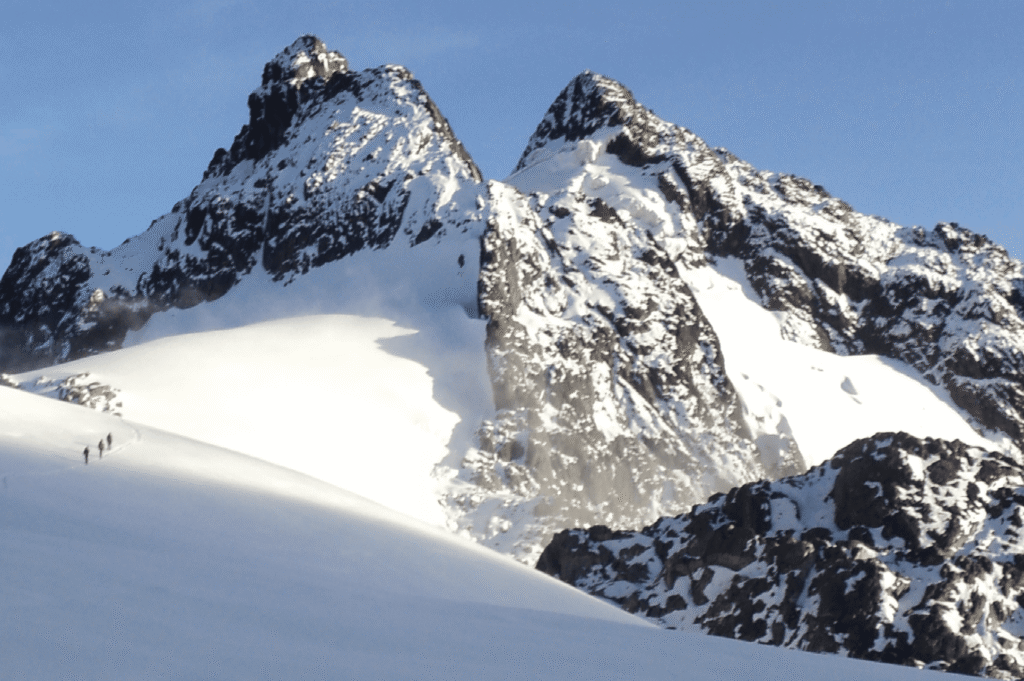
If the summit of Margherita Peak, the highest point of Mount Stanley at 5,109 metres, is the goal, my advice as a guide is consistent. Choose seven days as the minimum and eight if you can, because summit success on this mountain is governed far more by acclimatization than by fitness. The 7-day Margherita Peak climb via the Central Circuit and the 8-day Kilembe Trail climb are the two itineraries I would put in front of most pairs, and the 6-day Central Circuit trek exists for those with less time. Shorter summit itineraries do exist, but they carry a meaningfully higher risk of altitude trouble, and our guide to how long it takes to climb the Rwenzori explains why.
Shorter Treks for Pairs Who Do Not Want the Summit
Not every pair wants to stand on a glacier, and the Rwenzori is generous to those who do not. The 2-day hike to Lake Mahoma, the 3-day Mahoma Loop, the 2-day trek to Sine Camp, the 4-day Mutinda Lookout trek and the 4-day waterfalls hike all deliver the forest, the bogs, the giant lobelias and the birdlife of the lower and middle mountain without committing you to the summit day. Booked privately, they make superb short expeditions for couples, for friends with mixed fitness, and for anyone testing their appetite for altitude before committing to a longer climb. Our guide to trekking the Rwenzori without going to the summit explains these options in depth.
Multi-Peak Expeditions for Two
Long expeditions are where a two-person private team shows its real value. Over ten or more days, weather windows open and close, energy rises and falls, and a small party can work with its guides to make sensible adjustments within the limits of the route and the camps. The 8-day three-peaks trek links Mount Stanley, Mount Speke and Mount Baker, the 10-day four-peaks expedition adds Weismann Peak on Mount Luigi di Savoia, the 13-day six-peaks expedition adds Mount Emin and Mount Gessi, and the 18-day traverse completes all eight named summits. Every one of these is priced per person for one or two trekkers, and our guide to the six major peaks will help you decide which combination fits your ambitions.
The Bukurungu Trail for Experienced Pairs
For pairs who have already walked one of the main routes, or who simply want the mountain at its wildest, the Bukurungu Trail is the frontier. There are no permanent huts on this route, so the porters carry tents and everything else in, and the trail passes through four high alpine lakes in country that sees only a few dozen visitors a year. A private party of two is arguably the ideal size for it: small enough to camp lightly and quietly, and experienced enough to appreciate what it is looking at.
What a Private Seven-Day Central Circuit Looks Like for Two
Prices and policies only tell part of the story, so let me walk you through how a private seven-day climb to Margherita Peak unfolds for a party of two on the Central Circuit. The trek begins at the Rwenzori Mountaineering Services offices in Nyakalengija, at about 1,615 metres, where you register, are allocated equipment and are briefed by your guiding team. The approach follows the Mubuku River through farmland and into dense montane forest, and reaches Nyabitaba Camp at roughly 2,650 metres after six or seven hours, gaining height at the gentle rate that early acclimatization needs. If you are lucky, chimpanzees, black-and-white colobus monkeys and the Rwenzori turaco will keep you company along the way.

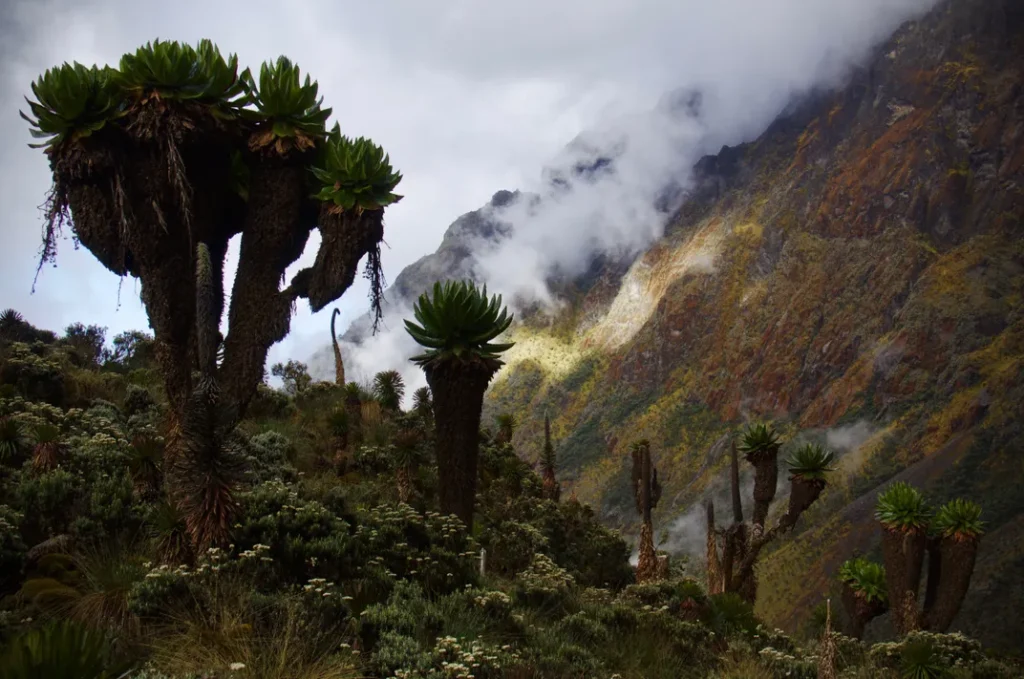
The second day is where the mountain changes its mind about what kind of trek this is. You drop to the Kurt Shafer Bridge at the meeting of the Mubuku and Bujuku rivers, then climb through bamboo forest and moss-draped rock to John Matte Camp, and for the first time the altitude is something you can feel. On the third day you cross the Lower and Upper Bigo Bogs among giant lobelias, a slow and energy-draining walk that the guides value for the physiological stress that aids acclimatization, and you sleep at Bujuku Camp just under 4,000 metres in a narrow valley beneath Mount Stanley and Mount Speke. On the fourth day the trail climbs through boggy ground and into the alpine zone, and you reach Elena Camp at 4,541 metres, the staging point for the summit. It is cold enough there to drop below freezing overnight, and it is where your guides prepare you for an early start.
This is the day when being two changes the texture of the expedition most. There is no larger group to wait for on the fixed ladders, no compromise on the pace of the first light, and your lead guide’s attention rests on the two of you. Summit day begins in the small hours, often before midnight depending on the weather, and involves glacier crossings, ropes, harnesses and crampons, fixed ladders over crevasses and exposed rock and ice before the final push to the top of Uganda. After the summit you descend to Elena for rest and lunch, then continue over the Scott-Elliot Pass, with views across Bujuku Lake to Mount Speke, to Kitandara Camp beside the twin Kitandara Lakes. The last two days climb to the Freshfield Pass, pass the Bujongolo Rock Shelter used by the Duke of Abruzzi’s 1906 expedition, descend the Kichuchu cliffs, and bring you back to Nyakalengija by late afternoon on day seven. The story of that expedition is told in our article on the first ascents and the Duke of Abruzzi.
Nothing in that schedule changes because you have booked privately. The camps, the altitudes and the acclimatization rhythm are fixed by the geography of the route. What changes is who shares the hut and the trail with you, and how the day feels. If you would like an additional day to acclimatize, the eight-day Kilembe Trail climb is the natural alternative.
Timing, Huts and Solitude: What Two Trekkers Can Expect
The Rwenzori receives roughly a thousand trekkers a year across every route, a fraction of the traffic on Africa’s better-known mountains, and our guides often complete multi-day expeditions without meeting another trekking party at all. The huts on the Central Circuit and the Kilembe Trail are frequently occupied by a single group. Add a private party of two to that natural quiet and you have one of the most peaceful serious mountain experiences in Africa, a subject we explore in our piece on how many people actually hike the Rwenzori. To be accurate, the mountain huts are shared spaces by design, so you will occasionally overlap with other parties at the larger camps, and our guide to mountain huts and camps and our overview of accommodation inside and outside the Rwenzori describe exactly where you sleep on each trail.
The two preferred trekking windows are December to February and June to August, when rainfall is lowest and summit weather most reliable, and these are also the busiest months, a word that on the Rwenzori means meeting a handful of other parties rather than queuing. The wetter months of March to May and October to November bring heavier rain, muddier trails and reduced visibility, but also fewer trekkers and an intensified sense of wilderness that many experienced mountain travellers actively prefer. Our best time to visit the Rwenzori guide and our month-by-month trekking guide will help the two of you choose, and for a private party the flexibility to choose is a genuine advantage.
How to Book a Private Trek for Two: Deposits, Dates and Cancellation
Booking begins with an enquiry, and the enquiry is a conversation rather than a form. You can reach us on WhatsApp, by email at rwenzoritrekkingsafaris@gmail.com, or through our contact page, and the details that help most are your preferred dates, the fact that you are two people wanting a private trek, each of your fitness levels and mountain experience, and what you hope to stand on at the end of it. We then hold a consultation call or WhatsApp conversation to recommend a route and answer your questions, and we follow it with a written itinerary and price for your party.
To confirm the booking we ask for a 30 percent non-refundable deposit, which secures your permit dates, guide allocation and porter team. You then receive a pre-departure pack covering gear, training, health and visa guidance, and the remaining 70 percent is due 30 days before the trek starts, by bank transfer or another agreed method. Bookings made within 30 days of the start date are paid in full at the time of booking. Our guide to how to book a Rwenzori trek and what is included sets out the whole process step by step.
We recommend booking three to six months ahead for most routes and six to twelve months ahead for the 13-day and 18-day expeditions, because permit availability and porter allocation tighten in the peak seasons. We can sometimes accommodate shorter-notice bookings, and if you are inside three months we will tell you honestly what is available, but we cannot guarantee dates until a deposit is paid and permits are confirmed.
Cancellation terms are worth understanding before you pay anything. Cancelling more than 60 days before the start date forfeits only the deposit. Cancelling between 30 and 60 days forfeits half of the total price, and cancelling inside 30 days forfeits the full price, because by then the guide team, porter allocation and permits are committed and cannot be recovered. For a party of two, where a single illness or work emergency can affect the whole trip, this is why we so strongly encourage you to buy trip-cancellation cover. Date changes requested more than 60 days ahead are typically possible without penalty, while changes inside 30 days are treated as cancellations of the original dates.
Insurance is a condition of booking, not a suggestion. You need cover for high-altitude trekking to at least 5,200 metres, including emergency evacuation and repatriation, and we will not start a trek without it, as our Rwenzori travel insurance guide explains. Most nationalities also need a Uganda visa, and our visa guide for Rwenzori trekkers covers the steps. Before you fly, our guides to how to get to the Rwenzori Mountains and to Kasese, the gateway town explain the routes from Entebbe, and our guide to accommodation before and after your trek will help you plan the nights either side of the mountain.
Preparing as a Pair: Fitness, Gear and Altitude
A party of two has no group energy to borrow from. On a shared departure, someone else’s momentum can carry you through a flat afternoon, but on a private trek the pace is set by the two of you, which is another way of saying that preparation matters. The mountain tests cardiovascular endurance on sustained steep ascents, leg strength and ankle stability on wet roots and rock, and the mental resilience to keep going in cold, damp conditions. Our 16-week training plan for the Rwenzori, our guide to staying fit for the Rwenzori and our honest assessment of how fit you need to be give you a structure, and our guide to how hard the Rwenzori trek really is tells you what you are training for.
Be honest with us, and with each other, about your fitness and experience. The Rwenzori is not recommended for complete beginners with no mountain experience, but it is achievable for well-prepared first-time mountain trekkers who train properly and choose an itinerary long enough to acclimatize, and our guides to whether beginners can climb the Rwenzori and whether older hikers can trek the Rwenzori speak directly to pairs at different stages of their lives. A private trek is particularly forgiving when the two of you differ in fitness, because the day can flex around it, although the sequence of camps and the acclimatization schedule cannot, so the stronger of you should plan to walk with the pace of the other.
Gear is the other half of the preparation, and the Rwenzori’s wet, cold terrain demands choices that differ from those on drier mountains. Rubber boots are the standard for the bogs, and our Rwenzori boot guide explains why, although you should confirm at booking whether boots are supplied on your itinerary. Our full packing list, our guide to whether you need special gear, our advice on renting gear and our guide to staying warm on the summit cover the rest. Finally, learn the early signs of altitude sickness on the Rwenzori, because on a two-person team you will each be the first person to notice when the other is struggling.
Turning a Private Trek Into a Longer Uganda Journey
Many pairs who book a private Rwenzori trek treat it as the centrepiece of a longer Uganda journey, and the region makes that easy. Bwindi Impenetrable Forest is about four hours by road from Kasese, and our 12-day Rwenzori and gorilla trekking safari, from USD 5,800, is built for exactly this pairing, with the full Rwenzori and gorilla combination laid out for those who want to see the possibilities. Gorilla permits are limited, so book three to six months ahead, and our complete guide to gorilla trekking explains the sectors and costs. Beyond the gorillas, chimpanzee trekking in Kibale Forest and the tree-climbing lions and boat safaris of Queen Elizabeth National Park sit within easy reach, and the 18-day grand safari and Rwenzori trek and the 19-day Uganda adventure bring them together in single itineraries. Our full portfolio of Uganda safaris shows every option, and combined itineraries are priced as complete packages with one transparent total.
There is one more reason to book with us that has nothing to do with the mountain itself. A share of every booking, 10 percent, supports Bakonjo communities, including orphans, schools and homes, and you can see exactly where your 10 percent goes. It is a good feeling to know that a private trek for two supports the same families whose sons and daughters carry your bags and guide your feet
Frequently Asked Questions About Private Rwenzori Treks for Two
Can I book a private Rwenzori trek for just two people?
Yes. Two people can book a fully private Rwenzori trek with Rwenzori Trekking Safaris on any route, and no minimum group size applies. Your party receives its own dedicated guide and porter team, your own dates and your own pace, and our published prices are quoted per person for parties of one or two trekkers. The only fixed rule is that you cannot trek without a licensed guide, because unguided trekking is prohibited inside Rwenzori Mountains National Park. Simply tell us that you are two people wanting a private trek when you enquire, and we will build the itinerary and price around you.
Is there a minimum group size for a Rwenzori trek?
No. There is no minimum group size for a Rwenzori trek with us. Parties range from one to twelve people, and we accept solo trekkers, couples and small groups. Private, exclusive treks are available on request, so you never need to wait for other trekkers to join a departure. Group departures reduce the per-person price because fixed costs are shared, but they are an option, not a requirement, and you can also ask to join a scheduled departure if you want company and a lower price.
How much does a private Rwenzori trek for two people cost?
Our 2026 published rates are per person for parties of one or two trekkers. The seven-day Central Circuit climb to Margherita Peak starts from USD 1,400 per person, which is about USD 2,800 for two, and the eight-day Kilembe Trail climb starts from USD 1,750 per person. Shorter treks start from USD 280 per person for the two-day Lake Mahoma hike, and the 18-day all-peaks traverse starts from USD 4,050. Flights, visas, insurance, pre- and post-trek accommodation, personal gear and tips are not included, and we always confirm the exact price in a written quote.
Is a private trek cheaper if there are two of us instead of one?
The published per-person price is the same for a solo trekker and for each person in a party of two, because both are quoted at the one-to-two-person rate, which is also the highest per-person tier since fixed costs are shared among the fewest people. A pair therefore pays the published rate twice but shares one guide team between them. Moving to a group of six can lower the per-person cost by roughly USD 200 to 400, so if price matters most, ask us about joining a group departure.
Will the two of us really be the only trekkers with our guide?
Yes. On a private trek, your guide and porter team belong to the two of you alone and are not shared with other trekkers. You may still overlap with other parties in the mountain huts at the larger camps, because the huts are shared spaces, but the Rwenzori sees only about a thousand trekkers a year, so huts are frequently occupied by a single group. Your daily pace, rest stops and summit decisions are made between you and your lead guide.
Can two people trek the Rwenzori without a guide?
No. The Uganda Wildlife Authority requires every trekker in Rwenzori Mountains National Park to be accompanied by a licensed guide at all times, and unguided or solo trekking is not permitted under any circumstances. A private trek for two means a dedicated guide and porter team, not trekking without a guide. This rule protects you, given the navigational complexity and changing weather of the terrain, and supports the Bakonzo mountain communities.
Is a private Rwenzori trek for two people safe?
Yes, when it is guided by certified professionals with the right equipment, and a private trek can be safer in one respect because your lead guide’s attention is divided between only two people. Guides monitor altitude symptoms daily and enforce descent if symptoms worsen, teams carry a first aid kit and oxygen, and summit decisions always rest on weather and how you are moving. Travel insurance covering high-altitude trekking to at least 5,200 metres is mandatory. Our safety guide explains the hazards and protocols in full.
How far in advance should we book a private Rwenzori trek?
We recommend booking three to six months in advance for most routes and six to twelve months for the 13-day and 18-day multi-peak expeditions. The peak seasons of December to February and June to August fill fastest, and permit availability can tighten. Shorter-notice bookings are sometimes possible, but dates are only guaranteed once a 30 percent deposit is paid and permits are confirmed. The balance is due 30 days before the trek.
What happens if one of us cannot continue?
Your lead guide monitors both of you daily and decides whether to continue, rest or descend, based on how each of you is coping with the altitude and conditions. If one trekker needs to descend, the guide team manages the descent, and our teams carry a first aid kit and oxygen for emergencies. Because a private trek is planned around two specific people, we recommend asking us at the quotation stage how the team would handle an early descent on your route, and making sure that your travel insurance covers evacuation and trip curtailment.
Can a couple book a private Rwenzori trek for a honeymoon or an anniversary?
Yes. A private trek is one of the most popular formats for couples, because it gives the two of you a quiet, self-contained team, the freedom to set your own pace and dates, and the option of a shorter trek that does not include the summit. Tell us what the occasion is when you enquire, and we will recommend a route and add a gorilla trek or a safari if you would like a longer celebration.
Can we combine a private Rwenzori trek with gorilla trekking?
Yes. Bwindi Impenetrable Forest is about four hours by road from Kasese, and our 12-day Rwenzori and gorilla trekking safari, from USD 5,800, combines the two in one journey. Gorilla permits are limited, so book three to six months ahead. Longer itineraries add chimpanzee trekking in Kibale Forest, Queen Elizabeth National Park and even a Nile rafting adventure.
What is the best private route for two first-time Rwenzori trekkers?
For pairs wanting the summit, the seven-day Central Circuit climb to Margherita Peak is our most popular itinerary, and the eight-day Kilembe Trail climb adds an extra day for acclimatization. Pairs who prefer to skip the glacier are well served by the three-day Mahoma Loop or the four-day Mutinda Lookout trek. Complete beginners with no mountain experience are not advised to attempt summit routes, but well-prepared first-time mountain trekkers can succeed.
Ready to Plan Your Private Rwenzori Trek for Two?
You now know that two is a perfectly good number for the Mountains of the Moon. You know that private means your own guide and porter team rather than trekking alone, that our published prices are built around parties of one or two, that a 30 percent deposit secures your dates, and that the right route depends on how much altitude, glacier and solitude the two of you want. The rest is a conversation, and it begins with a message.
Tell us your dates, your fitness and your ambitions, and we will tell you exactly which route, which season and which price suit the two of you, with no pressure and no generic brochure. Message a mountain guide on WhatsApp, send us a custom quote request, or write to rwenzoritrekkingsafaris@gmail.com, and let us start building the Rwenzori trek you will still be talking about years from now. Explore our full range of Rwenzori treks and expeditions or the Rwenzori FAQ library while you decide, and remember that the equatorial glaciers on Mount Stanley are retreating, which is one more reason not to wait.