
Hike the Rwenzori’s Kilembe Trail to Sine Camp (2,596 m) in 2 days. Spot blue monkeys, visit Enock’s Falls & explore pristine forests. Book your Uganda trek.
2-Day Rwenzori Trek to Sine Camp | Kilembe Trail
Overview of the 2-Day Rwenzori Trek to Sine Camp | Kilembe Trail, Uganda
The Rwenzori Mountains National Park in Uganda is a beautiful place to visit for a short hike. This 2-day trek to Sine Camp on the Kilembe Trail is open to anyone who likes nature, birds, or being in the wild for the weekend.
In Kasese, specifically in Kilembe, you can start your climb through the Afro-montane forest, which is full of tall trees covered in vines and moss. You’ll be able to hear birds singing and rivers running. At 2,596 meters, Sine Camp is the best place to stay for the evening. This section is the bamboo zone. There is a lovely hut camp with streams and lots of flora.
You can easily hike 9.5 kilometers both ways, and the views of the three-horned chameleons, blue monkeys, and strange birds are well worth it. From the forest up to Sine Camp, you’ll be led by our expert guides, whether this is your first mountain trek or you’re getting ready for a longer Rwenzori trip.
The Rwenzori Mountains have a way of making you stop and stay still. That moment somewhere in the first kilometer of the Afro-Montane forest when you look up through a cathedral of moss-wrapped trees and realize you have entered somewhere genuinely wild, genuinely ancient, genuinely unlike anywhere else on Earth. The 2-Day Rwenzori Trek to Sine Camp is your fastest route to that feeling.
In just 48 hours on the Kilembe Trail, you ascend 1,146 m through one of Uganda’s most intact equatorial mountain forests to Sine Camp at 2,596 m, a narrow ridge perched above a valley of thundering rapids, where the smell of damp moss and woodsmoke replaces every distraction from the world below. You will hear the Rwenzori turaco before you see it, find blue monkeys watching you from the canopy overhead, and stand 200 metres from Enock’s Falls at golden hour with a view that no photograph quite captures.
This is not a weekend walk in the lowlands. The terrain is steep, the forest is relentless, and the Rwenzori weather plays by its own rules. But the challenge is precisely what the 2-Day Sine Camp trek delivers: a real, raw, condensed Rwenzori trekking experience on a trail that works within a two-day window, without the commitment of a week-long summit expedition. This page is everything you need to prepare, plan, and book with confidence.
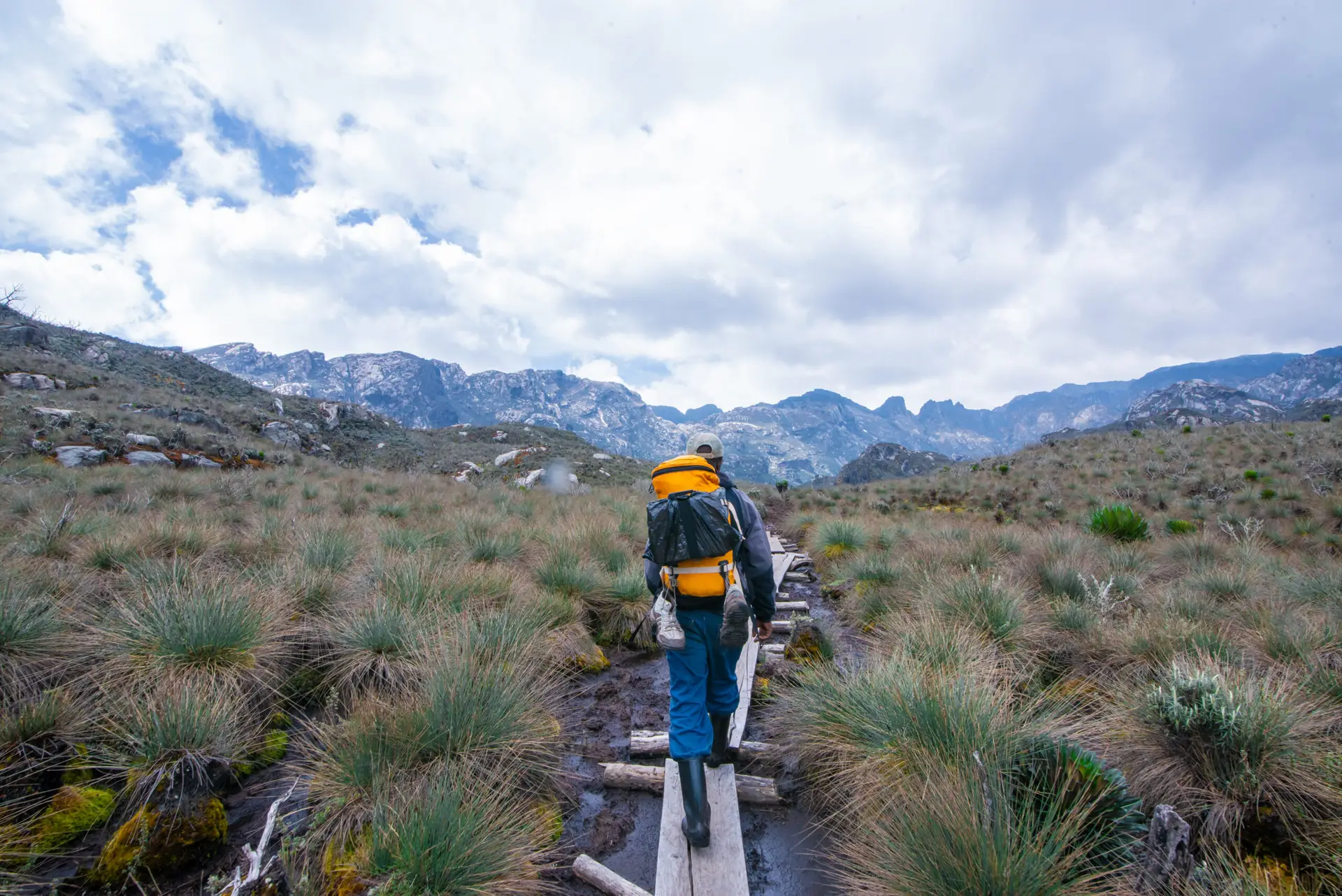
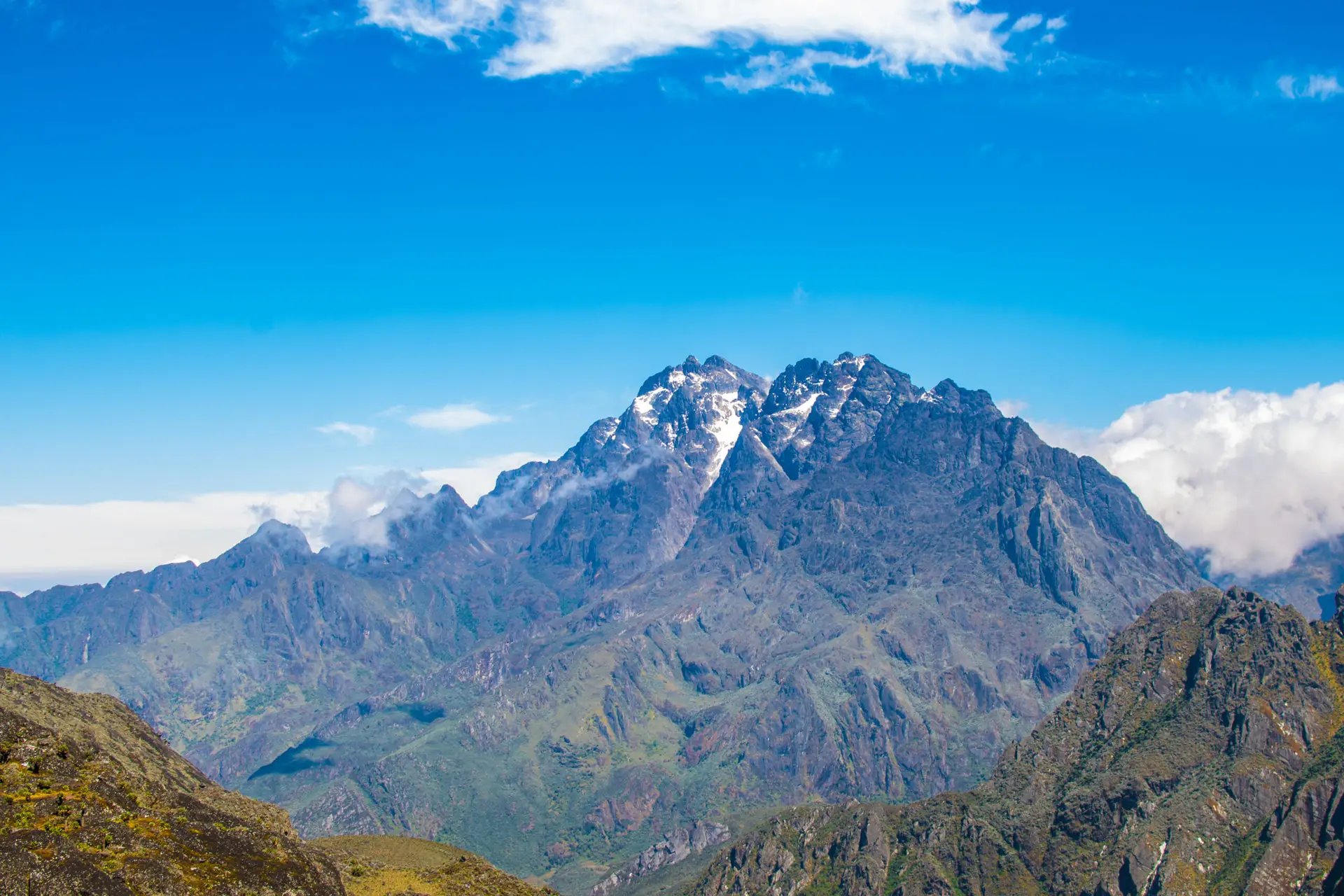
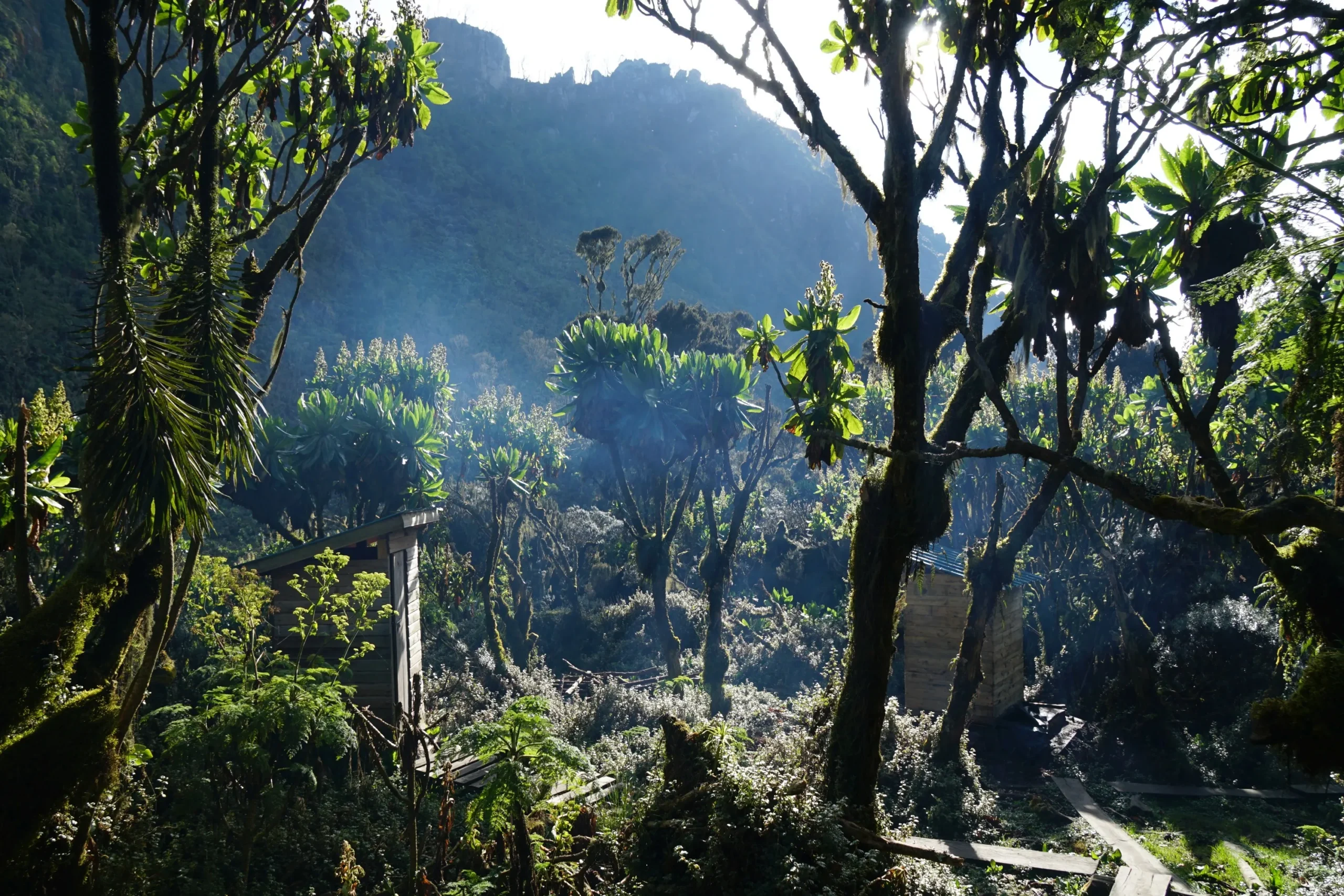
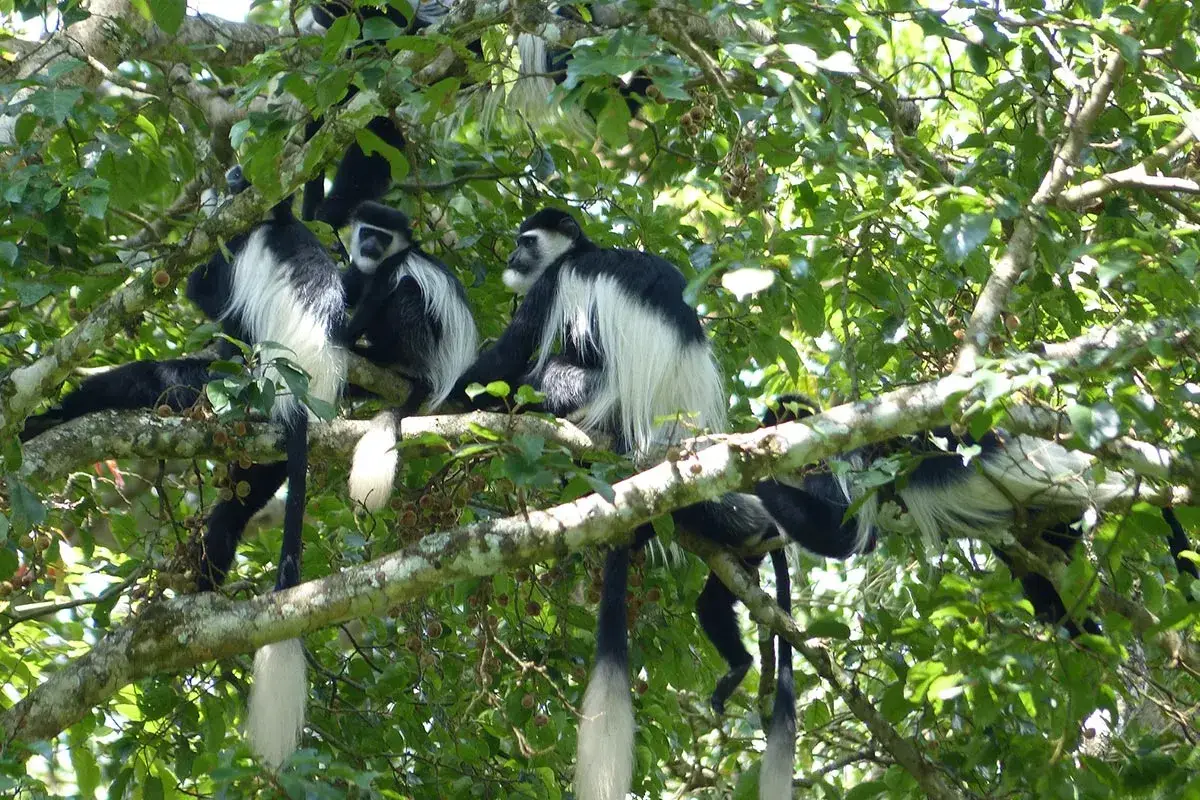
Trek at a Glance: 2-Day Rwenzori SineCamp Hike.
| Duration | 2 Days / 1 Night |
| Total Distance | ~19 km (9.5 km ascent Day 1 + 9.5 km descent Day 2) |
| Maximum Elevation | 2,596 m (Sine Camp) |
| Elevation Gain/Loss | 1,146 m ascent on Day 1 / 1,146 m descent on Day 2 |
| Start / End Point | Trekkers Hostel, Kyanjuki village (1,450 m), ~12 km from Kasese |
| Trek Route / Trail | Kilembe Trail Nyamwamba Valley |
| Difficulty | Moderate steep Day 1 ascent; suitable for fit beginners |
| Best Season | December–February & June–August (dry seasons) |
| Group Size | 1–12 trekkers (private departures available) |
| Accommodation | 1 night in wooden mountain huts at Sine Camp (2,596 m) |
| Highlights | Enock’s Falls · Afro-Montane forest · Blue monkeys · Rwenzori turaco |
| Price Indicator | From ~USD $250 per person (contact for exact quote) |
Why This Trek? What Makes the 2-Day Sine Camp Hike Unique
Of all the short trekking options in Rwenzori Mountains National Park, the 2-day Sine Camp trek offers the most compelling argument for what a 48-hour commitment to Africa’s Mountains of the Moon can deliver. This is not a sampler; it is a concentrated, genuine Rwenzori experience, every step of it earned and every view of it merited.
The Kilembe Trail begins near the historic Kilembe Copper Mines south of Kasese and immediately enters the Nyamwamba Valley, one of the most dramatically sculpted glacial valleys in equatorial Africa. Unlike the Central Circuit Trail, which approaches from the north, the Kilembe Trail offers a southern aspect that keeps the route quieter and the atmosphere more intimate.
If you have never trekked in equatorial Africa, this trek will reshape your understanding of mountain forests. And if you are using this route to gauge your readiness for the 7-Day Margherita Peak climb or the 8-Day Kilembe Trail expedition, there is no better test. Sine Camp at 2,596 m will tell you everything you need to know about your body’s relationship with these mountains.
The 2-day Sine Camp trek is also a strong choice for anyone combining Rwenzori trekking with Uganda’s wider attractions: gorilla trekking in Bwindi, wildlife safaris in Queen Elizabeth National Park, or chimpanzee trekking in Kibale Forest. Two days in the Rwenzori forest fit cleanly into any Uganda itinerary.
Full Day-by-Day Itinerary: 2-Day Rwenzori Trek to Sine Camp
Day 1: Kyanjuki Trailhead (1,450 m) to Sine Camp (2,596 m)
Distance: 9.5 km | Elevation Gain: 1,146 m | Hiking Time: 7–8 hours | Terrain: Forested valley, steep ridge climb
Your 2-day Rwenzori trek to Sine Camp begins at the Trekkers Hostel in Kyanjuki village, approximately 12 km from Kasese along the road past the Kilembe Copper Mines. Arrive the evening before your departure. Rwenzori Trekking Safaris can arrange pre-trek accommodation in Kasese; see our Pre & Post-Trek Hotel Guide.
The morning starts with guide introductions and a pre-trek briefing, a rundown of the day’s route, safety protocols, and an overview of the Kilembe Trail. Departure is typically by 8:30 AM (latest 10:00 AM). The early start matters: Day 1 is a full day in the forest.
The first 2.2 km is a gentle warm-up walk to the Uganda Wildlife Authority (UWA) ranger post at 1,727 m, where park entry formalities are completed. Carry your passport and booking confirmation. From here, the trail enters the Afro-Montane Forest Zone in earnest.
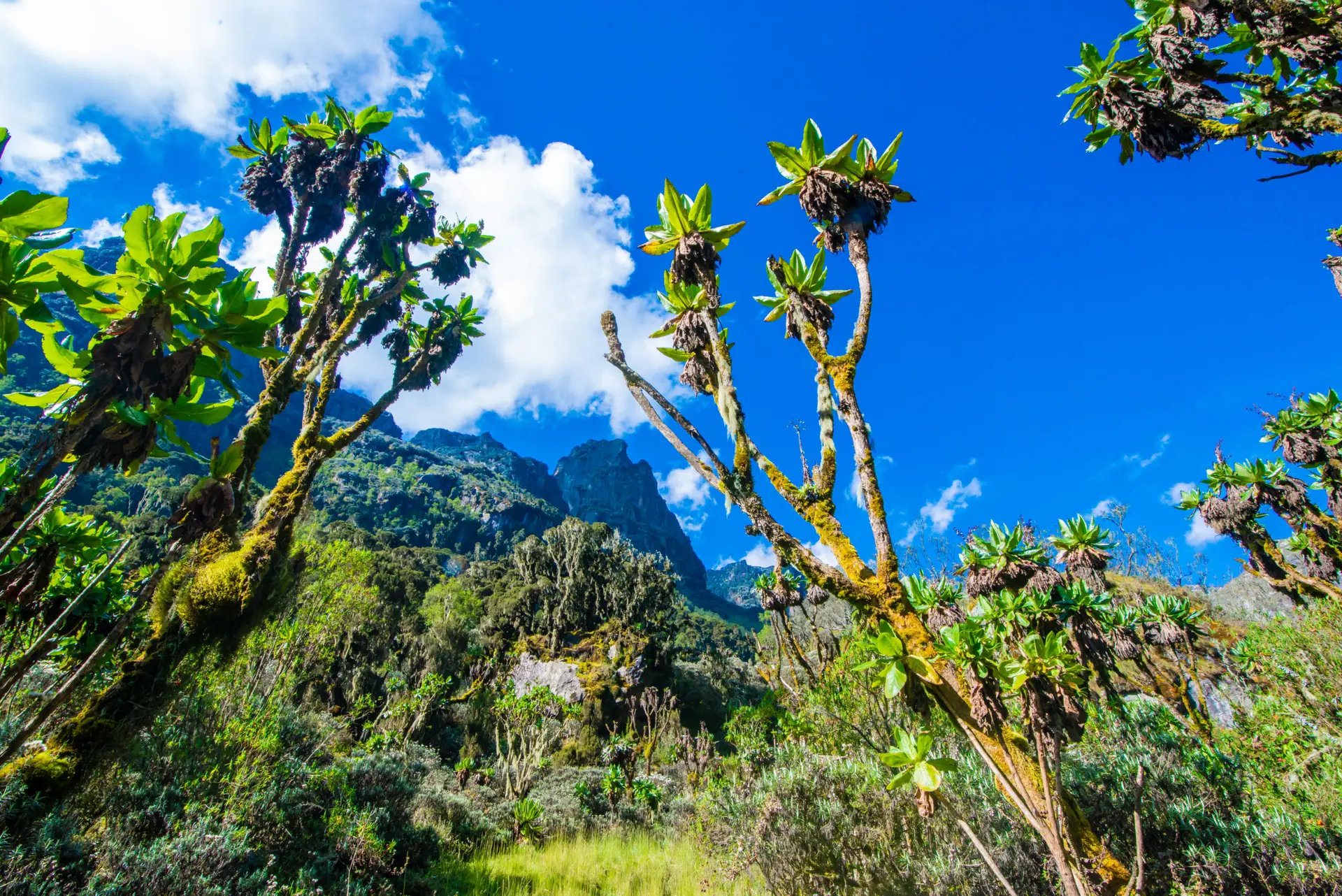
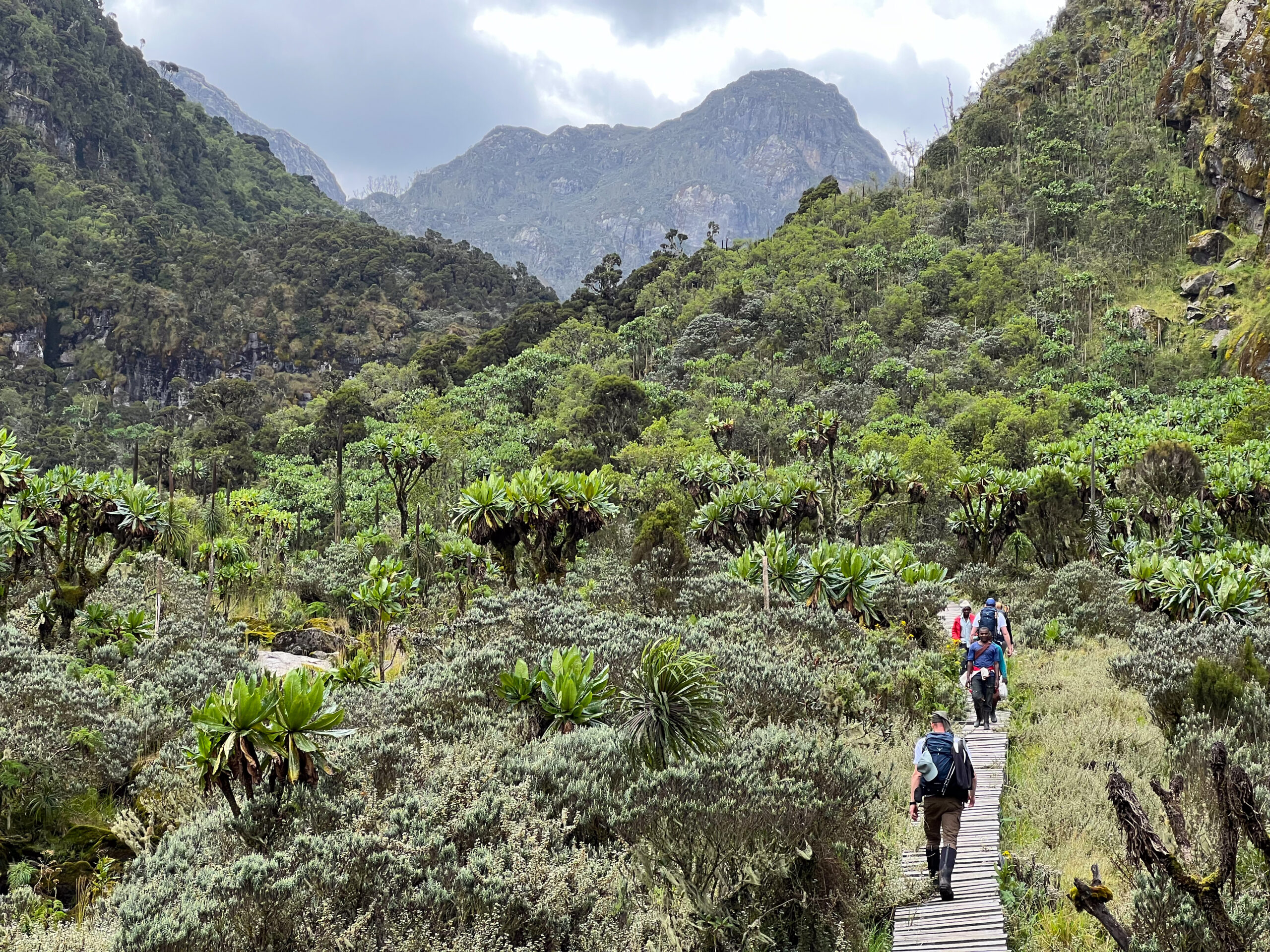
For the next six kilometers, you move through some of Uganda’s most intact equatorial mountain forest. Towering Podocarpus and Symphonia trees rise 20–30 m overhead, their canopies filtering the light into shifting green patterns on the mossy forest floor. Every surface is carpeted in lichen and liverwort. The forest smells profoundly of damp earth and wet moss. It is dense, alive, and deeply atmospheric.
Birdsong fills the canopy throughout. Your guide will identify calls as you move; listen for the explosive nasal call of the African green broadbill in the mid-canopy and the clucking of the handsome francolin in the undergrowth. In this section, observers regularly spot blue monkeys (Cercopithecus mitis), their dark faces and silver-grey backs flashing through the canopy above. Move slowly and keep your eyes up.
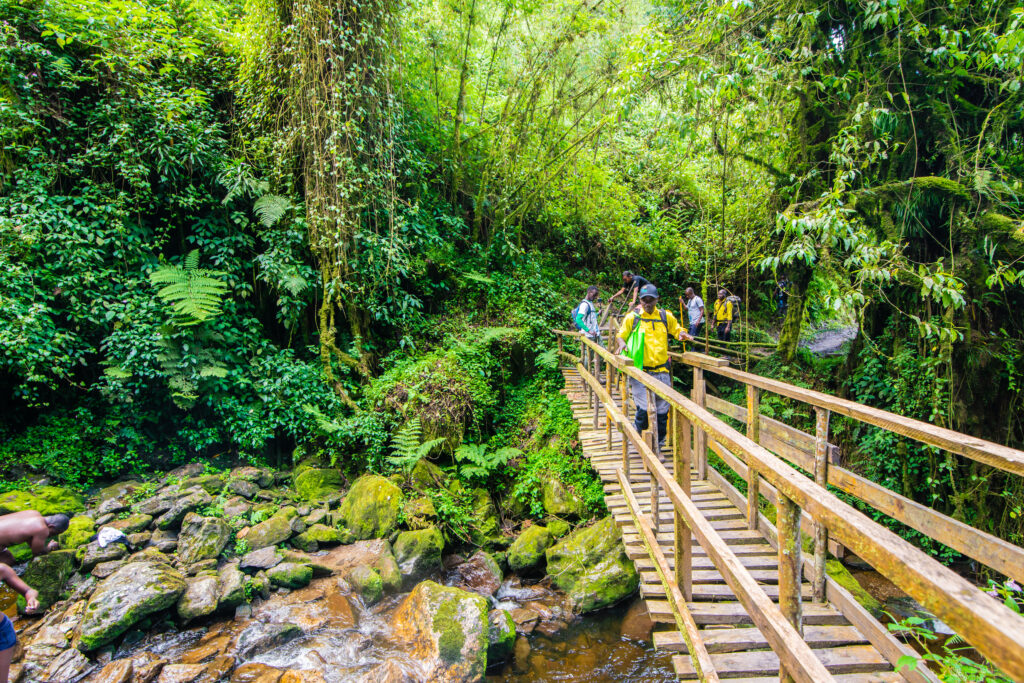
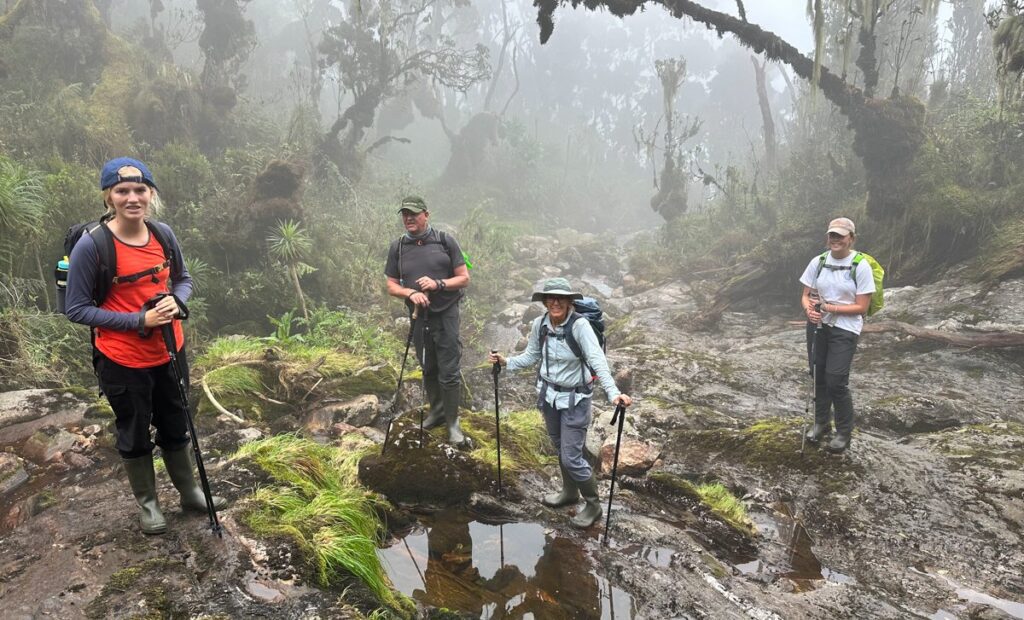
After crossing a river bridge, the trail steepens sharply for the final 2–3 km. This is the most physically demanding section of the entire 2-day trek: a sustained, rooted climb through increasingly dense moss forest, where the trail narrows and the valley drops away dramatically to your left. Trekking poles are invaluable here. Breathe steadily, shorten your stride, and follow your guide’s pace.
The sound of rushing water announces Sine Camp before the huts come into view. Perched on a narrow forested ridge at 2,596 m, the camp overlooks a long section of rapids and waterfalls plunging through the Nyamwamba Valley gorge. After 7–8 hours on the trail, the smell of the guide team’s cooking is one of the finest things you have ever encountered.
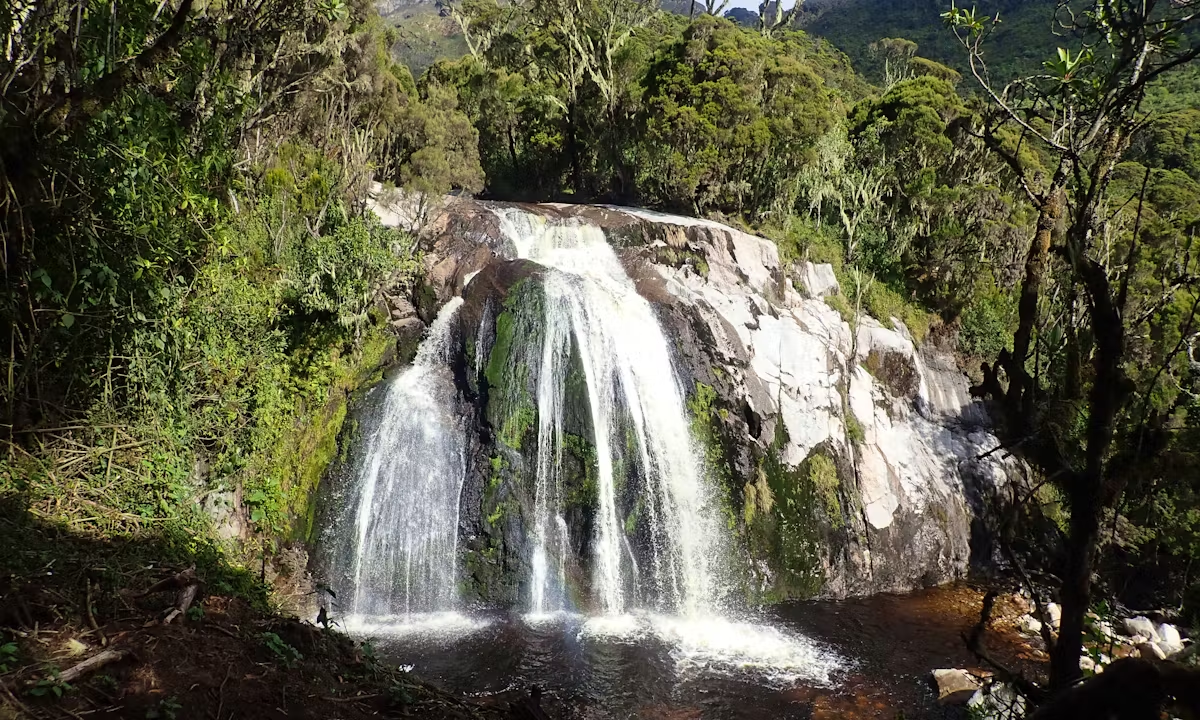
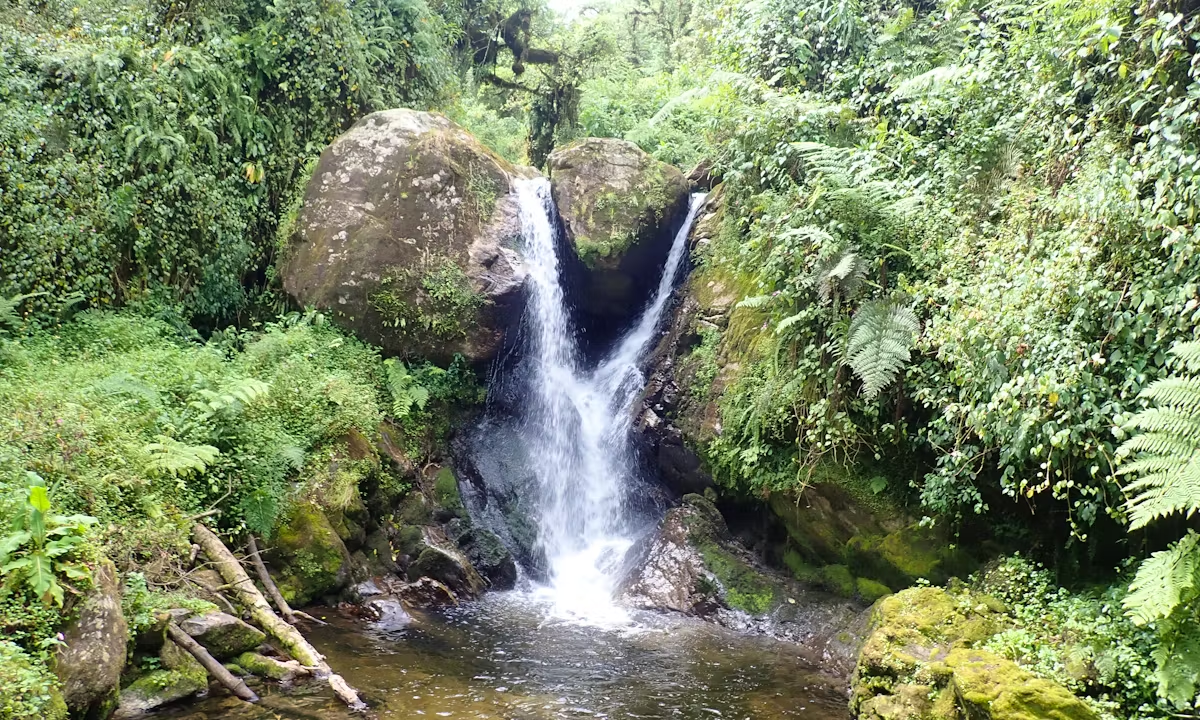
Before dinner, take the 200-meter side trail from camp to Enock’s Falls, a dramatic waterfall framed by hanging vines and vivid green lichen, cascading in multiple tiers through the valley forest. In the late afternoon light, with mist rising from the valley below, it is one of the most extraordinary scenes on the lower Kilembe Trail. Bring your camera and take your time.
The stillness and the constant ambient sound of falling water define the evening at Sine Camp. Temperatures drop to 8–12°C after sunset. A hot dinner, a cup of tea, and an early night prepare you for the Day 2 descent.
Key highlights: Afro-Montane forest immersion · Blue monkey sightings · UWA ranger post at 1,727 m · Steep ridge approach to camp · Enoch’s Falls at golden hour · Valley waterfall views from Sine Camp veranda
Day 2: Sine Camp (2,596 m) to Kyanjuki Trailhead (1,450 m)
Distance: 9.5 km | Elevation Loss: 1,146 m | Hiking Time: 5–6 hours | Terrain: Forest descent, river crossing
Wake up before the cloud rolls in. At Sine Camp, mornings are often clear for an hour or two. Sit on the camp veranda with your tea and listen: the forest comes alive at dawn, and this period is the best bird-observation window of the entire trek.
After breakfast, if you did not visit Enock’s Falls the previous evening, this morning is your opportunity. Morning light through the lichen-covered vines creates a softer, more diffuse atmosphere than the afternoon, with rising mist from the valley adding depth to the scene. Allow 30–45 minutes for the waterfall visit before beginning the descent.

The descent retraces the Day 1 route back down to Kyanjuki, but it is a genuinely different experience in the opposite direction. The steep ridge section that demanded so much on the ascent becomes a careful, methodical descent where trekking poles and a slow pace protect your knees and prevent slips on wet roots. Resist the urge to rush.
Back in the main forest body, the descent unlocks a new layer of observation. When you are not watching your footing as intently, the surrounding forest becomes more legible. People regularly spot three-horned Rwenzori chameleons (Trioceros johnstoni), which are endemic to this range, on low branches in the understory. The Rwenzori turaco is often more vocal on the descent, particularly in the lower forest where the canopy opens slightly.
Near the mid-forest section, your guide may offer a choice: a direct descent via the main trail or a short diversion following the Nyamwamba River through a particularly atmospheric stretch of old-growth forest, which is denser, quieter, and with a riverine character distinct from the ridge trail. If time allows, take the river route.
The trek concludes at the UWA ranger post and Kyanjuki trailhead, typically by early to mid-afternoon. Guide farewells and tip distribution happen here. Your transfer back to Kasese takes 20–30 minutes, leaving the afternoon free for rest or onward travel.
Key highlights: Dawn birding from Sine Camp veranda · Enock’s Falls morning visit · Rwenzori turaco and chameleon sightings on descent · Nyamwamba River forest diversion · Trek completion at Kyanjuki
Elevation Profile: 2-Day Sine Camp Trek
Day 1, Ascent: Kyanjuki (1,450 m) → UWA Ranger Post (1,727 m) → Sine Camp (2,596 m). A 9.5 km route with 1,146 m total elevation gain. The first 2.2 km to the ranger post is gradual. The following 6 km through the forest core is a consistently moderate ascent. The final 2–3 km steepens sharply. This is the hardest day of the trek.
Day 2, Descent: Sine Camp (2,596 m) → UWA Ranger Post (1,727 m) → Kyanjuki (1,450 m). The same 9.5 km trail in reverse, with 1,146 m total elevation loss over 5–6 hours. Descent time is shorter than ascent but requires careful footwork on the steep upper section and wet root areas.
Total distance: ~19 km | Total elevation gain: 1,146 m | Total elevation loss: 1,146 m | Maximum elevation: 2,596 m (Sine Camp)
Camps & Accommodation: Sine Camp (2,596 m)
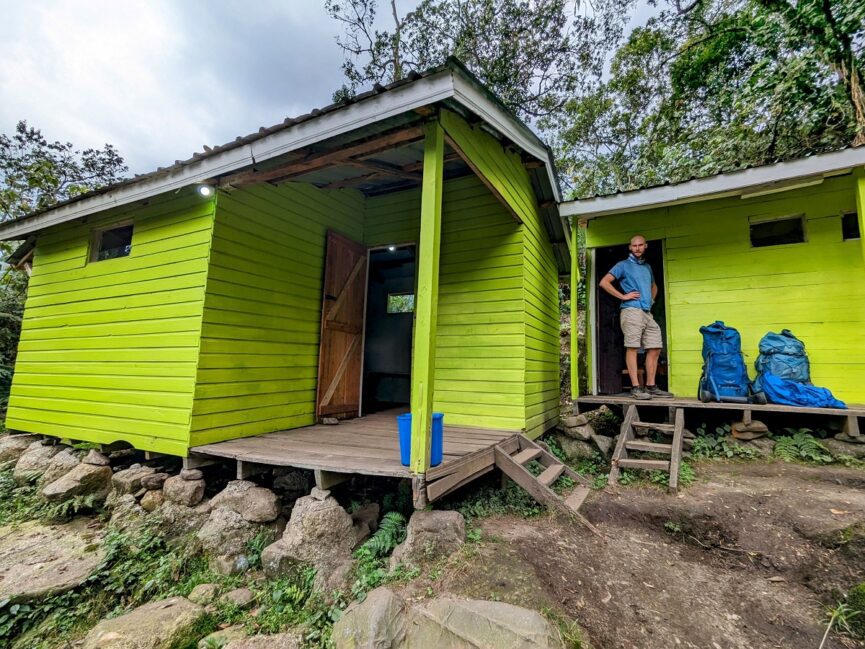
Sine Camp is the only overnight stop on this two-day itinerary. The camp is located on a narrow forested ridge at 2,596 m above the Nyamwamba Valley, where the Afro-montane forest meets the lower bamboo zone, giving it a unique ecological character that no other camp on the Kilembe Trail has.
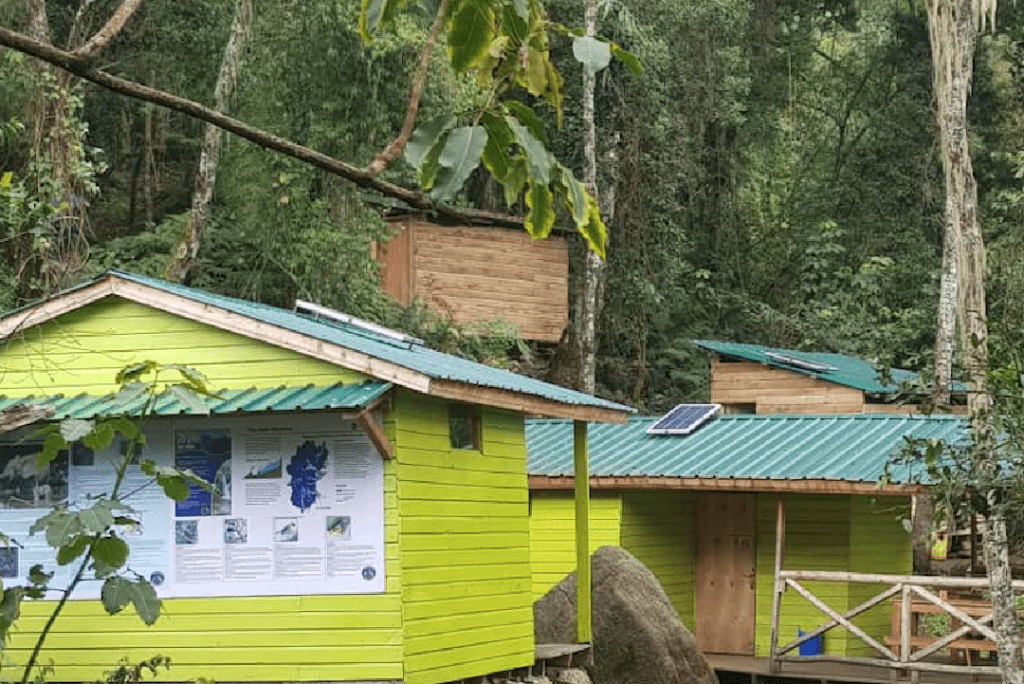
The Uganda Wildlife Authority constructed the wooden mountain huts at Sine Camp. Each hut offers bunk-style sleeping with basic mattresses and blankets provided. Your guide team prepares meals in the camp kitchen area. The camp’s defining feature is its acoustic environment: the constant sound of rapids and waterfalls crashing through the valley gorge below. Temperatures at Sine Camp: 8–12°C at night and 15–18°C during the day.
Enock’s Falls, approximately 200 metres from camp, is accessible via a short forest path and is the camp’s most celebrated feature, best photographed in the late afternoon or early morning light. For a complete guide to Rwenzori accommodation at all camps and altitudes, see our Mountain Huts & Campsites Guide.
Flora & Wildlife on the 2-Day Sine Camp Trek

This trek passes through the richest wildlife zone on the Kilembe Trail, the Afro-montane forest. For full species listings, see our Wildlife & Biodiversity Guide and Vegetation Zones of the Rwenzori.
Afro-Montane Forest Zone (1,450 m — 2,596 m)
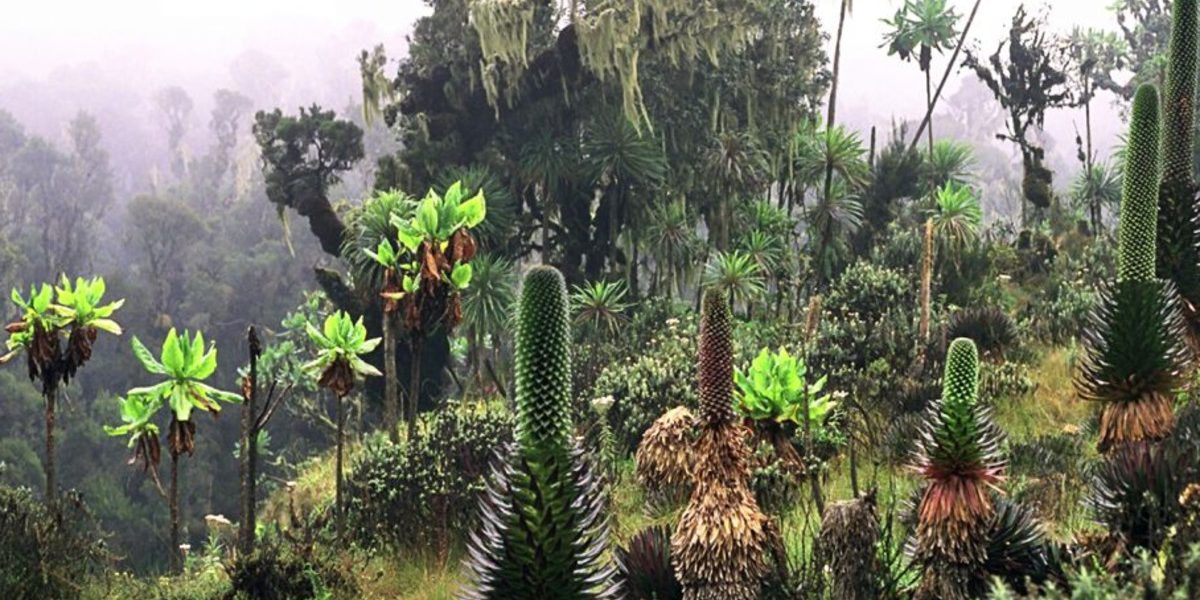
Tree species: Podocarpus latifolius, Symphonia globulifera, Ficalhoa laurifolia, Macaranga kilimandscharica, Hagenia abyssinica. Every surface above the forest floor is carpeted in moss, liverwort, and lichen.
Mammals: Blue monkeys (Cercopithecus mitis) are the most commonly sighted mammal. African civet and red duiker inhabit the forest floor. Black-and-white colobus monkeys are occasionally recorded on the lower trail.
Reptiles: Three-horned Rwenzori chameleons (Trioceros johnstoni) endemic to this range are regularly spotted on low branches in the understory, particularly on the slower-paced Day 2 descent.
Birds: Albertine Rift endemics dominate. Key species: Rwenzori turaco (Ruwenzorornis johnstoni), African green broadbill, handsome francolin, Rwenzori nightjar (crepuscular, around camp at dusk), African hill babbler, yellow-eyed black flycatcher, Rwenzori apalis, and Rwenzori double-collared sunbird.
Lower Bamboo Zone (above 2,500 m, near Sine Camp)
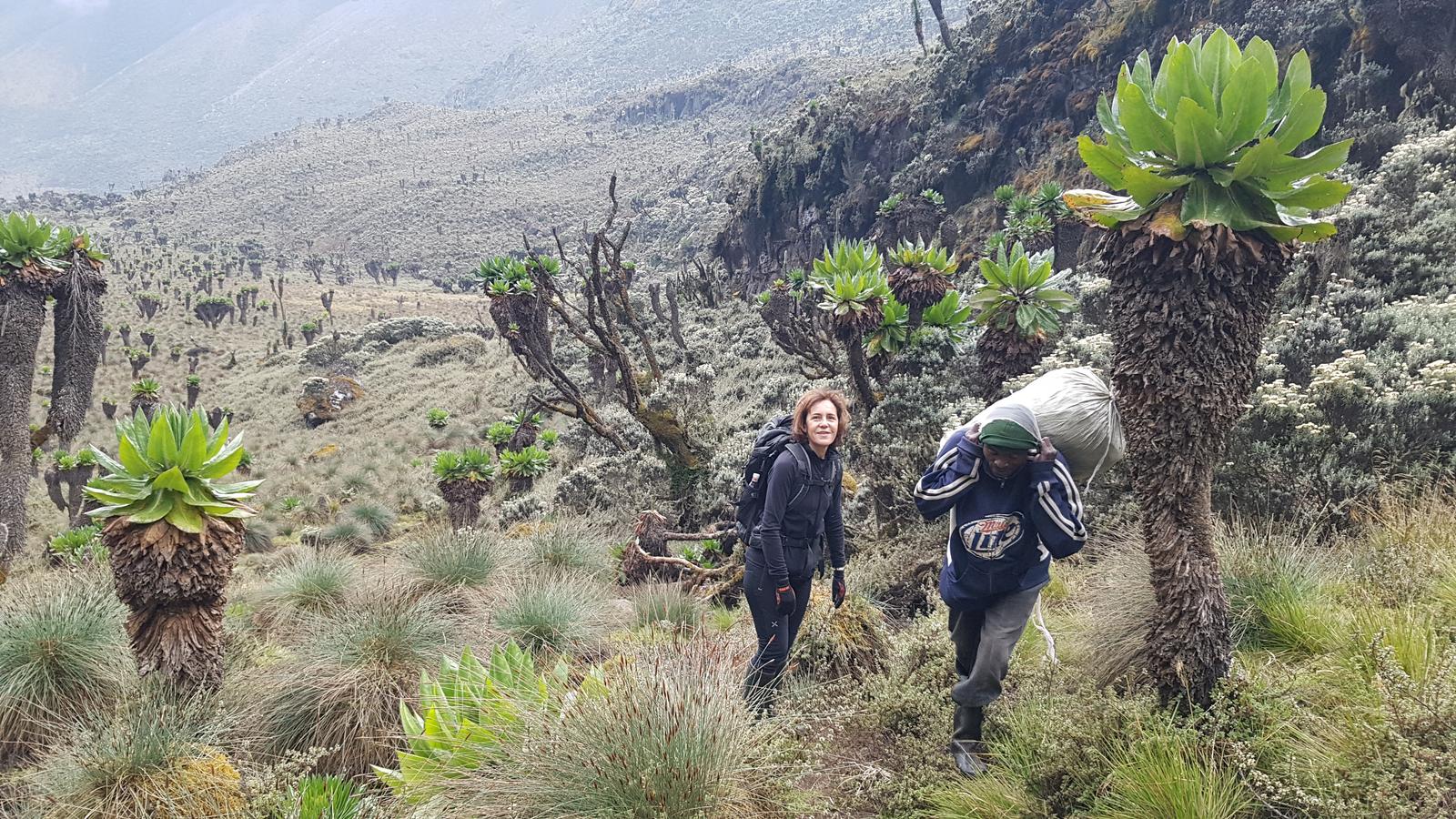
Giant mountain bamboo (Arundinaria alpina) begins to appear in patches above Sine Camp. On the 2-day itinerary, you briefly touch on this area. The 3-Day Sine & Samalira Camp trek pushes fully into the bamboo zone on Day 2 for those wanting deeper bamboo exploration.
Physical Difficulty & Fitness Requirements
The 2-Day Rwenzori Trek to Sine Camp is rated moderate. No technical climbing, glacier travel, or high altitude involved. What it does require is sustained cardiovascular fitness for a steep, rooted, often-muddy 7–8 hour day 1. For a complete first-timer’s guide, see Can Beginners Climb the Rwenzori?
Who This Trek Suits
- Nature and wildlife enthusiasts seeking a genuine Rwenzori experience within a 48-hour window
- Birdwatchers seeking Albertine Rift endemic species: the lower Kilembe Trail forest is outstanding for this
- First-timers gauging readiness for the 7-Day Margherita Peak climb or 8-Day Kilembe Trail expedition
- Travellers combining the Rwenzori with gorilla trekking, wildlife safaris, or a wider Uganda itinerary see our Rwenzori & Gorilla combo packages
- Older trekkers in good aerobic health should see our Honest Guide for Hikers Over 50 & 60
Altitude & Health
At a maximum of 2,596 m, this trek is well below the altitude range where serious AMS typically becomes significant. Staying hydrated and ascending at your guide’s pace are the main precautions. See our Altitude Acclimatisation Guide and Medical Guide to Rwenzori Trekking
Training Recommendation
For 4–6 weeks before departure: 3× weekly cardiovascular sessions (45–60 min each), 1× weekly long hike of 10–15 km with 500–800 m elevation change, plus knee-strengthening exercises for the day 2 descent. See our full Fitness & Training Guide.
Best Time to Do the 2-Day Rwenzori Trek to Sine Camp.
The Kilembe Trail is accessible year-round. For a full month-by-month breakdown, see our Best Time to Visit the Rwenzori guide.

Best: June–August (Long Dry Season)
Peak trekking window. Firmest trail conditions, lower rivers, and less frequent rainfall. Coincides with European and North American summer holidays; book ahead.
Also Excellent: December–February (Short Dry Season)
Often the driest period on the Kilembe Trail. Fewer trekkers than June–August. Excellent for photography and wildlife observation.
Wet Seasons (March–May & September–November)
Hikeable with full waterproof preparation. Waterfalls are at their most spectacular. Trails are muddier and require more careful footwork. Rubber gumboots, free at the trailhead, are strongly recommended. See our Footwear & Boot Guide
What’s Included in Your Trek Package
Included
| ✔ Professional UWA-registered mountain guide for both days |
| ✔ Trained porter (1 per 2 trekkers, max 15 kg per porter load) |
| ✔ All meals on the mountain: breakfast, packed lunch, dinner, and hot drinks |
| ✔ Accommodation in wooden mountain hut at Sine Camp (1 night) |
| ✔ Uganda Wildlife Authority (UWA) park entry fees and Kilembe Trail permit |
| ✔ Free use of rubber gumboots at the Kyanjuki trailhead if required |
| ✔ Emergency first-aid kit carried by guide throughout the trek |
| ✔ Pre-trek briefing and route introduction at Kyanjuki |
Not Included
| ✘ Tips and gratuities for guides and porters (strongly encouraged; see Tipping Guide) |
| ✘ Personal travel insurance and medical evacuation cover (required) |
| ✘ Accommodation in Kasese before and after the trek |
| ✘ Transfers to/from the Kyanjuki trailhead from Kasese (can be arranged on request) |
| ✘ Personal trekking gear, clothing, and footwear |
| ✘ Alcoholic beverages and personal snacks beyond standard meals |
| ✘ Any costs resulting from voluntary early descent |
| ✘ International flights, visa fees, and airport transfers |
Community CommitmentA 10% portion of all trek proceeds is directed to supporting the local Bakonzo mountain community by funding orphanages, primary schools, and homes in the Kasese region. When you trek with Rwenzori Trekking Safaris, your adventure directly benefits the people who call these mountains home. |
Full Packing & Gear List: 2-Day Kilembe Trail Sine Camp Trek

The Rwenzori Mountains are among the wettest mountain ranges in Africa. Waterproofing is not optional. For the complete master packing guide, see our Full Rwenzori Packing List and Footwear & Boot Guide.
| Footwear | • Waterproof hiking boots with ankle support (essential)
• Rubber gumboots available free at Kyanjuki trailhead; highly recommended in wet conditions • Thick wool or synthetic hiking socks (2+ pairs) • Lightweight camp sandals for Sine Camp evenings |
| Clothing | • 2× quick-dry trekking trousers (no jeans)
• Waterproof shell trousers (essential) • 2–3× moisture-wicking base layer shirts • 1× mid-layer fleece or insulated jacket • 1× hardshell waterproof jacket with sealed seams • Warm knit beanie & lightweight waterproof gloves |
| Pack & Carry | • Daypack 20–30 litres (porters carry main luggage)
• Dry bags or waterproof pack liner (essential) • Trekking poles highly recommended • Reusable water bottle / hydration bladder (2 litres min.) |
| Health | • Personal first-aid kit: blister plasters, ibuprofen, antihistamine
• Insect repellent (DEET-based) • Sunscreen SPF 30+ • Biodegradable soap and hand sanitiser |
| Sleep | • Sleeping bag rated 5–10°C
• Sleeping liner for hygiene |
| Electronics | • Headlamp with spare batteries
• Camera/phone in waterproof case • Power bank (no electricity at Sine Camp) • Emergency whistle • Passport copy + booking confirmation |
Permits, Park Fees & Costs
Your package fee includes all UWA park entry fees and Kilembe Trail permits for Rwenzori Mountains National Park. You do not need to purchase permits independently.
Cost Components Included
- UWA Park Entry Fee: USD $35 per person per day 2-day entry = $70 total
- Kilembe Trail Permit: Included in park fee structure
- Sine Camp Hut Fee: 1-night hut accommodation included
- Guide Fee: UWA-registered lead guide for all 2 days
- Porter Fee: 1 porter per 2 trekkers for main luggage (15 kg max)
- All Meals: Full board on the mountain (breakfast, packed lunch, dinner, hot drinks)
- Rubber Gumboots: Free use at the Kyanjuki trailhead if required
Additional Budget to Plan For
- Guide & Porter Tips: USD $30–46 per trekker. See our Porter Services & Tipping Guide
- Travel Insurance: See our Rwenzori Travel Insurance Guide
- Kasese Pre-Trek Accommodation: USD $30–80. See our pre- & post-trek accommodation guide.
- Kasese → Kyanjuki Transfer: ~USD $15–25; can be arranged by Rwenzori Trekking Safaris
For the complete 2026 cost breakdown, see our Full Cost Guide: How Much Does It Cost to Climb the Rwenzori?
Getting There: Reaching the Kyanjuki Trailhead
For complete transport logistics from Kampala and Entebbe, see our How to Get to the Rwenzori Mountains guide and Kasese Gateway Town Guide.
From Kasese Town to Kyanjuki (~12 km)
- Private vehicle/taxi: 20–30 minutes; trailhead pickup can be arranged by Rwenzori Trekking Safaris
- Boda-boda: 20–25 minutes; approximately 10,000–15,000 UGX
From Kampala
- Private charter vehicle: 5–5 hours via Fort Portal
- Scheduled coach bus: 6–7 hours from Kisenyi Bus Terminal, Kampala
From Entebbe Airport: allow 7–8 hours by road. Arrive the night before your trek start date.
Book Your Trek
Respond within Minutes
From
$250
per person
- Duration 2 Days / 1 Nights
- Group Size 1–25 people
- Start Point Kilembe Trail
- Departures Year-round
- Summits Sine Camp
No booking fee. Free cancellation up to 30 days before departure. We respond within Minutes.
Ready to Go Further? Extending Beyond Sine Camp
The 2-Day Sine Camp trek is the opening chapter of the Kilembe Trail story. Here is what the trail continues to offer:
Magheritah Peak (8 Days Kilembe Trail)
$1705 Per Person
The full Kilembe Trail experience, ending on Africa’s third highest summit at 5,109 m
The full Kilembe Trail experience, ending on Africa’s third highest summit at 5,109 m
Mutinda LookOut (4 Days)
$645 Per Person
Reach the dramatic Mutinda ridge with panoramic upper-mountain views.
Reach the dramatic Mutinda ridge with panoramic upper-mountain views.
3-Day Sine & Samalira Camp Trek
$580 Per Person
Add one day, push into the bamboo zone, and overnight at Samalira Camp (3,170 m) in the heather zone.
Add one day, push into the bamboo zone, and overnight at Samalira Camp (3,170 m) in the heather zone.
4-Day Rwenzori Waterfalls Hike
$615 Per Person
A scenic Kilembe Trail route focused on the six major waterfalls.
A scenic Kilembe Trail route focused on the six major waterfalls.
Frequently Asked Questions: 2-Day Rwenzori Trek to Sine Camp.
How difficult is the 2-Day Rwenzori trek to Sine Camp for a beginner?
The 2-Day Rwenzori trek to Sine Camp on the Kilembe Trail is rated moderate. Day 1 is the hardest day: a 9.5 km trail climbing 1,146 m in elevation over 7–8 hours, including a long, steady forest ascent followed by a steeper final push to Sine Camp at 2,596 m. Day 2 is the same trail in reverse (9.5 km descent, 5–6 hours), which is physically easier but requires care on muddy, rooted terrain. No technical climbing is involved. Fit beginners who exercise regularly, are comfortable with steep terrain, and have walked multi-day trails before can complete this trek successfully. However, it is not a casual stroll; arrive well prepared.
What is the maximum altitude on the 2-Day Rwenzori Sine Camp trek?
The highest point on this trek is Sine Camp, located at 2,596 m above sea level on the Kilembe Trail within Rwenzori Mountains National Park. This elevation is well below the altitude thresholds at which significant acute mountain sickness typically becomes a concern for most healthy adults; serious AMS risk increases substantially above 3,500–4,000 m. However, some individuals are more sensitive than others, and the rapid single-day ascent of 1,146 m on Day 1 can cause mild headaches or fatigue. Staying hydrated and moving at your guide’s pace are the key mitigation strategies on this route.
What is Sine Camp like, and what facilities does it have?
Sine Camp sits at 2,596 m on a narrow forested ridge above the Nyamwamba Valley, accessed via the Kilembe Trail. The camp consists of wooden mountain huts built by Uganda Wildlife Authority, with bunk beds, mattresses, and blankets included. Meals are prepared by your guide team. The setting is deeply forested and atmospheric: the camp overlooks a dramatic series of rapids and waterfalls cascading through the valley below, and Enock’s Falls is just 200 metres from the camp via a short forest path, one of the most photographed spots on the lower Kilembe Trail. There is no electricity, no phone signal in most conditions, and no charging facilities at camp. Water is sourced from mountain streams and treated by your guide team.
What wildlife will I see on the 2-Day Rwenzori trek to Sine Camp?
The 2-Day Sine Camp trek passes through some of the richest wildlife habitat on the Kilembe Trail. People frequently see blue monkeys (Cercopithecus mitis) in the forest canopy throughout both days. The forest is exceptional for birdwatching: the Rwenzori turaco (Ruwenzorornis johnstoni), with its vivid crimson and green plumage, is frequently spotted, particularly near the bamboo transition zone above camp. Birdwatchers commonly hear and see the African green broadbill, handsome francolin, and African hill babbler. Three-horned Rwenzori chameleons (Trioceros johnstoni), an endemic species, regularly inhabit low branches in the understory.
What is Enock’s Falls, and how close is it to Sine Camp?
Enock’s Falls is a dramatic multi-tier waterfall on the lower Kilembe Trail in Rwenzori Mountains National Park, located approximately 200 metres from Sine Camp via a short side trail. The falls cascade through lush hanging vines and vivid green lichen-covered rocks in the Nyamwamba Valley forest. It is one of the most photogenic spots on the entire lower Kilembe Trail and is considered a must-visit on the 2-Day Sine Camp trek. Best photographed in late afternoon or early morning light when the mist rises from the valley. Your guide will take you there on the evening of Day 1 or the morning of Day 2.
When is the best time to do the 2-Day Rwenzori trek to Sine Camp?
The best times are during Uganda’s two dry seasons: December to February and June to August. During these windows, the Kilembe Trail is firmer underfoot, river crossings are lower and safer, and rainfall is less frequent. June–August is the most popular window and coincides with European and North American summer holidays. December–January tends to be the driest period and is excellent for photography. The wet seasons (March–May and September–November) produce fuller waterfalls and a deeper green forest, but muddier trails. The trek is hikeable year-round with the right gear. See the Best Time to Visit the Rwenzori guide for month-by-month details.
How do I get from Kasese to the Kyanjuki trailhead?
The Kyanjuki trailhead is approximately 12 km from Kasese town along the Kilembe Road past the historic Kilembe Copper Mines. From Kasese, the journey takes 20–30 minutes by private vehicle or boda-boda (motorcycle taxi; approximately 10,000–15,000 UGX). Rwenzori Trekking Safaris can arrange a pickup from your Kasese accommodation. From Kampala, Kasese is 4.5–5 hours by private vehicle via Fort Portal, or 6–7 hours by scheduled bus from Kisenyi Bus Terminal. From Entebbe Airport, allow 7–8 hours by road.
How much should I tip my guide and porter on the 2-Day Sine Camp trek?
Tipping is not included in the trek package but is strongly encouraged. For a 2-day trek, a commonly recommended guideline is USD $10–15 per day for your lead guide and USD $5–8 per day for each porter. For a solo trekker with one guide and one porter, a total tip budget of USD $30–46 for the full trek is a reasonable starting point. Tips are distributed at the trailhead on the final day. Guides and porters are local Bakonzo community members whose livelihoods depend significantly on trekking income. See the Porter Services & Tipping Guide for full guidance.
Is the 2-Day Sine Camp trek suitable for older trekkers or hikers over 50?
The 2-day Sine Camp trek can be suitable for older trekkers in good cardiovascular health but requires honest self-assessment. The 9.5 km, 1,146 m ascent on Day 1 is a serious physical effort for any age, and the trail surface, steep, rooted, and often muddy, requires good balance and leg strength. Trekkers over 50 who regularly hike, cycle, or swim are well-positioned to complete this route with proper preparation. Trekking poles are especially valuable for older trekkers on the Day 2 descent. Consult your doctor if you have cardiovascular or joint concerns, and read the Hiking Over 50 & 60 guide for a complete, honest assessment.
Can I extend the 2-Day Sine Camp trek into a longer Kilembe Trail expedition?
Absolutely, and many trekkers who complete the 2-day Sine Camp trek immediately want more. The natural next step is the 3-day Sine & Samalira Camp trek, adding a second night at Samalira Camp (3,170 m) in the heather zone, passing through the bamboo corridor on Day 2, a dramatically different landscape. Further extensions include the 4-day Mutinda Lookout trek and the full 8-day Kilembe Trail expedition to Margherita Peak (5,109 m), Africa’s third highest summit. Use this 2-day trek to assess your fitness, altitude tolerance, and terrain comfort before planning a longer return visit.
Is the 2-Day Rwenzori Sine Camp hike good for birdwatching?
Yes, the 2-Day Sine Camp trek on the Kilembe Trail is one of the best short birdwatching experiences in the Rwenzori Mountains. The lower Kilembe Trail forest hosts an exceptional concentration of Albertine Rift endemic species. Key species to look for include: Rwenzori turaco (crimson flight feathers, distinctive call), African green broadbill, handsome francolin, African hill babbler, yellow-eyed black flycatcher, Rwenzori apalis, and Rwenzori double-collared sunbird in the upper forest near camp. Early morning on the trail and dawn from the Sine Camp veranda offer peak activity windows. Rwenzori Trekking Safaris’ guides have deep expertise in local bird species and can assist with identification throughout the trek.