Rwenzori Mountains Geology: How the Block Mountain Was Formed.
Discover how the Rwenzori Mountains formed, including tectonic uplift, the Albertine Rift, ancient gneiss & quartzite rocks, and Ice Age glaciers, explained in full expert detail.
There is a moment, somewhere above 4,000 metres on the Central Circuit Trail, when Rwenzori stops being a mountain and starts being a statement. The clouds part; the giant lobelias fall silent behind you, and the raw grey flanks of the massif rise into a sky that seems too close, too bright, and too permanent. You reach out and touch the rock-cold, crystalline, ancient beyond comprehension, and the thought arrives without invitation: this was not supposed to be here.
And geologically speaking, it was indeed very young. The Rwenzori Mountains are one of the most extraordinary geological accidents on Earth: a 120-kilometre block of Precambrian basement rock that has been wrenched from the floor of central Africa and heaved skyward by forces so vast they are almost impossible to picture. Unlike almost every other great African peak, the Rwenzori Mountains are non-volcanic. There was no eruption, no lava, no ash cloud. Instead, the earth simply split open along an ancient wound called the Albertine Rift, and the rock between two colossal fault lines was pushed upward by millions of years of tectonic pressure until it stood more than five kilometres above sea level.
That is the short version. The full story is far richer, far older, and far more instructive for anyone who wants to understand what they are actually walking through when they set foot on these mountains. Whether you are planning the 7-day Central Circuit Trek to Margherita Peak or simply trying to understand why this particular corner of Uganda produces some of the most surreal alpine landscapes anywhere on the planet, the geology of the Rwenzori is the place to begin.
The Rwenzori Mountains: Africa’s Great Geological Exception
To appreciate how remarkable the Rwenzori Mountains are, you first need to understand what they are not. Volcanism created Africa’s most famous high peaks, such as Kilimanjaro, Mount Kenya, and the Virunga volcanoes. They were built from below by magma rising through the crust, accumulating over time into the shield volcanoes and stratovolcanoes that define the continent’s iconic skylines. These are young mountains in geological terms, constructed relatively recently from fresh volcanic material.
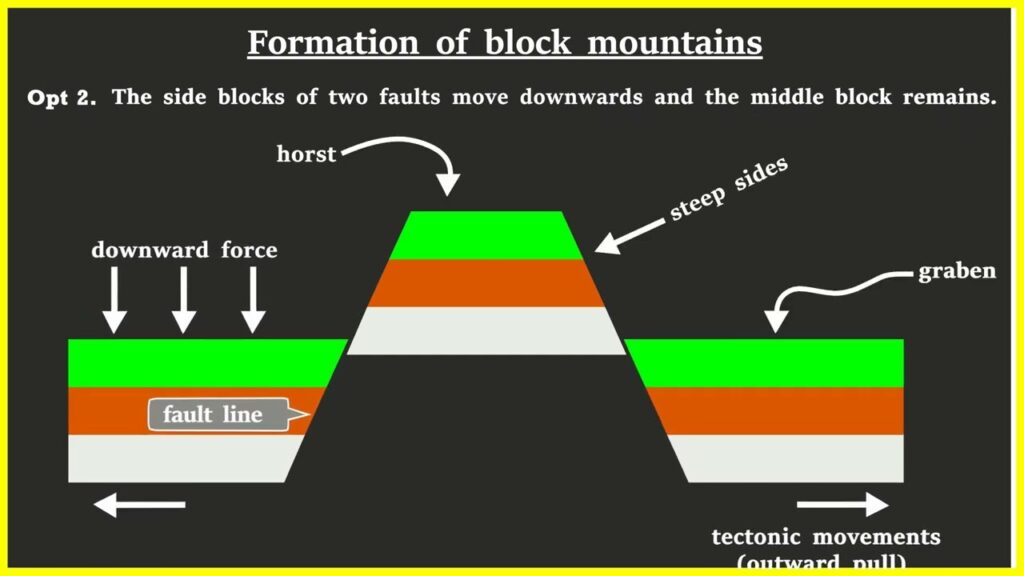
The Rwenzori are entirely different in character and entirely different in age. They are a horst, a block mountain formed not by accumulation but by elevation, not by the addition of material but by the upward displacement of rock that was already there, already ancient, already crystallised into some of the oldest formations on the African continent. The rock at the summit of Mount Stanley, which carries the legendary Margherita Peak at 5,109 metres, is composed primarily of gneiss and quartzite that formed under conditions of extreme heat and pressure more than 500 million years ago deep within the Precambrian basement of the African craton. The tectonic events that ultimately pushed these rocks into the clouds are far more recent, but the rocks themselves are primordial.
This distinction matters more than it might first appear. It means the Rwenzori are geologically singular on the African continent: a non-volcanic massif of ancient metamorphic and plutonic rock, elevated to alpine heights by a living, active rift system. It is the combination of these two realities, the antiquity of the rock and the relative youth of the uplift, that provides the Rwenzori their unique character, their dramatic relief, their extraordinary biodiversity, and the feeling, unmistakable to anyone who has trekked their ridges, of standing on something that predates everything they have ever known.
The Albertine Rift: The Tectonic Engine That Built the Mountains of the Moon
The story of the Rwenzori’s formation is inseparable from the story of the East African Rift System, one of the most geologically active and scientifically significant features on the surface of our planet. The East African Rift is a divergent tectonic boundary, a zone where the African tectonic plate is actively splitting into two new plates, the Nubian Plate to the west and the Somali Plate to the east. This process of continental rifting has been underway for roughly 25 to 30 million years and is still accelerating today.
The Rift System divides into two primary branches. The Eastern Rift Valley, the most well-known of the two, runs through Kenya and Tanzania and is characterised by dramatic volcanic activity; it is responsible for Mount Kilimanjaro, Mount Kenya, and the Ngorongoro Crater. The Western Rift, however, is the branch that concerns us here. Also known as the Albertine Rift, the western branch begins in the north at Lake Albert (from which it takes its alternative name) and curves southward through Uganda, the Democratic Republic of Congo, Rwanda, Burundi, and Tanzania, eventually merging with the main rift system near Lake Malawi. This western arm is older, deeper, and structurally more complex than its eastern counterpart, and it is the geological environment within which the Rwenzori were born.
The Albertine Rift is not a single crack in the earth but a rift valley, a dropped segment of crust bounded on both sides by high escarpment walls created as the surrounding land subsides relative to the faulted flanks. This Graben structure (from the German word “ditch”) is responsible for the chain of deep lakes that characterise the region: Lake Albert, Lake Edward, Lake George, Lake Kivu, Lake Tanganyika, and Lake Malawi all occupy the floor of the Albertine Rift, and all of them owe their existence to the same tectonic forces that produced the Rwenzori. The rift here reaches depths a few kilometres below the surrounding plateau, making the lakes exceptionally deep. Lake Tanganyika, for example, plunges to over 1,470 metres, making it the second deepest lake in the world.
The Rwenzori sit astride the border between Uganda and the Democratic Republic of Congo, precisely at the point where the Albertine Rift is most pronounced. It is a location that is not incidental; it is determinative. The rift’s faulting pattern placed the mountains where they are, and the forces that reshape this landscape are ongoing. The Rwenzori are still rising. Frequent low-magnitude earthquakes occur in the region as the fault systems adjust, reminding us that this landscape is still evolving.
Block Mountain Formation: The Mechanics of Tectonic Uplift
Understanding how the Rwenzori were formed requires a clear grasp of the mechanics behind block mountain, or horst, formation, a process that is conceptually quite different from either volcanic mountain-building or fold mountain-building (the process responsible for the Alps, the Himalayas, and the Rockies).
When continental rifting occurs, the crust does not pull apart uniformly. Instead, it fractures along a series of roughly parallel normal faults in the rock, along which one side slips downward relative to the other as extensional forces pull the crust apart horizontally. The result is a landscape of alternating highs and lows: grabens (dropped blocks) and horsts (elevated blocks). The grabens become valleys and, when they drop below the water table, lakes. The horsts become the elevated shoulders and ranges that flank the rift.
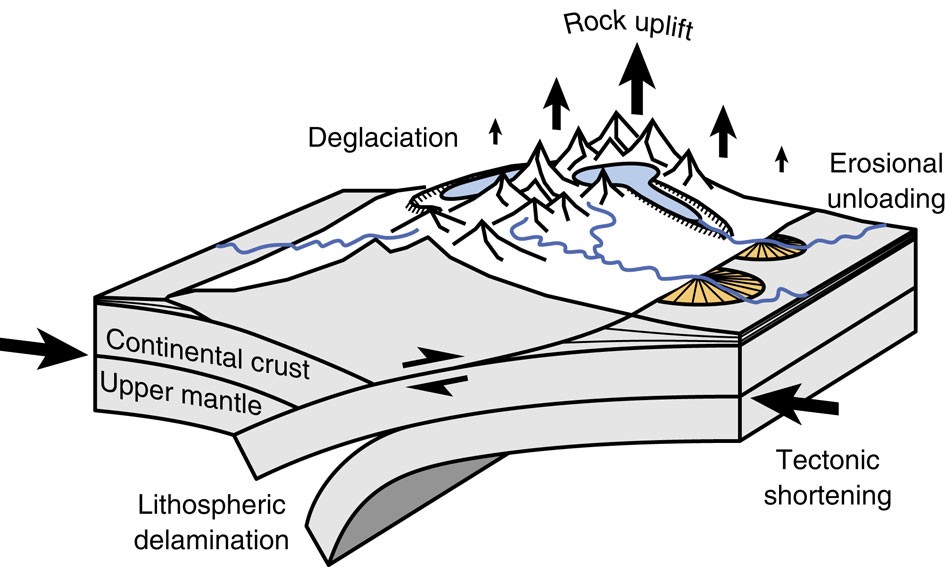
In the case of the Rwenzori, the mechanism was as follows: as the Albertine Rift opened over millions of years, two major parallel fault systems developed on either side of the Rwenzori block: the Bwamba Fault to the west and a complementary fault system to the east. As the crust on either side of these faults subsided into the rift, the block between them was effectively left behind, standing progressively higher as the surrounding land dropped. This is the fundamental paradox of Horst formation: the mountains rose not primarily because rock was pushed up from below but because the land around them sank. The relative uplift of the Rwenzori block was accentuated by both the subsidence of the surrounding graben floors and by isostatic rebound as the massive weight of eroded material was gradually removed from the elevated block by rivers and rainfall over geological time; the lighter crust responded by rising further, in the same way that a boat rises in the water as its cargo is unloaded.
There is, however, an additional component to the Rwenzori’s uplift that makes it unusual even among horst mountains: geological evidence suggests that the block also experienced a degree of compressional uplift, meaning that horizontal compressive stresses within the crust actively pushed the block upward in addition to the passive elevation resulting from surrounding subsidence. This combination of mechanisms, graben subsidence, isostatic rebound, and active compression is why the Rwenzori have achieved an elevation unmatched by any other horst mountain system in Africa and why their topographic relief (the difference in height between the rift floor and the summits) exceeds 5,000 metres over a horizontal distance of just a few dozen kilometres.
The scale of this relief is something you feel viscerally when you trek these mountains. Standing at Nyakalengija, the main trailhead for the Central Circuit Trail at roughly 1,600 metres above sea level, you are already well above the surrounding plateau. But Margherita Peak, on Mount Stanley, rises an additional 3,500 metres above you. That height difference, squeezed into less than 20 km of flat distance in some areas, shows one of the most striking examples of tectonic uplift in East Africa.
The Ancient Rock Beneath Your Boots: Gneiss, Quartzite, and the Precambrian Foundation
The rock that forms the core of the Rwenzori massif is among the oldest surface-exposed material in East Africa. To understand it properly, you need to go back not millions but hundreds of millions of years to a period long before the African continent assumed anything like its current shape, when the rocks that now form the Rwenzori were buried kilometres deep beneath the earth’s surface and subjected to temperatures exceeding 700 degrees Celsius and pressures equivalent to several thousand times the weight of the atmosphere.
Under these conditions of extreme metamorphism, existing sedimentary and igneous rocks were fundamentally transformed. Their minerals were recrystallised; their textures were reorganised, and new mineral assemblages were stable at high temperatures and pressures. The dominant rock type that emerged from this process in the Rwenzori is gneiss, a coarse-grained metamorphic rock characterised by its distinctive banded or foliated structure and created by the segregation of light and dark minerals (typically quartz and feldspar, alternating with biotite, hornblende, and other mafic minerals) under the immense directional pressures of deep metamorphism.
The gneisses of the Rwenzori are classified within a geological assemblage known as the Rwenzori Basement Complex, a suite of Precambrian metamorphic and plutonic rocks that form the fundamental geological fabric of the massif. These rocks are correlatives of the broader Kibaran Orogen, a major mountain-building event that affected much of central and eastern Africa between approximately 1.4 billion and 900 million years ago (the late Mesoproterozoic to early Neoproterozoic). During the Kibaran Orogeny, ancient oceanic crust was subducted beneath the African craton, and the resulting collision welded together terranes that had previously been separate, creating a vast chain of mountains now long since eroded to nothing whose deeply buried roots are the rocks we see exposed at the surface in the Rwenzori today.
Alongside the dominant gneisses, the Rwenzori Basement Complex includes significant bodies of quartzite, a metamorphic rock derived from the transformation of sandstone, composed almost entirely of interlocking quartz crystals and notable for its extraordinary hardness and resistance to weathering. Quartzite forms many of the most dramatic cliff faces and ridge crests in the upper reaches of the mountains, and its pale gray-to-white colouring gives certain zones of the high Rwenzori an almost lunar quality that has doubtless contributed to the “Mountains of the Moon” mystique. Other important rock types within the complex include amphibolites (metamorphic rocks rich in amphibole minerals, typically dark green to black, derived from the metamorphism of basaltic oceanic crust), granulites (very high-grade metamorphic rocks formed at the greatest depths and temperatures), and various migmatite rocks that reached temperatures close to their melting point during metamorphism, producing a complex mixture of residual metamorphic material and newly formed igneous-looking veins of granitic composition.
Later intrusions of granitic and pegmatitic material, which are coarser-grained igneous rocks, cut through all of these ancient metamorphic rocks, having been emplaced as magma intruded into the basement during subsequent tectonic events. These intrusions are visible across the upper mountain as pale dykes and veins threading through the darker gneisses, and they occasionally form larger masses (plutons) that create the particularly massive, blocky rock faces that challenge mountaineers on the approaches to Mount Baker and Mount Speke.
The practical consequence of this ancient, crystalline rock framework for trekkers is significant. Unlike volcanic mountains where loose scoria, crumbling ash, or unconsolidated lava creates unstable, shifting underfoot conditions, the Rwenzori’s metamorphic foundation produces solid, durable rock faces with excellent structural integrity. However, the intense faulting and fracturing associated with the rift uplift has heavily jointed much of this rock, creating the blocky, angular boulder fields and broken terrain that characterise the upper routes. Combine this terrain with the legendary Rwenzori rainfall, which keeps the rock perpetually wet and often moss-covered, and you have the conditions that make Rwenzori mountaineering a genuinely technical challenge even on the standard routes.
The Timeline of Uplift: When Did the Rwenzori Rise Above the Plateau?
Pinning down exactly when the Rwenzori achieved their current dramatic elevation is a question that has occupied geologists for much of the past century, and the answer has been progressively refined as new dating techniques, including thermochronology (using the thermal histories of minerals to reconstruct their exhumation from depth) and cosmogenic nuclide dating (measuring how long rock surfaces have been exposed to cosmic radiation), have become available.
The broad consensus emerging from the most recent research is that significant uplift of the Rwenzori horst began during the Miocene epoch, roughly 10 to 15 million years ago, coinciding with the intensification of rifting along the western branch of the East African Rift System. However, this initial uplift was relatively modest. The evidence from thermochronological studies suggests that the Rwenzori block was exhumed from depths of several kilometres during this Miocene phase, but the most dramatic and rapid phase of uplift, which pushed the peaks above the snowline and eventually above 5,000 metres, occurred more recently during the Pliocene and Pleistocene epochs, between roughly 5 million and 1 million years ago.
This younger phase of accelerated uplift appears to correlate with a significant intensification of rifting activity across the western branch and possibly also with changes in far-field tectonic stresses associated with the ongoing collision of the African and Eurasian plates along the Mediterranean margin. What is particularly striking is the evidence that uplift rates in the Rwenzori have been extraordinarily high by geological standards, estimated at between 0.4 and 1.0 millimetres per year averaged over the Plio-Pleistocene, and that, crucially, rock uplift rates have consistently exceeded the rates of erosion, allowing the mountains to grow progressively higher rather than being reduced by weathering as fast as they rose.
Geologically, this range is still a very young mountain range. In the context of the global mountain-building record, ranges of equivalent height, the Alps, the Rockies, and the Andes, are typically the products of tens of millions of years of orogenesis. The Rwenzori achieved comparable elevations in a fraction of that time, driven by the unusually rapid extension rates of the Albertine Rift. This youth is a significant factor in the Rwenzori’s uniqueness to geologists: they are essentially a mountain range in the process of formation, still rising, still being sculpted, and still geologically active, unlike ancient, tectonically quiescent ranges such as the Scottish Highlands or the Appalachians.
Ice Age Legacy: Glaciers, Cirques, and the Sculpting of the High Rwenzori
The highest terrain in the Rwenzori, the summit zone above approximately 4,200 metres, bears the unmistakable fingerprint of glaciation. Every valley, every rounded peak, every perfectly curved cirque headwall, and every scatter of erratic boulders deposited far from any possible source of outcrop tells the same story: these mountains were once far more comprehensively glaciated than they are today, and the landscape you traverse on the upper sections of routes toward Margherita Peak was carved and deposited during a period of dramatically colder global climate.
The relevant glacial episode is the Last Glacial Maximum (LGM), which peaked approximately 20,000 years ago. During this period, global temperatures were roughly 5 to 6 degrees Celsius cooler than today, atmospheric CO₂ concentrations were significantly lower, and ice sheets and mountain glaciers expanded dramatically across every continent. In Africa, high-altitude ranges including the Rwenzori, Mount Kenya, and Kilimanjaro all saw their glaciers grow to their maximum extents during the LGM and the preceding colder periods of the Pleistocene epoch (approximately 2.6 million years ago to 11,700 years ago).
On the Rwenzori, the most recent comprehensive glaciological mapping suggests that during the LGM, glaciers extended to approximately 2,200 metres above sea level on the wetter, western slopes more than 2,000 metres lower than the current glacier margins, which today hover at or above 4,400 metres. This means that what is now lush, bamboo-zone forest at around 2,500 metres was once buried beneath hundreds of metres of ice. The glacial erosion at these lower elevations is responsible for many of the characteristic landforms that trekkers pass through on the lower and middle sections of the mountain: the broad, flat-bottomed valleys with steep sides (classic U-shaped glacial troughs); the hanging valleys where tributary glaciers once joined the main ice stream; and the numerous glacial lakes and tarns, including the iconic Bujuku Lake in the upper Bujuku Valley, visible on the 7-day Central Circuit Trek, that fill rock basins scoured out by glacial erosion.
Higher up, the signature of glaciation becomes even more pronounced. Cirques, armchair-shaped hollows carved into the mountain flanks by the rotational movement of glacial ice, are abundant across the upper Rwenzori, giving the peaks their characteristic cliff-walled, amphitheatre-like headwalls. The summit ridges of Mount Stanley, Mount Speke, and Mount Baker are all classic arêtes, the sharp, knife-edged ridges that form where two adjacent cirque glaciers erode toward each other from opposite sides of a ridge, leaving only a narrow fin of rock between them. Roche moutonnées, asymmetrically smoothed bedrock outcrops polished on their upstream sides by the abrasive action of glacier ice and plucked into jagged faces on their downstream sides, are everywhere above 3,500 metres, and lateral and terminal moraines (ridges of rock debris deposited at the margins and fronts of former glaciers) demarcate the former extents of ice with remarkable clarity in the high valleys.
Glacial erratics are perhaps the most evocative evidence of the former glacial extent. These are boulders of rock types entirely foreign to the area where they now rest, transported by moving glacier ice from their sources high on the mountain and deposited when the ice melted, often perched in positions that seem physically improbable, balanced on ridges or sitting incongruously in the middle of what is now bog or heathland. They are time capsules of the Ice Age, each one a marker of how far the ice once reached.
The Rwenzori’s Surviving Glaciers: A Vanishing Archive
Today, the Rwenzori retains active glaciers but only just. The massif is home to some of the last remaining equatorial glaciers in Africa, concentrated on the highest summits of the Stanley, Speke, and Baker groups. The Speke, Elena, Alexandra, Albert, and Margherita glaciers on Mount Stanley; the Johnston and Speke glaciers on Mount Speke; and the Moore Glacier on Mount Baker together constitute one of the most scientifically important and climatically vulnerable cryospheric environments anywhere on Earth.
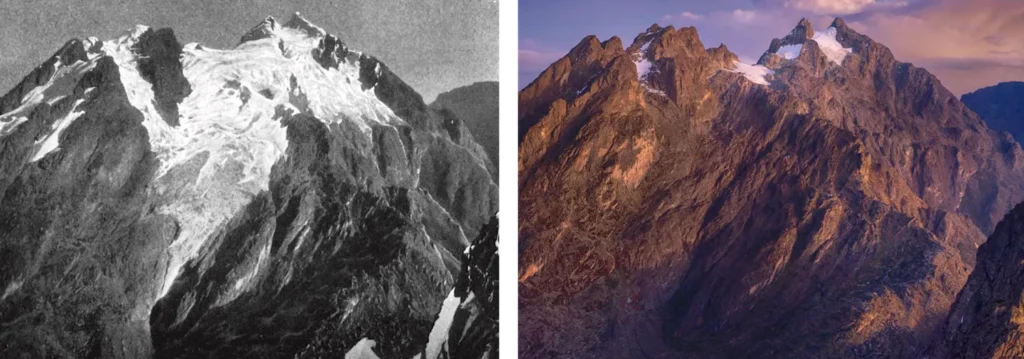
The retreat of these glaciers has been dramatic and well-documented. Systematic measurements beginning in the early twentieth century, including the comprehensive surveys conducted during and after the Duke of Abruzzi’s 1906 expedition, which first mapped the Rwenzori glaciers in detail, reveal that the total glaciated area on the Rwenzori has declined by approximately 80 to 90 percent over the past 100 years. In the 1900s, the combined glaciers covered roughly 6.5 square kilometres; by the most recent assessments, the area had shrunk to less than 0.5 square kilometres. The glaciers on the Rwenzori are expected to completely disappear in the next few decades. This is because global temperatures are rising, which speeds up the rate at which they are retreating. This makes them one of the most urgent signs of climate-driven cryospheric loss in the world.
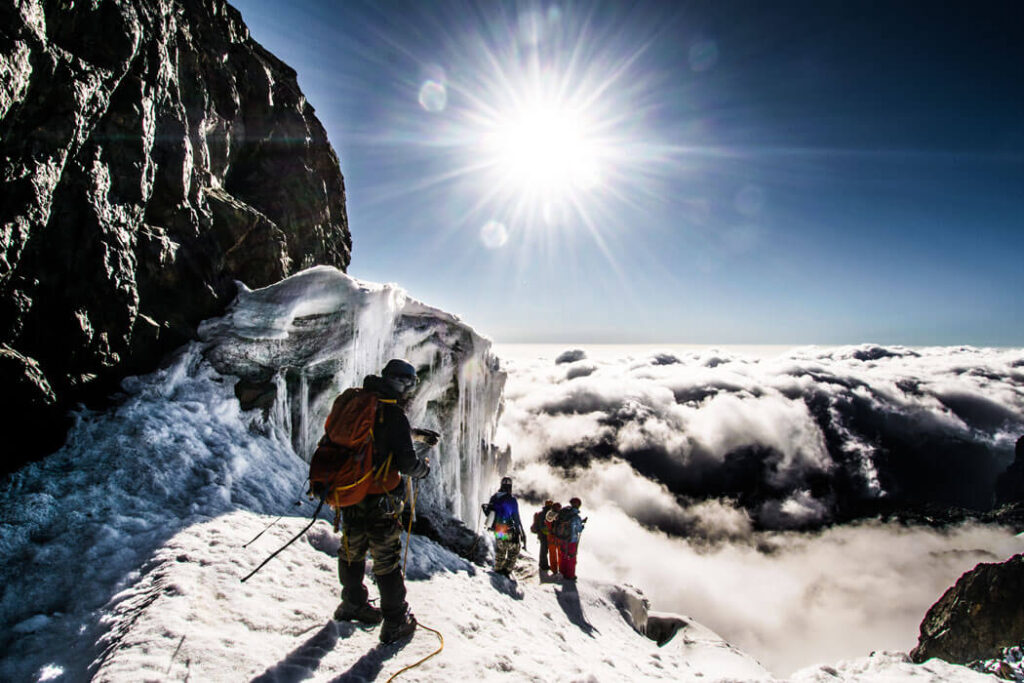
The loss of these glaciers is not merely symbolic. They are essential for managing river flow during dry times, supplying water to streams that support communities in the lowlands below the mountains, and providing the cold, oxygen-rich water that helps the unique aquatic life in the Albertine Rift thrive. The rivers draining the Rwenzori, the Mubuku, the Nyamwamba, the Butawu, and others are all partly glacier-fed, and their character will change profoundly as the ice disappears. For trekkers crossing the ice fields on the approach to Margherita, these glaciers are magnificent ancient, blue-white bodies of ice that have persisted through millennia of tropical warmth due to their sheer altitude and carry within their layered structure a record of past climates, atmospheric composition, and even ancient volcanic eruptions preserved in dust layers.
How the Geology Shaped Everything You See: The Rwenzori’s Unique Ecosystem
The geological history of the Rwenzori is not merely an academic subject; it is the direct cause of the extraordinary biological richness that makes the Rwenzori Mountains a UNESCO World Heritage Site and one of Africa’s most important biodiversity hotspots. Understanding the connection between geology and ecology deepens the trekking experience immeasurably.
Rwenzori’s exceptional rainfall, among the highest of any mountain range in Africa, with some high-altitude sites recording over 3,000 millimetres per year, is itself partly a function of the mountain’s geological character and position. The massif’s orientation perpendicular to the prevailing moisture-laden winds sweeping off the Congo Basin to the west forces moist air rapidly upward, cooling it and wringing out rainfall in a process called orographic precipitation. This extraordinary wetness has persisted for millions of years, and it is what has allowed the mountains to develop their unique suite of giant plant forms: the enormous groundsels (Senecio and Dendrosenecio species), the towering lobelias (Lobelia wollastonii and Lobelia bequaertii), and the vast carpets of Alchemilla that carpet the bogs of the afro-alpine zone.
The gneissic and quartzite basement rock also plays a direct role in soil chemistry and therefore in vegetation distribution. The Precambrian metamorphic rocks weather slowly, producing relatively thin, nutrient-poor, well-drained soils where slopes are steep but highly waterlogged in valley floors and gentle terrain. This waterlogging, combined with the incessant rainfall and cool temperatures, creates the famous Rwenzori bogs’ deep, saturated peat accumulations that make trail conditions challenging but that also represent carbon-rich archives of the mountain’s climate history going back thousands of years.
The steep changes in the landscape caused by tectonic uplift are what create the amazing variety of habitats that make hiking in the Rwenzori such a unique experience. From the montane forest at the base, through the bamboo zone, the heather and Rapanea forest, the giant heath zone, and finally the afro-alpine zone of giant groundsels and lobelias, each transition corresponds to a specific altitudinal band created by the mountain’s vertical extent, a vertical extent that exists only because of the tectonic forces that drove the block upward from the rift floor.
What You Are Walking Through: Geology Zone by Zone on the Rwenzori Trails.
For trekkers, the geology of the Rwenzori manifests differently at different altitudes and on different trail systems. Experienced guides on the Rwenzori trekking routes know how to read the landscape in geological terms, and understanding this context transforms what might otherwise seem like endless mud and rock into a coherent narrative of deep time.
The Lower Mountain: From the Trailhead to the Bamboo Zone (1,600–2,500m)
The underlying gneissic basement is largely obscured by deep weathering and vegetation in the lowest sections of the mountain, particularly in the approach zones accessible from Nyakalengija on the Central Circuit or from the Kilembe portal on the Kilembe Trail. The rock at these elevations has been exposed to tropical weathering for millions of years, producing a thick regolith (decomposed rock) that supports the rich montane forest. River valleys at these elevations display some of the clearest evidence of glacial modification. The Mubuku River valley below Nyakalengija, for example, shows a characteristically over-widened valley cross-section and a stepped longitudinal profile, reflecting successive episodes of glacial and fluvial erosion. Where rivers have cut through the regolith, outcrops of the dark, banded gneiss are occasionally visible, often shot through with pale quartz veins and showing the tight folding characteristic of rocks that have experienced intense ductile deformation at depth.
The Middle Mountain: Alpine Heathlands and the Frost Zone (2,500–3,800m)
As altitude increases and the bamboo forest gives way to the giant heathers, the rock becomes progressively more visible. This zone corresponds roughly to the upper extent of the LGM glaciation, and glacial landforms become increasingly prominent, including smoothed rock pavements, small cirque basins occupied by tarns, and angular boulder fields derived from frost-shattered exposed gneissic rock. The 3-day Mahoma Loop traverses much of this mid-mountain terrain and offers excellent exposure to these intermediate geological features, including striking views of the glacially modified upper valleys. The Kitandara Lakes, visited on the Central Circuit, occupy a classic glacial valley with well-preserved moraine ridges visible on the surrounding slopes. Their waters are extraordinarily clear and cold, coloured deep blue-green by dissolved minerals leaching from the surrounding gneissic rock, and they sit in basins scoured by ice into the very basement of Africa.
The Upper Mountain: The High Alpine Zone and the Rock of the Summits (3,800m+)
Above 3,800 metres, Rwenzori geology becomes visceral. The magnificent peaks Mount Stanley (5,109 m), Mount Speke (4,890 m), Mount Baker (4,843 m), Mount Emin (4,798 m), Mount Gessi(4,715 m), and Mount Luigi di Savoia(4,627 m) are all carved from the same ancient metamorphic basement, and at these elevations, bare rock is everywhere. The gneisses here are some of the finest-exposed examples of high-grade metamorphic rock in the world: coarsely banded, rich in garnet and feldspar, and glistening with the kind of crystalline texture that comes only from deep-crustal metamorphism under conditions of enormous heat and pressure. The quartzite ridges on the approaches to the higher summits are almost luminously pale in certain light conditions, and their extraordinary hardness means they have resisted glacial abrasion more than the surrounding gneisses, standing as prominent fins and towers above the smoothed ice-worn valleys below.
The summit environment itself, the Elena Hut zone, and the approaches to Margherita bring you to the immediate interface between rock and ice: the bergschrund (the crevasse separating the glacier from the headwall); the moraine debris freshly deposited by the retreating glaciers; and the bare gneiss polished by centuries of ice contact to a mirror finish in some places and roughened by freeze-thaw action into jagged spurs in others. The 13-day 6-peaks expedition that traverses all the major summits of the Rwenzori traverses this complete geological sequence multiple times, crossing the different massifs and experiencing the subtle but real differences in rock type, structure, and glacial modification that distinguish each peak from the others.
The Rwenzori in the Context of African Tectonics: Why This Mountain Is Scientifically Extraordinary
The Rwenzori is very important for studying African geology and tectonics, and it’s important to recognise this because it makes the mountains more than just beautiful views; they are real scientific wonders.
From a tectonic perspective, the Rwenzori are a crucial natural laboratory for understanding continental rifting, the process by which a continent splits apart to eventually create a new ocean. The Albertine Rift is an early stage of this process: still a narrow continental rift, not yet a sea floor spreading centre. By studying the patterns of faulting, the rates of uplift, the evolution of the landscape, and the sedimentary record in the adjacent rift lakes, geologists can reconstruct how rifting initiates, how it progresses, and what the early stages of ocean formation look like in geological terms. The Rwenzori horst is central to this story; it represents the maximum structural uplift of any segment of the western rift and is therefore the most extreme expression of the tectonic forces at work across the entire system.
From a palaeoclimate perspective, the Rwenzori’s glaciers and peat bogs contain detailed records of climate change extending back tens of thousands of years. Ice cores from equatorial African glaciers, including those on the Rwenzori, have been used by climate scientists to reconstruct atmospheric temperature and precipitation patterns during the Holocene and the last glacial period, providing baseline data for climate models and projections of future change. The accelerating retreat of the Rwenzori glaciers is itself becoming an important data set for monitoring the rate of current warming in equatorial Africa.
From a biodiversity perspective, the Albertine Rift, where the Rwenzori form a centrepiece, is recognised as one of the most biologically diverse and endemic-rich regions on Earth. The Rwenzori’s geological isolation, created by the rift faulting that effectively surrounded the massif with lowland barriers, has allowed species to evolve in relative isolation over millions of years, producing the extraordinary concentration of endemics, unique plants, birds, mammals, and insects that makes the Rwenzori Mountains as important to biologists as to mountaineers.
Frequently Asked Questions About Rwenzori Mountains Geology.
How were the Rwenzori Mountains formed?
The Rwenzori Mountains were formed through a geological process called ‘tectonic uplift’, specifically through the formation of a horst, a block of the earth’s crust elevated between two parallel fault systems. As the Albertine Rift (the western branch of the East African Rift System) opened over the past 10–25 million years, the crust on either side of the Rwenzori block subsided along major normal faults, leaving the block between the faults standing progressively higher. This process, combined with isostatic rebound as erosion lightened the elevated block and active compression within the crust, drove the Rwenzori above 5,000 metres. Crucially, the Rwenzori are not volcanic; they are composed of ancient Precambrian metamorphic rocks (primarily gneiss and quartzite) that are over 500 million years old, simply uplifted to alpine heights by these relatively recent tectonic forces.
What type of mountain are the Rwenzori Mountains?
The Rwenzori Mountains are a block mountain, also known geologically as a horst. This distinguishes them fundamentally from Africa’s most famous high peaks, Kilimanjaro, Mount Kenya, and the Virunga volcanoes, which are all volcanic mountains built from accumulated lava and ash. The Rwenzori were not created by volcanic activity but by tectonic faulting: the block of ancient basement rock that forms the massif was elevated between two major fault systems as the surrounding land subsided into the Albertine Rift. They are the highest non-volcanic mountain range in Africa and the only block mountain in East Africa to reach heights above 5,000 metres.
What is the Albertine Rift, and what role did it play in the formation of the Rwenzori?
The Albertine Rift is the western branch of the East African Rift System, a zone of continental divergence where the African tectonic plate is actively splitting apart. The rift runs through Uganda, the Democratic Republic of Congo, Rwanda, Burundi, and Tanzania and contains a chain of deep lakes (Albert, Edward, Kivu, Tanganyika, and Malawi) in its floor. The Rwenzori sit directly within this rift system, at a point where the faulting is particularly pronounced. The rifting process created the two parallel fault systems that bounded the Rwenzori block on its eastern and western sides, and as the rift floor dropped progressively deeper over millions of years, the Rwenzori block was left standing higher and higher in relative terms. Without the Albertine Rift, the Rwenzori would simply be part of a flat or gently undulating central African plateau at an elevation of around 1,000 to 1,200 metres. The rift is entirely responsible for their dramatic elevation and topographic relief.
What kind of rocks are the Rwenzori Mountains made of?
The Rwenzori Mountains are mostly made up of old metamorphic and plutonic rocks from the Rwenzori Basement Complex. The dominant rock type is gneiss, a coarse-grained, banded metamorphic rock formed under conditions of extreme heat and pressure deep within the earth’s crust during the Kibaran Orogeny, approximately 900 million to 1.4 billion years ago. Significant bodies of quartzite (a very durable metamorphic rock derived from sandstone) also form many of the prominent cliff faces and ridge crests on the higher peaks. Other important rock types include amphibolites, granulites, and migmatites, along with later granitic and pegmatitic intrusions that cut through the older basement as pale veins and dykes. This formation is in sharp contrast to the volcanic rocks (basalt, phonolite, and ash) that form mountains like Kilimanjaro and the Virungas.
Did the Rwenzori Mountains have glaciers during the Ice Age?
Yes, extensively. During the Last Glacial Maximum (approximately 20,000 years ago) and earlier Pleistocene cold periods, glaciers on the Rwenzori extended to approximately 2,200 metres above sea level on the western slopes, which is more than 2,000 metres lower than the current glaciers that today survive only above approximately 4,400 metres. At their maximum extent, the Rwenzori glaciers covered a vastly larger area than they do today and carved the landscape with tremendous effectiveness, producing the U-shaped valleys, cirques, arêtes, moraines, and glacial lakes (including Bujuku Lake) that characterise the high mountain terrain today. Since the end of the last ice age, and accelerating dramatically in the 20th and 21st centuries due to human-driven climate change, the glaciers have retreated precipitously. Current estimates suggest the Rwenzori has lost 80 to 90 percent of its glaciated area since 1900, and the surviving glaciers may disappear entirely within a few decades.
Why are the Rwenzori Mountains geologically different from Kilimanjaro?
The difference is fundamental. Kilimanjaro is a stratovolcano; it was built by successive eruptions of lava, ash, and pyroclastic material over the past few million years and is composed of volcanic rocks (primarily basalt and phonolite). It is a constructional mountain: material was added to it from below to create its form. The Rwenzori, by contrast, are a horst, a block of extremely ancient metamorphic rock (gneiss and quartzite, over 500 million years old) that was elevated by tectonic faulting, not by volcanic activity. No eruptions created the Rwenzori. Their material was already there, buried in the basement of the African craton, and was simply lifted into the sky by the opening of the Albertine Rift. This is why the Rwenzori are geologically older in terms of their rock composition (though the uplift itself is geologically recent) and why they have a fundamentally different character solid, crystalline, angular, glacially sculpted compared to the typically more smooth and rounded profiles of volcanic mountains.
How long have the Rwenzori Mountains been forming?
The rock that composes the Rwenzori is over 500 million years old and is a Precambrian basement formed during the Kibaran orogeny between approximately 900 million and 1.4 billion years ago. However, the uplift of the Rwenzori began much more recently than the block being raised to its current heights. Initial significant uplift started approximately 10 to 15 million years ago during the Miocene, coinciding with the intensification of Albertine Rift activity. The most dramatic, rapid phase of uplift, however, took place during the Pliocene and Pleistocene (approximately 5 million to 1 million years ago), with estimated average uplift rates of between 0.4 and 1.0 millimetres per year. Critically, the Rwenzori are still rising today; seismic activity in the region confirms that the fault systems bounding the massif remain active, and ongoing rifting continues to drive relative uplift of the block.
Are the Rwenzori Mountains still geologically active?
Yes. The Rwenzori sit within an active rift system and are subject to ongoing tectonic processes. Regular low-magnitude earthquakes are recorded in the region as the fault systems flanking the massif continue to adjust. The western branch of the East African Rift System is an active divergent boundary, and the forces responsible for the Rwenzori’s formation are not spent; they continue to operate today, albeit at rates that are imperceptible over a human lifetime. The mountains are still rising, at rates measured in fractions of a millimetre per year. Additionally, the glaciers, which are themselves geologically active agents reshaping the summit terrain through erosion and deposition, are undergoing rapid and measurable change as climate warming accelerates their retreat.
What is the significance of the Rwenzori Mountains as a UNESCO World Heritage Site?
The Rwenzori Mountains were inscribed as a UNESCO World Heritage Site in 1994, recognising their outstanding universal value in both geological and biological terms. Geologically, the site represents an exceptional example of a mountain system formed by a continental rift, featuring surviving equatorial glaciers, a combination found nowhere else on Earth in quite this form. The mountains’ old rock layers, their steep slopes, and their melting glaciers together serve as a valuable record of how the continent has changed over time, past climates, and today’s climate change. The Rwenzori Mountains are home to many unique plants and animals that can’t be found anywhere else, and this is due to the geological forces that lifted and separated the mountain range in the Albertine Rift biodiversity hotspot.
Plan Your Trek Into the Ancient Heart of the Rwenzori
Every step you take on the Rwenzori Mountains is a step on rock that formed before the first complex animals appeared on Earth, through landscapes carved by ice that has mostly vanished, and on a mountain that is still rising from the floor of Africa’s greatest rift. That is not a metaphor; it is a literal geological fact, and it is one of the most powerful things about trekking here. The Rwenzori do not just offer extraordinary scenery; they offer direct, physical contact with one of the most dramatic stories in Earth’s geological record.
Whether you are drawn to summit Margherita Peak at 5,109 meters on Mount Stanley, to traverse the complete range on our 13-day, six-peaks expedition covering Mount Speke, Mount Baker, Mount Emin, Mount Gessi, and Mount Luigi di Savoia, or to experience the mid-mountain geology and unique vegetation on the 3-day Mahoma Loop, we can design an itinerary that fits your experience level, timeline, and ambitions. Our expert guides have spent years studying and walking this terrain, and they bring its geological story to life in ways that no guidebook can replicate.
Rwenzori Trekking Safaris is Uganda’s specialist operator for the Mountains of the Moon, the team that knows these ancient rocks, these retreating glaciers, and these extraordinary trails better than anyone. Explore our full range of Rwenzori treks, browse our routes and departure dates, or get in touch with our team directly to start planning the trek of a lifetime.
The mountain that took 500 million years to reach you is not going anywhere. But its glaciers are. Come while they are still here.
Ready to stand on the Precambrian core of Africa?Contact our Rwenzori experts today and let us help you plan every detail of your expedition to the Mountains of the Moon.
ANY QUESTIONS?
If you need any clarification about a Rwenzori trek, contact one of our trekking experts to start planning your journey today.
A 10% percentage of your safari proceeds goes to supporting the local Bakonjo Communities (orphans, schools & homes)
Simply incredible
I have been very fortunate to go trekking and climbing in many incredible places around the world over the years, the Rwenzori mountains are one of the most incredible places I have ever visited. Rwenzori Trekking Safaris organized my trip to do the central circuit and summit Margherita peak. The guides, Josephat and Joackim, and porters were all friendly and helpful. The food was plentiful, but I suggest bringing some of your own day snacks you might like as well as rubber knee high boots, I suggest LaCrosse Burly Aero. I was able to complete the loop and peak in 4 days, but most people take 7-8 days I believe which is definitely recommended for acclimatization. There are new huts being built at Elena camp and Nyabitaba that cost a small amount extra, so ask about that too. Its a real adventure and in my experience way more rugged, beautiful, and less traveled than Kilimanjaro. The landscapes and unique plant life are like out of Jurassic Park.
Posted on Tripadvisor
Simon B
Verified
A wonderful experience in the Rwenzoris
We did the seven-day Central Circuit and had a wonderful experience. The landscapes were spectacular and really diverse. Also, the guides, porters and cooks were super friendly and helpful. Thank you very much!
Posted on Tripadvisor
Explorer43375006028
Verified
Magical mountain forest
We did the two day hike to Mahoma Lake, and it was beautiful. The guide was superfriendly, the coock made a great stew and the porters were really nice.
Posted on Tripadvisor
Dominic N
Verified
Forget Kilimanjaro, do this instead!
A beautiful and surreal 4 day hike in the Rwenzori mountains to Mutinda Lookout, made by the staff. Good food, good basic camp accommodation, excellent knowledge of the guides and lots of laughs. I did this trip solo and joined a welcoming group of 6. Pack for all weather, it gets particularly cold at night at Mutinda camp. Total cost was $635/2.2m UGX
Verified by Trustindex
Trustindex verified badge is the Universal Symbol of Trust. Only the greatest companies can get the verified badge who has a review score above 4.5, based on customer reviews over the past 12 months. Read more
Hi there, welcome. Need help planning a trek, safari, or adventure? Chat directly with a real expert and mountain guide for honest advice, clear answers, and practical recommendations. No guesswork, no pressure.