
Complete guide to the 5-Day Rwenzori Trek to Margherita Peak (5,109 m). Day-by-day itinerary, camps, gear list, difficulty, and booking. Book with Rwenzori Trekking Safaris.
5-Day Rwenzori Trek to Margherita Peak | Uganda's Highest Summit
5-Day Rwenzori Trek to Margherita Peak: Complete Guide to Climbing Uganda’s Highest Summit.
Only fit and experienced mountaineers should attempt the 5-day trek to Margherita Peak in the Rwenzori Mountains. The Central Circuit Trail is an exciting mountain trail that takes you through some of Africa’s most magnificent landscapes, including snow glaciers and montane jungles. It culminates at the summit of Africa’s third-highest peak.
Compared to the longer 8- or 10-day routes, this 5-day trek is difficult, rapid, and complicated. People who want to reach the top as rapidly as possible will need to put in significant effort. You must be in excellent shape, have a strong will, and be accustomed to the altitude, as you go up and down many steps every day.
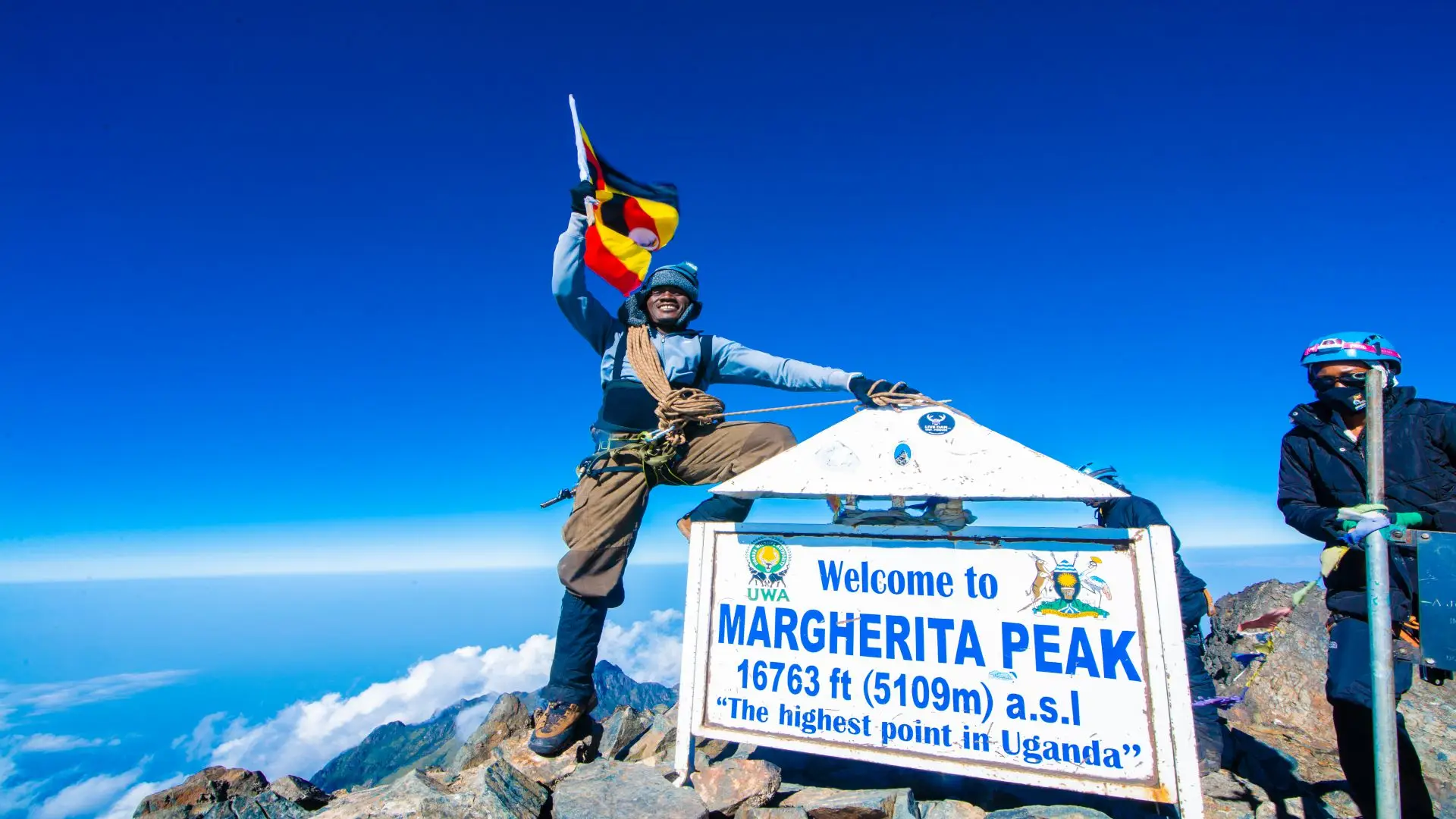
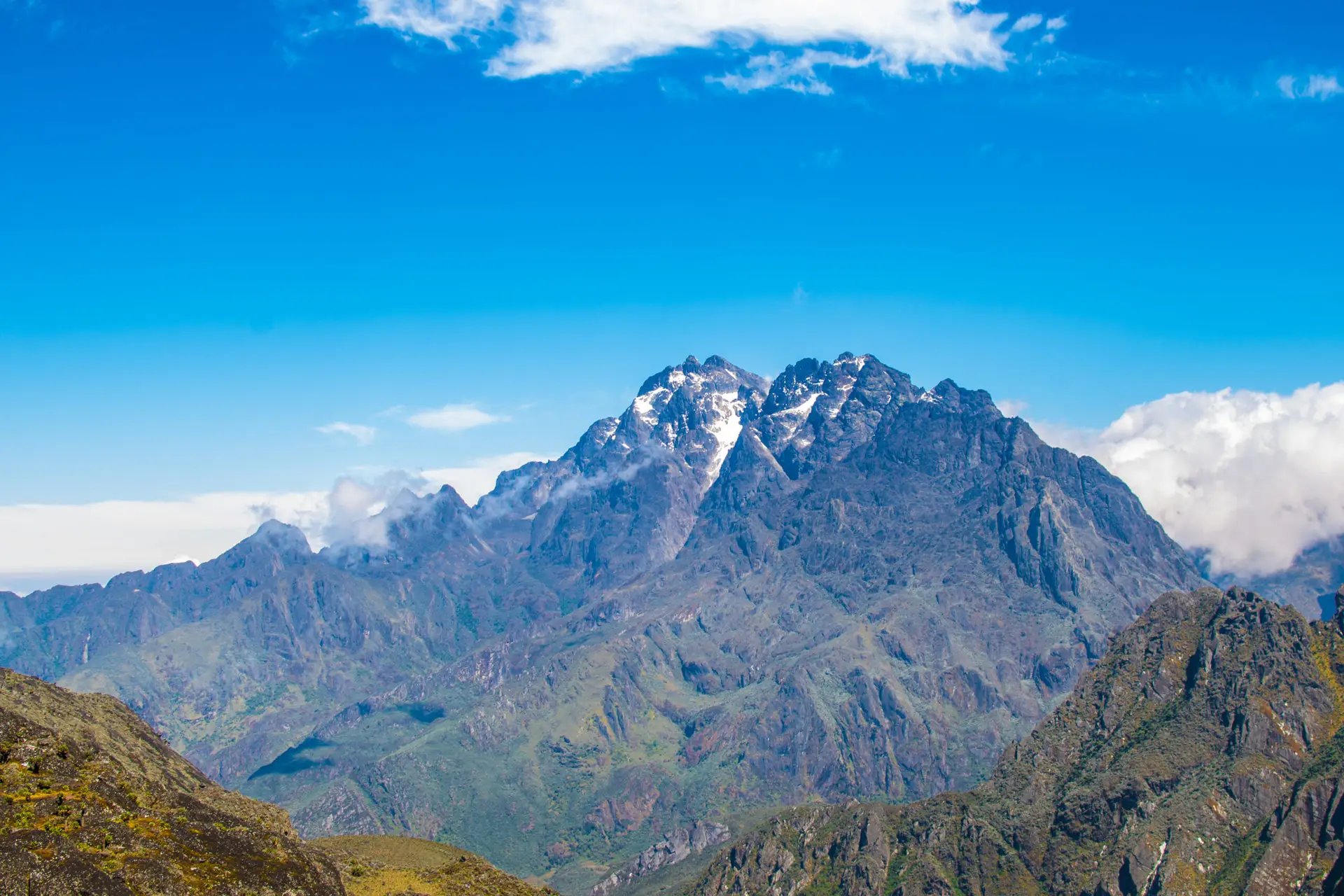
Standing at 5,109 metres above sea level, Margherita Peak crowns Mount Stanley and the entire Rwenzori range as the highest point in Uganda, the second-highest in the Democratic Republic of Congo, and the third-highest summit on the African continent. The 5-Day Rwenzori Trek to Margherita Peak is the fastest full-summit itinerary we offer on the Central Circuit Trail that still allows a complete crossing of the mountain’s iconic high-altitude zones. It compresses five extraordinary days into one of the most concentrated alpine experiences in East Africa.
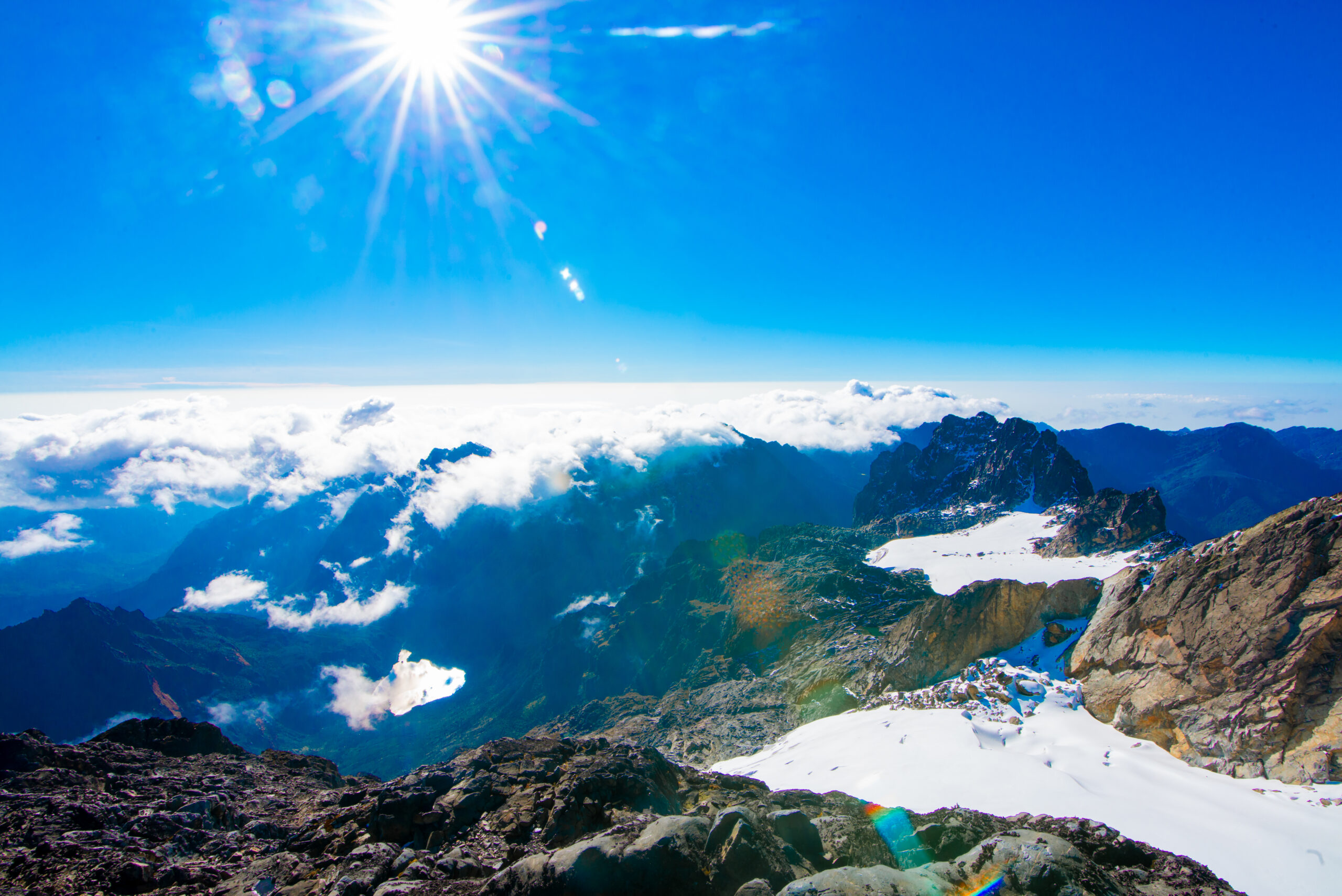
This is not a beginner’s route. The 5-day schedule demands strong cardiovascular fitness, prior high-altitude trekking experience, and genuine mental resilience. You will climb more than 3,400 vertical metres from the trailhead to the summit, navigate glacier terrain with ropes and crampons above Elena Hut, and spend nights above 4,500 metres. In return, you get Africa’s equatorial glaciers at arm’s length, an otherworldly landscape of giant lobelias and ancient heather forests, and a summit view over Uganda, the Congo basin, and the distant shimmer of Lake Edward.
If you have the fitness and the drive to move efficiently on mountain terrain, the 5-day route rewards you with something the longer itineraries cannot: the satisfying, whole-body tiredness that comes from earning one of the world’s great summits at pace. Every step counts, every morning’s early start matters, and the mountain pulls no punches. Read every section of this guide before you book. Then contact us when you are ready.
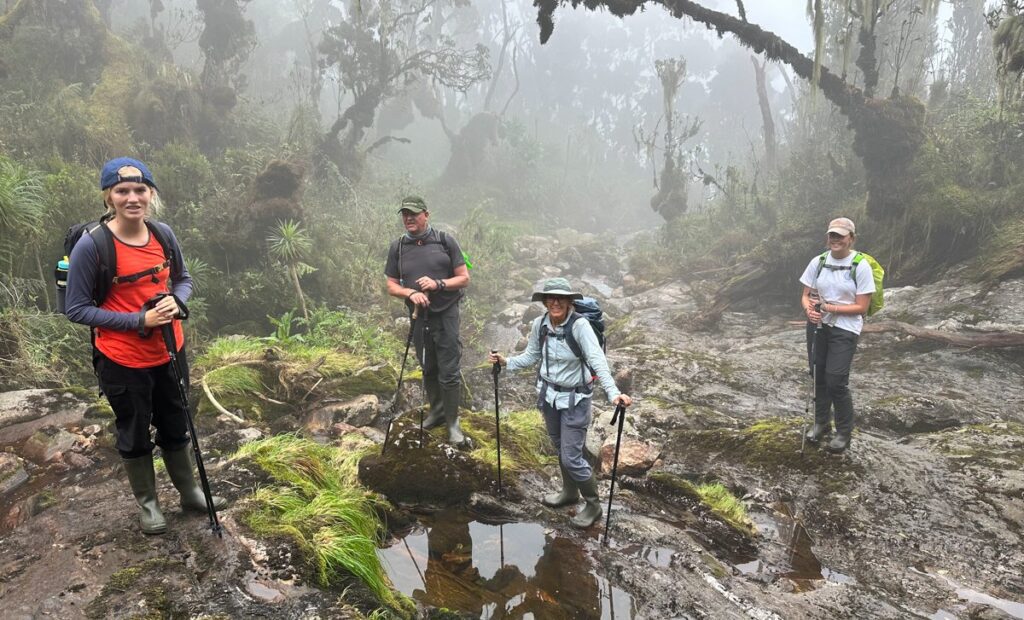
5-Day Margherita Peak Trek: At-a-Glance
| Duration | 5 Days / 4 Nights on the mountain |
| Total Distance | Approximately 55 km (34 miles) round trip |
| Maximum Elevation | 5,109 m Margherita Peak, Mount Stanley |
| Minimum Elevation | 1,646 m – Nyakalengija Trailhead |
| Total Elevation Gain | Approx. 3,463 m ascent over 5 days |
| Difficulty | Very Strenuous Experienced trekkers only |
| Trek Route | Central Circuit Trail (out-and-back with variant) |
| Start & End Point | Nyakalengija Gate, near Ibanda, Kasese District |
| Summit Day | Day 5 (from Elena Hut, 4,541 m) |
| Best Season | December-March and June-August (driest months) |
| Group Size | 2 to 12 trekkers (private groups by arrangement) |
| Accommodation | Mountain huts and metal-frame shelters |
| Glacier Crossing | Yes, ropes and crampons are required above. Elena Hut |
| Porter Policy | Mandatory – 1 porter per trekker minimum |
| Price Indicator | From USD $1,400 per person (group of 2) |
Why Choose the 5-Day Rwenzori Trek to Margherita Peak?
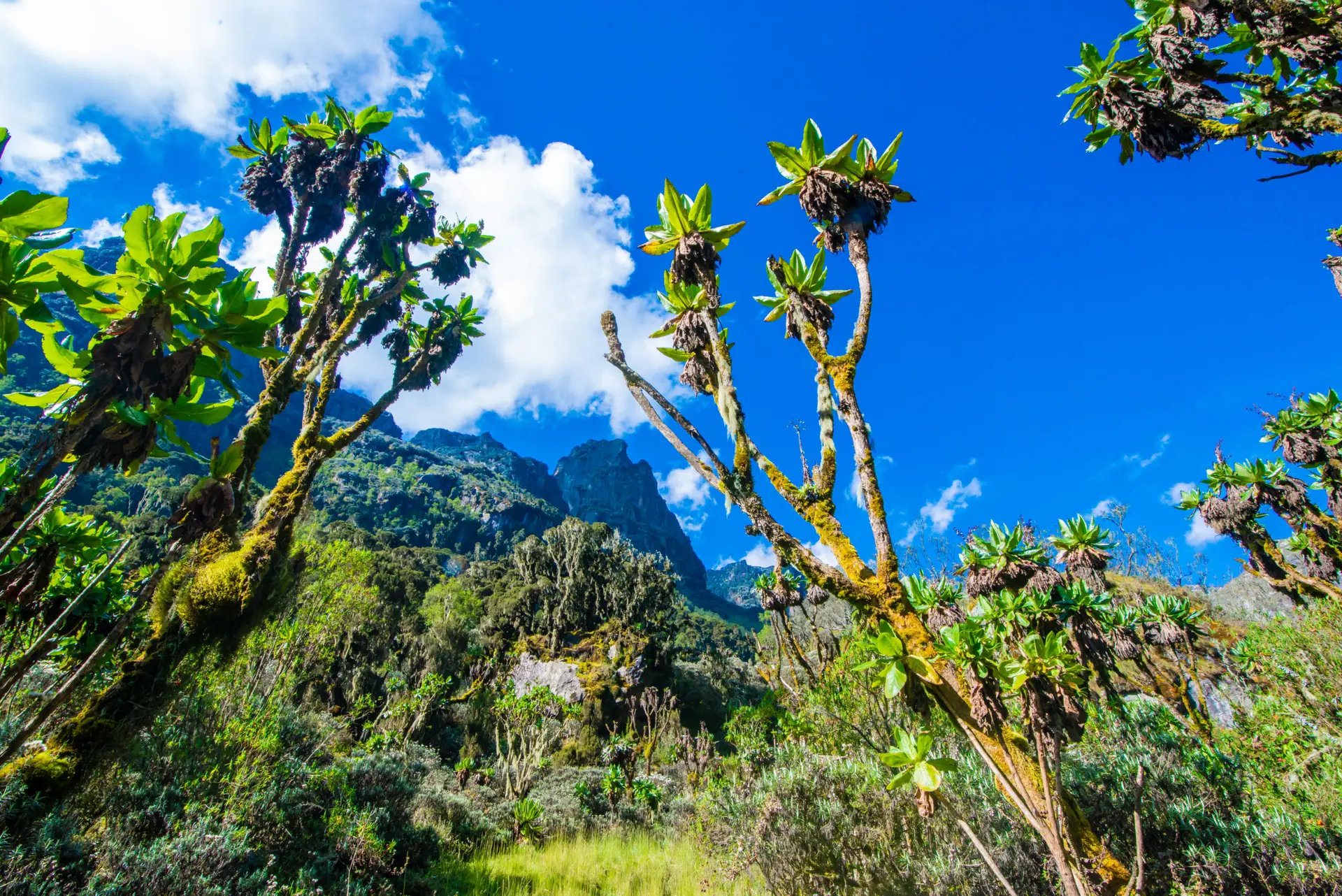
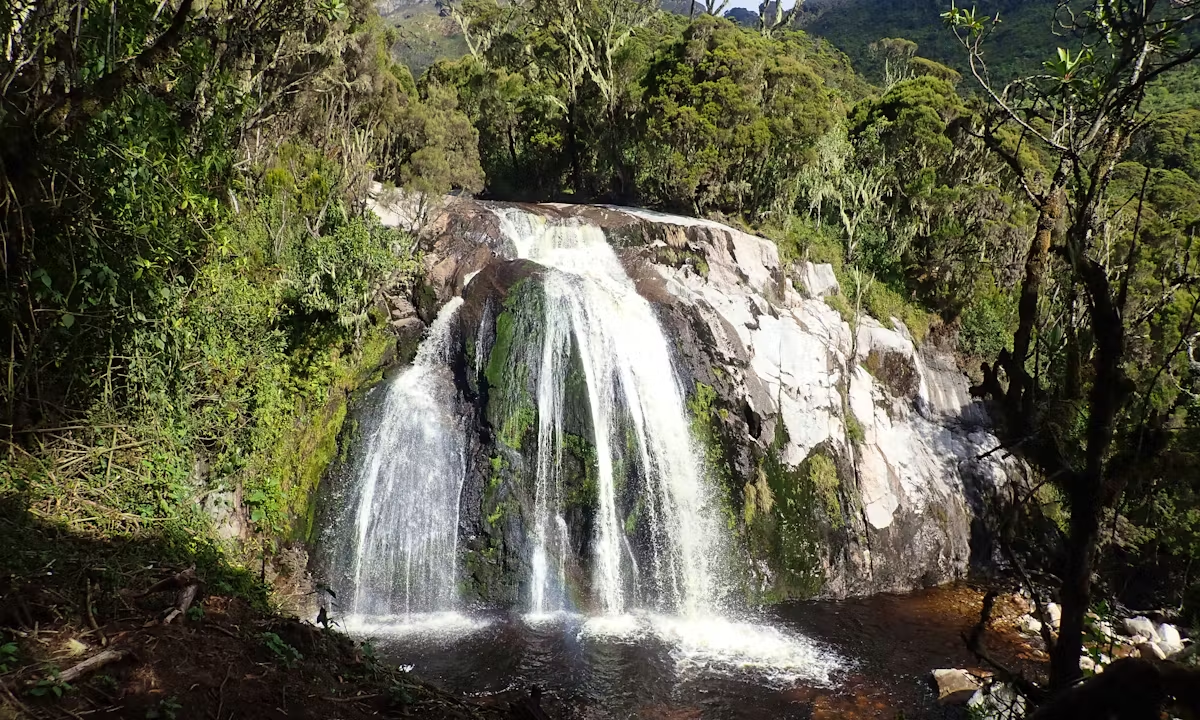
The Rwenzori Mountains are unlike any other range in Africa. Where Kilimanjaro rises as a single volcanic cone above the Tanzanian savanna, the Rwenzori is a block mountain formed by ancient tectonic uplift, a massif of jagged peaks, glaciated ridges, and deep valleys that are always wrapped in mist and equatorial weather. The mountain receives rainfall every month of the year, which has produced a botanical world found nowhere else on earth: forests of giant tree heather draped in lichen, valleys choked with six-meter Senecio trees, and moorlands studded with towering lobelia. When you climb the Rwenzori, you are not just ascending a mountain. You are passing through five completely distinct ecological worlds, each stranger and more beautiful than the last.
The 5-Day Margherita Peak Trek is the itinerary that suits the experienced trekker who cannot justify eight or ten days away from work but refuses to attempt the mountain without a complete summit experience. By moving more quickly through the lower zones and pushing to Elena Hut on Day 4 rather than spending an extra acclimatization night at Bujuku, this route keeps the pace deliberately high. The payoff is that you experience every zone: montane forest, bamboo, Afro-alpine moorland, high bog, and glaciated summit within five intense days.
Fewer than 5,000 people attempt the Rwenzori summit each year, compared to more than 50,000 on Kilimanjaro. You will share the trail only with your guide team and the occasional other expedition. On the summit snowfields, you may be entirely alone standing on equatorial ice in the heart of Africa, staring down at a continent that has no idea you are there. The Rwenzori glaciers are retreating rapidly, making the climb a genuinely time-sensitive experience. Scientists project that the glaciers of the Stanley Plateau will largely disappear by 2040-2050. The 5-day route is your fastest, most credible path to standing on them.
Compared to the 7-day Margherita Peak Climb, which is our recommended standard route, the 5-day itinerary sacrifices one additional acclimatization night at Bujuku Camp and reduces your rest time on the mountain. For trekkers who have prior altitude experience above 4,000m and strong aerobic fitness, this trade-off is entirely manageable. For those who are newer to high-altitude trekking, we recommend the 7-day route without hesitation. Read our acclimatization guide to understand how the pace difference affects your body.
Full Day-by-Day Itinerary: 5-Day Rwenzori Trek to Margherita Peak
Day 1: Nyakalengija Gate to Nyabitaba Camp
Elevation: 1,646m – 2,652m (+1,006m gain) | Distance: ~8 km | Hiking Time: 4-5 hours
Your Rwenzori expedition begins at Nyakalengija Gate (1,646 m), the main entry point for the Central Circuit Trail located approximately 22 kilometers from Kasese town. After completing your park registration formalities at the Uganda Wildlife Authority ranger station and meeting your guide team and assigned porters, you set off into the lower montane forest shortly after 8:00am.
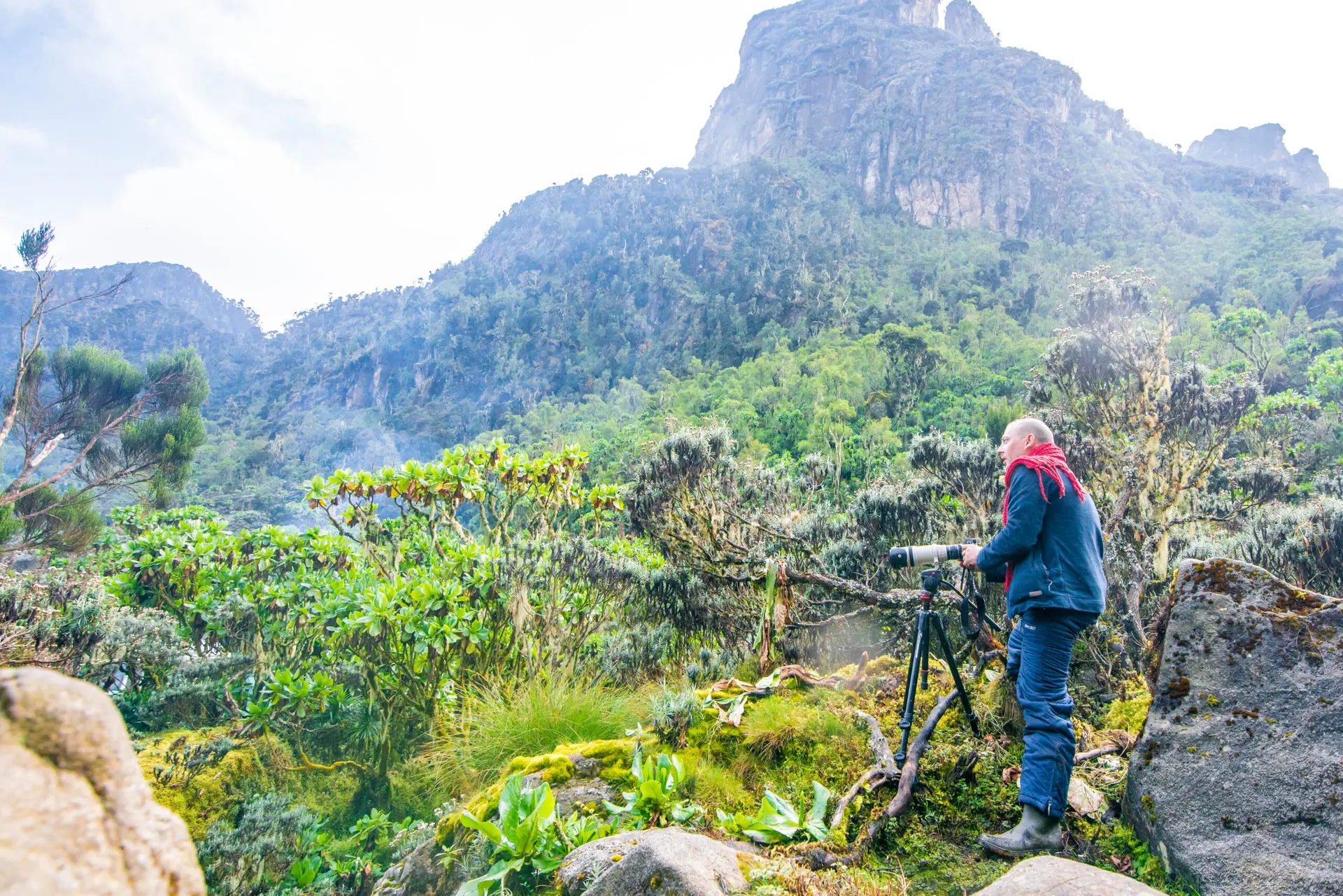
The first hour of walking follows a well-maintained footpath through lush, humid tropical forest. Sunlight filters through a dense canopy of Podocarpus and Symphonia trees. Listen for the Rwenzori turaco, a brilliantly crimson-winged bird found only on this mountain calling from the upper canopy. Olive sunbirds and the Rwenzori batis flit through the undergrowth. The forest floor is carpeted with ferns, mosses, and ancient tree roots that serve as natural stepping stones across the innumerable small streams that cross the trail.
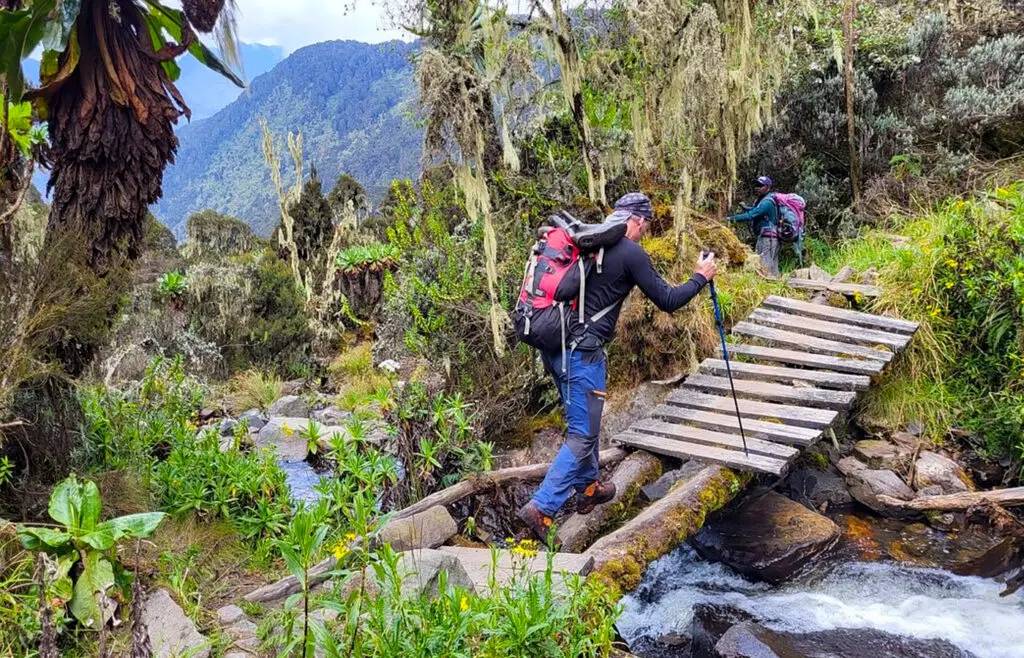
After roughly 2.5 hours, you cross the Mubuku River on a log bridge and begin the steepest section of the day, a sustained climb of about 400 metres through increasingly dense forest before the trail levels out onto the ridge where Nyabitaba Camp sits. The camp consists of a metal-frame hut with sleeping platforms and a separate cooking area. It stands on a prominent ridge with filtered views down the Mubuku Valley when the mist lifts in the late afternoon.
Your cook team will have lunch ready on arrival. The afternoon is yours to rest, dry your boots, and let your body begin adjusting to the altitude. Dinner is served inside the hut at dusk. Temperature at Nyabitaba drops to around 10-12 degrees Celsius overnight. Sleep comes easily after the first day’s effort.
Guide Insight: Day 1The trail from Nyakalengija to Nyabitaba looks deceptively gentle on paper. The humidity in the lower forest combined with the weight of your daypack makes the final climb to the ridge genuinely tiring. Pace yourself carefully on Day 1; your legs will need to carry you to 5,109 m over the next four days. |
Day 2: Nyabitaba Camp to Bujuku Camp
Elevation: 2,652m – 3,977m (+1,325m gain) | Distance: ~12 km | Hiking Time: 7-8 hours
Day 2 is the hardest single day of the trek and the section that distinguishes the 5-day itinerary from longer versions of the route. Whereas the 7-day program overnights at John Matte Camp (3,505 m) to allow for gradual acclimatization, the 5-day route pushes directly from Nyabitaba to Bujuku in a single sustained push. You will gain 1,325 metres of elevation over approximately 12 kilometers of increasingly challenging terrain. An early start at 6:30-7:00am is essential.
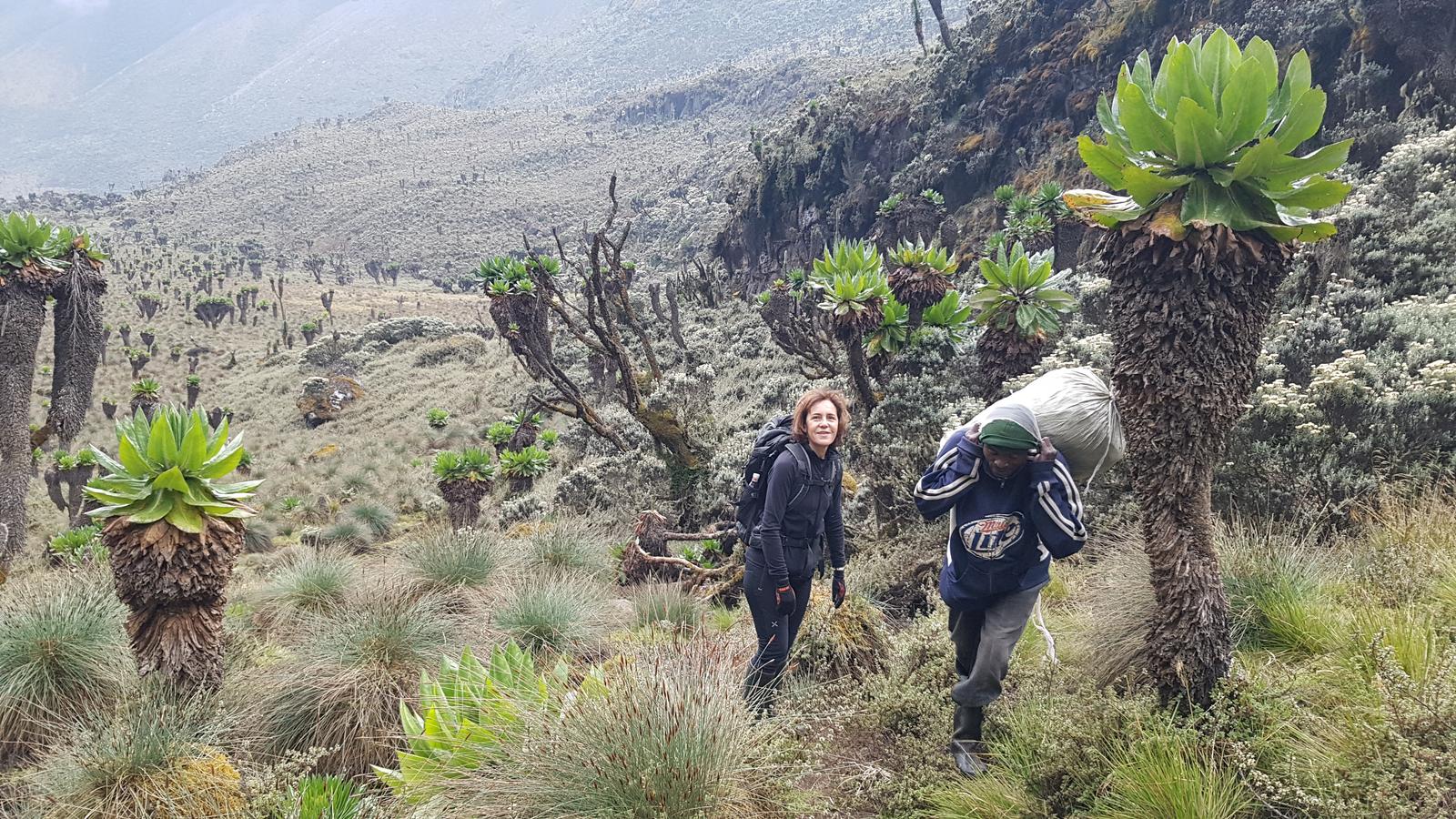
Leaving Nyabitaba, the trail descends briefly into the Mubuku River valley before crossing a second log bridge and climbing steeply through the beautiful moss-draped forest zone known locally as the bamboo zone. Giant groundsel trees (Senecio adnivalis) begin appearing from around 2,800m, first as scattered individuals and then as clusters that line the path. The vegetation starts to take on its characteristic Rwenzori strangeness; everything is oversized, moisture-laden, and ancient-looking.
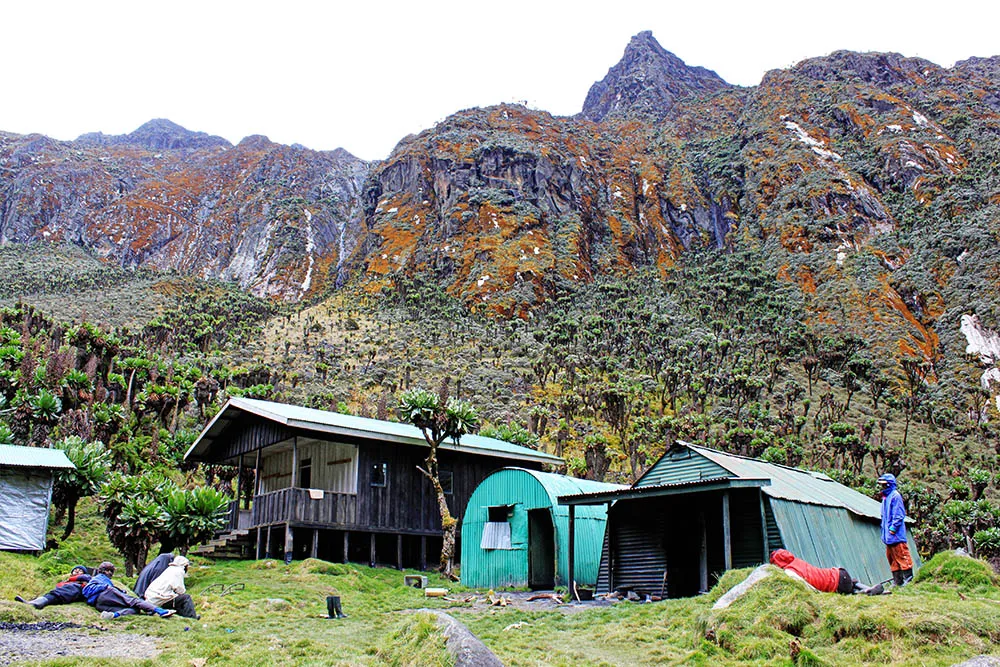
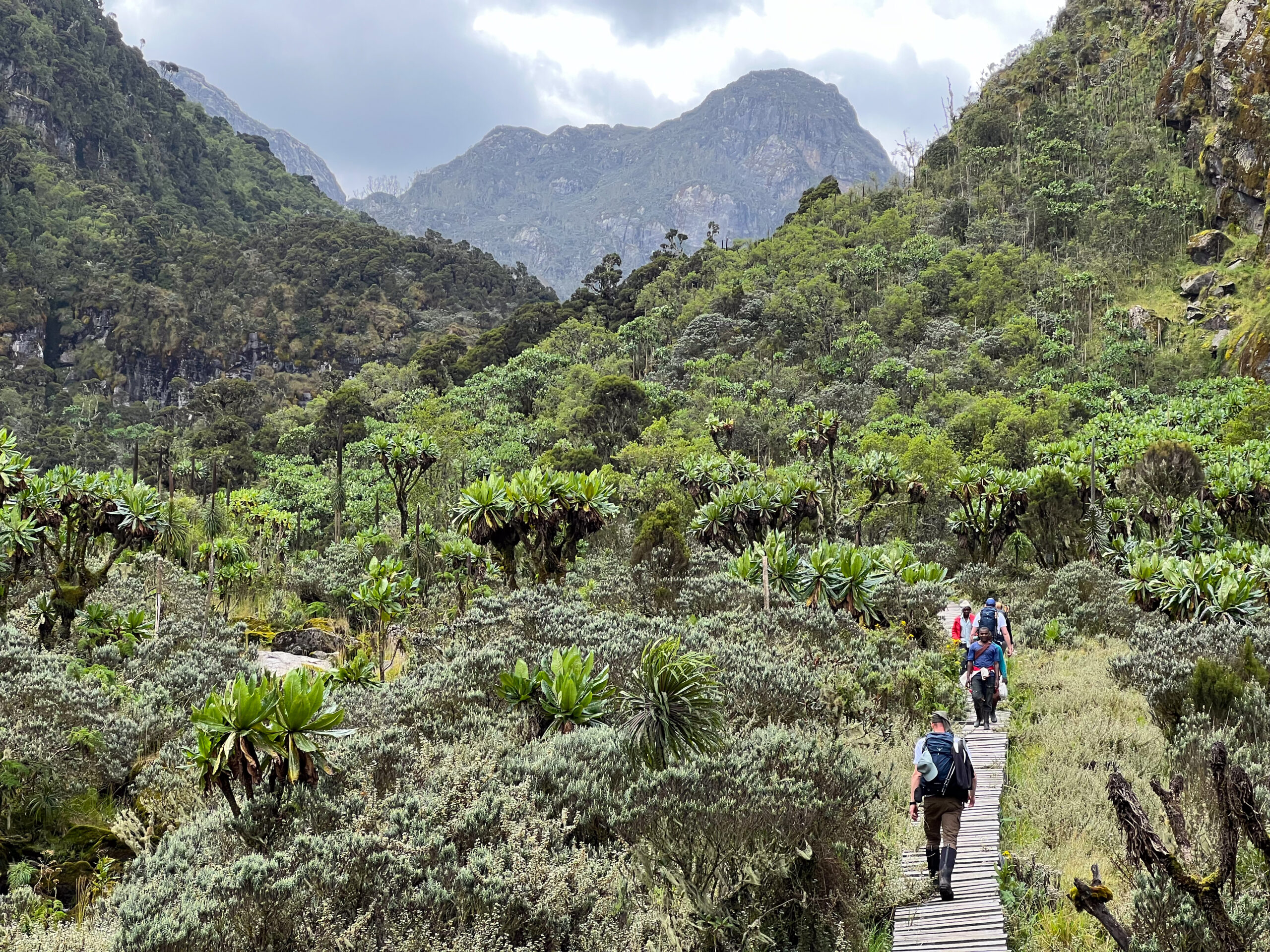
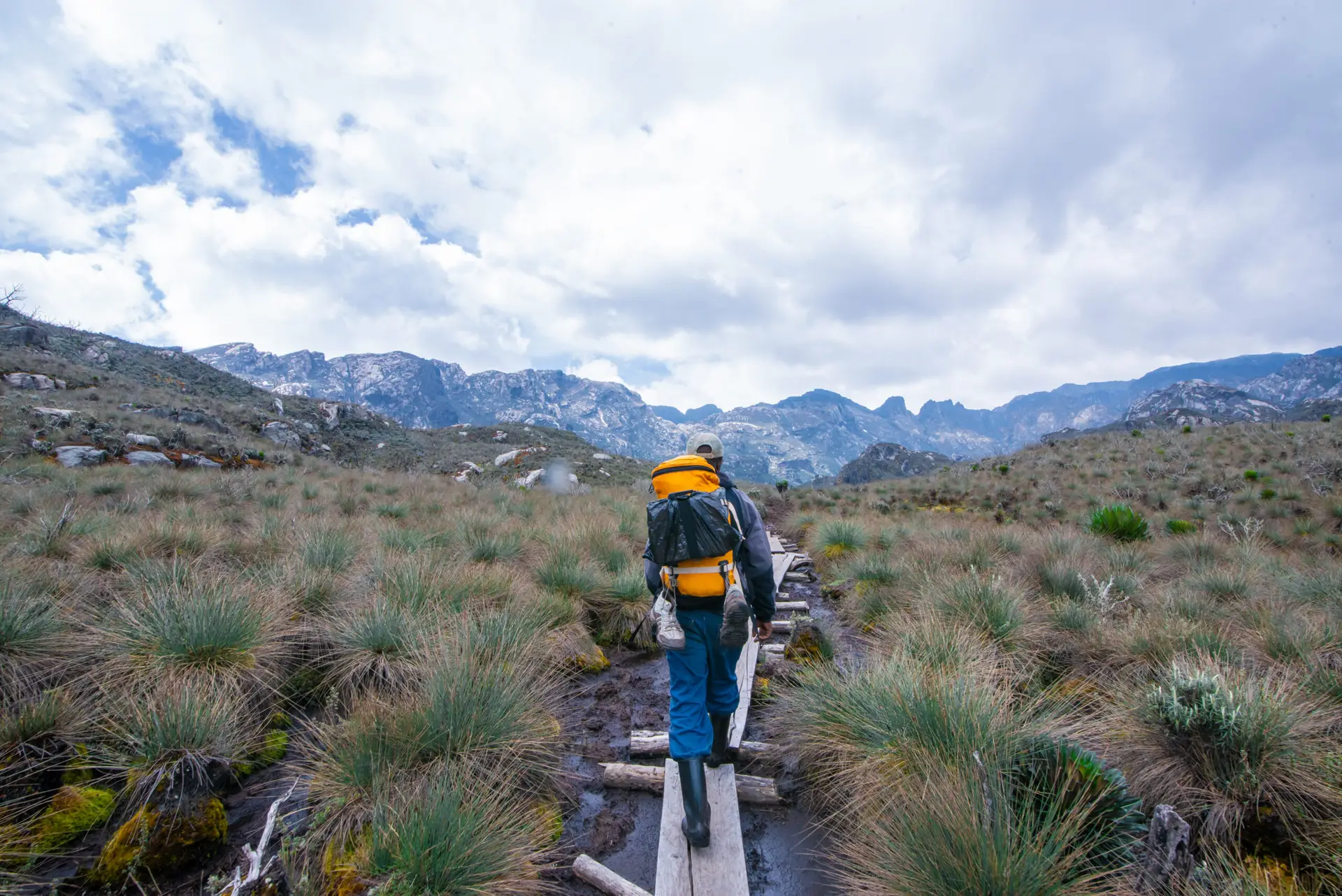
At John Matte Camp (3,505 m), roughly the halfway point of the day, you stop for a hot lunch served by your cook team, who have moved ahead to prepare it. Take at least 45 minutes here to eat, hydrate, and let your heart rate settle. From John Matte, the trail becomes progressively wetter and more technical, entering the iconic bog zone with its floating tussock-grass walkways and wooden duckboards. The combination of soft underfoot conditions, sustained climbing, and thinning air makes this upper section demanding.
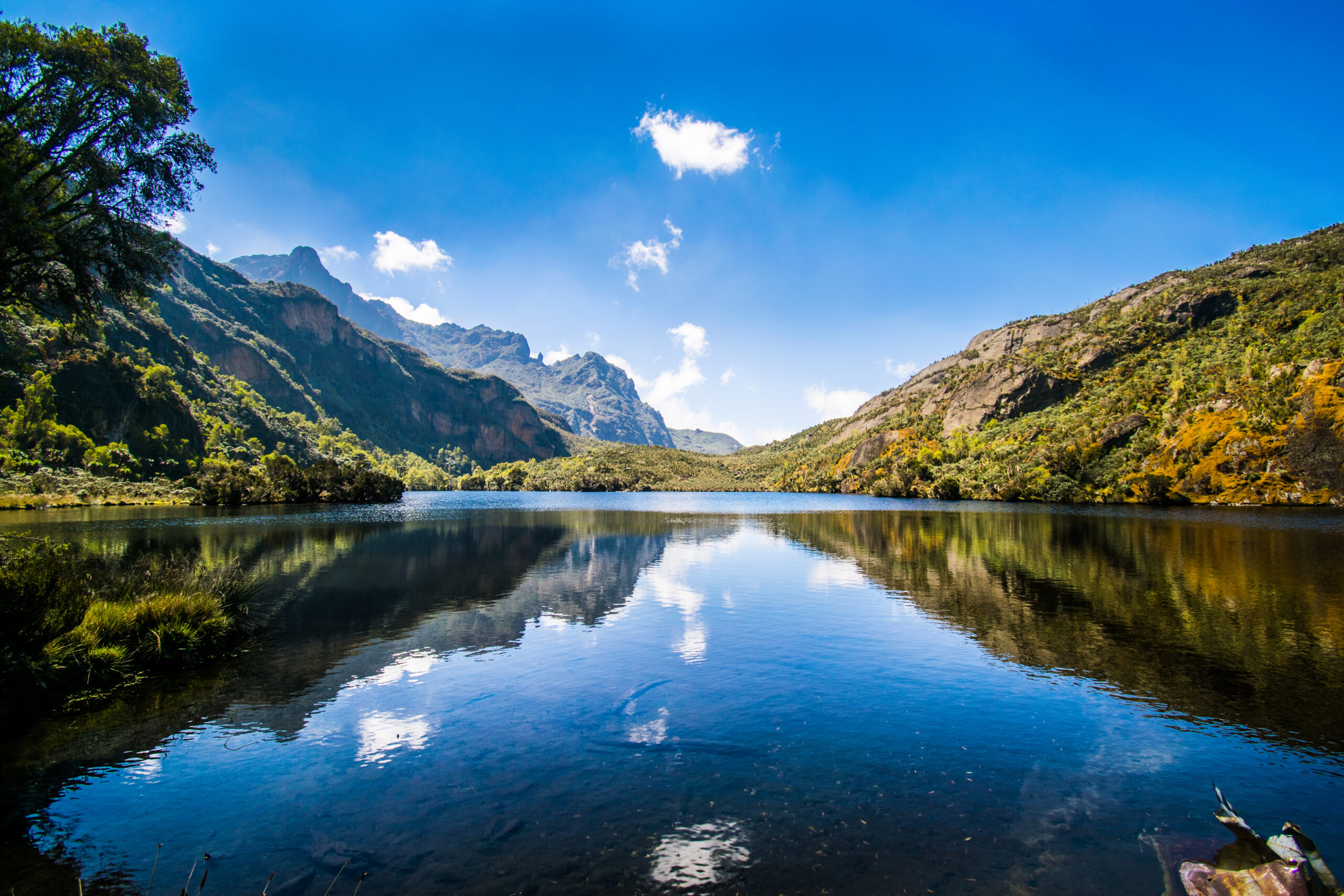
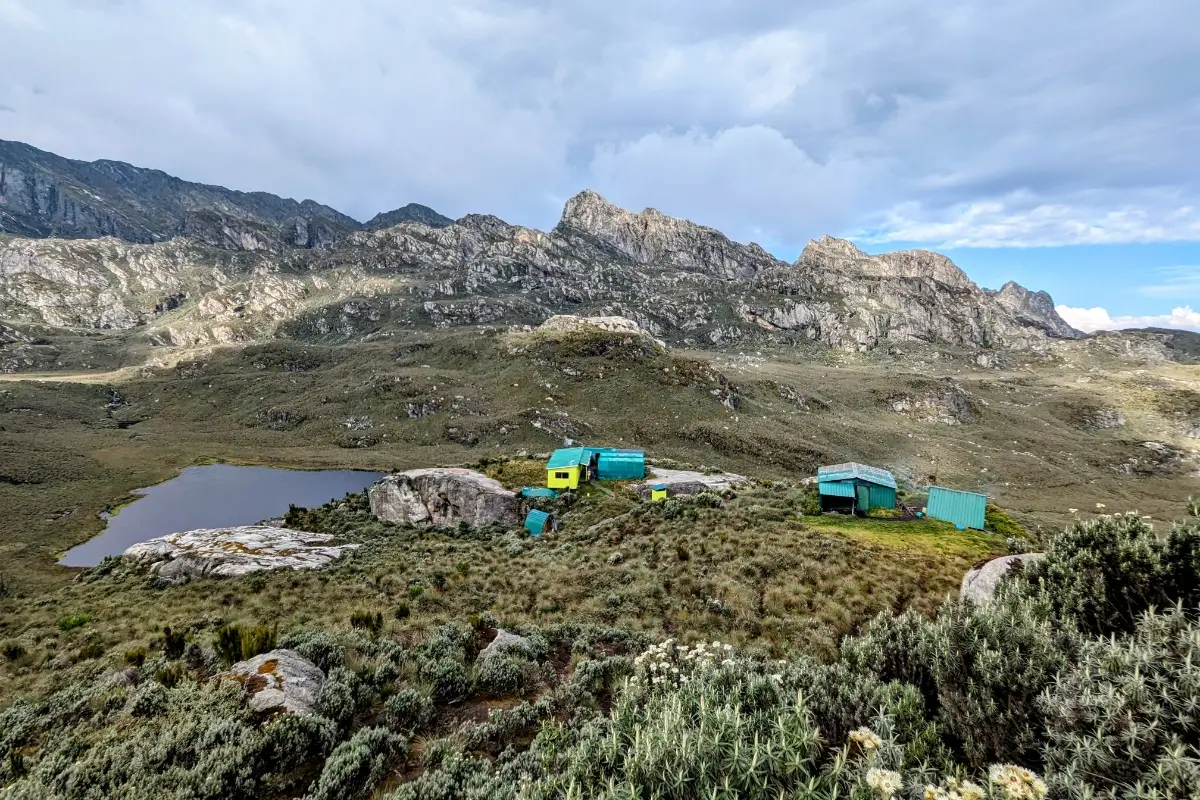
You arrive at Bujuku Camp (3,977 m) in the late afternoon, set in an extraordinary glacial valley beneath the sheer walls of Mount Baker to the south and the Stanley massif ahead. Lake Bujuku, a high-altitude glacial lake, reflects the peak above when the clouds clear. Your hut here is a metal-frame structure with sleeping platforms for up to 12 trekkers. Temperatures drop sharply after sunset; expect 2-6 degrees Celsius overnight. Hot soup and a substantial dinner are essential recovery fuel.
Warning: Altitude & Pace on Day 2Ascending 1,325m in a single day while already above 2,600m puts significant demands on your cardiovascular system. Headaches, reduced appetite, and slight nausea are common and normal at Bujuku. Drink at least 3-4 liters of water throughout the day. Inform your guide immediately if you feel disoriented, are unable to retain water, or develop a persistent headache that does not respond to rest and hydration. Read the full altitude acclimatization guide before your trek. |
Day 3: Bujuku Camp to Elena Hut (Acclimatisation & High Push)
Elevation: 3,977 m to 4,541 m (+564 m gain) | Distance: ~4 km | Hiking Time: 4-5 hours
Day 3 is the critical acclimatization day in the 5-day itinerary. The relatively short distance to Elena Hut (4,541 m) belies the seriousness of this push; you are crossing from the Afro-alpine zone into true glacier-margin terrain, and the body’s response to each additional 100 metres of altitude above 4,000 m becomes more pronounced. The trail from Bujuku climbs through increasingly rocky, frost-affected terrain above the tree line.
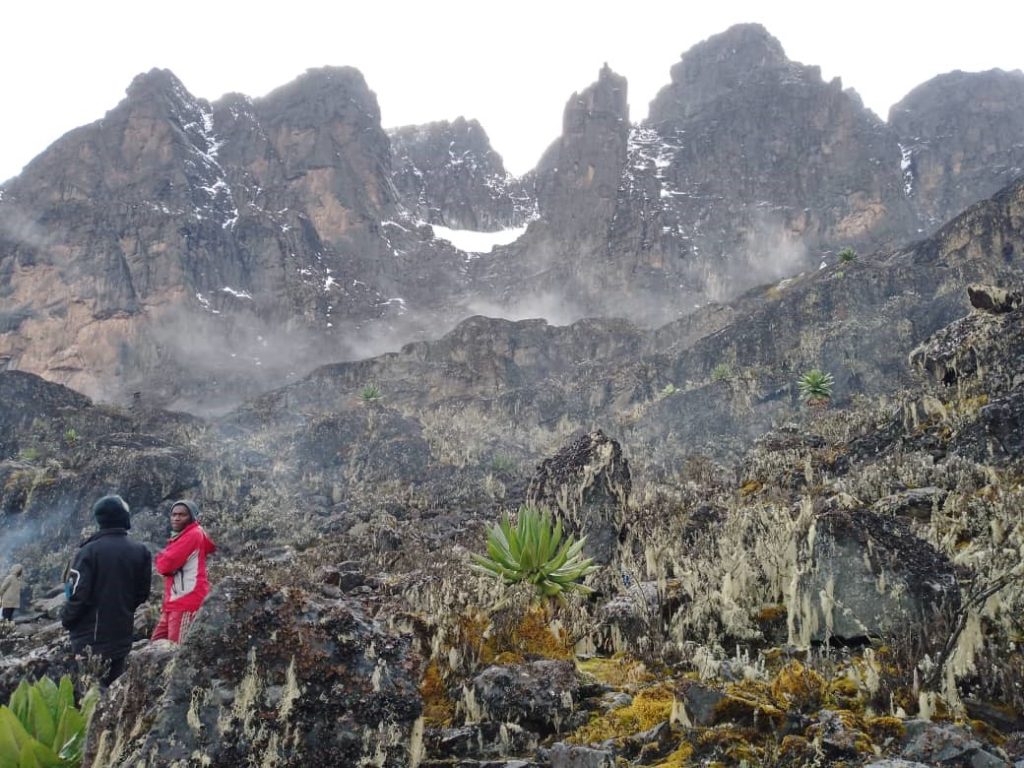
Leaving Bujuku Camp after breakfast, the path climbs directly toward the Stanley Plateau. The vegetation zones of the Rwenzori collapse rapidly as you gain altitude; the last giant lobelias yield way to open rock slabs dusted with lichen and frost. Crevassed ice fields become visible on the slopes of Mount Stanley above you. The trail is rocky, exposed, and demanding, with several short scrambling sections that require use of hands on wet rock.
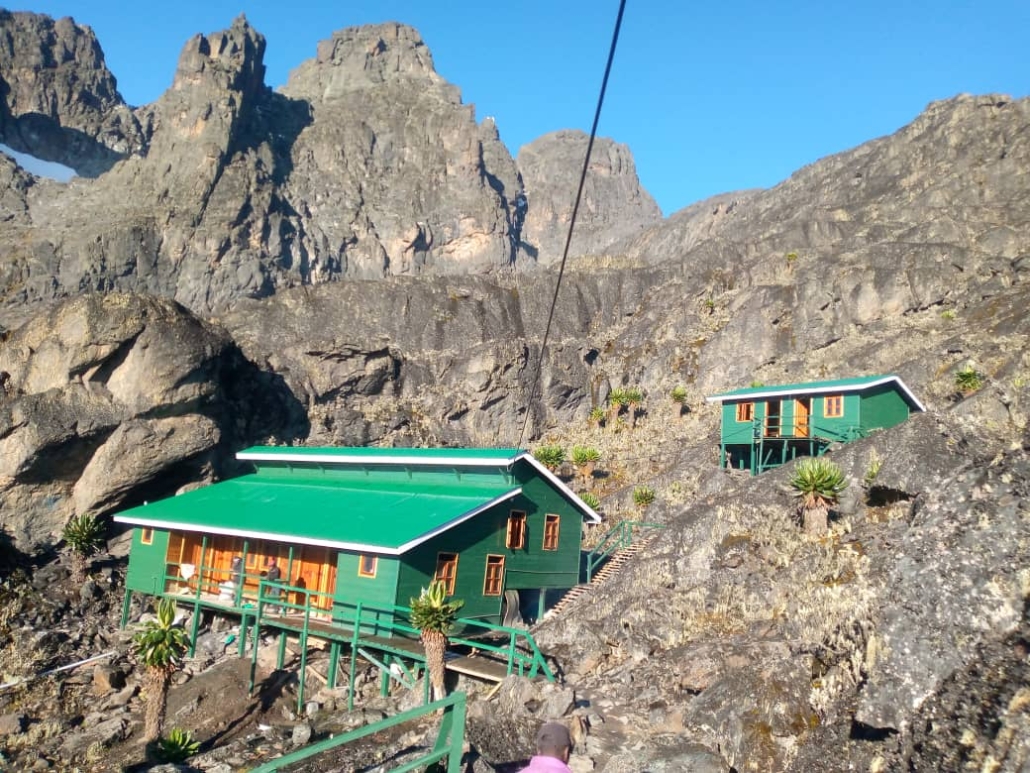
Elena Hut sits in a dramatic position on the Stanley Glacier’s lower moraine, directly beneath the ice. From the hut, the glaciated faces of Alexandra and Margherita Peaks are clearly visible above. On clear mornings, the view back down toward Bujuku Lake and across to Mount Speke is extraordinary. If the afternoon clouds clear, the hut is one of the finest photography positions in the entire Rwenzori Range.
Use the afternoon for genuine rest. Drink steadily, eat your full dinner even if your appetite is reduced, and sleep as early as possible. Your summit bid begins before 4:00am on Day 4. Ensure your guide checks your crampons, harness, and rope connections before last light. Night temperatures at Elena Hut drop to minus 5 to minus 10 degrees Celsius.
Guide Insight: Elena HutThe night at Elena Hut is the physical and psychological crux of the entire trek. Many trekkers struggle to sleep above 4,500 m. Thin air, cold, and pre-summit nerves combine to make deep sleep difficult. This phenomenon is entirely normal. Focus on staying warm, horizontal, and hydrated rather than chasing sleep. Your body continues acclimatizing even during restless sleep. Lay your summit clothing, head torch, and snacks out before you sleep so the 3:30am gear-up is smooth and efficient. |
Day 4: Elena Hut to Summit Margherita Peak (5,109m), Descend to Bujuku.
Elevation: Elena Hut 4,541 m – Summit 5,109 m (+568 m), then descend to Bujuku 3,977 m | Distance: ~8 km total | Hiking Time: 9-11 hours total
Day 4 is the summit day – the day the entire trek has been building toward. Your guide wakes the team at 3:30am. The staff serve hot tea and a light breakfast (porridge or bread with honey) before departure. By 4:00am, headtorches on, crampons fitted, harnesses checked, and ropes coiled, you move out of Elena Hut and begin the final ascent to the roof of Uganda.
The first section above Elena Hut follows the lower Stanley Glacier moraine in darkness, using trekking poles and careful footwork on the icy rock. As the angle steepens onto the glacier itself, your guide ropes the team together. The crampon technique is straightforward but must be precise, with flat-footed steps, controlled pace, and constant communication with your guide about footing conditions. Many trekkers find the glacier section liberating rather than frightening: the surface is solid, the exposure is manageable with a skilled guide, and the pre-dawn silence is absolute.
The summit ridge of Margherita comes after approximately 3-4 hours from the Elena Hut. The final metres involve a short, steep ice slope to which your guide will fix a rope for your security. Then you are there: 5,109 metres above sea level, standing on a narrow icy summit with Uganda visible in all directions through the thin, blue-cold air. On clear summit mornings, you can see Lake Edward to the south, the Congolese Virunga volcanoes on the horizon, and the vast green carpet of the equatorial forest below. Allow at least 20-30 minutes on the summit for photographs, celebration, and simply absorbing the scale of what you have just achieved.
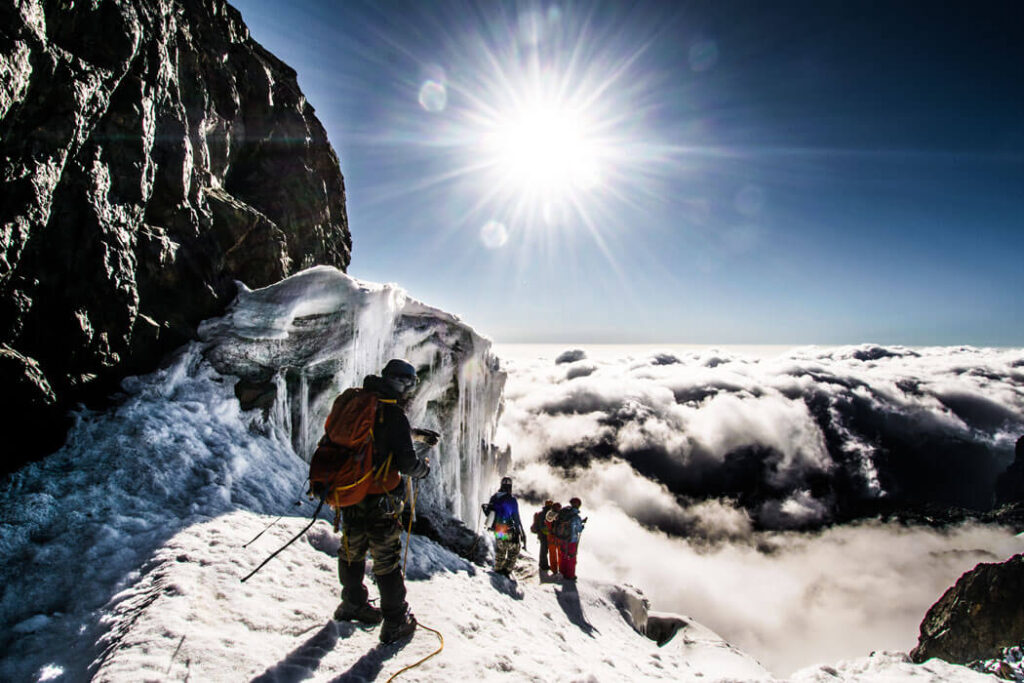
The descent from Margherita to Elena Hut reverses the glacier route, typically taking 2 hours. After warming up with hot drinks at Elena Hut, the team continues down to Bujuku Camp for the night, a descent of approximately 4 kilometers and 564 meters that takes 2 to 3 hours. Your cook team will have a warm meal waiting. The psychological release of the summit, combined with genuine physical exhaustion, produces extraordinarily deep sleep at Bujuku on summit night.
Warning: Summit ConditionsThe Margherita Peak summit is a glaciated alpine environment. Crevasses exist on the Stanley Glacier and must be avoided under guide direction at all times. Never move ahead of your guide on the glacier. Fixed ropes are rigged at technical sections and must be used correctly. Our guides are certified by the Uganda Wildlife Authority and have completed this route more than 200 times collectively. Trust their judgment on snow and ice conditions. The guide makes turnaround decisions, not the client. |
Day 5: Bujuku Camp to Nyakalengija Gate (Full Descent)
Elevation: 3,977 m – 1,646m (-2,331 m descent) | Distance: ~17 km | Hiking Time: 7-9 hours
The final day is the longest descent of the trek, a continuous 17-kilometer walk back down the mountain from Bujuku Camp through the full sequence of vegetation zones to the trailhead. After the intensity of Day 4, many trekkers are surprised by how much their legs still have left. The key is consistent pacing and early departure (by 6:30-7:00 am) to ensure a comfortable arrival at Nyakalengija before dark.
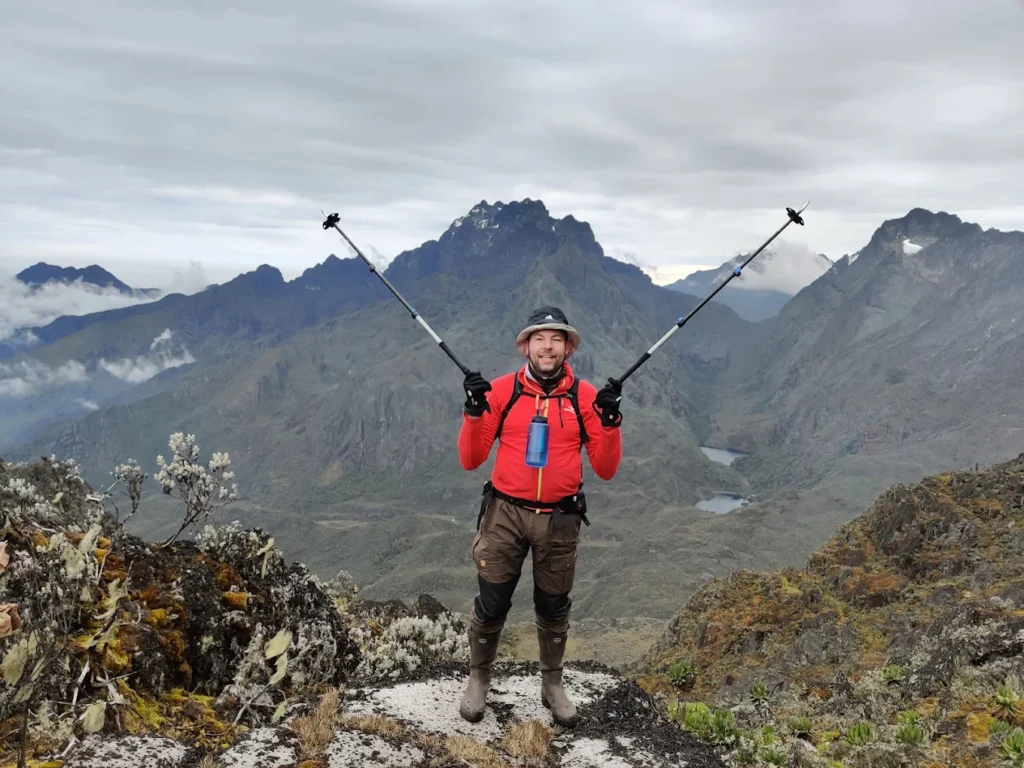
The descent retraces the approach route through the Afroalpine moorland, the giant groundsel forest, the bamboo zone, and finally back into the lush montane forest. What took two days on the ascent compresses into one long day on the way down. The contrast is striking; descending through the giant lobelia fields in morning light, watching the vegetation fill back in as altitude drops, feels like a slow return to the living world from the frozen zone above.
John Matte Camp is the natural lunch stop at the midpoint of the day. Your cook team will prepare a full hot lunch before the final 9-kilometre descent to Nyakalengija. The lower forest section, familiar from Day 1, passes quickly on weary but purposeful legs. Arriving at Nyakalengija Gate feels like a genuine homecoming. The park rangers issue certificates of ascent here. Your transport back to Kasese or your onward destination departs from the gate.
Many trekkers choose to spend the night at a guesthouse or lodge near Kasese to rest before onward travel. The accommodation guide for Kasese and Fort Portal covers all options from budget guesthouses to the comfortable Rwenzori Backpackers and Sandton Hotel. We recommend booking your first post-trek night in advance, as availability in Kasese can be limited during peak trekking season.
Guide Insight: Day 5 DescentThe last day descends more than 2,300 vertical metres on legs that carried you to 5,109 m the previous morning. Trekking poles are invaluable on the steep forested sections. Take them on your daypack regardless of pack weight. Your knees will thank you. Drink consistently; dehydration is the most common cause of cramps and exhaustion on descent days. |
Elevation Profile: 5-Day Margherita Peak Trek
| Day / Section | Elevation Range | Net Change |
| Day 1: Nyakalengija – Nyabitaba | 1,646 m to 2,652 m | +1,006 m gain |
| Day 2: Nyabitaba – Bujuku | 2,652 m to 3,977 m | +1,325 m gain |
| Day 3: Bujuku – Elena Hut | 3,977 m to 4,541 m | +564 m gain |
| Day 4: Elena Hut – Margherita – Bujuku | 4,541 m to 5,109 m, then 3,977 m | +568 m / -1,132 m |
| Day 5: Bujuku – Nyakalengija | 3,977 m to 1,646 m | -2,331 m descent |
| TOTALS | 5,109 m peak elevation | +3,463 m up / -3,463 m down |
The elevation arc of the 5-Day Margherita Peak Trek is notably aggressive by East African trekking standards. The ascent averages 866m of net elevation gain per trekking day across the first three days, with the critical summit push on Day 4 adding a further 568m to the glacier. The descent on Day 5 loses 2,331 m in a single sustained push. This compression is the defining characteristic of the 5-day itinerary and is why the trek demands prior high-altitude experience from all participants.
Camps & Accommodation on the 5-Day Trek
All accommodation on the Rwenzori Central Circuit is provided in metal-frame mountain huts managed by the Uganda Wildlife Authority. The full guide to mountain huts and campsite facilities covers every camp in detail, but below is what you specifically need to know about the four camps used on the 5-day itinerary.
Nyabitaba Camp (2,652 m)
Located on a forest ridge above the Mubuku Valley, Nyabitaba is the standard first-night stop for all Central Circuit expeditions. The hut has two sleeping rooms with raised wooden sleeping platforms and foam mattresses. The guide and cook team use a separate cooking shelter. Water is sourced from a stream a short walk from the hut. Dry firewood is available for the evening fire in cold weather. The camp has a basic long-drop toilet. Mobile phone signal (MTN Uganda) is occasionally available from the ridge when the skies are clear.
Bujuku Camp, 3,977 m (Nights 2 and 4)
Bujuku is the emotional heart of the Rwenzori trekking experience, a glacially carved valley surrounded by the three towering peaks of Stanley, Speke, and Baker. The camp sits directly beside Lake Bujuku, a small, cold, dark-watered glacial lake. The hut structure is similar to Nyabitaba but with a more exposed position that makes it colder at night. Sleeping temperatures regularly drop to 3-5 degrees Celsius. A second smaller shelter accommodates cook and guide teams. The sunsets and sunrises at Bujuku, when the cloud breaks, are among the finest mountain views in Africa.
Elena Hut (4,541 m)
Elena Hut is the highest overnight point on the 5-day itinerary, positioned on the lower moraine above Bujuku with the Stanley Glacier visible immediately above. The hut is a single metal-frame structure with sleeping platforms for 8-10 trekkers. Conditions are spartan, and cold temperatures drop to minus 5 to minus 10 degrees Celsius on clear nights. There is no running water; your guide will collect glacier meltwater for cooking. Elena Hut is the launch point for the 4:00am summit bid, where all gear should be organized and checked the evening before.
Accommodation NoteAll mountain huts are managed by Uganda Wildlife Authority and are included in your park fees. You do not need to bring a tent. A sleeping bag rated to at least -10 degrees Celsius is mandatory. Camp mattresses are provided, but a lightweight sleeping mat liner adds meaningful warmth. Your dedicated cook team prepares all meals on the mountain using fresh ingredients that your porter team carries in. |
Flora & Wildlife on the 5-Day Trek
The Rwenzori’s vegetation zones are among the most botanically extraordinary environments on earth. Compressed into a vertical span of roughly 3,500 metres, five distinct ecological worlds transition with an abruptness that consistently astonishes first-time visitors. The 5-day itinerary traverses all five zones, from the humid montane forest at Nyakalengija to the barren glacier margin above Elena Hut.
In the lower forest zone (1,600m-2,500m), expect to encounter the following regularly: the Rwenzori turaco (Ruwenzorornis johnstoni) with its vivid crimson wing patches, the handsome francolin, the prehistoric-looking Rwenzori double-collared sunbird, olive baboons moving along the forest floor, and black-and-white colobus monkeys in the upper canopy. Forest elephants occasionally use the lower slopes, though encounters are rare on the main trail.
From 2,500 m to 3,500 m, the forest transitions through a bamboo belt and into the iconic giant heather zone. Ancient tree heaths (Erica arborea and Philippia) grow to 10 metres or more, draped entirely in hanging lichen and moss. This is the environment that gave the Rwenzori its reputation as the world’s strangest mountain. The wildlife guide to the Rwenzori covers species in more detail, but in this zone, watch for the three-horned chameleon, hyraxes on rock outcrops, and the Rwenzori leopard, rarely seen but present throughout the range.
Above 3,500m, the giant groundsel trees (Senecio adnivalis) and giant lobelias (Lobelia wollastonii) take over. These prehistoric-looking plants are exclusive to the Afroalpine zone of Africa’s equatorial mountains and reach their most dramatic expression here in the Rwenzori. Individual Senecio trees can live for hundreds of years and grow to six metres tall. Above 4,200 m, all vegetation retreats to scattered cushion plants, lichen, and frost-resistant moss before giving way entirely to bare rock and glaciers.
Physical Difficulty & Fitness Requirements
The 5-Day Margherita Peak Trek is rated as Very Strenuous, the highest difficulty category we use for our itineraries. This rating reflects the compressed elevation gain schedule, the technical glacier section above Elena Hut, and the sustained nature of the Day 5 descent. It is not a rating to be taken lightly.
To complete this trek safely and enjoyably, you should be able to honestly answer yes to all of the following: You can hike 8-12 kilometers per day with 800-1,300 m of elevation gain, carrying a 10-12 kg daypack. You have completed at least one multi-day trek at altitude (above 3,500m). You can maintain a steady aerobic pace for 8 to 10 hours, with breaks. You have no significant cardiovascular or respiratory health conditions. You are comfortable navigating wet, muddy, and rocky terrain in sustained rain.
If you are training specifically for this trek, our fitness and training guide recommends a minimum 12-week preparation program that includes weekly long hiking days with altitude simulation (weighted vest/stair climbing), sustained cardio 4-5 days per week, core and lower-body strength training, and at least two practice multi-day hikes. Begin training at least three months before your departure date.
Altitude acclimatization on the 5-day itinerary is tighter than the 7-day route because you skip the additional night at Bujuku. To compensate, trekkers should arrive in Uganda without excessive jet lag (allow 24-48 hours), avoid alcohol for the 48 hours before the trek, hydrate aggressively from the day of arrival, and consider taking acetazolamide (Diamox) as a prophylactic after consultation with their doctor. Our medical team covers all altitude-related symptoms, their warning signs, and the mandatory descent protocol in the complete medical guide to Rwenzori trekking.
Trekkers over 50 should read the guide for older trekkers before committing to the 5-day itinerary. We have guided trekkers in their 60s successfully to Margherita Peak, but they have universally done so on the 7-day or 8-day schedules, which allow more recovery time.
Best Time to Climb the Rwenzori: 5-Day Margherita Trek
The Rwenzori receives precipitation every month of the year; it is one of the wettest mountain ranges in Africa. However, two drier windows offer significantly more reliable conditions: December through early March and June through August. Our complete best time to visit guide breaks the information down in full detail.
| Month | Conditions & Suitability |
| December – February | Best conditions. Drier, clearer summit views. Recommended. |
| March | Good but transitional. Some afternoon showers are building. |
| April – May | Heaviest rains. The trails are muddy and technically demanding. Not recommended for a 5-day trip. |
| June – August | Second dry season. Excellent conditions. Most popular months. |
| September – October | Transitional. Variable. Possible but expect wet days. |
| November | Short rains. Trails wet. A 7-day route is recommended over a 5-day route. |
For the 5-day itinerary specifically, the drier seasons are more important than for longer itineraries because you have less buffer time if inclement weather delays the summit push. A two-day weather window on the glacier is sufficient for the standard summit attempt, but in the wet seasons, these windows can be unreliable. If you must travel in the shoulder seasons, consider upgrading to the 6-day or 7-day itinerary to build in extra weather contingency.
What’s Included & What’s Not Included
What Is Included
- Uganda Wildlife Authority park entry fees for all 5 days
- Licensed lead mountain guide (certified by UWA, English-speaking)
- Assistant guide (one per four trekkers minimum)
- Dedicated cook with full equipment
- Porter team (one porter per trekker for personal luggage up to 15kg)
- All mountain hut accommodation (Elena Hut, Bujuku, Nyabitaba)
- All meals on the mountain (3 meals per day plus tea/snacks)
- Glacier equipment (crampons, rope, harness issued at Elena Hut)
- Summit certificate issued by Uganda Wildlife Authority on completion
- Emergency communication device carried by lead guide
- Airport/hotel transfers from Kasese (other pickup points by arrangement)
What Is Not Included
- International flights and Uganda visa fees
- Travel insurance (mandatory; see insurance requirements below)
- Personal trekking gear (sleeping bag, trekking poles, waterproof clothing, boots)
- Tips and gratuities for guide, cook, and porter team
- Personal medication, including altitude medication (Diamox)
- Any beverages beyond water and tea on the mountain
- Pre- and post-trek accommodation in Kasese or Kampala
- Any costs arising from early descent or emergency evacuation
Full Packing & Gear List: 5-Day Margherita Peak Trek.
The Rwenzori is wet, cold at altitude, and technically demanding above 4,500m. Gear selection is more important here than on most African treks. Our full Rwenzori packing list covers every item in detail, but the following are the non-negotiables for the 5-day trek.
Footwear
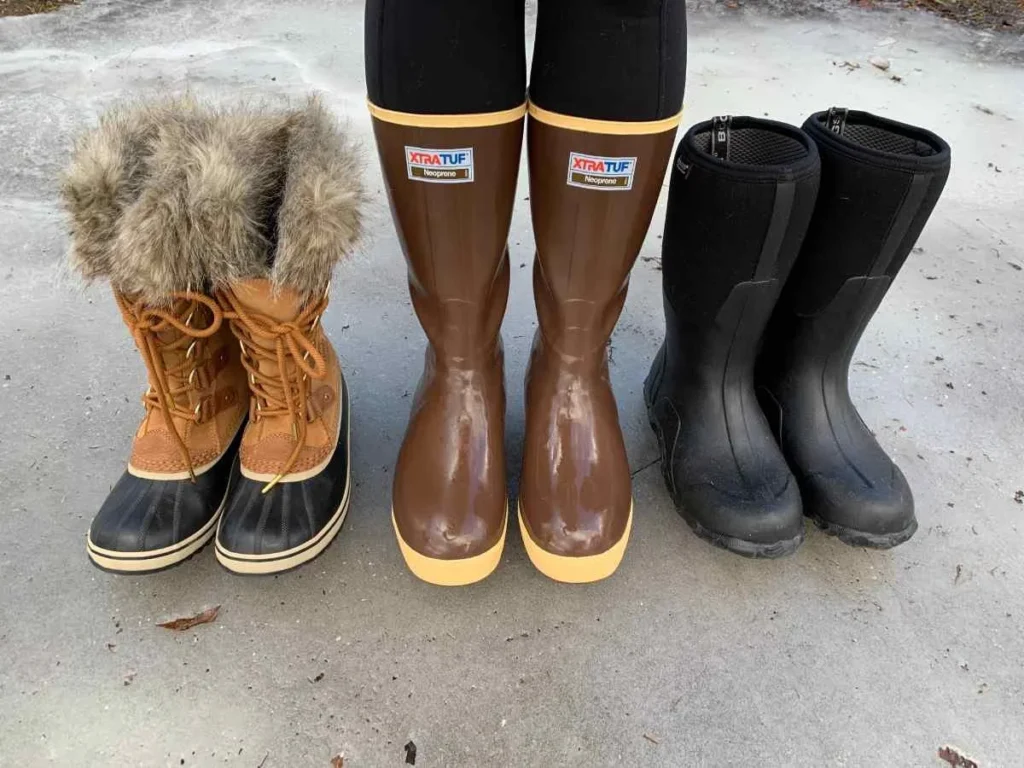
You will wear two types of footwear on this trek. Waterproof rubber boots (Bogs, Hunter, or similar) are mandatory on the lower and mid-mountain trails due to deep mud and bog crossings. Above Elena Hut, your guide switches to crampons for glacier travel. Our rubber boot and footwear guide explains what to bring and what to hire locally in Kasese.
Clothing System
- Moisture-wicking base layer top and bottom (2 sets minimum)
- Mid-layer fleece or softshell jacket (250-weight minimum)
- Insulated jacket (down or synthetic, rated to -10°C) essential for Elena Hut and summit
- Waterproof hard-shell jacket and trousers – fully taped seams required
- Warm hat covering ears, neck gaiter or balaclava
- Lightweight gloves (liner) plus insulated waterproof outer gloves for summit
- Thick wool or synthetic trekking socks x 4 pairs
- Dry camp shoes or lightweight trainers for hut use
Sleeping & Camp Gear
- A sleeping bag rated to 10 degrees Celsius mandatory
- Lightweight sleeping bag liner (silk or fleece adds 3-5 degrees)
- 35-45 litre daypack with rain cover
- Dry bags or heavyweight bin liners for electronics and spare clothes
Technical & Summit Gear
Rwenzori Trekking Safaris provides crampons, harness, and summit rope and fits them at Elena Hut. You do not need to bring these items. You must bring:
- Headtorch with spare batteries – LED, minimum 300 lumens. The summit starts at 4:00am.
- Trekking poles x 2 essential for bog sections and long descents
- Gaiters (for rubber boot interface and lower leg mud protection)
Health & Safety
- Comprehensive travel insurance documents copies carried on your person
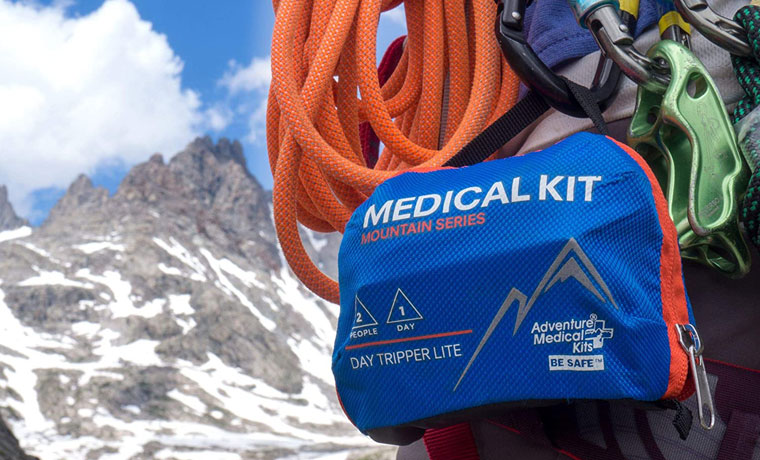
- Personal first-aid kit: blister treatment, ibuprofen, antihistamine, anti-diarrhoeal
- Altitude medication (Acetazolamide/Diamox) – prescribed by doctor before travel
- Water purification tablets or a filter bottle as backup
- High-factor sunscreen (SPF 50+) and glacier goggles or sunglasses
Rwenzori Permits, Park Fees & Costs
The Uganda Wildlife Authority (UWA) manages all trekking in Rwenzori Mountains National Park and requires prepaid permits. Our complete cost breakdown for 2026 covers all fees in detail. The table below reflects the fees applicable to the 5-day Central Circuit Trek.
| Fee Category | 2026 Rate (USD) |
| Park Entry (per person, per day) x 5 | $45 x 5 = $225 |
| Hut Accommodation (per person, per night) x 4 | $20 x 4 = $80 |
| Lead Guide Fee (per day) x 5 | $30 x 5 = $150 |
| Assistant Guide (per day) x 5 | $20 x 5 = $100 |
| Cook Fee (per day) x 5 | $20 x 5 = $100 |
| Porter Fee per porter (per day) x 5 | $15 x 5 = $75 per porter |
| Rescue Fund (mandatory UWA levy) | $35 per person |
| Glacier/Summit Equipment (crampons, rope, harness) | Included in package |
Total operator package pricing varies by group size. Our standard all-inclusive 5-day Margherita Peak Trek package begins at approximately USD $1,400 per person for a group of two trekkers and reduces per person as the group size increases. Prices include all permits, guides, cooks, porters, mountain accommodation, meals, and glacier equipment. They do not include international flights, visas, personal gear, or gratuities.
Contact us for a personalized quote based on your group size and travel dates. Quotes are provided within 24 hours.
The most common post-trek question we receive about tipping your guide, cook, and porter team is, “Read our porter and tipping guide.”
Getting to Nyakalengija: Transport & Logistics
The Nyakalengija trailhead is located approximately 22 kilometers northeast of Kasese town in western Uganda. Our complete transport and logistics guide covers all options in detail.
From Kampala
Kampala to Kasese is approximately 380 kilometers by road, taking 5-6 hours in normal traffic on the Kampala-Fort Portal-Kasese highway. We provide private 4WD vehicle transfers for all our trekkers from Kampala, Entebbe Airport, or Fort Portal. Shared post buses depart Kampala’s Kisenyi Bus Terminal for Kasese daily. From Kasese, a dedicated vehicle or boda-boda taxi makes the 30- to 40-minute transfer to Nyakalengija Gate.
From Entebbe International Airport
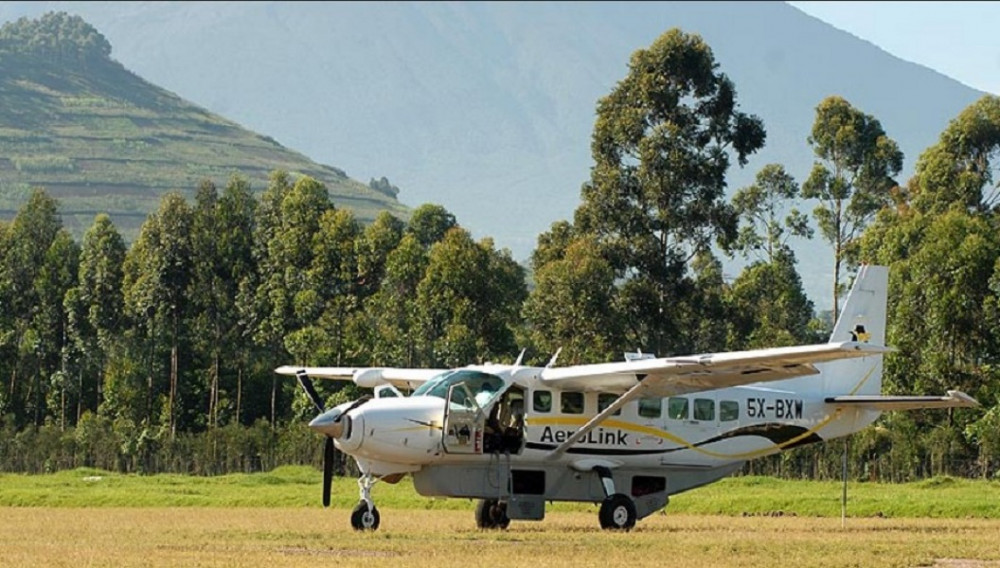
Entebbe to Kasese is approximately 430 kilometers and takes 6-7 hours. Trekkers arriving on international flights should allow a full day’s buffer between arrival and trek start date. We recommend arriving in Kasese the evening before Day 1 to allow for a good night’s sleep, gear checks, and a briefing with your guide team.
Our Kasese town guide covers recommended pre-trek accommodation, restaurants, and equipment hire options in Kasese.
Travel Insurance Requirements
WARNING: Travel insurance is mandatory.All trekkers on the 5-Day Margherita Peak Trek are required to carry valid travel insurance that covers emergency medical evacuation from altitude (minimum coverage: USD $250,000), trip cancellation, and repatriation. We will ask to see your policy documents at the pre-trek briefing. Trekkers without valid insurance will not be allowed to begin the trek. Read our complete insurance guide for Rwenzori trekkers for recommended providers and policy requirements. |
Book Your Slot
Respond within Minutes
From
$1,400
per person
- Duration 5 Days / 4 Nights
- Group Size 1–12 people
- Start Point Nyakalengija
- Departures Year-round
- Summits Margherita Peak
No booking fee. Free cancellation up to 30 days before departure. We respond within Minutes.
Our Popular Rwenzori Treks
Magheritah Peak (8 Days Kilembe Trail)
$1705 Per Person
Mutinda LookOut (4 Days)
$645 Per Person
Short Magherita Hike (5 Days Central Circuit)
$1200 Per Person
Rwenzori Hike (7 Days Central Circuit)
$1400 Per Person
Frequently Asked Questions: 5-Day Rwenzori Trek to Margherita Peak
How difficult is the 5-day Rwenzori Trek to Margherita Peak compared to the 7-day route?
The 5-day Margherita Peak Trek is significantly more demanding than the 7-day itinerary. The primary difference is the elevation gain compressed into each day; the 5-day route averages over 800 m of net gain per ascending day, with one day reaching 1,325 m of gain. The 7-day route spreads the elevation gain over more days, allowing a critical extra acclimatization night at both John Matte and Bujuku camps. For trekkers with prior high-altitude experience (above 4,000m), the 5-day route is entirely achievable. For first-time high-altitude trekkers, we strongly recommend the 7-day option. Read the full difficulty comparison for a detailed breakdown.
Do I need glacier and mountaineering experience to climb Margherita Peak on this route?
You do not need prior mountaineering experience for the glacier section above Elena Hut, but you must be comfortable with exposure on steep terrain and have no history of severe altitude sickness. Your certified guide will rope the team together for glacier travel, brief all trekkers on crampon technique and rope protocol at Elena Hut the evening before the summit bid, and make all decisions about route and safety on the glacier itself. The technical difficulty of the glacier crossing is graded as moderate alpine and is accessible to any fit, experienced trekker under competent guidance.
What is the success rate for summiting Margherita Peak on the 5-day itinerary?
Our overall summit success rate for Margherita Peak across all itineraries is approximately 85%. For the 5-day itinerary specifically, the success rate is slightly lower than the 7-day route, at approximately 75-80%, primarily because the reduced acclimatization time results in a higher incidence of altitude-related fatigue and headaches, which lead some trekkers to make the sensible decision to descend from Elena Hut rather than push to the summit. The trekkers who succeed on the 5-day route are typically those who arrive fit, well-prepared, and have prior altitude experience. Read our full summit success rate analysis.
How wet and muddy is the trail on the 5-day Central Circuit Trek?
The Rwenzori is one of the wettest mountain ranges in Africa, and the Central Circuit trail is genuinely muddy, particularly in the bog zone between John Matte and Bujuku. This is not a dry alpine trail. Rubber boots are mandatory equipment on this route, not optional, because long sections of the path cross floating grass tussocks over soft peat bog where conventional trekking boots would submerge entirely. In the dry seasons (December-March and June-August), the lower trails are much better drained, but the high bog sections above 3,500m are perennially wet regardless of season. Embrace the mud; it is an essential part of the Rwenzori experience.
What food will I eat on the mountain during the 5-day trek?
Your dedicated cook team prepares three full meals per day plus morning and afternoon tea on the mountain. A typical day starts with a cooked breakfast (eggs, bread, porridge, and tea), followed by a hot packed lunch served at the midday rest stop (soup, sandwiches, and fruit), and a three-course dinner at camp in the evening (soup, rice or pasta with protein, vegetables, and dessert). Special dietary requirements (vegetarian, vegan, gluten-free, and halal) are accommodated with advance notice at booking. Calorie requirements at altitude are significantly higher than at sea level; our cooks are experienced in providing high-energy mountain nutrition.
Is it safe to trek the Rwenzori alone or do I need a guide?
Independent trekking on the Rwenzori Mountains is not permitted by Uganda Wildlife Authority regulations. All trekkers must be accompanied by a licensed UWA-certified guide for the full duration of the trek. This is not merely a commercial requirement; the glacier above Elena Hut carries genuine crevasse risk, the high bog zone above Bujuku is navigationally complex in poor visibility, and the mountain’s weather patterns are notoriously unpredictable. Our guides are experienced professionals who have completed the route hundreds of times. Read more about safety on the Rwenzori.
How does the 5-day Rwenzori trek compare to climbing Kilimanjaro?
The Rwenzori and Kilimanjaro are profoundly different experiences. Kilimanjaro is a higher, more technically straightforward mountain with an established trail system and tens of thousands of annual visitors. The Rwenzori offers lower foot traffic, significantly more complex terrain, wetter conditions, richer biodiversity, and a summit experience that involves actual glacier climbing rather than a walk on scree. In our experience, the Rwenzori is harder on a day-to-day basis but less demanding on the final summit push than Kilimanjaro’s Crater Rim. See our Rwenzori vs Kilimanjaro comparison for a full analysis.
What is the minimum age requirement for the 5-day Margherita Peak Trek?
The minimum age for the 5-Day Margherita Peak Trek is 16 years old, subject to parental consent and assessment by our guides. The glacier section above Elena Hut requires the physical strength and judgment that younger children typically lack. Trekkers aged 16-18 must be accompanied by a parent or legal guardian and should complete the 7-day itinerary instead of the compressed 5-day route. We assess all young trekkers individually and reserve the right to recommend an adjusted itinerary for safety reasons.
Can I do the 5-day Rwenzori trek if I have never trekked at altitude before?
We strongly advise against attempting the 5-Day Margherita Peak Trek without prior altitude experience. The compressed schedule leaves limited margin for altitude acclimatization problems, and altitude sickness above 4,000 m can escalate quickly. If this is your first high-altitude trek, we recommend the 7-Day Margherita Peak Climb, which allows more time for gradual acclimatization. Beginners can also read our guide for first-time Rwenzori climbers.
What happens if I am unable to complete the 5-day trek due to illness or altitude sickness?
Your guide carries an emergency communication device and is trained in altitude sickness recognition, assessment, and emergency descent protocol. If you develop serious altitude sickness symptoms at any point on the mountain, such as a severe headache that does not respond to medication, loss of balance, confusion, or shortness of breath while at rest, your guide will immediately initiate a mandatory descent, regardless of how close you are to the summit. Porter teams are available to assist with rapid descent if needed. Your travel insurance must cover emergency evacuation from altitude; standard medical insurance typically does not.
Are there toilets and shower facilities on the 5-day trek?
Each camp on the Central Circuit has basic long-drop toilet facilities. There are no showers on the mountain. Most trekkers manage a cold-water wash using a basin at lower camps and wet wipes at Elena Hut. Some trekkers bring a lightweight portable camp shower bag and fill it with solar-warmed water at Nyabitaba and Bujuku during afternoon sunshine. At lower camps, washing is possible in the cold mountain streams near the huts. Good hygiene practice, particularly hand washing before meals, is important for maintaining health throughout the trek.
Ready to Climb Margherita Peak? Book Your 5-Day Rwenzori Trek
Our guides have stood on the Margherita Peak summit more than 200 times. They know exactly what it takes to get you there safely in five days. If you are fit, experienced at altitude, and ready to climb one of Africa’s most spectacular and rarely attempted summits, this trek is your route.
WhatsApp: +256 773 256 104 (instant response from our guides)
Email: rwenzoritrekkingsafaris@gmail.com
Online Enquiry: Contact Form & Custom Quote
If you are still planning and comparing options, explore our 7-Day Margherita Peak Climb (the standard recommended route) or the 6-Day Central Circuit Trek for one additional day of altitude buffer. Not sure which itinerary is right for you? Our full trek comparison page lays out every route we offer side by side.