The exact daily tip amounts for Rwenzori guides, porters, and cooks. Solo vs group rates, when to tip, and Ugandan shilling denominations. Expert guide from Rwenzori Trekking Safaris.
The Question Every Trekker Asks the Night Before the Mountain: There is a moment that happens in almost every pre-trek briefing held in Kasese. The itinerary has been confirmed, the gear has been checked, and the boots are broken in. Then someone raises a hand or sends a message the evening before departure and asks the question that should have been answered weeks ago: how much should I tip? How do I split it? Who gets what? When do I hand the money over? Should it be in dollars or shillings? And what happens if I feel like one porter was exceptional and another was just adequate?
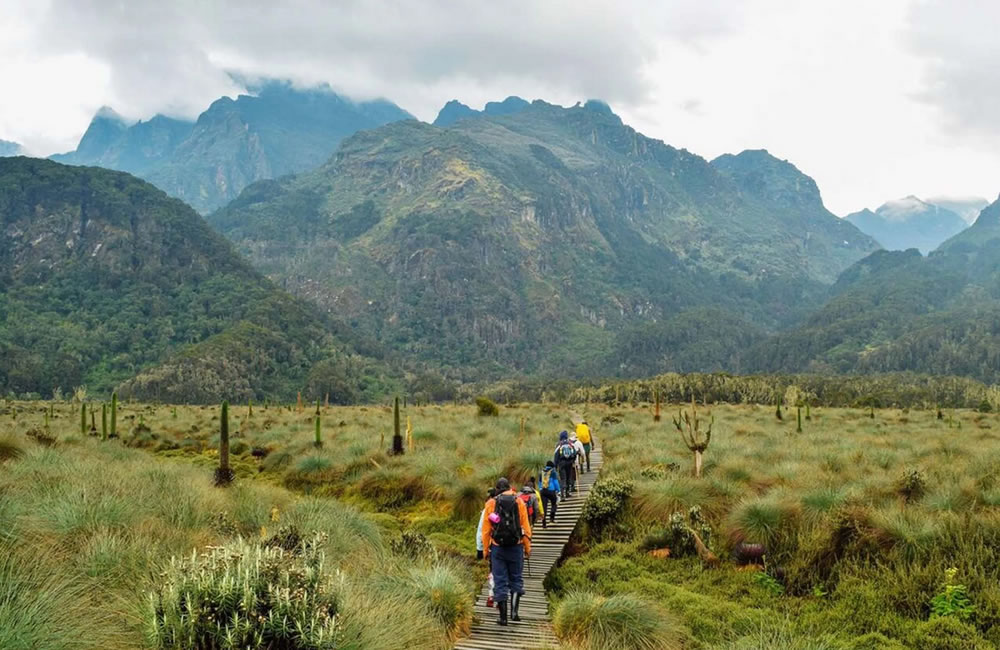
Without a doubt, this is the most common practical question that the team at Rwenzori Trekking Safaris receives after booking a trek. It is also the question for which trekkers find the least reliable information online: a scattering of vague forum posts, widely varying numbers, and almost nothing that accounts for the specific staffing structures, route lengths, and wage realities of the Rwenzori in particular.
This guide will answer it completely. Not just the numbers, though those are here, clearly stated and broken down by role, but the context that makes the numbers meaningful. The cultural expectations, the salary realities for mountain staff in western Uganda, the difference between tipping on a 3-day Mahoma Loop versus a 13-day six-peaks expedition, and exactly how to prepare the cash before you leave Kasese. By the end, tipping on the Rwenzori will be one less thing to stress about when you step through the park gate in the morning.
Why Tipping Matters More on the Rwenzori Than on Almost Any Other Mountain
The Rwenzori is not Kilimanjaro. It is not a commercially saturated mountain with a large, established tourism infrastructure that drives wage rates upward through volume and competition. The Rwenzori Mountains receive a fraction of the annual visitors that flow through Tanzania, which means the economic lifeblood of the mountain communities around Kasese and Kilembe is more directly dependent on each individual trekking party than visitors often realise. The guides, cooks, and porters who work these trails do not cycle through hundreds of groups per season. A single well-tipped group can represent a meaningful portion of a porter’s monthly income.
This is worth understanding not to create guilt, but to calibrate your sense of what a tip actually means in this context. In the communities surrounding Rwenzori Mountains National Park, mountain work is skilled, physically demanding, and carries real risk. Porters carry loads of 15–25 kg across terrain that many trekkers struggle to navigate with nothing more than a daypack. They do this work in perpetual moisture, sometimes in the dark, with equipment that is rarely as good as what the clients they are serving carry. A porter’s daily base wage is modest; the tip from an international trekker is not a bonus; it is a structural part of the compensation model for mountain work in this region.
Guides Are Professionals, Not Volunteers
It is worth being explicit about something that experienced mountain travellers understand but first-timers often do not: your Rwenzori guide is a trained professional. A senior guide on a Margherita Peak summit expedition carries wilderness first aid certification, detailed knowledge of the mountain’s microclimates, glacier and technical terrain navigation skills, and years of experience reading altitude symptoms. They make decisions that directly affect the safety of everyone in the party. Our senior guides have conducted Rwenzori mountaineering expeditions across multiple peaks and in conditions that change without warning. That expertise has real monetary value, and tipping is the internationally understood mechanism for acknowledging it.
Understanding the Roles: Who Is on Your Team and What They Do
Before discussing specific tip amounts, it is essential to understand what each member of your trekking crew actually does. The staffing structure varies by trek length and route, but the following roles are standard on most multi-day Rwenzori expeditions.
The Head Guide
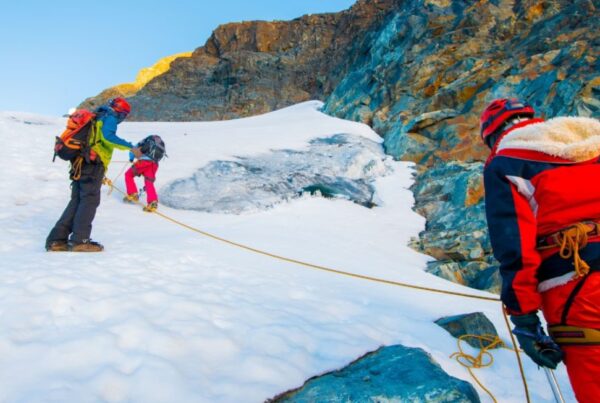
The head guide is the expedition leader. On a full summit attempt to Mount Stanley via the Central Circuit or the Kilembe Trail, this person is responsible for pacing decisions, campsite management, weather assessment, altitude monitoring for every member of the party, technical rope and crampon guidance on the glacier approach to Margherita, emergency response, and the daily management of the full crew. The head guide is also your primary cultural interpreter, local knowledge resource, and the person who will turn the group around if conditions require it, a decision that requires both courage and experience. Understanding how technically demanding the climb to Margherita Peak is will give you a full appreciation of what the head guide is managing on summit day.
The Assistant Guide
Longer treks, particularly anything above 7 days, or routes targeting multiple peaks such as the 8-day 3-peaks expedition will include one or more assistant guides. The assistant guide typically walks at the rear of the group to ensure no one falls behind, supports slower trekkers on difficult sections, helps with campsite setup, and steps up to lead guidance if the head guide needs to move ahead with faster trekkers. They are not trainees; they are experienced mountain workers whose role is specifically pastoral rather than expeditionary. They also frequently manage the day’s porter coordination: making sure loads are distributed properly and that the crew arrives at camp before dark.
The Cook
The mountain cook is one of the most underappreciated people on any Rwenzori trek. Operating from basic hut kitchens or ground-level gas setups in conditions that include near-freezing temperatures, perpetual dampness, and limited water supply, a skilled Rwenzori cook produces hot, nourishing meals that are genuinely one of the psychological lifelines of a long expedition. If you have ever arrived at Bujuku Hut cold and wet, with legs that feel like they belong to someone else, and then sat down to warm soup and a substantial plate of food, you understand the cook’s contribution. The quality of mountain food has a direct and measurable effect on team morale in the high-altitude sections of routes like the 10-day four-peaks expedition. The cook deserves a genuine tip.
The Porters
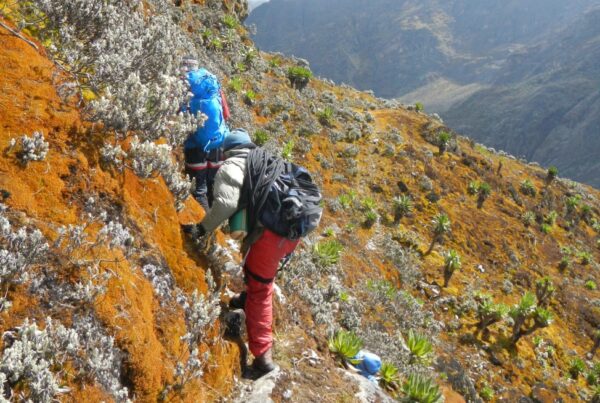
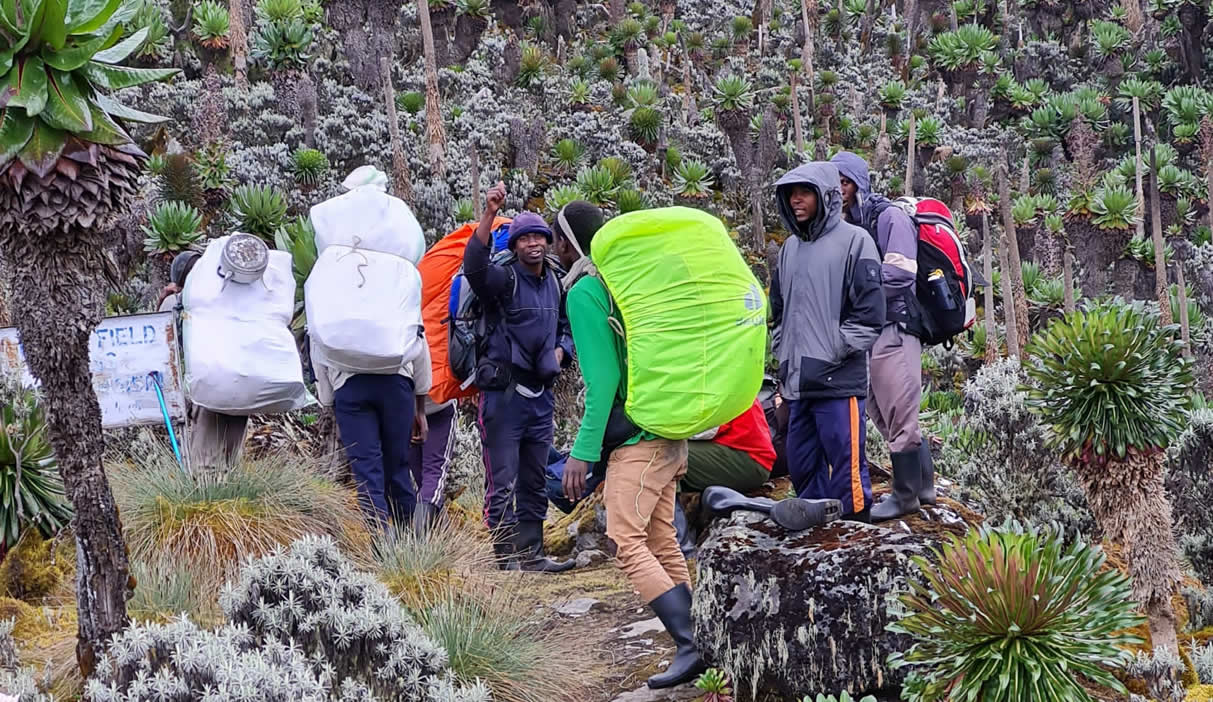
Porters carry the expedition forward literally. On the Rwenzori, porter work is exceptionally demanding because the terrain is not simply steep; it is technical, unstable, wet, and relentless. The root networks below 3,000 metres, the knee-deep bog sections through the Bujuku Valley, and the slippery rock sections above Elena Hut, these are all navigated with 15–25 kg on the back. Porters on longer routes such as the 18-day All-8-peaks Expedition remain on the mountain for the entire duration, with limited rest. Their footwear is often inadequate. Their rain protection is often minimal. They do this work because it is a valuable employment opportunity in a region with limited alternatives, and they do it with consistent professionalism. Tip them well.
The Rescue Porter
Some expeditions, particularly those targeting high-altitude summits, include a rescue or emergency porter on standby. This person may not carry loads for the full duration but is present specifically to assist if a trekker needs to be helped down from altitude. If a rescue porter is deployed during your trek, they should be tipped as generously as an active porter. If they are not deployed, please acknowledge them at tip time, as their presence served as a form of insurance that you benefited from simply by having them available.
Recommended Tip Amounts: The Full Breakdown by Role
The figures below represent current (2026-2027) recommended ranges based on prevailing wage standards in the Kasese region, international trekking norms for East Africa, and the specific working conditions of the Rwenzori. All amounts are expressed as daily rates, as this method is the most accurate way to account for varying trek lengths. The final tip is typically calculated as the daily rate multiplied by the number of days in the field.
| Role | Daily Tip (USD) | Approx. Daily (UGX) | Solo Trekker Note |
| Head / Senior Guide | $8 – $12 / day | 30,000 – 45,000 UGX | Upper end ($12) appropriate for solo trekkers |
| Assistant Guide | $5 – $8 / day | 18,000 – 30,000 UGX | Prorate down for groups of 4+ |
| Cook | $4 – $6 / day | 15,000 – 22,000 UGX | Same rate solo or small group |
| Porter (per porter) | $3 – $5 / day | 11,000 – 18,000 UGX | Typically 1–2 porters per solo trekker |
| Rescue / Emergency Porter | $5 – $7 / day | 18,000 – 26,000 UGX | Tip if deployed; acknowledge regardless |
These ranges are meaningful because the Rwenzori is not a single fixed experience. A solo trekker on the 5-day Margherita Peak summit route with two porters, a guide, and a cook is looking at a completely unique total tip from a group of six on the 7-day Central Circuit. The table below helps you apply these rates appropriately to your specific group size.
Solo Trekkers vs Groups: How to Scale the Tip Correctly
One of the most common sources of confusion around Rwenzori tipping is how group size affects the per-person contribution. The principle is straightforward: the crew works for the group as a whole, not for each individual, but certain roles (particularly the head guide) increase their personal output significantly when managing a larger party. Here is how to think about it.
| Group Size | Head Guide (total/day) | Porter (per porter/day) | Approx. Total/Day |
| Solo trekker | $12 | $5 | $22 – $30 (2 porters) |
| 2 trekkers | $10 pp = $20 | $4 pp = $8 | $35 – $45 (2 porters) |
| 4 trekkers | $8 pp = $32 | $4 pp = $16 | $60 – $75 (4 porters) |
| 6+ trekkers | $8 pp = $48+ | $3–$4 pp | $80 – $120+ (6+ porters) |
The Solo Trekker
As a solo trekker, you will receive intensely personal attention from your guide; they are focused entirely on you, your pace, your condition, and your summit ambitions throughout every hour on the trail. This level of service justifies the upper end of the guide tip range ($12 per day). Solo trekking on the Rwenzori is a legitimate and increasingly popular way to experience the mountain, and our article on solo trekking in the Rwenzori Mountains covers the logistics and safety considerations in detail.
Small Groups (2 to 4 Trekkers)
For small groups of two to four, the per-person contribution at the recommended ranges remains the most equitable approach. The guide’s workload increases slightly with group size but not proportionally, and porters typically scale one-to-one or close to it with the number of trekkers. Small groups also tend to have a more cohesive dynamic that makes the tip ceremony a more personal and satisfying moment for both parties.
Larger Groups (5 or More Trekkers)
In larger groups, the head guide’s total tip from all participants combined should feel meaningful in absolute terms, not just the arithmetic of per-person rates. If eight trekkers each tip $8 per day for a 10-day expedition, the head guide receives $640, which is generous and appropriate. Do not feel that the total per-role tips need to be equalised to the per-person equivalent; on a solo trek, the relevant benchmark is whether the individual being tipped can feel that their contribution was noticed and valued. For group treks, our team can advise on the right staffing ratio; you can explore options across the full range of our Rwenzori trekking expeditions.
When to Tip: Summit Day, Last Day, or Both?
Timing is the second most misunderstood aspect of Rwenzori tipping, and getting it wrong can inadvertently create awkwardness or misunderstanding. The short answer is this: tip on the final day of the trek, at the end of the descent, when the full crew is together and the expedition is definitively complete. But there are nuances worth understanding.
Why Not Summit Day?
On routes that include a summit attempt, there is an understandable temptation to tip on summit day, which is the emotional high point of the expedition and the moment when gratitude is at its peak. Resist this temptation. Tipping on summit day creates several practical problems. The crew still has descent responsibilities, potentially including technical rope management and, in some cases, rescue porter activation. A full tip on summit day implies the expedition is complete, even if it isn’t. Some crews, particularly on routes like the 8-day Kilembe Trail, where the descent takes one to two full days, have further significant work to do. More practically, the final day’s work can feel underacknowledged if the group has already given the tip and has emotionally separated from the summit experience.
The Final Day Ceremony
The conventional moment for tipping on the Rwenzori is at the end of the final descent, typically at the park gate or at the point where the crew formally hands over to road transport. This is usually a natural gathering point where the entire team, guides, porters, and cook are all present. The Rwenzori tipping tradition involves individual tip envelopes handed to each crew member directly, with a brief personal acknowledgement. This does not need to be a formal speech; a genuinely felt thank-you spoken directly to each person is entirely appropriate and deeply valued. Crew members often retain memories of specific trekkers for years, and a direct personal acknowledgement, regardless of its brevity, lingers even longer than the amount.
What About Exceptional Performance Mid-Trek?
If a specific crew member does something genuinely outstanding mid-trek, a porter who supports a struggling trekker on a difficult section, a cook who manages a flawlessly warm meal in a cold rainstorm, or a guide who makes a courageous and correct summit turnaround decision, you can absolutely express additional gratitude in the moment with a small informal tip. This is never expected and never required, but it is always noticed and appreciated. The formal per-role tip at the end remains separate from any such mid-trek acknowledgements.
GUIDE INSIGHTOver many years of guiding on this mountain, the most meaningful tip ceremonies I have witnessed have been the simplest ones. A trekker who looks each porter in the eye, says their name correctly, and thanks them specifically for something they did receives a response that no amount of extra cash can replicate. The money matters enormously. The acknowledgement matters at least as much. |
Cash, Currency, and Denominations: The Practical Planning Guide.
Getting the right cash in the right denominations before you begin the trek is a detail that first-time Rwenzori trekkers consistently underestimate. Uganda’s mountain areas are not places where you can break a large note or find an ATM at the end of the trail. The practical currency of tipping on the Rwenzori is the Ugandan shilling (UGX), and while US dollars are occasionally acceptable and genuinely appreciated, shillings are strongly preferred and for good reason.
Why Uganda Shillings Are Better Than Dollars for Tipping
A porter living in Kasese or the surrounding villages has no practical use for a small-denomination US dollar bill. Exchanging foreign currency in Kasese involves a trip to town, a queuing process, and exchange fees that eat into the value of the gift. A crisp 10,000 or 20,000 UGX note, by contrast, is immediately useful; it buys groceries, pays for transport, or goes directly into savings. Tipping in shillings is a genuine act of practical respect, not just a financial gesture. Convert your tip budget to shillings before you leave Kampala or Entebbe; the exchange rates at Entebbe International Airport or Kampala’s Forex bureaux are consistently better than anything available in Kasese, and you will have far more denomination flexibility at a city Forex bureau.
Recommended Denomination Mix
The table below reflects a practical denomination split for a solo trekker on a 7-day summit route, adjusted slightly for group use. The core principle is to have many small notes rather than a few large ones, as tipping individual crew members with individually sized amounts is far more dignified than asking for change in the tip ceremony moment.
| Note / Bill | Recommended Qty | Typical Use |
| 50,000 UGX | 8 – 12 notes | Guide tips (final envelope; senior staff) |
| 20,000 UGX | 10 – 15 notes | Mid-level tips: breaking larger notes |
| 10,000 UGX | 15 – 20 notes | Porter daily tips, cook flexible small amounts |
| 5,000 UGX | 10 – 15 notes | Day-by-day porter top-ups; small items |
| 2,000 UGX | 10 notes | Minor gratuities; gate staff; emergencies |
Where to Get Uganda Shillings
The most reliable places to exchange currency are the Forex bureaux at Entebbe International Airport (reasonable rates, open late to meet incoming flights), Kampala City Center (competitive rates, particularly on Kampala Road and in the Garden City Mall), and Kasese Town Center (lower rates and more limited denomination availability, but adequate for top-ups). Do not rely on hotel exchange desks, which typically offer the worst rates. Our guide to getting to the Rwenzori Mountains from Entebbe covers the Entebbe-to-Kasese travel logistics in detail and is a useful companion for understanding your full cash planning timeline.
Preparing Individual Tip Envelopes in Advance
Prepare individual envelopes the night before the final trekking day at camp (if you are on the mountain) or at your Kasese accommodation before departure. Each envelope should be labelled with the crew member’s name and role. This preparation prevents miscalculations, avoids awkward public counting of cash, and shows each crew member their contribution was deliberately considered. Write the name clearly; if you are not certain of the spelling, ask your guide the evening before.
PRACTICAL TIPBring a small supply of plain envelopes from home or buy them in Kampala. You will not encounter stationery in Nyakalengija or along the trail. Alternatively, any folded paper works perfectly well. The envelope is the gesture, not the vessel. |
Tipping by Trek Length and Route Type
Tip amounts scale with the number of days in the field, but the per-day rate should remain consistent regardless of whether the trek is 3 days or 18 days. What changes is the total, which can grow substantially on longer expeditions. Here is a realistic picture of what the tip pool looks like across the main route categories.
Short Treks: 3 to 4 Days
On shorter routes such as the 3-day Mahoma Loop hike, the 3-day Sine Camp and Samalira Falls trek, or the 4-day Mutinda Lookout route via the Kilembe Trail, the total tip pool for a solo trekker will be relatively modest, typically $40–$70 across the crew for a 3-day trek, rising to $55–$90 for 4 days. These are lower absolute figures, but the per-day rate matters and should not be reduced simply because the trek is shorter. The crew worked the same daily effort regardless of how many days were contracted.
Classic Summit Routes: 6 to 8 Days
The bread-and-butter Rwenzori trekking experiences, the 6-day Central Circuit, the 7-day Central Circuit to Margherita, and the 8-day Kilembe Trail summit represent the range where the tip calculation is most straightforward. A solo trekker on a 7-day route with a head guide, assistant guide, cook, and two porters should budget approximately $130–$180 in total tips. A couple (two trekkers) on the same route should budget $200–$260 combined, or $100–$130 per person. This range is meaningful and appreciated without being excessive.
Multi-Peak Expeditions: 10 to 18 Days
The longer expeditions, the 10-day four-peaks expedition targeting Margherita, Speke, Baker, and Weismann; the 13-day six-peaks circuit; or the ambitious 18-day all-8-peaks traverse involve much larger total tip pools. On an 18-day expedition with a full crew (head guide, assistant guide, cook, and four to five porters), a solo trekker should budget $400–$600 in tips. This amount is a significant sum, but it reflects 18 days of exceptional professional service at high altitude on Africa’s most technically demanding mountain trekking terrain. Budget for it explicitly when costing the expedition, alongside the main expedition costs.
Tipping Etiquette: The Cultural Dimension
The mechanics of tipping are relatively simple once you have the numbers. The cultural dimension is what transforms a financial transaction into a genuine human moment, and on the Rwenzori, that matters more than it does in most trekking contexts.
Tipping is Expected, Not Optional
In the context of international trekking in East Africa, tips are a standard and expected part of the compensation model for mountain staff. This practice is not unique to Uganda; the same is true across Kenya, Tanzania, and Ethiopia. Failing to tip, or tipping far below the accepted range, is culturally significant; it is noticed and discussed among mountain staff communities. We do not intend to pressure you with this information; rather, we want to ensure you comprehend the reality of the convention and its genuine social significance. If you genuinely had a poor experience with a specific crew member, discuss it with the head guide or with the team at Rwenzori Trekking Safaris before adjusting that person’s tip downward; there is usually context that is worth understanding.
Tipping in Person, Directly
Handing tips through the head guide for redistribution is a common practice on some mountains and is operationally efficient. On the Rwenzori, we recommend handing tips directly to each individual whenever the crew size and logistics allow. Direct giving acknowledges each person’s individual contribution and eliminates any uncertainty about whether the full amount reached them. It is a more dignified and personal act, and it is the practice that mountain staff on the Rwenzori most value.
What to Say
You do not need to prepare a speech. You need only to look the person in the eye, say their name, hand them the envelope, and express something true about why you are grateful, such as noticing something specific they did or acknowledging that the mountain was extraordinary because of their guidance, strength, or cooking. Even one sentence of genuine acknowledgement transforms the transaction into a connection. Ask your guide to help you learn the Rutooro or Lhukonzo phrase for “thank you” before the final day; using even a few words of the local language during the tip ceremony leaves an impression that crew members genuinely remember.
Group Coordination
In a group of four or more trekkers, designate one person in advance as the tip coordinator. This person collects individual contributions before the final day, prepares the envelopes, and manages the distribution. This approach avoids the awkward scenario where contributions are assembled publicly in front of the crew or where different group members contribute to the same person in an inconsistent way. The right time to finalise numbers and prepare the envelopes is a brief group conversation on the penultimate evening of the trip, when energy is still good and the logistics are fresh.
Special Situations: Partial Treks, Evacuations, and Exceptional Performance
If Your Trek Is Cut Short
Altitude sickness, injury, weather deterioration, or personal circumstances occasionally require a trekker to descend before the planned end of the expedition. Our guide to the success rate for summiting Margherita Peak addresses this reality honestly. If your trek ends early, tip for the full contracted duration, not just the days completed. Your crew made themselves available for the full trip, may have turned down other employment, and have done the most demanding portion of the work (ascending) even while they are assisting your descent. Early termination is not their professional failure, and reducing their tip proportionally to incomplete days would be genuinely unfair.
If You Receive Medical Assistance on the Mountain
If a crew member, guide or porter provides meaningful medical or physical assistance beyond their normal duties (carrying you on difficult terrain, administering first aid, coordinating an emergency descent), such assistance warrants additional acknowledgement above the standard tip. There is no fixed formula for such assistance, but $20–$50 per person directly involved, in addition to their standard tip, is a reasonable benchmark. Review our complete medical guide to trekking the Rwenzori before departure so you understand both the medical risks and the crew’s emergency response role.
When Performance Was Genuinely Exceptional
Sometimes a guide or porter delivers a level of service that goes beyond professional competence into something that genuinely shapes your experience of the mountain. A guide who reads the weather perfectly on a summit attempt on Mount Speke, making a precise call that takes the group to the summit and back before conditions close. A porter who carries an extra load for a struggling group member without being asked. A cook who produces something extraordinary on the night before the summit push. In these cases, tipping above the standard range is appropriate and meaningful. There is no ceiling; the upper range in the recommended table is a guideline, not a limit.
Budgeting for Tips: Where It Fits in Your Total Trek Cost
Tips are not included in the trek fee, and they should be budgeted as a separate line item when planning the total cost of your Rwenzori expedition. For most summit routes, the tip pool represents approximately 10–15% of the core trek fee. Our detailed breakdown of how much it costs to climb the Rwenzori Mountains covers the complete financial picture: park fees, accommodation, guide fees, porters, and gear hire. It’s worth reading alongside this guide to understand exactly what your total budget should look like.
A practical rule of thumb for initial budgeting: add $20 per trekker per day to your core expedition cost estimate as a tip reserve for a solo or small group trek, and $15 per trekker per day for larger groups of 5 or more. This figure will cover standard tipping at the recommended rates for all crew members and leaves a small margin for exceptional performance recognition. If your actual tip comes in below this reserve, the remainder is yours. If you decide to tip above the standard range, you will have the cash available. Having the cash prepared in advance in shillings, in the right denominations, and in labelled envelopes means the tip ceremony is the dignified moment it deserves rather than an improvised scramble.
Frequently Asked Questions: Tipping on the Rwenzori
How much should I tip my Rwenzori mountain guide per day?
The recommended daily tip for a head guide on a Rwenzori trek is $8 to $12 USD per trekker per day. Solo trekkers should tip at the upper end of this range ($12 per day) because the guide is focused entirely on a single client. In a group of four or more, the per-person contribution can move towards the lower end ($8 per day) while still producing a meaningful total for the guide. These rates reflect the skill, certification, and responsibility level of a professional Rwenzori mountain guide, particularly on summit routes to Margherita Peak at 5,109 metres, where technical glacier guidance and altitude management are core parts of the role.
How much should I tip Rwenzori porters?
The standard daily tip for a Rwenzori porter is $3 to $5 USD per trekker per day. For solo trekkers with two porters, each porter should receive approximately $5 per day. In groups where multiple trekkers share the porter load, a daily tip of $3 to $4 per trekker per porter is appropriate. The porter tip should always be given directly to the individual porter, not through the guide, to ensure the full amount reaches the person who earned it. Porters on the Rwenzori manage genuinely demanding loads over terrain that is technically challenging, and tipping at the lower end of the range should be the exception rather than the norm.
Should I tip in US dollars or Uganda shillings on the Rwenzori?
Uganda Shillings are strongly preferred for tipping on the Rwenzori. Mountain staff in the Kasese region have limited access to currency exchange facilities, and converting small-denomination foreign currency involves time, transport expenses, and exchange fees that reduce the actual value of the tip. Tipping in shillings means the money is immediately usable. Convert your full tip budget to shillings before leaving Kampala or Entebbe, where Forex bureaux offer competitive rates and can provide a mix of denominations. Recommended denominations are 50,000, 20,000, 10,000, and 5,000 UGX notes, with a supply of 2,000 UGX notes for small individual gratuities.
When is the right time to tip on a Rwenzori trek?
Tip at the end of the final day of the trek, at the park gate or at the point where the crew formally completes their service. Do not tip on summit day, even though the emotional impulse to do so is understandable the crew still has full descent responsibilities that deserve acknowledgement. Prepare individual labelled envelopes the evening before the final trekking day, with each crew member’s name on their envelope. Distribute directly and personally, with a brief spoken acknowledgement. This combination of timing, preparation, and direct personal delivery makes the tip ceremony the genuine farewell moment it should be.
Do I need to tip for a short 3- or 4-day Rwenzori trek?
Yes. Tipping etiquette does not diminish for shorter treks. The daily rate remains the same ($3–$5 for porters, $8–$12 for the guide) regardless of whether the trek is 3 days or 18 days. The absolute total is smaller for short routes like the 3-day Mahoma Loop or the 4-day Waterfalls Hike via the Kilembe Trail, but the daily rate is the socially expected norm, and reducing it because the trek is short sends the wrong signal. Even on a 3-day trek, a solo trekker should budget approximately $40–$75 in tips across the crew.
What if my trek is cut short due to altitude sickness?
Tip for the full contracted duration, not the number of days actually trekked. Your crew made themselves available for the full expedition, completed the most demanding work (the ascent), and provided emergency support during the descent. Altitude sickness is a medical event, not a failure of service. Reducing the tip proportionally to incomplete days is widely considered unfair and is not recommended. If anything, a guide who manages an emergency descent professionally, by recognising the symptoms early and making the right call about timing and route, deserves acknowledgement for that specific skill, not a reduced payment.
How do I handle tipping when one crew member was significantly better than another?
The recommended approach is to tip everyone at the standard rate, then add a specific additional amount to the envelope of the exceptional performer. This avoids the difficult social situation of visibly tipping one person more than another in the same ceremony while still acknowledging outstanding individual contributions. If a crew member were genuinely unsatisfactory, the appropriate channel is to discuss it with the operator Rwenzori Trekking Safaris rather than simply reducing their tip. There is almost always context to understand, and the guide team can often provide relevant information about personal circumstances or on-mountain events that explain behaviours that may have seemed inadequate to the trekker.
Is tipping expected for day hikes and short introductory walks?
For very short day experiences, such as the 1-day Nyabitaba introductory walk on the Central Circuit or the 2-day Lake Mahoma hike, a tip is appropriate but does not need to be calculated on the full per-day formula. A guide for a day hike typically receives $10–$20 total, and a porter for a day hike receives $5–$10 total, depending on the level of service and the distance covered. Use your judgement; if the guide contributed meaningfully to your experience of the mountain, tip towards the upper end. These shorter experiences often serve as scouting or conditioning walks for trekkers who are planning a longer summit attempt, and building a positive relationship with the guide team from the first day is always worthwhile.
Plan Your Rwenzori Trek with Complete Confidence
Tipping well is one of the most practical ways to contribute meaningfully to the mountain communities that make the Rwenzori trek experience possible. It is also, in the most direct sense, the right thing to do. The guides, cooks, and porters who carry expeditions across some of the most demanding terrain in Africa deserve to know that their work was seen, valued, and compensated accordingly.
When you book your expedition through Rwenzori Trekking Safaris, you will receive a full pre-departure briefing that covers tipping logistics, cash recommendations, and crew introductions so that by the time you step onto the trail at Nyakalengija, the administrative considerations are entirely handled. All that remains is the mountain, the experience, and the people who will guide you through it. Browse our full range of Rwenzori trekking itineraries from the 3-day introductory loop to the 18-day all-peaks expedition and get in touch when you are ready to begin planning.
START PLANNING YOUR TREKContact the Rwenzori Trekking Safaris team directly to discuss your itinerary, fitness level, preferred dates, and any questions about preparation, costs, or logistics. We provide honest, personalised guidance, no hard sell, and no generic packages. Email: rwenzoritrekkingsafaris@gmail.com | WhatsApp: +256 773 256 104 Plan your trek: www.rwenzoritrekkingsafaris.com/ |