Summit Margherita Peak (5,109 m) on the Kilembe Trail, trek with mountain gorillas in Bwindi, and explore Queen Elizabeth National Park, Uganda’s ultimate 12-day adventure safari.
12-Day Rwenzori Trek & Gorilla Trekking Safari
12 Days Rwenzori Trek, Gorilla Trekking & Uganda Wildlife Safari.
Summit Margherita Peak. Trek with Mountain Gorillas. Witness Uganda’s Wildlife.
Kilembe Trail, Rwenzori Mountains | Bwindi Impenetrable Forest | Queen Elizabeth National Park
Explore Uganda on a 12-day adventure with a 7-day Rwenzori trek, gorilla trekking in Bwindi, and wildlife safaris in Queen Elizabeth National Park. Stunning landscapes and rare wildlife await. This 12-day Rwenzori & gorilla trek blends Uganda’s greatest natural treasures into one unforgettable journey.
The snow-capped Rwenzori Mountains, the ancient rainforests of Bwindi, and the wildlife-rich savannahs of Queen Elizabeth National Park. The experience begins with gorilla trekking in Bwindi Impenetrable National Park, home to nearly half of the world’s remaining mountain gorillas. From here the journey continues to Queen Elizabeth National Park for classic African safaris, boat cruises, and sweeping views of the Rift Valley plains.
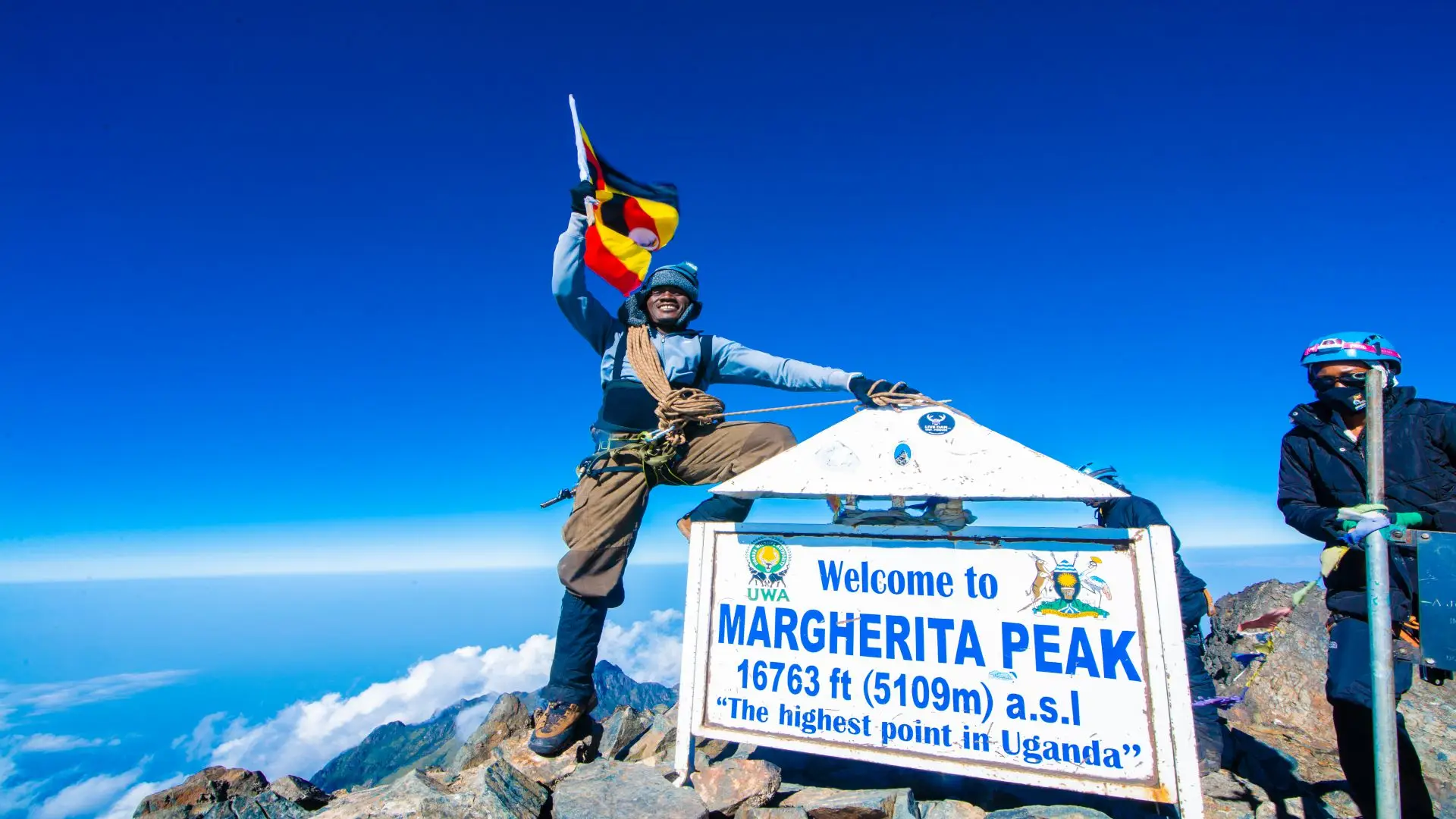
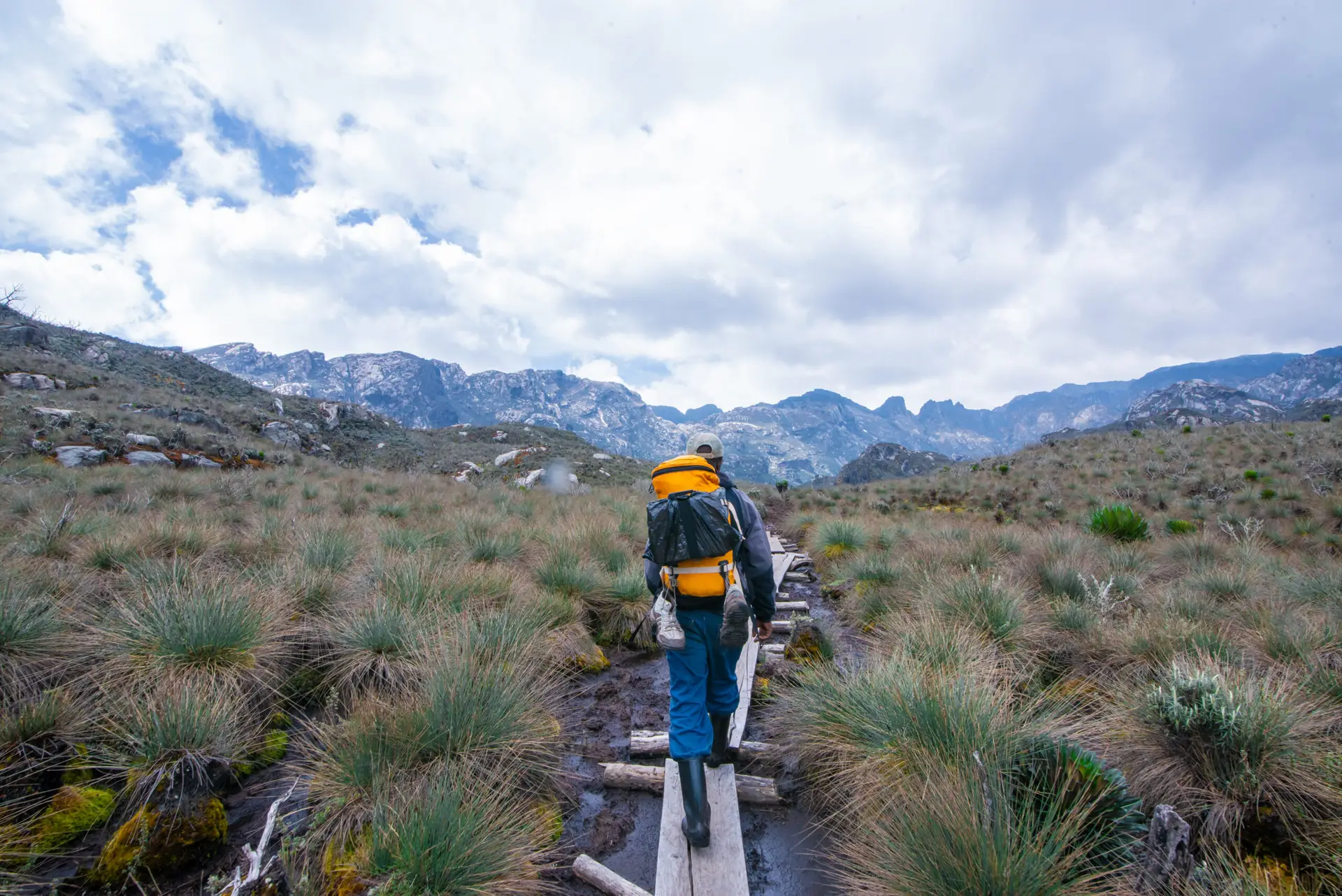
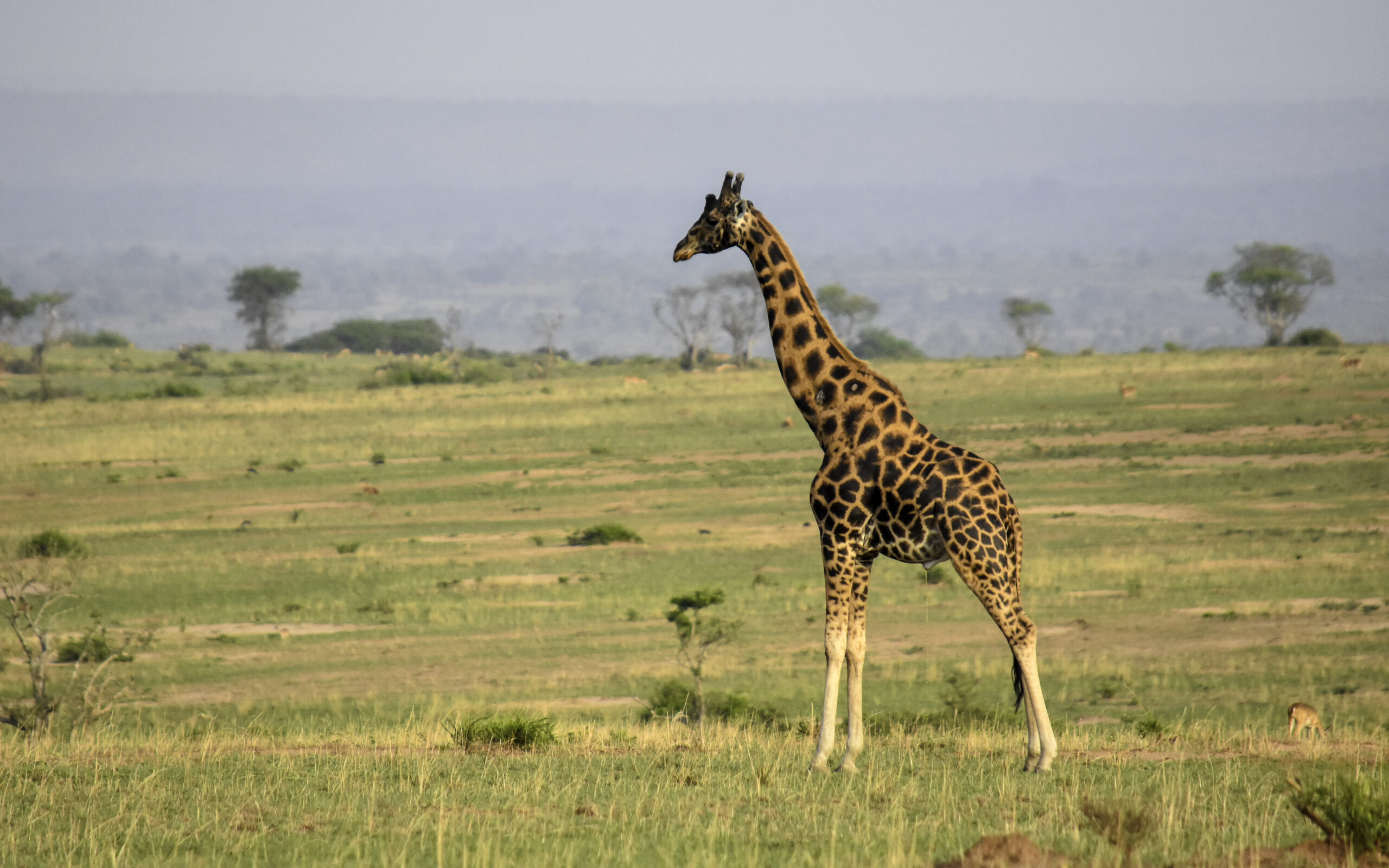
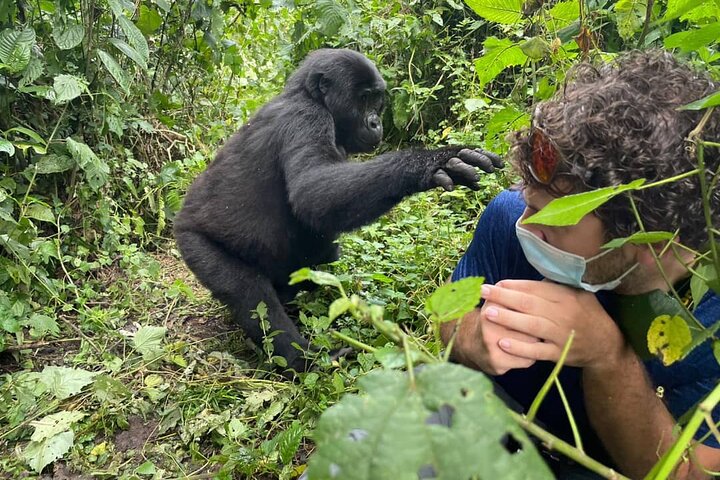
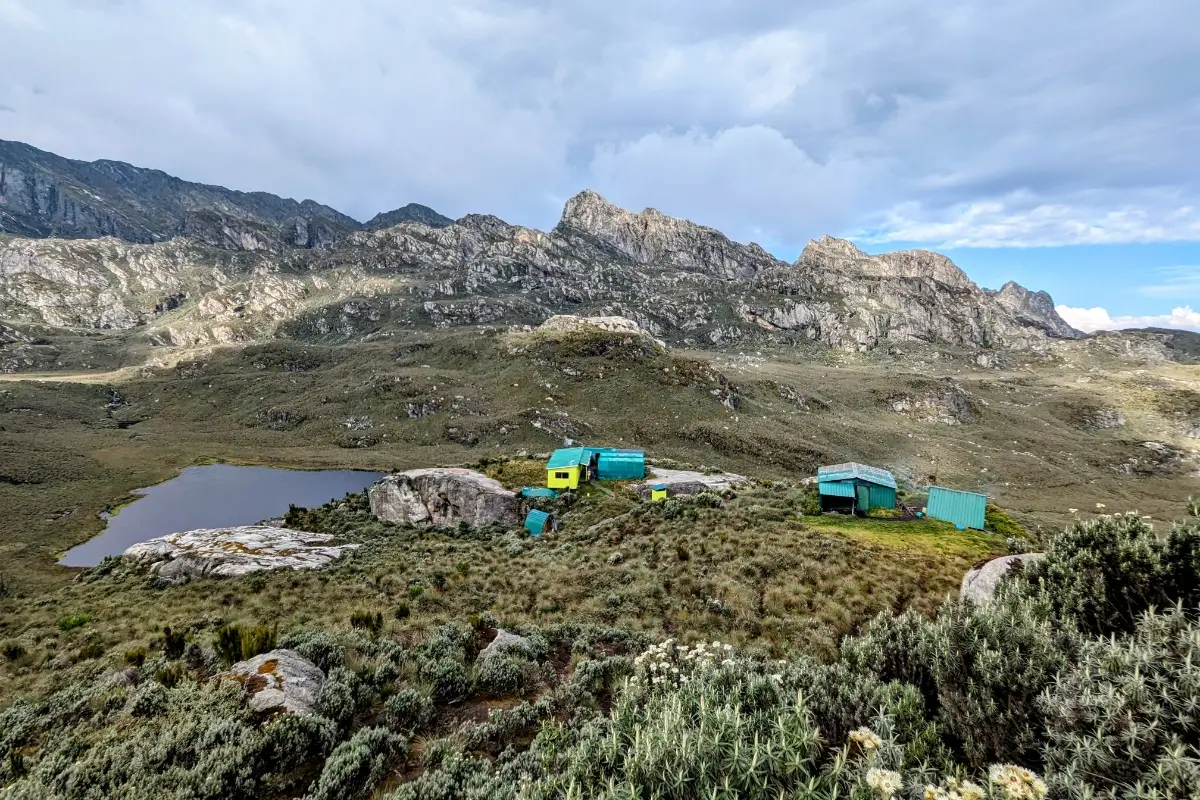
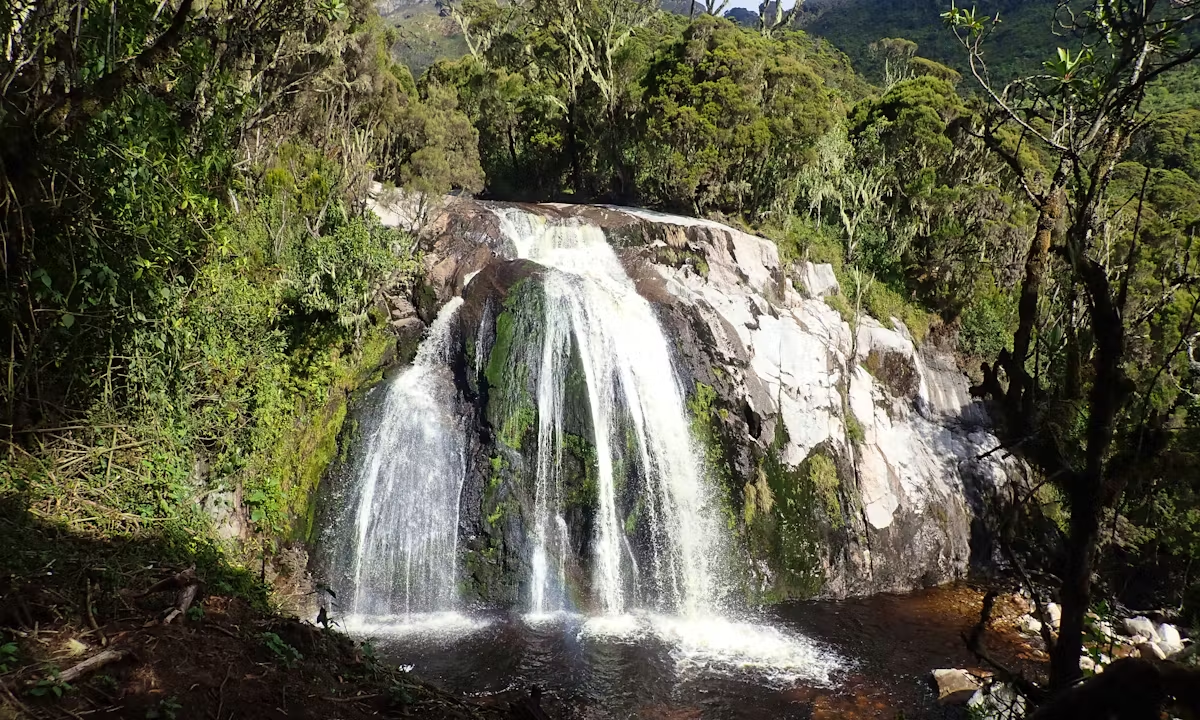
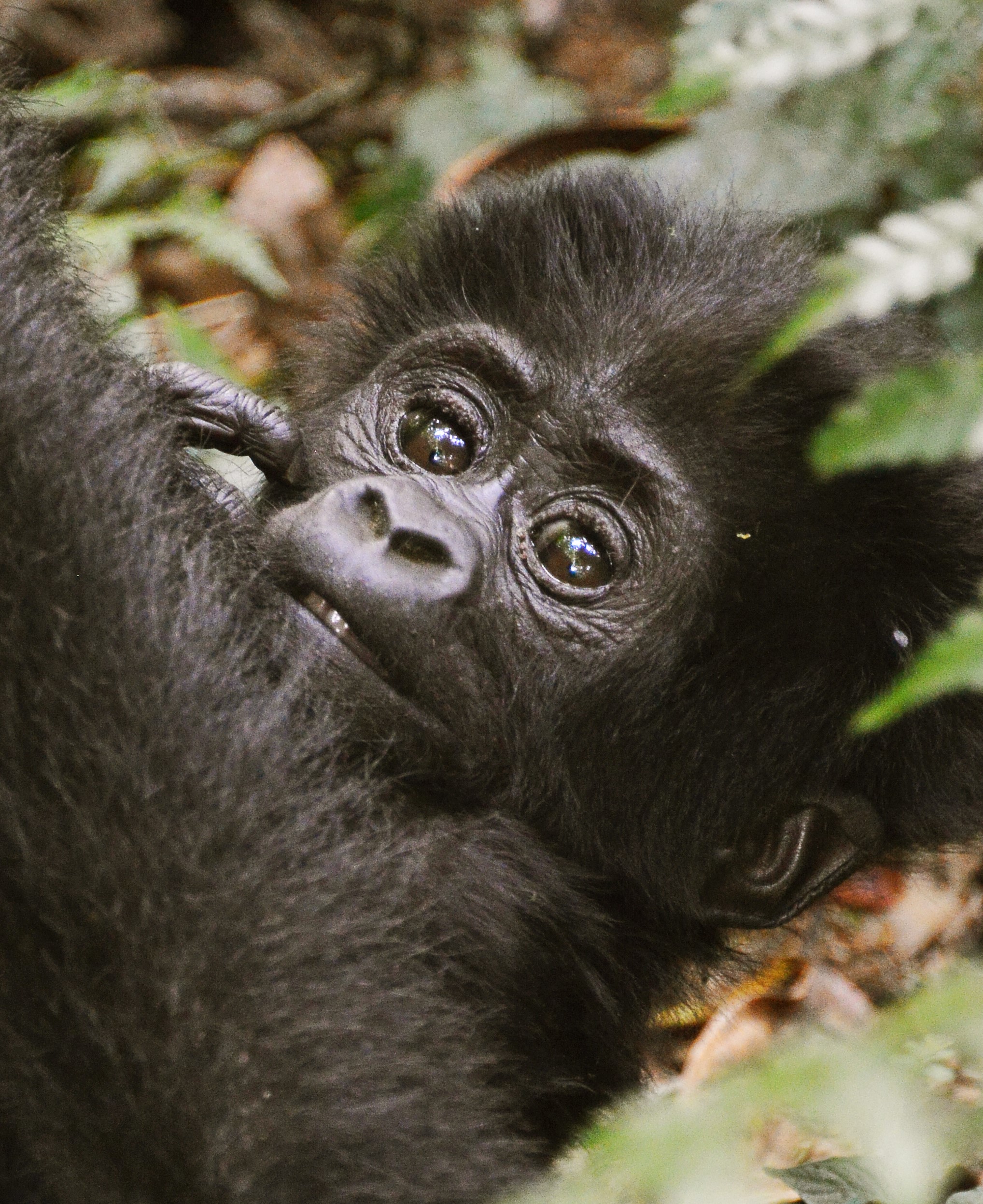
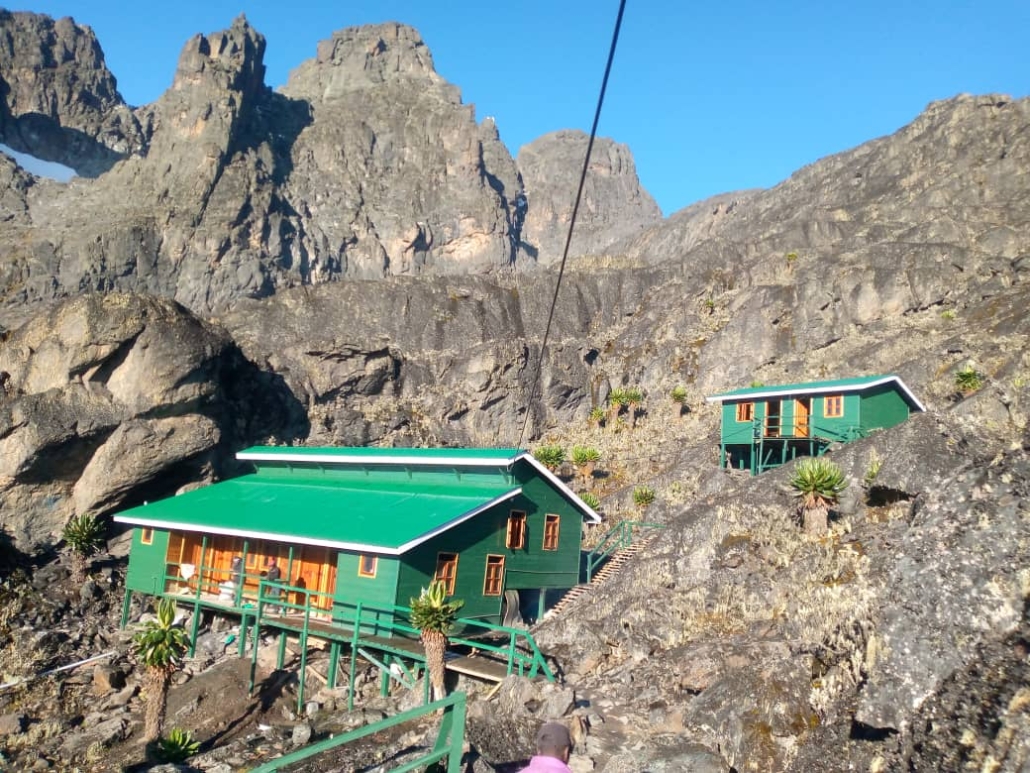
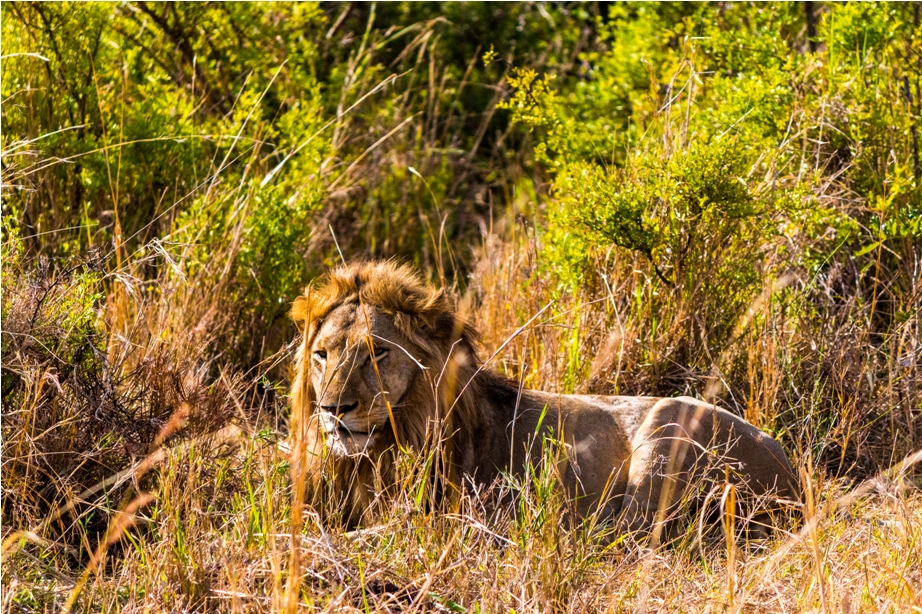
The expedition peaks literally with a 7-day Rwenzori Mountains trek via the Kilembe Trail, a route known for its rich vegetation zones, dramatic glaciers, sprawling valleys, and the thrilling ascent to Margherita Peak on Mount Stanley. This combination makes the itinerary one of East Africa’s most diverse, blending rainforest, alpine trekking, wildlife viewing, and cultural landscapes.
Anticipate unique interactions with elusive primates, a plethora of bird species, stunning volcanic landscapes, serene glacial lakes, lush Afro-montane forests, and some of the most breathtaking high-altitude vistas in Africa. This itinerary is crafted for those who seek to experience the rich tapestry of Uganda, going beyond mere highlights to uncover its true essence.
Gorilla trekking in Bwindi Impenetrable National Park is often regarded as one of the most life-changing wildlife experiences possible. Bwindi, a 25,000-year-old rainforest, protects more than 120 mammal species, 350 bird species, and over half of the world’s remaining mountain gorilla population.
Visitors at the park headquarters are briefed on the individual gorilla family they will be viewing, as well as trekking restrictions and how to behave around gorillas. The hike starts early in the morning. A team of trackers will be in the jungle ahead of you to find gorillas and guide your group to them.
Safari Snapshot: 12-Day Rwenzori Trek & Gorilla Trekking at a Glance
| Total Duration | 12 days / 11 nights |
| Rwenzori Trek | 7 days via the Kilembe Trail: Kilembe (1,450 m) to Margherita Peak (5,109 m) |
| Safari Component | 2 days gorilla trekking + wildlife safari: Bwindi Impenetrable NP & Queen Elizabeth NP |
| Maximum Elevation | 5,109 m: Margherita Peak, Mount Stanley (Africa’s 3rd highest summit) |
| Difficulty | Challenging to Strenuous: moderate fitness required for safari days; high fitness for Rwenzori |
| Mountain Route | Kilembe Trail (Rwenzori Mountains National Park) |
| Start Point | Kampala / Entebbe International Airport |
| End Point | Kampala (return transfer) |
| Best Season | December–February & June–August (dry season optimal for all three components) |
| Gorilla Permit | Required: USD 800 per person (booked in advance, included in package) |
| Accommodation | Lodges (Bwindi, Queen Elizabeth) + RMS mountain huts/banda (Kilembe Trail) |
| Price Indicator | From USD 5,800 per person |
| Group Size | 2–10 travellers (private departures available) |
| Community Benefit | 10% of proceeds support Bakonzo community schools, orphans & homes |
Why the 12-Day Rwenzori Trek & Gorilla Trekking Safari Is Uganda’s Greatest Adventure Combination.
Uganda holds a rare and extraordinary claim: it is the only country in the world where you can stand face-to-face with a mountain gorilla in a 25,000-year-old rainforest in the morning, drive through a wildlife-rich savannah park in the afternoon, and, a few days later, be fastening crampons to your boots at the edge of an equatorial glacier on one of Africa’s highest peaks. This 12-day safari doesn’t cherry-pick one of those experiences; it delivers all three, back-to-back, on a single, seamlessly connected itinerary.
The safari component begins in Bwindi Impenetrable National Park, home to over 460 mountain gorillas, representing more than half of the world’s entire remaining population. Your gorilla trekking permit grants you one hour of direct, intimate contact with a habituated gorilla family in their natural forest habitat. This is not a zoo encounter or a wildlife park viewing; it is one of the most profound wildlife experiences available anywhere on earth, and it sets the emotional tone for everything that follows. Read our complete gorilla trekking guide for full permit and preparation details.
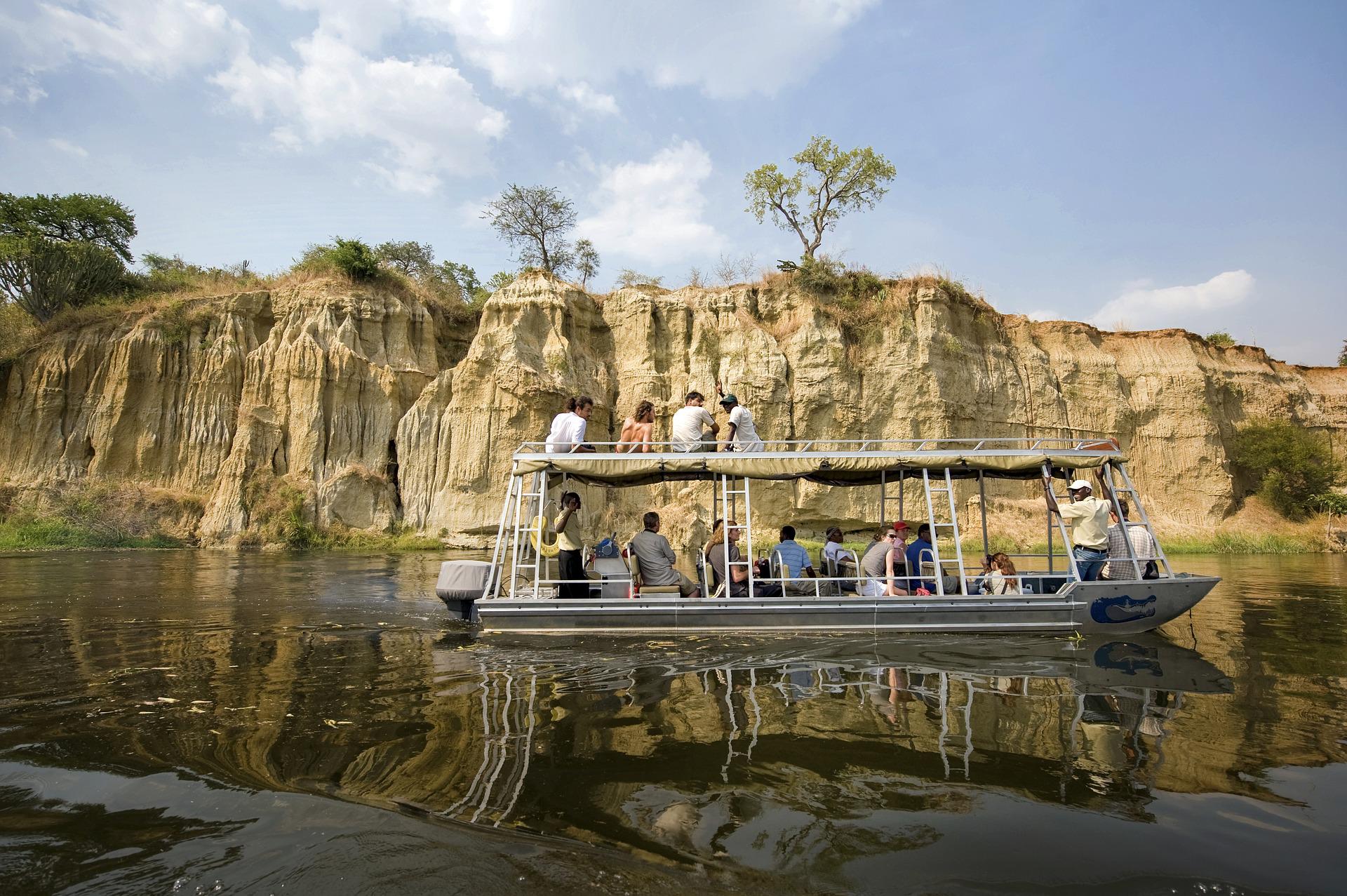
Queen Elizabeth National Park then offers the classic East African wildlife spectacle: tree-climbing lions on fig trees in the Ishasha sector, buffalo herds thousands strong, hippos packed into the Kazinga Channel, and some of Uganda’s finest birdwatching across open savannah, wetland, and forest edge habitats. A boat cruise on the Kazinga Channel, the 32-kilometer waterway connecting Lakes Edward and George, gives you hippo, crocodile, elephant, and water bird encounters at extraordinarily close range, gliding past animals that barely register your presence.
Then the Rwenzori. The 7-day summit expedition via the Kilembe Trail carries you from the old copper-mining town of Kilembe through five distinct ecological zones to the glaciated summit of Margherita Peak (5,109m) on Mount Stanley, Africa’s third highest point. The Kilembe Trail is a newer and less-trodden alternative to the Central Circuit, offering arguably superior vegetation scenery, dramatic waterfall views, the iconic Mutinda Lookout, and a genuine sense of wilderness that the more frequented trails cannot always match. It is one of the most beautiful mountain routes in Africa.
Put these three experiences together, and you have twelve days that span the full range of what Uganda offers: primates, savannah, alpine peaks, and equatorial ice. No other single itinerary at this duration matches the depth and diversity of this combination.
Day-by-Day Itinerary: 12-Day Rwenzori Trek, Gorilla Trekking & Uganda Wildlife Safari
Day 1: Kampala → Bwindi Impenetrable National Park
| Day | From | To | Distance | Hours | Terrain |
| Day 1 | Kampala | Bwindi Impenetrable NP | ~490 km | 7–9 hrs’ drive | Road transfer |
The Road South-West: Through Uganda’s Highlands to Gorilla Country
Your safari begins with an early-morning departure from Kampala. Your experienced driver-guide collects you from your hotel and heads southwest on the Masaka–Mbarara highway, one of Uganda’s main arterial routes. The drive passes through rolling green hills, tea plantations, banana groves, and small market towns before entering the dramatic highland landscapes of southwestern Uganda.
A lunch stop in Mbarara, the largest town in western Uganda and a convenient break point around the midway mark, gives you time to stretch, eat, and see a slice of regional Ugandan life before the road climbs toward Bwindi. The final section of driving, from Kabale or through the Echuya Forest, winds through mist-draped hills and terraced farmland as Bwindi’s dark forest appears on the horizon.
You arrive at your lodge in the late afternoon, check in, and receive a pre-trek briefing on tomorrow’s gorilla trekking experience, including which sector you will be visiting, the specific gorilla family assigned to your group, and what behavior to expect when you encounter the apes.
- Drive distance: approx. 490 km (Kampala to Bwindi via Mbarara)
- Drive time: 7–9 hours with lunch stop
- Meals: Lunch en route / dinner at lodge
Day 2: Gorilla Trekking in Bwindi Impenetrable National Park
| Day | From | To | Distance | Hours | Terrain |
| Day 2 | Bwindi | Gorilla habitat | Variable 2–8 km | 2–8 hrs | Rainforest / steep terrain |
The Encounter: One Hour with Africa’s Great Apes
This trek is the day most people describe as a life-changing experience. Bwindi Impenetrable National Park, a UNESCO World Heritage Site and one of the most biologically rich forests in Africa, is home to 19 habituated gorilla families, each tracked daily by a team of expert rangers and trackers. Your group (maximum of eight people per gorilla family per day) assembles at the park headquarters for a briefing at 7:30 a.m.
The briefing covers essential protocols: maintaining a 7-meter distance when possible, no flash photography, keeping voice levels low, and what to do if a silverback charges (stand firm, look down, and do not run). Then you enter the forest, following your assigned ranger team, who have already been in communication with the trackers stationed with the gorilla family.
The hike to find the gorillas can take anywhere from 30 minutes to several hours, depending on how far the family has moved overnight. The forest itself is extraordinary regardless: ancient Afromontane trees festooned with orchids and ferns, L’Hoest monkeys in the canopy, forest birds calling through the mist, and the dense, primeval atmosphere of a forest that has existed continuously for 25,000 years.
When you discover the gorillas, the world changes. Silverback males weighing up to 200 kg browse vegetation within metres of where you stand. Juveniles tumble and wrestle in the undergrowth. Mothers nurse infants while watching your group with calm, intelligent eyes. You have exactly one hour with the family. Most visitors will tell you it passes in what feels like ten minutes and that it stays with them for the rest of their lives.
Return to the lodge for lunch, a restful afternoon, and dinner. This is a day for reflection, reviewing photographs, and processing an experience that defies easy description.
- Start time: 7:30 AM briefing; trekking from approx. 8:00 AM
- Gorilla time: 1 hour maximum (per UWA regulations)
- Meals: Breakfast / packed lunch on trail / dinner at lodge
- Key wildlife: Mountain gorillas (Gorilla beringei beringei), L’Hoest monkeys, Bwindi turacos
Day 3: Bwindi → Queen Elizabeth National Park (Afternoon Boat Cruise)
| Day | From | To | Distance | Hours | Terrain |
| Day 3 | Bwindi | Queen Elizabeth NP | ~155 km | 3–4 hrs’ drive | Road / Kazinga Channel boat cruise |
Savannah Horizons: The Kazinga Channel at Sunset
After breakfast and a morning at leisure, you depart Bwindi and head north toward Queen Elizabeth National Park, Uganda’s most biodiverse national park and one of East Africa’s finest wildlife destinations. The three-to-four-hour drive crosses through spectacular landscapes: rolling hills give way to the Rift Valley escarpment and the broad plains of QENP, with the snow-dusted Rwenzori Mountains visible on the western horizon as you approach the park.
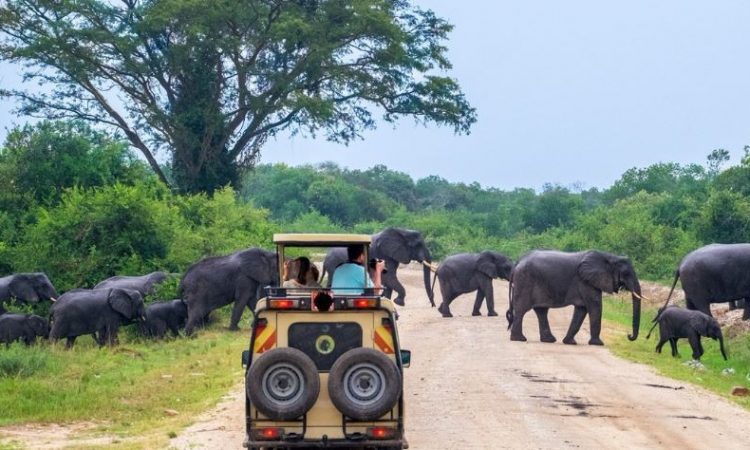
You arrive in time for lunch at your lodge and then head directly to the Kazinga Channel for the afternoon boat cruise, one of East Africa’s most rewarding wildlife experiences. The 32-kilometer channel connecting Lake George and Lake Edward is lined with hippo pods so dense you can barely count them; enormous Nile crocodiles basking on the banks; and thousands of water birds, including African fish eagles, pied kingfishers, yellow-billed storks, marabou storks, and the iconic African skimmer, among a checklist of over 600 species recorded in the park.
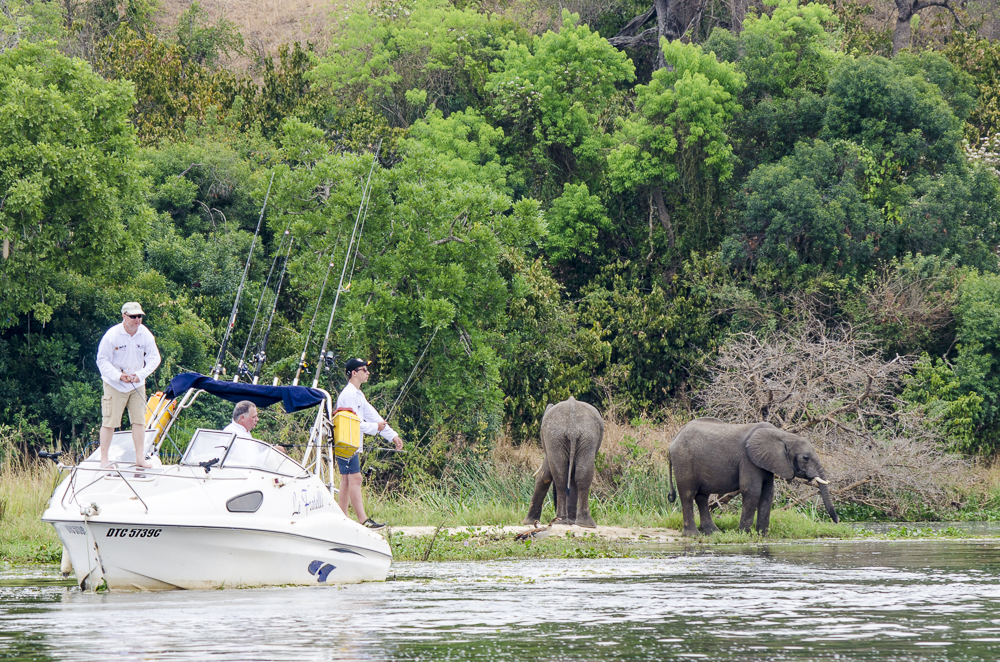
Elephant herds come down to drink in the late afternoon, often approaching the boat to within extraordinary proximity. Buffalo wade in the shallows. The combination of light, wildlife density, and the calm, slow movement of the boat makes the Kazinga Channel cruise one of the most reliably spectacular wildlife encounters in Africa.
- Drive: Bwindi to QENP approx. 3–4 hours via Ishasha / Kasese road
- Boat cruise: approx. 2 hours on the Kazinga Channel
- Meals: Breakfast / lunch at lodge / dinner at lodge
- Key wildlife: Hippos, Nile crocodiles, elephants, buffalo, water birds
Day 4: Morning Game Drive in QENP → Transfer to Kasese / Kilembe
| Day | From | To | Distance | Hours | Terrain |
| Day 4 | Queen Elizabeth NP | Kilembe / Kasese | ~60 km park + transfer | Morning game drive + 2–3 hrs drive | Savannah / road transfer |
Lions and Departure: The Final Safari Morning Before the Mountains
An early start rewards you with the best game-viewing of the day. The morning game drive covers the Kasenyi Plains and Mweya Peninsula areas, QENP’s most productive zones for predator sightings. In the early morning, when activity is highest and the light is golden and soft, you can regularly encounter lions, leopards, hyenas, Uganda kobs, and warthogs.
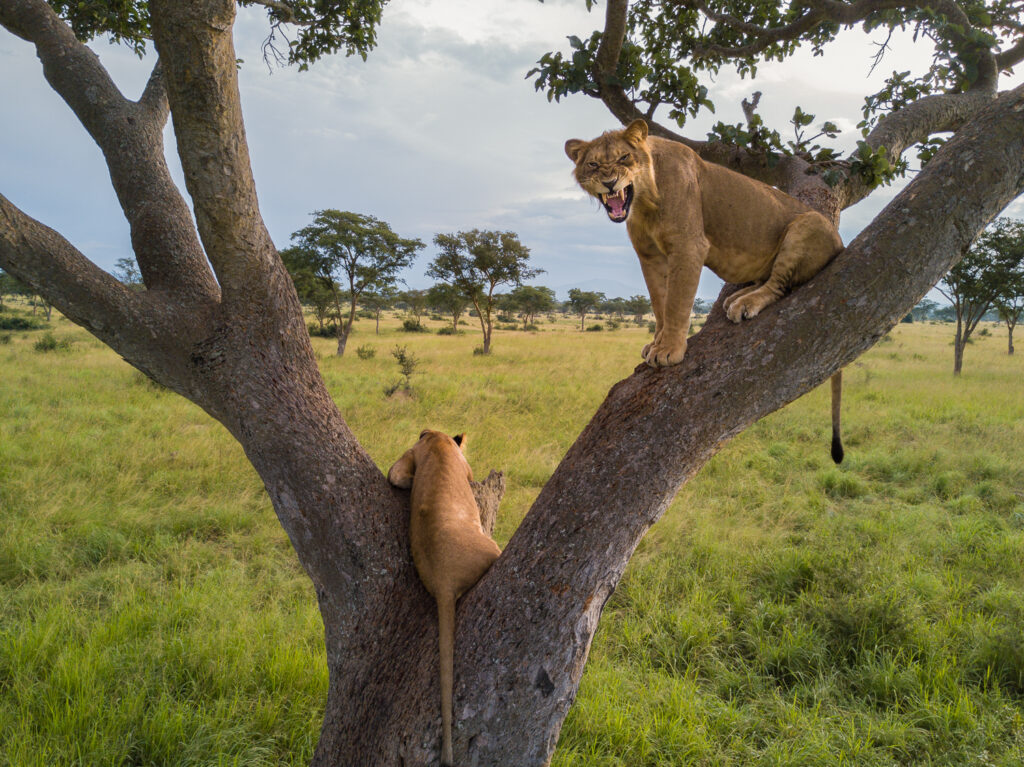
If your schedule and interest allow, the Ishasha Sector of QENP (reached via the southern boundary) is world-famous for its tree-climbing lions, a unique behavior exhibited by the lions of this area, who regularly lounge in large fig trees, sometimes 10–12 metres above ground. People debate the origin of this behavior, but the sighting is extraordinary and unusual enough to be worth the detour if time permits.
After the morning game drive and a late breakfast, you transfer north to Kasese, the gateway town to the Rwenzori Mountains, approximately 60 kilometers from the park. At Kasese, you check in with the Rwenzori Trekking Services (RTS) office at Kilembe for registration, porter assignment, and a comprehensive pre-trek briefing from your mountain guide team. Overnight accommodation in Kasese prepares you for Day 5’s trailhead departure.
For everything you need to know about Kasese before and after the trek, see our complete Kasese travel guide and pre- and post-trek accommodation guide.
- Game drive: 3–4 hours (Kasenyi Plains, Mweya Peninsula)
- Transfer to Kasese: approx. 2–3 hours from park
- Meals: Early breakfast / lunch en route / dinner in Kasese
- Sleep: Lodge in Kasese/Kilembe TrailHead
- Key wildlife: Lions, Uganda kob, warthogs, elephants (tree-climbing lions in Ishasha sector)
Day 5: Kilembe (1,450 m) → Kalalama Camp (3,147 m)
| Day | From | To | Distance | Hours | Terrain |
| Day 5 | Kilembe, 1,450m | Kalalama Camp, 3,147m | ~10 km | 5–7 hours | Montane forest / steep ascent |
Into the Rwenzori: The Forest Opens Above the Copper Mines
The Kilembe Trail begins at the Rwenzori Mountaineering Services (RMS) ranger post near the former Kilembe copper mines, a historically significant site where one of Uganda’s most important 20th-century industrial operations carved a network of shafts deep into the mountain. Your guides and porters assemble here for the final equipment check, boot fitting, and official registration before you take the first steps into the park.
The trail enters Rwenzori Mountains National Park almost immediately, passing through the national park gate and ascending into dense montane rainforest. This lower forest zone characterised by Podocarpus trees, wild begonias, tree ferns, and cascading waterfalls, is one of the most botanically rich sections of the entire Kilembe Trail. Sine Camp, at approximately 2,600 metres, provides a natural lunch stop before the trail continues to ascend through thinning forest toward Kalalama.
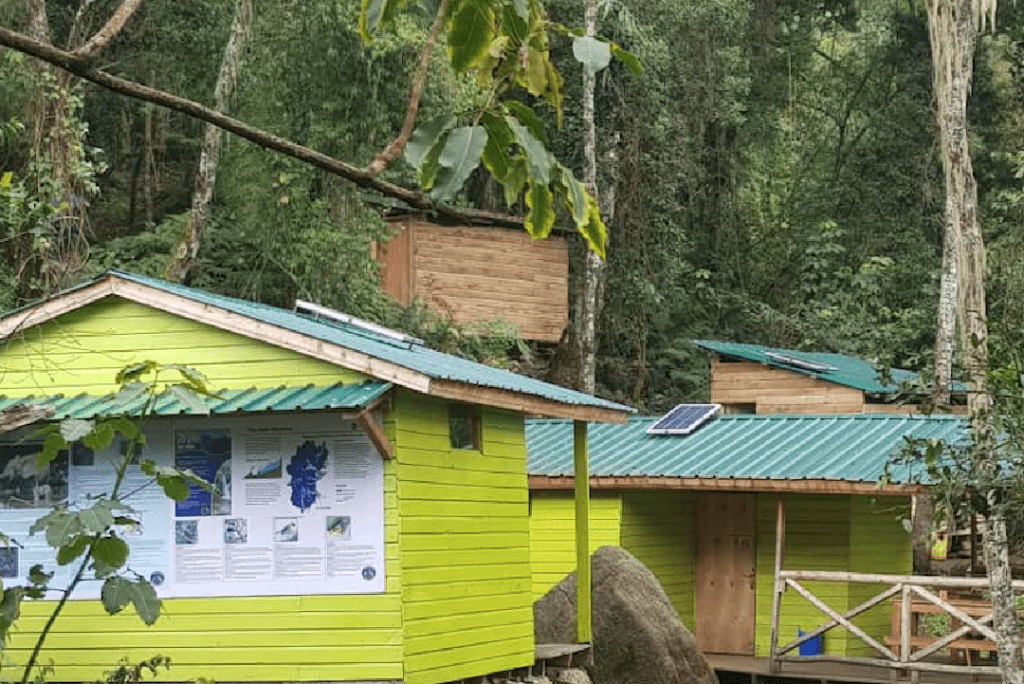
The Kilembe Trail is renowned for its waterfall scenery, and the first day sets the tone completely. Multiple waterfalls are visible or audible throughout the ascent, with the largest being spectacular enough to justify extended breaks for photography. See our dedicated 4-Day Rwenzori Waterfalls Hike guide for the full waterfall inventory on this trail.
Kalalama Camp, at 3,147 metres, sits in a sheltered valley within the transition zone between montane forest and lower heather. The camp has solid banda hut accommodation, a cooking shelter, and a water source from the nearby stream. Your guide team delivers a briefing on Day 6 before dinner and an early rest.
- Elevation gain: 1,697 m (1,450 m to 3,147 m)
- Hiking time: 5–7 hours
- Meals: Packed lunch on trail / dinner at camp
- Sleep: Kalalama Camp (3,147 m)
- Key experiences: Rwenzori waterfalls, forest entry, first Rwenzori turaco sightings, colobus and blue monkeys
Day 6: Kalalama Camp (3,147 m) → Mutinda Camp (3,688 m)
| Day | From | To | Distance | Hours | Terrain |
| Day 6 | Kalalama Camp, 3,147 m | Mutinda Camp, 3,688 m | ~6 km | 5–7 hours | Bamboo / mimulopsis / heather zone |
The Bamboo Tunnels and Heather Giants of the Middle Mountain
Departure from Kalalama at 9:00 AM takes you immediately into one of the Kilembe Trail’s most distinctive landscape zones: the bamboo-mimulopsis corridor. This section of trail has dense highland bamboo (Sinarundinaria alpina) mixed with mimulopsis shrubs, and the path goes up a series of steep steps cut into the slope, making it a constant climbing challenge that rewards you with increasingly dramatic views as the canopy opens.
Above the bamboo, the trail enters the heather zone. Erica arborea tree heathers draped in pale Usnea lichen, streams tumbling from rock faces, and the misty, ethereal atmosphere that imparts the Rwenzori Mountains their legendary mystique. Multiple streams and small waterfalls cross the path throughout this section, all sheltered by the characteristic green-grey moss that carpets every surface above 3,000 metres.
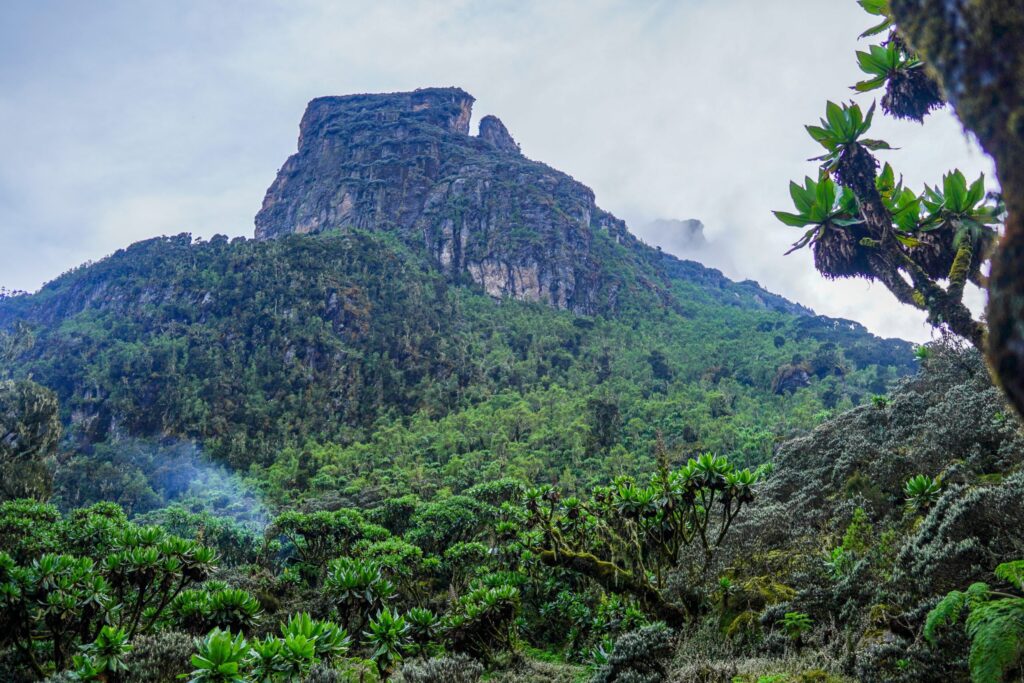
Mutinda Camp, at 3,688 metres, sits at the base of the Mutinda Peaks, a dramatic rock formation visible from much of the surrounding area. For trekkers with energy remaining after arrival, the optional ascent to Mutinda Lookout (3,925m) takes 90 minutes up and 60 minutes down from camp and offers one of the finest panoramic views on the entire Kilembe Trail: the Rwenzori peaks above, Kasese town and Lake George far below, and the Congo escarpment on the western horizon. The lookout is strongly recommended for those with the physical reserves to make it.
- Elevation gain: 541 m (3,147 m to 3,688 m)
- Hiking time: 5–7 hours (main trail) + optional 90 min Mutinda Lookout ascent
- Meals: Breakfast at camp / packed lunch / dinner at Mutinda
- Sleep: Mutinda Camp (3,688 m)
- Key experiences: Bamboo forest tunnel; heather zone transition; Mutinda Lookout panorama (optional)
Day 7: Mutinda Camp (3,688 m) → Bugata Camp (4,062 m)
| Day | From | To | Distance | Hours | Terrain |
| Day 7 | Mutinda Camp, 3,688m | Bugata Camp, 4,062m | ~7 km | 5–7 hours | Boggy alpine / giant lobelias / Namusangi Valley |
Giant Lobelias and the Namusangi Valley: Entering the Afroalpine World
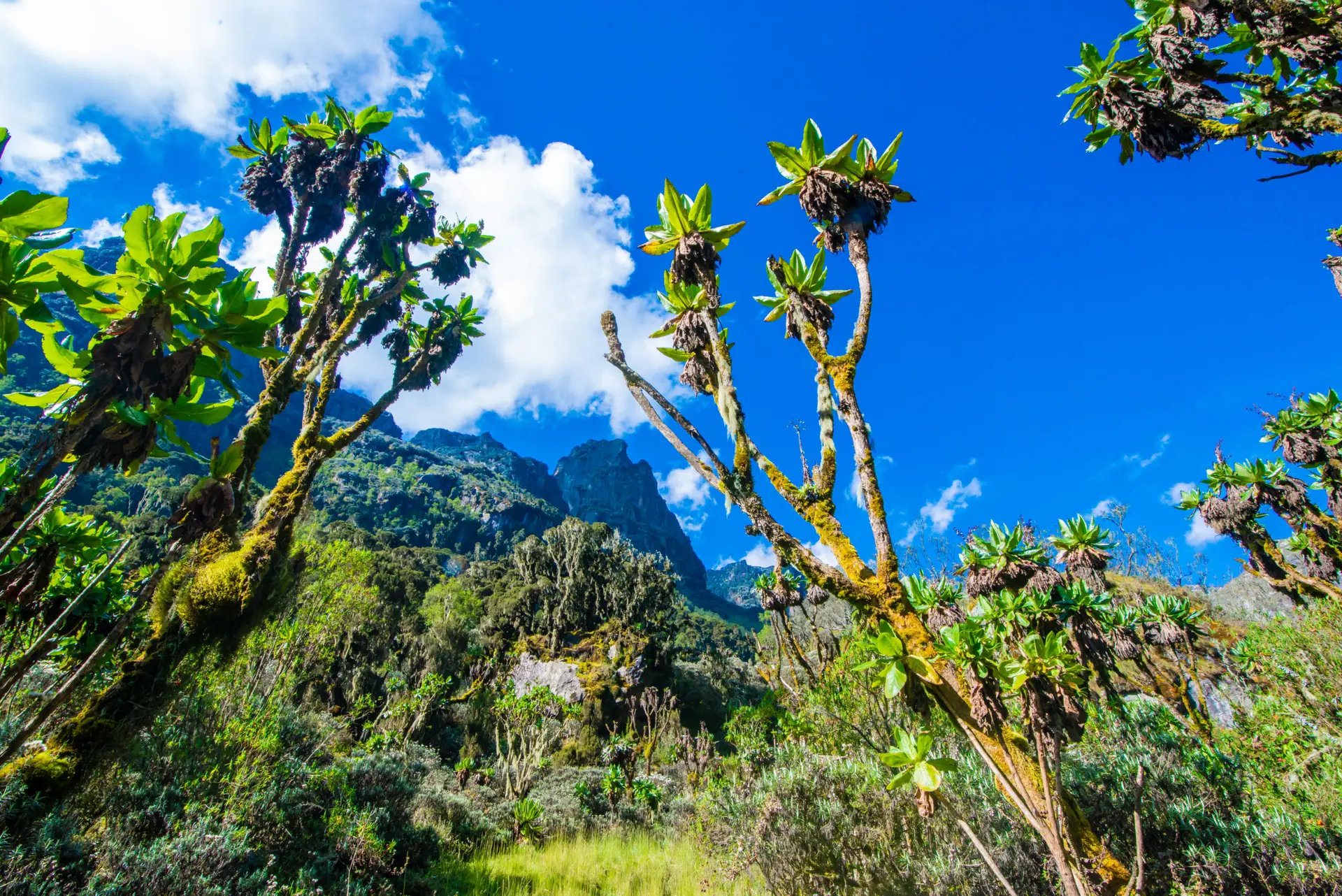
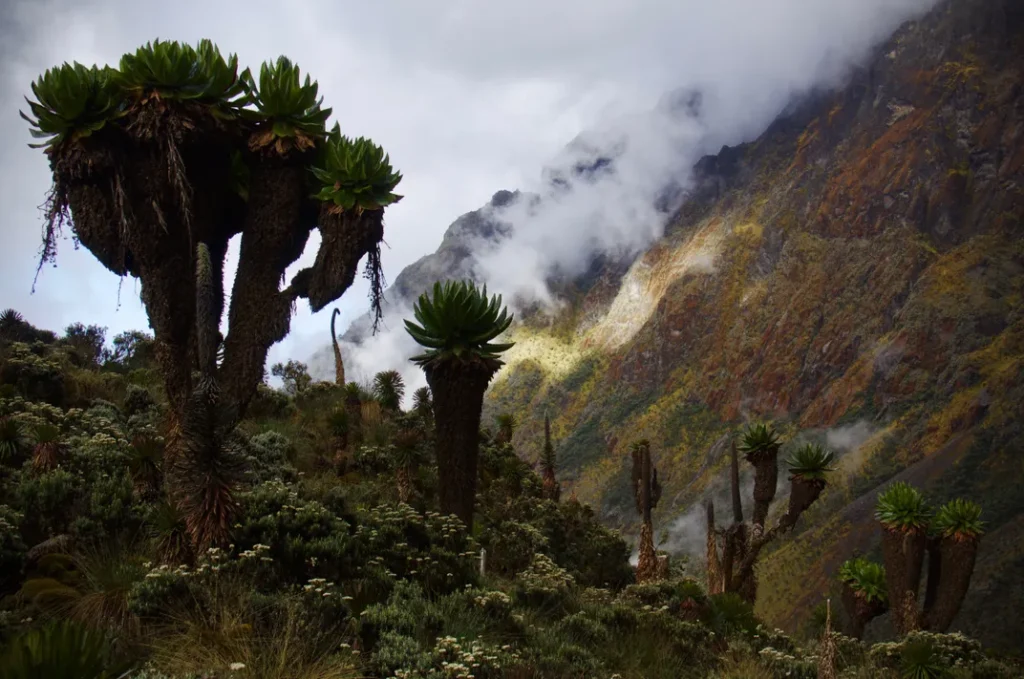
Today’s stage crosses into the full afro-alpine zone, the ecological threshold above which the Rwenzori reveals its most dramatically alien vegetation. Departing Mutinda at 9:00 AM, the trail immediately enters boggy terrain characterised by tussock grass, everlasting flowers (Helichrysum), and the first giant lobelias (Lobelia gibberoa), their flower spikes reaching two to three metres from the ground. This is classic Rwenzori, otherworldly and unlike any other mountain environment in Africa.
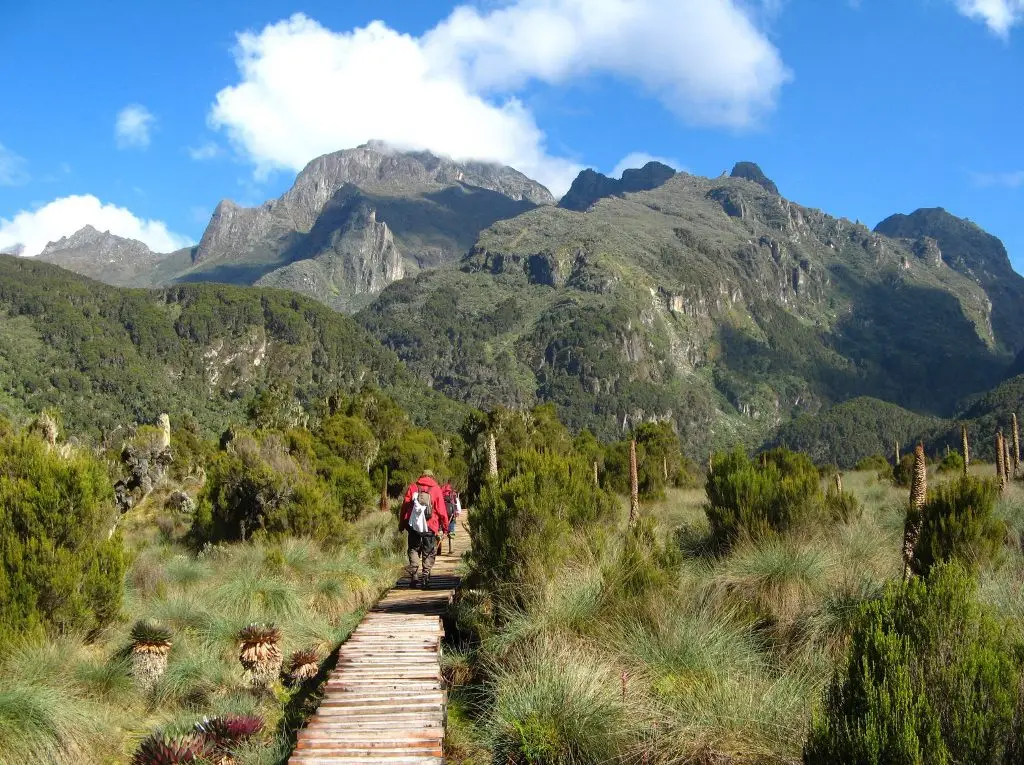
The path climbs steadily through the boggy terrain, crossing the Mutinda Valley before ascending steeply to the lip of Namusangi Valley at 3,840 metres a superlative viewpoint from which the Mutinda Peaks stand clear to the south and the higher Rwenzori massifs fill the northern skyline. The Namusangi Valley itself is one of the most scenic sections of the Kilembe Trail, a broad alpine bowl draped in giant groundsel (Senecio adnivalis) and threaded with clear streams.
Bugata Camp, at 4,062 metres, is the highest standard camp on the Kilembe Trail below the summit push and one of the best-equipped on the mountain: solar-powered lighting, eco-toilets, and bathroom facilities make it an unusually comfortable base at this altitude. From the camp, the views extend across the valley to the snow-dusted summit of Weismann Peak on Mount Luigi di Savoia, typically veiled in evening clouds. A short walk from camp allows views down nine lakes in the Nusuranja Valley. Dinner at Bugata marks the halfway point of the Rwenzori section.
- Elevation gain: 374 m (3,688 m to 4,062 m)
- Hiking time: 5–7 hours
- Meals: Breakfast / packed lunch / dinner at Bugata
- Sleep: Bugata Camp (4,062 m) solar lighting, eco-toilet, bathroom
- Key experiences: Giant lobelia fields; Namusangi Valley views; nine-lakes panorama; Weismann Peak view.
Day 8: Bugata Camp (4,062 m) → Hunwick's Camp (3,974 m)
| Day | From | To | Distance | Hours | Terrain |
| Day 8 | Bugata Camp, 4,062m | Hunwick’s Camp, 3,974m | ~8 km | 6–8 hours | Bamwanjara Pass / glacial lakes / steep rocky descent |
The High Crossing: Bamwanjara Pass and the Kachope Lakes
Today involves the expedition’s most dramatic high-pass crossing. From Bugata, the trail climbs steadily northwest across long, flat, boggy plateaus toward Bamwanjara Pass at 4,450 metres, the highest point on the trail before the final summit day. The ascent is gradual but sustained, and the altitude effect is clearly felt as you approach the pass: breathing is slower, steps are more deliberate, and the vast panorama that opens from the pass ridge justifies every measured footfall.
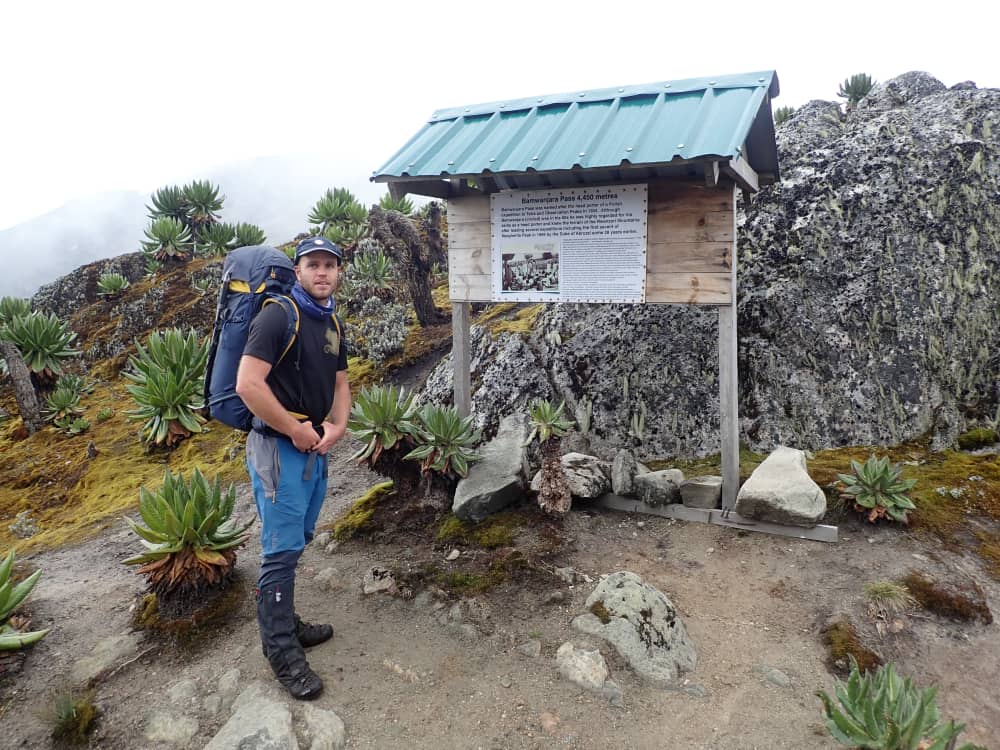
From Bamwanjara Pass, all the major Rwenzori peaks are visible simultaneously in excellent weather: Stanley, Speke, Baker, Emin, Gessi, and Luigi di Savoia spread across the horizon like a mountain encyclopedia. A small emergency shelter at the pass provides a windbreak for the mandatory rest and refreshment stop. The glacial lakes below the Stanley plateau are visible from here, a first glimpse of the glaciated world you will enter on summit day.
The descent from the pass to Hunwick’s Camp is steep, muddy, and technically demanding in wet conditions. The path drops sharply past the upper and lower Kachope Lakes, brilliant glacially-fed alpine lakes surrounded by rocky bluffs and everlasting flowers before leveling at the camp. Hunwick’s Camp, at 3,974 metres, is perched on a ridge that offers a commanding view of snow-capped Mount Baker directly across the valley. Dinner and a summit-approach briefing close the day.
- Elevation: Ascent to Bamwanjara Pass 4,450m, then descent to 3,974m
- Hiking time: 6–8 hours
- Meals: Breakfast / packed lunch at Bamwanjara Pass / dinner at Hunwick’s
- Sleep: Hunwick’s Camp (3,974m)
- Key experiences: Bamwanjara Pass 360° panorama; Kachope glacial lakes; Mount Baker views from camp
Day 9: Hunwick's Camp (3,974 m) → Margherita Camp (4,485 m)
| Day | From | To | Distance | Hours | Terrain |
| Day 9 | Hunwick’s Camp, 3,974m | Margherita Camp, 4,485m | ~6 km | 5–7 hours | Ridge traverse / Scott Elliot Pass / upper alpine zone |
Scott Elliot Pass and the Approach to Africa’s Third Highest Summit
The penultimate mountain day carries you from Hunwick’s Camp across a complex ridge system, navigating wet areas and stream crossings fed by snowmelt from Mount Baker and Fresh Field Pass above. The trail is exposed and requires careful route-finding in cloudy conditions, conditions that your guide knows intimately.
Scott Elliot Pass, a defining landmark of the Kilembe Trail approach, is named for the Scottish professor whose 1895 expedition first documented this high route. Gaining the pass places you at the intersection of the Stanley and Baker massifs, with the ice fields of Mount Stanley directly above and the Bujuku Valley dropping away to the north. The pass crossing is often cold, wind-swept, and cloud-shrouded; full windproof layers are essential from this point.
Margherita Camp, at 4,485 metres, sits just below the Elena Hut in a ring of protective high rocks, the same campsite first used by Prince Luigi Amadeo di Savoia, the Duke of Abruzzi, during his landmark 1906 expedition that made the first ascents of multiple Rwenzori peaks. The historical weight of this location is tangible. From here, the glacier is directly above. You arrive in the late afternoon for dinner and an extremely important pre-summit briefing: rope use, crampon technique, ice axe grip and arrest, and the precise timeline for tomorrow’s 3:00 a.m. departure.
- Elevation gain: 511 m (3,974 m to 4,485 m)
- Hiking time: 5–7 hours (may arrive late afternoon)
- Meals: Breakfast / packed lunch / early dinner at Margherita Camp
- Sleep: Margherita Camp (4,485 m) beneath Elena Hut, historic Duke of Abruzzi campsite
- Key experiences: Scott Elliot Pass; first glacier view from camp; technical summit briefing
Day 10: Summit Margherita Peak (5,109 m) → Hunwick's Camp (3,974 m)
| Day | From | To | Distance | Hours | Terrain |
| Day 10 | Margherita Camp, 4,485m | Margherita Peak 5,109m → Hunwick’s 3,974m | ~12 km round trip | 10–14 hours total | Glacier ascent / crampon / rocky descent |
The Summit: Margherita Peak at Sunrise: Africa’s Third Highest Point
Your alarm sounds at 2:00 AM. This is the day the entire safari has been building toward. Hot tea, a high-calorie breakfast, crampons clicked into rubber boots, an ice axe gripped, and a headtorch illuminating the rocky path behind Elena Hut in the darkness. The summit team assembles in silence and cold and begins moving.
The route initially crosses the rocky boulder field above Margherita Camp before transitioning to the Stanley Plateau approach, a vast, undulating snowfield that leads to the glacier proper. The Margherita Glacier, one of the last equatorial glaciers in Africa, is retreating by several metres annually and is predicted to be largely gone by 2040–2060. It is ascended with crampons on the fixed rope system installed by the Uganda Wildlife Authority. The crossing of a glacier bridge over a crevasse in the upper section is among the most memorable moments in African mountaineering.

At 5,109 metres, Margherita Peak is the highest point of the Rwenzori range, the highest point in Uganda, and Africa’s third highest summit after Kilimanjaro (5,895m) and Mount Kenya (5,199m). To the west, the Democratic Republic of Congo stretches to the horizon. Far below, Lake Edward glimmers to the south. The glaciated summits of Speke, Baker, and the Stanley massif surround you. Sunrise here, if the clouds allow, is one of the most spectacular sights available to any trekker in Africa.
After the summit photographs, the register, a sustained silence, and the descent begin. Crampons come off below the glacier. The long trek back down through Margherita Camp, past Hunwick’s junction, and down to Hunwick’s Camp covers significant ground. It is a physically demanding day, totalling 10–14 hours of movement. A hot dinner and deep sleep await at the end of it.
- Wake-up: 2:00 AM summit departure: 3:00 AM
- Summit typically reached: 6:00–8:00 AM (sunrise window)
- Return to Hunwick’s: late afternoon
- Meals: 2:00 AM early breakfast, trail snacks, and dinner at Hunwick’s
- Sleep: Hunwick’s Camp (3,974 m)
- Key experience: Glacier crossing with crampons; sunrise from 5,109m; equatorial ice; two-country panorama
Day 11: Hunwick's Camp (3,974 m) → Kilembe Ranger Post (1,450 m)
| Day | From | To | Distance | Hours | Terrain |
| Day 11 | Hunwick’s Camp, 3,974 m | Kilembe Ranger Post, 1,450 m | ~17 km | 7–9 hours | Full descent through all vegetation zones |
The Long Descent: Reversing Through Five Ecological Zones
The final mountain day is one of the most emotionally complex of the entire trip the mountain experience is ending, but the descent itself is a full-day physical commitment through terrain that is, if anything, more demanding underfoot going down than it was coming up. Slippery root sections, muddy bog crossings, and steep descents on weary legs require continuous concentration.
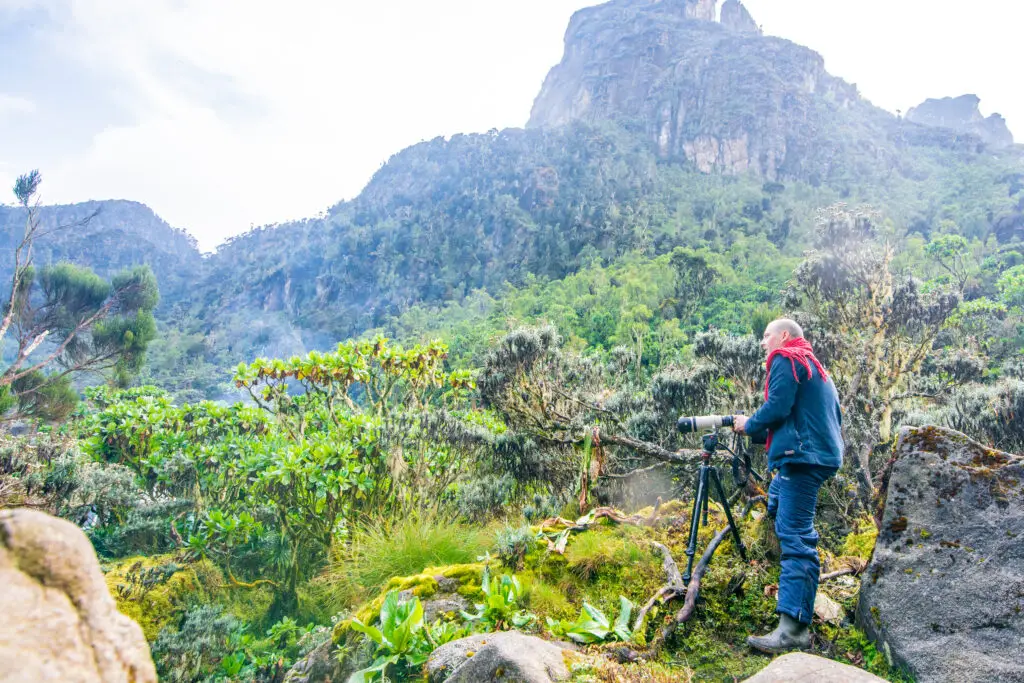
The descent retraces the Kilembe Trail in reverse: from Hunwick’s Camp down through the high alpine zone, past the Kachope Lakes, over the Bamwanjara plateau (now traversed at a lower elevation below the pass), through the Namusangi Valley, Bugata, and the lower heather and bamboo zones. Each vegetation zone reasserts itself as you lose altitude: the return of birdsong, the thickening of the canopy, and the warmth of the air rising to meet you.
As you approach the forest zone, colobus monkeys appear in the trees again, the familiar chorus of the Rwenzori turaco sounds across the valley, and the smell of tropical forest replaces the cold mineral air of the high camps. When the Kilembe Ranger Post comes into view through the trees, you collect your summit certificate, an official Rwenzori Mountaineering Services document confirming your ascent of Margherita Peak, and step off the mountain.
Transfer to Kasese for overnight accommodation. For Kasese hotel recommendations, see our Kasese gateway guide.
- Hiking time: 7–9 hours (full descent)
- Meals: Breakfast at camp / packed lunch on trail / dinner in Kasese
- Sleep: Lodge in Kasese
- Key experience: Collecting Margherita Peak summit certificate; full descent through five ecological zones
Day 12: Kasese → Kampala (End of Safari)
| Day | From | To | Distance | Hours | Terrain |
| Day 12 | Kasese, western Uganda | Kampala | ~390 km | 5–6 hrs’ drive | Road transfer |
Homeward: The Equator, the Road, and the Memory
Your final morning begins at a leisurely pace; the mountain is behind you, and the road ahead is long but comfortable. After breakfast at the Kasese lodge, your driver-guide loads the vehicle, and the journey east begins, following the main Kasese–Kampala highway through the Rwenzori foothills, past the edge of Queen Elizabeth National Park, and into the Ugandan midlands.
A lunch stop in Mbarara, Uganda’s western commercial hub, offers a final taste of the country’s roadside hospitality before the highway continues to the Uganda Equator crossing at Kayabwe, the 0° latitude marker that most Uganda visitors photograph, proof that you have crossed the equator in a country that spans both hemispheres. The site has a small craft market and offers the classic equatorial souvenir photograph.
Arrival in Kampala in the mid-to-late afternoon completes the 12-day circuit. Your driver-guide delivers you to your hotel or designated drop-off point. The trip is over, but the memory of standing on an equatorial glacier at 5,109 metres, three days after watching gorillas browse the forest floor of Bwindi, will take considerably longer to process.
- Drive distance: approx. 390 km (Kasese to Kampala via Mbarara)
- Drive time: 5–6 hours with stops
- Meals: Breakfast at lodge / lunch in Mbarara
- End point: Hotel or airport in Kampala / Entebbe
Elevation Profile: The Kilembe Trail Arc on the 12-Day Safari
The elevation profile of the Rwenzori component is a sustained ascent over five days followed by a single long descent. Starting at 1,450 metres at the Kilembe trailhead, the trail climbs progressively to Kalalama Camp (3,147 m, Day 5), Mutinda Camp (3,688 m, Day 6), and Bugata Camp (4,062 m, Day 7). The crossing of Bamwanjara Pass (4,450m, Day 8) represents the highest point before the summit push, with a descent to Hunwick’s Camp (3,974 m).
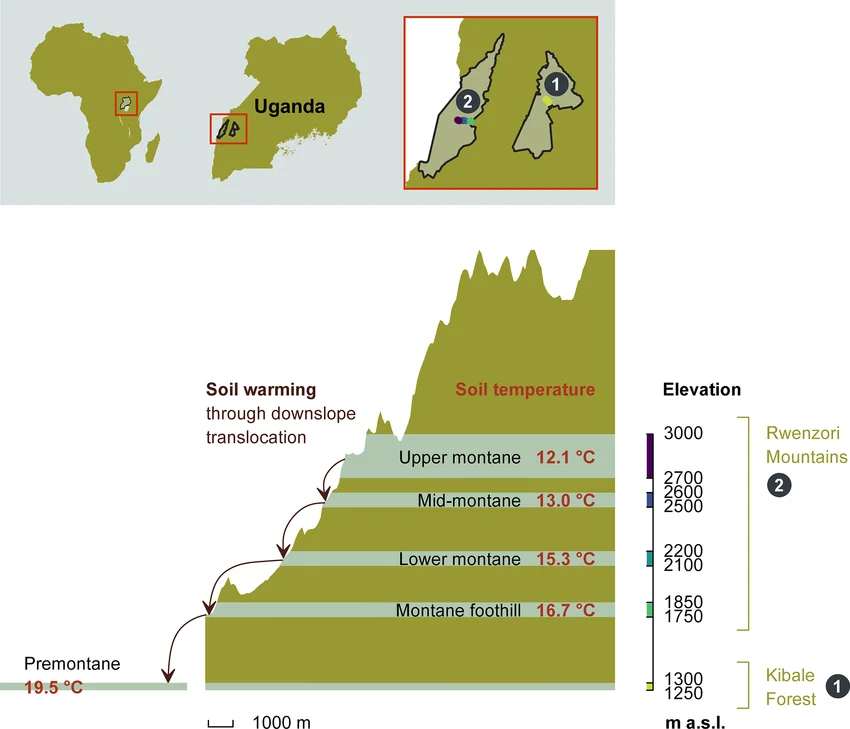
On Day 9, we re-ascend to Margherita Camp (4,485 m), and on Day 10, we reach the maximum elevation of 5,109 metres at Margherita Peak. The cumulative elevation gain from Kilembe to Margherita Peak is approximately 3,659 metres over five days of ascent. The full descent on Day 11 covers this same vertical relief in a single day. Total cumulative elevation gain across the seven mountain days is approximately 5,500–6,000 metres.
Wildlife and Ecosystems Across the 12-Day Safari.
This itinerary spans four completely distinct ecosystems: Afromontane rainforest, savannah / wetland, alpine moorland, and glacial summit zone, each with its own wildlife profile. The result is an extraordinary breadth of wildlife encounters across a single 12-day trip.
Bwindi Impenetrable National Park: Rainforest Primates and Forest Birds
Bwindi holds over 120 mammal species and 350 bird species in a 331-square-kilometer forest that dates back 25,000 years. In addition to the 19 habituated gorilla families, the forest supports chimpanzees, L’Hoest monkeys, black-and-white colobus, red-tailed monkeys, and over 23 Albertine Rift endemic bird species, which is one of the highest concentrations of endemics in Africa.
Queen Elizabeth National Park: Savannah, Wetland, and Tree-Climbing Lions
QENP supports over 95 mammal species and 600+ bird species, making it one of the most biodiverse parks in Africa. The Kazinga Channel holds hippo populations of up to 3,000 individuals. Lions, leopards, elephants, buffalo, and Uganda kobs are the flagship mammal species. The Ishasha sector’s tree-climbing lions are globally unique. See our full Queen Elizabeth National Park guide for more.
Rwenzori Mountains Five Altitude Zones of Unique Flora and Fauna
The Kilembe Trail goes through five different vegetation zones: montane forest (1,450–2,500 m), bamboo/mimulopsis zone (2,500–3,000 m), heather/moorland zone (3,000–3,800 m), Afro-alpine giant lobelia and groundsel zone (3,800–4,500 m), and nival/glacial zone (4,500–5,109 m). Each zone has specialist species not found below or above it. See our complete Rwenzori vegetation zones guide and Rwenzori wildlife guide for full species lists.
Physical Difficulty and Fitness Requirements for the 12-Day Safari
This itinerary combines two physically different experiences, each with its own demands. The safari component (Days 1–4) requires no specific fitness level; game drives and boat cruises are accessible to virtually all fitness levels, and gorilla trekking involves walking 2–8 km on uneven forest terrain at relatively low altitude, typically at 1,500–2,300 metres. Most reasonably mobile adults can complete the gorilla trek without specific prior training. For fitness guidance specific to gorilla trekking, see the gorilla trekking preparation guide.
The Rwenzori Kilembe Trail component (Days 5–11) is a different matter. This section is a Challenging to Strenuous seven-day high-altitude trek, with a summit day reaching 5,109 metres a classification that demands genuine pre-trip preparation. Trekkers should be able to hike 6–8 hours per day with a daypack on consecutive days, have some prior multi-day trekking experience, and be comfortable with steep, slippery, and technically varied terrain. The summit day involves glacier travel with crampons and an ice axe under guide supervision.
It is not necessary to have prior high-altitude mountaineering experience for this trek; the Kilembe Trail’s gradual ascent profile and the guide team’s expertise make it accessible to fit, motivated trekkers without summit experience. However, altitude sickness above 3,500 metres is a genuine risk, and all trekkers should read our altitude acclimatization guide and the Rwenzori medical guide before departure.
Training recommendation: Begin a 12-week progressive hiking program at least three months before the trek. Include weekend day hikes with a loaded pack (10–15 kg), consecutive-day hiking, and aerobic cardiovascular training. For older trekkers, our guide on hiking the Rwenzori over 50 is particularly relevant.
Best Time to Do the 12-Day Rwenzori Trek & Gorilla Trekking Safari
This itinerary involves three distinct geographical areas, each with its own optimal season. The good news is that Uganda’s two dry seasons broadly align across all three: the primary dry season (December–February) and the secondary dry season (June–August) offer the best conditions for gorilla trekking, game viewing, and Rwenzori summit attempts simultaneously. For the full Rwenzori seasonal guide, see our best time to visit the Rwenzori page.

December to February: Optimal for All Three Experiences
The driest and most reliably clear period for all three components. Gorilla trekking in Bwindi is enjoyable in dry conditions (a wet forest floor is harder going); QENP game viewing is excellent with good vegetation clearance and concentrated wildlife around water sources; and the Rwenzori summit window is at its most reliable. December and January are particularly recommended.
June to August: Strong Alternative Window
June and July are excellent for all three activities. Wildlife concentrations in QENP are high, gorilla trekking conditions are good in Bwindi, and the success rates for summiting the Kilembe Trail are strong. August can see the onset of short rains. This window aligns well with Northern Hemisphere summer holidays and is the most popular booking period.
March–May and September–November: Wet Season Operation
The safari is fully operational year-round, but wet season conditions bring additional challenges: the Rwenzori trail becomes muddier and more technically demanding, gorilla trek durations can be longer as gorilla families move in wet weather, and some game-viewing roads in QENP become impassable. Prices are typically lower in the wet season. Gorilla permits are easier to obtain.
Gorilla Permit Availability: Book Early
The Uganda Wildlife Authority issues Bwindi gorilla permits (USD 800 per person) in strictly limited daily allocations per gorilla family. Travelers can fully book popular travel windows, particularly December, January, June, and July, months in advance. We strongly recommend booking this itinerary a minimum of six months ahead to guarantee permit availability on your preferred dates. Contact us to check availability.
What Is Included and What Is Not Included
| ✓ INCLUDED | ✗ NOT INCLUDED |
| Kampala–Bwindi–QENP–Kasese–Kampala 4WD transfer in a private safari vehicle | International flights and visas (Uganda e-visa: approx. USD 50) |
| Professional English-speaking driver-guide (safari component, Days 1–4 & 12) | Airport arrival and pre-safari Kampala accommodation |
| Certified senior mountain guide and assistant guide (Rwenzori, Days 5–11) | Travel insurance and medical evacuation coverage (mandatory own arrangement) |
| Personal porter allocation: one porter per trekker (Kilembe Trail) | Tips and gratuities for guides, porters, drivers, and lodge staff |
| Uganda Wildlife Authority (UWA) gorilla trekking permit (USD 800/person) | Personal trekking equipment (sleeping bag, clothing, trekking poles) |
| All UWA Rwenzori Mountains National Park entry and trekking permit fees | Alcoholic beverages and personal spending money |
| All meals included throughout the 12 days (excluding Kampala nights) | Personal snacks and supplements beyond standard trail meals |
| Accommodation per itinerary (lodge + mountain huts/banda) | Optional Ishasha sector detour (tree-climbing lions) extra mileage charge |
| Kazinga Channel boat cruise | Laundry services |
| Game drive in Queen Elizabeth National Park | Gorilla habituation experience (separate permit available on request) |
| Technical glacier summit equipment: crampons, ice axes, helmets, harnesses | Any additional nights in Kampala or elsewhere before/after the itinerary |
| Free use of rubber boots on the mountain (Kilembe Trail) | Medical expenses and pharmaceutical costs |
| Camp cook and all cooking equipment on the mountain | |
| Emergency oxygen cylinder and mountain first-aid kit | |
| Rwenzori Mountains summit certificate on descent | |
| Community contribution: 10% to Bakonzo community support programme |
For a full cost breakdown across all Rwenzori trekking packages and Uganda safari components, see our complete cost guide for climbing the Rwenzori. For porter tipping guidance, visit our porter and guide tipping guide.
Packing and Gear List for the 12-Day Rwenzori Trek & Gorilla Safari
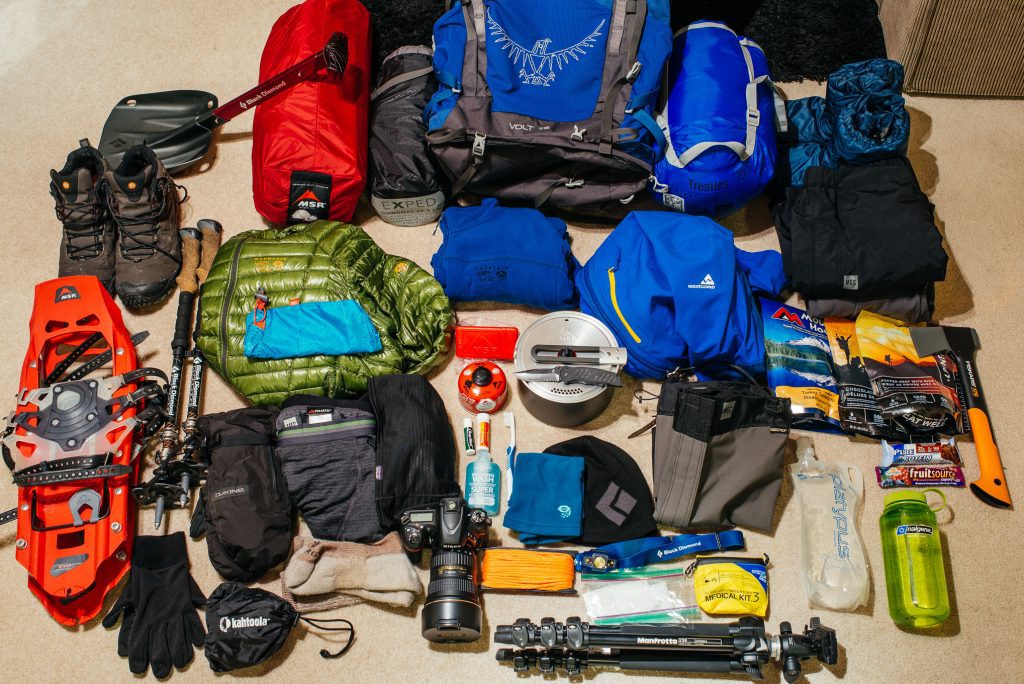
This itinerary requires two distinct packing considerations: a safari bag for the lodge-based wildlife days and a full mountain kit for the seven-day Kilembe Trail expedition. The Rwenzori gear list is on our dedicated packing and gear guide. The safari-specific items below supplement that list.
For the Safari Component (Days 1–4)
- Lightweight, neutral-coloured clothing (green, brown, khaki) gorilla protocol discourages bright colours
- Long-sleeved shirt and light trousers for forest/savannah protection
- Waterproof jacket (Bwindi forest is reliably wet)
- Sturdy closed-toe walking shoes for gorilla trekking (trail runners acceptable)
- Gardening-style gloves (recommended for gorilla trek gripping vegetation)
- Camera with zoom lens for QENP game drives
- Binoculars (8×42 or 10×42 recommended)
- Insect repellent (DEET important for Bwindi forest floor)
- Small day pack for gorilla trek (water, snacks, camera)
- Sunscreen SPF 50+ and sun hat for QENP game drives
For the Rwenzori Mountain Component (Days 5–11)
See the full Rwenzori gear list and Rwenzori boot guide for the complete mountain kit. Key items: sleeping bag rated to -10°C or lower; heavyweight down jacket; full waterproof shell jacket and trousers; rubber boots (provided by RTS); thermal layers; trekking poles; headtorch with spare batteries. 3-liter water capacity; personal first aid kit with altitude medication (consult doctor about Diamox); and a power bank to keep charged in your sleeping bag overnight.
Luggage Management on the 12-Day Safari
The key practical consideration for this combo itinerary is luggage logistics. On the mountain (Days 5–11), each porter carries a maximum of 15–18 kg of gear. You will carry only a daypack on the trail. A dedicated duffel bag (soft-sided, 60–80 liters) is ideal for mountain gear; hard-sided cases are impractical on the trail. Safari gear (lodge clothing, chargers, and non-mountain items) can be left securely at your Kasese lodge during the mountain days and collected on Day 11. Coordinate with us on luggage storage arrangements at booking.
Permits, Park Fees, and Costs
This 12-day itinerary involves park fees and permit costs across three national parks. All fees below are included within the quoted package price unless otherwise noted.
| Gorilla Trekking Permit | USD 800 per person per trek Bwindi Impenetrable NP (UWA) |
| QENP Entry Fee | USD 40 per person per day (safari days covered in package) |
| Kazinga Boat Cruise | USD 30 per person included in the package. |
| Rwenzori NP Entry | USD 45 per person per day × 7 mountain days |
| RMS Guide & Porter Fees | Mandatory, fully included in package |
| Hut & Camp Fees | All hut fees for the Kilembe Trail are included in the package. |
| Summit Permit (Stanley) | An additional UWA fee is included in the package. |
| Package Price | From USD 5,800 per person (group & season dependent; contact us) |
For a complete and transparent breakdown of all Rwenzori trekking costs, see our Rwenzori cost guide. Gorilla permit availability is limited; contact us early to confirm permit dates before finalizing bookings.
Getting There: Arrival, Logistics, and Transfers
The itinerary begins and ends in Kampala. Most international visitors arrive at Entebbe International Airport (EBB), located 40 kilometers south of Kampala on the shores of Lake Victoria. All road transfers within the itinerary, Kampala to Bwindi, Bwindi to QENP, QENP to Kasese, and Kasese to Kampala, are included in the package price and operated by Rwenzori Trekking Safaris in a comfortable, air-conditioned 4WD safari vehicle. For a full transport guide, check out our guide on how to reach the Rwenzori Mountains.
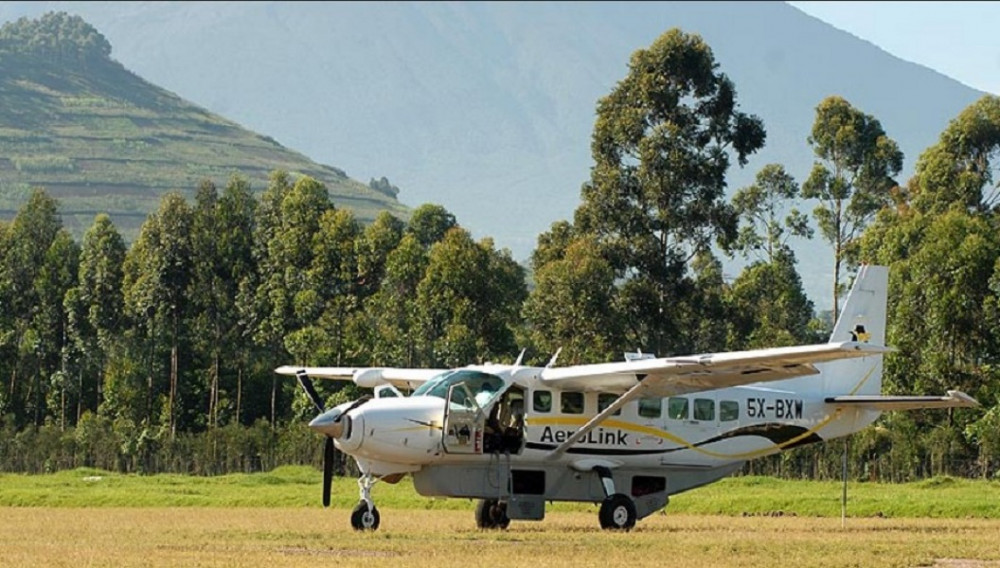
From Entebbe International Airport
Arrive at Entebbe the evening before Day 1, or on the morning of Day 1 for an afternoon Kampala departure. We recommend an overnight stay in Kampala or Entebbe the night before the safari begins to avoid travel fatigue on Day 1’s long drive to Bwindi. Airport pickup can be arranged; contact us for logistics support.
Visa Requirements
Most nationalities require a Ugandan tourist visa, obtainable online at the Uganda e-visa portal (evisa.go.ug) for approximately USD 50. The East African Tourist Visa (covering Uganda, Kenya, and Rwanda) is also available. Apply at least two weeks before travel. Check current requirements at your nearest Ugandan Embassy or the official UWA website.
Travel Insurance Requirements
Comprehensive travel insurance is mandatory for the Rwenzori Mountains component of this safari. Your policy must cover high-altitude trekking above 5,000 metres (many standard policies exclude above 3,000m read the terms carefully), helicopter or mountain rescue and medical evacuation from a remote location, medical expenses of at least USD 100,000, and trip cancellation and curtailment. See our comprehensive guide on Rwenzori travel insurance for recommended providers and what specific clauses to look for.
Book Your Safari
Respond within Minutes
From
$5,800
per person
- Duration 12 Days / 11 Nights
- Group Size 1–12 people
- Start Point Entebbe
- Departures Year-round
- Activities Rwenzori Trek/Gorilla Trek & Wildlife Safari
No booking fee. Free cancellation up to 30 days before departure. We respond within Minutes.
Extend Your Uganda trip. Adventure: Related Itineraries
Not sure 12 days is enough? Consider upgrading to the 16-Day Uganda Gorillas & Rwenzori Climbing, which adds chimpanzee trekking in Kibale Forest, or the ultimate 19-Day Rwenzori, Gorilla & Big Five Safari for a comprehensive Uganda experience, including Murchison Falls and Nile rafting.
If you want only the Rwenzori mountain experience without the safari component, our standalone 8-Day Rwenzori Trek via the Kilembe Trail delivers the full summit itinerary with an additional day of altitude buffer, or consider the 7-Day Margherita Peak Climb via the Central Circuit if you prefer the classic Rwenzori route. View our complete trek and expedition portfolio for all options.
Magheritah Peak (8 Days Kilembe Trail)
$1705 Per Person
16-Day Rwenzori & Chimp Trek & Gorilla Trek
$5,525 Per Person
Short Magherita Hike (5 Days Central Circuit)
$1200 Per Person
Rwenzori Hike (7 Days Central Circuit)
$1400 Per Person
Frequently Asked Questions: 12-Day Rwenzori Trek & Gorilla Trekking Safari.
How difficult is the gorilla trekking in Bwindi compared to the Rwenzori mountain trek?
The two experiences operate on entirely different difficulty scales. Gorilla trekking in Bwindi involves hiking 2 to 8 kilometers on steep, muddy forest terrain at altitudes of 1,500 to 2,300 metres it is moderate exercise, broadly accessible to adults with a reasonable base fitness level, and does not require specialist training or equipment. The Rwenzori Kilembe Trail is a 7-day high-altitude mountaineering expedition reaching 5,109 metres, demanding multi-day endurance, altitude tolerance, and the physical capacity for a 10 to 14-hour summit day. They are complementary rather than comparable; the gorilla trek is memorable for its wildlife intensity, while the Rwenzori is a genuine physical and mountaineering challenge.
Do I need prior mountaineering experience to summit Margherita Peak via the Kilembe Trail?
Prior glaciated or technical climbing experience is not required. The summit ascent uses crampons and ice axes on fixed ropes installed by the Uganda Wildlife Authority, and your certified guide manages all technical decisions and rope team movements. What is required is a solid base of general fitness, comfort with steep and variable terrain on consecutive days, and the mental stamina for a 3:00 AM start on summit day after six consecutive mountain days. The package price includes all technical equipment, crampons, ice axe, harness, and helmet.
How far in advance do I need to book gorilla trekking permits?
Gorilla trekking permits for Bwindi Impenetrable National Park are issued by the Uganda Wildlife Authority in strictly limited daily quantities, eight people maximum per gorilla family per day, with 19 habituated families currently available. During the peak dry season windows (December–January and June–July), permits are routinely booked out four to six months in advance. We strongly recommend booking this itinerary a minimum of six months ahead to secure your preferred travel dates. Contact us as soon as your dates are confirmed, and we will check permit availability immediately.
Can the safari and mountain components be customised or separated?
Yes. The safari component (Bwindi gorilla trekking and Queen Elizabeth National Park) and the Rwenzori mountain trek can each be booked independently, or the sequencing and duration can be adjusted to suit your schedule. If you have already done the Rwenzori trek and only want the safari component, or if you want to do the gorilla trek without the mountain, we can create a custom itinerary. Similarly, if you want to extend the Rwenzori component to the 8-day Kilembe Trail itinerary or upgrade to the Central Circuit, we can accommodate that. Contact us to discuss a tailored proposal.
What is the best sector of Bwindi for gorilla trekking, and which one is included?
Bwindi Impenetrable National Park has four trekking sectors: Buhoma (north), Rushaga and Nkuringo (south), and Ruhija (east). Each sector has multiple habituated gorilla families of different sizes and trekking difficulties. This itinerary is based in the Bwindi area (sector confirmed on booking depending on permit availability), which is the most established sector and has the longest history of gorilla habituation. The specific gorilla family assigned to your group is determined by the Uganda Wildlife Authority at the time of permit issuance and may change based on family movements. We advise all clients on what to expect for their specific family at the pre-trek briefing.
What happens if the weather prevents a Margherita Peak summit attempt on Day 10?
Adverse weather is the primary reason summit attempts fail or are delayed on the Rwenzori. The guide team monitors conditions and will make the summit decision based on safety and visibility at 2:00 AM on Day 10. If conditions are completely unsafe, such as heavy lightning, zero visibility, or extreme ice conditions, the guide may choose to wait a few hours or postpone until the following morning. The 12-day itinerary does not build in a dedicated weather buffer day specifically for summit reattempts, unlike some longer itineraries. If the weather cancels the summit attempt, the descent still proceeds on Day 11 as scheduled. For this reason, trekkers seeking the highest summit success probability should consider the longer 8-day Kilembe Trail itinerary, which provides additional time flexibility.
Is the 12-day itinerary suitable for families with children?
The safari component (gorilla trekking, game drives, and boat cruise) is suitable for responsible older children, with the caveat that gorilla trekking has a minimum age of 15 years, as set by the Uganda Wildlife Authority. Children under 15 cannot participate in gorilla trekking and must remain at the lodge. The Rwenzori mountain component has no official age minimum, but the physical demands of seven consecutive days at altitude, a summit night, and glacier travel make it inappropriate for children under 16 who have not demonstrated prior multi-day hiking experience. Contact us if you are traveling with family, and we will advise on the most appropriate itinerary configuration.
Can solo travellers join this itinerary, and what are the costs for a single traveller?
Solo travelers are fully accommodated on this itinerary. The package includes a private safari vehicle with a driver-guide, a dedicated mountain guide, and personal porter services that do not decrease in cost because you are traveling alone, which means the per-person cost for solo travelers is typically higher than for a group sharing those fixed costs. We also maintain a list of scheduled small-group departures where solo travelers can join an existing group to share costs. Contact us for solo pricing and group departure dates that match your schedule.
What vaccinations and health precautions are required before travelling to Uganda?
Uganda requires proof of Yellow Fever vaccination for all visitors arriving from countries where Yellow Fever is endemic and recommends it for all travellers. Please bring your Yellow Fever certificate. Additional recommended vaccinations include Hepatitis A and B, Typhoid, Meningococcal disease, and a review of Tetanus, Polio, and MMR status. Malaria prophylaxis is strongly recommended for all travel to Uganda. The mountain areas above 2,500 metres are effectively malaria-free, but the safari component (Bwindi, QENP) is in malaria-endemic areas. Consult a travel medicine specialist or your GP at least six weeks before departure.
How does this 12-day itinerary compare to the 16-day or 19-day combo safaris?
The 12-day safari is the entry point into Rwenzori Trekking Safaris’ Uganda combo itinerary range and focuses on the three core experiences: gorilla trekking, QENP wildlife, and the Rwenzori summit. The 16-day Gorillas & Rwenzori itinerary adds chimpanzee trekking in Kibale Forest and extends the Rwenzori trek component. The 19-day Ultimate Uganda Adventure adds Murchison Falls National Park, white-water rafting on the Nile, and optionally the Ziwa Rhino Sanctuary, building toward a comprehensive Uganda experience. The 12-day option is ideal for travelers with two weeks available who want the full range of highlights without overscheduling.
What is included in the gorilla permit fee, and is it refundable if I cannot complete the trek?
The Uganda Wildlife Authority gorilla permit fee of USD 800 per person covers the tracking fee, one hour of direct gorilla contact time, ranger guide services within the forest, and park conservation contributions that directly fund gorilla protection programs. The permit is non-refundable once issued by the UWA. In cases where a trekker cannot complete the gorilla trek due to illness on the day, the UWA may allow a permit transfer to the following day if availability permits such an arrangement is not guaranteed. We handle permit management on your behalf and advise you on the process if unexpected circumstances arise. We strongly recommend travel insurance that covers permit costs in the event of trip cancellation.
Book the 12-Day Rwenzori Trek & Gorilla Trekking Safari
Twelve days. Three national parks. Mountain gorillas, tree-climbing lions, and an equatorial glacier at 5,109 metres. This itinerary represents the most concentrated expression of what makes Uganda genuinely extraordinary, and it is the kind of trip that reshapes how you think about wilderness, wildlife, and what a mountain can be.
The Uganda Wildlife Authority issues gorilla permits at USD 800 in strictly limited quantities. If you are reading this guide and have dates in mind, the time to act is now. Our team checks permit availability daily and will confirm your dates as fast as possible.
BOOK YOUR RWENZORI & GORILLA SAFARI TODAY
WhatsApp: +256 773 256 104. Chat directly with a mountain guide Email: rwenzoritrekkingsafaris@gmail.com Package from USD 5,800 per person. Permits secured on confirmation |