What Makes It Special Compared to Other African Mountains
Honest expert guide: Is the Rwenzori really worth climbing? The study examines glaciers, alien vegetation, Bakonzo culture, and how these compare to Kilimanjaro and Mount Kenya.
There is a mountain range on the equator that carries permanent glaciers, grows groundsel trees the size of houses, and has been confounding travellers for over 2,000 years. Ptolemy placed it on his maps in 150 CE, the fabled source of the Nile, but it remained unseen by the outside world until 1888, when Henry Morton Stanley glimpsed its snow-covered peaks through parting clouds and could scarcely believe what he was seeing. That is the Rwenzori Mountains of Uganda, and the question every serious mountaineer eventually asks is a simple one: is it actually worth climbing?
This article will prove that the answer is a definite yes, but not for the same reasons as other African mountains. The Rwenzori is not a walk-up volcano with a path worn smooth by a million boots. It is not a trophy peak whose main appeal is a summit selfie or a name on a certificate. The Rwenzori Mountains are a UNESCO World Heritage Site for a reason: they represent an ecosystem so unusual, a landscape so alien, and a mountaineering experience so multidimensional that once you have been inside them, no other African mountain quite measures up. This is the mountain that earns its place in your memory for life.
This guide is written by guides who have spent years leading trekkers through this range, from the first bamboo-threaded steps above Nyakalengija to the final exposed ridge walk to Margherita Peak, at 5,109 meters. We will not flatter or overstate. We will give you the honest picture: the reward, the difficulty, the vegetation, the culture, the glaciers, and exactly why this mountain is different from everything else Africa has to offer.
The Honest Case for Climbing the Rwenzori
Every mountain guide has heard the question from clients who have just returned from Kilimanjaro: “I’ve done Kili. Is Rwenzori actually harder?” The honest answer is that the two mountains are so fundamentally different in character that comparing them is like asking whether open-ocean sailing is harder than rock climbing. They exist in different categories. Our dedicated article, Is the Rwenzori Harder Than Kilimanjaro?, provides technical details of that comparison, which are as follows: Kilimanjaro is higher, but the Rwenzori is harder. And that distinction matters enormously if what you are seeking is genuine mountaineering, not a walk-up.
Rwenzori stands at 5,109 meters at its highest summit, Margherita Peak, on Mount Stanley. That makes it the third-highest point on the African continent, behind Kilimanjaro (5,895m) and Mount Kenya (5,199m). But altitude alone tells almost nothing of the story here. The Rwenzori is a block mountain, not a volcanic cone formed by ancient tectonic uplift along the Albertine Rift. Its geology creates a fundamentally different terrain profile: instead of a single consistent slope walking up towards a crater rim, you are navigating a complex massif with multiple distinct peaks, deeply incised valleys, interconnected ridges, glacier-fed rivers, and high-altitude lakes. If you want to understand how this range was born, our geology guide to the Rwenzori block mountain explains the full tectonic story.
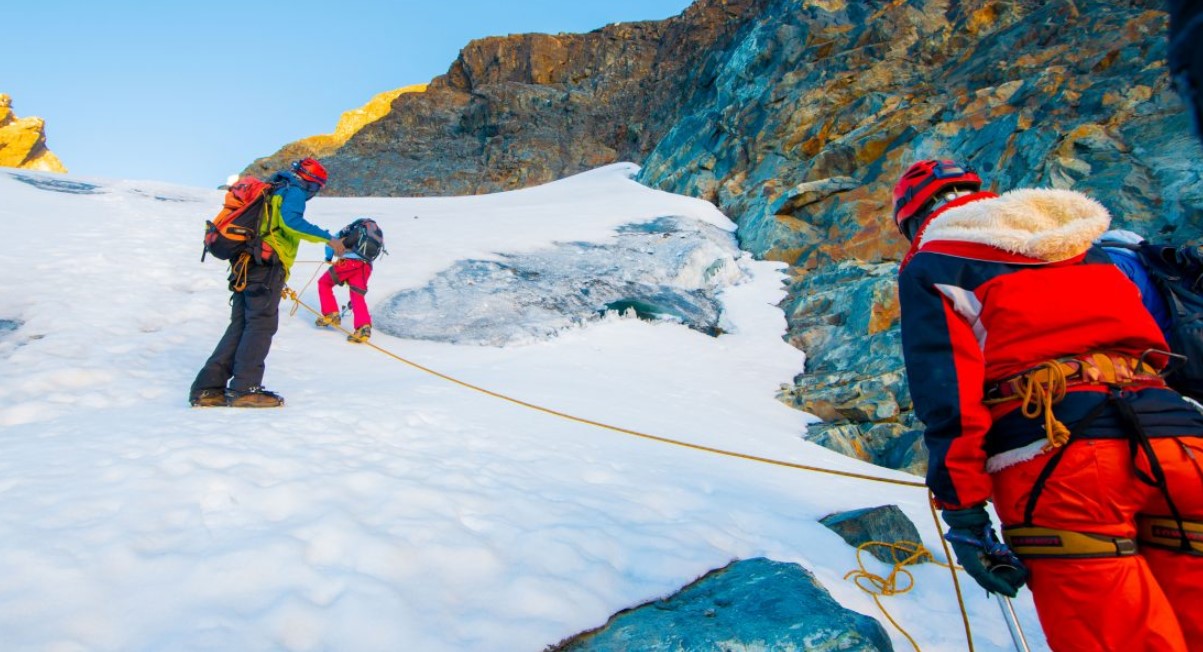
The mountain receives around 2,500 to 3,000 mm of rainfall annually in some zones, and the phrase “rain season” has little practical meaning here; it can rain on any day of the year, in any month. The paths are routinely muddy, the ascent is consistently steep, and the technical sections on the glacier approach to Margherita require the use of crampons, ropes, and ice axes in a way that Kilimanjaro’s Uhuru Peak simply does not. We have explored that in detail in our guide to how technical the climb to Margherita Peak really is. The Rwenzori demands genuine physical and mental preparation, and that is precisely what makes standing on its summit so profoundly satisfying.
What Serious Mountaineers Say About the Rwenzori
Mountaineers who have collected summits on multiple continents consistently describe the Rwenzori as unlike anything else they have done. The complexity of the terrain, the bizarre beauty of the high-altitude vegetation, and the sheer physical challenge of sustained multi-day trekking in extreme wet conditions produce an intensity of experience that very few ranges in the world can match. Among the six main mountain massifs in the range: Mount Stanley, Mount Speke, Mount Baker, Mount Emin, Mount Gessi, and Mount Luigi di Savoia, there is enough variety and technical range to sustain any serious climbing expedition for weeks.
🏔️ KEY FACTS AT A GLANCELocation: Western Uganda, on the DR Congo border | UNESCO World Heritage Site since 1994 | Highest point: Margherita Peak, 5,109m | Number of peaks over 4,500m: 6 | Glacier coverage: approximately 0.5 km² remaining | Annual trekking season: year-round, with December–March & June–September preferred |
The Otherworldly Vegetation: Nothing Else Looks Like This
If you ask guides which single feature makes the Rwenzori irreplaceable, most will answer without hesitation: the vegetation. What grows inside this mountain range does not grow anywhere else on Earth at this density or scale. As you climb through five distinct ecological zones, from the dense lowland rainforest at the mountain’s base all the way to the glacier margins at 5,000 meters, the landscape undergoes transformations so dramatic that many trekkers describe them as disorienting, dreamlike, and at times genuinely unsettling.
The lower montane forest zone, entered almost immediately after the trailhead at Nyakalengija, is dense, dripping, and alive. Fig trees, podocarpus, and African olive crowd the canopy, their roots bound with moss and liverworts. Above 2,700 metres, the bamboo zone takes over: tight stands of mountain bamboo through which the trail threads in near-darkness. Colobus monkeys operate in these upper reaches, and the three-horned chameleon is a common sighting on the trail margins. The area is already exceptional African wilderness, but it is what comes next that defines the Rwenzori experience entirely.
Giant Groundsels, Tree Heathers, and Giant Lobelias
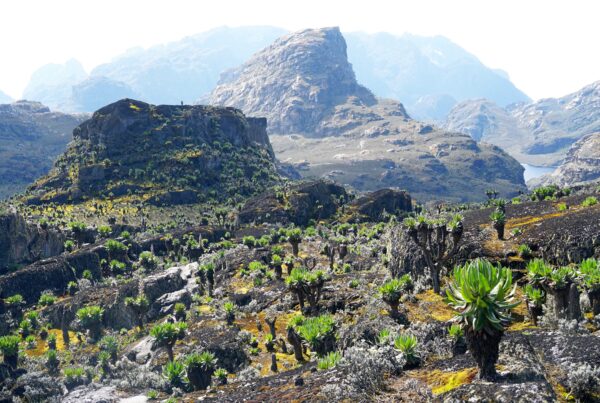
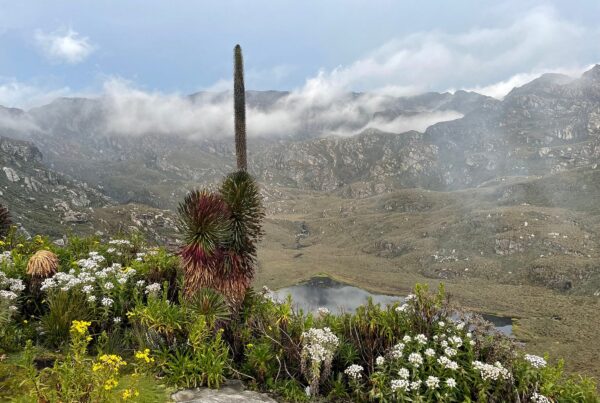
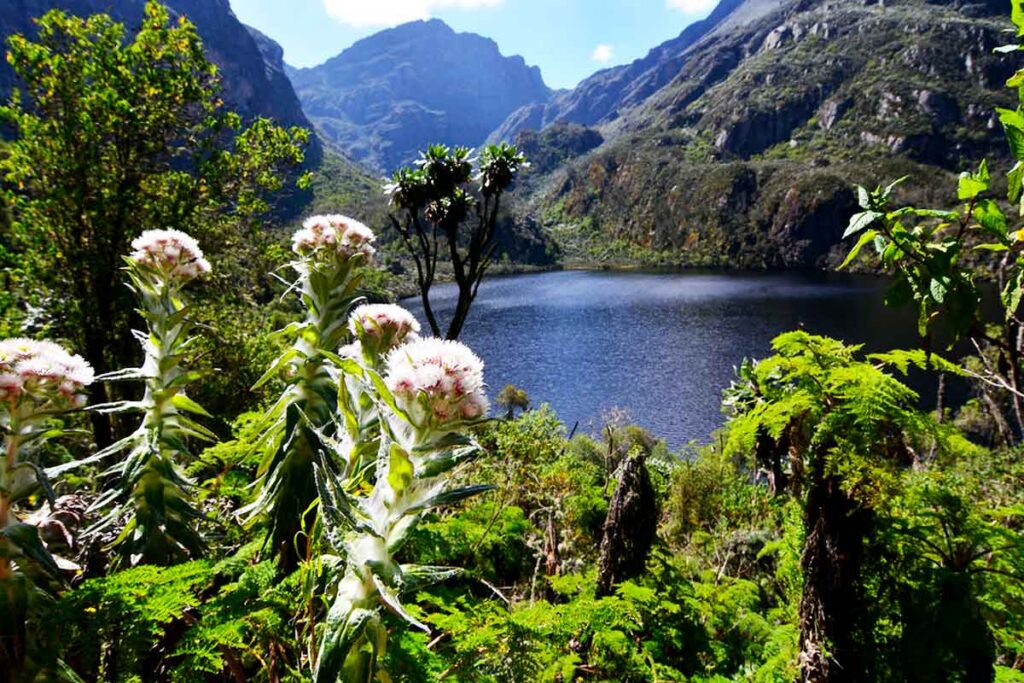
Above 3,000 metres, Rwenzori reveals its signature. The Afro-alpine zone is populated by plants that belong nowhere in the visual language of mountains you have encountered before. Senecio adnivalis, the giant groundsel, grows here as a tree, reaching heights of six meters or more; its thick trunk is wrapped in the residue of dead leaves, and its crown of succulent rosettes is catching the mist like satellite dishes. Growing alongside it are Lobelia wollastonii, giant lobelias whose blue-grey flower spikes can reach three meters in height and tower above a landscape of boggy heather and tussock grass.
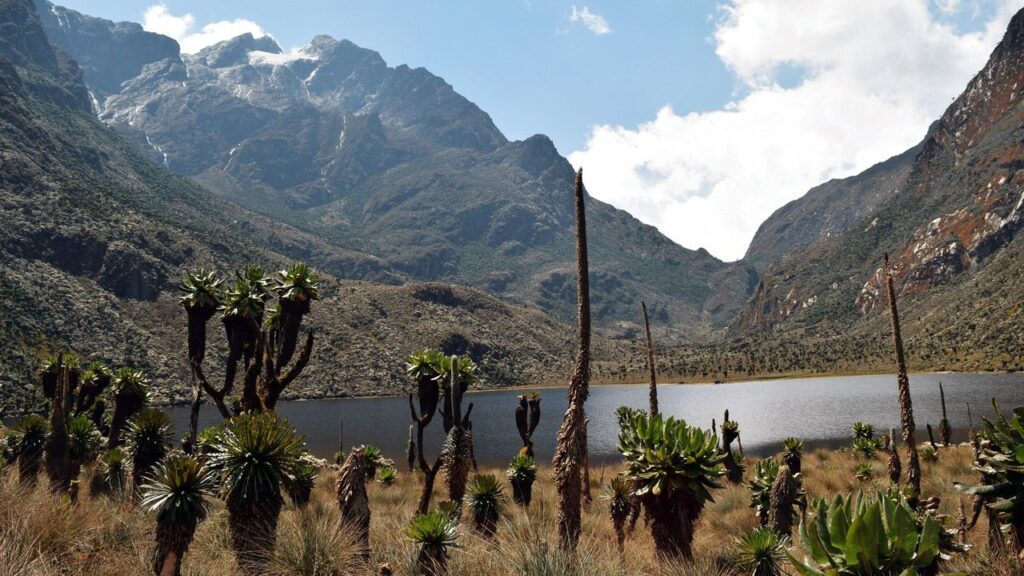
The heather zone itself is extraordinary. Erica arborea and Philippia benguellensis grow here as fully formed trees, draped in old man’s beard lichen and reaching heights that make the term “heather” feel inadequate. Walking through these heather forests at 3,500 metres, their trunks gnarled and silhouetted in the perpetual mist, feels closer to walking through a Tolkien landscape than through anything that reads as a conventional mountain environment. Add to the scene the perpetual cloud that hangs in the valleys, the smell of wet rock and peat bogs, and the soft silence broken only by the Rwenzori turaco’s alarm call overhead, and you understand why the Victorians called the Rwenzoris the most mysterious mountain in Africa.
The experience is not merely a visual spectacle. The Rwenzori’s endemic plant life, which exists nowhere else on the planet at this scale, is a direct consequence of the mountain’s isolation, rainfall, and ancient evolutionary separation from the surrounding lowlands. It is one reason the range achieved UNESCO World Heritage status and one reason trekkers who have experienced Afro-alpine zones across East Africa consistently rank the Rwenzori’s botanical landscape above everything else they have seen, including Mount Kenya’s comparable but less extensive giant groundsel fields. The site is also a Ramsar Wetland of International Importance, underscoring the global ecological value you are walking through with every step.
The Glaciers: Witnessing Africa’s Disappearing Ice
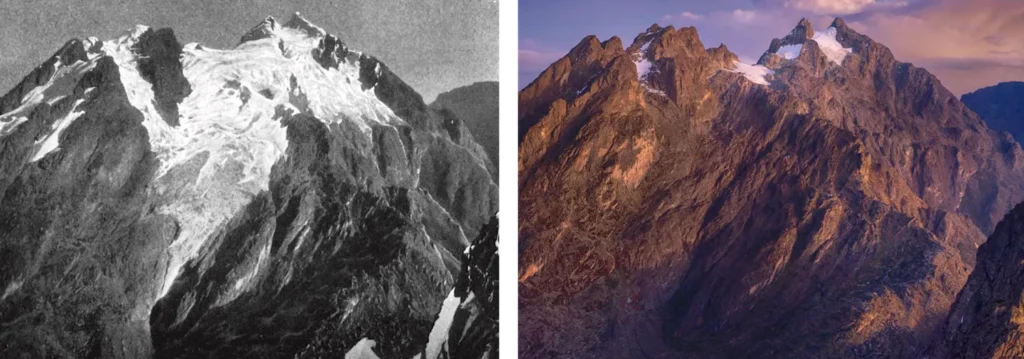
The Rwenzori carry some of the last permanent glaciers on the African continent, and they are retreating fast. In 1906, Duke Abruzzi’s Italian expedition mapped the Rwenzori range in extraordinary detail, revealing that it held approximately 6.5 square kilometres of glacial ice spread across six separate glacier systems. According to the most recent surveys, barely 0.5 square kilometres remain. The Stanley Glacier, the Elena Glacier, and the Savoia Glacier on Mount Stanley are retreating by measurable distances every year, and the scientific consensus is that without a dramatic reversal in global temperature trajectories, the Rwenzori could be ice-free within decades.
We have written extensively about this phenomenon in our piece on why the Rwenzori glaciers are disappearing, and the ecological and hydrological consequences for western Uganda are serious. But the mountaineering implication is also profound: trekking the Rwenzori right now, in this decade, means standing on glacial ice that may not exist for the generation that comes after yours. There is a particular weight to that knowledge when you are crossing the Elena Glacier on the approach to the Stanley Plateau and the summit ridge of Margherita. What you see on the snow and ice of the Rwenzori is both breathtaking and genuinely irreplaceable.
The glacial experience here is qualitatively different from Kilimanjaro’s. Kilimanjaro’s glaciers are largely ice cliff formations, visually dramatic but not traversed in the same way. To get to Margherita Peak on the Rwenzori, you have to cross a real glacier using special gear: crampons grip the icy surface, fixed ropes help on steep parts, and being at 5,000 meters on the Stanley Plateau means you’re in true high-altitude climbing territory The cold at this elevation, which our detailed guide to temperatures on Margherita Peak covers comprehensively, regularly reaches -10°C at night with windchill. Margherita Peak is a mountain that demands respect, preparation, and the right equipment and rewards all three generously.
The Bakonzo People: Culture That Lives Inside the Mountain
No account of the Rwenzori is complete without its people. The Bakonzo (also called the Bayira, or people of the snows) are the indigenous community of the Rwenzori foothills, with a history and cultural identity so deeply interwoven with the mountains that separating the two is impossible. The Bakonzo have lived on the lower slopes of the Rwenzori for centuries, farming the fertile volcanic soil, harvesting the bamboo forest, and relating to the peaks above as spiritual presences rather than geological structures.
In Bakonzo cosmology, the mountain is named Rwenzururu, meaning “place of snow”, a designation that conveys reverence. The snow-capped peaks above the clouds were not obstacles or resources to be exploited; they were the dwelling place of Kitasamba, a spirit entity whose goodwill determined rainfall, harvest, and community wellbeing. The Rwenzori’s nickname, the “Mountains of the Moon”, has roots that trace both to Ptolemy’s 2nd-century description of cloud-shrouded equatorial peaks and to the oral traditions of the Bakonzo themselves, who have passed down stories of the mountain’s ice and mist for as many generations as living memory can retrieve. We explore this topic fully in our piece on why the Rwenzori is called the Mountains of the Moon.
The Bakonzo as Guides and Porters
The guides and porters who work on the Rwenzori are almost exclusively Bakonzo men and women, many of whom have been leading expeditions up these trails for multiple generations of the same family. The knowledge they carry about the mountain is astonishing, including micro-weather patterns on specific ridges, the exact moment in a day when afternoon cloud tends to lift above the Bujuku Valley, and which crossing points on the glacier have held firm or are beginning to hollow underfoot. This is not guidebook knowledge; it is embodied expertise accumulated over decades of sustained mountain living.
Trekking with Bakonzo guides, as all expeditions through Rwenzori Trekking Safaris do, means trekking through a landscape you simultaneously navigate physically and understand culturally. When your guide points out the giant groundsel at Bujuku and tells you its local name, or explains why a particular ridgeline is considered sacred, or shares what it meant to his grandfather’s generation to stand at the point where the forest ends and the open heather begins, the trek becomes something richer than exercise. It becomes a window into one of East Africa’s most distinctive highland cultures, still living in close relationship with a mountain most of the world has never heard of.
The Remoteness: What It Actually Feels Like to Be Off the Grid
The Rwenzori receives only a few thousand trekkers per year. Kilimanjaro welcomes tens of thousands annually; Everest Base Camp draws something approaching that number in a season. On the Rwenzori, you will spend multiple consecutive days without meeting another group. The trails are narrow, the huts well-spaced, and the experience is genuinely solitary in a way that almost no other bucket-list mountain destination can honestly claim to be anymore.
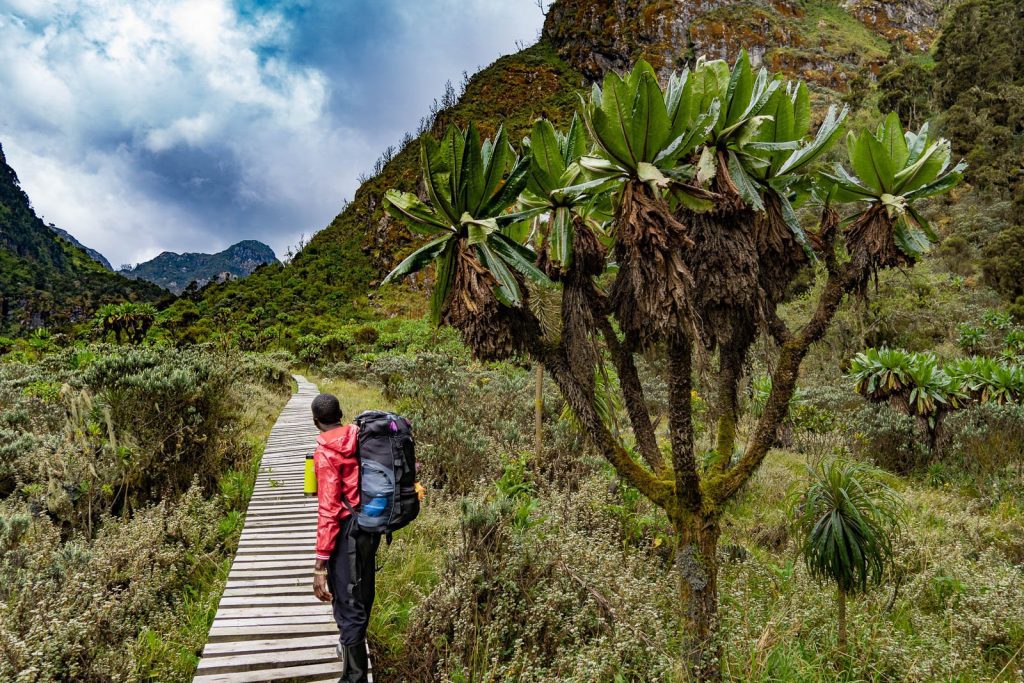
This remoteness has a particular quality that regular hikers find transformative. Without a mobile signal for most of the trek and without the social media-driven competitive atmosphere that has colonised peaks like Kilimanjaro and Mont Blanc, Rwenzori returns trekking to something closer to its essential nature: movement through the extreme wilderness with a small team in conditions that demand your complete and undivided attention. The silence above 4,000 meters, broken only by wind, water, and the creak of crampon straps on the ice, has a weight and quality that experienced mountaineers describe as genuinely rare.
Our article on solo trekking the Rwenzori Mountains explores what it means to experience this mountain outside the conventional group-tour framework, and it is worth reading even if you plan to go with a group because understanding how differently this mountain operates compared to Africa’s more commercialised peaks is central to preparing your expectations correctly.
The Routes and What They Offer
The Rwenzori has several distinct trail systems, each offering a meaningfully different experience. The Central Circuit Trail is the classic route, connecting the huts at Nyabitaba, John Matte, Bujuku, Elena, Kitandara, and Guy Yeoman in a roughly circular traverse of the mountain’s core. The Kilembe Trail approaches from the south through the old copper-mining town of Kilembe, offering a longer, more demanding route with its own hut network through different vegetation zones. For those wanting to explore without committing to a full summit expedition, shorter options like the 3-Day Mahoma Loop or the 4-Day Mutinda Lookout trek via the Kilembe Trail deliver exceptional Afro-alpine scenery and a genuine taste of the mountain without the full technical commitment of a summit attempt.
For those who want everything, our 13-day, 6-peak expedition takes in Mount Gessi, Mount Emin, Mount Speke, Mount Stanley, Mount Luigi di Savoia, and Mount Baker in a single continuous traverse, a mountaineering achievement that hardly any people in the world have completed. Our 18-day all-8-peaks expedition is the full-range traverse for those wanting the definitive Rwenzori experience, while the 7-day Central Circuit trek to Margherita remains the most balanced combination of immersive experience and achievable timeline for the majority of international trekkers.
How Does the Rwenzori Compare to Other African Mountains?
Rwenzori vs. Kilimanjaro
Kilimanjaro is Africa’s highest mountain and one of the world’s most recognisable summits. It is a legitimate and rewarding achievement. But Kilimanjaro is, at its core, a high-altitude endurance walk on well-established paths with hut accommodation, well-resupplied routes, and a substantial number of fellow trekkers for company at every stage. The altitude challenge is real and must be taken seriously, as our acclimatisation guide for Rwenzori trekkers explains in the context of high-altitude physiology, but the technical demands are minimal. Kilimanjaro rewards persistence more than skill. The Rwenzori rewards both and then rewards something harder to name: a tolerance for discomfort, rain, mud, and uncertainty that produces its own kind of pride.

The biodiversity on Kilimanjaro is impressive, particularly its own Afro-alpine zone. But it does not approach the Rwenzori’s combination of endemic species density, prehistoric forest age, and the particular strangeness of a mountain that has been saturated in cloud and rain for millions of years, producing ecological forms that seem genuinely from another planet. At Kilimanjaro, you will see beautiful landscapes. On Rwenzori, you will see landscapes that have no equivalent anywhere else on Earth.
Rwenzori vs. Mount Kenya
Mount Kenya is a superb mountaineering destination, genuinely technical on its twin main summits of Batian and Nelion, which require real rock and ice climbing skills, and beautiful throughout its moorland and tarn-studded plateau. The comparison with the Rwenzori is closer in character than the Kilimanjaro comparison. Both ranges have complex multi-summit topographies, both carry glaciers, and both offer genuine technical climbing options for those who want them. The key distinction is ecological: Mount Kenya’s high-altitude plateau is drier and more open than the Rwenzori, its vegetation less architecturally bizarre, and its cultural dimension, while present, does not carry the same depth of living Bakonzo tradition.

The Rwenzori’s significant advantage lies in its infrequent visits, which consistently maintain a sense of genuine wilderness. Mount Kenya, accessed from Nairobi, has become a popular weekend destination for expatriates and well-heeled tourists. The Rwenzori is still, by any measure, a proper expedition.
Rwenzori vs. Simien Mountains (Ethiopia) and the Atlas Range (Morocco)
The Simien Mountains in Ethiopia and the High Atlas in Morocco are wonderful places for trekking, but they don’t have the same mix of tough climbing, glacial ice, and rich plant life that the Rwenzori Mountains do. The Simiens offer astonishing escarpment scenery and endemic gelada baboon encounters; the High Atlas offers demanding multi-day desert-highland crossings in spectacular mountain villages. Neither carries permanent glaciers. Neither requires crampons and ice axes. Neither offers an ecosystem as singular and globally rare as the Rwenzori’s Afro-alpine zone.
⚠ HONEST ADVISORYThe Rwenzori is not the right first mountain for everyone. If you are entirely new to multi-day trekking, have significant altitude sensitivity, or are uncomfortable with sustained technical difficulty, consider beginning with one of our shorter routes, the 3-Day Mahoma Loop or the 4-Day Mutinda Lookout Trek, before committing to a full summit expedition. Our article on whether beginners can climb the Rwenzori is essential reading if you have questions about your suitability. |
We have assessed the question whether beginners can climb the Rwenzori Mountains. The answer depends entirely on which route you choose and how honest you are about your current fitness level, a topic covered in depth in our Rwenzori fitness guide. What we can say with confidence is that the Rwenzori’s lower routes are accessible to determined and reasonably fit walkers with proper support, while its upper summit routes demand conditioning and commitment that puts them in a different category entirely.
The Summit: What It Means to Stand on Margherita Peak.
Margherita Peak, the highest point on Mount Stanley and the third-highest point in Africa, is reached after a night at Elena Camp (4,541m) on the Stanley Plateau and a pre-dawn start across the Elena Glacier. The crossing involves crampon use from the moment you leave the hut. The ice is crevassed in places; the path is marked by fixed ropes on the steeper sections, and the altitude is already sufficient to make each meter of gain feel more effortful than the last.
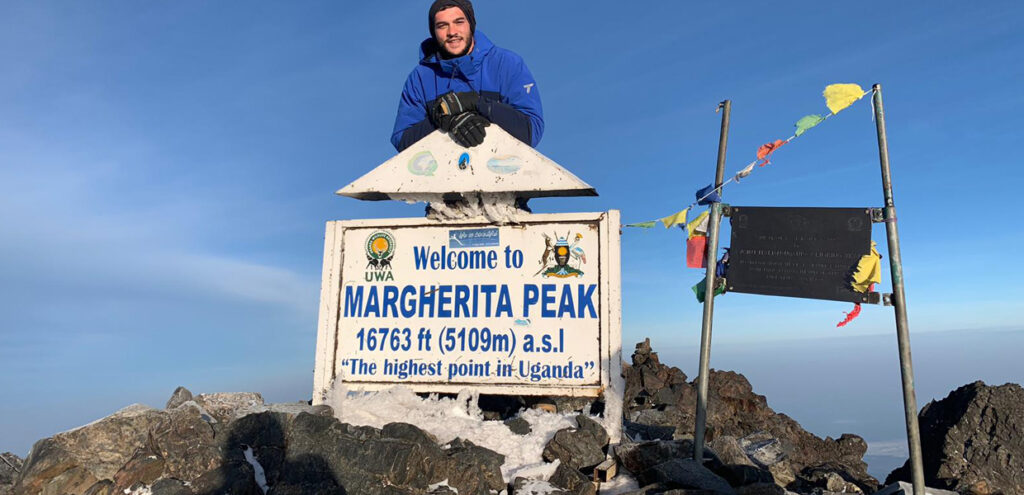
The summit ridge is narrow, and on a clear day, which happens here, the view from Margherita is extraordinary. To the east, the Bujuku Valley drops away into clouds and forest far below; the characteristic pattern of the Rwenzori’s ancient drainage systems is visible as silver threads through the vegetation. To the west, on the rare days when the clouds part entirely, you can see across to the Democratic Republic of Congo. Beneath your feet, the ice is luminous white against the black rock of the Stanley massif. Around you, the silence is absolute.
What our guides observe in trekkers at this point after five, seven, or eight days of climbing through forest, bog, heather, and ice is not simply triumph. It is a kind of recalibration. The Rwenzori has a way of clarifying perspective that comes from sustained physical difficulty in genuine wilderness, from days without a screen, and from the specific intimacy of small groups working through challenging terrain together. The summit is the endpoint, but the recalibration begins much earlier, in the bamboo zone or the heather forest, when the outside world starts to feel genuinely remote. That experience, that quality of immersion, is what the Rwenzori offers that no other mountain in Africa currently matches.
Success rates on Margherita vary by route and group preparation. Our guide to summit success rates on Margherita Peak breaks down what affects the outcome and how our team’s preparation methodology consistently achieves rates well above the mountain average. Route choice matters; the eight-day Kilembe Trail approach to Margherita provides superior acclimatisation compared to faster timelines, and the quality of the guide and pre-trek briefing makes a measurable difference at the point where the summit either happens or does not.
Weather, Timing, and What to Expect at Every Elevation
The Rwenzori’s weather is one of the most frequently misunderstood aspects of planning an expedition here. The short answer is it rains a lot, and this does not go away in the dry season. Our detailed guide to rainfall in the Rwenzori Mountains explains the full climatic picture, but the key takeaway is this: the preferred trekking windows are December to March and June to September, when precipitation is relatively lower and summit windows are more frequent. The term does not mean dry; it means drier. Trekkers should anticipate waterlogged ground, mist, afternoon rain, and the need for quality waterproof equipment regardless of season.
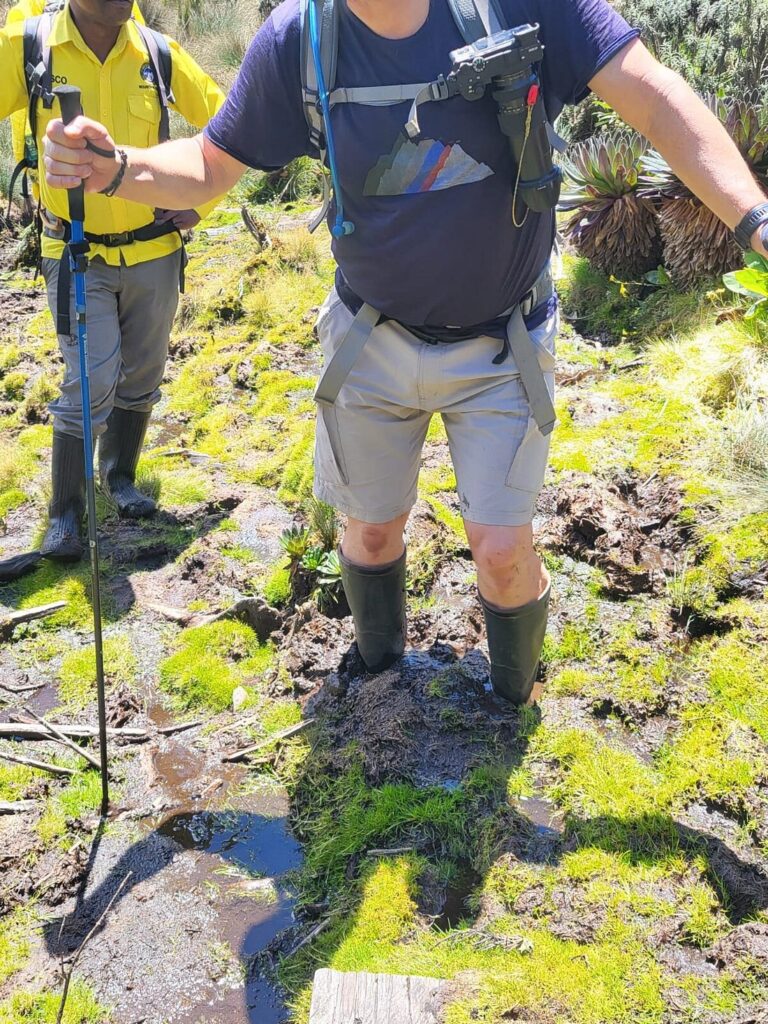
The practical question of whether to trek the Rwenzori in the rainy season deserves a direct answer: it is absolutely possible, experienced guides manage the conditions, and the vegetation is at its most vivid when wet. The challenge increases substantially, the paths become more demanding, and summit success rates drop, but many trekkers find the atmospheric intensity of the mountain in full cloud and mist adds to the experience rather than detracting from it. What gear you carry matters enormously; our guide to what climbing gear to bring for a Rwenzori trek covers this topic in detail, as does the guidance on whether you need crampons and ropes for the Rwenzori.
Is the Rwenzori Worth It If You Cannot Reach the Summit?
This dilemma is the question that honest guides must address directly. Not everyone who attempts Margherita Peak will reach it. Altitude, weather, and individual physical response all play roles that no amount of preparation can eliminate. Understanding how hard trekking the Rwenzori really is before you go is essential for realistic expectation-setting. But the more profound answer to the question of worth is this: the summit is not the experience. The summit is the punctuation mark at the end of a sentence that was already extraordinary from the first word.
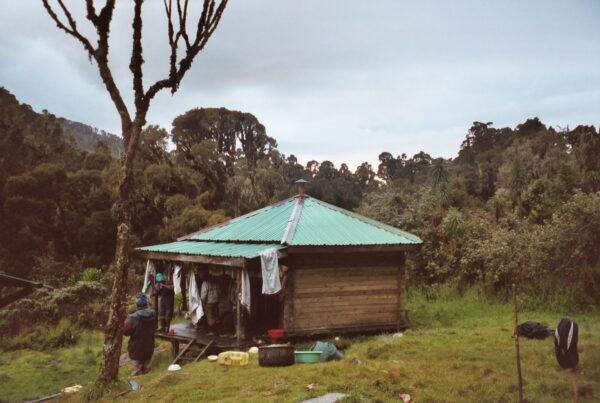
The Bujuku Valley, encircled by giant groundsels and the dark silhouettes of the Stanley and Speke massifs, is one of the most beautiful places in Africa. Trekkers have described the hut at Kitandara, perched above the twin Kitandara Lakes at 4,023 meters with a view across the water to the hanging glaciers of Mount Baker, as the most beautiful campsite they have ever occupied, a scene of quiet grandeur. The heather forests at dusk, when the light turns amber through the mist and the giant lobelias take on sculptural solidity in the fading day, are transcendent in a way that persists in memory for decades.
If the summit becomes unattainable for any reason, weather window, altitude response, or time constraint, what you carry home from even a five- or six-day Rwenzori trek is richer and more durable than the experience on most mountains that offer a technically simpler summit. The Rwenzori rewards depth of engagement, not only vertical achievement. This is why we design itineraries that prioritise acclimatisation, pace, and engagement with the mountain’s ecological and cultural layers, not just summit metrics. The 5-day Mount Speke trek or the 5-day Bujuku Valley hike offers deep mountain immersion without the full technical summit commitment, and both are exceptional experiences on their own terms.
Combining the Rwenzori with a Uganda Safari
Uganda’s position in the heart of East Africa makes Rwenzori the natural centrepiece of a broader adventure itinerary. From Kasese, the gateway town for the mountain Queen Elizabeth National Park is less than an hour away, its tree-climbing lions, elephant herds, and hippo-dense Kazinga Channel making it one of the most rewarding wildlife destinations in East Africa. Gorilla trekking in Bwindi Impenetrable Forest is a half-day’s drive from the Rwenzori foothills, and the combination of a mountain expedition with a gorilla permit produces an itinerary that, in terms of raw wildlife and wilderness experience, is difficult to beat anywhere in Africa.
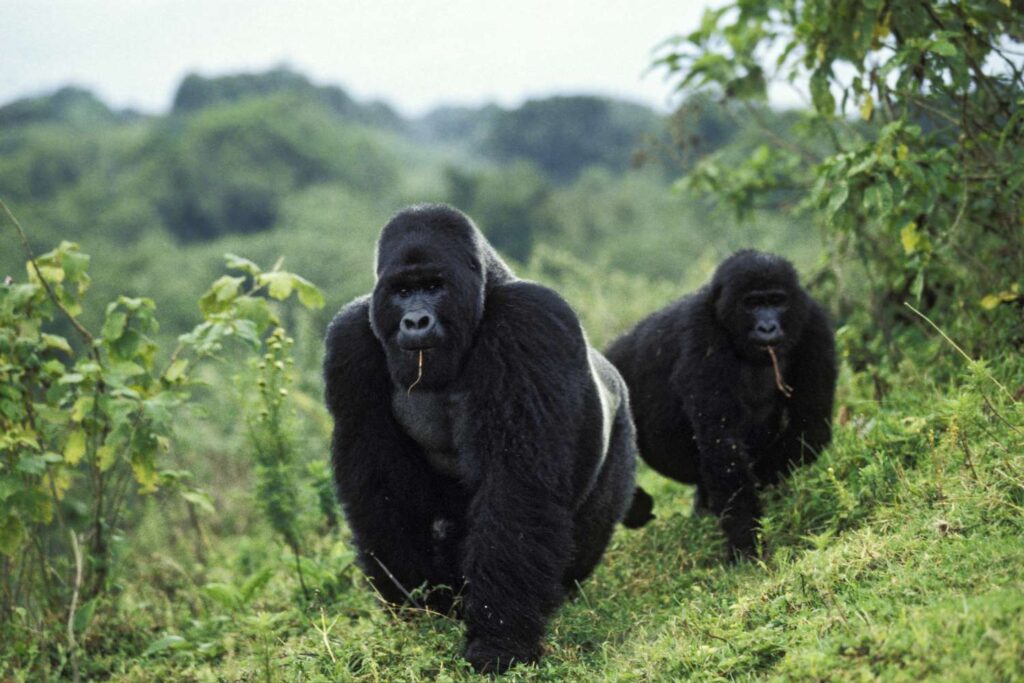
We offer a range of combo itineraries that integrate Rwenzori mountaineering with Uganda’s primate and wildlife experiences: from the 12-day Rwenzori plus gorilla trekking combination to the fully comprehensive 19-day Uganda adventure combining Rwenzori, gorillas, and the big five. The full range of Uganda safari options is explored on the site, and our team is well positioned to build customised itineraries around whatever combination of mountains, forests, and savannah best matches what you are looking for from a Ugandan expedition.
Frequently Asked Questions: Is the Rwenzori really worth climbing?
Is the Rwenzori really worth climbing compared to Kilimanjaro?
Yes, but the comparison depends on what you are seeking from an African mountain experience. Kilimanjaro is Africa’s highest peak and offers a clear, well-supported route to a very high summit. The Rwenzori is lower (5,109m vs. 5,895m) but considerably harder in technical terms, demanding crampons and ice axes on the summit approach to Margherita Peak and requiring sustained trekking through extreme wet conditions across multiple days. What makes the Rwenzori worth it above and beyond Kilimanjaro is the combination of factors that are unique to the range: the otherworldly Afro-alpine vegetation, giant groundsels, tree heathers, and giant lobelias found nowhere else on Earth; the permanent glaciers now disappearing faster than anywhere in Africa; the deep cultural world of the Bakonzo people, whose identity is embedded in the mountain; and the genuine solitude of a trekking destination that receives only a few thousand visitors per year. Many experienced mountaineers who have done both describe the Rwenzori as the richer, deeper, and more transformative experience.
What makes the Rwenzori Mountains unique compared to other African mountains?
The Rwenzori’s uniqueness rests on several compounding factors that no other African mountain replicates. First, it is a block mountain, not a volcano, formed by tectonic uplift rather than eruption, giving it a complex multi-summit massif with an entirely different topographic character from Kilimanjaro or Mount Kenya. Second, it carries some of the last equatorial glaciers in the world, retreating rapidly due to climate change and offering a window of time to see something that may not exist for future generations. Third, its Afro-alpine vegetation is globally singular: giant groundsels growing as six-metre trees, giant lobelias three metres tall, and ancient heather forests draped in lichen all growing in a landscape so visually alien that experienced trekkers routinely describe it as dreamlike. Fourth, its UNESCO World Heritage and Ramsar Wetland status reflects the ecological importance recognised at the highest international level. Fifth, the cultural dimension of the Bakonzo people, along with the guides and porters whose families have lived inside this mountain for generations, adds a human depth to the trekking experience that is completely absent from Africa’s more commercialised mountain destinations.
How difficult is trekking the Rwenzori compared to Kilimanjaro or Mount Kenya?
The Rwenzori is harder than Kilimanjaro by most measures apart from altitude. Kilimanjaro’s paths are well-graded and largely dry; the Rwenzori’s are steep, frequently boggy, root-laced, and often genuinely slippery. The Kilimanjaro summit is a walk-up; Margherita Peak on the Rwenzori requires glacier crossing, crampons, fixed-rope use, and genuine cold-weather preparation at 5,000 metres. Compared to Mount Kenya, the Rwenzori sits at a similar level of difficulty on the trekking routes, though Mount Kenya’s main summit peaks (Batian and Nelion) are more technically demanding in pure rock climbing terms. What the Rwenzori adds to any difficulty rating is the relentlessness of wet conditions, which compounds fatigue and demands a particular psychological resilience in addition to physical fitness. That said, the mountain is not inaccessible: fit, determined trekkers with proper guidance and realistic timelines achieve Margherita Summit regularly, and the lower routes are well within reach of any serious hiker.
What is the best route for climbing the Rwenzori Mountains?
The Central Circuit Trail starting from Nyakalengija is the most complete and scenically rewarding route for trekkers whose primary goal is Margherita Peak and the full Rwenzori landscape experience. The seven-day itinerary on the Central Circuit provides the best balance between acclimatisation times, ecological diversity, and summit access. The Kilembe Trail, approaching from the south via the old copper-mining town of Kilembe, is longer and more demanding and offers a different set of vegetation zones and camps. It is particularly well suited to trekkers who want a more remote experience and are prepared for greater daily elevation changes. For an authoritative comparison, our dedicated guide to the best Rwenzori routes explores both trails and several variant itineraries in detail. The right route depends on your available time, target summits, and fitness level – something our team discusses in every pre-trek consultation.
Can beginners climb the Rwenzori Mountains?
Beginners can absolutely experience the Rwenzori, but not all routes are appropriate for all fitness levels. The lower routes, such as the 3-Day Mahoma Loop or the 4-Day Mutinda Lookout trek via the Kilembe Trail, offer spectacular scenery in the Afro-alpine zone without requiring technical equipment or extremely high levels of fitness. For Margherita Peak specifically, a minimum baseline of regular hiking experience and sustained cardiovascular fitness is necessary. Complete beginners to multi-day trekking will find the upper routes very challenging and should build experience progressively. Our team assesses every client’s fitness profile before recommending a route, and we never push trekkers beyond what their preparation and condition genuinely supports. Honest assessment at the planning stage dramatically improves both safety and enjoyment on the mountain.
When is the best time of year to trek the Rwenzori Mountains?
The preferred trekking windows are December to March (the main dry season) and June to September (the shorter dry season). These times have less rain, more frequent weather windows at the summit, and easier trail conditions, but they are never completely dry. The Rwenzori receives rainfall year-round due to its equatorial position and orographic effect on moisture-laden air from the Congo Basin, so there is no period in which rain can be entirely ruled out. The rainy season months of April–May and October–November see considerably heavier rainfall, deeper bogs, and reduced summit success rates, but some experienced trekkers deliberately choose these periods for the heightened atmospheric drama and the vivid green intensity of the vegetation in full rain. Regardless of season, quality waterproof equipment and preparation for wet conditions are non-negotiable.
Do the Rwenzori glaciers still exist, and will I see them?
Yes, the Rwenzori’s glaciers still exist, but they are retreating rapidly and are at a fraction of their former extent. In 1906, the range contained approximately 6.5 square kilometres of glacial ice. Current surveys put the remaining ice at approximately 0.5 square kilometres, concentrated primarily on the Stanley Plateau above 4,800 metres on the Stanley Glacier and Elena Glacier systems. Trekkers on summit routes to Margherita Peak will cross glacial ice and experience conditions that require crampons and rope management. The scale of the ice that remains is genuine and visually striking, though greatly reduced from historical records. Critically, the current scientific consensus suggests the Rwenzori’s glaciers could disappear entirely within the coming decades if warming trajectories continue. Trekking here now means seeing something that may not exist for future generations, a fact that gives the glacier crossing a particular emotional and historical weight.
Is it safe to trek the Rwenzori Mountains?
Yes, trekking the Rwenzori is safe when done with professional guides and proper preparation. The mountain carries genuine objective hazards: altitude sickness risk above 4,000 metres, glacier terrain on the summit approaches, unpredictable weather, and remote wilderness conditions, but all of these are manageable with experienced guidance. Our guides are trained in high-altitude first aid and mountain rescue procedures; all teams carry standard emergency communications, and our itineraries are designed with appropriate acclimatisation profiles to minimise altitude-related risk. The mountain is not inherently more dangerous than other major African trekking destinations, but it demands more from trekkers in terms of physical preparation and environmental respect than a walk-up volcano. Detailed safety information is available in our dedicated guide to Rwenzori safety, and we encourage every client to read it before booking.
Ready to Find Out for Yourself?
There is a certain type of mountain experience that cannot be replicated, summarised, or adequately photographed. The Rwenzori is that kind of mountain. It stands out from other African climbing spots not because it’s the tallest or the hardest to climb, but because it offers unique experiences: the unusual plants in its Afro-alpine zone, the visible signs of its melting glaciers, the knowledgeable Bakonzo guides who are familiar with every rock on the trails, and the rare peace of a peak that hasn’t been crowded by tourists yet.
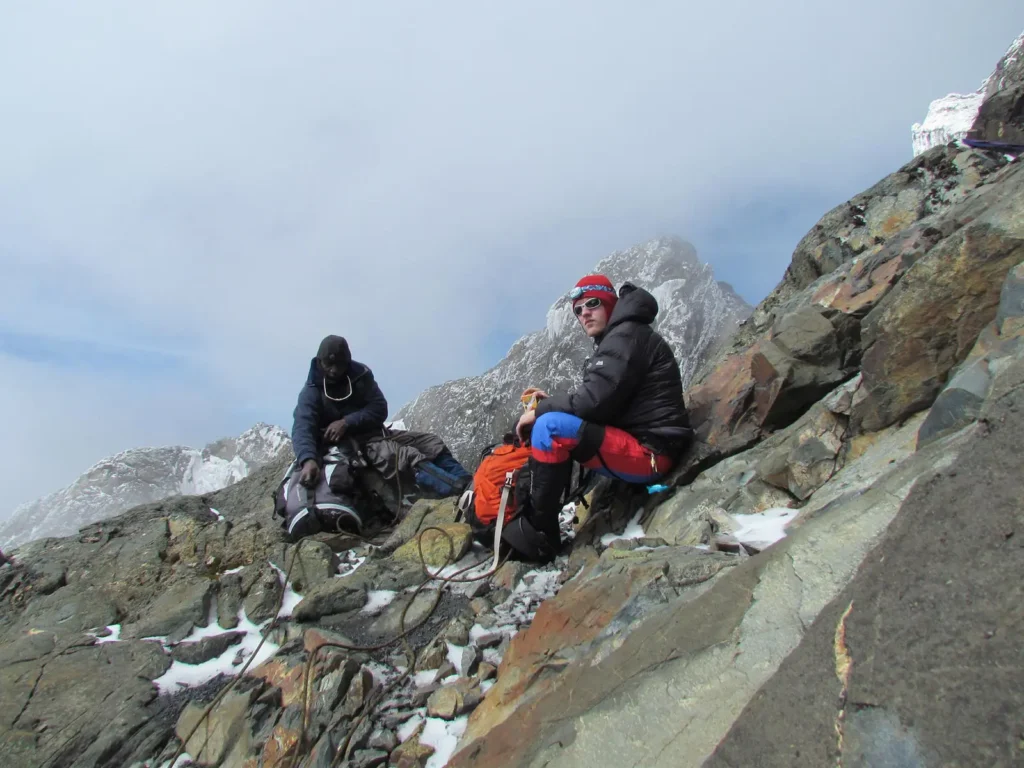
The honest answer to whether it’s worth climbing is yes; it’s worth more than almost anything else you’ll do in the mountains of this continent. The question is only which route, which timeline, and which combination of summits best fits your experience, your fitness, and your available days. We are exceptionally well positioned to assist you in answering those questions.
| 🌿 START PLANNING YOUR RWENZORI TREK
Get in touch with our team to discuss the route that fits your experience, timeline, and ambitions. Whether you are planning your first visit to the Rwenzori or returning for a harder summit, we will build an itinerary that takes you into this mountain properly with the knowledge, equipment, and cultural depth that the Mountains of the Moon deserve. |