Expert boot guide for the Rwenzori Mountains: specific model recommendations, gaiters, and waterproofing that holds up in bogs & glacier routes. Plan your trek today.
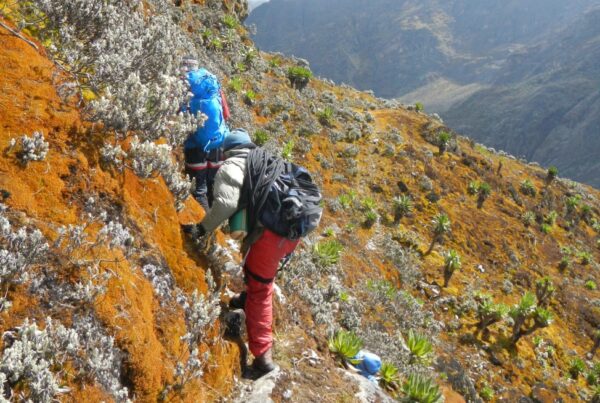
The Bogs Are Not What You Think They Are: Every experienced guide on the Rwenzori Mountains has watched the same scene unfold more times than they can count. A well-prepared trekker, technically informed, physically fit, and properly dressed from the waist up, steps confidently onto the trail above the John Matte Hut and encounters the bogs of the Bujuku Valley for the first time. There is a moment of hesitation. Then a tentative probe with a trekking pole, which sinks to the grip. Then a cautious first step, which sinks to the knee. If the trekker is unlucky and their boots were chosen for Kilimanjaro or the Scottish Highlands rather than for this specific, infamous terrain, they will look down at footwear that was fine an hour ago and is now comprehensively, irreversibly soaked.
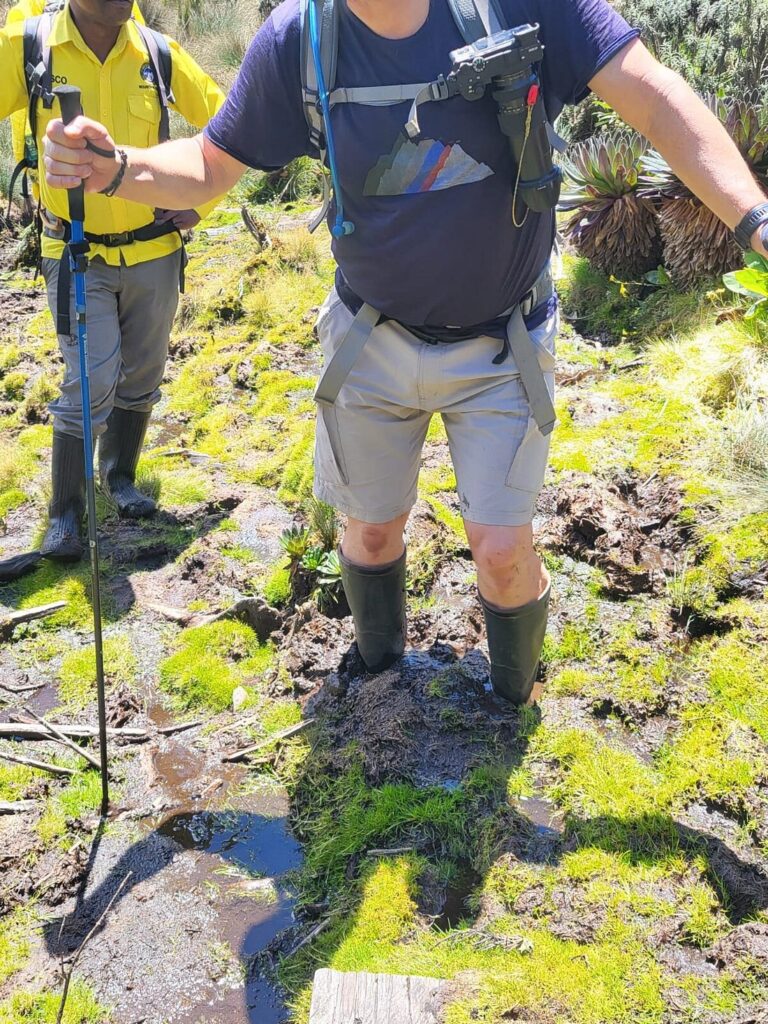
The Rwenzori bogs are not deep puddles or soft ground or marshy patches that you can navigate around. Between approximately 3,200 and 4,000 meters, particularly in the Bujuku Valley corridor that connects the Central Circuit huts and forms the approach to Margherita Peak on Mount Stanley, there are sections where the peat accumulation is so dense and saturated that it has been built for thousands of years. It is not mud in the conventional sense. It is a suspension of partially decomposed plant matter that looks solid, feels soft, and will absorb a booted foot and leg to thigh depth if you misread it. It is cold. It is dark. It smells of ancient, undisturbed organic material. And it will test every waterproofing claim your footwear manufacturer has ever made.
This guide exists because the wrong boots on the Rwenzori do not just make you uncomfortable; they create real safety and medical risk. Wet feet at 4,000 meters in near-freezing temperatures are not a minor inconvenience; they are the primary pathway to trench foot and hypothermia, two of the most common medical issues on the mountain, as detailed in our complete medical guide to trekking the Rwenzori. Choosing the right footwear is not a comfort decision on this mountain; it is a safety decision.
Understanding the Terrain: Why Rwenzori Footwear Is Different from Every Other Trek in Africa
To understand what your boots need to do on the Rwenzori, you need to understand what the terrain actually consists of across the different elevation zones. The Rwenzori is not a mountain with a single surface type. From the Nyakalengija trailhead to the summit of Margherita Peak at 5,109 meters, your shoes will encounter at least six genuinely distinct ground conditions in a single day of movement, sometimes within a single hour.
The Root Forest (1,600 to 2,800 metres)
The lower mountain is a dense, humid Albertine rainforest laced with a root network that makes every step a balance problem. Roots cross the trail at every angle, horizontal, vertical, and diagonal, slicked with permanent moisture and covered in moss that has the friction coefficient of polished glass. The ground beneath and between the roots is soft, yielding, and frequently waterlogged. Your boot needs serious ankle support here, not for the vertical load but for the constant lateral and rotational forces on the joint as the foot navigates irregular root platforms. This is the area that injures ankles in soft trail shoes or low-cut boots, and it is the zone where you will spend the first and last hours of almost every Rwenzori trekking itinerary.
The Bamboo Zone and Heather Belt (2,800 to 3,400 metres)
Above the dense rainforest, the vegetation transitions through bamboo groves and into the heather belt, tall tree heather draped in old-man’s-beard lichen, creating a cathedral-like landscape that is one of the most photographically distinctive sections of routes like the Kilembe Trail. The ground in this zone is softer than the root forest but more consistently wet. Standing water is common on the trail. The soil beneath the heather is peaty, compressible, and cold. Waterproofing that performed adequately in the rainforest is now being seriously tested here, especially at the heel-sole upper junction, where marginal waterproofing first fails under sustained immersion.
The Bog Zone (3,200 to 4,100 metres)
This area is where the Rwenzori separates itself from every other trek in Africa. The Bujuku Valley, the approach corridors to Mount Speke, and sections of the Central Circuit Trail above John Matte Hut contain bogs that are, by any objective measure, among the most demanding mountain terrain in the world for footwear. Trekkers on the 7-day Central Circuit spend the better part of two days crossing and re-crossing this terrain. The depth of submersion per step is genuinely unpredictable; a section that was knee-deep last week may be shin-deep today and thigh-deep after rain. No gaiter or boot will keep water out if the submersion exceeds its height. The goal of boot and gaiter selection in this zone is to maximise the height of protection while keeping the system light enough so that the extra weight does not impair balance on unstable surfaces.
The Afro-Alpine Zone and Rock Belt (4,000 to 4,800 metres)
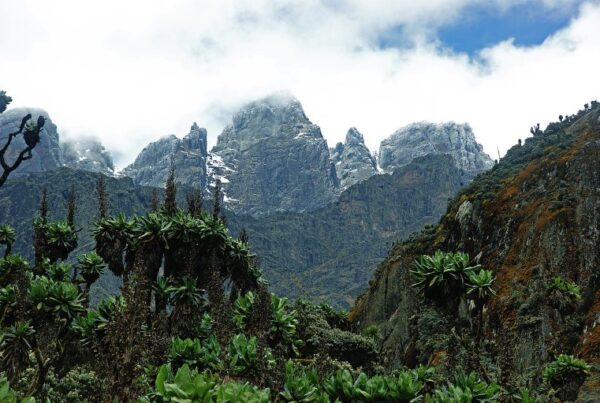
Above the bogs, the vegetation opens into the extraordinary Afro-alpine zone: giant groundsels, giant lobelias, everlastings, and the moonscape rock belt that precedes the glacier on summit routes. The ground is firmer here but never dry: morning frost, overnight hail, and the ever-present cloud that gives the Rwenzori Mountains their name as the Mountains of the Moon keep all exposed surfaces perpetually damp. Rock sections between 4,200 and 4,800 metres require excellent edging performance from the boot sole, the ability to grip a sloped, wet rock face at a precise angle, which is a completely unique demand from the compression and waterproofing required in the bog zone.
The Glacier (4,800 to 5,109 metres)
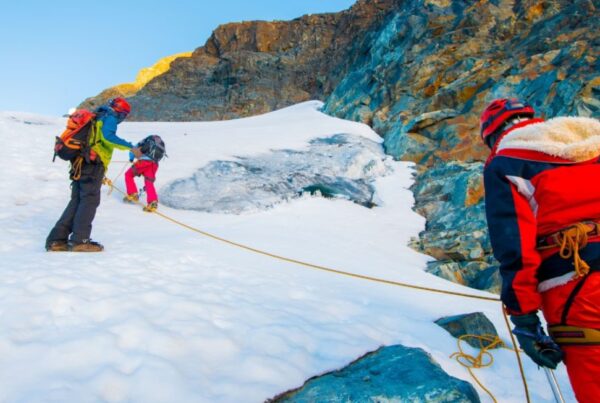
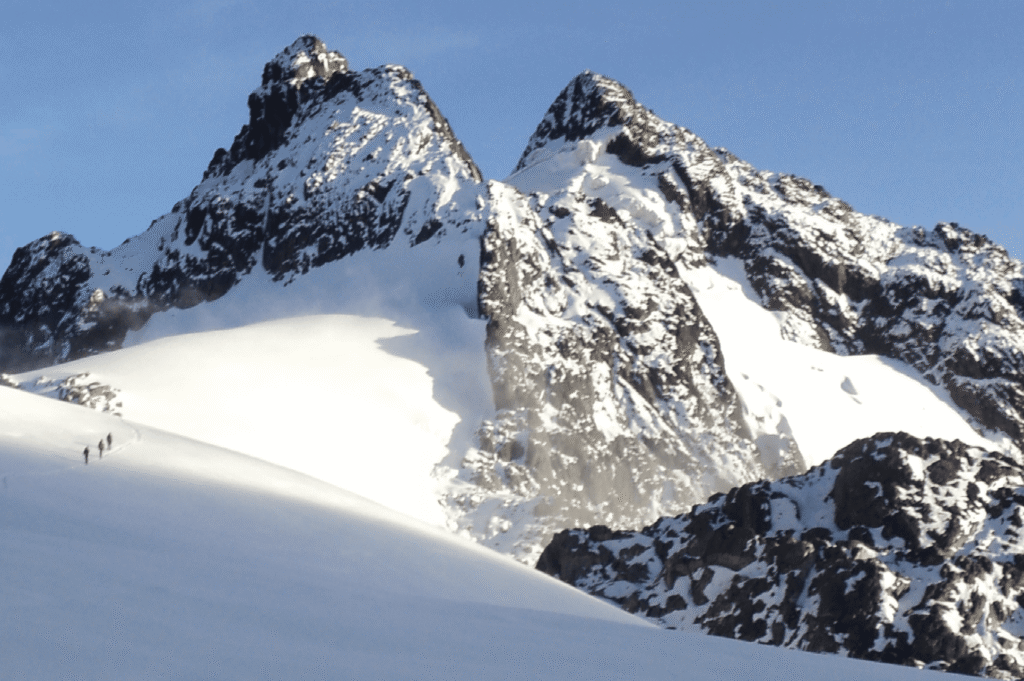
The final section to the summit on routes approaching Margherita Peak via the Elena Hut involves cramponed glacier travel, which is why summit routes require a B2 or B3 rated boot that accepts a rigid crampon. This is the requirement that eliminates many otherwise excellent trekking boots from consideration for full summit attempts. A boot that excels in the bogs but is too flexible in the sole to safely accept a steel crampon becomes useless exactly when the summit is within reach. Understanding the transition from bog trekker to glacier mountaineer within the same expedition, sometimes within the same day, is the central challenge of Rwenzori gear selection.
What a Rwenzori Boot Actually Needs to Do: The Technical Requirements
With the terrain mapped, the footwear requirements become specific rather than general. Here is the non-negotiable specification for boots intended for a full-mountain Rwenzori expedition, including summit routes to Margherita or any of the high-altitude peaks.
Full Waterproofing with a Sealed Membrane
Waterproof-treated leather or a DWR (Durable Water Repellent) surface coating is inadequate for the Rwenzori. What is required is a full waterproof-breathable membrane that extends to the boot collar, either GORE-TEX (the industry standard), eVent, OutDry, or a comparable sealed membrane system. The membrane must be bonded to the upper at every seam, including the tongue junction, the collar stitch, and the sole-upper welt. The sole-upper welt is the anatomical weak point in virtually every waterproof boot; after sustained submersion in Rwenzori-depth bogs, any boot without a fully sealed welt will allow water infiltration. This is not a design flaw peculiar to cheap boots; it affects premium boots too if they are not designed with bog-depth submersion in mind.
Ankle Height: Above the Ankle Is Not Enough
Standard mid-height trekking boots, those that finish at the ankle or just above it, are insufficient for the Rwenzori bog zone. When a bog step reaches shin depth (which is common) or knee depth (which happens), water enters over the top of the boot collar regardless of how waterproof the boot itself is. This is the single most common waterproofing failure mode on the mountain, and it is solved by gaiters rather than boot height. However, the boot collar itself must sit at the maximum practical height of a genuine high-cut boot, finishing above the ankle at or near the mid-calf to work effectively with a full-length gaiter. The combination of a high-cut boot and a full knee-height gaiter is the essential system. Neither component works without the other.
Sole Stiffness: B2 Minimum for Upper Routes, B3 for Summit
Boot sole stiffness is classified from B0 (walking shoe flexibility) to B3 (full cramponing rigidity). For routes that remain below the glacier, including the 3-day Mahoma Loop, the 4-day Mutinda route via the Kilembe Trail, and day-exploration routes, a B1 boot is technically adequate, but a B2 provides meaningfully better stability on the sloped wet rock sections of the mid-mountain. For any route that includes a glacier section and summit attempt on Margherita Peak, Mount Speke, or Mount Baker, a B2 boot is the minimum, and a B3 is strongly preferred. A flexible sole with a rigid crampon makes it harder to keep the crampon secure with each step, which can lead to slipping and falling. Stiff soles on glaciers are not just preferred; they are not a preference; they are a technical safety requirement.
Upper Construction: Leather vs Synthetic
Full-grain leather uppers have a well-established reputation on wet mountain terrain that synthetic alternatives have not yet fully matched for multi-day expedition use. The reasons are specific: leather, when properly waxed and maintained, develops a waterproof surface that becomes more effective over time rather than less. The seam density of leather uppers is lower than synthetic uppers, reducing the number of potential ingress points. Leather also resists abrasion from sharp rock better than most synthetics, which matters on the upper rock sections of Rwenzori summit routes. The disadvantages of leather, heavier, slower to dry when soaked internally from sweating, and longer break-in period are real but manageable. For the bog zone specifically, a well-maintained full-grain leather boot with a sealed GORE-TEX liner will outperform most synthetics in sustained partial submersion.
Lug Pattern and Sole Compound
The Rwenzori root forest and wet rock sections require a lug pattern that self-cleans, meaning deep, widely spaced lugs that shed mud and wet organic material rather than clogging with it. Vibram Montagna, Vibram Mulaz, and Vibram Mont series compounds are the most proven performers on wet organic terrain. Closely spaced lug patterns designed for dry trail use will pack with peat mud in minutes on the lower mountain and effectively become slick platforms. Look for lugs that are at least 4–5mm deep, angled to shed material during the push-off phase, and covering the full lateral edge of the sole for root-edge grip.
Specific Boot Recommendations: Models That Have Proven Themselves on the Rwenzori
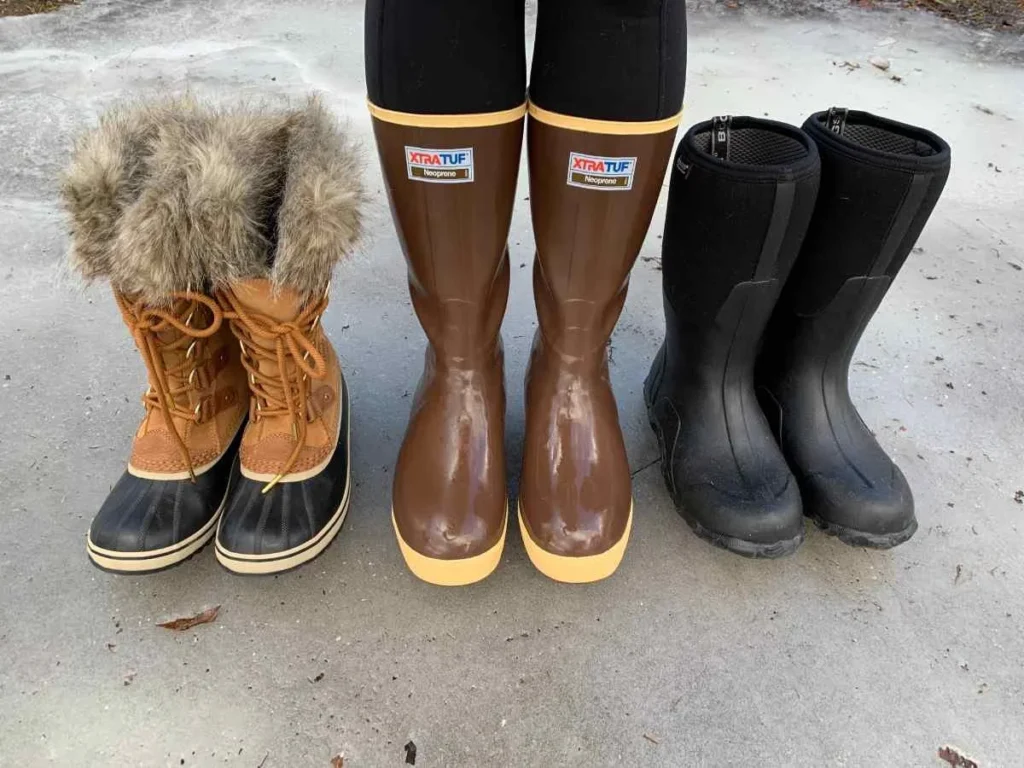
The recommendations below are based on direct observation of boot performance across multiple seasons of guiding in the Rwenzori, not on manufacturer specifications alone. Every model listed has been worn by trekkers on the mountain and evaluated specifically for performance in the bog zone, the wet root forest, and (where applicable) the glacier approach. The comparison table that follows provides an at-a-glance overview before the detailed reviews.
| Model | Type | Membrane | Stiffness | Bog Rating | Rwenzori Verdict |
| Scarpa Manta Tech GTX | Alpine / Summit | GORE-TEX | B3 (very stiff) | ★★★★★ | Top pick for Margherita & glacier routes |
| La Sportiva Nepal Evo GTX | Alpine | GORE-TEX | B3 | ★★★★★ | Outstanding on glacier; heavier in bogs. |
| Hanwag Alaska GTX | Heavy hiking/alpine | GORE-TEX | B2/B3 | ★★★★☆ | Excellent all-round; very durable leather |
| Lowa Tibet GTX | Trekking/alpine | GORE-TEX | B2/B3 | ★★★★☆ | Great fit range; superb ankle support |
| Zamberlan 996 Vioz Lux GTX | Technical trekking | GORE-TEX | B2 | ★★★★☆ | Lighter feel; proven on multi-day Rwenzori |
| Asolo Fugitive GTX | Heavy trekking | GORE-TEX | B2 | ★★★☆☆ | Good waterproofing and less ankle stiffness in bog |
| Salomon Quest 4 GTX | Trail/trekking | GORE-TEX | B1/B2 | ★★★☆☆ | Light & comfortable; adequate for lower routes |
| Meindl Bhutan MFS GTX | Heavy trekking | GORE-TEX | B2 | ★★★★☆ | German-made; excellent seam integrity in wet |
| Vasque Eriksson LTR GTX | Leather trekking | GORE-TEX | B2 | ★★★☆☆ | Good value; needs aggressive waxing regimen |
Scarpa Manta Tech GTX: The Top Pick for Margherita and Glacier Routes
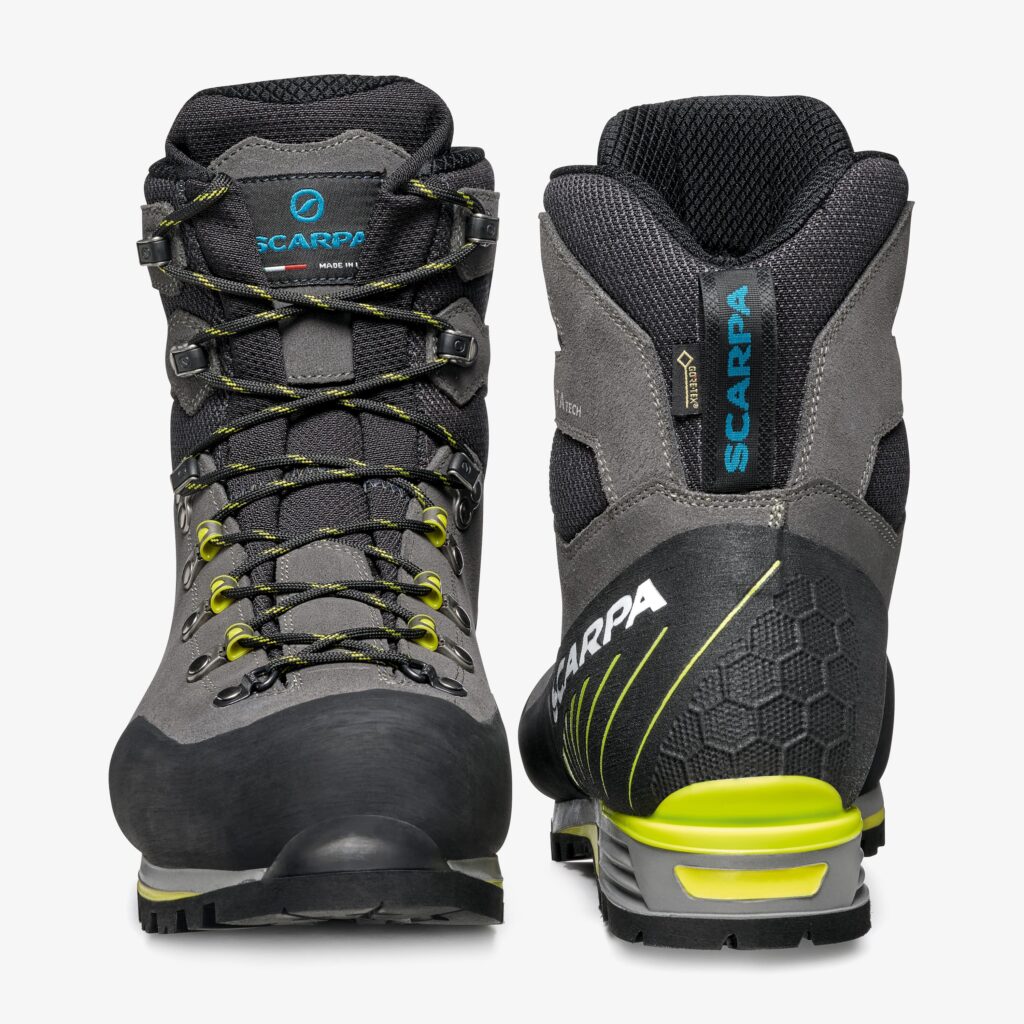
If you are attempting a summit route on the Rwenzori and can afford one premium footwear investment, the Scarpa Manta Tech GTX is the boot that consistently earns the strongest endorsement from experienced Rwenzori guides. It is a B3-rated alpine boot with a full GORE-TEX lining, a high collar, and a Vibram Mulaz sole that performs reliably on both saturated organic terrain and the wet rock belt above 4,500 metres. The upper part of the boot is made from tough Perwanger leather and reinforced with Schoeller Keprotec, making it very durable in the rough conditions of the Rwenzori. It accepts both C1 and C2 crampons, making it equally effective in the bogs at 3,600 metres and on the Elena glacier at 4,900 metres. The significant limitation is stiffness in the lower boot on descents through the root forest, which creates fatigue in the toe and forefoot on the long approaches. Wear them extensively before the trek; this boot requires at least 80-100 km of conditioning before they move naturally.
La Sportiva Nepal Evo GTX: Glacier Supremacy, Bog Competence
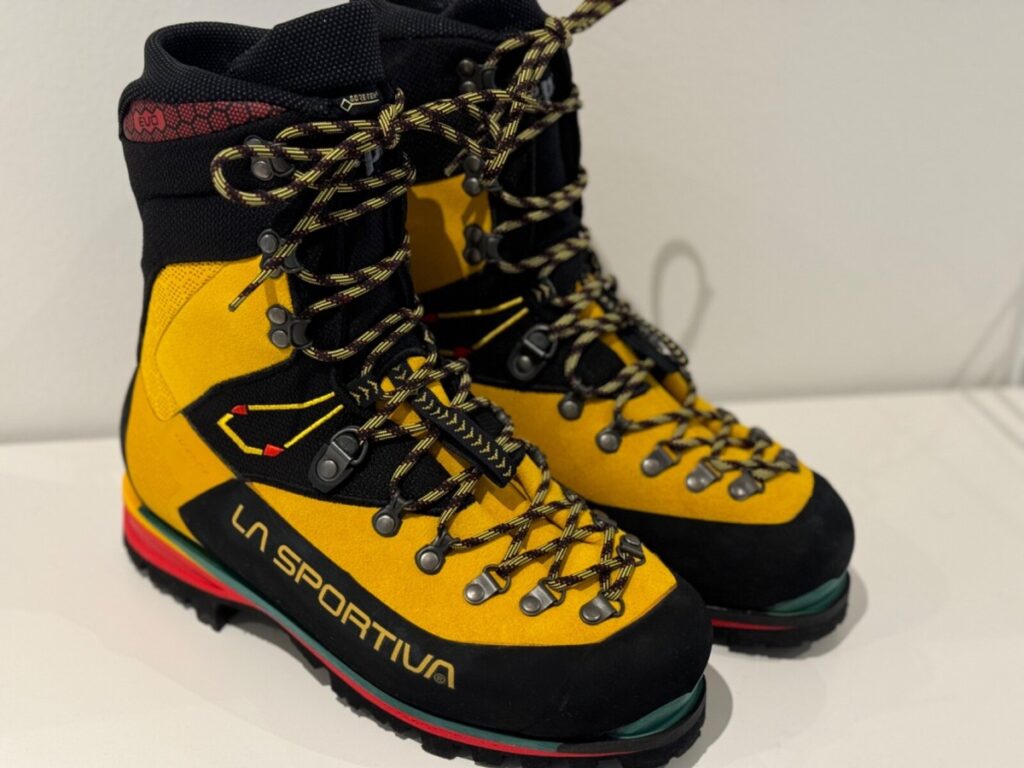
The Nepal Evo is one of the most iconic high-altitude mountaineering boots in production and performs superbly on the glacier section. Its GORE-TEX liner is excellent, and the Vibram IBS (Integrated Braking System) sole grips wet rock with precision. On the bog section specifically, it is slightly less comfortable than the Scarpa Manta because of its more extreme B3 stiffness; each bog step requires more deliberate placement rather than the natural flex that makes bog navigation intuitive. For trekkers who are focused primarily on the summit and willing to accept slightly more effort in the bog zone, this boot is an outstanding choice. For trekkers who find that extremely stiff boots cause Achilles or calf fatigue on multi-day approaches, the Hanwag or Lowa options may suit better.
Hanwag Alaska GTX: The Proven All-Rounder
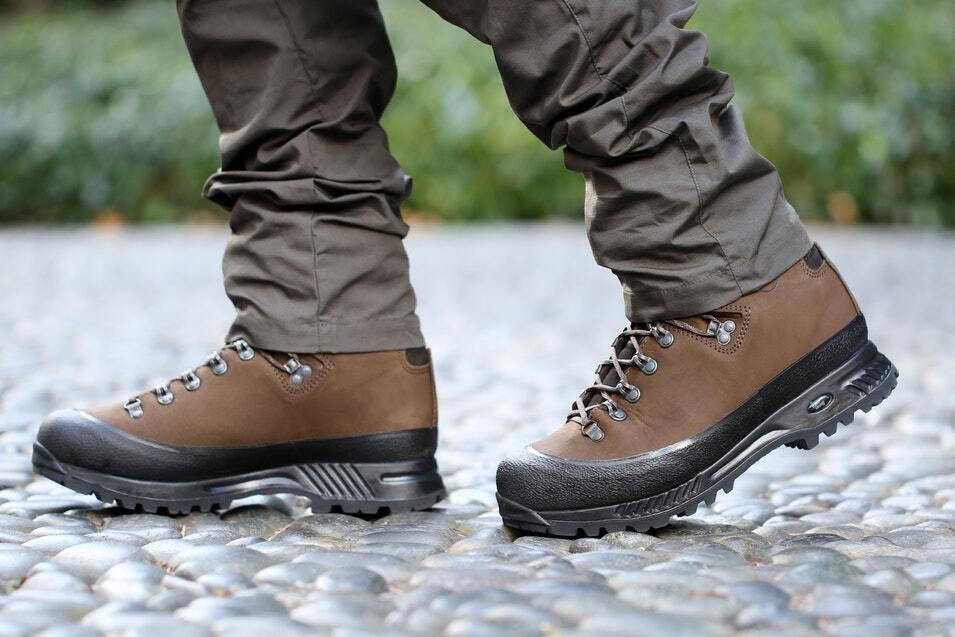
The Hanwag Alaska GTX is a full-grain nubuck leather boot with a GORE-TEX lining and a Vibram Tsavo sole that has been a benchmark for expedition trekking for over two decades. Its stiffness is in the B2/B3 range, which means it works well with most crampon systems while still allowing enough flexibility for natural movement through areas with roots and wet ground. The Alaska GTX does an impressive job of staying waterproof even when fully submerged in deep bogs for a long time, thanks to its leather material and the strong seal where the upper part meets the sole. The boot is heavier than synthetic alternatives, which is felt on long approaches, but on the Rwenzori specifically, that weight is a function of the durability and waterproofing that the terrain demands.
Lowa Tibet GTX: Superior Fit System, Exceptional Ankle Support
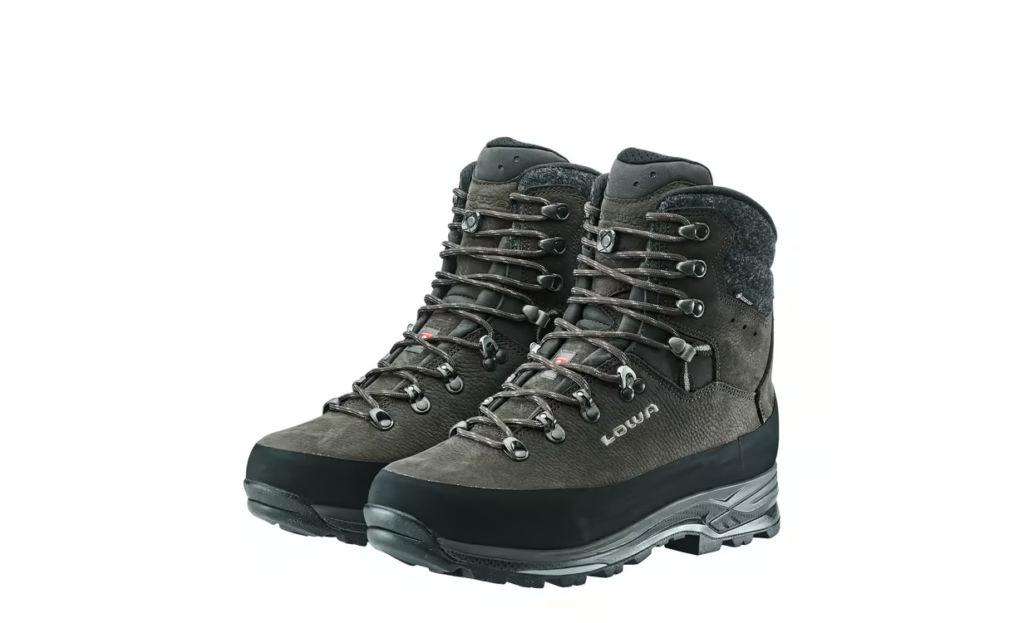
The Lowa Tibet GTX earns its place on this list primarily because of its fit architecture. Lowa’s Monowrap frame system, a single-piece midsole and heel cradle that wraps the foot in a continuous structure, provides ankle support that is objectively better than most competitors at the same stiffness rating. On the Rwenzori bog section, ankle support is not just about preventing sprains; it is about reducing the muscular fatigue that comes from continuous postural correction on unstable surfaces. Trekkers who have experienced ankle fatigue on previous high-altitude treks or who are covering the full distance of routes like the 10-day four-peaks expedition will find the Tibet GTX particularly beneficial. The GORE-TEX lining performs well in prolonged wet conditions, and the Vibram Masai sole has excellent self-cleaning geometry for bog terrain.
Zamberlan 996 Vioz Lux GTX: Lighter Feel on Long Multi-Day Routes.
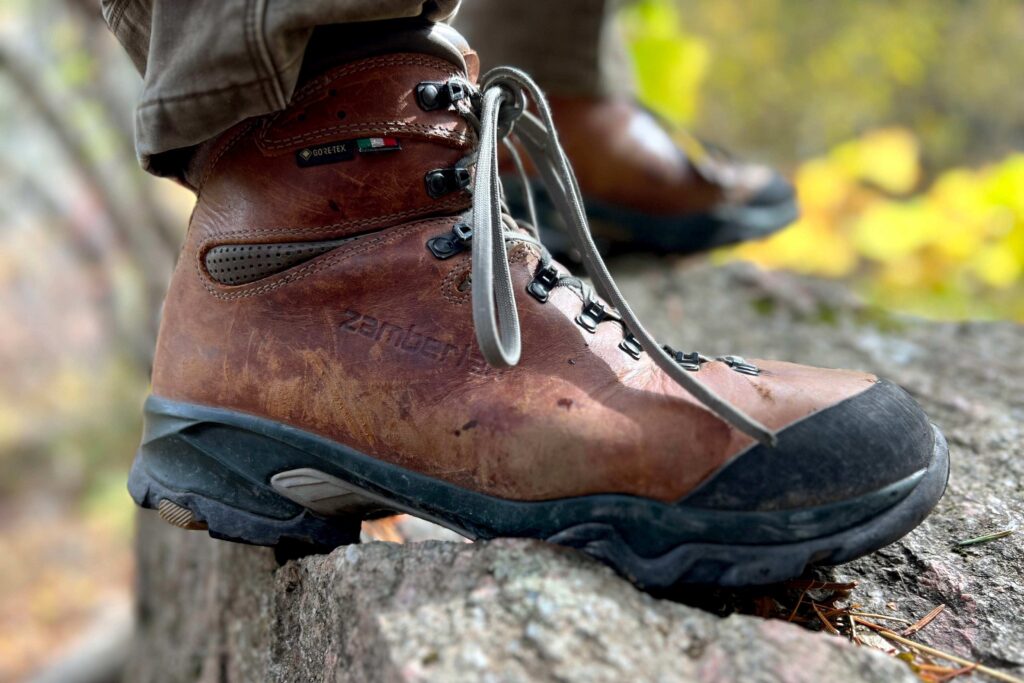
The Zamberlan 996 Vioz Lux occupies an intriguing position: it is lighter than the Hanwag, Lowa, or Scarpa alpine options yet offers a GORE-TEX lining and enough sole stiffness (B2) to accept C1 crampons. The Zamberlan 996 Vioz Lux provides an excellent balance of waterproof protection and day-long comfort for trekkers on routes that do not require full glacier travel, including the demanding 8-day Kilembe Trail to Margherita up to the point where they don crampons. Multiple trekkers who have covered the full 13-day six-peaks circuit in the Vioz Lux report that the reduced weight relative to full B3 alpine boots significantly reduces fatigue on the long traverse days between peaks. If your summit ambition focuses on routes where C1 crampons are sufficient rather than full B3 cramponing, the Meindl Bhutan MFS GTX is an excellent choice.
Meindl Bhutan MFS GTX: Underrated, Remarkably Durable.
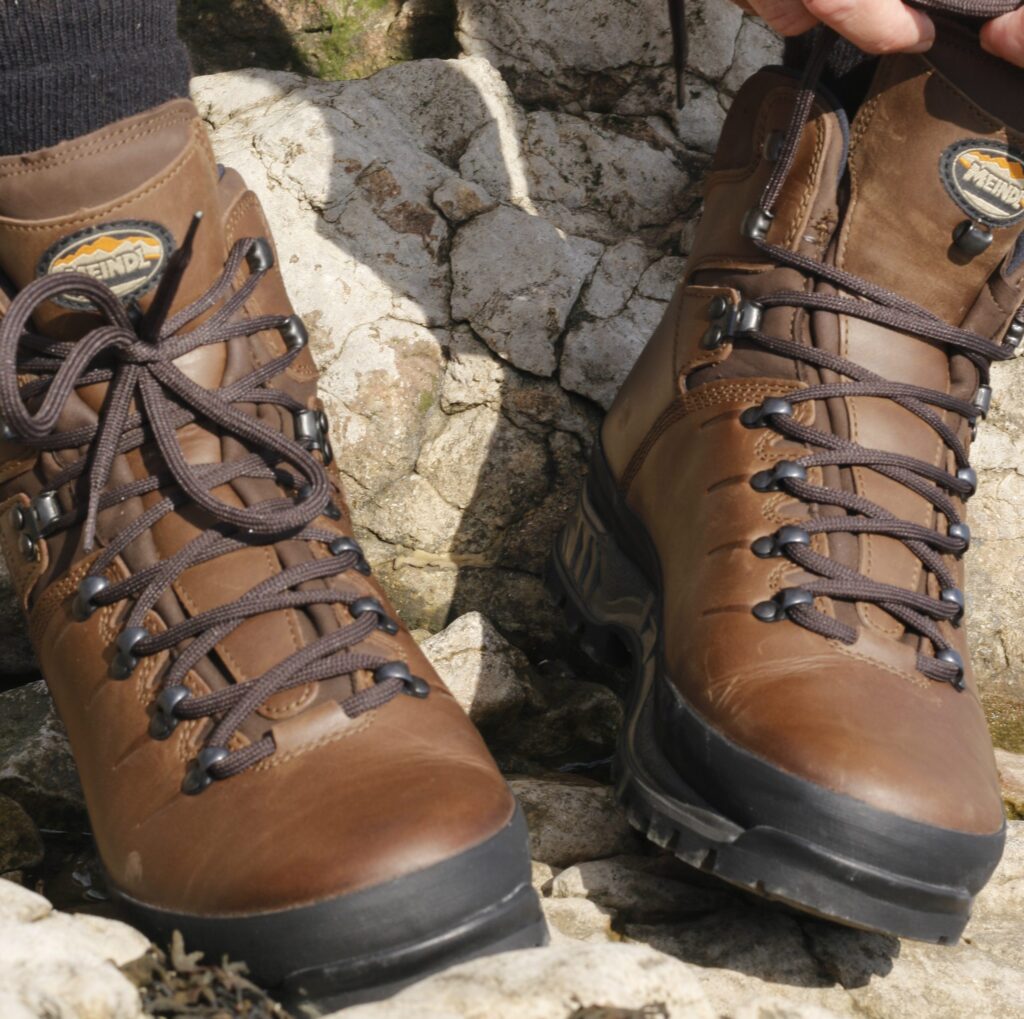
The Meindl Bhutan MFS GTX is less commonly discussed than the Italian and Austrian alternatives above, but it has a strong track record among long-distance trekkers in consistently wet environments. Meindl’s Memory Foam System (MFS) insole provides a custom-adaptive fit that becomes more comfortable over time rather than less important for expeditions lasting 10 days or more. The GORE-TEX lining is strongly attached with excellent seam quality, and the upper part is built to avoid coming apart in situations where it gets soaked and dried repeatedly, which would ruin lesser waterproof materials. The sole is Vibram Masai and performs well on both organic bog terrain and wet rock. It is slightly heavier than the Zamberlan option but offers better long-term durability for those planning multiple Rwenzori expeditions or back-to-back seasons.
A Note on Salomon Quest 4 GTX and Trail-Style Boots
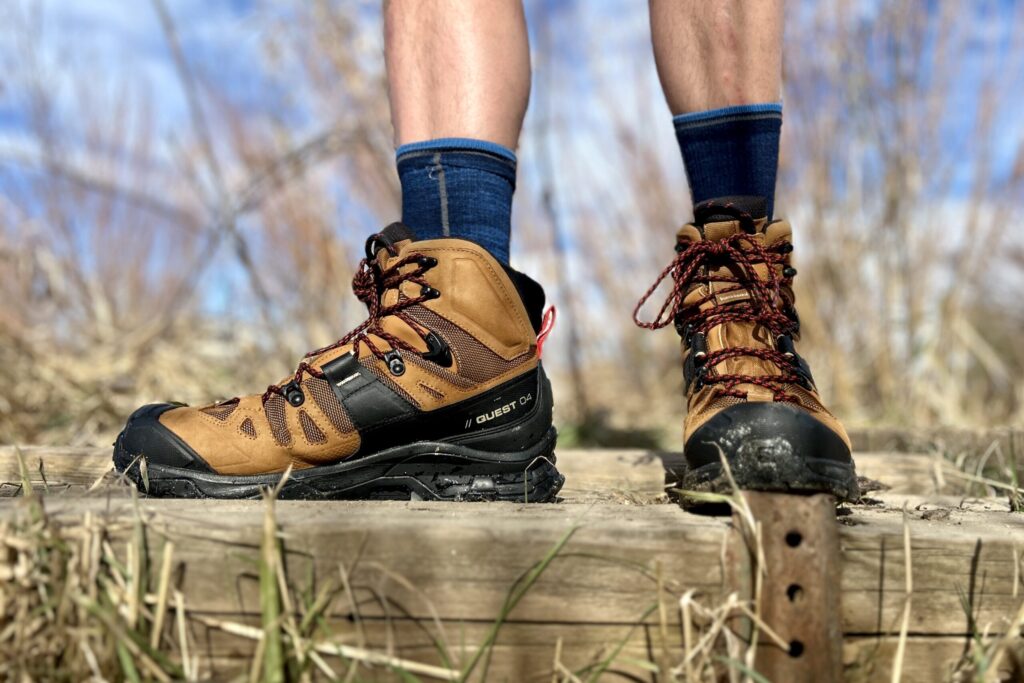
General hiking websites frequently recommend the Salomon Quest 4 GTX and similar trail-orientated trekking boots with GORE-TEX linings for African mountain trekking. On the Rwenzori, they are adequate for shorter lower-mountain routes like the 4-day Rwenzori Waterfalls Hike or the 2-day Sine Camp route, where bog depth is moderate and glacier travel is not required. They are inadequate for summit routes. Their B1 sole is incompatible with most crampon systems. Their collar height, while adequate for light trail work, leaves a gap below the lower shin that gaiters do not reliably seal against deep bog submersion. They are light, comfy, and easy to break in, making them tempting for Rwenzori first-timers who underestimate the terrain. If in any doubt about your route’s demands, consult the full route comparison guide before committing to a lighter boot.
GUIDE WARNINGWe see this scenario every season: trekkers who arrive at Nyakalengija with trail runners, approach shoes, or low-cut hiking boots, having read on a general travel forum that they were sufficient. Within two hours on the trail, their feet are wet, their ankles are beginning to ache from root-terrain instability, and the psychological impact of cold, wet feet has already begun. There is no solution at that point. You must buy and break in the right boots before arriving in Uganda, not improvise. |
Gaiters: The Component Most Trekkers Get Wrong
If the boot is the foundation of your Rwenzori footwear system, the gaiter is the wall. Without the gaiter, the foundation faces every threat it wasn’t designed to handle alone. The gaiter’s job on the Rwenzori is to extend the waterproof protection of the boot upward along the shin and lower knee, sealing against bog water that would otherwise pour in over the boot collar. This is not a secondary consideration on the bog-heavy sections of most summit routes; it is the primary determinant of whether your feet stay dry above shin depth.
The gaiter must be full-length.
Half-gaiters and ankle gaiters offer no meaningful protection against Rwenzori bog conditions, as they are designed for dry trail use to keep debris out of boots. The minimum effective gaiter for the Rwenzori reaches the knee or just below it, covering the full shin. This specification alone eliminates the majority of gaiters sold at outdoor retailers as multi-purpose “hiking gaiters.” Look at the product description: if it says “suitable for light snow and mud”, it will not work here. You need a gaiter specifically designed for high-precipitation mountain terrain, rated for submersion rather than just splash resistance.
The Seal Between Boot and Gaiter Is Everything
A full-length gaiter that does not seal tightly against the boot is worse than no gaiter at all, because it creates a funnel that channels bog water down into the boot interior. The seal is achieved through three components working together: a stirrup cord that passes under the boot sole and keeps the gaiter hem pulled down tightly over the boot upper, a front or side zip that closes from ankle to knee with a waterproof storm flap, and the collar of the gaiter boot interface, which should grip the lower boot shaft without gaps. Check this seal specifically with the exact boot you plan to wear. Gaiter-to-boot compatibility varies between models, and some combinations leave gaps at the ankle junction that will allow water ingress in deep bogs.
| Model | Height | Material | Max Bog Depth | Rwenzori Rating |
| Outdoor Research Crocodile | Full knee | GORE-TEX + Cordura | 50–60 cm | ★★★★ ★ Top pick |
| Black Diamond talus | Mid-calf | Nylon + WR coating | 30–40 cm | ★★★☆☆ Lower zones only |
| Rab Latok Alpine Gaiter | Full knee | eVent fabric | 45–55 cm | ★★★★☆ Excellent breathability |
| Mammut Nordwand | Full knee | GORE-TEX | 50–60 cm | ★★★★★ Summit-day choice |
| Montane Superfly | Mid-calf | Pertex Shield | 25–35 cm | ★★☆☆☆ Not adequate above treeline |
Outdoor Research Crocodile GTX: The Rwenzori Standard
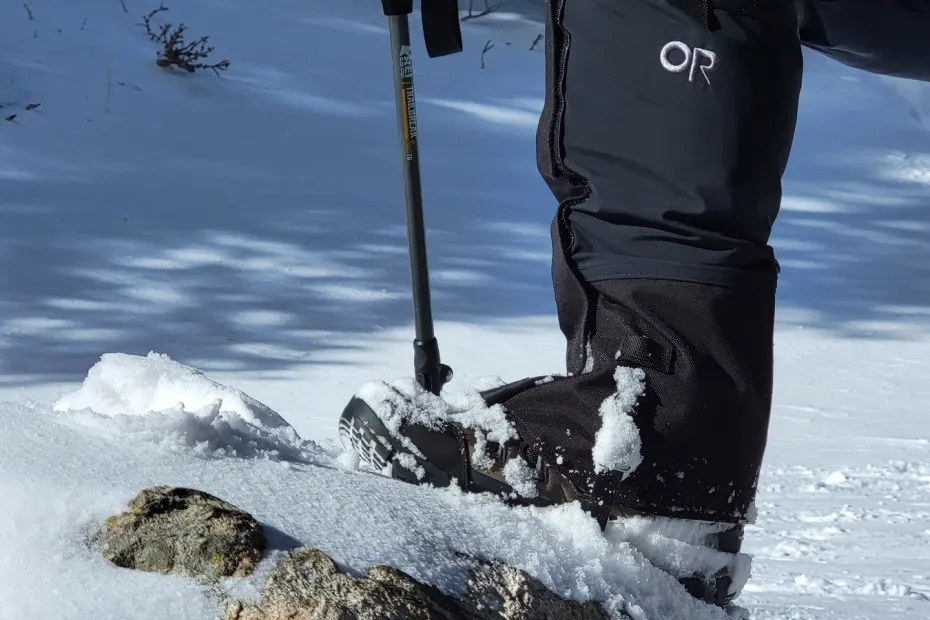
The Outdoor Research Crocodile GTX gaiter has earned near-universal endorsement from Rwenzori-experienced guides and trekkers because it solves the specific problem the mountain presents. The gaiter is made with GORE-TEX on the outside, a tough Cordura material on the bottom to protect against scratches from roots and rocks, a long zipper with a strong storm flap, and a stirrup system that keeps it tightly attached to the boot even when moving sideways or downwards. The coverage extends well past the knee on most leg profiles, providing meaningful protection even in the deepest bog sections. It is heavier than minimalist options, which affects the overall pack weight calculation, but on a mountain where wet feet pose a genuine medical risk, the weight penalty is trivially justified.
Mammut Nordwand: Summit Day Gaiter
For summit day on routes to Margherita Peak via the Elena glacier, the Mammut Nordwand gaiter offers GORE-TEX protection with a more streamlined profile that works better with crampons. Its lower profile relative to the OR Crocodile means slightly less bog protection on the approach, but above the snowline, where the primary risk is crampon snagging rather than bog submersion, its tighter geometry is a functional advantage. Many trekkers on summit routes carry both: the OR Crocodile for approach days through the bog zone and the Mammut Nordwand for glacier day. This adds 300–400 grams to the pack, but it provides optimised protection for each distinct terrain type.
Waterproofing Maintenance: What Actually Holds Up in Rwenzori Conditions
Understanding the difference between factory waterproofing and field waterproofing performance is essential for anyone trekking the Rwenzori. Unless you actively maintain them, boots that are genuinely waterproof in the shop gradually lose their waterproofness under sustained field conditions. Here’s what happens to waterproofing on a multi-day Rwenzori trip and how to fix it.
How GORE-TEX Fails
GORE-TEX and similar waterproof-breathable membranes do not fail catastrophically; they fail incrementally. The membrane itself is remarkably durable and rarely the primary failure point. What fails is the Durable Water Repellent (DWR) treatment applied to the outer fabric of the boot upper. DWR is a surface coating that causes water to bead and run off the outer fabric rather than soaking in. When DWR is depleted, which happens over weeks of field use, especially in organic-rich bog conditions, the outer fabric becomes saturated with water. This does not let water through the membrane (the GORE-TEX is still intact), but it means the membrane is now in contact with saturated fabric on the outside and your foot on the inside, which dramatically reduces breathability. The boot feels wet from the inside even when the membrane is functioning correctly, because moisture from your foot cannot escape through a membrane that is blocked by external saturation. Renewing DWR with a wash-in product (Nikwax TX Direct Wash-In or Granger’s Performance Repel Plus) is the single most important maintenance action you can take mid-expedition.
The Leather Boot Advantage in Multi-Day Wet Conditions
This scenario is where the case for full-grain leather uppers becomes most concrete. A properly waxed leather boot does not rely on a surface DWR coating in the same way synthetic boots do; the wax impregnates the leather fibres directly, creating a hydrophobic barrier that is mechanically embedded rather than coated on the surface. This wax treatment, applied with Leder Grig, Nikwax Leather Wax, or Sno-Seal before the expedition and topped up at camp on multi-day routes, repels water at the primary contact surface rather than relying on a secondary membrane layer. On a 13-day expedition in the perpetually wet Rwenzori environment, the difference between a well-maintained leather boot and a synthetic boot with depleted DWR is the difference between consistently dry feet and increasingly damp ones.
Boot Care Protocol for the Rwenzori
The maintenance protocol for a Rwenzori expedition is simple but must be followed consistently. Before departure, apply a full leather wax treatment (for leather boots) or refresh the DWR with a wash-in product (for synthetic boots). Carry a small tube of leather wax or a 100ml spray DWR refresher in your pack. On multi-day routes, apply a thin coat of wax to leather boots each evening and allow it to absorb overnight in the hut or tent. For synthetic boots, a light spray of DWR refresher on the upper fabric at each camp where it has become noticeably wet-looking will extend the effective waterproofing significantly. Clean mud from the boot collar and the gaiter-boot interface every evening. Accumulated mud prevents the seal from seating properly the following day and creates pathways for water ingress.
What to Carry for Boot Repair
On expeditions of 10 days or more, carry a small repair kit: 50cm of quality duct tape (for emergency gaiter tears or loose sole sections), a tube of Seam Grip or similar sealant for sole delamination, and a spare gaiter stirrup cord. Sole delamination is rare in quality boots but occurs under sustained submersion and drying cycles. A starter separation at the toe can be arrested with Seam Grip applied under the separated sole section and taped firmly overnight to cure. On longer routes, such as the 18-day all-peaks expedition, boots face stresses that would not occur during a normal hiking season, and even a minimal repair kit has saved expeditions from premature descent.
Socks: The Overlooked Variable That Changes Everything
Trekkers who invest correctly in boots and gaiters but underestimate socks will still arrive at camp with wet, cold feet because the best waterproof system in the world cannot protect against moisture generated from inside the boot by the foot itself. Foot perspiration at the exertion levels required by Rwenzori trekking is substantial; a cotton or poorly wicking sock holds that moisture against the skin throughout the day, creating the damp-cold environment that causes blisters and, in sustained exposure, contributes to trench foot.
Merino Wool or Technical Synthetics: Not Cotton
Merino wool is the premium choice for Rwenzori trekking socks because it continues to insulate when wet, actively wicks moisture away from the skin, and has natural anti-microbial properties that reduce odours over multiple days without washing. A mid-weight merino sock (200–250 gsm) provides enough cushioning for the root forest and bog sections while maintaining adequate thermal performance in the cold nights and early mornings of the high-altitude camps. Smartwool, Icebreaker, and Darn Tough are the three brands most consistently recommended by Rwenzori guides. Technical synthetic socks from brands like Injinji (toe socks, which eliminate inter-toe blisters) or Balega are also excellent if merino creates skin sensitivity. Cotton socks should be left at home entirely.
The Double-Layer System
Many experienced high-altitude trekkers use a thin polypropylene liner sock inside a heavier merino outer sock. The liner sock wicks moisture from the foot surface to the outer sock, reducing the friction between foot and sock (which is the primary cause of blisters) and providing an additional wicking layer. On the Rwenzori, where even perfect waterproofing will not prevent some moisture infiltration during the deepest bog sections, the liner sock provides an additional barrier that keeps the foot surface drier than a single thick sock alone. Carry three to four pairs of outer socks on any route longer than 6 days, and dry them at every available hut opportunity.
Trekking Poles and Bog Navigation: The Forgotten Footwear Complement
No discussion of footwear for the Rwenzori bog zone is complete without addressing trekking poles. In the deepest bog sections, poles are not a comfort aid; they are part of the balance and safety system that allows upright movement through terrain where a fall means full immersion in cold organic water at altitude. The poles function as a depth probe (pressing ahead before committing a foot to a surface of unknown solidity) and as a lateral stability brace (preventing the rotational fall that occurs when one foot sinks deeper than expected). Poles should be set slightly shorter than trail length for bog sections gripped near the top of the handle rather than through the wrist strap to allow rapid reconfiguration when depth changes suddenly underfoot.
Carbon fibre poles are lighter but brittle under the sideways bending forces that bog navigation frequently creates. Aluminium poles are heavier but flex rather than snap under sudden lateral loading. For Rwenzori, specifically, aluminium poles are the pragmatic choice unless weight minimisation is a primary constraint. Carry them on every day that includes the bog zone, which, on the Central Circuit Trail above John Matte, means every day between the start of the approach and the glacier section. Consult our Does it Rain a Lot in the Rwenzori guide to understand the correlation between rainfall and bog depth, which changes by season and elevation.
When to Buy and How Long to Break In Your Boots
The single most common boot-related mistake on the Rwenzori, after choosing the wrong specification, is buying the right boot too late. A new B2 or B3 leather mountain boot requires a minimum of 80–120 kilometres of walking before it can naturally move enough for multi-day expeditions. This is not hyperbole; it is the physical reality of thick leather and stiff midsoles conforming to the specific architecture of your foot and gait. A boot that is still being broken in on Day 1 of a 10-day expedition will produce blisters on the heel and Achilles area, hotspots on the little toe lateral edge, and restricted ankle movement that increases fatigue on root and bog terrain.
The Break-In Timeline
Purchase your expedition boots at least 12 to 16 weeks before your trek departure. This is not a coincidental alignment with the training plan timing described in our separate guide; a well-structured Rwenzori preparation involves conditioning your feet and boots simultaneously. Wear the new boots for every training hike from Week 2 of your preparation onwards. Begin with shorter flat walks and progress to your loaded long hikes by Week 6 or 7, at which point the boot should be functioning naturally and any fit issues (particularly hotspot locations) will have been identified and addressed. Bring any hotspot concerns to a specialist boot fitter early; most issues can be resolved with a custom insole, a heat-moulded footbed, or specific lacing techniques, none of which are available as solutions on the mountain.
Buying in Kampala vs Buying at Home
A recurring question from trekkers planning their first Rwenzori expedition is whether high-quality boots are available in Uganda. Kampala has a reasonable selection of outdoor and sporting goods shops, and basic hiking footwear is available. However, the specific models recommended for the Rwenzori bog zone, full B2/B3-rated leather boots with sealed membranes, are not reliably stocked in the Ugandan market, and sizing availability is limited. Plan to purchase and break in your boots before departure, at home, where you have access to the full range of specialist retailers and can return boots that fit incorrectly without time pressure.
Frequently Asked Questions: Boots and Footwear for the Rwenzori
What type of boots do I need for trekking the Rwenzori Mountains?
For a full summit route to Margherita Peak or any of the high-altitude Rwenzori peaks, you need a B2 or B3 rated mountain boot with a full GORE-TEX or equivalent waterproof membrane, a full-grain leather or robustly sealed synthetic upper, a high collar above the ankle, and a Vibram or equivalent sole with deep self-cleaning lugs. The boot must be compatible with a full knee-height gaiter for the bog sections between 3,200 and 4,100 metres. For lower-altitude routes like the Mahoma Loop and the Mutinda Lookout route, a B1 or B2 boot is adequate, but the same waterproofing standard applies. No route on the Rwenzori is suitable for trail runners, approach shoes, or low-cut boots.
Are GORE-TEX hiking boots waterproof enough for the Rwenzori bogs?
GORE-TEX boots are waterproof up to the height of the boot collar. In the Rwenzori bog zone, bog depth frequently exceeds the boot collar height, which means water enters over the top regardless of how good the boot membrane is. This is why full knee-height gaiters are essential rather than optional. Properly fitted, full-length gaiters worn with GORE-TEX boots provide adequate waterproof protection for the vast majority of bog sections. The maintenance of DWR treatment on the outer fabric is also critical. A Gore-Tex boot with depleted DWR will feel wet inside even though the membrane is intact because saturated outer fabric prevents breathability. Refresh DWR before departure and carry a spray refresher for multi-day routes.
Do I need gaiters for a Rwenzori trek?
Yes, full-length gaiters are essential equipment for any Rwenzori route that crosses the bog zone above 3,200 metres. This includes all summit routes to Margherita Peak, the full Central Circuit, and most multi-day routes that traverse the mid-mountain. Half-gaiters or ankle gaiters are inadequate; the minimum specification is a full knee-height gaiter with a sealed outer fabric (GORE-TEX or similar), a stirrup cord, and a waterproof storm flap over the zip closure. The Outdoor Research Crocodile GTX is the most consistently recommended model. For routes that involve walking on glaciers, it’s a good idea to bring a lighter gaiter for the summit day, like the Mammut Nordwand, because bulky knee gaiters can affect how crampons fit. Our guide on the Rwenzori covers the full technical gear requirements, including whether crampons and ropes are necessary.
Can I use the same boots on the Rwenzori bogs and on the glacier?
Yes, but only if your boots are B2 or B3 rated and compatible with the crampon type required for your specific route. A B2 boot will accept C1 (strap) crampons; a B3 will accept C2 (step-in) crampons. The key is that a single boot must perform adequately in both the deep bog sections at 3,500 metres and on the cramponed glacier at 4,800 metres. The boots recommended for full summit routes in this guide, Scarpa Manta Tech GTX, La Sportiva Nepal Evo GTX, Hanwag Alaska GTX, and Lowa Tibet GTX, all fulfil this dual requirement. Do not attempt glacier travel in a B1 boot even with strap crampons, as the sole flex under crampon load creates an instability and trip hazard that becomes dangerous on steep ice.
How deep are the Rwenzori bogs, and how far do they extend on the route?
The depth of the bogs varies by season, recent rainfall, and specific location on the trail. In typical conditions during the main trekking seasons, bog sections range from ankle-deep (common) to knee-deep (frequent) to mid-thigh depth (occasional, usually in sections off the main tread where trekkers have tried to navigate around congested areas). In exceptional rainfall conditions, which the Rwenzori climate guide documents in detail, thigh-deep submersion in isolated sections is possible. The main bog zone on the Central Circuit extends across the Bujuku Valley floor and the approach corridors to the upper camps; approximately 6–10 kilometres of trail have been covered over two days of movement. The Kilembe Trail has a lower bog density, but it remains significant above 3,500 metres. No section of a multiday route above 3,200 meters should be assumed to be bog-free.
How long does it take to break in mountain boots for the Rwenzori?
Full-grain leather B2 or B3 mountain boots typically require 80 to 120 kilometres of walking before they conform adequately to the foot for multi-day expedition use. This means purchasing your boots at least 12 weeks prior to your departure and wearing them consistently throughout your training program. Begin with shorter flat walks in the first two weeks, progressing to loaded hikes of increasing duration from Week 4 or 5 onwards. A professional boot fitter should address any hotspot or blister point that arises during the break-in period before the trek. Common solutions include heat-moulded insoles, custom heel pads, and specific lacing patterns that redistribute pressure away from problem areas. A boot that is still producing hot spots 60 kilometres into the break-in process should be reconsidered for fitness rather than persevered with.
What socks should I wear on a Rwenzori trek?
Socks made of mid-weight merino wool in the 200-250 gsm range are the strongest recommendation for Rwenzori trekking. Merino wool insulates when wet, actively wicks moisture from the skin, and resists odour accumulation over several days of use. Brands with a strong reputation for quality and durability in high-use conditions include Smartwool, Icebreaker, and Darn Tough. A thin polypropylene liner sock worn inside the merino outer sock reduces inter-layer friction and therefore blister incidence. Cotton socks are entirely unsuitable; they absorb and retain moisture against the skin, accelerating both blister formation and the cold-foot conditions that contribute to trench foot. Carry at least three to four pairs of outer socks and dry them at every available hut night.
Should I bring spare boots or just one pair for a multi-week Rwenzori expedition?
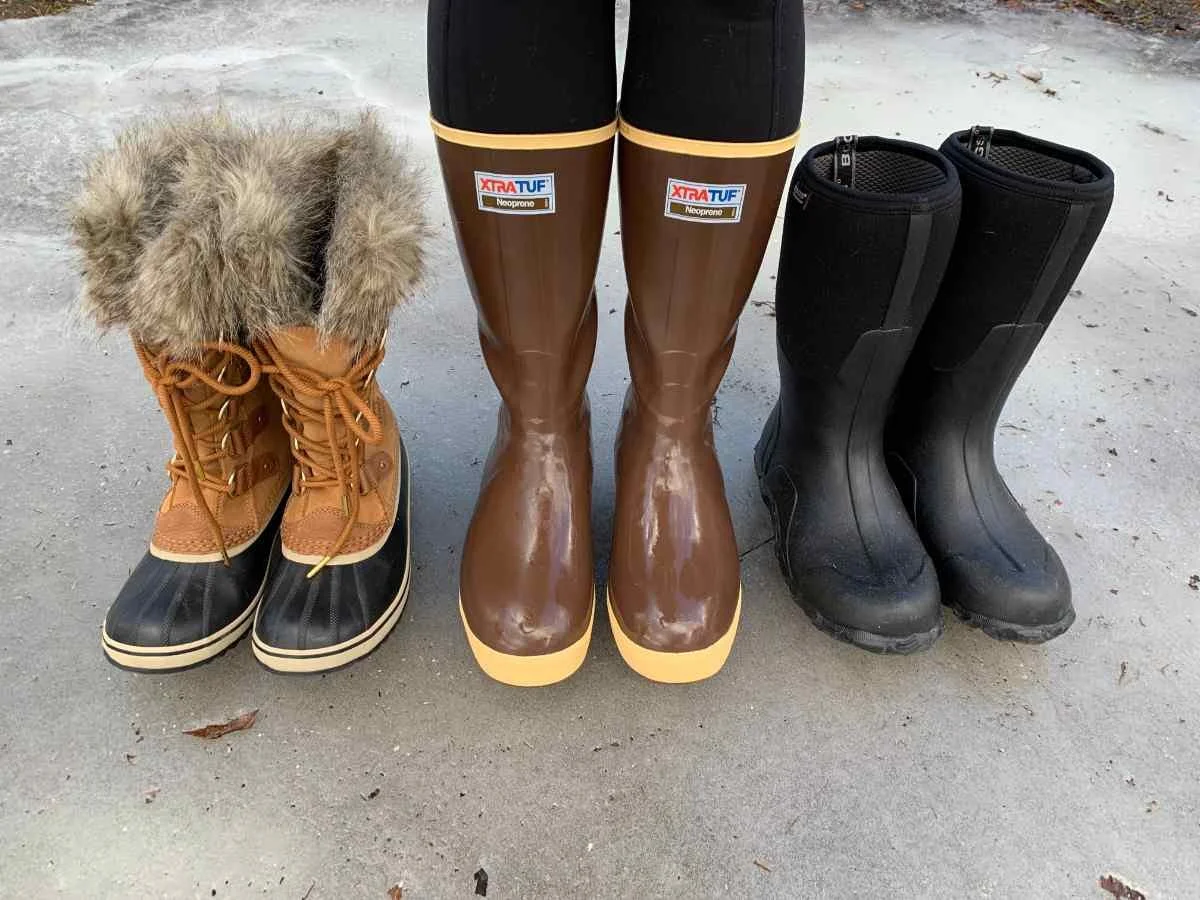
For expeditions of 13 days or more, including the 13-day six-peaks circuit and the 18-day all-peaks expedition, many experienced Rwenzori trekkers carry a secondary pair of lightweight camp shoes or neoprene socks for hut evenings, allowing the primary boots to dry overnight rather than being worn continuously. A spare pair of trail shoes is also useful if your primary boots need any drying time after exceptionally deep bog submersion. Carrying two full pairs of mountaineering boots is neither practical nor necessary, but a lightweight secondary footwear option adds genuine recovery benefit to the primary boot’s longevity and performance on longer expeditions.
The Right Gear, The Right Guide, The Right Mountain
The Rwenzori Mountains are a genuinely extraordinary trekking destination, arguably the most immersive and least-visited high-altitude wilderness in Africa. The bogs that scare first-timers become a defining memory for those who cross them with the right gear. With the right boots, the right gaiters, and the right preparation, they are navigable, often beautiful, and always unforgettable.
When you book a guided expedition with Rwenzori Trekking Safaris, your pre-departure briefing includes a detailed gear consultation covering every item on your kit list, including a boot and gaiter check against the specific requirements of your chosen route. If you are unsure whether your current footwear is adequate, send us the model details before you buy anything new. We have seen enough boots on this mountain to give you an informed, honest opinion. Explore our full range of Rwenzori trekking itineraries from introductory lower-mountain routes to complete multi-peak expeditions and reach out when you are ready to start planning.
PLAN YOUR EXPEDITIONContact the Rwenzori Trekking Safaris team directly. Share your target route, experience level, and any gear questions. We provide honest, personalised advice without pressure. Email: rwenzoritrekkingsafaris@gmail.com | WhatsApp: +256 773 256 104 Website: www.rwenzoritrekkingsafaris.com/ |