
Climb Margherita Peak (5,109m) in just 4 days via the Central Circuit. Africa’s fastest guided route to Uganda’s highest summit. Full itinerary, gear list & costs.

4 Days Rwenzori Trek to Margherita Peak | Fastest Rwenzori Climb
Overview of the 4-Day Rwenzori Trek to Margherita Peak
Africa’s Fastest Route to Africa’s Third Highest Summit
Four days. 5,109 metres. One glacier. No compromises. This trek is the fastest possible route to the top of Uganda: a condensed, high-intensity ascent of Margherita Peak via the Central Circuit Trail, built for experienced, well-conditioned trekkers who can’t afford a longer expedition but won’t compromise on the summit.
The 4-Day Rwenzori Trek to Margherita Peak offers a rapid ascent via the Central Circuit. Conquer Margherita Peak in just 4 days on this fast-track Rwenzori Mountains trek via the Central Circuit. This trek is designed for experienced hikers who are seeking a challenging summit ascent.
This 4-day Rwenzori Mountains trek to Margherita Peak (5,109 m) is a high-intensity, fast-track ascent designed strictly for experienced, physically strong, and well-acclimatized hikers.
Normally the Rwenzori hike to Margherita is completed in 6–7 days; this itinerary compresses the Central Circuit route into the shortest feasible timeframe without skipping critical sections. Expect long hiking hours, steep altitude gains, glacier travel, and minimal recovery time. This 4-day Rwenzori trek is not recommended for beginners or travelers without prior high-altitude trekking experience.


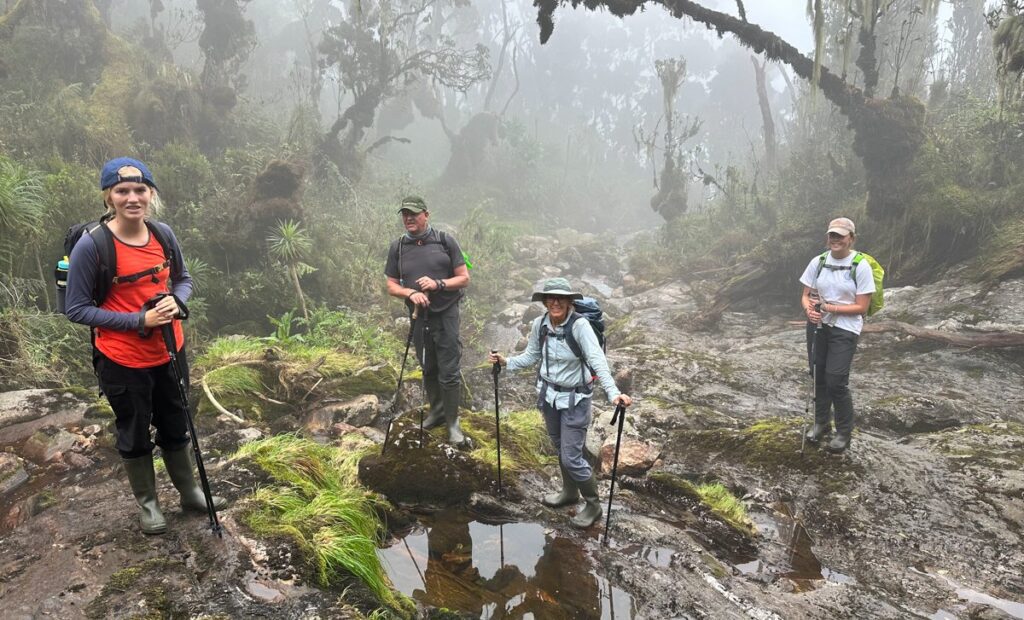
Important Notes about this 4-Day Rwenzori Trek. (Non-Negotiable)
-
This itinerary is only suitable for very fit and experienced hikers
-
Prior high-altitude trekking experience is essential
-
Weather, glacier conditions, or altitude sickness may require itinerary adjustments
-
Proper technical gear is mandatory
4-Day Margherita Peak Trek At-a-Glance
| Duration | 4 days / 3 nights |
| Total Distance | ~56 km (roundtrip on the Central Circuit) |
| Maximum Elevation | 5,109 m Margherita Peak, Mount Stanley |
| Elevation Gain | +3,509m total ascent from Nyakalengija (1,600m) |
| Difficulty | VERY HARD Expert trekkers only |
| Trail Used | Central Circuit Trail (Rwenzori Mountains National Park) |
| Start & End Point | Nyakalengija Trailhead, near Kasese, Western Uganda |
| Summit Camp | Elena Hut (4,563m) summit staging point |
| Best Months | January–February & June–August (drier windows) |
| Group Size | 2–10 trekkers (private groups available) |
| Accommodation | Mountain huts (John Matte, Bujuku, Elena) |
| Technical Gear | Crampons, harness, ropes, ice axe all provided |
| Price Indicator | From USD $1400 per person |
| Park Authority | Uganda Wildlife Authority (UWA) |
Why Choose the 4-Day Margherita Peak Route?
Most trekkers who come to the Rwenzori Mountains allocate seven or eight days for the full Central Circuit, and that is the right call for most people. But there exists a specific type of trekker for whom four days is not just workable but preferable: seasoned high-altitude hikers with prior acclimatization experience, tight travel schedules, and the physical conditioning to sustain 8–12 hours of mountain movement per day across three consecutive days at altitude.
This 4-day Rwenzori trek to Margherita Peak is, without question, the fastest route to Africa’s third-highest summit (5,109m) that remains safe and guided. It compresses the full central circuit approach into the shortest possible timeframe without skipping the critical camp progressions needed for any chance at summit success. You will still experience the iconic rainforest approach, the Bigo Bog, the dramatic alpine terrain above 4,000m, and the technical glacier crossing to the top of Mount Stanley.
What makes this route exceptional is not its brevity; it’s the contrast it packs into four days. You begin at 1,600 m in equatorial rainforest among Bakonzo village settlements and colobus monkeys. By Day 2 you are navigating ancient wooden boardwalks across surreal Afro-alpine bogs among giant lobelias the height of a person. By summit morning you are roping up on a glacier straddling the equator, with the curvature of equatorial Africa stretching in all directions beneath a pre-dawn sky. No other four-day mountain itinerary in Africa delivers such an experience.
It is worth being completely honest: this trek demands significantly more from your body than the 7-day Margherita Peak climb. The elevation gain on Day 1 alone, 1,820 m from Nyakalengija to John Matte Hut, is grueling. Day 2 pushes you from 3,420m to 4,563m in eight hours. Summit day starts at 2:00 AM and does not end for 10–12 hours. If any of this sounds daunting rather than exciting, we recommend our 5-day Margherita Peak trek or 6-day Central Circuit route instead. But if you are ready, few experiences on the African continent match what waits at the top.
Full Day-by-Day Itinerary: 4-Day Margherita Peak Trek
DAY 1: NYAKALENGIJA → JOHN MATTE HUT
Hiking time: 7–9 hours | Elevation gain: +1,820m | Overnight: John Matte Hut (3,420m)
Pre-Trek Briefing at Nyakalengija
Your 4-day Rwenzori trek begins at the Uganda Wildlife Authority (UWA) trailhead station in Nyakalengija (1,600m), approximately 13km from Kasese town. Before setting off, guides complete a thorough equipment check, permits are verified, and porters are allocated, typically one porter per trekker, carrying up to 15 kg of communal gear and your personal kit. Budget 30–45 minutes for this process. Do not skip the briefing: guides will review summit glacier protocols, emergency evacuation procedures, and pace expectations for each day.
The Rainforest Ascent: Village to Nyabitaba
The trail departs immediately into a patchwork of Bakonzo smallholder farms and gardens, the mountain villages that have sat in the Rwenzori foothills for centuries. The Bakonzo people have a deep spiritual connection to these mountains locally called ‘Rwenzururu,’ meaning ‘place from which rain clouds come.’ Within 30 minutes the path enters proper tropical montane forest, the canopy closing overhead. This is bird-rich country: the Rwenzori turaco with its crimson wing flash, Hartlaub’s duck along streams, and dozens of forest-specialist species. Black-and-white colobus monkeys are frequently spotted in the upper canopy.
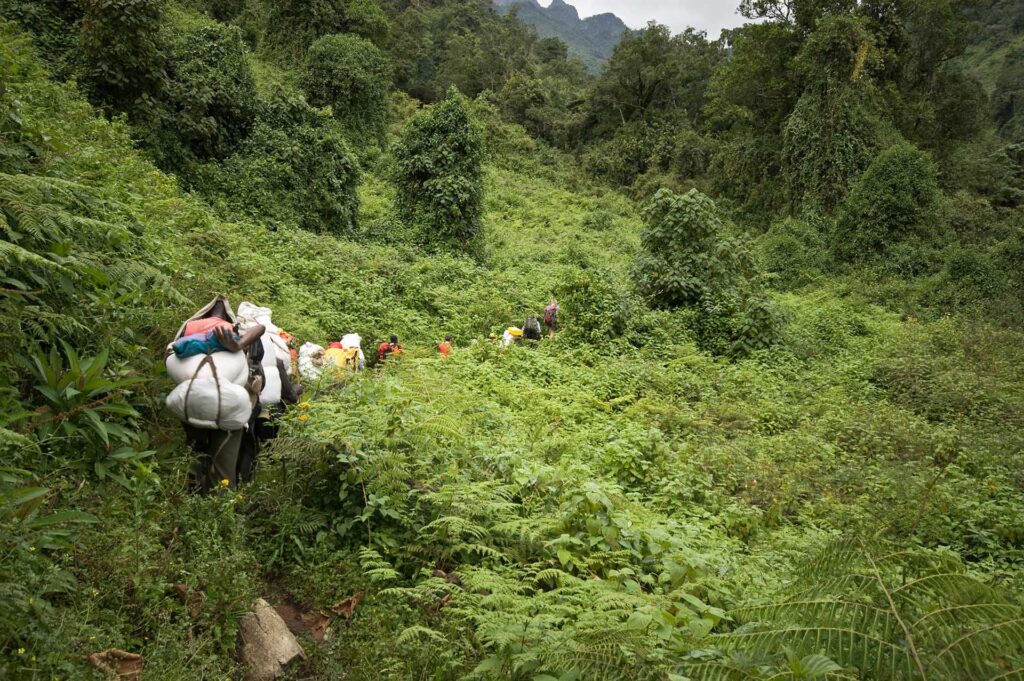
The ascent to Nyabitaba Hut (2,652m) takes approximately 3.5–4 hours. This is the traditional first overnight camp on the longer Central Circuit itineraries and a welcome rest point even on this compressed schedule. Lunch is served here: warm food prepared by your mountain cook, the first taste of the excellent catered meals your team provides throughout the trek.
Kurt Schafer Bridge and the Upper Forest
After lunch, the trail drops slightly from Nyabitaba to cross the famous Kurt Schafer Bridge, a narrow suspension footbridge strung across the confluence of the Bujuku and Mubuku rivers. The sound of the rivers below and the forest closing in above makes this one of the most atmospheric moments of Day 1. Beyond the bridge, the character of the landscape changes immediately: the terrain becomes steeper, more root-bound, and muddy, and the vegetation shifts toward lower bamboo and mossy cloud forest.
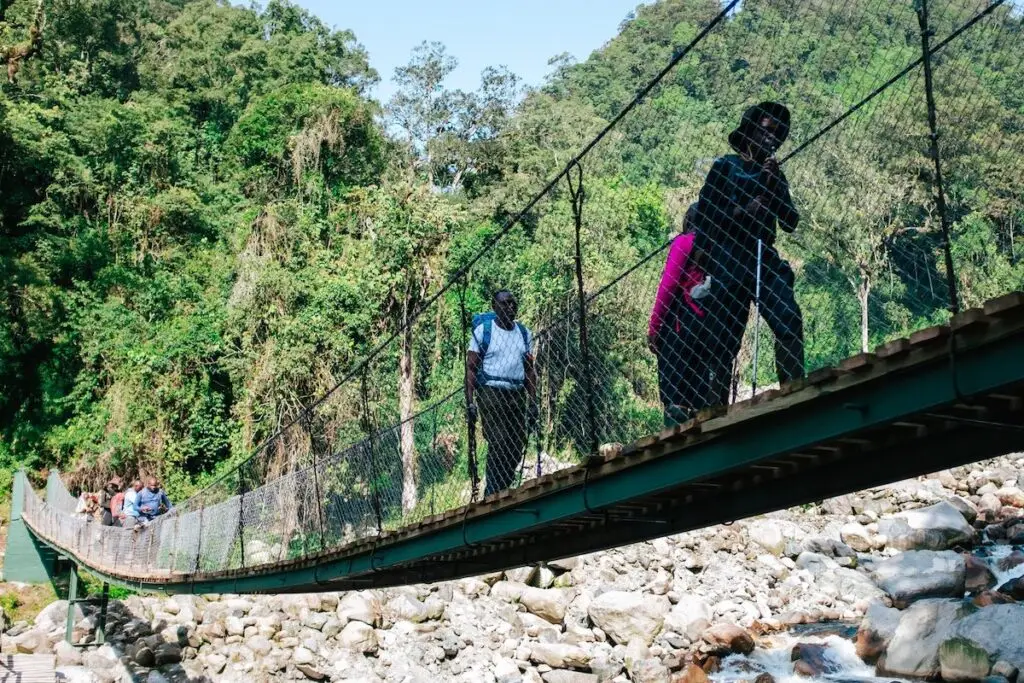
The 3-hour push from Nyabitaba to John Matte Hut gains another 770 m of altitude through increasingly dense vegetation. By late afternoon you emerge into a more open zone of giant heather and the first true mountain plants of the Rwenzori. John Matte Hut sits in a grassy clearing at 3,420 m with views to the northeast toward the valley. After dinner, typically three courses: soup, a hot main, and something sweet, you settle into the mountain hut dormitory for an early night. Tomorrow begins in darkness.
Day 1 Highlights
- First views of the Rwenzori forest canopy and colobus monkey sightings
- Kurt Schafer Bridge river crossing a memorable landmark
- Transition from tropical forest to lower Afro-alpine zone
Dinner and overnight at John Matte Hut (3,420 m), the highest-elevation first camp of any 4-day Rwenzori itinerary
DAY 2: JOHN MATTE HUT → ELENA HUT (3,420 m → 4,563 m) | Approx. 12–13 km
Hiking time: 8–10 hours | Elevation gain: +1,143 m | Overnight: Elena Hut (4,563 m)
The Bigo Bog: A Walk Through Prehistory
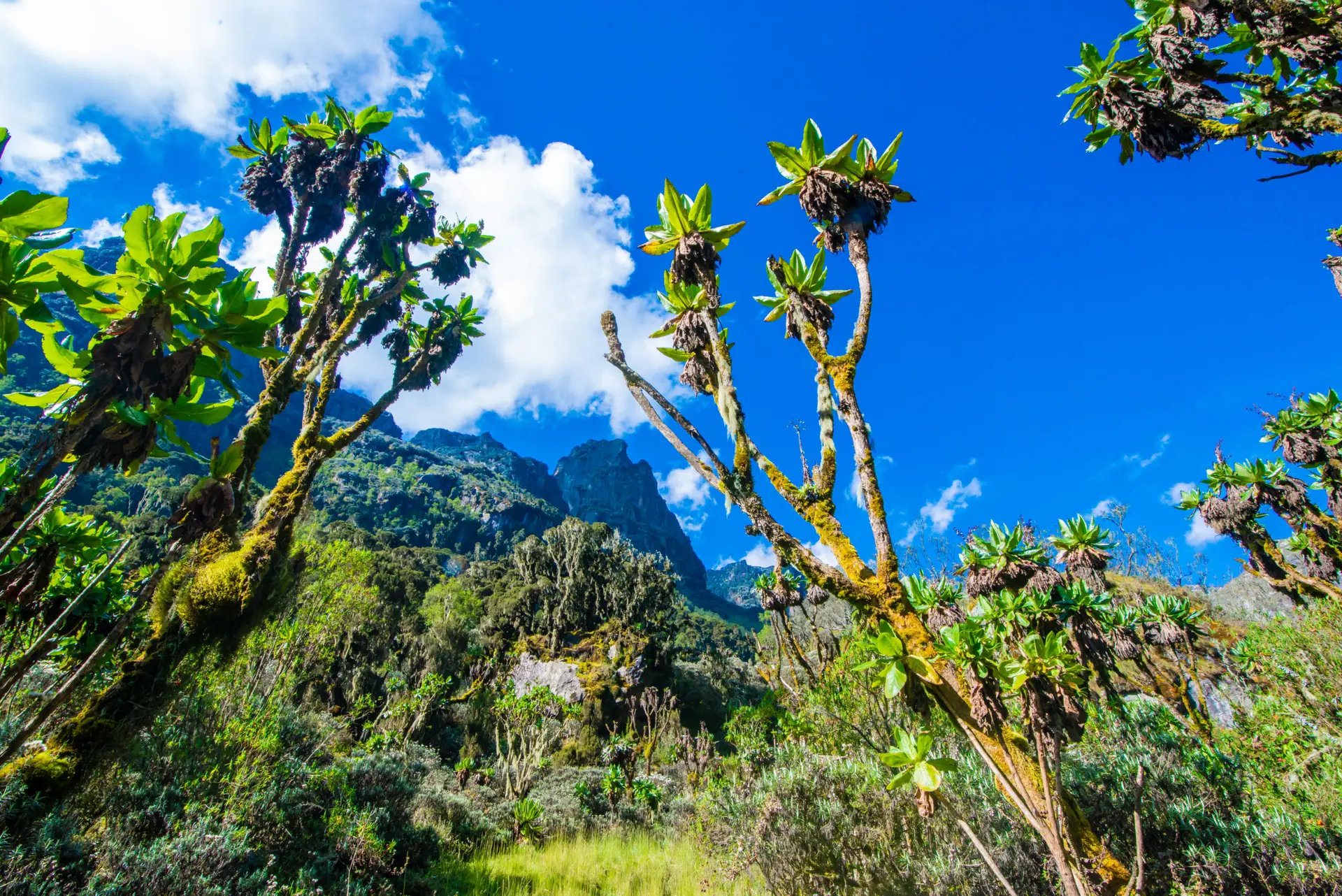
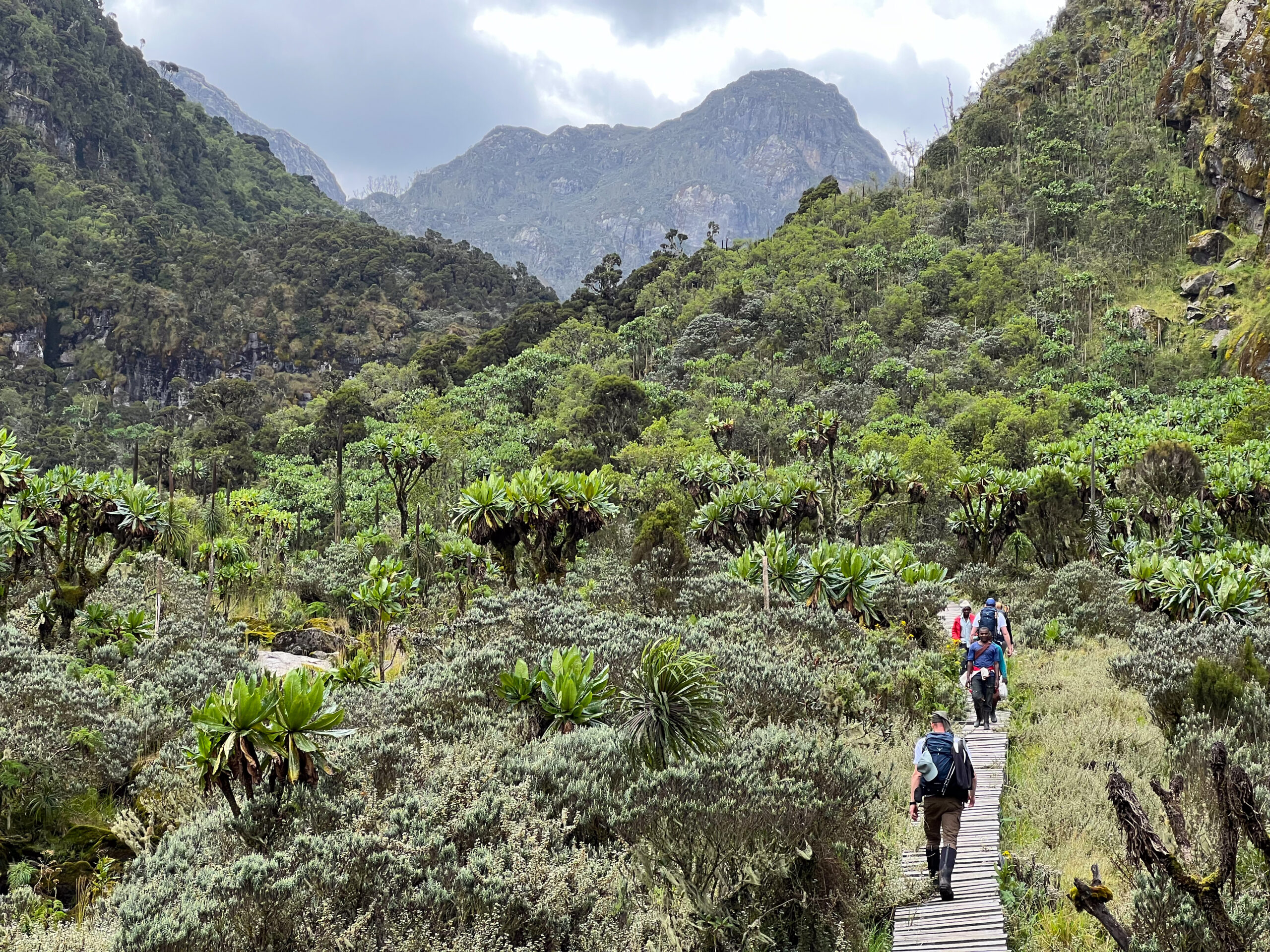
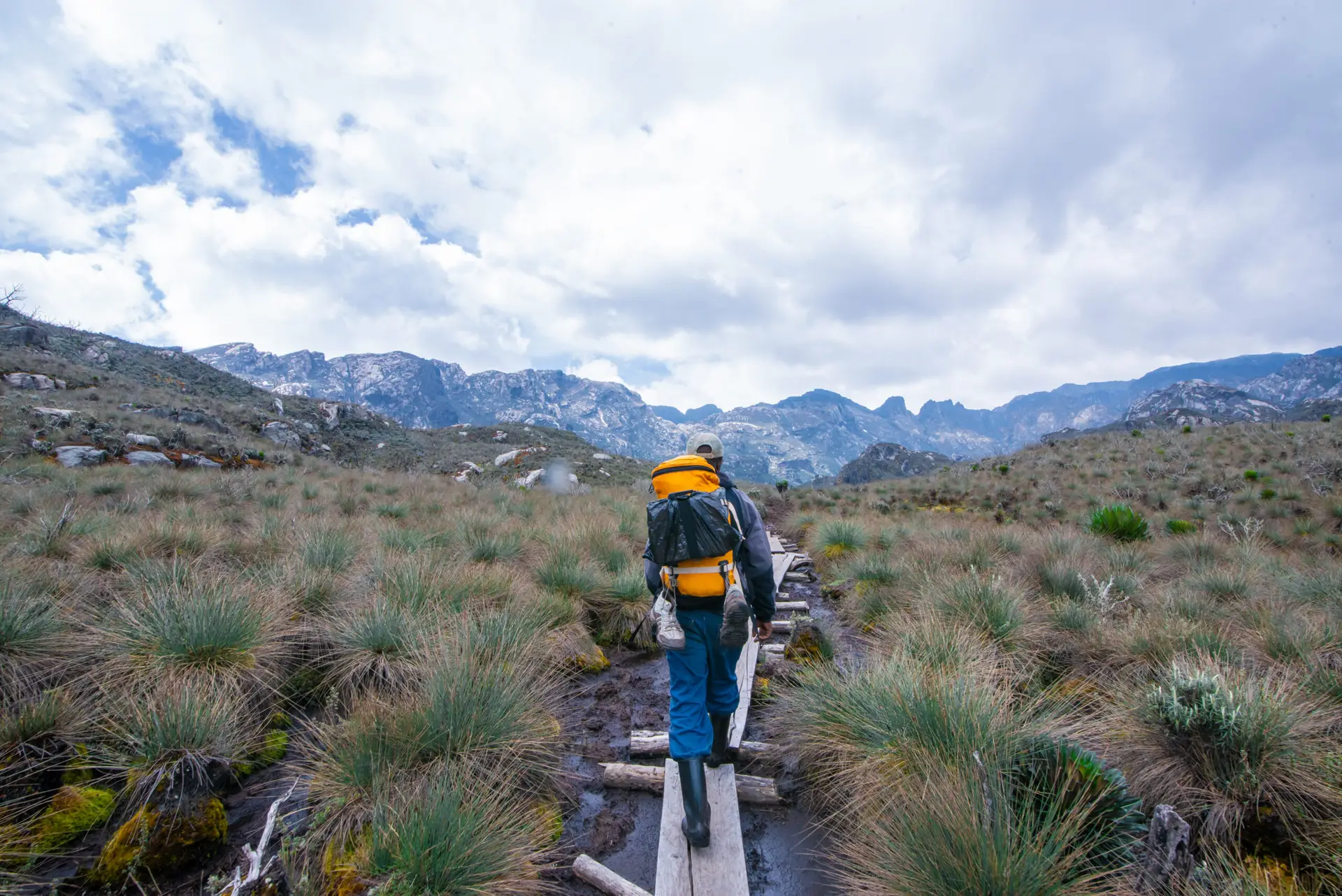
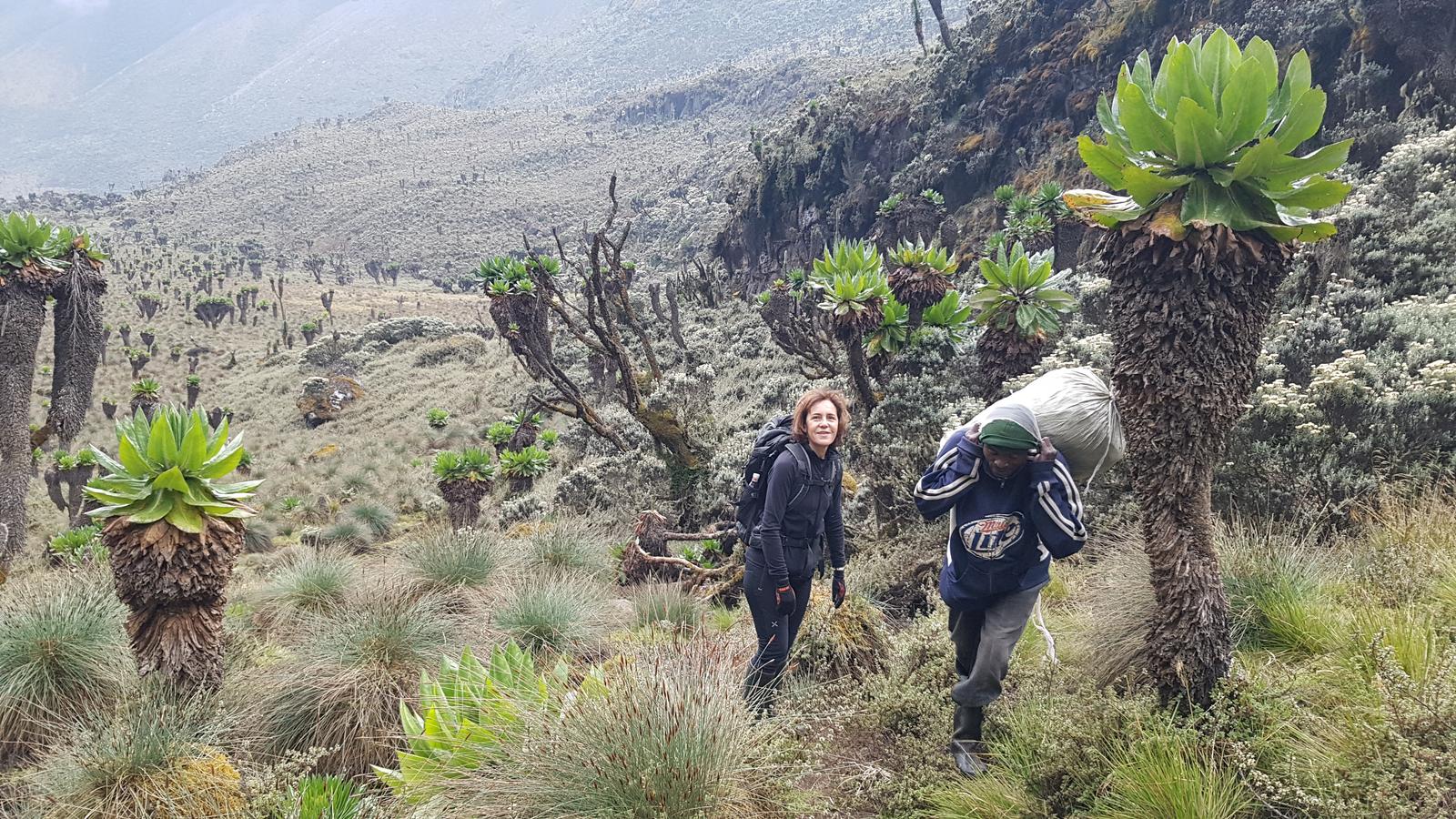
Breakfast at 6:00 AM sharp. Day 2 of the 4-day Margherita Peak trek is arguably the most visually extraordinary day in the Rwenzori range. The trail from John Matte leads into the Bigo Bog, one of the most surreal landscapes in African mountaineering. The valley floor here sits at around 3,600–3,900m and is carpeted in a dense peat bog accumulated over millennia. Long wooden boardwalks, some sections spanning hundreds of metres carry you above the swamp. On either side, giant lobelias (Lobelia wollastonii) reach 4–5 metres in height, their rosettes of silver-green leaves glistening with moisture. Giant groundsels (Senecio adnivalis), everlasting flowers (Helichrysum stuhlmannii), and cushion plants fill every gap between the boardwalks. There is nothing like this environment anywhere else in Africa.
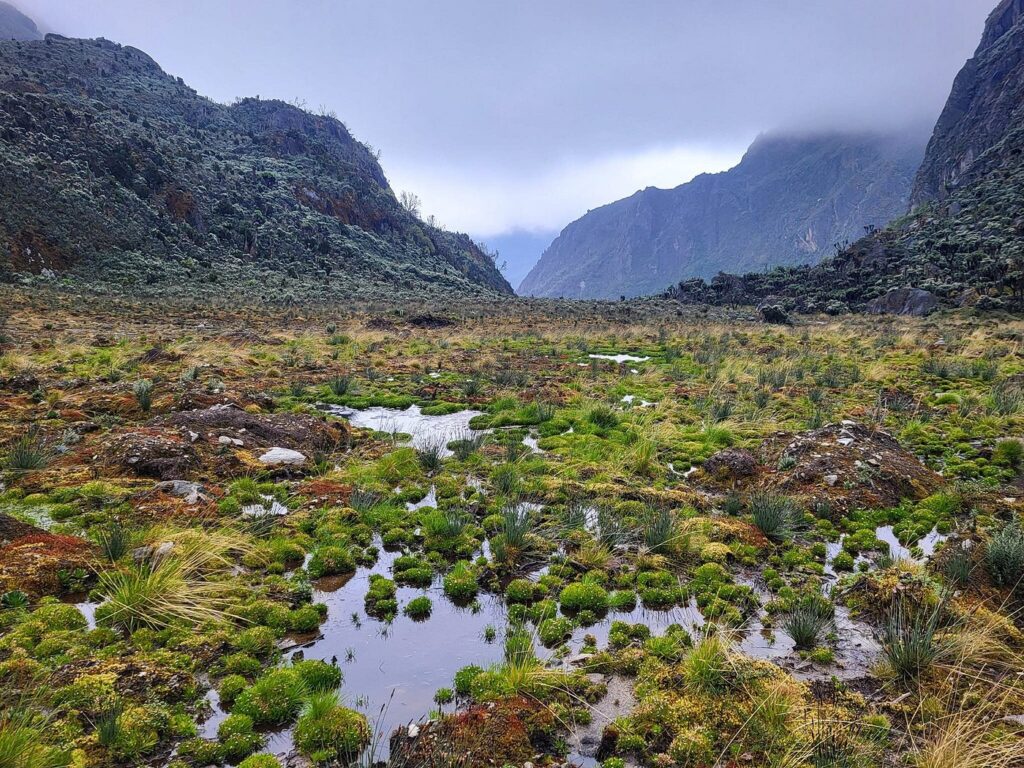
The air is noticeably thinner here. Most trekkers begin to feel the effects of altitude above 3,800 m: a mild breathlessness on steeper sections, perhaps a slight headache in the afternoon. This is expected and manageable; the key is to walk at the guide’s pace, which is deliberately slow and rhythmic. You are not racing. You are acclimatizing.
Bujuku Valley and the Approach to Mount Stanley
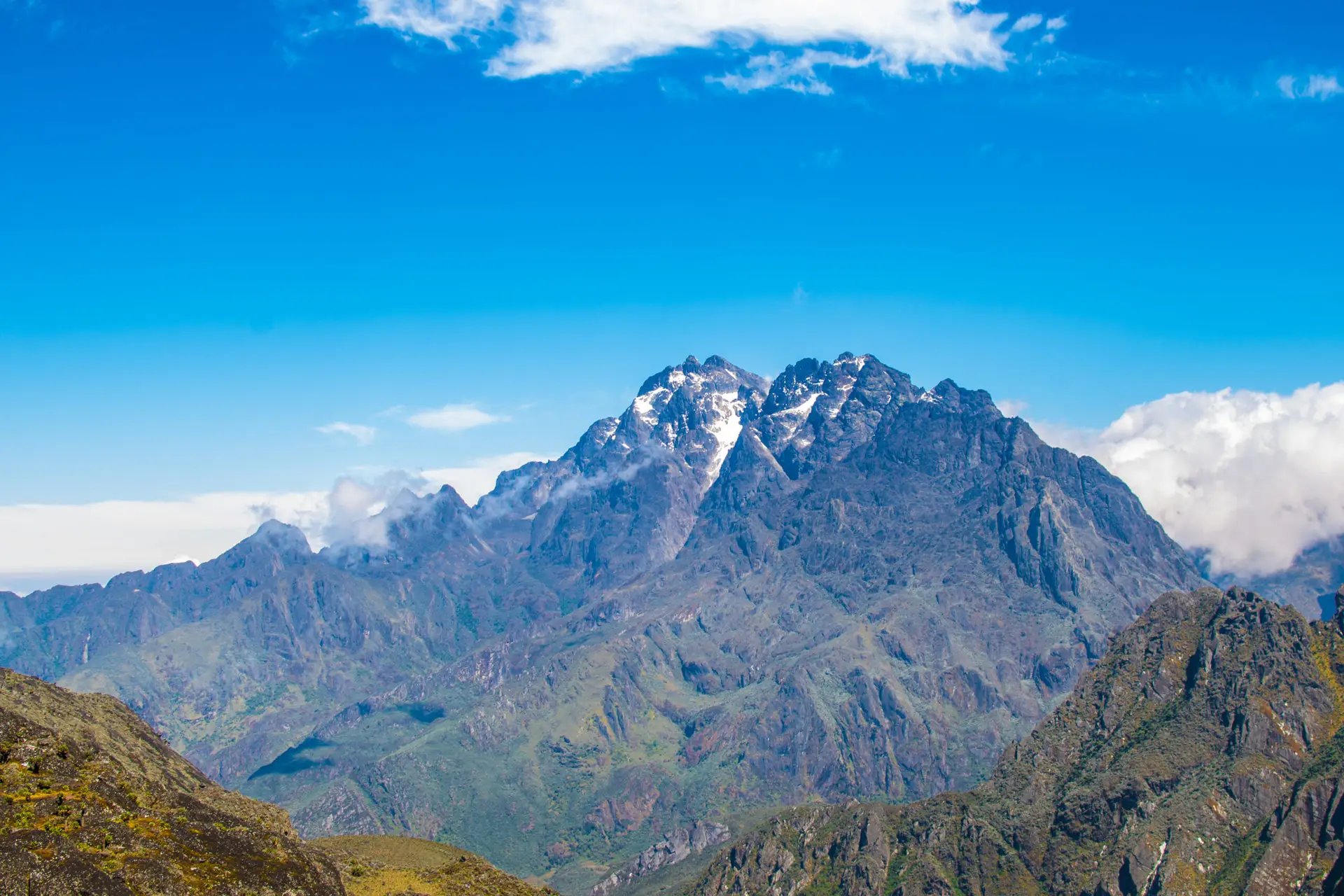
Past the Upper Bigo Bog, the trail enters the glacially carved Bujuku Valley, where the landscape becomes dramatically more alpine. Mount Speke (4,890 m) dominates the skyline to your right, and fast-moving clouds often wreathe its summit tower. Ahead, the flanks of Mount Stanley begin to reveal themselves, the glacier visible as a bright white band high on the massif. The scale is extraordinary. For the first time, Margherita feels real and close.
Bujuku Hut (3,960m) appears after approximately 5 hours of hiking from John Matte. You pass it on Day 2 without stopping for the night; this will be your overnight on Day 3 after the summit. A brief rest and hot drinks here, then the final push of the day begins.
The Final Climb to Elena Hut
The 600m ascent from Bujuku Hut to Elena Hut (4,563m) is the hardest hiking section on Day 2. The terrain turns rocky, and in wet conditions (which is most conditions in the Rwenzori), the boulders are slick with moss and running water. Trekking poles are essential here. The trail climbs steeply through diminishing vegetation, the last giant groundsels, then pure rock and ice at the highest levels.
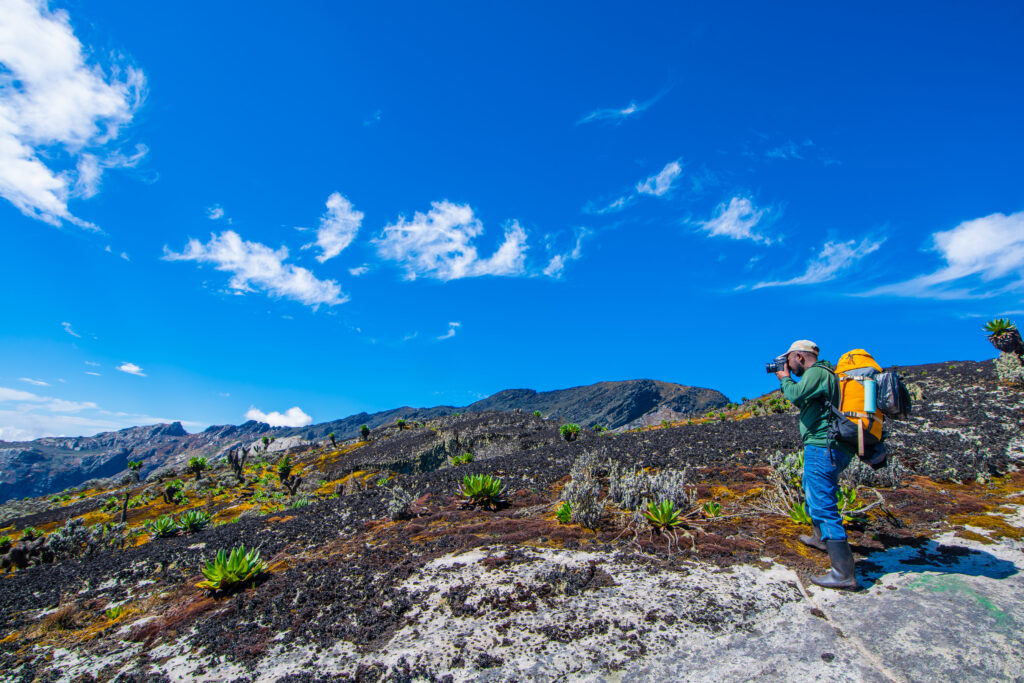
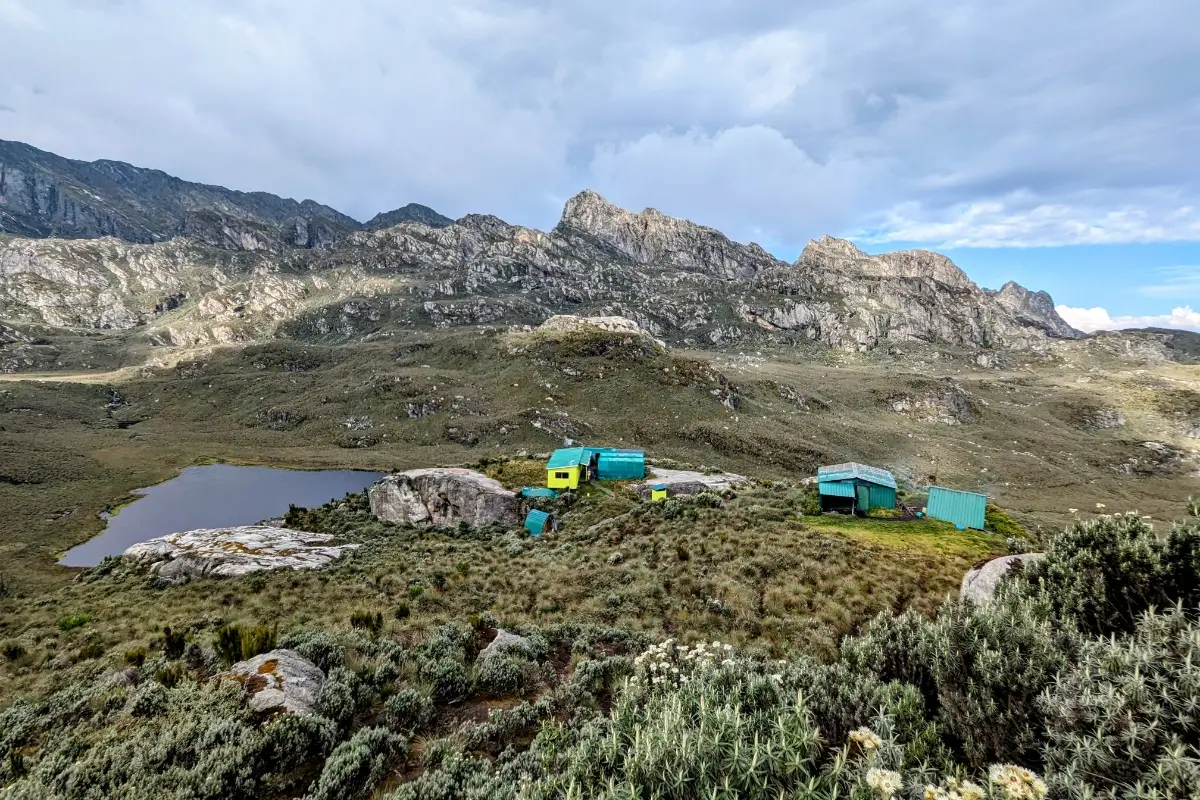
Elena Hut perches on a rocky platform just below the Stanley Glacier. It is the highest camp on the Central Circuit Trail and one of the highest fixed camps in East Africa. At 4,563 m, you are above 98% of Uganda’s landmass. The cold hits you as you arrive; at night, temperatures at Elena routinely drop to between -2°C and -5°C. Eat a full hot dinner, hydrate aggressively, and be in your sleeping bag no later than 8:00 PM. The summit call is at 2:00 AM.
Day 2 Highlights
- Bigo Bog boardwalk, the most photographed section of the Central Circuit
- Giant lobelia and groundsel fields Afro-alpine vegetation at its most otherworldly
- First views of the Stanley Glacier from the upper Bujuku Valley
- Arrival at Elena Hut (4,563 m), the highest camp on the route
DAY 3: ELENA HUT → MARGHERITA PEAK → BUJUKU HUT (4,563 m → 5,109 m → 3,960 m) | Approx. 10–12 km
Total hiking time: 10–14 hours | Summit elevation gain: +546m from Elena | Total descent to Bujuku: −1,149m
Summit Night: 2:00 AM Departure
There is no gentle easing into Day 3 of this four-day Rwenzori trek. Your guide knocks at 1:30 AM. By 2:00 AM you are dressed in every layer you packed: thermal base layer, mid-layer fleece, insulated jacket, waterproof shell, plus harness, crampons, and helmet fitted in the beam of your headlamp. A hot drink and some biscuits, and then you step out into the Rwenzori night.
The cold at 4,563 m at 2:00 AM is profound. Temperatures can reach -8°C with wind chill. The sky, when not obscured by clouds, is a staggering canvas of equatorial stars. Orion sits almost directly overhead. The glacier above you catches faint starlight. Your guide ropes the group together, and the summit attempt begins.
The Stanley Glacier Crossing
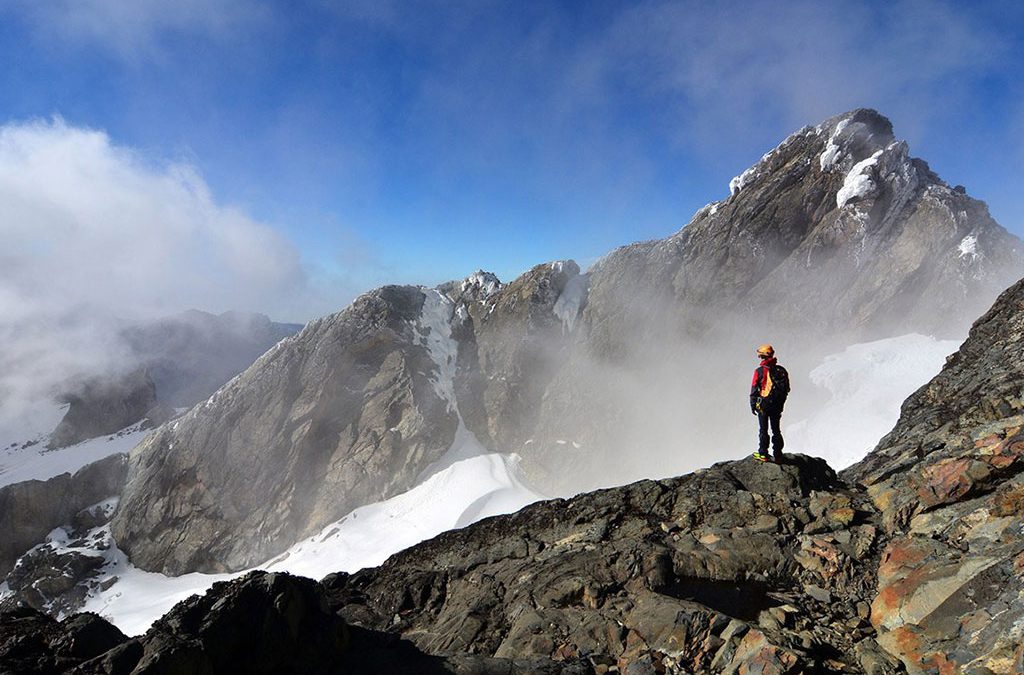
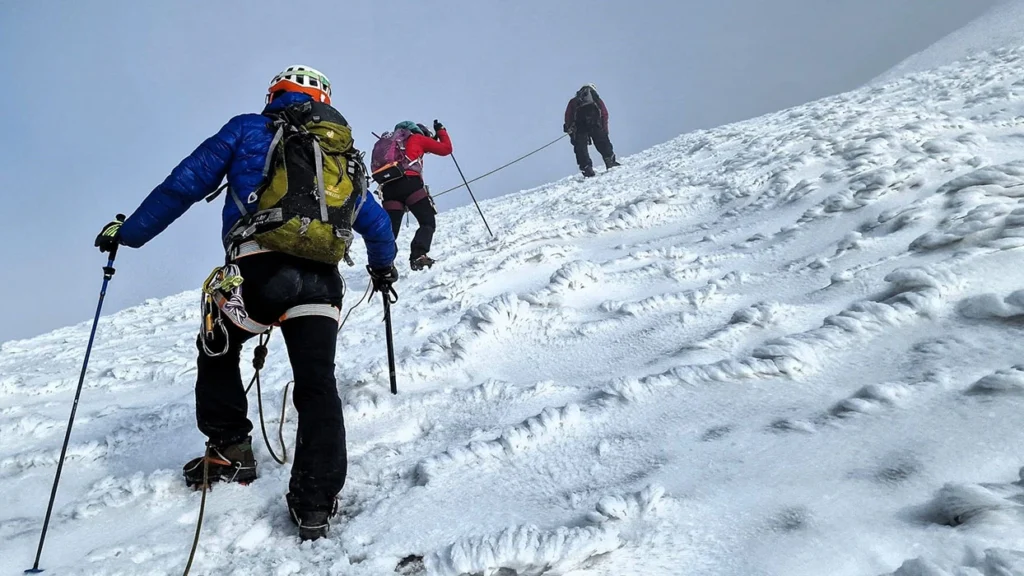
The first section of the summit climb traverses the lower Stanley Glacier. Your guide leads the rope line across the ice, cutting steps where necessary, moving carefully around crevasse zones and icefalls. If you have never walked on a glacier before, the experience is disorienting at first; the crampons bite, the ice beneath you shifts from blue to grey as your headlamp sweeps, and the exposure is immediately apparent.
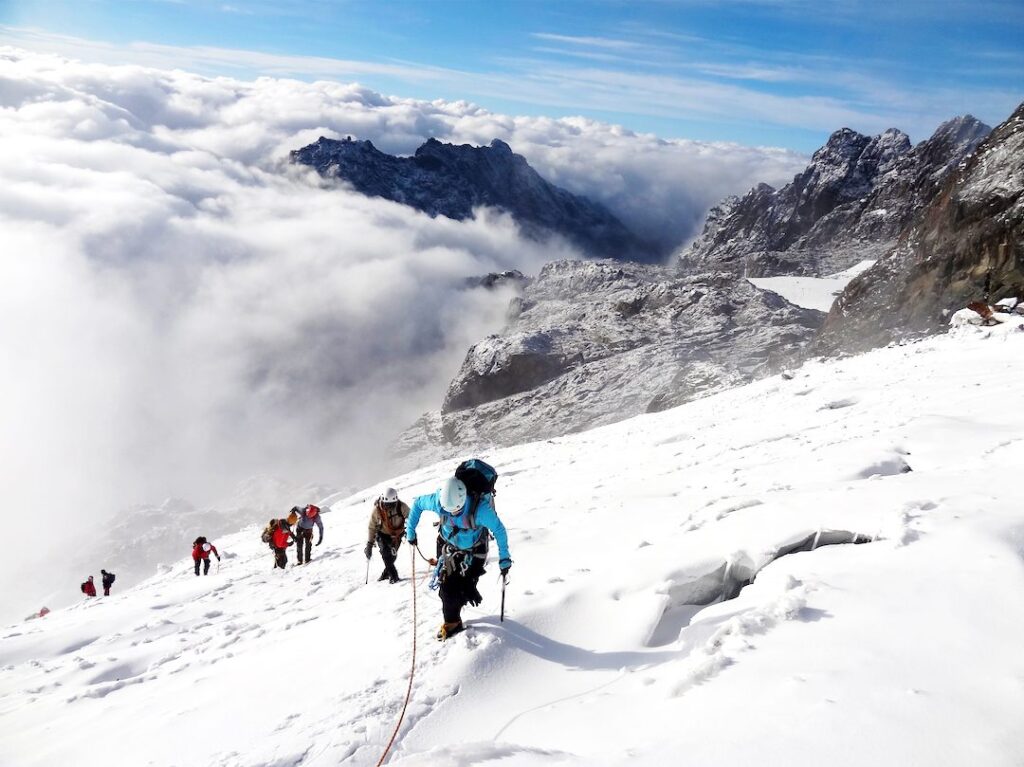
The Margherita Glacier is a real glacier on the equator, one of Africa’s last equatorial glaciers, and it is retreating at a rate that scientists now consider irreversible. The Rwenzori glaciers have lost over 80% of their surface area in the past century. To stand on this ice is to witness something increasingly rare on Earth. The scientific urgency of the moment adds a dimension of meaning to the climb that no other African summit provides.
The Margherita Glacier and Fixed Rope Sections
Beyond the Stanley Glacier, the route steepens dramatically. Rocky outcrops coated in ice require careful footwork and, in steeper sections, fixed rope assistance. Your guides have established anchor points on the most exposed sections. You clip your safety line to these and move one at a time. This area is the most technically demanding section of the entire itinerary.
The Margherita Glacier forms the final approach to the summit. The slope steepens to 45–55 degrees in places. Fixed ladders assist with two or three particularly exposed rock steps. There is significant exposure, meaning if you look down, you will see a very long way down, and the combination of altitude, exertion, cold, and exposure tests the resolve of even experienced trekkers.
The Summit: Margherita Peak (5,109m)
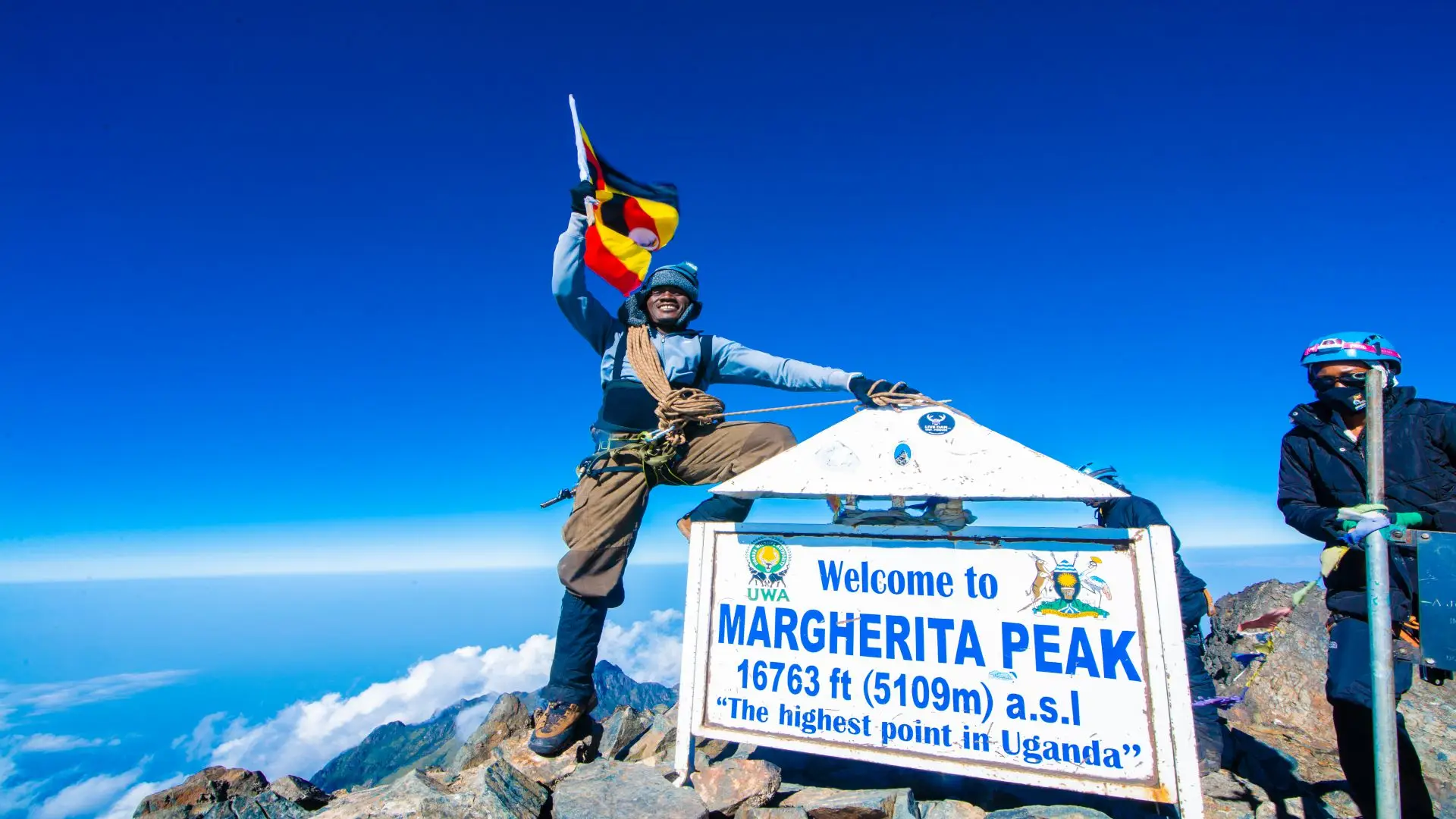
You reach the summit ridge as the sky begins to lighten in the east, typically between 6:00 and 8:00 AM, depending on group pace and conditions. Margherita Peak itself, the true high point of Mount Stanley and the Rwenzori Mountains, is marked with a small metal plaque commemorating its first ascent by the Duke of Abruzzi in 1906. Uganda spreads below you to the east; the Democratic Republic of Congo recedes into the western haze. On clear days you can see the outline of Lake Edward far to the south.
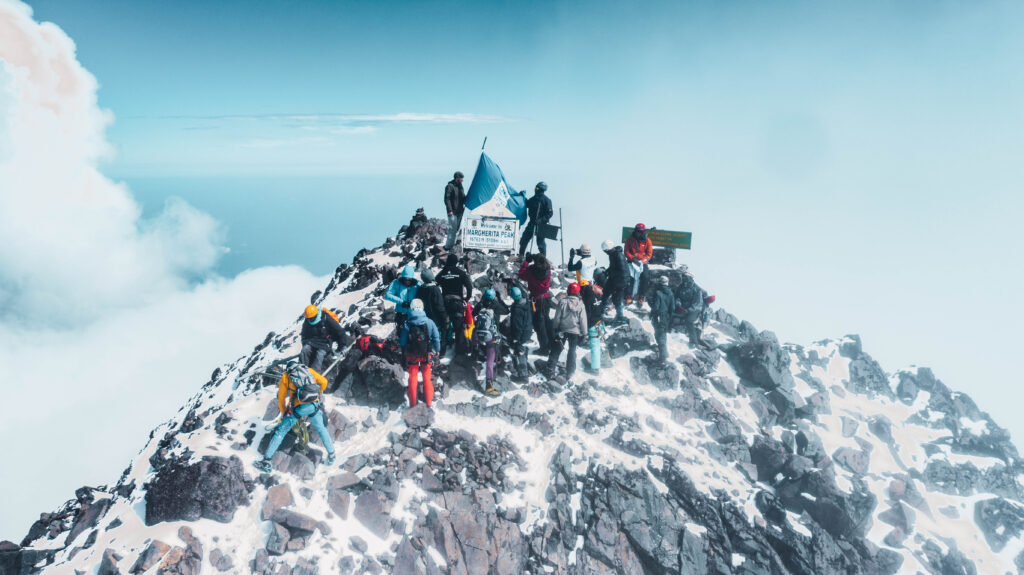
The summit is not a comfortable place to linger. Wind, cold, and the risk of weather changes mean your time at the top is typically 20–40 minutes enough for photographs, a moment of genuine reflection, and the private pride of knowing you have summited Africa’s third-highest peak. Then descent begins immediately.
Descent to Bujuku Hut
The descent from Margherita to Elena Hut reverses the morning’s technical sections, arguably more taxing on tired legs, as down-climbing on icy rock demands focused footwork throughout. Most parties reach Elena Hut by mid-morning for a hot lunch and a change of clothing before the continued descent.
From Elena, the trail drops back to Bujuku Hut (3,960m) in 2–3 hours. The Bujuku Valley feels almost warm after the glacier; the giant groundsels and heather are a welcome return to color. Dinner at Bujuku Hut celebrates the summit behind you and the hardest climbing you have done. Get as much sleep as possible before the long final descent tomorrow.
Day 3 Highlights
- Pre-dawn glacier crossing on the Stanley Glacier: crampons, headlamps, rope
- Fixed rope ascent through the Margherita Glacier approach
- Summit of Margherita Peak (5,109 m), Africa’s third-highest point
- Panoramic views across Uganda and the DRC on clear mornings
- Descent through the Bujuku Valley back to Bujuku Hut for overnight
DAY 4: BUJUKU HUT → NYAKALENGIJA (3,960 m → 1,600 m) | Approx. 20 km
Hiking time: 8–9 hours | Elevation loss: −2,360m | End of trek
The Long Descent to the Trailhead
Day 4 features a long, relentless descent that is physically demanding in a different way than the ascent days. While gravity handles the altitude change, your knees, ankles, and toes absorb all the impact. Start at 6:30 AM after a full breakfast. The route retraces the Central Circuit back through the Bujuku Valley, across the Bigo Bog boardwalks (which somehow feel stranger on the way back, your body still carrying the memory of the summit), and down through John Matte Hut for a midmorning break.
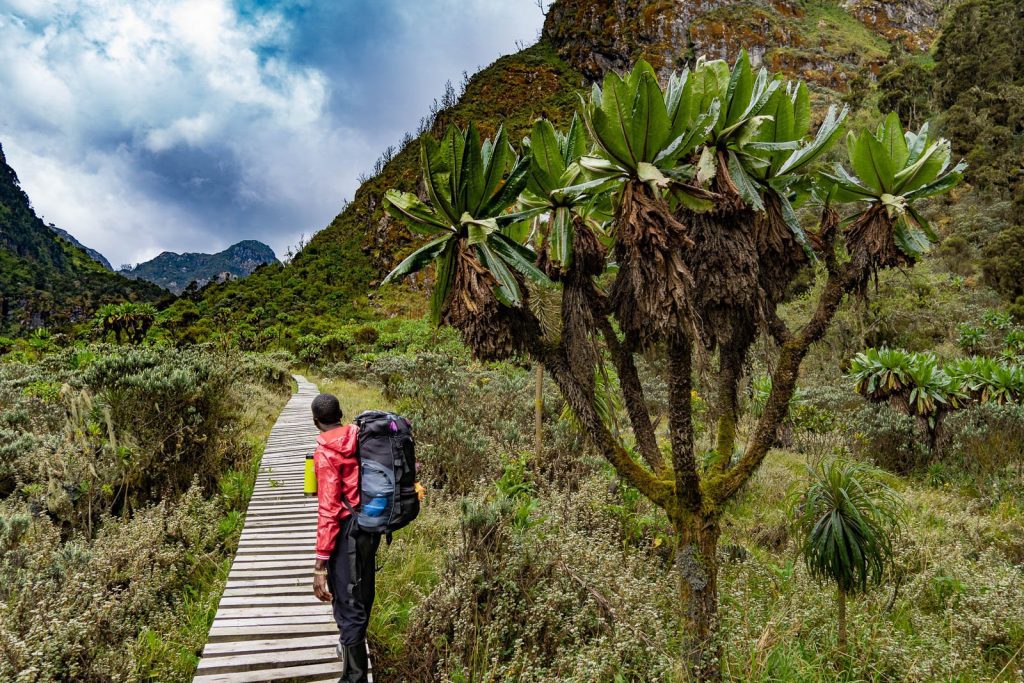
From John Matté, the trail drops steeply back into the upper montane forest zone. The vegetation changes rapidly as you lose altitude; heather gives way to giant lobelia, then mossy cloud forest, then dense tropical rainforest. Birds that were absent at altitude reappear: turacos calling from the canopy and sunbirds darting across clearings. The warmth returns gradually.
Nyabitaba and the Final Forest Section
Nyabitaba Hut (2,652m) is a welcome stop for lunch. This is where you recross the Kurt Schafer Bridge for the last time, with the river below louder or quieter depending on overnight rain. The final 3–4 hours drop through agricultural land and Bakonzo settlements back to Nyakalengija (1,600 m).
The moment you step off the mountain at the trailhead office is both a relief and a loss. Your guides and porters, whose profound knowledge of the Rwenzori mountain routes and whose skill kept the summit possible, have become familiar companions over four days. This moment is the time for photographs together, for tipping (see our tipping guide for Rwenzori guides and porters), and for the cold drink that has been somewhere in your imagination since Elena Hut. Transfer to your hotel in Kasese or onward transport, depending on your plans.
Day 4 Highlights
- Final traverse of the Bigo Bog boardwalks a different experience on the way back
- Return through the tropical forest with bird and wildlife sightings
- Farewell ceremony with your guides and porters at Nyakalengija
- Return to Kasese or onward travel
Elevation Profile: 4-Day Margherita Peak Trek
The elevation arc of this 4-day Rwenzori trek is extreme by any standard. Starting at Nyakalengija (1,600 m), you gain 1,820 m on Day 1 alone, the single largest elevation gain day of the entire trek. Day 2 adds another 1,143 m from John Matte (3,420 m) to Elena Hut (4,563 m), with the critical psychological milestone of sleeping above 4,500 m for the first time. Summit day adds 546 m to the glacier-draped summit of Margherita Peak (5,109 m), before a 1,149 m descent to Bujuku Hut (3,960 m). Day 4 descends the full 2,360 m back to the trailhead.
Total ascent across the 4-day itinerary: approximately 3,509m. Total descent: approximately 3,509m. This is among the most demanding vertical profiles of any guided trek in East Africa, comparable in accumulated gain to many classic Himalayan approaches. The difference is that you accomplish every meter of this trek in four days, which is why prior fitness and acclimatization are non-negotiable.
| Day 1 Start | Nyakalengija: 1,600m |
| Day 1 End | John Matte Hut: 3,420m (+1,820m) |
| Day 2 End | Elena Hut: 4,563m (+1,143m) |
| Day 3 Summit | Margherita Peak: 5,109m (+546m from Elena) |
| Day 3 End | Bujuku Hut: 3,960m (−1,149m from summit) |
| Day 4 End | Nyakalengija: 1,600m (−2,360m) |
| Total Ascent | ~3,509m |
| Total Descent | ~3,509m |
Camps & Mountain Huts on This Route
Nyabitaba Hut, 2,652 m (Day 1 Lunch Stop)
The first significant landmark on the Central Circuit Trail, Nyabitaba Hut, sits at 2,652 m in open montane forest. On the 4-day itinerary, you stop here for lunch only; it is the overnight camp on the longer 7-day version. The hut has basic sleeping platforms, an outdoor cooking area, and stunning views south across the Mubuku River valley. The Kurt Schafer Bridge is a 20-minute walk below.
John Matte Hut, 3,420 m (Day 1 Overnight)
John Matte Hut is your first overnight camp and at 3,420m, it is the highest first-night camp of any Rwenzori itinerary. The hut offers sleeping platforms for 12–16 trekkers, a separate kitchen and dining area, and a composting toilet. Named after a legendary Rwenzori guide, it sits in a broad clearing at the transition between upper montane forest and the lower Afroalpine zone. On clear evenings, early stars appear over the valley ahead. Temperatures drop sharply after dark, typically to 5–8°C, so sleeping bags rated to 0°C are essential here.
Elena Hut, 4,563 m (Day 2 Overnight / Summit Staging Camp)
Elena Hut is the psychological centerpiece of the 4-day route, the last shelter before the glacier, the most exposed camp, and the staging point for the 2:00 AM summit push. It sits on a rocky platform just below the Stanley Glacier at 4,563m. The hut sleeps 12–14 in tiered bunks. At this altitude, sleep is often interrupted by the altitude itself; vivid dreams, frequent waking, and a subtle sense of pressure in the head are normal. This phenomenon is not dangerous; it is your body adapting. Eat and hydrate well regardless of appetite.
Bujuku Hut, 3,960 m (Day 3 Overnight)
Bujuku Hut sits at 3,960m in the upper Bujuku Valley, surrounded by some of the most spectacular alpine scenery in the Rwenzori Mountains. Views of Mount Speke (4,890m), Mount Baker (4,843m), and the Stanley massif dominate in all directions. The hut has sleeping platforms, a kitchen, and a dining shelter and sits adjacent to a small glacial tarn. After summit day, arriving here feels like arriving at a sanctuary. Dinner is ample and warming; most trekkers are asleep before 8:00 PM.
Flora & Wildlife: What You’ll Encounter
The Rwenzori Mountains are a UNESCO World Heritage Site partly because of their extraordinary ecological layering: five distinct vegetation zones stacked within 3,500 m of elevation. On this 4-day route you pass through all of them, sometimes within a single hour of hiking.
Montane Forest Zone (1,600–2,500 m)
Day 1’s lower slopes take you through Uganda’s mountain forest, which is dense, dripping, and bird-rich. Rwenzori turacos (green with red wings) are the star attraction; Rwenzori olive pigeons, white-starred robins, and Rwenzori batis are regularly recorded. Black-and-white colobus monkeys move through the canopy in social groups. In open areas close to Bakonzo settlements, olive baboons can sometimes be seen. Tree ferns and wild begonias line the trail.
Bamboo Zone (2,200–2,800 m)
A narrow but distinctive band of mountain bamboo (Arundinaria alpina) forms a dense corridor above the mixed forest. Light filters green through tall culms, and the understory is rich in mosses and ferns. L’Hoest’s monkeys occasionally venture here. The transition is sudden and memorable.
Heather Zone (2,800–3,500 m)
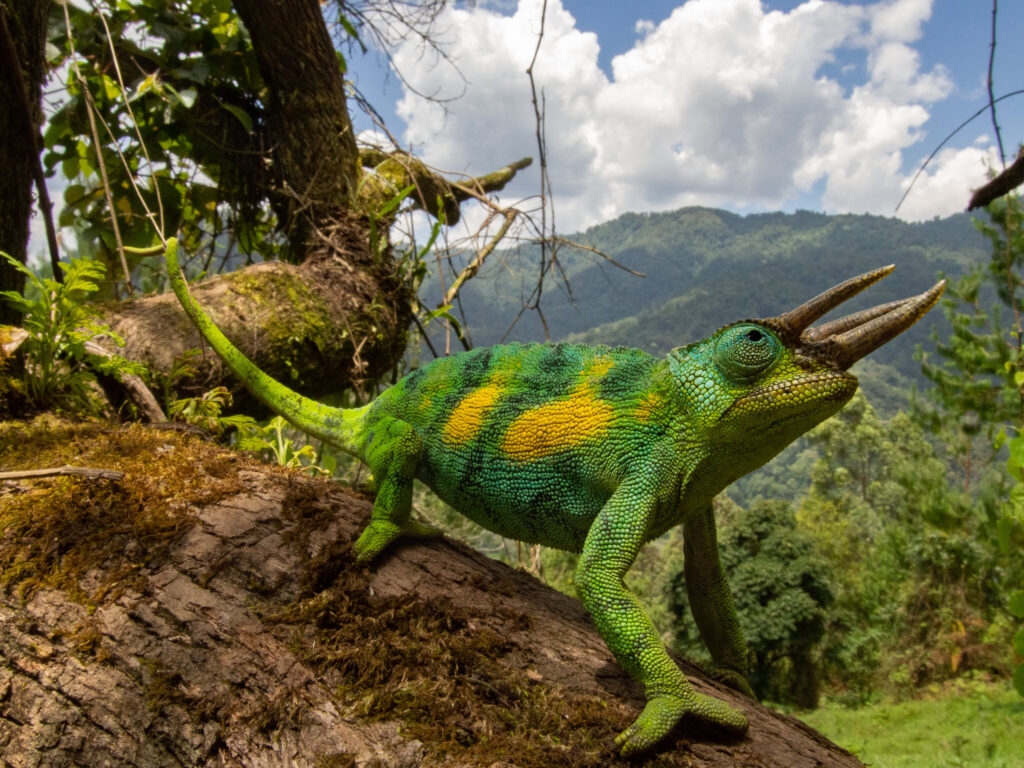
Above the bamboo, tree heathers (Erica arborea and Erica trimera) form an increasingly gnarled and sculptural woodland. Draped in pale green Usnea lichen, these trees take on an otherworldly quality in mist. Three-horned chameleons (Trioceros johnstoni) are sometimes spotted on branches at eye level.
Afro-Alpine Moorland Zone (3,500–4,500 m)
This region is the Rwenzori’s most famous ecological zone, the giant lobelia and groundsel moorland that makes every photograph from these mountains look like science fiction. Giant lobelias (Lobelia wollastonii) reach 4–5 metres, their flower spikes surrounded by silvery rosettes. Giant groundsels (Senecio adnivalis and Senecio erici-rosenii) resemble alien trees. Everlasting flowers (Helichrysum species) carpet the open ground. Ravens and alpine chats are the most common birds above 4,000m.
Nival/Glacial Zone (4,500 m+)
Above Elena Hut, vegetation essentially ceases. Bare rock, ice, and snow form the summit environment. On the glacier itself, you may see cryoconite holes, dark sediment-filled pockets in the ice that absorb solar radiation and melt downward, creating circular pools. The glaciers are visibly retreating year on year; sections of ice that guides remember from a decade ago are now bare rock.
Physical Difficulty & Fitness Requirements
This is, unambiguously, one of the most physically demanding guided mountain treks in Africa. The 4-day Margherita Peak route is not a stretch goal for a moderately fit person; it is an appropriate challenge for a specifically trained, high-altitude-experienced trekker.
Who Should Attempt This Route
- Trekkers who have previously summited peaks above 4,000m with no significant altitude sickness
- Hikers capable of 8–10 hours of continuous mountain movement with a 10–15kg pack
- People with prior experience in cold, wet mountain conditions
- Anyone who has completed at least three multi-day hiking trips in the previous 12 months
- Trekkers who have trained specifically for this trip with altitude simulation or sustained cardiovascular training
Who Should NOT Attempt This Route
- First-time high-altitude trekkers consider the 7-day version instead
- Anyone with a history of acute mountain sickness (AMS), HACE, or HAPE
- Trekkers who have not been physically active in the 3 months before the trek
- Those unwilling or unable to use technical glacier equipment (crampons, harness, fixed ropes)
- Anyone currently managing a respiratory, cardiac, or musculoskeletal condition without medical clearance
Altitude & Acclimatisation
The 4-day itinerary offers very limited acclimatization time. This is its defining risk. On a 7-day route, you gain altitude gradually with built-in rest days; here, you climb from 1,600m to 4,563m across two consecutive hiking days. The acclimatization principles that protect all Rwenzori climbers apply with greater urgency here: drink at least 3–4 liters of water daily, eat full meals regardless of appetite, walk at the guide’s pace without pushing, and report any symptoms immediately.
Our medical guide recommends that trekkers attempting the 4-day route discuss acetazolamide (Diamox) with their physician before departing. This prescription medication can reduce the incidence and severity of altitude sickness symptoms. Read the full Rwenzori medical guide for complete guidance on altitude management, hypothermia prevention, and trench foot, a real risk in the wet Rwenzori terrain.
Best Time to Attempt the 4-Day Margherita Peak Trek
The Rwenzori Mountains receive precipitation year-round; they are, after all, the source of the Nile’s permanent flow and one of the wettest mountain ranges on Earth. ‘Best season’ is relative, not absolute. Read the full best time to visit the Rwenzori guide for detailed monthly analyses.
Primary Dry Window: January – February
The January–February window is the Rwenzori’s most reliable dry period. Glacier conditions are typically firmest, mist is less persistent, and summit views are most likely. This is the prime season for the 4-day route; the compressed timeline is made much safer by more stable weather and solid ice underfoot.
Secondary Dry Window: June – August
The June–August period offers the second most reliable window for glacier access. Conditions vary more than the January window, but experienced guides know the daily weather patterns well. Summit days are usually attempted in the hours when the glacier is most stable (pre-dawn to mid-morning).
Shoulder & Wet Seasons: March–May and September–December
These periods see heavier rainfall and more unstable glacier conditions. The 4-day route is technically possible year-round with the right gear, but we strongly recommend experienced trekkers use the dry windows for this compressed itinerary. Wet season treks are better suited to the 7-day or 8-day routes, which allow flexibility for weather delays.
What’s Included in the 4-Day Margherita Peak Package
Included
- All park entry fees and Uganda Wildlife Authority permits
- Professional certified mountain guide (English-speaking, summit-experienced)
- Assistant guide (for groups of 4+)
- Dedicated mountain chef and full catering (all meals on the mountain from Day 1 lunch to Day 4 lunch)
- One porter per trekker (carrying up to 15kg of your gear)
- Accommodation in mountain huts (John Matte, Elena, and Bujuku huts)
- All technical summit equipment: crampons, harness, ropes, ice axe, helmet
- Free loan of rubber boots (gumboots) for the lower mountain sections
- Rescue stretcher and first aid kit carried at all times
- Emergency communication equipment
- Porter wages, meals, and accommodation during the trek
Not Included
- International flights and Uganda visa fees
- Accommodation before/after the trek in Kasese or Fort Portal
- Airport or hotel transfers (can be arranged; ask us)
- Travel insurance and medical evacuation insurance (MANDATORY; see below)
- Tips for guides and porters (see our tipping guide for recommended amounts)
- Personal trekking equipment (sleeping bag, clothing, personal boots)
- Bottled water, soft drinks, and alcohol
- Any costs arising from itinerary changes due to weather, illness, or force majeure
⚠️ INSURANCE IS MANDATORY:
All trekkers on this route must hold valid travel insurance with high-altitude (5,200m+) and medical evacuation coverage. No insurance = no departure. See our Rwenzori travel insurance guide.
Full Packing & Gear List: 4-Day Margherita Peak Trek
The Rwenzori Mountains have one defining characteristic that separates them from every other African range: they are permanently, relentlessly, gloriously wet. This is not rain in the conventional sense; it is a total moisture environment where your clothes, gear, pack, and boots will be damp within an hour and stay that way. Preparation for this specific condition is what separates successful summit attempts from failed ones. Read the full Rwenzori packing list for the complete gear breakdown.
Clothing (Layering System)
- Moisture-wicking thermal base layer (top and bottom): 2 sets minimum
- Mid-layer fleece or light down jacket
- Heavy insulated jacket (down or synthetic) essential for Elena Hut and summit
- Waterproof shell jacket (Gore-Tex or equivalent): this is non-negotiable
- Waterproof shell trousers
- Warm synthetic or wool trekking trousers 2pairs
- Gaiters (knee-length) to seal out mud and water
- Warm beanie and balaclava
- Insulated gloves (inner liner + waterproof outer)
- Wool or synthetic trekking socks (at least 4 pairs)
Footwear

The Rwenzori has a specific footwear requirement that surprises many first-time trekkers. Read our complete Rwenzori boot guide for full details. In short, rubber gumboots (Bogs or equivalent) are standard for the lower forest sections (provided free of charge), and rigid-soled, waterproof hiking boots are required for rocky alpine terrain and summit day. Crampons are fitted over hiking boots for the glacier sections; all technical gear is provided.
Equipment
- Hiking poles (telescopic, strong; you will use them constantly)
- Headlamp with fresh batteries and at least one spare set
- Sleeping bag rated to -5°C to 0°C (comfort rating, not limit rating)
- Sleeping bag liner for additional warmth
- Waterproof dry bags (to line your main pack and protect electronics)
- Daypack (25–30L) for summit day and personal items
- Water bottles or hydration bladders with a minimum 2L capacity
- Water purification tablets as backup
- High-SPF sun cream and UV-protective sunglasses (glacier glare is intense)
- Lip balm with SPF
Health & Personal Items
- Personal prescription medications (including any altitude medication — discuss with doctor)
- Basic personal first aid kit (blister plasters, ibuprofen, antihistamine, rehydration salts)
- Foot care supplies: moleskin, blister prevention balm, antiseptic cream
- High-energy snacks for summit day (energy bars, nuts, chocolate, dried fruit)
- Electrolyte sachets or tablets (vital for hydration management at altitude)
- Camera and ample power storage (no charging on the mountain)
- Small quick-dry towel
Permits, Park Fees & Cost Breakdown
All treks in Rwenzori Mountains National Park operate under Uganda Wildlife Authority (UWA) regulations. Permits are mandatory and non-transferable. Our full cost breakdown for climbing the Rwenzori in 2026 provides detailed fee schedules for all route options.
| UWA Park Entry | USD $40 per person per day (included in our package) |
| UWA Hut Fees | Included in our package price |
| Technical Climbing Fee | Included for summit routes |
| Professional Guide | Included certified RMS and UWA guide |
| Porters | Included one per trekker at standard rate |
| All Meals on Mountain | Included from Day 1 lunch to Day 4 lunch |
| Technical Summit Gear | Included crampons, harness, ropes, ice axe, helmet |
| Rubber Boots Loan | Included free of charge |
| Gratuities | NOT included; see tipping guide |
| Pre/Post Hotel | NOT included; arrange separately |
Contact us directly for the current per-person price for the 4-day Margherita Peak trek. Prices vary by group size, season, and any add-on services. Private groups and customized departure dates are available. For comparison, see our 5-day Margherita Peak trek from USD $1,350 and the 7-day Margherita Peak climb from USD $1,400 per person.
Getting to the Rwenzori Trailhead
The trailhead for this 4-day Rwenzori trek is Nyakalengija, approximately 13 km outside Kasese town in Western Uganda. See our full guide to getting to the Rwenzori Mountains for complete logistics.
From Kampala (approximately 5–6 hours by road)
Kampala to Kasese: daily bus services depart from the Kisenyi bus park, with companies including Link Bus and Gateway Bus. The journey takes 5–6 hours on a good road. Alternatively, private vehicle transfer can be arranged through us, departing at your chosen time and arriving with luggage safely stowed. We strongly recommend arriving in Kasese the evening before your trek starts.
From Entebbe International Airport
Most international visitors fly into Entebbe International Airport (EBB), 40km from Kampala. From Entebbe to Kasese, the total road journey is approximately 5.5–6.5 hours. Fly-in options also exist: charter flights to Kasese Airport (KSE) operate periodically, reducing travel time dramatically. Ask us about current flight-in options when booking.
Pre-Trek Accommodation in Kasese
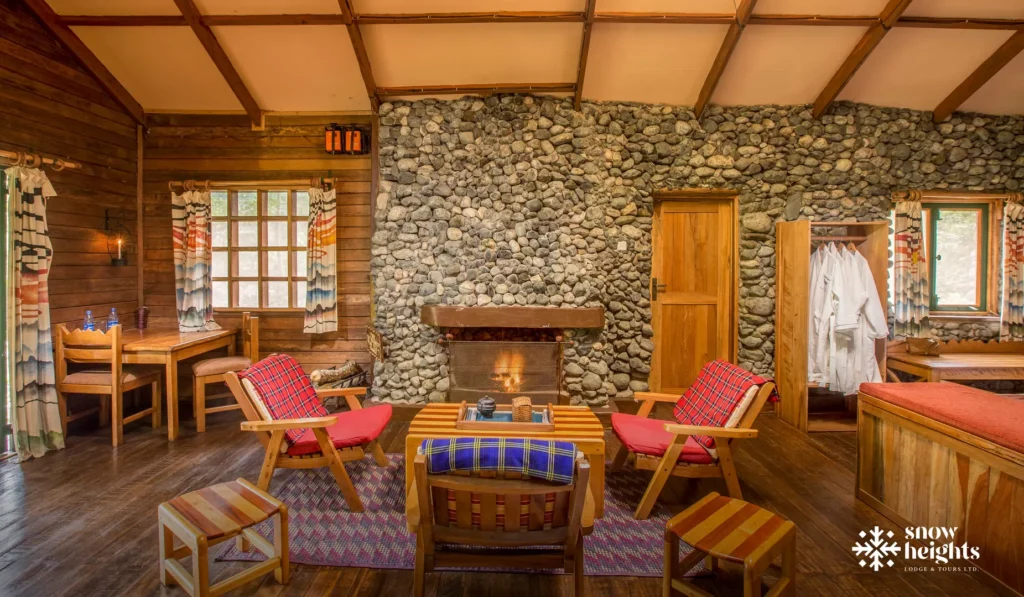
We recommend staying one night in Kasese before your trek departs, allowing you to meet your guide, complete equipment checks, and rest before the early start. Our Kasese travel guide lists the best accommodation options near the trailhead. We can arrange hotel bookings on request. Similarly, for post-trek recovery, Fort Portal (40km north of Kasese) offers excellent lodges and makes a superb base for a post-Rwenzori recuperation day.
Book Your Trek
Respond within Minutes
From
$1,400
per person
- Duration 4 Days / 3 Nights
- Group Size 1–12 people
- Start Point Nyakalengija
- Departures Year-round
- Summits Margherita Peak
No booking fee. Free cancellation up to 30 days before departure. We respond within Minutes.
Explore Related Rwenzori Trekking Itineraries
Not sure if the 4-day Rwenzori trek is right for you? Here are the most relevant alternatives to consider:
Magheritah Peak (8 Days Kilembe Trail)
$1705 Per Person
A completely different approach through Uganda's remote southern Rwenzori
A completely different approach through Uganda's remote southern Rwenzori
8-Day Rwenzori 3-Peaks Trek: Stanley, Speke & Baker
$1,850 Per Person
Go beyond Margherita and bag three summits in one expedition
Go beyond Margherita and bag three summits in one expedition
Short Magherita Hike (5-Day Central Circuit)
$1400 Per Person
One extra night on the mountain, better acclimatization, and the same summit
One extra night on the mountain, better acclimatization, and the same summit
Rwenzori Hike (7 Days Central Circuit)
$1400 Per Person
The best all-round Margherita Peak itinerary for most trekkers
The best all-round Margherita Peak itinerary for most trekkers
Frequently Asked Questions: 4-Day Rwenzori Trek to Margherita Peak
How hard is the 4-day Rwenzori trek to Margherita Peak compared to the 7-day route?
The 4-day Margherita Peak trek is significantly harder than the 7-day version. The core itinerary is identical: the same trail, the same camps, and the same technical glacier but compressed into fewer days. Day 1 requires a 1,820m gain from Nyakalengija to John Matte Hut in one push, which is more than double the typical Day 1 gain on the 7-day schedule. Your body has far less time to acclimatize before the summit push, and there are no rest days built in for weather or fatigue recovery. On the 7-day route, trekkers spend two nights below 4,000m before reaching Elena Hut; on the 4-day route, you sleep at John Matte (3,420m) just once before going straight to Elena (4,563m). This compressed acclimatization profile is the defining risk and why this route is restricted to experienced, high-altitude-tested trekkers.
Is the 4-day Rwenzori summit route technically safe? What technical skills do I need?
Yes, this trek is genuinely technical in ways that most African treks are not, but it can be attempted with certified guides. The Margherita Peak summit day involves glacier crossing with crampons, movement on fixed ropes on 45–55 degree ice and rock slopes, and exposure to significant drops. Our guides manage the rope systems, set anchors, and lead the technical sections. What you need to bring is comfort at heights, the ability to follow guide instructions precisely under cold and fatigue, and no acrophobia. Prior experience with crampons or mountaineering is an advantage but not a strict requirement if your guide assesses you as capable. Discuss your background honestly with us before booking.
What is the summit success rate for the 4-day Margherita Peak trek?
The summit success rate on this compressed itinerary is lower than on the 7-day route, primarily because the accelerated ascent allows less acclimatization time. Our guides report that approximately 70–80% of physically prepared trekkers on the 4-day route reach the Margherita Peak summit under good weather conditions. The main reasons for turning back are acute mountain sickness (AMS) symptoms (typically headache, nausea, and dizziness above 4,000m), adverse weather closing the glacier window, and physical exhaustion. Our full summit success analysis is available at the Margherita Peak success rate page. We always advise clients to choose the 7-day route if maximizing summit probability is the priority.
Will I experience altitude sickness on the 4-day Rwenzori trek?
Altitude-related symptoms are common above 3,500m and nearly universal above 4,000m irrespective of fitness. On the 4-day route, you will likely experience a mild headache, reduced appetite, disrupted sleep at Elena Hut (4,563 m), and breathlessness during exertion. These are normal acclimatization responses, not necessarily signs of dangerous AMS. The key signs to watch for and report immediately to your guide are severe, persistent headache unrelieved by ibuprofen; vomiting; loss of coordination (ataxia); confusion; or shortness of breath at rest. Any of these require immediate descent. Our guides are trained in altitude illness recognition and will make descent decisions without hesitation if safety demands it. Discuss acetazolamide (Diamox) prophylaxis with your doctor before departure.
What gear is provided and what must I bring personally?
We provide all technical summit equipment (crampons, harness, ropes, ice axe, and helmet) and the free loan of rubber boots for the lower mountain sections. Meals on the mountain, hut accommodation, and a sleeping mat are included. You must bring your clothing layering system (thermal base layers, mid-layer, waterproof shell jacket and trousers, and insulated jacket); sleeping bag rated to -5°C; sleeping bag liner; hiking poles; headlamp with spare batteries; personal boots fitting your feet (waterproof hiking boots); sunglasses; sun cream; personal medications; and snacks. The full gear list is detailed on this page and in our comprehensive Rwenzori packing guide.
Can I do the 4-day Margherita Peak trek as a solo trekker?
You cannot trek unguided in Rwenzori Mountains National Park; guides are mandatory under Uganda Wildlife Authority regulations for all routes. However, you can book the 4-day itinerary as a solo client with a private guide and porter team, which is the experience most solo trekkers prefer. Private departures are available on any date subject to park availability. Solo trekkers often prefer the 7-day Central Circuit for a more comfortable acclimatization profile; see our solo trekking guide for an honest assessment.
What happens if weather prevents the summit attempt on Day 3?
Our guides monitor weather conditions carefully throughout the trek. If summit conditions are clearly unsafe on the scheduled Day 3 morning due to severe wind, lightning, zero visibility, or heavily iced routes, the guide will delay the attempt by a few hours or, in rare cases, recommend descent. The 4-day itinerary has very limited flexibility for weather delays, unlike the 7-day route. In exceptional circumstances, your guide may decide an earlier departure or modified route is safer. We do not guarantee summit success on any trek; what we guarantee is that our guide will make the best possible decision for your safety and summit chance given the conditions.
How does the Rwenzori Central Circuit compare to the Kilembe Trail for a Margherita summit?
The Central Circuit Trail (used on this 4-day route) is the most direct and well- established route to Margherita Peak. It is shorter in total distance and faster in elevation gain. The Kilembe Trail approaches Mount Stanley from the south via the Nyamwamba Valley and requires 8 days minimum for a Margherita summit; it is more remote and more scenic in different ways but not appropriate for a compressed 4-day schedule. If time allows, the 8-day Kilembe Trail itinerary is a magnificent alternative. Our route comparison guide explains the differences in detail.
What food will I eat on the mountain, and is it safe to eat?
Our mountain kitchen teams are experienced in high-altitude cooking and food safety. All meals are prepared fresh each day using clean water and properly stored provisions carried by the porter team. Typical Day 1–3 meals include morning porridge or eggs with bread; a hot packed lunch (soup, sandwiches, fruit); and a three-course dinner (soup, rice or pasta with stew, dessert). Summit morning breakfast is light hot drinks and biscuits at 1:30 AM. On Day 4, a full breakfast before descent and a packed lunch for the trail. Vegetarian and dietary restriction accommodations can be arranged with advance notice.
Do I need travel insurance for the 4-day Rwenzori trek to Margherita Peak?
Comprehensive travel insurance with high-altitude coverage (to a minimum of 5,200 m) and medical evacuation is mandatory for all trekkers on this route, not optional. If you are injured or fall seriously ill on the mountain, you will face expensive and complex medical evacuation from the Rwenzori backcountry. Your insurance must explicitly cover trekking at altitude above 5,000 m, helicopter or ground evacuation, and emergency medical treatment in Uganda. Many standard travel insurance policies exclude high-altitude activities; check your policy explicitly. Read our Rwenzori travel insurance guide for recommended providers and the exact coverage language to look for.
Is the 4-day Rwenzori trek suitable for trekkers over 50 or 60?
Age is less important than fitness and acclimatization history on this route. We have guided trekkers in their 50s and 60s to the Margherita Peak summit, but they were consistently those who had trained specifically for the trek and had prior high-altitude experience. The 4-day itinerary is not the right starting point for older trekkers who are new to altitude. We recommend the 7-day version as a better-suited option, and our honest guide for older Rwenzori hikers provides a thorough framework for assessing readiness.
How Does This Compare to Other Margherita Peak Routes?
| Route | 4-Day Central Circuit | 5-Day | 6-Day | 7-Day |
| Total Days | 4 days | 5 days | 6 days | 7 days |
| Difficulty | VERY HARD | Hard | Moderate-Hard | Moderate |
| Acclimatisation | Minimal | Some | Good | Best |
| For Whom | Experts only | Fit, experienced | Most trekkers | All levels |
| Summit Success | 70–80% | 80% | 85% | 90%+ |
| Price Indicator | From $1,200 | Price varies | From $1,400 |
If you are comparing options, read our full route overview on the Rwenzori trekking routes page. For most first-time Rwenzori trekkers, the 7-day Margherita Peak climb remains the single best option; it provides the most acclimatization, the best summit success rate, and the fullest experience of the Central Circuit ecology. The 4-day route is for those who already know they can handle the physical demands.
Ready to Attempt the Fastest Route to Margherita Peak?
Our guides have summited Margherita Peak over 200 times. They know the glacier, the weather, and what it takes to get you to the top and back safely in four days. If you are serious about this route, talk to one of them before you book.
What Happens When You Get in Touch:
✔ A certified Rwenzori mountain guide reviews your fitness and experience honestly. ✔ You receive a transparent, itemised quote for your group size and dates. ✔ We help you choose between the 4-day, 5-day, 6-day, or 7-day route based on your profile. ✔ Booking is confirmed with a 30% deposit
📲 WhatsApp: +256 773 256 104 | 📧 rwenzoritrekkingsafaris@gmail.com