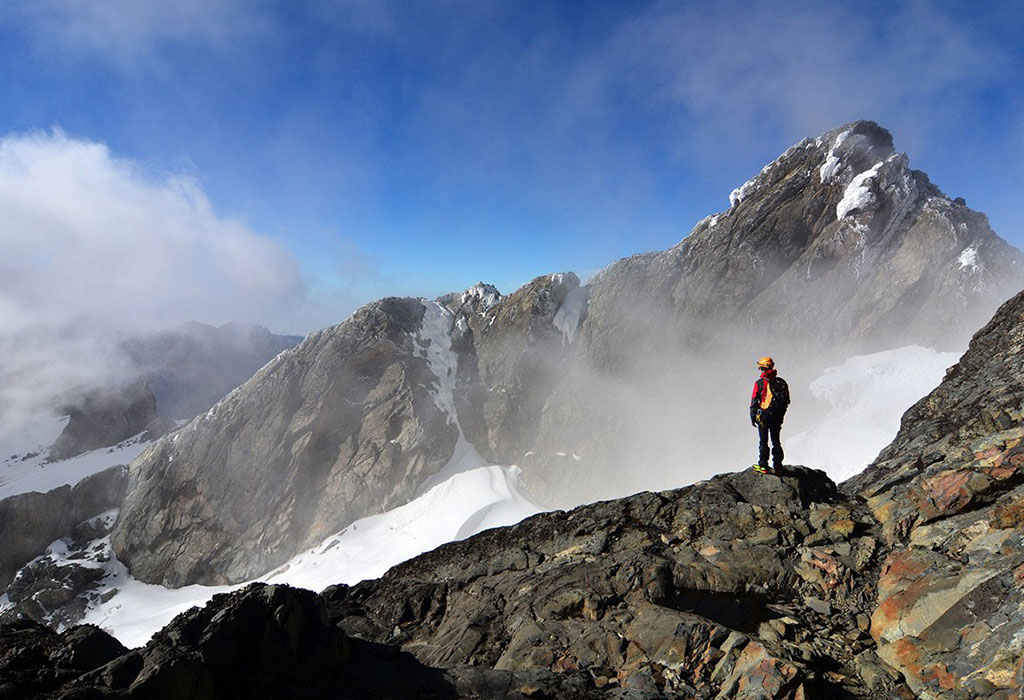
Summit Margherita (5,109m), Speke, Baker & Weismann on the 10-Day Rwenzori 4 Peaks Trek via the Kilembe Trail. Expert guides, full board, all fees included.
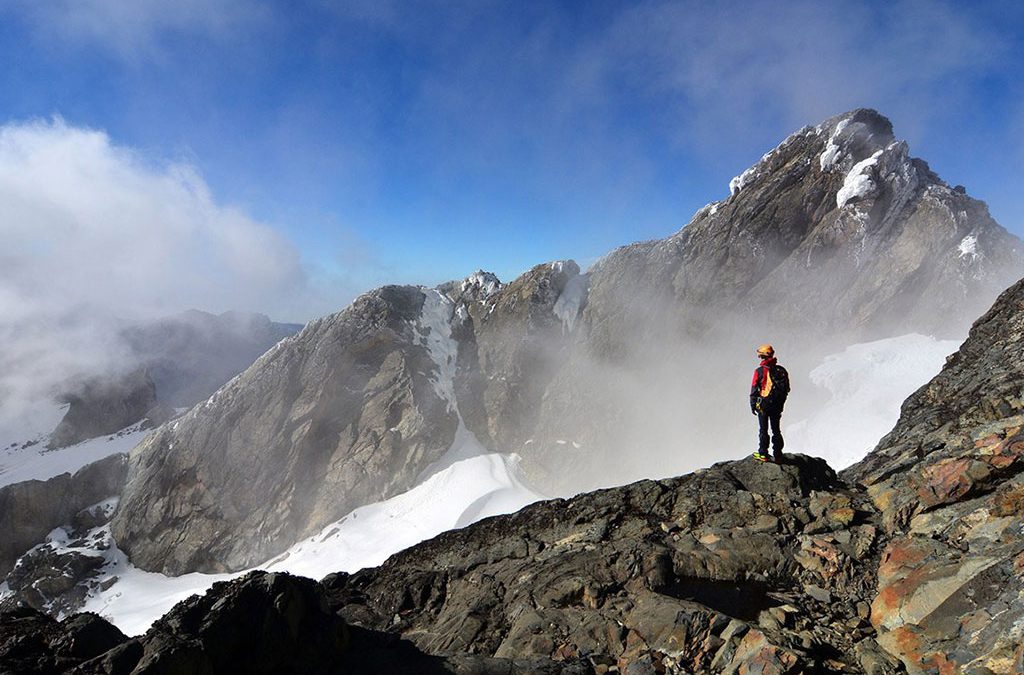
10-Day Rwenzori 4 Peaks Trek | Margherita, Speke, Baker
Overview of the 10-Day Rwenzori 4 Peaks Trek: Margherita, Speke, Weismann & Baker.
Summit four of the Rwenzori’s greatest peaks, Margherita (5,109m), Vittorio Emanuele on Mount Speke (4,890m), Weismann on Mount Luigi di Savoia (4,627m), and Edward on Mount Baker (4,843m) on the most ambitious multi-peak expedition available via the Kilembe Trail. This journey is not simply a trek to the top of Africa’s third-highest mountain. This is ten days of sustained alpine immersion across four distinct massifs, moving through some of the most extraordinary mountain terrain on earth: equatorial glaciers, giant lobelias, Afro-alpine bog, and ancient rock faces draped in mist. If you have already considered the 7-Day Margherita Peak Climb or the 8-Day Kilembe Trail trek and are wondering what comes next, this is the answer.
10-Day Rwenzori 4 Peaks Trek [Edward Peak, Margherita Peak, Vittoria Emanuele, and Weismann’s Peak]. Embark on a 10-day Rwenzori Four Peaks trek, where you will summit Margherita, Speke, Weismann, and Baker while challenging Africa’s legendary Mountains of the Moon via the Kilembe Trail.
This 10-day Rwenzori Four Peaks expedition is one of the most demanding and rewarding high-altitude trekking and mountaineering adventures in Africa. The Kilembe Trail takes you through all the different environments of the Rwenzoris, including thick rainforests, bamboo jungles, large heather forests, alpine wetlands, glaciers, and rocky ridges.
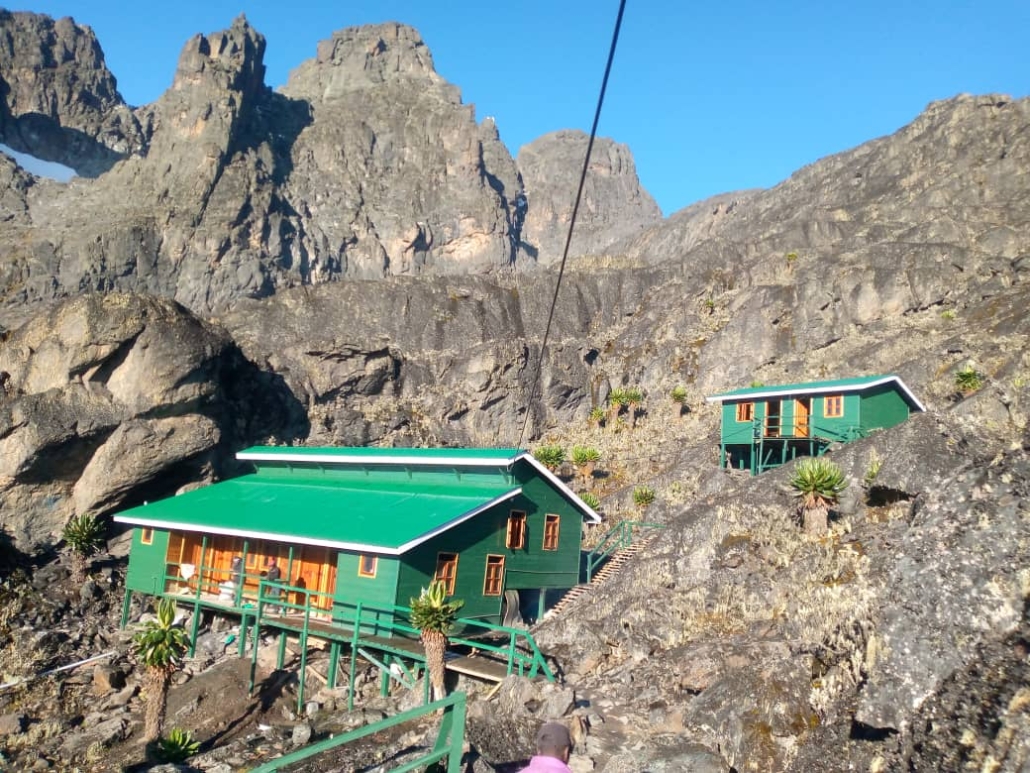
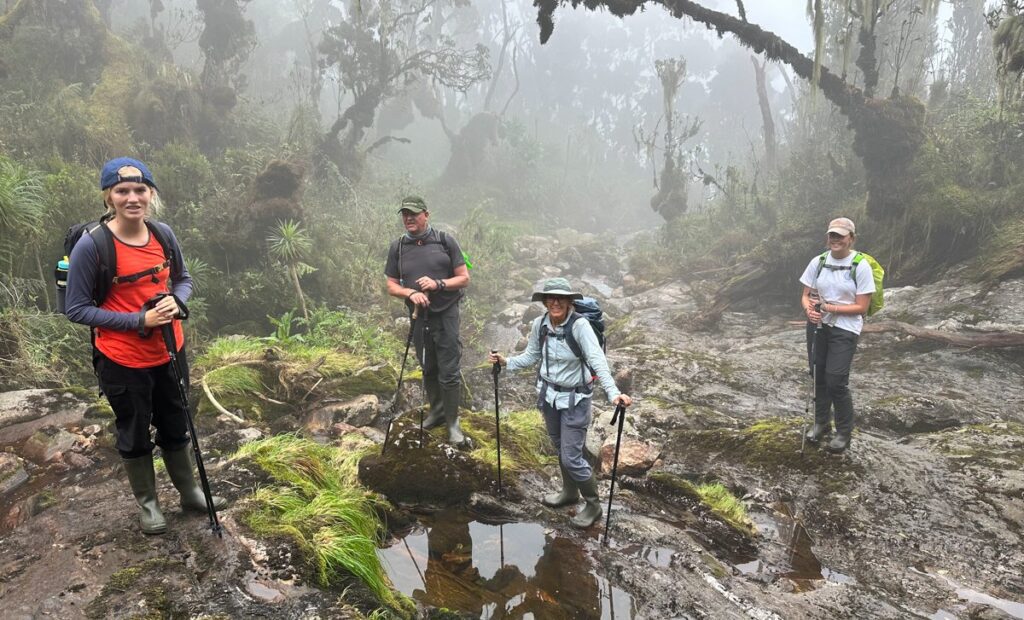
10-Day Rwenzori 4 Peaks Trek at a Glance
| Duration | 10 Days (9 nights on the mountain) |
| Total Distance | Approximately 95–110 km |
| Maximum Elevation | 5,109 m, Margherita Peak, Mount Stanley |
| Difficulty | Strenuous/Expert glacier travel, scrambling, sustained altitude |
| Trail | Kilembe Trail (primary): high-altitude traverse to Stanley, Speke, Baker, Luigi di Savoia massifs |
| Start Point | Kilembe Trailhead, near Kasese, western Uganda |
| End Point | Kilembe Trailhead (circular) |
| Peaks Summited | Margherita Peak (Mt Stanley 5,109m), Vittorio Emanuele Peak (Mt Speke 4,890m), Weismann Peak (Mt Luigi di Savoia 4,627m), Edward Peak (Mt Baker 4,843m) |
| Best Season | December–February and June–August (dry seasons) |
| Group Size | 2–12 trekkers (private and group departures available) |
| Accommodation | Mountain huts and A-frame shelters throughout |
| Guides & Porters | Certified Rwenzori mountain guides and porter team included |
Why Attempt the 10-Day Rwenzori 4 Peaks Trek?
The Rwenzori Mountains receive fewer than 1,500 trekkers annually, a figure that stands in stark contrast to the 50,000+ who attempt Kilimanjaro each year. That exclusivity is part of the mountain’s powerful appeal, but it is the terrain itself that makes a multi-peak traverse genuinely special. Each of the four massifs on this itinerary is geologically distinct, vegetatively unique, and demanding in its own right. On no other ten-day mountain expedition in Africa will you cross between four independent summit complexes, each requiring technical focus and rewarding you with views that no other route provides.
The Rwenzori’s Kilembe Trail forms the logistical backbone of this expedition. It enters the mountains from the south, ascending through dense montane forest, crossing into the giant heather zone, and emerging eventually into the afro-alpine belt where giant lobelias and groundsels dominate a landscape of extraordinary strangeness. From the high camps in the valley systems between the peaks, your guide will lead you on summit pushes to each of the four massifs in turn. The itinerary is designed to allow for proper acclimatization before each ascent, maximizing both safety and the summit success rate.
This expedition sits between the 8-Day 3-Peaks Trek and the epic 13-Day 6 Peaks Expedition in our expedition range. It is the sweet spot for the serious mountaineer who wants to go beyond a single summit and experience the full breadth of what Africa’s Mountains of the Moon can offer, without the extreme commitment of an 18-day traverse. Read our full Rwenzori Mountains overview to understand the full geographical and cultural context of this remarkable range.
Each of the four peaks carries its own altitude psychology, its own physical demands, and its summit moment. Margherita Peak is the objective that most trekkers know: Africa’s third-highest summit, a glaciated crown above the Stanley Plateau. Mount Speke’s Vittorio Emanuele Peak demands a sustained approach through the Elena and Speke Glacier terrain. Mount Baker’s Edward Peak rises above the mist-shrouded Scott Elliot Pass. And Mount Luigi di Savoia’s Weismann Peak, the least-summited of the four, is a scramble of near-perfect Rwenzori character: technical, remote, and utterly rewarding.
Full Detailed 10-Day Rwenzori 4 Peaks Trek Itinerary (Day-by-Day)
Day 1: Kasese / Kilembe Trailhead to Sine Camp | 2,610 m | ~10 km | 5–6 hrs
Your Rwenzori 4 Peaks expedition begins in Kasese, the gateway town on the western edge of Uganda’s Rift Valley. After early-morning check-in formalities and briefings at the Kilembe Trailhead, where your guide team, porters, and equipment will be assembled and weighed, you step into one of Africa’s most biodiverse mountain ranges. The trail rises immediately through former copper-mining terrain, crossing the Mubuku River on a steel-railed bridge before entering the dense montane rainforest that characterizes the Rwenzori’s lower slopes.
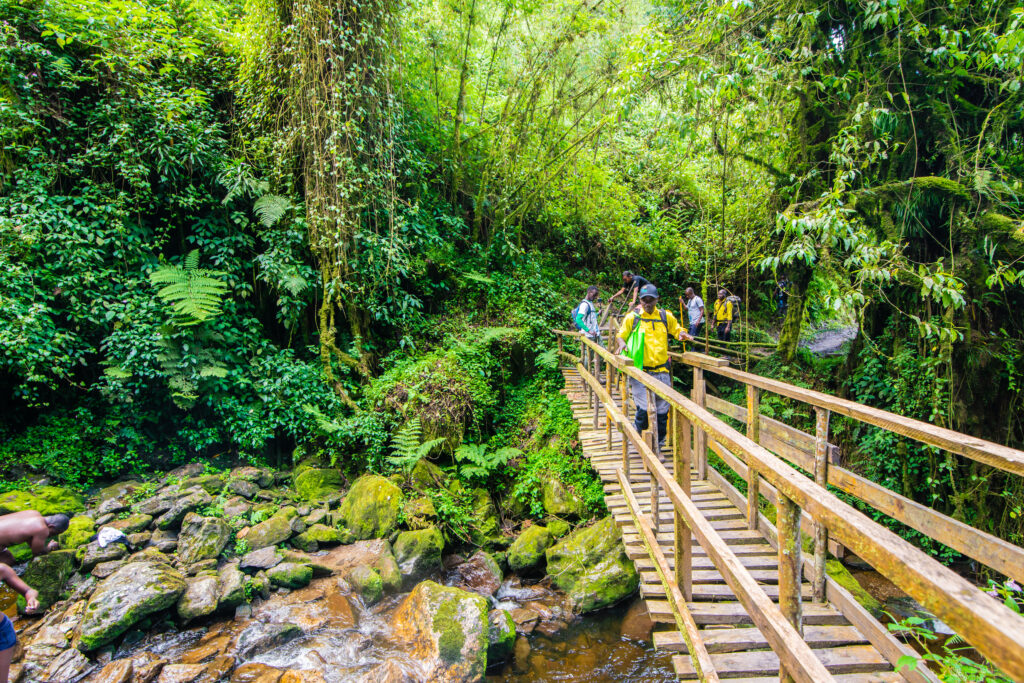
The forest here is cathedral-dark and humid, alive with the calls of Rwenzori turacos and red-tailed monkeys moving through the upper canopy. Your boots will already be wet within the first kilometer; the Rwenzori’s famous rainfall begins at the forest floor and does not relent. This is not a mountain you climb dry, and the sooner you embrace the moisture, the more you will enjoy the next ten days. The trail climbs steadily through bamboo zones and mossy ravines before arriving at Sine Camp, a well-constructed hut set in a clearing above the forest canopy. Dinner is prepared by your cook over the camp stove. Sleep at 2,610 m.
Accommodation: Sine Camp hut | Meals: Lunch pack & dinner
Day 2: Sine Camp to Kiharo Camp | 3,061m | ~9km | 5–6 hrs
The second day deepens the immersion. You leave Sine’s forest clearing and continue ascending through increasingly twisted vegetation; the transition from lowland forest to the giant heather zone is one of the Rwenzori’s defining sensory shifts. Trees become gnarled and moss-draped; the understory thickens with ferns and club mosses; the path narrows and becomes more technical underfoot.
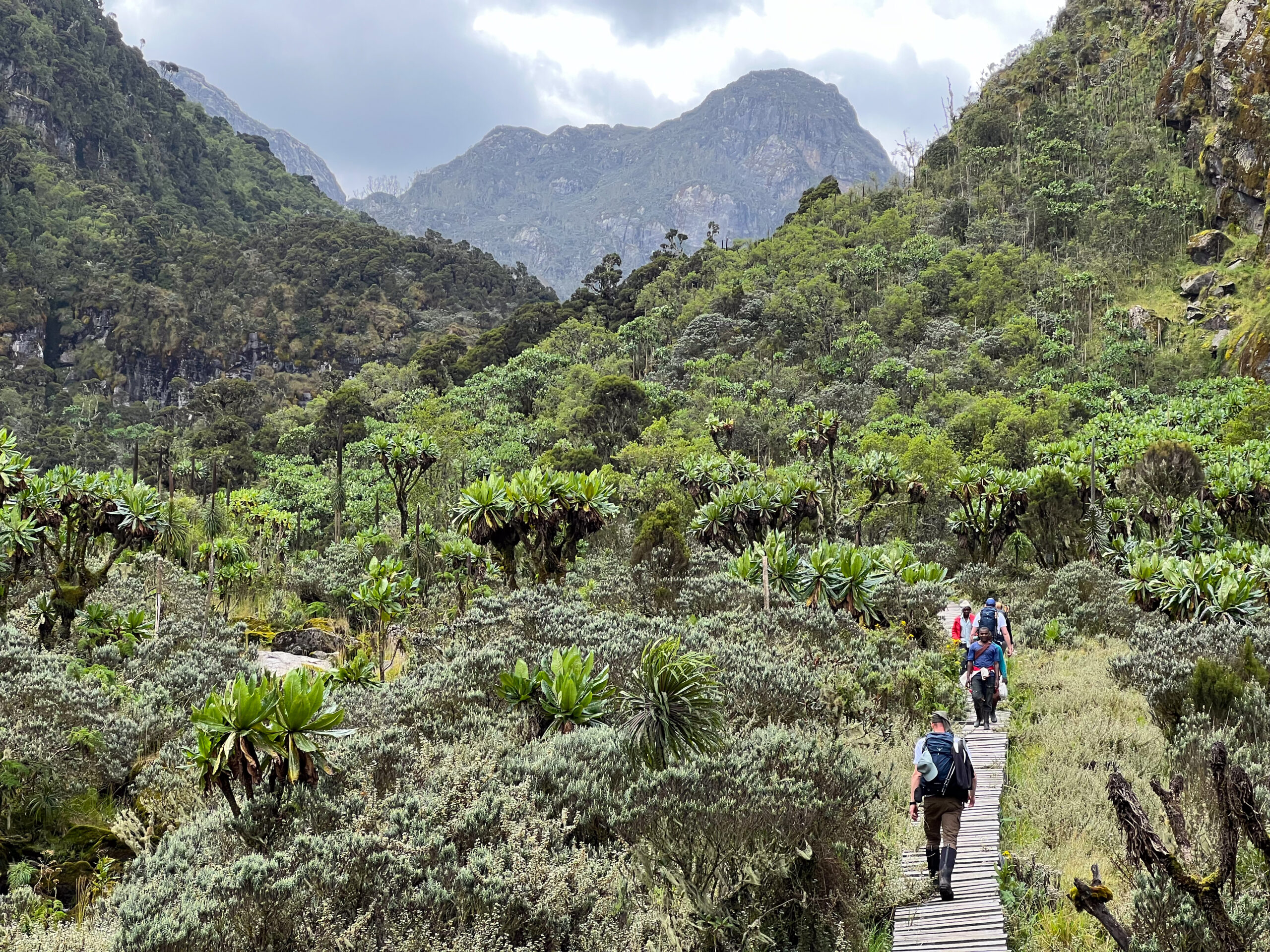
As you enter the heather zone, the characteristic Rwenzori vegetation begins to assert itself: giant heathers rising five to eight metres overhead, their trunks wrapped in thick layers of sphagnum moss that soak up water and release it in slow, cold seeps across the trail. Erica arborea, the dominant species, creates a tunnel world with an extraordinary atmosphere. Kiharo Camp sits at the edge of this zone, perched on a small ridge with views opening west toward the Kilembe valley below. Tonight’s dinner is hot and plentiful; your cook understands the caloric demands of what lies ahead.
Accommodation: Kiharo Camp hut | Meals: Breakfast, lunch pack & dinner
Day 3: Kiharo Camp to Bugata Camp | 3,750 m | ~8km | 5–7 hrs
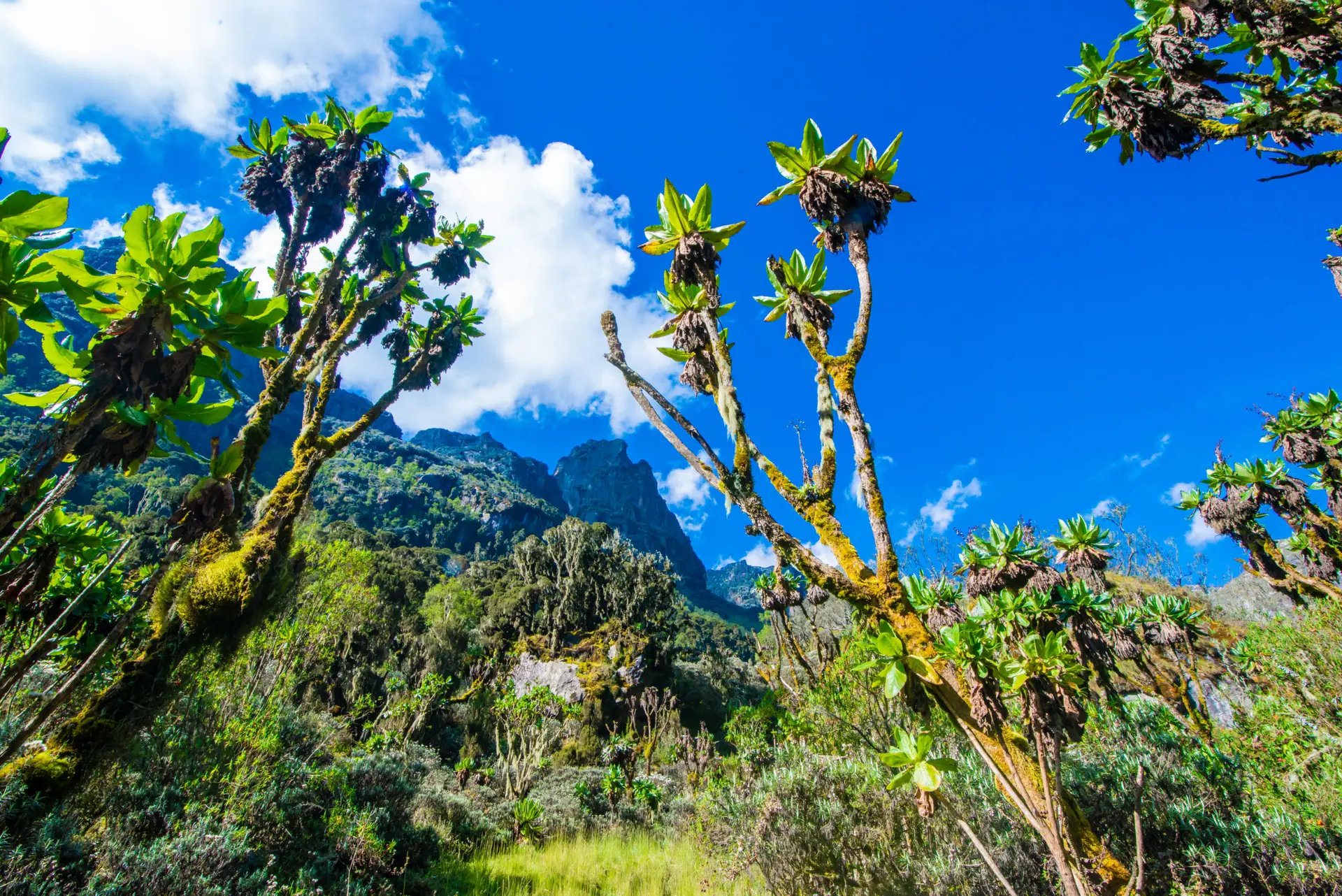
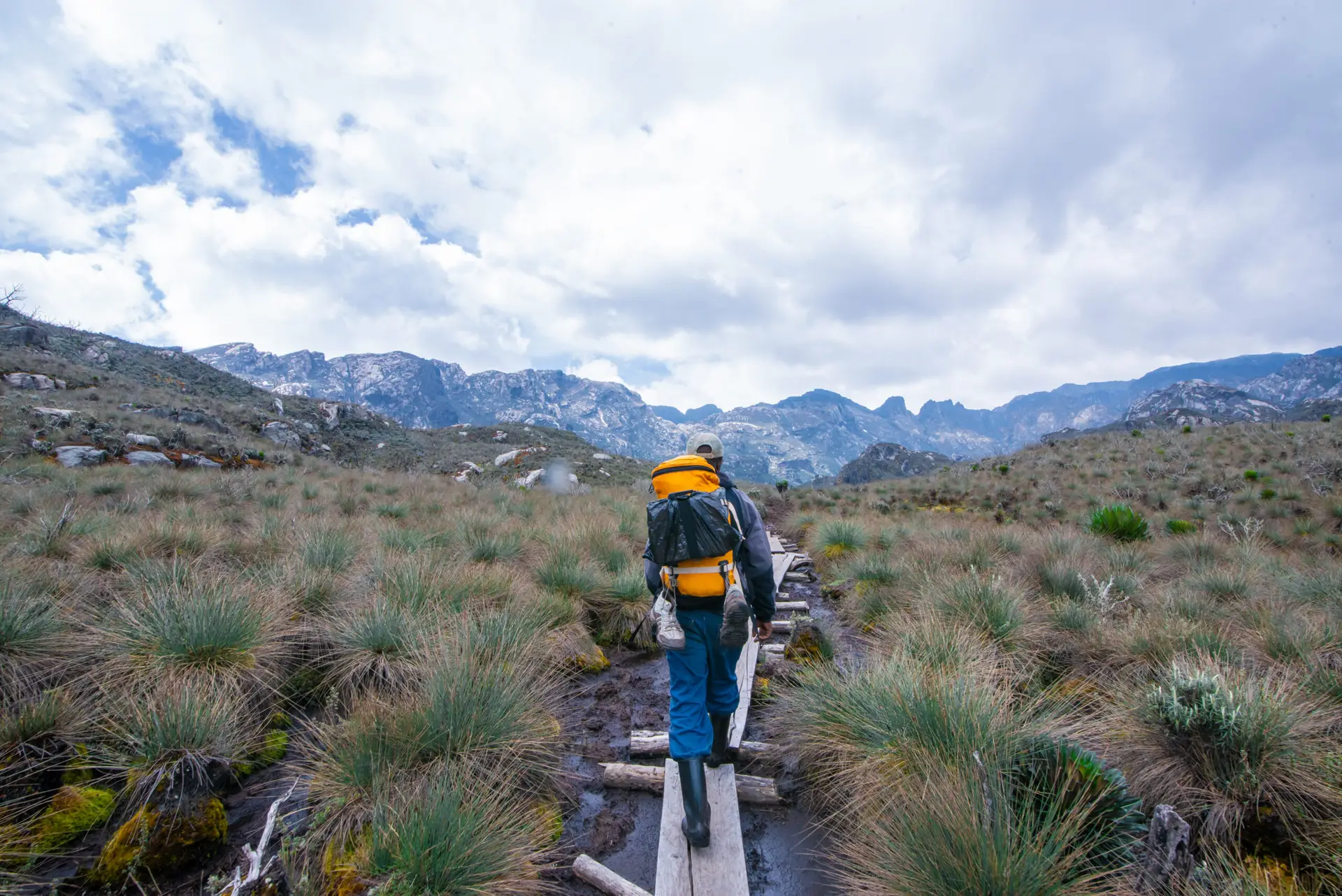
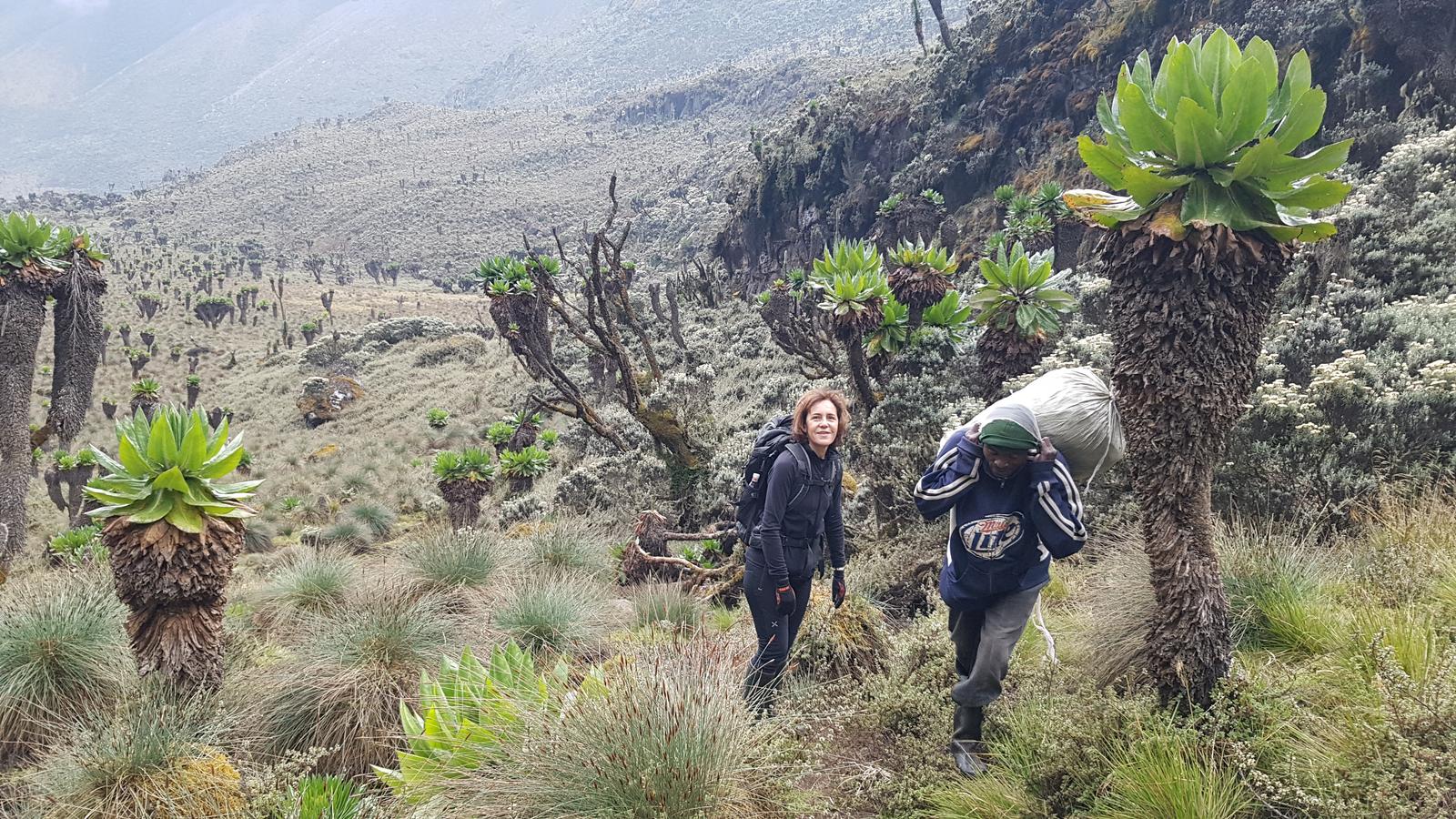
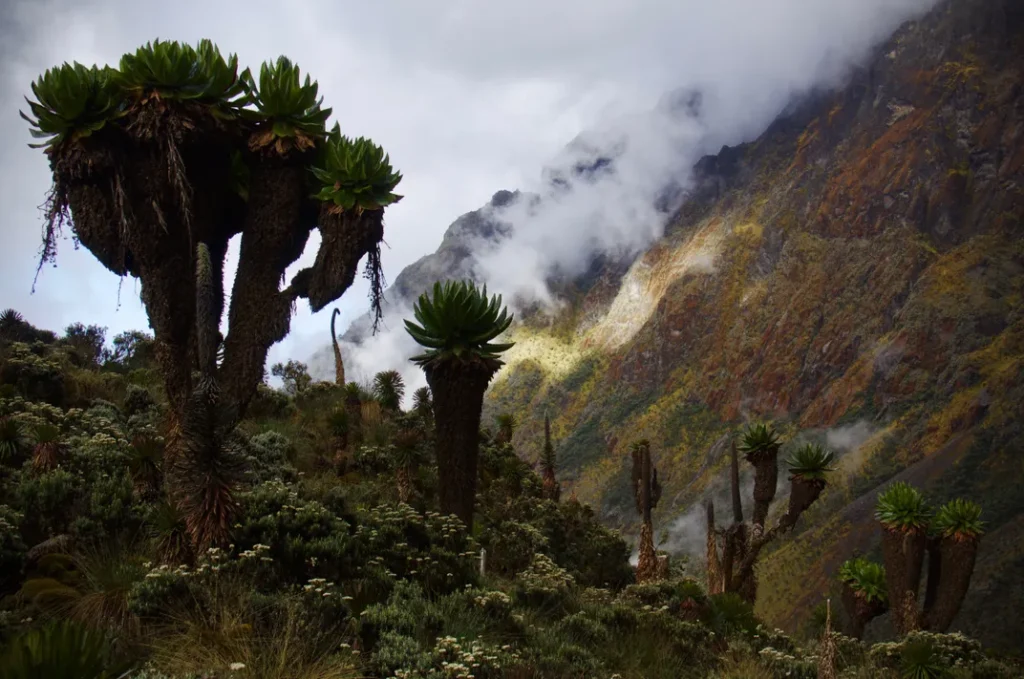
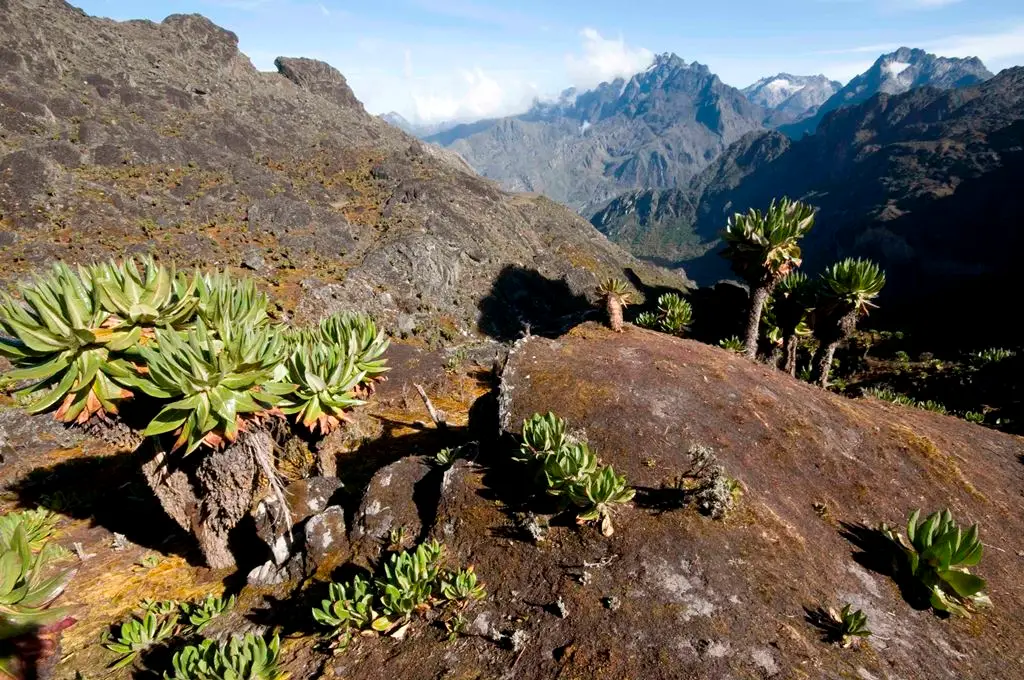
Day three is your introduction to the true alpine Rwenzori. The path climbs out of the heather forest into the giant lobelia and senecio zone, the landscape that defines the popular imagination of these mountains and that no photograph fully prepares you for. Giant lobelias rise two to three metres from the bog like alien sentinels, their silver-blue rosettes pointing skyward. Tree groundsels form a forest of their own, their yellow daisy-like flowers bright against the grey mist. The trail crosses several streams on wooden bridges and traverses long sections of boardwalk installed to protect the delicate bog vegetation.
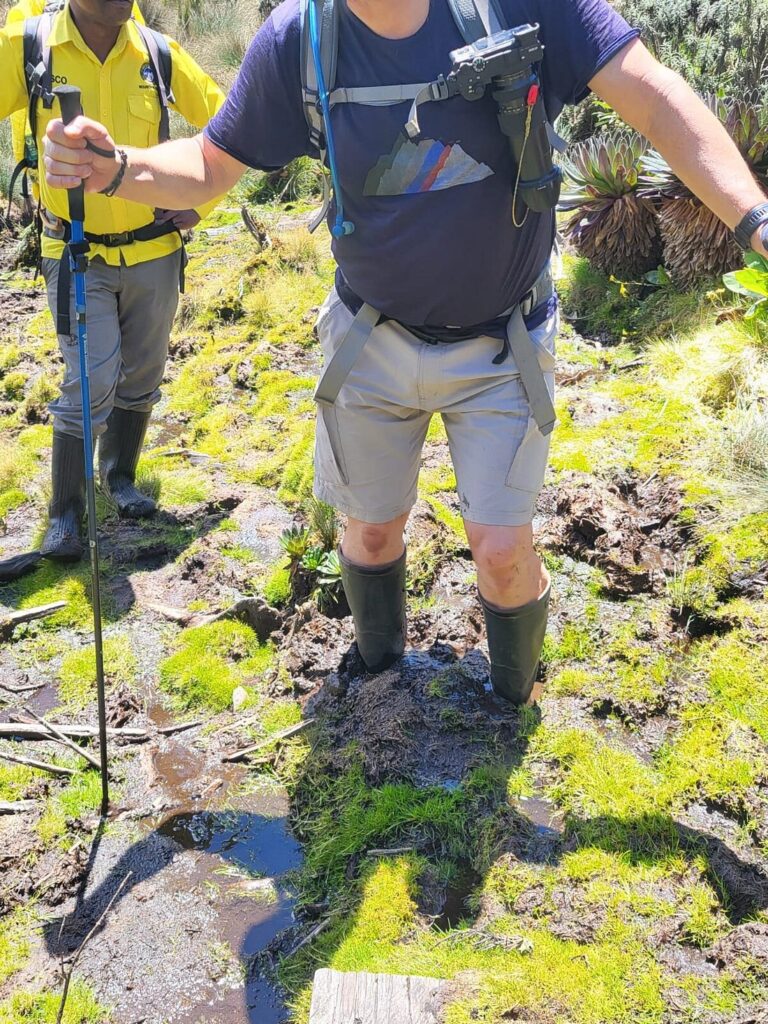
Altitude becomes a real consideration starting today. At Bugata Camp (3,750 m), you may feel your first hints of altitude-related fatigue. Drink consistently, eat well, and pay attention to your body. Your guide will brief you this evening on the acclimatization strategy for the days ahead. The camp itself is a solid stone-and-timber structure with a communal dining area comfortable by mountain standards and a genuine refuge on a cold and wet evening.
Accommodation: Bugata Camp hut | Meals: Breakfast, lunch pack & dinner
Day 4: Bugata Camp to Lake Bujuku / Bujuku Camp | 3,962 m | ~7 km | 4–5 hrs
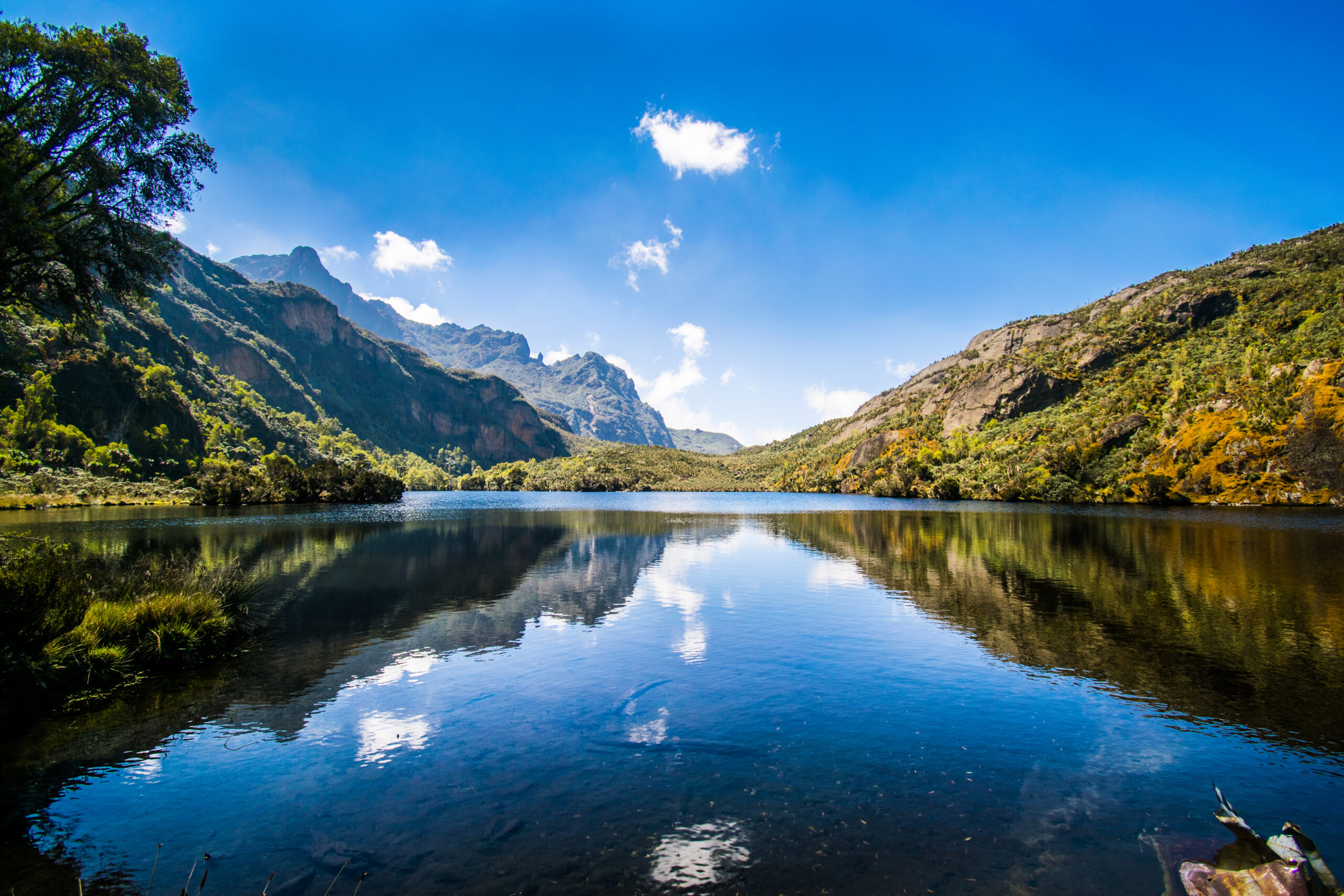
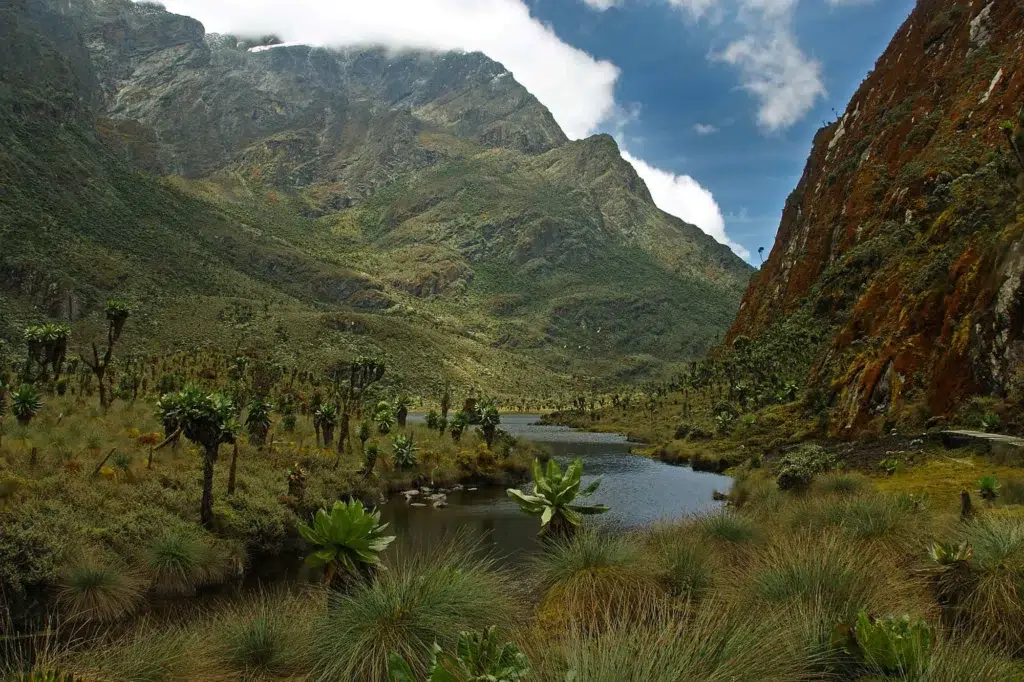
The approach to Bujuku is one of the most photographed stretches of the Rwenzori, for valid reason. The Bujuku Valley opens before you like a scene from an antediluvian world: vast boggy meadows of afro-alpine vegetation, the Elena Glacier glinting above on the Stanley massif, and the dark walls of Mount Speke rising to your east. Lake Bujuku, a high glacial lake at 3,962 m, reflects the sky and mountains in equal measure on clear days, and on overcast days, the mist rolling across its surface creates an atmosphere of primal remoteness.
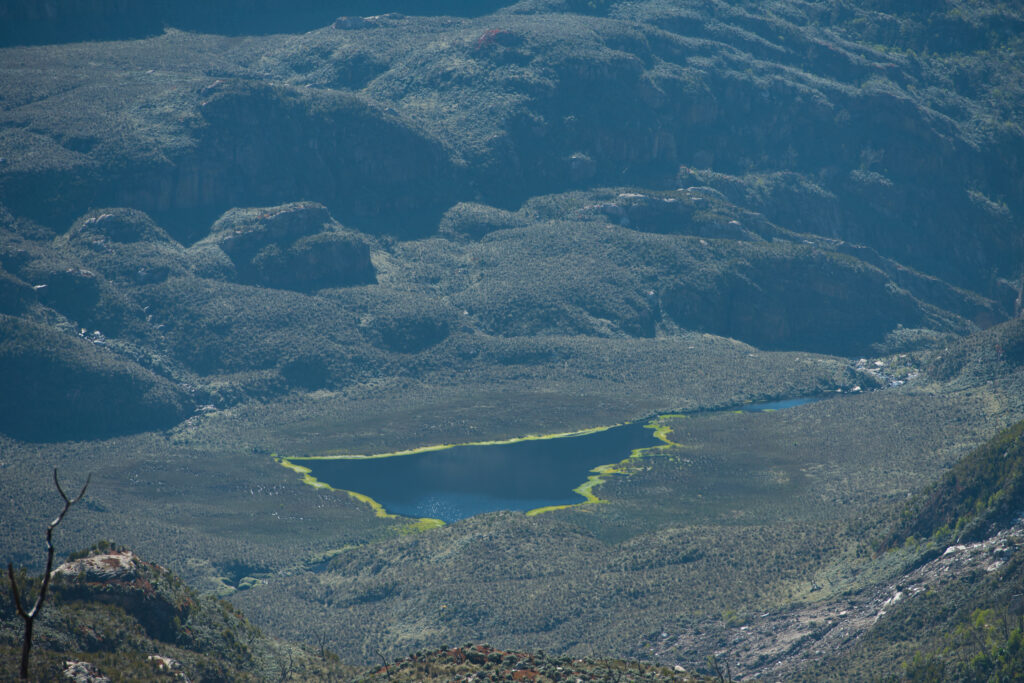
This trek is a shorter day in distance, designed as an acclimatization stage. You will gain approximately 200m of altitude from Bugata and spend the afternoon at rest in camp, letting your red blood cell count adjust to the growing elevation. Bujuku Camp is the operational hub for the peaks ahead. Mount Stanley, Mount Speke, and Mount Baker are all accessible from this valley. Your guide will walk you through the summit plans for each peak over dinner tonight.
Accommodation: Bujuku Camp hut | Meals: Breakfast, lunch pack & dinner
Day 5: Summit Day; Margherita Peak (5,109 m), Mount Stanley | ~6–8 hrs round trip from high camp
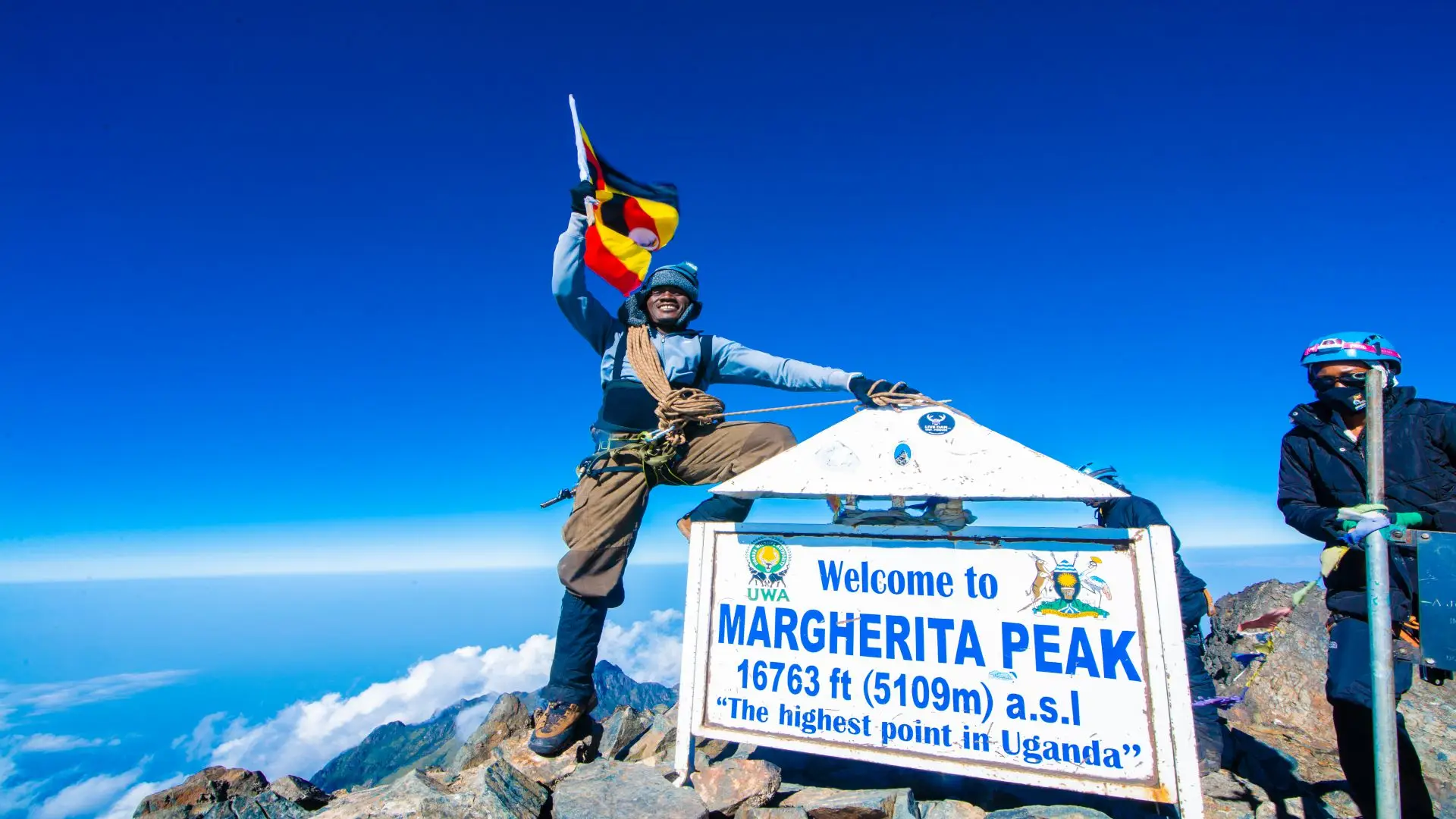
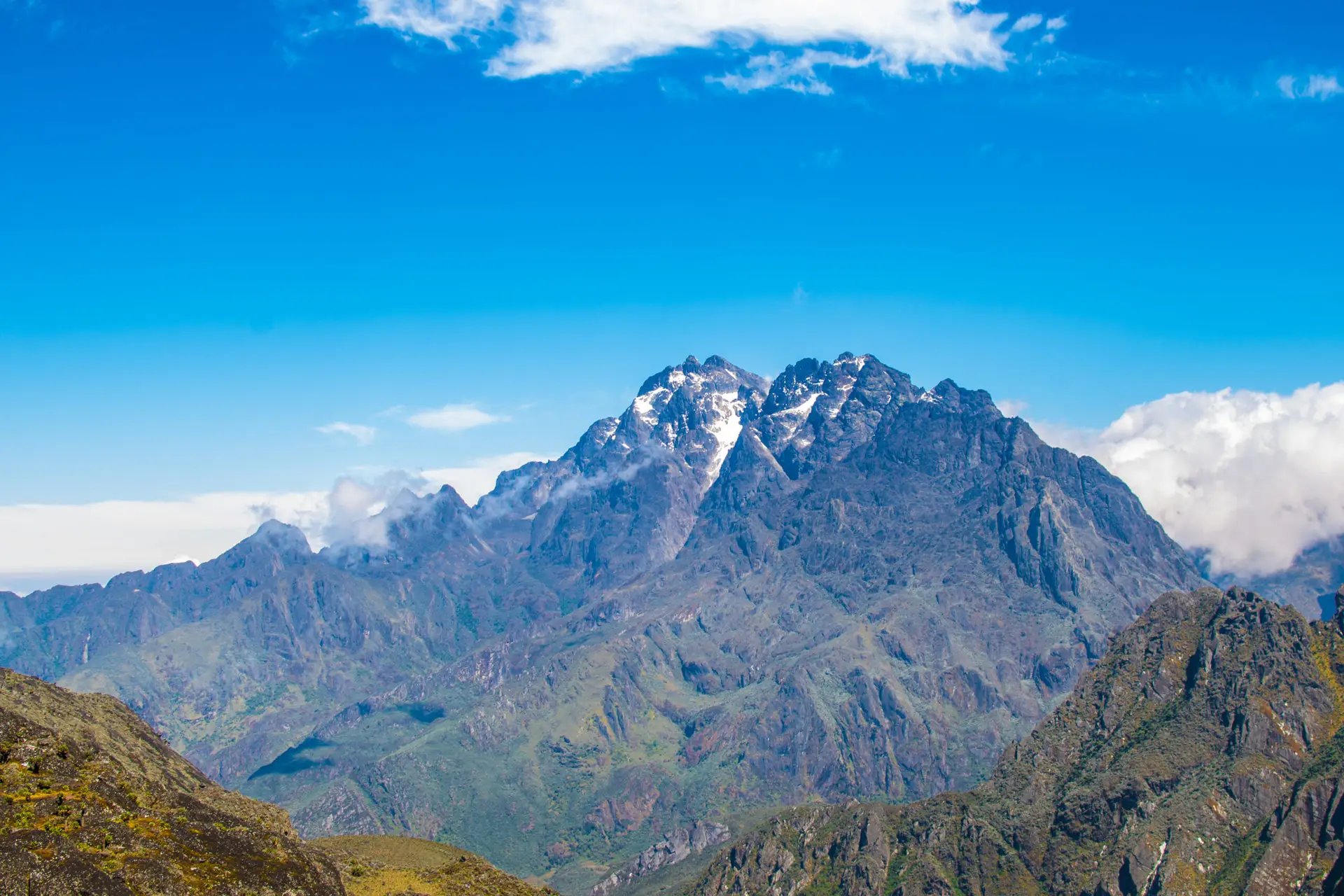
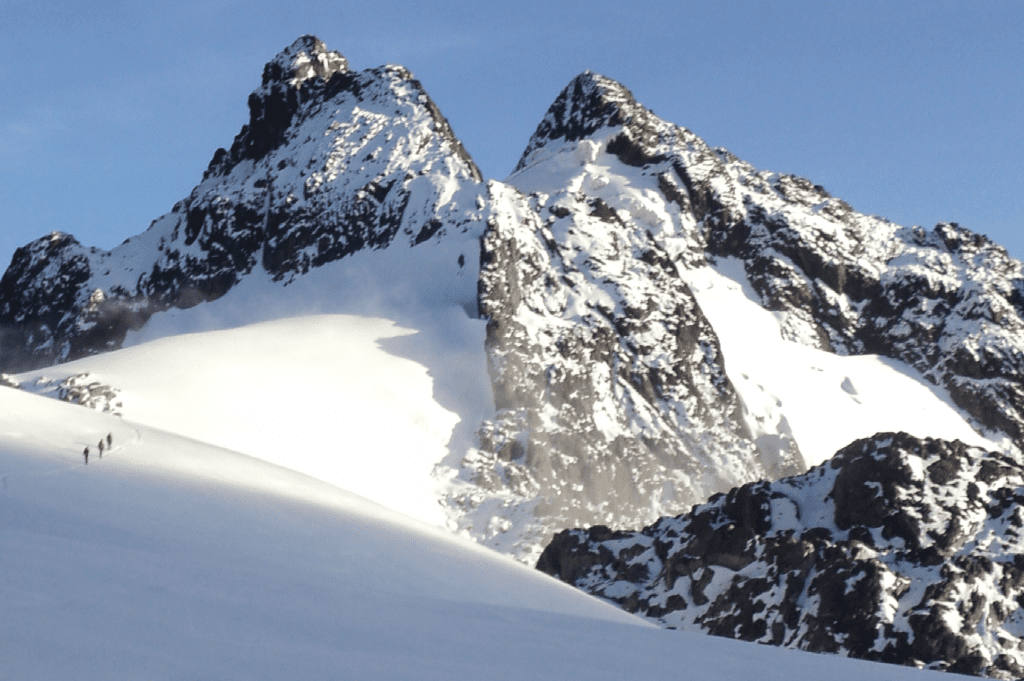
The pre-dawn start for Margherita Peak is the emotional centerpiece of this expedition. Headtorches pierce the darkness as you leave Elena Camp (a short move from Bujuku, typically done the evening before as a staged advance) and begin the ascent of the Stanley Plateau. The Elena Glacier, one of Africa’s last equatorial glaciers, now dramatically retreated from its extent a century ago, is crossed with the aid of crampons and your guide’s ice axe. The final push to Margherita at 5,109m is an exercise in pure mental and physical resolve: steep snow-ice, a narrow summit ridge, and the knowledge that you are standing on Africa’s third-highest point.

On clear days, the summit view extends across the Congo basin to the west, across the Rwenzori’s full ridge to the east, and, on exceptional mornings, as far as the volcanic peaks of the Virunga range. The Duke of Abruzzi first ascended this peak in 1906, and you are among a very short list of people who have stood here. Return to Bujuku Camp for the night.
Accommodation: Elena Camp (advance) / Bujuku Camp | Meals: Breakfast, lunch pack & dinner
Day 6: Summit Day; Vittorio Emanuele Peak, Mount Speke (4,890 m) | ~5–7 hrs round trip
Rest and recovery at Bujuku Camp in the morning; you have earned it. After breakfast and time to dry your kit, your guide leads you north toward the Speke massif. Vittorio Emanuele Peak, at 4,890m is the highest point on Mount Speke and requires a sustained approach across scree and rocky terrain before a final scramble to the summit. The views from Speke’s summit look directly across to the Stanley massif; you can trace the exact line of yesterday’s Margherita ascent from here, an extraordinary perspective on the terrain you have already covered.
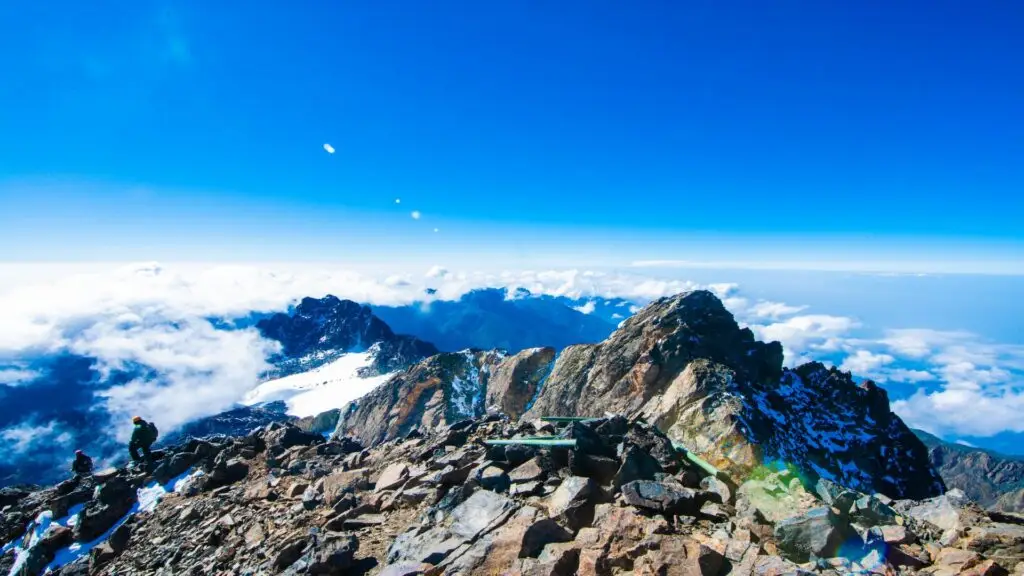
The trek is a long and demanding day that follows a summit push on Day 5. Managing energy carefully is critical: eat well at breakfast, carry sufficient snacks, and hydrate consistently throughout. Your guide will set a pace that prioritizes sustainable progress over speed. Return to Bujuku Camp for your final night in this remarkable valley.
Accommodation: Bujuku Camp hut | Meals: Breakfast, lunch pack & dinner
Day 7: Bujuku Camp over Scott Elliot Pass (4,372 m) to Kitandara Camp | 4,023 m | ~8km | 5–6 hrs
Scott Elliot Pass at 4,372 m is one of the Rwenzori’s great transition points, the divide between the northern Bujuku Valley and the southern Kitandara Valley, and a place where the full scale of the mountain range becomes suddenly and magnificently apparent. The climb to the pass from Bujuku takes you through the final lobelia and groundsel zones, past frozen pools and frost-shattered rock faces, to a narrow saddle of wind-scoured rock with vertiginous drops on both sides.
The descent to Kitandara Lakes is one of the expedition’s finest walking stretches, a long, gradually declining traverse across the southern face of the Baker massif, with the twin glacial lakes of Kitandara shimmering below. These lakes, set in a broad afro-alpine valley, form one of the most serene high-altitude scenes in Africa. Kitandara Camp sits at the valley head beside the upper lake. From here, Mount Baker and its Edward Peak dominate the skyline to the northeast.
Accommodation: Kitandara Camp hut | Meals: Breakfast, lunch pack & dinner
Day 8: Summit Day; Edward Peak, Mount Baker (4,843 m) | ~5–6 hrs round trip
Edward Peak on Mount Baker is a technically demanding summit that involves steep, rocky scrambling and, in wet conditions, requires careful footwork and the use of your hands. The ascent departs Kitandara Camp before dawn, climbing steeply up the eastern face of the Baker massif through rock and scrub before breaking onto the open upper slopes. The summit at 4,843 m is a relatively compact but exposed point with panoramic views back toward the Stanley and Speke massifs, a confirmation of the extraordinary distance your feet have covered.
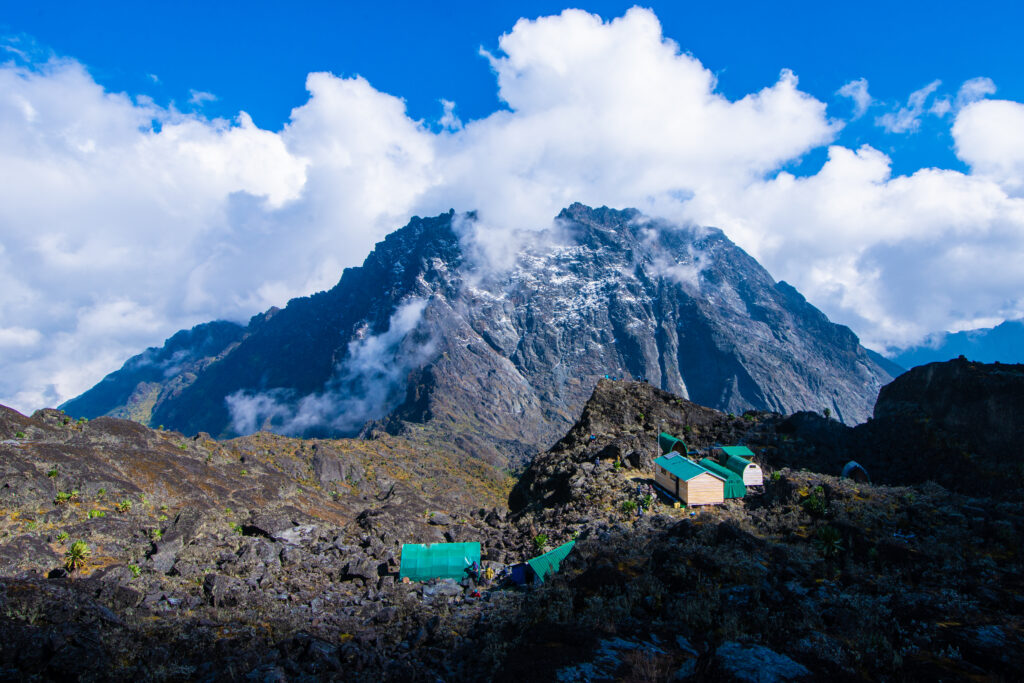
Return to Kitandara Camp for rest, food, and preparation for tomorrow’s move toward the Luigi di Savoia massif. This is the last major summit day of the expedition, and the psychological weight of that knowledge makes the return to camp particularly warm.
Accommodation: Kitandara Camp hut | Meals: Breakfast, lunch pack & dinner
Day 9: Kitandara Camp over Freshfield Pass (4,282 m) to Weismann Summit Camp | ~4,200 m | 6–7 hrs
Freshfield Pass at 4,282 m is the second remarkable high crossing of this expedition, connecting the Kitandara Valley to the Luigi di Savoia massif in the south. The ascent to the pass is gradual, winding through the final afro-alpine meadows before reaching bare rock and the exposed saddle. From the pass, the trail descends into a wild, rarely visited section of the Rwenzori where Mount Luigi di Savoia stands aloof and largely unvisited. A high camp is established near the summit approach, allowing an early push on Weismann Peak the following morning.
Today is primarily a transit and positioning day, but it is neither short nor easy. Freshfield Pass is the emotional and psychological threshold between the expedition’s major summits and the final objective: arriving at camp with sufficient energy to rest, eat well, and sleep.
Accommodation: High camp near the Weismann approach | Meals: Breakfast, lunch pack & dinner.
Day 10: Summit Day; Weismann Peak, Mount Luigi di Savoia (4,627 m) | ~4–5 hrs then descend to Kilembe
Weismann Peak is the summit of Mount Luigi di Savoia at 4,627m and the final objective of your four-peak expedition. It is also the least summited of the four, reached by a minority of trekkers who have the endurance and ambition to extend their Rwenzori expedition beyond the Stanley-Speke-Baker triangle. The approach involves scrambling over loose rock and heather, with occasional fixed ropes on steeper sections. The summit itself is a broad, flat-topped point with exceptional views south toward the Congo border and north along the entire Rwenzori ridgeline.
After the summit, you descend directly back toward the Kilembe Trailhead via the southern Kilembe Trail approach, a long descent of several hundred metres in altitude through heather, forest, and eventually into the Mubuku Valley. This is a full and demanding final day. The descent to the trailhead and transfer to Kasese marks the completion of one of the most ambitious mountain treks in East Africa.
Accommodation: Hotel in Kasese | Meals: Breakfast & summit-day lunch pack
Rwenzori Elevation Profile Summary
The 10-Day Rwenzori 4 Peaks Trek is defined by sustained high-altitude exposure across the majority of its days. On Day 3, the trekker enters the alpine zone at Bugata (3,750 m). For the next six nights, they sleep above 3,900 m, with summit pushes reaching 5,109 m (Margherita), 4,890 m (Speke), 4,843 m (Baker), and 4,627 m (Weismann). The expedition crosses two major mountain passes, Scott Elliot Pass (4,372 m) and Freshfield Pass (4,282 m), each serving as both a physical challenge and a geographical gateway between the four massifs.
Total cumulative elevation gain across the ten days is estimated at 6,500–7,500 m. The acclimatization staging on Day 4 (Bujuku Camp rest day) is critical to the itinerary design, allowing physiological adaptation before the highest summit push. The descent profile on Day 10 is steep and sustained, the longest single descent of the expedition, returning from approximately 4,200 m to the Kilembe Trailhead near 1,590 m.
Camps & Accommodation on the Route
The Uganda Wildlife Authority (UWA) manages all accommodation on this expedition, which is provided in purpose-built mountain huts and A-frame shelters. Facilities are functional rather than luxurious: wooden sleeping platforms with foam mattresses, communal dining areas with basic cooking facilities, and pit or composting toilets. Running water is available at most camps from natural streams. Blankets and sleeping bag liners are typically provided; trekkers should carry their own sleeping bags rated to at least -5°C.
Sine Camp, 2,610 m.
The first night’s resting point is set in a forest clearing on the lower Kilembe Trail. Sine Camp has a solidly built main hut with sleeping platforms for up to 12 trekkers, a separate cook’s area, and the sounds of the montane forest as your lullaby. A comprehensive introduction to Rwenzori mountain accommodation.
Kiharo Camp, 3,061m
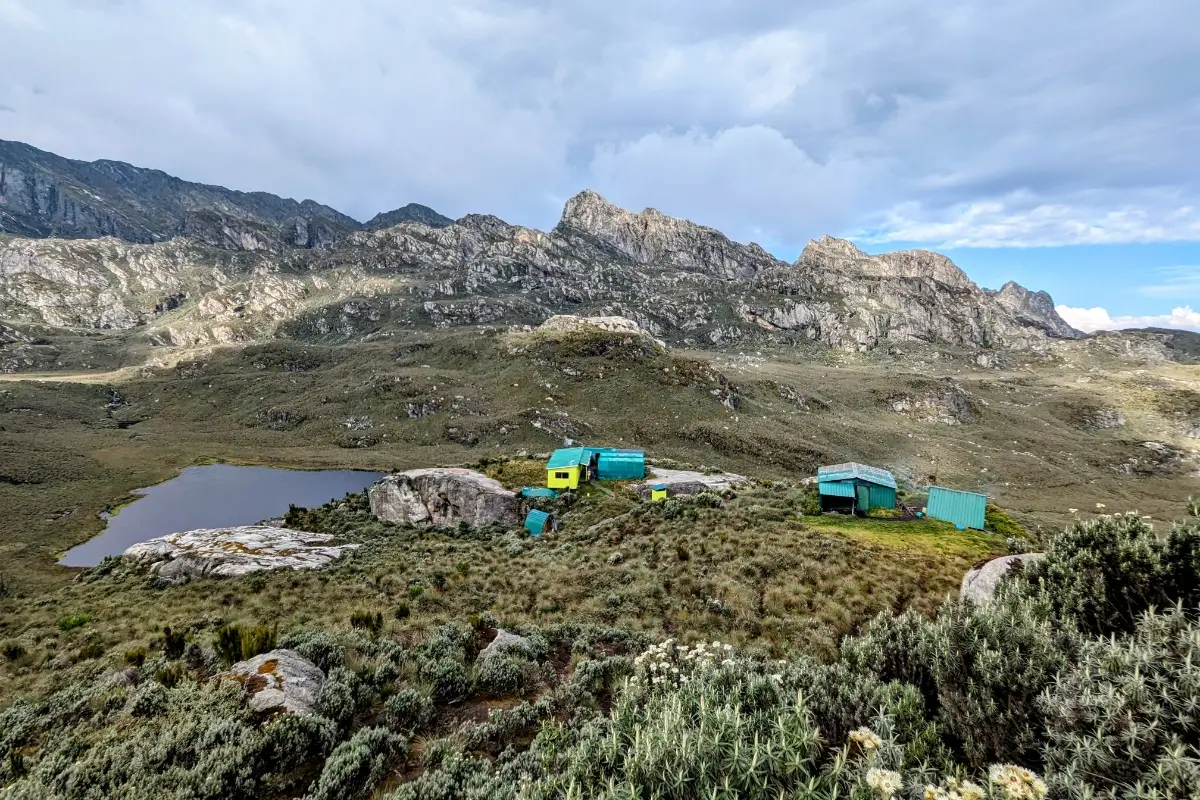
Perched on a ridge at the transition between forest and giant heather, Kiharo is a compact camp with excellent views west over the Kilembe Valley. The shelter is a timber-framed structure with metal roofing, functional and dry when the mist descends, which it frequently does.
Bugata Camp, 3,750m
Stone-built and solid, Bugata Camp marks your official entry into the Rwenzori’s afro-alpine zone. The altitude is sufficient to produce noticeable respiratory effort on exertion, and the camp’s communal space is where acclimatization briefings take place. Well-maintained by the UWA.
Bujuku Camp, 3,962m
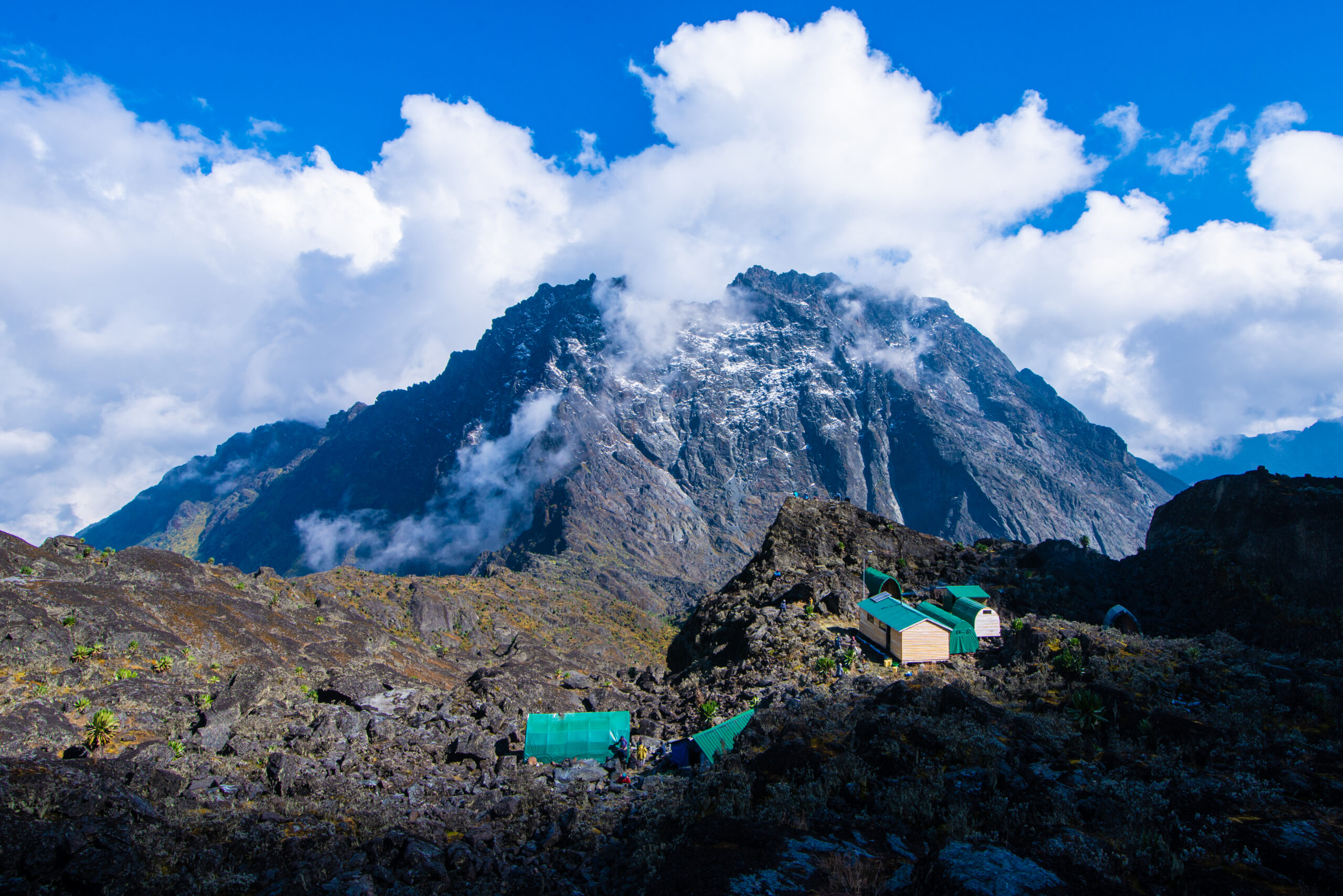
The operational hub of this expedition. Bujuku sits in the valley below Lake Bujuku with a direct view of the Elena Glacier on the Stanley massif. The camp has multiple sleeping huts, a dining area, and toilet facilities. It is from here that the three northern summits, Margherita and Speke, and the approach to Baker via Scott Elliot Pass are reached.
Elena Camp, ~4,541m
A small high camp used as an advance base for the Margherita summit push. Elena Camp sits just below the Elena Glacier on the southeastern flank of Mount Stanley and is one of the highest permanently staffed camps in East Africa. The cold here is significant; temperatures drop well below freezing overnight. This area is where you will strap on your crampons before dawn. The glacier science at this elevation is sobering: the Elena Glacier has retreated dramatically over the past century, and scientists estimate it may be gone within three decades.
Kitandara Camp, 4,023 m
It is one of the most beautiful camp settings in the Rwenzori. Kitandara Camp sits between the two glacial Kitandara Lakes, with Mount Baker rising dramatically to the northeast. The camp has a clean main hut and functional toilet. The stillness of the lakes at dawn, glassy, silent, and ringed by afro-alpine vegetation, is one of this trek’s defining photographic memories.
Flora & Wildlife to Expect
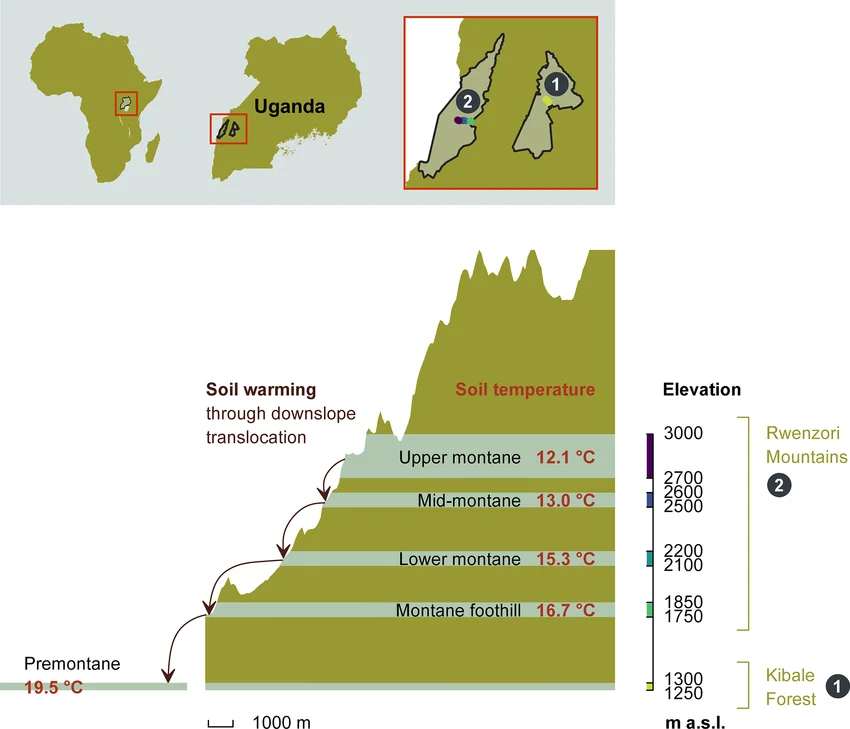
The Rwenzori Mountains contain five distinct vegetation zones, each with characteristic species assemblages. Across ten days on the 4 Peaks Trek, you will pass through all five. Our comprehensive vegetation zone guide provides detailed ecological context; the summary below covers what you are most likely to encounter on this specific route.
Montane Forest (1,800–2,500m): Entering the forest above Kilembe, you pass through a dense canopy of African olive, Hagenia, and Podocarpus trees. Look for Rwenzori turacos, the mountain range’s avian emblem, a vivid green bird with crimson wing patches. Rwenzori colobus monkeys and L’Hoest’s monkeys are regularly encountered here. Birdlife is exceptionally rich; this zone has recorded over 70 montane forest species.
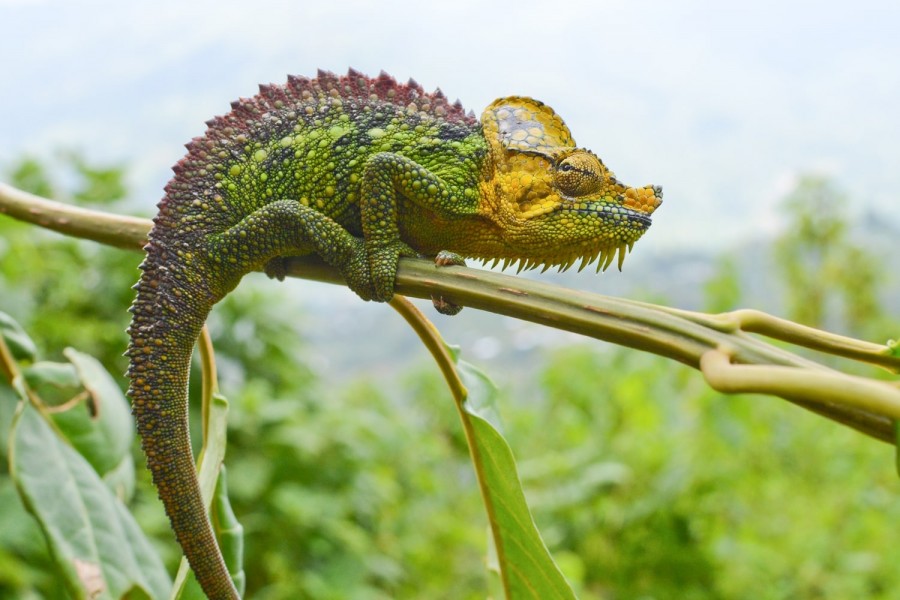
Giant Heather Zone (2,500–3,500 m): The Erica arborea heather here reaches heights of 8–10 metres, its trunks smothered in dripping sphagnum moss. This zone is dark, atmospheric, and often enveloped in clouds. Three-horned chameleons are occasionally spotted in the heather.
Afroalpine / Giant Lobelia-Senecio Zone (3,500–4,200m): The signature landscape of the Rwenzori. Giant Lobelia wollastonii rises to three metres; Senecio adnivalis (tree groundsel) forms grove-like assemblages. This is the zone where Rwenzori wildlife includes hyrax, duiker, and various sunbird species, including the Rwenzori sunbird.
In the Nival / Glacial Zone (above 4,500 m), vegetation gives way to bare rock, ice, and remnant glaciers that create the Rwenzori’s equatorial snowfield character. This zone is geologically ancient; the crystalline gneiss and schist exposed at these elevations formed over 500 million years ago.
Physical Difficulty & Fitness Requirements
The 10-Day Rwenzori 4 Peaks Trek is classified as strenuous to expert-level. It involves glacier travel on the Margherita summit push (crampons and ice axe required), sustained technical scrambling on the Baker and Luigi di Savoia ascents, consecutive summit days at altitude above 4,800m, and a total elevation gain exceeding 7,000m over ten days. It is physically and mentally more demanding than either the 7-Day Central Circuit trek or the 8-Day Kilembe Trail route taken individually.
You should arrive having completed regular training hikes of at least 20–25km with significant elevation gain and ideally at least one multi-day wilderness trek in the preceding six months. Read our detailed Rwenzori fitness and training guide for specific preparation protocols. Prior high-altitude experience (above 4,000m) is strongly recommended not because altitude illness is guaranteed, but because knowing how your body responds to thin air removes uncertainty from the critical summit days.
Altitude sickness is a real and serious consideration above 3,500m. The staged itinerary is designed to allow acclimatization, but no schedule eliminates individual risk entirely. Carry acetazolamide (Diamox) if prescribed by your doctor, brief your guide on any symptoms immediately, and never ascend with a headache that does not resolve with rest and hydration. Our guide team is trained in wilderness first aid and high-altitude emergency protocols. Read our dedicated altitude sickness guide for detailed symptom management information.
There is no formal upper age limit for this expedition, but the consecutive high-altitude summit days make it unsuitable for most trekkers over 65 unless they have demonstrable recent high-altitude experience. If you are 55 or older and considering this route, review our guide on trekking the Rwenzori as an older hiker and contact us directly to discuss your specific fitness level.
Best Time to Attempt the 10-Day 4 Peaks Trek
The Rwenzori is one of the wettest mountain ranges in Africa, receiving up to 3,000mm of annual rainfall. Unlike Kilimanjaro, which has clearly defined dry and wet seasons, the Rwenzori can produce precipitation in any month. That said, two broad, dry windows offer the best conditions for a 4 Peaks expedition.

December to February: The primary dry season. Skies are clearest and snowpack on the Stanley Plateau is at its most stable. January and February in particular offer the best glacier conditions for the Margherita push. This period is the peak season for serious summit attempts.
June to August: This period is the secondary dry window. Conditions are generally good through June and July; August can bring the beginning of the shorter wet season. This is a popular period for trekkers who want to combine a Rwenzori expedition with a Uganda gorilla trek. Our 12-Day Rwenzori & Gorilla Trek package is ideal for this combination.
March–May and September–November: The wet seasons. Trails become extremely muddy, and river crossings can be hazardous. The glacier conditions on Margherita are becoming less predictable, and the success rates of summits are declining. Determined trekkers with good waterproofs can still attempt this route in the wet season. The Rwenzori is extraordinarily beautiful in the rain, but the 4 Peaks objective is best reserved for the dry windows.
What’s Included
- All Uganda Wildlife Authority (UWA) park entry fees and peak permits
- Certified Rwenzori mountain guide throughout the expedition
- Full porter team for expedition equipment and food supplies
- All mountain hut accommodation (9 nights)
- Full-board catering on the mountain: breakfast, lunch pack & dinner each day
- Crampons and ice axe equipment for the Margherita glacier crossing
- Emergency oxygen canister carried by guide team
- Basic first-aid kit and wilderness medical support from guide team
- Rescue and evacuation cover coordination (trekkers must hold individual travel insurance)
- Transfer from Kasese town to Kilembe Trailhead
What’s Not Included
- International flights and visas
- Travel insurance with emergency evacuation cover (mandatory; see Insurance section below)
- Accommodation in Kasese before or after the trek
- Personal trekking gear and clothing (see gear list below)
- Alcoholic beverages
- Tips for guides and porters (strongly encouraged; see our tipping guide)
- Any pre- or post-trek activities
Full Packing & Gear List for the 10-Day Rwenzori 4 Peaks Trek.
| The Rwenzori Mountains are exceptionally wet. Every item on this list should be considered through the lens of waterproofing and warmth. Assume you will be wet every day. Pack accordingly. |
Footwear
- Waterproof mountaineering or heavy trekking boots (ankle support is essential; the terrain is uneven and often bog-deep)
- Neoprene gaiters (essential trail sections are permanently waterlogged)
- Camp shoes / sandals for hut evenings
- Thick wool or synthetic trekking socks (minimum 3 pairs)
Clothing Layers
- Moisture-wicking base layer (top and bottoms): minimum 2 sets
- Mid-layer fleece or softshell jacket
- Heavyweight insulated jacket (down or synthetic) essential for Elena Camp and summit nights
- Waterproof hardshell jacket Gore-Tex or equivalent
- Waterproof hardshell trousers
- Trekking trousers 2 pairs (lightweight and mid-weight)
- Warm gloves (liner gloves + waterproof outer mitts for summit days)
- Wool or fleece beanie hat
- Sun hat or wide-brimmed cap for lower-altitude days
- Balaclava or buff neck gaiter
Technical Equipment (Provided by RTS)
- Crampons (12-point, fitted to your boot size provided by Rwenzori Trekking Safaris)
- Ice axe (provided by Rwenzori Trekking Safaris)
- Fixed-line harness (carried by guide team for steep sections)
Pack & Carry
- Day pack (25–35 litres) for summit days and daily hiking
- Duffel bag or kit bag for porter carry (max 15kg porter load)
- Dry bags and zip-lock bags for electronics and documents
- Pack rain cover (essential)
Sleep & Camp
- Sleeping bag rated to -5°C or lower (critical for Elena Camp and high camps)
- Sleeping bag liner (adds 5–8°C of effective warmth)
- Foam earplugs for shared huts
Navigation & Safety
- Trekking poles (collapsible, adjustable; highly recommended for boggy terrain and descents)
- Headtorch with spare batteries (essential for pre-dawn summit starts)
- Personal first-aid kit including blister treatment, ibuprofen, and antihistamine
- Acetazolamide (Diamox) if prescribed: consult your doctor before departure
- Personal water purification (iodine tablets or filter backup to camp water supply)
- Emergency whistle
Hygiene & Sundries
- Biodegradable soap and hand sanitiser
- Sunscreen SPF50+ and lip balm
- Sunglasses with UV protection (essential at glacier elevation)
- Insect repellent (lower forest zones)
- Toilet paper and personal hygiene supplies
- Camera with spare batteries and dry bag the photographic opportunities on this trek are exceptional
- Power bank: no charging facilities on the mountain
Rwenzori Permits, Park Fees & Cost Structure.
The Uganda Wildlife Authority (UWA) regulates all trekking in the Rwenzori Mountains National Park. Entry fees, peak permits, and guide/porter fees are embedded in all our all-inclusive expedition pricing. The following breakdown provides transparency about the components:
- UWA National Park Entry Fee: charged per day per person (currently USD 35–45/day subject to annual revision by UWA)
- Peak Permit fees: levied per summit attempted; all four peaks are included in our package price
- Certified Mountain Guide fee: per guide per day, minimum one guide per two trekkers; additional guides for larger groups
- Porter fees: per porter per day we adhere strictly to the UWA-mandated minimum porter wages and maximum porter load regulations
- Hut accommodation: per person per night included in package price
- Rescue fund levy: a small UWA-mandated levy per trekker, contributing to the national mountain rescue fund
Contact us directly for a current all-inclusive expedition quote. Pricing varies by group size, season, and any customization of the itinerary. All prices include the full fee structure above; there are no hidden extras after booking confirmation.
Getting to the Kilembe Trailhead
From Kampala
Kampala to Kasese is approximately 380km, typically a 5.5–7 hour road journey depending on traffic through the Kampala-Entebbe corridor and road conditions on the Fort Portal–Kasese stretch. The most comfortable option is a private transfer arranged through Rwenzori Trekking Safaris. Alternatively, Post Bus Uganda operates a daily scheduled coach service from Kampala to Kasese. For trekkers transiting through Fort Portal, the road south to Kasese takes approximately 1.5 hours.
From Entebbe International Airport
Entebbe is approximately 420km from Kasese; allow 6–7 hours by road. We recommend arriving in Kasese the evening before your trek departure date to allow for a full gear check, briefing with your guide team, and a proper night’s rest. Our Kasese transfer service can be arranged from either Kampala or Entebbe.
From the Kilembe Trailhead
The Kilembe Trailhead is 14km from Kasese town, accessible by vehicle on a well-maintained gravel road. Rwenzori Trekking Safaris provides complimentary transfers from your Kasese hotel to the trailhead on Day 1 and back from the trailhead upon completion of the trek. Our guide to Kasese as a trekking gateway covers recommended accommodation, restaurants, and logistics in the town.
Book Your Trek
Respond within Minutes
From
$2,000
per person
- Duration 10 Days / 9 Nights
- Group Size 1–12 people
- Start Point Kilembe TrailHead
- Departures Year-round
- Summits Margherita/Vittorio Emanuele/Weismann/Edward Peak
No booking fee. Free cancellation up to 30 days before departure. We respond within Minutes.
Our Popular Rwenzori Treks
Magheritah Peak (8 Days Kilembe Trail)
$1705 Per Person
Mutinda LookOut (4 Days)
$645 Per Person
Short Magherita Hike (5 Days Central Circuit)
$1200 Per Person
Rwenzori Hike (7 Days Central Circuit)
$1400 Per Person
Everything you need to know before booking your 10-Day Rwenzori 4 Peaks Trek.
How difficult is the 10-Day Rwenzori 4 Peaks Trek compared to other Rwenzori routes?
The 10-Day 4 Peaks Trek is the most demanding itinerary on the Kilembe Trail short of the full 13-Day or 18-Day expeditions. It is significantly harder than the standard 7-Day Central Circuit route or the 8-Day Kilembe Trail trek because it involves four separate summit pushes, including glacier travel on Margherita, technical scrambling on Baker and Luigi di Savoia, and the cumulative physical toll of nine nights above 2,600 m. Trekkers should approach it with the preparation level of an alpine mountaineering trip rather than a standard trekking holiday.
Do I need prior mountaineering experience to attempt this trek?
You do not need formal mountaineering qualifications, but you must be comfortable with steep and exposed terrain, confident on loose rock, and physically capable of sustained effort over consecutive days. The Margherita glacier section is guided with crampons and an ice axe your guide will brief you fully and manage the technical elements. However, arriving with no prior experience of mountain terrain above 4,000m is inadvisable. At minimum, complete one previous multi-day high-altitude trek before attempting this expedition.
What is the success rate for summiting all four peaks?
Success rates vary by season, group fitness, and acclimatization. In the dry season (December–February and June–July), well-prepared trekkers with Rwenzori Trekking Safaris achieve all four summits at a high rate. The Margherita glacier section and the Baker scramble are the two points where individual fitness levels most determine outcomes. Our guides are experts at pacing groups to maximize summit success; read our detailed piece on the success rate for summiting Rwenzori for data and context.
Is altitude sickness a serious risk on this trek?
Altitude sickness is a genuine consideration on any Rwenzori expedition above 3,500m, and this trek spends the majority of its duration at or above that elevation. The staged itinerary is designed to allow progressive acclimatization, and the Day 4 rest day at Bujuku is a critical buffer before the highest summit push. Symptoms of acute mountain sickness (AMS), such as headache, nausea, dizziness, and loss of appetite, should be reported to your guide immediately. The only reliable treatment for severe AMS is descent. Carry acetazolamide (Diamox) if your doctor recommends it, and never ascend if symptomatic.
What weather should I expect across the ten days?
Expect rain every day. The Rwenzori is one of Africa’s wettest mountain ranges, and even in the dry season, afternoon precipitation is the norm above 3,000m. The summit mornings for the major peaks, particularly Margherita, tend to clear overnight; pre-dawn starts are timed to take advantage of morning stability before afternoon cloud builds. Pack as though you will be wet every day and treat any dry moment as a bonus rather than an expectation.
Can the itinerary be customised or extended?
Yes, the 10-Day 4 Peaks Trek can be extended into our 13-Day 6 Peaks Expedition with the addition of Mount Emin and Mount Gessi or combined with a Uganda gorilla trekking itinerary for a comprehensive Uganda adventure. We can also adjust the pacing of the 10-day itinerary for groups who prefer more acclimatization time or who wish to spend an additional day in the Bujuku Valley. Contact us to discuss customization options.
How many porters will be in our group, and how are they treated?
Rwenzori Trekking Safaris operates in full compliance with UWA porter welfare regulations. Each porter carries a maximum of 15–18kg (excluding their equipment and food). Porters receive hot meals, adequate shelter in porter-designated huts, and wages at or above the UWA-mandated minimum. We encourage all trekkers to read our porter welfare and tipping guide before departure. Porters are local Bakonzo community members, the indigenous people of the Rwenzori foothills, and their employment is a direct economic benefit to the communities at the mountain’s base.
What should I do about travel insurance?
Our 7-day Margherita itinerary has been designed specifically to maximize summit success through proper acclimatization staging. With well-prepared climbers following guide instructions, our summit success rate is very high. The primary factors that prevent summiting are adverse weather windows (which can develop rapidly on summit day), acute mountain sickness, and pre-existing injuries or illnesses.
Our guides will always make the final call on summit conditions; they never compromise safety for achievement. The 5-day itinerary has a lower success rate; the 7-day is our recommended format for any serious summit attempt
How does the 10-Day 4 Peaks Trek compare to the 8-Day 3-Peaks Trek?
The 8-Day 3-Peaks Trek covers Mount Stanley (Margherita), Mount Speke, and Mount Baker, the same three northern massifs as Days 5–8 of this itinerary. The 10-Day 4 Peaks adds Mount Luigi di Savoia’s Weismann Peak via the Freshfield Pass crossing, two additional days of high-altitude trekking, and the completion of the southern section of the Kilembe Trail. If you are choosing between the two, consider whether the additional two days of physical commitment and the Weismann summit are objectives you are prepared and motivated for; both routes deliver outstanding Rwenzori experiences.
Is there mobile phone or internet coverage on the mountain?
Mobile phone coverage on the Rwenzori is limited and inconsistent. Some Ugandan network providers (MTN, Airtel) offer intermittent signals at certain camps, particularly Bujuku and Kitandara, but coverage is not reliable enough to depend upon. Wi-Fi is not available on the mountain. For full details on communication options, read our guide on phone and WiFi coverage in the Rwenzori Mountains.
What is the minimum group size for a private departure?
We offer private departures on this expedition for a minimum of two trekkers. Solo trekkers wishing to join a scheduled group departure should contact us regarding upcoming group dates. Solo bookings incur a single supplement for the private guide allocation, but this cost can often be absorbed into a small group at a reduced rate. Please contact us to discuss availability.
Book Your 10-Day Rwenzori 4-Peak Expedition
| Four summits. Ten days. Africa’s Mountains of the Moon. Enquire now to secure your place on one of East Africa’s most exclusive mountain expeditions. |
The window to climb the Rwenzori’s glaciated peaks is narrowing. Scientists project that the remaining equatorial ice fields, including the Elena Glacier on Margherita’s approach, could disappear within three decades. Every year, the glacier retreat accelerates. This is not a mountain that will wait indefinitely.
Rwenzori Trekking Safaris is the specialist operator for the Rwenzori Mountains, based in Kasese at the mountain’s gateway. We operate exclusively on these mountains; it is all we do, and our knowledge of the terrain, the weather patterns, the camp infrastructure, and the route conditions is unmatched. With fewer than 1,500 trekkers visiting the Rwenzori each year, the region remains one of the last truly uncrowded expedition destinations in Africa.
To inquire about dates, pricing, and group availability for the 10-Day Rwenzori 4 Peaks Trek, contact us. We respond to all inquiries within just minutes. For trekkers comparing routes, our full Treks & Expeditions page provides a complete overview of every Rwenzori itinerary we operate from the 1-Day Nyabitaba introduction to the 18-Day All 8 Peaks expedition.