History of the Rwenzori Mountains: From Ptolemy’s Mountains of the Moon to Africa’s Last Equatorial Glaciers
Explore the full history of the Rwenzori Mountains, from Ptolemy’s Mountains of the Moon to the 1906 first ascent, UNESCO designation, and today’s glacier retreat.
Every time I lead a group out of the forest at Bugata Camp and the high peaks of Mount Stanley open up above us, ice-capped, cloud-wreathed, improbably close to the equator, I contemplate all the people throughout history who described these mountains without ever seeing them, as well as all the people who saw them and could not believe what they were looking at. The Rwenzori has been making people question their assumptions about Africa for nearly two thousand years. That hasn’t changed.
The Most Mysterious Mountains in Africa
The Rwenzori Mountains of western Uganda have a history as layered and complex as their geology. They are ancient in the deepest sense: Precambrian rock thrust skyward by tectonic forces over millions of years, shaped by ice ages, carved by glaciers, and draped in ecosystems that have evolved in magnificent isolation since before the last Ice Age. But they are also ancient in the human record: referenced by Greek geographers in the second century AD, described by mediaeval Arab cartographers, sought by generations of European explorers, and finally, in 1888, identified by Henry Morton Stanley as the source of the Nile’s northern tributaries and the physical reality behind the most famous geographical mystery in Western history.
No other mountain range in Africa carries this weight of historical reference. European explorers did not formally identify Kilimanjaro until 1848. Mount Kenya was first confirmed in 1849. The Ruwenzori, to use the older spelling, were already known in the ancient world by a name that has outlasted every civilisation that used it: the Mountains of the Moon. That name, in various translations across Greek, Latin, Arabic, and eventually English, has followed the Rwenzori through nearly two millennia of human geography, and it remains the range’s most evocative description today.
Let’s trace the complete history of the Rwenzori Mountains: from their first appearance in written human records, through the era of Arab cartography and the European Age of Exploration, to the definitive ascent of Margherita Peak by the Duke of Abruzzi in 1906, the establishment of the national park, the UNESCO World Heritage designation, and the contemporary challenge of glacier recession that is changing the mountain in real time. It is a history of remarkable duration and complexity, and understanding it provides every trekker who visits the Rwenzori a more profound relationship with the landscape they are walking through.
Rwenzori History at a Glance: A Chronological Reference
Before going in depth on each era, the table below provides a complete chronological reference for the key events in the Rwenzori’s recorded history, from Ptolemy’s second-century geography to the Uganda Wildlife Authority’s twenty-first-century infrastructure investments.
| Period / Date |
Event |
Significance |
| ~150 AD |
Ptolemy describes “Lunae Montes” (Mountains of the Moon) as the source of the Nile in his Geographia |
First known written reference to the Rwenzori, nearly 1,900 years before European confirmation |
| 10th–14th century AD |
Arab geographers, including Al-Idrisi, reference snow mountains at the equatorial source of the Nile |
Islamic cartographic tradition preserves the Rwenzori in medieval world maps |
| 1848–1862 |
Lake Victoria and Lake Tanganyika discovered; Nile source debated among European explorers |
Sets the context for the rush to identify the Nile’s true origins, pointing toward the central African highlands |
| 1876 |
Henry Morton Stanley leads his transcontinental expedition across equatorial Africa |
Passes within reach of the Rwenzori but does not identify the mountains due to persistent cloud cover |
| May 24, 1888 |
Henry Morton Stanley becomes the first European to clearly observe and name the Rwenzori range from near Fort Beni |
Resolves centuries of debate, identifies the Rwenzori as the “Mountains of the Moon” and the likely Nile source |
| 1889 |
Stanley publishes “In Darkest Africa”, documenting his Rwenzori discovery |
Introduces the Rwenzori to the global reading public and ignites European scientific interest |
| 1891 |
G. F. Scott Elliot becomes the first European to penetrate the high forests of the Rwenzori |
First ground-level scientific expedition; his route becomes the ancestor of the modern Kilembe Trail |
| 1895 |
Scott Elliot crosses the Scott Elliot Pass (4,372 m), named in his honour |
First recorded crossing of a major Rwenzori pass, the same pass used today on the Central Circuit Trail |
| 1900–1905 |
Multiple early British expeditions probe the mountain; Freshfield, Moore, and others map the lower zones |
Systematic cartographic and scientific documentation begins |
| 1906 |
Duke of Abruzzi (Luigi Amadeo di Savoia) leads the definitive first ascent expedition |
First ascent of Margherita Peak (5,109 m); first systematic mapping and glaciological survey of the high Rwenzori |
| June 18, 1906 |
Margherita Peak first summited by Vittorio Sella, Joseph Petigax, and César Ollier of the Abruzzi expedition |
First summit of the third-highest peak in Africa, establishing the Rwenzori in the annals of world mountaineering |
| 1932 |
Eric Shipton and H. W. Tilman complete notable explorations of the Rwenzori glaciers |
British mountaineering elite engage with the range; early documentation of glacier extent |
| 1950s |
Central Circuit Trail formally established for guided trekking |
The modern trekking era begins; the route that remains the classic Rwenzori circuit today |
| 1991 |
Rwenzori Mountains National Park gazetted by the Uganda government |
Formal legal protection of 1,000 km² of the range within Uganda |
| 1994 |
Rwenzori Mountains designated a UNESCO World Heritage Site |
International recognition of the range’s exceptional universal value, biodiversity, geology, and endemic ecosystems |
| 2008 |
Rwenzori Mountains designated a Ramsar Wetland of International Importance |
Recognition of the range’s critical role as a water tower for the surrounding region |
| 2011 |
Kilembe Trail officially launched by Rwenzori Trekking Services |
The southern circuit opens, providing an alternative and more challenging approach to the high peaks |
| 2018 |
Bukulungu Wilderness Camping Trail established by UWA and WWF |
The third major route opens, expanding access to the western and northern sections of the range |
| 2020s |
Uganda Wildlife Authority installs glacier bridge and fixed lines on Margherita approach |
Critical safety improvement in response to glacier recession changing the technical character of the summit |
The Mountains of the Moon: Ancient and Medieval Records
Ptolemy’s “Lunae Montes”, The First Written Reference
The earliest known written reference to the Rwenzori Mountains appears in the Geographia of Claudius Ptolemy of Alexandria, the Greek mathematician and geographer who compiled and synthesised the geographical knowledge of the ancient world in approximately 150 AD. Ptolemy described two great lakes near the equator from which the Nile drew its waters, fed in turn by snowy mountains that he called the “Lunae Montes”, the Mountains of the Moon. He placed these mountains at approximately the correct latitude for Rwenzori, which sits just 33 kilometres north of the equator on the border of modern Uganda and the Democratic Republic of Congo.
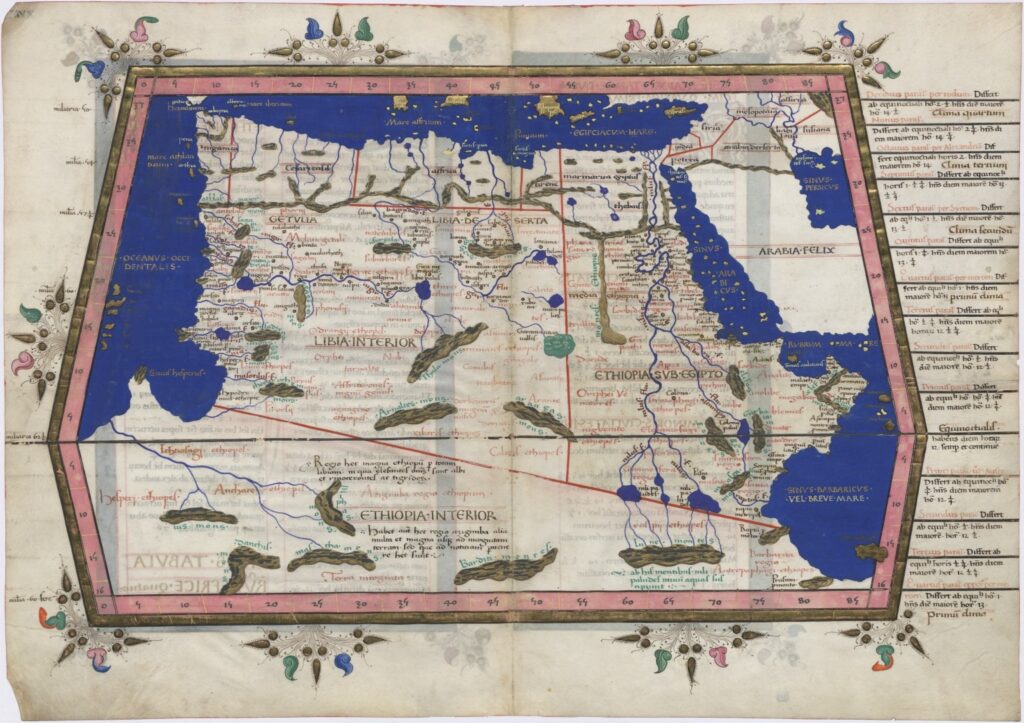
Ptolemy’s Map
Whether Ptolemy was describing the Rwenzori specifically or combining accounts of multiple Central African highland systems into a single geographical concept has been debated by historians for centuries. The balance of modern scholarly opinion leans toward the Rwenzori as the primary referent, given the precision of the latitude description and the consistent snow and ice at the summit, a feature that would have been deeply remarkable and memorable to ancient travellers or traders bringing secondhand reports north along the Nile corridor. The Rwenzori’s permanent snowfields and glaciers, visible on clear days from the plains below, are unique among equatorial African highlands in their permanence and extent, and they provide precisely the kind of astonishing geographical fact that would generate and sustain a tradition of oral and written transmission for centuries.
The name “Lunae Montes”, Mountains of the Moon, may itself carry significant meaning. Some historians have proposed that the name reflects the appearance of the glaciated summit zone at night, when moonlight on the ice would have produced a distinctive glow visible from the plains. Others suggest a connection to lunar symbolism in Bakonjo and the neighbouring cultures that occupied the mountain’s slopes. Whatever the etymology, the name passed from Ptolemy’s Greek into Latin, then into mediaeval Arabic as “Jabal al-Qamar” and eventually into the English “Mountains of the Moon” that remain in use today.
Arab Geographers and the Medieval Tradition
The Arab geographical tradition that flourished between the tenth and fourteenth centuries preserved and elaborated on Ptolemy’s account of the equatorial snow mountains while adding new layers of detail drawn from Arab and Swahili coastal traders who had penetrated the East African interior through trade routes along the coast and up the river systems. The great Arab geographer al-Idrisi, who compiled his comprehensive world geography for Roger II of Sicily in 1154, described the mountains at the source of the Nile in terms consistent with Ptolemy’s account and added details about the rivers flowing from their slopes that align with the Rwenzori’s hydrology.
The Arab cartographic tradition is significant for two reasons. First, it kept the concept of equatorial snow mountains alive in the geographical literature through the European mediaeval period, when the Arab world was the primary custodian of classical geographic knowledge. Second, it reflects an awareness of the Rwenzori that may have been based on more direct commercial knowledge than purely Ptolemaic transmission: Arab and Swahili traders who reached the Great Lakes region of central Africa in the mediaeval period would have encountered the Rwenzori as a dominant geographical feature of the landscape, and their accounts, however filtered, would have influenced the geographical literature reaching literate Arab scholars.
The European mediaeval period, by contrast, largely lost contact with these accounts. The classical knowledge of equatorial African geography became fragmentary in European scholarship during the centuries of reduced engagement with Arabic learning, and the Rwenzori retreated into the realm of legend, a feature of maps but not of direct observation or systematic investigation.
The Age of European Exploration: The Search for the Nile’s Source
The Great Nile Debate and the African Interior
The intellectual and commercial forces that drove European exploration into the African interior in the nineteenth century were many and intertwined: the abolition movement and its opposition to the East African slave trade, the missionary enterprise that sent men like David Livingstone deep into the continent, the commercial interests of the British and other European empires, and the geographical societies of London, Paris, and Berlin that turned the mapping of Africa’s river systems into a project of intense scientific prestige. At the centre of all this activity was a single question that had been theoretically unresolved since Ptolemy: where did the Nile begin?
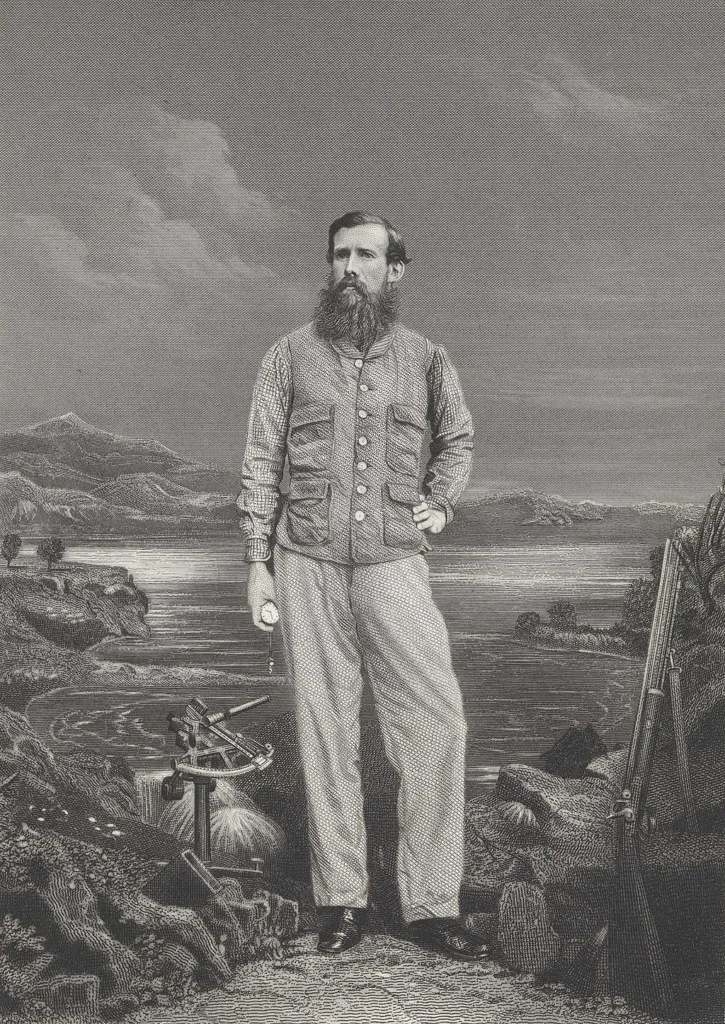
The discoveries of Lake Victoria by John Hanning Speke in 1858 and Lake Albert by Samuel Baker in 1864 had gone a long way toward resolving the question in practical terms, but the precise geography of the lake systems and their connection to the Central African highlands remained unclear. The Rwenzori, as it turned out, sits at the intersection of the Nile and Congo drainage basins, its rivers flowing east into the Albert Nile system and ultimately to the Mediterranean, and west into the Congo system and ultimately to the Atlantic. It is, literally, the continental divide of Africa, and its position was one of the most geographically significant unknowns in nineteenth-century science.
The Naming of the Peaks: Speke, Baker, and Their Honours
The names that European explorers gave to the Rwenzori’s individual peaks reflect the politics and personalities of nineteenth-century exploration as much as any geographical logic. Mount Speke (4,890 m at Vittorio Emanuele Peak) honours John Hanning Speke, who identified Lake Victoria as the Nile’s primary source in 1858. Samuel White Baker, who reached Lake Albert in 1864 and was the first European to connect that lake to the Nile system, gives his name to Mount Baker (4,843 m at Edward Peak). Neither man ever saw the mountains that bear their name, but their contributions to the geographical resolution of the Nile question were judged sufficient to earn them a place in the Rwenzori’s permanent nomenclature.
The other peaks carry different histories. Mount Emin (4,798 m) is named after Eduard Schnitzer, known as Emin Pasha, the German-Egyptian administrator of Equatoria province who was famously “relieved” by Stanley’s 1888–1889 Emin Pasha Relief Expedition, the same expedition during which Stanley first observed the Rwenzori. Mount Gessi (4,715 m) honours Romolo Gessi, the Italian who navigated and circumnavigated Lake Albert in 1876 in Gordon’s Egyptian service. And Mount Luigi di Savoia (4,627 m), named after the Duke of Abruzzi himself, is the only peak in the range named directly for the man who first ascended most of it.
Henry Morton Stanley: The Confirmation, 1888
Henry Morton Stanley arrived at the Rwenzori not by design but by geographical logic. His 1887–1889 Emin Pasha Relief Expedition, a massive, complex, and ultimately traumatic undertaking that crossed equatorial Africa from the Congo coast to the East African lakes, took him through the territory immediately east of the Rwenzori range. On multiple occasions, trekking through the western Uganda plains in heavy cloud, Stanley’s expedition were within sight of mountains they could not see. The Rwenzori, true to its eternal character, was hidden.
On 24 May 1888, near the location of modern Fort Beni in what is now the Democratic Republic of Congo, the cloud broke. Stanley recorded in his journals a sight that struck him with immediate and unmistakable geographical significance: a massive mountain range to the east, its upper slopes covered in snow, rising from the forested plains to an altitude far exceeding anything he had seen in equatorial Africa. He named the range “Ruwenzori”, a phonetic rendering of the name used by local Bakonjo people, meaning approximately “rainmaker” or “cloud king”, and immediately identified it as a probable component of the Nile source system.
Stanley’s observation resolved one of the most persistent questions in Victorian geography. The snowfields he saw were the source of the rivers feeding Lake Albert, which fed the Nile. We had found Ptolemy’s “Lunae Montes”, a place he had suspected, theorised, and searched for across seventeen centuries. Stanley published his account in “In Darkest Africa” in 1890, introducing the Rwenzori to the educated reading public of Europe and America and triggering the era of scientific and mountaineering investigation that would culminate in the Duke of Abruzzi’s expedition sixteen years later.
The Scientific Exploration Era: 1891 to 1905
Scott Elliot and the First Forest Penetration
The first European to actually enter the Rwenzori’s high forests, rather than observing the range from a distance, was the Scottish botanist George Francis Scott Elliot, who reached the mountain in 1891 and 1894 as part of natural history collecting expeditions in east-central Africa. Scott Elliot pushed into the montane forest zone on the southern side of the range, encountering the Rwenzori’s extraordinary botanical communities for the first time and making collections of plant specimens that would later form part of the basis for describing the mountain’s unique endemic flora.
Two of the most significant features of the Rwenzori’s trekking geography bear Scott Elliot’s name permanently. The Scott Elliott Pass, at approximately 4,372 metres, is the dramatic crossing point on the Central Circuit Trail that connects the Bujuku Valley with the southern approach toward the Kitandara Lakes. It was first crossed by Scott Elliott in 1895, and subsequent explorers named it in his honour. It remains one of the defining moments of any Central Circuit trek: the pass crests onto a view of the entire southern Rwenzori high zone, with Mount Baker and Margherita Peak spread simultaneously across the horizon.
The Kilembe Trail officially launched in 2011, but tracing its origins directly to Scott Elliot’s 1895 southern approach carries his legacy in a different way. The trail’s historical reference date of 1895 points to Scott Elliot’s pioneering penetration of the mountain from the Kilembe side as the conceptual ancestor of what is now the most scenically spectacular and best-developed trekking route on the Rwenzori. In a very real sense, every trekker who walks the Kilembe Trail today is following a path opened by a Scottish botanist with a plant press and a compass more than 130 years ago.
The Botanist-Explorers and the Discovery of the Rwenzori’s Ecology
The decade between Stanley’s 1888 observation and the Duke of Abruzzi’s 1906 expedition saw a series of botanical and geographical explorations that began to characterise Rwenzori’s extraordinary ecology. Freshfield and Moore, Wollaston and Doggett, and other British naturalists and explorers made partial ascents, collected botanical and zoological specimens, and produced the first maps of the mountain’s lower zones. Every expedition ascended to unprecedented heights, explored uncharted vegetation zones, and brought back records of previously undocumented species.
The giant lobelia (Lobelia wollastonii, named after Alexander Frederick Wollaston, who collected specimens on the mountain in 1906) and the giant groundsel (Senecio adnivalis) were among the most dramatic discoveries: plants so physically unlike anything in temperate-zone botanical experience that early collectors struggled to communicate their scale and strangeness to readers who had no frame of reference. The Rwenzori’s endemic plants were products of millions of years of evolution in complete isolation; what biologists call “island biogeography” applied vertically rather than horizontally. The mountain’s altitude created an ecological island above the surrounding forest, and that island had been developing its own distinctive community of organisms since long before the first human being looked up at its slopes from the valley below.
The Duke of Abruzzi’s 1906 Expedition: The Rwenzori’s Defining Moment
Luigi Amadeo di Savoia and the Most Important Rwenzori Expedition in History
If the history of the Rwenzori has a single transformative moment, the event that changed everything, that turned the range from a geographical mystery into a mapped and climbed reality, it is the expedition led by Luigi Amadeo di Savoia, Duke of Abruzzi, between May and July 1906. The Duke was one of the most accomplished explorers and mountaineers of the late nineteenth and early twentieth centuries: he had already made the first ascent of Mount Saint Elias in Alaska in 1897, reached a record latitude of 86°34’N in the Arctic in 1900, and climbed extensively in the Alps and Caucasus before turning his attention to the Rwenzori. He arrived in Africa not as an amateur adventurer but as a systematic scientific expedition leader with the resources, the team, and the methodology to produce definitive results.
The 1906 expedition was extraordinary in its scope and achievement. In approximately two months on and around the mountain, the Duke’s team, which included the outstanding photographer and mountaineer Vittorio Sella, the guide Joseph Petigax and his son Laurent, César Ollier, and Josef Brocherel, completed the first ascents of all six major Rwenzori massifs: Stanley, Speke, Baker, Emin, Gessi, and Luigi di Savoia. They were the first to stand on the summits of all the highest peaks in the range, including Margherita Peak on Mount Stanley, which was reached on 18 June 1906. They conducted the first systematic survey and mapping of the range, producing topographic data that remained the authoritative cartographic reference for decades. And they photographed the Rwenzori’s glaciers in meticulous detail; these photographs, compared with current satellite imagery and ground observations, provide some of the most compelling evidence of glacier retreat anywhere in Africa.
The First Ascent of Margherita Peak
The summit of Margherita Peak on 18 June 1906 was a landmark moment in African mountaineering history. The peak, 5,109 metres above sea level, the highest point in both Uganda and what is now the Democratic Republic of Congo, and the third-highest summit in Africa, was named by the Duke in honour of Queen Margherita of Italy, the consort of King Umberto I, and a figure of considerable cultural prestige in Italian public life. The adjacent Alexandra Peak (5,091 m) was named for Queen Alexandra of the United Kingdom. The naming reflects the international diplomatic context of the expedition: the Duke was a member of the Italian royal family, leading an expedition that carried the prestige of Italy’s scientific and mountaineering culture, and the choice of names placed the Rwenzori firmly within the geopolitical imaginary of European imperialism.
The climb itself was technically demanding for its era. The Duke’s party approached the upper mountain from the southwestern side, establishing a high camp in the position that is now used by the Kilembe Trail’s Margherita Camp, a camp that the Duke’s own expedition established and that still carries his expedition’s historical association in every briefing given by today’s guides at the same site. The glacier travel required for the summit, navigating the Stanley Plateau Glacier, now significantly reduced from its 1906 extent, using the primitive crampon technology of the early twentieth century, was a genuine test of the team’s mountaineering skill. Their success opened the Rwenzori to subsequent ascents and established the route that, in modified form due to glacier recession, is still used by guided summit expeditions today.
Vittorio Sella’s Photographs: A Legacy of Comparison
Of all the outputs of the 1906 expedition, perhaps the most enduring in the twenty-first century are Vittorio Sella’s photographs. Sella was one of the finest mountain photographers of his era; his work on Kangchenjunga, the Caucasus, and the Alps had already established him as the preeminent visual documentarian of high mountain environments. His Rwenzori photographs show the range in a condition that is now irrecoverable: glaciers extending hundreds of metres beyond their current terminus, snowfields covering rock faces that are now bare, and an ice mass on the Stanley Plateau that was several times larger than what trekkers encounter today.
The comparison between Sella’s 1906 photographs and current satellite imagery and ground observations is not an abstract scientific exercise. It is a visible, tangible record of climate change happening to one of Africa’s most important water sources. The Rwenzori’s glaciers have lost approximately 80% of their area since 1906, and the rate of recession has accelerated in the twenty-first century. The mountain that the Duke of Abruzzi photographed, the Mountain of the Moon with its dramatic icefields, is being replaced in real time by a mountain of rock and heather, and the change is happening within the span of living memory. Every guide who has worked the Rwenzori for more than a decade has watched the glacier margin retreat.
The Post-Abruzzi Era: Between the Wars and the Rise of Trekking
Shipton, Tilman, and the Interwar Mountaineering Generation
The Duke of Abruzzi’s 1906 expedition had a significant impact on the exploration of Rwenzori. For nearly three decades, no expedition matched its systematic ambition or scientific output. Individual climbers and naturalists continued to visit the range through the 1910s and 1920s, but the interwar period saw relatively modest activity on the mountain compared to the intensive engagement of the Himalayan and Antarctic expeditions that captured the world’s mountaineering imagination.
Eric Shipton and H. W. Tilman, two of the most celebrated British mountaineers of the twentieth century, whose partnership produced a string of landmark Alpine, Himalayan, and East African ascents, visited Rwenzori in 1932 and explored the central high zone with the efficiency and aesthetic sensibility that characterised their approach to all mountain exploration. Shipton and Tilman were not interested in first ascents (the Duke had taken care of those) but in the quality of the mountain experience: the character of the terrain, the ecology of the high zones, and the particular pleasure of moving efficiently through a complex and demanding landscape. Their accounts of the Rwenzori, while less celebrated than their Himalayan writing, capture something of the mountain’s essential character, its wetness, its complexity, and its reluctance to reveal itself that remains recognisable to anyone who has spent time on the range.
The Establishment of the Central Circuit Trail
The formal establishment of a guided trekking route through the Rwenzori, which would become the Central Circuit Trail, took place in the 1950s, during the final years of British colonial administration in Uganda. By this period, the groundwork for the modern trekking industry was being laid across East Africa: Kilimanjaro had developed a system of guided routes and huts, and there was growing interest in formalising Rwenzori’s access structure for the increasing number of European and East African residents who wanted to experience the mountain without the full resources of a scientific expedition.
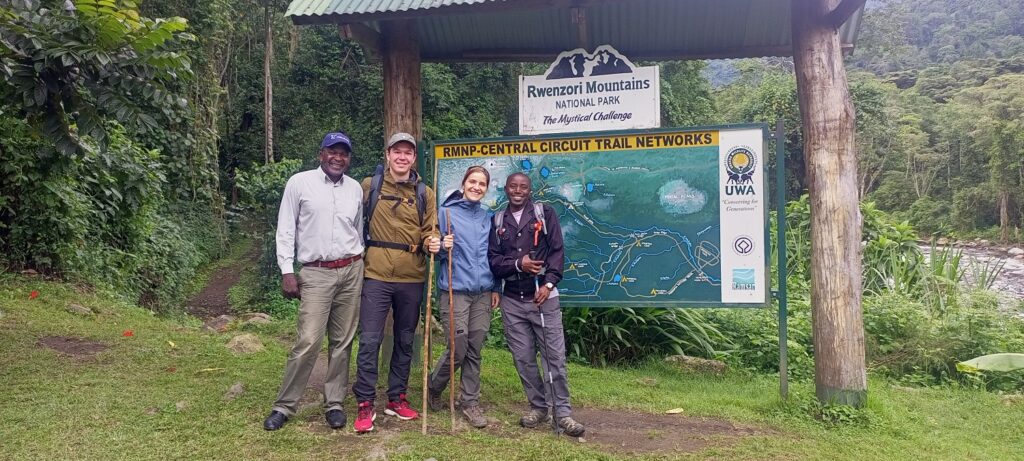
The route that was established beginning at what is now Nyakalengija Gate, passing through Nyabitaba, John Matte, and the upper Bujuku valley before reaching the high camps became the foundation of the Central Circuit Trail as it exists today. The hut system that followed modest wooden shelters at each camp provided the infrastructure that made the route viable for trekkers who were not carrying the full logistical support of an expedition. The community-owned Rwenzori Mountaineering Services (RMS), which manages the Central Circuit today, traces its operational lineage to this establishment period, embodying the continuity of local Bakonjo mountain knowledge and guiding expertise that stretches across more than seventy years of organised trekking on the northern circuit.
Independence, Conservation, and the National Park Era
Uganda’s Independence and the Rwenzori’s First Decades of National Governance
Uganda gained independence from Britain on 9 October 1962, and the Rwenzori Mountains transitioned from a colonial administrative resource to a national heritage managed by the new Ugandan state. The decades that followed were turbulent: the Idi Amin period from 1971 to 1979, the subsequent years of political instability, and the civil conflicts of the 1980s all affected the capacity of the Ugandan government to manage natural resources effectively. The Rwenzori, remote and inaccessible by nature, was somewhat protected from direct human impact by its own geography during these years, but tourism and organised trekking activities declined significantly, and the infrastructure that had developed in the colonial period deteriorated.
The return to relative political stability under the National Resistance Movement government from 1986 onwards created the conditions for the rehabilitation of Uganda’s national parks and the revival of tourism as an economic development tool. The Rwenzori benefited from this rehabilitation period, and by the early 1990s, the political and administrative foundations for formal national park designation were in place.
1991: The National Park Gazette and 1994: UNESCO World Heritage Site
Rwenzori Mountains National Park was formally gazetted in 1991, protecting approximately 1,000 square kilometres of the range within Uganda’s national parks legislation and placing its management under the jurisdiction of the Uganda Wildlife Authority. The gazettement was a critical step in providing the legal protection necessary to manage the competing pressures of trekking tourism, local community land use, and conservation pressures that had been informally managed for decades but now required a formal regulatory framework.
Three years later, in 1994, the Rwenzori Mountains were designated a UNESCO World Heritage Site, one of only a handful of natural World Heritage Sites in Uganda and one of the most significant conservation designations in the history of the East African highlands. The UNESCO designation recognised the range’s exceptional universal value across multiple criteria: its outstanding natural beauty, its significance as a geological formation, and above all its extraordinary biodiversity, specifically the unparalleled vertical sequence of Afroalpine ecosystems and the concentration of Albertine Rift endemic species that it contains. The same year, Bwindi Impenetrable Forest was also designated a UNESCO World Heritage Site, giving Uganda two such designations in a single year and signalling the country’s emergence as one of Africa’s most important conservation destinations.
In 2008, the Rwenzori’s conservation significance was recognised from a different angle when the mountains were designated a Ramsar Wetland of International Importance, acknowledging the range’s critical role as a water tower for the surrounding region. The rivers rising in the Rwenzori’s glaciers and snowfields feed the Nile system to the east and the Congo system to the west, supplying freshwater to millions of people across two drainage basins. The Ramsar designation placed an additional layer of international obligation on the Ugandan government to protect the hydrological integrity of the range.
The Bakonjo People: Indigenous Guardians of the Mountains of the Moon
The history of the Bakonjo, a Bantu-speaking people who have inhabited the mountain’s lower and middle slopes for centuries and whose cultural, spiritual, and economic relationship with the range predates every European cartographer, botanist, and mountaineer by generations, is essential to understanding the Rwenzori Mountains. The Bakonjo call the mountain “Rwenzururu”, from which the colonial name “Ruwenzori” and the modern name “Rwenzori” are derived. Their relationship with the mountain is one of deep interdependence rather than transactional extraction, which characterised much of the European engagement with the range.
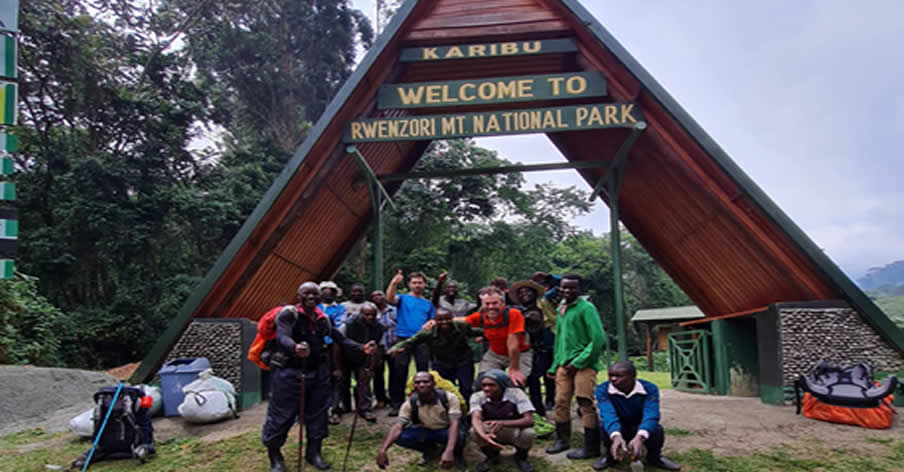
For the Bakonjo, the mountain is not simply a geographical feature. It is the source of the water that sustains their agricultural communities on the foothills, the home of ancestral spirits that require propitiation, and the physical embodiment of a cosmology that connects the human and natural worlds in ways that Western scientific categories do not easily accommodate. The L’Hoest’s monkey, a primate species with a restricted Albertine Rift range that is frequently encountered in the Rwenzori’s lower forest zones, is a cultural totem for many Bakonjo families, protected from hunting by tradition in ways that parallel the formal conservation regulations of the national park. When a guide points out a L’Hoest’s monkey on the trail and explains its significance to the local people, they are transmitting a layer of the Rwenzori’s human history that no European text records.
The Bakonjo’s knowledge of the mountain’s trails, weather patterns, water sources, and ecological communities was the practical foundation on which every European exploration of the Rwenzori was built. Scott Elliot’s penetration of the southern slopes, the Duke of Abruzzi’s approach routes, and every subsequent expedition all depended on Bakonjo’s knowledge and labour as porters, guides, and carriers; without their expertise, the mountains would have remained inaccessible to the European expeditions regardless of their equipment and resources. The Bakonjo porters and guides of the early twentieth century were the direct professional ancestors of the guide and porter teams that operate on the Rwenzori today, and this continuity of knowledge and expertise is one of the most important elements of the Rwenzori’s living heritage.
The modern trekking operations on the Rwenzori, both the Central Circuit managed by Rwenzori Mountaineering Services and the Kilembe Trail managed by Rwenzori Trekking Services, are Bakonjo community enterprises in their staffing, their cultural knowledge base, and their commitment to directing trekking revenues back into local communities. Rwenzori Trekking Safaris directs ten percent of all safari proceeds to supporting Bakonjo communities in the Kilembe area, continuing a relationship between the mountain and its people that stretches back further than any official record.
The Kilembe Trail: A New Chapter in Rwenzori History
The Kilembe Trail represents the most significant development in Rwenzori trekking history since the establishment of the Central Circuit in the 1950s. Officially launched in 2011 by Rwenzori Trekking Services under the supervision of the Uganda Wildlife Authority, the trail formalises and modernises the southern approach to the high peaks that Scott Elliott pioneered in the 1890s. The Kilembe copper mines, which gave the trail its name, had made the Kilembe area an established settlement with road access and logistical infrastructure, and the establishment of a formal trekking route from the mine town to the mountain’s high zone created both a new product for Uganda’s mountain tourism sector and a new economic opportunity for the Bakonjo communities of the southern Rwenzori.
The Kilembe Trail’s development involved significant investment in hut infrastructure by Rwenzori Trekking Services, with newer and better-maintained camps than existed on the Central Circuit, built specifically for the trekking market with improved sleeping facilities and sanitation. The trail’s establishment also incorporated lessons learned from decades of Central Circuit operations: the acclimatisation profile was carefully designed, the camp spacing was calibrated to the daily distances achievable by fit non-specialist trekkers, and the guide training standards were set at the highest level the RTS operation could support.
In a historical context, the Kilembe Trail’s launch marked the beginning of the Rwenzori’s most commercially accessible era, the period in which a broad range of international trekkers, beyond the specialist mountaineering community, could access the high peaks with appropriate support and realistic summit expectations. This democratisation of the mountains, while it brings its own management challenges for conservation and carrying capacity, is a continuation of a trajectory that began with Stanley’s first observation and has been moving consistently toward greater human engagement with this extraordinary range ever since.
The Glacier Recession: The Rwenzori’s Most Urgent Contemporary History
The most consequential ongoing historical process on the Rwenzori Mountains in the twenty-first century is one that no explorer, cartographer, or mountaineer could have anticipated: the rapid recession of the glaciers that have defined the range’s visual identity and hydrological function since the last Ice Age. The comparison between Vittorio Sella’s 1906 photographs and current conditions on Mount Stanley shows a loss of approximately 80% of the glacier surface area that existed at the time of the Duke of Abruzzi’s expedition. Research published by glaciologists tracking the remaining ice suggests that without dramatic intervention in global greenhouse gas emissions, the Rwenzori’s last glaciers may disappear within decades.
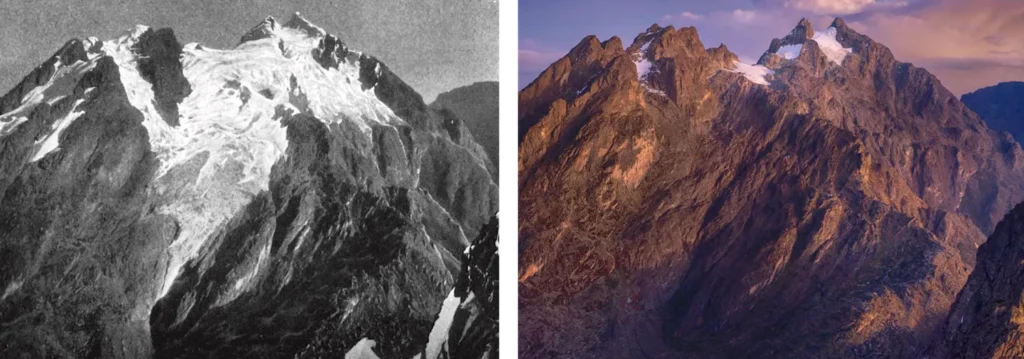
Although the glacier recession is an aesthetic and symbolic loss, it is more than that: the white caps that have made the Rwenzori visually distinctive, that gave it its name as the “snow mountains” in ancient Arabic sources, and that define its identity in the popular imagination are disappearing in real time. The functional consequences are equally serious. The glaciers’ meltwater contributes to the base flow of the rivers feeding the Nile and Congo systems, and their loss will alter the seasonal water availability in a region where freshwater supply is already pressured from population growth and climate variability.
For trekkers visiting the Rwenzori today, the glacier recession has changed the character of the summit section in ways that practical guides need to communicate honestly. The Stanley Plateau Glacier, which the Duke of Abruzzi crossed on gently angled snowfields in 1906, now presents steeper and more technically demanding ice as the glacier has thinned and the angle of the remaining ice has increased. The Uganda Wildlife Authority has installed a new glacier bridge and fixed climbing lines on the critical crevasse section, referenced by the UWA in its current mountain safety communications, as a direct response to the changed glacial terrain. Every summit attempt today is both a mountaineering achievement in the contemporary sense and a witness to an ongoing historical process that is reshaping one of Africa’s most ancient natural monuments.
The Rwenzori in the Modern Era: Conservation, Research, and the Future
The Rwenzori Mountains in the early twenty-first century occupy a position of heightened global significance. As one of the few remaining equatorial glacier systems in Africa, the range is a primary site for climate science research. It has international conservation responsibilities as a Ramsar Wetland and UNESCO World Heritage Site. As the homeland of the Bakonjo people and the economic base of the Kasese district, it is a living human environment as much as a protected natural area. And as one of the finest and most distinctive mountain trekking destinations in the world, it is an increasingly important component of Uganda’s tourism economy.
The establishment of the Bukurungu Wilderness Camping Trail in 2018, a partnership between the Uganda Wildlife Authority and the World Wildlife Fund for Nature represents the most recent significant development in the Rwenzori’s trekking infrastructure, opening the western and northern sections of the range to a new generation of trekkers seeking the most raw and unmediated encounter with the mountain’s wilderness character. The trail passes through terrain that no commercial trekking operation had previously accessed in a formalised way, connecting four alpine lakes Irene, Mughuli, Bukulungu, and Bujuku, in a route of extraordinary ecological richness and physical demand.
The Rwenzori’s history, from Ptolemy’s second-century hypothesis through Stanley’s 1888 confirmation to the Duke of Abruzzi’s 1906 ascent and the UNESCO designation of 1994, is a history of progressive human engagement with one of the Earth’s most remarkable geographical features. That engagement is ongoing: in the climate scientists monitoring the glaciers, in the conservation rangers managing the park boundaries, in the Bakonjo guides and porters whose families have been part of the mountain’s human story for centuries, and in the international trekkers who arrive each year seeking to experience something that has been drawing human attention since before the fall of Rome.
The mountain endures. The glaciers for now remain. And the trail that Scott Elliot opened in the 1890s, that the Duke of Abruzzi ascended in 1906, and that trekkers from every corner of the world walk today is still there: unchanged in its fundamental character, increasingly precious for everything it contains, and still capable of producing, in the person who stands on the summit ridge of Margherita Peak on a clear morning, a feeling that cannot be explained to anyone who has not been there.
Frequently Asked Questions: History of the Rwenzori Mountains.
What is the history of the Rwenzori Mountains?
The Rwenzori Mountains have one of the longest documented histories of any mountain range in Africa. The Greek geographer Ptolemy of Alexandria referenced equatorial snow mountains which he called “Lunae Montes” (Mountains of the Moon) as the source of the Nile in approximately 150 AD, almost certainly referring to the Rwenzori. Arab geographers, including al-Idrisi, preserved this reference in mediaeval cartography. The mountains were formally identified by European explorers when Henry Morton Stanley observed them on 24 May 1888 during his Emin Pasha Relief Expedition, naming them “Ruwenzori”. The first systematic scientific expedition, led by Luigi Amadeo di Savoia, Duke of Abruzzi, made the first ascents of all six major Rwenzori massifs in 1906, including Margherita Peak (5,109 m) on 18 June 1906. The range was gazetted as a national park in 1991 and designated a UNESCO World Heritage Site in 1994.
Why are the Rwenzori Mountains called the Mountains of the Moon?
The name “Mountains of the Moon” derives from the Greek “Lunae Montes” used by Ptolemy of Alexandria in approximately 150 AD, where he described snow-capped equatorial mountains as the source of the Nile. The name passed through the Arab geographical tradition as “Jabal al-Qamar” before being transmitted into European languages. The etymology of the name is uncertain; it may reflect the appearance of glaciated summits gleaming in moonlight when seen from the surrounding plains, or it may carry lunar symbolic significance in the indigenous Bakonjo tradition. The Arabic name for the mountains used in mediaeval cartography means “White Mountain” or “Mountain of the Moon”. Henry Morton Stanley, who confirmed the mountains in 1888, adopted the phonetic rendering “Ruwenzori” from the local Bakonjo name meaning approximately “rainmaker” or “cloud king”, but the Mountains of the Moon designation has persisted in parallel use ever since.
Who was the first person to climb Mount Rwenzori?
The first person to summit the highest peak of the Rwenzori Mountains was Vittorio Sella, leading a team including Joseph Petigax and César Ollier, during the Duke of Abruzzi’s 1906 expedition. Margherita Peak on Mount Stanley (5,109 m) was first reached on 18 June 1906. The Duke of Abruzzi (Luigi Amadeo di Savoia) led the overall expedition, and his team made first ascents of all six major Rwenzori massifs during the same expedition. Prior to 1906, the botanist and geographer G. F. Scott Elliot had penetrated the mountain’s high forests in 1891 and 1894 and crossed the Scott Elliott Pass at approximately 4,372 metres in 1895, but no European had reached the glaciated summits before the Duke’s expedition.
Who named the Rwenzori Mountains?
The Rwenzori Mountains received their current name from Henry Morton Stanley, who adopted a phonetic rendering of the Bakonjo indigenous name during his 1888 Emin Pasha Relief Expedition. The Bakonjo name, sometimes rendered as “Rwenzururu”, means approximately “rainmaker” or “cloud king”, reflecting the mountain’s role as a source of the rivers and rainfall that sustain agricultural communities in the surrounding region. Individual peaks within the range were named by the Duke of Abruzzi and by earlier European geographers: Mount Stanley and Mount Baker were named after the explorers Henry Morton Stanley and Samuel White Baker; Mount Speke after John Hanning Speke; Mount Emin after Eduard Schnitzer (Emin Pasha); Mount Gessi after Romolo Gessi; and Mount Luigi di Savoia after the Duke of Abruzzi himself. Margherita Peak was named after Queen Margherita of Italy; Alexandra Peak after Queen Alexandra of the United Kingdom.
When was the Rwenzori declared a UNESCO World Heritage Site?
The Rwenzori Mountains were designated a UNESCO World Heritage Site in 1994. The designation recognised the range’s outstanding universal value across multiple criteria, including its natural beauty, geological significance as a tectonic block mountain rather than a volcanic formation, and exceptional biodiversity, particularly the unparalleled vertical sequence of Afroalpine ecosystems and the concentration of Albertine Rift endemic species, including the giant lobelia (Lobelia wollastonii) and giant groundsel (Senecio adnivalis), that are found nowhere else on Earth. The Rwenzori Mountains National Park had been gazetted three years earlier, in 1991, providing the legal protected area framework within Uganda. In 2008, the Rwenzori was additionally designated a Ramsar Wetland of International Importance, recognising its critical role as a water source for the Nile and Congo river systems.
What is the significance of the Duke of Abruzzi’s 1906 Rwenzori expedition?
The Duke of Abruzzi’s 1906 expedition is the defining event in the modern history of the Rwenzori Mountains. Led by Luigi Amadeo di Savoia, it achieved the first ascents of all six major Rwenzori massifs – Stanley, Speke, Baker, Emin, Gessi, and Luigi di Savoia – including the first ascent of Margherita Peak (5,109 m) on 18 June 1906. The expedition conducted the first systematic topographic survey and scientific mapping of the range, producing cartographic data that remained the authoritative reference for decades. Vittorio Sella’s photographs from the expedition documented the extent of the glaciers at that time – photographs that, compared with current conditions, provide compelling evidence of approximately 80% glacier area loss over the past 120 years. Today, the Kilembe Trail still uses the Duke’s high camp as the staging point for summit day.
Why are the Rwenzori Mountains geologically unique?
The Rwenzori Mountains are geologically unique in East Africa because they are a horst a block of ancient Precambrian rock thrust upward along fault lines by tectonic forces rather than a volcanic mountain like Kilimanjaro, Mount Kenya, or the Virunga volcanoes. The rock that forms the Rwenzori’s core is among the oldest on the continent, and the range’s distinctive shape — a massive, irregular block of interconnected ridges and valleys rather than a cone or dome reflects this tectonic rather than volcanic origin. The glaciation of the summit zone is a legacy of Ice Age climate conditions; the Rwenzori’s equatorial position means that the glaciers that formed during cooler climatic periods are now under sustained thermal stress from global warming, explaining the rapid recession documented since the late nineteenth century. The mountain’s position straddling the African continental divide with rivers draining east to the Nile and west to the Congo is a direct consequence of its tectonic uplift along the Western Rift Valley escarpment.
What is the history of the Kilembe Trail?
The Kilembe Trail’s historical origin traces to 1895, when the Scottish botanist G. F. Scott Elliot penetrated the southern Rwenzori from the Kilembe side and crossed the Scott Elliott Pass at approximately 4,372 metres establishing the conceptual and geographical precedent for the southern approach to the high peaks. The trail takes its modern name from Kilembe town, historically known for its copper mines, which provided the established settlement and logistical base from which the trail was formalised. The trail was officially launched in 2011 by Rwenzori Trekking Services (RTS), under the oversight of the Uganda Wildlife Authority, as a distinct and complete southern circuit beginning and ending at Kilembe. The launch provided an alternative to the older Central Circuit Trail and introduced a route with newer hut infrastructure, a different camp sequence, and a more dramatic visual approach to the high peaks via Bamwanjara Pass and Scott Elliott’s Pass.