Vegetation Zones of the Rwenzori Mountains: The Complete Ecological Guide to Africa’s Most Extraordinary Mountain Environment
Explore all five vegetation zones of the Rwenzori Mountains, from montane forests to glaciers. A complete guide to giant lobelias, tree heathers, endemic species, and wildlife.
The first thing that strikes you about the Rwenzori is not the altitude. It is the plants. During my first day of guiding in the Rwenzori Mountains, I observed a client from California halt in the middle of the heather zone, gaze up at a twenty-meter tree heather covered in four inches of moss and old man’s beard lichen, and quietly utter, “I don’t think I’m in Africa anymore.” That is precisely the right reaction. The Rwenzori’s vegetation is not African in any conventional sense. It is something older and stranger, and once you have been inside it, it is impossible to forget.
Why the Rwenzori’s Vegetation Zones Are Its Greatest Natural Wonder
The Rwenzori Mountains of western Uganda are designated a UNESCO World Heritage Site for reasons apart from their summit glaciers, extraordinary altitude, or even their geological significance as one of Africa’s few non-volcanic high mountain systems. They are designated because of their vegetation, specifically the unparalleled vertical sequence of five distinct ecological zones that stack from the valley floor at 1,450 meters to the glaciated summit at 5,109 meters. Each zone contains communities of plants and animals that have evolved in relative isolation for millions of years and exist nowhere else in the world in this unique combination or quality.

No other mountain in Africa presents this complete and intact vertical transect from tropical rainforest to equatorial glacier. Kilimanjaro passes through analogous zones, but its volcanic cone shape produces thinner, drier belts, and its proximity to semi-arid savannah creates a very different baseline ecology. Mount Kenya has comparable high-altitude communities but lacks the giant lobelia and groundsel diversity of the Rwenzori. The Virunga volcanoes have impressive Afroalpine communities, but their volcanic origin and geological youth mean their floras lack the deep evolutionary age of the Rwenzori’s endemic species. The Rwenzori stands alone, an ancient tectonic block thrust skyward over millions of years, whose isolation and altitude have allowed an unbroken chain of ecological adaptation from equatorial forest floor to polar ice.
For trekkers, such diversity matters in the most immediate and practical sense: every day on the mountain delivers an entirely new environment. The transition between the Rwenzori’s vegetation zones is not gradual and imperceptible; it is abrupt, dramatic, and unmistakable. On the second morning of the Kilembe Trail, you walk out of the montane forest into a wall of bamboo that clicks and sways in an entirely different acoustic world. An hour later, the bamboo gives way to giant heathers so buried in moss that they seem to belong to a different planet. Three days after that, you are standing in a landscape of giant lobelias whose scale is genuinely difficult to process without a human figure for reference. The Rwenzori is not one mountain; it is five distinct worlds, stacked on top of each other, each more improbable than the last.
This guide covers all five vegetation zones in exhaustive detail: their altitude ranges, their defining species, their ecological logic, their wildlife communities, and what they look and feel like on the ground from the perspective of a trekker walking through them. It is designed to be the single most comprehensive resource on this subject available anywhere on the internet, precise enough to satisfy a botanist, accessible enough to inform a first-time trekker, and grounded in the firsthand experience of many years guiding the routes that pass through every one of these worlds.
The Five Vegetation Zones: Quick Reference
Before going deep into each zone, the table below provides a concise reference for all five, including altitude ranges, defining plant species, key wildlife, and the trekking days on which each zone is traversed on the two main Rwenzori routes.
| Zone |
Alt. Range |
Key Vegetation |
Key Wildlife |
Trail Days (Kilembe) |
Trail Days (Central Circuit) |
| Montane/Afro-Montane Forest |
1,450–2,600m |
Podocarpus, Prunus africana, Ficalhoa laurifolia, bamboo fringe, climbing plants, mosses |
Rwenzori turaco, L’Hoest’s monkey, black & white Colobus, three-horned chameleon, forest elephant (lower) |
Day 1 |
Day 1 |
| Bamboo-Mimulopsis Zone |
2,500–3,000 m |
Giant bamboo (Yushania alpina), Mimulopsis elliotii, transitional mosses |
Chimpanzee (occasional), blue monkey, Rwenzori batis, Handsome francolin |
Day 2 (early) |
Day 2 (early) |
| Heather-Rapanea (Giant Heather) Zone |
3,000–3,500 m |
Erica arborea (giant tree heather), Rapanea rhododendroides, Usnea lichen (old man’s beard), abundant mosses |
Malachite sunbird (lower range), Rwenzori double-collared sunbird, hyrax, duiker |
Days 2–3 |
Days 2–3 |
| Afroalpine/Moorland Zone |
3,500–4,500 m |
Giant lobelia (Lobelia wollastonii), giant groundsel (Senecio adnivalis / Dendrosenecio), everlasting flowers (Helichrysum), tussock grass (Carex bequaertii) |
Malachite sunbird (peak population), scarlet-tufted sunbird, Rwenzori red duiker, leopard (rare) |
Days 3–6 |
Days 3–5 |
| Nival (Glacial/Rocky Summit) Zone |
4,500–5,109 m |
Rock, ice, snow, scattered lichens on exposed rock faces; virtually no vascular plants |
Non-resident; occasional raptors (augur buzzard, lammergeier) overhead |
Summit Day 6 |
Summit Day 5 |
The Ecological Logic: Why the Rwenzori Has These Zones
The Rwenzori’s exceptional vegetation zonation is the product of three interacting factors: altitude, moisture, and evolutionary time. The altitude gradient from 1,450 meters at the Kilembe trailhead to 5,109 meters at Margherita Peak creates a temperature range equivalent to moving from central Africa to the sub-Arctic within a horizontal distance of roughly 30 kilometers. Every 1,000 meters of altitude gain reduces mean annual temperature by approximately 6°C, so the summit environment is roughly 22°C colder than the valley floor. This temperature gradient is the primary driver of vegetation change, but it interacts with moisture and solar radiation in ways that produce the specific communities of each zone.
The moisture dimension is equally critical. The Rwenzori is one of the wettest mountain ranges in Africa, receiving over 2,500 millimeters of annual rainfall at mid-altitude stations and considerably more in the forest zones. This exceptional wetness is a product of the range’s position: moist air masses from the Congo basin hit the western escarpment and are forced upward, cooling rapidly and depositing moisture as cloud, rain, and, at altitude, ice. The mountain creates its own weather, and the resulting moisture regime sustains forest communities at altitudes that would be moorland or desert on drier African mountains.
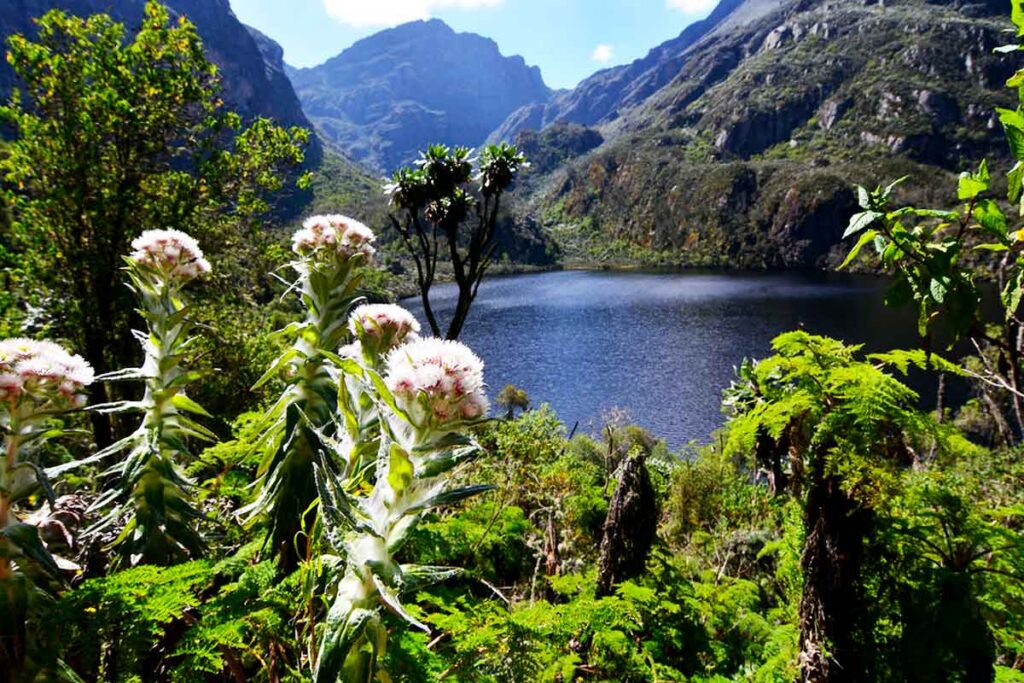
The evolutionary time dimension provides the Rwenzori its uniqueness. This mountain has been high since before the last Ice Age, and its isolation from other equatorial highland systems has allowed species to evolve along independent trajectories for millions of years. The giant lobelias and giant groundsels are the most famous examples; they are neither the ancestors nor the descendants of their counterparts on other African mountains but parallel evolutionary experiments, arriving at similar adaptations (gigantism, woolly leaf bases, internal water storage) through different genetic pathways. The Rwenzori’s flora is what happens when you take a collection of colonizing plant species, present them with an isolated high-altitude environment, and leave them alone for long enough.
Zone One: The Afro-Montane Forest (1,450m – 2,600m)
The Architecture of the Lower Forest
The Afro-Montane Forest Zone is where every Rwenzori trek begins, and its first impression warm, humid, loud with bird calls, and dense with layered vegetation sets the sensory baseline against which every subsequent zone will be measured. At the Kilembe trailhead, the forest begins almost immediately: within fifty meters of the park gate, the cultivated land and eucalyptus of the foothills give way to the true montane forest, and the acoustic and visual transition is instant. The light changes from direct to diffused, filtered through multiple canopy layers. The temperature drops noticeably. The sound of the town disappears and is replaced by the continuous background of insect noise, water, and birdsong.
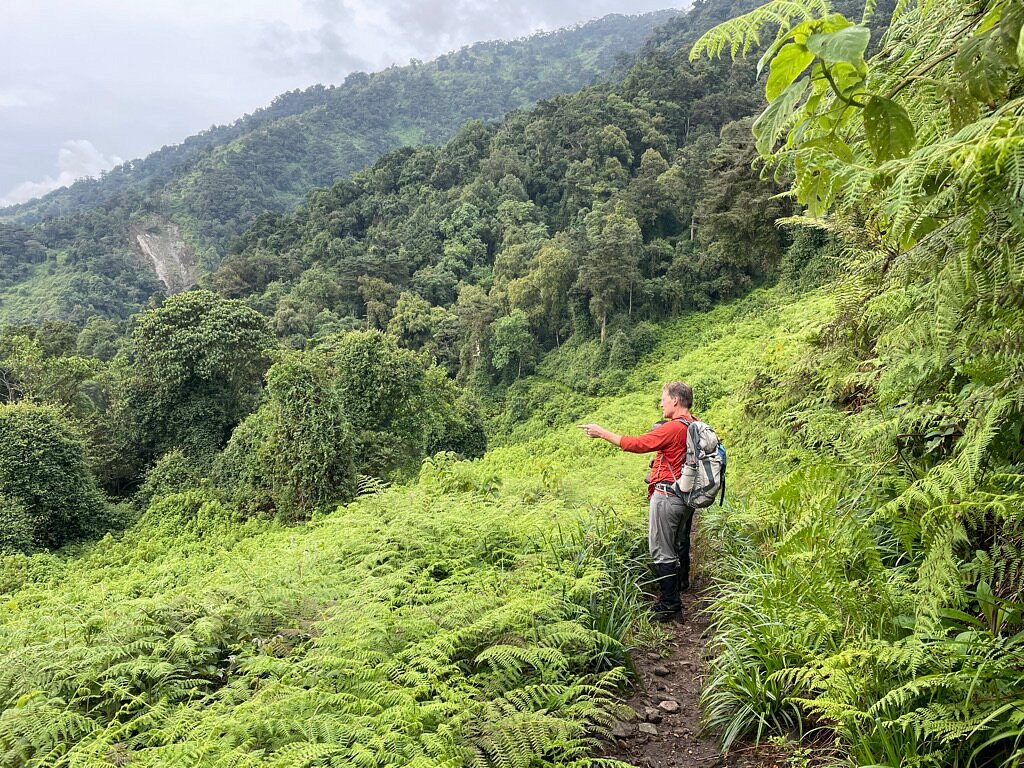
The structural architecture of the lower Rwenzori forest is characterized by three to four distinct vertical layers. The emergent layer, the tallest trees whose crowns extend above the main canopy, is dominated by Podocarpus milanjianus and Prunus africana (the African cherry), both of which can reach thirty meters and above. Their trunks are massive, buttressed at the base, and wound with climbing plants, including aroids and several species of fig. The main canopy layer below them, typically at fifteen to twenty meters, includes Ficalhoa laurifolia, Macaranga kilimandscharica, and various species of Syzygium and Cassipourea. Below this, a sub-canopy of smaller trees and tall shrubs provides a third layer, and a ground layer of ferns, mosses, and shade-tolerant herbs completes the vertical sequence.
The total effect is one of layered, humid complexity, with every surface colonized, every gap filled, and every fallen trunk immediately occupied by a new generation of competing plants. The Rwenzori’s forest is not simply old growth: it is old growth saturated with moisture, and the mosses and lichens that colonize every available surface impart it a density and texture that distinguishes it visually and ecologically from any other montane forest in East Africa.
Wildlife of the Lower Forest
The Afro-Montane Forest Zone is the Rwenzori’s most species-rich environment in terms of animal diversity, and for trekkers with an interest in wildlife, the first day on either the Kilembe Trail or the Central Circuit is typically the most productive for encounters. The forest harbors a complete primate community: Black-and-white Colobus monkeys (Colobus guereza) are the most frequently seen, moving through the upper canopy in groups of five to fifteen individuals, their long black-and-white mantles unmistakable in the canopy backlight. L’Hoest’s monkeys (Cercopithecus lhoesti), a cultural totem of the Bakonjo people, are more secretive, typically seen in smaller groups in the lower and mid-canopy, and identifiable by their white bib and dark facial mask. Blue monkeys (Cercopithecus mitis) complete the monkey community of the lower forest.
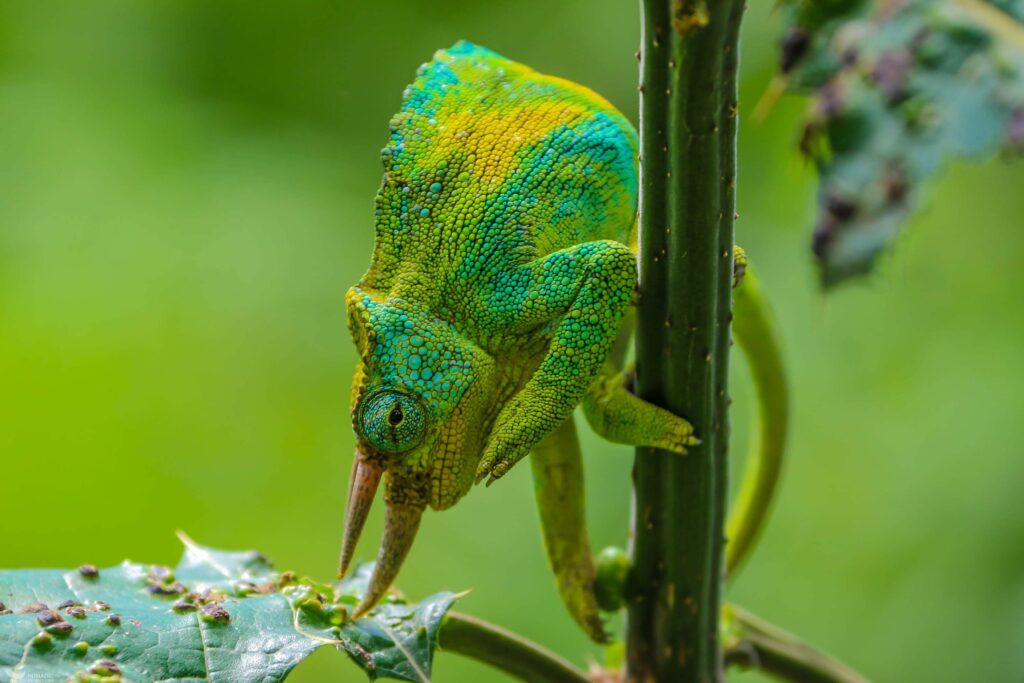
The Rwenzori turaco (Gallirex johnstoni) is the forest’s most iconic bird and one of the most sought-after sightings in the entire Albertine Rift region. Its plumage is a deep metallic green on the body with a brilliant crimson flash on the wing primaries visible only in flight, and it is one of the most striking moments in East African birding when a turaco breaks cover and the red wings open. Other signature bird species of the lower forest include the handsome francolin, the Rwenzori batis, the strange weaver, the Archer’s robin-chat, and the cinnamon-chested bee-eater. Forest elephants are present in the lower zones, though their shyness and the density of the vegetation mean they are heard far more often than seen; a distant trumpet call at 2,000 meters in the pre-dawn dark is one of the Rwenzori’s most atmospheric experiences.
The Key Forest Trees and Their Ecological Roles
Podocarpus milanjianus, the East African yellowwood, is a conifer in an environment usually dominated by angiosperms, and its presence in the Rwenzori’s forest canopy is a marker of the range’s ancient ecological character. Conifers in tropical African montane forests are relict species, survivors from cooler climatic periods when conifer-dominated vegetation extended further into equatorial latitudes. The Rwenzori’s Podocarpus stands are among the finest remaining examples of this community in East Africa, and their conservation is part of the rationale for the mountain’s UNESCO designation.
Prunus africana is both ecologically important and commercially significant; its bark is harvested for pharmaceutical use (it contains compounds used in treating prostate conditions), making it one of the most overexploited trees in African montane forests. Within the national park, Prunus africana is protected from harvest, and the Rwenzori population represents one of the most intact remaining stands of this species in Uganda. Walking past a large Prunus africana, its deep-furrowed dark bark is immediately recognizable once you know the tree. You are walking past something that is simultaneously a botanical specimen of conservation significance and a living component of the forest architecture that the Duke of Abruzzi’s expedition photographed in 1906.
Zone Two: The Bamboo-Mimulopsis Zone (2,500m – 3,000m)
The Bamboo-Mimulopsis Zone is the briefest of the Rwenzori’s five vegetation belts in vertical extent, but it is among the most distinctive in sensory character. Yushania alpina, the mountain bamboo, sometimes classified as Arundinaria alpina, is a giant grass that forms dense, near-impenetrable stands in the transitional zone between the lower montane forest and the giant heather community above. Its culms (stems) reach eight to twelve meters in height, their feathery leaf clusters forming a roof of swaying green that turns the forest light from diffuse gold to a cool, greenish blue.
Walking through the bamboo zone is one of the most distinctive experiences on the Rwenzori’s lower trail. The stems click and rustle constantly in any movement of air, producing a sound unlike anything in the forest below. The ground is covered in a deep mat of fallen bamboo leaves, soft and slightly springy underfoot. In the wet season, this layer turns to a saturated slurry that makes footing challenging on the steep sections, a genuine test of boot quality and walking technique. The bamboo zone’s trail sections are the most technically demanding of the lower mountain for precisely this reason: steep and heavily stepped, and in wet conditions, they genuinely require careful balance and occasionally the use of both hands for stability.
Mimulopsis elliotii, named in honor of the botanist Scott Elliot, who first documented the Rwenzori’s southern zones, is a sprawling shrub with large, soft leaves and small white tubular flowers that blooms in mass synchronized events every seven to eight years, filling the forest floor with white for several weeks before dying back completely. The massed die-off after flowering produces deep drifts of yellowing leaves that temporarily transform the appearance of this zone. Between flowering years, the Mimulopsis forms the understory to the bamboo canopy and contributes significantly to the zone’s distinctive humid, enclosed character.
Zone Three: The Giant Heather-Rapanea Zone (3,000m – 3,500m)
The Most Visually Extraordinary Zone on Any African Mountain
If you asked every guide who has ever worked the Rwenzori to name the zone that most reliably stops trekkers dead in their tracks, the answer would be nearly unanimous: the giant heather zone. Not because of the altitude, not because of a view, but because of the plants themselves. Erica arborea, the tree heather, grows to fifteen to twenty meters in the Rwenzori’s heather zone, a height that would be remarkable for any heather anywhere in the world. But height alone is not what produces the effect. What produces the effect is the moss.
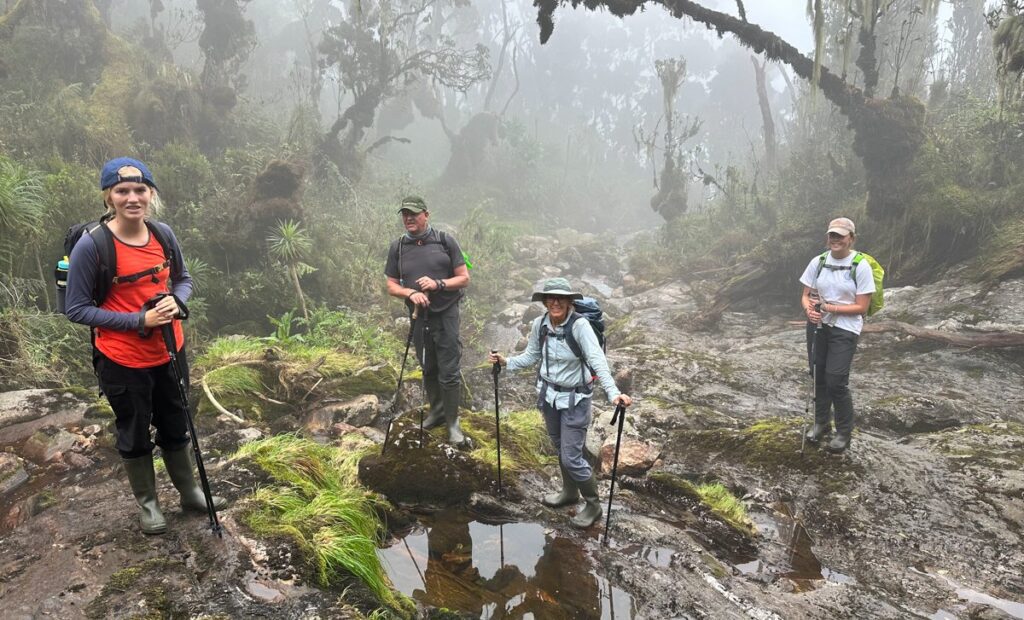
Every surface of every giant heather tree trunk, branch, twig, and in some cases individual leaf is covered, saturated, and in many places submerged beneath a community of mosses and lichens so dense and varied that the tree structure beneath becomes almost incidental. The dominant lichen is Usnea, old man’s beard, which hangs in long, trailing grey-green curtains from every branch, stirring in the slightest air movement like a living curtain. The mosses are of many species, forming deep cushions of green and gold on the horizontal surfaces, building up in layers on the trunk bases until some trees appear to be growing out of solid moss rather than soil.
The visual effect is entirely unlike any other mountain vegetation in Africa and only partially comparable to the mossy forests of cloud-zone mountains in other equatorial regions (some New Zealand forests, parts of the Borneo highlands, and the montane forests of Central America). It is the combination of scale, density, and moisture that makes the Rwenzori heather zone unique: the trees are tall enough to be genuinely imposing, the moss is deep enough to be genuinely surreal, and the permanent cloud that keeps the zone in near-constant moisture produces an atmospheric quality of diffuse light, muted colors, and the sound of water everywhere that imparts this environment a mood unlike any other mountain landscape on Earth.
Rapanea and the Understory
Rapanea rhododendroides, the rapanea shrub, forms the dominant understory beneath the giant heathers and confers the zone its full scientific designation as the Heather-Rapanea Zone. Rapanea is a small-leaved shrub with a dense, tangled growth form that fills the spaces between the heather trunks and extends onto the zone’s more exposed ridges where the heathers thin out. Its leaves have a waxy surface that sheds moisture efficiently, an adaptation to the zone’s near-continuous saturation, and its growth form creates a physical labyrinth at knee-to-waist height that contributes to the enclosed, maze-like quality of movement through this zone.
The heather zone’s ground layer is among the most species-rich in the entire mountain. Mosses of extraordinary diversity cover every surface. Ferns colonize sheltered pockets. Small flowering plants push through the moss mat in the brighter openings. The diversity at ground level is easy to miss when the eye is drawn upward to the spectacular tree structures above, but botanists who have studied the Rwenzori’s heather zone have identified moss and lichen communities of exceptional richness, with some species known only from this mountain system.
The Heather Zone in the Trekking Context
On both the Kilembe Trail and the Central Circuit Trail, the giant heather zone is typically traversed on Day 2 of the trek. On the Kilembe Trail, the approach to Mutinda Camp at 3,588 meters takes the trekker deep into the heart of the heather forest; the Mutinda Lookout at 3,975 meters sits above the heather zone’s upper boundary and provides a retrospective view back over the heather canopy from above. On the Central Circuit, the climb from Nyabitaba toward John Matte Hut at 3,380 meters passes through the zone’s full extent. Both trails spend more time in the heather zone in terms of walking hours than in any other single vegetation belt, and most trekkers report that their photographs from this section are among the most distinctive of the entire expedition.
Zone Four: The Afroalpine Moorland Zone (3,500m – 4,500m)
Giant Lobelias and Groundsels: Africa’s Most Spectacular Alpine Plants
Above the giant heather zone, the vegetation opens out. The trees disappear. The sky expands. And then, on every slope around you, the giants appear. The Afroalpine Zone of the Rwenzori is defined by two plant groups that are unique to the high mountains of equatorial Africa: the giant lobelias and the giant groundsels, and encountering them for the first time is one of the genuinely mind-altering moments of any mountain trek.
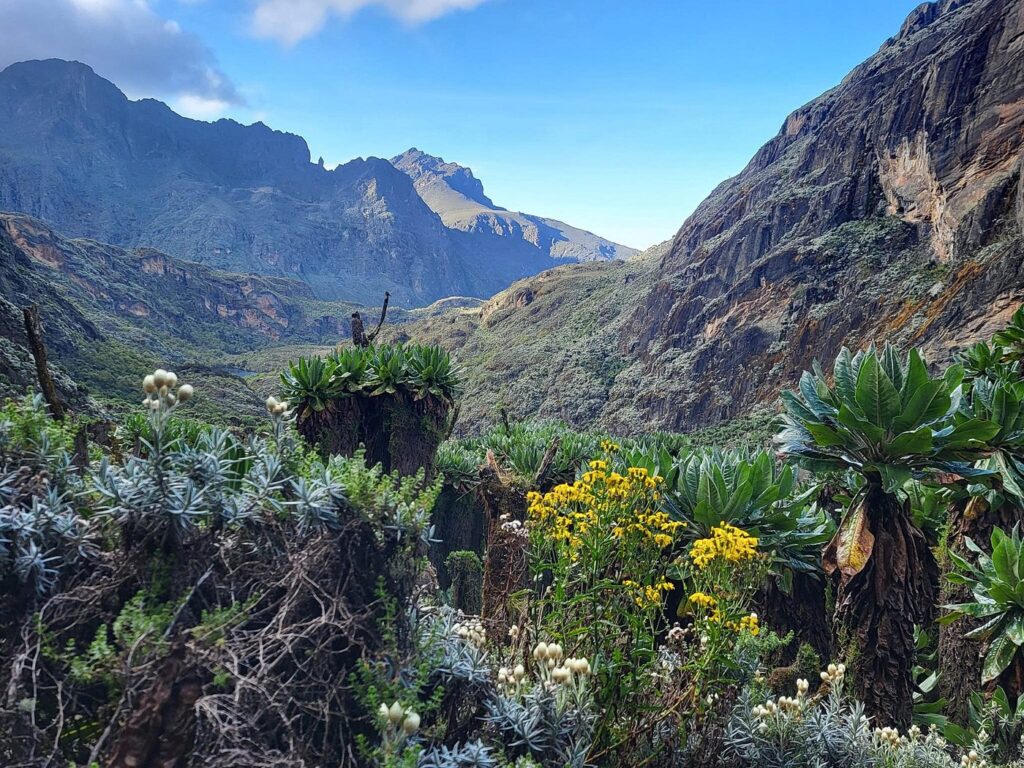
Lobelia wollastonii, the giant lobelia, grows in the Rwenzori’s Afroalpine Zone to heights of four to five meters and occasionally more. It is a monocarpic plant: it lives for years, sometimes decades, as a ground-hugging rosette of strap-like leaves before sending up a single massive flowering spike densely packed with small tubular blue flowers. After flowering, which can take several years, the plant dies. But the scale of the flowering spike, the density of its packing, and the sheer improbability of this form of growth at 4,000 meters above sea level impart the giant lobelia a presence that photographs consistently fail to convey. To understand it, you must stand next to one, look up, and see that the flower spike is above your head.
The giant groundsel, Senecio adnivalis, and closely related Dendrosenecio species are the giant lobelia’s companions and, in many ways, its structural opposite. Where the lobelia is monocarpic, sending up a single spike and dying, the groundsel is a perennial tree-like plant with a distinctive architectural form: a branching trunk topped with large, cabbage-headed rosettes of leaves that radiate outward from the branch tips. The interior of each rosette is filled with closely packed young leaves that protect the meristematic growing tip from frost damage, a crucial adaptation at altitudes where night temperatures frequently fall below zero. The old dead leaves hang down the trunk in a skirt of brown and provide additional insulation instead of being shed.
Both the giant lobelia and the giant groundsel demonstrate a phenomenon called gigantism in alpine plants: the tendency of certain plant groups to produce much larger forms at high altitudes on tropical mountains than at lower altitudes or on temperate mountains. The ecological logic involves the extreme diurnal temperature fluctuation of equatorial high mountains: temperatures can swing from above zero to several degrees below zero and back within a single twenty-four-hour period, a thermal stress that rewards plants with high thermal mass and efficient insulation. The giant form achieves both, and the convergent evolution of gigantism in multiple unrelated plant groups on the separate high mountains of equatorial Africa, including the Rwenzori, the Virungas, the Ethiopian Bale Mountains, Mount Kenya, and Kilimanjaro, is one of the most compelling examples of parallel evolution in the biological world.
The Bogs, Tussocks, and Everlasting Flowers
The Afroalpine moorland of the Rwenzori is not simply a landscape of giant plants. Between the lobelia and groundsel stands, the ground is occupied by dense communities of tussock sedge (Carex bequaertii), everlasting flowers (Helichrysum citrispinum and related species), and various low-growing herbs and grasses that together create the characteristic texture of the high moorland. The tussock sedge forms dense, discrete hummocks of elevated cushions of grass on the accumulated dead material of previous seasons that are the principal navigational challenge of the high bogs. Walking through a tussock field requires either stepping from hummock to hummock (precarious, ankle-straining, requiring constant attention) or stepping between the hummocks into the wet gap between them (boots-wetting, slower, but more stable). The boardwalks that RMS has installed in the most saturated sections of the Central Circuit’s Bigo Bogs are a significant practical improvement, but large sections of the Afroalpine moorland on both routes remain un-boardwalked and genuinely demanding in wet conditions.
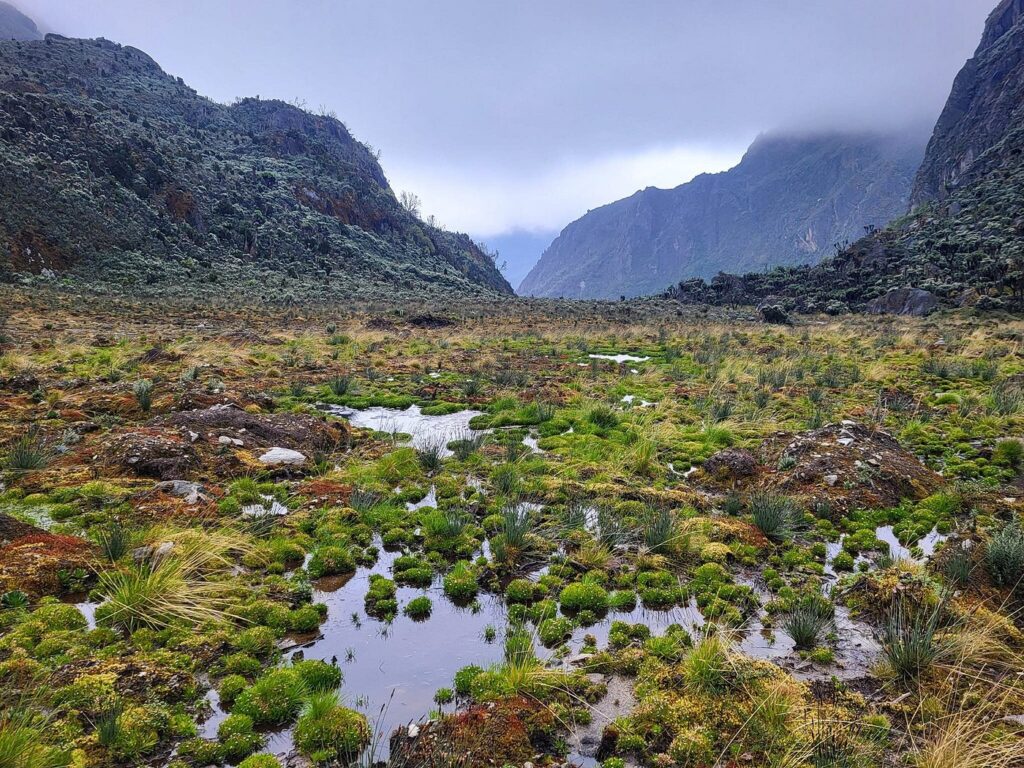
The everlasting flowers are among the Afroalpine zone’s most visually striking non-giant plants. Helichrysum species, straw flowers, or everlastings produce clusters of papery yellow-white or orange flowers on erect stems that dry in place rather than wilting, creating a landscape that appears simultaneously alive and crystallized. At the end of the dry season, when the flowers are fully developed and the surrounding grass is golden, the moorland has a quality of preserved suspension, a landscape arrested mid-bloom that makes it one of the most distinctive photographic environments on any East African mountain.
Bamwanjara Pass and the High Camp Perspectives
The Afroalpine Zone encompasses the most dramatic viewpoints of both main Rwenzori trails. On the Kilembe Trail, Bamwanjara Pass at 4,450 meters, reached on Day 4 of the standard itinerary, is the single most dramatic panoramic viewpoint on the trail, opening simultaneous sight lines to Mount Stanley, Mount Baker, and Weismann’s Peak from a position deep inside the Afroalpine zone with giant lobelias and groundsels framing the view. Hunwick’s Camp at 3,974 meters and Bugata Camp at 4,062 meters both sit within this zone. On the Central Circuit, the Bigo Bogs section with its boardwalks is the most famous Afroalpine experience, followed by the approach to Bujuku Hut at 3,960 meters beneath the north face of Mount Stanley.
The Bird and Animal Life of the Afroalpine Zone
Animal diversity in the Afroalpine zone is lower than in the forest zones below, but the species present are highly specialized and often endemic to the Albertine Rift highlands. The Malachite Sunbird (Nectarinia famosa) is the zone’s most charismatic resident, an iridescent emerald-green bird with a long decurved bill and an obvious affinity for the giant lobelia’s flower spikes, which it pollinates as it extracts nectar. Its presence around the lobelia stands is so consistent that it functions as an index species: where you see giant lobelias in flower, you will observe Malachite Sunbirds working them. The Scarlet-tufted Sunbird (Nectarinia johnstoni) is a higher-altitude specialist, approaching the upper boundary of the Afroalpine zone and occasionally found above 4,000 meters.
The Rwenzori red duiker (Cephalophus rubidus) is a small forest antelope that extends from the upper heather zone into the lower Afroalpine moorland. It is shy and typically seen at dusk or dawn, grazing on the moorland margins. Leopards are present in the Rwenzori, with occasional tracks and signs found in the Afroalpine zone, though sightings are extremely rare. The Rwenzori has no resident large herbivores in the high zones; no buffalo, elephant, or giraffe extend above the forest boundary, which means the Afroalpine vegetation is shaped primarily by climate, fire, and the browsing of small mammals rather than by large-mammal grazing pressure.
Zone Five: The Nival (Glacial Summit) Zone (4,500m – 5,109m)
Above approximately 4,500 meters, the Rwenzori’s vegetation effectively ends. The Nival Zone, the domain of rock, ice, snow, and the remnant Stanley Glacier, is not a vegetation zone in the conventional sense. It is a zone defined by the absence of vegetation except for scattered cryptogamic communities: lichens colonizing exposed rock faces, occasional isolated mosses in sheltered depressions, and at the very upper boundary of vascular plant life, small cushions of Alchemilla subnivalis, a lady’s mantle that represents perhaps the final vascular plant before the ice. No woody plants, no grasses in any established community, and no resident animals. The nival zone belongs to the mountain itself, to the physics of temperature and pressure, and to the trekkers who climb through it on their way to Margherita Peak at 5,109 meters.
The transition from the upper Afroalpine zone to the nival zone is abrupt and unmistakable. Leaving Margherita Camp at 4,485 meters in the pre-dawn dark of summit day, crampons are fitted at the glacier margin, a physical boundary between the world of vegetation and the world of ice that is also a boundary between two completely different modes of movement, two different sets of skills, and two different categories of risk. The Rwenzori’s glaciers are the diminishing remnants of an ice system that has been retreating since the early twentieth century, and the line where the last plants give way to the first ice is itself a changing line moving upward each decade as the glacier retreats.
Lichens, which are made up of a fungus and an algae working together, are found on rock surfaces in the snowy area, even on the highest rocks near the summit. They are the pioneers: the first organisms to colonize bare rock, beginning the long process of soil formation that will eventually allow more complex plant communities to establish if the climate ever stabilizes. On the Rwenzori, where the glaciers are retreating and leaving new bare rock exposed on an annual basis, lichen colonization is actively visible on recently deglaciated rock surfaces, a living demonstration of primary succession in one of its most extreme forms.
What Makes the Rwenzori’s Vegetation Globally Unique
The Island Biogeography Principle
The concept of island biogeography, which observes that isolated areas of suitable habitat develop distinctive species communities through the combined processes of colonization, evolution, and extinction, applies with extraordinary force to the Rwenzori’s high-altitude vegetation. The mountain’s Afroalpine zone above 3,500 meters is, in ecological terms, an island: surrounded on all sides by lower-altitude environments in which the Afroalpine species cannot survive, separated from comparable habitats on other equatorial African mountains by hundreds of kilometers of unsuitable intervening terrain, and effectively isolated from genetic exchange with other mountain populations for long enough that speciation has occurred in multiple lineages.
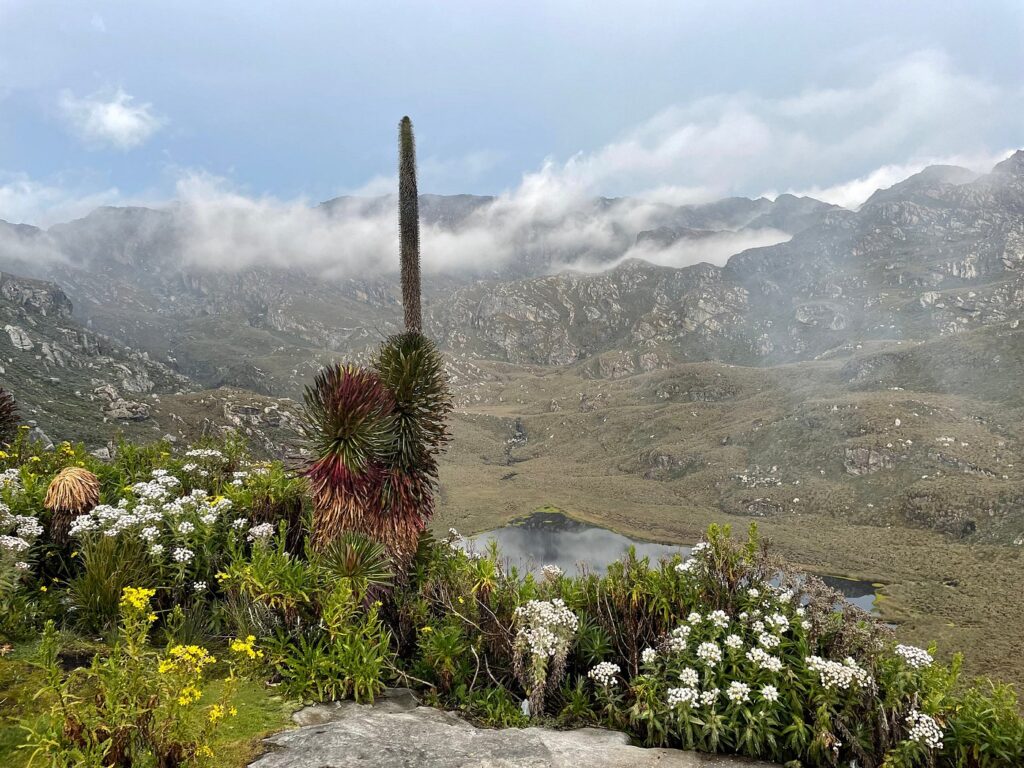
The result of this island isolation is the phenomenon that botanists call Afroalpine endemism: the development of plant species that exist only in the high-altitude zone of one or a small number of equatorial African mountains. The Rwenzori’s giant lobelia (Lobelia wollastonii) and giant groundsel (Senecio adnivalis) are Rwenzori-specific or near-endemic species, distinct from though related to their counterparts on Mount Kenya, Kilimanjaro, and the Virungas. Their distinctiveness results from isolation and independent evolution, meaning that visiting the Rwenzori’s Afroalpine zone offers a botanical world that cannot be fully experienced on any other mountain.
The Survival of the Last Equatorial Ice Age: A Refugium
The Rwenzori’s flora is unique not just for its species but also for what it has endured. During the last Ice Age, when much of equatorial Africa’s forest cover retreated to isolated refugia as the climate cooled and dried, the Rwenzori’s high moisture regime produced by its orographic weather system allowed forest communities to persist when surrounding lowland forests were fragmenting or disappearing. The Rwenzori is considered one of Africa’s major forest refugia: a place where forest-dependent species survived the Ice Age and from which the surrounding forest recolonized the landscape as the climate warmed.
This refugium status explains several features of the Rwenzori’s biology that would otherwise be puzzling. The extraordinary diversity of Albertine Rift endemic species of birds, mammals, plants, and insects found only in the highland forests of this region reflects the long period of isolation during which populations developed distinctive characteristics. The Rwenzori’s forest is not simply old-growth tropical forest; it is a forest with a deep evolutionary history as a sanctuary, and the species within it carry the genetic signature of that history in their DNA.
Key Endemic and Signature Species of the Rwenzori’s Vegetation Zones
The table below presents the key endemic and ecologically significant species of the Rwenzori Mountains, organized by vegetation zone, with notes on their distinctive features and ecological roles.
| Species |
Type |
Zone |
Notable Feature |
| Lobelia wollastonii |
Giant lobelia |
Afroalpine (3,500–4,500 m) |
Reaches 5m+ in flower; single stem terminates in a massive spike; named for explorer A. F. Wollaston |
| Senecio adnivalis / Dendrosenecio |
Giant groundsel |
Afroalpine (3,500–4,500 m) |
Cabbage-headed rosettes on tall trunks; drainage channels in leaves prevent ice accumulation |
| Erica arborea (tree heather) |
Giant heath tree |
Heather zone (3,000–3,500 m) |
Grows to 15–20m; trunk diameter approaching 1 m; buried under kilograms of moss and Usnea lichen |
| Impatiens stuhlmannii |
Rwenzori balsam |
Forest & heather zones |
Brilliant pink-purple flowers endemic to the Albertine Rift highland forests |
| Lobelia gibberoa |
Giant lobelia (lower) |
Montane forest fringe (2,500–3,500 m) |
Lower-altitude lobelia species; forms dense stands in boggy montane clearings |
| Helichrysum citrispinum |
Everlasting flower |
Afroalpine moorland |
Dense yellow-white clusters that persist dried on the plant through the dry season |
| Carex bequaertii |
Tussock sedge |
Afroalpine moorland |
Forms dense hummocks that create the characteristic ankle-twisting terrain of the high bogs |
| Alchemilla subnivalis |
Lady’s mantle |
Afroalpine/nival boundary |
Ground-hugging rosette plant at the uppermost limit of vascular vegetation |
| Rwenzori turaco (Ruwenzori turaco, Ruwenzori Turaco) |
Bird (Gallirex johnstoni) |
Montane forest (1,500–2,800 m) |
Brilliant crimson wing patches visible in flight; the Rwenzori’s most iconic bird |
| L’Hoest’s monkey (Cercopithecus lhoesti) |
Primate |
Montane forest (1,500–2,500 m) |
Cultural totem of the Bakonjo people; white bib and dark face distinctive; Albertine Rift endemic |
How to Experience the Vegetation Zones: Practical Guidance for Trekkers
The Complete Transect: Why the Full Summit Trek Is the Best Botanical Experience
The most complete experience of the Rwenzori’s five vegetation zones is provided by a full summit expedition, which necessarily passes through all five zones in sequence during the ascent and returns through the same sequence in reverse during the descent. The 8-day Kilembe Trail and the 7-day Central Circuit both offer this complete journey, and the return trip through the zones, seeing them in a different order and with a new perspective after reaching the summit, feels very different from the climb up instead of just being the same.
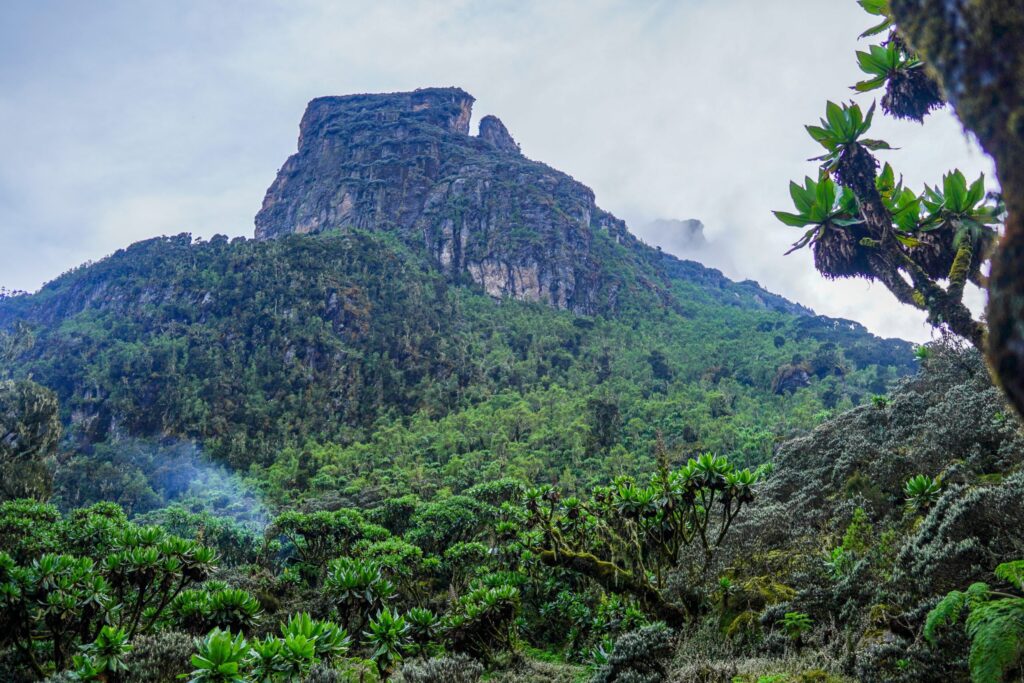
For trekkers who cannot commit to a full summit expedition, the 4-day Mutinda Lookout trek on the Kilembe Trail reaches the upper boundary of the Afroalpine zone at 3,975 meters, passing through the montane forest, bamboo, heather, and lower Afroalpine zones in a compact and scenically outstanding four-day loop. It is the strongest single option for experiencing four of the five vegetation zones without the technical demands of the nival and glacier section. For trekkers with only two or three days, the 3-day Mahoma Loop on the Central Circuit side reaches Lake Mahoma at approximately 3,515 meters, covering the forest, bamboo, and lower heather zones with exceptional wildlife potential.
Photography in Each Zone
Each zone presents distinctive photographic opportunities that reward different approaches. In the montane forest, the primary challenge is light: the dense canopy reduces ambient light to levels requiring either a wide aperture, elevated ISO, or a tripod for the macro and close-up work that the forest’s detail rewards. Trekking poles can be adapted as monopods in a pinch. The golden light windows at dawn and dusk, when the lower canopy catches warm directional light, are brief but extraordinary. A telephoto lens of at least 300 mm is essential for bird photography in this zone.
In the giant heather zone, the fundamental photographic challenge is scale: how to communicate the height of the heathers and the density of the moss when photographs consistently flatten both. The answer is to use a person for scale, to obtain very close to the moss texture with a macro or short telephoto lens, and to shoot in the grey, diffuse light of cloud cover rather than direct sun. The even illumination of a misty heather zone morning is often the most flattering light for this environment. In the Afroalpine zone, including a human figure beside a giant lobelia for scale is often the difference between a photograph that communicates the true size of the plant and one that looks like a normal-scale plant in an ambiguous landscape.
The Best Season for Botanical Observation
The Rwenzori’s vegetation zones are present and accessible year-round, but the dry seasons, June through August and December through February, provide conditions that maximize both the quality of the trekking experience and the photographic potential. In the dry season, the forest floor is firmer and less muddy, the bamboo zone is less treacherous, the heather zone trails are more manageable, and the Afroalpine moorland is accessible with less of the boot-sucking bog that characterizes the wet season. The vegetation is often most photogenic in the first weeks after rain, when the mosses are saturated and intensely green but the trails have begun to dry.
The wet season treks in April-May and October-November are not without their own botanical rewards. The forest is at its most lush, the waterfalls are at maximum volume, and the mosses of the heather zone achieve a depth and saturation of color in the rain that the dry season cannot match. Experienced trekkers with good waterproofs and a philosophical attitude to mud often find that the wet season in the Rwenzori is the most immersive and atmospheric experience of the two options.
Frequently Asked Questions: Vegetation Zones of the Rwenzori Mountains
How many vegetation zones are in the Rwenzori Mountains?
The Rwenzori Mountains have five distinct vegetation zones, each occupying a defined altitude band between the valley floor and the glaciated summit. The five zones, from lowest to highest, are the Afro-Montane Forest Zone (approximately 1,450–2,600 meters), the Bamboo-Mimulopsis Zone (approximately 2,500–3,000 meters), the Giant Heather-Rapanea Zone (approximately 3,000–3,500 meters), the Afroalpine Moorland Zone (approximately 3,500–4,500 meters), and the Nival (Glacial Summit) Zone (above approximately 4,500 meters to the summit at 5,109 meters). These five zones represent a complete vertical transect from tropical rainforest to equatorial glacier, and their intact, unbroken sequence from valley floor to summit is the primary reason the Rwenzori Mountains were designated a UNESCO World Heritage Site in 1994.
What are the giant plants of the Rwenzori Mountains?
The giant plants of the Rwenzori Mountains are the iconic botanical community of the Afroalpine Moorland Zone, between approximately 3,500 and 4,500 meters. The two most celebrated are the giant lobelia (Lobelia wollastonii) and the giant groundsel (Senecio adnivalis and related Dendrosenecio species). The giant lobelia grows to four to five meters or more in height, producing a single massive flowering spike before dying a monocarpic growth strategy at an extraordinary scale. The giant groundsel forms a tree-like structure with a branching trunk topped with cabbage-headed rosettes of leaves that protect the growing tip from frost. Both species demonstrate the phenomenon of Afroalpine gigantism, the tendency of certain plant groups to produce dramatically oversized forms at high altitude on equatorial mountains. A third iconic plant, the giant tree heather (Erica arborea), grows to fifteen to twenty meters in the Heather-Rapanea Zone below, buried under deep communities of moss and old man’s beard lichen (Usnea).
Why is the Rwenzori’s vegetation unique in Africa?
The Rwenzori’s vegetation is unique in Africa for several reasons. First, the mountain presents a complete, unbroken sequence of five vegetation zones from tropical rainforest to equatorial glacier in a compact vertical range of approximately 3,600 meters, a completeness and integrity found nowhere else on the continent. Second, the Rwenzori’s long geological history as an ancient tectonic block (rather than a young volcano) has given its endemic species far more evolutionary time to diverge than the comparable communities on younger East African mountains. Third, the mountain’s exceptional moisture regime sustains forest communities at altitudes that would be moorland or desert on drier African mountains, thanks to its own orographic weather system drawing moisture from the Congo Basin. Fourth, the Rwenzori functioned as an Ice Age refugium, allowing forest communities to survive climatic fluctuations that eliminated them from surrounding lowlands, resulting in high levels of endemic species found nowhere else on Earth.
What wildlife lives in the Rwenzori Mountains vegetation zones?
The Rwenzori Mountains support different wildlife communities in each vegetation zone. The Afro-Montane Forest Zone (1,450–2,600 meters) has the highest animal diversity: Rwenzori turaco, L’Hoest’s monkey, black-and-white Colobus monkey, blue monkey, three-horned chameleon, forest elephant (lower zones), handsome francolin, Rwenzori batis, and many other forest birds. The Bamboo-Mimulopsis Zone hosts blue monkeys, occasional chimpanzees, and various forest birds. The Giant Heather-Rapanea Zone supports hyrax, duiker, the Rwenzori double-collared sunbird, and a diverse community of moss-dwelling invertebrates. The Afroalpine Moorland Zone is home to the Malachite Sunbird (closely associated with giant lobelia flower spikes), the Scarlet-tufted Sunbird, the Rwenzori red duiker, and occasional leopard. The Nival (Glacial Summit) Zone above 4,500 meters has no permanent animal residents, though raptors, including the augur buzzard, may be seen overhead.
What is the giant lobelia of the Rwenzori Mountains?
Lobelia wollastonii, the giant lobelia of the Rwenzori Mountains, is a monocarpic flowering plant that grows to four to five meters in height in the Afroalpine Moorland Zone between approximately 3,500 and 4,500 meters. It lives as a ground-hugging rosette of strap-like leaves for a period of years to decades, accumulating resources, before sending up a single massive flowering spike densely packed with small tubular blue flowers. After flowering, the plant dies. The giant lobelia is named after Alexander Frederick Wollaston, the British explorer and naturalist who collected the first botanical specimens from the Rwenzori on the Duke of Abruzzi’s 1906 expedition. It is closely associated with the Malachite Sunbird, which pollinates it by extracting nectar from the flower spike. The giant lobelia is one of several endemic Afroalpine giant plants found on equatorial African mountains, demonstrating a phenomenon called Afroalpine gigantism, the evolutionary tendency to produce oversized forms at high altitudes on tropical mountains.
What is the difference between the Rwenzori’s vegetation and Kilimanjaro’s vegetation?
Both the Rwenzori Mountains and Mount Kilimanjaro pass through broadly comparable vertical sequences of vegetation zones montane forest, heath, moorland, alpine, and summit but the vegetation communities of the two mountains are significantly different in character and ecological quality. The Rwenzori’s giant heather zone is far denser and more developed than Kilimanjaro’s equivalent heath zone, producing individual trees of fifteen to twenty meters buried in extraordinarily deep moss communities, whereas Kilimanjaro’s heathers rarely exceed eight to ten meters with comparatively thin moss cover. The Rwenzori’s Afroalpine zone has a much greater diversity of giant lobelia and groundsel species than Kilimanjaro’s equivalent zone. Most significantly, the Rwenzori’s forest zones are far wetter, more species-rich, and more intact than Kilimanjaro’s equivalent zones, which have been significantly impacted by human activity on the volcano’s lower slopes. The Rwenzori’s endemic plant diversity, species found only in the Albertine Rift highlands, is substantially greater than Kilimanjaro’s, reflecting the older geological age of the mountain and its Ice Age refugium history.
Which vegetation zone is most photographed on the Rwenzori Mountains?
The Giant Heather-Rapanea Zone (3,000–3,500 meters) is widely considered the most photographed vegetation zone on the Rwenzori Mountains, owing to the visual drama of the giant tree heathers reaching fifteen to twenty meters and buried under deep communities of old man’s beard lichen (Usnea) and multiple moss species. The combination of scale, texture, and the atmospheric light quality produced by the zone’s near-permanent cloud cover creates photographic conditions unlike any other mountain environment in Africa. The Afroalpine Moorland Zone (3,500–4,500 meters) is closely competitive, particularly the sections with intact stands of giant lobelias and giant groundsels that offer visually striking subject matter at a scale difficult to capture in a single frame. Photographs from both zones consistently appear in travel media coverage of the Rwenzori and are among the most widely circulated images of any African mountain environment.
Do the vegetation zones change between the Kilembe Trail and the Central Circuit Trail?
Both the Kilembe Trail and the Central Circuit Trail pass through the same five vegetation zones of the Rwenzori Mountains, in the same altitudinal sequence, but the character of each zone can differ significantly between the two routes due to their different approaches and geographical positions on the mountain. The Kilembe Trail’s montane forest section (Days 1–2) is typically considered denser and more intact than the Central Circuit’s equivalent, and its giant heather section around Mutinda Camp is among the finest examples of this zone anywhere in the range. The Central Circuit’s Bigo Bogs section is the most famous Afroalpine bog environment on either trail, with boardwalk infrastructure that makes the crossing more accessible and the classic view of the bog under the north face of Mount Stanley one of the defining Rwenzori images. The Kilembe Trail’s descent via Oliver’s Pass and the Nyamwamba Valley passes through different sections of the heather and montane forest zones from those used on the ascent, providing a richer overall botanical experience of the lower zones.