Fewer than 1,000 hikers visit yearly, along with alien vegetation and equatorial glaciers. Discover why the Rwenzori is Africa’s best and most overlooked mountain hike.
The Mountain the World Forgot
There is a place on this earth where tree heathers grow taller than houses, where groundsels push their prehistoric flower spikes fifteen feet into low-hanging clouds, and where glaciers – actual glaciers at the equator – lie within a morning’s hike of a tropical rainforest. This region is a place where fewer than a thousand people annually venture onto its trails, where the silence between footsteps evokes a sense of geological depth, and where the mountain itself appears as if it belongs to a different planet entirely. That place is the Rwenzori Mountains of western Uganda, and in over two decades of guiding climbers on the outstanding mountain hikes of Africa, I have never found anything quite like it.
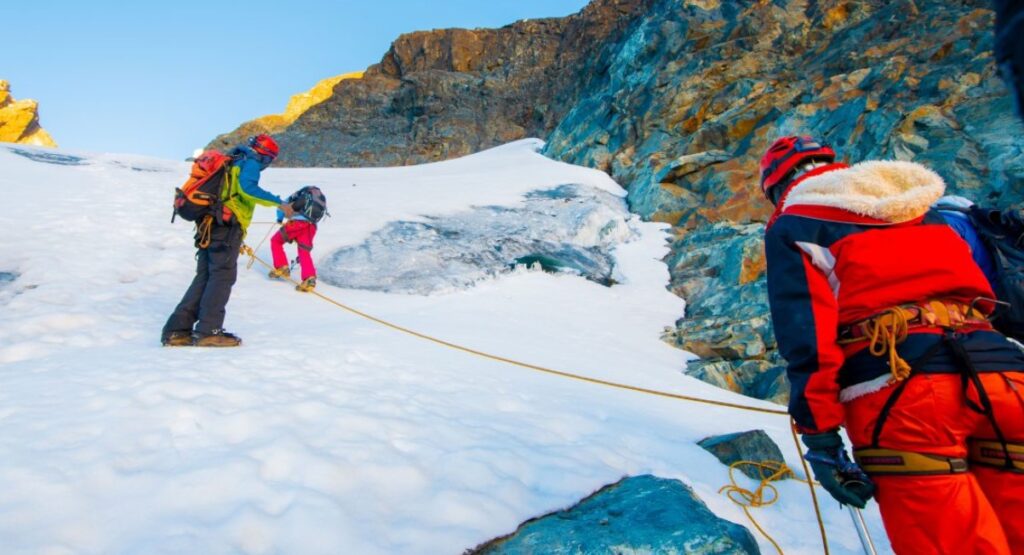
Most international trekkers, when they think of Africa and altitude, think of Kilimanjaro. It is a fine mountain, the highest on the continent, standing at 5,895 metres, and a worthy objective for any serious adventurer. But Kilimanjaro receives more than 50,000 visitors per year. The Rwenzori receives fewer than 1,000. Those numbers alone should prompt a serious mountain traveller to take note. But the numbers are only the beginning of the story.
The Rwenzori Mountains, known since antiquity as the “Mountains of the Moon”, are a UNESCO World Heritage Site, a Ramsar wetland of international importance, and the third-highest mountain range on the African continent. Their highest point, Margherita Peak on Mount Stanley, stands at 5,109 meters, higher than the highest peak in the Alps, higher than Mont Blanc, and taller than anything in the continental United States. And yet, if you mention the Rwenzori to most well-travelled people, you are more likely to receive a blank look than a knowing nod.
This article is my attempt to correct that. I want to explain, from the perspective of someone who has guided expeditions through these mountains in all conditions and seasons, exactly why the Rwenzori is not just a worthy alternative to the better-known African peaks; it is, by almost every meaningful measure, the finest mountain hike on the continent.
A Mountain With a Two-Thousand-Year History of Mystery.
The fact that you may never have heard of the Rwenzori is, in a way, entirely consistent with the mountain’s entire recorded history. Ptolemy, writing in the second century AD, described a great chain of snow-capped mountains near the equator that he called the “Mountains of the Moon.”. He believed they were the source of the Nile, and for nearly two thousand years, the identity of those mysterious mountains was a matter of intense speculation and controversy across the civilised world. The European explorers of the 19th century searched for them for decades. Mount Speke is named after John Hanning Speke, who never saw them. Even Henry Morton Stanley, who eventually caught a clear view of the snowy peaks in 1888, initially struggled to identify what he was looking at. The mountains were, quite literally, hidden from the world for almost two thousand years.
That culture of hiddenness runs deep. The Rwenzori do not announce themselves. They sit in perpetual cloud, shrouded in mist that rolls in from the Congo Basin and rarely fully clears, even in the dry season. You can stand at the trailhead in Nyakalengija, staring up at thick tropical forest, and have absolutely no idea that glaciated summits rise five kilometres above you. The mountain does not perform. It does not loom, as Kilimanjaro looms, like an ice dome over a savanna plain. The Rwenzori reveals itself slowly, in layers, over days of walking, and the experience is all the more profound for it.
The name “Rwenzori” itself comes from a local Bakonzo phrase meaning “rainmaker”, a tribute to the mountains’ extraordinary capacity to generate precipitation. The ice fields and glaciers that cap the highest peaks feed the rivers that water the surrounding lowlands, making these mountains one of the most important water towers in East Africa. The headwaters of both the Nile and the Congo river systems originate in these peaks, a fact that gives the Rwenzori a significance far beyond mere altitude.
📚 HISTORICAL CONTEXTIn 1906, the Duke of Abruzzi led the first European mountaineering expedition to reach Margherita Peak. His team was the first to summit most of the major Rwenzori peaks and map the range. The expedition’s accounts remain some of the finest mountaineering literature ever written about Africa. In his honour, the range’s sixth-highest massif bears the name Mount Luigi di Savoia. |
Africa’s Third Highest Peak and Its Most Underrated
Let us discuss altitude for a moment, because elevation matters not just for the physiological challenge it presents but for what it tells you about the nature of a mountain. Margherita Peak stands at 5,109 metres above sea level, making it Africa’s third-highest point after Kilimanjaro (5,895 m) and Mount Kenya’s Batian Peak (5,199 m). However, altitude alone does not provide a complete picture.
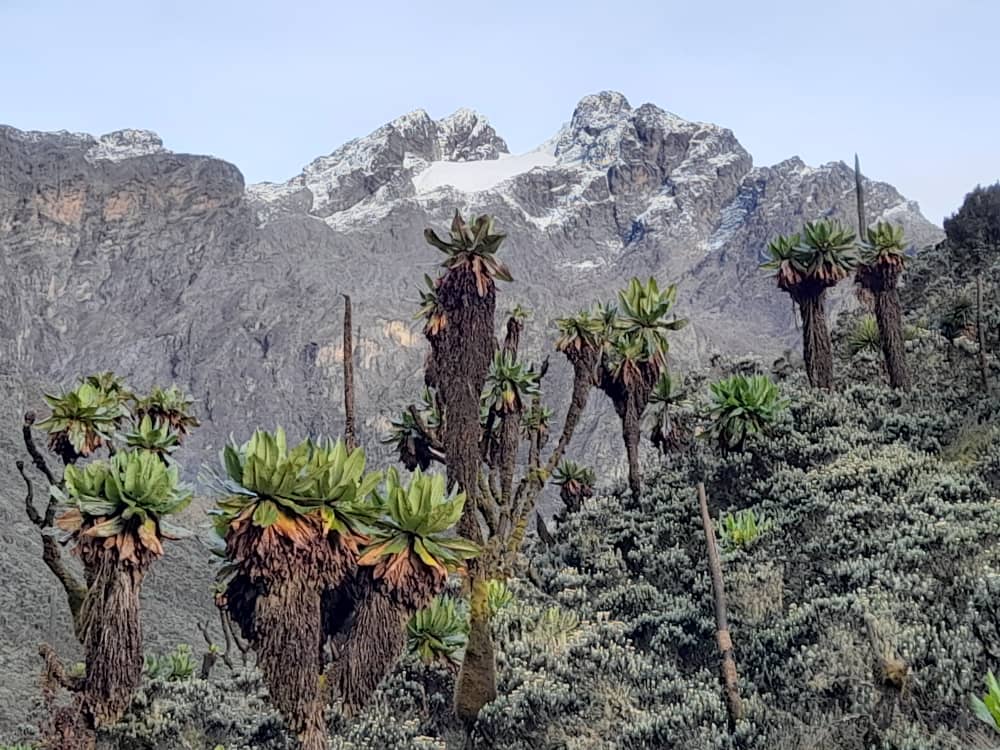
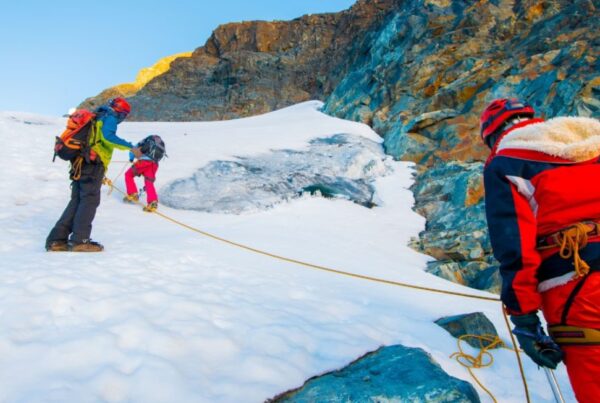
What makes the Rwenzori’s altitude particularly demanding is the combination of high elevation, permanent moisture, and the technical terrain you must navigate to reach the summit. Unlike Kilimanjaro, where the standard routes are essentially high-altitude walking trails, the approach to Margherita Peak on Mount Stanley involves genuine technical climbing: fixed ropes, ice axes, crampons, and short sections of glaciated terrain. The peak is not a casual stroll. It demands proper preparation, the right equipment, and ideally the guidance of experienced mountain professionals.
Beyond Margherita and Mount Stanley, the Rwenzori range offers five additional major massifs, each with its own distinct character and summit objectives. Mount Speke (4,890 m) rises to the Vittoria Emanuele peak, a demanding and relatively remote objective that rewards those who push beyond the main Central Circuit itinerary. Mount Baker (4,843 m), with its Edward Peak centrepiece, offers extraordinary views across the Bujuku Valley and is regarded by many guides, myself included, as one of the most dramatic summit experiences in the entire range. Mount Emin (4,798 m), Mount Gessi (4,715 m), and Mount Luigi di Savoia (4,627 m) complete the roster of major peaks, and for those with the ambition and fitness to tackle all six, the 13-day six-peaks expedition stands as perhaps the most comprehensive high-altitude mountaineering journey anywhere in Africa.
⚡ PLANNING NOTE: ALTITUDE ACCLIMATISATIONThe multiday structure of every Rwenzori route means you gain altitude gradually, which is your best defence against altitude sickness. The 7-day Central Circuit and the 8-day Kilembe Trail both build in sufficient elevation gain per day to allow your body to adapt. Attempting to rush the summit is the single most common mistake first-time Rwenzori trekkers make. |
The Exclusivity Angle: What 1,000 Trekkers Per Year Actually Means
The statistics bear repeating because they are genuinely extraordinary. Kilimanjaro sees upwards of 50,000 climbers per year. The Rwenzori sees approximately 1,000. That is not a minor difference in footfall; it is a fifty-to-one ratio that translates into a profoundly different experience on the mountain.
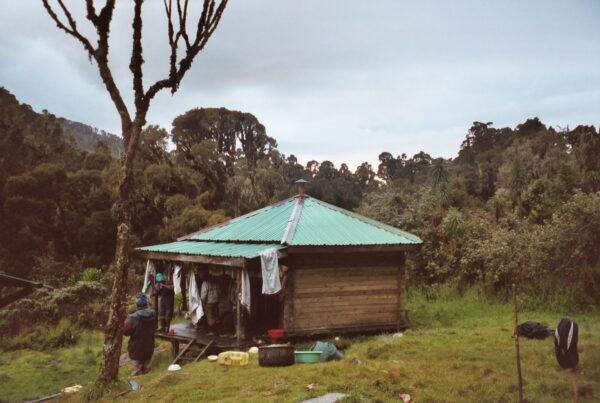
When you trek the Rwenzori, you will rarely, if ever, encounter another group on the trail. The mountain huts, solid structures set at the key overnight camps along both the Central Circuit Trail and the Kilembe Trail, will often be yours alone. Evenings are quiet. Mornings, when the cloud lifts briefly to reveal a glacier-wrapped peak above you, feel almost private, as though you have stumbled onto something the rest of the world simply does not know exists.
Compare the Rwenzori experience to the Kilimanjaro experience, where the Marangu and Machame routes in high season resemble queues rather than wilderness trails. Rwenzori lacks the social infrastructure of mass-market mountaineering, which includes crowds, noise, and commercial clamour at the huts. What you receive instead is silence, solitude, and the rare luxury of a mountain that exists on its terms.
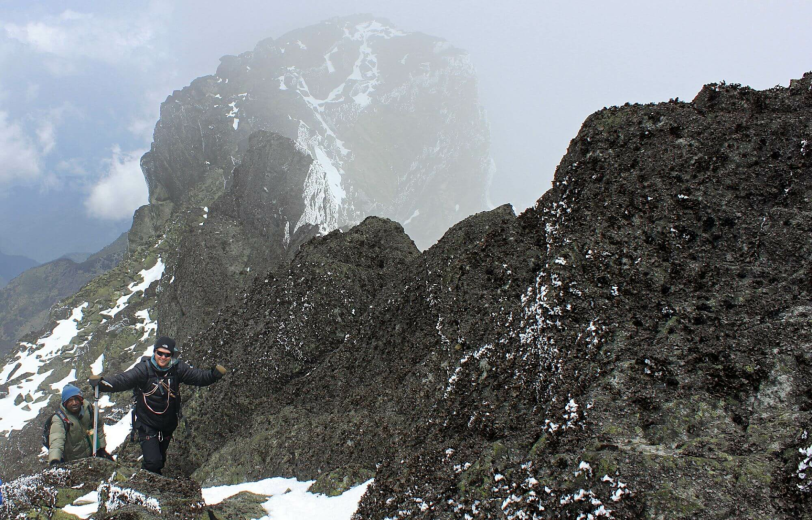
For some trekkers, particularly those coming from a background of adventure travel in less-visited destinations, this exclusivity is the primary attraction. For others, it is an unexpected bonus that makes an already extraordinary mountain even more special. Either way, if you have ever arrived at a famous summit and felt vaguely disappointed by the crowd gathered there, the Rwenzori is your antidote.
The low visitor numbers also mean that the mountain’s ecosystems experience significantly less pressure than better-known high-altitude trekking destinations. The trails are not eroded to bare rock. The hut areas are not surrounded by accumulated litter. The wildlife from the Rwenzori turaco to the three-horned chameleon is habituated to encountering humans gently and infrequently, which makes wildlife encounters in the lower forest sections some of the most rewarding available anywhere in Uganda.
🌍 THE UNESCO DIFFERENCEThe Rwenzori Mountains National Park was designated a UNESCO World Heritage Site in 1994 and a Ramsar Wetland of International Importance in 2008. This dual designation, rare globally, reflects the mountain’s significance not just as a scenic attraction but as a critical ecological system: a water tower for an entire region, home to species found nowhere else on Earth. If you are the kind of traveller who cares about what lies beneath the scenery, Rwenzori rewards your attention in a way that only a few mountains can match. Explore the full range of Rwenzori Mountains peaks and the ecosystems they support. |
Alien Vegetation: The Botanical Otherworld That Awaits You
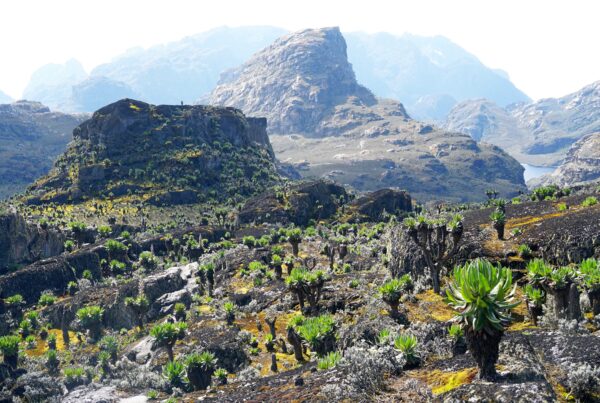
The vegetation is the most visceral feature of the Rwenzori for first-time trekkers, more than the glaciers, altitude, or summit views. The Rwenzori’s plant life is genuinely unlike anything else on this planet, and I do not mean that hyperbolically. The combination of equatorial latitude, extreme altitude, and near-constant moisture has produced an Afro-alpine flora that looks as though it was designed by a science fiction illustrator rather than by evolution.
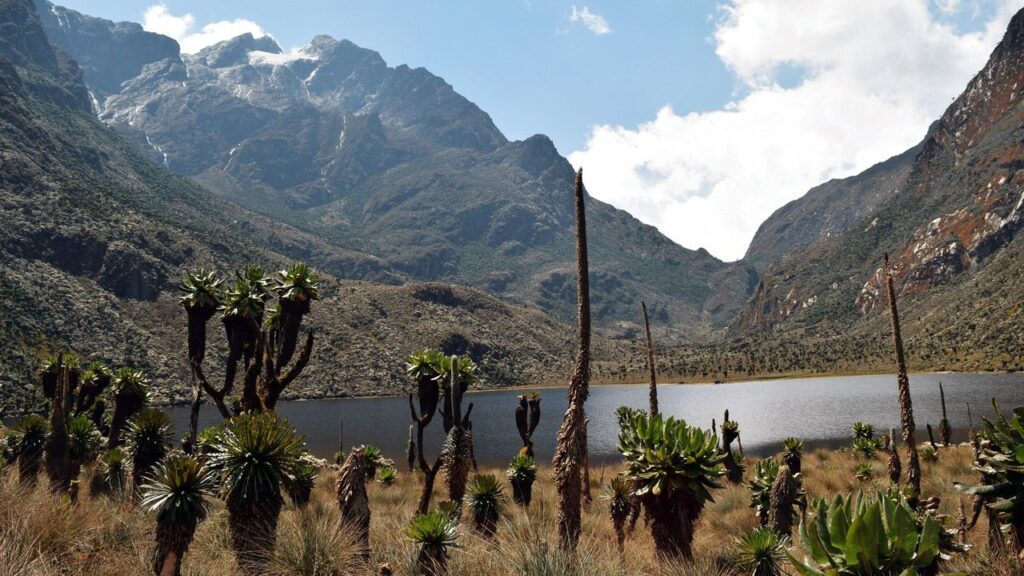
Begin at the base, in the lowland tropical forest that cloaks the mountain’s lower slopes. Here the trail winds through dense rainforest, where colobus monkeys move through the canopy and Rwenzori turacos flash red-and-green through the understory. As you climb through the bamboo zone and into the heather forests, the scale begins to shift. Tree heathers, which would be knee-high shrubs in Scotland, grow here to the height of three-storey buildings, their trunks wrapped in thick moss that retains moisture like a sponge and provides the forest with a strange, spongy silence.
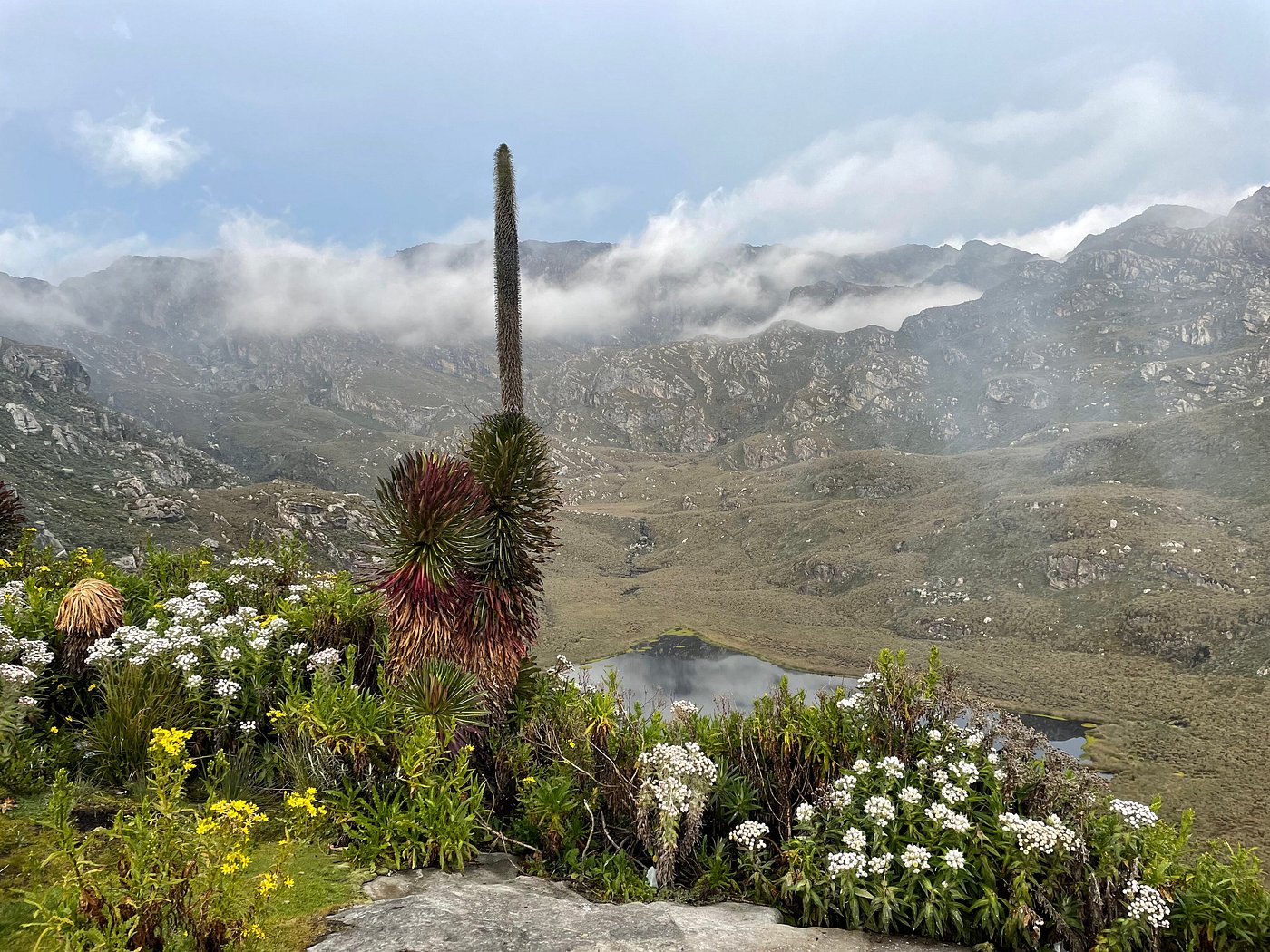
Higher still, in the Afro-alpine zone above 3,500 metres, the vegetation enters a phase that most trekkers describe as genuinely surreal. Giant lobelias, Lobelia wollastonii, rise from the bog like alien antennae; their rosette crowns sit atop stalks two metres tall, dripping with moisture. Giant groundsels, Senecio species endemic to the Rwenzori, push cabbage-like heads above swollen, cactus-like trunks, sometimes reaching five metres in height. The overall effect, particularly in morning mist, is of a landscape that belongs to a different geological age: Jurassic in feeling, Martian in appearance.
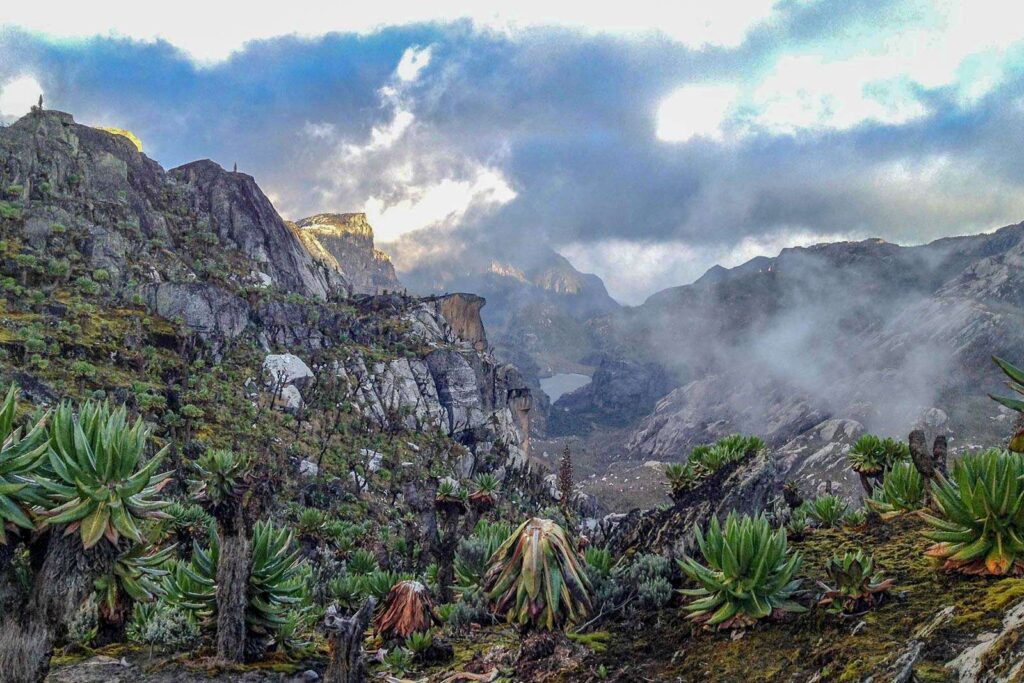
What makes the Rwenzori’s flora scientifically remarkable is its degree of endemism. The Afro-alpine zone above 3,000 metres hosts a significant proportion of plant species that are unique to this region. This is partly a consequence of the mountains’ isolation; the Rwenzori are a “sky island”, geologically distinct from the surrounding lowland habitats. It is also partly a consequence of the extraordinary stability of their climate over geological time. These plants have had millions of years to evolve in a peaceful environment, free from the catastrophic climate events that often disrupt ecological clocks in less stable environments.
For botanists, zoologists, and anyone who genuinely loves the natural world, trekking in the Rwenzori offers both a mountain adventure and a field expedition into one of the planet’s most unique ecosystems. There are trekkers who have walked the Himalayas, the Andes, and the Alps who have told me, unprompted, that the Rwenzori’s vegetation was the most extraordinary natural spectacle they had ever encountered. I believe them.
The Routes: Choosing Your Approach to the Mountains of the Moon
There are four principal ways to experience the Rwenzori Mountains, each suited to a different combination of ambition, fitness, and available time. Understanding the differences between them is essential to planning a trek that matches your objectives.
The Central Circuit Trail
The Central Circuit Trail is the original and most comprehensive Rwenzori route. Beginning at Nyakalengija, a short drive from Kasese town, the trail traverses the mountain’s interior in a complete loop, passing through all five vegetation zones and visiting the key high-altitude valleys, lakes, and camps. The 7-day Central Circuit itinerary is the most popular full-mountain option, taking you through camps at Nyabitaba, John Matte, Bujuku, Elena, and Kitandara before descending via Guy Yeoman. Those who want to reach Margherita Peak will spend an additional day pushing from Elena Camp to the summit and back, negotiating the fixed ropes and glaciated terrain on the upper mountain.
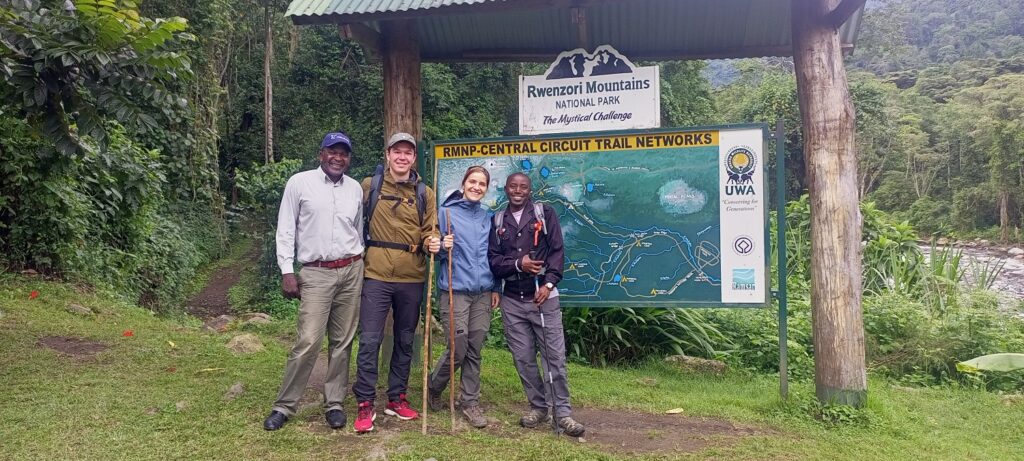
The Central Circuit is rightly considered the classic Rwenzori experience. It rewards patient acclimatisation, offers the greatest variety of landscapes, and gives those with summit ambitions the best possible foundation for a safe and successful push toward Margherita. Its well-maintained huts, established camps, and the depth of terrain it covers make it the recommended starting point for most first-time Rwenzori trekkers.
The Kilembe Trail
Officially opened in 2011, the Kilembe Trail approaches the mountain from the south, starting near Kilembe village in Kasese District. It is widely regarded as the more challenging of the two main routes, steeper, more technical, and less forgiving of poor pacing. But those challenges come with compensations: the Kilembe Trail offers scenery that many experienced guides consider even more dramatic than the Central Circuit, with views of the Nyamwamba Valley, a series of stunning waterfalls in the lower sections, and approaches to the western faces of the high peaks that are genuinely spectacular.
The 8-day Kilembe Trail itinerary to Margherita Peak is the standard summit option via this route, passing through the well-equipped camps at Sine, Mutinda, and the high Margherita camp before the final push to the summit. For those who want to sample the Kilembe Trail without committing to a full summit expedition, the 4-day Mutinda Loop offers a superb introduction to the route’s lower and mid-mountain sections.
The Bukulungu Trail
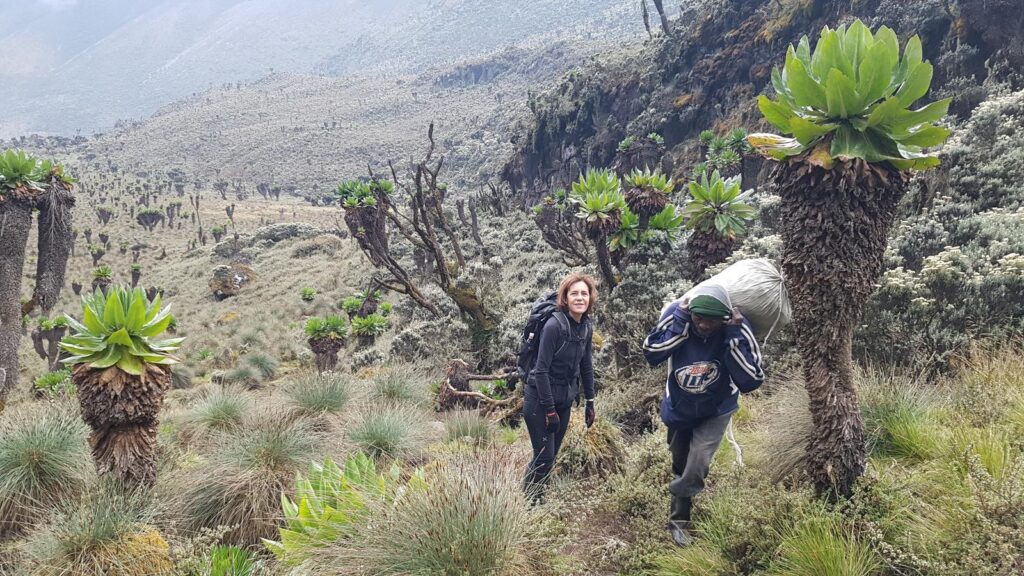
The Bukurungu Trail is the Rwenzori at its most wild and exploratory. Far less developed than either the Central Circuit or the Kilembe Trail, it is the route for experienced wilderness travellers who want to experience the mountain as the early explorers did with minimal infrastructure, genuine remoteness, and the particular satisfaction of knowing that the route beneath your boots has been walked by hardly any people. The Bukulungu’s reward is access to four of the range’s most beautiful glacial lakes, approached through terrain that few trekkers will ever visit.
The Mahoma Loop
For those with limited time or who prefer a lower-altitude introduction to the Rwenzori’s biodiversity, the 3-day Mahoma Loop is an outstanding option. Starting from the Mihunga gate, the trail winds through heather woodlands and bamboo forests to the spectacular Lake Mahoma, a glacial lake set in a forested crater at around 2,400 metres. The birding along this route is exceptional; the area is prime territory for Rwenzori turacos, sunbirds, and the various chameleon species endemic to the range.
Summiting Margherita Peak: Africa’s Most Atmospheric Climb
I want to be honest with you about Margherita Peak because I think it deserves honesty rather than marketing gloss. This is not an uncomplicated climb. The approach to the summit from Elena Camp involves navigating steep, ice-covered terrain using fixed ropes, ice axes, and crampons. You need to be comfortable with exposure sections where the consequence of a slip is significant. You need to be fit, properly acclimated, and appropriately equipped.
But here is what I will also tell you, from the experience of having guided dozens of trekkers to that summit: the view from Margherita Peak on a clear morning, with the Rwenzori’s glacier field around you and the vast green lowlands of Uganda and the Democratic Republic of Congo stretching to the horizon far below, is one of the most memorable summit experiences in world mountaineering. Not because of the altitude – you can stand higher on other mountains – but because of what you have to walk through to get there.
There is also an urgency to the Margherita summit that adds a layer of meaning to every expedition. The glaciers of the Rwenzori have retreated dramatically over the past century and are continuing to shrink. Scientists predict that the Rwenzori’s ice fields could disappear entirely within decades, making this one of the last opportunities in human history to stand on an equatorial glacier. If you summit Margherita today, you are standing on something that may not exist for your children. That is a sobering and motivating thought.
For those who want a clear-eyed technical assessment of what the summit involves, the article on how technical the climb to Margherita Peak really is covers every section of the route in detail, and the guide on crampons and ropes for the Rwenzori explains the specific technical equipment you will need.
The Six Major Peaks: A World Beyond Margherita
Most people, when they think of a Rwenzori expedition, think about Margherita. This is understandable; it is the highest point and the headline objective. But to focus exclusively on Margherita is to miss much of what makes the Rwenzori range exceptional. The six major massifs each offer their own summit objectives, and for the mountaineer with time and ambition, the possibility of climbing multiple peaks in a single expedition is one of the Rwenzori’s most compelling features.
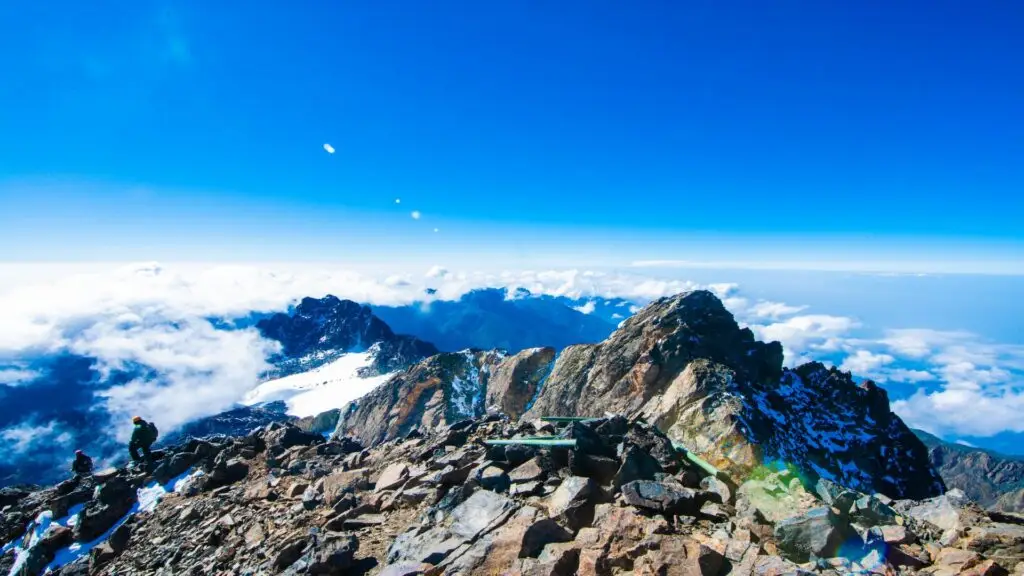
Mount Speke (4,890 m) is, in the view of many experienced Rwenzori guides, the range’s most aesthetically satisfying mountain. Its Vittoria Emanuele Peak involves a serious approach through the upper Bujuku Valley and some genuinely demanding climbing on the summit day, but the position, set in the heart of the range, surrounded by views of the other major massifs, is extraordinary. The dedicated 5-day Mount Speke trek is worth every step.
Mount Baker (4,843 m) occupies the southern end of the main massif and offers views that are arguably the most dramatic in the Rwenzori. Edward Peak, its summit point, looks directly across to Margherita and down into the Kitandara Lakes basin, a sight that stops trekkers mid-stride. The 7-day Baker and Weismann Peak itinerary combines two of the range’s most rewarding summit objectives.
For those who want to go further still, the 13-day six-peaks expedition visits Mount Stanley, Speke, Baker, Emin, Gessi, and Luigi di Savoia the full six-massif circuit that represents the most comprehensive mountaineering objective in the Rwenzori range. And for those who truly want to leave no peak unclimbed, the extraordinary 18-day all-eight-peaks expedition adds the remaining sub-summits to create an itinerary that stands as one of the most ambitious mountain journeys anywhere in Africa.
Rwenzori vs Kilimanjaro: An Honest Expert Comparison
This is the comparison that most undecided trekkers eventually arrive at, and it deserves a direct answer. If you are trying to decide between the Rwenzori and Kilimanjaro as your African mountain objective, here is my honest, experience-based assessment.

Kilimanjaro is higher (5,895 m vs 5,109 m), more accessible, and requires less technical skill. The standard routes, Marangu, Machame, and Lemosho, are essentially well-maintained walking trails with a tough high-altitude section near the summit crater. The infrastructure is superb, the guides are numerous and experienced, and the summit success rate is high for well-prepared trekkers. If your sole objective is to stand on the highest point in Africa, Kilimanjaro is the right choice.
But if your objective is a genuine mountain experience, wilderness, technical engagement, extraordinary biodiversity, solitude, and a summit that requires real mountaineering skills, then the Rwenzori is in a different league entirely. The technical demands are higher. The terrain is more complex. The vegetation is unlike anything in the Kilimanjaro ecosystem. Moving through a mountain that virtually no one else visits and that the world has largely overlooked produces an adventure quality that the well-trodden Kilimanjaro routes simply cannot replicate.
The Rwenzori is harder than Kilimanjaro; there is no honest way to say otherwise. The mud, the bogs, the technical summit, and the persistent moisture that makes every section of the trail more demanding than it would be on a dry mountain. All of this means that the Rwenzori asks more of you physically and technically. But it gives back more, too. The 1,000 people per year who walk these trails are not there, despite the challenges. Because of them, most of them are there.
| Feature | Rwenzori vs Kilimanjaro |
| Highest Point | Rwenzori: Margherita 5,109m | Kilimanjaro: Uhuru 5,895m |
| Annual Visitors | Rwenzori: ~1,000 | Kilimanjaro: ~50,000 |
| Technical Difficulty | Rwenzori: Moderate–Technical | Kilimanjaro: Non-technical walk |
| Summit Terrain | Rwenzori: Ice, fixed ropes, crampons | Kilimanjaro: Scree, dust |
| Vegetation | Rwenzori: Afro-alpine endemic flora | Kilimanjaro: Moorland & desert |
| UNESCO Status | Rwenzori: World Heritage + Ramsar | Kilimanjaro: World Heritage only |
| Solitude | Rwenzori: Near-complete | Kilimanjaro: Crowded on popular routes |
| Best For | Rwenzori: Serious adventurers seeking depth | Kilimanjaro: First high-altitude trekkers |
Weather, Seasons, and When to Go
Embrace the Rwenzori’s deserved reputation for being wet, rather than resisting it. The mountains generate their weather, drawing moisture from the Congo Basin to the west and producing rainfall throughout most of the year. There is no “dry” season in the conventional sense, but there are two periods of relative dryness, June to August and December to March, during which conditions on the upper mountain are more predictable and the risk of heavy snow on the summit day is lower.
The question of whether you can trek the Rwenzori in the wetter months is one that many prospective trekkers wrestle with. The guide to trekking the Rwenzori in the rainy season provides a detailed answer, including my assessment of each month’s conditions. The short answer is yes, with the right gear and expectations. The mountain in the wet season is, in many ways, even more beautiful than in the dry; the waterfalls are in full flood, the vegetation is at its most lush, and the light filtering through mist-laden giant heathers produces a visual atmosphere that is difficult to describe and impossible to photograph adequately.
What matters far more than the season, in my experience, is the quality of your wet-weather gear. Every trekker on the Rwenzori needs waterproof boots, reliable waterproof outer layers, and the psychological preparedness to be comfortable in wet conditions for sustained periods. Those who see the mountain’s renowned moisture as a challenge often face difficulties. Those who approach it as part of the mountain’s character as integral to what makes the Rwenzori the Rwenzori tend to love every waterlogged step.
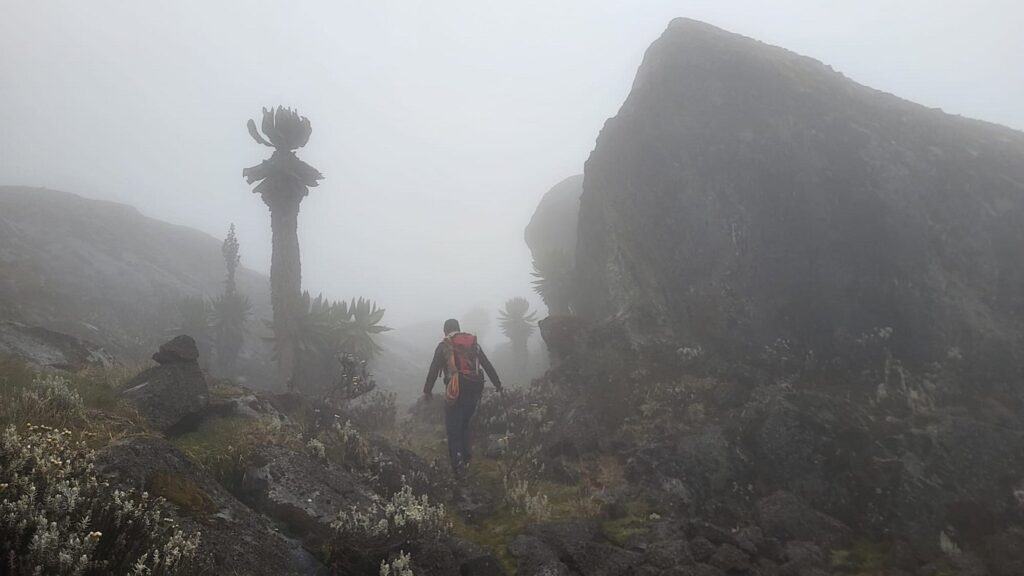
Temperature on the upper mountain can drop significantly below freezing, particularly on the summit day. The article on how cold it gets on Margherita Peak provides a detailed breakdown of what to expect at each elevation band and is essential reading for anyone planning a summit attempt. And yes, you will almost certainly see snow on the Rwenzori; these are equatorial mountains, but they carry real snow and ice at altitude. That combination of tropical latitude and alpine conditions is, in itself, one of the mountain’s defining paradoxes.
Planning Your Rwenzori Trek: The Practical Reality.
Getting to the Rwenzori is straightforward. International flights arrive at Entebbe International Airport on the shores of Lake Victoria, from where Kasese, the nearest town to the main trailhead, is accessible by domestic flight (approximately one hour), private vehicle (approximately five hours via the Kampala–Mbarara highway), or public bus. The approach to the mountain and the full range of trekking routes and available itineraries are covered in detail on our routes page.
A registered guide must accompany all trekkers to the Rwenzori Mountains National Park. This is not a bureaucratic restriction; it is a genuine safety requirement on a mountain that commands respect and where conditions can change rapidly. On the upper mountain, guides with experience of the glaciated terrain, fixed-rope management, and high-altitude emergency response are not a luxury but a necessity. Our team of professional Rwenzori guides has accumulated decades of combined experience on every route and in every season.
Regarding equipment: whether you need to bring your own technical gear or can source it on arrival is a question we address directly in the guide to climbing gear for a Rwenzori trek. The short version: personal items like boots, gaiters, and base layers should ideally be your own gear that you have walked in and trust. Technical items like crampons and ice axes can be hired at the trailhead.
For those who want to combine a Rwenzori trek with Uganda’s other extraordinary wildlife experiences, we offer a range of combined itineraries, including the 12-day Rwenzori and gorilla trekking combination pairing Africa’s finest mountain hike with mountain gorilla encounters in Bwindi Impenetrable Forest and the 16-day Rwenzori, chimpanzee, and gorilla expedition that takes in the full spectrum of Uganda’s wilderness. Uganda, it should be said, is arguably the most biodiversity-rich destination in Africa for the serious adventurer, and the broader Uganda safari options available alongside a Rwenzori trek make it possible to build a journey that combines world-class mountaineering with world-class wildlife from a single trip.
🏕️ ACCOMMODATION ON THE MOUNTAINBoth the Central Circuit and Kilembe Trail have well-maintained mountain huts at each camp. Central Circuit camps include Nyabitaba, John Matte, Bujuku, Elena, Kitandara, and Guy Yeoman. Kilembe Trail camps Kalalama, Mutinda, Bugata, Hunwicks, and Margherita are equipped with solar panels at some sites for device charging. Wild camping via tent is available on the Bukulungu Trail for those who want the full wilderness experience. |
Why the Rwenzori Deserves to Be Africa’s Best-Known Mountain Hike
I want to come back, at the end of this article, to the question in the title: why is the Rwenzori the best mountain hike in Africa, and why have you never heard of it?
The second part of that question is easier to answer than the first. The Rwenzori’s obscurity can be attributed to a combination of historical, geographical, and marketing factors. It sits in a corner of Uganda that does not lie on the main safari circuit. Clouds obscure its peaks for most of the year, making dramatic photography challenging. Its difficulty is real and significant, meaning it does not appear in mainstream “bucket list” trekking guides that emphasise accessibility. It has never had the celebrity associations, renowned authors, expedition films, or world-record attempts that have made Kilimanjaro and Everest household names.
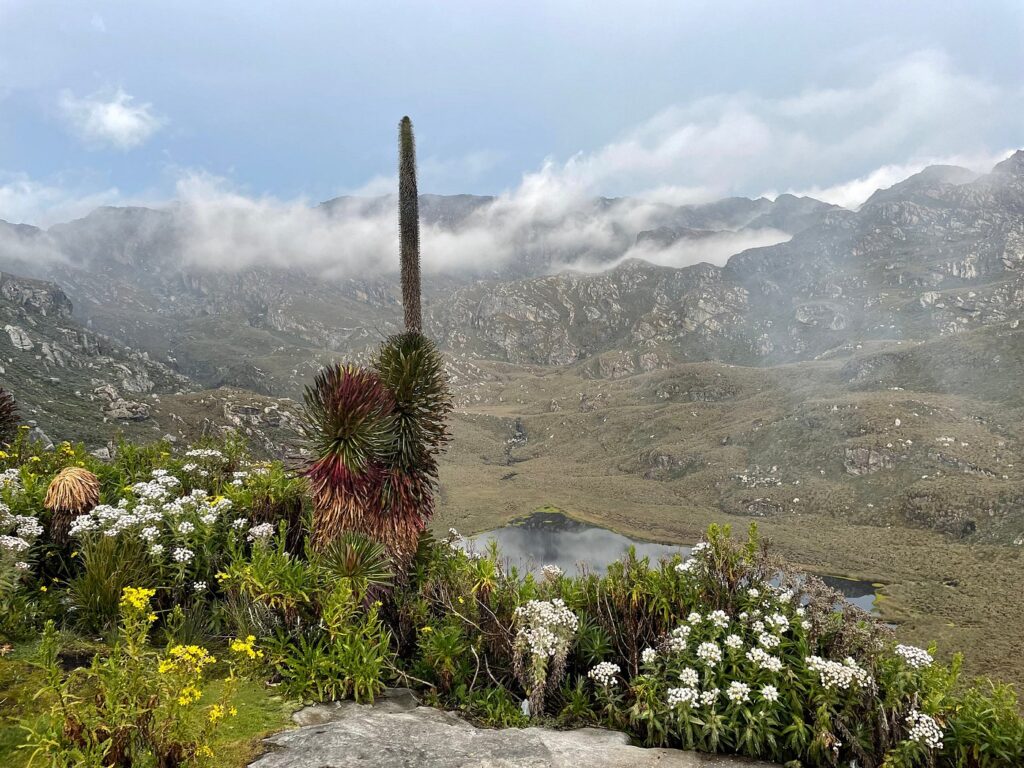
The first part of the question, ‘Why is it the best?’ I will let the mountain answer for itself. Walk through a forest of fifteen-meter tree heather draped in golden moss at dawn. Stand at Bujuku Lake at 3,960 metres as the mist peels back to reveal Mount Baker on one side and Margherita’s ice cap on the other. Pull yourself up the fixed ropes in the final section to the summit, step onto the Margherita glacier at 5,109 metres, and look across an equatorial African landscape that extends to the horizon in every direction. Then ask yourself whether you are standing on Africa’s best mountain.
I have guided climbers on the Rwenzori for years. I have watched people who arrived sceptical and left transformed. I have seen trekkers who had already climbed Kilimanjaro and “wanted something different” reach the summit in tears, not from the altitude or effort, but because they had just walked through a world they didn’t know existed. That is what this mountain does. That is what no other mountain in Africa does quite so completely.
If this article has convinced you to consider Rwenzori, the next step is to talk. Browse the full range of Rwenzori trekking itineraries, explore our group trek options, and then get in touch. Every Rwenzori trek we plan is built around you: your timeline, your fitness, your summit ambitions, and the kind of mountain experience you are looking for.
Frequently Asked Questions About Hiking the Rwenzori Mountains
Is the Rwenzori the best mountain hike in Africa?
For the most experienced mountaineers and adventure travellers who have trekked multiple African ranges, the Rwenzori stands out as the most complete mountain experience on the continent. It combines Africa’s third-highest summit (Margherita Peak at 5,109 m) with extraordinary endemic vegetation found nowhere else on Earth, near-complete solitude compared to the heavily trafficked Kilimanjaro and Mount Kenya routes, a real technical mountaineering challenge on the upper mountain, a UNESCO World Heritage designation recognising its global ecological significance, and a historical mystique stretching back to Ptolemy’s second-century descriptions. No other African mountain offers this particular combination of altitude, difficulty, biodiversity, and exclusivity. That said, “best” is ultimately personal. Kilimanjaro offers the highest point and more accessible routes, while Mount Kenya’s technical ridges satisfy pure rock climbers. The Rwenzori’s advantage is depth: it rewards those who want a full mountain journey rather than a summit tick.
Why have so few people heard of the Rwenzori Mountains?
The Rwenzori’s relative obscurity has several interlocking causes. Geographically, the mountains sit in western Uganda, off the main East Africa safari circuit and far from major international hubs. Visually, the peaks are cloud-covered for much of the year, making them impossible to photograph dramatically from the valley, which limits the kind of iconic imagery that drives travel marketing. Their genuine technical difficulty places them outside the accessible “anyone can do it” marketing bracket that has made Kilimanjaro a global brand. And historically, the Rwenzori were genuinely unknown to the outside world until the late 19th century, arriving on the global consciousness long after Kilimanjaro and Everest had established their reputations. None of these factors diminish the mountain; they simply explain why it remains one of Africa’s best-kept secrets.
How does the Rwenzori compare to Kilimanjaro in terms of difficulty?
The Rwenzori is significantly more challenging than Kilimanjaro by most objective measures. Where the standard Kilimanjaro routes are non-technical, essentially high-altitude hiking trails on dry terrain, the Rwenzori summit routes involve traversing boggy, technical terrain through all altitude bands, with the upper mountain to Margherita Peak requiring fixed ropes, crampons, ice axes, and comfort with exposure and glaciated terrain. The persistent moisture in the Rwenzori, one of the wettest mountain environments in Africa, adds consistent difficulty to every section of the trail. The altitude difference (5,895 m Kilimanjaro vs 5,109 m Rwenzori) means Kilimanjaro is physiologically more demanding at the summit, but the overall physical and technical challenge of the Rwenzori is greater due to the multi-day complexity, technical summit, and demanding terrain. A detailed comparison is available in the article on whether the Rwenzori is harder than Kilimanjaro.
How many people hike the Rwenzori each year?
The Rwenzori Mountains receive approximately 1,000 trekkers per year. This figure is in stark contrast to Kilimanjaro’s 50,000-plus annual visitors, and it has a profound effect on the character of the mountain experience. Trails are uncrowded, mountain huts are frequently occupied by only your group, and wildlife encounters in the lower forest sections occur in conditions of genuine quiet. This extraordinary level of solitude rare for any mountain of this significance is one of the most compelling arguments for choosing the Rwenzori over more famous alternatives.
What is the unique vegetation of the Rwenzori Mountains?
The Rwenzori’s vegetation is one of its defining characteristics and one of the most extraordinary natural spectacles available anywhere on Earth. The mountain passes through five distinct vegetation zones as you ascend: lowland tropical rainforest, bamboo forest, montane forest, giant heather forest, and Afro-alpine moorland. It is the Afro-alpine zone above roughly 3,500 metres where the vegetation becomes truly surreal. Giant lobelias (Lobelia wollastonii) grow to heights of two metres or more; their rosette crowns drip with moisture. Giant groundsels (Senecio species endemic to the Rwenzori) reach five metres on swollen, cactus-like trunks. Tree heathers grow to the height of three-storey buildings, their trunks encased in thick, moisture-retaining moss. A substantial proportion of the Rwenzori’s Afro-alpine plant species are endemic, found nowhere else on Earth, the result of millions of years of evolutionary isolation on a “sky island” separated from surrounding lowland habitats.
Is Margherita Peak difficult to climb?
Mount Stanley’s Margherita Peak (5,109 m) presents a genuinely technical mountaineering challenge that demands respect. The approach from Elena Camp to the summit involves navigating steep, ice-covered terrain using fixed ropes, and you will need crampons and an ice axe. There are sections with significant exposure where a fall would have serious consequences. The peak is rated as a moderate technical climb by alpine standards, broadly comparable to some of the more accessible routes on peaks in the Alps, but it is firmly in the category of “mountaineering” rather than “trekking”. The full technical breakdown of what the climb involves is covered in the guide to how technical the Margherita Peak climb is. In practical terms, fit trekkers with good stamina and a willingness to follow guide instructions carefully have a strong summit success rate at this peak, but the key is proper acclimatisation, appropriate gear, and a professional guide.
What is the best time of year to hike the Rwenzori?
The best conditions for a Rwenzori trek are found during the two drier periods: June to August and December to March. During these windows, rainfall is reduced (though never absent entirely on the Rwenzori), the trails on the upper mountain are more stable, and the risk of heavy new snow on the summit day is lower. That said, the Rwenzori is a mountain that receives rainfall year-round, and “dry season” is a relative term. Many experienced Rwenzori trekkers consider the shoulder months May and October to offer an excellent balance of manageable weather and striking visual conditions, with the vegetation at its most vivid and the waterfalls in impressive flow. Trekking is possible year-round with the right gear. The article on whether you can trek the Rwenzori in the rainy season addresses the wet-season question in full.
How much does a Rwenzori trek cost?
Rwenzori trek costs depend on the route chosen, the duration, the number of peaks included, and any additional pre- or post-trek accommodation and transport. As a general guide: shorter treks of 3–4 days on the lower mountain begin at approximately $500–$650 per person. Standard summit itineraries to Margherita Peak, the 7-day Central Circuit, or the 8-day Kilembe Trail range from approximately $1,400 to $1,750 per person, inclusive of park fees, guides, porters, hut accommodation, and meals. Multi-peak expeditions and extended itineraries are priced higher accordingly, with the 13-day, six-peak expedition starting at around $3,350. These figures typically include the full mountain package; flights, visas, and pre-trek accommodation in Kasese or Kampala are additional. Our team provides transparent, detailed cost breakdowns for every itinerary on the contact page.
Do you need a guide to hike the Rwenzori Mountains?
Yes, a registered guide is mandatory for all trekkers in Rwenzori Mountains National Park. This is not just a legal requirement; it is a practical safety necessity. The Rwenzori’s trails, particularly in the upper mountain and summit sections, require navigational expertise and knowledge of conditions that change daily. In the event of a medical emergency at altitude, a trained and experienced guide is your most important resource. Our guides are not just navigators; they are knowledgeable naturalists, experienced mountaineers, and deeply committed professionals who understand every aspect of the mountain’s character. Planning a trek with our Rwenzori mountaineering team means your mountain experience is backed by accumulated expertise.
| 🏔️ READY TO PLAN YOUR RWENZORI TREK?
The Rwenzori Mountains are waiting, and they will not wait forever. The glaciers are retreating. The mountain that Ptolemy described two thousand years ago as the “Mountains of the Moon” is changing, and the window for standing on its ice cap at the equator is measurably shorter with each passing decade. If you are serious about the future, if reading this article has moved you from curiosity to conviction, then the next step is a conversation with our team. We have guided trekkers from every continent, on every route, and in every season in the Rwenzori. We know this mountain in a way that only years of close, patient attention can produce. We will help you choose the right route, the right duration, and the right level of ambition for your first or fifth Rwenzori expedition. Every trek we plan is built around you and your objectives, not around a standardised package. Get in touch with our team to start planning your Rwenzori trek. Whether you are drawn to the Central Circuit Trail, the Kilembe Trail, the summit of Margherita Peak, or the full six-peak expedition, we are ready to take you there. Begin Planning Your Rwenzori Trek → |