Is Rwenzori trekking the same as hiking Kilimanjaro? No. Compare terrain, technical demands, altitude, crowds and cost before you choose your mountain.
I get this question in almost every pre-trip call, usually phrased in one of two ways. Either someone has just come down off Kilimanjaro, felt the pull of altitude for the first time, and wants to know whether the Rwenzori is simply the next rung on the same ladder. Or someone has read about the Mountains of the Moon, seen a photograph of a headlamp beam on a fixed ladder above a glacier, and wants to know whether it is, underneath the marketing, basically the same walk as the one their friend did in Tanzania with a photo at a wooden signpost. The honest answer, and I say this as someone who has guided on the Rwenzori Mountains for years and watched hundreds of Kilimanjaro veterans arrive here expecting a repeat performance, is no. They are not the same trek, not the same mountain, and in several respects not even the same kind of undertaking. They share an equator, a continent and a habit of ending in ice, and that is very nearly where the similarity stops.

This article exists because most comparisons online are either thin marketing copy or a single paragraph buried in a listicle, and neither gives you what you actually need before you commit weeks of leave and a serious amount of money to one mountain or the other. What follows is the complete comparison: how the two mountains were made, how their trails behave underfoot, what technical skill each summit actually demands, how altitude affects you differently on each, how crowded or empty each experience is, what each costs, and, at the end, straightforward guidance on which one is right for you, and whether you should simply do both. If you have already read our dedicated piece on whether the Rwenzori is harder than Kilimanjaro, this article covers similar ground from a different angle: not just which is harder, but whether the experiences themselves are the same kind of thing at all.
The Short Answer: No, They Are Fundamentally Different Mountains
Rwenzori trekking and Kilimanjaro trekking are not the same experience, even though both are often marketed under the same broad banner of “climb a high mountain in Africa.” Kilimanjaro is a single dormant volcano in Tanzania that you walk up and around on wide, engineered trails to a non-technical summit at 5,895 metres, the highest point on the continent, typically over five to nine days. The Rwenzori is a jagged, glaciated mountain range straddling the Uganda-DRC border, built by tectonic uplift rather than volcanism, where reaching Margherita Peak on Mount Stanley at 5,109 metres requires days of walking through mud, bog and river crossings followed by genuine glacier travel on ropes, crampons and fixed ladders. Kilimanjaro tests your lungs and your patience with altitude. The Rwenzori tests your lungs, your feet, your balance and, on summit day, your ability to move competently on ice. Both are extraordinary. Neither is a substitute for the other.
It helps to see the two mountains side by side before going into the detail, because the differences compound rather than cancel out.
| Mount Kilimanjaro | Rwenzori Mountains | |
| Summit / highest point | Uhuru Peak, 5,895 m | Margherita Peak, 5,109 m |
| Origin | Dormant stratovolcano | Non-volcanic, tectonic fault-block range |
| Location | Kilimanjaro National Park, Tanzania | Rwenzori Mountains National Park, western Uganda (UNESCO World Heritage Site, DRC border) |
| Technical summit day | No roped climbing; a long, steep, non-technical night walk | Roped glacier travel, crampons, harnesses, fixed ladders over crevasses |
| Typical duration | 5–9 days | 6–18 days depending on route and peaks |
| Terrain underfoot | Wide, graded volcanic scree and dirt paths | Mud, bogs, boardwalks, river crossings, rock scrambles, ice |
| Annual trekkers | Roughly 50,000+ | Roughly 1,000–2,000 |
| Governing authority | Tanzania National Parks Authority (TANAPA) | Uganda Wildlife Authority |
| Guide requirement | Mandatory | Mandatory — see our guide on why guides are required |
How the Two Mountains Were Made, and Why It Matters on the Trail
The single biggest reason these two treks feel nothing alike underfoot traces back to geology, and it is worth pausing on because everything else in this article flows from it. Kilimanjaro is a dormant stratovolcano, formally comprising the cones of Kibo, Mawenzi and Shira, built up over roughly a million years by successive eruptions that layered ash, lava and pumice into the broad, smooth-sided massif you see in every photograph. Volcanic cones build trails that geology itself has already graded: consistent slopes, loose but predictable scree, and a summit that sits at the literal top of a single, symmetrical structure. Kilimanjaro National Park, which protects the mountain above roughly 2,700 metres along with surrounding montane forest, was established in 1973 and inscribed as a UNESCO World Heritage Site in 1987 for exactly this singular, freestanding volcanic form.
The Rwenzori is a completely different kind of mountain. It was not built by eruption at all. It is a horst, a block of the earth’s crust thrust upward along fault lines over millions of years as the two arms of the Great Rift Valley pulled apart around it, and our own explanation of what makes the Rwenzori special goes into that story in more depth. Rather than one cone, you are walking into a jumbled range of six major glaciated massifs, Mount Stanley, Mount Speke, Mount Baker, Mount Emin, Mount Gessi and Mount Luigi di Savoia, separated by deep valleys, knife-edge ridges and boggy basins that never had the chance to be smoothed into a single predictable gradient. This is also why the Rwenzori is a UNESCO World Heritage Site in its own right, listed for its exceptional natural beauty and its role as one of Africa’s last great glaciated wildernesses, and why our guide to Kilimanjaro versus Mount Kenya versus the Rwenzori treats tectonic geology as the starting point for understanding all three ranges.
Fault-block terrain does not offer you a graded path. It offers you whatever the valley, the ridge or the bog happened to leave behind, and the trail engineers who built Kilimanjaro’s wide volcanic corridors had no equivalent canvas to work with here.
Terrain and Trail Conditions: Graded Scree Versus Mud, Bog and Ladders
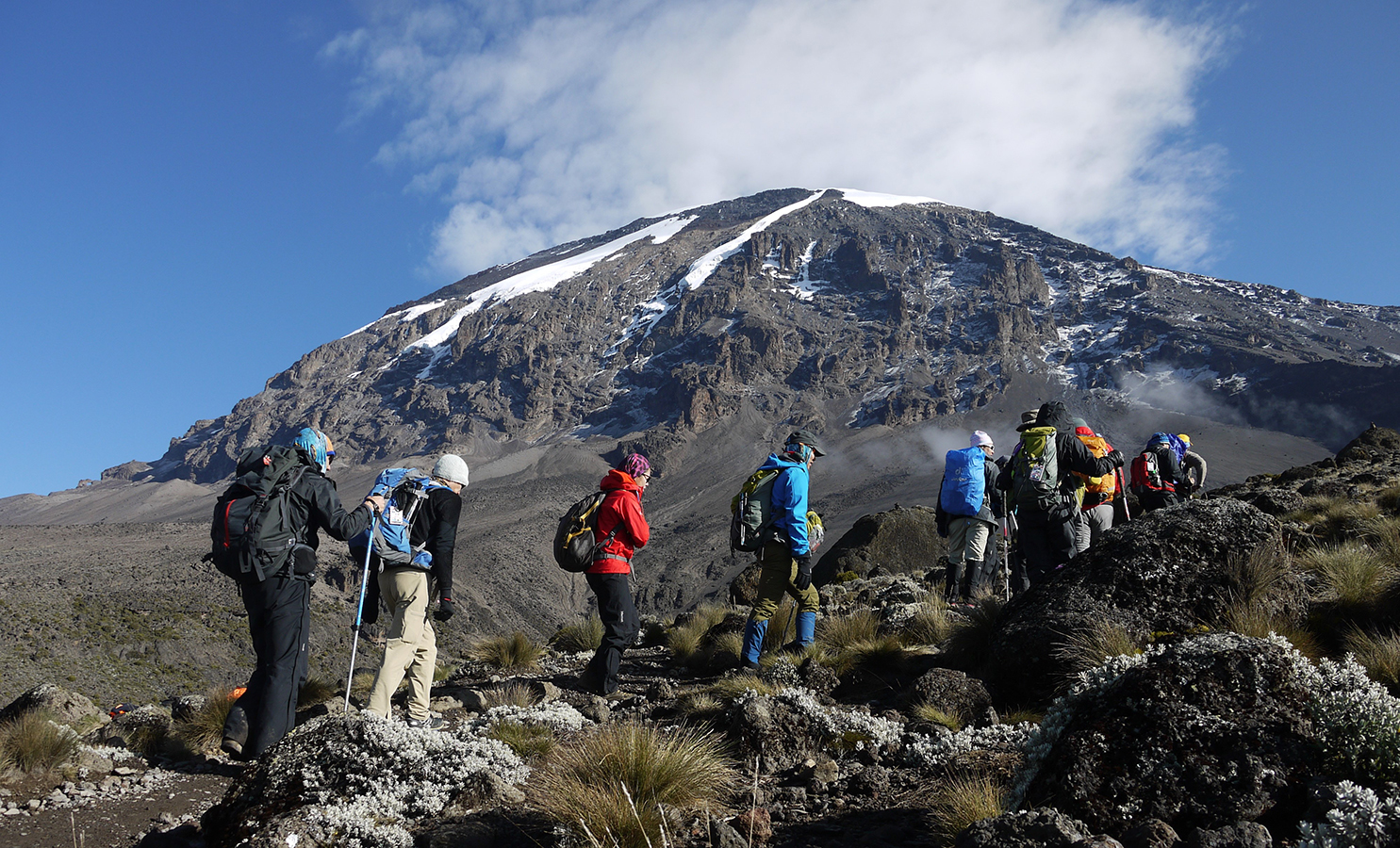
If you have climbed Kilimanjaro, picture the trail on the Machame or Lemosho routes: broad, generally dry, with a surface of packed dirt and volcanic scree that a support vehicle could almost drive on for the lower sections. The path is obvious, well-marked and, outside of the final summit push, rarely demands you to use your hands. That experience does not exist on the Rwenzori, and this is the single fact that surprises Kilimanjaro veterans most on arrival.
The Rwenzori sits inside one of the wettest high-altitude environments in Africa, receiving well over 3,000 millimetres of rain a year in its upper zones with only modest seasonal variation, which is why our month-by-month trekking guide and our best time to visit article talk in terms of drier and wetter windows rather than dry and wet seasons in the Kilimanjaro sense. That rainfall turns the trail itself into a variable, living obstacle. Sections of the Central Circuit Trail and the Kilembe Trail cross bogs where the ground genuinely swallows a misplaced boot to the knee, and the famous stretches through the Bigo Bog demand a slow, energy-sapping wading gait that no volcanic scree slope ever asks of you. Wooden boardwalks, tree-root staircases, river crossings on log bridges and short rock scrambles are routine, not occasional, and our Rwenzori boot guide explains why rubber boots, not the stiff leather boots that work fine on Kilimanjaro, are the standard footwear here.
None of this makes the Rwenzori simply “harder mud.” It makes it a different kind of physical problem. Kilimanjaro asks your cardiovascular system a straightforward, repeated question: can you keep climbing at altitude. The Rwenzori asks that same question and adds balance, ankle stability, route-finding through changing bog channels and the accumulated fatigue of picking your footing consciously for hours at a stretch. Our overview of how hard trekking the Rwenzori really is breaks this down in full, and it is the terrain, more than the altitude, that experienced trekkers from Kilimanjaro consistently underestimate before their first Rwenzori day.
Technical Demands: A Long Walk Versus Roped Glacier Travel
This is the most consequential difference of all, and it is the one that should decide your itinerary regardless of how fit you are. Kilimanjaro’s summit, Uhuru Peak, requires no technical climbing skill whatsoever. Summit night is long, cold, steep and genuinely difficult on the lungs and the will, typically six to eight hours of switchbacking scree in the dark, but at no point do you clip into a rope, strap on crampons or cross a crevasse. It is entirely a trekking challenge, which is precisely why it is accessible to roughly fifty thousand people a year with widely varying levels of mountain experience.
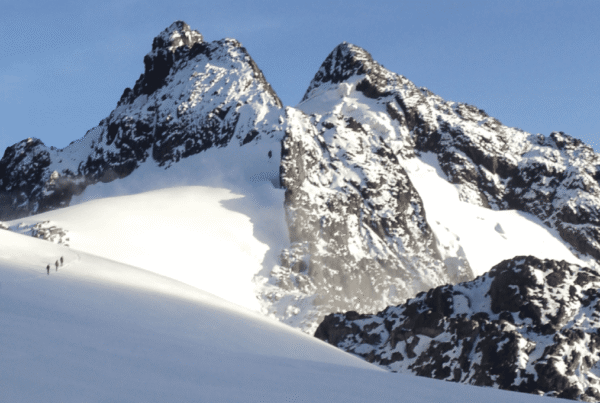
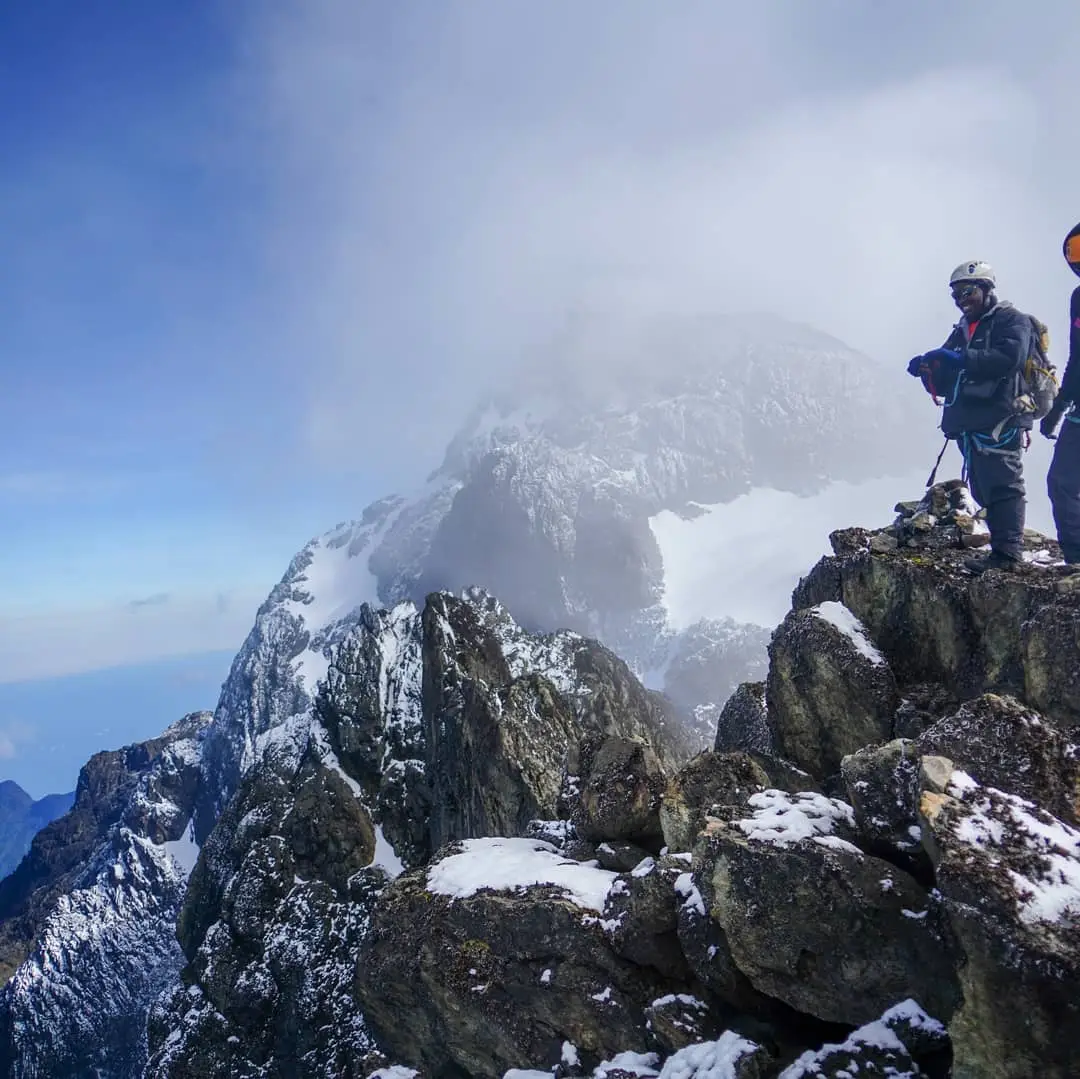
The Rwenzori is not that kind of mountain once you leave the trekking-only routes behind. Reaching Margherita Peak on Mount Stanley means crossing the remnant Stanley Plateau glacier, a genuinely technical section involving fixed ropes, harnesses, crampons and, in places, aluminium ladders bridging crevasses, all under the direction of your lead guide and assistant guides. Our detailed breakdown of the Margherita Peak climb explains exactly what the glacier crossing and the final rock-and-ice push to the summit demand, and the story of the Duke of Abruzzi’s first ascent in 1906 is a useful reminder that this was, and remains, a mountaineering objective in the fullest sense, not merely a long walk with a view. No prior ice-climbing certification is required, because your guides teach and manage the technical sections as part of the expedition, but you are, by any honest definition, doing real glacier mountaineering on summit day, not trekking.
That said, it is entirely possible to experience the Rwenzori without ever touching the glacier. Routes such as the 3-day Mahoma Loop, the 4-day Mutinda Lookout trek and the 2-day hike to Lake Mahoma keep you in the forest and moorland zones and never approach technical terrain, and our guide to trekking the Rwenzori without going to the summit lays these out for readers who want the range’s landscapes without its mountaineering demands. In that narrower sense, a non-summit Rwenzori trek is closer in character to a Kilimanjaro day walk than the Margherita climb ever is. But the mountain most people mean when they ask this question, the one that ends on Africa’s third-highest point, is a technical mountaineering objective that Kilimanjaro simply is not.
From the MountainI have guided strong Kilimanjaro alumni who arrived assuming their summit-night experience would translate directly. Cardiovascular fitness from Kilimanjaro helps enormously, and it should not be discounted. But nothing about six days of scree walking prepares you for your first steps in crampons on a glacier, and we build that instruction into the itinerary precisely because it is new ground even for seasoned trekkers. Our glacier crossing guide and our minute-by-minute account of the final push to Margherita Peak are worth reading in full before you commit to the summit route. |
Altitude and Acclimatization: A Faster Mountain Versus a Slower One
Counter-intuitively, Kilimanjaro is often the more physiologically punishing of the two mountains when it comes to altitude sickness, despite being the lower-difficulty trek in terrain terms. Kilimanjaro rises higher, to 5,895 metres, and its shorter itineraries compress a great deal of altitude gain into a short number of days, which is precisely why acute mountain sickness rates on the five-day Marangu route are notoriously high. The mountain’s popularity has, if anything, pushed operators toward itineraries that are shorter than ideal for safe acclimatization, and summit-night altitude gain on Kilimanjaro is aggressive by any standard.
Rwenzori itineraries, by contrast, are built around a longer, more gradual ascent profile almost by necessity, because the terrain itself will not let you move quickly. The 7-day Margherita Peak climb via the Central Circuit and the 8-day Kilembe Trail climb both build in a step-wise gain through five distinct vegetation zones over multiple days before the final push from Elena Camp at 4,541 metres, and our acclimatization guide explains why this slower rhythm, while physically demanding in its own right, tends to produce better acclimatization outcomes than Kilimanjaro’s faster and more compressed profile. None of this means the Rwenzori is free of altitude risk. Trekkers should still take mountain sickness seriously at over 4,500 metres, and our complete medical guide and our dedicated article on altitude sickness on the Rwenzori cover the symptoms, the protocols and the point at which a guide will call a descent. The honest summary is that Kilimanjaro concentrates its altitude risk into fewer days at a higher final elevation, while the Rwenzori spreads a lower but still serious altitude challenge across a longer, physically harder ascent.
Crowds, Permits and What the Trail Actually Feels Like
Kilimanjaro is, by a wide margin, the busier of the two mountains, and this shapes the emotional character of the climb as much as any physical factor. Tanzania National Parks Authority figures put annual visitor numbers at more than fifty thousand, and on the popular routes and around the summit approach it is common to share the trail, the campsites and the final night’s queue for the crater rim with dozens of other parties. Our article on how many people hike the Rwenzori each year puts the comparison starkly: the Rwenzori receives roughly one-thirtieth of Kilimanjaro’s annual trekkers, somewhere between one and two thousand people a year across every route combined. On a private or small-group Rwenzori expedition it is entirely normal to go a full day, or several, without encountering another trekking party at all.

Permits on both mountains are mandatory, administered by government wildlife or parks authorities, and cannot be trekked without a licensed guide, so this is one point of genuine structural similarity. On the Rwenzori, our step-by-step guide to UWA permit booking and our overview of park entrance fees and permits explain how permit dates are secured and bundled into your trek price, exactly as TANAPA fees are bundled into a Kilimanjaro operator’s price. What differs is what that permit buys you: a place in a queue of thousands on Kilimanjaro’s peak season weeks, or a genuinely private, uncrowded expedition on the Rwenzori almost any time of year.
Cost, Duration and What Each Trip Actually Involves
Kilimanjaro treks are typically priced from around USD 2,000 to USD 4,000 per person depending on route, operator and duration, most commonly across five to nine days. Rwenzori pricing follows a similar range but a different shape: our full cost breakdown and companion piece on what climbing the Rwenzori actually costs show that the seven-day Central Circuit climb to Margherita Peak starts from roughly USD 1,400 per person for a private party of one or two, with the eight-day Kilembe Trail option from about USD 1,750, and multi-peak expeditions extending to thirteen or eighteen days for those chasing more than one summit. Duration is where the two mountains diverge most for planning purposes: Kilimanjaro is almost always a five-to-nine-day commitment, while a serious Rwenzori itinerary asks for six days at an absolute minimum for the summit and comfortably rewards eight, with multi-peak and traverse options running to nearly three weeks for trekkers pursuing every named summit in the range, a scale of ambition our guide to the six major peaks puts into context.
Group size structures the price differently too. Kilimanjaro operators commonly run large scheduled group departures because the wide trails and high hut or campsite capacity support them easily. Rwenzori pricing, as our comparison of group versus private treks explains, is quoted per person for parties of one or two as the baseline, with group departures of four to eight trekkers bringing the per-person cost down, reflecting a mountain built for smaller, more intimate expeditions rather than mass throughput.
Vegetation, Wildlife and the Sensory Experience of Each Mountain
Both mountains climb through dramatic vegetation zones, from cultivated lowland farmland through montane forest, moorland and alpine desert to bare rock and ice, and both are genuinely spectacular in their own register. But the character of those zones differs enormously. Kilimanjaro’s upper reaches, above the tree line, become increasingly stark, dry and almost lunar, a landscape of volcanic scree, wide horizons and thin, cold air that feels vast and exposed. It is a mountain you experience mostly by looking outward and upward across enormous distances.
The Rwenzori works in the opposite direction, pulling you inward. Its afro-alpine zone above 3,500 metres is dominated by giant groundsel and giant lobelia, plants that grow nowhere at this scale outside East Africa’s high mountains and that give the range its otherworldly, almost prehistoric character, while the montane forest below hosts chimpanzees, black-and-white colobus monkeys, duiker and, for the fortunate, the endemic Rwenzori turaco. The route rarely opens into Kilimanjaro-style wide views for long; instead, you are threading valleys, crossing bogs between walls of vegetation, and passing glacial lakes like Bujuku and Kitandara that sit tucked beneath the peaks rather than visible from a great distance. If Kilimanjaro feels planetary and vast, the Rwenzori feels enclosed, humid and alive, a genuinely different sensory register that our comparison of Kilimanjaro, Mount Kenya and the Rwenzori explores at length.
Who Should Choose Which Mountain, and Who Should Do Both
If your priority is standing on Africa’s highest point, want a well-supported, non-technical trekking challenge, and are comfortable sharing the trail with a large number of other trekkers in peak season, Kilimanjaro is the right choice and there is no shame in that preference. It remains one of the world’s great accessible high-altitude objectives.
If your priority is genuine wilderness, a physically and technically varied challenge that includes real glacier mountaineering, a landscape found nowhere else on the planet, and an expedition you are unlikely to share with more than a handful of other trekkers, the Rwenzori is the better fit, and our honest assessment of whether the Rwenzori is worth climbing makes the case in full. Trekkers who have already summited Kilimanjaro and are looking for the next serious step, rather than a repeat of the same kind of day, consistently tell us the Rwenzori delivered exactly that. Our guide to do you need to be very fit to climb the Rwenzori and our honest look at whether beginners can climb the Rwenzori will help you judge your own readiness regardless of your Kilimanjaro background.
You do not, in fact, have to choose only one. A growing number of our clients treat East Africa’s three great glaciated ranges as a single, staged ambition, and our guide to combining Kilimanjaro, Mount Kenya and the Rwenzori sets out how trekkers sequence the three, often opening with the Rwenzori’s technical demands while their crampon technique is freshest, or closing with it as the hardest final test after two accessible summits already stand behind them. If Uganda is already on your itinerary, pairing a Rwenzori trek with gorilla trekking in Bwindi turns the trip into something Kilimanjaro alone cannot offer.
Preparing Differently for Each Mountain
Because the two mountains ask different things of your body, your training should not be identical even if your general fitness base is the same. Cardiovascular conditioning, long hill walks and stair training that serve a Kilimanjaro climber well remain useful for the Rwenzori, but they are not sufficient on their own. Our 16-week Rwenzori training plan adds ankle stability work, load-carrying practice and, where possible, some exposure to uneven or muddy terrain, because balance and proprioception matter here in a way they simply do not on Kilimanjaro’s graded paths. Gear lists diverge too: our full Rwenzori packing list and our guide on whether you need special gear both explain why rubber boots, gaiters and technical glacier equipment feature here in a way that a standard Kilimanjaro kit list never mentions. In both cases, mandatory travel insurance covering high-altitude trekking and emergency evacuation is non-negotiable, and our Rwenzori travel insurance guide explains what to look for, a requirement that applies with equal seriousness on Kilimanjaro.
Frequently Asked Questions: Rwenzori Trekking Versus Kilimanjaro
Is Rwenzori trekking the same as hiking Kilimanjaro?
No. Rwenzori trekking and Kilimanjaro trekking are different experiences on different kinds of mountains. Kilimanjaro is a single dormant volcano climbed on wide, graded, non-technical trails to a 5,895-metre summit. The Rwenzori is a non-volcanic, tectonically uplifted mountain range where reaching Margherita Peak at 5,109 metres involves days of muddy, boggy terrain followed by genuine roped glacier travel with crampons and fixed ladders. They share an African, near-equatorial setting and a habit of ending in permanent ice, but the terrain, technical demands, crowd levels and physical challenge involved are substantially different.
Which is harder, Rwenzori or Kilimanjaro?
Most experienced trekkers and guides, including our own team, rate the Rwenzori as the harder overall challenge, even though Kilimanjaro is the higher mountain. Kilimanjaro’s difficulty is concentrated almost entirely in altitude and a long, cold summit night. The Rwenzori adds difficult, muddy and bog-heavy terrain, greater physical demands across multiple days, and genuine technical glacier mountaineering on summit day, none of which Kilimanjaro requires. Our dedicated comparison, Is the Rwenzori Harder Than Kilimanjaro?, covers this question in full technical detail.
Do I need technical climbing skills for the Rwenzori if I have already climbed Kilimanjaro?
You do not need prior technical climbing certification, but you should expect the Margherita Peak summit day to involve skills that Kilimanjaro never asked of you: using crampons, being clipped to fixed ropes, crossing aluminium ladders over crevasses, and moving carefully on glacier ice. Your guides teach and supervise these sections as part of the expedition. Kilimanjaro fitness is a genuine advantage but is not, on its own, preparation for the Rwenzori’s glacier terrain.
Is Kilimanjaro more crowded than the Rwenzori?
Yes, considerably. Kilimanjaro receives more than fifty thousand trekkers a year, and popular routes and summit nights can involve dozens of other parties on the trail at once. The Rwenzori receives roughly one to two thousand trekkers a year across all routes combined, and it is common on a private or small-group expedition to go an entire day, or several, without seeing another trekking party.
Which mountain is better for a first-time high-altitude trekker?
Kilimanjaro is generally the gentler introduction to high altitude, since its trails are wide, well-graded and non-technical, though its shorter itineraries can carry a higher risk of altitude sickness if not chosen carefully. The Rwenzori is achievable for well-prepared first-time trekkers on its non-summit routes, such as the Mahoma Loop, but the Margherita Peak summit route is better suited to trekkers with some hiking experience and realistic fitness preparation, given its terrain and technical demands.
Can I climb both the Rwenzori and Kilimanjaro on one trip?
Yes, though logistics require planning, since the two mountains sit in different countries roughly a long day’s travel apart via Nairobi or Kigali connections. Many trekkers sequence them as separate expeditions within the same regional trip or across two visits, and our guide to combining Kilimanjaro, Mount Kenya and the Rwenzori explains how trekkers commonly stage the three East African giants for maximum acclimatization benefit and manageable logistics.
Is the Rwenzori a UNESCO World Heritage Site like Kilimanjaro?
Yes. Both mountains carry UNESCO World Heritage Site status. Kilimanjaro National Park was inscribed in 1987 for its status as the world’s highest freestanding volcanic mass. The Rwenzori Mountains National Park was inscribed for its outstanding natural beauty, its permanent equatorial glaciers and its exceptional afro-alpine biodiversity, recognitions that reflect two very different but equally significant natural landscapes.
Does climbing Kilimanjaro prepare you for the Rwenzori?
Partially. The cardiovascular fitness and altitude exposure gained on Kilimanjaro are genuinely useful and transfer well to the early days of a Rwenzori trek. What Kilimanjaro cannot prepare you for is the Rwenzori’s underfoot terrain, its bogs, river crossings and rock scrambles, or its technical glacier travel, so additional preparation specific to those demands is strongly recommended regardless of Kilimanjaro experience.
Ready to Choose Your Mountain?
Both the Rwenzori and Kilimanjaro are extraordinary in their own right, but they are not interchangeable, and choosing the one that actually matches what you want from an African mountain, solitude or shared celebration, a technical glacier challenge or a well-supported trekking objective, will shape how much you enjoy every single day on the trail. If what you have read here points you toward the Mountains of the Moon, we would be glad to help you plan the right route, the right season and the right level of ambition for your experience.
Message a mountain guide on WhatsApp, send us a custom quote request, or write to rwenzoritrekkingsafaris@gmail.com, and let us build the Rwenzori expedition that will answer this question for you, permanently, from the summit down. Explore our full range of Rwenzori treks and expeditions or browse our FAQ library while you weigh your decision.
| Thought about Kilimanjaro. Ready for something wilder?
WhatsApp a mountain guide: +256 773 256 104 Request a custom quote: rwenzoritrekkingsafaris.com/contact-us Email: rwenzoritrekkingsafaris@gmail.com |
Is Rwenzori trekking the same as hiking Kilimanjaro? No. Compare terrain, technical demands, altitude, crowds and cost before you choose your mountain.
I get this question in almost every pre-trip call, usually phrased in one of two ways. Either someone has just come down off Kilimanjaro, felt the pull of altitude for the first time, and wants to know whether the Rwenzori is simply the next rung on the same ladder. Or someone has read about the Mountains of the Moon, seen a photograph of a headlamp beam on a fixed ladder above a glacier, and wants to know whether it is, underneath the marketing, basically the same walk as the one their friend did in Tanzania with a photo at a wooden signpost. The honest answer, and I say this as someone who has guided on the Rwenzori Mountains for years and watched hundreds of Kilimanjaro veterans arrive here expecting a repeat performance, is no. They are not the same trek, not the same mountain, and in several respects not even the same kind of undertaking. They share an equator, a continent and a habit of ending in ice, and that is very nearly where the similarity stops.
This article exists because most comparisons online are either thin marketing copy or a single paragraph buried in a listicle, and neither gives you what you actually need before you commit weeks of leave and a serious amount of money to one mountain or the other. What follows is the complete comparison: how the two mountains were made, how their trails behave underfoot, what technical skill each summit actually demands, how altitude affects you differently on each, how crowded or empty each experience is, what each costs, and, at the end, straightforward guidance on which one is right for you, and whether you should simply do both. If you have already read our dedicated piece on whether the Rwenzori is harder than Kilimanjaro, this article covers similar ground from a different angle: not just which is harder, but whether the experiences themselves are the same kind of thing at all.
The Short Answer: No, They Are Fundamentally Different Mountains
Rwenzori trekking and Kilimanjaro trekking are not the same experience, even though both are often marketed under the same broad banner of “climb a high mountain in Africa.” Kilimanjaro is a single dormant volcano in Tanzania that you walk up and around on wide, engineered trails to a non-technical summit at 5,895 metres, the highest point on the continent, typically over five to nine days. The Rwenzori is a jagged, glaciated mountain range straddling the Uganda-DRC border, built by tectonic uplift rather than volcanism, where reaching Margherita Peak on Mount Stanley at 5,109 metres requires days of walking through mud, bog and river crossings followed by genuine glacier travel on ropes, crampons and fixed ladders. Kilimanjaro tests your lungs and your patience with altitude. The Rwenzori tests your lungs, your feet, your balance and, on summit day, your ability to move competently on ice. Both are extraordinary. Neither is a substitute for the other.
It helps to see the two mountains side by side before going into the detail, because the differences compound rather than cancel out.
| Mount Kilimanjaro | Rwenzori Mountains | |
| Summit / highest point | Uhuru Peak, 5,895 m | Margherita Peak, 5,109 m |
| Origin | Dormant stratovolcano | Non-volcanic, tectonic fault-block range |
| Location | Kilimanjaro National Park, Tanzania | Rwenzori Mountains National Park, western Uganda (UNESCO World Heritage Site, DRC border) |
| Technical summit day | No roped climbing; a long, steep, non-technical night walk | Roped glacier travel, crampons, harnesses, fixed ladders over crevasses |
| Typical duration | 5–9 days | 6–18 days depending on route and peaks |
| Terrain underfoot | Wide, graded volcanic scree and dirt paths | Mud, bogs, boardwalks, river crossings, rock scrambles, ice |
| Annual trekkers | Roughly 50,000+ | Roughly 1,000–2,000 |
| Governing authority | Tanzania National Parks Authority (TANAPA) | Uganda Wildlife Authority |
| Guide requirement | Mandatory | Mandatory — see our guide on why guides are required |
How the Two Mountains Were Made, and Why It Matters on the Trail
The single biggest reason these two treks feel nothing alike underfoot traces back to geology, and it is worth pausing on because everything else in this article flows from it. Kilimanjaro is a dormant stratovolcano, formally comprising the cones of Kibo, Mawenzi and Shira, built up over roughly a million years by successive eruptions that layered ash, lava and pumice into the broad, smooth-sided massif you see in every photograph. Volcanic cones build trails that geology itself has already graded: consistent slopes, loose but predictable scree, and a summit that sits at the literal top of a single, symmetrical structure. Kilimanjaro National Park, which protects the mountain above roughly 2,700 metres along with surrounding montane forest, was established in 1973 and inscribed as a UNESCO World Heritage Site in 1987 for exactly this singular, freestanding volcanic form.
The Rwenzori is a completely different kind of mountain. It was not built by eruption at all. It is a horst, a block of the earth’s crust thrust upward along fault lines over millions of years as the two arms of the Great Rift Valley pulled apart around it, and our own explanation of what makes the Rwenzori special goes into that story in more depth. Rather than one cone, you are walking into a jumbled range of six major glaciated massifs, Mount Stanley, Mount Speke, Mount Baker, Mount Emin, Mount Gessi and Mount Luigi di Savoia, separated by deep valleys, knife-edge ridges and boggy basins that never had the chance to be smoothed into a single predictable gradient. This is also why the Rwenzori is a UNESCO World Heritage Site in its own right, listed for its exceptional natural beauty and its role as one of Africa’s last great glaciated wildernesses, and why our guide to Kilimanjaro versus Mount Kenya versus the Rwenzori treats tectonic geology as the starting point for understanding all three ranges.
Fault-block terrain does not offer you a graded path. It offers you whatever the valley, the ridge or the bog happened to leave behind, and the trail engineers who built Kilimanjaro’s wide volcanic corridors had no equivalent canvas to work with here.
Terrain and Trail Conditions: Graded Scree Versus Mud, Bog and Ladders
If you have climbed Kilimanjaro, picture the trail on the Machame or Lemosho routes: broad, generally dry, with a surface of packed dirt and volcanic scree that a support vehicle could almost drive on for the lower sections. The path is obvious, well-marked and, outside of the final summit push, rarely demands you to use your hands. That experience does not exist on the Rwenzori, and this is the single fact that surprises Kilimanjaro veterans most on arrival.
The Rwenzori sits inside one of the wettest high-altitude environments in Africa, receiving well over 3,000 millimetres of rain a year in its upper zones with only modest seasonal variation, which is why our month-by-month trekking guide and our best time to visit article talk in terms of drier and wetter windows rather than dry and wet seasons in the Kilimanjaro sense. That rainfall turns the trail itself into a variable, living obstacle. Sections of the Central Circuit Trail and the Kilembe Trail cross bogs where the ground genuinely swallows a misplaced boot to the knee, and the famous stretches through the Bigo Bog demand a slow, energy-sapping wading gait that no volcanic scree slope ever asks of you. Wooden boardwalks, tree-root staircases, river crossings on log bridges and short rock scrambles are routine, not occasional, and our Rwenzori boot guide explains why rubber boots, not the stiff leather boots that work fine on Kilimanjaro, are the standard footwear here.
None of this makes the Rwenzori simply “harder mud.” It makes it a different kind of physical problem. Kilimanjaro asks your cardiovascular system a straightforward, repeated question: can you keep climbing at altitude. The Rwenzori asks that same question and adds balance, ankle stability, route-finding through changing bog channels and the accumulated fatigue of picking your footing consciously for hours at a stretch. Our overview of how hard trekking the Rwenzori really is breaks this down in full, and it is the terrain, more than the altitude, that experienced trekkers from Kilimanjaro consistently underestimate before their first Rwenzori day.
Technical Demands: A Long Walk Versus Roped Glacier Travel
This is the most consequential difference of all, and it is the one that should decide your itinerary regardless of how fit you are. Kilimanjaro’s summit, Uhuru Peak, requires no technical climbing skill whatsoever. Summit night is long, cold, steep and genuinely difficult on the lungs and the will, typically six to eight hours of switchbacking scree in the dark, but at no point do you clip into a rope, strap on crampons or cross a crevasse. It is entirely a trekking challenge, which is precisely why it is accessible to roughly fifty thousand people a year with widely varying levels of mountain experience.
The Rwenzori is not that kind of mountain once you leave the trekking-only routes behind. Reaching Margherita Peak on Mount Stanley means crossing the remnant Stanley Plateau glacier, a genuinely technical section involving fixed ropes, harnesses, crampons and, in places, aluminium ladders bridging crevasses, all under the direction of your lead guide and assistant guides. Our detailed breakdown of the Margherita Peak climb explains exactly what the glacier crossing and the final rock-and-ice push to the summit demand, and the story of the Duke of Abruzzi’s first ascent in 1906 is a useful reminder that this was, and remains, a mountaineering objective in the fullest sense, not merely a long walk with a view. No prior ice-climbing certification is required, because your guides teach and manage the technical sections as part of the expedition, but you are, by any honest definition, doing real glacier mountaineering on summit day, not trekking.
That said, it is entirely possible to experience the Rwenzori without ever touching the glacier. Routes such as the 3-day Mahoma Loop, the 4-day Mutinda Lookout trek and the 2-day hike to Lake Mahoma keep you in the forest and moorland zones and never approach technical terrain, and our guide to trekking the Rwenzori without going to the summit lays these out for readers who want the range’s landscapes without its mountaineering demands. In that narrower sense, a non-summit Rwenzori trek is closer in character to a Kilimanjaro day walk than the Margherita climb ever is. But the mountain most people mean when they ask this question, the one that ends on Africa’s third-highest point, is a technical mountaineering objective that Kilimanjaro simply is not.
From the MountainI have guided strong Kilimanjaro alumni who arrived assuming their summit-night experience would translate directly. Cardiovascular fitness from Kilimanjaro helps enormously, and it should not be discounted. But nothing about six days of scree walking prepares you for your first steps in crampons on a glacier, and we build that instruction into the itinerary precisely because it is new ground even for seasoned trekkers. Our glacier crossing guide and our minute-by-minute account of the final push to Margherita Peak are worth reading in full before you commit to the summit route. |
Altitude and Acclimatization: A Faster Mountain Versus a Slower One
Counter-intuitively, Kilimanjaro is often the more physiologically punishing of the two mountains when it comes to altitude sickness, despite being the lower-difficulty trek in terrain terms. Kilimanjaro rises higher, to 5,895 metres, and its shorter itineraries compress a great deal of altitude gain into a short number of days, which is precisely why acute mountain sickness rates on the five-day Marangu route are notoriously high. The mountain’s popularity has, if anything, pushed operators toward itineraries that are shorter than ideal for safe acclimatization, and summit-night altitude gain on Kilimanjaro is aggressive by any standard.
Rwenzori itineraries, by contrast, are built around a longer, more gradual ascent profile almost by necessity, because the terrain itself will not let you move quickly. The 7-day Margherita Peak climb via the Central Circuit and the 8-day Kilembe Trail climb both build in a step-wise gain through five distinct vegetation zones over multiple days before the final push from Elena Camp at 4,541 metres, and our acclimatization guide explains why this slower rhythm, while physically demanding in its own right, tends to produce better acclimatization outcomes than Kilimanjaro’s faster and more compressed profile. None of this means the Rwenzori is free of altitude risk. Trekkers should still take mountain sickness seriously at over 4,500 metres, and our complete medical guide and our dedicated article on altitude sickness on the Rwenzori cover the symptoms, the protocols and the point at which a guide will call a descent. The honest summary is that Kilimanjaro concentrates its altitude risk into fewer days at a higher final elevation, while the Rwenzori spreads a lower but still serious altitude challenge across a longer, physically harder ascent.
Crowds, Permits and What the Trail Actually Feels Like
Kilimanjaro is, by a wide margin, the busier of the two mountains, and this shapes the emotional character of the climb as much as any physical factor. Tanzania National Parks Authority figures put annual visitor numbers at more than fifty thousand, and on the popular routes and around the summit approach it is common to share the trail, the campsites and the final night’s queue for the crater rim with dozens of other parties. Our article on how many people hike the Rwenzori each year puts the comparison starkly: the Rwenzori receives roughly one-thirtieth of Kilimanjaro’s annual trekkers, somewhere between one and two thousand people a year across every route combined. On a private or small-group Rwenzori expedition it is entirely normal to go a full day, or several, without encountering another trekking party at all.
Permits on both mountains are mandatory, administered by government wildlife or parks authorities, and cannot be trekked without a licensed guide, so this is one point of genuine structural similarity. On the Rwenzori, our step-by-step guide to UWA permit booking and our overview of park entrance fees and permits explain how permit dates are secured and bundled into your trek price, exactly as TANAPA fees are bundled into a Kilimanjaro operator’s price. What differs is what that permit buys you: a place in a queue of thousands on Kilimanjaro’s peak season weeks, or a genuinely private, uncrowded expedition on the Rwenzori almost any time of year.
Cost, Duration and What Each Trip Actually Involves
Kilimanjaro treks are typically priced from around USD 2,000 to USD 4,000 per person depending on route, operator and duration, most commonly across five to nine days. Rwenzori pricing follows a similar range but a different shape: our full cost breakdown and companion piece on what climbing the Rwenzori actually costs show that the seven-day Central Circuit climb to Margherita Peak starts from roughly USD 1,400 per person for a private party of one or two, with the eight-day Kilembe Trail option from about USD 1,750, and multi-peak expeditions extending to thirteen or eighteen days for those chasing more than one summit. Duration is where the two mountains diverge most for planning purposes: Kilimanjaro is almost always a five-to-nine-day commitment, while a serious Rwenzori itinerary asks for six days at an absolute minimum for the summit and comfortably rewards eight, with multi-peak and traverse options running to nearly three weeks for trekkers pursuing every named summit in the range, a scale of ambition our guide to the six major peaks puts into context.
Group size structures the price differently too. Kilimanjaro operators commonly run large scheduled group departures because the wide trails and high hut or campsite capacity support them easily. Rwenzori pricing, as our comparison of group versus private treks explains, is quoted per person for parties of one or two as the baseline, with group departures of four to eight trekkers bringing the per-person cost down, reflecting a mountain built for smaller, more intimate expeditions rather than mass throughput.
Vegetation, Wildlife and the Sensory Experience of Each Mountain
Both mountains climb through dramatic vegetation zones, from cultivated lowland farmland through montane forest, moorland and alpine desert to bare rock and ice, and both are genuinely spectacular in their own register. But the character of those zones differs enormously. Kilimanjaro’s upper reaches, above the tree line, become increasingly stark, dry and almost lunar, a landscape of volcanic scree, wide horizons and thin, cold air that feels vast and exposed. It is a mountain you experience mostly by looking outward and upward across enormous distances.
The Rwenzori works in the opposite direction, pulling you inward. Its afro-alpine zone above 3,500 metres is dominated by giant groundsel and giant lobelia, plants that grow nowhere at this scale outside East Africa’s high mountains and that give the range its otherworldly, almost prehistoric character, while the montane forest below hosts chimpanzees, black-and-white colobus monkeys, duiker and, for the fortunate, the endemic Rwenzori turaco. The route rarely opens into Kilimanjaro-style wide views for long; instead, you are threading valleys, crossing bogs between walls of vegetation, and passing glacial lakes like Bujuku and Kitandara that sit tucked beneath the peaks rather than visible from a great distance. If Kilimanjaro feels planetary and vast, the Rwenzori feels enclosed, humid and alive, a genuinely different sensory register that our comparison of Kilimanjaro, Mount Kenya and the Rwenzori explores at length.
Who Should Choose Which Mountain, and Who Should Do Both
If your priority is standing on Africa’s highest point, want a well-supported, non-technical trekking challenge, and are comfortable sharing the trail with a large number of other trekkers in peak season, Kilimanjaro is the right choice and there is no shame in that preference. It remains one of the world’s great accessible high-altitude objectives.
If your priority is genuine wilderness, a physically and technically varied challenge that includes real glacier mountaineering, a landscape found nowhere else on the planet, and an expedition you are unlikely to share with more than a handful of other trekkers, the Rwenzori is the better fit, and our honest assessment of whether the Rwenzori is worth climbing makes the case in full. Trekkers who have already summited Kilimanjaro and are looking for the next serious step, rather than a repeat of the same kind of day, consistently tell us the Rwenzori delivered exactly that. Our guide to do you need to be very fit to climb the Rwenzori and our honest look at whether beginners can climb the Rwenzori will help you judge your own readiness regardless of your Kilimanjaro background.
You do not, in fact, have to choose only one. A growing number of our clients treat East Africa’s three great glaciated ranges as a single, staged ambition, and our guide to combining Kilimanjaro, Mount Kenya and the Rwenzori sets out how trekkers sequence the three, often opening with the Rwenzori’s technical demands while their crampon technique is freshest, or closing with it as the hardest final test after two accessible summits already stand behind them. If Uganda is already on your itinerary, pairing a Rwenzori trek with gorilla trekking in Bwindi turns the trip into something Kilimanjaro alone cannot offer.
Preparing Differently for Each Mountain
Because the two mountains ask different things of your body, your training should not be identical even if your general fitness base is the same. Cardiovascular conditioning, long hill walks and stair training that serve a Kilimanjaro climber well remain useful for the Rwenzori, but they are not sufficient on their own. Our 16-week Rwenzori training plan adds ankle stability work, load-carrying practice and, where possible, some exposure to uneven or muddy terrain, because balance and proprioception matter here in a way they simply do not on Kilimanjaro’s graded paths. Gear lists diverge too: our full Rwenzori packing list and our guide on whether you need special gear both explain why rubber boots, gaiters and technical glacier equipment feature here in a way that a standard Kilimanjaro kit list never mentions. In both cases, mandatory travel insurance covering high-altitude trekking and emergency evacuation is non-negotiable, and our Rwenzori travel insurance guide explains what to look for, a requirement that applies with equal seriousness on Kilimanjaro.
Frequently Asked Questions: Rwenzori Trekking Versus Kilimanjaro
Is Rwenzori trekking the same as hiking Kilimanjaro?
No. Rwenzori trekking and Kilimanjaro trekking are different experiences on different kinds of mountains. Kilimanjaro is a single dormant volcano climbed on wide, graded, non-technical trails to a 5,895-metre summit. The Rwenzori is a non-volcanic, tectonically uplifted mountain range where reaching Margherita Peak at 5,109 metres involves days of muddy, boggy terrain followed by genuine roped glacier travel with crampons and fixed ladders. They share an African, near-equatorial setting and a habit of ending in permanent ice, but the terrain, technical demands, crowd levels and physical challenge involved are substantially different.
Which is harder, Rwenzori or Kilimanjaro?
Most experienced trekkers and guides, including our own team, rate the Rwenzori as the harder overall challenge, even though Kilimanjaro is the higher mountain. Kilimanjaro’s difficulty is concentrated almost entirely in altitude and a long, cold summit night. The Rwenzori adds difficult, muddy and bog-heavy terrain, greater physical demands across multiple days, and genuine technical glacier mountaineering on summit day, none of which Kilimanjaro requires. Our dedicated comparison, Is the Rwenzori Harder Than Kilimanjaro?, covers this question in full technical detail.
Do I need technical climbing skills for the Rwenzori if I have already climbed Kilimanjaro?
You do not need prior technical climbing certification, but you should expect the Margherita Peak summit day to involve skills that Kilimanjaro never asked of you: using crampons, being clipped to fixed ropes, crossing aluminium ladders over crevasses, and moving carefully on glacier ice. Your guides teach and supervise these sections as part of the expedition. Kilimanjaro fitness is a genuine advantage but is not, on its own, preparation for the Rwenzori’s glacier terrain.
Is Kilimanjaro more crowded than the Rwenzori?
Yes, considerably. Kilimanjaro receives more than fifty thousand trekkers a year, and popular routes and summit nights can involve dozens of other parties on the trail at once. The Rwenzori receives roughly one to two thousand trekkers a year across all routes combined, and it is common on a private or small-group expedition to go an entire day, or several, without seeing another trekking party.
Which mountain is better for a first-time high-altitude trekker?
Kilimanjaro is generally the gentler introduction to high altitude, since its trails are wide, well-graded and non-technical, though its shorter itineraries can carry a higher risk of altitude sickness if not chosen carefully. The Rwenzori is achievable for well-prepared first-time trekkers on its non-summit routes, such as the Mahoma Loop, but the Margherita Peak summit route is better suited to trekkers with some hiking experience and realistic fitness preparation, given its terrain and technical demands.
Can I climb both the Rwenzori and Kilimanjaro on one trip?
Yes, though logistics require planning, since the two mountains sit in different countries roughly a long day’s travel apart via Nairobi or Kigali connections. Many trekkers sequence them as separate expeditions within the same regional trip or across two visits, and our guide to combining Kilimanjaro, Mount Kenya and the Rwenzori explains how trekkers commonly stage the three East African giants for maximum acclimatization benefit and manageable logistics.
Is the Rwenzori a UNESCO World Heritage Site like Kilimanjaro?
Yes. Both mountains carry UNESCO World Heritage Site status. Kilimanjaro National Park was inscribed in 1987 for its status as the world’s highest freestanding volcanic mass. The Rwenzori Mountains National Park was inscribed for its outstanding natural beauty, its permanent equatorial glaciers and its exceptional afro-alpine biodiversity, recognitions that reflect two very different but equally significant natural landscapes.
Does climbing Kilimanjaro prepare you for the Rwenzori?
Partially. The cardiovascular fitness and altitude exposure gained on Kilimanjaro are genuinely useful and transfer well to the early days of a Rwenzori trek. What Kilimanjaro cannot prepare you for is the Rwenzori’s underfoot terrain, its bogs, river crossings and rock scrambles, or its technical glacier travel, so additional preparation specific to those demands is strongly recommended regardless of Kilimanjaro experience.
Ready to Choose Your Mountain?
Both the Rwenzori and Kilimanjaro are extraordinary in their own right, but they are not interchangeable, and choosing the one that actually matches what you want from an African mountain, solitude or shared celebration, a technical glacier challenge or a well-supported trekking objective, will shape how much you enjoy every single day on the trail. If what you have read here points you toward the Mountains of the Moon, we would be glad to help you plan the right route, the right season and the right level of ambition for your experience.
Message a mountain guide on WhatsApp, send us a custom quote request, or write to rwenzoritrekkingsafaris@gmail.com, and let us build the Rwenzori expedition that will answer this question for you, permanently, from the summit down. Explore our full range of Rwenzori treks and expeditions or browse our FAQ library while you weigh your decision.
| Thought about Kilimanjaro. Ready for something wilder?
WhatsApp a mountain guide: +256 773 256 104 Request a custom quote: rwenzoritrekkingsafaris.com/contact-us Email: rwenzoritrekkingsafaris@gmail.com |