What is it really like to cross the Rwenzori glacier? Crampons, ice axes, crevasses, guide techniques: the complete first-timer’s guide to the Stanley Glacier.
The question arrives without exception. I have guided hundreds of trekkers to the high camps of the Rwenzori Mountains, and within a day or two of every summit departure, it is always the same: what is the glacier actually like? Not in the abstract. Not in the way a travel article describes it. What does it feel like, under your boots, with the rope attached, the ice axe in your hand, the darkness still not fully lifting? What is the sound of a glacier at three in the morning on the equator? What does your guide do when the slope steepens? And honestly, what are the dangers?
This guide answers all of those questions from the inside. The Stanley Glacier on Margherita Peak at 5,109 metres is one of the most remarkable pieces of terrain on the African continent: a remnant equatorial ice field sitting almost exactly on the geographic equator, shrinking visibly year by year, and yet still completely glaciated enough to demand crampons, rope, ice axes, and the full respect of the alpine environment. For most trekkers who attempt it, it will be the first glacier they have ever crossed. This guide exists to ensure that the moment is not a surprise.
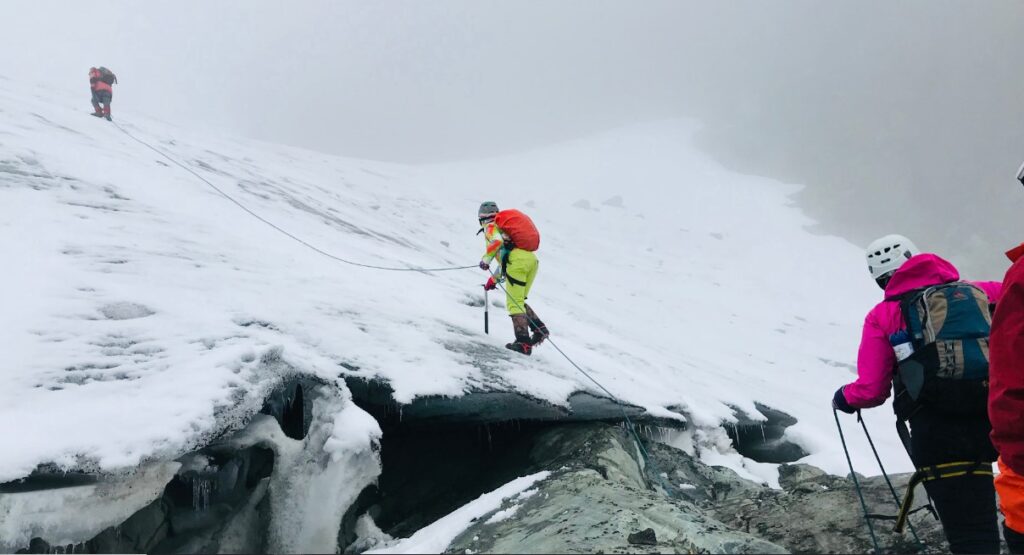
The Stanley Glacier: A Glacier Unlike Any Other on Earth
Before discussing the glacier crossing, it’s important to know that the Rwenzori glaciers are unlike any other ice in the world, and that context changes the experience.
The glaciers in the Rwenzori Mountains are equatorial. They sit at latitudes where the sun passes almost directly overhead twice a year, at an elevation of roughly 4,800 to 5,109 metres above sea level. This combination of equatorial sun and extreme altitude creates a glacial environment that behaves very differently from the glaciers of the Alps, the Andes, or the Himalayas. The Rwenzori ice does not follow the same seasonal melt cycles. It is not fed by winter snowfall in the way a temperate glacier is. Instead, it exists in a perpetual negotiation between the high-altitude cold that preserves it and the equatorial radiation that constantly eats at its edges. The result is an ice body that is simultaneously ancient and fragile, stable in its upper reaches and dynamic at its margins, capable of coating itself in a fresh skin of ice overnight and absorbing warmth with alarming speed by mid-morning.
The Stanley Glacier covers the upper flanks of Mount Stanley, the highest massif in the Rwenzori range and the mountain on whose summit ridge Margherita Peak sits. The first documented ascent of Margherita was made in 1906 by the Duke of Abruzzi, an Italian mountaineer who also pioneered routes on K2 and Denali and established his base camp at the site now known as Margherita Camp, a shelter at 4,485 meters still used by every climbing party today. The glacier that the Duke of Abruzzi crossed in 1906 was larger than the one you will cross today. Climate change has shrunk the Rwenzori’s glaciers dramatically. Satellite imagery shows they have lost more than eighty percent of their extent since the early twentieth century. This retreat is visible and stark from the high camps: you can see the bare rock where the glacier’s edge has pulled back, the moraine debris left behind, and the discoloration of newly exposed stone. What remains is still magnificent and genuinely dangerous, and it still requires every piece of technical equipment the route demands. But it carries with it the weight of a glacier in its final chapters, and standing on it carries a quality of attention that purely scenic places do not.
🧊 Ice FactThe Rwenzori Mountains are one of only three locations in Africa where permanent glaciers still exist; the others are on Mount Kilimanjaro and Mount Kenya. Of these three, the Rwenzori’s glaciers are considered the most stable and the most technically demanding to traverse. They are also among the equatorial glaciers most closely studied by climate scientists for evidence of long-term temperature change. |
The Approach: What Happens Before You Step onto the Ice
No trekker steps onto the Stanley Glacier without having spent several days on the mountain first. Whether you approach via the Kilembe Trail, spending nights at Sine Camp, Mutinda, Bugata, Hunwick’s, and Margherita Camp on the 8-day itinerary, or via the Central Circuit Trail through Nyabitaba, John Matte, and Bujuku Huts, the glacier is not something you reach quickly. You earn it across five, six, or seven days of ascent through the Rwenzori’s five vegetation zones. By the time the glacier comes into view from the upper slopes on the evening before summit day, you have already walked through ancient rainforest, bamboo and heather zones, open moorland, and bare rock. You have already slept over 4,400 meters. If acclimatization has gone well, your body is as ready as it will be.
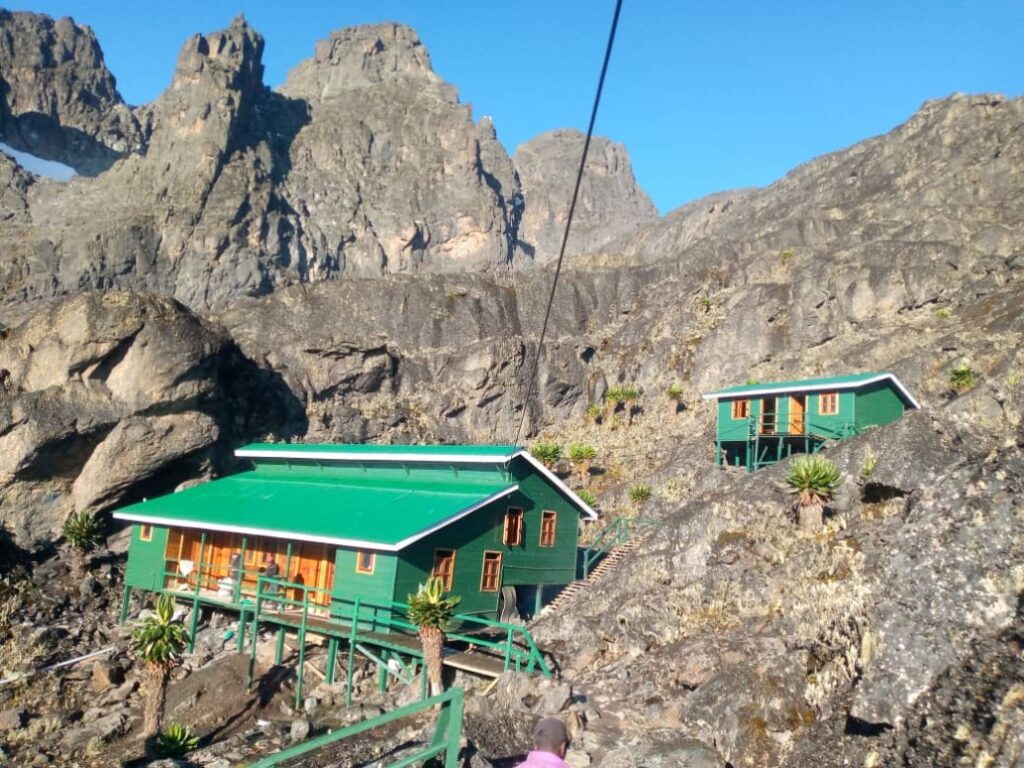
The evening before summit day at Margherita Camp is a gear-check evening. The guides lay out the technical equipment that most trekkers have not yet used: crampons, ice axes, harnesses, helmets, and the rope. This is when the first nervous questions come. Some trekkers have never held an ice axe before. Many have never put on crampons. The guides are relaxed and thorough in equal measure; this combination is one of the things that distinguishes experienced Rwenzori guides from all-purpose trekking staff. They have done this briefing dozens of times. They know which questions matter and which anxieties simply need time and morning air to dissolve. By 9 p.m. Most parties are sleeping in their tents. The wake-up call is at 1:30 a.m.
The 2:00 a.m. Start and What It Means
The very early departure time is not a tradition or an eccentricity. It is the direct product of the equatorial glacier’s behavior in sunlight. The Stanley Glacier surface is at its safest and most stable in the hours before dawn. The overnight cold has refrozen any melt from the previous day, hardening the surface enough for crampon purchase to be reliable and the soft-snow slides that threaten afternoon climbers to be non-existent. The window between approximately 3 a.m. and 8 a.m. This period is the safest time to climb this mountain. Thereafter, the equatorial sun begins converting the upper glacier from an ice surface to a softening mass of wet snow, and what was firm underfoot at four in the morning can be ankle-deep slush by eleven. This statement is not an exaggeration; it is the reason experienced mountaineers on equatorial glaciers always move fast in the morning and are always off the summit long before midday.
You leave Margherita Camp with a headlamp, full summit layers, and an ice axe in hand. The crampons are carried to the glacier edge and fitted there. In the darkness and cold, the valley below is invisible. The stars over the Rwenzori range at this altitude are extraordinary in density and brightness. At 4,500 meters, the air has so little moisture and particulate matter in it that the Milky Way is rendered with a sharpness most people have never seen. Then the headlamp goes on, the team forms up on the trail, and you begin climbing.
Crampons: What They Are, How They Feel, and What They Actually Do
If you’ve never worn crampons, the first step onto ice with them is one of the most reassuring experiences in mountaineering. Crampons are steel frames that attach to the sole of your boot, armed with twelve or more downward-pointing metal spikes called points. When you place a crampon-equipped boot onto firm ice, those points bite into the surface with a grip that has no equivalent in any other form of footwear. Where a normal boot would simply slide away on a 30-degree ice slope, a crampon holds with a certainty that the body registers as relief before the mind has quite processed why.
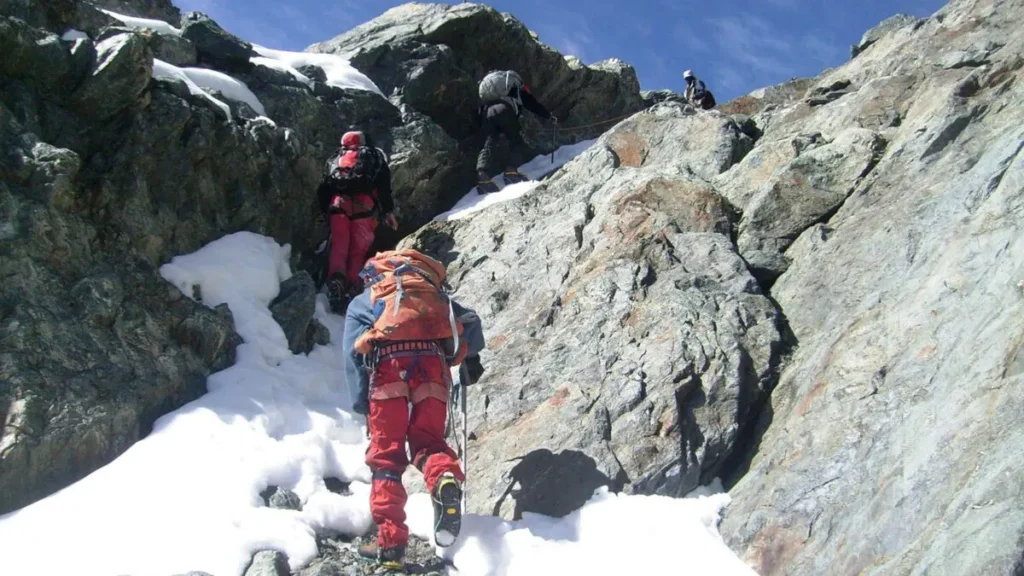
The crampons provided on Rwenzori Trekking Safaris are twelve-point models, appropriate for the mixed terrain of rugged ice and névé snow encountered on the Stanley Glacier approach. They are fitted at the glacier edge by your guide, who checks the attachment to your boot with the specific attention of someone who knows that a loosely fitted crampon in the middle of a glacier slope is a serious problem. The adjustment takes several minutes per pair. It should not be rushed, and the guides do not rush it.
The Weight and Sound of Crampons
The physical sensation of wearing crampons is immediately distinctive. Each crampon adds roughly one kilogram to your boot, and your stride changes: you walk with a slightly wider stance to avoid catching the inside front points on your gaiters or opposite boot, a condition known as ‘balling’ or ‘tripping,’ which can cause falls and which the guides will remind you to watch for at the start of every icy section. The sound crampons make on different glacier surfaces is one of the most memorable sensory details of summit day. On brittle refrozen overnight ice, each step produces a sharp metallic crack, a clean, confident bite that you hear and feel simultaneously through the boot. On neve, which is the compressed granular snow that forms the upper layers of a glacier, you hear a lower, drier crunch. On the partially melted afternoon surface that you want to avoid being on, crampons make a softer, less reliable sound, and the feedback through the sole of the boot changes from crisp to uncertain. Experienced guides hear this difference and adjust their pace accordingly.
Walking Technique on Ice
The technique for walking in crampons on a glacier is not intuitive and takes conscious effort to apply correctly, particularly for trekkers who have spent the previous six days walking on soft trails. On sturdy ice, the cardinal rule is flat-footing: placing the entire sole of the boot flat against the ice surface so that all twelve points engage simultaneously, rather than walking heel-to-toe as you would on a trail. This necessitates a greater than usual knee bend on steep sections and a deliberate weight transfer that initially feels unnatural but becomes mechanical within twenty minutes. Your guide walks in front of you, demonstrating the technique continuously. The pace is slow. On a summit day at a high altitude, slow is correct.
💡 Trekker TipOn the morning of the glacier approach, eat and drink before you fit the crampons, not after. Crampon-equipped boots are unwieldy on the rocky terrain between Margherita Camp and the glacier edge, and the combination of altitude, cold, and pre-dawn darkness makes even simple tasks slower than normal. Having calories and fluids already aboard when you step onto the ice makes a measurable difference to the first hour of the glacier. |
The Ice Axe: What It Is For and What Your Guide Does With It
An ice axe is not primarily a walking tool, though it functions as one on steep snow. Its purpose is more specific and more serious than that. Understanding what an ice axe actually does and what your guide does with theirs transforms it from an intimidating object into a piece of equipment whose presence is genuinely reassuring once you understand its function.

The ice axe has two main working components: the adze (a flat, chisel-like blade on one side of the head) and the pick (a curved, serrated spike on the other side). The spike at the bottom is the ferrule. In glacier travel, the axe serves three primary purposes. The first is balance and support on steep snow, where the shaft is plunged vertically into the snow beside you as a walking stake. This use resembles ordinary hiking pole work and is what trekkers spend most of their time doing on the lower glacier slopes. The second is step-cutting, where the guide uses the adze to chop flat platforms into sturdy ice when the slope steepens and flat-footing with crampons alone is insufficient. The third function that no trekker ever hopes to need, but every trekker should understand, is self-arrest.
The Self-Arrest: Why It Matters
A self-arrest is the technique used to stop a fall on a snow or ice slope. If a climber loses their footing and begins to slide down a glacier, the ice axe is the primary tool for stopping before the slope accelerates the fall into something uncontrollable. The technique involves rolling onto the axe as you fall, driving the pick into the snow or ice beside your shoulder, and using body weight to create friction and drag until the slide stops. It requires muscle memory developed through practice. The guide briefs trekkers on the basic principle at Margherita Camp and demonstrates it on a gentle slope before the serious climbing begins. No first-time trekker is expected to perform a flawless self-arrest under pressure. The rope and the guide’s own axe management are the real protection system. But understanding the technique reduces panic if a slip occurs, and that reduction in panic is itself a safety benefit.
How Your Guide Uses Their Ice Axe
The guide’s ice axe work on the glacier is a continuous, largely invisible form of route management. Ahead of the team, the lead guide tests the surface with their pick at every significant change in slope angle, listening and feeling for the difference between solid ice and an ice layer over an unstable void. They cut steps on steepening sections before the first trekker reaches them. On the most technical parts of the glacier, the fixed-rope sections near the summit ridge, the guide places the axe pick as a running anchor while clipping and unclipping the rope, managing the team’s vertical progress with a patience and precision that makes the whole system feel controlled even when the exposure is significant. This is expertise that looks simple because it has been practiced until it is automatic. Watching an experienced Rwenzori glacier guide work the upper Stanley Glacier is one of the most technically elegant things the mountains offer.
🌿 Guide InsightEvery guide who leads summit attempts on Margherita Peak has specific glacier sections they watch with heightened attention. The area just below the summit ridge where the ice meets exposed rock and the slope angle changes sharply is the section where the most cautious footing is required. The guides slow the team intentionally here, often placing an intermediate anchor and waiting for every member to be on stable ground before the next movement. This caution is not arbitrary. It is the most experienced part of the whole operation. |
The Rope: Roping Up and What It Means in Practice
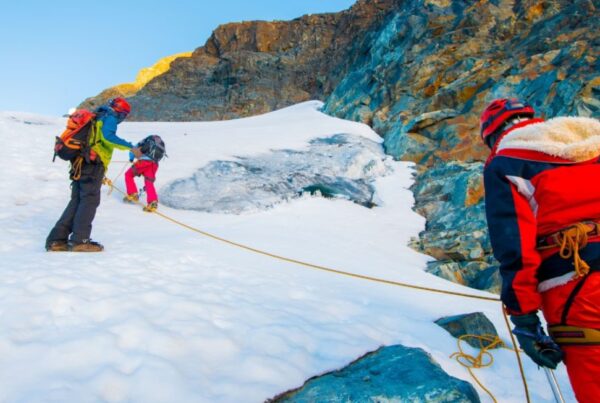
Roping up on a glacier is a psychological act as much as a technical one. When the guide threads the rope through your harness and clips it to the team, something shifts. The individual trekker becomes part of a connected system. The rope is a commitment: it says that if one person falls, the others hold. It says that the team moves together, at the pace of its most cautious member, and that no one is abandoned to the physics of a snow slope alone. For first-time glacier trekkers, the moment of roping up is when the reality of what is happening becomes clear, and most of them later say that their earlier anxiety turned into focus.
The rope used on the Stanley Glacier approach is a dynamic climbing rope designed to absorb and distribute the force of a fall rather than transmit it as a sudden jerk. The guides attach trekkers at intervals of eight to ten metres, with the lead guide setting the front position and a second guide at the rear. The distance between trekkers prevents the pendulum effect of a single taut line while still maintaining the arrest capability of a roped team on a slope. The guides can increase the spacing on the widest, most open sections of the glacier. On narrow ridges and the steepest ice near the summit, the guides bring the rope tighter, reducing the potential slide distance if a fall occurs.
Fixed Ropes and Ladder Sections
The steep rock and ice sections immediately below the Margherita summit ridge have fixed ropes that are anchored permanently or semi-permanently into the rock and ice on the most technical sections of the summit approach. These ropes are checked and replaced by the guides at the start of each climbing season, and they form a critical safety system on sections where unroped climbing would be genuinely dangerous. Trekkers clip into these fixed ropes using a prussik loop or a mechanical ascender, allowing a controlled ascent of sections that would otherwise require full technical belaying. On some of the more exposed ridgeline sections, there are short aluminum ladder sections fixed to the rock face. Walking across these ladders, a narrow bridge over an exposed rock face, with crampons clanking on the rungs, is one of the more visceral moments of the summit day. Most first-timers cross them without looking down, and the guides encourage exactly that approach.
What the Glacier Surface Actually Looks Like and Feels Like
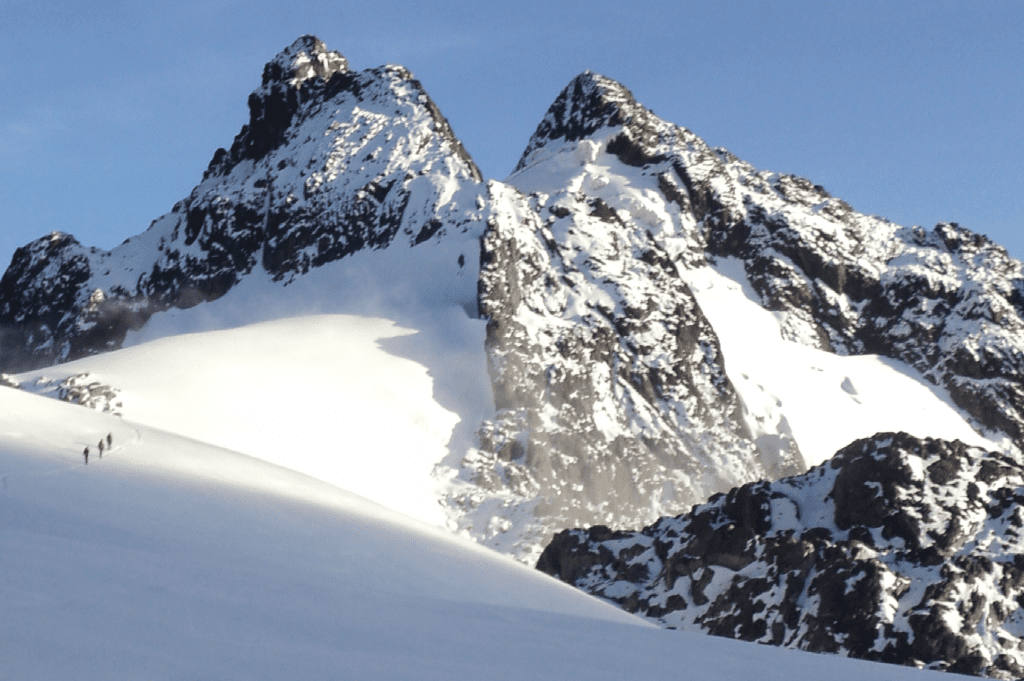
No photograph adequately prepares you for the color of the Rwenzori glacier surface in the minutes before dawn. In headlamp light, the ice appears almost grey, its texture granular and rough where overnight cold has refrozen the melt surface into a kind of crystalline sandpaper. As the first light comes up from the east not sunrise yet, but the pre-dawn paling that arrives at high altitude before the sun itself the glacier surface shifts through shades of blue and grey and white that have no precise names in ordinary language. At certain angles and in certain light, the upper Stanley Glacier appears almost luminous, as if generating its own pale radiance. This is the property of deep ice, the same optical effect that makes the interior of large glaciers appear blue, and it is one of the details that trekkers seldom think to expect but always remember once they have seen it.

The surface underfoot is not uniform. The lower portions of the glacier where you first step onto ice are often covered in névé, a compressed, granular snow surface that is neither as durable as old glacier ice nor as soft as fresh snow. It is firm enough for crampons to bite effectively, and it has a texture that registers as slightly rough through the boot sole. Higher up, where the glacier has been exposed to more cycles of freeze and thaw, the surface becomes harder and more glassy, the crampons sinking less deeply and the sound of each step becoming crisper. In some sections, particularly on north-facing aspects that receive less direct sunlight, the ice is the blue-green color of deep glacier ice, transparent enough at the edges to see through, opaque in the middle, and cold beyond description when you touch it.
The surface is also not flat. Glacier ice exists in constant slow motion; it flows, deforms, fractures at its edges, and develops a topography of ridges, depressions, and features that shift over years. On the Stanley Glacier, you will encounter pressure ridges, small raised lines where ice has been pushed up by internal compression, and the remnants of old crevasse systems now closed but still visible as linear shadows on the ice surface. Where the glacier meets rock at its margins, the ice is often more fractured and unpredictable, and this area is where the guides adjust the team’s line to avoid crossing unstable margins.
🧊 What It Feels Like UnderfootThe most common description first-time glacier trekkers give for the sensation underfoot on rough ice with crampons is “completely unlike anything else.” Not slippery that is the surprise. The crampons make the ice feel more secure than many of the muddy, root-covered forest trails lower on the mountain. What is different is the feedback: ice transmits the shape of the terrain through your boot with a precision that soft ground never does. You feel every small gradient change. You feel the difference between solid ice and ice over a void. This heightened topographic sensitivity is one of the things that makes glacier travel simultaneously demanding and extraordinarily alive. |
The Sounds of the Glacier: A Sensory Landscape Most People Never Describe
At 3 a.m., the Rwenzori glacier stands as one of the continent’s most acoustically remarkable environments, yet it rarely receives written attention. Most accounts of summit day focus entirely on visual experience: the view, the dawn, and the light on the peaks. The sounds are equally extraordinary and equally specific to this place and this hour.
The dominant sound in the pre-dawn hours on the glacier is silence, but it’s a silence of a very particular quality. At 4,800 metres, there are no insects, no animal calls, no wind in trees, and no human settlements within earshot. The only sounds are those the team makes: the crunch and crack of crampons on ice with each footfall, the rhythmic tap of ice axe ferrules on the surface, the soft grunt of breathing at altitude, the occasional word from a guide, and the sound of the rope moving over ice when the team changes direction. These sounds carry in the cold air with a clarity that seems amplified partly because of the air’s dryness and partly because the absence of background noise removes every frequency that would normally mask them. The crampons are loudest: on firm ice, they sound almost metallic, each step a cleanly struck note. On névé, the sound is softer and more percussive.
Occasionally, the glacier makes its own voice heard. A deep, low crack like wood splitting, but longer and more resonant, travels through the ice beneath you. This is thermal contraction: the glacier ice cools further in the pre-dawn air, its internal stresses releasing in a fracture that can run for tens of meters through the ice body at a velocity of several kilometers per second. First-time trekkers stop when they hear it. The guides do not stop. The sound is normal and expected at this temperature, and the cracks it represents are closing fractures, ice pulling together, not opening fractures that indicate instability. Knowing the situation in advance is worth something.
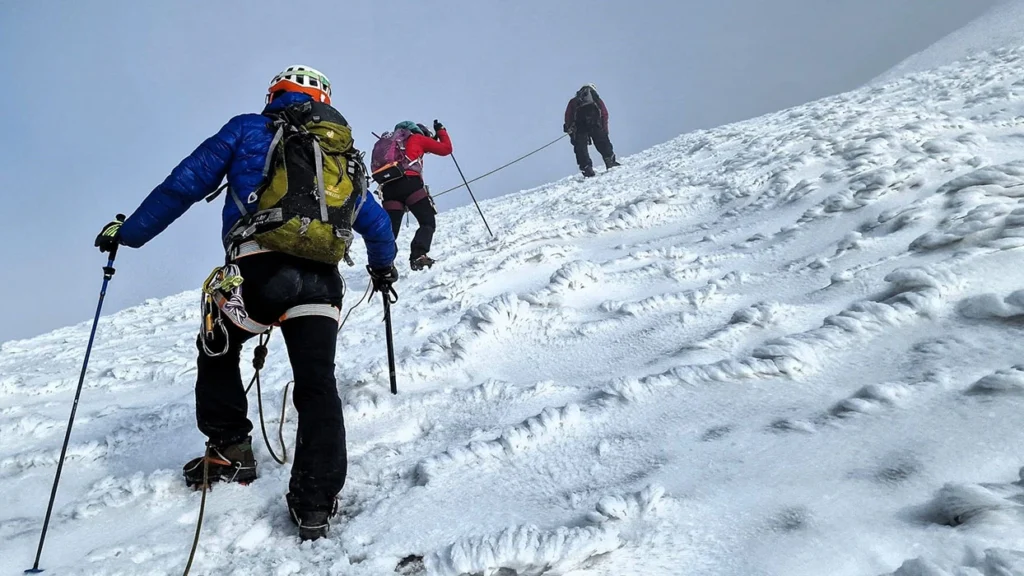
As dawn comes and the sun begins to work on the upper glacier, the acoustic character changes. The crampons become quieter as the surface softens, their bite less crisp. Water begins to move: trickles appearing in ice channels, the earliest melt of the morning pooling in the glacier’s micro-topography. By the time most summit parties are descending, the glacier has acquired a new layer of sound running water, the occasional soft collapse of an ice edge into a melt pool, and the wind that typically picks up with the sun. The morning’s silence is gone. The mountain is waking up, and the guides are already moving the team faster in response.
The Real Danger Zones: What to Understand About Glacier Risk
This section is not intended to frighten. It is intended to inform, because trekkers who understand the actual sources of danger on a glacier are safer than those who are given only reassurance. The Stanley Glacier’s risks are real, manageable with experienced guides, and specific to identifiable zones and conditions. Understanding them is part of being a competent participant in an expedition.
Crevasses
A crevasse is a crack in the glacier ice that forms where the ice is moving over an irregular bedrock surface or where the glacier flow creates internal tension. On the Stanley Glacier, crevasses are present but not as numerous or as dramatic as on larger temperate glaciers. The Rwenzori’s relatively small and thin ice body means fewer of the massive crevasse systems found on glaciers like those of the Mer de Glace or the Khumbu Icefall. The real crevasse risk is not the visible crack but the hidden one: a narrow fracture bridged by a fragile snow crust that can collapse under a trekker’s weight. This is why the lead guide tests the surface continuously with their axe, probing ahead of the team’s line. It is also why trekkers should always follow the guide’s exact line on the glacier and never improvise an independent path. A first-timer may perceive a stable surface, but the guide may have rejected it for a reason that isn’t immediately apparent.
Seracs and Ice Fall
Seracs are towers or blocks of ice that form at the margins of glaciers and at glacier breaks, places where the ice moves over a significant change in slope and the surface fractures into unstable columns. The Stanley Glacier has serac formations on its margins, and these zones are explicitly avoided in the guided route. Seracs are unpredictable. Ice that has been stable for years can collapse without warning, particularly in the warming hours of the morning. The guides route the approach line with specific reference to serac positions, keeping the team in the fall-line-safe corridor through the glacier. This routing is one of the many reasons the guided approach to Margherita Peak is the only responsible approach. An unguided team does not have the knowledge of the glacier’s serac positions, and those positions change year to year as the glacier retreats.
Soft Snow and Avalanche Risk
In the hours after sunrise, the glacier surface softens rapidly under the equatorial sun. Soft, wet snow on a steep slope has avalanche potential. This is the primary reason for the early start: by the time significant solar heating is occurring, a well-paced team should already be off the summit and on the descent below the glacier. The guides manage this timing with specific attention on days when overnight temperatures have been unusually warm. Warm overnight temperatures mean less refreezing, a softer morning surface, and an earlier onset of the dangerous warming window. On such days, departure from Margherita Camp may be pushed to as early as 1 a.m. rather than the standard 2 a.m. Trekkers who have prepared physically and mentally for the early departure by understanding its purpose are always easier to wake at 1 a.m. than those who regard it as an arbitrary inconvenience.
Weather and Visibility
The Rwenzori Mountains create their own weather with a consistency that no forecast can fully predict. Cloud builds from the Congo basin to the west and can engulf the summit zone in minutes; a clear sky at 4 a.m. is no guarantee of a clear sky at 7 a.m. In whiteout conditions on a glacier, spatial orientation becomes genuinely difficult: without visible contrast between ice and sky, depth perception fails, and the very surface you are walking on becomes ambiguous. The guides manage this risk by monitoring cloud development continuously during the approach and making route adjustments, including the decision to abort the summit attempt based on conditions rather than schedule. For trekkers, the correct response to changing weather on the glacier is to follow guide instructions immediately and without argument. The guides know this mountain. They have been on it in weather that would have turned back any unsupported climber. Their judgment in deteriorating conditions is the team’s greatest asset.
⚠️ Safety NoteEvery trekker on the Rwenzori glacier crossing should carry comprehensive travel insurance that explicitly covers high-altitude mountaineering and helicopter evacuation. Emergencies on the glacier are rare, but when they occur, they require resources that standard travel insurance does not include. This is non-negotiable. |
What Your Guide Does: The Full Picture of Professional Glacier Management
The guides who lead the Rwenzori glacier crossing do not simply walk in front of you. They are managing a complex, continuously evolving safety system, and understanding their work helps trekkers engage with it rather than simply being carried by it.
The lead guide’s primary role is route-finding. On a glacier whose surface changes with every season, every weather event, and every year of retreat, the correct line across the ice is never identical on consecutive trips. The guide reads the surface for safe passage, selecting the line that avoids visible and suspected crevasses, routes around serac fall zones, offers the best crampon surface on the steepest sections, and maintains a logical orientation toward the summit route. This reading of the glacier surface is a continuous, real-time analysis that draws on accumulated knowledge of this specific mountain’s behavior under different conditions. It cannot be replicated by a trekker using a map or a GPS track from a previous expedition.
While the lead guide manages the front of the rope, the rear guide manages the back. The rear guide’s role is complementary: watching each trekker’s footwork for signs of fatigue or incorrect technique, adjusting the rope tension to maintain safety without pulling any trekker off balance, and monitoring the team’s pace relative to the weather window. Between the two guides, every trekker is sandwiched in a management structure that is monitoring not just the terrain but the physical state of each individual on the rope. When a trekker is visibly struggling, whether with altitude, cold, or technical difficulty, the rear guide comes forward. A pace adjustment is made. The problem is addressed before it becomes a crisis.

The guides also carry the emergency equipment: a bivouac shelter, first aid kit, emergency radio, and spare technical gear. The emergency radio is the link to the park’s ranger system and, if necessary, to the evacuation assets that Uganda Wildlife Authority maintains for the Rwenzori Mountains National Park. In the event of a medical emergency on the glacier, the guide’s response protocol is trained and systematic. Trekkers are not managing an emergency alone. The guides are trained for it.
The Summit: What Happens When You Come Off the Glacier
The final metres of the approach to Margherita Peak are above the glacier proper, a scramble over icy rock on the summit ridge, still in crampons, still on the rope, still requiring every piece of technique the morning has trained into you. The summit itself is a narrow rocky crest at 5,109 metres, the highest point of Mount Stanley and the third-highest summit in Africa. Standing on it, the glacier you have just crossed falls away below and to the south, its blue-white surface visible between the ridgelines. To the north and west, the peaks of the greater Rwenzori range, Baker, Speke, Luigi di Savoia, Emin, and Gessi appear in a sequence that represents the full scope of what these mountains actually contain. On a clear morning, the view extends westward into the Congo Basin, an infinite green forest interrupted only by the distant line of the horizon.
Time at the summit is always short. The guides permit photos, standing, and silence for whatever arrives after such an experience. Then the descent begins. Coming down the glacier is in some ways harder than going up: the slope that you ascended with upward momentum now requires a different weight management, leaning back slightly against the angle and planting the heel-side points of the crampons. The guides reverse their positions, the lead guide now at the rear to catch any fall, and the front guide picking a descent line that may differ slightly from the ascent line as morning conditions change the surface. By the time the team reaches the bottom of the glacier and can remove crampons, the sun is already on the ice. The morning window is closing behind you. You have come through it.
Mental Preparation: What No One Tells You About the Glacier
Physical fitness and technical briefings are the foundation of glacier readiness, but they do not fully account for the psychological dimension of the experience. Most first-time glacier trekkers are surprised by how present the glacier makes them. Not frightened, though there is an element of that in the first minutes, but acutely, viscerally present in a way that ordinary trekking does not produce. The combination of altitude, cold, darkness, the crampons’ grip on the ice, the rope connecting you to the team, and the knowledge that you are on a genuinely serious terrain feature creates a state of sustained attention that many trekkers describe afterwards as the most fully alive they have ever felt on a mountain. The 16-Week Training Plan for a Rwenzori Trek helps prepare your body. Nothing fully prepares your mind, and that is probably as it should be.
The most useful mental tool on the glacier is the acceptance of slowness. At an altitude, moving slowly means moving correctly. The impulse to push harder, close the gap to the guide ahead, and prove something through speed is counterproductive on glacier ice at 5,000 metres. The trekkers who perform best on summit day are almost always those who have fully internalized this principle before they arrive: they set their pace early, they breathe deliberately, they move one step at a time with complete attention to that step, and they do not think about the summit until they are on it. The summit will arrive. The glacier is not a race. It is a crossing.
It is also important to clearly state what happens if you cannot complete the crossing. A small proportion of trekkers may have to abandon the glacier section before reaching the summit due to altitude, weather, or physical condition. This decision is always made by the guides, and it is always made in the interest of the trekker’s safety. A partial ascent does not diminish the Rwenzori. The mountain’s lower slopes, its extraordinary plant life, its rare wildlife, and its ancient geology all of these factors retain its full power whether or not you reach 5,109 metres. Many trekkers who have turned back below the summit of Margherita have returned in subsequent seasons to complete the climb. The mountain keeps its place.
How to Prepare for the Glacier Before You Arrive in Uganda
Most first-time Rwenzori glacier trekkers will never have worn crampons or held an ice axe before summit day. Such inexperience is common and manageable. But there are preparation steps that make a genuine difference to your experience on the ice, and several of them can be taken anywhere in the world before you set foot in Uganda.
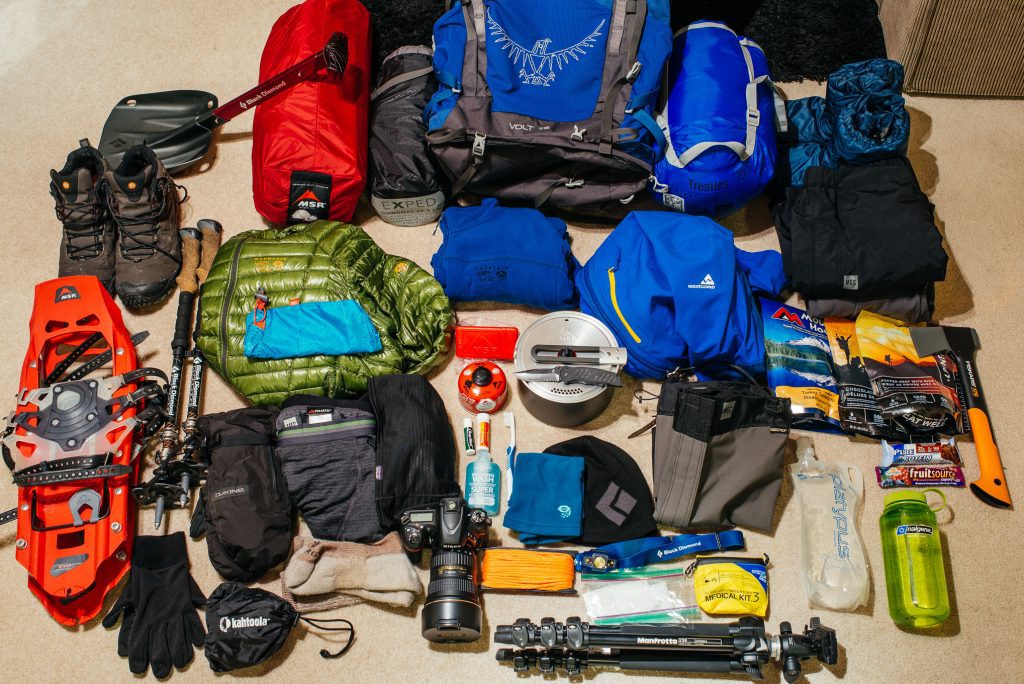
Physical preparation is the most important foundation. The 16-week training plan for a Rwenzori trek includes specific protocols for building the cardiovascular base and leg strength that glacier travel demands. If you have access to an alpine environment with any technical terrain, even a scramble route with sections of fixed rope or ladder, practicing those features before arrival will familiarize you with the psychological experience of exposed terrain. Indoor climbing walls provide practice with harness systems. Some alpine training centers offer crampon orientation sessions on artificial ice walls.
Gear preparation is equally important. The boots guide for the Rwenzori bogs covers footwear for the lower trail in detail, and the summit gear list, including the warm summit mittens, insulated jacket, and headlamp with fresh batteries, should be assembled and tested before departure. Cold-weather gloves and mittens deserve particular attention: fingers that go numb on the glacier make crampon adjustments and rope management difficult, and spare gloves should always be accessible without removing your pack.
Finally, acclimatization is preparation. The acclimatization strategy for the Rwenzori is built into the itinerary structure, but trekkers who arrive with some prior altitude experience, whether from a previous high-altitude trek, a stay at altitude before the trek, or simply awareness of how their body responds at elevation, are almost always better positioned on summit day than those for whom the high camps are their first experience of altitude. The question of whether older hikers can manage the Rwenzori is answered not by age but by physical preparation: fit, well-acclimatized trekkers of any age succeed on the glacier. Trekkers of any age who are unfit and under-prepared face challenges.
Frequently Asked Questions: Crossing the Rwenzori Glacier
Do I need previous glacier experience to cross the Rwenzori glacier?
No previous glacier experience is required to cross the Stanley Glacier on the way to Margherita Peak. The vast majority of first-time Rwenzori glacier trekkers have never been on ice before, and the professional guides who lead the crossing are specifically trained to introduce trekkers to glacier techniques in the context of the summit approach. What is required is adequate physical fitness, a solid acclimatization base built over the preceding days on the mountain, and the willingness to follow guide instructions precisely. The guides provide, fit, and manage all the technical elements, including crampons, ice axes, harnesses, ropes, and fixed lines. You must use the techniques you learned at Margherita Camp the night before, keep your pace, and tell the guide how you feel. The guides have brought first-time glacier trekkers to the summit of Margherita Peak successfully on dozens and dozens of occasions. The glacier is demanding. It is not beyond the reach of a well-prepared, responsive trekker.
How long does the glacier crossing take on summit day?
The summit day on Margherita Peak typically begins between 2:00 and 2:30 a.m. The trek begins at Margherita Camp, located at 4,485 metres, and lasts between ten and fourteen hours in total, including the full ascent, summit time, and descent back to Hunwick’s Camp at 3,974 metres. The glacier crossing itself from the point where crampons are fitted at the glacier edge to the summit ridge above the ice typically takes between two and four hours depending on conditions, team pace, and the specific route the guides take through the glacier that day. The descent from the summit back below the glacier line takes slightly less time. The total distance on glacier terrain is approximately 1.5–2.5 kilometers of route, though the actual footsteps cover more than this distance due to the switchback line required on steeper sections.
What is the Stanley Glacier like compared to glaciers on other African mountains?
The Stanley Glacier on Mount Stanley in the Rwenzori Mountains is significantly more technically demanding than the remnant glaciers on Kilimanjaro and the glaciers on Mount Kenya’s higher routes. Kilimanjaro’s summit craters contain small, rapidly retreating ice fields that are generally visible but rarely require technical crossing gear on standard trekking routes. Mount Kenya’s technical routes, particularly the Direct Route and the Gate of the Mists approach to the summit, involve genuine glacier work, and Mount Kenya’s glaciers are more extensive than the Rwenzori’s in terms of current area. The Stanley Glacier’s specific character is equatorial and relatively compact, with a strong serac presence on its margins and a summit approach that combines glacier with exposed rocky ridge, creating a technical environment that is distinctly its own. The Rwenzori glaciers are considered the most scientifically significant of Africa’s three remaining glacier systems because of the directness with which they reflect equatorial climate change; they are also, for the trekking mountaineer, the most complex and intriguing of the three to navigate.
Can you fall into a crevasse on the Rwenzori glacier?
Crevasses exist on the Stanley Glacier, but they are significantly smaller and less numerous than on major temperate glaciers, and the guided approach manages crevasse risk systematically. The lead guide probes the route ahead continuously and routes the team around identified and suspected crevasse zones. The rope system means that if a trekker breaks through a snow bridge over a crevasse, the rest of the roped team acts as an arrest system. Falls into crevasses on the Rwenzori guided routes are extremely rare. The more realistic risk is a surface fall on steep ice, a slip rather than a crevasse entry, and this is what the crampon technique, ice axe, and rope system are primarily designed to address. No mountain environment is free of risk. The Rwenzori glacier is managed professionally, and that management is the difference between a demanding but achievable expedition and an unguided adventure whose risks would be genuinely serious.
What happens if the weather closes in on the glacier?
Weather on the Rwenzori can change with extreme rapidity at summit elevations. Whiteout conditions in which cloud or snow removes all visual contrast from the glacier surface are not uncommon and are one of the more challenging glacier environments to navigate safely. If the weather closes in significantly on the ascent, the lead guide makes the route decision: continue on a known safe line if visibility permits safe navigation and the window appears temporary; hold the team in place on stable terrain and shelter if possible while conditions are assessed; or initiate a controlled descent if conditions deteriorate to the point where forward progress cannot be managed safely. Trekkers should never argue with a weather-based turn-around decision. The guides’ understanding of the mountain’s weather and the specific terrain makes their judgment in these moments more reliable than any individual trekker’s instinct. A safe return to Margherita Camp in deteriorating weather is not a failure. It is what experience looks like.
Is the Rwenzori glacier in danger of disappearing?
The Rwenzori Mountains’ glaciers are retreating rapidly and are at serious risk of disappearing within the coming decades. Studies from the Uganda National Meteorological Authority and multiple academic research teams have documented a reduction of more than eighty percent in the total glaciated area of the Rwenzoris since the early twentieth century, with the rate of retreat accelerating since the 1990s. The equatorial location makes the Rwenzori glaciers especially sensitive to temperature increases: a small rise in the mean temperature at 5,000 metres on the equator has a proportionally larger effect than the same temperature rise at a polar glacier. Climate scientists who study the Rwenzori glaciers use their retreat as a direct indicator of long-term tropical atmospheric warming. For trekkers, this context adds a dimension to the crossing of the Stanley Glacier that purely technical descriptions miss: the glacier you walk on today may not be there in the lifetime of the younger generation. This is one of the truest reasons to make the expedition now rather than later.
What gear do I need for the glacier section specifically?
Crampons, an ice axe, a harness, a helmet, and the rope are all provided by Rwenzori Trekking Safaris as part of the expedition package; you do not need to source or bring these items. What trekkers must bring for themselves: warm summit mittens (inner liner plus outer shell, waterproof); a warm insulated jacket suitable for temperatures of minus five to minus ten Celsius in wind; waterproof over-trousers; a warm hat; a balaclava or neck gaiter; a reliable headlamp with fresh batteries plus a spare set; a thermos of hot water or tea for the glacier approach (the guides brief this the night before); and high-energy food for the summit push (chocolate, energy gels, nuts, or similar). Gaiters are essential for the glacier section to prevent snow entering the boot at the crampon binding. A full gear check at Margherita Camp the evening before summit day will identify any gaps. For comprehensive guidance on what to pack for the full expedition, the site’s cost and logistics guide covers the full picture.
Plan Your Margherita Peak Expedition
The Stanley Glacier is one of the most extraordinary pieces of terrain in Africa, an equatorial ice field on the summit ridge of the continent’s third-highest mountain, managed by guides who know its every feature. Crossing it is not an everyday experience. It is the kind of experience that changes the way you understand what mountains are.
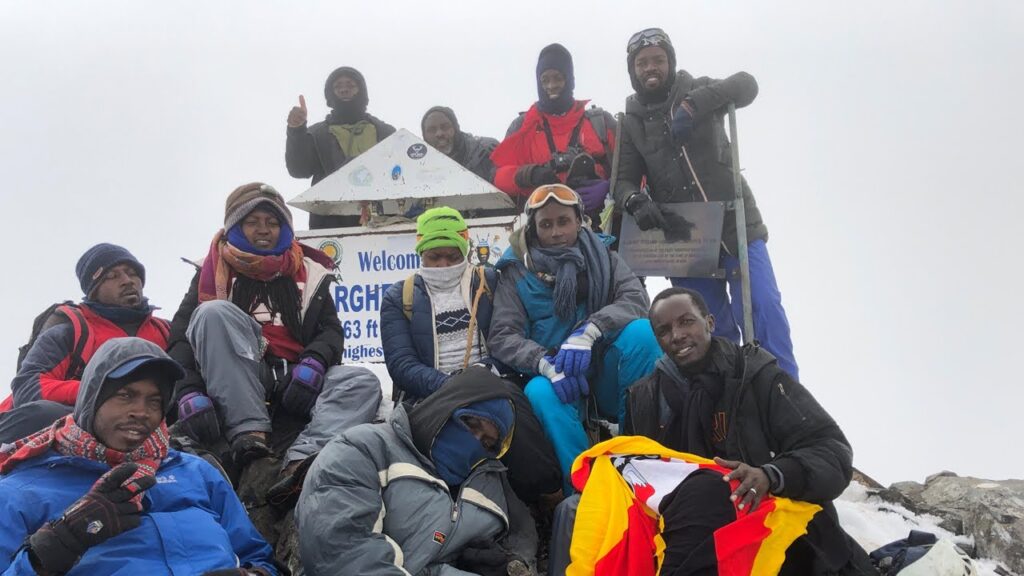
Rwenzori Trekking Safaris operates all summit approaches to Margherita Peak with professional glacier-trained guides, full technical equipment provision, and the full acclimatization structure that the mountain demands. Whether you choose the 8-Day Kilembe Trail, the 7-Day Central Circuit, or an extended multi-peak expedition via the 13-Day Six Peaks itinerary, the glacier crossing is part of what you come for. Contact our team and start planning the expedition that takes you to the ice.
Ready to step onto the Stanley Glacier?
Our guides are ready to walk you through every step literally.