
Walk every day of the Kilembe Trail before you arrive. A vivid camp-by-camp guide to terrain, altitude, food, and the Margherita Summit experience. Expert advice from Rwenzori guides.
There is a question that arrives in almost every inbox within days of booking a Rwenzori expedition. What is it actually like, day by day, out there? Not the altitude numbers, not the packing list those are simple to find. What people want to know is what it feels like to push through the pre-dawn darkness on summit morning with ice forming on your jacket hood. They want to know what the huts smell like after five days of rain, what the guides cook at 4,100 meters; and whether you will cry when you finally see the glacier. This guide answers all of that.
The Kilembe Trail is the Rwenzori Mountains’ most modern, most scenically dramatic, and in many ways the most rewarding trekking route. Officially launched in 2011 by Rwenzori Trekking Services and managed in partnership with Uganda Wildlife Authority, it traces a long arc southward from the copper-mining town of Kilembe through five extraordinary vegetation zones before depositing you breathless and elated beneath the snows of Margherita Peak at 5,109 metres. What follows is not a simple itinerary. It is a vivid, honest, day-by-day account of precisely what you will experience on the 8-Day Kilembe Trail expedition written by guides who have walked every kilometer of it more times than we can count.
Kilembe Trail at a Glance: The 8-Day Route Summary
Here’s the full route overview so you can keep the journey in mind before we detail each day. The trail climbs from 1,450 metres at the Kilembe trailhead to 5,109 metres at Margherita Peak’s summit, descending via a different valley on the return. The total elevation gain across the ascent is approximately 3,659 meters. The terrain shifts dramatically at each camp, and that variety from humid rainforest to open moorland to glaciated rock is precisely what makes the Kilembe Trail unlike anything else in East Africa.
| Day | From | To | Dist. | Gain | Terrain | Challenge |
| Day 1 | Kilembe (1,450m) | Sine Camp (2,596 m) | 9.5km | +1,146 m | Afro-Montane Forest | Moderate |
| Day 2 | Sine Camp | Mutinda (3,688 m) | 7km | +1,092 m | Bamboo–Heather Zone | Strenuous |
| Day 3 | Mutinda | Bugata (4,062 m) | 6km | +374 m | Moorland–Alpine | Strenuous |
| Day 4 | Bugata | Hunwick’s (3,974 m) | 8km | −88 m / pass | Bamwanjara Pass | Very Strenuous |
| Day 5 | Hunwick’s | Margherita Camp (4,485 m) | 5km | +511 m | Rock & Ice | Strenuous |
| Day 6 | Margherita Camp | Hunwick’s (3,974 m) | Summit + descent | +624 m / −1,135 m | Glacier & Rock Face | Expert |
| Day 7 | Hunwick’s | Kiharo Camp (3,460 m) | 12 km | Oliver’s Pass | Moraines, Bog | Hard |
| Day 8 | Kiharo | Kilembe (1,450 m) | 18.8 km | −2,010 m | Forest–Kasese | Moderate |
Understanding the Kilembe Trail: Five Worlds in Eight Days
The Rwenzori Mountains are not one mountain; they are a compressed archive of ecosystems, stacked vertically like chapters in a very strange novel. On the Kilembe Trail, you ascend through five distinct vegetation zones, each with its light, its sound, and its demand on your legs. Understanding these zones before you arrive helps you sense the radical changes in landscape that would otherwise feel disorienting.
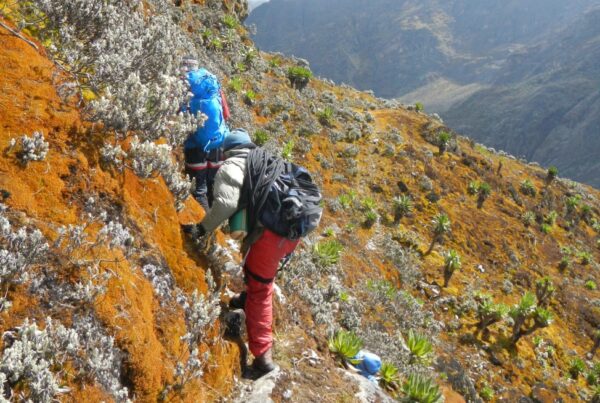
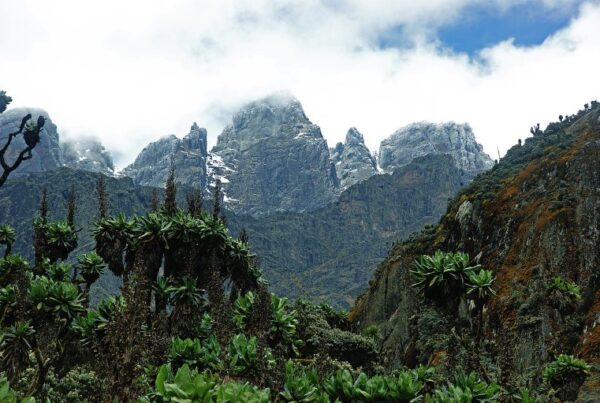
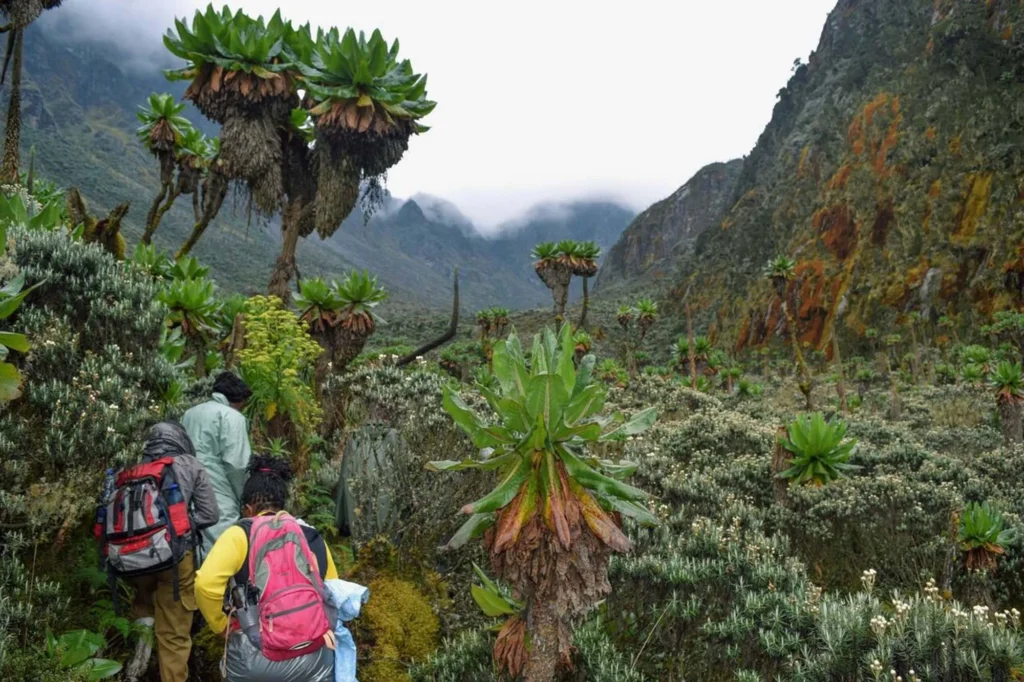
The journey begins in the Afro-Montane Forest Zone, a rich cathedral of towering hardwoods, ancient fig trees, and parasitic vines draped in moss. Blue monkeys thread through the upper canopy; the air smells of wet bark and river stone. As you gain altitude, the forest transitions away to the bamboo-mimulopsis zone, where dense bamboo shoots crowd the trail and the gradient steepens uncomfortably. Higher still, you enter the Heather-Rapanea Zone, where the trees become gnarled and ancient, their trunks thick with Usnea lichen, old man’s beard, hanging in grey curtains. The transition into the Afro-Alpine Moorland feels almost theatrical: suddenly the trees are gone, replaced by giant lobelias standing two meters tall in pools of bog water, their blue-gray spires pointing at a sky that feels impossibly close. And finally, at the highest elevations, the Nival Zone has bare rock, permanent snow, and the remnants of a glacier that the legendary explorers of the nineteenth century once documented as vast and permanent, now retreating visibly year by year.
🌿 Guide InsightNowhere else on Earth can you find the plant communities of the Rwenzori in this unique combination. The giant lobelias and groundsels that you will pass on Days 3 and 4 are not just spectacularly photogenic; they are living fossils of an alpine ecosystem that has evolved in near-total isolation for tens of thousands of years. Take the time to stop and look at them properly. You will not see anything like them again. |
Day 1: Kilembe Trailhead to Sine Camp (1,450m → 2,596m)
Distance: ~9.5km | Elevation Gain: +1,146m | Walking Time: 5–6 hours | Difficulty: Moderate
The World You Are Leaving Behind
You will set off from Kilembe in the morning; the specific timing depends on when you arrive from Kasese, and the first thing that strikes almost every trekker is the abruptness of the transition. One moment you are in a small Ugandan mining town, breathing dust and diesel and listening to the sound of motorbikes. Then you cross the park boundary gate, your permit is stamped, and the forest swallows you whole. The silence that follows is not silence exactly, but the replacing of human noise with the layered sounds of a living ecosystem is one of the most immediately arresting experiences on the entire trail.
The Kilembe trailhead sits at just 1,450 metres, and the trail begins along the valley floor of the Nyamwamba River, following its course deeper into the mountains. The path here is wide and relatively clear, threading beneath enormous trees whose root systems have colonized the trail edges like knotted fists. The forest is dense and green, and in the early morning the light comes in at angles through the canopy, casting cathedral shadows across the path. The scenery is the same primordial forest that Professor Scott Elliot walked into in 1895 during the first serious scientific expedition into the Rwenzoris, and standing in it, you understand immediately why he found it so difficult to leave.
Wildlife in the Montane Forest
Day 1 offers the richest wildlife encounters of the entire trek, and it is worth walking slowly enough to benefit from them. Blue monkeys are almost guaranteed you will hear them before you see them, their quiet chittering giving way to a sudden crash of branches overhead. If you are fortunate, you may encounter a troop of black-and-white Colobus monkeys, sometimes fifteen or twenty strong, moving through the upper canopy with a grace that makes human trekking seem clumsy by comparison. The colobus, with its dramatic black-and-white coloring and long flowing white tail, is one of the Rwenzori’s most celebrated sights. The L’Hoest monkey, a rarer, more secretive species with a chestnut back and white chest, is also present, though sightings require patience and a quiet step.
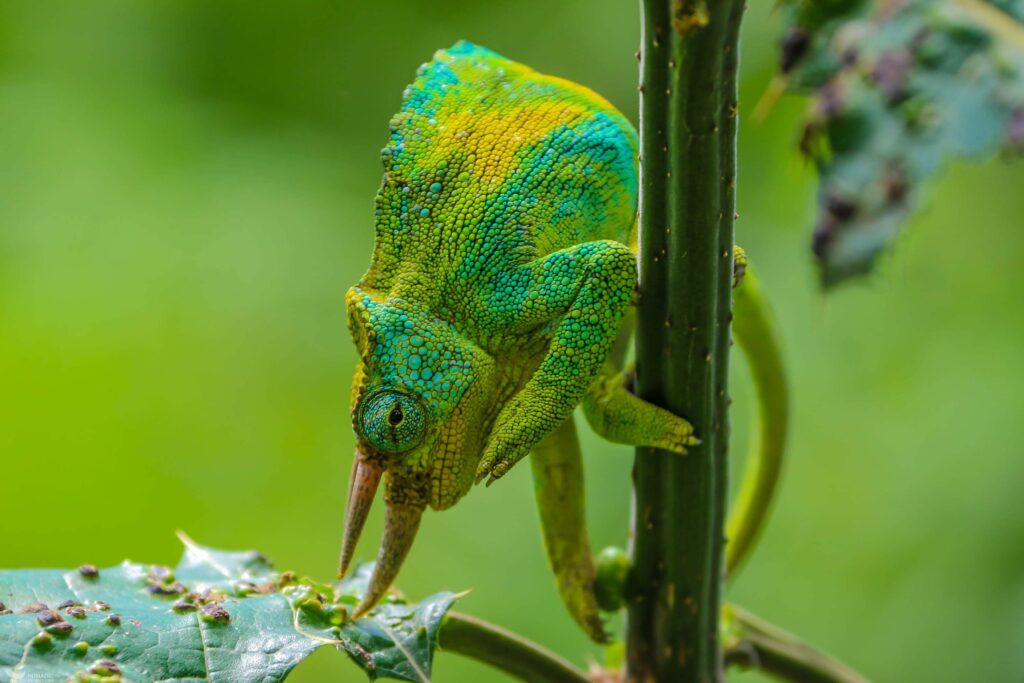
Birdwatchers should keep their binoculars ready for the Rwenzori Turaco, a spectacular green-and-red bird that is endemic to these mountains and appears with some regularity in the mid-elevation forest. The distant hooting of chimpanzees sometimes carries through the valley, a reminder that the Rwenzori’s biodiversity extends well beyond what is easily visible from the trail.
Enock’s Falls and the Final Climb to Sine
About seven kilometers into the walk, the trail crosses a small bridge, and you begin to hear a lot of water. Enock’s Falls is located just 200 metres from Sine Hut, and it is, without exaggeration, one of the most beautiful natural features on the entire trail: a tall, clean waterfall dropping through dark rock into a pool surrounded by moss and tree ferns, catching the afternoon light in a way that stops most trekkers in their tracks. The guides have grown accustomed to such scenes. They build a few extra minutes into the schedule. It is, as they say quietly, worthy of a screensaver.

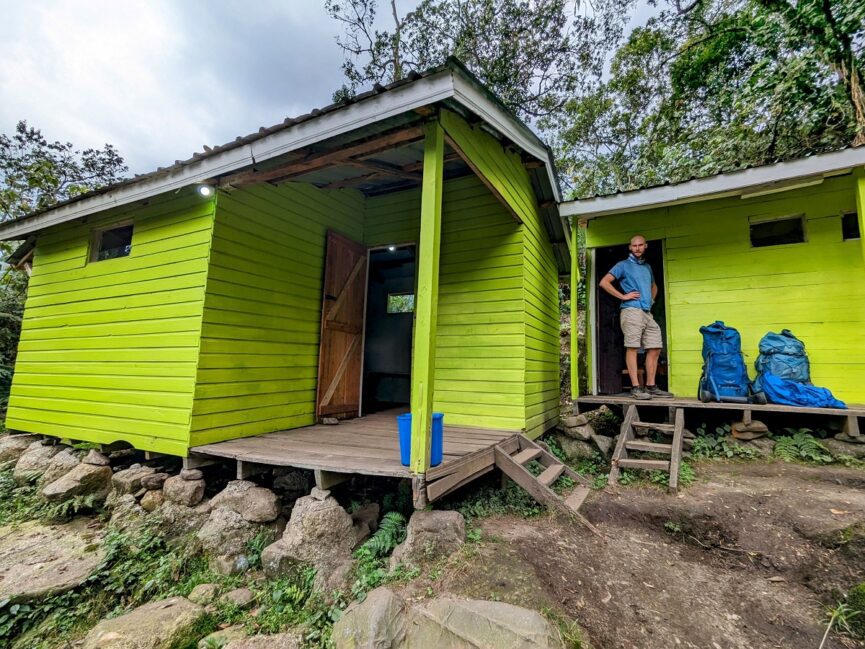
The ascent to Sine Camp is steeper in its final section, and by the time you arrive most trekkers are ready to stop. Sine Camp sits at 2,596 meters in a clearing at the edge of the montane forest, and the wooden hut is your first introduction to Rwenzori Mountain accommodations.
What Sine Camp is Like
Sine Hut is compact, functional, and deeply atmospheric. The walls are raw timber, the floorboards creak with satisfying weight, and the interior smells of wood and damp wool not unpleasantly, but with the specific scent of a place that has absorbed many trekking expeditions into its grain. Mattresses are provided, though sleeping bags are essential because the temperature drops sharply after dark. There is a small solar-powered light, and on a clear evening, the hut’s small clearing offers your first unobstructed view upward into the mountain’s higher elevations: the forest canopy below you, the darker ridgeline above, and somewhere beyond that, the peaks you have come to climb.
Dinner at Sine is typically the first hot mountain meal of the expedition: rice or pasta, a vegetable stew, and sometimes ugali with a bean sauce filling, warm, and welcome after a long day’s walking. Vegetarian and vegan options are fully accommodated on all Kilembe Trail expeditions, and the guides are accustomed to preparing nourishing plant-based meals at every camp.
💡 Trekker TipIf you are in excellent physical condition and your guide agrees, it is possible on Day 1 to push past Sine Camp to Kalalama Camp at 3,134m. This builds extra buffer time at Mutinda for acclimatization, which is valuable if you are targeting Margherita Peak. Discuss this option with your guide at the trailhead. |
Day 2: Sine Camp to Mutinda Camp (2,596m → 3,688m)
Distance: ~7km | Elevation Gain: +1,092m | Walking Time: 6–7 hours | Difficulty: Strenuous
Into the Bamboo Zone
You leave Sine Camp shortly after 8:30 a.m., and within twenty minutes of walking, you cross an invisible but instantly perceptible threshold into the Bamboo-Mimulopsis Zone. The bamboo here is not the elegant, spacious bamboo of landscape gardens. This is dense, aggressive, trail-swallowing bamboo that grows in thick clusters between a lattice of roots and muddy steps. During the wet season, the gradient already steep is compounded by a trail surface that is part mud, part moss-covered rock, and part running water. You find your rhythm and keep it. The guides navigate through the bamboo like fish through kelp.
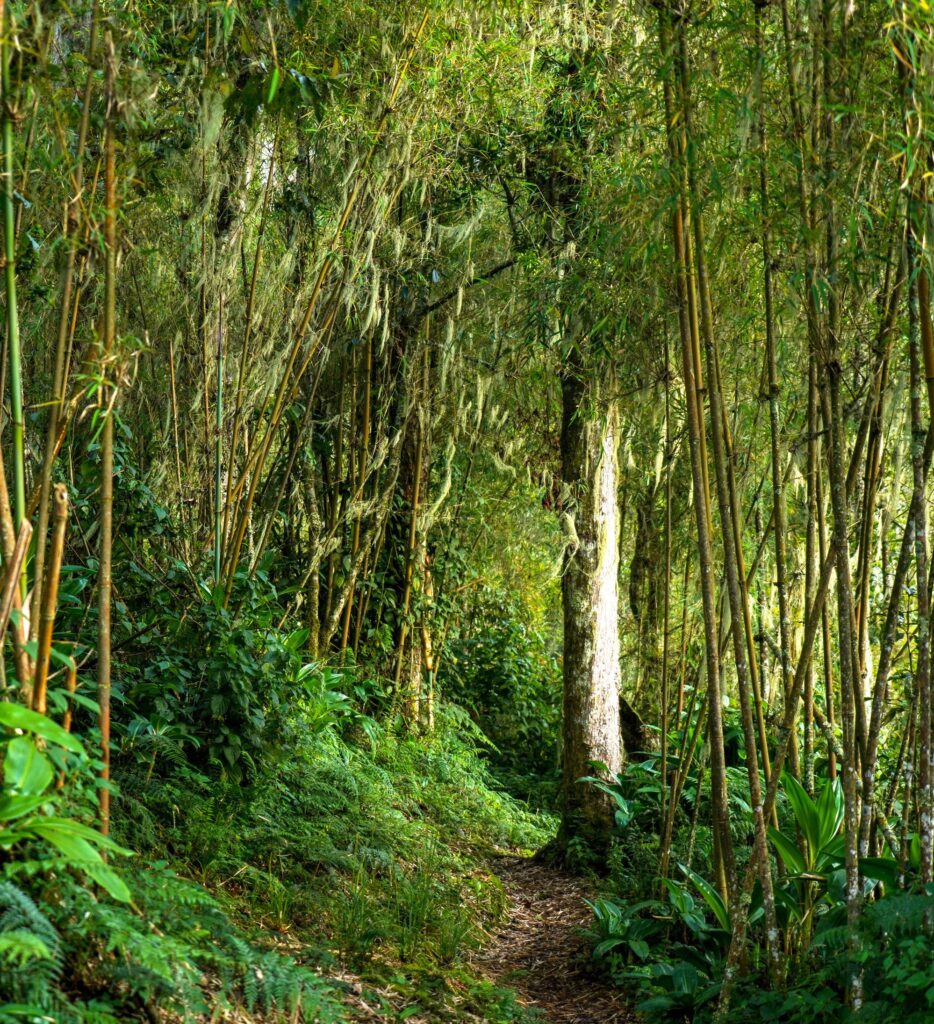
The climb gains 551 meters over 1.8 kilometers to reach Kalalama Camp at 3,147 meters, a statistic that tells you almost nothing about what it actually feels like. What it actually feels like is a series of high natural steps, each one requiring a deliberate lift of the knee, in air that is already noticeably thinner than yesterday’s. The bamboo eventually thins, and the vegetation transitions into the Heather-Rapanea zone, and the first sensation is one of opening. The trail becomes visible further ahead, the air moves, and the sky appears through gaps in the old heather trees whose trunks are wrapped in a foot-thick layer of bright green moss.
Kalalama Camp: The First High Rest
Kalalama Camp, at 3,134 meters, is a welcome waypoint. It is here that trekkers typically stop for tea and a snack, your first encounter with the practical rhythm of mountain time, where pauses are non-negotiable and sitting in cold air with a hot cup in your hands is one of the small but genuine pleasures of high-altitude trekking. The camp sits at the forest edge, and from its clearing, there are already surprising views back down toward the Kasese valley.
The Ridge Walk to Mutinda
From Kalalama, the trail climbs onto a series of small knolls along a ridge before descending the valley side, crossing small creeks, and threading past moss-covered waterfalls. The heather trees here are extraordinary; some of them are several metres tall, their branches horizontal and wrapped so thickly in bright green moss that they look like creatures from a Tolkien manuscript. Usnea lichen hangs in long grey curtains from the branches, catching whatever light the mist allows through. The trunks are covered in tiny ferns and liverworts. Every surface in this forest grows something.
The trail then follows a wonderful mossy river that cascades over rocks beneath the heather canopy, and you ascend alongside it for what feels like a long time in the best possible way. The valley is deep and misty, filled with the sound of rushing water and bird calls, and the emotional effect is of moving through a world that has been untouched for a very long time. This Kilembe Trail section is often discussed by trekkers for its atmosphere, not its difficulty.
Mutinda Camp: Where the View Arrives
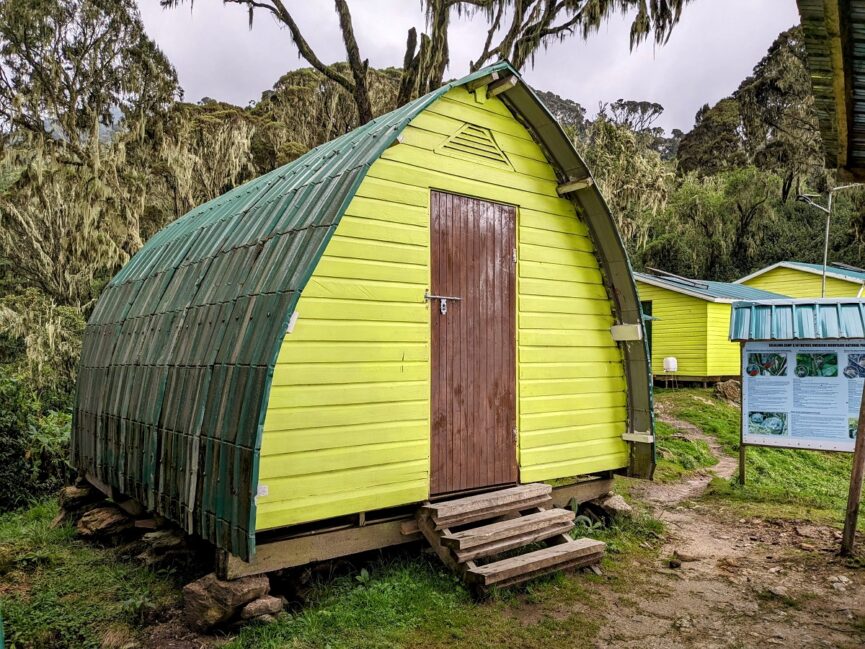
Mutinda Camp, at 3,688 meters, marks your true arrival in the heather moorland. The hut here is larger than Sine’s, and the clearing around it gives an unobstructed panorama that on a clear day extends south toward Lake George and east toward Kasese town, the last evidence of the lowland world you have left behind. If the sky is clean at this elevation, the view from the nearby Mutinda Lookout at 3,975 meters is one of the finest in the entire Rwenzori range. Many trekkers choose to undertake the 4-Day Mutinda Loop as a standalone trek for precisely this reason.
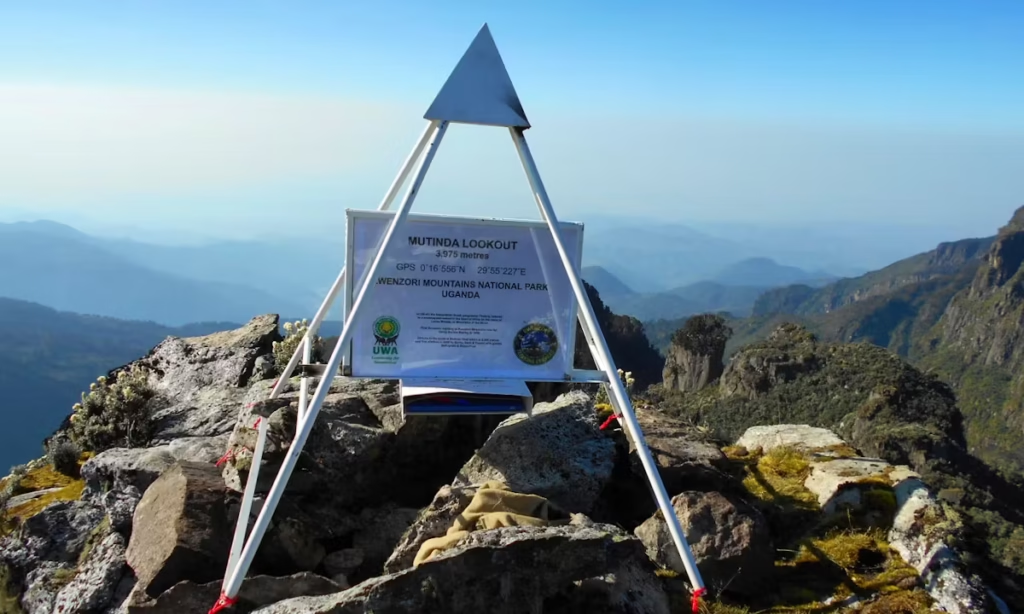
The interior of Mutinda hut smells differently from Sine’s: there is more stone and less timber, and the cold presses in more insistently through the walls. Dinner arrives in the dark. There is often a condensation drip somewhere near the ceiling, and the sleeping bags feel more important than they did last night. You eat well. Guides at this altitude are accomplished cooks working in cold, cramped kitchens, and the meals are consistently more substantial and better seasoned than most trekkers expect. Stews with potatoes, chapati, sweet tea, and fruit appear with a reliability that becomes one of the great comforts of mountain life.
⚠️ Altitude WarningAt 3,688m, Mutinda Camp is your first genuine high-altitude camp. It is here that altitude sickness symptoms sometimes announce themselves: headache, mild nausea, disrupted sleep, and unusual fatigue. These are not reasons to panic, but they are reasons to pay attention. Please ensure you drink at least three liters of water today, eat adequately even if your appetite has decreased, and promptly inform your guide of any symptoms. Our full acclimatization strategy is the standard practice on all our expeditions. |
Day 3: Mutinda Camp to Bugata Camp (3,688m → 4,062m)
Distance: ~6km | Elevation Gain: +374m | Walking Time: 5–7 hours | Difficulty: Strenuous
Into the Alpine Zone: The World Goes Strange
Day 3 is the day the Rwenzori starts to feel genuinely alien. You leave Mutinda with your legs still carrying the memory of yesterday’s climb, and almost immediately the trail changes character. The heather forest is behind you. What lies ahead is an open, wind-swept landscape of tussock grass, marshy bog, and the most extraordinary plant life you have ever encountered outside of a science fiction film.
The path to Bugata Camp ascends the difficult Namusangi Valley to an elevation of 3,840 metres before continuing up to the camp at 4,100 metres. During the wet season, this section is very marshy, and trekking poles become genuinely important tools for balance rather than accessories. The trail meanders through tussocks of thick grass, each rising half a meter from the bog below, creating small islands, and each transition between islands requires careful judgment to determine the most stable path. The guides navigate this section with ease, while first-time trekkers typically acquire their boots wet at least once.
The Giant Lobelias and Groundsels
But the difficulty of the terrain recedes from conscious attention the moment you see your first giant lobelia. These extraordinary plants, Lobelia wollastonii, and related species stand up to two meters tall, their towers of blue-grey flowers rising from basal rosettes of broad, water-channeling leaves. Encountering them en masse, scattered across a misty moorland with vertical waterfalls descending behind them, is one of the most visually arresting experiences the African continent has to offer.
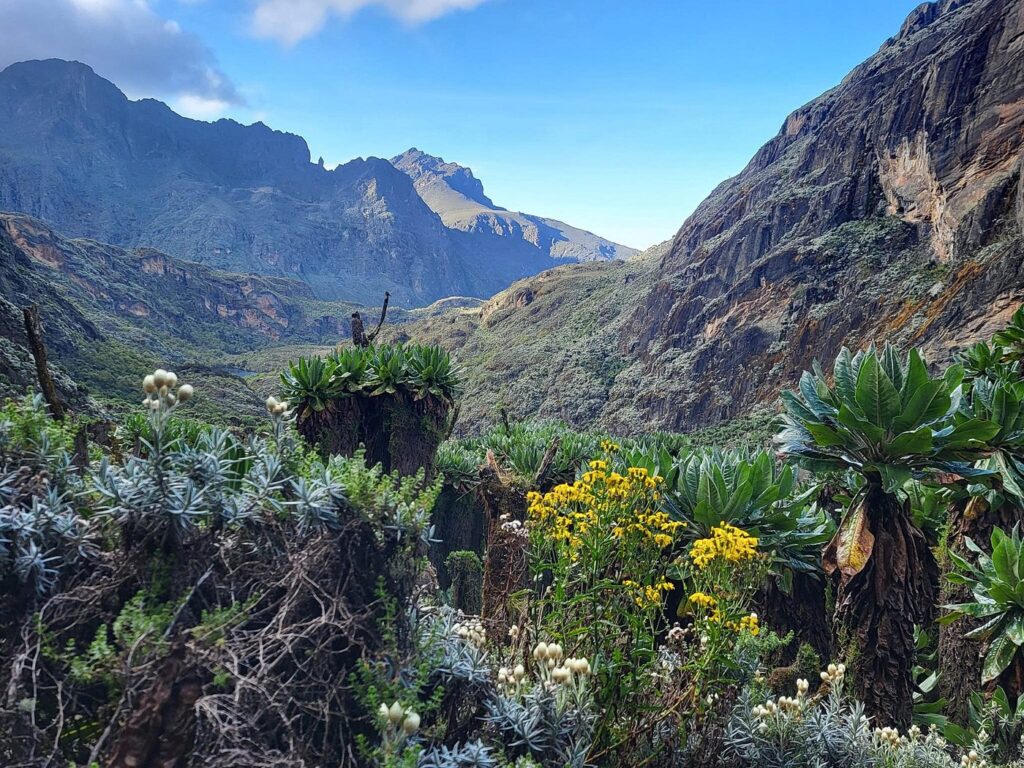
Giant groundsels (Dendrosenecio) are equally present and equally strange: enormous cactus-like plants with thick, swollen trunks and spreading heads of yellow flowers, looking for all the world like something designed by a committee that had never actually agreed on what a plant should look like. Between them, everlasting flowers (Helichrysum) form broad cushions of yellow and white across the valley floor. Evolution seems to have designed the entire landscape with complete disregard for human aesthetic conventions, resulting in a genuinely magnificent scene.
On clear mornings, looking back down the Namusangi Valley from the upper trail, the views of the Mutinda Peaks are breathtaking in the literal sense: you stop walking, you look back, and you stand there processing the scale of what surrounds you. The vertical waterfalls catch the sun. The valley falls away in a series of green steps toward the forest, and beyond it the lowland plains of western Uganda stretch to a horizon that feels impossibly distant.
Bugata Camp: Above the Clouds
Bugata Camp sits at 4,062 meters on the edge of the Nyamwamba Valley, and it is the first camp where a sense of genuine high-altitude isolation becomes complete. On most evenings, clouds build from the Congo basin to the west and roll over the camp in the late afternoon, blotting out the peaks above and turning the landscape monochrome and still. The hut is solidly built, a welcome contrast to the exposed position, and the sleeping accommodation is similar to what you have been using: wooden bunks with mattresses, a small eating area, and a kitchen where the cooks manage remarkable things with limited resources.

The air at Bugata is noticeably thinner than at Mutinda, and for many trekkers, the first evening is when sleep becomes genuinely difficult not from the cold, which is manageable with proper gear, but from how altitude disrupts breathing rhythms during rest. Periodic breathing (a pattern of breath-holding followed by rapid breathing) is common and normal at this elevation. It is worth knowing about in advance so it does not alarm you.
💡 Trekker TipThe Malachite Sunbird, one of the most beautiful birds in Africa, the male, a metallic emerald green, is frequently sighted around Bugata Camp because of the abundance of lobelia flowers. This area is a known nesting site. Look low into the lobelia rosettes in the mornings. The iridescent green of the male in direct sunlight is one of the small but unforgettable details of the Rwenzori high country. |
Day 4: Bugata Camp to Hunwick’s Camp (4,062m → 3,974m) via Bamwanjara Pass
Distance: ~8km | Elevation Change: +450m to pass, −537m to camp | Walking Time: 6–8 hours | Difficulty: Very Strenuous
The Pass That Shows You Everything
Day 4 carries the highest concentration of dramatic mountain scenery of any single day on the Kilembe Trail, and it demands more from your legs and lungs than any previous day in exchange for its rewards. You leave Bugata Camp and begin a steep ascent toward Bamwanjara Pass, climbing through open moorland on a trail that becomes increasingly rocky as the elevation rises.
Bamwanjara Pass sits at 4,450 meters, and there is a small emergency shelter here; it is useful to know if the weather deteriorates rapidly, which it can. But on a clear morning, this pass is one of the most memorable viewpoints in the entire Rwenzori Mountains. From the crest of the pass, Mount Baker appears to the north with its Edward Peak at 4,843 meters; its ridgeline is a series of dark rocky towers against the sky. To the northwest, Mount Stanley rises beyond it, and at its crown, visible as a white smear in the upper air, sits the glacier beneath Margherita Peak, the summit you are walking toward. This experience is the moment many trekkers later describe as the one that made everything feel real. After three days of forest and moorland, the actual high mountain is suddenly, undeniably there.
The Descent Toward Hunwick’s
From the pass, the trail descends the valley on the far side, weaving through thickets of evergreen shrubs, giant lobelias, moss, and enormous groundsel. You must navigate a swamp on the valley floor, which may result in wet feet, and the trekking poles will come out again. The valley is a known habitat for the Malachite Sunbird, and you will likely see it visiting the lobelia spires that line the lower part of the descent.
From the valley floor, the trail climbs again along a long, gradual ridge toward Hunwick’s Camp. This final climb after the pass descent is the point at which many trekkers discover reserves of determination they did not know they possessed. The altitude is telling, the legs are worn out, the camp is somewhere above, and the distance is uncertain. But the ridge walk delivers increasingly extraordinary views with each gain in elevation, and somewhere in the final stretch, the mountains completely take over from the tiredness, allowing you to walk the last half-kilometer in a state that is somewhere between exhaustion and wonder.
Hunwick’s Camp: The View That Earns Its Reputation
Hunwick’s Camp, located at 3,974 meters, occupies one of the most dramatic positions of any campsite in East Africa. It is situated on the edge of a vast valley, which curves up to the peaks above, and from its clearing, you can see Mount Stanley, Mount Baker, Weismann’s Peak, and McConnell’s Prong all at once, arranged across the sky in a panorama that feels almost theatrical. On a clear evening, the last light catches the rock faces of Baker’s ridgeline in orange and amber, and the snow on Stanley turns pink in the dusk. It is the sort of view that makes people silent.

Hunwick’s hut is solid and well-maintained. The interior has a characteristic smell that all high-altitude mountain huts acquire: a blend of dried mud, kerosene from the small cooking stove, damp wool, and something mineral and clean that belongs to the high-altitude air itself. The bunks are firm and the mattresses serviceable. The cook produces something warming, a thick soup, perhaps, followed by pasta with a tomato and vegetable sauce, and the team gathers around the small table with the particular relief and camaraderie of people who have shared something difficult and are starting to understand what they have walked into.
⚠️ Physical Reality CheckDay 4 is the hardest day of the approach. The combination of the Bamwanjara Pass ascent, the valley crossing, and the ridge climb to Hunwick’s at altitude is genuinely demanding. Do not be surprised if some members of your party find this day very hard. Pace conservatively, eat and drink at every opportunity, and remember that the mountain rewards patience. Rushing at altitude costs more than it saves. |
Day 5: Hunwick’s Camp to Margherita Camp (3,974m → 4,485m)
Distance: ~5km | Elevation Gain: +511m | Walking Time: 4–5 hours | Difficulty: Strenuous
Lake Kitandara and the Scott Elliott Pass
Day 5 is short in distance but long in drama. You descend from Hunwick’s Camp into the valley below, crossing its floor toward one of the Rwenzori’s most celebrated natural features: Lake Kitandara. The lake sits at around 4,023 meters in a bowl of rocks and heather; its water is so deep and still that the surrounding peaks reflect in it on calm mornings with photographic precision. The contrast between the dark water, the bright sky, and the stark grey rock of the peaks above is the kind of composition that professional landscape photographers would travel weeks to capture. The guides will provide you time to absorb the view as you warm up for the day.
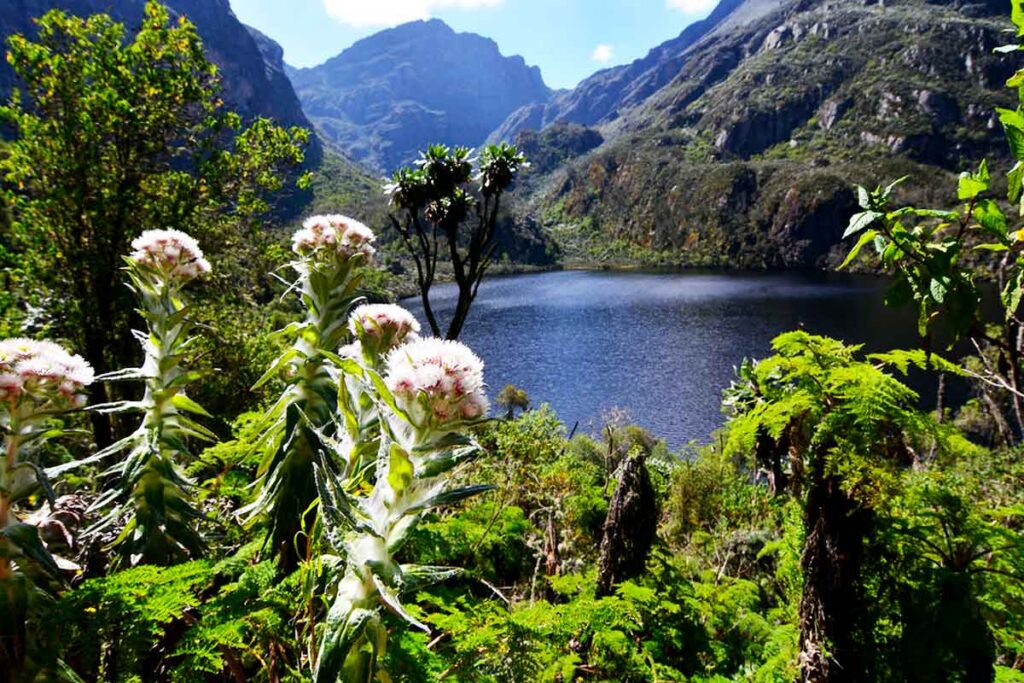
From Kitandara, the trail climbs toward Scott Elliott Pass, named for Professor Scott Elliot, who first explored this terrain in 1895. The pass, at approximately 4,372 meters, is a narrow notch in the rock, and crossing it brings you out onto the upper slopes of Mount Stanley for the first time. The landscape here is rock and ice. The glaciers are above you, the valley falls behind, and the air is cold enough that most trekkers add a layer immediately upon crossing. The Kilembe Trail has brought you a long way from the Afro-Montane Forest. You are now in an entirely different category of mountains.
Margherita Camp: Where Expeditions Are Born
Margherita Camp sits at 4,485 metres in a sheltered hollow between large boulders that appear to have been placed there by the mountain itself as a windbreak. The camp earned its name because this location is precisely where the Duke of Abruzzi made camp during his historic 1906 expedition, the first successful ascent of Margherita Peak. Standing at this camp at dusk, watching the glaciers above catch the last light, the continuity with that original expedition is palpable and strange; they used exactly this hollow, looked at exactly these peaks, and felt exactly this mixture of cold and anticipation.
The hut at Margherita Camp is compact and purpose-built for pre-summit accommodation: there is room to sleep, room to eat, room to inspect gear, and very little else. Everything unnecessary has been stripped away by altitude and necessity. You eat early and try to sleep early, because tomorrow’s departure time is 2:00 a.m. The gear check before bed is thorough: Ice axe confirmed, crampons fitted, harness adjusted, headlamp batteries fresh. The guides go through it all with systematic care. Outside, the stars over the Rwenzori at 4,485 metres are of a density and brightness that has no equivalent at lower altitudes. If you can force yourself out of the hut for five minutes before sleeping, do it.
🌿 Guide InsightIt is normal to feel anxious at Margherita Camp the evening before summit day. Some trekkers sleep almost not at all. The altitude affects sleep chemistry, and the anticipation of tomorrow compounds it. This is not a sign of trouble; it’s the mountain warning you that something serious is about to happen. Trust the preparation, trust the guides, and let the anxiety be there without fighting it. It will convert itself into useful energy at 2 a.m. |
Day 6: Summit Day: Margherita Peak (5,109m) and Return to Hunwick’s Camp
Elevation: +624m to summit | Descent: −1,135m to Hunwick’s | Walking Time: 10–14 hours | Difficulty: Expert (glacier travel required)
The 2:00 a.m. Departure
The alarm arrives in the darkness and cold like a small act of aggression. You are already only half-asleep. The guides have been up since 1:30 a.m., boiling water for tea, checking the weather, and preparing everything that needs preparing. You dress in layers at the table: a thermal base, fleece, a shell jacket, and summit mittens while the headlamp turns the interior of Margherita Hut into a small theater of organized motion. The tea is hot and very sweet. You eat something solid, porridge, biscuits, or whatever your stomach will accept at 2 a.m. because the body needs fuel even when the appetite has abandoned it.
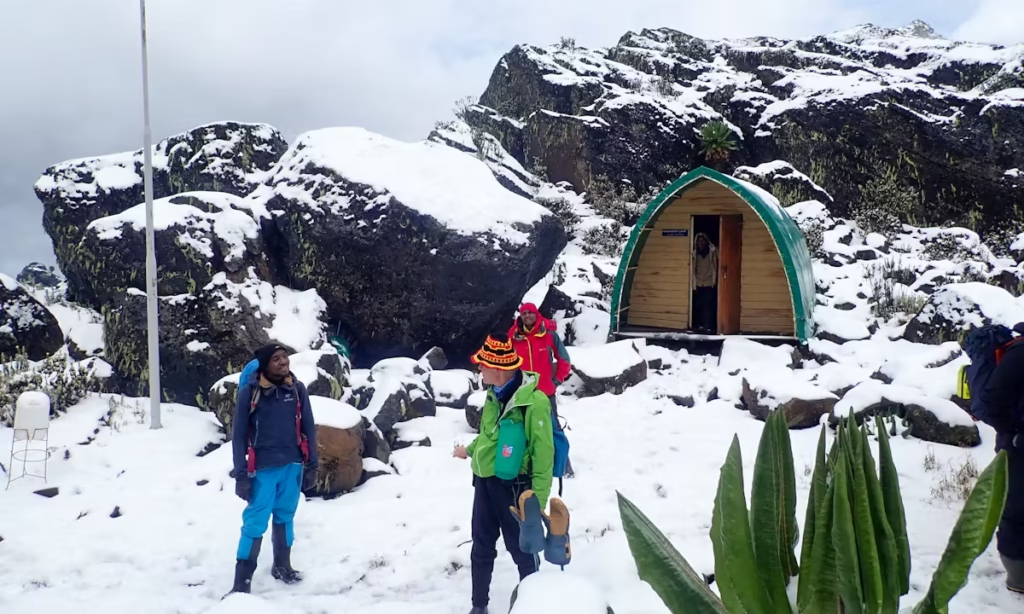
You step outside at 2:30 a.m. into a cold that is absolute and clean. The darkness is profound except for the stars, and the headlamps of the team are small moving points of light on the ridge above. Crampons bite into the rock and ice with a satisfying crunch. The pace is deliberate and slow; the reason is not caution so much as physics: at this altitude, rushing is physiologically impossible. The body moves at the speed the altitude sets.
The Stanley Glacier
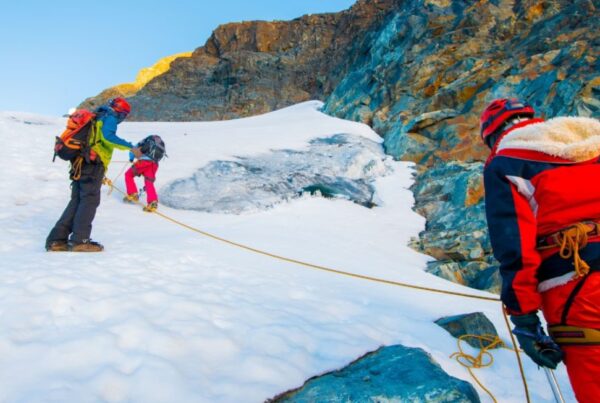
The approach to Margherita crosses the Stanley Glacier, and this transition onto ice is one of the defining moments of the entire expedition. The rope connects the team to the guides; the ice axes are now tools rather than objects. The glacier surface is hardened in the pre-dawn cold, better for crampon purchase than later in the day when the sun softens it. For trekkers with limited glacier experience, this section requires complete attention and complete trust in the guides, who set the pace and the line across the ice with precise knowledge.
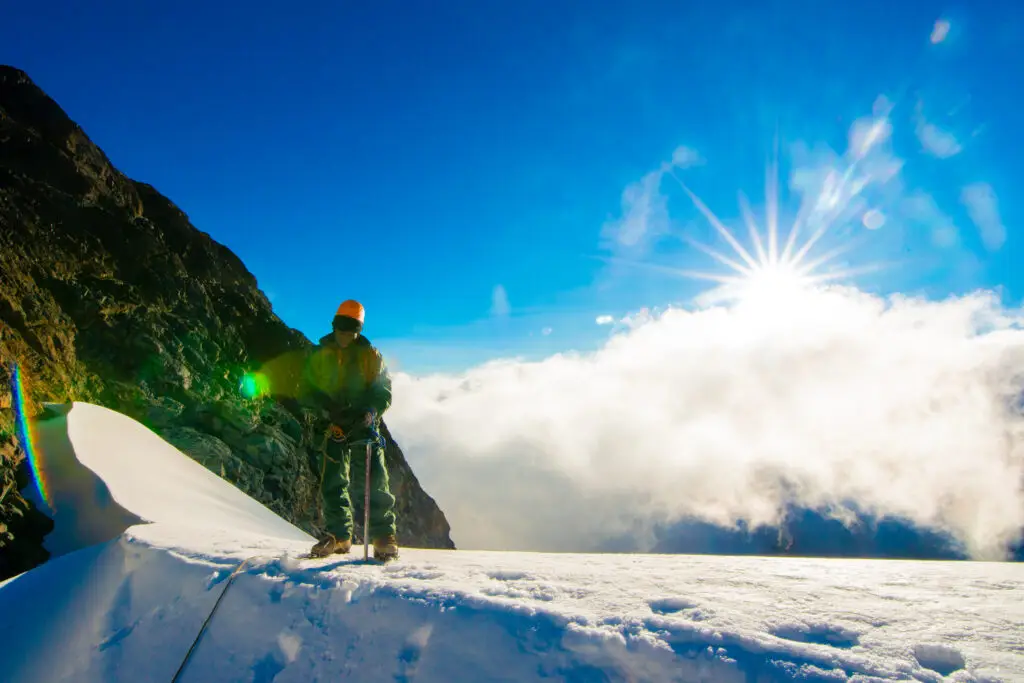
Looking down from the glacier in the pre-dawn hours when the valleys below are invisible and the horizon is a distant pale line is one of those experiences that redefines the word ‘perspective.’ You are standing on ice that has been forming and retreating for thousands of years, on the roof of Uganda, on the equator, in Africa. The cognitive dissonance of those facts arriving together is something trekkers describe for years afterward.
The Summit of Margherita Peak (5,109m)
Margherita Peak is the highest point of Mount Stanley and the third-highest summit in Africa, after Kilimanjaro (5,895m) and Mount Kenya’s Batian (5,199m). It sits on the Uganda-Democratic Republic of Congo border, and on a clear morning the view from its summit encompasses the Rwenzori range in its entirety: the dark ridgelines of Mount Baker, Mount Speke, Mount Luigi di Savoia, Mount Emin, and Mount Gessi arranged below you like chapters in a mountaineering bibliography as well as the vast forests of the Congo basin rolling westward to a horizon that has no edges.
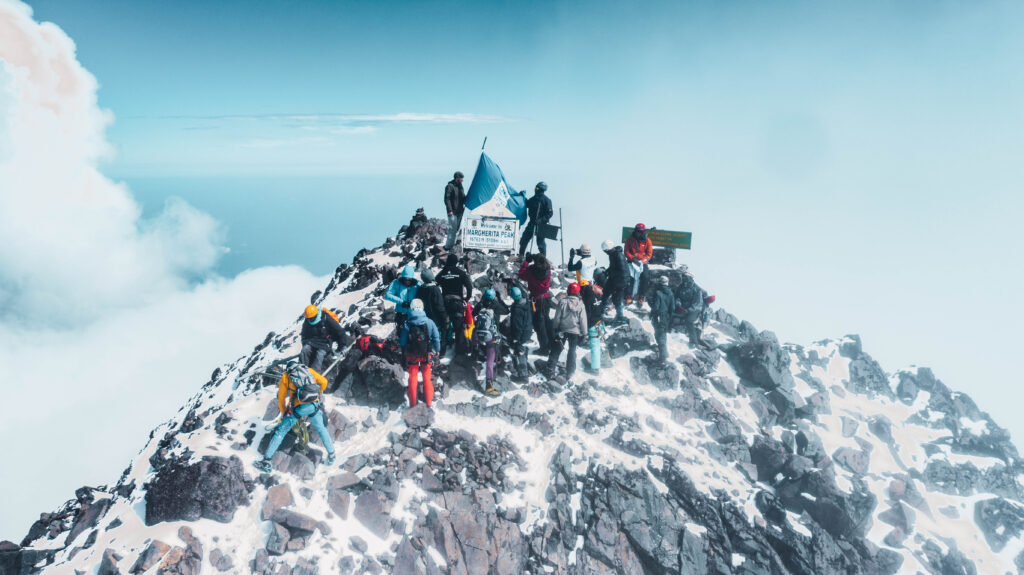
The emotional experience of the summit is different for every trekker. Some cry. Some stand completely still for a very long time. Some laugh. Most describe it as “huge,” “quiet,” and “unreal,” but halfway through, they give up. What is consistent is the time: you need to be off the summit and descending by 9:00 a.m. at the absolute latest, because from midday onward, the clouds that build over the Congo forests roll in rapidly, and the summit can be engulfed in fifteen minutes. The guides are firm on this timing, and they are right to be.
The Descent to Hunwick’s Camp
The descent from Margherita to Hunwick’s Camp, at 3,874 meters, is long and demands concentration throughout. The glacier descent requires the same discipline as the ascent: crampons, rope, slow deliberate steps, and below the glacier, the trail down to Hunwick’s passes through terrain that has been transformed by the light of day into something you recognize from five days of approach. The tiredness of a long summit day and the altitude combine to make every step feel considered. Your legs know what to do even when your mind is still on the summit.
Dinner at Hunwick’s on summit night is one of the more memorable meals of any expedition, not because the food is different, but because the context has changed completely. You ate the same stew before you became a person who had stood on Margherita Peak. You eat it again, as that person did. The guides bring out small celebrations when the team reassembles: extra tea, sometimes a small treat, and a quiet communal acknowledgement of what the day has been.
⚠️ Summit RealityEven in the dry season, the summit of Margherita can receive significant snowfall, and clouds regularly engulf the peak between 1–4 p.m. regardless of the season. This is not unusual; the moisture-laden air from the Congo builds clouds quickly at these elevations. The 2 a.m. start is specifically designed to give you the best possible chance of a clear summit window. Trust the departure time, even if every instinct objects to a 2 a.m. alarm. |
Day 7: Hunwick’s Camp to Kiharo Camp (3,974m → 3,460m) via Oliver’s Pass
Distance: ~12km | Elevation: +531m (Oliver’s Pass) then descent | Walking Time: 7–9 hours | Difficulty: Hard
The Return Route: A Different Mountain
One of the elegant features of the Kilembe Trail is that the descent follows a fundamentally different route from the ascent, which means you spend very little time on ground you have already seen. The return journey from Hunwick’s Camp takes the team northwest along a ridge toward McConnell’s Prong, a distinctive rocky pinnacle that has been visible on the horizon since Bugata Camp, and then continues along that ridge to Oliver’s Pass at 4,505 metres.
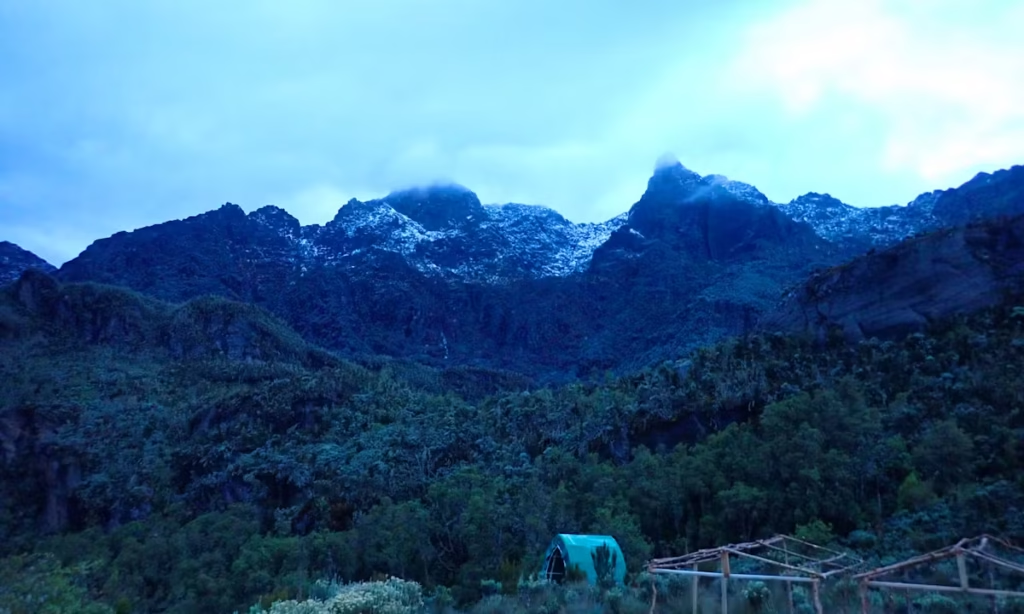
The view from Oliver’s Pass opens to the west and south in a way that none of the previous viewpoints have managed, and from this elevation, the Three Peaks, Stanley, Baker, and Speke, arrange themselves in a panorama that distills the entire Rwenzori massif into a single extraordinary frame. At 4,505 meters, Oliver’s Pass is actually higher than anything you have been on since the summit, and the body notices it. But by Day 7, most trekkers have acclimatized enough that the altitude feels familiar rather than threatening.
The Nyamwamba Valley and Descent to Kiharo
Below the pass, the trail descends toward the confluence of the Nyamwamba and Kilembe rivers, an important geographical landmark, because from this point the water runs downward through Kasese and Kilembe before ultimately reaching Lake George in Queen Elizabeth National Park. The sense of the mountains draining into the wider world of Uganda becomes palpable here: you are back in the watershed, and the valley below is the beginning of the return to the lowlands.
The path down the valley from the confluence to Kiharo Camp navigates through a series of moraines, the jumbled ridges of boulder and soil left by glaciers that advanced and retreated over thousands of years. You clamber over these stone ridges, each deposited by a glacier that no longer exists, and the landscape tells a story of geological time, written in rock and debris by the geology of the Rwenzori. This section is fascinating if you are geologically curious and perfectly navigable even if you are not.
Kiharo Camp: Silence and Cliffs
Kiharo Camp sits at 3,460 metres in a secluded valley that feels, on arrival, like something out of a fairy tale: the camp nestles against a wall of dark basalt cliffs, and the vegetation around it, a transitional zone between the alpine and the heather forest, creates a sheltered, intimate atmosphere after the exposed ridgelines of the previous two days. The hut here is well-maintained, the position dramatic, and the sound at night, wind in the heather and occasional distant water, is the sound of the mountain at rest.
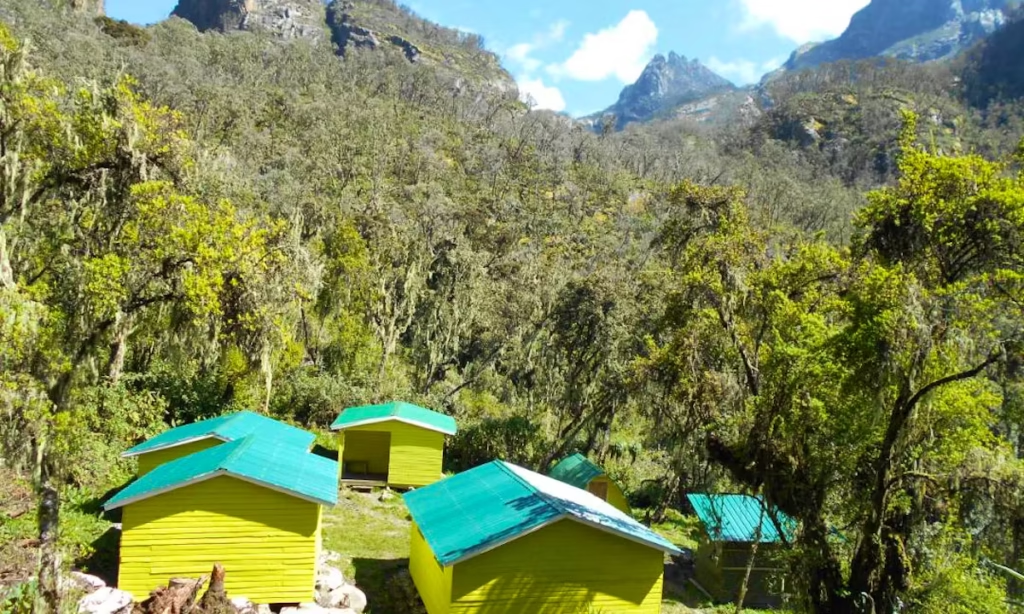
This evening is your last night in the mountains. Most trekkers become unexpectedly quiet in the evening at Kiharo. The expedition is almost over, and the mountains, which felt remote and abstract in the planning stages, have become vivid and personal over seven days of walking. There is a particular form of melancholy in last-night-in-the-mountains dinners, and the guides at Rwenzori Trekking Safaris have learned to honor it with good food, strong tea, and conversation that covers both the practical details of tomorrow and the harder-to-articulate shape of what the last week has meant.
Day 8: Kiharo Camp to Kasese via the Kilembe Trailhead.
Distance: ~18.8km | Elevation Loss: −2,010m | Walking Time: 6–8 hours | Difficulty: Moderate
The Last Long Walk
The distance from Kiharo Camp to the park gate is sixteen kilometers, with an additional 2.8 kilometers to the Kilembe Trekkers’ Hostel. It is a long walk, but mostly downhill, and it carries the specific lightness of a journey that is ending rather than beginning. The trail beyond Kiharo diverges briefly to follow the river before rejoining the main descent route, and within the first few kilometers of the walk you are back in the montane forest, the same forest you entered on Day 1, but experienced now with the accumulated weight of everything that happened between.
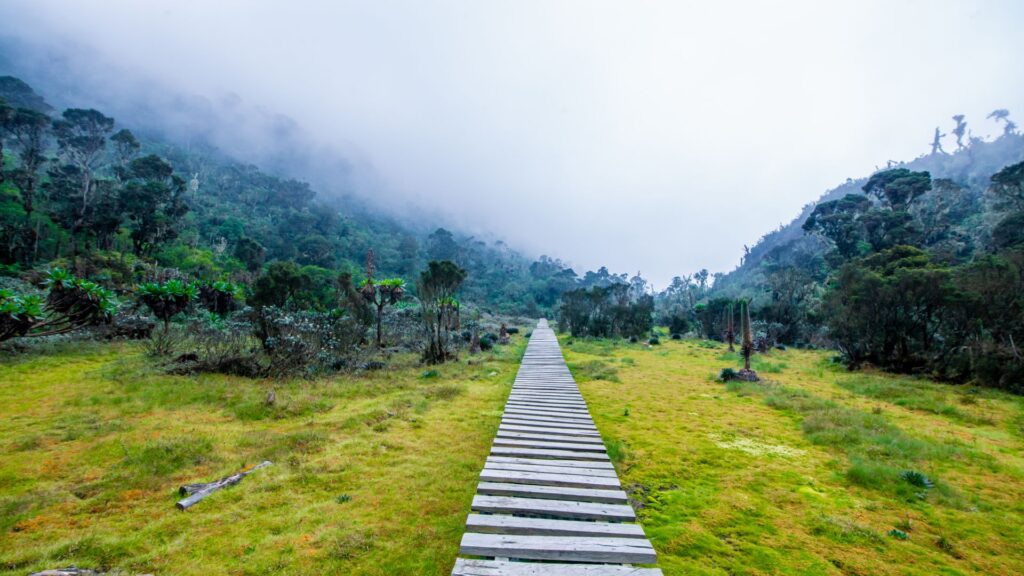
The forest on Day 8 is different in one important respect from Day 1’s version: you know it now. You have walked through all five of its vegetation zones and returned. The giant heather above gave way to the alpine moorland, which gave way to the glacier. You stood on a 5,109-meter summit and came back down. Walking through the forest on the way out, you notice things you walked past on the way in: the particular species of fig tree, the way the light falls, and the calls of birds you can now identify. The forest does not know your name. But you do.
Cascades and the Final Descent
A few kilometers below Kiharo, the river becomes steeper, and a series of stunning cascades appears tall, clean waterfalls dropping through the dark forest in sequences that would stop any tourist. Trekkers who still have phone batteries photograph everything. The trail climbs briefly to a high ridge after the cascades, offering broad views of the valley below, and then descends through dense woodland to a lunch stop at Forest View Camp.
The final kilometers to the trailhead are covered in a state that most experienced trekkers describe as contented automatism: the legs know what to do, and the mind is elsewhere, reviewing the week, cataloging memories, and making the tentative first plans that always form on the way down from a significant mountain. The Kilembe trailhead arrives with a modest, practical finality. The permit is stamped. The bags come off. The transfer vehicle is waiting. Margherita Peak sits, as it always has, somewhere behind you, above the forest, heather, moorland, and glacier, entirely indifferent to the fact that you have just walked to its summit and back.
🌿 Guide InsightThe most common thing trekkers say at the trailhead on Day 8 is some variation of “I didn’t expect to feel this way.” The Rwenzori has a particular habit of exceeding expectations and defying description. If you feel that the last eight days were harder, more beautiful, stranger, and more significant than you had planned for, that is exactly right. The mountain does that to people. It is one of its finest qualities. |
Kilembe Trail vs. Central Circuit: Which is Right for You?
If you are weighing the Kilembe Trail against the Central Circuit Trail, the other major route to Margherita Peak, the table below summarizes the key practical differences. Rwenzori Trekking Safaris operates both routes, and both can take you to the summit. The right choice depends on your priorities.
| Feature | Kilembe Trail | Central Circuit |
| Starting Point | Kilembe (1,450m) | Nyakalengija (1,646m) |
| Duration | 8 days to Margherita | 7 days to Margherita |
| Infrastructure | Newer, modern huts (post-2011) | Classic huts (older infrastructure) |
| Scenery | More varied, Southern Circuit vistas | Classic Bujuku Valley & crater lakes |
| Difficulty | More technical ascents | Steadier gradient overall |
| Crowding | Less crowded | More established, slightly busier |
| Special Features | Bamwanjara Pass, Lake Kitandara, Mutinda Lookout | Bujuku Lake, Elena Hut, Scott Elliot Pass |
| Who It Suits | Trekkers who want maximum scenic variety | Classic Rwenzori experience seekers |
Preparing for the Kilembe Trail: What This Guide Does Not Replace
Reading a day-by-day account of the Kilembe Trail is a valuable foundation for planning, but it does not replace preparation. A complete Kilembe expedition requires physical fitness built over months, not weeks. The 16-Week Training Plan for a Rwenzori Trek on this site is the most structured way to prepare. It also requires appropriate gear: if you are unsure what footwear to choose for the notorious Rwenzori bogs, the gear guide to boots for the Rwenzori answers that question in detail.
Budgeting is another practical reality. The full cost breakdown for climbing the Rwenzori explains what is included in the package price and what to plan for separately. The guides and porters who make your summit possible deserve adequate acknowledgement of their skill and effort. The tipping guide for Rwenzori porters and guides gives clear, fair guidance on this. And because the Rwenzori involves genuine high-altitude and glacier travel, appropriate travel insurance, including medivac coverage, is a non-negotiable requirement.
If you are an older trekker wondering whether the Kilembe Trail is realistic, the guide to trekking the Rwenzori over 50 addresses that question honestly. The Rwenzori is demanding for anyone, and the best predictor of success is fitness and preparation, not age. Many of the most dedicated and successful Kilembe trekkers are in their 50s and 60s.
Frequently Asked Questions: Kilembe Trail Day-by-Day Experience
What is the Kilembe Trail, and how many days does it take?
The Kilembe Trail is a trekking route through the Rwenzori Mountains National Park in western Uganda, starting at the town of Kilembe near Kasese at 1,450 metres and ascending to Margherita Peak at 5,109 metres. Officially launched in 2011 and managed by Rwenzori Trekking Services in partnership with the Uganda Wildlife Authority, it is widely regarded as the most scenically diverse and well-developed of the Rwenzori’s major trekking routes. The standard itinerary to Margherita Peak takes 8 days, with seven nights spent in mountain huts at Sine Camp, Mutinda Camp, Bugata Camp, Hunwick’s Camp, Margherita Camp, Hunwick’s Camp again on the descent, and Kiharo Camp. Alternative itineraries including the 4-Day Mutinda Loop and the 8-Day Cheptegei Peak route use the same lower portion of the trail and offer shorter, non-summit options.
What are the camps on the Kilembe Trail, and what elevation are they at?
The Kilembe Trail has six primary overnight camps on the 8-day Margherita itinerary. Sine Camp sits at 2,596 meters in the Afro-Montane Forest Zone, offering a gentle first-night acclimatization point with the adjoining Enock’s Falls nearby. Kalalama Camp, at 3,134 meters, is a waypoint used as a tea stop on Day 2 or as an overnight option for stronger parties. Mutinda Camp, at 3,688 meters, is in the heather moorland and provides access to the famous Mutinda Lookout, at 3,975 meters. Bugata Camp, at 4,062 meters, sits in the full Afro-alpine zone and is surrounded by giant lobelias and groundsels. Hunwick’s Camp, at 3,974 meters, offers the most panoramic views of the high peaks and is used both on the ascent and descent. Margherita Camp, at 4,485 meters, is the final pre-summit camp, positioned in a sheltered hollow between boulders, the site where the Duke of Abruzzi camped before the first ascent in 1906. Kiharo Camp, at 3,460 meters, is the final descent camp before the return trip to Kilembe.
How difficult is the Kilembe Trail compared to other Rwenzori routes?
The Kilembe Trail is generally considered more technically demanding than the Central Circuit Trail, primarily because of its steeper ascent profile, longer days, and more varied terrain, including the crossing of Bamwanjara Pass at 4,450 metres on Day 4 and the glacier travel required for the summit push on Day 6. The Central Circuit covers similar elevation on a slightly gentler and more direct gradient. That said, both routes require a solid base of aerobic fitness, experience with multi-day trekking, and the ability to manage altitude discomfort sensibly. What the Kilembe Trail offers in return for its extra demands is greater scenery diversity, fewer other trekkers on the trail, and the full experience of the Southern Circuit, including Lake Kitandara, Oliver’s Pass, and the Nyamwamba Valley descent, which is unavailable on the Central Circuit.
What food do you eat on the Kilembe Trail?
The dedicated cook from the trekking team fully provides meals on the Kilembe Trail from Day 1 to Day 8. Breakfasts typically consist of porridge, eggs, toast or chapati, and hot tea or coffee. Lunches are eaten at rest stops on the trail: packed meals of sandwiches, fruit, biscuits, and energy bars. Dinners are the most substantial meals: rice, ugali, or pasta with vegetable stews, bean sauces, or meat dishes, depending on the day and the availability of supplies. The cooking is done at high altitude on simple stoves, and the quality is consistently impressive given the conditions. Vegetarian and vegan diets are fully accommodated with advance notice. Hot drinks, tea, coffee, and hot chocolate are available at all camps in the evening and morning.
What does Margherita Camp feel and smell like?
Margherita Camp, at 4,485 metres has the particular character of a high-altitude shelter at the edge of the glaciated zone: compact, purposeful, and stripped of anything unnecessary. The hut is built to withstand the severe wind and cold of the upper mountain, with solid timber walls and a low ceiling that retains heat efficiently. The smell is that of all the Rwenzori’s high camps: a combination of damp wool, dry timber, kerosene from the small cooking stove, and the clean, mineral cold of glaciated air pressing in through every gap. There is very little ambient noise at this elevation: no animal calls and no wind in trees. When the wind drops, the silence is absolute in a way that feels geographic rather than merely quiet. The camp’s position between large boulders provides genuine shelter from wind and creates an intimacy that belies the altitude. Sleeping at Margherita Camp is often difficult; the altitude suppresses deep sleep and induces periodic breathing, but the hours before the 1:30 a.m. Wake-up times are valuable, and most trekkers get more rest than they expect.
Do you need technical mountaineering skills for the Kilembe Trail?
For most of the Kilembe Trail days 1 through 5, no technical mountaineering skills are required, though a good level of fitness, comfort with rugged terrain, and experience managing altitude are essential. Day 6, the summit push to Margherita Peak at 5,109 metres, involves glacier travel that requires the use of crampons, an ice axe, and a fixed rope with guides, and this section is technically demanding enough that it is managed entirely by the professional guides of Rwenzori Trekking Services. Trekkers do not need previous glacier experience, but they do need to be physically capable of the demands described above and willing to follow their guides’ instructions precisely. Summit day typically takes 10 to 14 hours total, including the descent to Hunwick’s Camp.
How does altitude affect you on the Kilembe Trail?
Altitude effects on the Kilembe Trail build gradually through the ascent. Most trekkers notice their first symptoms at Mutinda Camp (3,688m) on Day 2: a mild headache, slightly disrupted sleep, and a reduction in appetite are the most common presentations. By Day 3 at Bugata Camp (4,062 m), these symptoms may have intensified, and periodic breathing during sleep, which involves a cycle of breath-holding followed by rapid breathing, is normal and expected. At Margherita Camp (4,485m) and on summit day at 5,109m, the altitude is significant: exertion is harder, thinking can feel slightly sluggish, and the body’s resources are genuinely taxed. The Kilembe Trail’s acclimatization profile, particularly the climb-high-sleep-low opportunity at Mutinda and the rest day optionality built into the itinerary, is well designed to give bodies time to adjust. Drinking three liters of water daily, eating fully even when appetite diminishes, and communicating any symptoms to your guide are the three most important personal acclimatization practices on the trail.
What is the best time of year to hike the Kilembe Trail?
The best times to hike the Rwenzori are the two dry seasons: December to March and June to September. In these months, the trails are drier, the cloud cover over the summit is reduced, and the probability of summit success is higher. That said, the Rwenzori receives rain in all months of the year; it is the wettest mountain range in Africa, and even in the dry season, waterproof gear is non-negotiable. The wet-season Kilembe Trail (April to May and October to November) is harder underfoot, particularly through the marshy Namusangi Valley and the bamboo zone on Day 2, and summit success rates are lower because of persistent cloud cover. The Rwenzori is trekked year-round, and visitor numbers are low relative to other African mountains, roughly 1,000 to 1,500 per year, which means you will never encounter the trail crowds familiar from Kilimanjaro or Mount Kenya regardless of the season.
Can I do a shorter version of the Kilembe Trail without summiting?
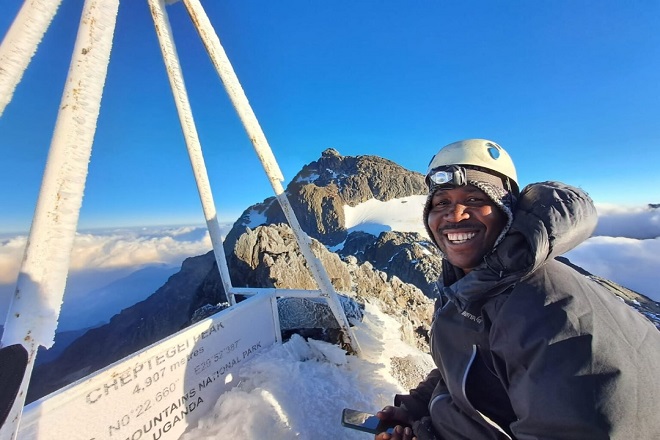
Yes, and the Kilembe Trail offers several excellent non-summit itineraries that use its lower and middle sections. The 2-Day Sine Camp Trek covers the montane forest section to Sine Camp and back, an ideal introduction to Rwenzori trekking for those with limited time. The 4-Day Waterfalls Hike explores the Kilembe Trail’s remarkable waterfall corridor through the forest and bamboo zones. The 4-Day Mutinda Loop reaches Mutinda Camp and the Mutinda Lookout at 3,975 meters, offering high-altitude moorland scenery and the “climb high, sleep low” acclimatization profile without proceeding to the summit. The 8-day Cheptegei Peak route offers the full Kilembe experience for those seeking a different summit, using the same trail to reach Cheptegei Peak at 4,907 meters, a demanding and rewarding alternative to Margherita.
Plan Your Kilembe Trail Trek
The Kilembe Trail is the Rwenzori at its fullest: five vegetation zones, six dramatic camps, Bamwanjara Pass, Lake Kitandara, a glacier, and the third-highest summit in Africa. There is no more comprehensive introduction to what these mountains actually are and no better way to understand why serious trekkers who come to the Rwenzori once nearly always come back.
Rwenzori Trekking Safaris operates all Kilembe Trail departures in partnership with Rwenzori Trekking Services, with professional guides, full mountain accommodation, all meals, and technical summit equipment included as standard. Whether you are planning the full 8-day Margherita expedition, a shorter Mutinda Loop taster, or a multi-peak adventure via the 13-day Six Peaks Expedition, we can help you design the trek that matches your fitness, your timeframe, and your ambitions.
Are you ready to walk the Kilembe Trail?
Contact our team to begin planning your Rwenzori expedition. Every trek is tailored to you.