People ask me this question all the time, often alongside another one: why not just climb Kilimanjaro instead? After many seasons guiding in the Rwenzori Mountains, after summits reached and a few turned back, after nights in Elena Hut listening to hail hammer a tin roof at 4,541 metres, I can answer both questions honestly, and the answer to the first is a good deal longer than that to the second. What makes the Rwenzori special is not one single feature. It is the accumulation of several genuinely rare qualities inside one mountain range: permanent glaciers sitting almost on the equator, five vegetation zones compressed into a single trek, a chain of six named massifs rather than one lonely summit, some of the strangest and most beautiful high-altitude scenery on the continent, a level of physical and technical challenge that rivals or exceeds its far more famous neighbors, and, remarkably, a price tag that undercuts them. This guide covers all of it in the kind of detail that only comes from actually spending years of your life on this mountain.
If you are trying to decide whether the Rwenzori deserves a place on your list or whether it should be the centerpiece of your African trekking plans, read on. By the end, you will understand exactly why guides who have worked across the continent’s great ranges keep coming back to this one and how to start planning your own expedition to the Mountains of the Moon.
A Mountain Range, Not a Single Peak
The first thing that separates the Rwenzori from almost every other trekking destination in Africa is structural. Kilimanjaro is one volcanic cone. Mount Kenya is one eroded volcanic massif. The Rwenzori is neither. It is a 120-kilometer chain of six distinct massifs straddling the Uganda-DRC border, each one a separate mountain in its own right, with its own glaciers, its own approach, and its own personality. Trekkers who research only Margherita Peak often discover, partway through planning, that they are actually choosing among an entire range of objectives, from the celebrated Mount Stanley at 5,109 metres down to the quieter, less-visited slopes of Mount Luigi di Savoia at 4,627 metres.
Between those two sit Mount Speke at 4,890 metres, Mount Baker at 4,843 metres, Mount Emin at 4,798 metres, and Mount Gessi at 4,715 metres, each carrying multiple named summits of its own. This diversity is why our full portfolio of peaks reads less like a single mountain’s statistics sheet and more like an entire mountaineering region compressed into one national park. A trekker with a week climbs Margherita Peak and goes home satisfied. A trekker with two weeks can attempt our 13-day, six-peak grand expedition, and the most committed mountaineers pursue the 18-day, all-eight-peaks expedition, a genuine rarity in African mountaineering that almost no other operator on the continent is equipped to deliver safely.
The Rwenzori is not a mountain you finish in an afternoon, taking a photo at a summit sign. It is a range you can return to for a decade and still have new massifs left to climb, and that sense of depth, of a mountain with more to give than any single visit can exhaust, is one of the defining reasons trekkers describe the Rwenzori as special rather than merely difficult.
Africa’s Last Equatorial Glaciers
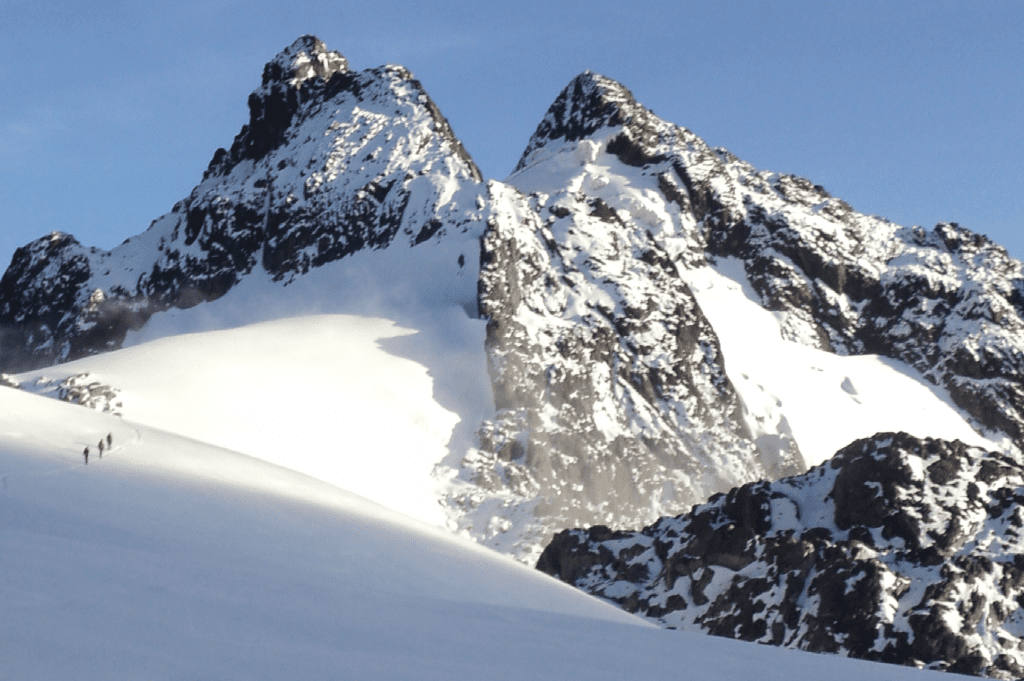
No feature of the Rwenzori generates more disbelief among first-time visitors than this one: these mountains sit almost directly on the equator, and yet their upper slopes carry permanent glacial ice. Standing on the Stanley Plateau, a frozen high-altitude plain ringed by crevassed ice fields, in a country better known worldwide for savanna and rainforest, is one of the most disorienting and unforgettable experiences available anywhere on earth. Only three places on the African continent have ever carried permanent ice: Kilimanjaro, Mount Kenya, and the Rwenzori. Of the three, the Rwenzori’s glaciers remain the least visited and, for now, still rank among the most extensive relative to the mountain’s overall height.
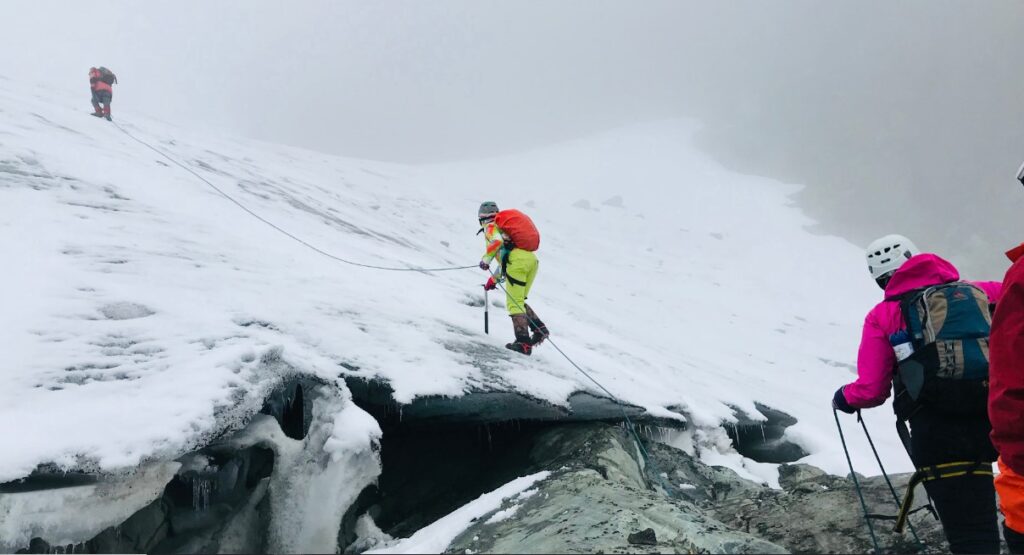
That last point carries real urgency. UNESCO’s own assessment of the Rwenzori Mountains National Park World Heritage listing recognizes the range’s glaciers, waterfalls, and lakes as forming one of the most exceptional alpine landscapes anywhere on the continent and notes that the property holds a far larger alpine zone than either of its taller neighbors. But our own detailed glacier report lays out the harder truth: the ice has retreated by more than 80 percent since 1906, and glaciologists expect the remaining ice fields to vanish entirely within a matter of decades. Trekking the Rwenzori today, crossing the Elena Glacier by fixed rope and crampon on the way to Margherita Peak, is an experience future generations of trekkers may simply not have available to them. That combination of rarity and impermanence gives Rwenzori trekking a dimension no volcanic summit trek can replicate: you are not just climbing a mountain; you are witnessing the final chapter of equatorial ice on this continent.
| Guide Insight:
Every guide who has worked here for long enough carries the same quiet urgency about the glaciers. I tell every group the same thing before we reach Elena Hut: look closely at the ice on the way up, because within your children’s lifetime, and possibly within your own, it may not be there to look at again. |
Five Vegetation Zones in a Single Trek
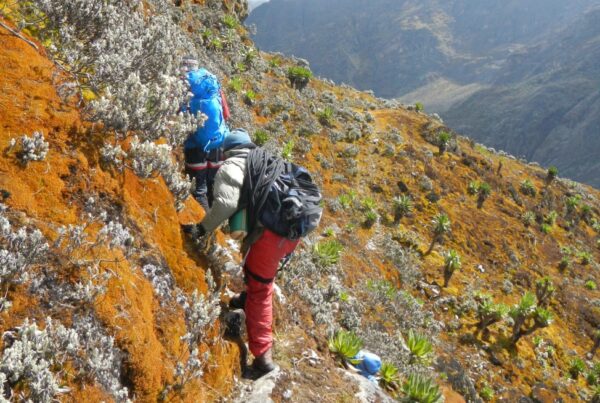
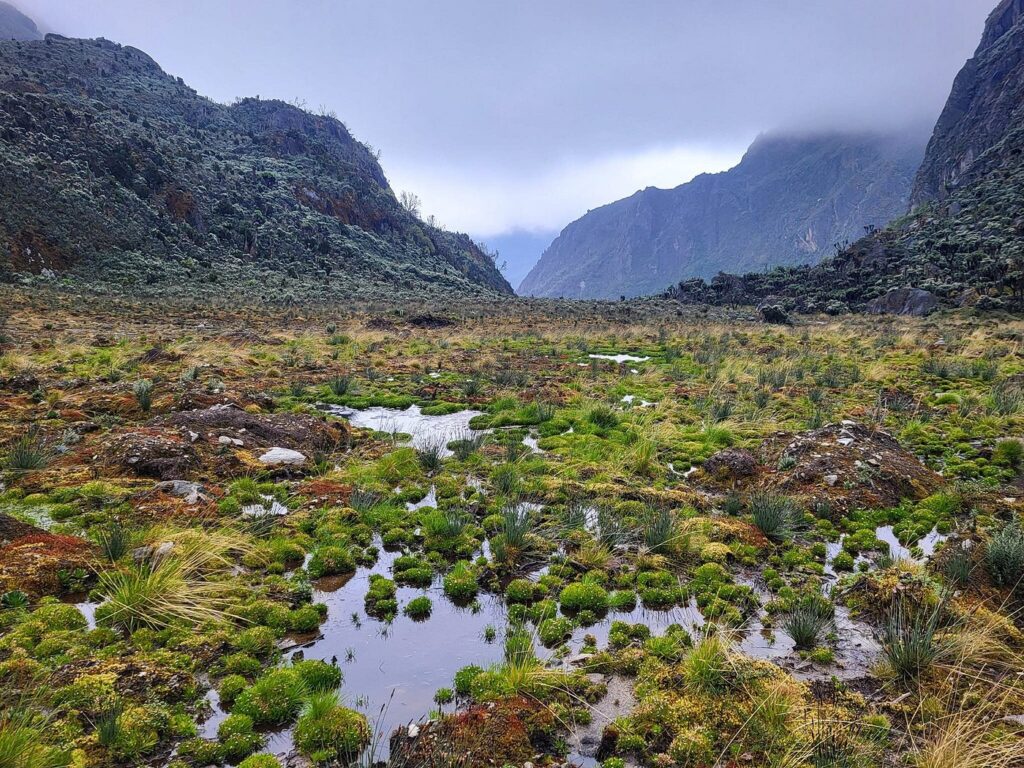
Few mountains anywhere in the world compress as much ecological range into a single ascent as the Rwenzori. Over the course of one expedition, a trekker climbs through montane rainforest, bamboo forest, heathland, Afro-alpine moorland, and finally a nival zone of rock, snow, and ice, a transition that on most mountains would require traveling between entirely different climate regions. Our full breakdown of the Rwenzori’s vegetation zones covers each belt in detail, but the short version is this: no other East African trekking destination changes its character this dramatically, this often, over such a short vertical distance.

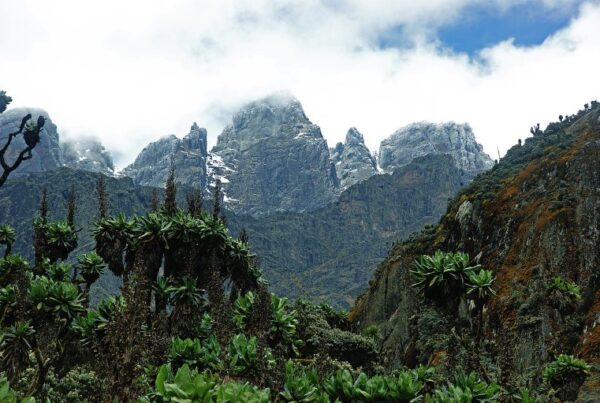
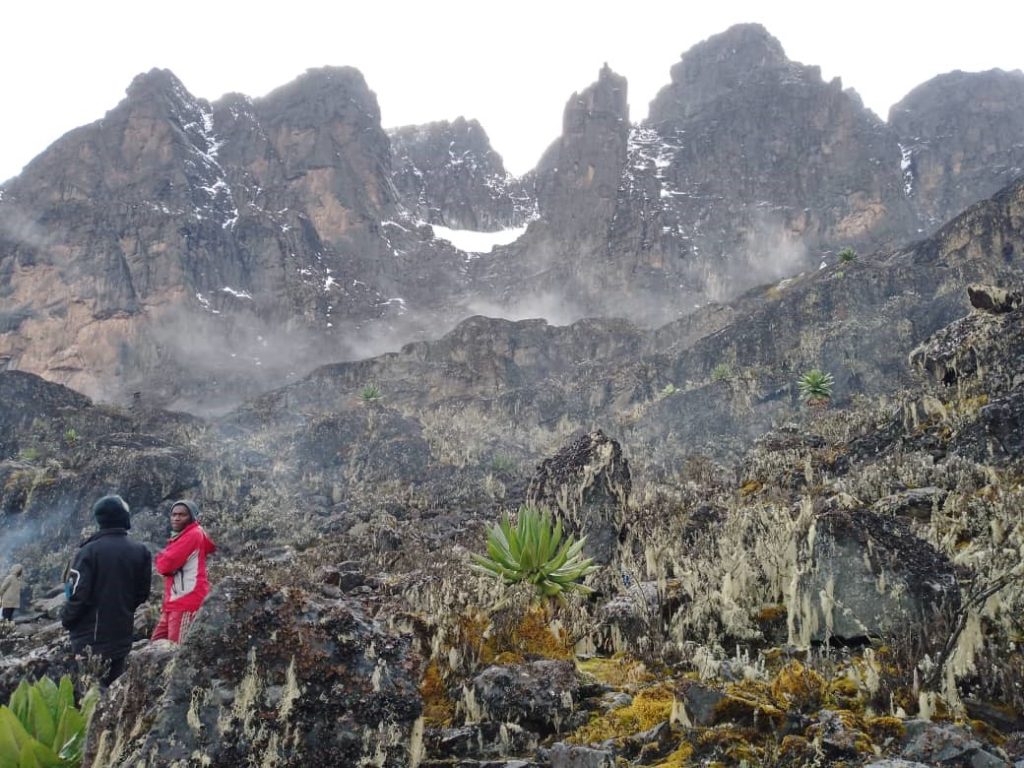
The Afro-alpine zone is where the range truly earns its reputation for strangeness. Giant lobelias rising three metres into the mist and giant groundsels reaching five metres are found nowhere else on the planet outside a handful of other Albertine Rift peaks, and walking among them, cloaked in mist, is regularly described by our clients as the single most surreal landscape they have encountered anywhere on their travels. UNESCO’s own scientific assessment of the property specifically singles out this high-altitude flora, including the giant heathers, groundsels, and lobelias, as representing some of the rarest vegetation types found anywhere on the African continent. Layered beneath this alien botany is genuine wildlife: the elusive Rwenzori turaco, the three-horned chameleon, L’Hoest’s monkeys, and chimpanzees in the lower forest, all documented in our Rwenzori wildlife guide. Kilimanjaro’s vegetation zones exist too, but they are drier, thinner, and far less biologically rich than what the Rwenzori’s near-constant humidity and rainfall have produced over millions of years.
A Different Kind of Mountain, Geologically
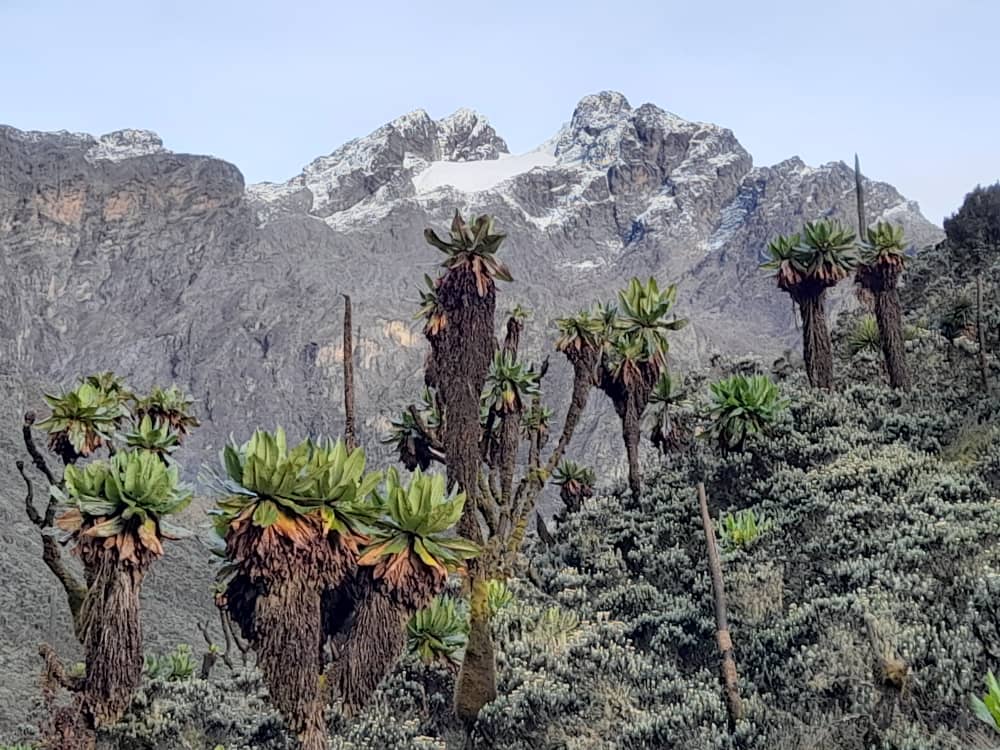
Part of what makes the biodiversity and glaciation possible is the Rwenzori’s unusual origin. Unlike Kilimanjaro, Mount Kenya, and the Virunga volcanoes that flank it on either side, the Rwenzori is not volcanic at all. It is a block mountain, a slab of ancient Precambrian crystalline rock, among the oldest exposed rock on the continent, thrust skyward along a fault line of the western branch of the East African Rift System over millions of years. This geological history is why the range rises so abruptly, nearly 4,000 metres above the floor of the Albertine Rift Valley in places, and why its jagged, ice-carved ridgelines look so different from the smooth volcanic cone of Kilimanjaro or the eroded plug of Mount Kenya. You are not walking up the side of an old volcano here. You are walking up a fragment of continental crust that has been pushed into the sky.
Scenery Almost No One Else Ever Sees
Kilimanjaro receives somewhere in the region of 50,000 trekkers a year. Our visitor statistics analysis puts the Rwenzori’s annual trekking numbers at roughly 1,000, a difference of nearly fiftyfold on a mountain that is, by most objective measures, more scenically varied and more biodiverse than its famous neighbor. That is not a marketing statistic. This is simply a consequence of a mountain that demands more of its visitors in terms of fitness, gear, and patience with mud, which in turn means that the landscapes you pass through are experienced by only a fraction of the people who will ever see Kilimanjaro’s crater rim.
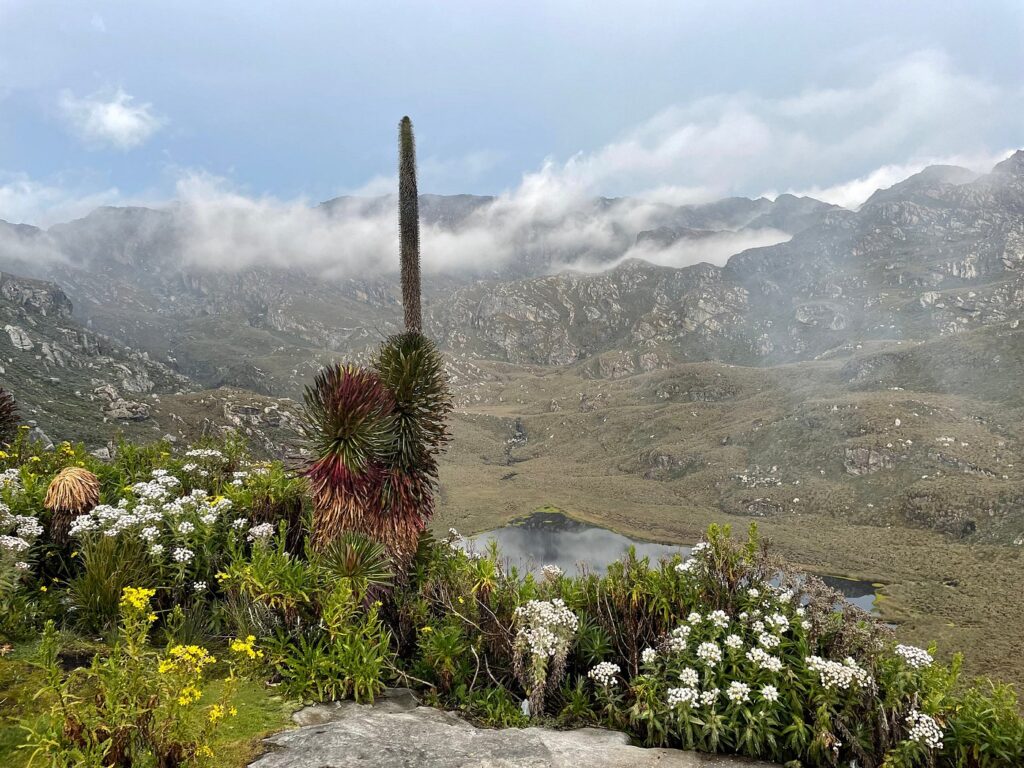
The reward for that exclusivity is considerable. The Bujuku Valley, framed by the twin summits of Mount Baker and Mount Stanley, is one of the most photographed yet least seen alpine valleys in Africa. Along the Central Circuit Trail, trekkers pass a sequence of glacial lakes, waterfalls, and moss-draped cathedral forest that shifts character almost hourly. The Kilembe Trail climbs through the dramatic Nyamwamba Valley, where the river cuts a series of cascading waterfalls through heath and forest, covered in detail in our Kilembe waterfalls hike guide. For those who want to go further off the map entirely, the Bukurungu Wilderness Trail, developed with the Uganda Wildlife Authority and WWF, passes four high-altitude alpine lakes on a route that sees only a handful of visitors annually, a genuinely undiscovered corner of an already underexplored mountain.
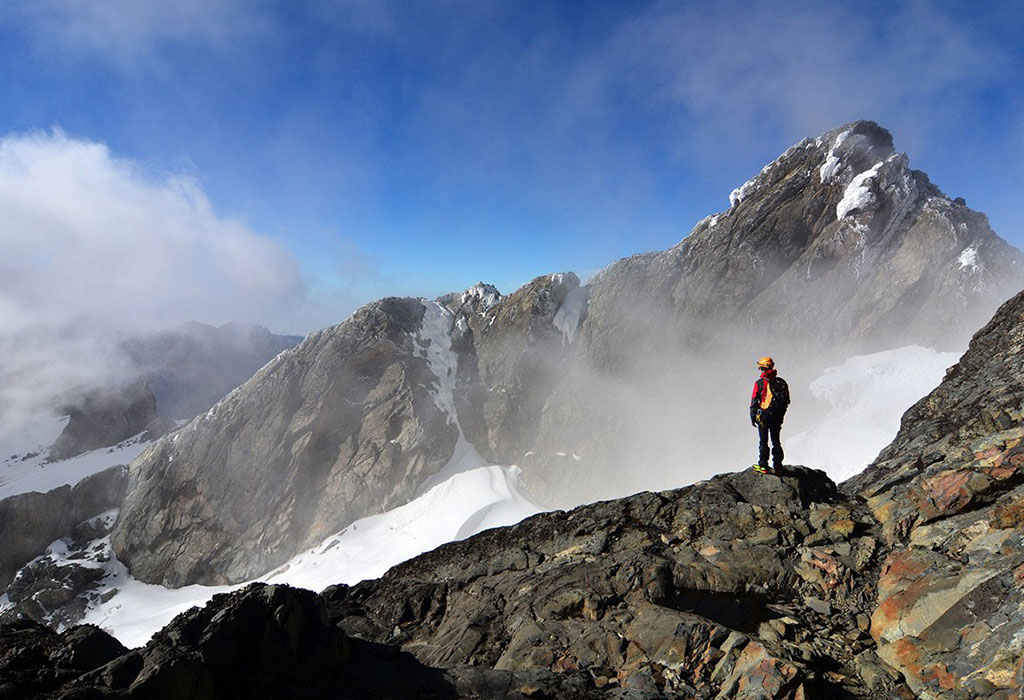
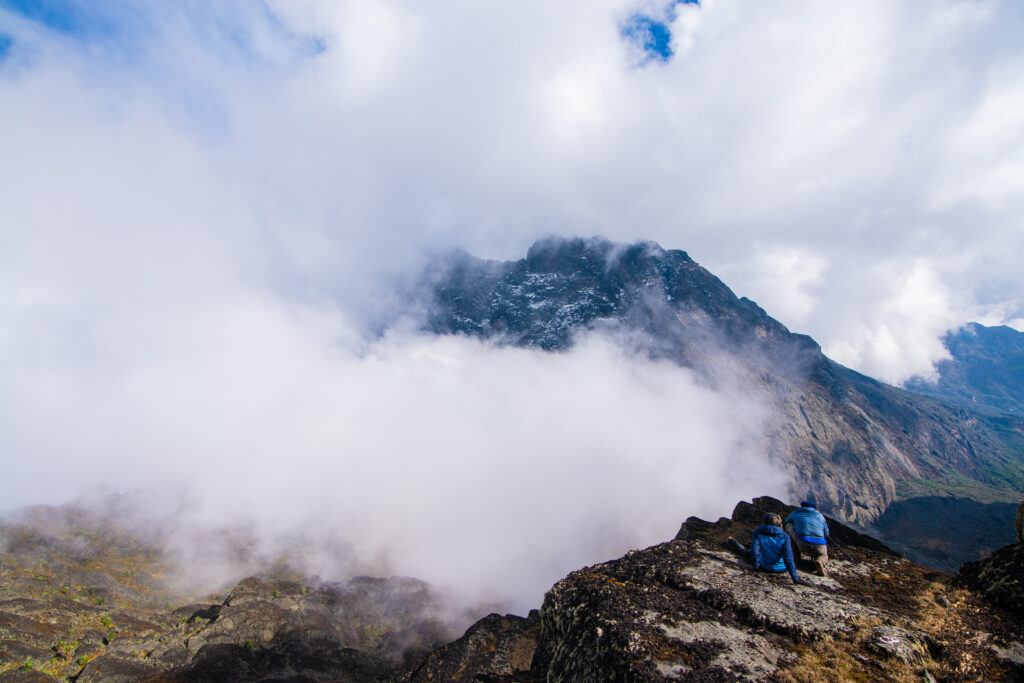
And then there is the Stanley Plateau itself: a frozen high-altitude plain sitting almost on the equator, ringed by crevassed glacial ice, with views on a clear day stretching across the Congo Basin to the west and the plains of western Uganda to the east. I have watched the expression on a trekker’s face when the cloud finally breaks and that plateau materializes in front of them more times than I can count, and it never gets old, for them or for me.
Harder and Wilder Than Its Famous Neighbours
Difficulty is a defining part of what makes the Rwenzori special, and it is worth being completely honest about it, because false modesty here does trekkers no favors. Our full difficulty assessment and our head-to-head comparison with Kilimanjaro both reach the same conclusion: Rwenzori trekking is harder than Kilimanjaro, even though Kilimanjaro’s summit, at 5,895 metres, sits 786 metres higher than Margherita Peak. Altitude is not the deciding factor here. Terrain is.
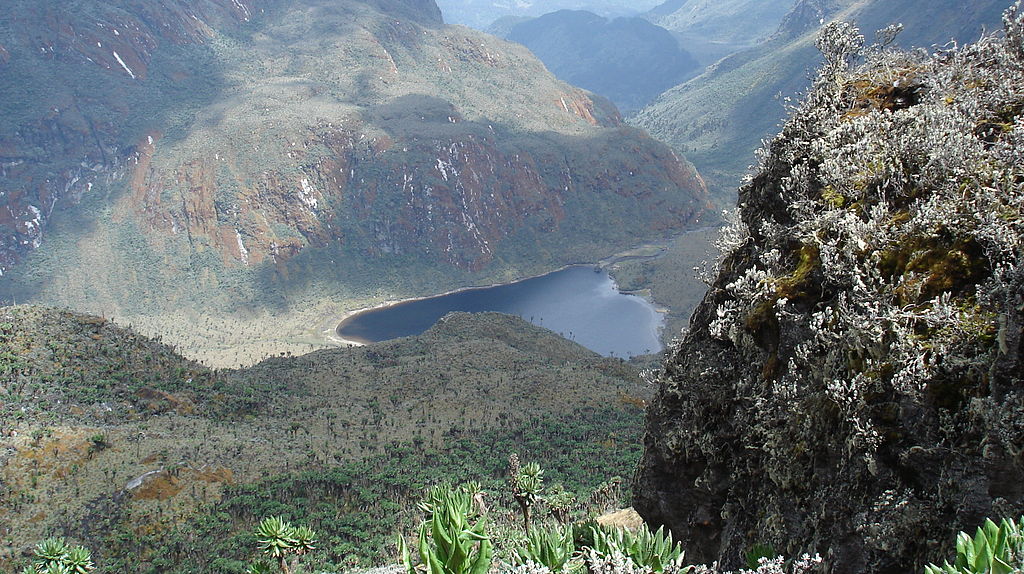
Kilimanjaro’s trails are, for the most part, wide, well-maintained paths on a single conical volcano with predictable gradients and clear sightlines. The Rwenzori offers none of those comforts. The lower trails cross saturated bogs where every step demands concentration. The middle sections combine steep root climbing and rock scrambling with mud of startling depth. The Afro-alpine zone is technically complex and navigationally serious, and weather here can shift from bright sunshine to near whiteout in twenty minutes. Summit day itself adds a further layer that Kilimanjaro does not require at all: a genuine glacier crossing above Elena Hut, using crampons, an ice axe, and fixed ropes on steep mixed terrain. None of this is beyond a well-prepared trekker, and our guides bring hundreds of successful summits’ worth of experience to managing it, but it is real mountaineering terrain, not a long uphill walk.
Compared with Mount Kenya’s technical rock routes or the short, steep volcanic climbs of the Virunga range, the Rwenzori occupies a category of its own: a multi-day wilderness expedition that combines equatorial glaciation, difficult non-technical terrain, and a genuine technical glacier crossing, all inside one trek. Our detailed case for why the Rwenzori is Africa’s most underrated mountain trek sets out exactly why serious mountain travelers increasingly rank it above its more commercialized neighbors.
| Guide Insight:
Trekkers who have climbed both the Rwenzori and Kilimanjaro often ask me which is better. My honest answer is that they are different mountains, not competing ones. But if I had to choose one to climb for the landscapes, the wildlife, the sense of genuine wilderness, and the honest physical challenge, I would choose the Rwenzori without hesitation every time. |
A More Affordable Mountain Than Its Reputation Suggests
Given everything above, glaciers, six massifs, five vegetation zones, and harder terrain, most people assume Rwenzori trekking must cost more than Kilimanjaro. The opposite is true. A fully guided Rwenzori expedition to Margherita Peak, covering park fees, guide and porter wages, mountain hut accommodation, and full agency logistics, typically runs between roughly USD 1,300 and USD 3,500 for a 7 to 8-day itinerary, as set out in our complete 2026 cost breakdown. A comparable guided Kilimanjaro summit trek through a reputable operator commonly runs USD 2,500 to USD 4,000 or more per person, a difference driven largely by Tanzania’s high park fees and an intensely competitive guide and porter market.
That means the Rwenzori delivers a more technically demanding, more ecologically diverse, and substantially more exclusive mountain experience at a lower price than its two most obvious East African rivals. For trekkers looking to manage the budget further without cutting corners on safety or guiding quality, our budget trekking guide identifies legitimate ways to reduce costs. It is a rare thing in adventure travel to find the harder, rarer experience also being the better value, and it is one more reason the Rwenzori deserves a place on any serious mountain traveler’s shortlist.
A UNESCO World Heritage Site and a Living Water Tower
Rwenzori Mountains National Park was inscribed as a UNESCO World Heritage Site in 1994 and designated a Ramsar wetland of international importance in 2008, formal recognition of a landscape UNESCO itself describes as one of the most beautiful and ecologically outstanding alpine areas on the African continent. The park covers close to 100,000 hectares, of which around seventy percent lies above 2,500 metres, giving the range a far larger high-altitude zone than either Kilimanjaro or Mount Kenya despite its lower summit elevation.
The Rwenzori’s importance extends well beyond scenery. These mountains are the highest and most permanent source of the Nile system, feeding rivers that sustain agriculture and communities across a wide stretch of the Albertine Rift, a role that gives every trek here a significance that reaches far beyond the personal achievement of reaching a summit. Understanding this deeper context, the history of the Rwenzori Mountains and the story of why the range is called the Mountains of the Moon, adds real depth to the experience of trekking here. The ancient geographer Ptolemy is credited with the name, describing snow-capped peaks that fed the Nile from the heart of Africa, a claim later generations of explorers, including Henry Morton Stanley and the Duke of Abruzzi’s pioneering expeditions, eventually confirmed to be substantially correct.
Guarded by the People Who Have Always Lived Here
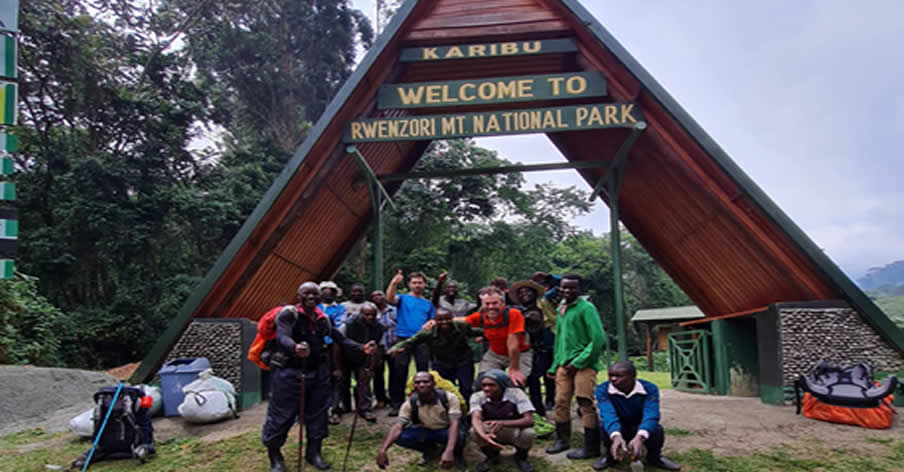
No account of what makes the Rwenzori special is complete without the Bakonzo, the indigenous community whose villages ring the base of the range and whose members make up virtually the entire guide and porter workforce operating on the mountain. The Uganda Wildlife Authority requires every trekker inside the national park to be accompanied by a certified guide at all times, a rule that reflects both the genuine complexity of the terrain and the central economic role mountain tourism plays for Bakonzo families in the Kasese region. Every guide and porter we work with has grown up in the shadow of these peaks, and that inherited, generational knowledge of the mountain’s moods, its safe lines through the bogs, and its weather patterns is something no amount of outside training can fully replicate. Ten percent of the proceeds from every trek we operate goes directly back into supporting local Bakonzo communities, their schools, homes, and orphan-support programs, which means choosing the Rwenzori is also, in a very direct way, choosing to support the people who have protected this landscape for generations.
Choosing How You Experience the Rwenzori’s Uniqueness
Because the Rwenzori is a range rather than a single peak, the route you choose materially changes the version of this mountain’s uniqueness you get to experience. The Central Circuit Trail is the classic option, looping through the widest sweep of the range’s five vegetation zones and offering the greatest variety of summit objectives, and it remains the natural choice for our most popular itinerary, the 7-day Margherita Peak climb. The Kilembe Trail approaches from the Nyamwamba Valley and delivers a genuinely different set of landscapes and its own celebrated waterfalls, while the 8-day Kilembe route to Margherita Peak adds an extra acclimatisation day that consistently improves summit outcomes. Our route comparison guide walks through every variable to help you decide.
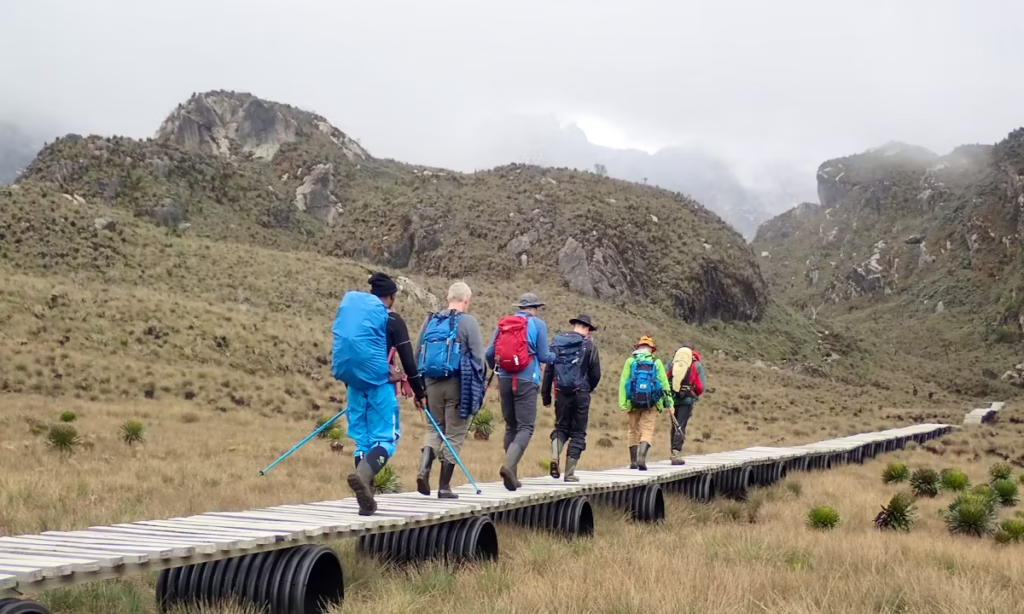
If your ambitions run higher than a single summit, our full treks and expeditions portfolio covers everything from short introductory forest walks to the complete eight-peak traverse. Preparation is very important on a mountain this demanding, and our acclimatisation strategy guide and summit success rate analysis explain why longer itineraries are so much better than rushed ones. Our beginner’s guide to Rwenzori trekking is essential reading if this will be your first major mountain expedition. Many trekkers also choose to pair a Rwenzori expedition with gorilla trekking in Bwindi Impenetrable Forest, and our 12-day Rwenzori and gorilla trekking combination remains one of the most requested itineraries in our entire program, pairing a high-altitude glacier crossing one week with a forest encounter with mountain gorillas the next.
Why It All Adds Up to Africa’s Most Underrated Trek
Strip away the marketing language, and what remains is a mountain range that offers equatorial glaciers nowhere else on the continent can match outside two other peaks, five vegetation zones compressed into days rather than weeks of travel, six separate massifs and more than a dozen named summits, terrain that tests experienced mountaineers as seriously as it rewards first-time trekkers who prepare properly, scenery that only a few hundred people a year ever witness, and a price that consistently undercuts its more famous rivals. That is not one reason to trek the Rwenzori. It is a dozen reasons stacked on top of each other, and in my years guiding here, I have yet to meet a trekker who reached Margherita Peak, or Weismann, or any of this range’s summits and felt that any one of those reasons had been oversold.
Ready to Stand Where Few Ever Have?Every reason the Rwenzori is special, the glaciers, the six massifs, the vegetation zones, the wild scenery, and the honest challenge, is a reason to plan your trek with the operator that lives and breathes this mountain. Talk to a guide who has personally summited Margherita Peak, ask every question you have, and let us build the itinerary that matches your fitness, your timeline, and your ambition. |
Frequently Asked Questions: What Makes the Rwenzori Mountains Special
What makes the Rwenzori Mountains unique compared to other African mountains?
The Rwenzori is unique because it combines several rare qualities in a single range: permanent equatorial glaciers found on only three African peaks in total, five distinct vegetation zones from rainforest to snow, six separate glaciated massifs rather than one summit, non-volcanic block-mountain geology unlike Kilimanjaro or the Virungas, and a level of wilderness exclusivity that comes from receiving roughly fiftyfold fewer visitors than Kilimanjaro each year.
Does Rwenzori Mountain have glaciers?
Yes. The Rwenzori is one of only three African mountain ranges, alongside Kilimanjaro and Mount Kenya, to carry permanent glacial ice, and it does so almost directly on the equator. The glaciers sit on Mount Stanley, Mount Speke, and Mount Baker, with the most accessible crossing occurring above Elena Hut on the route to Margherita Peak. These glaciers have retreated by more than 80 percent since 1906 and are projected to disappear within decades.
Why is the Rwenzori considered harder than Kilimanjaro?
Rwenzori trekking is considered harder than Kilimanjaro primarily because of terrain rather than altitude. Although Kilimanjaro’s summit is higher, its trails are well-maintained and gradual, while the Rwenzori’s routes involve saturated bogs, steep root and rock climbing, rapidly changing weather, and a genuine glacier crossing on summit day that requires crampons, an ice axe, and fixed ropes.
How does the cost of trekking Rwenzori compare to Kilimanjaro or Mount Kenya?
A fully guided 7 to 8-day Rwenzori expedition typically costs between roughly USD 1,400 and USD 3,500 per person, while a comparable guided Kilimanjaro expedition commonly costs USD 2,500 to USD 4,000 or more. Despite being more technically demanding and ecologically diverse, the Rwenzori is generally the more affordable of Africa’s major glaciated peaks.
What kind of vegetation and wildlife will I see on a Rwenzori trek?
A Rwenzori trek passes through five distinct vegetation zones: montane rainforest, bamboo forest, heathland, Afro-alpine moorland, and a nival zone of rock and ice. The Afro-alpine zone is especially striking, home to giant lobelias and giant groundsels found almost nowhere else on earth. Wildlife includes chimpanzees, L’Hoest’s monkeys, the endemic Rwenzori turaco, and the three-horned chameleon, concentrated mainly in the lower forest sections.
Why are the Rwenzori Mountains called the Mountains of the Moon?
The name traces back to the ancient Greek geographer Ptolemy, who described a range of snow-capped mountains at the source of the Nile in the heart of Africa. Their perpetually mist-shrouded, glacier-capped appearance earned them the poetic name, later confirmed by nineteenth-century explorers who established the Rwenzori as one of the true sources feeding the Nile system.
How many peaks does the Rwenzori Mountains have?
The Rwenzori range consists of six major glaciated massifs: Mount Stanley (5,109 m), Mount Speke (4,890 m), Mount Baker (4,843 m), Mount Emin (4,798 m), Mount Gessi (4,715 m), and Mount Luigi di Savoia (4,627 m). Each massif carries multiple named summits, bringing the total number of significant named peaks across the range to well over a dozen.
Is trekking the Rwenzori Mountains worth it?
For trekkers seeking genuine wilderness, ecological richness, and a real mountaineering challenge rather than a crowded trophy summit, the Rwenzori is widely regarded by experienced guides as one of the most rewarding and underrated treks on the African continent. Its combination of equatorial glaciers, exceptional biodiversity, low visitor numbers, and comparatively affordable pricing makes it a standout choice for serious trekkers researching their next expedition.
Every question above has a more detailed answer waiting in our full FAQ library, and every guide on our team is on hand to answer whatever this article did not cover. If the Rwenzori sounds like the mountain you have been looking for, the next step is simple: get in touch and start planning your own expedition into Africa’s most underrated range.