Hour by hour: what a Rwenzori porter actually carries, earns, and does each day on the mountain. An expert guide’s honest, detailed account.
Every trekker who summits Margherita Peak remembers the glacier, the pre-dawn cold of the Stanley Plateau, the moment the crater rim comes into view. Almost none of them can tell you what time their porter woke up that same morning, what was in his bag, or how many kilograms of it he carried up the same ascent they were struggling with under a light day pack. I’ve spent more than a decade guiding on this mountain, and if there’s one gap in almost everything written about Rwenzori trekking, it’s this: the porter’s day is the actual engine of every expedition on this range, and it remains almost entirely invisible in how the trek gets described.
This article exists to close that gap properly, hour by hour, from the pre-dawn load weighing at the trailhead to the final song sung on the descent. It’s a companion piece to our broader look at mountain life on the Rwenzori and our structural guide to porters and guides, but it’s narrower and more specific than either: this is what one working day actually looks like, told from inside a porter’s boots, not a trekker’s.
Before Dawn: The Load Weighing
A porter’s day on the Rwenzori doesn’t start at the trailhead; it starts well before that, at home in one of the villages scattered across the lower slopes of Kasese District, where most of the men and increasingly women who carry loads on this mountain were born and raised. Most porters live close enough to walk to the assembly point at Nyakalengija for the Central Circuit or the Kilembe trailhead for the southern route, arriving in the pre-dawn dark carrying little more than a sleeping mat, a change of clothes, and whatever food they’ll need to supplement what the trekking company provides on the mountain.
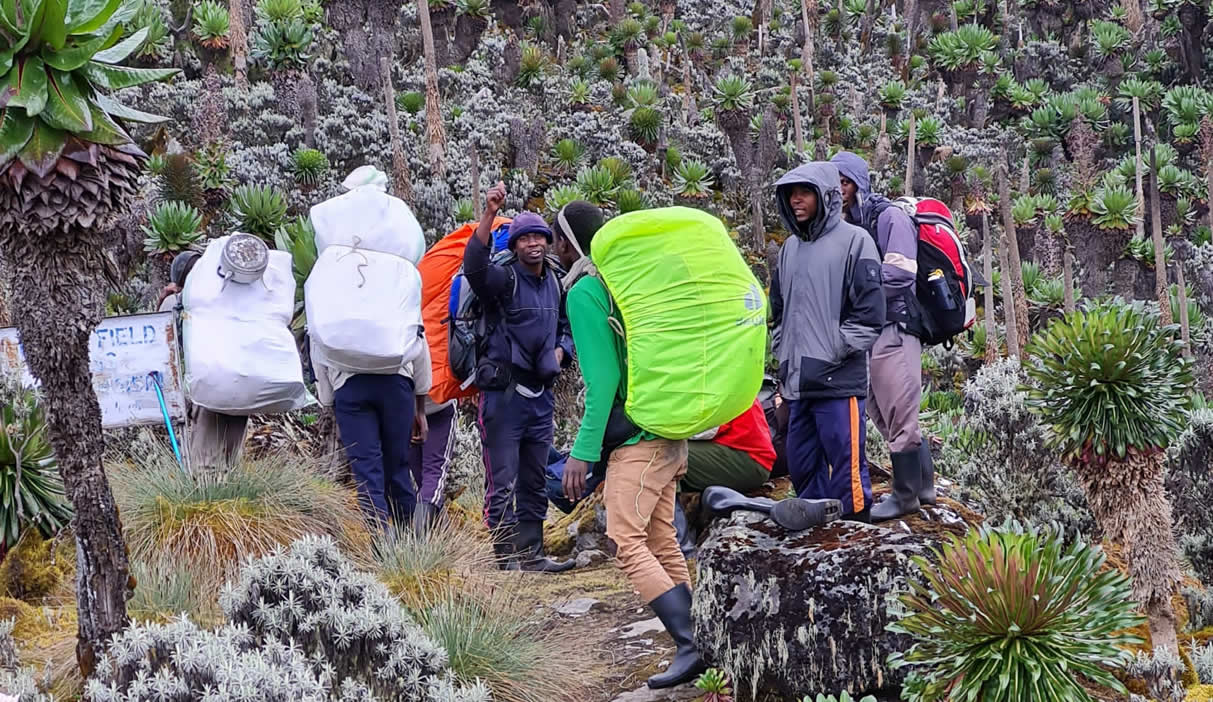
The single most important ritual of the entire day happens before a single step is taken: the load weighing. Every bag destined for the mountain is weighed on a spring scale at the assembly point, under the direct supervision of the head guide and, on the Central Circuit, staff from Rwenzori Mountaineering Services. The maximum load a porter is permitted to carry is capped at 25 kilograms, a limit set and strictly enforced by the trail management organizations specifically to protect porter welfare, a hard-won standard that didn’t always exist on this mountain and that responsible operators now treat as completely non-negotiable. Any bag that comes in over the limit gets repacked on the spot, sometimes to the visible frustration of a trekker who packed for every possible contingency and now has to make a decision about what actually needs to go up the mountain. Our page on how many porters you need for your trek explains how this weight limit, combined with group size and communal equipment, determines the total size of your expedition’s porter team.
The Assignment: Who Carries What
Once the loads are weighed, the head guide assigns them, and this is where the porter role reveals its real complexity. It isn’t simply a matter of handing out bags at random. Communal equipment, tents for routes without huts, cooking gear, gas canisters, food supplies for the entire trek, and emergency kit, gets distributed among the strongest and most experienced members of the team, since this is the equipment the entire expedition depends on regardless of which trekker’s personal bag goes to whom. Trekkers’ main packs are assigned individually, and over a multi-day trek the same porter will often carry the same bag each day, developing a working familiarity with its particular weight distribution and quirks that makes the carry marginally easier by the third or fourth day.
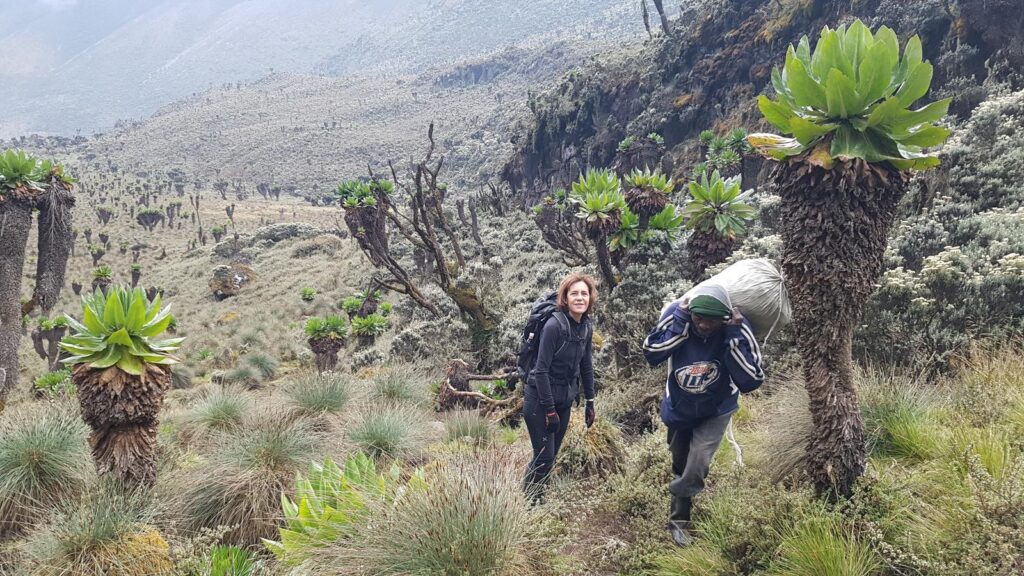
On routes without a hut system, most notably the Bukurungu Trail, the load list expands considerably to include tents, cooking equipment, and the group shelter that on the Central Circuit or Kilembe Trail would already be waiting at the huts. This is one of the clearest practical differences between the Central Circuit Trail and Kilembe Trail, both served by fixed mountain huts and camps, and the wilder Bukurungu route, and it directly affects how many porters a given itinerary requires and how their day is structured.
On the Trail: A Physically Different Experience of the Same Mountain
Setting Off Ahead, Not Behind
One detail that surprises almost every first-time trekker: porters don’t trail behind the group the way support staff often do on other mountains. On the Rwenzori, the porter team typically moves out ahead of or well alongside the main trekking party, often at a noticeably faster pace despite carrying two to three times the weight. This isn’t showing off; it’s operational necessity. Porters need to reach camp early enough to set up tents where required, get water collection underway, and have the cooking fire going before the trekkers themselves arrive, cold and ready for tea. Watching an experienced porter move through the Bigo Bogs or up the switchbacks below Nyabitaba with a 25-kilogram load balanced on his back or head, at a pace that leaves fit trekkers with empty packs breathing hard to keep up, is one of the genuine humbling experiences of a Rwenzori trek.
The Terrain Doesn’t Get Easier With a Heavier Bag
The Rwenzori’s trail conditions are demanding for anyone, the persistent mud, the root systems, the wooden boardwalks through the bogs that are slick even when dry, but every one of those obstacles is a materially different problem when you’re carrying a heavy pack rather than a light day bag. A stream crossing on slick rock, a scramble over a fallen tree trunk, the exposed sections crossing Scott Elliot Pass, all of these require a different kind of balance and judgment with load on your back, and Rwenzori porters develop this skill over years, often starting as young men accompanying older relatives before being certified to carry independently. The physical toll compounds daily across a multi-day itinerary in a way that trekkers, resting under a lighter load and often taking rest days built into longer expeditions, simply don’t experience in the same way.
Weather as a Daily Companion, Not an Inconvenience
Rain on the Rwenzori isn’t an occasional disruption; it’s close to a daily certainty across most of the year, and a porter’s relationship with it is fundamentally practical rather than emotional. Where a trekker might mentally register a downpour as bad luck on their trip, a porter is thinking about keeping the communal food supplies dry, protecting the tents and cooking gas from moisture damage, and managing his own layering with far fewer changes of clothing than most international trekkers carry. Footwear matters enormously here; gumboots are standard issue for many porters specifically because the terrain’s mud and stream crossings make standard hiking boots impractical for someone working at this pace and load across multiple days.
Arrival at Camp: The Second Job Begins
Reaching camp isn’t the end of a porter’s working day; in many respects it’s where the second half begins. Porters who’ve arrived ahead of the trekking party immediately start setting up, on the Central Circuit and Kilembe Trail this means preparing the assigned hut space, laying out mattresses, and getting communal cooking equipment organized in the hut’s kitchen area; on Bukurungu it means pitching tents and establishing a full camp from nothing. Water collection is a constant, physically demanding task at altitude, since every litre used for cooking, drinking, and washing has to be fetched, often from a stream some distance from camp, and Rwenzori water sources require careful selection and treatment given the altitude and the shared use of the trail by wildlife.
The cook, working alongside the porter team, begins meal preparation well before the trekkers arrive, and by the time the main party reaches camp exhausted and cold, hot tea and a snack are typically ready and waiting, a small institutional kindness that repeat Rwenzori trekkers often single out as one of the trip’s most memorable details. Our account of the huts, food, and sleep reality on the mountain covers what trekkers experience on the receiving end of this system in full.
Rest, Community, and the Evening Rhythm
Once the main tasks of camp setup are complete, the porter team’s evening has its own rhythm and its own social character, largely separate from the trekkers’ own dinner and downtime. Porters typically eat together, often a heartier, more calorie-dense meal reflecting the physical demands of the day’s carry, and this shared meal is where the genuine camaraderie of the team becomes visible, conversation in Lhukonzo, the Bakonzo language, laughter, occasionally music. For trekkers curious about the human dimension of who’s carrying their expedition, this is a good moment to walk over, greet the team, and learn names, a small gesture our tips for hiking the Rwenzori article specifically recommends, since it genuinely changes the character of the whole trek.
Sleeping arrangements for porters are typically simpler and more communal than the trekker accommodation, often a dedicated porter room within the hut structure on the Central Circuit and Kilembe Trail, or shared tent space on Bukurungu. Nights above 3,500 metres are cold regardless of who you are, and porters manage this with fewer technical layers than most international trekkers carry, relying instead on experience, shared body heat in communal sleeping areas, and the fires kept going for as long as fuel allows.
Who Becomes a Rwenzori Porter
Porters on this mountain are drawn overwhelmingly from the Bakonzo community, the Bantu-speaking indigenous people whose ancestral homeland covers the mountain’s foothills and lower slopes on both the Ugandan and Congolese sides of the border. Becoming a certified porter isn’t informal; it typically starts young, often as an assistant or apprentice to an established family member, and progresses through the certification standards maintained by the trail management organizations, Rwenzori Mountaineering Services on the Central Circuit and Rwenzori Trekking Services on the Kilembe Trail. Porter work represents one of the primary sources of formal, monetised income available in Kasese District, and for many families it directly funds school fees, healthcare, and food security in a way that few other local employment options can match.
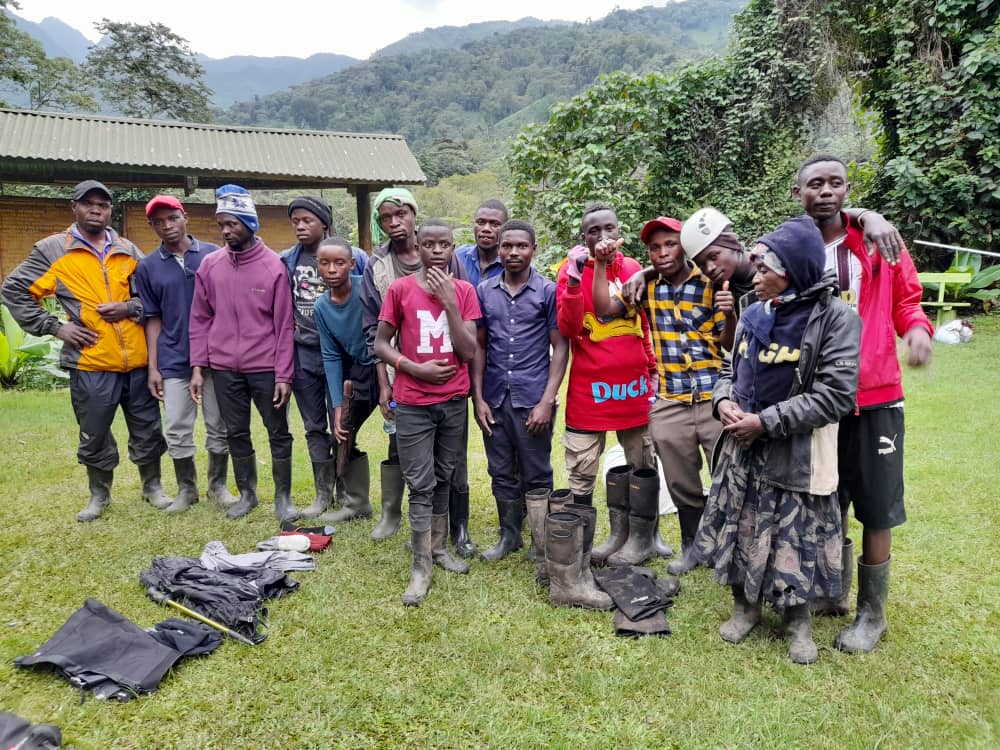
Our full porters and guides guide covers the certification pathway, team roles, and welfare standards in complete detail.
Career progression on the mountain follows a fairly consistent pattern: a young porter builds experience and reliability over several seasons, and the most capable and knowledgeable eventually train toward assistant guide and then head guide certification, roles that carry more responsibility, higher pay, and direct responsibility for trekker safety and navigation. It’s genuinely common to meet head guides on the Rwenzori who started as porters a decade or more earlier, which gives the whole system a career-ladder quality that’s easy to miss if you only think of porters as interchangeable labor rather than as professionals on a defined path.
What a Porter Actually Earns
The honest answer requires two figures held together: the base daily wage and the tip. Base wages are set at minimum standards established by the trail management organizations, calibrated to be commercially sustainable for operators while providing meaningful income by the standards of the local Kasese District economy; a full trekking season, combining base wages with tips and equipment provisions, meaningfully supports a family household. On their own, though, base wages are modest, which is precisely why the tip a trekker leaves at the end of an expedition carries real economic weight rather than functioning as an optional courtesy.
This is the part of a porter’s day, or more precisely the end of a porter’s trek, that trekkers have the most direct influence over, and it’s worth understanding properly before you arrive rather than improvising it at the trailhead. Our dedicated guide on how much to tip Rwenzori porters and guides sets out specific recommended amounts by role, group size, and trek duration, and our currency guide covering cash, ATMs, and tipping logistics explains practically how to arrive with the right denominations, since large bills are difficult to break in Kasese and porters overwhelmingly prefer smaller notes they can actually use.
The Final Morning: The Song
There’s a moment that happens on the final morning of almost every Rwenzori expedition, after the last mountain breakfast, when the entire team, guides, cook, and every porter, gathers together before the descent to the trailhead and sings a farewell song. It’s an unrehearsed, wholehearted expression of Bakonzo joy and communal celebration, and I’ve watched it catch nearly every first-time trekker completely off guard, in the best possible way. From the trekker’s side, this moment is often described as the emotional high point of the entire trip. From the porter’s side, having carried this same 25-kilogram load up the same passes for the seventh or eighth time that season, it’s something different: a genuine closing ritual, a release, and a moment of collective pride in a job done well. Tips are traditionally collected into a single envelope at this point and presented to the lead guide for distribution among the team, a tradition our broader account of mountain life on the Rwenzori describes from the trekker’s vantage point, worth reading as the companion piece to everything covered here.
Why This Matters for How You Plan Your Own Trek
Understanding a porter’s actual day changes how most trekkers approach their own preparation, in ways that go beyond simple gratitude. It’s a direct argument for packing lighter and more deliberately, since every unnecessary kilogram in your main bag is a kilogram someone else carries up the same mud and passes you’re finding difficult with nothing on your back. It’s a reason to budget tips properly and in advance rather than treating them as an afterthought calculated hastily the night before departure. And it’s a reason to book with an operator that enforces the 25-kilogram weight limit and pays fair, transparent wages rather than the cheapest team available, since porter welfare standards vary considerably across operators on this mountain even though the trail management organizations set clear minimums. Our page on what’s included when you book a Rwenzori trek sets out exactly how guide and porter wages, equipment, and welfare provisions factor into a properly structured trekking package.
Frequently Asked Questions
How much weight does a Rwenzori porter carry?
Rwenzori porters are limited to a maximum load of 25 kilograms, a standard set and enforced by the trail management organizations, Rwenzori Mountaineering Services on the Central Circuit and Rwenzori Trekking Services on the Kilembe Trail. Every bag is weighed on a spring scale at the trailhead before departure, and any load found to be over the limit is repacked on the spot. This limit exists specifically to protect porter health and welfare over a multi-day, physically demanding trek.
What time does a Rwenzori porter’s day start?
A porter’s working day effectively begins before dawn at the trailhead assembly point, Nyakalengija for the Central Circuit or the Kilembe gate for the southern route, where loads are weighed and assigned under the head guide’s supervision. Many porters have already walked from nearby villages to reach the assembly point by this time. Once loads are assigned, porters typically set off ahead of or alongside the main trekking group so they can reach camp early enough to prepare it before the trekkers arrive.
Do porters walk ahead of or behind trekkers on the Rwenzori?
Porters typically move ahead of or alongside the trekking party rather than trailing behind, despite carrying substantially heavier loads. This is a practical necessity rather than a display of strength: porters need to arrive at camp early enough to set up tents where required, collect and prepare water, and have the cooking fire and tea ready for trekkers arriving cold and tired at the end of the day’s stage.
How much should I tip a Rwenzori porter?
Recommended tips vary by role, group size, and trek length, with specific figures set out in our dedicated tipping guide, but as a general reference, a solo trekker on a standard 7-day route with a full team, including two porters, should budget roughly $130 to $180 in total tips across the whole crew. Tips are collected into a single envelope and presented to the lead guide for distribution among the team on the final morning of the trek, traditionally accompanied by a farewell song from the whole crew.
Where do Rwenzori porters come from?
The overwhelming majority of Rwenzori porters are members of the Bakonzo community, the Bantu-speaking indigenous people whose ancestral homeland encompasses the mountain’s foothills and lower slopes across both Uganda’s Kasese District and the neighbouring Congolese side of the border. Porter work is one of the primary sources of formal income available to Bakonzo families in the region, and many porters live within walking distance of the Nyakalengija or Kilembe trailheads.
Can a porter become a guide on the Rwenzori?
Yes, and it’s a common and well-established career path on this mountain. Porters who build experience and reliability over multiple seasons can progress toward assistant guide and eventually head guide certification through the training standards maintained by the trail management organizations. It’s genuinely common to meet head guides on the Rwenzori today who started their careers as porters a decade or more earlier.
Where do porters sleep on a Rwenzori trek?
On the Central Circuit and Kilembe Trail, where fixed mountain huts are used, porters typically sleep in dedicated, simpler communal quarters within the hut structure, separate from trekker accommodation. On routes without a hut system, such as the Bukurungu Trail, porters share tent space as part of the full camp they set up each evening. Conditions are more basic than trekker accommodation, and porters manage the cold above 3,500 metres with fewer technical layers, relying on experience and shared warmth.
Ready to Plan Your Rwenzori Trek?
If reading this has given you a real sense of who is actually carrying your Rwenzori expedition, and what their day looks like while you’re admiring the view, get in touch with our team through our contact page to start planning your own trek. We’ll help you choose the right route, build a fair and properly resourced porter team into your itinerary from the outset, and make sure you arrive prepared to treat the people who make this mountain accessible the way they deserve to be treated.