Spot the Rwenzori turaco on your trek: where to look, best timing, ID tips & photography advice from expert Rwenzori guides
Long before you see it, you will hear it. On the lower forest sections of any Rwenzori trek, somewhere in the tangled canopy above the trail between Nyakalengija and Nyabitaba, a loud, guttural, almost barking call rolls out through the mist-damp trees, repeated in a rhythmic series that carries for a surprising distance through dense montane forest. Most first-time trekkers stop dead on the trail the first time they hear it, convinced something large and possibly dangerous is nearby. It is neither. It is the call of the Rwenzori turaco, and if you are lucky, and patient, and know where to look in the seconds that follow, you are about to see one of the most extraordinary birds in Africa.
I have guided trekkers through this forest for years, and the Rwenzori turaco remains, without exception, one of the two or three wildlife encounters clients ask about before every single expedition. Part of that is reputation. This is not simply another attractive forest bird among the more than 200 species recorded in Rwenzori Mountains National Park; it is a genuine Albertine Rift endemic, found nowhere else on the planet outside this narrow band of Central African highland forest, and it carries in its feathers a piece of biochemistry so unusual that ornithologists still cite it as one of the strangest pigment systems in the entire bird world. This guide exists because most trekkers arrive at the park gate having heard the name “Rwenzori turaco” without any real sense of what makes the bird so remarkable, where on the mountain it actually lives, or how to give themselves a genuine chance of a clear sighting rather than a fleeting flash of red disappearing into the canopy. By the end of it, you will know all three, and you will be far better equipped than the average visitor to actually find one.
Meeting a Ghost in Green and Crimson: What Exactly Is the Rwenzori Turaco?
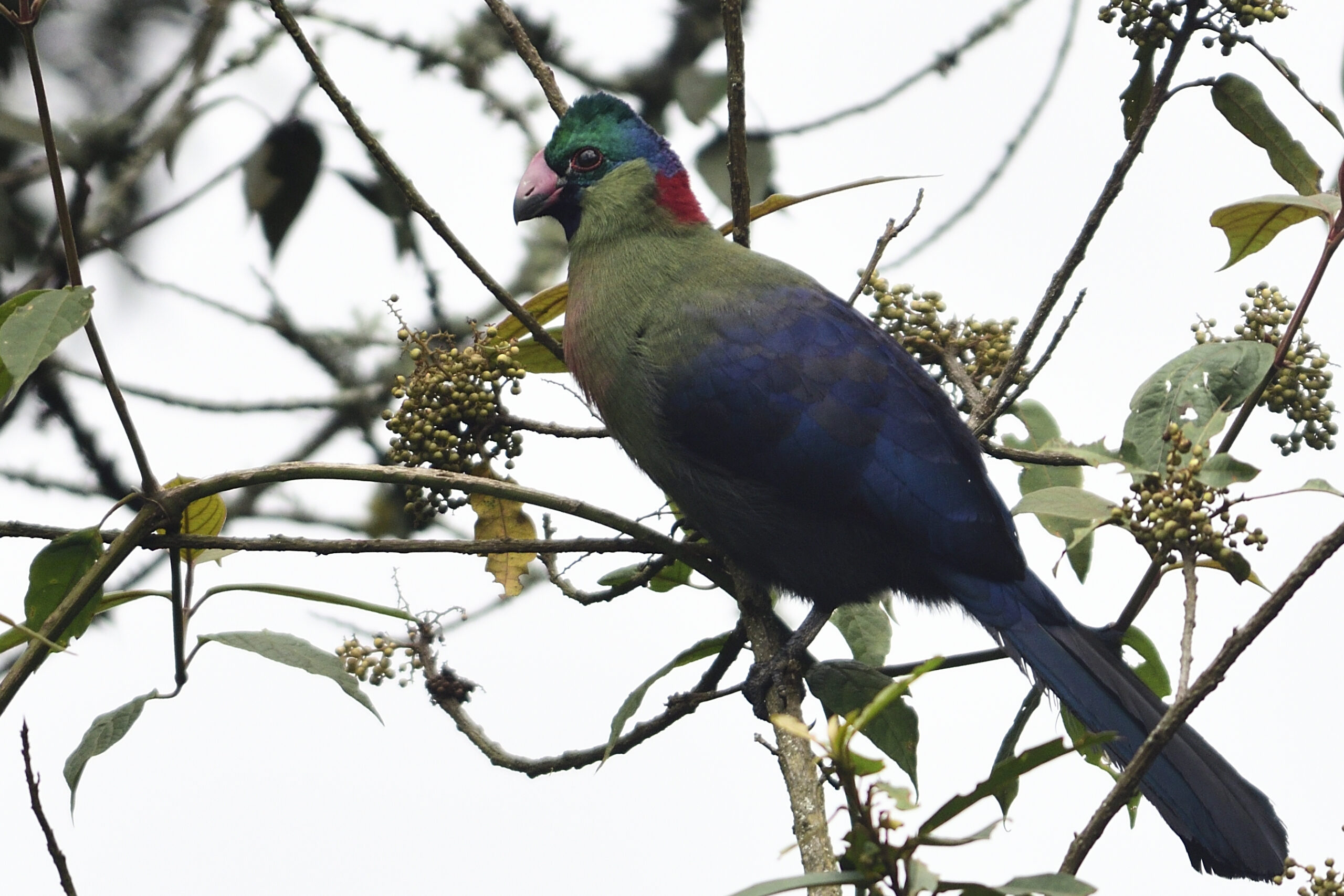
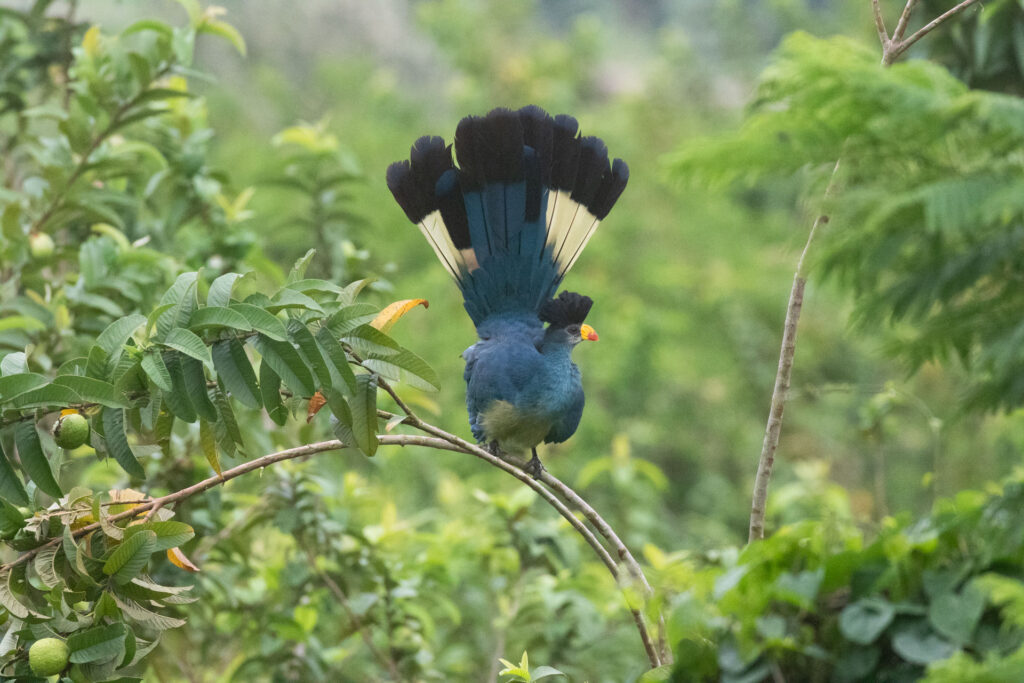
The Rwenzori turaco is a large, heavy-bodied forest bird, measuring roughly 40 to 45 centimetres from bill to tail, built for a life of clambering and short gliding flights through dense mid-canopy vegetation rather than sustained flight in open air. Its base plumage is a deep, glossy bluish-purple across the head, neck, and upperparts, offset by a metallic green crest and mantle that shifts in tone with the angle of the light, from bottle green to near-black depending on whether it is standing in shadow or catching a shaft of equatorial sun through a gap in the canopy. A patch of bare, vivid yellow-orange skin encircles each eye, giving the bird a slightly startled, wide-eyed expression that is oddly endearing at close range. But the feature every trekker remembers, the one that turns a good sighting into an unforgettable one, is what happens when the bird takes flight: its primary flight feathers flash a brilliant, unmistakable crimson red, a burst of colour that seems to appear from nowhere as the bird launches from one tree to the next and vanishes again the instant it lands and folds its wings.
Taxonomy and a Name That Has Changed Three Times
Scientifically, the Rwenzori turaco has had a genuinely unsettled history, and you will encounter all three of its names if you read enough about it. British ornithologist Richard Bowdler Sharpe first described the species in 1901 from a specimen collected on the western slopes of Mount Ruwenzori, initially placing it in the genus Musophaga. It was later moved into its own dedicated genus, Ruwenzorornis, literally “the Rwenzori bird,” a classification that persisted through most of the twentieth century and is still the name you will find in many older field guides and trekking reports, including some published on this very site. More recent molecular taxonomy has folded it into the genus Gallirex alongside the purple-crested turaco of southern and eastern Africa, giving the bird its currently accepted scientific name, Gallirex johnstoni. The species epithet honours Sir Harry Johnston, the British colonial administrator and naturalist whose early expeditions through this region brought back some of the first specimens of Rwenzori wildlife to reach European science. Whichever name you encounter on a checklist, guidebook, or local guide’s field notes, Ruwenzorornis johnstoni, Musophaga johnstoni, or Gallirex johnstoni, they all refer to the same bird.
An Albertine Rift Endemic, Not Just a Rwenzori Endemic
It is worth being precise about the bird’s range, because “Rwenzori turaco” slightly overstates how narrowly it is confined to this one mountain range. The species is endemic to the wider Albertine Rift montane forests, the chain of highland forest habitats that runs along the western branch of Africa’s Great Rift Valley through the Rwenzori, the Virunga volcanoes, and isolated highland pockets in eastern Democratic Republic of Congo. Three recognised subspecies exist across this range: the nominate G. j. johnstoni found here in the Rwenzori and adjacent DRC forest; G. j. kivuensis, found further south around the Virunga region and eastern DRC; and G. j. bredoi, an isolated population on Mount Kabobo near Lake Tanganyika. What this means for a trekker planning a Uganda itinerary is simple and worth understanding before you arrive: this bird is not something you will encounter on a Queen Elizabeth National Park game drive, in Kibale Forest, or on a Bwindi gorilla trek. Within Uganda, a genuinely wild sighting of the Rwenzori turaco effectively means the Rwenzori Mountains themselves, which is exactly what makes finding one here feel less like ticking a checklist entry and more like witnessing something genuinely rare.
The Secret Behind Its Color: Turacin and Turacoverdin
The single most scientifically remarkable thing about the Rwenzori turaco has nothing to do with its behaviour and everything to do with its blood chemistry. Almost every red and green colour you encounter in the bird world is produced one of two ways: by carotenoid pigments absorbed from the diet, as in a flamingo’s pink or a robin’s red breast, or by microscopic structural effects in the feather that scatter light of a particular wavelength, as in the iridescent blue of a peacock or a starling. Turacos, and only turacos, do neither. The crimson in the Rwenzori turaco’s flight feathers is produced by a pigment called turacin, and the green of its crown and mantle by a related pigment called turacoverdin, both of which are copper-based porphyrin compounds found nowhere else in the animal kingdom outside the turaco family, Musophagidae. Turacin is, remarkably, water-soluble, which means that in heavy rain, and the Rwenzori receives a great deal of it, a small amount of red pigment can genuinely wash out of the feather, something that has been documented in captive turacos kept in enclosures with standing water and is a genuine biochemical curiosity unmatched anywhere else in ornithology.
For a trekker standing on the trail with binoculars raised, none of this chemistry is visible directly, but it does explain something practical worth knowing: the crimson wing flash you are hoping to see is not a trick of the light the way most vivid bird colouration is. It is a genuine pigment, present in the feather itself, which is why the colour reads as an intense, almost unnatural red even in the flat, overcast light typical of the Rwenzori’s forest zone, rather than requiring direct sun to “switch on” the way iridescent structural colour often does. It is one of the reasons the Rwenzori turaco photographs so well even on a grey, misty morning, which is, on this mountain, most mornings.
Diet, Behavior, and Life in the Canopy
The Rwenzori turaco is overwhelmingly frugivorous, with research on turaco feeding ecology in East African montane forest finding that fruit makes up over ninety percent of its diet, supplemented by young leaves, shoots, and occasional flowers. It moves through the mid and upper canopy of the montane forest zone in pairs or small family groups, working methodically through fruiting trees rather than foraging widely, which is one of the reasons a guide who knows a currently fruiting fig or podocarpus tree along the trail can often predict turaco activity with real accuracy on a given morning. Its movement style is distinctive once you learn to recognise it: rather than sustained flapping flight, the bird moves through the canopy in a sequence of energetic hops, bounds, and short branch-to-branch runs, punctuated by brief gliding flights between trees during which the crimson wing patches become fully visible. This locomotion style, more athletic scrambling than graceful flying, is a shared trait across the turaco family and is part of why the bird is so much easier to hear moving through foliage than to spot cleanly against the canopy.
As a heavy fruit-eater moving daily through the forest, the Rwenzori turaco also functions as an important seed disperser for the montane tree species it feeds on, carrying seeds away from parent trees and depositing them, with a fertiliser package included, elsewhere in the forest. It is a small but genuine illustration of how the biodiversity that makes the Rwenzori such an extraordinary
UNESCO World Heritage Site is not simply a static inventory of interesting species but an interconnected system, in which this one strikingly coloured bird plays a genuinely functional ecological role in maintaining the forest it inhabits.
Where to See the Rwenzori Turaco on Your Trek
Location matters enormously with this species, and it is the single most common gap in general Uganda wildlife advice, most of which simply lists the Rwenzori turaco as present in the park without telling you which section of which trail actually gives you a realistic chance.
The Best Stretch: Nyakalengija to Nyabitaba
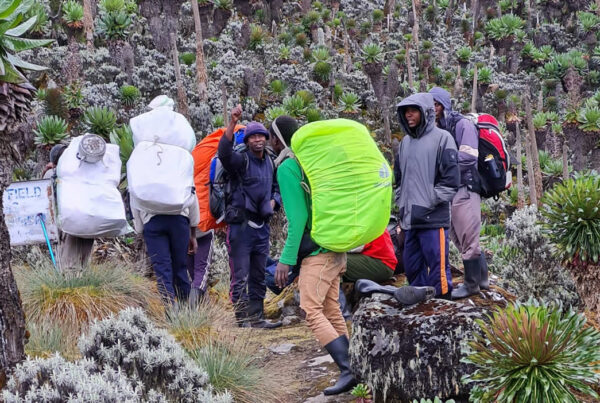
On the Central Circuit Trail, the single most productive stretch for turaco sightings is the lower montane forest section on day one, between the Nyakalengija trailhead and Nyabitaba Hut. This is broadleaf forest at its most intact, with a closed canopy, abundant fruiting trees, and a density of birdlife that thins out noticeably once the trail climbs into the bamboo and heather zones above roughly 2,600 metres. Guides on this route know several reliable fruiting trees along this section that the local turaco pairs return to repeatedly, and it is worth telling your guide directly, before you set out, that a turaco sighting matters to you specifically. A guide walking a group that has not mentioned this priority will often move at a pace geared toward reaching Nyabitaba Hut before the afternoon rain, whereas a guide who knows you want a genuine chance at the bird will slow the pace through exactly this stretch and stop at the right moments to listen.
The Kilembe Trail’s Southern Forest
Trekkers approaching from the south on the Kilembe Trail have an equally strong opportunity in the lower forest section between the Kilembe trailhead and Sine Camp, where the river valley forest along the Nyamwamba is wide, humid, and rich in fruiting canopy trees. The character of this forest differs somewhat from the Central Circuit’s Nyabitaba approach, with more exposed river-edge vegetation and a slightly different mix of understorey species, but turaco activity here is comparably strong, and several guides who work this route report it as at least as reliable as the northern approach, particularly in the early morning hours before the group’s pace and noise level increase for the day’s climb.
Elevation and Vegetation Zone: Why Altitude Matters
The Rwenzori turaco is fundamentally a bird of the lower and middle montane forest zone, roughly between 1,600 and 2,600 metres, and it becomes progressively less likely, then effectively absent, as the trail climbs into bamboo, then heather and moorland, then the afro-alpine zone above. This matters practically for itinerary planning: a trekker on a fast four-day Margherita Peak push who spends only a single rushed morning in the forest zone has a genuinely lower chance of a sighting than a trekker on a longer itinerary, or one who has deliberately built in a slower first day. If a turaco sighting is a genuine priority rather than a pleasant bonus, it is worth discussing directly with our team when planning your trek so your first day can be paced accordingly, and it is one of several reasons trekkers with a serious interest in the mountain’s birdlife often prefer a seven-day Central Circuit itinerary over the compressed four-day option.
When to Go: Timing Your Trek for the Best Sightings
Two separate timing questions matter here, and they operate on entirely different scales: which time of day, and which time of year.

Dawn and the Daily Activity Window
Turaco activity, like most forest bird activity in the Rwenzori, is heavily concentrated in the first two to three hours after dawn, when the forest is coolest, insect and fruit activity is highest, and birds are most vocal while establishing territory and pair contact for the day. Trekkers who begin their first day’s walk at first light rather than mid-morning give themselves a materially better chance, both because the birds are more active and more vocal at that hour, and because the trail itself is quieter, with fewer other groups moving through and disturbing the forest ahead of you. A guide who has walked this stretch for years will typically recommend an early departure from Nyakalengija specifically for this reason, quite apart from the standard logistical reasons for an early mountain start.
September and the Seasonal Activity Peak
Across multiple seasons of guiding this trail, September consistently stands out as the month of most reliable turaco activity, coinciding with a period of increased fruiting in several of the lower forest’s key tree species and falling within the drier transitional window described in our month-by-month Rwenzori trekking guide. This is not to say the bird disappears in other months. It is present and can be seen year-round, and wetter months bring their own compensations in a quieter, mistier forest with fewer other trekking groups on the trail. But a visitor whose primary motivation for the trek is genuinely centred on birding, rather than simply hoping for a lucky encounter, should weigh September heavily when choosing dates, alongside the broader seasonal considerations covered in our guide to the best time to visit the Rwenzori Mountains.
How to Actually Spot One: Field Technique
Knowing where and when is only half the equation. The Rwenzori turaco is a genuinely difficult bird to see well despite its loud call and vivid colouration, precisely because both of those traits evolved for communication within dense foliage rather than visibility to an observer standing below and behind the canopy line. A handful of field techniques make a disproportionate difference to your actual sighting odds.
Listen First, Look Second
The turaco’s call, a loud, resonant, repeated bark that experienced guides can identify from a considerable distance, is your primary detection tool, far more reliable than scanning the canopy on the off chance of spotting movement. The moment you hear it, stop walking completely and stay still. Turacos are shy of sudden movement and will often go silent and motionless themselves if they sense a group approaching quickly, which is precisely why a fast-moving trekking group covers this forest section without ever registering how many birds were actually present just off the trail. Once the group has stopped, the call typically resumes within a minute or two, and its direction and apparent distance will guide where in the canopy to focus your attention.
Reading the Canopy, Not the Ground
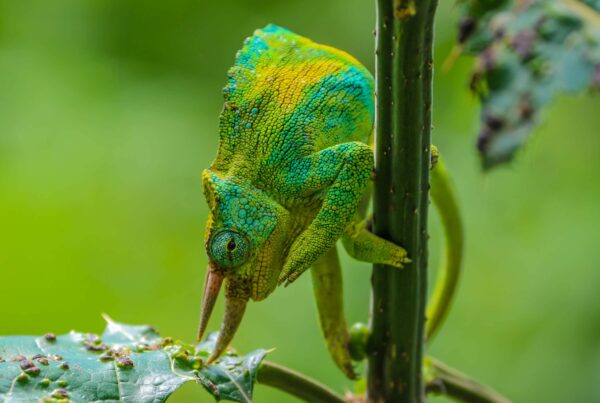
Novice birders instinctively scan at roughly head height and slightly upward, where much of the forest’s smaller, more approachable birdlife is found. The Rwenzori turaco lives and forages almost exclusively in the mid to upper canopy, generally eight to twenty metres above the ground, in the fruiting trees rather than the understorey. Train your eye to work the canopy layer specifically, looking for movement or a flash of that unmistakable crimson against the green, rather than expecting the bird to present itself at a comfortable, close-range height the way some of the forest’s monkeys or the ground-dwelling three-horned chameleon often will.
Patience at Camp Pays Off Too
Sightings are not confined to the trail itself. The forest immediately surrounding Nyabitaba Hut, particularly in the quiet early-morning window before a group sets off for day two, is regularly productive, and trekkers who use a rest day, a short acclimatisation walk, or simply the twenty minutes after breakfast to sit quietly at the camp’s forest edge frequently report better sightings than those who only pass through at trail pace. If a dedicated forest wildlife morning genuinely interests you, our shorter Rwenzori day hike options are also worth considering as a lower-commitment way to spend concentrated time specifically in this productive lower-forest zone.
Photographing the Rwenzori Turaco
Turaco photography presents a genuinely specific set of challenges that differ from most of the Rwenzori’s other photographic subjects, and it is worth preparing for them deliberately rather than hoping a general wildlife photography setup will suffice. The bird is fast-moving, frequently backlit against an overcast canopy, and typically encountered at a working distance and angle that punishes slow autofocus and underpowered lenses. A telephoto in the 300 to 400 millimetre range, or the longer end of a travel zoom, is close to essential; anything shorter and you are photographing a green smudge with an occasional red flash rather than a recognisable bird. Because sightings are often brief, a fast autofocus mode set to continuous tracking, and a willingness to shoot at a higher ISO than you would ordinarily choose given the Rwenzori forest’s typically low, flat light, will produce far better results than a photographer who stops to adjust settings once the bird is already visible. Our full Rwenzori Mountains photography guide covers the broader question of shooting through this mountain’s mud, mist, and shifting light in far more depth, and much of that general advice, particularly around keeping gear dry and accessible rather than buried in a pack, applies directly to giving yourself a real chance at a usable turaco image.
Sharing the Forest: Other Wildlife Along the Same Stretch
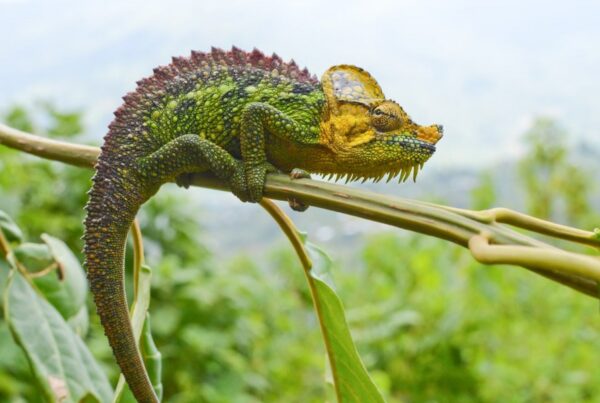
Part of what makes the Nyakalengija-to-Nyabitaba forest section so rewarding is that the Rwenzori turaco is very rarely the only notable species you encounter there. Black-and-white colobus monkeys move through the same canopy layer in noisy, visible troops, their long white tail plumes trailing behind them as they leap between branches, an easier sighting for most trekkers than the more secretive turaco. L’Hoest’s monkeys, generally more ground-oriented and often seen crossing the trail itself rather than staying high in the canopy, are common in this same zone. Closer to eye level and considerably easier to approach for a photograph, the three-horned chameleon is a near-certainty for guides who know where to look along the trailside vegetation, and its slow, deliberate, almost prehistoric movement makes a striking contrast to the turaco’s fast, energetic canopy work. Our complete Rwenzori wildlife guide sets all of this in context across the full elevation range of a trek, from this rich lower forest zone up through the bamboo, heather, and afro-alpine belts where an entirely different community of species, including several of the range’s Albertine Rift endemic birds, takes over.
Conservation Status: A Rare Range, Not (Yet) a Threatened Species
The Rwenzori turaco is currently assessed by the IUCN Red List, via BirdLife International’s most recent global evaluation, as a species of Least Concern, reflecting a population that, while entirely confined to Albertine Rift montane forest and therefore naturally restricted in range, is not currently understood to be experiencing the kind of steep, ongoing decline that would justify a more urgent conservation category. That status should not be mistaken for a suggestion that this bird is common in any ordinary sense: its entire global range consists of scattered highland forest fragments across the Rwenzori, the Virungas, and a handful of isolated DRC forests, and habitat loss at the forest margins from agricultural encroachment remains a long-term pressure on Albertine Rift endemics as a group. The protection afforded by Rwenzori wildlife guide is a genuinely significant part of why the lower forest habitat this species depends on remains intact here, in contrast to unprotected forest fragments elsewhere in the Albertine Rift that have been steadily cleared. Every trekking permit issued for this park contributes directly to the conservation funding that keeps this forest, and the bird that calls through it every morning, standing.
The turaco is, in a very real sense, one among the constellation of attractions that make this range worth the journey. Our broader guide to the attractions of the Rwenzori Mountains places it alongside the range’s glaciers, giant afro-alpine flora, and alpine lakes as one of the defining reasons serious travellers choose this mountain over Africa’s more heavily trafficked peaks.
Frequently Asked Questions About the Rwenzori Turaco
What does the Rwenzori turaco look like?
The Rwenzori turaco is a large forest bird around 40 to 45 centimetres long with glossy bluish-purple plumage across the head, neck, and upperparts, a metallic green crest and mantle, and a patch of bare yellow-orange skin around each eye. Its most distinctive feature is only visible in flight: its primary flight feathers flash a brilliant crimson red, produced by a rare copper-based pigment called turacin that is found only in the turaco family and in no other birds on Earth.
Where exactly can I see a Rwenzori turaco?
The most reliable location is the lower montane forest zone between roughly 1,600 and 2,600 metres elevation, which on the Central Circuit Trail means the stretch between the Nyakalengija trailhead and Nyabitaba Hut, and on the Kilembe Trail means the lower forest between the trailhead and Sine Camp. The bird becomes increasingly scarce and then effectively absent above the montane forest zone, so treks that spend more time at these lower elevations, rather than rushing through toward the higher camps, offer meaningfully better odds.
What is the best time of day and year to spot one?
The first two to three hours after dawn are consistently the most productive window, when the birds are most vocal and active and the forest itself is quietest. Seasonally, September stands out as the month of most reliable activity in our guiding experience, coinciding with peak fruiting in several key forest tree species, though the bird can be seen in any month and is present year-round in its forest habitat.
Is the Rwenzori turaco endangered?
No. The IUCN Red List, via BirdLife International’s assessment, currently classifies the Rwenzori turaco as Least Concern. It is, however, a true Albertine Rift endemic confined to a naturally limited range of highland forest across the Rwenzori, the Virunga region, and a few isolated forest patches in the Democratic Republic of Congo, which means its long-term security depends heavily on continued protection of that habitat, including the protected status of Rwenzori Mountains National Park itself.
Why is its call so loud, and what does it sound like?
The call is a loud, resonant, repeated barking or croaking sound used primarily for territorial announcement and pair contact within dense forest, where visual signalling between mates and neighbouring pairs is often impossible through the foliage. It carries a genuinely surprising distance through the Rwenzori’s damp, closed-canopy forest and is, for most trekkers, the very first indication that a turaco is present nearby, often heard well before, or even instead of, an actual sighting.
Do I need special equipment to see or photograph one?
A pair of binoculars in the 8×42 range makes a substantial difference to your odds of a clean sighting and is genuinely worth the extra pack weight for anyone with a serious interest in the bird. For photography, a telephoto lens of at least 300 millimetres, fast continuous autofocus, and a willingness to shoot at a higher ISO than usual given the forest’s typically flat, overcast light will produce far better results than a standard travel camera setup used at trail pace.
Start Planning Your Rwenzori Trek
A genuine sighting of the Rwenzori turaco is one of those rewards that cannot be manufactured or guaranteed on any mountain, but it can be planned for with real intent, the right pace on the right morning, in the right stretch of forest, with a guide who knows exactly which trees to watch. If spotting this extraordinary bird, alongside the glaciers, giant lobelias, and alpine lakes that make this range unlike anywhere else in Africa, is part of what draws you to the Rwenzori, our guiding team can build that priority directly into your itinerary from day one. Get in touch with our expedition team through our contact page to start planning a Rwenzori trek built around the wildlife, the summits, and the timing that matter most to you.