Meet the Rwenzori three-horned chameleon, Trioceros johnstoni. Where to spot it, its biology, and how to see it on your Rwenzori trek.
What Exactly Is the Rwenzori Three-Horned Chameleon
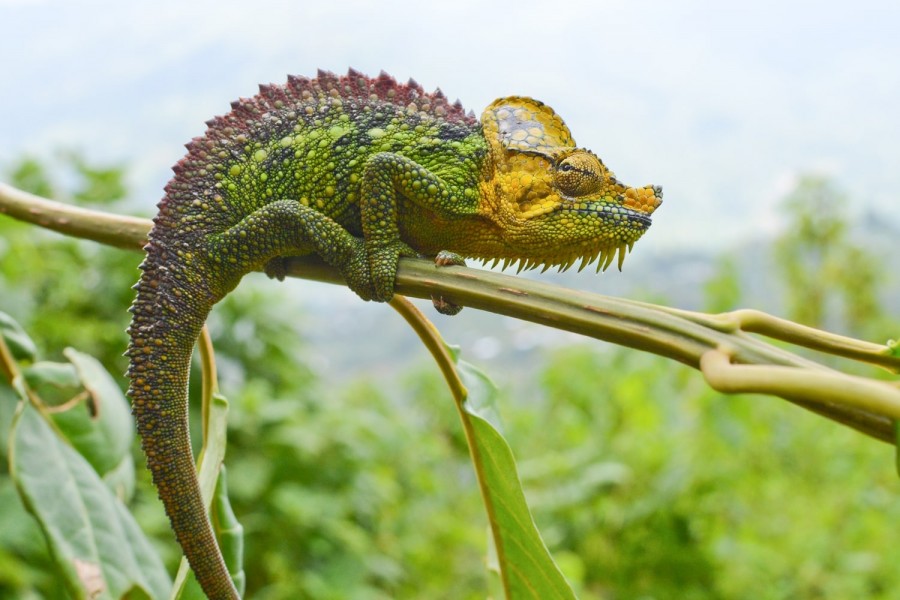
Trioceros johnstoni was first described by the herpetologist George Albert Boulenger in 1901, and its species name honors Sir Harry Johnston, the colonial administrator and naturalist whose expeditions across this part of Africa brought back some of the first specimens of the region’s wildlife to European science. The animal is endemic to the Albertine Rift, the western branch of the Great Rift Valley that runs along the Uganda-DRC border through Rwanda and Burundi, and within that range it occupies forest habitat roughly between 1,000 and 2,500 meters above sea level, which places the classic viewing zone squarely within the lower and middle forest sections of both the Central Circuit Trail and the Kilembe Trail before either route climbs into bamboo and heather. An adult reaches around thirty centimeters in total length including the tail, which makes it a substantial, unmistakable animal rather than something you need to search for on hands and knees, though its natural camouflage means most sightings still come down to a sharp-eyed guide rather than luck. The species belongs to the genus Trioceros, a group of African chameleons whose name literally means three-horned, and while several related species across East and Central Africa share a broadly similar horned appearance, the Rwenzori population has its own distinct coloring, trending toward reds and deep greens that set it apart from related forms found around Bwindi Impenetrable Forest and further south in Rwanda and Burundi.
Only the males carry the three horns
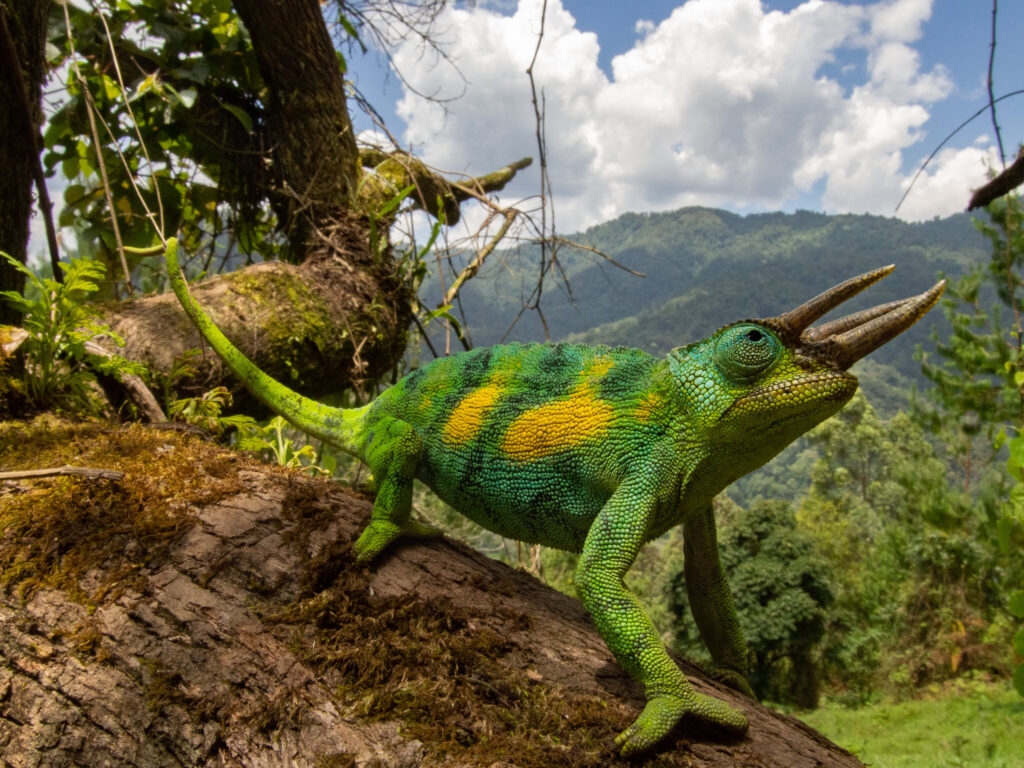
One detail that surprises almost every trekker is that the three horns are an exclusively male feature. Adult male Johnston’s chameleons carry the three long, ringed horns that give the species its common name, positioned above each eye and on the tip of the snout, while females are entirely hornless, identifiable instead by their more subdued but still striking mottled coloring. The horns are not used for hunting, since the chameleon’s extraordinary tongue does all the work of catching prey, but rather for the ritualized combat that occurs between rival males competing for territory and mates, a slow, deliberate pushing contest rather than the violent clashes seen in horned mammals. This sexual dimorphism means that when your guide points out a hornless individual moving through the branches, it is not a juvenile or a different species, it is simply a female of the same striking animal.
Where and When You Are Most Likely to Encounter One
The forest zone is the sighting sweet spot
Both of the mountain’s principal trekking corridors pass directly through prime three-horned chameleon habitat on their opening days. On the Central Circuit Trail, the lower forest between the Nyakalengija trailhead and Nyabitaba Camp is consistently the most productive stretch, a section covered in detail in our guide to the vegetation zones of the Rwenzori Mountains, which explains why this lower montane forest supports the mountain’s richest concentration of animal life in general. On the Kilembe Trail, the equivalent stretch is the approach to Sine Camp, and this short, accessible route is popular enough as a standalone introduction to the mountain that our overview of the attractions of the Rwenzori Mountains specifically highlights the three-horned chameleons, alongside blue monkeys and forest birdlife, as one of the trip’s defining rewards. If chameleon sightings are a genuine priority for you rather than a pleasant bonus, we can build a Rwenzori itinerary around this forest zone specifically, and a short two-day introduction is often the most reliable way to maximize time in exactly the elevation band where the species is most active.
Timing your walk for the best odds
Chameleons are cold-blooded and their activity follows the temperature and light of the forest day closely. The most productive viewing tends to come in the mid-morning hours once the sun has warmed the canopy enough to bring the animals out to bask and feed, and again in the late afternoon before the evening cooling sets in. Early morning departures from the trailhead, which our guides favor in any case for the acclimatization and pacing benefits described in our 16-week training and preparation planning, also happen to put you in the forest zone during one of the better windows for wildlife activity generally. Rain does not stop chameleon sightings entirely, since the Rwenzori’s near-constant moisture is simply part of the environment this species has adapted to, but a spell of direct sun through the canopy noticeably increases how visible and active the animals become, as they, like most reptiles, rely on external warmth to regulate their body temperature.
The Biology That Makes This Animal So Strange
A tongue built like a spring-loaded trap
The three-horned chameleon’s tongue, like that of every chameleon species, is a genuinely remarkable piece of biological engineering. It can extend to a length greater than the animal’s own body in a fraction of a second, propelled by elastic tissue that functions more like a catapult than a muscle, and the sticky, muscular tip closes around insect prey with enough grip to haul it back into the mouth before the target has any chance to react. This is how the species feeds primarily on forest insects, though larger individuals will also take small invertebrates opportunistically.
Watching a feeding strike, on the rare occasion you are lucky enough to witness one in the field, is one of the genuine highlights of forest-zone trekking, a reminder that the Rwenzori’s smaller residents can be every bit as extraordinary as its glaciers and peaks.
Color change is about mood and temperature, not camouflage alone
Contrary to popular belief, chameleons do not change color primarily to match their surroundings. The shifting colors of Trioceros johnstoni are driven mainly by temperature regulation, mood, and social signaling between individuals, with darker tones helping the animal absorb heat on cooler mornings and brighter, more saturated colors appearing during territorial displays or encounters with potential mates. The layered, cellular structure responsible for this color change, involving specialized skin cells that reflect light at different wavelengths depending on how the animal adjusts their spacing, is a piece of biology that continues to fascinate researchers well beyond the chameleon family itself. For trekkers, the practical upshot is that a chameleon’s coloring at any given moment tells you something real about its physical state and the conditions around it, not simply an attempt to disappear into the leaf litter.
Independently swiveling eyes and a grip built for branches
The Rwenzori three-horned chameleon shares the family trait of eyes that move completely independently of one another, each scanning its own hemisphere of the forest for movement, before both eyes lock onto a single target the moment prey or a threat is detected. Its feet, split into opposing bundles of fused toes, function almost like tongs, giving the animal a secure, deliberate grip on branches of almost any diameter, which explains the slow, careful, swaying gait that first draws a trekker’s eye. Every element of this animal’s anatomy, from its horns to its tongue to its grip to its eyes, has been shaped by a life spent moving cautiously through three-dimensional forest canopy rather than across open ground.
An Endemic Species and What That Actually Means for Trekkers
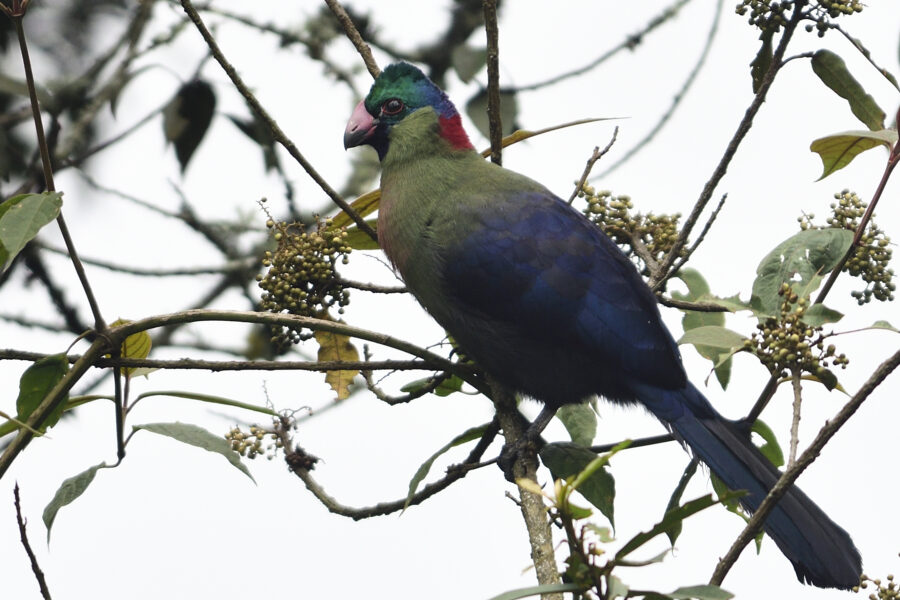
The Rwenzori three-horned chameleon is not found in zoos, roadside markets, or forest patches anywhere outside its narrow Albertine Rift range, and within Uganda specifically it is essentially restricted to the forests of the Rwenzori, Bwindi Impenetrable Forest, and Mgahinga. That endemism is precisely what makes a sighting meaningful rather than incidental. Our full wildlife guide to the Rwenzori Mountains places the three-horned chameleon in context alongside the range’s other Albertine Rift endemics and near-endemics, a list that includes the Rwenzori turaco, the Rwenzori red duiker, and more than a dozen bird species found nowhere else on the planet in meaningful numbers. Our broader piece on incredible Rwenzori facts explains why this single mountain range holds such an outsized share of the Albertine Rift’s endemic species diversity, a consequence of the range’s isolation and its dramatic elevation gradient acting as a kind of biological time capsule through past climatic shifts. For a comprehensive account of what lives at every elevation band you will cross, our overview of what the Rwenzori Mountains National Park actually protects is worth reading before your trek, not least because it clears up the common misconception that this park holds mountain gorillas, which it does not; gorilla trekking is a worthwhile addition through nearby Bwindi or Mgahinga, but the Rwenzori’s own wildlife identity is built around endemics like this chameleon rather than the primates most first-time Uganda visitors expect.
Sharing the Forest: Chameleons Among the Rwenzori’s Other Residents
The three-horned chameleon does not exist in isolation, and part of what makes the lower forest sections of any Rwenzori trek so rewarding is the density of wildlife moving through the same canopy and understory. Black-and-white colobus monkeys move through the upper canopy in vocal, visible troops, while the more secretive L’Hoest’s monkey, a species with particular cultural significance to the local Bakonjo community, tends to stay lower and quieter. Overhead, the unmistakable flash of red wing feathers announces the Rwenzori turaco, one of the most sought-after bird sightings in the entire Albertine Rift and a frequent companion sighting to the chameleon on the same forest mornings. Trekkers ask us often, and reasonably, about the mountain’s larger and more intimidating-sounding residents, and our honest answer, laid out fully in our guide to leopards and other dangerous animals in the Rwenzori, is that the forest is safe territory for trekkers moving with a licensed guide; the Rwenzori leopard exists in very low numbers at higher elevations and is almost never encountered on the standard trekking routes. What you are actually likely to remember from your first forest morning is not danger but abundance, the chameleon rocking along a branch at eye level, monkeys calling overhead, and a turaco flashing red through the mist.
Photographing the Rwenzori Three-Horned Chameleon
Getting a genuinely good photograph of this species takes a little more patience and technique than pointing a phone camera at a branch. Chameleons move deliberately and often freeze the moment they sense a large approaching presence, so the single most effective technique is to let your guide spot the animal first, then approach slowly and quietly from a slight angle rather than head-on, giving the animal time to settle rather than triggering its defensive stillness or retreat deeper into foliage. Our dedicated Rwenzori photography guide covers camera settings and technique for the mountain’s demanding low-light, high-humidity forest conditions in detail, including why continuous autofocus with a wide detection area consistently outperforms single-point focus when a chameleon’s slow swaying motion is combined with the visual clutter of dense branches and leaves. A macro or telephoto lens capable of working at a respectful distance produces far better results, and more ethical ones, than moving in close enough to stress the animal.
Why This Small Animal Matters to the Bigger Rwenzori Story
It would be easy to treat a chameleon sighting as a footnote to the real business of a Rwenzori trek, the long days toward Elena Hut or Margherita Camp and the eventual summit push described in our 6-day Margherita Peak itinerary, but that framing sells the mountain short. Part of what makes the Rwenzori genuinely unlike Kilimanjaro or the volcanic ranges further south, a comparison our guides address directly in is the Rwenzori harder than Kilimanjaro, is precisely this layered biological richness at lower elevation, a forest ecosystem worth experiencing in its own right before the trail ever climbs into bog, moorland, and glacier. Trekkers who arrive expecting only peaks and ice often leave telling us that their first morning encounter with a three-horned chameleon, or their first sight of a colobus troop moving through the canopy, was the moment the trek stopped feeling like a physical challenge and started feeling like an genuine wilderness experience. That first impression, set on Day One in the forest, shapes how every subsequent day on the mountain is remembered.
Frequently Asked Questions About the Rwenzori Three-Horned Chameleon
What is the scientific name of the Rwenzori three-horned chameleon?
The Rwenzori three-horned chameleon’s scientific name is Trioceros johnstoni, commonly known as Johnston’s chameleon. It was first described in 1901 and is endemic to highland forests of the Albertine Rift in Uganda, the Democratic Republic of Congo, Rwanda, and Burundi.
Where on the Rwenzori Mountains can I see a three-horned chameleon?
The species inhabits forest habitat between roughly 1,000 and 2,500 meters above sea level, which corresponds to the lower and middle forest sections of both the Central Circuit Trail, between the Nyakalengija trailhead and Nyabitaba Camp, and the Kilembe Trail, on the approach to Sine Camp. These are the opening days of most Rwenzori itineraries, making chameleon sightings a realistic highlight even on short introductory treks.
Do all three-horned chameleons have horns?
No. Only adult males carry the three long, ringed horns that give the species its common name. Females are hornless and are identified instead by their mottled but still distinctive coloring. The horns are used in slow, ritualized contests between competing males rather than for hunting or defense against predators.
Is the three-horned chameleon dangerous to trekkers?
Not at all. The species is entirely harmless to humans, has no venom or aggressive defense behavior toward people, and its only response to a close approach is typically to freeze, change color, or retreat slowly along a branch. It poses no risk whatsoever to trekkers moving through the forest zone.
Why does the three-horned chameleon change color?
Color change in this species is driven primarily by temperature regulation, mood, and social communication with other chameleons, rather than being a simple camouflage response to surroundings. Darker tones help the animal absorb warmth on cool mornings, while brighter colors often appear during territorial or mating displays.
Is the Rwenzori three-horned chameleon endangered?
Trioceros johnstoni is currently assessed as a species of Least Concern by the IUCN, meaning its population within its Albertine Rift range is not considered at immediate risk, though as with all Albertine Rift endemics, ongoing forest habitat protection within Rwenzori Mountains National Park remains important to its long-term security.