Are there leopards, elephants, or dangerous animals in the Rwenzori? Expert guide to wildlife safety, what you’ll encounter, and what you won’t.
It is one of the first questions that prospective trekkers ask, and it is an entirely reasonable one. You are planning a trek in Africa, a continent whose wildlife reputation is built on images of lions on the savannah, elephants at the waterhole, and the occasional terrifying close encounter that fills a page in someone’s memoir. You are going into a wild mountain range with dense forest, limited visibility, and no fences. And you want to know, honestly, what is actually in there? What might I encounter? Should I be afraid?
The short answer is this: the Rwenzori Mountains are a genuine wilderness with genuine wildlife, and that wildlife deserves the same respect that all wild animals do in their own habitats. But the Rwenzori is not a predator-rich savannah. It is a mountain range, and the animals that live in it have generally evolved to avoid the trails, not to exploit them. In more than a decade of guiding on this mountain, I have never seen an animal injure a trekker. That record is not accidental; it is a consequence of operating with knowledge, respect, and appropriate behavior in the mountain’s environment. This article is your complete, unvarnished guide to the wildlife reality of the Rwenzori: what is there, what you are likely to encounter, what you are unlikely to encounter, and how to behave if you come face-to- face with something unexpected.
🦁 The African Wildlife AssumptionMost first-time visitors to Uganda arrive with a mental image of African wildlife assembled from documentaries filmed on the East African savannah: lions, leopards, elephants, and buffalo roaming in open country. The Rwenzori Mountains are an entirely different ecosystem. The mountain is a dense equatorial forest and high-altitude moorland environment that supports a totally different set of species, with very different behavioral profiles. The big-five framing of African wildlife does not apply here, and understanding this distinction is the foundation for realistic safety planning on the Rwenzori. |
What You Will Not Find on the Rwenzori Trails
Lions: Not Present
Lions do not live in dense equatorial montane forests. They are savannah and open woodland animals, and the Rwenzori’s steep, heavily forested terrain is entirely outside their ecological range. There are no lions anywhere in or near Rwenzori Mountains National Park. This question comes up repeatedly from visitors whose mental map of Africa has not yet differentiated between the open grasslands of the Masai Mara and the cloud forests of the western rift escarpment. They are as different, ecologically, as a Norwegian fjord is from the Sahara. You won’t see a lion on any Rwenzori trek, and no amount of time in the forest will change that.
Rhinoceros: Functionally Absent
Both the black and white rhinoceroses have been effectively eliminated from Uganda through a combination of 20th-century poaching and civil unrest, and any surviving individuals are in highly protected lowland reserves far from the Rwenzori range. There are ongoing conservation efforts to reintroduce rhino to certain protected areas in Uganda, but these do not involve the Rwenzori Mountains National Park. Rhinoceroses are not a wildlife safety consideration on any Rwenzori trek.
Crocodiles: Absent from Mountain Trails
Nile crocodiles are present in the lake systems of the western Albertine Rift, Lake Edward, Lake George, and the lower Kazinga Channel, but they are strictly lowland aquatic animals. The cold, fast-running mountain rivers of the Rwenzori are not crocodile habitat. You will cross rivers on your trek. Some of them are deep enough to wade in. None of them carry crocodile risk. The moment you enter the mountain environment above the park boundary, the crocodile hazard disappears entirely from the safety calculus.
Hippos: Not on Mountain Trek Routes
Hippos are abundant in the lakes and rivers of the western rift valley, and Queen Elizabeth National Park, which borders the Rwenzori range to the northeast, has significant hippo populations in the Kazinga Channel and crater lakes. However, hippos are lowland, water-dependent animals. They do not live at mountain altitudes, and the cold, narrow rivers of the Rwenzori’s forested slopes are not hippo habitat. Hippo encounter is not a risk factor on any Rwenzori trekking route.
Cheetah: Not Present
Cheetahs are open-country sprint predators completely unsuited to dense mountain forest terrain. They do not occur in the Rwenzori range or in any of the surrounding forested escarpment areas. The leopard is another species whose African savanna reputation sometimes creates unwarranted concern among mountain-bound visitors.
✅ The Clear PictureThe large predators and dangerous megafauna that dominate Africa’s wildlife reputation, lions, rhinos, cheetahs, and, to a large extent, hippos and crocodiles, are simply not present on the Rwenzori trekking routes. The mountain’s forest and high-altitude ecosystem do not support these species. This absence is not because the wildlife has been removed. It is because these animals never belonged to this ecosystem in the first place. |
Leopards: Present but Rarely Encountered
The leopard is the one member of Africa’s iconic predators that genuinely does inhabit the Rwenzori Mountains, and it is worth giving it the full, honest account it deserves because both the fear and the dismissal of leopard risk are, in different ways, unhelpful.
African leopards (Panthera pardus pardus) are confirmed residents of the Rwenzori Mountains National Park. They are highly adaptable predators that thrive in montane forest environments precisely because the dense vegetation provides them cover for their ambush-based hunting strategy. Leopards are present throughout the Rwenzori’s forest zone and, less commonly, in the heather and lower afro-alpine zones. The park’s leopard population is not large; estimates are difficult to verify given the animal’s secretive nature, but it is real and resident.
Now here is what all of that means in practical terms for a trekker: almost nothing. Leopards are not harmless; they are powerful, fast, and capable of taking down prey considerably larger than a human. However, they are profoundly secretive animals that go to considerable lengths to avoid contact with humans. In the entire recorded history of Rwenzori trekking as an organized activity, there has not been a single verified case of a leopard attacking a trekker on the mountain. This is not surprising to anyone who knows leopard behavior. They can detect your approach long before you detect theirs, and their default response to a large group of noisy humans is to melt into the vegetation and disappear.
What you are far more likely to encounter than a leopard itself are the signs of leopard activity: pugmarks in the soft mud of the trail, scratch marks on a tree trunk where the animal has sharpened its claws or marked its territory, and occasionally the remains of a kill, a colobus monkey or duiker hauled into a tree fork. These signs are thrilling rather than threatening, evidence of a functioning apex predator in a healthy mountain ecosystem.
The practical precautions for leopard awareness in the Rwenzori are straightforward. Stay on the trails and do not move between camps alone at night without a guide. Avoid nocturnal walks outside the immediate camp area after dark. Make reasonable noise while hiking, not artificially but naturally, through conversation with your group. These behaviors are consistent with exemplary mountain practice in any forest environment and are the standard protocols on all our Rwenzori guided expeditions.
🧭 Leopard Sightings on the RwenzoriIn a decade-plus of guiding on the Rwenzori, I have seen a leopard on the trail exactly twice. Both times, the animal was moving away from us before we had fully registered what we were seeing. What I have seen hundreds of times are the pugmarks in the soft earth of the Mubuku Valley, in the mud of the heather zone, and occasionally overnight on the path right outside a camp hut. The leopard is there. It simply has no interest in meeting you. |
Elephants: Seasonal Presence at the Park Boundary
Forest elephants and a small population of savannah-forest hybrid elephants are present in the broader Rwenzori landscape, but their relationship with the trekking routes is limited and seasonal. The elephant population associated with the Rwenzori area tends to move along the lower park boundaries, particularly in the transition zone between the forest and the agricultural land below, and their presence on the upper mountain and established trekking routes is uncommon.
The more significant elephant concern is at the park entry zone and the lower forest approaches, where elephant damage to vegetation, broken saplings, dung, and tracks is occasionally visible. During dry seasons, elephants may push further up the escarpment in search of water and fresh vegetation, and there have been documented elephant sightings in the lower sections of the forest zone. However, these occurrences do not happen often on the established trail network, and the daily management of the mountain by Uganda Wildlife Authority rangers includes being aware of large mammal movements that might affect trekker safety.
The standard protocol if you encounter an elephant on or near the trail is straightforward and non-negotiable: stop immediately, make no sudden movements, keep quiet, and follow your guide’s instructions precisely. A professional Rwenzori mountain guide will have specific training in large mammal encounter management and will know both the appropriate response and the best retreat route. Never approach an elephant, never position yourself between a cow and her calf, and never attempt to photograph from close range ; these behaviors can turn an uneventful encounter into a dangerous one.
Buffalo: The Animal That Demands the Most Respect
Of all the animals you might potentially encounter in the Rwenzori forest zone, African buffalo (Syncerus caffer) are statistically the most significant safety consideration, not because they are the most commonly seen, but because they are unpredictable and have a tendency, unlike most forest animals, to stand their ground rather than flee. The Rwenzori National Park harbors a buffalo population primarily in the lower forest and transitional zones, and buffalo encounters, while not frequent on established trails, do occur.
Buffalo are not the aggressive animals of myth that charge without provocation. They are, however, large, powerful, and equipped with a stress response that can shift from passive to actively dangerous with limited warning, particularly in low visibility, in dense vegetation where they feel cornered, or when a lone individual has been separated from a herd. A buffalo bull standing in the trail ahead is a situation that requires complete deference: stop, stand still, speak quietly to your guide, and wait for the animal to move on its own terms. Do not move toward it, do not make eye contact, and do not run. This is not the time for documentary-style photography at close range.
The practical reality is that most trekkers on the Rwenzori’s established routes will not encounter buffalo on the trail itself. Buffalo tend to move away from trails when they detect human activity. But the possibility is real enough that every competent Rwenzori guide briefs their group on large mammal encounter protocol before departure, and the presence of an experienced guide who knows the mountain, the seasonal animal movements, and the appropriate responses is the single most important wildlife safety factor on any Rwenzori trek.
⚠️ Buffalo Encounter ProtocolIf you encounter a buffalo on the trail, stop immediately and signal the rest of your group to do the same. Do not run; such behavior can trigger a charge response. Stay calm, stand still, and follow your guide’s instructions. In most cases, the animal will move away within a few minutes. If the guide signals retreat, move backward slowly and quietly. Never shout, never throw objects, and never attempt to move around the animal in the vegetation. |
Chimpanzees and Other Primates: Spectacular but Respected
The eastern chimpanzees of the Rwenzori forest zone are one of the mountain’s most extraordinary wildlife assets, and the possibility of hearing or seeing them on the lower forest trails is genuinely exciting. Chimpanzees live in family groups throughout the montane forest and are most active in the early morning, when their calls, the distinctive pant-hoot that builds from low mumbles to a crescendo of screaming and drumming, can be heard echoing through the forest canopy from considerable distances.
A direct sighting of a Rwenzori chimpanzee is an exceptional experience. They are not habituated to tourists in the way that the chimpanzee populations of Kibale Forest or Budongo Forest have been managed for primate tracking tourism. What you encounter in the Rwenzori is a genuinely wild chimpanzee that may or may not choose to remain in view, and there is nothing orchestrated about the meeting. The animal looks at you. You look at the animal. And then, typically, it moves away quickly and completely into vegetation so dense that it vanishes in seconds.
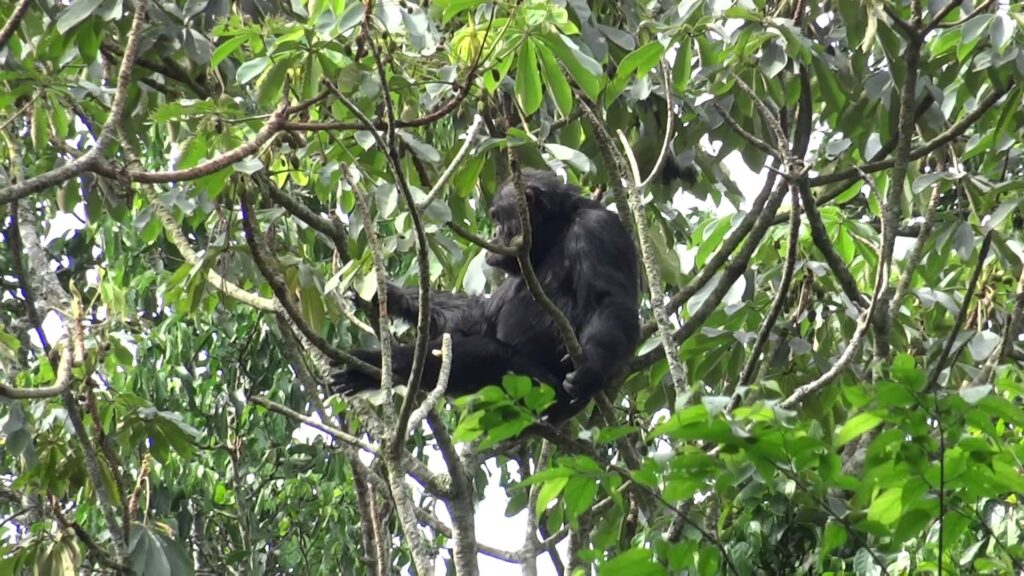
Chimpanzees are not dangerous to trekkers who behave appropriately. Observe at a distance of at least eight to ten metres. Never approach or attempt to feed them; feeding wild chimpanzees is illegal in Uganda and genuinely harmful to the animals. Avoid direct eye contact with an individual chimp, which can be read as a challenge. Do not position yourself between a chimp and its escape route. These simple protocols make encounters with wild chimpanzees safe and memorable rather than stressful.
Black-and-white colobus monkeys are much more commonly seen, and their dramatic white-and-black coloring makes them spectacular sightings in the canopy. They are entirely non-aggressive, moving away from human presence with graceful, arcing leaps that are among the most beautiful movements in the primate world. L’Hoest’s monkeys, blue monkeys, and olive baboons may also be encountered in the lower zones, all of them equally non-threatening to trekkers who do not attempt to feed or approach them.
Giant Forest Hogs, Honey Badgers, and Other Residents.
Giant Forest Hogs
The giant forest hog (Hylochoerus meinertzhageni) is the world’s largest wild pig and a genuine resident of the Rwenzori’s lower forest zone, though trail encounters are uncommon. These animals are large; adult males can reach 275 kg, and their appearance in the forest is striking enough that first encounters can be alarming. However, giant forest hogs are generally not aggressive toward humans unless cornered or surprised at very close range. The standard response to a giant forest hog encounter is to stand still and give the animal room to move away, which it will almost always do without hesitation. They are not territorial in the way that buffalo are, and their primary concern is generally access to food, not confrontation with primates.
The Rwenzori Red Duiker
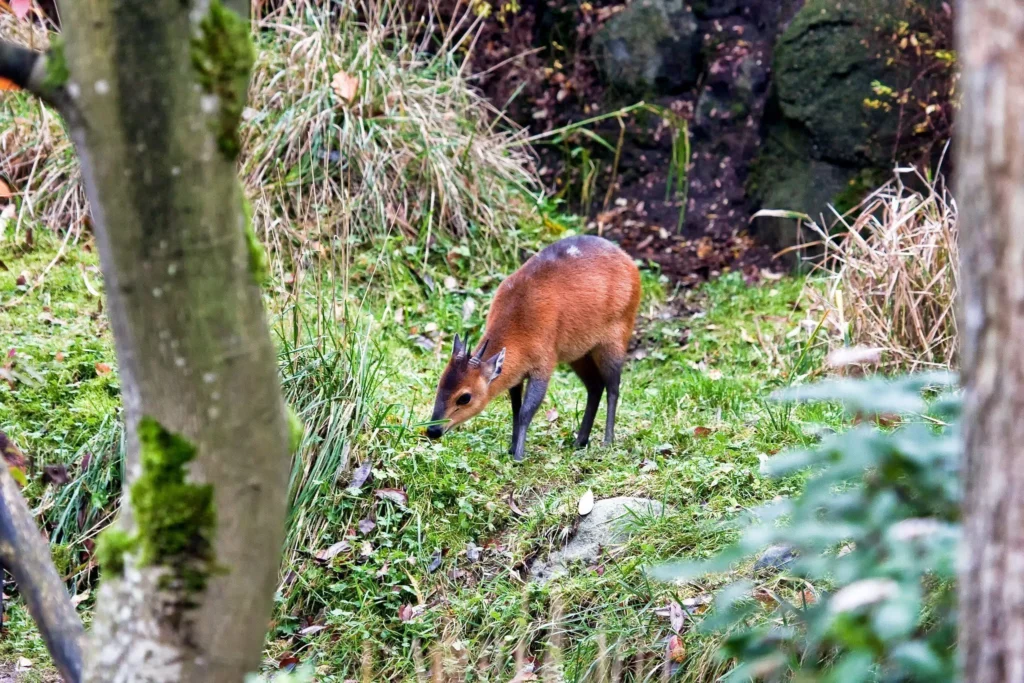
The Rwenzori red duiker (Cephalophus rubidus) is a small, shy antelope endemic to the mountain, most active at dawn and dusk. It is a woodland specialist that moves quickly and silently through the heather and lower afro-alpine zones, and a sighting, typically a brief flash of reddish-brown fur disappearing into the vegetation, is a genuine privilege. The duiker presents absolutely no safety concern to trekkers; it is far more concerned with avoiding detection than with engaging with the large, noisy creatures on the trail. Sightings of this endemic species are one of the specific joys of trekking the heather zone and are a reminder that the Rwenzori’s biodiversity extends far beyond the iconic giant plants.
Honey Badgers
The honey badger (Mellivora capensis) is present in the Rwenzori forest and heather zones and has a formidable reputation, largely justified, for aggression when provoked. Honey badgers are nocturnal and largely solitary, and daytime trail encounters are uncommon. If you do encounter one, give it space and do not attempt to interact with it. A honey badger that feels threatened will defend itself with disproportionate ferocity for its size, but a honey badger that has a clear route away from you will almost always take it. The key is not to surprise someone at close range.
The Tree Hyrax: Alarming Sound, Harmless Animal
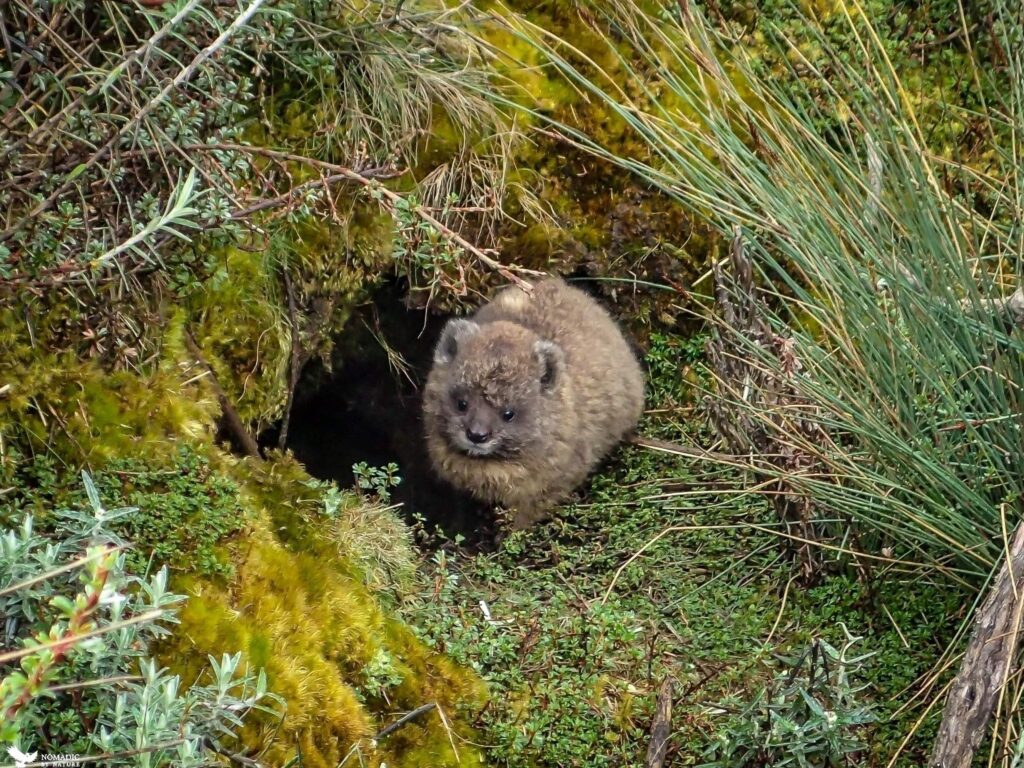
No discussion of Rwenzori wildlife encounters would be complete without addressing the tree hyrax (Dendrohyrax arboreus), not because it is dangerous, but because its nocturnal territorial call is so alarming to first-time visitors that it merits specific preparation. The tree hyrax looks like a large guinea pig with no visible tail. It sounds, at close range and in darkness, like a creature considerably larger, angrier, and more dangerous than that. Its call begins as a series of harsh barks, builds through a crescendo of escalating screams, and ends in a prolonged dying shriek that can genuinely stop a trekker’s heart for a moment if they have not been warned. It is completely harmless. It is also one of the most unforgettable sounds of the Rwenzori night.
🧭 The First Night in CampEvery group I guide has the same experience on their first night at a forest or heather camp. Around 9 or 10 p.m., the tree hyrax starts up in the trees above the hut. Within thirty seconds, at least one tent zip opens, and a head appears looking slightly panicked. I always brief groups about the hyrax beforehand. They always still jump the first time they hear it. There is something about the raw immediacy of a primate alarm call in complete darkness that bypasses rational preparation and goes straight to the nervous system. It is, in my view, one of the finest experiences the mountain offers. |
Snakes, Insects, and Other Small Hazards
Snakes
Venomous snakes are present in the Rwenzori’s forest zone. The Gaboon viper (Bitis gabonica), the largest venomous snake in Africa by body mass, is documented in montane forest habitats across the Albertine Rift, and the forest cobra (Naja melanoleuca) is also found in forest environments of this type. That sounds alarming. In practice, snake encounters on the Rwenzori trails are genuinely rare, for several reasons: snakes in this climate are often sluggish and prefer thermal cover; the trails are well-worn, and snake encounters require a degree of coincidence that simply does not happen frequently; and the great majority of snakes in equatorial African forests are non-venomous and entirely harmless.
The practical precautions are the same as in any forested tropical mountain environment: wear proper ankle-covering boots at all times on the trail, never walk barefoot or in sandals outside camp areas, watch where you place your hands when scrambling over rocks or logs, and do not reach into piles of debris or hollow logs. After dark, use a headlamp for any movement outside the huts and watch your footing. These behaviors are standard practice on any well-run Rwenzori expedition and require no special anxiety, simply consistent attention.
Insects: Low Risk in a Cool Mountain Environment
The Rwenzori Mountains are effectively malaria-free above approximately 2,000 metres, because the consistently cool temperatures at altitude prevent Anopheles mosquito breeding. The lower approaches are the first few kilometers from Kasese to the trailhead, and the overnight stays in town before the trek are in a zone where malaria prophylaxis remains relevant, but once you enter the mountain proper, the risk drops to near zero. This is a significant practical advantage of mountain trekking over lowland or savannah travel in equatorial Africa.
The insect hazard that catches more trekkers off-guard than mosquitoes is the Rwenzori’s biting fly population in the lower forest zones, particularly during the wet season. These are not malaria vectors, but they are persistent and irritating, and a good insect repellent applied to exposed skin is worthwhile for the first day or two of any trek. Above the bamboo zone, insect activity drops dramatically and becomes a non-issue in the colder upper zones.
Stinging nettles (Urera hypselodendron) deserve a mention here because they are present in the heather and bracken zones, and their sting is significantly more painful and longer-lasting than the European nettle most trekkers will be familiar with. Wearing long trousers in the heather zone is advisable partly for warmth and partly for protection from vegetation contact. The nettles are not threatening, but an unexpected sting on an exposed leg mid-climb is an unpleasant experience that is easily avoided.
Rwenzori Wildlife Encounter Reference: What to Expect and How to Behave
The following table summarizes the key wildlife of the Rwenzori Mountains, with practical guidance on encounter likelihood and appropriate behavior. It is a working reference for trekkers preparing their safety awareness, not a substitute for the pre-departure briefing every group receives from their guide.
| Animal | Altitude Zone | Encounter Likelihood | Safety Note |
| Leopard | All zones (rare above forest) | Very rare tracks more likely than sightings | No direct threat; avoid lone night movement |
| Forest elephant | Park boundary / lower forest | Rare on trails; seasonal boundary presence | Give wide berth; do not approach |
| Eastern chimpanzee | Montane forest zone | Heard frequently; seen occasionally | Observe at distance; no approach |
| Black-and-white colobus | Forest & bamboo zone | Common daily sightings typical | None; non-aggressive |
| L’Hoest’s monkey | Forest zone | Regular on most treks | None; avoids humans |
| Buffalo | Forest edges / lower slopes | Occasional, mainly near park boundary | Never approach; it’s the highest risk in an encounter. |
| Rwenzori red duiker | Forest to heather zone | Occasionally, often at dawn/dusk | None small, shy antelope |
| Hippo | Not on mountain trails | Absent from trek routes | N/A on mountain |
| Honey badger | Forest to moorland | Uncommon; nocturnal | Avoid provoking it; it’s powerful for its size |
| African wild pig | Forest edge | Occasional | Give space; can be aggressive if cornered |
| Tree hyrax | Forest to heather | Heard nightly; rarely seen | None sounds alarming; it is harmless |
| Giant forest hog | Lower forest | Rare on trails | Stand still; they almost always move away |
| Rwenzori turaco | Forest zone | Common and conspicuous | A non-spectacular bird |
| Venomous snakes | Forest zone | Rare encounters on trail; watch footing | Watch where you step; avoid nocturnal barefoot walks |
The Real Wildlife Safety Framework on the Rwenzori
Professional Guiding Is Your Primary Safety Layer
The single most important wildlife safety factor on any Rwenzori trek is having a professional, experienced guide who knows the mountain’s animal population, seasonal movement patterns, and encounter protocols. Every trek with Rwenzori Trekking Safaris is guided by trained professionals whose knowledge of the mountain includes not just the trails and camps but also the wildlife ecology of every zone. Your guide’s briefing on wildlife before the first day of trekking is not a formality; it is substantive, specific, and based on current knowledge of what has been seen recently in the areas you will pass through.
Behaviour on the Trail
The behaviors that make you safe in the Rwenzori’s wildlife environment are the same behaviors that make you a good mountain trekker: stay on established trails, maintain group cohesion, make natural noise while moving (conversation is ideal), never leave camp alone at night without your guide, and give all wildlife generous space and your complete respectful attention when encountered. The mountain’s animals have been managing human presence on these trails for decades. They have established patterns of avoidance and coexistence that work well as long as trekkers respect the basic protocols.
Our guide to safety on the Rwenzori Mountains covers the complete safety picture, not just wildlife but also weather, altitude, trail conditions, and emergency procedures. Reading it before your trek gives you the full context for the specific wildlife guidance in this article.
The Bigger Safety Picture
It is worth being explicit about where wildlife ranks in the actual risk hierarchy for Rwenzori trekkers, because the fear it generates is often disproportionate to its real significance. In practice, the safety challenges that affect the highest number of Rwenzori trekkers are altitude sickness, hypothermia, and trail-related injuries from the wet, technical terrain, not animal encounters. The wildlife is real. It is wild. It deserves respect. And it is, in the objective assessment of risk, considerably less likely to affect your trek than the cold, the rain, or the altitude.
Our complete medical guide to trekking the Rwenzori covers altitude sickness, hypothermia, trench foot, and the other health risks in detail. These are the areas of safety preparation that will most concretely protect your trek, and they deserve at least as much attention as the question of what wildlife lives on the mountain.
✅ The Honest SummaryThe Rwenzori Mountains are a genuine African wilderness, and genuine wilderness involves real animals behaving in real ways. But the mountain is not a dangerous safari environment, and trekkers who have prepared properly, are guided professionally, and follow reasonable behavioral protocols face no meaningful wildlife threat on any of the established routes. The animals of the Rwenzori are one of its greatest assets. The leopard in the forest. The chimpanzees are calling at dawn. The duiker in the heather. These are not hazards. They are reasons to be here. |
Frequently Asked Questions: Dangerous Animals in the Rwenzori
❓ Are there lions or dangerous predators on the Rwenzori trekking routes?No. Lions are savannah and open-woodland animals that do not inhabit dense mountain forest environments, and they are not present in Rwenzori Mountains National Park or on any Rwenzori trekking route. The large-predator species associated with African wildlife documentaries, lions, cheetahs, and wild dogs, are simply not part of the Rwenzori ecosystem. The one significant predator that does live in the Rwenzori is the leopard, which is a genuine resident of the forest zone but is extremely secretive and has no recorded history of attacking trekkers in the park. Cheetahs and wild dogs also do not occur in the Rwenzori, which is montane forest habitat entirely outside their ecological range. |
❓ Are there elephants in the Rwenzori Mountains?Forest elephants and hybrid elephant populations are present in the broader Rwenzori landscape, primarily in the lower forest and park boundary zones. They occasionally move into the lower sections of the forest zone, particularly during dry seasons when food and water resources push them up the escarpment. However, elephant encounters on the established trekking trails are uncommon, and the Uganda Wildlife Authority rangers monitor large mammal movements in the park as part of their routine management. Trekkers in the lower forest zone should be aware of the possibility and know the standard protocol: stop, be quiet, follow your guide’s instructions, and give the animal space and time to move away. Your guide will have specific knowledge of any recent elephant activity in the areas you are passing through. |
❓ Can I encounter a leopard on the Rwenzori trail?Leopards are confirmed residents of Rwenzori Mountains National Park and are present throughout the forest zone. However, a direct trail encounter with a leopard is genuinely rare in over a decade of guiding on the mountain, most professional Rwenzori guides have seen a leopard on the trail only a handful of times. Leopards are deeply secretive animals that detect human presence long before humans detect them and choose avoidance almost universally. What trekkers are far more likely to encounter are pugmarks in the mud, claw marks on trees, or occasionally the remains of a kill. There is no recorded case of a leopard attacking a trekker on the established Rwenzori routes. Practical precautions include not walking between camps alone at night and following standard group-movement protocols that your guide will brief you on before the trek. |
❓ Is it safe to trek through the forest at night on the Rwenzori?Night movement between camps is not a standard part of any Rwenzori itinerary; trekkers arrive at each camp before dark. The general protocol is that no trekker should move between camps or away from the immediate camp area alone at night without their guide. This protocol exists for several reasons: the terrain is technically challenging in darkness, the trail is often wet and slippery, and the forest is home to nocturnal wildlife, including leopards and honey badgers. Movement within the immediate camp area for necessary purposes, like toilet trips or checking equipment, is generally fine with a headlamp. Full night treks outside the camp perimeter should always involve your guide. This is standard mountain safety practice, not a response to a specific high-probability wildlife threat. |
❓ Are there crocodiles or hippos in the rivers on the Rwenzori trek?No. The rivers you will cross during a Rwenzori trek are cold, fast-running mountain streams and rivers completely unsuitable habitats for crocodiles or hippos. Both species require warm, slow-moving or static water bodies (lakes, lowland rivers, and marshes) that do not exist on the mountain. Crocodiles and hippos are abundant in the lakes and river systems of the Albertine Rift Valley lowlands, Lake Edward, Lake George, and the Kazinga Channel, but these are a different ecosystem entirely from the mountain you will be trekking. The rivers of the Rwenzori are crossed safely throughout every trekking itinerary, and river crossings are a standard and unremarkable part of the experience. |
❓ What insects should I be aware of on the Rwenzori?The Rwenzori Mountains are effectively malaria-free above approximately 2,000 metres due to the cool temperatures that prevent Anopheles mosquito breeding. Malaria prophylaxis remains advisable for the approach zone around Kasese at lower altitudes, but on the mountain trails above the forest base, mosquito risk is minimal to absent. The more relevant insects are biting flies in the lower forest zones during the wet season; a good insect repellent handles this adequately. Stinging nettles (Urera hypselodendron) in the heather zone cause a significant and long-lasting sting, making long trousers advisable in that zone. Above the heather zone, insect activity drops dramatically and becomes largely irrelevant as a comfort factor. |
❓ What is the biggest real safety risk on the Rwenzori, if not wildlife?In honest terms, the primary safety risks on a Rwenzori trek are altitude sickness (Acute Mountain Sickness, or AMS), hypothermia from cold and wet conditions, and trail injuries from the technical, boggy terrain. These three factors account for the great majority of incidents that affect Rwenzori trekkers, while wildlife-related incidents remain extremely rare. Trekkers preparing for the mountain should invest substantial attention in understanding altitude acclimatization, appropriate cold-weather gear, and the signs and treatment of AMS. A professional guide with specific Rwenzori experience is the most important single safety measure for all three of these risks, as well as for wildlife awareness. The wildlife of the Rwenzori is genuinely extraordinary; it is one of the mountain’s greatest gifts to the trekker. Approaching it with respect rather than fear and with the right guide transforms it from a worry into a wonder. |
The Wildlife Is a Reason to Come, Not a Reason to Hesitate
Chimpanzees in the forest canopy. A leopard’s pugmarks in the early-morning mud on the trail. A Rwenzori turaco blazing crimson and green through the trees. The eerie scream of a tree hyrax in the dark. These are the wildlife experiences of the Rwenzori Mountains, not threats but encounters with a living ecosystem that very few people in the world will ever have the privilege of entering.
Rwenzori Trekking Safaris guides every expedition with professional wildlife awareness built into every stage of the experience. Our guides know the mountain, its animals, its seasonal patterns, and how to manage any situation that arises with calm expertise. The mountain is safe. The wildlife is extraordinary. And the experience is unlike anything else available in Africa.