What does the Rwenzori actually look like? Giant alien plants, glaciers, mist-soaked forests, and summit views are all part of the experience. This is a vivid guide to what you’ll see on the mountain.
There is a moment that happens to almost every trekker on their first day in the Rwenzori Mountains, a moment that no photograph fully prepares you for, no travel article adequately describes, and no conversation with a returned trekker quite captures. It usually happens somewhere between the forest edge and the first bamboo stands, when the scale and strangeness of this place settle over you like the cloud itself, and you suddenly understand with clarity that you are somewhere genuinely unlike anywhere you have ever been.
The Rwenzori Mountains do not look like what most people expect from an African mountain. There is no sun-blasted volcanic cone rising from a yellow plain. The horizon lacks a single iconic silhouette, and no view has been reproduced on ten thousand postcards. What there is instead is a vast, green, mist-soaked world of staggering complexity, a place where the vegetation changes so dramatically from one altitude band to the next that walking from the trailhead to the summit is like traveling through half a dozen entirely different ecosystems, each stranger and more beautiful than the last. Where the weather is so mercurial that the mountain can be simultaneously sunny and storming, invisible and breathtakingly revealed. Where plants have evolved into forms so outlandish that the first European botanists who encountered them struggled to believe their descriptions.
This article is a vivid, detailed account of what the Rwenzori actually looks like, what your eyes will take in, what your body will feel, what the air will smell like, and what sounds will accompany you from the trailhead to the glacier. It is written from thousands of hours spent on this mountain, in every season, and at every altitude. Read it, and then close your eyes and try to imagine it. Then come and discover that even this account does not fully do it justice.
| The Rwenzori is not a mountain you understand from a distance. You have to go inside it. And when you do, it changes something in you that doesn’t change back. |
Your First View: The Mountain That Hides Itself
Before you see the Rwenzori, you will probably hear it: a low, continuous roar of rivers in the forest below the escarpment, the sound of a mountain that receives more than 3,000 millimeters of rain per year channeled through a thousand watercourses. You will arrive at Kasese or at the trailhead in warm equatorial heat, looking west towards a wall of forest so dense and steep that it seems to rise straight out of the savannah without warning. And then, above the forest, if you are very lucky and the day is clear, you will catch your first glimpse of the upper mountain: a pale, grey-white mass hanging in the sky so high above the forest that it appears to belong to a different atmosphere altogether.
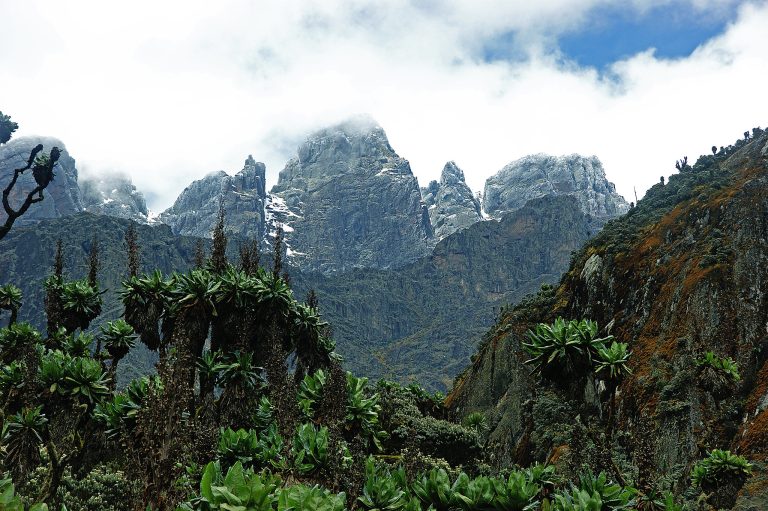
Luck is the key factor. The Rwenzori is one of the cloudiest mountain ranges in the world. Its peaks are shrouded in cloud for most of the daylight hours on most days of the year, a consequence of the range’s position at the intersection of multiple air mass systems that move across the Congo Basin and the Albertine Rift. Many trekkers complete an entire trek without seeing the upper mountain clearly from the valley below. This is not a disappointment; it is part of the mountain’s character. The Rwenzori reveals itself slowly, reluctantly, on its terms. When it clears even briefly, the glaciated summits of Mount Stanley hanging above the cloud layer in the early morning light create one of the most extraordinary natural spectacles in Africa.
The approach from Kasese takes you through the communities of the western escarpment, past small farms carved into the hillside, and eventually into the buffer zone of Rwenzori Mountains National Park, where the cultivated land yields way abruptly to the mountain’s own vegetation. That transition from farmland to primary forest happens with a suddenness that feels almost theatrical. One moment you are walking past banana plants and cassava fields. The next, the canopy closes over you, and you are in another world.
🧭 Guide’s PerspectiveI have started treks on the Rwenzori in brilliant sunshine, in blinding rain, in pre-dawn darkness with only headlamps, and in a thick mist that reduced visibility to five metres. Each entrance to the mountain is entirely different. But the feeling, that slight shift in the air, the coolness, the smell of wet earth and ancient vegetation is always the same. You are entering something that has been here for millions of years, and it knows it. |
Zone One: The Montane Forest Where the Journey Begins
ZONE 1: MONTANE FORESTAltitude: 1,600 – 2,500 metres | Colour palette: fifty shades of green | Sound: roaring rivers, hornbills, colobus alarm calls |
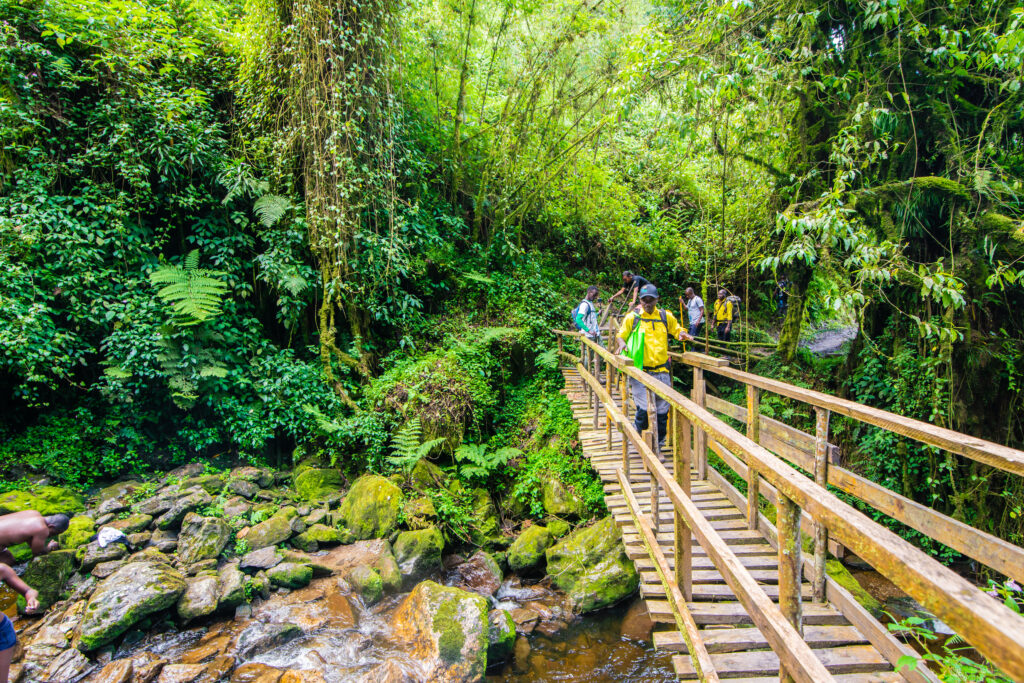
The montane forest zone of the Rwenzori is a world of almost overwhelming greenness. Every surface, every trunk, every branch, and every rock is covered in moss, which is itself covered in fern, and the fern is draped in lichen. The whole layered system is perpetually dripping with moisture, even when it is not actively raining. The light that penetrates the forest canopy arrives filtered and diffuse, giving everything a green-gold quality that is deeply calming and slightly otherworldly at the same time.
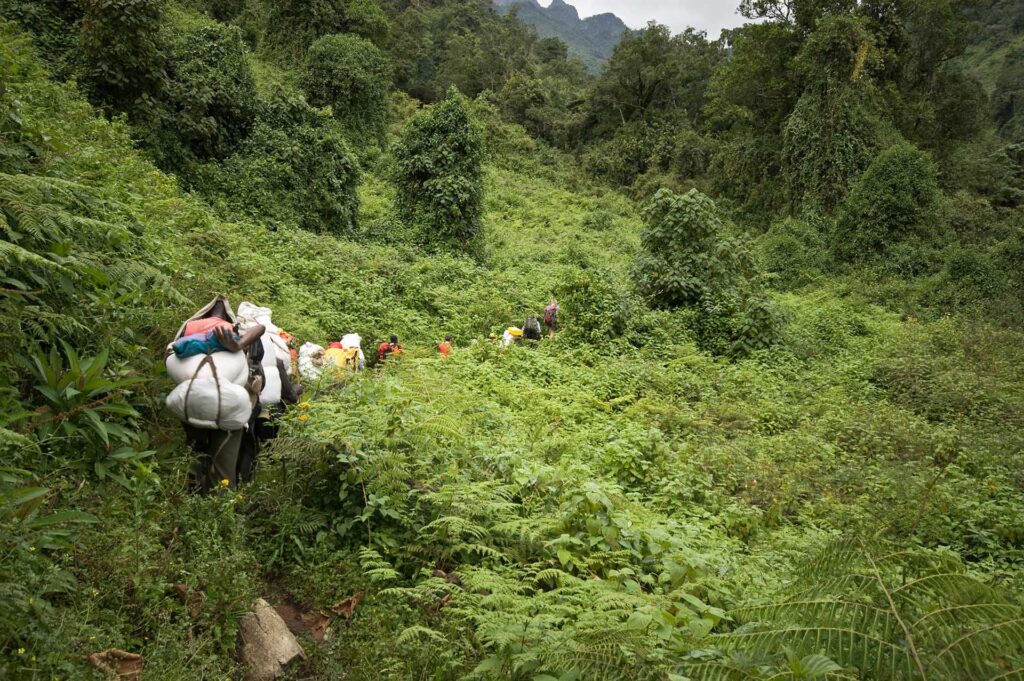
The trees of the lower Rwenzori forest are not the towering smooth-barked giants of the Congo lowlands. They are gnarled, heavily buttressed, moss-heavy veterans that have been growing in this specific place for centuries, their trunks twisted by the relentless competition for light in a forest where every square centimeter of space is occupied. Afrocrania volkensii, Symphonia globulifera, and Podocarpus species dominate, their crowns interlocking to form a canopy that you will rarely see clearly because the undergrowth is so thick. The path pushes through it like a green tunnel, and the sounds of the savannah world below engine noise, bird calls of open country, and human activity disappear within the first few hundred metres.
The smells of the lower forest are layered and complex: the sharp, mineral scent of wet rock; the rich, sweet decomposition of leaf litter; the faintly antiseptic tang of certain mosses; and occasionally, drifting through the trees, the extraordinary musky sweetness of a wild flower in a gap in the canopy overhead. These are not scents you will discover in a bottle. They are the smell of a place that has been building its own fragrance for millions of years without any human input.
In the lower forest, the wildlife of the Rwenzori is heard more often than seen. Eastern chimpanzees live in these forests, and the sound of them the hooting, the branch crashing, the occasional distant scream of a dominance dispute is one of the most viscerally exciting sounds in nature, arriving without warning from deep in the trees. Black-and-white colobus monkeys are more frequently visible, their long white mantles flashing in the canopy as they move with impossibly elegant leaps between branches. The Rwenzori turaco, with its crimson wing patches and green-and-red crest, announces itself with a loud, harsh call before appearing at close range if you are still enough and patient enough.
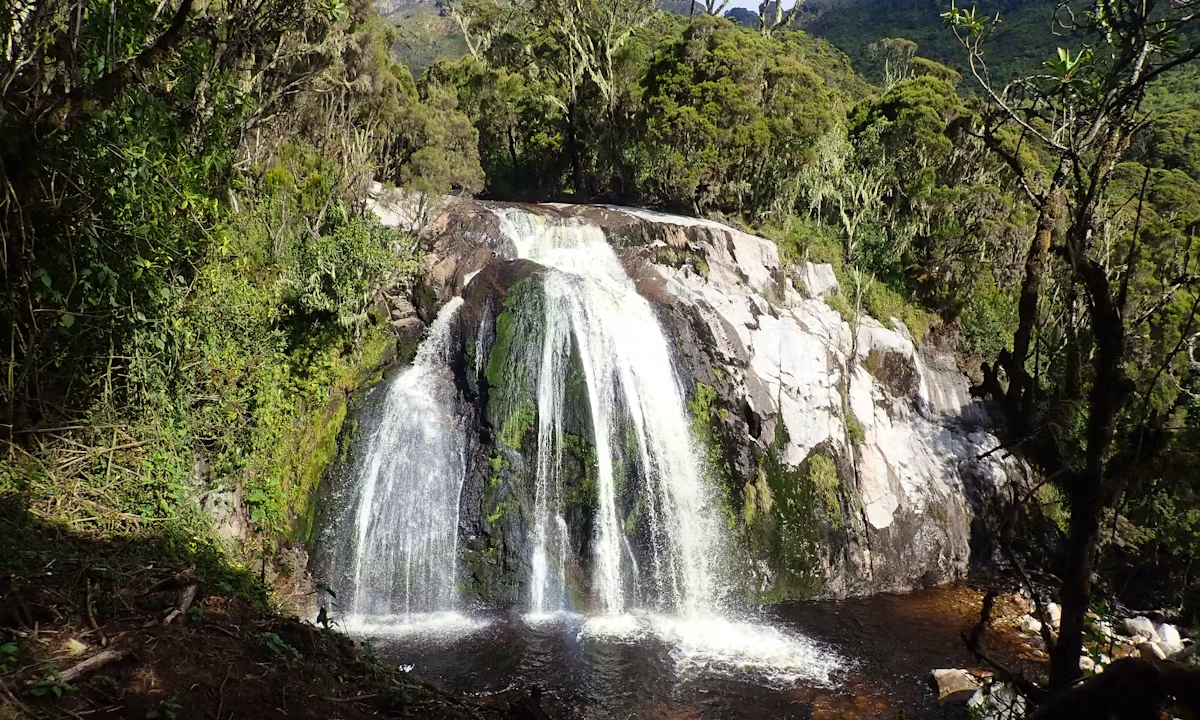
The rivers of the lower forest are one of its defining aesthetic features. They are powerful, clear, cold, and loud far louder than rivers of comparable size in flat country, because every meter of descent on the Rwenzori concentrates energy. You will cross them on log bridges, stepping stones, and in some places simply by wading, and the shock of the cold water on overheated feet is one of the uncomplicated pleasures of the early trekking days. The pools beneath the falls glow a deep, clear green-blue where the light catches them.
| In the forest, the mountain speaks in water. It is always present, dripping, rushing, pooling, and misting. You stop hearing individual rivers and start hearing the mountain breathing. |
Zone Two: The Bamboo Zone, A Forest Within a Forest
ZONE 2: BAMBOO ZONEAltitude: 2,500 – 3,000 metres | Colour palette: jade green, dark olive, filtered silver light | Sound: hollow creaking, wind in canes |
As you gain altitude above 2,500 metres, the nature of the forest changes. The broad-leaved montane trees thin and yield to stands of mountain bamboo, Arundinaria alpina, so dense and tall that they form a second forest structure above the ground-level vegetation. Bamboo on the Rwenzori grows to heights of eight to twelve metres, its stems as thick as a child’s wrist, its canopy forming a light-filtering lattice of overlapping leaves that provides the zone a distinctive quality of illumination: cool, green, and slightly cathedral-like.
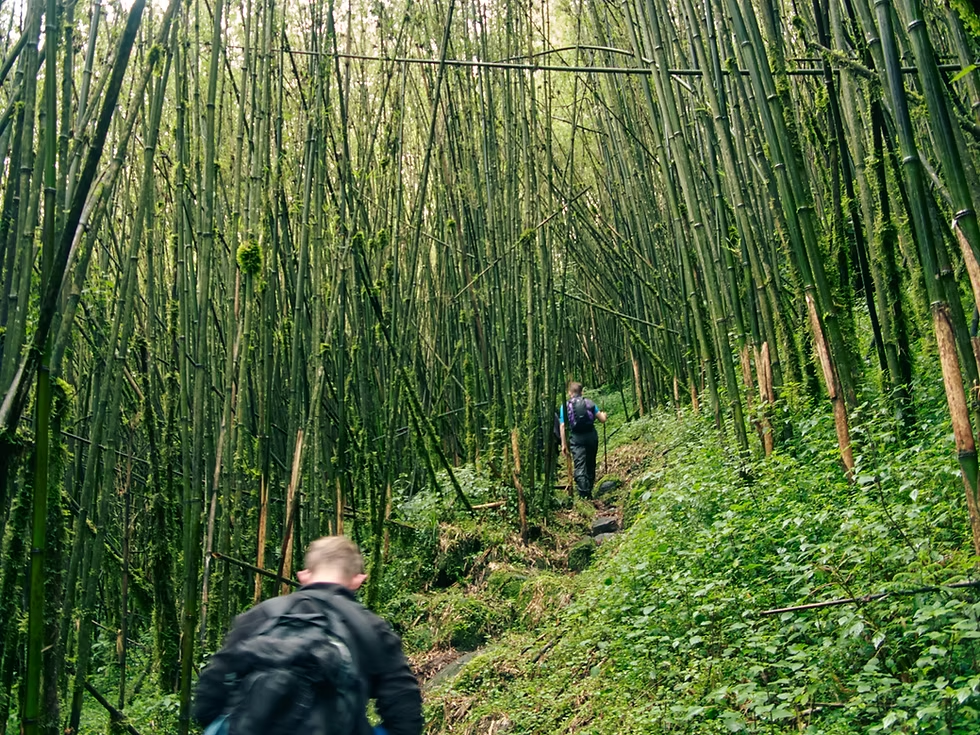
Walking through the bamboo zone is acoustically unlike anything else on the mountain. The stems creak and knock against each other in the wind with a sound that is somewhere between a ship’s rigging and a percussion instrument’s. When the wind drops, the silence is profound; the dense cane walls absorb sound the way a recording studio absorbs sound, and you can become yourself aware of your breathing and footsteps in a way that the noisier forest below does not allow. And then the wind returns and the whole bamboo forest comes alive again, swaying and creaking, filtering the light in waves.
The ground under the bamboo is carpeted in dead cane stems that have fallen and decomposed into a springy, ankle-deep mat of organic material. In the wet season, this mat absorbs water like a sponge and then releases it slowly, keeping the path through the bamboo zone perpetually soft underfoot somewhere between a bog and solid ground. This is the beginning of the Rwenzori’s famous mud, which will be your companion from this zone upward. The mud of the Rwenzori deserves its own description, and we will provide it, but know that in the bamboo zone it is still manageable, a minor inconvenience rather than an obstacle.
The birdlife in the bamboo zone is excellent and quite different from the forest below. Olive sunbirds, Rwenzori double-collared sunbirds, and the extraordinarily handsome francolin move through the cane at eye level, close enough to photograph if you are still. At dusk, the tree hyrax, a small, furry mammal that sounds nothing like what it looks like, emits its extraordinary territorial call: a series of escalating screams that echo through the bamboo and sound, to the unprepared ear, like something considerably larger and more alarming than a hyrax. The first time you hear it at 2,700 metres in the dark, it is genuinely startling. The second time, it is one of the defining sounds of the mountain.
Zone Three: The Heather and Bracken Zone Where the Mountain Opens Up
ZONE 3: HEATHER & BRACKEN ZONEAltitude: 3,000 – 3,500 metres | Colour palette: silver-grey, burnt orange, muted gold | Sound: wind, distance, your own heartbeat |
Above the bamboo, the forest opens. For the first time on the ascent, you may see the sky, a real sky, not forest canopy filtered by leaves and bamboo, and the sudden expansion of the visual field is genuinely disorienting after days in enclosed greenery. The heather zone of the Rwenzori is dominated by Erica arborea, the tree heather, which can grow to heights of six metres or more, with its branches and trunks completely encased in thick grey-green moss and lichen. These heather trees do not look like the low-scrub heather of European moorlands. They are gnarled, stooped, moss-heavy columns that line the path on both sides, their crowns often touching overhead to form a low arch that you duck through.
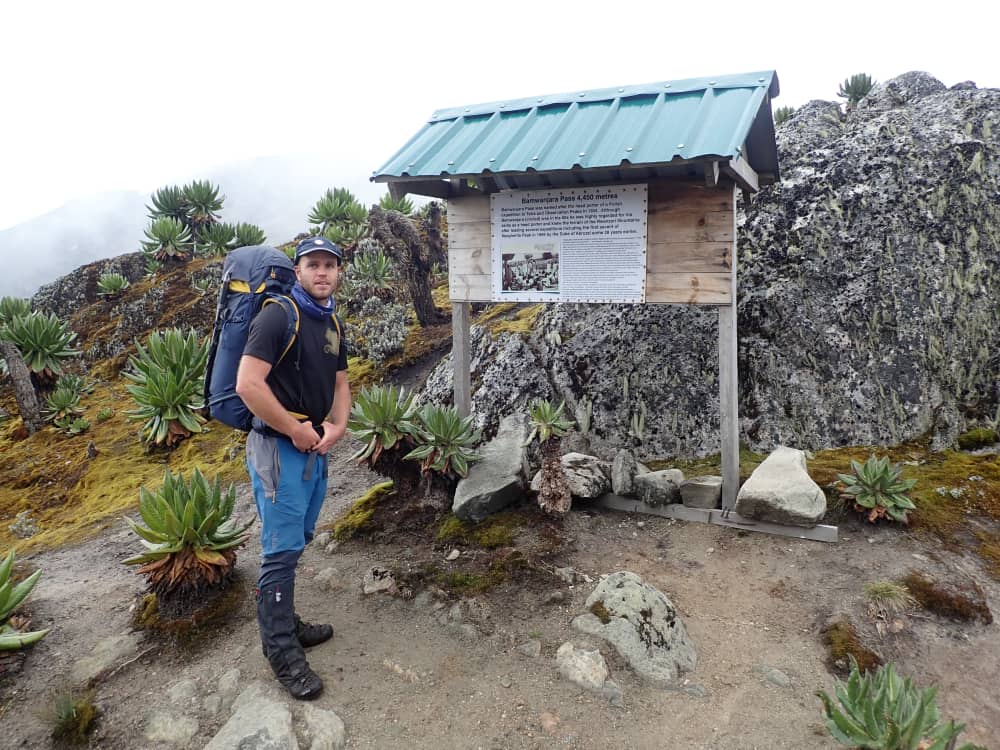
The quality of light in the heather zone is different from the forest below: colder, clearer, and more silver than gold. When the sun breaks through, which it does more readily here than lower down because you are often above the first cloud layer, the wet moss on the heather trunks catches the light and turns the whole landscape briefly radiant, every surface glittering. When the cloud closes in, which it does with extraordinary speed, the same landscape becomes monochrome and slightly spectral, the heather forms emerging from the white mist like the ruins of something.
Bracken ferns grow thickly between the heather stands, sometimes head-height, and the path through them is often narrow and wet. The ground here is increasingly boggy, and the Rwenzori’s famous terrain begins to assert itself: narrow log bridges over muddy depressions, stepping stones across saturated peat, and sections of path that are essentially submerged. This is not a disaster. It is the mountain’s normal operating condition, and with proper footwear, it is entirely manageable. But it does require attention and acceptance. The Rwenzori rewards trekkers who make peace with being wet.
At the upper reaches of the heather zone, the vegetation thins and the landscape begins to take on an open, moorland quality. You can see your objective for the first time, not just the immediate next ridge but the actual shape of the high mountain, distant and formidable, its summit zone still hidden in cloud. This is the moment when the scale of your attempt becomes viscerally real, and the gap between where you are and where you are going acquires physical weight.
🧭 Guide’s PerspectiveThe heather zone is where I watch trekkers mentally recalibrate. The forest was extraordinary but enclosed; you could not see how far you had come or how far you had to go. The heather opens everything up at once. It energizes some people. Some are momentarily daunted. Both responses are completely rational. The mountain is large. The air is thinner than they expected. The bog is real. And it is magnificent. |
Zone Four: The Afro-Alpine Moorland, The Alien World.
ZONE 4: AFRO-ALPINE MOORLANDAltitude: 3,500 – 4,200 metres | Colour palette: grey rock, silver frost, vivid alien green | Sound: wind, silence, the creak of giant stems |
Nothing in the botanical world of temperate Europe, North America, or most of Asia prepares you for what the Rwenzori’s afro-alpine zone looks like. This region is where the mountain stops resembling anything familiar and starts resembling a dream or a science fiction film set designed by someone who had studied evolutionary biology cautiously and then decided to ignore all normal aesthetic constraints.
The defining plants of the Rwenzori’s afro-alpine zone are the giant lobelias and giant groundsels, two groups of plants that have, over millions of years of evolutionary isolation, grown to sizes that seem to violate the normal rules of their families. Lobelia wollastonii stands two to four metres tall, its thick stem topped by a rosette of grey-green leaves tipped with fine silver hairs that trap moisture and insulate the growing point from the severe frost-thaw cycles of the afro-alpine night. When in flower, it produces a single vertical spike of small blue flowers that can reach another meter above the rosette, the whole structure resembling a peculiar scepter designed for a king of somewhere entirely fantastical. There are hundreds of them on some moorland sections, standing at irregular intervals across the hillside, each one distinct in its stage of growth, some young and compact, some ancient and tall, and a few lying dead where frost or age has finally claimed them.
🌿 Giant Groundsel: Senecio adnivalisThe giant groundsel is arguably the most visually dramatic plant in the Rwenzori’s alpine zone. Related to the common European groundsel of garden borders, it has evolved over millions of years into something that reaches five to eight metres in height, with a palm-like trunk capped by a large, cabbage-like rosette of bright green leaves. The dead leaves hang down the trunk like a skirt, providing insulation against the cold. At night, the living leaves fold inward to protect the growing point from frost. Walking through a forest of these plants in the mist, their forms emerging and dissolving, is one of the most otherworldly experiences available anywhere on Earth. |
Between the giant lobelias and groundsels, the moorland floor is covered in everlasting flowers. Helichrysum species whose papery blooms remain intact long after the plant has died, giving sections of the Rwenzori moorland a peculiar quality of preserved beauty, as though the landscape has been freeze-dried. Mixed among them are mosses of extraordinary variety and color, some bright green and plush, some grey and wiry, and some forming deep cushions that sink under your foot with a satisfying springiness. The bog on the Rwenzori moorland is not like agricultural mud. It is ancient, deep peat that has been accumulating for thousands of years, and in some sections the path is effectively floating on a mat of living vegetation over a depth of water and organic material that has no visible bottom.
The sky in the afro-alpine zone is different from the sky lower down, larger, with a different quality of blue on the occasions when clouds do not dominate and with a UV intensity that feels physically present on exposed skin in a way that lower altitudes do not. The air is thinner and colder and smells of nothing except itself, the sweet, faintly metallic smell of high altitude, the smell that serious mountain people learn to recognize and that the body interprets as both exhilarating and slightly alarming. At 4,000 metres on the Rwenzori, the combination of the alien vegetation, the vast views on clear days, the cold, the quality of light, and the profound silence between wind gusts produces an experience of place that is genuinely unlike anything else available to the mountain traveler.
Views from the afro-alpine zone, when the cloud relents, are extraordinary. The Bujuku Valley, the magnificent bowl at the heart of the Central Circuit Trail, opens below you in both directions, its floor silvered with glacial lakes, and the dark green carpet of the lower zones falls away towards the horizon. The summits of Mount Speke and Mount Baker rise on either side, their upper slopes grey and rocky where the vegetation has been stripped away by altitude and cold. And above everything, if the day is unusually clear, the ice of the upper Stanley glaciers hangs in the sky like something that has no business existing on the equator, which is, of course, precisely what makes it so extraordinary.
| Standing in a field of giant lobelias at 4,000 metres in the mist, with the silence pressing in from all sides and the shapes of these ancient plants appearing and disappearing around you, it is the closest I have come, on any mountain anywhere, to feeling like a visitor to another planet. |
Zone Five: The Glacial Zone The World at the Top of the World
ZONE 5: GLACIAL & NIVAL ZONEAltitude: 4,200 – 5,109 metres | Colour palette: grey, white, blue ice, black rock | Sound: ice creaking, wind, absolute silence |
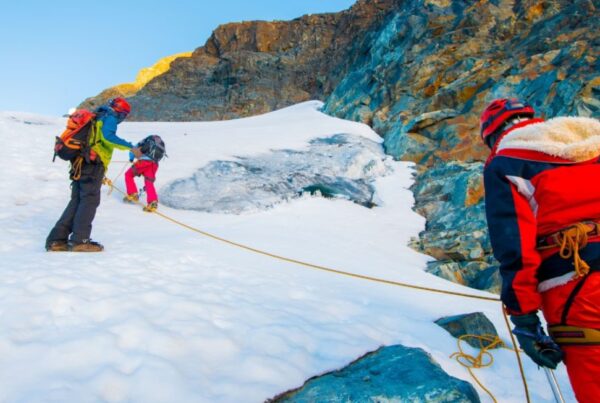
Above approximately 4,200 metres, the vegetation disappears almost entirely. What remains is rock, specifically ancient Precambrian gneiss and schist, which is dark grey and smoothly polished where the glaciers have retreated, but rough and frost-shattered everywhere else, along with ice. The Elena Glacier on Mount Stanley is the most visited of the Rwenzori’s remaining ice fields, approached on the route to Margherita Peak via the upper Elena Camp. The glacier itself is ancient ice, Pleistocene in origin, formed during the last ice age and retreating steadily ever since. Its surface is not the clean, smooth white of photographic alpine glaciers. It is grey-blue, heavily crevassed in places, with surface meltwater channels and exposed dirt bands that record decades of annual accumulation. It is ice that carries its age visibly, and there is something moving about encountering it that goes beyond simple aesthetic appreciation.
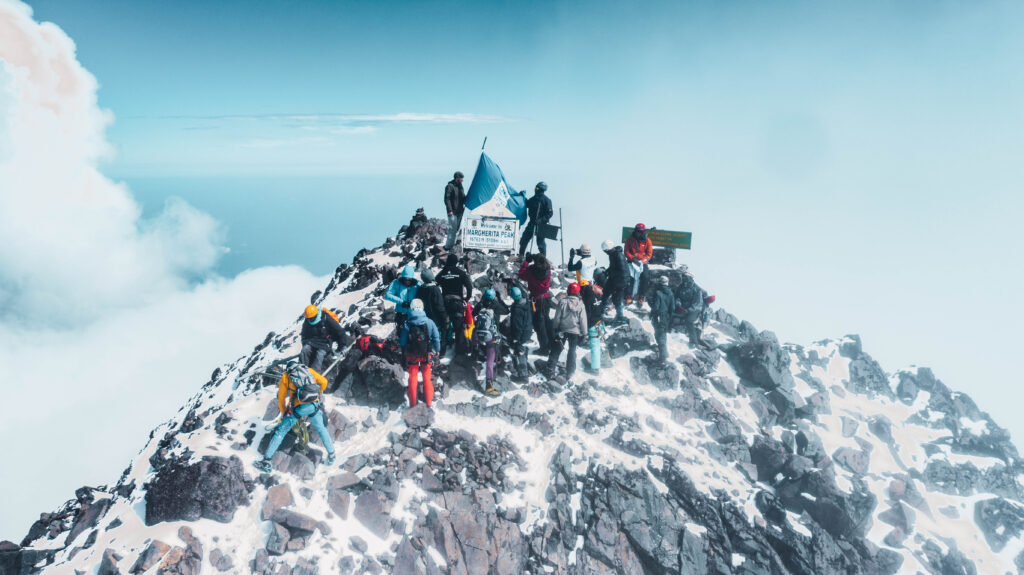
The experience of putting on crampons for the first time on the Rwenzori glacier, the satisfying crunch of the front points engaging with the ice, and the sudden security of grip on a surface that was moments ago treacherous is one of the most memorable sensory events of the high mountain day. The cold at this altitude is a different kind of cold than the wet chill of the forest and moorland below. It is dry and sharp and constant, and the wind above the glacier can drive it through inadequate layers with a thoroughness that demands proper preparation.
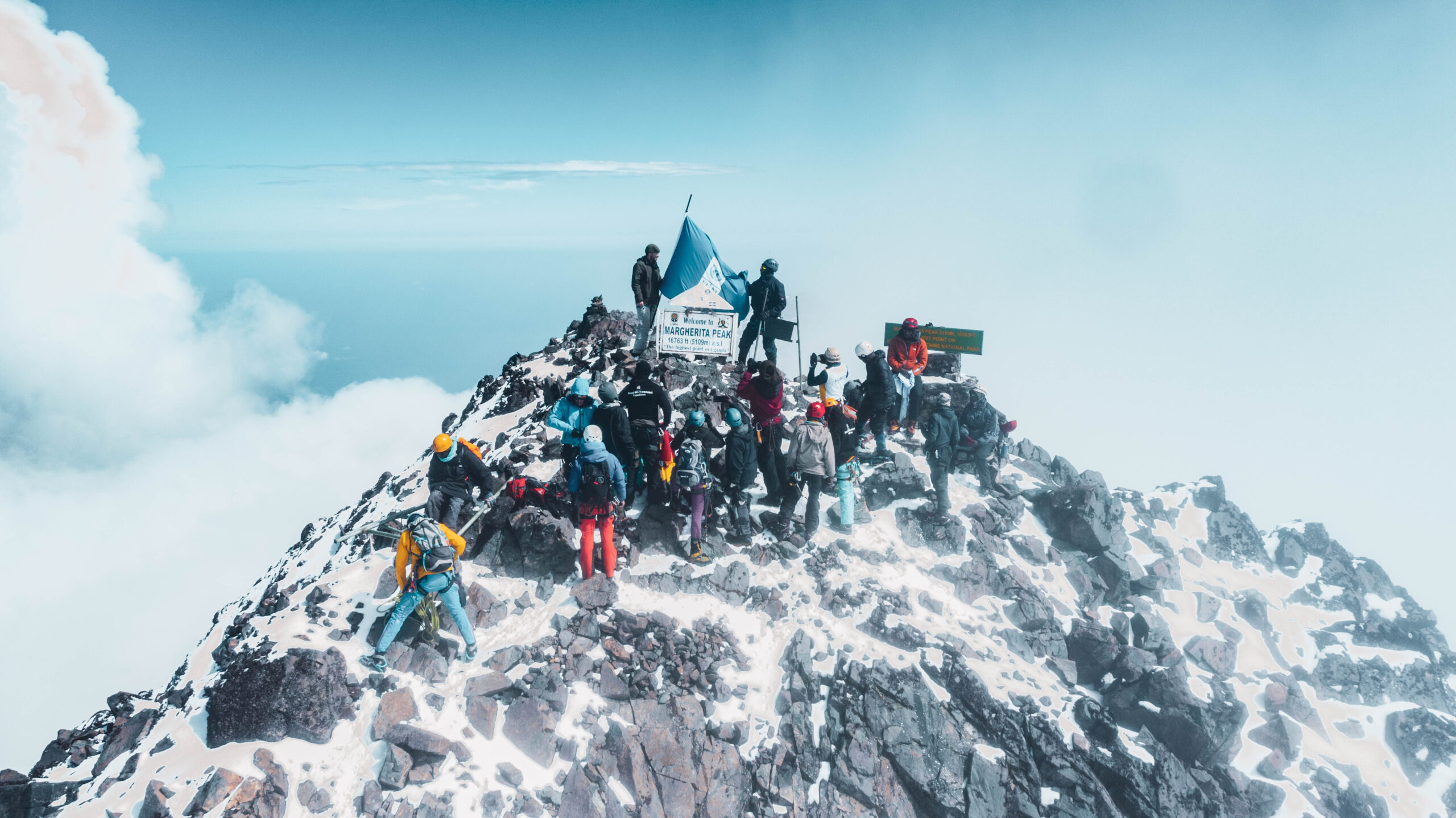
The views from the glacier approach and from the summit of Margherita Peak itself , when the weather allows, are among the most extraordinary available to any trekker in Africa. The full sweep of the Rwenzori range is visible: the six major massifs arranged across the horizon, their upper portions snow-capped or cloud-wrapped, their valleys dropping away into the green world below. On exceptionally clear days, perhaps a dozen times a year, the view from Margherita extends to Lake Edward and Lake George to the east, visible as pale glitters of light in the haze of the rift valley, and to the dark mass of the Congo Basin forest stretching westward to the horizon without interruption. It is a view that encompasses the very geography that puzzled Ptolemy, that drew Stanley, and that drove the Duke of Abruzzi to organize the most comprehensive mountaineering expedition in the history of African exploration. You are standing where all of that history arrived.
🧭 Guide’s PerspectiveI have stood on Margherita Peak perhaps forty times. I have been there in a whiteout, and I have been there in perfect clarity. The clear days are extraordinary beyond description. But even the whiteout days, when you stand on the highest point in the Rwenzori with nothing visible beyond five metres of grey ice and grey cloud, possess a quality of absolute presence that the summit views cannot fully match. You are there. You are at the top. The mountain is real, and it is completely indifferent to your ambitions, which is somehow the most liberating feeling available to a human being. |
The Mud, the Rain, and the Beautiful Discomfort
Any honest account of what the Rwenzori looks and feels like must include the mud. The Rwenzori’s mud is not incidental to the experience; it is an essential part of the character of the place, not just a disclaimer or a warning. The region is one of the wettest mountain environments on the planet, and the paths carry that water in a way that becomes, over the days of a trek, almost a personality trait of the mountain itself.
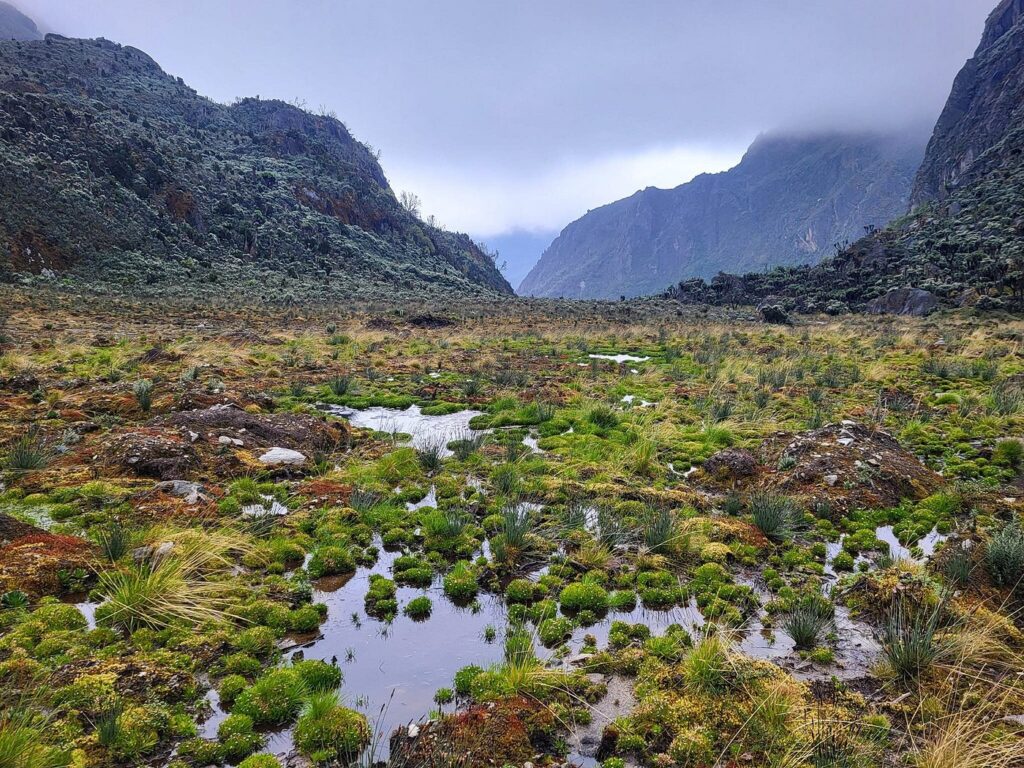
The mud of the Rwenzori begins in earnest at the bamboo zone and intensifies through the heather into the moorland, where, in the wet season, entire sections of trail are submerged. It is black, peaty, cold, and occasionally bottomless in the sense that you place a trekking pole, and it sinks thirty centimeters before hitting anything solid. It carries the smell of ancient organic decomposition, not unpleasant, actually, once your olfactory system adjusts, but unmistakable. And it tends to appear when you least expect it: a stretch of apparently solid path that suddenly opens into a bog; a wooden boardwalk that has subsided at one end and pitches you off-balance mid-stride; a crossing that was manageable in the morning and has become a small river by afternoon.
The rain on the Rwenzori arrives horizontally, vertically, and diagonally. It arrives as mist and as a downpour. It arrives when the sky has been completely clear for three hours. It is warm at lower altitudes and genuinely cold above 3,500 metres. A good waterproof jacket is not optional on the Rwenzori; it is the most important piece of gear you own on this mountain, and our boots guide for the Rwenzori makes the case for footwear that can handle continuous immersion without compromise. But something interesting happens to most trekkers after the first day or two of genuine Rwenzori wet: they make peace with it. The discomfort, once accepted as the mountain’s normal condition rather than a meteorological injustice, loses much of its power to diminish the experience. You are wet. The mountain is extraordinary. These two facts coexist without contradiction.
Frequently Asked Questions: What Does the Rwenzori Look Like?
What does the landscape of the Rwenzori Mountains actually look like?
The Rwenzori Mountains present a dramatically varied landscape that changes completely with altitude. Dense, moss-draped equatorial forest with extraordinary biodiversity, gnarled trees, roaring rivers, and prolific birdlife covers the lower slopes (1,600–2,500 m). Above this area lies the bamboo zone (2,500–3,000 m), where tall mountain bamboo forms walls on either side of the path, and the ground becomes increasingly boggy. Higher still is the heather zone (3,000–3,500 m), where giant tree heathers cloaked in grey-green moss line the trail and the first views of the upper mountain become visible. The afro-alpine moorland (3,500–4,200 m) is the most visually distinctive zone, an alien landscape of giant lobelias (Lobelia wollastonii) standing up to four metres tall and giant groundsels (Senecio adnivalis) reaching eight metres, interspersed with everlasting flowers and ancient peat bog. Above 4,200 metres, the vegetation disappears and the landscape becomes bare rock and glacial ice, culminating at the Rwenzori glaciers and Margherita Peak at 5,109 metres.
What are the giant plants of the Rwenzori Mountains?
The Rwenzori Mountains are renowned for their extraordinary giant afro-alpine plants species that have evolved to enormous sizes in response to the unique combination of equatorial altitude, high rainfall, and extreme diurnal temperature swings. The most iconic are Lobelia wollastonii (giant lobelia), which stands two to four metres tall and produces a towering flower spike when mature; and Senecio adnivalis (giant groundsel), which grows to five to eight metres on a palm-like trunk capped by a large rosette of leaves. Both species have evolved sophisticated thermal-insulation mechanisms: the lobelia traps water in its leaf rosette to prevent freezing, while the groundsel’s dead leaves hang down the trunk as an insulating skirt. These plants are found only in the afro-alpine zone of the Rwenzori and a few other East African mountains, and the experience of walking through a forest of them in the mist is widely described as one of the most otherworldly encounters available to any mountain traveler.
What is the weather like in the Rwenzori Mountains?
The Rwenzori Mountains receive some of the highest annual rainfall of any mountain range in Africa, exceeding 3,000 mm per year at some stations, and are consistently among the cloudiest mountain environments on the continent. The mountains intercept moisture-laden air masses moving across the Congo Basin, producing near-constant cloud cover on the upper peaks for most of the year. Rainfall can occur at any time and in any season, though the driest periods are generally December to February and June to August. Temperatures vary dramatically with altitude: the trailhead zone is warm and tropical (20–28°C), while the high camps at 4,000–4,500 metres experience overnight temperatures regularly below freezing. Summit conditions can produce wind-chill temperatures of -15°C or colder. The mountain’s characteristic weather, cloud, rain, and bog is not an obstacle to overcome but an intrinsic part of the Rwenzori experience that all trekkers should plan for.
What wildlife will I see in the Rwenzori Mountains?
The Rwenzori Mountains support exceptional biodiversity, with a high proportion of species endemic to the Albertine Rift. In the lower forest zone, trekkers regularly hear eastern chimpanzees and often see black-and-white colobus monkeys, L’Hoest’s monkeys, and the spectacularly colored Rwenzori turaco (Musophaga johnstoni). The mid-altitude zones support the Rwenzori red duiker, various mongoose species, and outstanding birdlife, including 19 Albertine Rift endemic species. The Rwenzori three-horned chameleon (Chamaeleo johnstoni) lives in the forest zone and is one of the mountain’s most sought-after sightings. In the afro-alpine moorland, the large-spotted genet and the Rwenzori leopard are rarely seen, but they are residents of the higher zones. The mountain does not offer the open-country game viewing of a savannah park, but its wildlife is in many ways more extraordinary because such a high proportion of it is found nowhere else on Earth.
What does it feel like to trek through the Rwenzori Mountains?
Trekking the Rwenzori Mountains is a multisensory experience that most people describe as unlike any other mountain they have been on. Physically, it is demanding: the terrain is steep and frequently boggy, the altitude is real above 3,500 metres, and the sustained wetness from rain and mist requires mental as well as physical resilience. Sensory highlights include the roar of forest rivers in the lower zones, the extraordinary silence of the high moorland broken only by wind, the vivid smell of wet peat and ancient forest, and the temperature contrast between the warm, humid forest and the sharp, dry cold of the glacier zone. The visual experience moves from overwhelming greenness in the forest to the grey-silver of the heather zone to the alien green-and-grey of the afro-alpine moorland and finally to the blue-white of the glacier. Most trekkers report that the experience deepens over the days of the trek, that the mountain reveals itself gradually and deliberately, and that by the final days the accumulated immersion in this extraordinary environment produces a quality of attention and presence that is genuinely rare in modern life.
Can I see the Rwenzori glaciers on a standard trek?
Yes, trekkers on the summit routes to Margherita Peak will encounter the Elena Glacier and other remaining ice fields at approximately 4,500 metres. The glacier approach and summit day involve basic glacier travel with crampons and an ice axe, and the ice itself is fully visible and physically accessible. However, it is important to note that the Rwenzori glaciers have lost approximately 80–90% of their area since the Duke of Abruzzi photographed them in 1906, and the remaining ice is retreating rapidly. Trekkers on the lower forest treks (Mahoma Loop and Lake Mahoma) will not encounter glacial ice but will see the distant summit zone on clear days. Trekkers on the 4-Day Mutinda Loop and 6-Day Weismann Peak expedition will approach close to the glacial zone without entering it. The urgency of experiencing the Rwenzori glaciers while they remain is real; most climate projections suggest the remaining ice will disappear within 20–30 years.
What makes the Rwenzori different from Kilimanjaro visually?
The Rwenzori and Kilimanjaro present entirely different visual and environmental experiences, despite both being high African mountains with glaciers. Kilimanjaro is a single, isolated volcanic cone rising from flat, dry savannah; its iconic silhouette is immediately recognizable from a great distance. The Rwenzori, by contrast, is a complex massif of six major peaks, deeply forested, perpetually cloud-wrapped, and hidden from view for much of the time. Kilimanjaro’s vegetation zones are relatively simple forest, moorland, and alpine desert, while the Rwenzori’s five zones include the extraordinary giant plant community of the afro-alpine moorland, which has no equivalent on Kilimanjaro. Kilimanjaro is substantially drier, receives over 50,000 trekkers per year, and can feel crowded on its main routes. The Rwenzori is wet, green, and complex; receives fewer than 1,500 trekkers per year; and provides a solitary mountain experience that feels genuinely remote. Most trekkers who have done both describe them as entirely different experiences that satisfy different kinds of mountain hunger.
Come and See It for Yourself
No description, however detailed, does justice to what the Rwenzori actually looks like. The giant lobelias stand in the mist at 4,000 metres. The color of glacier ice in the first light of a clear morning. You can hear the roar of a river in the forest before you can see it. The absolute silence of the high camp at 3 a.m. These are things that exist only in experience.
Rwenzori Trekking Safaris has been putting people inside this landscape for over a decade. We know every trail, every camp, and every shift in the weather and light. We can design an itinerary from a 3-day forest walk to an 18-day full-range traverse that puts you exactly where this mountain is at its most extraordinary.