Why do giant groundsels and lobelias grow so huge in the Rwenzori? Explore the science behind Africa’s most alien Afro-alpine landscape.
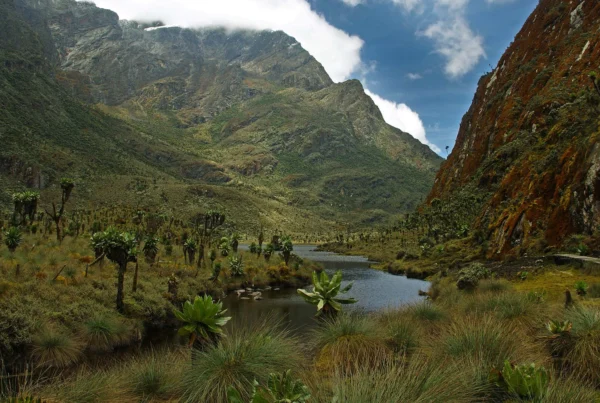
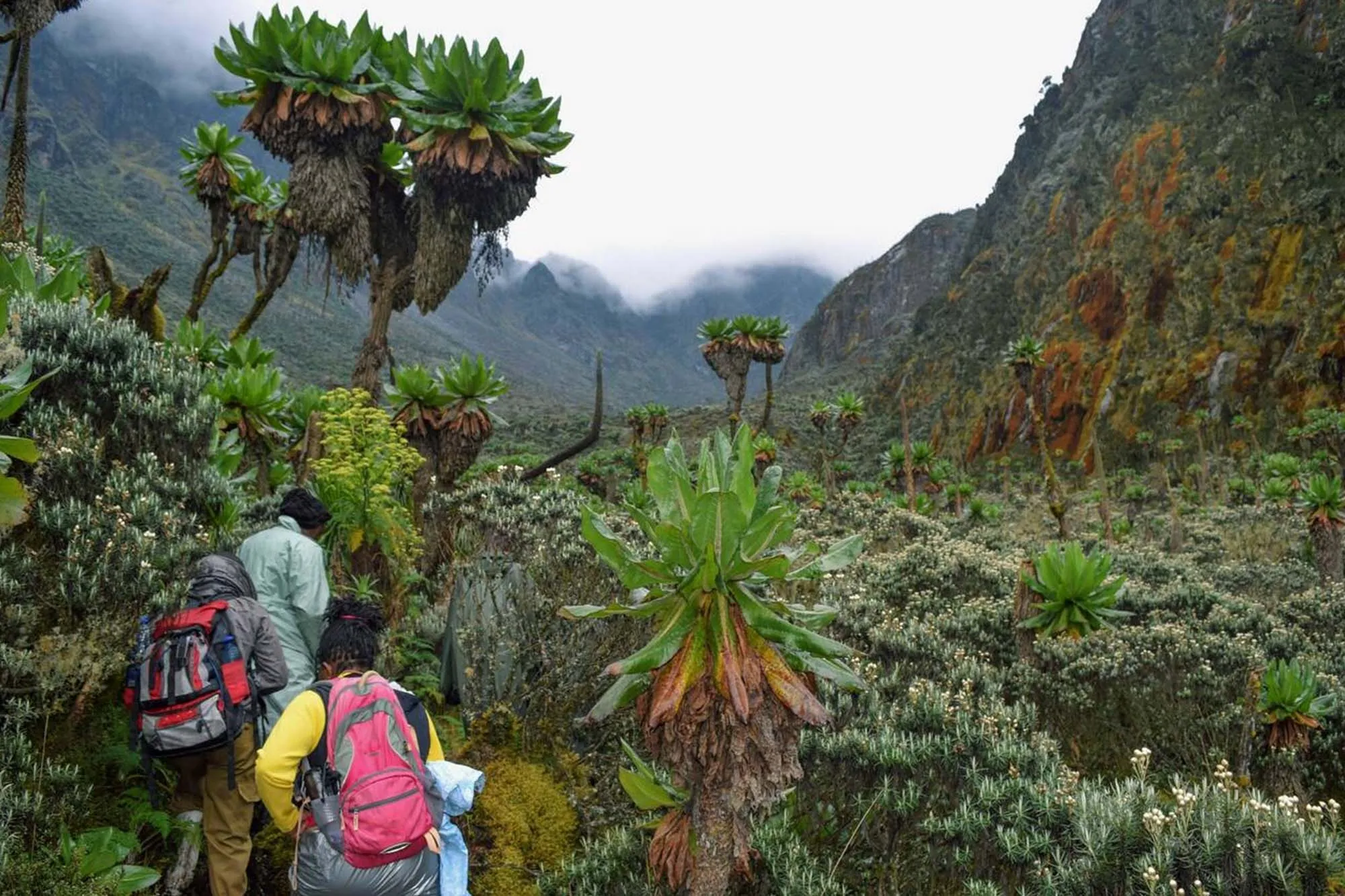
I have walked into the Rwenzori’s Afro-alpine zone more times than I can count, and I have never once seen it fail to stop a trekker mid-stride. It usually happens somewhere above John Matte, where the heather forest thins, the trail turns to saturated black peat, and the mist parts to reveal a landscape that looks like it was designed by someone who had only ever heard vegetation described secondhand. Cabbage-headed trees on shaggy, fur-wrapped trunks stand shoulder to shoulder with towering green spires that resemble something between a yucca and a rocket. Everything drips. Everything glows faintly silver in the low light. A client from Toronto once told me, quite seriously, that she felt like she had walked onto the set of a science-fiction film with a botany budget nobody else could afford. She was not exaggerating, and she was not the first person to say something like it to me on this exact stretch of trail.

What she was looking at were giant groundsels and giant lobelias, the two plant groups that define the Rwenzori’s Afro-alpine zone and give it its enduring reputation as one of the strangest walkable landscapes on the planet. This is not scenery dressed up with clever marketing language. It is a genuine evolutionary anomaly, the product of millions of years of isolation, altitude, and an unusually stable equatorial cold that has pushed ordinary daisy and lobelia relatives into forms three, five, sometimes eight metres tall. In the pages that follow I want to walk you through exactly why this zone looks the way it does, the biology behind the giants, where on the mountain you will meet them, and how to experience this landscape properly when you come to trek it yourself.
What the Afro-Alpine Zone Actually Is
The Afro-alpine zone is the fourth of the five vegetation belts that stack the Rwenzori from valley floor to summit ice, and on most itineraries it is the belt that trekkers remember most vividly once the trek is over. It begins where the giant heather forest thins out, somewhere in the neighbourhood of 3,500 metres, and it continues up to roughly 4,500 metres, where the last hardy cushion plants give way to bare rock and the permanent ice documented in our guide to what the Rwenzori actually looks like. Within that thousand-metre band sits a world of high-altitude peat bog, wind-scoured ridges, and a plant community found in this particular combination nowhere else on the continent.
Where the Zone Sits on the Mountain
Trekkers following the Central Circuit Trail meet the Afro-alpine zone in earnest in the Bujuku Valley, the boggy, glacier-fed basin cradled between Mount Stanley, Mount Speke, and Mount Baker, where the density of giant groundsels and giant lobelias exceeds anything found elsewhere in the range. On the southern approach, trekkers on the Kilembe Trail enter a parallel version of the same zone above Bugata Camp, on the climb toward Mutinda and Hunwick’s, arriving at the giants from a different valley system but the same altitude band. Even trekkers with limited time are not shut out of this landscape: the Mahoma Loop day hike reaches the lower edge of the zone near Lake Mahoma, offering a genuine, if brief, introduction to the giants without committing to a full summit expedition. Every trekker who overnights at Elena Hut, Bujuku Hut, or the high camps documented in our huts and camps guide sleeps inside this zone, often within sight of the plants themselves.
The Conditions That Shaped It
The Afro-alpine zone did not become strange by accident. Our geology guide explains how the Rwenzori’s tectonic, non-volcanic origin has kept this range standing at extreme altitude for far longer than its volcanic neighbours, giving its plant communities millions of extra years of evolutionary time to specialise. Layered onto that ancient elevation is a climate regime unlike almost anywhere else on Earth at this latitude, which our full climate guide breaks down belt by belt: intense equatorial ultraviolet radiation by day, temperatures that drop toward or below freezing every single night of the year regardless of season, and a soaking, near-constant humidity that keeps the peat bog permanently saturated. No single one of these pressures would have produced giants on its own. Together, over an evolutionary timescale measured in millions rather than thousands of years, they did.
The Giant Groundsels: Senecio and Dendrosenecio
The first plants most trekkers notice on entering the zone are the giant groundsels, tree-like relatives of the humble garden ragwort that have, on this mountain alone, grown trunks and crowns you would expect from a small tree rather than a daisy relative. Species in the genera Senecio and Dendrosenecio dominate the skyline of the Bujuku Valley from the heather-moorland transition all the way up toward Elena Hut, with the snow groundsel, Senecio adnivalis, reaching heights of four to six metres on drier ridges and rocky outcrops above the bog. Our dedicated guide to the Rwenzori’s giant plants goes deeper into the individual species and their botanical classification for readers who want the full scientific picture; here I want to focus on why they look the way they do.
How a Daisy Became a Tree
Ordinary groundsels are low, herbaceous plants, the kind you might dismiss as a roadside weed anywhere in temperate Europe or North America. On the Rwenzori, isolated for millions of years at an altitude that punishes anything without serious frost protection, the groundsel lineage responded to that pressure by getting taller, woodier, and structurally more like a small palm tree, complete with a shaggy trunk of persistent dead leaves that hang on rather than dropping off. That dead-leaf skirt is not neglect. It is insulation, wrapping the living stem in a thick, air-trapping layer that buffers the trunk against the zone’s brutal overnight temperature swings, in exactly the way a heavy coat traps warmth around a human body.
The Rosette That Won’t Freeze
The true engineering, though, happens at the crown. Each giant groundsel carries its actively growing tissue, the meristem responsible for all future growth, inside a dense rosette of tightly overlapping leaves. At night, as temperatures fall toward freezing, that rosette closes in on itself, sealing the growing point away from the coldest air and trapping a pocket of relative warmth at its centre. Come morning, as the equatorial sun climbs, the rosette reopens to resume photosynthesis. This daily opening and closing, repeated every single day of the plant’s multi-decade life, is the single adaptation that makes survival possible in a climate that delivers a hard nightly frost and a warm, UV-intense midday within the same twenty-four hours, a cycle our wildlife guide notes also shapes which animals can survive at this altitude.
The Giant Lobelias: Living Thermoses
If the groundsels supply the Afro-alpine zone’s architecture, the giant lobelias supply its punctuation, rising as narrow green spires between the wider groundsel crowns and marking the wettest sections of the bog with unmistakable vertical accents. Lobelia wollastonii, named for the botanist Alexander Wollaston, is the signature species of this zone, typically standing two to four metres tall, though our Bujuku Valley guide documents individuals in the valley’s densest sections reaching closer to five.
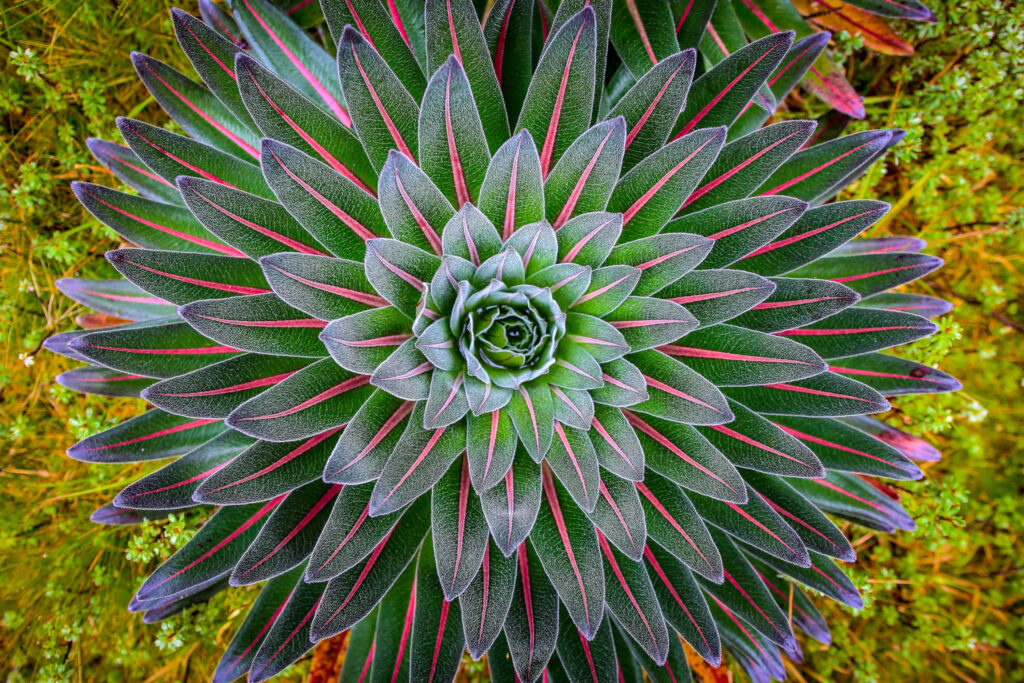
A related species, Lobelia bequaertii, occupies similar ground at slightly different elevations, and both belong to a plant family whose lowland relatives are, almost without exception, small and unremarkable.
The Water-Filled Rosette Trick
The giant lobelia solves the same nightly freezing problem the groundsel faces, but with an entirely different piece of engineering. At the heart of its rosette sits a cup that fills with water, and because water freezes far more slowly than still air and releases heat as it does so, that cup acts as a thermal reservoir, buffering the plant’s growing point against the sharpest overnight temperature drops. As the cold deepens after dark, the rosette leaves partially close over the water-filled cup, slowing heat loss still further. It amounts to a living thermos flask, refilled by rain and mist every day of the plant’s life, and it is one of the more genuinely elegant pieces of natural engineering you will see on any trek anywhere in the world.
The Flower Spike
When a giant lobelia reaches reproductive maturity, usually after years of purely vegetative growth, it sends up a single dense flower spike that can add another metre or more to the plant’s already considerable height, densely packed with small blue-purple flowers along its length. Trekkers lucky enough to pass through the Bujuku Valley or the upper Kilembe Trail during a flowering event describe it as one of the visual highlights of the entire expedition, a single plant briefly transforming from architectural oddity into genuine spectacle before the spike eventually dies back.
Why the Zone Looks Alien: The Science of Afro-Alpine Gigantism
The technical term botanists use for this pattern, tree-like daisies and lobelias reaching sizes that seem to defy their small-plant relatives, is Afro-alpine gigantism, and it is not unique to the Rwenzori. Related giant groundsels and giant lobelias also grow on Mount Kenya, on Kilimanjaro, and on the Virunga volcanoes, each range having produced its own distinct species through the same underlying evolutionary pressure. This is convergent evolution in close to its purest form: separate, geographically isolated mountain populations, faced with the identical combination of intense equatorial sun and nightly frost, independently arriving at strikingly similar solutions, oversized rosettes, insulating dead-leaf skirts, and water-storing cups.
Convergent Evolution Across Three Mountains
What makes this comparison useful for trekkers weighing destinations is understanding why the expression of gigantism differs so much between ranges. Kilimanjaro’s volcanic cone produces thinner, drier vegetation belts and sits close to semi-arid savannah, conditions that support giant groundsels and lobelias but in noticeably lower density and diversity than the Rwenzori’s. Mount Kenya carries a genuinely impressive high-altitude flora of its own, but again lacks the sheer variety of groundsel and lobelia species found on this range. The result is that a trekker who has stood among Kilimanjaro’s Senecio kilimanjari will find the Rwenzori experience recognisable in outline but considerably denser, wetter, and more varied in the species on display.
Why the Rwenzori’s Giants Outsize the Rest
The explanation traces back to the same tectonic origin discussed in our geology article. Because the Rwenzori was thrust upward by rifting rather than built by successive volcanic eruptions, it has stood at extreme altitude for a far longer stretch of geological time than Kilimanjaro or Mount Kenya, both comparatively young volcanic edifices. Longer standing time at altitude means more generations of selective pressure pushing the groundsel and lobelia lineages toward ever more extreme adaptations, and it is compounded by the exceptional, near-constant rainfall documented in our rivers guide, which keeps the Afro-alpine bog saturated in a way that drier volcanic slopes simply cannot match. Deep time plus abundant water is, in short, the recipe that makes the Rwenzori’s giants the largest and most varied on the continent.
Walking Through It: What Trekkers Actually Experience
No description fully prepares a first-time visitor for the sensory experience of walking through this zone in person. The trail narrows to boardwalk sections and stepping stones across the wettest ground, mist rolls through the groundsel crowns in slow curtains that appear and vanish within minutes, and the silence is broken only by boots sinking into peat, the occasional call of a Rwenzori turaco from the forest edge below, and your own breathing, noticeably harder now than it was two days earlier at the trailhead. Silvery everlasting flowers, Helichrysum, carpet the drier hummocks between the groundsels, adding a final, almost lunar texture to a landscape that has already abandoned every visual reference point trekkers arrive with.
Best Places to See the Giants
For the single richest concentration of giant groundsels and giant lobelias anywhere on the mountain, nothing on either trail rivals the Bujuku Valley on the Central Circuit Trail, walked on the standard seven-day itinerary to Margherita Peak and on most multi-peak expeditions to Mount Speke and Mount Baker.

On the Kilembe side, the stretch above Bugata Camp toward Mutinda and Hunwick’s offers a comparably dramatic, if slightly less densely populated, version of the same landscape. Trekkers with only a day or two available should not assume the giants are out of reach: the Mahoma Loop hike brushes the lower fringe of the zone near Lake Mahoma, giving a genuine, compressed taste of the Afro-alpine world.
Photographing an Alien Landscape
The Afro-alpine zone rewards patient photography more than almost any other section of the trek. Persistent mist and low, diffuse light actually favour close, detailed shots of individual rosettes over wide panoramas, and our full photography guide covers the lens choices, weatherproofing, and composition techniques that make the most of this specific light. Early morning, in the brief window before the daily mist thickens, tends to produce the clearest views across the bog toward the surrounding peaks.
Conservation and Trekking Etiquette in the Afro-Alpine Zone
Giant groundsels can take decades to reach their full height, and the peat bog they grow in is fragile, easily damaged by boots straying off the boardwalk sections that the Uganda Wildlife Authority and our own guiding teams maintain through this zone. Every trekker on our huts and camps itineraries treks with a licensed guide precisely because they know which sections of trail can safely bear foot traffic and which cannot, and staying on the marked path through the Afro-alpine zone is one of the simplest, most meaningful things a trekker can do to protect a landscape that took millions of years to develop and cannot be replaced within a human lifetime if it is degraded.
When to See the Afro-Alpine Zone at Its Best
The giants are visible in every month of the year, since this is a permanently cold, permanently wet zone regardless of season, a point our guide to the Rwenzori in winter explores in detail. Trekkers who prefer clearer views across the bog toward Mount Stanley and Mount Speke generally do best in the drier windows of December to February or June to August, while those who do not mind heavier rain in exchange for thinner crowds and mist-wreathed drama, described fully in our wet season trekking guide, will find the Afro-alpine zone arguably at its most atmospheric during the wetter months.
Frequently Asked Questions About the Rwenzori’s Giant Groundsels and Lobelias
Why do the Rwenzori’s plants grow so much bigger than related species elsewhere?
The Rwenzori’s giant groundsels and giant lobelias are the product of Afro-alpine gigantism, an evolutionary response to a climate that combines intense equatorial sun by day with hard frost almost every night. Growing larger, insulating the growing point inside a closing rosette, and wrapping the trunk in a skirt of dead leaves or storing water in a cup-shaped rosette are all adaptations that help the plant survive that daily freeze-thaw cycle. The Rwenzori’s unusually long geological history at high altitude and its exceptional rainfall have given its populations more evolutionary time and more available moisture than related giants on Kilimanjaro or Mount Kenya, producing the largest and most diverse examples anywhere in Africa.
Where exactly will I see the giant groundsels and lobelias on a Rwenzori trek?
The densest and most dramatic concentration grows in the Bujuku Valley, reached on the Central Circuit Trail on the standard route toward Margherita Peak, typically between John Matte Hut and Elena Hut. Trekkers on the Kilembe Trail encounter a comparably striking, if slightly less dense, version of the same landscape above Bugata Camp on the approach to Mutinda and Hunwick’s. Even a short two- or three-day itinerary such as the Mahoma Loop reaches the lower fringe of the zone near Lake Mahoma.
Are the giant groundsels and lobelias found only in the Rwenzori Mountains?
No. Related giant groundsel and giant lobelia species also grow on Kilimanjaro, Mount Kenya, and the Virunga volcanoes, each range hosting its own distinct species that evolved independently through the same evolutionary pressure. The Rwenzori’s giants are generally considered the largest and most species-diverse of the group, a result of the mountain’s much older, non-volcanic tectonic origin and its exceptionally high, near-constant rainfall.
How tall do the giant groundsels and giant lobelias actually get?
Giant groundsels in the Senecio and Dendrosenecio genera commonly reach four to six metres in the Rwenzori’s Afro-alpine zone, with some individuals growing taller in especially sheltered, moist locations. Giant lobelias, principally Lobelia wollastonii, typically stand two to four metres tall, with the tallest specimens documented in the densest sections of the Bujuku Valley approaching five metres, including their flower spikes.
Is it safe to touch or walk close to the giant plants?
Trekkers can walk close to and photograph the giant groundsels and lobelias, but should stay on the marked boardwalk and stepping-stone sections of trail rather than stepping into the surrounding peat bog. The bog is ecologically fragile, the plants can take decades to reach full size, and off-trail foot traffic causes erosion damage that persists for years. Licensed guides on every Rwenzori Trekking Safaris itinerary will indicate exactly where it is safe to stand for photographs.
What is the best time of year to see the Afro-alpine zone in the Rwenzori?
The giant groundsels and giant lobelias are visible year-round since the Afro-alpine zone experiences frost-prone, misty conditions in every month regardless of season. For the clearest views across the bog toward the surrounding peaks, the drier windows of December to February and June to August are generally most reliable. Trekkers who prioritise atmosphere and thinner crowds over dry trail conditions often find the wetter months produce the most dramatic, mist-wreathed version of the landscape.
Ready to Walk Among the Giants?
There is a particular kind of quiet that settles over first-time visitors somewhere in the middle of the Bujuku Valley, standing among plants that look like they belong to another geological era entirely, and it is not an experience that photographs or descriptions fully capture. It has to be walked. If you are ready to see the Rwenzori’s Afro-alpine giants for yourself, get in touch with our team through our contact page and we will help you plan the itinerary, trail, and season that puts you in the middle of this landscape at its very best.