Does the Rwenzori have a winter? Get the truth on seasons, snow, temperatures & the best months to trek this equatorial glacier range.
Every July, and again every December, our inbox fills with a version of the same question, usually typed by someone sitting somewhere genuinely cold: is it possible to trek the Rwenzori Mountains in winter, and what should I expect? It is a fair question to ask, and an almost impossible one to answer honestly with a simple yes or no, because the honest answer is that the Rwenzori Mountains do not have a winter in the sense that a trekker from Toronto, London, or Melbourne understands the word. And yet, in another sense, entirely real and entirely relevant to your trip planning, the Rwenzori has winter every single day of the year, permanently, on its upper slopes, and it has done so for longer than any human civilization has existed. Reconciling those two facts, the absence of a seasonal winter and the presence of a permanent one, is the single most useful thing I can do for you in this guide. I have spent years guiding trekkers up this mountain in every month of the calendar, watching people arrive with mental models built for the Alps or the Rockies collide gently with the reality of an equatorial massif that runs on an entirely different climatic logic. By the end of this article you will understand exactly what “winter” means here, when the closest thing to it occurs, what temperatures and conditions you will actually meet at each stage of your climb, and how to prepare properly for the cold, whichever month you choose to come.
Does the Rwenzori Mountains Actually Have a Winter Season?
No, not in the way the word is used in temperate countries. The Rwenzori range straddles the equator almost exactly, sitting within roughly half a degree of latitude zero on the border between Uganda and the Democratic Republic of Congo, a location UNESCO recognised when it inscribed the range as a World Heritage Site in 1994. At this latitude, day length barely changes across the year, the sun’s angle stays high and consistent, and the mechanism that produces winter in the mid-latitudes, the tilt of the earth’s axis dramatically reducing solar input for months at a time, simply does not operate with any meaningful strength here.
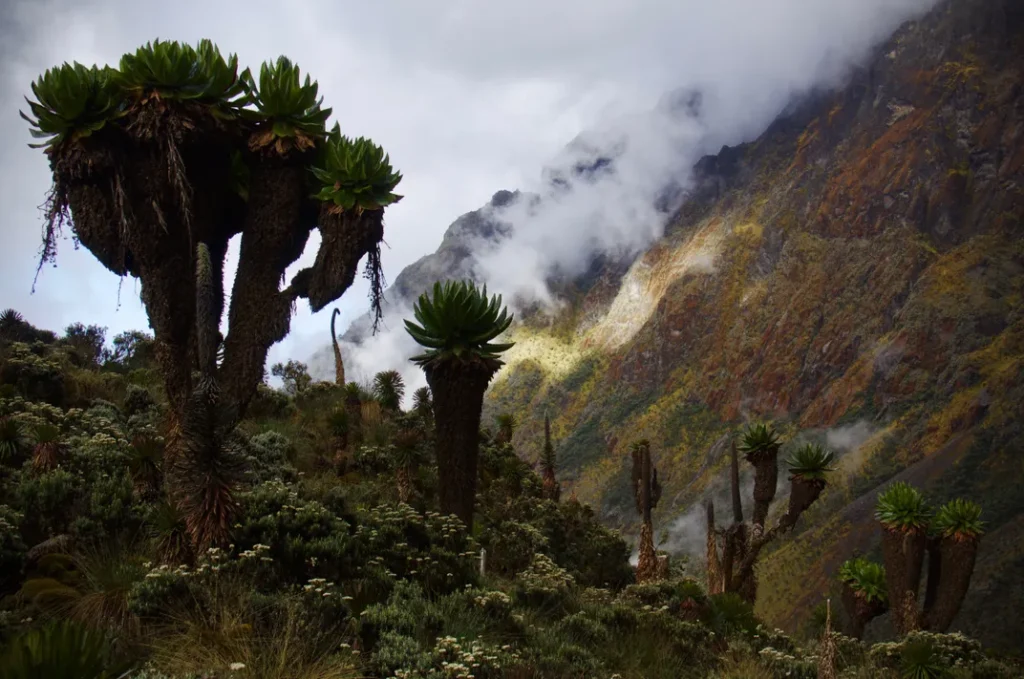
There is no month in which the Rwenzori goes dark, cold, and dormant the way the northern hemisphere does in January. Instead, as we cover in detail in our guide to whether it rains a lot in the Rwenzori Mountains, the range runs on a rhythm of wet and dry seasons driven by the movement of the Inter-Tropical Convergence Zone rather than by axial tilt. Two windows of markedly reduced rainfall occur each year, and two windows of increased rainfall occur in between. Neither of these has anything to do with temperature dropping the way it does in a true winter; both windows sit at almost exactly the same average temperature range for any given altitude, year-round.
The Only Real Winter on the Rwenzori: A Permanent One, Above 4,500 Metres
Here is the part that genuinely surprises first-time trekkers, and the part that makes the “winter” question worth asking after all. While the Rwenzori has no seasonal winter, it has a permanent one. Above roughly 4,500 metres, on the upper flanks of Mount Stanley, Mount Speke, and Mount Baker, temperatures sit below freezing essentially every night of every month, snow falls with some regularity in every season, and the range still carries the last remaining glaciers in Africa outside Kilimanjaro and Mount Kenya. Our detailed guide on whether you will see snow on the Rwenzori Mountains explains this phenomenon properly, but the short version is that altitude, not season, is what manufactures winter here. You are not waiting for a calendar month to bring you cold and snow; you are climbing into a fixed climatic zone that behaves like winter twelve months a year, a zone that begins abruptly somewhere around the Elena Hut and Margherita Camp elevation and intensifies with every step toward the summit ridge. When people ask about Rwenzori in winter, what they are very often unconsciously asking about is this permanent alpine zone, the genuine ice-and-snow environment that sits atop an otherwise tropical mountain, and it is available to you in July exactly as it is in January.
If You Mean December to February: What Is Actually Happening on the Mountain
Most trekkers who search for “Rwenzori in winter” are really asking about the months that coincide with winter back home, roughly December through February. This is a useful window to understand in detail because it happens to overlap with one of the range’s two dry seasons, described comprehensively in our guide to the best time to trek the Rwenzori Mountains.

During this period, rainfall on the lower and middle slopes drops meaningfully compared to the wetter months, trail surfaces firm up, river crossings become more manageable, and the odds of a clear morning at altitude, the kind that lets you see Margherita Peak’s ice cap catch the first light, improve considerably. It is not a dry month in the way a Mediterranean summer is dry; some rain is close to guaranteed on any given day somewhere on the route, particularly above 2,500 metres, a reality our piece on rainfall patterns across the range covers with real numbers. But relative to the long rains of March through May, December through February is a genuinely favourable window, and it is one of the two periods, alongside June through August, that our guides recommend most strongly for summit attempts on Margherita Peak.
Temperature Reality by Zone During the December to February Window
At the Nyakalengija trailhead and through the lower forest, daytime temperatures during this window sit comfortably in the low-to-mid twenties Celsius, humid and warm, with nothing that resembles winter in any sense. Climbing into the bamboo and heather zones between roughly 2,500 and 3,800 metres, daytime highs drop into the mid-teens, mornings turn crisp, and a fleece layer becomes welcome rather than optional. Above 3,800 metres, in the Afro-alpine zone around Bujuku and the approach to Elena Hut, daytime temperatures often sit near or just above freezing, while nights drop several degrees below it. This is the zone our comprehensive guide to what to expect when you hike the Rwenzori Mountains describes as the point where the mountain stops feeling tropical and starts feeling alpine, and it holds true whether you arrive in December or June. On summit morning, leaving Elena Hut in the pre-dawn darkness for the push to Margherita Peak, wind chill regularly pushes effective temperatures to minus ten or minus fifteen degrees Celsius, cold enough to freeze water bottles and numb exposed skin within minutes, a condition that is essentially identical whichever calendar month you climb in.
What Winter-Style Cold Actually Feels Like, Zone by Zone
Understanding the mountain’s vertical climate is more useful for trip planning than fixating on the calendar, because your experience of “winter” on this mountain will be defined far more by altitude than by which month your flight lands.
The Forest and Bamboo Zones, 1,650 to 3,000 Metres
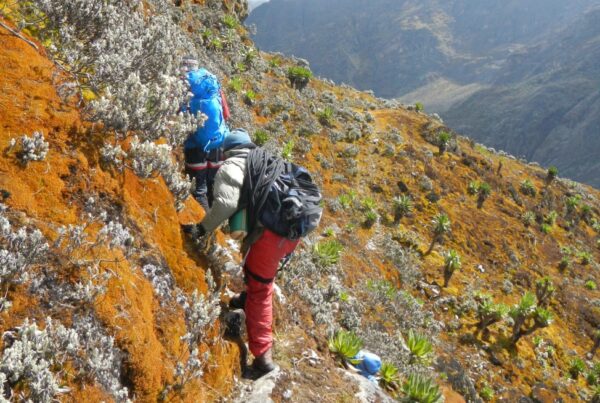
This lower section, walked on both the Central Circuit Trail and the Kilembe Trail, never feels wintry at any time of year. Expect humid, warm air, dense vegetation dripping with condensation, and the kind of heat that has you stripping down to a base layer within the first hour of walking. This is also, incidentally, the zone with the richest wildlife encounters on the mountain, including the chimpanzees and L’Hoest’s monkeys you may spot along the lower Central Circuit.
The Heather and Afro-alpine Zones, 3,000 to 4,300 Metres
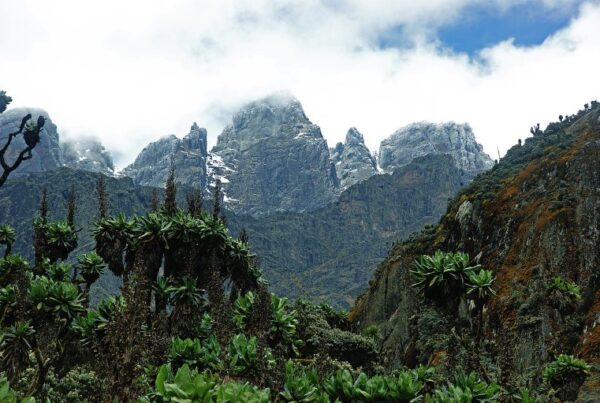
Here the mountain begins its transformation. Giant lobelias and groundsels, the extraordinary botanical specimens described in our article on the Rwenzori’s giant plants, thrive in a cold, misty, frost-prone environment that would not look out of place in a fantasy film.

Overnight temperatures at camps like John Matte and Bujuku drop well below what most trekkers expect from an African mountain, frequently into the low single digits or below freezing, and morning frost on tent flysheets is common regardless of season.
The Glacial Zone and Summit Night, 4,300 to 5,109 Metres
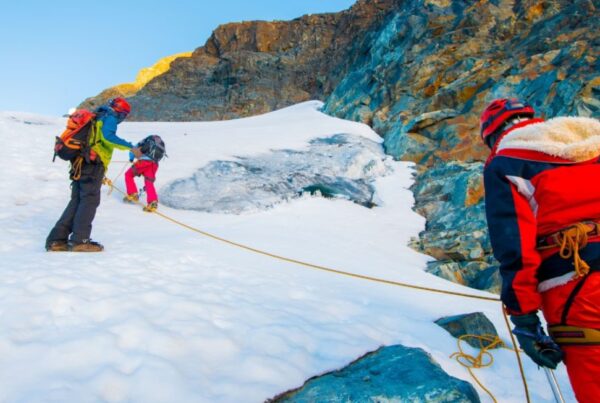
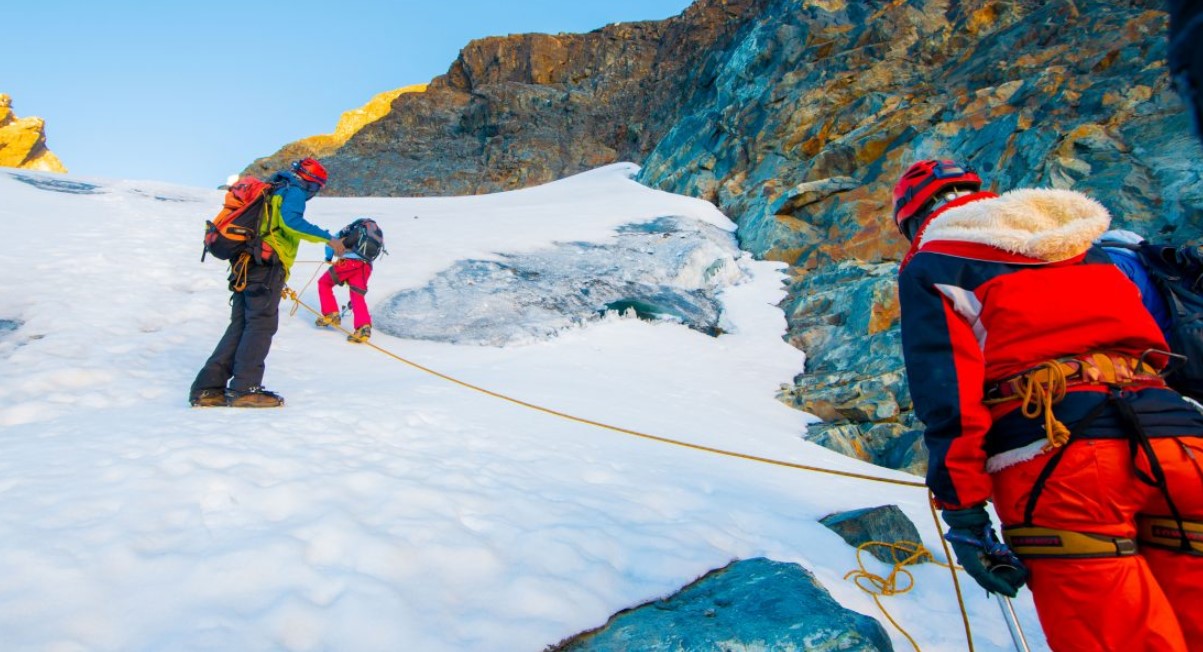
This is the mountain’s true winter, permanent, unyielding, and identical in character whether you climb it in January or July. Elena Hut and Margherita Camp sit inside this zone, and the final push across the Stanley Glacier, covered step by step in our guide to crossing a Rwenzori glacier, takes you across genuine ice, roped and in crampons, in conditions that would be entirely at home in a temperate-zone winter mountaineering trip. The summit of Margherita Peak at 5,109 metres carries snow and ice cover essentially year-round, and the wind exposure on the final ridge adds a cold factor that catches underprepared trekkers off guard even when they arrived expecting an “African” climb.
Snow, Glaciers, and the Illusion of an Equatorial Winter
The presence of permanent snow and ice on a mountain sitting almost exactly on the equator remains one of the great counterintuitive facts of world geography, and it is precisely what gave the range its ancient name, Mountains of the Moon, and its long association with the source of the Nile. What makes this possible is altitude rather than latitude: at 5,109 metres, the air is simply too thin and too cold to support liquid water reliably, regardless of how close you are to the sun’s most direct rays. However, as our article on crossing the Stanley Glacier discusses candidly, this permanent winter zone is shrinking. The range’s glaciers have retreated by more than eighty percent since the early twentieth century, and climate scientists studying the Rwenzori consider the ice cap’s disappearance within the coming decades to be effectively certain. If experiencing genuine equatorial ice and snow is part of what draws you to a Rwenzori winter-style expedition, that experience carries a growing urgency; the glacial “winter” this mountain has maintained for millennia will not be available to trekkers indefinitely.
Comparing the December-to-February Window with the Rwenzori’s Other Dry Season
Trekkers set on visiting during their own hemisphere’s winter often ask whether they are missing out by not coming in June through August instead. In practical terms, the two windows are close cousins. Both sit within the range’s two dry-season periods, both offer meaningfully better trail conditions than the March-to-May and September-to-November rains, and both give you a genuine shot at clear summit mornings over Margherita’s ice cap. If there is a distinguishing factor, it is a slight edge in stability toward July and August, when clear windows over the summit between roughly six and ten in the morning occur with marginally greater frequency, a detail our season-by-season breakdown covers in full. For most trekkers whose travel dates are fixed by a northern hemisphere winter break, however, December through February remains an excellent, fully viable choice, and the difference between the two windows is a matter of degree rather than a reason to delay your trip.
How Winter-Style Route Conditions Differ Between the Central Circuit and Kilembe Trail
Both of the mountain’s principal routes to Margherita Peak behave similarly during the December-to-February dry window, but with distinct character. The Central Circuit Trail, approaching from Nyakalengija on the range’s eastern side, moves through the Bigo Bogs on elevated boardwalks that become noticeably firmer and less waterlogged during this period, and delivers you to Elena Hut for a summit push that many first-time trekkers find the more classic, historically resonant approach to the mountain. The Kilembe Trail, climbing from the south through the dramatic Nyamwamba Valley, tends to run slightly drier at comparable altitudes during this window and offers newer hut infrastructure, along with straightforward access to Weismann Peak on Mount Luigi di Savoia for trekkers wanting a secondary summit beyond Margherita. Our detailed route comparison walks through the full set of trade-offs, but in terms of winter-season cold and conditions specifically, the two routes converge at essentially the same experience once you reach the shared glacial terrain near the summit.
Packing for a Rwenzori “Winter” Expedition
Whichever month you choose, the packing logic for the Rwenzori’s permanent alpine zone does not change, and it is worth taking seriously regardless of how warm your journey begins.

Our full breakdown of the clothing you need for the Rwenzori is essential reading before you buy anything, but the core principle is that you are packing for two climates simultaneously inside a single trek: humid tropical warmth at the trailhead and genuine sub-zero alpine cold at the summit, with everything in between. A sleeping bag rated to at least minus five degrees Celsius is non-negotiable for anyone spending a night at Elena Hut or Margherita Camp, a point our camping guide covers alongside the tents and kitchen equipment we provide. Waterproof, insulated mountaineering boots capable of taking crampons are essential for the glacier crossing, and our dedicated guide to Rwenzori boots explains exactly what specification to look for. Anyone missing key items can review our gear rental options in Kasese, though we always recommend arriving with your own properly broken-in gear rather than relying on rental stock for a summit attempt, and our guide to climbing gear you’ll need lays out precisely which technical items, crampons, harnesses, ice axes, and helmets, are provided by our team versus what you should bring yourself.
Booking a Rwenzori Winter Expedition: What We Recommend
December through February is one of our two peak booking windows, and hut space and guide availability tighten accordingly, particularly around the Christmas and New Year period when both international and regional trekkers compete for the same dates. We generally advise booking three to six months ahead if you are targeting this window for a Margherita Peak summit attempt, whether via the Central Circuit Trail or the Kilembe Trail. If your schedule is flexible and you are simply chasing the coldest, clearest conditions with the fewest other parties on the trail, early-to-mid January, after the holiday rush has passed but while the dry-season trail conditions remain firm, is a window many of our guides quietly favour.
Frequently Asked Questions: Rwenzori Mountains in Winter
Does the Rwenzori Mountains have a winter like Europe or North America?
No. The Rwenzori sits almost exactly on the equator, so it does not experience the seasonal temperature swings that produce winter in temperate countries. Day length and average temperature at any given altitude stay broadly consistent throughout the year. What the range does have is a permanent cold, snow, and ice zone above roughly 4,500 metres that behaves like winter every day of every month, and two annual dry seasons, December to February and June to August, that offer the most stable trekking conditions.
What is the coldest time of year to trek the Rwenzori Mountains?
There is no single coldest month in the conventional sense, because temperature at any given altitude on the Rwenzori changes very little across the year. Nights at Elena Hut and Margherita Camp sit below freezing in December just as reliably as they do in June. What genuinely varies by season is rainfall and cloud cover rather than raw temperature, which is why the two dry-season windows are recommended for trekking, not because they are colder or warmer, but because trails are firmer and summit visibility is better.
Is it colder on the Rwenzori in December and January than in July and August?
Not meaningfully. Both windows are dry-season periods with very similar temperature profiles at each altitude. Some guides note marginally clearer summit mornings in July and August, but the difference is small, and neither period should be chosen over the other purely on the basis of expecting colder or warmer conditions.
Will I see snow on the Rwenzori Mountains if I trek in winter?
Yes, if your itinerary takes you above roughly 4,500 metres toward Margherita Peak, Mount Speke, or Mount Baker, you will encounter permanent snow and glacial ice regardless of which month you visit. Below that altitude, on the standard forest, bamboo, and heather sections of the Central Circuit or Kilembe Trail, you will not encounter snow at any time of year.
Do I need special winter mountaineering gear for a Rwenzori trek?
For any itinerary that includes a summit attempt on Margherita Peak or the other glaciated peaks, yes. You will need insulated, crampon-compatible mountaineering boots, a sub-zero-rated sleeping bag, a hardshell waterproof jacket and trousers, warm insulating layers, gloves, and a headlamp, alongside technical climbing equipment such as crampons, an ice axe, a harness, and a helmet for the glacier crossing itself. Shorter, non-summit itineraries on the lower trail sections do not require this technical kit, but still call for genuine waterproofing and warm layers for the higher camps.
Is trekking the Rwenzori in December through February a good idea for a first-timer?
Yes. December through February is one of the two recommended dry-season windows for Rwenzori trekking and is a strong choice for first-time trekkers, offering firmer trails, more manageable river crossings, and better odds of clear summit mornings than the wetter months. As with any Rwenzori itinerary, proper gear, a realistic fitness base, and an experienced guide team remain the deciding factors, a topic our guide on whether it’s safe to trek the Rwenzori Mountains addresses in full.
Start Planning Your Rwenzori Expedition
The Rwenzori’s version of winter is not a season you wait for; it is a place you climb into, permanent, glaciated, and unlike anything else on the African continent. Whether you are planning to trek during the December-to-February window to coincide with your own winter break, or simply want to experience the range’s genuine alpine cold at the summit whenever your schedule allows, our guiding team has spent years reading this mountain’s conditions in every month of the year. Get in touch with us today to start planning a Rwenzori expedition built around the season that actually suits you, and let our guides help you prepare properly for the cold that waits above 4,500 metres.