Kilembe Village: The Complete Guide to the Kilembe Trail Trailhead.
Everything you need to know about starting the Kilembe Trail, how to get to Kilembe village, park gate registration, facilities, and where to stay the night before.
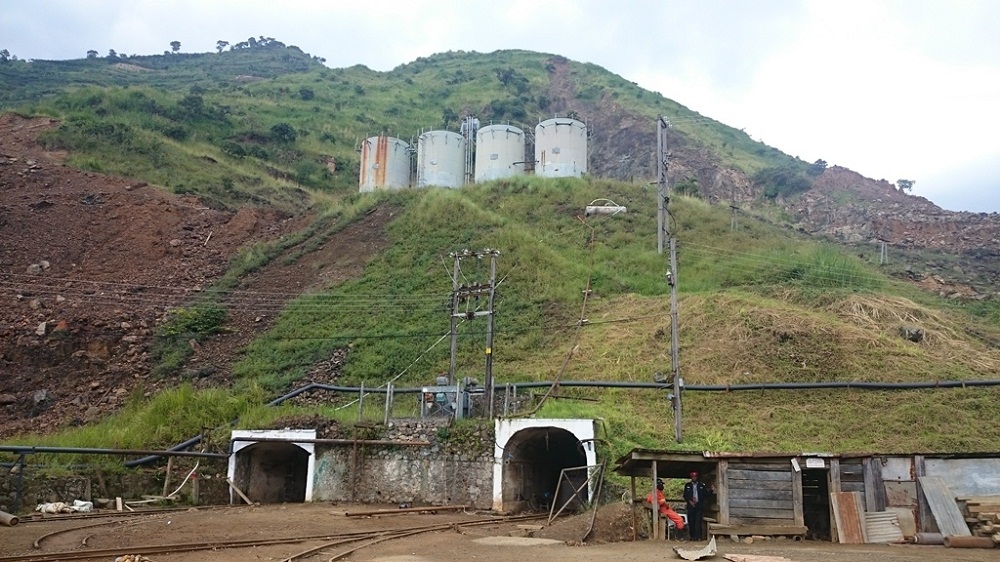
Kilembe sits in a fold of the Rwenzori foothills that most travelers pass right through without stopping. The road from Kasese follows the Nyamwamba River valley south, climbing gently through a patchwork of smallholder farms and secondary forest before the old industrial bones of the Kilembe Mines complex come into view: rusted ore-processing structures, an overhead cable car line that once carried copper ore down from the mountain, and the particular atmosphere of a place that was once the industrial heartbeat of western Uganda and has since returned to something quieter, more creaturely, more itself. Beyond the mine structures, the mountains rise so steeply that they seem less like a geographic feature and more like a wall that the sky has been propped against. This location is where the Kilembe Trail begins.
For trekkers choosing the southern approach to the Rwenzori, there are compelling reasons to choose it, which this guide will address in full. Kilembe village is what Nyakalengija is to those entering from the north: the threshold between the world below and the mountain above. Understanding how to reach it, what happens at the park gate on arrival day, where to sleep the night before your trek departs, and what the facilities look like on the ground is not peripheral planning information. This detailed, first-hand knowledge distinguishes a well-prepared expedition from one that wastes its first day solving issues that could have been fixed before the trailhead.
This guide provides that knowledge in full, drawn from direct experience leading expeditions on the Kilembe Trail and from years of coordinating pre-trek logistics for international trekkers arriving in Kasese with varying degrees of preparation. If you are seriously researching a Rwenzori trek via the southern approach, read this guide carefully. It is the resource we wish every client had encountered before they arrived.
Kilembe Village: Setting, History, and Why It Matters for Trekkers.
Kilembe is a small community in the Kasese District of western Uganda, located approximately 12 kilometers south of Kasese town along the Nyamwamba River valley. It sits at an elevation of roughly 1,450 to 1,600 metres above sea level, slightly lower than Nyakalengija on the northern side of the range, and its position on the southern flank of the Rwenzori provides it a distinctly different character from the northern trailhead. Where Nyakalengija feels like a farming village that has grown up in the shadow of the mountains, Kilembe has an industrial ghost-town quality overlaid on a natural landscape of extraordinary beauty.
The reason for that industrial character is copper. The Kilembe Mines operated from the 1950s through the early 1980s as one of Uganda’s most significant mining operations, extracting copper and cobalt ore from deposits embedded deep in the Rwenzori’s southern ridges. At its peak, the mine employed thousands of workers, supported a sizeable residential town, and contributed meaningfully to the Ugandan national economy. The overhead tramway that carried ore buckets down from the upper mine workings was an engineering landmark of its era. When the mines closed, primarily due to falling copper prices and the political instability that characterized Uganda in the late 1970s and early 1980s, the industrial infrastructure fell into disrepair. The local community absorbed the workers’ housing. The equatorial climate has steadily reclaimed the processing plant ever since.
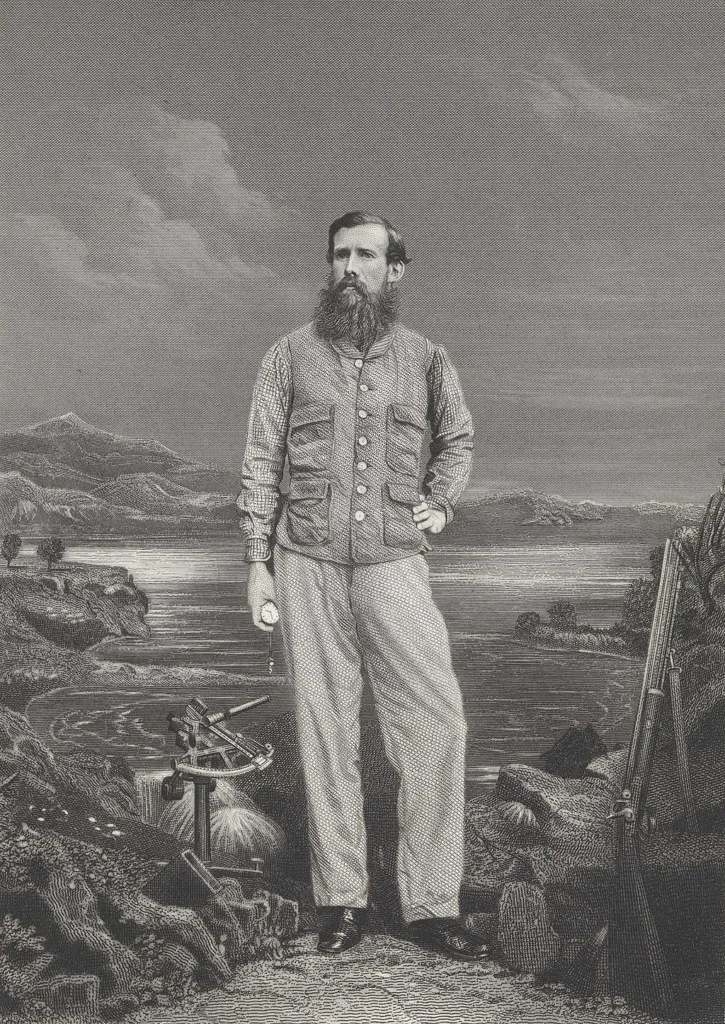
What the mining era left behind, somewhat unexpectedly, is one of the things that makes Kilembe a compelling starting point for a Rwenzori trek today. The mine access roads, tunnels, and infrastructure cut into the southern slopes of the mountain created access corridors into terrain that would otherwise be extremely difficult to penetrate. The Kilembe Trail, officially launched in 2011 by Rwenzori Trekking Services under the management of the Uganda Wildlife Authority, follows some of these corridors on its lower sections before breaking out into the spectacular valley systems and high-altitude terrain that characterize the upper mountain. The trail traces its conceptual origins back even further to the 1895 expedition of Professor Scott Elliot, whose pioneering exploration of the southern Rwenzori gave its name to the Scott Elliot Pass, one of the most dramatic high points on the Kilembe Trail route.
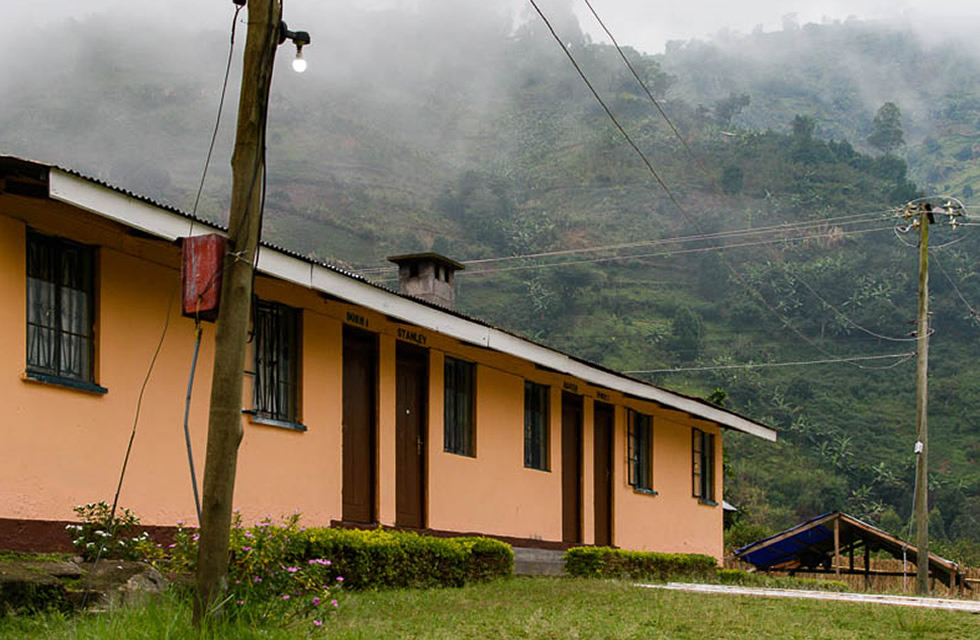
For trekkers today, Kilembe village functions as the operational base for the southern approach. The Uganda Wildlife Authority park gate for the Kilembe Trail entrance is located here, the Rwenzori Trekking Services offices that manage the trail are based nearby, and the accommodation and logistical support facilities that serve departing trekkers are concentrated in and around the village. The 8-day Kilembe Trail itinerary begins here, and so do several longer multi-peak expedition routes that use the Kilembe approach as their entry or exit point.
How to Get to Kilembe from Kasese
The Road from Kasese to Kilembe
The practical starting point for all trekkers approaching the Kilembe Trail is Kasese town, the regional center of western Uganda and the logistics hub for all Rwenzori trekking operations. From Kasese, Kilembe is closer than Nyakalengija; the drive covers approximately 12 kilometers and takes between 20 and 35 minutes under normal conditions, making it the more accessible of the two principal trailheads in simple distance terms.
The road south from Kasese to Kilembe passes through the expanding outskirts of the town before settling into a narrower tarmac road that follows the Nyamwamba River valley. The drive is scenic in a way that trickles information about the landscape ahead: the valley walls steepen progressively, the vegetation becomes denser and more layered, and the river audible from the road at points grows faster and more turbulent as the gradient increases toward the mountains. On a clear morning, the Rwenzori summits are occasionally visible above the ridgeline, though cloud typically builds by mid-morning even in the dry season.
The road surface between Kasese and Kilembe is generally in better condition than the road to Nyakalengija, though sections can deteriorate after heavy rain and the final approach to the mine complex and park gate area involves some unpaved stretches. A saloon car can make the journey in dry conditions; in the wet season or after sustained rain, a vehicle with reasonable ground clearance is advisable.
Organising Transport Through Your Operator
As with all trailhead logistics on the Rwenzori, the simplest and most reliable approach to reaching Kilembe is to have transport coordinated by your trekking operator. Rwenzori Trekking Safaris handles the Kasese-to-Kilembe transfer as standard practice for all Kilembe Trail bookings, which means the vehicle is matched to road conditions, departure timing is optimized for the gate registration process, and all gear, porter loads, group equipment, and any rental items collected in Kasese travel together under the supervision of your guide. There is a meaningful difference between arriving at a mountain trailhead in an organized group with everything accounted for and arriving having assembled your own transport with gear distributed across two or three separate vehicles of varying capacity. The first approach allows you to focus on the mountain. The second option creates unnecessary stress on a day when you should be focusing your energy and attention elsewhere.
Independent transport options from Kasese include special-hire taxis (private vehicles hired for the journey), which are available from the town center and are perfectly functional for the Kilembe trip given the short distance involved. Local residents use boda bodas for their journey, but trekkers with significant luggage find them entirely impractical. There is some shared transport between Kasese and Kilembe given that the community is large enough to sustain a degree of regular commuter traffic, though this is unreliable as a primary strategy for getting a trekking group and its equipment to the trailhead on schedule.
Arriving from Further Afield: Kampala and Entebbe
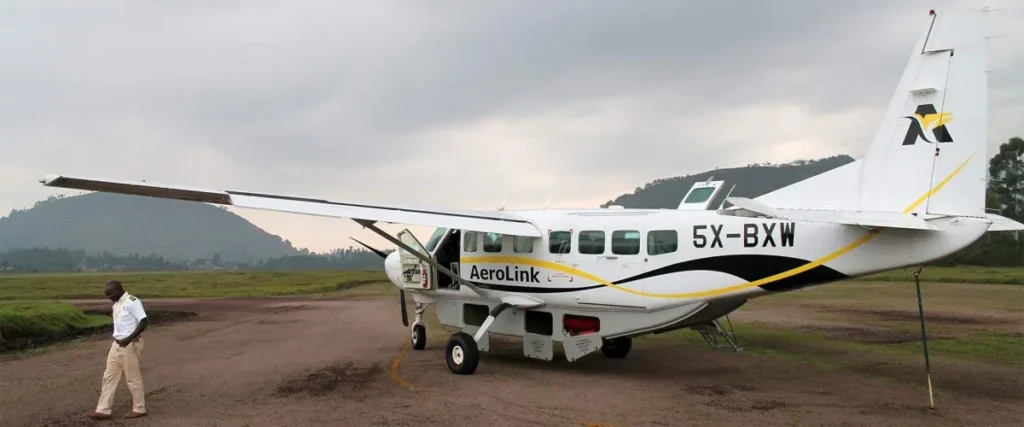
Most international trekkers arrive in Uganda via Entebbe International Airport and travel to Kasese either by road or, less commonly, by small aircraft to the Kasese airstrip. The road journey from Kampala to Kasese covers approximately 410 kilometers via the Kampala-Mbarara-Kasese highway or the Fort Portal route and takes between six and nine hours depending on traffic and road conditions. Both routes are improving steadily as part of Uganda’s infrastructure investment program, but neither is a quick motorway drive. Trekkers flying into Entebbe and then transferring directly to Kasese are strongly advised to break the journey with an overnight in either Kampala, Fort Portal, or Kasese itself rather than attempting to arrive in Kilembe on the same day as their international flight. The combination of a long-haul flight and a six-hour road journey followed immediately by the first day of a demanding mountain trek is a recipe for fatigue that affects everything that follows. The mountains will still be there tomorrow. Take the night.
Many trekkers combine their Rwenzori expedition with other Uganda wildlife experiences; gorilla trekking in Bwindi Impenetrable Forest is the most popular pairing, followed by chimpanzee tracking in Kibale National Park and game drives in Queen Elizabeth National Park. All three are within a few hours of Kasese. Trekkers arriving from Bwindi should allow a half-day or full day of travel to Kasese depending on which sector of Bwindi they are departing from and should plan an overnight in Kasese before the Kilembe transfer. Trekkers coming from Kibale or Queen Elizabeth are even closer and can generally reach Kasese comfortably in two to three hours.
Arriving at the Kilembe Trail Park Gate
The Physical Setting of the Gate
The Uganda Wildlife Authority park gate for the Kilembe Trail is located within the Kilembe Mines complex area, positioned at the point where the managed road into the mine concession meets the boundary of Rwenzori Mountains National Park. The setting is one of the more atmospherically unusual trailhead environments in East African mountaineering: the old mine infrastructure processing buildings, collapsed structures, and the rusted remnants of the cable tramway system surround the immediate vicinity, while the mountain rises immediately behind and above with a density and steepness that signals obviously that you are about to enter a genuinely wild and demanding environment.
The gate itself is a Uganda Wildlife Authority ranger station equipped with the administrative facilities required for park entry management: a registration office, a briefing area, toilet facilities, and the weighing and load distribution area where porter preparations take place. On a morning when multiple groups are departing, the gate area carries the productive, purposeful energy of expedition departure guides and porters moving with calm efficiency, trekkers conducting final gear checks, and the last cups of tea from thermos flasks that someone has brought from wherever they spent the night before.
Park Entry Permits: What You Need and How They Are Arranged
Every trekker entering Rwenzori Mountains National Park via the Kilembe gate must hold a valid Uganda Wildlife Authority national park permit, covering each day they will spend inside the park boundary. For the standard eight-day Kilembe Trail itinerary, this means obtaining permits covering the full duration of the trek. The Uganda Wildlife Authority sets the permit fees, which undergo periodic revision. Current figures should be confirmed with your operator at the time of booking, as they represent a significant component of the overall trek cost and are non-negotiable regardless of how the trip is booked.
If you book with Rwenzori Trekking Safaris, your guide will present your permits at the gate on departure day. You will not be required to purchase permits at the gate on arrival day; this process is handled on your behalf, which is one of the material advantages of booking through a specialist operator with established relationships with the UWA management system. Avoiding the uncertainty of attempting to obtain permits independently at the gate on the day of departure is easily achievable. Permit availability is managed in advance, and peak season periods, June through August and December through February, can see high demand. Book early, and book through your specialist Rwenzori operator.
The Registration Process at the Gate
The registration process at the Kilembe gate follows the same essential structure as the northern Nyakalengija gate. Each trekker in the party registers individually in the park entry record, providing their full name, nationality, passport number, emergency contact details, next-of-kin information, planned route through the park, and expected exit date. This registration is a genuine safety record rather than a bureaucratic formality: the data entered here is what rangers use to trigger a search response if a group fails to exit the park by their declared date.
Keep your passport with you and accessible, as you will need to present it for identity verification against the permit documentation. Ensure that the emergency contact information you provide is genuinely reachable from Uganda if needed. Your guide will coordinate the group’s registration, but individual trekkers must sign the register themselves. The entire registration process for a small group typically takes 20 to 30 minutes assuming the paperwork is in order.
The Pre-Trek Briefing at the Kilembe Gate
Following registration, or running parallel to it in larger groups, a Uganda Wildlife Authority ranger delivers the pre-trek orientation briefing. The briefing includes important rules for Rwenzori Mountains National Park related to the Kilembe Trail; how to manage waste and leave no trace in the high-altitude areas; what to do in an emergency, including how to report it and how rangers will respond; and any current information about the trail, like conditions affected by recent rain, the capacity of camp facilities, or any temporary restrictions.
The Kilembe Trail briefing tends to include slightly more specific terrain information than its northern equivalent, reflecting the trail’s more recent establishment and the fact that trekkers are generally less familiar with what to expect. Pay close attention to the lower valley sections; the Kilembe Trail through the Nyamwamba valley is wetter and more technically demanding than the early stages of the Central Circuit Trail north of Nyakalengija. The briefing will directly address these issues, and your guide will provide more detailed information once the group assembles and begins moving.
Porter Assignments and Load Preparation
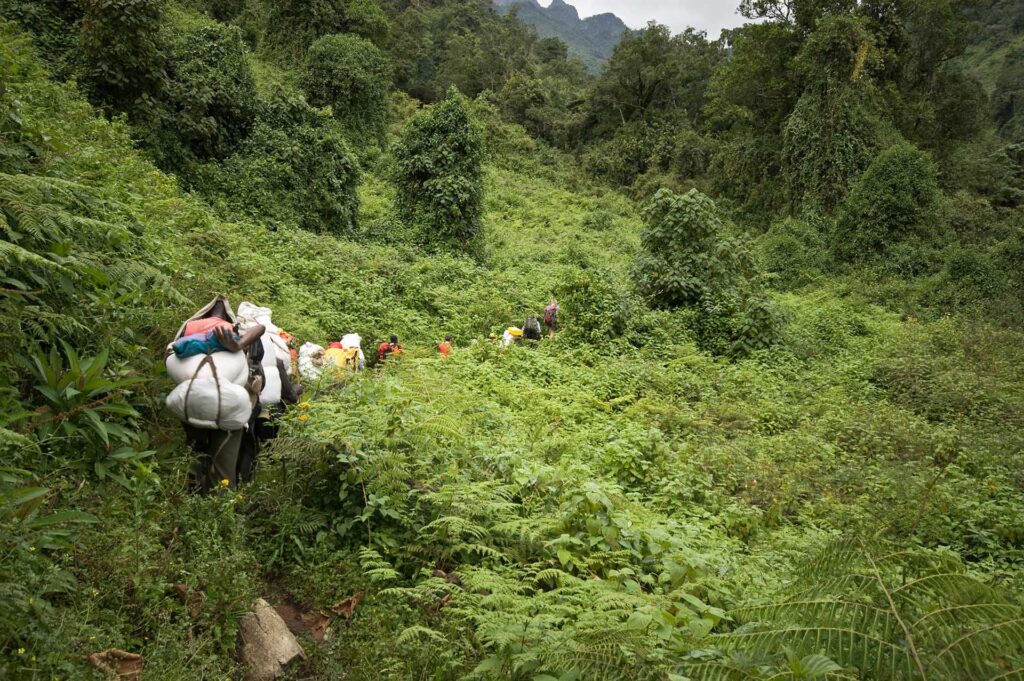
The porter assembly and load weighing process at the Kilembe gate is operationally identical to its northern equivalent: each porter load is weighed against the regulated maximum, loads are assigned to individual porters, and the guide ensures that every item of group equipment is accounted for and correctly packed before the group moves off toward the trail entrance. Kilembe porters are members of the local community and represent one of the most direct economic benefits that the trekking industry delivers to the villages around the park boundary. Rwenzori Trekking Safaris adheres strictly to fair porter employment standards, including weight limits, appropriate equipment provision, and fair wage structures.
The porter preparation process at Kilembe typically takes between 45 minutes and one and a half hours depending on group size and the complexity of the equipment inventory. Trekkers should use this time constructively: conduct a final check of your daypack, confirm that rain gear is accessible at the top of the pack rather than buried beneath everything else, fill water bottles from the cleanest available source before entering the park, and take a moment to look at the mountain above you and acknowledge, quietly, what you are about to do.
Kilembe has a bigger community than Nyakalengija because it has more buildings and services from its mining history, making it easier to find what you need near the park gate. However, trekkers should not arrive expecting the kind of gear shops, restaurants, or tourism services that characterize the gateways to more heavily visited mountains elsewhere in Africa. This is not that kind of trailhead, so it’s important to know that ahead of time.
Toilet facilities are available at the UWA ranger station for trekkers preparing to depart. There is running water in the Kilembe area, but its reliability varies, so trekkers should not plan to source all their day-one water requirements from the gate; they should carry sufficient water from wherever they spent the previous night. Basic refreshments may be available from the small shops and trading stalls that serve the local community in the Kilembe area, but these should be treated as a supplementary option rather than a primary supply strategy. You must arrange all food for the trek, whether from the operator or self-sourced, before you reach the gate.
There are no gear shops at the Kilembe trailhead. Trekkers who have not thoroughly researched often make this common practical error, so it’s important to state it clearly. Before embarking on the journey to Kilembe, trekkers must collect and confirm every item of gear, whether sourced from home or rented in Kasese. Arriving at the gate to discover a missing item means a return trip to Kasese, a significantly delayed start, and a compressed first day on a trail that is demanding under normal conditions. Avoid such situations entirely by conducting a thorough gear check in your Kasese accommodation the evening before departure.
Mobile Coverage and Communications
Mobile phone coverage is available in Kilembe village and at the park gate on the major Ugandan networks, though signal strength varies and not all international SIM cards roam on every local network equally well. Make any essential calls or send final messages before entering the park; coverage degrades rapidly once you move into the Nyamwamba valley and disappears entirely above the lower forest zone. Your guide carries emergency communication equipment appropriate to the mountain environment, and the ranger system within the park provides a framework for emergency communication beyond that. For most trekkers, the practical approach is to send a final location update to relevant contacts from Kilembe on the morning of departure and arrange a check-in protocol for your expected exit date.
Where to Stay the Night Before Your Kilembe Trail Trek
Kasese: The Primary Base
For the overwhelming majority of international trekkers, Kasese town is the right answer to the question of where to sleep the night before a Kilembe Trail departure. Given that the drive from Kasese to the Kilembe gate takes less than 35 minutes in normal conditions, there is no practical advantage to being physically closer to the trailhead that outweighs the superior accommodation, food, and logistical facilities available in Kasese town itself.
Kasese has a range of accommodation options covering most budget requirements, from modest guesthouses through to comfortable mid-range hotels with reliable hot water, functioning air conditioning, and restaurants serving adequate pre-trek fuel. ATMs are available in Kasese for final cash withdrawals; the mountain economy runs on cash, and ensuring you have sufficient Ugandan shillings before leaving town is a mundane but genuinely important practical step. Kasese offers pharmacies for any last-minute medical supplies, as well as small supermarkets and general stores for snacks, water, and personal items.
Spending the pre-trek night in Kasese also gives you the evening to confirm that your gear is complete, collect any rental equipment arranged through your operator, review the route information for the first few days of the trek, and eat a proper dinner, which is more important than it might seem, especially since the following morning involves a technically demanding first day on the mountain. The Kilembe Trail’s first camp involves a climb of several hundred meters through forest and lower valley terrain that rewards trekkers who arrive well-rested and fed.
Accommodation in the Kilembe Area
There is limited accommodation available in the Kilembe area itself for trekkers who prefer to overnight as close to the trailhead as possible. The options are basic, simple guesthouses or community-based accommodation structures that provide a functional sleeping environment without the full-service infrastructure of a Kasese hotel. The logic for staying in Kilembe rather than Kasese is primarily atmospheric: sleeping in the shadow of the mountain you will climb the following morning has a particular quality that some experienced trekkers actively seek, and the proximity means a shorter, more relaxed morning before the gate registration begins.
If you are considering accommodation in the Kilembe area, confirm the arrangement directly with your operator in advance rather than expecting to find something on arrival. Kilembe has a limited accommodation inventory, which can reach full capacity during peak trekking season. Your operator will know which options are currently functional and will have established working relationships with the relevant guesthouse owners.
A Note for Trekkers Combining the Kilembe Trail with a Traverse
Some trekkers choose to combine the Kilembe Trail with the Central Circuit by entering from one trailhead and exiting from the other, a traverse that offers the most complete possible experience of the Rwenzori, covering both the southern and northern approaches in a single extended expedition. These traverse itineraries typically enter via Kilembe and exit at Nyakalengija, or vice versa, and require transport coordination between the two trailheads at the end of the trek. If you are planning a traverse, discuss the logistics with your operator well in advance. The pre-trek night in Kasese serves both approaches equally well given the town’s central position relative to both trailheads. For traverse trekkers, the pre-trek night is also when the operator arranges the vehicle to pick you up from your exit trailhead. This kind of logistical coordination is precisely what a specialist operator like Rwenzori Trekking Safaris handles routinely as part of custom Rwenzori mountaineering expedition planning.
The Kilembe Trail vs. the Central Circuit: Choosing Your Starting Point
Trekkers who are still deciding between the two primary Rwenzori approaches will find that the choice of starting point Kilembe or Nyakalengija is closely bound up with the choice of route and overall expedition objectives. It is worth addressing the key differences here, because understanding them changes how you think about both trailheads.
The Kilembe Trail is widely regarded as the more challenging of the two primary routes on a day-by-day basis. The terrain through the Nyamwamba valley is steeper, wetter, and more technically demanding underfoot than the early stages of the Central Circuit. The trail is also significantly less frequented, which gives it a wilder, more immersive character that experienced trekkers and those seeking a less commercialized mountain experience often strongly prefer. You are unlikely to encounter other groups on the Kilembe Trail outside of the joint camps near the high peaks. On this route, the mountain feels genuinely owned by the people walking it.
The Central Circuit Trail starting in Nyakalengija is more established, with a longer track record and a larger base of trekker experience to draw on when planning. The huts and camps along the Central Circuit are well-built, and the seven-day trip is a great way to see all the different heights of the Rwenzori, from the lowland forest to the icy peak. For trekkers on their first Rwenzori expedition who want the broadest possible experience within a defined timeframe, the Central Circuit via Nyakalengija is the logical choice.
For trekkers whose primary objective is one or more of the Rwenzori’s secondary summits, Mount Baker, Mount Speke, Mount Emin, Mount Gessi, or Mount Luigi di Savoia, the Kilembe Trail approach often provides better positioning, and some of these peaks are more naturally accessed from the south than from the north. The 13-day, six-peaks expedition that takes in all the major Rwenzori summits typically uses the Kilembe Trail as a key component of the route architecture.
The First Day on the Kilembe Trail: What to Expect Beyond the Gate
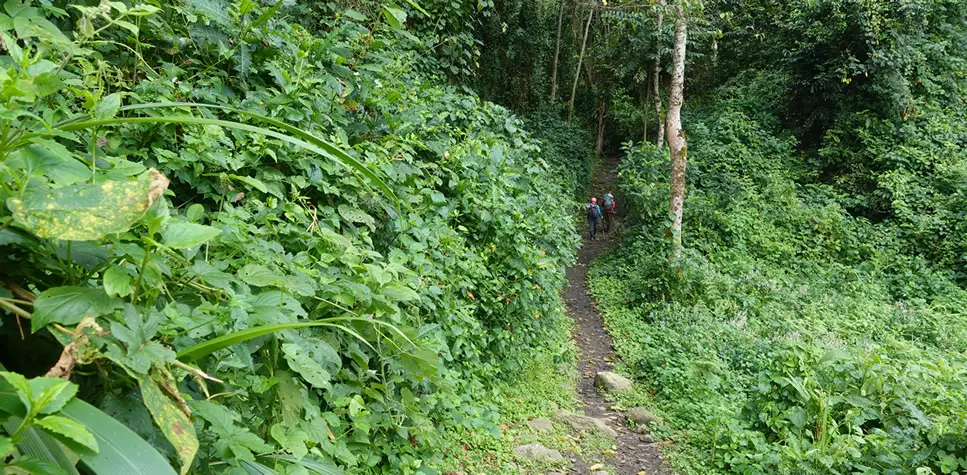
Once the gate formalities are complete and the porter loads are distributed, the group moves from the administrative world of the park gate into the ecological world of the mountain, and the transition is immediate. The Kilembe Trail’s initial stages pass through the lower sections of the Nyamwamba River valley, following a route that climbs steeply through dense montane forest with the river audible and often visible below. The forest here is genuinely old-growth in places: large Podocarpus trees, enormous fig species, and a dense understory of ferns, orchids, and moisture-loving plants that create a forest interior of extraordinary visual richness.
The trail underfoot from the first kilometers establishes the character of the Kilembe approach clearly: it is muddy, it is steep, and it requires full attention. The combination of equatorial rainfall and the southern flanks of the Rwenzori receive even more precipitation annually than the northern side, which is saying something, and heavy foot traffic from porters and trekkers creates a trail surface that varies from manageable compacted earth to deeply churned mud depending on recent weather and season. Gaiters are not optional on the Kilembe Trail from the first step. Neither is a considered approach to foot placement.
The first camp on the standard Kilembe Trail itinerary is Forest Camp, at approximately 2,600 meters, reached after a day of sustained climbing through the lower montane forest zone. It is a full and demanding day’s walking that typically takes between five and eight hours depending on group pace and conditions. Arriving at Forest Camp with energy reserves intact—rather than having burned everything in a flat-out effort to keep pace with an arbitrary schedule is one of the skills that experienced mountain travelers develop over time. Your guide will set a pace appropriate to the group, but individual trekkers who are managing their own energy output actively will have a significantly more enjoyable experience than those who simply follow without self-awareness. The mountain is long. The first day is an introduction, not a test. Treat it accordingly. For a complete breakdown of what lies beyond Forest Camp, the full Kilembe Trail route guide covers every camp and altitude zone in detail.
Kilembe as an Exit Point: The Return to the Trailhead
For trekkers completing the standard Kilembe Trail itinerary as an out-and-back route, ascending and descending via the same southern approach, the return to Kilembe at the end of the trek mirrors the outward journey in reverse. The de-registration process at the gate records your safe exit from the park, confirming to the ranger system that all members of your group have returned from the mountain. This is the administrative closure of the safety record opened at departure and should be completed without exception, even if the group is tired, running late, or eager to reach the vehicle and begin the return journey to Kasese.
After de-registration, the transport arranged by your operator will be waiting at or near the gate for a return to Kasese. The drive back, short as it is in distance, has a quality quite unlike any ordinary car journey: The accumulated experience of the preceding days sits in your body; your legs carry the particular deep fatigue of sustained mountain trekking, and the Nyamwamba valley that seemed so steep and demanding on the way up now scrolls past the window with an almost dreamlike familiarity. Most trekkers spend a final night in Kasese before continuing their Uganda itinerary, and this stop is something your operator will coordinate as part of the post-trek logistics.
Practical Checklist for the Day Before You Depart Kilembe
The 24 hours before your trek begins are among the most practically consequential of the entire expedition. Most logistical issues that can complicate the first days on the Kilembe Trail stem from things that could have been fixed the day before leaving Kasese. Experience, not theoretical checklists, informs the following guidance.
Please gather all rental gear in the afternoon prior to departure, rather than in the morning. This gives you time to identify problems (a crampon that doesn’t fit your boot sole, a sleeping bag zipper that binds, or a headlamp whose batteries are flat) and address them before you need to be at the trailhead. Confirm with your operator that all porter loads have been assembled and are ready and that the vehicle for the Kilembe transfer is confirmed for the following morning with an agreed-upon departure time.
Pack your daypack the night before. Trekking poles should be accessible without unpacking everything. Rain gear must be reachable within seconds on the Kilembe Trail; there is no warning before rain begins, and the rainfall here is heavy when it comes. Your headlamp goes at the very top of the pack, accessible in the dark. Bottles, not a filter, should hold water for the drive and the first hour of trekking.
Eat a proper dinner in Kasese, something with carbohydrates and protein, not just whatever is fastest. Drink enough water to be well-hydrated before you sleep. The first day on the Kilembe Trail climbs several hundred meters over a short horizontal distance through a heavy, humid forest. Arriving well-fueled and hydrated at the trailhead matters. If you haven’t already, please read through the Kilembe Trail camp and route overview one more time, paying attention to the elevation profile and the approximate walking times between camps. Knowing what to expect is one of the best ways to prepare mentally for a mountain trip.
Frequently Asked Questions About Kilembe Village and the Kilembe Trail Trailhead
Could you please provide the exact location of Kilembe village and its distance from Kasese?
Kilembe is a community in the Kasese District of western Uganda, located approximately 12 kilometers south of Kasese town along the Nyamwamba River valley on the southern flank of the Rwenzori Mountains. The drive from Kasese to the Kilembe park gate takes between 20 and 35 minutes in normal conditions, making it significantly closer to Kasese than the Nyakalengija trailhead on the northern side of the range. Kilembe sits at approximately 1,450–1,600 meters above sea level and is best known historically as the site of the Kilembe Mines, a copper mining operation that ran from the 1950s through the early 1980s. Today it functions primarily as the trailhead and gateway community for the Kilembe Trail into Rwenzori Mountains National Park.
What is the registration and permit process at the Kilembe Park gate?
At the Kilembe, Uganda Wildlife Authority park gate, trekkers must present valid national park permits covering each day they will spend inside the park. Your guide arranges these permits in advance and presents them at the gate if you are trekking with an organized operator. Individual trekkers register in the park entry record, providing their name, nationality, passport number, emergency contact details, planned route, and expected exit date. A UWA ranger then delivers a pre-trek orientation briefing covering park regulations, leave-no-trace practices, emergency procedures, and current trail conditions. The complete gate process registration, briefing, and porter load preparation typically takes between one and two hours. Arriving at the gate by 8:00 to 9:00 am ensures the group can set off in good time for the first camp.
Where should I stay the night before starting the Kilembe Trail?
Most international trekkers recommend Kasese town as the overnight stop before departing for the Kilembe Trail. The drive from Kasese to the Kilembe gate takes less than 35 minutes, so staying in Kasese does not create any meaningful logistical disadvantage, and Kasese offers significantly better accommodation, food, and facilities than are available in the Kilembe area itself. Hotels and guesthouses, functioning ATMs, pharmacies, and restaurants in Kasese offer a variety of options for a proper pre-trek dinner. Trekkers who want to sleep near the trailhead can find basic lodging in Kilembe, but it must be booked in advance due to limited availability. Camping near the trailhead is possible for groups with appropriate equipment.
What facilities are available at the Kilembe trailhead?
The Kilembe trailhead has a Uganda Wildlife Authority ranger station with toilet facilities available for departing trekkers. Some basic food and drinks may be available from local shops and stalls in the Kilembe community near the gate, but trekkers should not rely on this as a primary supply source—all food for the trek must be organized before arriving at Kilembe. There are no gear shops at the Kilembe trailhead. All equipment, whether personal or rented, must be sourced in Kasese before the journey to the gate. Mobile phone coverage is available in Kilembe village on the major Ugandan networks but deteriorates rapidly once trekkers enter the Nyamwamba valley and disappears entirely above the lower forest zone.
How does the Kilembe Trail compare to the Central Circuit Trail as a starting point?
The two trails offer meaningfully different experiences even from the first day. The Kilembe Trail, starting from Kilembe village on the southern flank of the Rwenzori, is generally considered more technically demanding and physically challenging than the Central Circuit Trail, which starts from Nyakalengija on the northern side. The Kilembe Trail passes through terrain that is steeper, wetter, and more rugged in its lower sections, and it receives substantially less trekker traffic, giving it a wilder and less commercialized character. The Central Circuit Trail is better established, more frequently trekked, and follows a route that circuits the central peaks in approximately seven days, making it a highly efficient choice for trekkers wanting a complete Rwenzori experience within a fixed timeframe. Both trails lead to the high peaks, and both can include a summit attempt on Margherita Peak. The choice between them ultimately depends on the trekker’s experience level, appetite for challenge, and preference for a more remote versus more established mountain environment.
Do I need a permit to start the Kilembe Trail, and is it possible to purchase it at the gate on the day?
Yes, a Uganda Wildlife Authority national park permit is required before entering the park through the Kilembe gate, and this permit should be organized before arrival rather than purchased at the gate that day. Park permit fees are calculated per day inside the park and represent a significant component of the total trek cost. Trekkers who book with an organized operator will have their permits arranged as part of the booking process. Attempting to purchase permits at the gate on the morning of departure creates uncertainty and potential delays, particularly during peak trekking season when permit supply may be limited. Confirm permit arrangements with your operator well before your trek date.
What elevation does the Kilembe Trail start at, and what altitude does it reach?
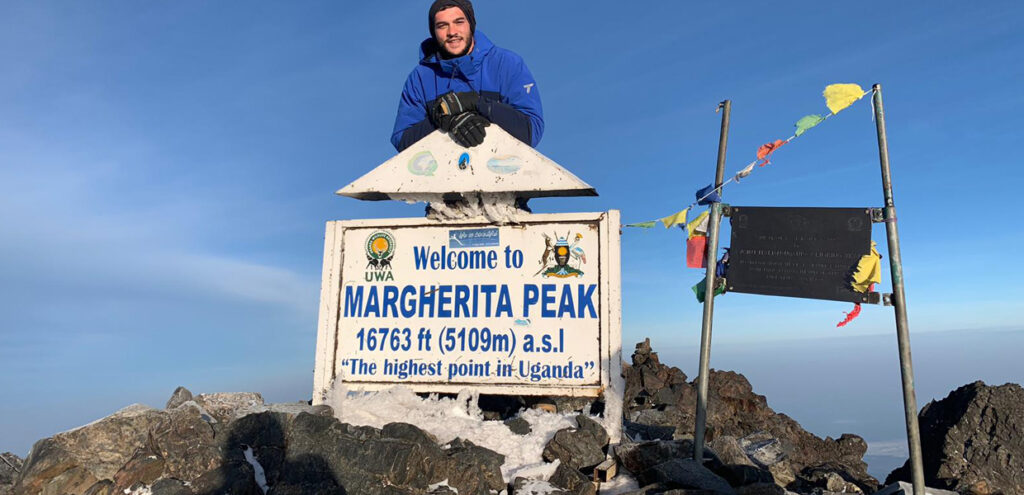
The Kilembe Trail begins approximately 1,450 to 1,600 meters above sea level at the Kilembe Park Gate. The first camp, Forest Camp, is situated at about 2,600 meters. The trail then climbs progressively through successive altitude zones: Kalalama Camp at approximately 3,134 m, Sine Hut at around 3,600 m, and Mutinda Camp at approximately 4,023 m before reaching the high mountain terrain above 4,500 m that leads to the summit approaches of the major Rwenzori peaks. Summit attempts to reach Margherita Peak on Mount Stanley at 5,109 meters above sea level, representing a total altitude gain of over 3,500 meters from the Kilembe trailhead. The multi-day approach provides a reasonable opportunity for acclimatization, though the steep daily gains in the lower sections of the trail demand careful attention to pace and hydration.
Is Kilembe used as both an entry and an exit point for Rwenzori treks?
Yes. For trekkers completing the standard Kilembe Trail itinerary as an out-and-back route, Kilembe serves as both the starting and finishing point, and deregistration at the gate on return is required to formally close the park entry record. Some trekkers use Kilembe as one end of a traverse itinerary, entering via Kilembe and exiting at Nyakalengija on the northern side of the range, or the reverse. These traverse routes require transport coordination between the two trailheads and are best arranged through an operator experienced with both approaches. The traverse option offers the most complete possible Rwenzori experience, covering both the southern and northern ecological corridors of the range in a single expedition.
Ready to Trek the Kilembe Trail? Let’s Get You to the Mountain.
Kilembe Village is not a destination in itself; it is the starting line for one of the most rewarding trekking experiences in Africa. Getting the trailhead logistics right, from the night-before accommodation to the gate registration to the porter preparation, is the foundation on which everything that follows on the mountain is built. We have coordinated hundreds of Kilembe trailhead departures and handled every logistical question.
If you are planning a Kilembe Trail trek, a multi-peak summit expedition combining the southern approach with targets including Mount Baker, Mount Speke, and Margherita Peak on Mount Stanley, or a traverse that combines the Kilembe and Central Circuit approaches into a single extended expedition, get in touch with the Rwenzori Trekking Safaris team. Tell us your preferred dates, your group size, your experience level, and what you want to achieve. We will build you a complete expedition proposal including trailhead logistics, accommodation recommendations, permit coordination, gear advice, and a day-by-day itinerary so that when you arrive in Kasese, the mountain is the only thing on your mind.
The Kilembe Trail is waiting. The Mountains of the Moon are waiting. Start the conversation today.
ANY QUESTIONS?
If you need any clarification about a Rwenzori trek, contact one of our trekking experts to start planning your journey today.
A 10% percentage of your safari proceeds goes to supporting the local Bakonjo Communities (orphans, schools & homes)
Simply incredible I have been very fortunate to go trekking and climbing in many incredible places around the world over the years, the Rwenzori mountains are one of the most incredible places I have ever visited. Rwenzori Trekking Safaris organized my trip to do the central circuit and summit Margherita peak. The guides, Josephat and Joackim, and porters were all friendly and helpful. The food was plentiful, but I suggest bringing some of your own day snacks you might like as well as rubber knee high boots, I suggest LaCrosse Burly Aero. I was able to complete the loop and peak in 4 days, but most people take 7-8 days I believe which is definitely recommended for acclimatization. There are new huts being built at Elena camp and Nyabitaba that cost a small amount extra, so ask about that too. Its a real adventure and in my experience way more rugged, beautiful, and less traveled than Kilimanjaro. The landscapes and unique plant life are like out of Jurassic Park.
Posted on Tripadvisor
Simon B
Verified
A wonderful experience in the Rwenzoris We did the seven-day Central Circuit and had a wonderful experience. The landscapes were spectacular and really diverse. Also, the guides, porters and cooks were super friendly and helpful. Thank you very much!
Posted on Tripadvisor
Explorer43375006028
Verified
Magical mountain forest We did the two day hike to Mahoma Lake, and it was beautiful. The guide was superfriendly, the coock made a great stew and the porters were really nice.
Posted on Tripadvisor
Dominic N
Verified
Forget Kilimanjaro, do this instead! A beautiful and surreal 4 day hike in the Rwenzori mountains to Mutinda Lookout, made by the staff. Good food, good basic camp accommodation, excellent knowledge of the guides and lots of laughs. I did this trip solo and joined a welcoming group of 6. Pack for all weather, it gets particularly cold at night at Mutinda camp. Total cost was $635/2.2m UGX
Verified by Trustindex
Trustindex verified badge is the Universal Symbol of Trust. Only the greatest companies can get the verified badge who has a review score above 4.5, based on customer reviews over the past 12 months. Read more
Hi there, welcome. Need help planning a trek, safari, or adventure? Chat directly with a real expert and mountain guide for honest advice, clear answers, and practical recommendations. No guesswork, no pressure.