Rwenzori Giant Plants: Africa’s Prehistoric Vegetation. Giant lobelias, 6m groundsels & tree heathers of Rwenzori: the science, species guide & best trails to see Africa’s most extraordinary alpine plants.
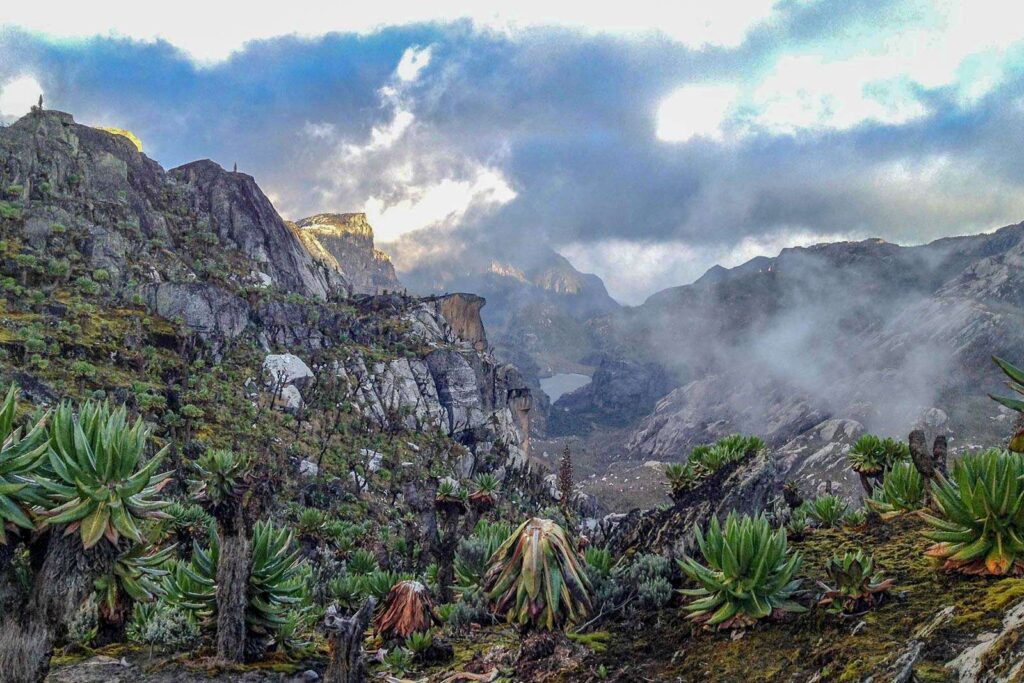
There is a moment on the Central Circuit Trail , somewhere between John Matte Hut and the Bujuku Valley, when the landscape changes so completely and so suddenly that even trekkers who have been preparing for this moment feel unprepared for it. The trail opens from the mossy heather forest into a wide, cloud-draped bog, and rising from the saturated ground around you are plants that do not look like they belong to this planet, let alone to equatorial Africa. Cabbage-like crowns perched atop shaggy, two-meter trunks. Towering flower spikes of blue-green that rise four metres from rosette bases the size of café tables. Trees whose branches disappear into a grey beard of hanging moss twenty metres long. Nothing you have read about the Rwenzori Mountains has quite prepared you for the reality of standing inside a giant groundsel forest with clouds moving through it at eye level, in silence, at 4,000 metres above sea level, on the equator.
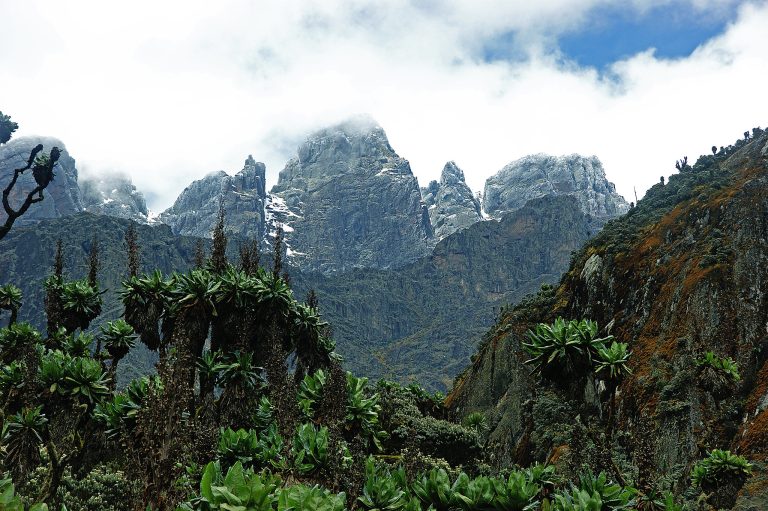
This view is the Rwenzori’s most extraordinary gift to the trekker who has put in the effort to reach it: a landscape of prehistoric-scale vegetation that evolution built separately from the rest of Africa, responding to conditions so specific to these mountains that the combination of equatorial UV intensity, nightly freezing temperatures, persistent moisture, and geological isolation means that the plants that grow here are found nowhere else on Earth in quite this form or scale. I have guided dozens of expeditions through this vegetation, and I find, consistently, that it produces a more profound sensory response in trekkers than almost any other experience the mountain offers, including the summit of Margherita Peak itself.
This guide comprehensively covers the giant plants of the Rwenzori: their nature, size, locations on each trail, what their gigantism reveals about this extraordinary mountain range, and how the loss of the Rwenzori’s glaciers threatens the conditions that created and sustain them. Read it before you trek, and the forest will speak to you differently than it speaks to those who arrive without context.
High-Altitude Gigantism: The Science Behind Africa’s Largest Plants
The phenomenon that produces the Rwenzori’s giant plants is known scientifically as “high-altitude gigantism” a term that describes the tendency of certain plant lineages to develop dramatically larger bodies when they occupy high-altitude equatorial environments compared to their lower-altitude or higher-latitude relatives. It is not a characteristic of all plants at altitude; it is specific to particular evolutionary lineages that have developed the physiological and structural adaptations to exploit a very unusual combination of environmental conditions.
The driver of this gigantism is, at its heart, a problem of temperature extremes. At the equatorial high altitudes of the Rwenzori, between 3,500 and 4,500 metres the diurnal temperature cycle is more extreme than at almost any other location in the world. Daytime temperatures may reach 15°C to 20°C under direct sun, with UV radiation at this altitude approximately 40% more intense than at sea level. At night, the same plants that experienced warm-sun afternoons face temperatures that drop to -5°C and below, a freeze-thaw cycle that repeats every single day, every single night, 365 days a year. This phenomenon is sometimes described as “summer every day, winter every night” a rhythmic thermal stress that the vegetation zones of higher latitudes never experience because their winters and summers are measured in months, not hours.
The Evolutionary Response to Daily Freeze-Thaw Cycling
Plants that survive in this environment have, over millions of years, evolved solutions to the nightly freeze problem that happen to produce gigantism as a structural byproduct. The giant groundsels (Senecio and Dendrosenecio species) insulate their meristems, the actively growing tissue at the plant’s growth points, within dense rosettes of overlapping leaves that close at night, trapping warmth and preventing ice crystal formation in the most metabolically active tissue. The larger the rosette, the better the insulation. The taller the trunk, the higher the rosette above the cold air layer that pools at ground level on calm, clear nights. Both greater diameter and greater height are directly adaptive, which is why natural selection has relentlessly pushed these plants toward the impressive dimensions we see today.
The giant lobelias solve the same freezing problem through a different architectural strategy. Lobelia wollastonii maintains a cup-like rosette that fills with water, which freezes more slowly than air, providing a thermal buffer around the growing point. At night, the rosette partially closes over the water-filled cup, slowing heat loss further. The plant is, in effect, a living thermos. The lobelia’s enormous flower spikes and broad rosettes have evolved to scales that provide a selective advantage by being larger, having more water volume, and offering better insulation, making them unmistakable even from a distance of fifty metres across a mountain bog.
Why choose the Rwenzori over other African mountains?
Giant groundsels and giant lobelias exist on other African mountains. Mount Kenya, the Aberdare Range, and the Virunga volcanoes all have representatives of these lineages at altitude. But the Rwenzori’s versions are larger, more diverse, and more densely distributed than anywhere else. The reasons come from the mountain’s special mix of features: its very high rainfall (one of the wettest mountain ranges in Africa); its geological stability as a non-volcanic block that has kept its height without major changes for three to four million years; and the depth of its bog substrates, the ancient peat deposits that lie under the Bujuku Valley and other upper basins, providing a continuous growth medium that holds water very well.
The Rwenzori’s isolation as a biological island, a high massif surrounded by the lower rift valley and the Congo Basin, has also allowed its plant lineages to evolve in relative genetic isolation, producing the high degree of endemism that makes the Rwenzori’s flora a global conservation priority. Many of the giant plants you will encounter on the 7-day Central Circuit trek exist nowhere else on Earth in the form they take here. This area is not a botanical garden. This phenomenon is evolution in full expression, in a place where the conditions required to trigger it have persisted, largely unchanged, for millions of years.
Giant Groundsels: The Rwenzori’s Most Iconic Plants
Senecio adnivalis, the Snow Groundsel
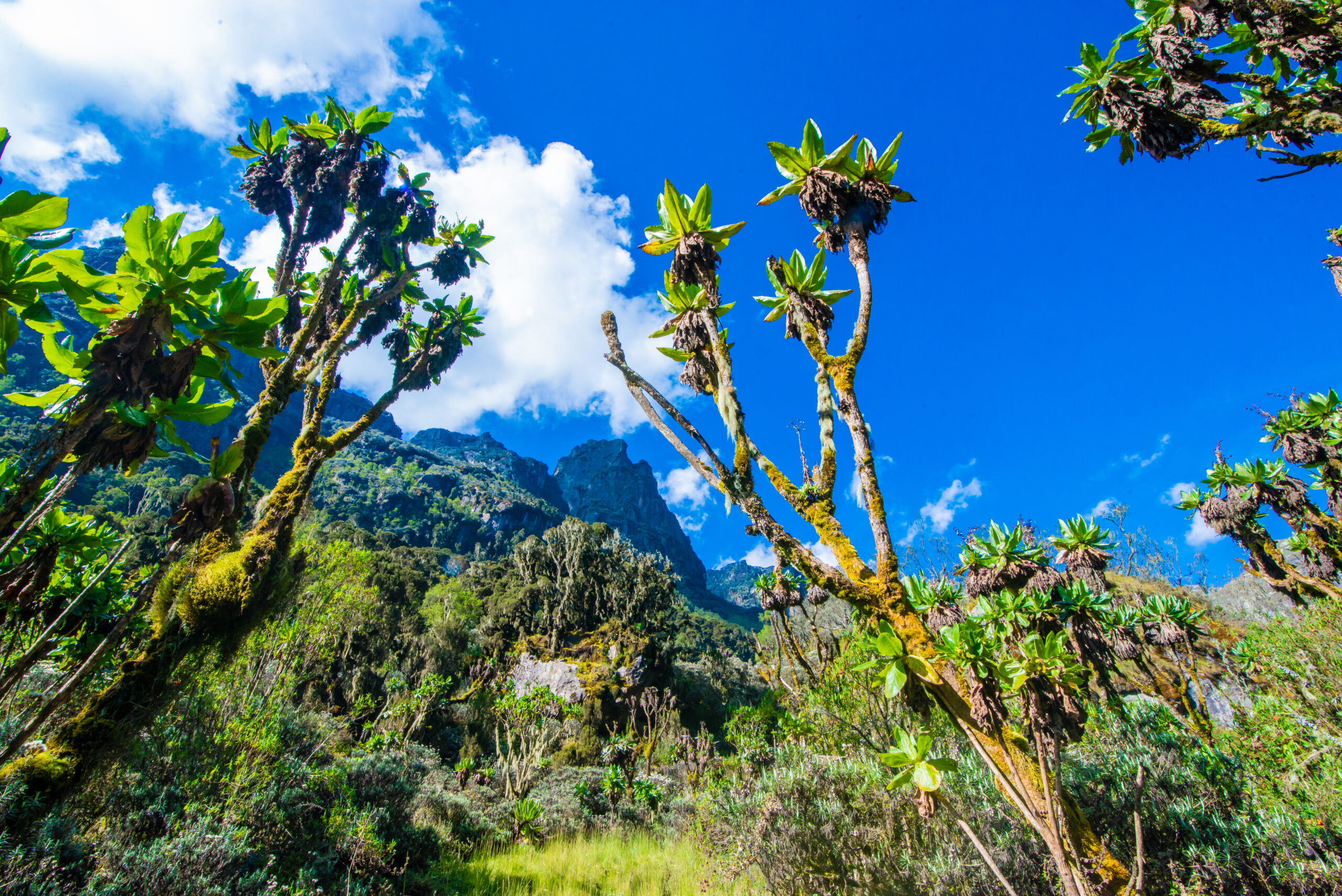
The groundsel most commonly encountered by trekkers in the Rwenzori’s upper alpine zone is Senecio adnivalis, the snow groundsel, or “giant groundsel” in common trekking parlance. It grows at altitudes between 3,500 and 4,500 metres and is the dominant large plant in the open bog and moorland communities of the Bujuku Valley and the approaches to the Freshfield and Scott Elliot Passes. Its silhouette is unmistakable: a branching, shaggy-barked trunk of dead, persistent leaf bases. The plant retains its old leaves as insulating armor around the stem, topped by one or more rosette crowns of large, grey-green, spatula-shaped leaves that can exceed 40 centimeters in length. The overall height of a mature specimen can reach four to six metres, with the trunk alone sometimes exceeding three metres.
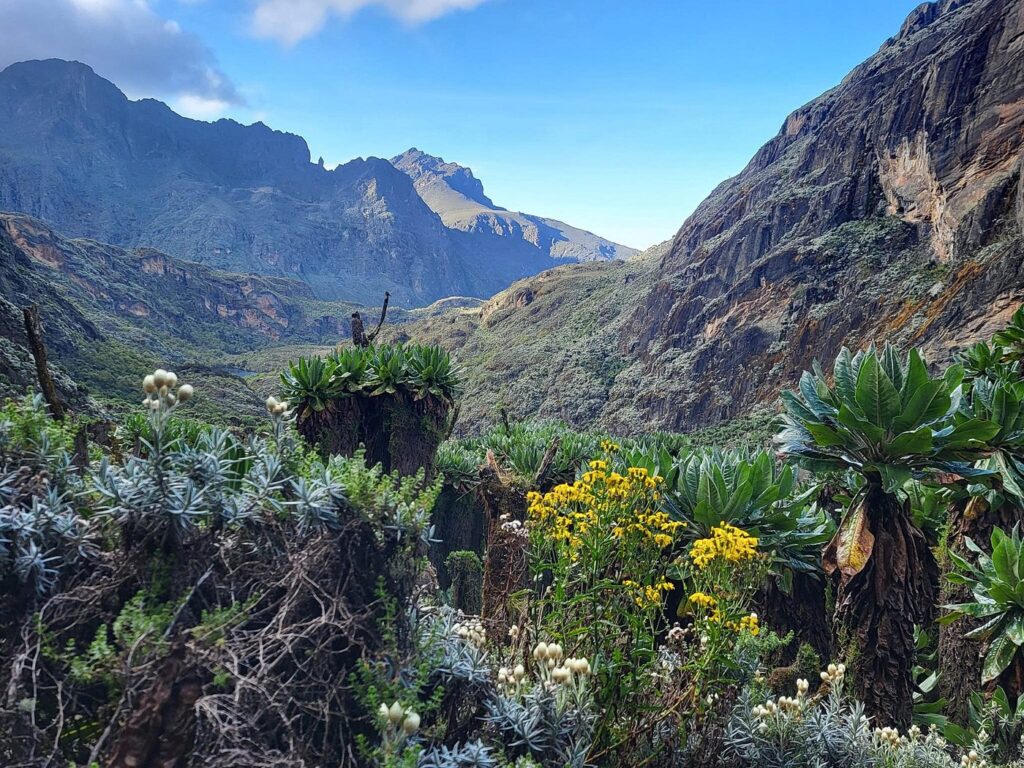
In flower, which occurs seasonally and irregularly, the rosette crown produces an upright stalk of small, daisy-like yellow flowers typical of the family Asteraceae, to which all groundsels belong. The contrast between the enormous vegetative scale of the plant and the relative modesty of its individual flowers is one of the Rwenzori’s recurring botanical surprises: the giant is, at its reproductive core, a daisy. The flowers attract a range of insects, including sunbirds and specialized alpine bees, which are active in the brief warm windows of the Rwenzori day.
Dendrosenecio adnivalis, the Tree Groundsel
Taxonomic revisions have led to some Rwenzori groundsel species being reclassified under the genus Dendrosenecio (meaning “tree groundsel”) to better reflect their arboreal character, an entirely appropriate revision for plants that have, by any functional definition, become trees. The Dendrosenecio grouping captures the most spectacular upper-alpine specimens, whose woody, persistent trunks have over decades built trunk diameters exceeding 30 centimeters. Where multiple stems branch from a single root system, the effect is that of a multi-armed candlestick tree, a form that photographs from the Rwenzori’s upper alpine zone have made iconic in botanical and adventure photography circles.
The giant groundsels of the Bujuku Valley are at their most photogenic in the first two hours after sunrise, when low-angle light illuminates the crown rosettes from below and traces the texture of the dead-leaf trunk armor with long shadows. Clouds typically build from mid-morning; composition becomes more atmospheric, but the dramatic light window closes quickly. Plan your Bujuku morning with photography in mind. Our campsite guide notes the specific viewpoints from each hut.
Where to Find Giant Groundsels on the Rwenzori Trails
The densest concentrations of Senecio adnivalis and Dendrosenecio on any Rwenzori trail are found in the Bujuku Valley on the Central Circuit Trail, between the valley floor at approximately 3,800 metres and the approaches to the Scott Elliot Pass at 4,372 metres. The trail from Bujuku Hut to Elena Hut passes through the densest stands of groundsel along the entire route. Trekkers walking this section in the early morning, before clouds build, walk through a landscape that has no parallel anywhere in Africa. The groundsel here is at its maximum density and stature.
On the Kilembe Trail, giant groundsels begin to appear in earnest above Mutinda Camp at 3,700 metres and become the dominant vegetation in the upper trail sections approaching Bugata and Hunwicks Camps. The Mutinda Lookout, at approximately 4,000 metres provides a panoramic view in which groundsels are visible across the entire upper valley landscape, a ground-level view that cannot be fully replicated even by the best aerial photography. The Bukurungu Trail goes through groundsel communities between its alpine lake sections, where the specimens growing in wetter microhabitats around the lake margins are among the most impressive in the range.
Giant Lobelias: The Rwenzori’s Living Thermoses
Lobelia wollastonii, the Giant Alpine Lobelia
Of all the Rwenzori’s giant plants, Lobelia wollastonii, named after Alexander Frederick Richmond Wollaston, the British naturalist who participated in the Duke of Abruzzi’s 1906 expedition and collected the type specimen, is the one that most reliably produces an exclamation from trekkers encountering it for the first time. Its flowering spike can reach three to four metres above the rosette base, producing a dense column of small, pendulous, blue-green tubular flowers that is simultaneously beautiful and improbable at this altitude. The base rosette, the central living heart of the plant, can exceed one meter in diameter, its overlapping, strap-shaped leaves arranged with the mathematical precision of a living fortification against the nightly freeze.
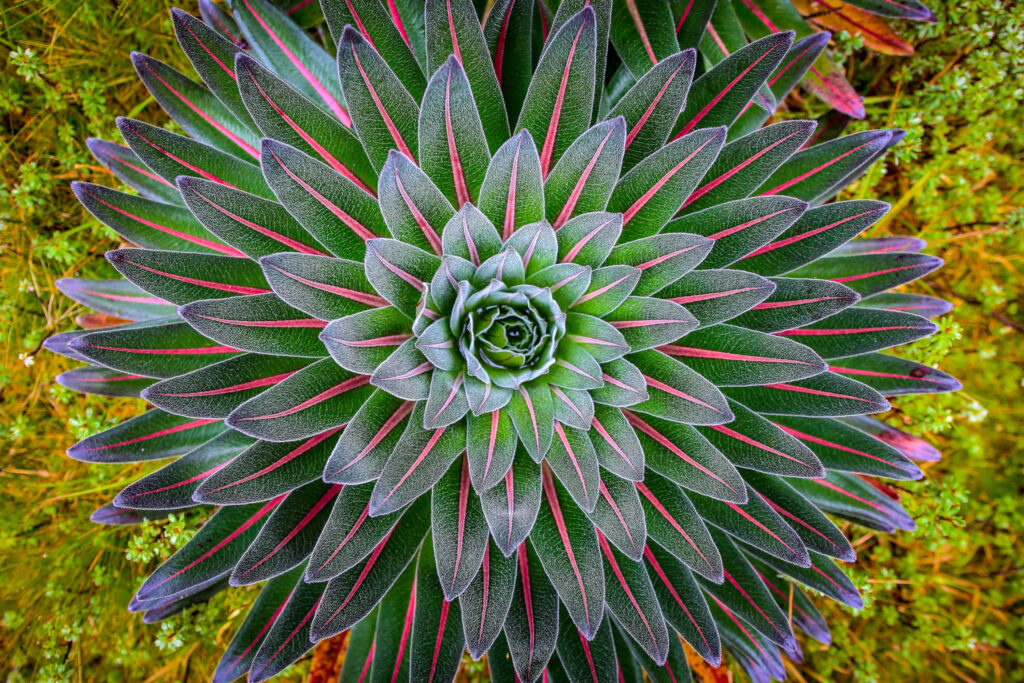
The water-filled cup formed by the inner rosette leaves is one of the most studied adaptations in alpine plant biology. On a still, clear Rwenzori night when temperatures fall below -5°C, this cup of water , protected by the overlapping leaf canopy and insulated by the surrounding rosette mass, may remain liquid or freeze only at its edges, while the surrounding air temperatures would freeze exposed water within minutes. The plant has effectively invented the thermos flask millions of years before a Swedish inventor filed his patent. This observation is not merely whimsical: it is the central adaptive insight that explains why Lobelia wollastonii can thrive at altitudes where most plants cannot survive the nightly cold cycle.
The Lobelia’s Relationship with the Rwenzori’s Bog Ecosystem
Giant lobelias are not randomly distributed across the Rwenzori’s upper alpine zone; they are concentrated in the bog communities of the valley floors, where permanent soil moisture and the particular chemistry of the ancient peat substrate provide optimal growing conditions. The Rwenzori’s lobelia heartland lies in the bogs of the Bujuku Valley, crossed on the Central Circuit via wooden bog bridges that protect the underlying peat from damage. Walking these bog bridges at first light, with lobelia flower spikes emerging from the mist on all sides, is one of the most visually extraordinary experiences available on any trekking route in Africa.
The relationship between the lobelias and the bog peat is mutually reinforcing. The lobelia’s rosette catches rainfall and sends it into the peat substrate through its root system; the peat’s ability to hold water creates the consistently saturated conditions that the lobelia’s roots need. This mutual dependency means that changes to the hydrological regime of the upper Rwenzori, whether through glacier loss, altered precipitation patterns, or peat degradation, affect the lobelias as directly as the groundsels. The retreat of the Rwenzori’s glaciers is not merely a headline about ice; it is a story about the future of every giant plant you will encounter on the upper mountain.
Lobelia bequaertii and Other Rwenzori Lobelia Species
The Rwenzori hosts multiple species of giant lobelia, with Lobelia wollastonii being the most prominent in the upper alpine zone and Lobelia bequaertii occupying somewhat lower and wetter sites, particularly in the heather-moorland transition zones between 3,000 and 3,800 metres. Lobelia bequaertii is generally smaller than Lobelia wollastonii but produces the same remarkable flower spike architecture and the same cup-of-water rosette strategy. The co-occurrence of multiple lobelia species across the Rwenzori’s altitude gradient is itself evidence of the evolutionary radiation that the mountain’s long geological stability and isolation have enabled. The ancestral lobelia lineage arrived on the mountain and diversified into multiple ecological niches as altitude increased and conditions changed.
Tree Heathers: The Cathedral Forests of the Middle Mountain
Erica arborea and Erica johnstonii Heather as a forest
Below the giant groundsel and lobelia zone of the upper alpine, between approximately 2,500 and 4,000 metres, the Rwenzori Mountains are dominated by tree heathers, members of the genus Erica that have, like the groundsels and lobelias, grown to scales that defy the casual use of the word “heather.” In temperate Europe, heather (Erica species) is a low-growing moorland shrub rarely exceeding 50 centimeters. In the Rwenzori, the same evolutionary lineage has produced Erica arborea trees reaching ten metres in height and the Rwenzori-endemic Erica johnstonii at eight metres with trunks of wrinkled, silver-grey bark and branch systems draped so densely in hanging lichen and moss that individual tree forms become impossible to distinguish within the canopy mass.

Walking through the tree-heather forest of the Rwenzori is one of the most psychologically disorienting experiences the mountain offers, and I mean this as the highest compliment. The density of the epiphytic moss and lichen on every surface absorbs sound, creates a peculiar acoustic stillness, and softens all edges until the path feels more like a tunnel through living material than a trail through an identifiable landscape. The light that penetrates the heather canopy is filtered to a diffuse, blue-grey quality that makes the interior of these forests feel neither like day nor night but something specifically in between. Trekkers who have photographed the heather forests describe the experience as “like shooting inside a cloud. “That is accurate.
The Moss and Lichen Communities of the Heather Zone
The tree heather forest of the Rwenzori is not merely a community of large Erica trees; it is an entire ecosystem structured around the tree heathers as its architectural foundation. The branches of Erica arborea and Erica johnstonii support hundreds of species of epiphytic mosses (especially various Sphagnum species that hang down from branches in long curtains), liverworts, and lichen communities, creating a total biomass of epiphytes that, in some studies, is greater than the biomass of the trees themselves. The hanging moss creates a visual effect that most trekkers compare to dreadlocks, to Spanish moss of the American South, or simply to “something from a fantasy novel” all of which are attempts to describe a visual experience that has no adequate precedent for most visitors.
The Kilembe Trail passes through some of the most intact tree-heather forest in the Rwenzori range, between Sine Camp and the Mutinda Camp transition. The 3-day Sine Camp and Samalira Falls hike passes through this heather environment specifically during the middle trail sections, where the trees are at maximum density and epiphytic development. The 4-day Rwenzori Waterfalls Hike traverses the heather zone in both ascent and descent directions, giving trekkers the opportunity to experience the forest’s different quality of light at different times of day.
Giant St John’s Wort: The Heather Zone’s Sunlit Accent
Hypericum revolutum, the giant St. John’s Wort, provides the most vivid splash of color in the otherwise green-and-grey world of the heather forest and open moorland zones between 2,500 and 4,000 metres. Growing as a large shrub or small tree reaching four to five metres, Hypericum revolutum produces clusters of bright yellow flowers with prominent stamens that are visible from a considerable distance against the dark background of the heather canopy. In European contexts, St. John’s Wort (Hypericum perforatum) is a modest herb of roadsides and meadows. In the Rwenzori, the evolutionary logic of altitude has produced a tree-like relative whose yellow flowers are one of the most photographed features of the mid-altitude trail.
The Five Vegetation Zones: A Trekker’s Botanical Journey from Valley to Summit
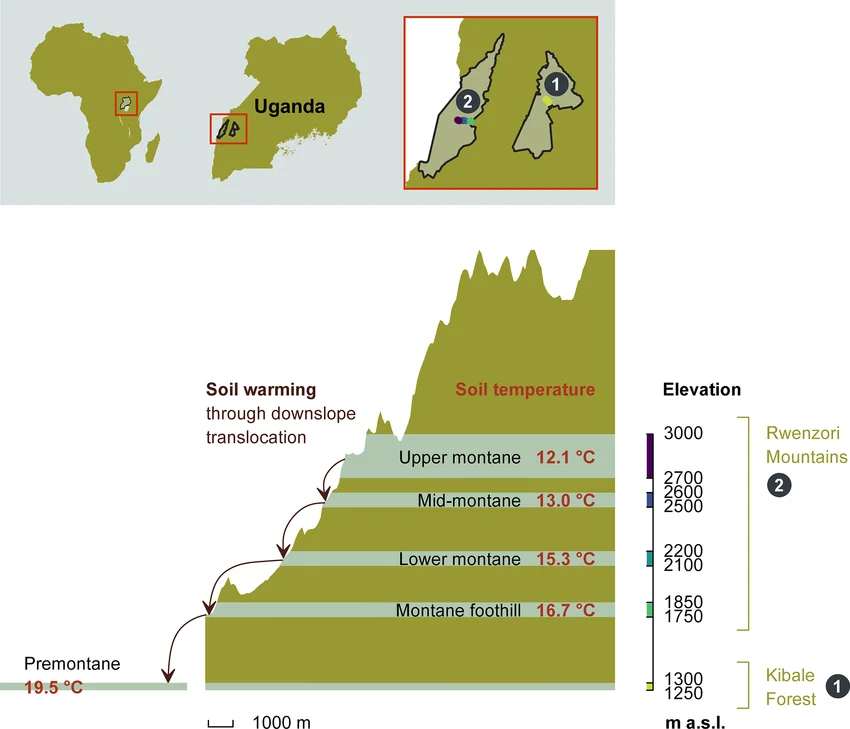
Understanding the Rwenzori’s giant plants alone misses the bigger picture: they are part of a vertical sequence of vegetation zones that includes five entirely different ecological communities between the trailhead and the permanent snowfields. No other trekking route in Africa allows a trekker to pass through an equivalent range of ecological communities in a single ascending journey. The full vegetation zone guide on our website covers each zone in depth; what follows here is the botanical story of each zone as you will experience it day by day on the trail.
Zone One: Montane Forest (1,800–2,500 metres)
The trail from Nyakalengija into the forest begins immediately in the dense, multi-story montane rainforest that covers the lower slopes of the Rwenzori up to approximately 2,500 metres. This area is not yet the zone of giant groundsels and lobelias, but it is botanically remarkable. The montane forest is dominated by large hardwood trees, including species of Podocarpus (yellowwood) and Symphonia globulifera, beneath which a dense understory of ferns, herbs, and epiphytic orchids creates the classic architecture of tropical mountain forests. This region is the zone of maximum wildlife activity. L’Hoest’s monkeys, colobus, the Rwenzori turaco, and three-horned chameleons are all most readily observed here in the first day’s walking from the trailhead to Nyabitaba Hut.
Zone Two: Bamboo and Transitional Forest (2,500–3,000 metres)
Above approximately 2,400 metres, the hardwood forest gives way to a dense bamboo zone dominated by Arundinaria alpina, the same African alpine bamboo that forms part of the mountain gorilla’s habitat in the Bwindi and Virunga ranges. The bamboo stands of the Rwenzori are dense, tightly spaced, and create a characteristic acoustic environment: the hollow knock of bamboo culms in wind, the dry rustle of leaves, and the sudden opening of the canopy where the bamboo yields way to the first heather trees. This zone is transitional between the dense lower forest and the open heather moorland above, and species from both adjacent zones are present, creating the highest botanical diversity per vertical meter of the entire altitude range.
Zone Three: Heather Moorland (3,000–3,500 metres)
The heather moorland zone is where the tree heathers (Erica arborea and Erica johnstonii) are dominant. This zone corresponds to the section of the Central Circuit Trail between John Matte Hut and the lower Bujuku Valley, and to the mid-trail section of the Kilembe Trail between Sine and Mutinda Camps. The giant Hypericum revolutum brightens the open areas between heather stands, and the first appearances of Senecio specimens begin at the upper edge of this zone as altitude approaches 3,500 metres. The heather moorland zone is where the Rwenzori’s bog character begins to assert itself; waterlogged sections require gaiters, and bog bridges become common trail features.
Zone Four: Afro-Alpine (3,500–4,500 metres)
The Afro-alpine zone is the Rwenzori’s most celebrated and most photographed botanical environment. This is where giant groundsels and giant lobelias grow the most densely, are the biggest, and dominate the ecosystem; where the Dendrosenecio six-meter trunks rise from the bog; where Lobelia wollastonii spikes punctuate every opening in the vegetation; and where the everlasting flowers (Helichrysum stuhlmannii) form silver carpets across the drier ridgelines between bog hollows. This zone corresponds to the Bujuku Valley and the trail sections approaching Elena Hut and the Freshfield Pass on the Central Circuit, as well as to the upper Kilembe Trail above Bugata Camp. The 4-day Mutinda Lookout trek reaches the edge of the Afro-alpine zone, offering trekkers on shorter itineraries their best opportunity to experience the giant plant landscape without committing to a full summit expedition.
Zone Five: Nival and Glacial (4,500 metres and above)
Above 4,500 metres, vegetation becomes sparse and ultimately absent as the permanent snowfields and glacier ice of the upper Mount Stanley massif take over. The transition from the last struggling groundsel specimens to bare rock and ice is abrupt, a botanical cliff edge that marks the upper limit of the Rwenzori’s extraordinary biological community. Some hardy cushion plants (small Alchemilla species) and cryptogams (mosses, lichens, and liverworts) persist at the very edge of this zone, but the exuberant biological complexity of the Afro-alpine zone below is replaced by the stripped-back geology of the summit world. Trekkers on the Margherita Peak summit push pass through this transition in the pre-dawn hours, moving from the last ghost-white groundsel trunks into the black rock and white ice of the upper glacier approach.
Rwenzori Giant Plants: Complete Species Reference Table
The table below provides a reference guide to the key giant and distinctive plant species of the Rwenzori, including their scientific names, height, altitude zone, best trail for observation, and key identifying features.
| Common Name | Scientific Name | Height | Zone (m) | What Makes It Extraordinary |
| Giant Groundsel | Senecio adnivalis | Up to 6m | 3,500–4,500 | Cabbage-like crown atop a shaggy dead-leaf trunk; found only in Rwenzori & Kenya |
| Giant Lobelia | Lobelia wollastonii | Up to 4m | 3,500–4,500 | Towering spike of blue-green flowers above a rosette base; fills upper bogs |
| Tree Heather | Erica arborea | Up to 10m | 2,500–4,000 | Moss-draped trunks forming dense cathedral canopies; scented white flowers |
| Rwenzori Heather | Erica johnstonii | Up to 8m | 2,800–3,800 | Endemic to the Rwenzori, closely related to Erica arborea but distinct to the range |
| Giant St John’s Wort | Hypericum revolutum | Up to 5m | 2,500–4,000 | Yellow flowers on tall shrubs, bright colour against heather grey and bog green |
| Everlasting Flower | Helichrysum stuhlmannii | Up to 1.5m | 3,500–4,500 | Silvery papery flowers persist long after blooming, found above 3,500 m. |
| Rwenzori Moss (dominant) | Sphagnum spp. | Carpeting | 3,000–4,500 | Creates the bog substrate; holds enormous water volumes; ancient peat source |
| Afro-alpine Sedge | Carex runssoroensis | Up to 0.8m | 3,500–4,800 | Dominant in the highest bog communities and endemic to central African highlands |
Why the Giant Plants Are Under Threat and Why It Matters for Trekkers
The giant plants of the Rwenzori are not simply beautiful curiosities. They are the visible manifestation of a mountain ecosystem that has been developing in relative isolation for three to four million years and that is, in multiple dimensions simultaneously, under threat. Understanding those threats is part of understanding what you are walking through when you are in the giant groundsel forest, and it is part of understanding why the urgency of visiting the Rwenzori now, before conditions change irreversibly, is genuine and not merely a marketing sentiment.
Climate Change and the Hydrological Cascade
The most significant threat to the Rwenzori’s giant plant communities is the progressive disruption of the mountain’s hydrological system through climate change. The giant groundsels and lobelias of the Afro-alpine zone are exquisitely sensitive to moisture availability. The bog substrates they depend on are maintained by a combination of glacial meltwater, precipitation, and the water-retaining capacity of the peat that underlies them. As the Rwenzori’s glaciers disappear, and they are disappearing at an accelerating speed, from an estimated 6.5 square kilometers in 1900 to less than 0.5 square kilometers today, the glacial meltwater component of this system diminishes. Seasonal flow in the upper rivers becomes more variable. Bog moisture levels in the driest months decrease. The plants that depend on these consistently wet conditions face the most direct physiological stress.
The temperature component of climate change adds further pressure. The giant plants’ gigantism was shaped by the specific temperature regime of equatorial high altitudes, with intense UV days and freezing nights. As average temperatures rise, the nightly freeze that made large insulating rosettes and dead-leaf trunk armor necessary becomes less frequent. The selective pressure that drove gigantism is gradually relaxing. Over generations, this trend would be expected to favor smaller, faster-growing individuals over the massive slow-growing giants, a shift that could transform the character of the Rwenzori’s Afro-alpine zone within decades, not centuries.
Why This Adds Urgency to Your Rwenzori Trek
I raise these threats not to dampen the excitement of planning a Rwenzori expedition but because they add a dimension of genuine urgency to the experience that every trekker should carry up the mountain. When you walk through the giant groundsel forest of the Bujuku Valley on the 7-day Central Circuit or the 13-day six-peaks expedition or the 8-day Kilembe Trail trip, you are walking through a landscape that your children may experience in a significantly diminished form. The combination of glacier loss, hydrological change, and temperature shift means that the Rwenzori’s giant plants, like its glaciers, are most fully and most authentically experienced now, in the present decade, by the present generation of trekkers.
This is not a counsel of despair. The Rwenzori’s ecological systems are very resilient, and the national park’s protection has kept the giant plant communities safe from the direct human pressures of deforestation, agricultural encroachment, and invasive species that have devastated similar habitats elsewhere in Africa. The 18-day all-peaks traverse passes through the full altitudinal range of the giant plant communities across both the Central Circuit and Kilembe Trail infrastructure, and the overall health of the Afro-alpine vegetation communities along these routes is, at present, excellent. The urgency is real, but the beauty is intact. That combination is precisely why the Rwenzori deserves to be on every serious trekker’s list.
Photographing the Giant Plants: Composition, Light, and Timing
The giant plants of the Rwenzori are among the most photographed natural subjects in equatorial Africa and among the most difficult to photograph well. The challenge is partly compositional (how do you convey the scale of a six-meter groundsel without a person in the frame for reference, and how do you include a person without reducing the plant to a prop?) and partly technical (the Rwenzori’s characteristic mist and low light require either patient waiting for clear windows or a deliberate embrace of the atmospheric conditions).
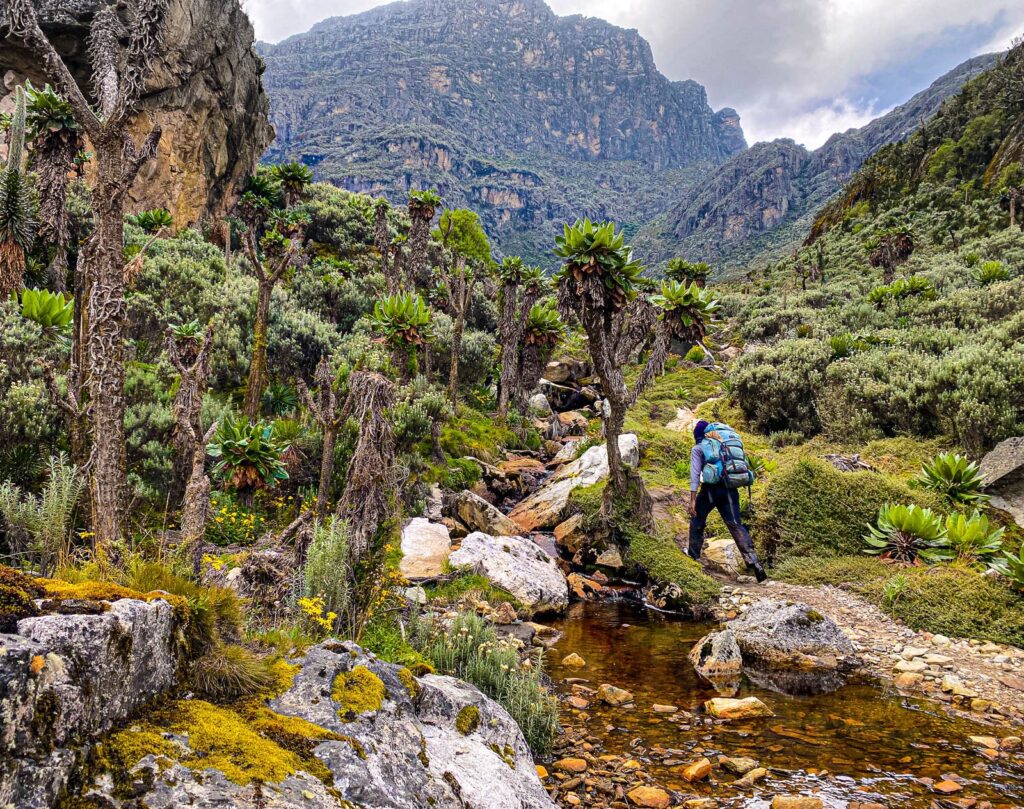
The most effective approach to giant groundsel photography is to shoot from below the rosette crown, angling upward to place the crown against the sky, which maximizes the dramatic scale impression and eliminates the muddy bog floor from the frame. Morning light within the first two hours after sunrise produces the most usable conditions: warm, directional, and present before the cloud builds. The mist that arrives by mid-morning can itself be extraordinarily beautiful in photographs of the heather zone; the tree heathers with their hanging moss photographed in diffuse mist light produce images of almost supernatural quality, but they require higher ISO settings and stable camera positioning.
For scale reference, trekkers should photograph their guides standing among the groundsel. The contrast between a 1.8-meter guide and a six-meter Senecio adnivalis trunk is more immediately legible to a viewer than any landscape framing. This is also, incidentally, an excellent reason to ask your guide to pause occasionally in a groundsel stand; the photographs from these moments are consistently among the most shared and most emotionally resonant images from any Rwenzori expedition. Our charging and electronics guide addresses battery management for camera systems on multi-day expeditions, which is particularly important given the cold-induced battery drain at the upper altitudes where the best groundsel photography opportunities occur.
Which Trek Gives You the Best Giant Plant Experience?
Not all Rwenzori itineraries penetrate the Afro-alpine zone, where the giant groundsels and lobelias are at their maximum development. The following guidance helps trekkers select the route that best matches their botanical objectives.
For the Full Giant Plant Experience
Any itinerary that includes at least one night at Bujuku Hut (3,977 metres) on the Central Circuit guarantees full immersion in the giant groundsel and lobelia zone. The 7-day Central Circuit trek spends two nights at Bujuku and passes through the Afro-alpine vegetation on the approach to Elena Hut, providing the most extended exposure to the giant plant landscape of any standard itinerary. The 13-day six-peaks expedition goes even further, crossing the Afro-alpine zone many times on different routes to the summits and providing the most complete botanical experience of any single Rwenzori expedition.
For a Taste of the Giant Plant Zone Without a Summit Push
The 4-day Mutinda Lookout trek on the Kilembe Trail goes to the edge of the giant plant zone at about 3,700 to 4,000 metres near Mutinda Camp and the lookout, providing a real Afro-alpine vegetation experience, including early groundsel and lobelia specimens, without the technical demands of the full summit approach. This is the best option for trekkers with altitude limitations or shorter time windows who want to experience the giant plants. The 3-day Mahoma Loop does not reach the Afro-alpine zone, remaining in the heather moorland and forest zones, but delivers excellent tree, heather, and forest ecology for trekkers on short schedules.
For the Heather Forest Specifically
The Kilembe Trail between Sine Camp and Mutinda Camp goes through what many botanists think is the most intact and impressive tree heather forest left in the Rwenzori, which is denser, older, and has more epiphytes than the same area on the Central Circuit. Trekkers for whom the tree heather forest is the primary botanical draw should consider beginning on the Kilembe Trail for maximum exposure to this community. The 4-day Kilembe Waterfalls Hike passes through the heather zone in impressive depth while adding the spectacular waterfall scenery of the Kilembe Trail’s mid-altitude river gorges.
Frequently Asked Questions: Giant Plants of the Rwenzori Mountains
What are the giant plants of the Rwenzori Mountains?
The Rwenzori Mountains are renowned for their giant plants of the high-altitude Afro-alpine zone, most notably giant groundsels (Senecio adnivalis and Dendrosenecio species) that reach four to six metres in height, giant lobelias (Lobelia wollastonii) whose flower spikes can reach three to four metres, and tree heathers (Erica arborea and the Rwenzori-endemic Erica johnstonii) growing to eight to ten metres. These plants grow at altitudes between 3,000 and 4,500 metres above sea level and are the product of a phenomenon called “high-altitude gigantism” driven by the unusual combination of equatorial UV intensity and nightly sub-zero temperatures that has pushed certain plant lineages toward dramatically large body sizes as a frost-protection adaptation. Many of these species are endemic to the Rwenzori range or the broader Albertine Rift highlands.
Why are the plants on Rwenzori so big?
The giant size of Rwenzori’s alpine plants is the result of high-altitude gigantism, an evolutionary response to a specific combination of environmental conditions found only at equatorial high altitudes. At 3,500 to 4,500 metres on the equator, plants experience intense UV radiation during the day (daytime temperatures can reach 15–20°C) followed by freezing temperatures at night (often falling to -5°C and below). This extreme daily freeze-thaw cycle repeats every single day of the year. Plants that insulate their growing points (meristems) within large, overlapping leaf rosettes survive better than small ones; larger rosettes trap more heat and provide better freeze protection. Over millions of years, natural selection has relentlessly favored larger individuals, producing the six-meter groundsel trunks and four-meter lobelia spikes for which the Rwenzori is internationally renowned.
What is the giant groundsel of Rwenzori?
The giant groundsel of Rwenzori is a plant of the genus Senecio or Dendrosenecio (family Asteraceae) that grows at altitudes between 3,500 and 4,500 metres in the Rwenzori’s upper alpine zone. The most common species encountered by trekkers is Senecio adnivalis, which grows up to six metres tall with a distinctive shaggy trunk of persistent dead leaf bases topped by one or more rosette crowns of large grey-green leaves. Despite its enormous vegetative size, it is botanically a relative of the familiar garden groundsel, and its flowers, when they appear, are small yellow daisy-like blooms typical of the Asteraceae family. Giant groundsels are most densely concentrated in the Bujuku Valley of the Central Circuit Trail, between Bujuku Hut and Elena Hut, and in the upper sections of the Kilembe Trail above Mutinda Camp.
What is the giant lobelia that grows on the Rwenzori?
The primary giant lobelia of the Rwenzori is Lobelia wollastonii, named after the naturalist A.F.R. Wollaston, who participated in the 1906 Duke of Abruzzi expedition and collected the type specimen. It grows at altitudes between 3,500 and 4,500 metres and can reach three to four metres in total height from its broad rosette base to the top of its dense, blue-green flower spike. The lobelia’s most remarkable adaptation is its water-filled cup rosette; the inner leaves form a cup that retains water, which freezes more slowly than air, providing a thermal buffer around the plant’s growing point during nightly frosts. A closely related species, Lobelia bequaertii, occupies wetter, slightly lower sites between 3,000 and 3,800 metres. The bog communities of the Rwenzori’s upper valleys, especially the Bujuku Valley on the Central Circuit Trail, concentrate both species.
Which trekking route provides the best view of Rwenzori’s giant plants?
The best trekking route for experiencing the full range of Rwenzori’s giant plants is the Central Circuit Trail, specifically any itinerary that includes at least one night at Bujuku Hut (3,977m) and the ascent toward Elena Hut (4,541m). The 7-day Central Circuit trek spends two nights at Bujuku and traverses the densest giant groundsel and lobelia communities in the range on the approach to Elena Hut. The 13-day six-peaks expedition provides the most comprehensive botanical exposure of any single itinerary. For trekkers seeking a giant plant experience without a full summit expedition, the 4-day Mutinda Lookout trek on the Kilembe Trail reaches the lower edge of the Afro-alpine zone at approximately 3,700–4,000 metres, where groundsels and lobelias begin to appear. For the tree heather forest specifically, the Kilembe Trail between Sine Camp and Mutinda Camp has the most intact and impressive tree-heather communities in the range.
Are the giant plants of Rwenzori endemic? Do they grow anywhere else?
Many of the Rwenzori’s giant plants are endemic to the range or to the broader Albertine Rift highlands of central Africa. Erica johnstonii, the Rwenzori heather, is specifically endemic to the Rwenzori Range. Lobelia wollastonii is endemic to the Rwenzori and a few adjacent Albertine Rift highlands. The giant groundsel species of the Rwenzori represent an endemic radiation within the Senecio/Dendrosenecio lineage that parallels but is distinct from the giant groundsel radiations on Mount Kenya and the Kilimanjaro massif-related plants, which evolved separately in response to similar conditions on different African mountains. The overall degree of plant endemism in the Rwenzori contributes significantly to the mountain range’s status as a UNESCO World Heritage Site and its inclusion within the Albertine Rift global biodiversity hotspot.
What altitude do you need to reach to see the giant lobelias and groundsels?
The giant lobelias and groundsels of the Rwenzori begin to appear in earnest at approximately 3,500 metres above sea level, becoming the dominant vegetation in the open bog and moorland communities above this altitude. The densest and most impressive concentrations are found between 3,800 and 4,300 metres primarily in the Bujuku Valley (around Bujuku Hut at 3,977 m on the Central Circuit) and in the upper Kilembe Trail sections above Bugata Camp (4,062 m). Early specimens of Senecio start to appear at about 3,400 metres in transition zones, and the Mutinda Camp area on the Kilembe Trail (3,700 m) provides trekkers on shorter itineraries with their easiest view of lower-zone Afro-alpine vegetation, including early groundsel and lobelia specimens.
Are the Rwenzori’s giant plants threatened?
Yes. The giant plants of the Rwenzori’s Afro-alpine zone face increasing threats from climate change, primarily through two pathways. First, the progressive loss of the Rwenzori’s glaciers, which have declined by more than 90% since 1900, reduces the glacial meltwater contribution to the bog hydrology that the giant groundsels and lobelias depend on. Reduced bog moisture in dry periods stresses these moisture-dependent species. Second, rising average temperatures are gradually altering the nightly freeze-thaw cycle that drove the evolution of gigantism in the first place. Warmer nights reduce the selective pressure for large insulating rosettes, favoring smaller, faster-growing individuals over the giant specimens over generational timescales. Within the national park boundary, the authorities largely control direct anthropogenic pressures. Climate-driven change is the primary concern for the long-term persistence of the Rwenzori’s giant plant communities in their current form and scale.
Come and Walk Among the Giants While They Are Still Here
There is a particular kind of silence that settles over trekkers who first encounter the giant groundsel forest of the Bujuku Valley. I have observed it many times, over many years of standing alongside clients at that first full encounter with the Afro-alpine world. The silence is not an absence; the mountain is never quiet, the wind through the dead groundsel leaves has its voice, and the distant water in the bog beneath the bridges makes its presence known. The silence is the cessation of the need to say anything. The landscape makes conversation feel inadequate. The plants’ enormous, ancient, alien, achingly beautiful forms do not need description in that moment. They simply need to be seen.
Whether your Rwenzori expedition takes you through the full Afro-alpine zone on the 7-day Margherita Peak summit trek, the 13-day six-peaks grand expedition, the 4-day Mutinda Lookout trek that gives you your first taste of the giant plant world at 3,700 metres, or the tree heather forest of the Kilembe Trail between Sine and Mutinda, the Rwenzori’s vegetation will deliver an experience that photography can prepare you for but cannot replace.
At Rwenzori Trekking Safaris, our guides are trained naturalists as well as mountaineers. They know the scientific names and the ecological stories of the plants you walk among. They know where the oldest groundsels stand, where the most photogenic lobelia colonies emerge from the bog, and which mornings are most likely to give you the light that makes the heather forest luminous. They are the interpreters between you and a landscape that has been evolving, largely undisturbed, for three million years.
Browse our full range of Rwenzori trekking itineraries, explore the month-by-month guide to Rwenzori conditions to identify the best season for botanical photography, and review our complete guide to Rwenzori campsite facilities to understand the overnight conditions in the giant plant zone. When you are ready to move from reading about the giants to walking among them, contact our expedition team directly. We will help you design the perfect itinerary for your botanical ambitions, your fitness level, and your timeline. The Mountains of the Moon, and their prehistoric giants, are waiting