Can you charge your phone at Rwenzori camps? Camp-by-camp power guide: solar panels, power bank tips, cold battery advice & electronics packing list.
Here is a question that seems mundane until you are sitting at 3,977 meters above sea level at Bujuku Hut with a dead camera battery, a phone showing 4% charge, and three more days of the most dramatic mountain scenery in equatorial Africa stretched out ahead of you. The question of power, specifically, whether you can charge your phone, camera, or other electronics at the mountain camps of the Rwenzori Mountains, is one of the most practically consequential pieces of information a trekker can have before they pack. However, I have never encountered a planning resource that answers this question precisely, comprehensively, or honestly.
The Rwenzori is not the Himalayas, where teahouses in Nepal’s Everest region have USB ports built into every table and charge per hour of use. It is not Kilimanjaro, where some camps have generator-powered charging stations that attract a small fee. It is a UNESCO World Heritage mountain wilderness spectacularly, intentionally remote where the infrastructure of the modern world thins rapidly as you gain altitude and the very remoteness that makes it one of the world’s great mountain experiences also means that the answer to “can I charge my phone?” is complicated, camp-specific, and significantly shaped by the weather on any given day. I have guided groups on the Central Circuit Trail, the Kilembe Trail, and the Bukurungu wilderness route, and I know this question intimately both from the trekkers who ask it and from the occasions when it was not asked and should have been.
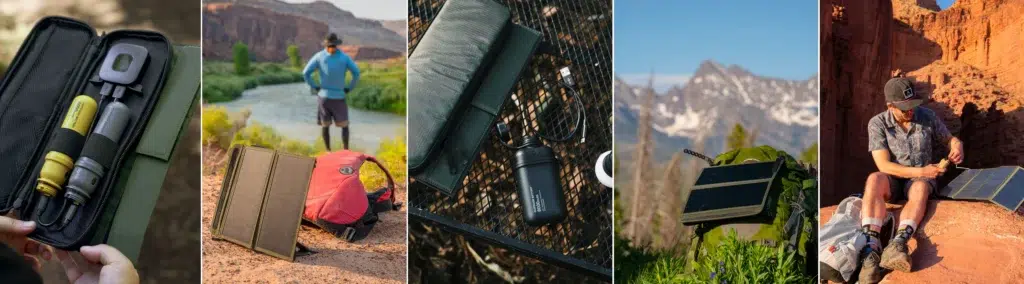
This guide answers it definitively. You will know exactly what electrical infrastructure exists at each camp on each of the three main Rwenzori trail systems, what the realistic charging expectations are at each location, what the Rwenzori’s famously persistent cloud cover does to solar panel output, how cold temperatures affect battery performance at high altitude, and most importantly exactly what power bank capacity and electronics setup to bring to ensure you never miss a photograph of the giant lobelias at dawn or the glaciers of Mount Stanley catching the last light of an equatorial afternoon.
The Fundamental Reality of Power on the Rwenzori Mountains
Before we go camp by camp, it is important to establish the governing principle of power access on the Rwenzori: do not plan your electronics setup around the assumption of reliable charging at mountain camps. Plan around the assumption of no charging at all, and treat any solar power you encounter as a welcome bonus rather than a dependency. This is not pessimism it is the practical intelligence that separates experienced high-altitude trekkers from those who arrive expecting the comforts of a hotel and find instead a wooden hut and a fog bank.
The Rwenzori Mountains receive some of the highest annual rainfall of any mountain range in Africa. The perpetual cloud and mist that give the mountains their mystical character and that prompted Ptolemy to call them the “Mountains of the Moon” also systematically limit the effectiveness of solar panels. Solar panels generate power in direct proportion to sunlight intensity. Cloud cover reduces sunlight intensity to a fraction of what a solar panel requires for meaningful output. On the Rwenzori, where overcast conditions are the norm rather than the exception from late morning onward, solar panels are frequently operating at minimal efficiency for most of the day.
The camps that have solar panels , and several do, were installed to provide basic lighting for the huts and allow opportunistic device charging. They deliver on these goals in the morning hours when there is the greatest likelihood of direct sun, and they struggle or fail entirely during the long afternoon and overnight periods when cloud dominates. This variability is not a malfunction; it is the honest physics of solar power in one of the world’s wettest mountain environments. Understanding it changes how you pack and how you manage your devices throughout the expedition.
The Cold Factor: Why Altitude Destroys Battery Life
There is a second factor compounding the power challenge on the upper Rwenzori, and it operates independently of solar availability: cold temperature dramatically reduces the effective capacity of lithium-ion batteries the type used in virtually every modern phone, camera, and power bank. At temperatures approaching 0°C, as occur regularly at the Elena Hut (4,541m) and above, a fully charged battery may deliver only 60-70% of its rated capacity before reading as empty. At the Margherita Camp near the summit, temperatures of -5°C to -10°C can cause usable battery capacity to fall to 50% or less.
This is not a defect in your phone or camera it is standard lithium-ion chemistry. Cold temperatures slow the electrochemical reactions that release stored energy, reducing effective output regardless of the charge percentage displayed on screen. The practical implication for Rwenzori trekkers is that a battery that reads “fully charged” when you begin walking at 7,000 in the morning may behave as though it is 40–50% charged by noon at a high altitude, particularly if the device has been cold overnight. Keeping devices warm in an inner jacket pocket or inside your sleeping bag overnight slows the cold drain significantly. Knowing about this effect in advance turns it from a surprise into a managed variable.
The golden rule of Rwenzori electronics management: Charge everything fully in Kasese the night before your trek departure. Bring a high-capacity power bank as your primary charging source on the mountain. Treat any solar panel access at camps as supplementary. Keep devices and batteries warm at high altitude. Never leave your camera or phone in an exposed outer pocket overnight above 3,500 metres.
Power and Charging at Each Central Circuit Trail Camp
The Central Circuit Trail is the primary route through the Rwenzori range and the infrastructure backbone of most guided expedition itineraries. It uses a network of wooden mountain huts established over decades and progressively maintained by the Uganda Wildlife Authority. The charging situation at each camp reflects the practical limitations of maintaining electrical infrastructure in one of the most remote and persistently wet mountain environments in Africa.
Nyabitaba Hut 2,651 Metres
Nyabitaba is the first overnight camp on the Central Circuit and the destination of day one of standard itineraries, including the 7-day Margherita Peak summit trek and the 6-day Weismann Peak hike. There is no reliable electricity supply at Nyabitaba. The hut managers have occasionally had small solar panels installed, but their output has historically been inconsistent, limited to very basic lighting at best and frequently non-functional due to cloud cover or maintenance issues. Do not plan any device charging at Nyabitaba. This is day one of your expedition, and if you have left Kasese with fully charged devices and a fully charged power bank, as you should, you will not yet need it.
John Matte Hut 3,414 Metres
John Matte has no electricity supply. There are no solar panels at this camp, and no charging facilities of any kind. The camp sits in the transitional zone between forest and open heather moorland, well into the altitude range where maintaining power infrastructure becomes logistically complex. If you are on a standard itinerary with John Matte as your second night as on the 7-day Central Circuit this is the moment your power bank first becomes operationally important. Any photography-intensive trekker should have consumed minimal phone battery by this point and should be protecting their camera battery carefully.
Bujuku Hut 3,977 Metres
Bujuku Hut is the hub camp of the Central Circuit and the camp where limited solar infrastructure does exist. Solar panels installed at Bujuku provide basic lighting for the hut’s communal area and, under favorable conditions, allow for slow device charging. The word “slow” deserves emphasis: even when the system is operational, the output is modest. A phone with a depleted battery may gain a 40–60% charge over several hours, not a full charge. The availability of this charging fluctuates significantly with the weather. On a morning with clear skies, the panels produce useful output during the early hours; as clouds build through the day (the standard Rwenzori pattern), output drops to minimal.
Bujuku is the camp where groups on extended multi-peak expeditions the 8-day three-peaks trek, the 13-day six-peaks grand expedition, the 18-day all-peaks traverse spend multiple nights using it as a base for summit attempts on the surrounding peaks. Those trekkers have the best opportunity to take advantage of whatever solar charging is available over successive mornings, using clear-sky hours strategically for device top-ups.
Elena Hut 4,541 Metres
Elena Hut has no electricity and no solar panels. It is a stone structure on the upper slopes of Mount Stanley, compact and minimal, existing purely to provide shelter for summit attempts on Margherita Peak. The temperatures at Elena regularly drop to 0°C and below, and this cold-induced battery drain is at its most significant here. Groups staying at Elena should have all devices and power banks stored in sleeping bags overnight to preserve battery capacity for the summit day. Camera batteries pulled from a cold external pocket at 5am for the summit push may be significantly depleted before a single photograph is taken. Keep them warm.
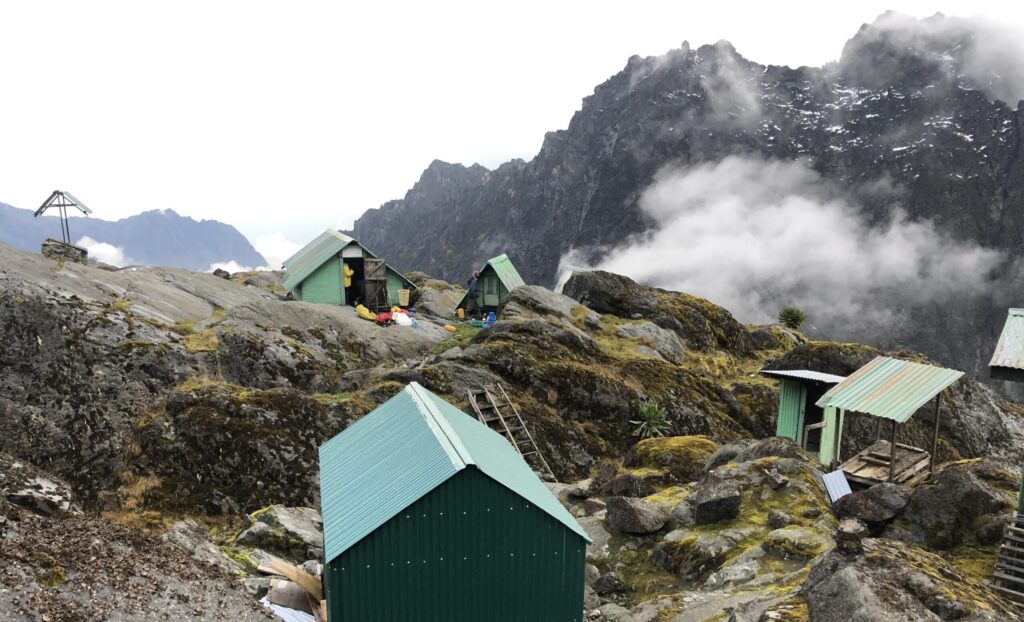
The summit push from Elena and from the equivalent-altitude Margherita Camp on the Kilembe Trail approach is the moment when photography matters most to almost every trekker. The glaciers of Mount Stanley, the dawn light on the equatorial snowfields, the view from Africa’s third highest point at 5,109 metres: these are the images trekkers have imagined since they first decided to attempt the mountain. Arriving at the summit with dead batteries because cold management was not prioritised at Elena Hut is one of the most avoidable regrets in Rwenzori trekking. The power bank and the overnight warming practice exist precisely to prevent it.
Kitandara Hut 4,023 Metres
Kitandara, positioned at the edge of the spectacular twin glacial lakes for which it is named, has limited solar infrastructure similar in character to Bujuku panels that can provide basic lighting and opportunistic slow charging when sunlight permits. The Kitandara Lakes setting is one of the most photographed in the Rwenzori range, which makes the presence of any solar charging option here especially welcome for camera-heavy trekkers on the descent from Elena after their summit day. As with Bujuku, treat it as a supplement to your power bank rather than a replacement for it. The lake views are best in early morning clarity, and so is the solar output use both while you have them.
Guy Yeoman Hut 3,261 Metres
Guy Yeoman, the final overnight camp before the descent back to Nyakalengija, has no reliable electricity supply. Battery drain from the cold is noticeably less severe at this lower altitude and in the warming temperatures of the final mountain night during the descent from Kitandara. Most trekkers at Guy Yeoman are successfully managing a power bank that they have progressively drawn on throughout the expedition. If your power bank has been used judiciously by supplementing camera charging at Bujuku and Kitandara, keeping devices warm at Elena, and avoiding unnecessary phone use mid-trail, you should still have a meaningful reserve capacity for the final day’s descent to the trailhead and the journey back to Kasese.
Power and Charging at Each Kilembe Trail Camp
The Kilembe Trail was purpose-built as a newer trekking infrastructure from 2011 onwards, managed by Rwenzori Trekking Services in partnership with the Uganda Wildlife Authority. Its construction reflected the lessons of the Central Circuit and deliberately incorporated better solar infrastructure at the lower and middle camps. The result is that the Kilembe Trail offers meaningfully better charging availability than the Central Circuit particularly in the first half of the route, where most trekkers spend the days with the best sunlight hours and the most operational solar systems.
Sine Camp 2,612 Metres
Sine Camp is the standout in terms of charging availability on any of the Rwenzori’s trail networks. The solar infrastructure here is the most functional and best maintained of any mountain camp, with USB charging points that allow device charging overnight. For trekkers on the 2-day Sine Camp introductory trek or arriving at Sine on the first night of longer Kilembe expeditions like the 8-day Kilembe Trail summit trek or the 8-day Cheptegei Peak hike, Sine Camp offers the closest thing to reliable overnight charging on the Rwenzori mountain network.
Even at Sine, the charging rate is modest a full phone charge overnight is generally achievable, a power bank full charge will be partial. Bring a short charging cable that fits comfortably to any USB point and label it clearly so it does not get mixed up with other group members’ cables in the communal charging space. The lower altitude of Sine Camp (2,612 metres) means cold-induced battery drain is minimal, which makes this the optimal camp for topping up devices before the temperature-demanding upper mountain sections ahead.
Mutinda Camp 3,700 Metres
Mutinda Camp has functional solar panels with charging capacity that represents a beneficial second tier in the Kilembe Trail charging hierarchy after Sine. Overnight device charging is generally possible here, though the success rate is more weather-dependent than at Sine the camp is higher and therefore in cloud for longer portions of the day, which reduces solar input. Morning charging during the early sun window before departure gives the best results.
Mutinda is famous for its panoramic views from the Mutinda Lookout one of the most photographed vantage points on the Kilembe Trail. Camera battery management becomes strategically important here. If you have conserved camera battery usage on the lower forest sections of the trail, Mutinda is the moment to use it freely, knowing that you have the Mutinda solar panels available for a top-up before continuing upward, and that the dramatic Afro-alpine landscape visible from the lookout deserves to be documented without rationing your shots.
Bugata Camp 4,062 Metres
Bugata Camp is where the reliable solar charging of the lower Kilembe Trail gives way to the variable, weather-dependent situation familiar from the Central Circuit’s upper camps. Solar panels exist at Bugata, but the camp’s position in the high-alpine zone means it is routinely enveloped in cloud from midday onward, and the solar input during the brief morning clear periods may be insufficient to fully charge even a single device overnight. Treat Bugata’s solar access as welcome but unreliable. By the time you arrive at Bugata typically the third or fourth night on the 8-day Kilembe expedition your power bank strategy should already be well underway: you should have used Sine and Mutinda for top-ups and arrived at Bugata with meaningful reserve capacity.
Hunwicks Camp 4,364 Metres
Hunwicks Camp, the pre-summit staging camp on the Kilembe Trail equivalent of Elena Hut’s role on the Central Circuit, has no reliable electricity. Some minimal solar infrastructure may be present, but at this altitude and exposure level where high winds are more frequent and cold temperatures are more severe it cannot be counted on. The same cold battery management protocols that apply at Elena apply here: devices inside sleeping bags overnight, camera batteries in an inner jacket pocket, power bank reserves maintained for the summit push.
Margherita Camp 4,600 to 4,700 Metres
Margherita Camp has no electricity supply of any kind. No solar panels, no USB points, no generator. At this altitude, in this cold and wind exposure, maintaining any electrical infrastructure is impractical and logistically untenable. Every electronic device you use at Margherita Camp and on the subsequent summit push draws from a finite reserve: your power bank and whatever battery capacity you have carefully preserved across the preceding days. This is why the decisions made at Sine Camp, Mutinda Camp, and Bugata about when to charge and what to prioritize matter so much: they directly determine whether your camera has a functioning battery when you stand at Margherita Peak at 5,109 meters, Africa’s third highest summit and one of the last glaciated peaks on the equator.
The Bukurungu Trail: No Power Infrastructure at Any Campsite
The Bukurungu Trail is the Rwenzori’s wilderness camping route, a genuine wilderness experience initiated in 2018 through a partnership between the Uganda Wildlife Authority and the World Wildlife Fund for Nature. There are no permanent hut structures on the Bukurungu Trail and no electrical infrastructure of any kind at any campsite. Trekkers sleep in ground tents at designated camping sites. The four spectacular alpine lakes, Irene, Mughuli, Bukurungu, and Bujuku, provide the primary scenery and water sources, but they provide nothing in the way of electricity.
For trekkers choosing the Bukurungu Trail for its off-the-beaten-track wilderness character, the power equation is the simplest of any Rwenzori route: bring everything you need in the form of pre-charged devices and a high-capacity power bank. There is no supplement, no fallback, no camp manager with a solar panel and a USB cable. What you carry from Kasese is what you have. This reality reinforces the wilderness nature of the Bukurungu experience, and for trekkers who embrace it with proper preparation, it is not a hardship; it is simply mountain life on its own terms.
At-a-Glance: Charging Availability at Every Rwenzori Camp
The table below summarizes the power and charging situation at each campsite across all three main Rwenzori trail systems. Use this as your packing reference.
| Campsite | Trail | Altitude | Solar/Charging | Notes |
| Nyabitaba Hut | Central Circuit | 2,651 m | None / very limited | No reliable charging; power bank essential |
| John Matte Hut | Central Circuit | 3,414m | None | No electricity supply at this camp |
| Bujuku Hut | Central Circuit | 3,977 m | Solar (limited) | Occasional solar lighting; slow charging possible |
| Elena Hut | Central Circuit | 4,541 m | None | No electricity; extreme cold drains batteries fast |
| Kitandara Hut | Central Circuit | 4,023 m | Solar (limited) | Basic solar charging availability varies by weather |
| Guy Yeoman Hut | Central Circuit | 3,261 m | None | No electricity at this camp |
| Sine Camp | Kilembe Trail | 2,612 m | Solar functional | Best charging on Kilembe Trail; USB points available |
| Mutinda Camp | Kilembe Trail | 3,700 m | Solar functional | Good solar infrastructure; device charging overnight |
| Bugata Camp | Kilembe Trail | 4,062 m | Solar (limited) | Cloud cover reduces solar input reliably |
| Hunwicks Camp | Kilembe Trail | 4,364 m | None / minimal | Very limited or no power; cold degrades battery fast |
| Margherita Camp | Both / upper | 4,600-4,700 m | None | No power; battery management critical at summit altitude |
| Bukurungu campsites | Bukurungu Trail | Varies | None | Wilderness camping; zero electrical infrastructure |
The Power Bank: Your Most Important Electronic Item on the Rwenzori
If the previous sections have established one thing clearly, it is this: the power bank is not an optional accessory for a Rwenzori expedition. It is core infrastructure as essential to your electronics management as waterproof bags are to keeping your sleeping bag dry. The question is not if to bring one, but which capacity and how to manage it during your trek.
Choosing the Right Power Bank Capacity
The capacity of a power bank is measured in milliamp-hours (mAh). A standard modern smartphone has a battery capacity of approximately 3,000 to 5,000 mAh. A 10,000 mAh power bank therefore provides roughly two to three full smartphone charges. A 20,000 mAh power bank provides four to six. A camera battery charger typically draws a similar or lower amount per charge cycle depending on the camera model.
For a Rwenzori expedition, the capacity recommendation scales with trek duration. For short treks, the 3-day Mahoma Loop, the 2-day Lake Mahoma forest walk, or the 4-day Mutinda Lookout hike, a 10,000 mAh power bank is adequate for most trekkers who are disciplined about phone use. For classic summit treks of 6 to 8 days, such as the 7-day Central Circuit or the 8-day Kilembe Trail expedition, a 20,000 mAh power bank is the recommended minimum for a trekker carrying both a phone and camera. For longer trips that last 10 days or more, like the 10-day four-peaks trek, the 13-day six-peaks expedition, and the 18-day all-peaks traverse, it’s a good idea to bring two 20,000 mAh power banks or one 30,000 mAh power bank if
Anker, Ravpower, and Baseus all make reliable 20,000 mAh power banks that have performed consistently in cold mountain environments. Look for a model with Power Delivery (PD) fast-charging support, which improves charging efficiency for compatible devices. Ensure the power bank is fully charged the night before your trek departure in Kasese. Do this work in your guesthouse rather than leaving it to a last-minute charge the morning of.
Power Bank Cold Management
Cold temperatures affect power banks, just like they do with phone and camera batteries. A power bank stored in an external pack pocket overnight at Elena Hut or Margherita Camp will lose effective capacity overnight due to cold, even without any devices drawing from it. Store your power bank in your sleeping bag at high-altitude camps; your body warmth during the night prevents the temperature-induced capacity loss that would otherwise occur. In the morning, the power bank pulled from a warm sleeping bag will perform significantly better than one that has been cold for eight hours. This is not an optional best practice for summit expedition trekkers; it is the difference between a functioning and a non-functioning power bank on summit day.
Protecting Power Banks During the Wet Mountain Sections
The Rwenzori is one of the wettest mountain ranges on Earth. Rain, mist, and condensation are constant companions from the lower forest sections through to the bog-heavy terrain of the upper Bujuku Valley and the Scott Elliot Pass. Rain or heavy condensation can damage a power bank. Store your power bank in a waterproof dry bag or heavy-duty zip-lock bag inside your main pack at all times. The same applies to charging cables, camera batteries, memory cards, and any other electronic items. Our dedicated gear guide for the Rwenzori bogs and wet conditions addresses the broader waterproofing strategy for all your mountain gear.
Building Your Complete Rwenzori Electronics and Power Strategy
Photography: DSLR, Mirrorless, or Smartphone?
The camera question is inseparable from the power question on the Rwenzori. Trekkers who bring a DSLR or mirrorless camera for a 7 to 13-day expedition face a more complex power management challenge than smartphone-only photographers: camera batteries are single-purpose (they cannot be charged from a USB power bank without an adapter), they are cold-sensitive, and they can drain rapidly during active shooting sessions at high altitude.

The recommended approach for serious photographers on extended Rwenzori expeditions is to bring two or three spare batteries for their camera systems, not just one. These can be cycled through: one in the camera, one stored warm in an inner jacket pocket, and one being charged from the power bank via a USB camera battery charger adapter (widely available online for most major camera brands). This cycle ensures that at no point during the day, and particularly on summit morning at Elena or Margherita Camp, does the photographer run out of camera power.
Smartphone photography has made enormous strides in quality, particularly in the latest generation of flagship devices, and the convenience of a single device that combines phone and camera is a genuine practical advantage on a long mountain expedition. Modern flagship phones, particularly the Pixel Pro, iPhone Pro, and Samsung Galaxy Ultra series, produce exceptional high-altitude photography results and charge from the same USB cable as your power bank. For trekkers who are not professional photographers or who prioritize simplicity over absolute image quality, smartphone-only photography is a thoroughly viable choice for the Rwenzori.
Headlamps: Batteries or Rechargeable?
Headlamps are essential on any Rwenzori expedition for the 5am summit departure from Elena Hut in complete darkness, for camp navigation after an afternoon arrival in poor light, and for any unexpected delay on the trail. The headlamp question connects directly to the power management strategy because modern rechargeable headlamps draw from the same USB power pool as your phone and camera.
There are two viable approaches. Battery-powered headlamps with standard AA or AAA cells are completely independent of your power bank management. Carry a set of fresh lithium batteries (which perform better than alkaline in cold) and a spare set, and your headlamp power is independent of all other charging decisions. Rechargeable USB headlamps are lighter and eliminate the need for spare batteries, but they draw from your power bank capacity and require management within your overall charging schedule. Either works well on the Rwenzori; the choice reflects your personal approach to systems simplicity versus weight optimization.
Satellite Communication Devices: An Important Power Consideration
Some trekkers bring satellite communication devices, such as Garmin InReach, SPOT communicators, or similar, for emergency communication capability or to share GPS tracking with family at home during the expedition. These devices also require charging and should be included in your calculation of power bank capacity. Our guides on all expeditions carry satellite communication capability as part of the standard safety kit, so personal satellite devices are an additional comfort rather than a safety necessity. If you choose to bring one, add approximately 2,000-5,000 mAh to your power bank capacity calculation to account for its charging needs over the full expedition duration.
The Charging Cable Kit
A chaotic bundle of incompatible cables is a frustrating and preventable problem on a mountain expedition. Before departure, assemble a minimal, organized charging kit: one USB-C to USB-C cable (for modern phones and many power banks), one USB-A to USB-C adapter (for older USB-A power bank ports), one USB camera battery charger for your specific camera model if you are carrying a dedicated camera, and one short extension cable if your power bank does not have a long enough lead for comfortable bedtime charging inside a sleeping bag. Store all cables in a single labeled dry bag. Do not rely on borrowing cables from other group members; cable compatibility varies widely, and assumptions about sharing lead to frustration in hut environments.
Before the Mountain: Charging Infrastructure in Kasese
Kasese, the gateway town for all Rwenzori expeditions, has reliable mains electricity at hotels and guesthouses with the standard East African caveat that power outages (load-shedding) occur periodically and may last several hours. Standard electrical outlets in Uganda use the type G socket (the same three-pronged rectangular-pin socket used in the UK and parts of East Africa). If your devices use European two-pin (Type C) or American two-flat-pin (Type A) plugs, bring appropriate travel adapters; these are not reliably available to purchase in Kasese itself.
Our recommended protocol is to arrive in Kasese with all devices already partially charged from your last reliable mains connection (Kampala or Entebbe) and to use your Kasese accommodation the night before your trek departure to bring everything to 100%. Charge simultaneously: phone, power banks, camera batteries, headlamp (if rechargeable), and any satellite communicators. Use a multi-port USB charging block to handle everything at once rather than sequentially. When you walk out of your Kasese guesthouse the next morning for the drive to Nyakalengija, every electrical device you carry should be at maximum capacity. This is the foundation on which your entire mountain power management strategy rests.
For detailed guidance on accommodation options in Kasese and what to expect on the night before your trek departure, our article on where to stay before and after the Rwenzori trek covers everything from budget guesthouses to mid-range hotels, including which properties have the most reliable electricity access.
Your Complete Rwenzori Electronics Packing List: What to Bring
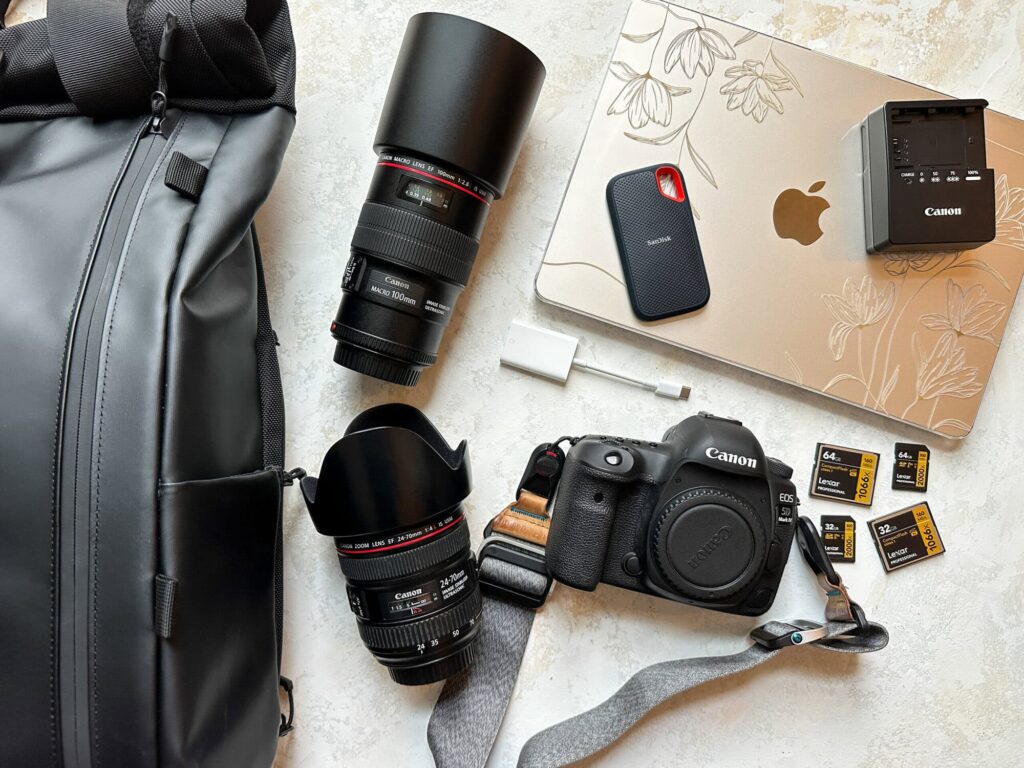
The following represents the complete electronics and power kit I recommend to clients preparing for any Rwenzori expedition. The specific quantities scale with trek duration as noted, and the entire kit should be packed within a single dedicated waterproof dry bag for protection from the Rwenzori’s pervasive moisture. For broader gear preparation, including boots, waterproofs, and sleeping bags, our Rwenzori gear guide covers the full clothing and equipment picture.
For a 7- to 8-day classic summit trek, the main electronics kit includes: one 20,000 mAh power bank (fully charged from Kasese); your main camera or smartphone with any extra batteries; a USB charger for your camera if you have one; two to three spare camera batteries kept in an inner jacket pocket while hiking; a headlamp with either new lithium AA/AAA batteries or a USB rechargeable option; a compact USB charging block for charging in Kasese before the trek; a small international plug adapter (UK Type G for Ugandan sockets); organized short charging cables for each device; a small electronics dry bag; and a separate zip-lock bag for individual batteries kept inside your sleeping bag at high-altitude camps.
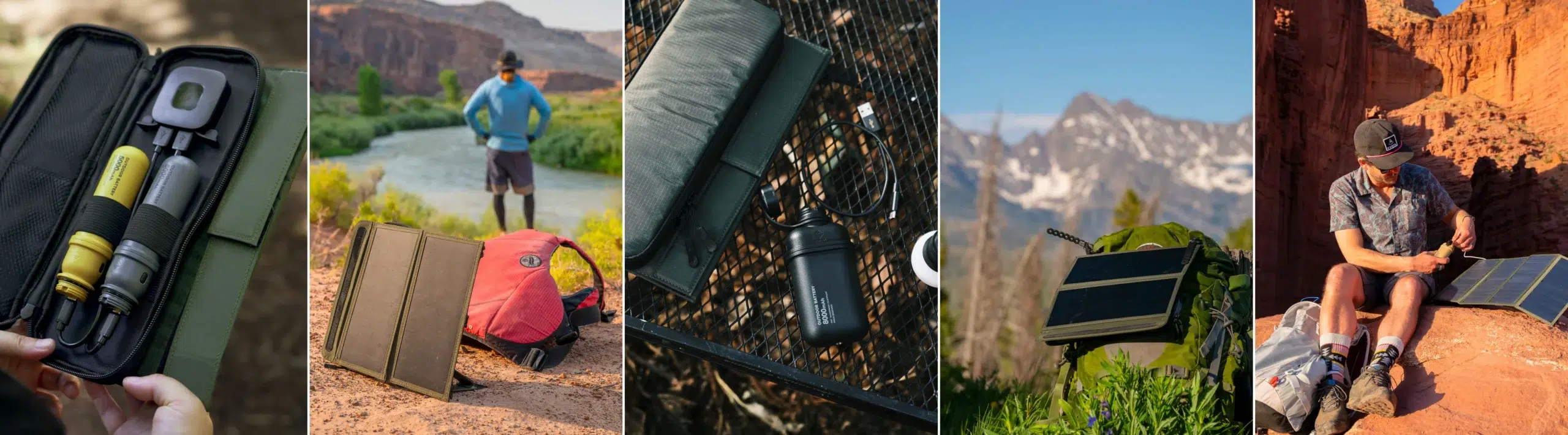
For the 13-day six-peak expedition and the 18-day all-peak traverse, upgrade to two 20,000 mAh power banks or one 30,000 mAh unit, four or more camera battery spares, and consider a small, lightweight solar panel of your own (100–200 g panels from Anker or BioLite clip to a pack exterior and can collect opportunistic solar energy on clear-morning trail sections; output is modest but adds meaningful supplementary capacity over 13 to 18 days).
Memory cards: Bring more storage than you think you need. On a 13-day expedition across six peaks with the extraordinary wildlife and landscapes of the Rwenzori range, you will take more photographs than you have ever taken on a trek. A 128GB card as your primary and a 64GB card as backup is the minimum I recommend for serious photographers. Cards are lightweight, inexpensive, and there is no such thing as too much storage on a mountain you may never return to.
Frequently Asked Questions: Charging Phones and Cameras on the Rwenzori
Can I charge my phone at Rwenzori Mountain camps?
The ability to charge a phone at Rwenzori Mountain camps depends on which camp and which trail you are on. On the Central Circuit Trail, Bujuku Hut (3,977 m) and Kitandara Hut (4,023 m) have limited solar panels that can allow slow device charging when sunlight is available, typically in the morning before cloud builds. All other Central Circuit camps, Nyabitaba, John Matte, Elena, and Guy Yeoman, have no reliable electricity supply. On the Kilembe Trail, Sine Camp (2,612m) and Mutinda Camp (3,700m) have the best solar infrastructure on any Rwenzori trail and can provide meaningful overnight device charging. Upper Kilembe camps, including Bugata, Hunwicks, and Margherita Camp, have no reliable power. The Bukurungu Trail has no electricity at any campsite. Every Rwenzori trekker should bring a high-capacity power bank (minimum 20,000 mAh for classic summit treks) and treat any camp solar access as supplementary rather than primary.
Which Rwenzori camps have solar panels for charging?
The camps with the most functional solar charging infrastructure on the Rwenzori are Sine Camp and Mutinda Camp on the Kilembe Trail, both of which have USB charging points that allow device charging in optimal solar conditions. Bujuku Hut and Kitandara Hut on the Central Circuit have limited solar panels that provide basic lighting and occasional slow device charging, though reliability is heavily weather-dependent given the Rwenzori’s characteristic cloud cover. All other camps on the Central Circuit, Nyabitaba, John Matte, Elena Hut, and Guy Yeoman, have no reliable electricity. Hunwicks Camp and Margherita Camp on the upper Kilembe Trail have no reliable power. All Bukurungu Trail campsites are entirely electricity-free.
How does cold affect phone and camera batteries on the Rwenzori?
Cold temperature significantly reduces the effective capacity of lithium-ion batteries, the type used in virtually all modern phones, cameras, and power banks. At temperatures near 0°C, as occurs regularly at Elena Hut (4,541 m) and Margherita Camp on summit nights, a fully charged battery may deliver only 60-70% of its rated capacity before reading as empty. At -5°C to -10°C, usable capacity can fall to 50% or less. This is standard battery chemistry, not a device fault. The management approach is to keep all devices and power banks stored inside your sleeping bag overnight at camps above 3,500 meters and to keep camera batteries in an inner jacket pocket while hiking rather than in an external pack pocket. Warming a cold battery before use, even briefly in a pocket, partially restores its effective output.
What size power bank should I bring for the Rwenzori trek?
Recommendations for power bank capacity depend on the duration of the trek. For short Rwenzori treks of 1–4 days, a 10,000 mAh power bank is adequate for most trekkers. For classic summit treks lasting 6–8 days, such as the 7-day Central Circuit or the 8-day Kilembe Trail expedition, a 20,000 mAh power bank is the recommended minimum, particularly if you are carrying both a phone and a camera. For extended multi-peak expeditions spanning 10–18 days, consider two 20,000 mAh power banks or a single 30,000 mAh unit. The power bank must be fully charged in Kasese before departure, stored in a waterproof bag during the trek, and kept inside your sleeping bag at high-altitude camps to prevent cold-induced capacity loss.
Can I charge a DSLR or mirrorless camera battery on the Rwenzori?
Yes, with the right preparation. Camera batteries for DSLR and mirrorless systems can be charged from a power bank using a USB camera battery charger adapter, which is available for most major camera brands and plugs into a standard USB-A or USB-C port. This allows your power bank to serve as the charging source for camera batteries at camps where no solar power is available. The practical approach for serious photographers on extended Rwenzori expeditions is to bring two or three spare camera batteries in addition to the one in the camera, cycle them through a USB charger from the power bank overnight, and store all batteries in warm locations during cold nights. A camera that runs out of battery on a summit morning at Margherita Peak is one of the most avoidable regrets of Rwenzori trekking.
Is there primary electricity at Kasese hotels before the Rwenzori trek?
Yes. Kasese hotels and guesthouses have mains electricity, though periodic power outages (load-shedding) occur and may last several hours. Uganda uses Type G electrical sockets, the same three-pronged rectangular-pin format used in the UK, so European and North American travelers will need a travel adapter. The protocol before any Rwenzori expedition is to use your Kasese accommodation the night before departure to charge all devices simultaneously to 100%: phone, power banks, camera batteries, and headlamp if rechargeable. A compact multi-port USB charging block allows multiple devices to charge from a single socket simultaneously. Walking out of your Kasese guesthouse the next morning with every battery at maximum capacity is the foundation of responsible Rwenzori electronics management.
Does the Bukurungu Trail have any charging facilities?
No. The Bukurungu Trail is a designated wilderness camping route with no permanent hut structures and no electrical infrastructure of any kind at any campsite. Trekkers sleep in ground tents provided by the expedition operator, and there are no solar panels, USB points, or generators at any point along the trail. All power for the entire Bukurungu expedition must come from devices charged in Kasese before departure and managed carefully through a high-capacity power bank. This is entirely achievable with proper preparation and is simply a reflection of the Bukurungu Trail’s character as a genuine wilderness experience.
Can I use a portable solar panel on the Rwenzori trek?
A personal lightweight solar panel, the fold-out type from brands like Anker, BioLite, or Goal Zero, typically weighing 100–300 grams, can provide supplementary charging capacity on the Rwenzori, but with important caveats. The characteristic cloud cover of the Rwenzori limits effective solar output to the morning hours before clouds build. A panel clipped to the outside of a moving pack during the early trail hours can collect meaningful solar energy on clear mornings, but output is far lower than in full sun and cannot be counted on for primary device charging. Personal solar panels are most valuable as supplementary tools on longer expeditions of 13 days or more, where small consistent daily top-ups meaningfully extend the overall power bank reserve. They are not a substitute for a high-capacity power bank and should not be treated as one.
Plan Your Rwenzori Trek with Complete Preparation
The Mountains of the Moon reward those who prepare. Every decision you make before you step onto the trail the sleeping bag temperature rating you choose, the boot waterproofing you invest in, and the power bank capacity you bring has a direct consequence somewhere in the seven, ten, or thirteen days that follow. Power management on the Rwenzori is no different. Get it right, and your camera is ready when the Rwenzori turaco flashes electric red across the heather at dawn. Your phone is charged when you want to share the summit photograph. Your navigation app has battery when a morning mist obscures the trail markers above John Matte Hut. The details that feel administrative in the planning phase become the difference between an extraordinary experience and a frustrating one on the mountain.
At Rwenzori Trekking Safaris, we brief every client comprehensively on electronics and power management as part of the pre-departure process, tailored to the specific camps and altitude profile of their chosen itinerary. Whether you are preparing for the introductory 2-day Sine Camp trek, the classic 7-day Margherita Peak summit expedition, the comprehensive 13-day six-peaks grand expedition, or any other expedition in our portfolio, our pre-departure guidance ensures you arrive at the Nyakalengija trailhead with every device fully charged, every cable in place, and every battery decision already made.
Browse our complete range of Rwenzori trekking itineraries, explore the full detail of what facilities you can expect at every campsite, or review our full packing and gear guide. And when you are ready to move from planning into action, contact our team directly; we will help you design the perfect expedition, brief you on every practical detail, and make sure the Mountains of the Moon deliver everything you have imagined.