
Rwenzori vs Mount Kenya compared: technical difficulty, altitude, routes, cost, and which African summit is right for you. Expert guide.
There is a particular moment in every serious mountaineer’s research process when Kilimanjaro stops being the answer. It happens somewhere around the discovery that Kilimanjaro’s standard routes are, technically speaking, long high-altitude walks, and that the real question, the one that actually separates a trekking holiday from a mountaineering expedition, is being asked about two very different mountains: the Rwenzori range on the Uganda-Congo border, and Mount Kenya, rising alone out of the central Kenyan highlands. I have guided on the Rwenzori for years, taken trekkers to the summit of Margherita Peak more times than I can count from memory, and fielded this exact comparison from climbers standing in our Kasese office with a Mount Kenya guidebook in one hand and our route notes in the other. This article is the honest answer I give them, written down properly, without the marketing gloss that most comparison articles apply to make every mountain sound equally appealing to everyone.
Both mountains carry the word “technical” in how climbers describe them, and both deserve it, but the word means something different on each. Understanding that difference, not the summit statistics alone, is what actually determines which mountain is right for you. This guide works through the terrain, the climbing itself, the logistics, the risk, and the character of each expedition in enough depth that you should be able to make the decision with confidence by the end of it. If you have already read our broader Kilimanjaro vs Mount Kenya vs Rwenzori Mountains comparison, think of this as the deep dive on the two mountains from that comparison that actually require technical skill, set side by side with nothing else competing for attention.
Two Mountains, Two Different Meanings of “Technical”
The single biggest misunderstanding I encounter in the Kasese office is the assumption that “technical” means the same thing on every mountain. It does not, and the difference between the Rwenzori and Mount Kenya is precisely where that assumption breaks down.
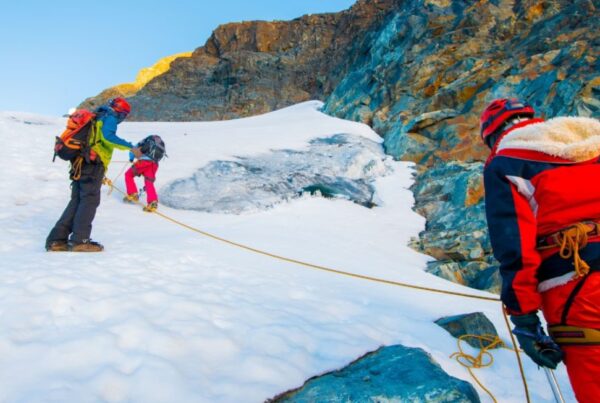
On the Rwenzori, technical difficulty is unavoidable if you want the true summit. Margherita Peak, at 5,109 metres on Mount Stanley, sits on the far side of a glacier crossing that involves crampons, an ice axe, a harness, and fixed ropes on exposed rock.
There is no non-technical way to stand on the highest point of Uganda. Every trekker who reaches that summit, regardless of how they feel about rock climbing as a discipline, has crossed real glaciated terrain to get there. Our own detailed breakdown of exactly what that involves, how technical the climb to Margherita Peak really is, walks through every section of the route, and it is worth reading in full before you commit to a Rwenzori itinerary, because it is not a climb to walk into unprepared.
Mount Kenya works differently. Its trekking summit, Point Lenana at 4,985 metres, requires no rock climbing at all: it is a steep, high-altitude walk that rewards fitness and acclimatization rather than technical skill, and it is what the overwhelming majority of Mount Kenya visitors actually climb. The mountain’s true summits, Batian at 5,199 metres and Nelion at 5,188 metres, are a separate proposition entirely: proper multi-pitch rock climbs on the standard routes, graded around UIAA IV or roughly 5.6 in the American system, requiring rope work, a licensed technical guide, and genuine climbing competence, not just fitness. In other words, Mount Kenya lets you choose your level of technical exposure. The Rwenzori does not. If your goal is Uganda’s highest point, the glacier crossing is simply part of the itinerary, not an optional add-on.
The Numbers: Altitude, Location, and What They Actually Mean
Set side by side, the raw statistics look closer than most people expect. Batian, Mount Kenya’s true summit, sits at 5,199 metres, making it the second-highest point in Africa after Kilimanjaro. Margherita Peak sits at 5,109 metres, the third-highest point on the continent, a difference of only 90 metres from Batian and considerably closer to Mount Kenya’s altitude than either mountain is to Kilimanjaro’s 5,895 metres. Point Lenana, Mount Kenya’s non-technical trekking summit, sits lower still at 4,985 metres, over a hundred metres below Margherita.
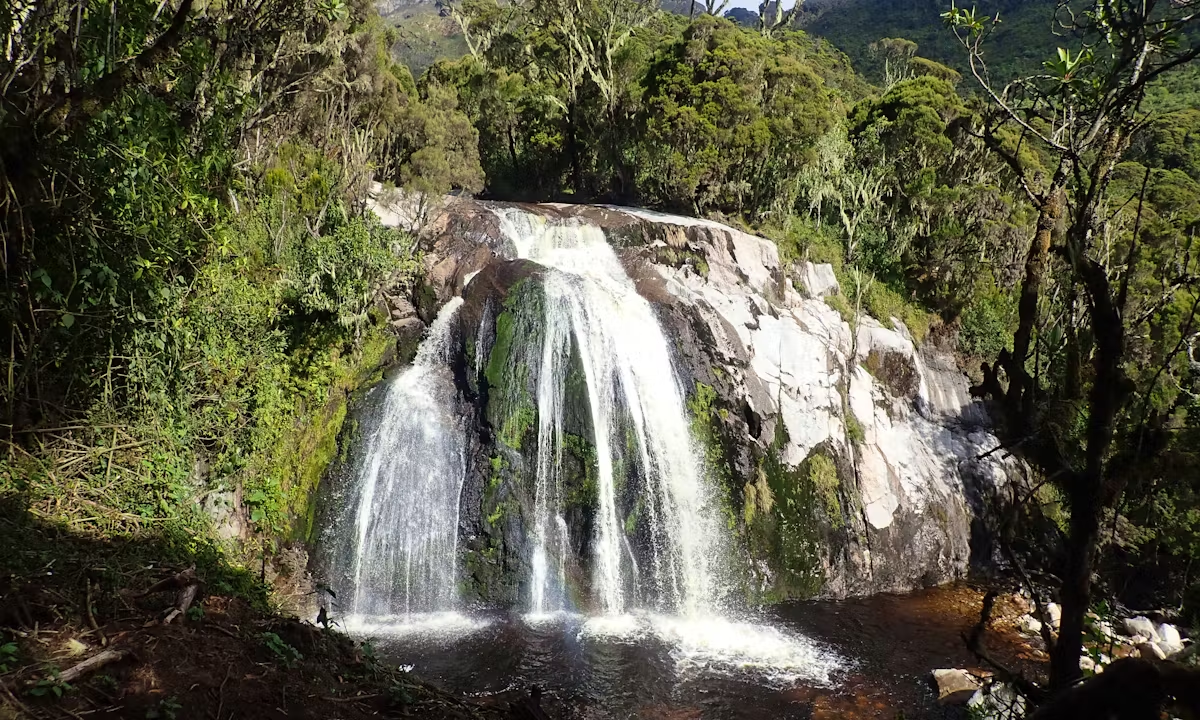
Location shapes the two mountains as much as altitude does. Mount Kenya rises as an isolated volcanic massif directly on the equator in central Kenya, visible for great distances across the surrounding plains, its glaciers retreating on an exposed, weather-beaten cone. The Rwenzori is a non-volcanic block-faulted range straddling the Uganda-Democratic Republic of Congo border in the Albertine Rift, a jumbled mass of six distinct glaciated massifs rather than a single cone, permanently wrapped in cloud far more often than it is visible. Our facts about the Rwenzori Mountains guide covers the geology in more depth, but the practical consequence for a climber is this: Mount Kenya is a mountain you can often see clearly from a distance while you plan your route up it; the Rwenzori is a mountain you frequently cannot see at all until you are already inside it.
Quick comparison: key figures at a glance
| Rwenzori (Margherita Peak) | Mount Kenya (Batian / Point Lenana) | |
| Highest point | 5,109 m (Margherita Peak, Mount Stanley) | 5,199 m (Batian); Point Lenana 4,985 m |
| Africa ranking | 3rd highest | 2nd highest |
| Technical climbing required for true summit | Yes, for everyone (glacier crossing) | Only for Batian/Nelion; Point Lenana is non-technical |
| Typical trek length | 6–9 days | 4–6 days trekking; +1–2 days for technical summit |
| Mountain type | Non-volcanic, block-faulted, glaciated massif | Extinct stratovolcano |
| Annual visitors (approx.) | ~1,000 | Tens of thousands |
| UNESCO status | World Heritage Site | World Heritage Site |
What the Climbing Itself Actually Involves
The Rwenzori’s Glacier Mountaineering
The technical section of a Rwenzori summit push begins above Elena Hut, where trekkers rope up, fit crampons, and cross the Stanley Plateau glacier before tackling a series of steep, icy rock steps using fixed ropes to reach the small summit platform of Margherita, which sits directly on the Uganda-Congo border. Our guides manage all of the fixed rope infrastructure and team roping on this section, which is covered in detail in our guide to crampons and ropes on the Rwenzori, but trekkers are still expected to move confidently on crampons, manage basic exposure, and function at altitude in cold, often whiteout conditions. This is not advanced technical climbing in the rock-grade sense; it is closer to a straightforward alpine glacier route, comparable to an introductory day on a European glaciated peak. But it is real mountaineering, not a scramble, and the Rwenzori mountaineering guide on our site sets out exactly which of the range’s peaks qualify as technical objectives and which do not.
Because every Margherita summit requires this section, there is no way to opt out of technical terrain while still reaching Uganda’s true high point. Trekkers who prefer to stay off glaciated terrain entirely still have excellent options within the Rwenzori itself, among them the non-technical trek to Stella Point or the shorter loops through the moorland zone, and we always discuss these honestly with anyone who tells us they are uncomfortable with the idea of crampons and rope work.
Mount Kenya’s Rock Climbing on Nelion and Batian
Mount Kenya’s technical climbing is a different discipline altogether. The standard route to Nelion, the South East Face, is a genuine multi-pitch rock climb of roughly eighteen to twenty pitches at a crux grade around UIAA IV, comparable to a moderate 5.6 in the American Yosemite Decimal System, typically completed in one long day after acclimatizing on the trekking approach.
Reaching Batian from Nelion requires an additional traverse across the exposed Gate of Mist, often involving a bivouac at the Howell Hut partway across. This is proper technical rock climbing at altitude, requiring rope management, multi-pitch climbing experience, and comfort on exposed rock faces, skills that go well beyond what the Rwenzori’s glacier crossing demands.
The crucial point, and the one that changes the entire comparison, is that this technical climbing is entirely optional on Mount Kenya. A trekker with no climbing background whatsoever can hike to Point Lenana, stand at 4,985 metres, watch the sun rise over the equator with Batian and Nelion’s rock spires directly in front of them, and descend having completed a serious, legitimate high-altitude trek without ever touching a rope. On the Rwenzori, that choice does not exist for anyone whose goal is the true summit.
Terrain and the Character of the Approach
The Rwenzori: Rainforest, Bog, and Relentless Mud
What genuinely surprises experienced mountaineers on the Rwenzori is rarely the glacier crossing itself; it is everything that comes before it. Our Central Circuit Trail and Kilembe Trail both climb through dense montane rainforest where the trail is frequently a river of mud and exposed roots, then into a bog-covered heather and moorland zone where progress can slow to a genuine crawl through knee-deep mud between the tussocks. Our tips for hiking the Rwenzori article spends considerable space on bog technique alone, because it is a skill in its own right, one that no amount of Kilimanjaro or Mount Kenya experience prepares you for. This is why the Rwenzori has a reputation, entirely earned, for being harder than Kilimanjaro on a day-to-day basis, a comparison we address directly in our piece on whether the Rwenzori is harder than Kilimanjaro.
Above the bogs, the terrain shifts again into Afro-alpine moorland dotted with giant groundsels and lobelias, then finally into the rock and ice of the upper massif around Elena Hut. The route between the Central Circuit and Kilembe trails differs meaningfully in how this terrain is sequenced, and choosing correctly between them is one of the more consequential planning decisions a Rwenzori trekker makes.
Mount Kenya: Dry Alpine Terrain and Open Ridgelines
Mount Kenya’s approach could hardly be more different. The Sirimon, Chogoria, and Naro Moru routes climb through montane forest and bamboo relatively quickly, then open into drier moorland and alpine desert with far better underfoot conditions than the Rwenzori’s saturated bogs. The Chogoria route in particular is widely regarded as one of the most scenic mountain approaches in East Africa, threading past the Gorges Valley, Lake Ellis, and Lake Michaelson before reaching the high camps beneath the main peaks. Trekkers moving between Mount Kenya and the Rwenzori consistently describe the underfoot experience as the single biggest contrast between the two ranges: Mount Kenya rewards a strong pace on relatively firm trail, while the Rwenzori rewards patience, careful foot placement, and an acceptance that your boots will not stay dry.
Routes, Itineraries, and Time on the Mountain
A standard Rwenzori itinerary aimed at Margherita Peak runs six to nine days, reflecting both the distance involved and the acclimatization profile the route demands; our 7-day Margherita Peak climb and 6-day Margherita Peak trek are our two most common Central Circuit itineraries, while the Kilembe Trail typically runs slightly longer and opens access to the range’s less-visited peaks, including Mount Luigi di Savoia and the western approaches to Mount Baker and Mount Speke. Trekkers with more time and ambition can combine several of the range’s six major peaks, including Mount Gessi and Mount Emin, into a single extended expedition.
Mount Kenya’s trekking itineraries to Point Lenana typically run four to six days on the Sirimon, Chogoria, or Naro Moru routes, often combined for a more scenic ascent-and-descent pairing. Adding the technical summit changes this significantly: reaching Nelion, and especially the Nelion-to-Batian traverse, typically adds one to two full days of dedicated climbing and acclimatization time on top of the trekking approach, along with the need for a specialist technical mountain guide separate from the standard trekking crew. In practical terms, a full Batian expedition on Mount Kenya and a full Margherita expedition on the Rwenzori end up requiring a broadly similar total time commitment, even though the two mountains reach that point by very different means.
Weather, Seasons, and When to Go
Both mountains sit close to the equator and share the broad East African pattern of two drier windows and two wetter ones each year, but they express that pattern differently.

The Rwenzori’s location deep inside the Albertine Rift, catching moisture rolling in off the Congo Basin, makes it one of the wettest mountain environments in Africa; even in the driest months of December to February and June to August, rain and mist remain a daily possibility, a reality our climate of the Rwenzori Mountains guide covers zone by zone. Mount Kenya, more exposed and further from that moisture source, has a noticeably drier climbing season, particularly December to March on its southern aspects, when the technical rock routes on Nelion and Batian are at their most favourable because the rock is dry rather than verglassed.
This difference matters practically. A Rwenzori trek can be planned around the driest months to reduce, but never eliminate, the likelihood of wet conditions underfoot and low cloud on summit day. A Mount Kenya technical climb is far more weather-dependent in a binary sense: the standard rock routes are dramatically harder and more dangerous when wet or covered in fresh snow, which pushes serious technical attempts firmly into the dry season window.
Crowds, Wilderness Character, and What the Mountain Feels Like
This is where the two mountains diverge most sharply as an experience, independent of technical difficulty. Mount Kenya, as Kenya’s second-highest peak and a well-established fixture on the East African trekking circuit, sees a steady and often considerable stream of climbers on its main routes, particularly Sirimon and Chogoria, with busy camps and huts during peak season. The Rwenzori, by contrast, receives roughly a thousand trekkers a year across the entire range, a figure so low relative to its scale that our guides regularly spend entire days on the trail without encountering another group. Our article on why the Rwenzori is the best mountain hike in Africa goes into this contrast in more depth, but the practical effect on the ground is simple: huts that are frequently yours alone, mornings without another headlamp in sight, and a genuine sense of solitude that is becoming rare on Africa’s more accessible peaks.
Neither experience is objectively better. Trekkers who want camaraderie with other climbing parties, established infrastructure, and a slightly more social mountain atmosphere often prefer Mount Kenya. Trekkers seeking genuine wilderness immersion, the kind our returning clients describe in our piece on why the Rwenzori is Africa’s last great mountain challenge, consistently choose the Rwenzori for precisely that reason.
Fitness, Skills, and Honest Self-Assessment
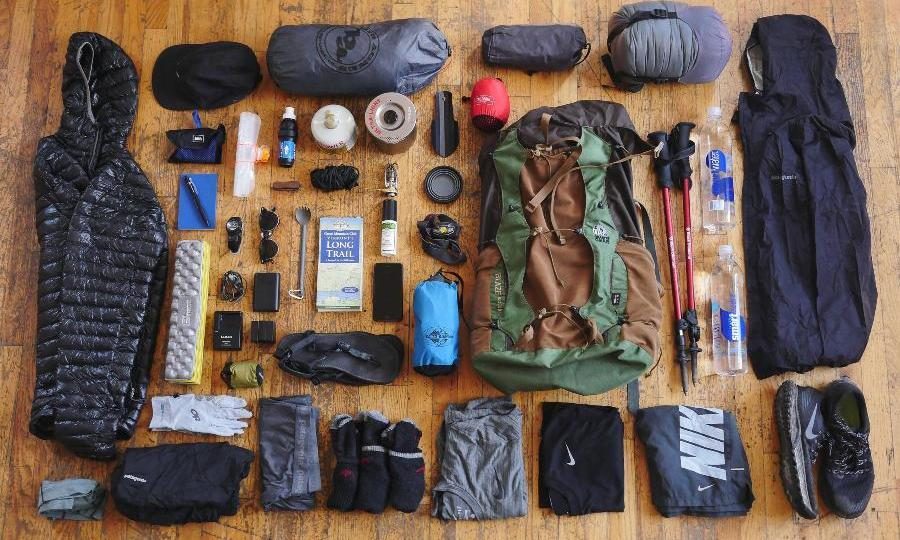
For a Rwenzori Margherita attempt, the baseline requirement is strong cardiovascular fitness combined with genuine comfort carrying a daypack over six to eight hours a day of rough, wet, uneven terrain for multiple consecutive days, the kind of conditioning our fitness guide for the Rwenzori sets out in specific training terms.

On top of that baseline, you need enough comfort on crampons and exposed terrain to manage the glacier crossing calmly, which is why we recommend that first-time technical mountaineers arrive having at least practiced cramponing on a dry-tooling wall, a via ferrata, or a guided glacier day elsewhere before attempting the Rwenzori.
For a Point Lenana trek on Mount Kenya, the fitness demand is comparable but the technical skill requirement drops to essentially zero; this is genuinely a mountain a fit, motivated first-time high-altitude trekker can complete. For Nelion or Batian, the calculus flips entirely: fitness becomes almost secondary to genuine multi-pitch rock climbing competence, ideally at a grade well above the route’s technical crux, since altitude, cold hands, and exposure all erode climbing performance. A strong hiker with no rock climbing background should not view Batian as a natural extension of a trekking career; it is a separate discipline that requires separate preparation, ideally including prior alpine rock climbing experience at altitude.
Altitude, Acclimatization, and Risk
Margherita’s 5,109 metres and Point Lenana’s 4,985 metres both sit comfortably within the altitude range where acute mountain sickness is a real, well-documented risk, and Batian and Nelion at just over 5,100 and 5,180 metres respectively sit slightly higher still. Our guide on whether you should acclimatize before the Rwenzori explains why the Rwenzori’s standard itineraries, which reach high sleeping altitudes relatively quickly on a demanding, energy-sapping trail, can actually present a more compressed acclimatization challenge than they first appear, despite the mountain’s lower summit elevation than Kilimanjaro. Mount Kenya’s longer trekking approaches, particularly Chogoria, generally allow a more gradual altitude gain, though the addition of a technical summit attempt on Batian introduces its own risk layer: climbing at altitude on exposed rock while fatigued from the preceding trek is a genuinely different risk profile from a straightforward high-altitude walk.
On both mountains, the operators you climb with should be monitoring you formally rather than casually. Our guides use the Lake Louise Score protocol and pulse oximetry to track every trekker’s altitude response throughout a Rwenzori trek, a system covered in full in our injury, illness, and evacuation guide, and any Mount Kenya operator you choose for a technical objective should be able to describe an equivalent standard of monitoring, along with a licensed technical mountain guide for the Nelion and Batian sections specifically, separate from your trekking guide.
Cost, Logistics, and Getting There
Reaching the Rwenzori means flying into Entebbe International Airport in Uganda and travelling on to Kasese, the gateway town for both the Central Circuit and Kilembe trailheads, a journey our team can arrange by road or by domestic flight depending on your itinerary. Reaching Mount Kenya means flying into Nairobi and travelling to one of the trailhead towns, Naro Moru, Nanyuki, or Chogoria, a shorter and generally more straightforward transfer given Kenya’s more developed domestic travel infrastructure. Neither logistics chain is difficult, but Uganda’s is the less familiar of the two for most first-time visitors to East Africa, and our gear rental and full package inclusions guides exist specifically to remove the guesswork from that unfamiliarity.

On cost, the two mountains are broadly comparable when you match itinerary length and technical scope fairly, though the Rwenzori’s lower visitor volume means less price competition and, in our experience, a package structure that leans more heavily on a small, highly experienced guide team per trekker rather than the larger group operations common on Mount Kenya’s busier routes. Trekkers looking to manage costs without compromising safety on technical sections should read our budget guide to the Rwenzori, which is explicit about which costs are worth protecting and which can reasonably be trimmed.
Which Mountain Should You Actually Climb?
If you are a strong hiker with little or no technical climbing background and you want the highest non-technical summit experience Africa’s second and third-highest mountains can offer, Point Lenana on Mount Kenya is the more accessible choice, and an entirely legitimate high-altitude achievement in its own right at just under 5,000 metres.
If you already have some rock climbing experience, ideally multi-pitch and at altitude, and you specifically want a genuine technical rock summit alongside a trek, Nelion or the full Batian traverse on Mount Kenya rewards that background directly, offering climbing most Rwenzori itineraries simply do not include.
If you want the single most complete high-altitude mountaineering experience available in East Africa, one that combines a demanding multi-day wilderness trek through rainforest, bog, and moorland with a mandatory glacier crossing to reach the true summit, all inside a range so lightly visited that solitude is close to guaranteed, the Rwenzori and Margherita Peak are the answer. This is precisely the trekker our mountaineering guide is written for, and it is the client we are, honestly, best equipped to serve. Whichever mountain you choose, please read our full guide on what to expect when you hike the Rwenzori Mountains before you commit, because an honest expectation of the terrain is worth more than any amount of gear.
It is also worth saying plainly that these two mountains are not actually in competition for most serious African mountaineers; they are complementary objectives on the same continent, and a growing number of our clients climb both within a year or two of each other, using one as preparation and calibration for the other.
Can You Combine a Rwenzori and Mount Kenya Trip?
Logistically, yes, though it requires more planning than a single-country itinerary. The two mountains sit in different countries with separate visa requirements there is however an option of applying for the east african visa which is legal in both countries , separate national park authorities, and no direct overland route between them, so a combined trip typically means flying between Entebbe and Nairobi as a discrete leg rather than a continuous overland journey. Most trekkers embark on both challenges starting with either of the two and sometimes even go for the popular Mount Kilmanjaro during their visit to East africa. Trekkers who want to build Uganda’s other headline adventure into the same trip more easily should look instead at our Rwenzori and gorilla trekking combination, which pairs a Margherita or shorter Rwenzori trek with gorilla trekking in Bwindi Impenetrable Forest, since both sit within Uganda and can be sequenced on a single visa without an international flight in between.
Frequently Asked Questions
Is the Rwenzori or Mount Kenya more technical?
It depends on which Mount Kenya summit you compare against. Point Lenana, Mount Kenya’s trekking summit, requires no technical climbing at all, making it less technical than any Rwenzori route to Margherita Peak, which always involves a roped glacier crossing. Batian and Nelion, Mount Kenya’s true summits, are proper multi-pitch rock climbs graded around UIAA IV, which is more advanced technical climbing than the Rwenzori’s glacier crossing demands. So Mount Kenya spans a wider technical range: easier at its trekking summit, harder at its true summits, than anything on the Rwenzori.
Which is higher, Margherita Peak or Mount Kenya?
Batian, Mount Kenya’s true summit, is higher at 5,199 metres, making Mount Kenya the second-highest mountain in Africa. Margherita Peak on the Rwenzori’s Mount Stanley reaches 5,109 metres, the third-highest point on the continent, a difference of 90 metres. Mount Kenya’s trekking summit, Point Lenana, is lower than both at 4,985 metres.
Do I need mountaineering experience for the Rwenzori?
You do not need prior mountaineering experience to book a Rwenzori trek, but you do need to arrive fit, mentally prepared for sustained mud and bog terrain, and willing to learn crampon and rope technique under guide supervision for the glacier crossing near the summit. Trekkers with zero technical background summit Margherita Peak successfully every season, but they do so through careful guide instruction on the mountain itself, not because the glacier crossing can be skipped.
Can I climb Mount Kenya without technical climbing skills?
Yes. Point Lenana, Mount Kenya’s trekking summit at 4,985 metres, is a non-technical high-altitude walk accessible to any reasonably fit trekker with proper acclimatization. Only the true summits, Nelion and Batian, require rock climbing skill and a specialist technical guide.
Which mountain is more remote and less crowded?
The Rwenzori is significantly less visited, receiving roughly a thousand trekkers a year across the entire range compared to the considerably higher volumes on Mount Kenya’s main trekking routes. Trekkers seeking genuine solitude and empty trails consistently find that on the Rwenzori rather than on Mount Kenya’s more established routes.
What is the best time of year to attempt the technical summit on either mountain?
On the Rwenzori, January to February and June to August are the driest windows, though rain and mist remain possible year-round given the range’s location in the Albertine Rift. On Mount Kenya, December to March is generally the most favourable period for the technical rock routes on Nelion and Batian, since the rock is driest and least likely to be verglassed or snow-covered during those months.
Should a beginner mountaineer start on the Rwenzori or Mount Kenya?
A beginner with no rock climbing background who still wants a technical glacier experience is often better served starting on the Rwenzori, where the technical section is a guided glacier crossing rather than independent multi-pitch rock climbing, and where the skill can be taught progressively on the mountain under close guide supervision. A beginner who wants to test their appetite for altitude without any technical component at all should start with Point Lenana on Mount Kenya, then decide from there whether Margherita Peak or the Nelion-Batian rock routes are the more appealing next step.
Ready to Plan Your Rwenzori Expedition?
Both of these mountains reward the trekker who does the research before they book, and both punish the one who does not. If the Rwenzori’s combination of rainforest, bog, moorland, and mandatory glacier mountaineering to a true African summit sounds like the expedition you have been looking for, get in touch with our team through our contact page and speak directly with a guide who has stood on Margherita Peak more times than they can count. Tell us your experience level honestly, and we will help you choose the right route, the right season, and the right level of preparation to get you there safely.