Discover every named waterfall in the Rwenzori Mountains, Enock’s, Samalira, Nyamwamba Falls & more, plus the best treks to see them. Plan your trek today.
The first waterfall you encounter on the Rwenzori will probably not be the one you were expecting. It arrives quietly, a distant percussion behind birdsong, and then it doesn’t stop, because on this mountain it never really does. I have guided trekkers into the Rwenzori for many seasons, along both the Central Circuit and the Kilembe Trail, and if there is one feature of this range that consistently surprises even well-travelled hikers, it is the sheer density of falling water. Kilimanjaro, by comparison, is a dry mountain. Rwenzori is not. Rain falling on some of the oldest exposed rock on the African continent has nowhere to go but down, fast, and over millennia that water has carved a landscape stitched together with cascades, plunge pools, and thundering gorges, several of them among the most photogenic waterfalls anywhere on the continent, and almost none of them known outside a small circle of guides, porters, and the handful of trekkers who make it onto the Kilembe Trail each year. This is the guide I give trekkers who ask specifically about the waterfalls, expanded into the complete written account: every named fall, where it sits on the mountain, how it was formed, when it runs at its most dramatic, and exactly which of our itineraries will put you in front of it.
Why the Rwenzori Has So Many Waterfalls
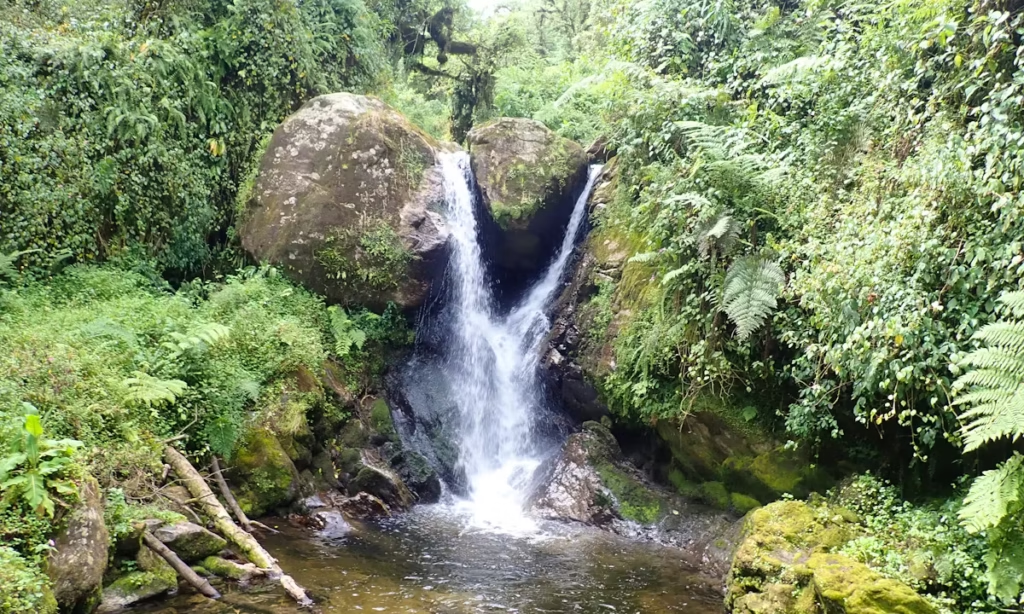
Waterfalls are not a coincidental feature of this mountain; they are a direct consequence of its geology and its climate working together. The Rwenzori is a block mountain, a slab of ancient crystalline gneiss, granite, and amphibolite thrust nearly four kilometres skyward along the faults of the Albertine Rift, a process explained in detail in our guide to the range’s geology and block mountain formation. That bedrock is essentially impermeable. On a volcanic mountain like Kilimanjaro, rainwater soaks into porous ash and scoria and disappears underground. On the Rwenzori, it cannot. Rain lands on hard rock and runs, immediately, gathering into rivulets within minutes and building, within a few kilometres of descent, into the muscular, cold, boulder-choked rivers that define every trail on this mountain, a subject we cover comprehensively in our companion guide to the rivers of the Rwenzori Mountains.
Add to that geology one of the wettest climates in Africa. Mid-elevation zones on the Rwenzori receive between 2,000 and 3,000 millimetres of rain a year, a volume that would be considered exceptional almost anywhere else on the continent and here is simply normal. Combine relentless rainfall with impermeable rock and steep gradients, and the result is inevitable: every valley on the mountain becomes a staircase for water, and wherever that staircase meets a resistant band of the Rwenzori’s crystalline rock, a genuine waterfall forms. This is precisely why the Nyamwamba Valley on the southern flank of the range, drained by the Kilembe Trail, has become known among guides as the waterfall country of the Rwenzori. Nowhere else on the mountain does the geology and the rainfall conspire to produce quite so concentrated a sequence of named falls.
The Waterfalls of the Nyamwamba Valley: Rwenzori’s Falling-Water Heartland
If you have come to this mountain specifically for waterfalls, this is the valley that will define your trek. The Nyamwamba River rises high on the southern Rwenzori and drops through a sustained sequence of cascades and rapids on its way down to Kasese, a descent that in the assessment of most guides who have worked both major trails makes the Kilembe route the more visually dramatic of the mountain’s two principal lower approaches, a comparison we lay out fully in our Central Circuit versus Kilembe Trail guide. Six named waterfalls sit along this single trail corridor, and walking past all of them in sequence, as our dedicated 4-Day Rwenzori Waterfalls Hike is built to do, remains one of the most rewarding short experiences available anywhere in East Africa.
Enock’s Falls
The first of the named falls sits just a short walk from Sine Camp, close enough that trekkers who arrive with energy to spare in the late afternoon can reach it, photograph it in the low, golden light of an equatorial evening, and be back at camp in time for dinner.

Enock’s Falls is not the tallest or the most thunderous cascade on the trail, but it is the most accessible, and for that reason it is often the fall that first-time Rwenzori trekkers remember most fondly: a manageable introduction to what the rest of the valley has in store.
Samalira Falls
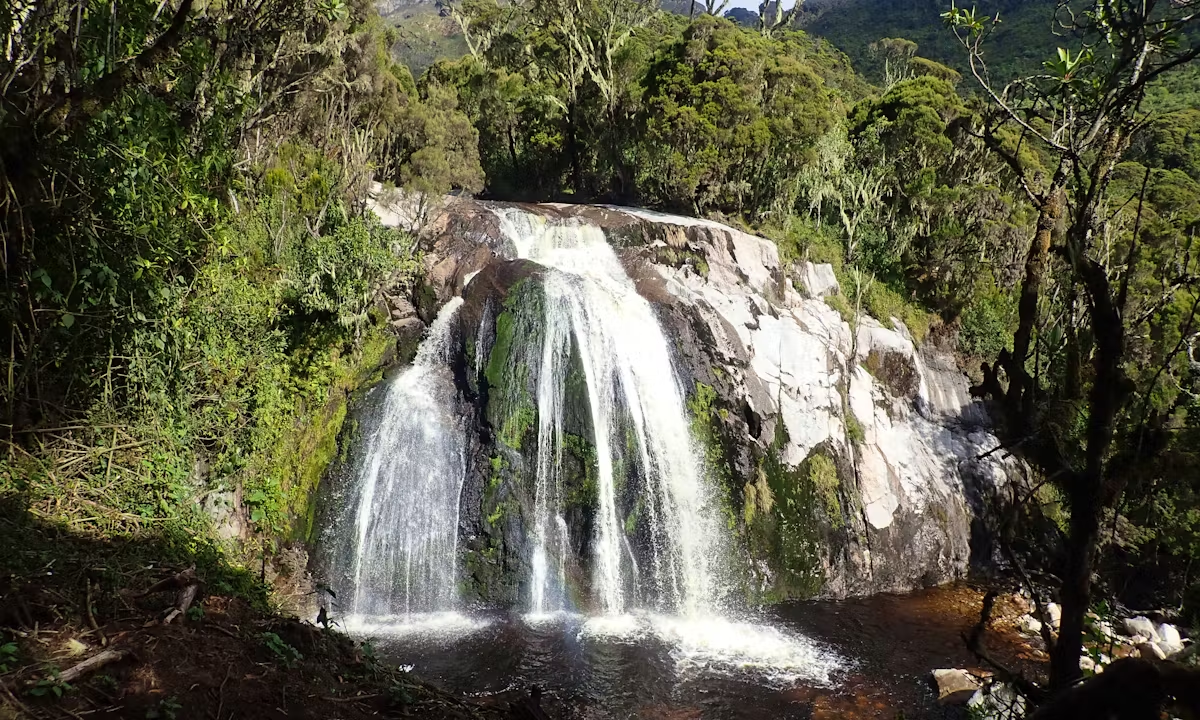
Climbing higher into the valley, the trail brings you to Samalira Falls, a multi-drop cascade tumbling through a narrow gorge lined with giant heather and old man’s beard lichen, close to Samalira Camp itself. This is the fall most trekkers hear before they see, a deep percussive roar building steadily as the trail bends around exposed rock, and the camp positioned directly above it means the sound of falling water becomes the soundtrack of an entire night on the mountain, oddly soporific once you have adjusted to it. Because Samalira Falls sits so close to camp, it rewards trekkers who arrive early enough to explore it in both afternoon and early morning light, when mist rising off the gorge catches the sun in a way that has filled more than a few trekkers’ camera memory cards.
Cathy’s Falls
Further into the Nyamwamba Valley, Cathy’s Falls is a comparatively recent discovery on this trail, and it is, by consensus among the guides who know this valley best, at its most spectacular in the period immediately following heavy rain, when the volume of water going over it multiplies dramatically. Cathy’s Falls is a reminder that the Rwenzori is a mountain still revealing itself; new features continue to be identified in valleys that see so few visitors that a genuinely dramatic waterfall can remain informally unnamed for years before local guides settle on what to call it.
Nyamwamba Falls: The Tallest Named Waterfall on the Mountain
Nyamwamba Falls itself, named directly for the river that carved it, is the tallest of the Rwenzori’s well-documented waterfalls, dropping a full fifty-two metres into a deep pool at its base. That pool is genuinely swimmable, and on a hot ascent day the shock of that cold, glacier-and-rain-fed water against overheated skin is one of the small, uncomplicated pleasures the Rwenzori offers trekkers willing to take the short detour to its edge. At fifty-two metres, Nyamwamba Falls stands as the benchmark against which every other named cascade on the mountain is measured, and it is the single most frequently photographed water feature on the entire Kilembe Trail.
Plozza Falls and Egwe Falls
Further downstream, as the trail continues its descent toward Forest View Camp, two further falls complete the Nyamwamba sequence: Plozza Falls and Egwe Falls, both worked directly into the descent route and both offering a final, dramatic farewell to the valley before the trail levels out toward the lower forest and, eventually, Kasese. Trekkers descending this route in the late afternoon often catch these two falls in the softest light of the day, the forest canopy overhead filtering the equatorial sun into the kind of diffuse glow that photographers specifically plan their itineraries around.
Taken together, these six falls, Enock’s, Samalira, Cathy’s, Nyamwamba, Plozza, and Egwe, make the lower Kilembe Trail the single most waterfall-dense stretch of trekking anywhere in Uganda, a claim that is difficult to dispute once you have walked it yourself.
Waterfalls Beyond the Kilembe Trail
While the Nyamwamba Valley holds the Rwenzori’s best-known named waterfalls, it is not the only part of the mountain where falling water shapes the trekking experience. On the eastern side of the range, the Central Circuit Trail follows the Mubuku River for the majority of its lower approach, and while this valley is less densely punctuated with individually named falls than the Nyamwamba, its network of feeder streams produces frequent smaller cascades on the climb from Nyakalengija toward Nyabitaba, particularly in the sections where trekkers cross tributary streams on log bridges before the trail enters the true montane forest. The Mubuku’s character is powerful rather than showy: a river defined more by sustained volume and rapids than by isolated dramatic drops, and trekkers who want the full Mubuku story alongside a Margherita Peak summit attempt should look closely at our Central Circuit Trail overview, which follows this river for its entire lower approach.
On the gentler Mahoma Loop, water takes a different form again, feeding the crater lakes and forest streams that make this short trek popular with trekkers seeking scenery without a summit attempt, while shin-deep stream crossings replace the dramatic plunges of the Kilembe Trail. Further south and west, along the wild, seldom-visited Bukurungu Trail, the Nyamugasani River is associated with several of its own waterfalls in its upper sections, in a valley so lightly trekked that the falls there see, in most years, no international visitors at all. For trekkers whose fascination is specifically with remote, essentially unvisited waterfall country, a custom itinerary on the Bukurungu route is worth discussing directly with our guides.
How to See the Rwenzori’s Waterfalls: Choosing the Right Trek
Because the Nyamwamba Valley concentrates the mountain’s most spectacular named falls, several of our itineraries are built specifically around showing them to you without requiring a full summit attempt.
The 4-Day Rwenzori Waterfalls Hike is the itinerary designed expressly for this purpose. Starting at the Kilembe Trailhead near Kasese and climbing to a maximum elevation of roughly 3,100 metres at Bugata Camp, it requires no glacier experience and no technical mountaineering skill, only solid cardiovascular fitness and a tolerance for the mud that defines the Rwenzori’s lower forest zone. Over four days you move through montane forest, bamboo, and giant heather, camping at Sine, Samalira, and Bugata, with the Nyamwamba Valley’s waterfall sequence forming the spine of the entire route. Because fewer than a thousand trekkers visit the whole Rwenzori range in a typical year, a fraction of Kilimanjaro’s annual traffic, it is entirely normal to stand at the base of a fifty-two-metre waterfall completely alone, hearing nothing but the water itself.
For trekkers with less time available, the 3-Day Sine Camp and Samalira Falls Trek compresses the experience into a shorter window while still delivering the valley’s signature cascade, and it is one of several compact options detailed in our guide to shorter three-to-four-day Rwenzori treks for travellers balancing ambition against limited holiday time. Trekkers who want waterfall scenery alongside sweeping panoramic viewpoints, rather than a pure water-focused itinerary, might instead consider the 4-Day Mutinda Lookout Trek, which shares the same Kilembe Trailhead.
For those who want the full waterfall experience as a prelude to something bigger, every one of these routes shares its lower trail with our longer expeditions to Margherita Peak. The 8-Day Kilembe Trail to Margherita Peak follows precisely the same waterfall-lined valley for its first days before climbing on into the Afroalpine zone and, eventually, the summit itself, meaning trekkers do not have to choose between the falls and the peak; the two experiences share the same trailhead.
Best Time to See the Rwenzori’s Waterfalls at Full Power
The volume of water going over every named fall in the Nyamwamba Valley changes dramatically with the season, and understanding that rhythm, laid out in detail in our Rwenzori trekking calendar, is essential to planning a waterfall-focused trip well.

During the two dry-season windows, roughly June to August and December to February, trails are at their most stable and river crossings at their most predictable, though the falls themselves run at a slightly gentler, clearer volume. During the wet seasons, particularly through April and October, the same falls are transformed: what is a strong but manageable cascade in July becomes, in our guides’ own consistent description, a genuinely thunderous spectacle, one of the reasons the Waterfalls Hike is regularly recommended as one of the very best wet-season Rwenzori itineraries, a topic explored further in our guide to trekking the Rwenzori in the rainy season. There is no objectively correct choice between the two; a dry-season trek trades some of that maximum drama for easier underfoot conditions and more reliable mountain views, while a wet-season trek accepts more difficult trail conditions in exchange for witnessing the Nyamwamba’s falls at a volume few visitors ever see.
Photographing Rwenzori Waterfalls
The falls of the Nyamwamba Valley reward a particular kind of patience. The forest canopy overhead filters equatorial light into a soft, even glow that is often more flattering to moving water than harsh midday sun, and the period an hour either side of sunrise or sunset consistently produces the richest colour, particularly at Enock’s Falls, close enough to Sine Camp to visit twice in a single evening without disrupting a trekking schedule. A slower shutter speed brings out the characteristic silky texture of falling water at Samalira and Nyamwamba Falls, though a stable footing and, ideally, a lightweight tripod are essential given the wet, often slick rock underfoot near any of these cascades. Persistent mist thrown up by the larger drops, especially at Nyamwamba Falls, means a rain cover or dry bag for camera equipment is not optional gear on this trek but a genuine necessity, a point covered further in our full Rwenzori packing list.
Waterfalls Within the Wider Rwenzori Water System
None of these waterfalls exist in isolation. Each one marks the precise point where a river coming down off the mountain’s moorland and heather zones meets a resistant band of the Rwenzori’s ancient crystalline rock, the same geological story that also produced the mountain’s block-fault structure. Water passing over Nyamwamba Falls, Samalira Falls, and their neighbours continues downstream to reach Kasese and, ultimately, Lake George, part of the same Albertine Rift drainage system that our complete rivers guide traces all the way to the Semliki River, Lake Albert, and the beginning of the White Nile. It is a genuinely remarkable thought to stand at the base of a fifty-two-metre waterfall on the southern Rwenzori and know that the same water, days or weeks later, becomes part of the river system that convinced the Greek geographer Ptolemy this range was his Lunae Montes, the fabled Mountains of the Moon, source of the Nile.
It is also worth setting the Rwenzori’s waterfalls in the context of Uganda’s wider waterfall landscape.
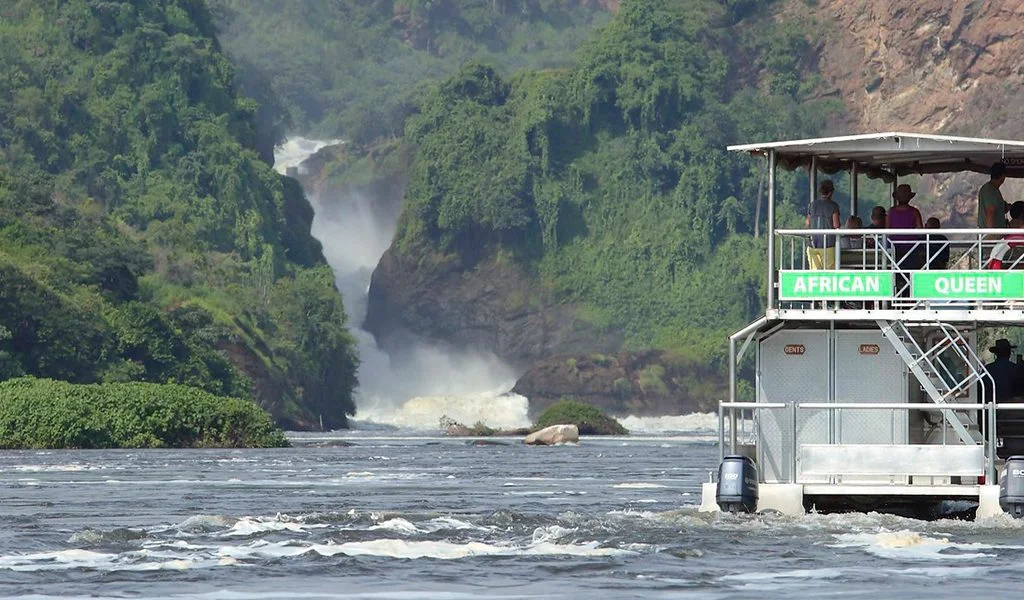
Nothing on this mountain approaches the sheer volume of Murchison Falls, where the entire Nile is forced through a gap barely seven metres wide, and trekkers who complete a Rwenzori itinerary and want to see Uganda’s most powerful single waterfall as a contrasting experience often add a Murchison Falls extension to their trip. What the Rwenzori offers instead is not raw power but density and intimacy: six named falls within a single valley, most of them reachable without a single other trekking group in sight, an experience Murchison, with its regular tourist boat traffic, simply cannot replicate.
Getting to the Waterfalls: Practical Logistics
Every waterfall described in this guide sits along the Kilembe Trail, which begins at the Kilembe Trailhead, roughly twelve kilometres southwest of Kasese town in western Uganda. Kasese itself is reachable from Kampala by a five-to-six-hour drive or scheduled bus service, and our kasese gateway guide for trekkers covers arrival logistics, accommodation, and onward transfer options in full. Every waterfall-focused itinerary we run includes the transfer between Kasese and the Kilembe Trailhead as standard, along with UWA park permits, a certified lead guide, a dedicated porter team, and full board camp meals throughout, the same inclusions detailed on each specific trek page linked above.
No trekker needs prior mountaineering experience to see these falls; the entire waterfall sequence sits below 3,100 metres and involves no glacier travel or technical climbing. What it does demand is genuine cardiovascular fitness, comfort with sustained, muddy uphill walking, and waterproof gear suited to a mountain that receives among the highest rainfall totals in Africa, considerations covered fully in our fitness and training guide and our guide to how hard the Rwenzori trek really is. Every waterfall itinerary we run is fully guided and fully catered, and exactly what that includes, from permits to porters to camp meals, is broken down in our guide to what’s included in a booked Rwenzori trek. If a question about your specific circumstances isn’t answered here, our full FAQ library covers more than a hundred further questions from past trekkers.
Frequently Asked Questions About Rwenzori Waterfalls
What is the biggest waterfall in the Rwenzori Mountains?
Nyamwamba Falls, on the lower Kilembe Trail, is the tallest of the Rwenzori’s well-documented named waterfalls, dropping approximately fifty-two metres into a deep pool at its base that is sometimes used for swimming by trekkers on the 4-Day Rwenzori Waterfalls Hike. It sits within a wider sequence of falls on the same trail, including Enock’s Falls, Samalira Falls, Cathy’s Falls, Plozza Falls, and Egwe Falls, that together make the Nyamwamba Valley the most waterfall-rich section of any Rwenzori trekking route.
How many waterfalls are there in the Rwenzori Mountains?
The Nyamwamba Valley on the Kilembe Trail contains at least six named waterfalls: Enock’s Falls, Samalira Falls, Cathy’s Falls, Nyamwamba Falls, Plozza Falls, and Egwe Falls. Beyond this valley, the mountain’s other rivers, including the Mubuku on the Central Circuit and the Nyamugasani on the remote Bukurungu Trail, feed numerous further unnamed cascades, meaning the true total of significant waterfalls across the entire Rwenzori range is considerably higher than the number of falls that have been formally named and documented.
Which trek is best for seeing the Rwenzori waterfalls?
The 4-Day Rwenzori Waterfalls Hike on the Kilembe Trail is purpose-built around the Nyamwamba River’s waterfall sequence and visits the greatest concentration of named falls available on any single Rwenzori itinerary. Trekkers with less time can choose the 3-Day Sine Camp and Samalira Falls Trek, which still delivers the valley’s signature cascade in a shorter window. Trekkers who want the same waterfalls as a prelude to a summit attempt can extend onto the 8-Day Kilembe Trail to Margherita Peak, which shares the identical lower trail.
When is the best time to see the Rwenzori waterfalls at their most dramatic?
The falls run at their most thunderous during the wet seasons, particularly through April and October, when rainfall dramatically increases the volume of water going over every named cascade in the Nyamwamba Valley. Trekkers prioritising trail stability and mountain views over maximum waterfall drama should instead target the dry-season windows of June to August or December to February, when the falls remain impressive but conditions underfoot are considerably easier.
Can you swim in any of the Rwenzori waterfalls?
Yes. The pool at the base of Nyamwamba Falls is deep enough for swimming and is used by trekkers on the 4-Day Rwenzori Waterfalls Hike, particularly on hot ascent days when the shock of the cold, glacier-and-rain-fed water is a welcome relief. As with any mountain river pool, conditions vary with recent rainfall, and your guide will advise on the day whether the water is safe to enter.
Is it difficult to reach the Rwenzori’s waterfalls?
Reaching the Nyamwamba Valley’s waterfalls requires a multi-day guided trek rather than a day trip; none of these falls are accessible by vehicle or short walk from a road. The 4-Day Rwenzori Waterfalls Hike is rated moderate and is achievable by fit beginners with several weeks of uphill training, requiring no prior mountaineering experience or technical gear, since the entire route stays below the mountain’s glacier line.
How do the Rwenzori waterfalls compare to Uganda’s other famous waterfalls, like Murchison Falls?
The Rwenzori’s waterfalls and Murchison Falls offer fundamentally different experiences. Murchison Falls is defined by raw power, the entire Nile forced through a gap only a few metres wide, and is reached easily by vehicle and boat as part of a wildlife safari. The Rwenzori’s waterfalls, by contrast, are defined by density, intimacy, and remoteness: six named falls within a single trekked valley, most encountered without another visitor in sight, reachable only on foot after days of walking through pristine montane forest.
Are the Rwenzori waterfalls safe to visit?
Yes, when visited with an experienced local guide as part of an organised trek. The main hazards are wet, slippery rock near the base of any fall and the general demands of multi-day trekking at altitude rather than any danger specific to the waterfalls themselves. All Rwenzori Trekking Safaris itineraries are led by certified guides who know the Nyamwamba Valley’s conditions intimately and adjust routes and pacing according to current river levels and recent rainfall.
Start Planning Your Rwenzori Waterfall Trek Today
Few short treks anywhere in Africa put you this close to this much falling water, walking valley after valley in the company of guides who grew up within sight of these very cascades. Whether your ambition is a focused four days chasing the Nyamwamba’s full waterfall sequence, a shorter introduction on the Sine and Samalira route, or a longer expedition that carries the same falls forward into a Margherita Peak summit attempt, our team can build the itinerary that matches your time, fitness, and curiosity. Get in touch with our team to start planning your Rwenzori waterfall trek, or message a mountain guide directly on WhatsApp at +256 773 256 104 for honest, first-hand advice on which route will put you closest to the falls you most want to see.