Rwenzori vs Everest Base Camp: cost, difficulty, altitude, and crowds compared in detail. Find out which trek is right for you.
I have lost count of the number of times a trekker has sat across from me in our Kasese office, halfway through a Rwenzori planning conversation, and mentioned that Everest Base Camp was the other trip on their shortlist. It is a natural comparison. Both are bucket-list, non-technical-to-moderate high-altitude treks with genuine global reputations, both take you into a landscape dominated by permanently snow-capped peaks, and both are the kind of expedition people spend years saving for and training toward. But the two experiences could hardly be more different once you are actually on the trail, and having guided extensively on one of them while sending countless clients researching the other, I want to give you the honest, detailed comparison I wish existed when I was planning my own first Himalayan trip years ago.
This is not a piece designed to talk you out of Everest Base Camp. It is one of the great treks on earth, and for a huge number of people it is exactly the right trip. What this article will do is walk you through cost, difficulty, crowding, altitude, logistics, scenery, and the day-to-day feel of both journeys in enough detail that you can make the decision with real information rather than marketing copy. If you are weighing the Rwenzori against Kilimanjaro instead, our Kilimanjaro vs Mount Kenya vs Rwenzori Mountains comparison covers that ground; this piece is specifically about the Rwenzori and the world’s most famous Himalayan trek.
The Fundamental Difference: A Range of Six Peaks vs a Single Mountain’s Approach
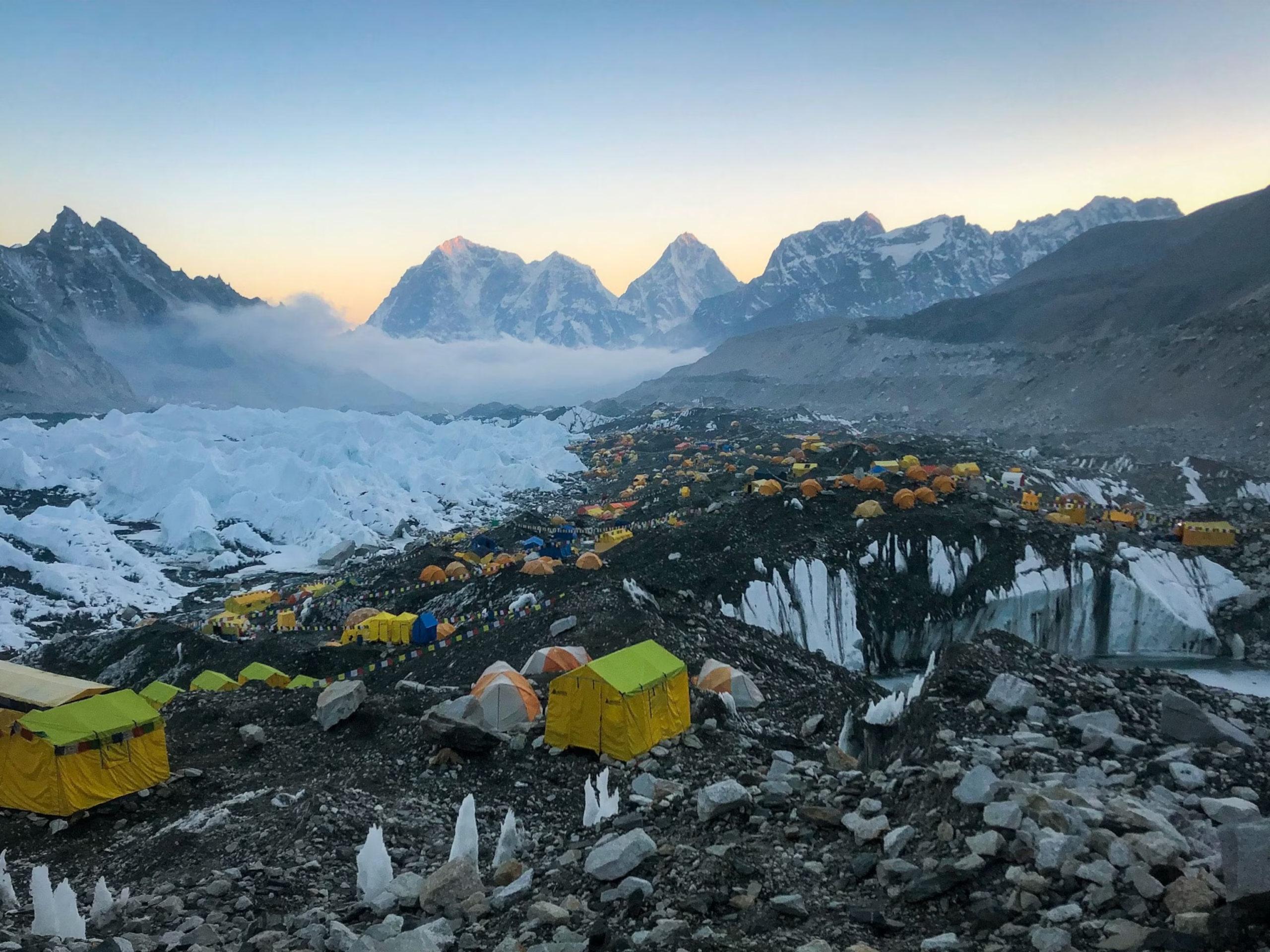
Before any numbers, it helps to understand what each trek is actually structured around, because the two are built differently at a conceptual level. The Everest Base Camp trek is an approach trek: you are walking up the Khumbu Valley toward the foot of a single mountain, Everest itself, and the destination is a viewpoint and a base camp, not a summit. You do not climb Everest on this trip. You walk to where climbers begin their attempt on it, and to the nearby viewpoint of Kala Patthar, and then you walk back out the way you came.
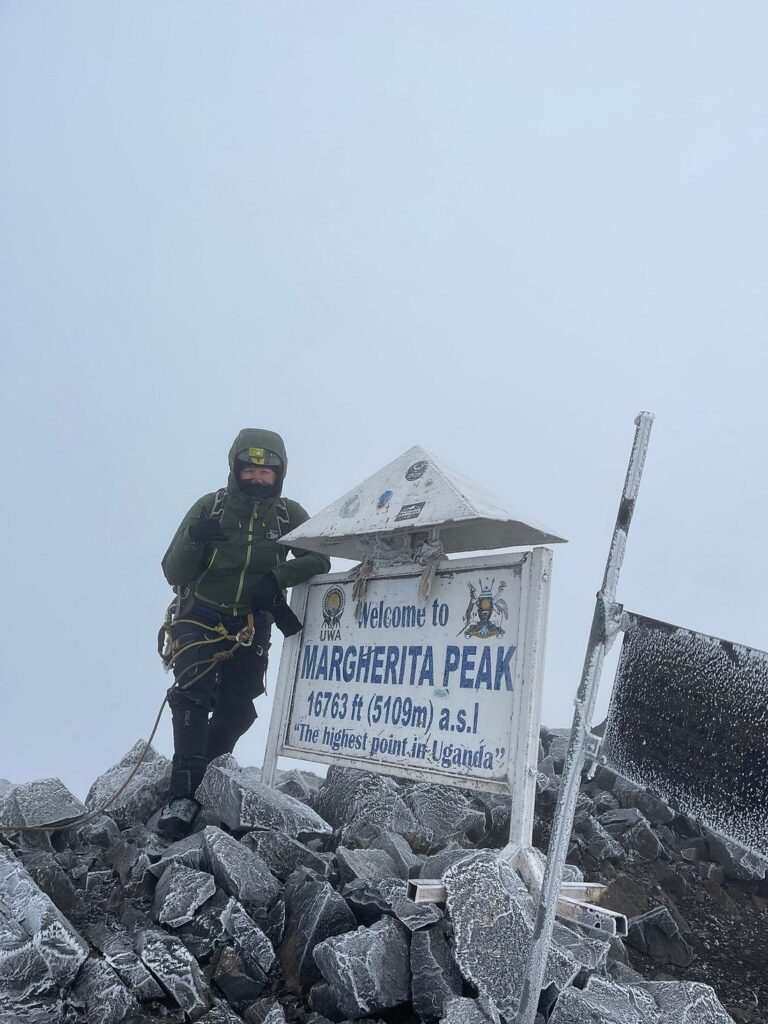
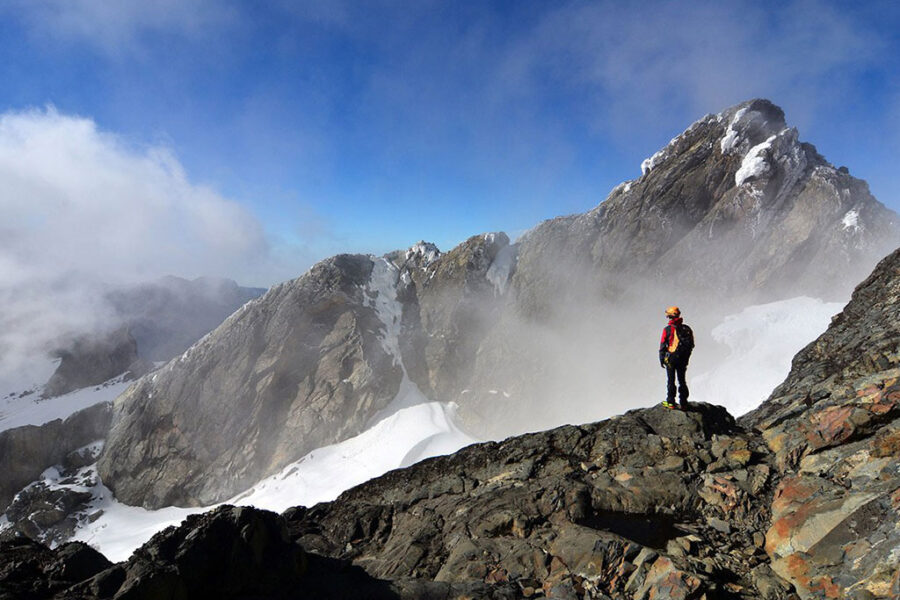
The Rwenzori is structured around something different: an actual summit expedition inside a range of six distinct glaciated massifs. Our Central Circuit Trail and Kilembe Trail both culminate not in a viewpoint of a mountain you cannot climb, but in an actual guided ascent of Margherita Peak on Mount Stanley, the third-highest point in Africa at 5,109 metres, using crampons, rope, and an ice axe to cross a real glacier. For trekkers who want the psychological and physical satisfaction of standing on an actual summit rather than looking at one from a distance, this is the single biggest structural difference between the two trips, and it is worth sitting with before you compare anything else.
Altitude and Physiological Demand
Everest Base Camp itself sits at 5,364 metres, and the standard trek’s true high point, the Kala Patthar viewpoint, reaches 5,545 metres, both figures meaningfully higher than Margherita Peak’s 5,109 metres. On pure numbers, Everest Base Camp trekkers spend time at a higher elevation than Rwenzori trekkers do, and the thinner air at those altitudes is a genuine physiological factor: oxygen availability at 5,545 metres is noticeably lower than at 5,109 metres, and acute mountain sickness is a well-documented risk throughout the upper Khumbu Valley.
What complicates a simple altitude comparison is ascent profile and physical exertion. The standard Everest Base Camp itinerary, at twelve to fourteen days, is built around a slow, deliberate altitude gain with mandatory acclimatization days at Namche Bazaar and Dingboche, walking on generally good trail at a measured six to seven hours a day. The Rwenzori’s standard summit itineraries, typically six to nine days on our 7-day and 6-day Margherita Peak treks, compress a comparable altitude gain into a shorter window over dramatically harder underfoot terrain. Our detailed guide on whether you should acclimatize before the Rwenzori explains why this combination, faster altitude gain plus higher energy expenditure per metre climbed, can make the Rwenzori’s acclimatization challenge feel more compressed than the raw summit altitude would suggest, even though Everest Base Camp reaches higher on paper.
Difficulty: Two Very Different Kinds of Hard
Everest Base Camp: Long, High, and Cold, But Not Technical
The Everest Base Camp trek is, by design, a non-technical high-altitude walk. You are on established, well-maintained trail for the entire route, following a single main corridor up the Khumbu Valley through villages, suspension bridges, and Sherpa settlements, with teahouse lodging available at every stop. The difficulty is almost entirely a function of sustained altitude, cold, and cumulative daily distance over roughly 130 kilometres round trip, rather than technical terrain. No ropes, crampons, or climbing skill are involved at any point on the standard route.
The Rwenzori: Physically Brutal Terrain Plus a Mandatory Glacier Crossing
The Rwenzori’s difficulty comes from an entirely different combination of factors. The lower trail sections pass through genuine equatorial rainforest where mud, roots, and standing water slow progress to a crawl, and the middle sections cross Afro-alpine bog where trekkers routinely sink to their knees between the tussocks, a reality our field notes on hiking the Rwenzori address in specific, practical detail. Then, unlike Everest Base Camp, the Rwenzori’s standard summit itinerary ends with a mandatory technical section: crampons, a roped glacier crossing of the Stanley Plateau, and a final push up steep, icy rock using fixed lines to reach the Margherita summit, all covered step by step in our guide to how technical the climb to Margherita Peak really is. Our detailed comparison of whether the Rwenzori is harder than Kilimanjaro is a useful reference point here too, since the same terrain-driven, rather than altitude-driven, difficulty applies relative to Everest Base Camp: the Rwenzori is not necessarily harder because it is higher; it is harder because the ground itself fights you at every elevation, and it asks for a mountaineering skill that Everest Base Camp never requires.
The honest summary for a trekker weighing both trips is this: Everest Base Camp is a longer, higher, colder walk that punishes you gradually through altitude and distance. The Rwenzori is a shorter, muddier, more physically technical expedition that punishes you through terrain and finishes with a genuine mountaineering challenge that Everest Base Camp simply does not include.
Crowds and the Character of the Trail
This is, in my honest assessment, the single most dramatic point of contrast between the two treks, and the one that consistently surprises trekkers who have done both. Sagarmatha National Park, home to the Everest Base Camp route, receives somewhere in the range of fifty to sixty thousand foreign visitors a year, the overwhelming majority of them walking the same single trail corridor from Lukla, with October and November alone accounting for a huge share of annual traffic. During the main autumn season, the trail through Namche Bazaar, the teahouses at Dingboche and Lobuche, and the pre-dawn queue up Kala Patthar for sunrise can feel genuinely crowded, with dozens of other trekkers visible at any given time and lodges filling to capacity in peak weeks.
The Rwenzori sees roughly one thousand trekkers a year across the entire six-peak range, a figure so much smaller that the comparison barely functions as a ratio. Our guides regularly complete multi-day expeditions without encountering another trekking party on the trail at all, the mountain huts along the Central Circuit and Kilembe Trail are frequently occupied by a single group, and summit mornings on Margherita Peak do not involve queuing. Our piece on why the Rwenzori is the best mountain hike in Africa goes into this contrast at length, but the practical takeaway for anyone choosing between the two trips is straightforward: if solitude, genuine wilderness immersion, and the feeling of exploring somewhere the wider trekking world has largely overlooked matter to you more than established infrastructure and a well-worn trail, the Rwenzori delivers something Everest Base Camp, for all its grandeur, cannot.
Cost: A Detailed Breakdown
A standard guided Everest Base Camp package in the 2026/2027 season typically runs from around USD 1,100 at the budget end to USD 2,200 or more for a comfort-oriented itinerary, generally covering Kathmandu-Lukla flights, teahouse lodging, meals, a guide, a porter, and the mandatory Sagarmatha National Park and Khumbu municipality permits. International flights to Kathmandu and personal gear are additional. A fully guided Rwenzori expedition to Margherita Peak, as our own complete cost breakdown sets out in detail, runs from roughly USD 1,800 to 2,500 for a standard seven to eight-day itinerary, with shorter non-summit treks starting from around USD 300 to 500 and extended multi-peak expeditions priced higher again. Our park entrance fees and permits guide breaks down the Uganda Wildlife Authority charges that form part of this figure, including how additional peaks and unplanned extra days are priced.
Set side by side at comparable itinerary lengths, the two treks land in a similar overall price bracket, though the Rwenzori’s cost reflects a genuinely different service model: smaller group sizes, a higher guide-to-trekker ratio on technical terrain, and the provision of full technical mountaineering equipment, crampons, ropes, ice axes, and harnesses, as standard, all of which our full package inclusions guide sets out clearly. Both trips require a tipping budget on top of the package price for the porter and guide team; our own tipping guide for Rwenzori porters and guides recommends budgeting roughly ten to fifteen percent of the core trek fee, a figure broadly comparable to accepted Everest Base Camp tipping norms for Sherpa crews.
Duration and Itinerary Structure
The standard Everest Base Camp trek runs twelve to fourteen days door to door from Kathmandu, including the Lukla flights on either end, with most operators building in two dedicated acclimatization days at Namche Bazaar and Dingboche. A comparable Rwenzori summit expedition runs six to nine days depending on the trail chosen, our 6-day and 7-day Margherita Peak itineraries being our most common bookings, with the Kilembe Trail generally running a day or two longer than the Central Circuit. Trekkers with limited vacation time will notice this gap immediately: the Rwenzori delivers a comparable summit-level achievement, an actual glaciated African summit rather than a viewpoint, in roughly half the total trip duration of Everest Base Camp, a genuinely significant factor for anyone balancing a bucket-list trek against a fixed number of annual leave days.
For trekkers with more time available, the Rwenzori also offers something Everest Base Camp’s single-mountain structure cannot: the ability to extend an expedition to include multiple summits within the same range, from Mount Speke and Mount Baker to the more remote objectives of Mount Emin, Mount Gessi, and Mount Luigi di Savoia, turning a single expedition into a genuine multi-peak mountaineering trip across our full range of peaks.
Scenery and Ecological Character
Everest Base Camp’s landscape is dramatic in a stark, high-alpine way: rock, ice, and the world’s greatest concentration of 8,000-metre peaks rising directly above the trail, with Sherpa villages, prayer flags, and Buddhist monasteries providing cultural texture along a route that climbs steadily out of forest into high-altitude desert. It is one of the most photographed landscapes on earth for good reason.
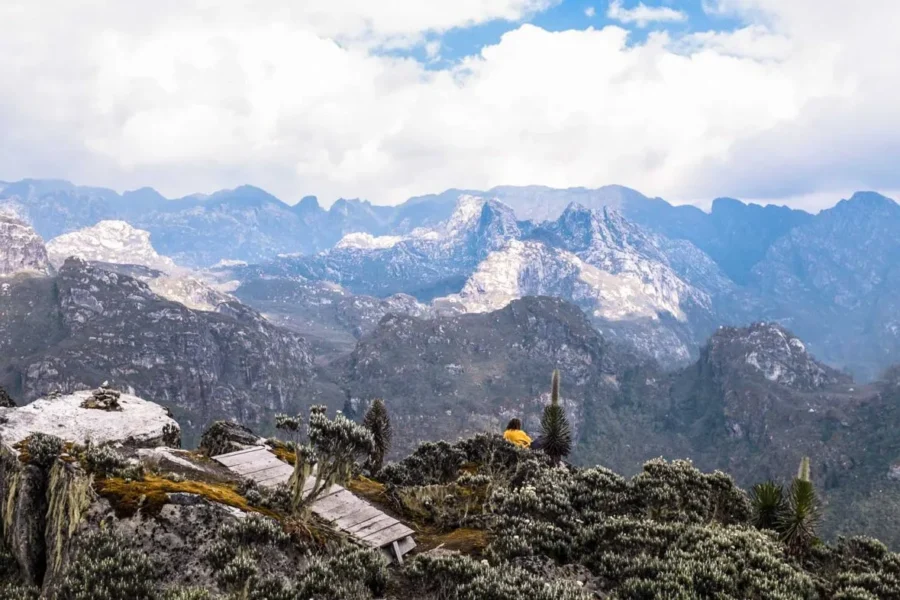
The Rwenzori offers something almost opposite in character: a compressed vertical journey through five or six distinct ecological zones in a single trek, from dense montane rainforest through bamboo and heather zones into other-worldly Afro-alpine moorland dotted with giant groundsels and lobelias found almost nowhere else on the planet, before finishing in genuine glaciated alpine terrain. Our facts about the Rwenzori Mountains article covers this ecological range in detail. Where Everest Base Camp’s scenery is defined by scale and singular grandeur, the Rwenzori’s is defined by density and transformation, a trekker moving through more distinct biomes in a week than most mountain treks anywhere in the world offer in a month.
Weather and Best Time to Go
Everest Base Camp has two clearly defined prime windows, spring from March to May and autumn from September to November, with the monsoon months of June to August generally avoided due to heavy rain and obscured views, and winter considered viable only for well-prepared, cold-tolerant trekkers. The Rwenzori’s climate works differently: our best time to trek the Rwenzori guide identifies December to March and June to August as the driest windows, but the range’s position deep in the Albertine Rift means some rain falls on most days even in the driest months, a genuinely different climate reality from the more clearly delineated dry and wet seasons of the Everest region. What this means practically is that Everest Base Camp trekkers can plan around a narrower, more reliably clear weather window, while Rwenzori trekkers should expect and prepare for wet conditions regardless of season, a distinction covered thoroughly in our guide to the Rwenzori’s climate through the seasons.
Logistics: Getting There and Getting Around
Reaching Everest Base Camp means flying into Kathmandu, then taking a short, well-known but weather-dependent flight to Lukla’s Tenzing-Hillary Airport, widely regarded as one of the most dramatic commercial airstrips in the world, before walking the entire remaining route on foot. Reaching the Rwenzori means flying into Entebbe International Airport in Uganda, then travelling on to Kasese, either overland or via a short domestic flight, the gateway town for both major trailheads. Our complete Kasese travel guide covers this leg of the journey, including where to stay before and after your trek, in detail.
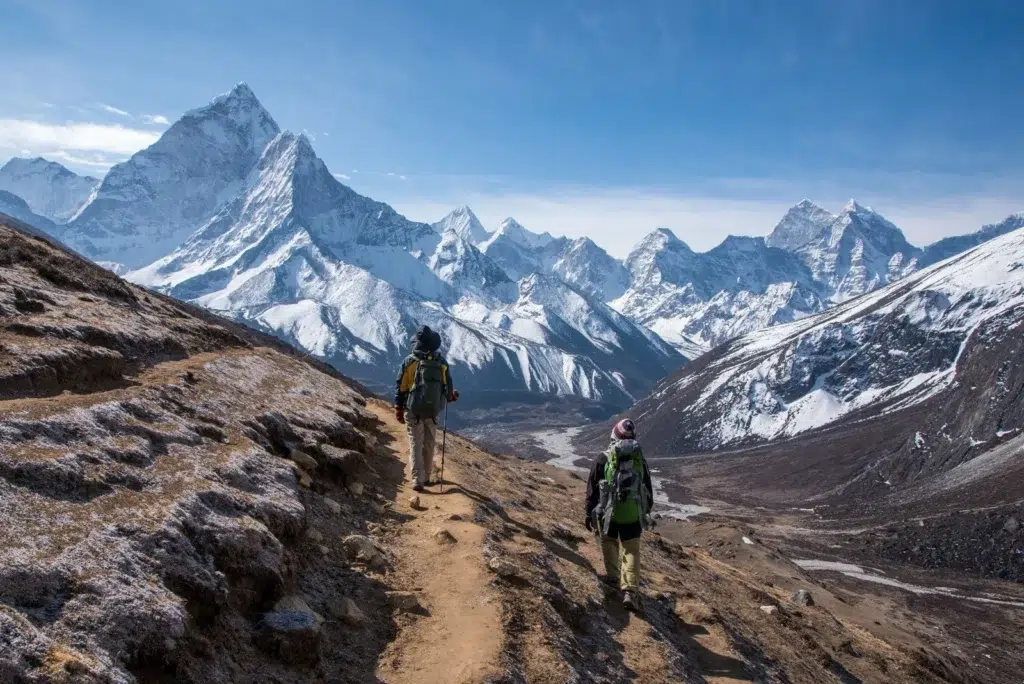
Rwenzori vs Everest Base camp
Once on the mountain, both treks use broadly similar support structures: teahouse lodging on the Everest Base Camp route versus mountain hut accommodation on the Rwenzori’s Central Circuit and Kilembe trails, both staffed by local guide and porter teams. Ours are drawn overwhelmingly from the Bakonzo community native to the Rwenzori foothills, a relationship our guide to Rwenzori porters and guides describes in depth, in much the same way Everest Base Camp’s guiding workforce is drawn predominantly from Sherpa communities native to the Khumbu.
Success Rates and What Determines Them
Success rates on Everest Base Camp are generally high, since reaching base camp itself requires no technical skill and the main failure mode is altitude illness on a compressed itinerary; well-paced fourteen-day treks with proper acclimatization days succeed at a high rate. The Rwenzori’s summit success rate for Margherita Peak on properly guided, adequately prepared itineraries is similarly strong, typically in the range of seventy to eighty-five percent on our standard six-day itinerary, with altitude sickness and severe weather the primary causes when a summit attempt does not succeed. The determining factors are broadly similar on both mountains: adequate pre-trek acclimatization, physical preparation, itinerary length, and the quality and attentiveness of the guiding team, a topic our own summit success rate guide explores specifically for the Rwenzori.
Which Trek Should You Choose?
If your primary goal is the specific cultural and scenic experience of the Everest region, Sherpa villages, monasteries, and an unobstructed view of the world’s highest mountain, and you have the time for a twelve to fourteen-day itinerary, Everest Base Camp remains a genuinely extraordinary trip and nothing in this comparison is intended to diminish that.
If your priority is standing on an actual summit rather than viewing one from a distance, if you want a shorter itinerary that still delivers serious high-altitude achievement, if solitude and genuine off-the-beaten-path wilderness matter to you more than established infrastructure, or if you are specifically drawn to the idea of a mandatory glacier crossing as part of your trek rather than an optional technical add-on, the Rwenzori is very likely the better fit. It is also, for what it is worth, the trek that lets you combine world-class mountaineering with one of Africa’s other great wildlife experiences: our Rwenzori and gorilla trekking combination pairs a Margherita Peak expedition with gorilla trekking in Bwindi Impenetrable Forest on a single Uganda itinerary, something no Nepal trip can offer. Before you commit to either mountain, read our full Rwenzori Mountains National Park guide, because an honest, detailed picture of what the trail actually demands is worth more than any comparison article, including this one.
Frequently Asked Questions
Is the Rwenzori trek harder than Everest Base Camp?
The two treks are difficult in different ways rather than one being simply harder than the other. Everest Base Camp reaches a higher altitude, up to 5,545 metres at Kala Patthar versus 5,109 metres at Margherita Peak, and demands sustained effort over a longer twelve to fourteen-day itinerary on generally good trail. The Rwenzori is shorter but far more physically demanding underfoot, with sustained mud, bog, and root-covered terrain, and it adds a mandatory technical glacier crossing with crampons and ropes that Everest Base Camp does not require at all. Most experienced trekkers who have done both describe the Rwenzori as harder on a day-to-day physical basis, and Everest Base Camp as harder in terms of sustained altitude exposure over time.
Which trek is cheaper, the Rwenzori or Everest Base Camp?
The two are broadly comparable in overall cost for a standard guided itinerary. Everest Base Camp packages typically run from around USD 1,100 to 2,200, while a standard Rwenzori Margherita Peak expedition runs from roughly USD 1,800 to 2,500, though shorter non-summit Rwenzori treks start considerably lower, from around USD 300 to 500. Given that the Rwenzori’s price includes full technical mountaineering equipment as standard, and delivers an actual summit rather than a base camp viewpoint, in roughly half the trip duration, many trekkers find the Rwenzori’s value proposition stronger even at a similar or slightly higher headline price.
Is Everest Base Camp more crowded than the Rwenzori?
Significantly more crowded. Sagarmatha National Park, home to the Everest Base Camp trail, receives somewhere in the region of fifty to sixty thousand foreign visitors a year, the vast majority walking the same single trail corridor, which produces genuinely busy conditions during the peak autumn and spring seasons. The Rwenzori receives approximately one thousand trekkers a year across its entire range, and it is common to complete a full multi-day expedition without encountering another trekking group on the trail.
Do I need technical climbing skills for Everest Base Camp or the Rwenzori?
Everest Base Camp requires no technical climbing skill whatsoever; it is a non-technical high-altitude walk on established trail the entire way. A Rwenzori trek to Margherita Peak does require a mandatory technical section near the summit, a roped glacier crossing using crampons and an ice axe, though this is taught and closely supervised by guides on the mountain itself, and no prior mountaineering experience is required to attempt it. Trekkers who prefer to avoid technical terrain entirely can choose non-summit Rwenzori itineraries that stay below the glaciated zone.
How long does each trek take?
The standard Everest Base Camp trek takes twelve to fourteen days including the Lukla flights, with most of that time spent walking at altitude between acclimatization days. A standard Rwenzori expedition to Margherita Peak takes six to nine days depending on whether the Central Circuit or Kilembe Trail is used, meaning the Rwenzori generally delivers a comparable high-altitude achievement in roughly half the total time.
Which trek offers a more authentic wilderness experience?
This depends on what a trekker means by wilderness. Everest Base Camp offers a rich cultural landscape of Sherpa villages and monasteries alongside dramatic Himalayan scenery, but it follows a single well-established trail that carries tens of thousands of trekkers a year. The Rwenzori offers a genuinely low-traffic wilderness experience across five or six distinct ecological zones in one trek, with a real chance of not encountering another trekking group for days at a time, an experience that is becoming increasingly rare on the world’s more famous mountain trails.
Can beginners attempt either trek?
Reasonably fit beginners with no prior high-altitude experience can and do complete both treks successfully, provided they train adequately beforehand and choose an itinerary with sufficient acclimatization days. Everest Base Camp beginners should prioritize a fourteen-day itinerary over faster options to reduce altitude illness risk. Rwenzori beginners should be honest about their fitness for six to eight hours of daily hiking over rough, wet terrain, and should expect to learn crampon and rope technique under guide supervision for the summit day rather than arriving with that skill already in place.
Ready to Plan Your Rwenzori Expedition?
Whichever mountain has been on your mind, the right next step is the same: talk to someone who has actually guided the route you are considering. If the idea of a shorter, wilder, more physically demanding expedition that ends on a real glaciated African summit rather than a base camp viewpoint has you leaning toward Uganda, get in touch with our team and speak directly with a guide who has taken trekkers to Margherita Peak more times than they can count. Tell us your experience level, your fitness, and your available time, and we will help you build the right Rwenzori itinerary to get you there safely.