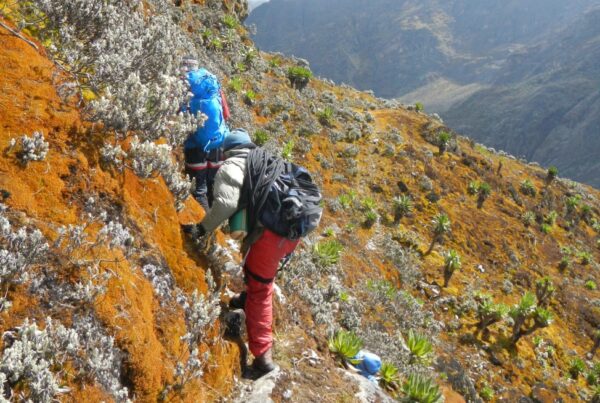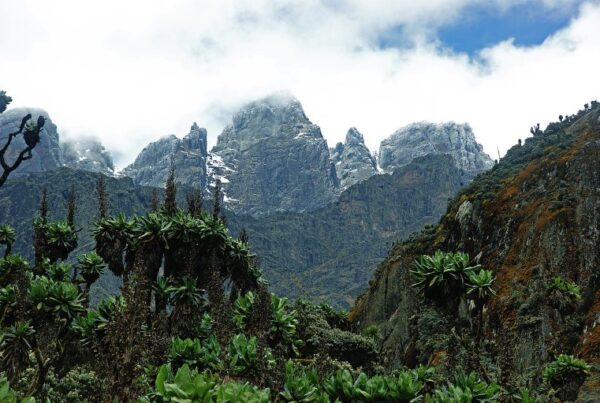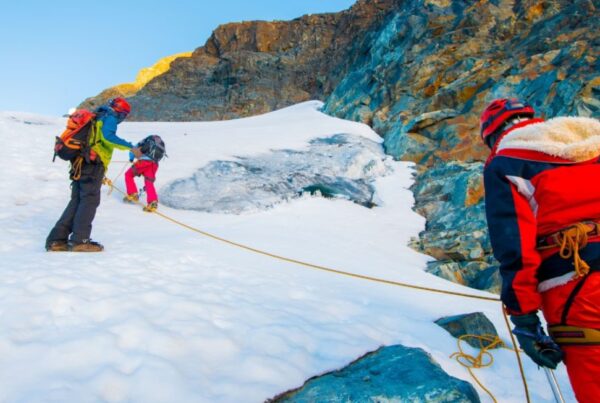
It is one of the most Googled questions about the Rwenzori and one of the most consistently unsatisfying to answer with a single word because the single-word answer, whichever country you name, is technically incomplete. The Rwenzori Mountains sit on an international border. The range straddles the boundary between Uganda to the east and the Democratic Republic of Congo to the west, with the highest peaks, including Margherita Peak at 5,109 metres, Africa’s third-highest summit, sitting essentially on the border ridge itself. On a clear morning, from the summit of Margherita, the view is eastward into Uganda’s Bujuku Valley. The view westward is into the vast Congo Basin. The mountain does not belong to one country. But the trekking is most emphatically done.
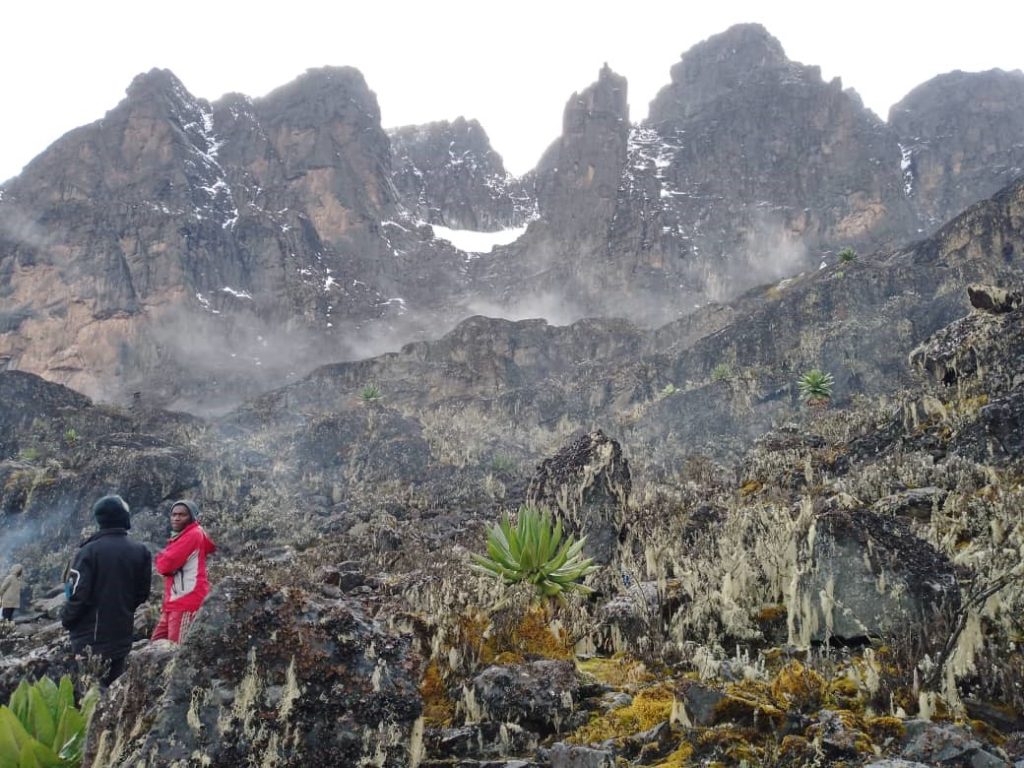
This guide fully explains which country the mountain is in by covering the geography, the political situation, the history of the border, what each country’s side looks like for trekking, and why most climbers and experts agree that Uganda is the best starting point for any expedition to the Rwenzori today. This book is the guide I wish had existed when I first encountered a trekker who had spent two weeks researching whether they could approach from the Congo side, convinced by the geography that both options were equally viable. They are not, and this guide is why.
The Geography: A Mountain Range on Two Countries’ Maps
The Rwenzori Mountains form a faultblock range a massif lifted by the geological movements that created the Albertine Rift, stretching approximately 120 kilometers along the border between Uganda and the Democratic Republic of Congo. Unlike the volcanic peaks that define much of East African highland geography, the Virunga volcanoes, Kilimanjaro, Mount Elgon, and the Rwenzori are ancient crystalline block ranges, composed of metamorphic rocks that were forced upward by tectonic pressure over millions of years. The geology of how the Rwenzori was formed gives the range its distinctive character: not the conical geometry of a volcano, but a complex ridgeline of multiple massifs, each with several summits, all rising from the rift valley escarpment.
The international border between Uganda and the DRC runs directly along the main watershed ridge of the range. This means that rainfall falling on the eastern slopes drains eastward into Uganda’s rivers, eventually reaching Lake Albert or Lake George. Rainfall on the western slopes drains westward into the Congo Basin’s river system, eventually reaching the Congo River and the Atlantic Ocean. The six major massifs of the range, Mount Stanley (5,109 m), Mount Speke (4,890 m), Mount Baker (4,843 m), Mount Emin (4,798 m), Mount Gessi (4,715 m), and Mount Luigi di Savoia (4,627 m), sit along or very close to this ridge.
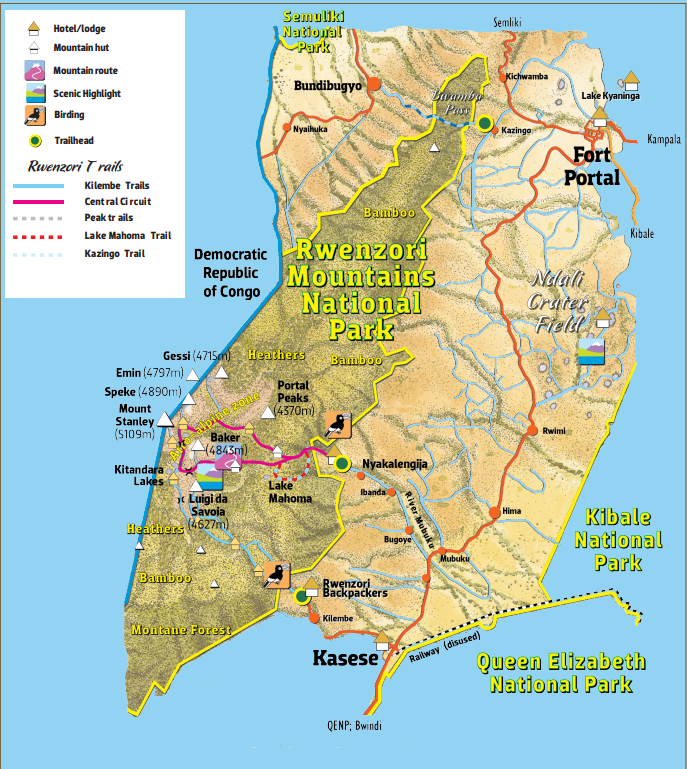
The protected area on the Ugandan eastern side is Rwenzori Mountains National Park, established in 1991 and designated a UNESCO World Heritage Site in 1994. It covers approximately 1,000 square kilometers of the eastern slopes and high mountain zone and is administered by the Uganda Wildlife Authority. The protected area on the Congolese western side is Virunga National Park, Africa’s oldest national park (established 1925) and also a UNESCO World Heritage Site, though, critically, a site that has been on UNESCO’s List of World Heritage in Danger for years due to the ongoing armed conflict in the eastern DRC.
🌍 Geographic FactMargherita Peak, the highest point in the entire Rwenzori range, at 5,109 meters, sits on the exact border between Uganda and the Democratic Republic of Congo. It is simultaneously the highest point in Uganda and the highest point in the DRC. The Uganda-DRC border line passes directly through the summit. Both countries technically share it. All established routes to the summit, however, approach from the Ugandan side. |
How the Border Was Drawn: Colonial History on a Mountain Ridge
The current border between Uganda and the DRC through the Rwenzori Mountains is a product of the late nineteenth-century scramble for Africa, when European colonial powers divided the continent among themselves with a cartographic confidence that bore limited relationship to the terrain, the ecology, or the human communities involved. The line along the Rwenzori watershed ridge was established in the 1890s through a series of Anglo-Belgian agreements that divided the region into British East Africa (later Uganda) to the east and the Belgian Congo to the west.
The agreement was geographically logical in a narrow sense: the watershed ridge serves as a natural dividing line, but it directly cuts through the Bakonzo and Bamba people, who have lived in the mountain foothills for centuries and whose cultural and economic relationships with the mountain completely disregard the distinction between eastern and western slopes. The Bakonzo, whose descendants today work as guides and porters on the Kilembe Trail and Central Circuit Trail, are divided by this border in ways that continue to affect their communities. Families in Kasese District on the Ugandan side have relatives in the Congolese communities on the western foothills.
When Uganda and the Belgian Congo achieved independence in 1962 and 1960, respectively, they inherited the colonial border as drawn. The Democratic Republic of Congo retained the western Rwenzori flank within its territory after several decades of political upheaval, including the renaming of the country as Zaire during the Mobutu era. The border itself has never been a subject of bilateral territorial dispute; unlike some African borders, the Rwenzori ridgeline is legally uncontested. What has changed dramatically over recent decades is the security situation on the Congolese side.
Two National Parks, Two Entirely Different Realities
Understanding the contrast between the two protected areas on either side of the Rwenzori border is the most important context for any trekker researching the country question.
Rwenzori Mountains National Park, Uganda
The Ugandan side of the Rwenzori has a functional, professionally administered national park that has been serving international trekkers and mountaineers for decades. The park operates under Uganda Wildlife Authority, which maintains the trail systems, manages the hut and camp network, provides ranger escorts, sets and collects park fees, and coordinates emergency response. The infrastructure on the Ugandan side, the mountain huts at Nyabitaba, John Matte, Bujuku, Elena, Kitandara, and Guy Yeoman on the Central Circuit, and the camp system at Kalalama, Mutinda, Bugata, Hunwick’s, and Margherita Camp on the Kilembe Trail, is the result of decades of sustained investment in the trekking infrastructure.
The park is politically stable, the permit system is clear and well-established, and Uganda as a country maintains normal diplomatic relations and a straightforward visa arrangement for international visitors. The route from Entebbe International Airport to the Rwenzori trailhead at Nyakalengija or Kilembe is a standard, safe, and well-documented road journey of approximately six to seven hours through western Uganda’s highland landscapes. Getting to the Rwenzori from Entebbe involves nothing more complicated than arranging transport through your trekking operator.
Virunga National Park, Eastern DRC
The Congolese side of the Rwenzori presents an entirely different picture, one that has deteriorated rather than improved over recent decades. Virunga National Park, which encompasses the western Rwenzori slopes, has been on UNESCO’s List of World Heritage in Danger continuously since 1994, the year Rwenzori Mountains National Park on the Ugandan side was added to the regular World Heritage List. For over three decades, persistent armed conflict involving multiple armed groups has affected the eastern DRC, particularly North Kivu Province.
In early 2025, the M23 armed group launched a major offensive across eastern DRC that resulted in the capture of Goma and Bukavu, the primary logistics and gateway cities for any approach to Virunga. By early 2026, the park had lost operational control of significant portions of its southern and central sectors. Ranger staff had been forced to withdraw from large areas. Many armed groups, like the M23 and the ADF, along with several smaller militias, were actively working in the areas that anyone would need to go through to reach the Rwenzori massif from the Congolese side.
There is no established trekking trail, no mountain hut network, no guide or porter system, no emergency evacuation infrastructure, and no functioning regulatory framework for summit trekking on the Congolese side of the Rwenzori in 2026. This situation is not a temporary gap that will close before your departure date. It reflects conditions that have been present in various forms for decades and that worsened significantly in 2025.
⚠️ Security Warning: Eastern DRC 2026All major Western government travel advisories, including those of the US Department of State, the UK Foreign Commonwealth & Development Office, the Australian Department of Foreign Affairs, and the European External Action Service, advise against all but essential travel to eastern DRC and specifically to North Kivu Province, where the Congolese portion of the Rwenzori is located. These advisories are not precautionary. They reflect an active armed conflict with demonstrated and ongoing civilian and personnel risk. Do not plan any element of a Rwenzori expedition on the assumption that the DRC side offers a viable alternative or supplement to the Ugandan routes. |
Uganda vs. DRC: The Practical Comparison Every Trekker Needs to See
The table below makes the contrast concrete. There is no version of this comparison in which the DRC side represents a viable option for an international trekker in the current period.
| Factor | Uganda (East) | DRC / Congo (West) |
| Security status | Stable; normal political conditions | Active armed conflict; UNESCO World Heritage in Danger |
| Trail infrastructure | Full network: Central Circuit, Kilembe, Bukulungu, Mahoma Loop | No established trail; no maintained routes |
| Mountain huts / camps | 13+ maintained huts and camps; mattresses, kitchens | None for summit trekking |
| Licensed guides | Professional Rwenzori-specialist guides; UWA-registered | No functioning guide system for summit routes |
| Porter system | Established, experienced Bakonzo porter workforce | No functioning porter system for summit routes |
| Park administration | Uganda Wildlife Authority: permits, rangers, emergency protocols | ICCN: limited control; large areas inaccessible to rangers |
| Visa & entry | Uganda e-visa; straightforward; reliable | Active conflict zone; no viable tourist entry in relevant areas |
| Emergency evacuation | Helicopter protocols; emergency communication at camps | No framework; no reliable emergency response |
| UNESCO listing | World Heritage Site (regular list, 1994) | World Heritage in Danger (1994 to present) |
| Travel advisories | Normal travel; standard precautions | All major governments: avoid non-essential travel / all travel |
| Margherita Peak access | Via Central Circuit (Elena Camp) or Kilembe Trail | Not accessible; no route exists |
| Recommended for trekkers | ✓ Fully recommended | ✗ Not recommended under any circumstances |
Why Does the Country Question Persist? Understanding the Confusion
The question of whether the Rwenzori Mountains are in Uganda or the DRC is asked so frequently because the geography genuinely supports the confusion. Any map of the region shows the range clearly sitting across the border. Educational resources describing the Rwenzori often note that it straddles Uganda and the DRC, which is accurate but can give the impression that both countries offer equivalent access. Several high-profile facts about the range that Margherita Peak is both Uganda’s highest point and the DRC’s highest point and that the Duke of Abruzzi’s 1906 expedition approached from the eastern side but descended the mountain looking west into Congo reinforce the sense of a shared mountain.
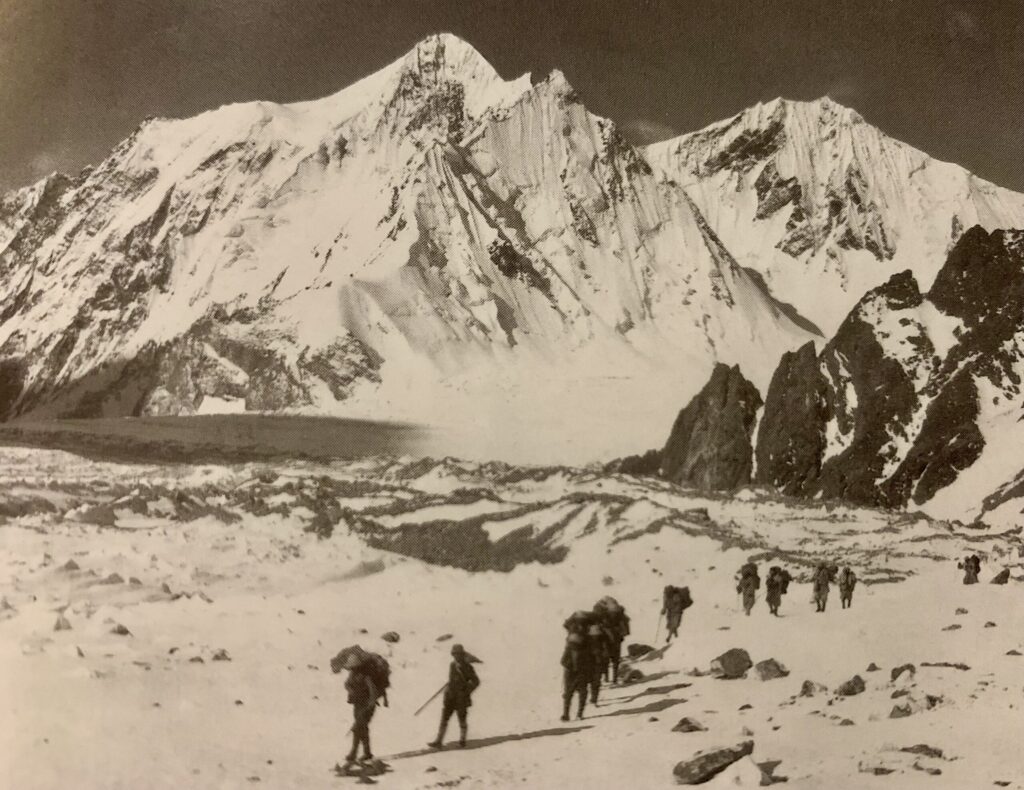
There is also a type of trekker who specifically asks this question out of a desire for remoteness: someone who has done their research, knows that the Ugandan side has established routes, and wonders whether approaching from the less-documented Congo side might offer a more genuinely wild experience. This instinct is worth addressing directly, because the desire for genuine wilderness is entirely legitimate on a mountain that only sees roughly 1,000 to 1,500 trekkers per year. The answer to the wilderness seeker is straightforward: the Ugandan side of the Rwenzori already delivers genuine wilderness, and the routes that most trekkers never reach, the Mount Gessi expedition, the Mount Emin itinerary, and the deep circuits of the 18-Day All 8 Peaks expedition take you to terrain that sees fewer than a handful of expeditions per year. The frontier that most Rwenzori seekers are looking for exists fully within Uganda’s borders.
|
🌿 Rwenzori Guide Perspective I have guided expeditions deep into the Rwenzori range for many years, including routes that take trekkers very close to the western border ridge to summits from which the Congo Basin is directly visible below and the western forest zones look exactly as wild and untouched as anything a trekker could imagine approaching from the other side. That frontier quality, that sense of being at the edge of something enormous and largely unseen, is available from the Ugandan side without the addition of armed-group risk. The mountain gives you what you are looking for. You do not need to add the DRC to find it. |
Was the DRC Side Ever Used for Trekking?
Historically, yes, though the history is more limited than many accounts suggest. During the colonial period, Belgian administrators and early explorers made occasional penetrations of the western Rwenzori slopes, and there was some limited mountaineering activity from the Congolese side through the mid-twentieth century. The Duke of Abruzzi’s expedition in 1906, which achieved the first ascents of the main Rwenzori peaks, as the full story of his expedition describes, approached entirely from the Ugandan side, but he and his team looked westward from the summit ridge down toward the forests that descend to the Congo.
After the DRC achieved independence in 1960, access to the western Rwenzori became increasingly difficult as the country experienced successive waves of political and military instability. The Mobutu era (1965-1997) saw Virunga’s infrastructure gradually deteriorate, and the First and Second Congo Wars (1996-1997 and 1998-2003) created conditions in eastern DRC from which the region has never fully recovered. By the time systematic trekking tourism developed in the Rwenzori, primarily from the Ugandan side in the 1990s and 2000s, with the Kilembe Trail formally launched in 2011, the Congolese approach was already non-functional.
There was no golden era of DRC Rwenzori trekking that was later closed off. The western approach, such as it was, never developed into the kind of systematic, supported trekking infrastructure that exists on the Ugandan side. The question is sometimes framed as ‘can we get back to the way it was on the DRC side,’ but there was no comparable golden era to return to.
What the Western (DRC) Flank of the Rwenzori Actually Looks Like
Setting aside the security and access question for a moment, it is worth describing what the western side of the Rwenzori actually contains geographically because it is genuinely compelling terrain, and understanding it contextualizes why the question of DRC access persists among serious trekkers.
The western slopes of the Rwenzori descend from the border ridge into the forests of the Congo Basin with a gradient that is generally steeper than the eastern side. The forest zone on the western flank is part of the broader Congo rainforest, the world’s second-largest tropical forest, and it connects the Rwenzori’s montane ecosystem to one of the most biologically extraordinary forest systems on Earth. The Congolese slopes receive the moisture from weather systems that build over the Congo Basin and drive westward up the mountain, which means they are even wetter than the Ugandan side. They also carry the biological legacy of their relative inaccessibility: the western Rwenzori forest communities have been less disturbed by human activity than comparable zones on the Ugandan side, simply because fewer people have been there.
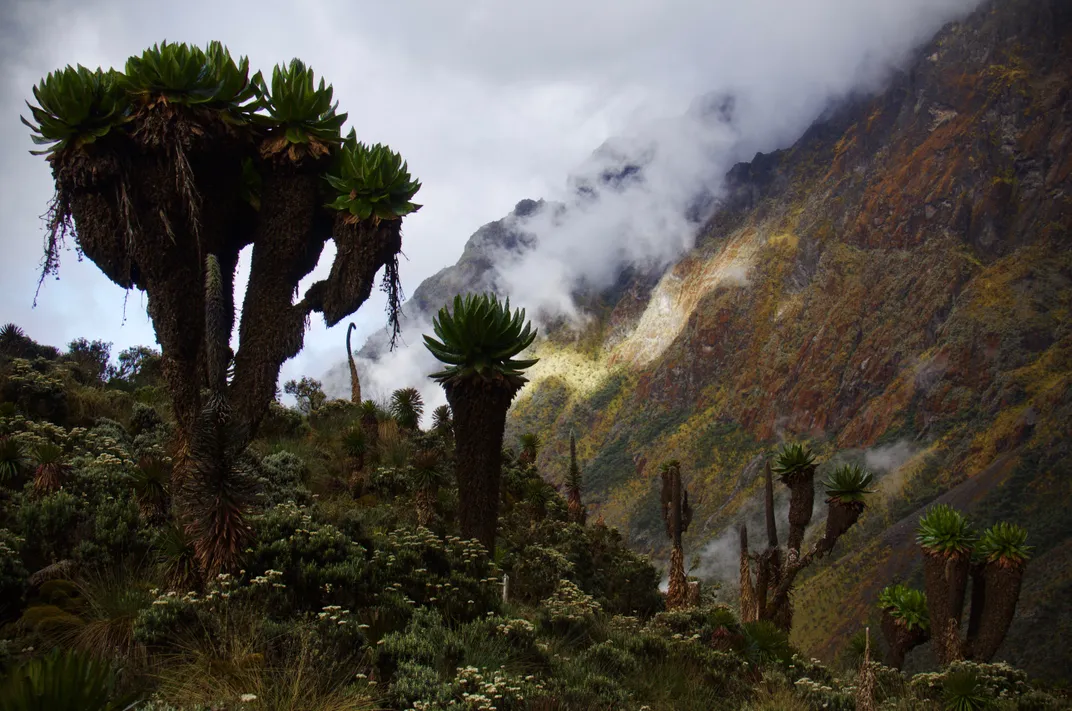
From the summit of peaks near the western border ridge, trekkers see a visually extraordinary Congolese forest landscape to the west, as remarkable as anything the eastern side offers. On a clear morning, the Congo Basin stretches westward with a vastness that makes the concept of scale feel inadequate. This vista is what trekkers who reach the western-facing summits of the Ugandan Rwenzori actually see: the DRC, vast and green and wild, from a safe position above it.
Could the DRC Side Become Accessible for Trekking in the Future?
In principle, yes, and it is worth being honest about this rather than dismissing the question entirely. If the security situation in eastern DRC were to resolve durably, if Virunga National Park were to rebuild functional ranger operations across its full territory, and if investment in western Rwenzori trail infrastructure were to follow, the Congolese approach to the range could eventually develop into something genuinely extraordinary. The terrain is there. The wildlife is there. The forest is there. The mountain is there.
But the word ‘if’ is doing a great deal of work in that sentence. The eastern DRC has been in various states of armed conflict since the early 1990s, more than thirty years of instability that has defeated successive international peace efforts and repeatedly reversed periods of apparent stabilization. The M23 offensive of 2025 represents not an aberration in an otherwise improving situation but a continuation and intensification of dynamics that have proven resistant to resolution. International conservation organizations that have invested heavily in Virunga have seen their infrastructure destroyed, their staff threatened, and their operational areas reduced repeatedly during conflict cycles. The United Nations, the African Union, and the East African Community have all engaged with eastern DRC’s security situation without producing durable resolution.
The honest answer to whether the DRC side might become accessible is possibly, eventually, in conditions we cannot predict from the present. It is not a near-term prospect. It is not something that should enter any trekker’s planning horizon for an expedition in the coming years. The mountain that trekkers are trying to reach is fully and magnificently accessible from Uganda. Plan accordingly.
Planning Your Rwenzori Trek from Uganda: A Practical Starting Point
Having established clearly that Uganda is the country for your Rwenzori trek, the practical planning question becomes which route, which peaks, and which duration best fit your objectives.
The Two Primary Routes from Uganda
The Central Circuit Trail starts from the Nyakalengija trailhead and traces a complete loop through the mountain’s core, passing through all five vegetation zones and providing access to the high central massif. The 7-Day Central Circuit is the classic Rwenzori itinerary and remains the best route for first-time Rwenzori trekkers who want the complete mountain experience. The Kilembe Trail begins at the Kilembe trailhead, located south of Kasese, and offers a more demanding and scenically varied southern approach that many trekkers consider the most rewarding route to Margherita Peak, which is the standard summit itinerary from this trailhead.

Reaching the Rwenzori from Entebbe or Kampala
Getting to the Rwenzori trailhead from Kampala or Entebbe takes approximately six to seven hours by road, traveling west through Fort Portal, a beautiful journey through Uganda’s western highlands that passes the Kibale Forest corridor and the Albertine Rift escarpment. The full guide to getting to the Rwenzori Mountains covers transport options in detail. Kasese town, the main hub for Rwenzori expeditions, has several guesthouses and hotels for pre-trek and post-trek accommodation.
Combining the Rwenzori with Uganda’s Other Highlights
Uganda’s position within the Albertine Rift means that the Rwenzori trek can be combined with some of the finest wildlife experiences in Africa within a single itinerary. The 12-Day Rwenzori and gorilla trekking combination pairs the mountain with a gorilla tracking day at Bwindi Impenetrable Forest, delivering two of Africa’s most remarkable experiences in sequence. The 19-day Rwenzori, primates, big five, and Nile rafting safari extends the itinerary further into a comprehensive Ugandan expedition.
Uganda’s Safety and Political Context
Uganda is a politically stable East African country with a functioning tourism industry, clear visa procedures, and well-established infrastructure for international visitors. The contrast with the DRC’s eastern conflict zone could not be more pronounced. Uganda’s western region, including Kasese District and the Rwenzori Mountains, is not affected by the spillover from eastern DRC’s conflicts in any way that creates risk for trekkers. The Uganda-DRC border in the Rwenzori area is monitored and quiet. Trekkers concerned about the DRC border can rest assured that being on the Ugandan side of the Rwenzori is safe.
Frequently Asked Questions: Rwenzori Mountains, Uganda or DRC?
What country are the Rwenzori Mountains in?
The Rwenzori Mountains straddle the international border between Uganda to the east and the Democratic Republic of Congo (DRC) to the west. The range extends approximately 120 kilometers along this border, with the highest peaks including Margherita Peak at 5,109 meters and the summit of Mount Stanley sitting on or very close to the border ridge itself. Margherita Peak is simultaneously the highest point in Uganda and the highest point in the DRC. However, all established trekking routes, mountain huts, guide and porter services, and national park infrastructure exist exclusively on the Ugandan side, within Rwenzori Mountains National Park. When people refer to the Rwenzori as ‘in Uganda,’ they are indicating the location of the accessible mountain. The trekking takes place entirely in Uganda, despite the shared full range.
Are the Rwenzori Mountains in Uganda or Congo?
The Rwenzori Mountains are geographically in both Uganda and the Democratic Republic of Congo. The international border runs along the main watershed ridge of the range, placing the eastern slopes in Uganda and the western slopes in the DRC. For practical trekking purposes, however, the Rwenzori Mountains are in Uganda. All established routes, the Central Circuit Trail, the Kilembe Trail, the Bukulungu Trail, and the Mahoma Loop, are on the Ugandan side. The Congolese side of the Rwenzori falls within Virunga National Park, which is currently not accessible for trekking due to the active armed conflict in eastern DRC. Any trekker planning an expedition to the Rwenzori Mountains will enter through Uganda via Rwenzori Mountains National Park.
Is Margherita Peak in Uganda or DRC?
Margherita Peak, the highest summit in the Rwenzori range at 5,109 metres, sits on the international border between Uganda and the Democratic Republic of Congo. It is technically in both countries simultaneously, as it sits on the watershed ridge that marks the boundary. Margherita Peak is the highest point in Uganda and also the highest point in the DRC. Every expedition that has ever reached the summit of Margherita Peak has approached it from the Ugandan side, either via Elena Camp on the Central Circuit Trail or via Margherita Camp on the Kilembe Trail. There is no functioning route to the summit from the Congolese side of the range.
Can you trek the Rwenzori from the Congo side?
No, not in any practical sense in 2026. The western slopes of the Rwenzori fall within Virunga National Park in the Democratic Republic of Congo. Due to the persistent and currently escalating armed conflict in eastern DRC, including the M23 offensive in 2025 that caused significant portions of Virunga National Park to fall outside park authority control, the Congolese side of the Rwenzori is inaccessible for trekking. There are no maintained trails, no mountain huts, no guide or porter system, and no emergency evacuation infrastructure on the DRC side of the range. All major government travel advisories discourage all but essential travel to North Kivu Province, home to the Congolese Rwenzori. The only way to trek to the Rwenzori Mountains is from Uganda.
Is Virunga National Park the same as Rwenzori Mountains National Park?
No. These are two separate national parks in two separate countries. Rwenzori Mountains National Park is located in Uganda on the eastern slopes of the Rwenzori range. It is a UNESCO World Heritage Site (added to the regular World Heritage List in 1994) and is managed by the Uganda Wildlife Authority. It is the location of all established Rwenzori trekking routes. Virunga National Park is located in the Democratic Republic of Congo and encompasses the Rwenzori’s western slopes as one of several distinct sectors. It is Africa’s oldest national park (established 1925) and is also a UNESCO World Heritage Site, but one that has been on the List of World Heritage in Danger since 1994 due to ongoing armed conflict in eastern DRC. Virunga also contains the Virunga volcanoes and is famous as a mountain gorilla habitat in its southern sectors, but those sectors are physically and geographically separate from the Rwenzori massif.
Where exactly is Rwenzori Mountains National Park in Uganda?
Rwenzori Mountains National Park is located in Kasese District in western Uganda, in the Albertine Rift region bordering the Democratic Republic of Congo. The park’s two main entry points are the Nyakalengija trailhead, which serves the Central Circuit Trail, and the Kilembe trailhead near the old copper mining town of Kilembe, which serves the Kilembe Trail routes. The nearest major town is Kasese, approximately 25 kilometers from the Nyakalengija gate. Fort Portal is the nearest major regional center, approximately 75 kilometers away. The park is about six to seven hours from Kampala by road, traveling west through Fort Portal on the highway that serves Uganda’s western highlands.
Why do so many sources say the Rwenzori is in Uganda when it is technically in both countries?
When sources describe the Rwenzori as being ‘in Uganda,’ they are typically making a practical rather than a strictly geographical statement. The Rwenzori Mountains National Park, the protected area that manages the established trekking routes, is in Uganda. The country context for any trekking expedition is Uganda. The permit system, visa requirements, and regulatory framework are all Ugandan. The Rwenzori mountain range extends into the DRC, but trekker access is limited to Uganda due to security issues in eastern DRC. Sources that describe the Rwenzori as being in Uganda are accurately describing where you would go to trek the mountain, even if technically incomplete in geographical terms.
Do I need a DRC visa to trek the Rwenzori?
No. A trekker entering the Rwenzori from Uganda does not require a DRC visa at any point. The entire trekking route from the trailhead to the summit and back is on the Ugandan side of the range within Rwenzori Mountains National Park. Even on Margherita Peak, which sits on the actual border, there is no immigration checkpoint, no requirement to cross into the DRC, and no legal obligation related to the DRC. You need a Ugandan visa (available as an e-visa in advance or on arrival at Entebbe International Airport) and Uganda Wildlife Authority park permits arranged through your trekking operator. You do not need to interact with DRC immigration or consular services in any way.
Ready to Trek the Rwenzori? Uganda Is Where the Mountain Is.
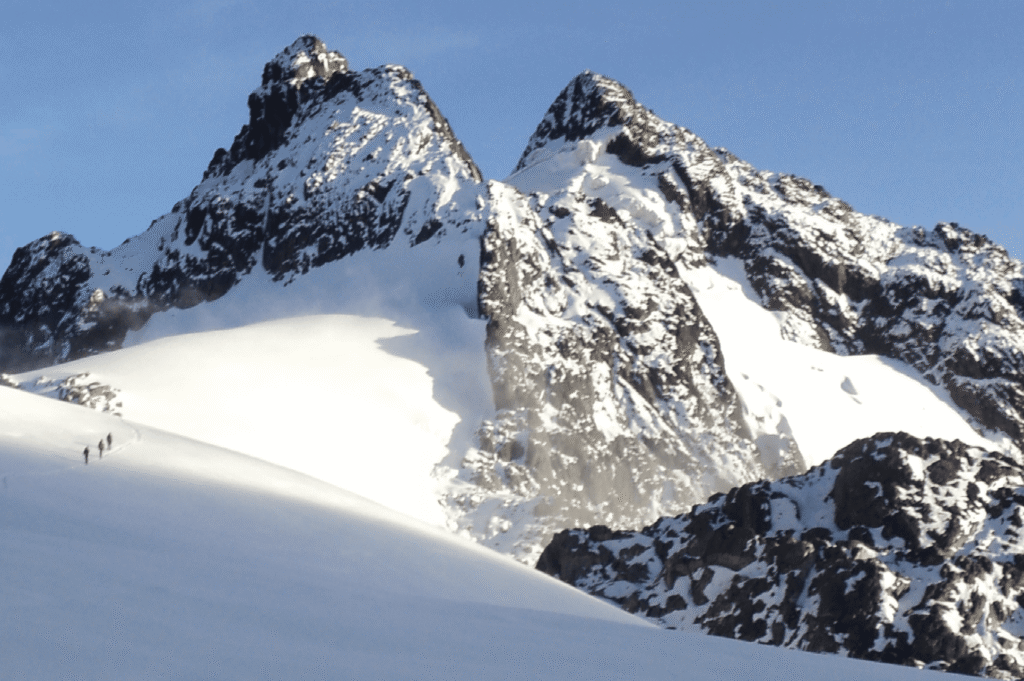
The Rwenzori Mountains straddle a border, but the trekking belongs to Uganda: the eastern slopes, the Afro-montane forest, the bog-crossed moorland, the giant lobelias, the Bakonzo guides, the wooden mountain huts, the pre-dawn departures for the glacier, and the summit ridge above the clouds where two countries meet and the third-highest mountain in Africa delivers its view. Whether you are planning the 8-Day Kilembe Trail, the 7-Day Central Circuit, an expedition targeting Mount Gessi or Mount Emin, or the full 13-Day Six Peaks expedition, Rwenzori Trekking Safaris is ready to help you plan it.