Bakonzo People: Guardians of the Rwenzori Mountains. The Bakonzo people of the Rwenzori: their history, language, mountain knowledge, spiritual traditions & how trekking creates direct community benefit. Expert guide.
The moment your lead guide turns and reads the mountain, identifies the distant weather system building behind Mount Stanley, calls the name of the stream you are about to cross, and points out the three-horned chameleon motionless on a mossy branch that you walked past without noticing, you are receiving something that no guidebook contains. You are receiving generational knowledge. The knowledge of a people who have lived in relationship with the Rwenzori Mountains for longer than any recorded human history of the range exists, who named the peaks before any European explorer set eyes on them, and who understood the mountain’s moods, microclimates, and safe passages before the first geological map was drawn.
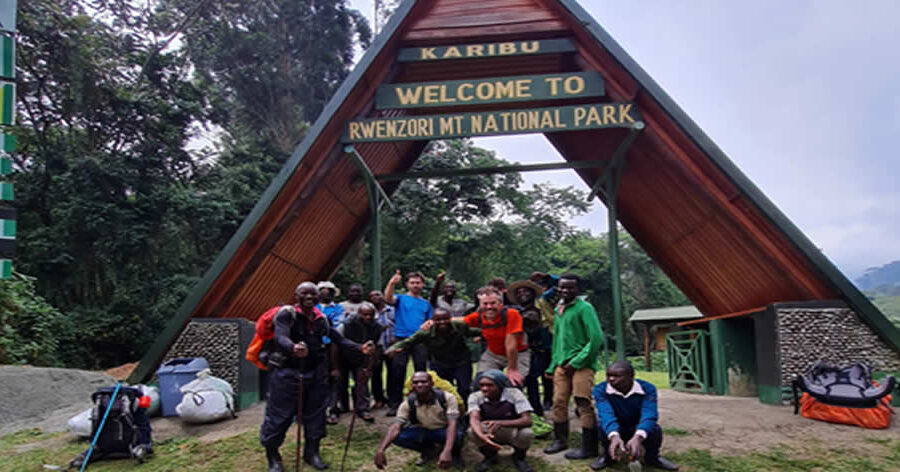
The Bakonzo people, also called the Konzo and collectively referred to in their language as Amakonzo, are the indigenous community of the Rwenzori foothills and the primary human presence in and around Rwenzori Mountains National Park. They are farmers, herders, craftspeople, and, in their most direct relationship with the international trekking community, the porters, cooks, and guides who make every expedition on the mountain possible. The Central Circuit Trail and the Kilembe Trail are routes through Bakonzo ancestral territory, maintained by Bakonzo hands, navigated by Bakonzo knowledge. Understanding who these people are, their history, their culture, their relationship with the mountain, and their contemporary lives is not a supplement to the Rwenzori trekking experience. It is the Rwenzori trekking experience, fully understood.
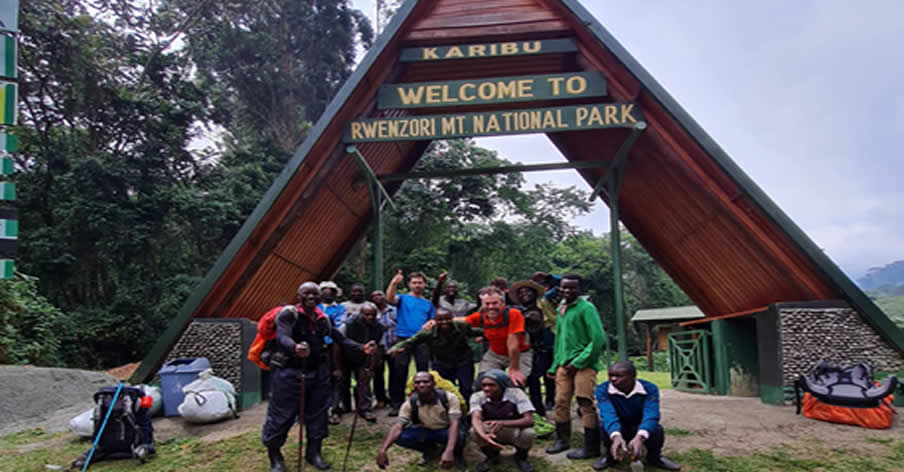
This article is the most comprehensive English-language resource on the Bakonzo people in the context of Rwenzori trekking available anywhere online. It is written from years of working alongside Bakonzo guides and porters on the mountain, from conversations conducted at camps from Nyabitaba to Elena Hut, and from deep respect for a community whose knowledge and labor make the mountain accessible and whose cultural richness deserves to be understood, not merely thanked with a tip at the end of a trek.
Who Are the Bakonzo People? History, Identity, and Origins
The Bakonzo are a Bantu-speaking people whose ancestral homeland encompasses the foothills and lower slopes of the Rwenzori Mountains on both the Ugandan and Congolese sides of the international border. In Uganda, the Bakonzo are the dominant community in Kasese District, located in the Rwenzori sub-region of western Uganda, with significant populations also in Bundibugyo District to the north. In the DRC, closely related Nande communities (who share linguistic and cultural roots with the Ugandan Bakonzo) inhabit the Lubero and Rutshuru territories of North Kivu Province, adjacent to the mountain’s western slopes.
The Bakonzo are broadly classified within the Lacustrine Bantu linguistic and cultural grouping, the family of Bantu languages and cultures associated with the Great Lakes region of east-central Africa, including the Bunyoro-Kitara Kingdom that historically dominated the broader region. Unlike the cattle-keeping kingdoms of the Great Lakes interior, the Bakonzo traditionally occupied a distinct ecological and cultural niche as mountain cultivators, farmers of the fertile Rwenzori foothills, who supplemented agriculture with hunting in the forest zones and with trade relationships with the lowland communities of the Semliki Valley and the rift floor.
The Origins Debate and the Question of “First People”
The precise origins of the Bakonzo on the Rwenzori are a subject of ongoing scholarly discussion. Oral traditions, the primary source for pre-colonial Bakonzo history, describe the Bakonzo as the original inhabitants of the Rwenzori foothills, present on the mountain’s slopes from time immemorial. Some oral narratives describe a descent from the mountain itself, with the Bakonzo’s ancestors emerging from the peaks to settle the foothills. These origin stories are not merely mythological in the colloquial sense; they are the frameworks through which the Bakonzo understand their relationship to the mountain as one of fundamental belonging rather than settlement. In this worldview, the Rwenzori is not a landscape that the Bakonzo arrived at, but one that they are part of.
Archaeological and linguistic evidence supports the antiquity of the Bakonzo presence in the region, though precise dating is difficult given the limited archaeological fieldwork conducted in the area. Linguistic analysis suggests that the Bakonzo language, Lukonzo, has been spoken in the Rwenzori region for at least several thousand years. The existence of a rich, mountain-specific vocabulary in Lukonzo, with specific terms for different altitude zones, plant communities, weather patterns, and mountain phenomena, is consistent with a very long-term human presence in and around the range rather than a relatively recent arrival from the lowlands.
The Rwenzururu Movement: Political Identity and the Kingdom
The most significant political and cultural event in modern Bakonzo history is the Rwenzururu Movement, a resistance movement that emerged in the late 1950s and early 1960s in response to the domination of Kasese District by the more politically powerful Toro Kingdom. The Rwenzururu Movement sought recognition of Bakonzo cultural and political distinctiveness and, ultimately, the establishment of a separate Bakonzo kingdom, the Obusinga bwa Rwenzururu (Kingdom of the Rwenzori).
The movement, initially led by Isaya Mukirane and sustained across decades of political struggle by his successors and the Bakonzo community broadly, maintained a parallel political structure in the Rwenzori foothills throughout the post-independence period of Ugandan political history. The Rwenzururu was not a mere cultural aspiration; it had its government, its security structures, and its own social institutions, functioning in the mountain foothills alongside and often in tension with the official Ugandan state.
In 2009, the Ugandan government formally recognized the Obusinga bwa Rwenzururu as a cultural institution under the framework of Uganda’s constitutional recognition of traditional kingdoms. The current Omusinga (King) of Rwenzururu is Wesley Mumbere (Charles Wesley Mumbere Irema-Ngoma), who was enthroned in 2009 after the formal recognition of the kingdom. The recognition was a landmark moment for Bakonzo identity and political dignity, and its significance to the community cannot be overstated: it was the culmination of more than half a century of cultural and political struggle for recognition of the Bakonzo’s right to govern their affairs within the broader Ugandan constitutional framework.
The Bakonzo’s name for the mountain range, “Rwenzururu,” meaning “Place of Snow,” predates all European names for the Rwenzori by centuries. The colonial adoption of “Ruwenzori” (later standardized as “Rwenzori”) in European cartography was an anglicization of the Bakonzo name, not an independent European coinage. The mountain has always been Rwenzururu in the minds of its indigenous guardians.
The Mountain as Sacred Space: Bakonzo Spiritual Relationships with the Rwenzori
For the Bakonzo, the Rwenzori Mountains have never been simply a geographical feature or a resource landscape. The mountain is a sacred presence, the domain of Kithasamba, the primary mountain deity of Bakonzo religious tradition, whose breath creates the mists that perpetually shroud the upper peaks and whose displeasure manifests as the storms, lightning, and violent precipitation that can transform the upper mountain within minutes. Kithasamba is not a benign or indifferent deity in Bakonzo tradition; he is a demanding, powerful presence who must be approached with respect and propitiated with appropriate ritual observance.
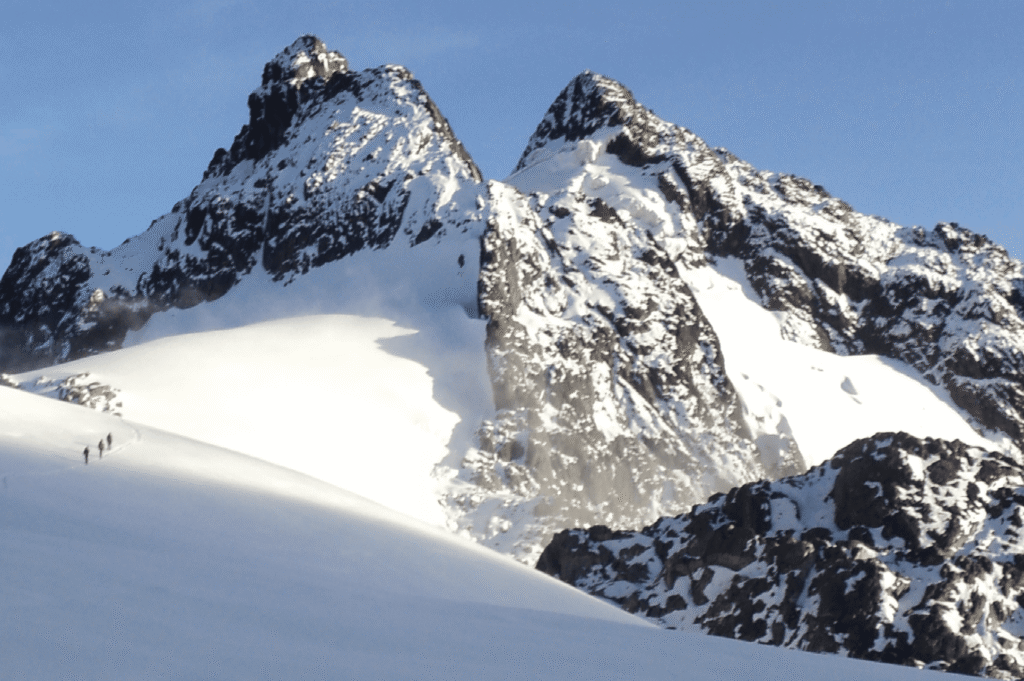
The ancient tradition of treating the Rwenzori’s upper zones as sacred space requires specific protocol from those who venture into them and is deeply embedded in Bakonzo culture. Hunters who historically followed game upward into the mountain’s forest zones; herders who pushed livestock to high pasture; and the small number of Bakonzo who ventured into the truly high alpine terrain for specific purposes all did so within a framework of ritual obligation. Particular trees, springs, and landscape features in the Rwenzori’s lower and middle zones were, and in some communities continue to be, regarded as shrines: places where communication with the mountain’s spiritual dimension was most direct and where offerings were appropriate.
Sacred Geography and the Trail Network
The trail network that international trekkers now follow on the Central Circuit Trail and the Kilembe Trail was not created by colonial administrators or national park authorities. It evolved from pathways that the Bakonzo had been using for centuries: routes to hunting grounds, to high-altitude pastures, to sacred sites, and to the trade points where mountain products (honey, game, and forest materials) were exchanged with lowland communities. The Nyakalengija trailhead is at the foot of one of the Rwenzori’s oldest approach routes, used by Bakonzo people long before the first European expedition arrived in the mountain’s foothills in the 1880s.
Older Bakonzo guides occasionally point out specific landscape features along the trails, a particular rock formation, an unusual tree, or a spring at a specific junction that carries cultural significance beyond their immediate practical function. These traces of the mountain’s sacred geography are visible to those who can read them and invisible to those who cannot. Walking the Rwenzori with a Bakonzo guide who is willing to share this layer of the mountain’s meaning is a qualitatively different experience from walking with one who does not.
The Transition of Spiritual Practice in the Modern Context
The Bakonzo community has been significantly shaped by Christian missionary activity since the late nineteenth century, and the majority of Bakonzo today identify as Christians, primarily Catholic and various Protestant denominations. This religious transition has transformed the mountain’s spiritual significance in Bakonzo life, but it has not eliminated it. The mountain remains, in the cultural imagination of many Bakonzo, a place of heightened spiritual dimension, a place where the ordinary rules of the lowland world are suspended and where something older and more powerful is present. The language of that presence has changed in numerous instances. Kithasamba may be spoken of less directly, but the underlying intuition that the Rwenzori is not merely landscape remains deeply embedded.
For international trekkers, this difference translates into a quality of encounter with Bakonzo guides and porters that is not always easy to articulate but is frequently described in post-expedition reflections: a sense that the mountain means something different to the people who grew up in its shadow than it can mean to those who have come from elsewhere to visit it. This difference is not a barrier; it is one of the most genuinely cross-cultural dimensions of the Rwenzori trekking experience, and it rewards trekkers who approach it with curiosity and respect.
The Bakonzo as Mountain Guides and Porters: Knowledge, Profession, and Pride.
The most immediate and sustained encounter between international trekkers and the Bakonzo community happens on the mountain itself, through the guide and porter relationships that structure every expedition. These relationships deserve more profound understanding than the functional framing of “guide” and “porter” typically suggests. These relationships involve people with radically different mountain biographies: one person encounters the Rwenzori for the first time, while another returns for the hundredth time to terrain they know as intimately as their home garden. The knowledge exchange that occurs across this difference is one of the greatest and most underappreciated assets of the Rwenzori trekking experience.
Generational Mountain Knowledge: What Bakonzo Guides Know
A Bakonzo lead guide who has been working on the Rwenzori Mountains for ten or fifteen years carries knowledge that no training course, guidebook, or map can fully replicate. They know the micro-weather patterns that predict afternoon precipitation, the specific cloud formation over Mount Baker that means you have two hours before the rain arrives, and the wind direction at the Freshfield Pass that indicates whether the summit window will hold through the morning. They know the specific section of bog on the approach to Bujuku Hut where the submerged stepping stones shift seasonally and need to be felt for rather than walked on confidently. They know which streams run clear and which streams run silt-brown after rain, as well as which sections of the trail are safe in wet conditions and which sections require slower, more deliberate movement.
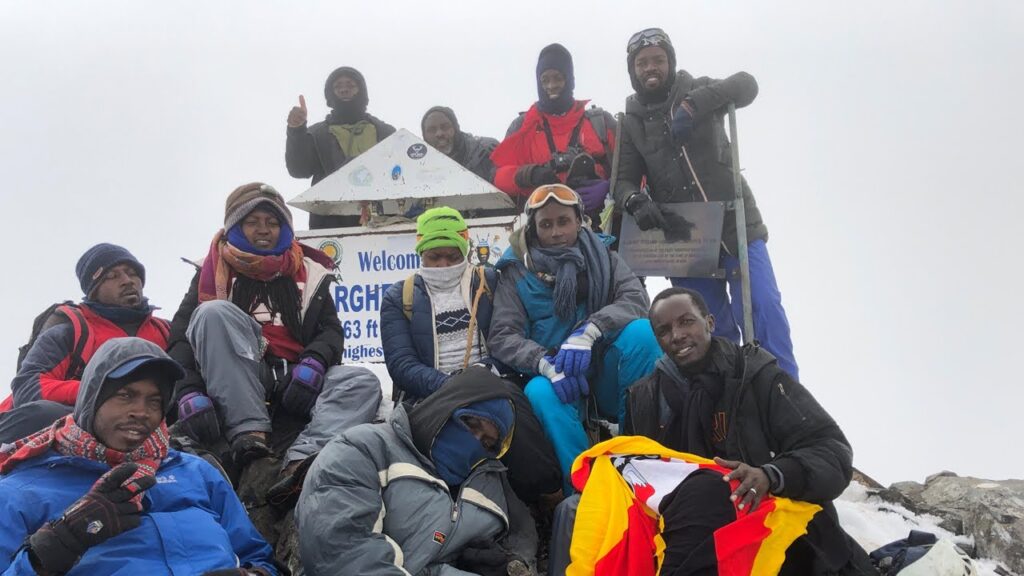
This knowledge is partly learned through formal guide training. The Uganda Wildlife Authority and the trekking operators who partner with UWA conduct guide training programs covering wilderness first aid, trail management, group leadership, altitude illness recognition, and technical glacier skills. But it is substantially built on a foundation of cultural familiarity with the mountain landscape that begins in childhood, through the stories and observations of parents and grandparents who also lived in the Rwenzori’s shadow, hunted in its forests, and farmed in its foothills.
The Porter Community: Physical Capability and Cultural Dignity
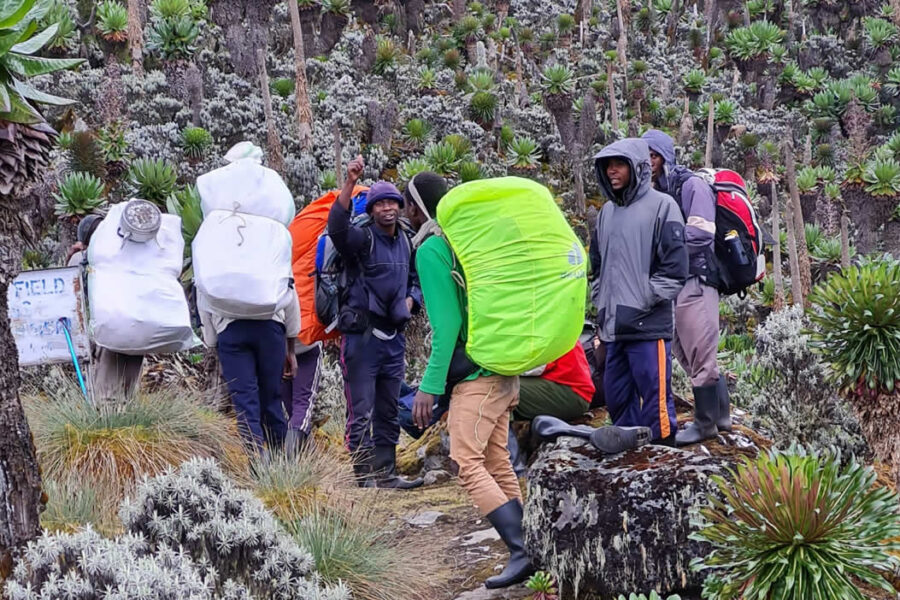
The Rwenzori’s porter community carries loads of up to 25 kilograms, which is the limit set by the Uganda Wildlife Authority for porter welfare, across terrain that challenges even fit, experienced trekkers who are walking with only a daypack. The bog sections of the upper Central Circuit, the steep exposed ridgelines above the treeline, and the cold and wet conditions of the middle mountain that can last for days: the porters navigate all of these challenges while carrying the food, equipment, and supplies that make the expedition possible. It is physically extraordinary work, and understanding this changes the tone and quality of the interaction between trekkers and their porter teams.
The Bakonzo community does not regard the porter role as menial; they consider it a skilled, valued, and respected occupation. Experienced porters have detailed knowledge of safe load management across different terrain types, efficient pacing strategies for different altitude profiles, and the specific handling techniques required for the fragile or temperature-sensitive equipment (camera gear, medical supplies, and tent structures) that they carry. Senior porters sometimes manage younger or newer members of the porter team, forming a de facto hierarchy of experience and responsibility within what might appear from the outside to be a simple labor arrangement.
When you arrive at Nyabitaba Hut after four or five hours on the trail and your tent is already pitched, your sleeping bag is laid out, and the smell of cooking is already drifting from the communal area, you are experiencing the result of a porter team that departed camp before you and arrived before you, moving faster over terrain they know intimately, with loads that represent a significant proportion of their body weight. The gratitude this effort deserves is not merely logistical appreciation. It is recognition of genuine professional capability.
Tipping: The Economics of Respect
The question of how much to tip Rwenzori porters and guides is answered in detail in our dedicated tipping guide. In the context of this article on the Bakonzo people, we should specifically note the cultural significance of tipping. The tip paid at the end of a Rwenzori expedition is not simply a financial transaction; it is the primary mechanism through which the trekking industry’s economic benefits are transferred directly to the mountain workers, the Bakonzo individuals whose labor, knowledge, and cultural familiarity make the expedition possible.
The amounts recommended, USD 3–5 per porter per day and USD 5–10 per lead guide per day, are modest in the context of international tourism spending but significant in the context of Kasese District’s local economy, where they represent a meaningfully above-average daily income for skilled mountain work. The decision to tip generously, in Ugandan Shillings rather than foreign currency (as covered in our currency guide for Rwenzori trekkers), is one of the most direct ways in which the trekking experience generates economic benefit for the Bakonzo community.
Bakonzo Culture, Language, and Daily Life: Understanding the Community You Are Visiting
Lukonzo: The Language of the Mountain
The Bakonzo speak Lukonzo, a Bantu language of the Lacustrine subgroup, closely related to Lurnde, Lundande, and other languages of the Western Rift Corridor. Lukonzo is spoken by approximately 1 to 1.5 million people in Uganda and a comparable or larger number in the DRC (where related Kinande dialects are spoken by the Nande people). In Uganda, Lukonzo has official recognition as a regional language and is used in primary school education in Kasese and Bundibugyo Districts alongside English, which is Uganda’s official national language and the language of secondary and higher education.
Lukonzo has a rich mountain-specific vocabulary that reflects the Bakonzo’s deep historical engagement with the Rwenzori landscape. The mountain itself is Rwenzururu (“Place of Snow”). Different altitude zones, vegetation communities, weather patterns, and mountain phenomena have specific Lukonzo names that carry detailed experiential information, a vocabulary that has no direct equivalent in English and that reveals, through its specificity, the depth of the Bakonzo’s ecological knowledge of their mountain. When a Bakonzo guide uses a Lukonzo place name on the trail, they are connecting the landscape to a naming tradition that predates the arrival of any external cartography or botanical science.
| Lukonzo Word / Phrase | English Meaning | Cultural / Trail Context |
| Rwenzururu | Place of Snow | The Bakonzo name for the Rwenzori range predates all European naming by centuries |
| Kithasamba | Mountain deity / spirit | The god believed to inhabit the mountain’s upper zones; storms are his expression of displeasure |
| Obusinga bwa Rwenzururu | Kingdom of the Rwenzori | The Bakonzo cultural kingdom, officially recognised by the Ugandan government in 2009 |
| Omusinga | King | Title of the Bakonzo monarch; current Omusinga is Wesley Mumbere |
| Batebe | Porters / mountain carriers | Traditional term for those who carry loads on the Rwenzori; an honoured community role |
| Bamere | Guides / pathfinders | Those with the knowledge to lead others safely through the mountain zones |
| Amakonzo | The Bakonzo people | Collective noun; Bakonzo is the Anglicised form used in most written contexts |
| Enganda | Clan / extended family unit | The primary social and identity structure of Bakonzo society |
| Butoho | Home area / homeland | The foothills of the Rwenzori are the Bakonzo’s butoho, their cultural heartland |
Agriculture, Land Use, and the Rwenzori Foothills Economy
The Bakonzo are fundamentally an agricultural people, and the fertile foothills of the Rwenzori Mountains provide the basis for a productive smallholder farming economy. The primary crops of the Rwenzori foothills include matoke (cooking banana, Uganda’s staple food), sorghum, millet, maize, beans, sweet potatoes, and a range of vegetables adapted to the mountain’s climate gradient. At higher elevations in the foothill zone, farmers successfully grow Irish potatoes and cabbages in the cooler, moister conditions produced by the mountain’s altitude. The Bakonzo farming system uses the Rwenzori’s reliable rainfall, which is exceptional even by Ugandan standards, to maintain production across the year with limited dependence on irrigation.
Coffee is the most important cash crop of the Rwenzori foothills, and the Kasese region is one of Uganda’s significant coffee-producing areas. Rwenzori arabica coffee, grown at altitude on the mountain’s lower slopes, is of high quality and has attracted significant interest from the specialty coffee market recently, a potential avenue for premium income generation for Bakonzo smallholder farmers that could reduce economic pressure on the mountain environment. Honey production, exploiting the Rwenzori’s extraordinary floral diversity, is also an important economic activity, and Rwenzori honey is prized in regional markets for its complex flavor profile derived from the mountain’s diverse montane forest flora.
Arts, Crafts, and Material Culture
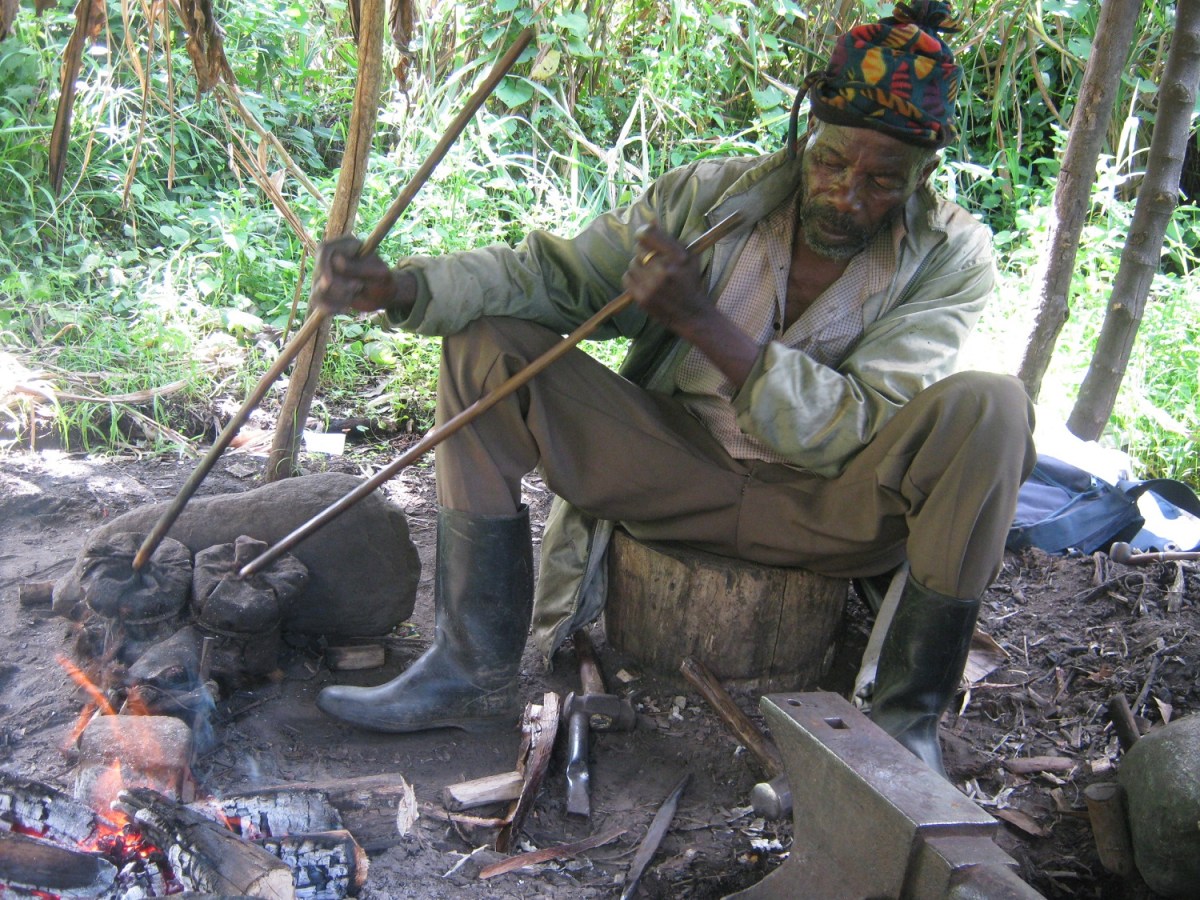
The Bakonzo have a rich tradition of material culture that is visible in the markets and craft stalls of Kasese Town and in the homes and community spaces of the Rwenzori foothills. Traditional crafts include woven baskets (using a range of plant fibers from the forest and cultivated areas in distinctive geometric patterns with natural and mineral dye colors), wooden carving (including functional household items, traditional musical instruments, and decorative objects that increasingly incorporate Rwenzori-themed motifs for the tourist market), and barkcloth production (the traditional Ugandan fabric made from the inner bark of the mutuba fig tree, still used for ceremonial purposes in Bakonzo cultural practice).
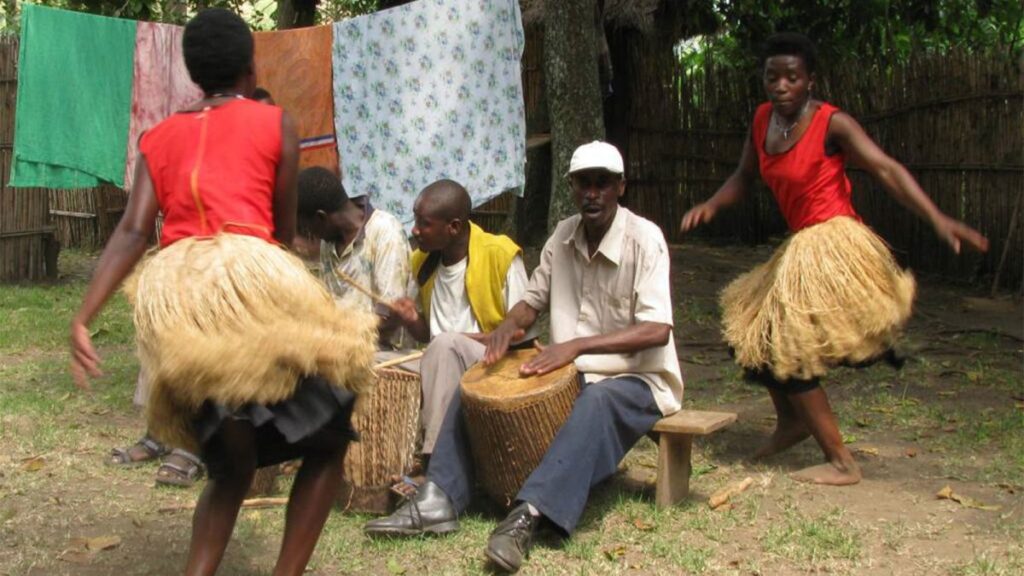
Traditional Bakonzo music featuring drums, the bowl lyre (adungu), and a range of wind and percussion instruments remains an important part of cultural celebration and ceremony, heard at weddings, harvest festivals, and community gatherings in the Rwenzori foothills. Trekkers who spend time in Kasese before or after their mountain expedition, particularly those staying an extra day to acclimatize or recover, may encounter these musical traditions in the town’s social life, which carries a distinctively Bakonzo cultural character despite the diversity of Uganda’s national population.
Food and Hospitality: What to Expect in the Bakonzo World
Bakonzo hospitality, the cultural value of generosity toward guests, is one of the most immediately apparent cultural qualities that trekkers encounter in their interactions with guide and porter teams. The warmth with which groups are welcomed at the mountain huts, the quality of care that expedition cooks put into meal preparation under genuinely difficult conditions, and the attentiveness of senior guides to the needs and welfare of their groups are all expressions of cultural values around hospitality that run deep in Bakonzo social practice.
The food prepared by Bakonzo expedition cooks on the Rwenzori campsites reflects both the international dietary expectations of the trekking market and the Bakonzo culinary tradition: substantial, starchy, warming, and made from the freshest available ingredients that the porter team has carried from the trailhead. Trekkers who express interest in learning to prepare a traditional Bakonzo dish, matoke, groundnut stew, or a traditional bean preparation sometimes find that their cook is willing to give an informal lesson at a camp, particularly on longer expeditions like the 13-day six-peaks grand expedition, where there is more time for cultural exchange than in the faster-paced summit push formats.
How Rwenzori Trekking Benefits the Bakonzo Community
The relationship between the Rwenzori trekking industry and the Bakonzo community is one of the most directly beneficial tourism-to-community economic relationships in Uganda’s outdoor adventure sector. Unlike safari tourism, which concentrates economic benefit primarily in large lodge operators and vehicle hire companies with more diffuse local community impact, Rwenzori Mountain trekking by its nature requires close, sustained engagement with local Bakonzo labor and knowledge at every stage of the expedition. Every trek puts money directly into Bakonzo hands in guide wages, porter wages, cook wages, and tips.
Employment: The Direct Economic Channel
A standard seven-day Rwenzori expedition employs a team that typically includes one lead guide, two assistant guides, one cook, and four to six porters, a group of seven to ten Bakonzo individuals whose income from the expedition represents a meaningful economic contribution to their households. On extended multi-peak expeditions like the 13-day six-peaks expedition or the 18-day all-peaks traverse, the crew size is larger and the income period longer; a single 18-day expedition employs a substantial team for nearly three weeks. Multiplied across the fewer than 2,000 trekkers who complete multi-day Rwenzori expeditions each year, the aggregate employment created by the trekking industry represents one of the most important income sources in Kasese District’s formal and semi-formal economy.
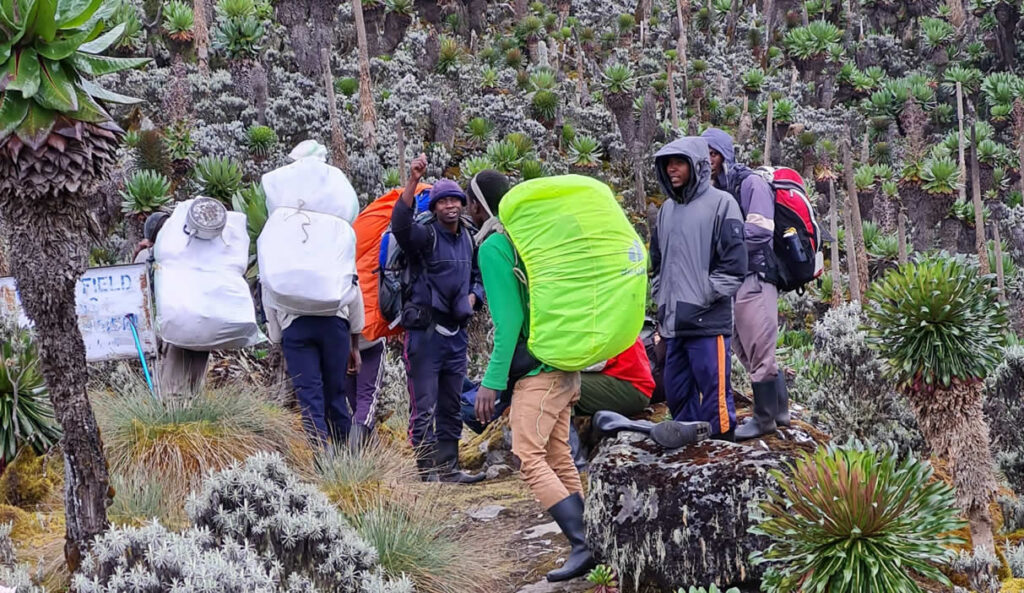
The Uganda Wildlife Authority sets minimum wage standards for Rwenzori Mountain workers through its guide and porter regulation framework, and reputable operators, including Rwenzori Trekking Safaris, comply with and, often, exceed these standards. The regulation of porter load weights, which includes the UWA’s 25-kilogram maximum per porter enforced at the Nyakalengija trailhead, is also a form of worker protection. It indicates that the UWA understands the physical welfare of mountain workers is a real concern for conservation and labor rights, not just an operational issue.
Skills Development and Career Pathways
The Rwenzori trekking industry has created a skills development pipeline that provides meaningful career pathways for young Bakonzo men and women in the Kasese District economy. An entry-level porter, beginning at 18 or 20 years of age with the strength and fitness advantage of a youth raised in the Rwenzori foothills, can, over several years of regular mountain work, develop the knowledge, language skills (most active guides are functionally trilingual in Lukonzo, English, and Swahili), and technical skills to become an assistant guide and ultimately a lead guide. Lead guides on the Rwenzori’s premier expeditions are skilled professionals trained in wilderness first aid, glacier travel with crampons and ice axes, group management, and emergency response protocols whose qualifications represent genuine professional achievement.
The trekking industry has also generated indirect economic activity in the Kasese area: accommodation businesses that host pre- and post-trek visitors, food supply chains that provide expedition provisions, transport services, and the craft market economy that sells to visiting international trekkers. The Kasese travel guide covers the town’s accommodation, dining, and market options for trekkers who want to spend time in the gateway community before or after their mountain expedition.
Conservation: The Economic Argument for the Mountain’s Protection
One of the most important ways in which the Rwenzori trekking industry benefits the Bakonzo community and the mountain simultaneously is by creating an economic argument for the mountain’s conservation. Rwenzori Mountains National Park was gazetted in 1991 and designated as a UNESCO World Heritage Site in 1994, and this protected status has inevitably created tensions with local Bakonzo communities who historically used the mountain’s forest zones for hunting, gathering, and in some cases agriculture.
The trekking industry provides a partial resolution to this tension by demonstrating that the mountain’s ecological integrity, its extraordinary vegetation zones, its wildlife community, and its glaciers has significant, ongoing economic value to the Bakonzo community. A healthy, intact mountain ecosystem generates employment and income through trekking. A degraded mountain does not. This economic logic does not resolve all the tensions between conservation and community land use; those tensions require sustained policy engagement and are outside the scope of this article, but it creates a genuine, tangible economic incentive for mountain communities to support conservation that the trekking industry provides.
Meeting Your Bakonzo Guide: What Makes the Relationship Work
I want to say something directly about the guide relationship, based on my years of working alongside Bakonzo guides and watching how that relationship develops between the guides and the international trekkers they lead. The quality of a Rwenzori expedition is fundamentally shaped by the quality of that relationship, not just by the technical competence of the guide, but also by the interpersonal dynamic between the guide and the trekker and the degree of mutual respect and genuine curiosity that both parties bring to the encounter.
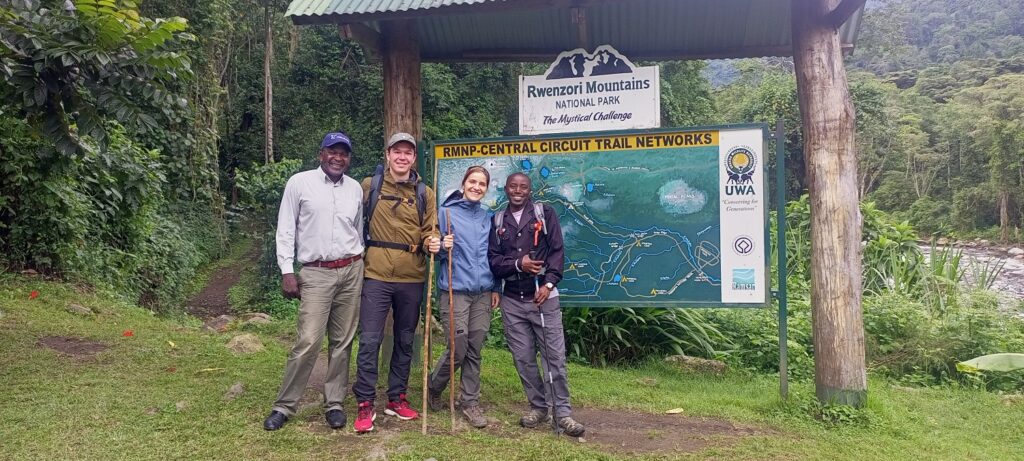
Trekkers who treat their guide primarily as a logistical service provider, someone to follow up the hill and tip at the end, miss most of what the relationship has to offer. Trekkers who bring genuine curiosity about their guide’s life, family, relationship with the mountain, cultural background, and perspective on the trekking experience they are sharing , and who share their own background in return, consistently report that the guide relationship was one of the most memorable dimensions of their Rwenzori experience. This phenomenon is not a coincidence. It is a reflection of the fact that Bakonzo guides are not simply mountain navigators; they are cultural interpreters, natural historians, and human beings with rich inner lives that are entirely available for genuine engagement if you bring the curiosity to invite it.
Learning a Few Words of Lukonzo
One of the most immediately effective ways to signal genuine respect for your Bakonzo guide and porter team is to learn a small number of words and phrases in Lukonzo before your trek. The Lukonzo language guide in this article provides the most trekking-relevant terms. A greeting in Lukonzo, “Musiime” (thank you), or a friendly acknowledgment of the mountain’s Bakonzo name is received not as a novelty performance but as a genuine gesture of cultural respect that consistently produces a visible shift in the quality of the interaction. You are acknowledging that you know whose mountain you are on.
The Departure Briefing as Cultural Introduction
The registration and departure briefing at Nyakalengija formally introduces you to the Bakonzo world of the mountain as you meet your guide team, sign the register, weigh your loads, and receive the orientation briefing. Take time with the introductions. Learn the names. Ask your lead guide how long they have been working on the mountain, which trail they know best, and what their favorite camp is and why. These are not time-wasting pleasantries; they are the foundation of a relationship that will carry you safely across terrain the guide knows but you do not.
Respecting the Cultural Protocols of the Mountain
Your guide will brief you on the park regulations set by the Uganda Wildlife Authority during the orientation. Beyond these formal regulations, there are informal cultural courtesies that experienced Rwenzori trekkers observe as a matter of respect for the Bakonzo relationship with the mountain. Moving quietly through the forest zones is not merely for wildlife observation purposes, but out of respect for the mountain’s character as a place that the Bakonzo experience as spiritually significant. It is important to ask before photographing individual guides and porters rather than treating them as picturesque background elements. Listen when your guide interprets the landscape, weather, or ecology, and recognize that this interpretation comes from a knowledge tradition your own research cannot replicate.
The Future of the Bakonzo and the Rwenzori: Challenges and Opportunities
In the early twenty-first century, the Bakonzo community faces challenges that are common to indigenous mountain communities worldwide: balancing cultural preservation with economic modernization, dealing with demographic growth that puts pressure on land resources in the Rwenzori foothills, coping with climate change that affects both agriculture and the mountain ecosystem that supports the trekking economy, and ensuring that the benefits of the trekking industry are shared more fairly among the Bakonzo community instead of being concentrated in the small number of people who work directly in mountain tourism.

The accelerating loss of the Rwenzori’s glaciers, projected to disappear entirely within two to three decades under current warming trajectories, poses a particular long-term challenge to the trekking economy and, therefore, to the Bakonzo mountain worker community. The glaciers are one of the most significant draws for international trekkers choosing the Rwenzori over other East African mountain destinations. A de-glaciated Rwenzori will need to rely more heavily on its extraordinary ecology, its cultural dimension, and its unique character as Africa’s only non-volcanic major mountain range to maintain its trekking market position.
On the opportunity side, the growing international market for culturally immersive, ethically engaged adventure travel creates real potential for Rwenzori trekking to evolve beyond the traditional expedition format toward offerings that include more profound community engagement, home visits to Bakonzo farming families, demonstrations of traditional crafts and food preparation, cultural storytelling sessions at mountain camps, and community-based tourism initiatives in the Kasese area that connect international visitors with Bakonzo life beyond the mountain trail. These are directions that responsible operators and the Bakonzo community are actively exploring.
“The mountain is not ours to own. It is ours to know.” A reflection on the Bakonzo relationship with the Rwenzori, shared by a senior Bakonzo guide on an evening at Bujuku Hut.
Frequently Asked Questions: The Bakonzo People and the Rwenzori Mountains
Who are the Bakonzo people?
The Bakonzo, also called the Konzo and collectively referred to in their language as Amakonzo, are the indigenous Bantu-speaking people whose ancestral homeland encompasses the foothills and lower slopes of the Rwenzori Mountains in western Uganda and adjacent parts of the Democratic Republic of Congo. In Uganda, the Bakonzo are the dominant community in Kasese District and significant areas of Bundibugyo District, with a total population estimated to be between 1 and 1.5 million people. They are governed culturally by the Obusinga bwa Rwenzururu (Kingdom of the Rwenzori), officially recognized by the Ugandan government in 2009, with Wesley Mumbere as the current Omusinga (King). The Bakonzo speak Lukonzo, a Bantu language of the Great Lakes subgroup, and have maintained a deep, multigenerational relationship with the Rwenzori Mountains that is simultaneously agricultural, spiritual, and, in the contemporary era, economic through the mountain trekking industry.
What is the Bakonzo name for the Rwenzori Mountains?
The Bakonzo call the Rwenzori Mountains “Rwenzururu” meaning “Place of Snow” in the Lukonzo language. This name predates all European names for the range by centuries. When European explorers arrived in the region in the 1880s and began cartographically recording the mountains, they anglicized the Bakonzo name into “Ruwenzori” (later standardized as “Rwenzori” in Ugandan official usage). The name “Rwenzori” is therefore not a European coinage but an anglicization of the indigenous Lukonzo name. The Bakonzo also maintained their own mountain deity tradition centered on Kithasamba, the spirit believed to inhabit the mountain’s upper zones and whose breath creates the mists that perpetually shroud the high peaks.
What is the role of Bakonzo guides and porters on the Rwenzori trek?
Bakonzo guides and porters are the essential human infrastructure of every Rwenzori expedition. Guides, including lead guides, assistant guides, and cooks, are trained professionals who provide route navigation, safety oversight, altitude illness monitoring, emergency response, and cultural interpretation throughout the trek. Porters carry equipment, food, and supplies under the load limits set by the Uganda Wildlife Authority (maximum 25 kilograms per porter), enabling trekkers to walk with lightweight daypacks rather than expedition backpacks. The knowledge that Bakonzo guides bring to the mountain is not merely learned from training programs; it is built on cultural familiarity with the Rwenzori landscape that has accumulated over generations of Bakonzo presence in and around the range. A standard 7-day Rwenzori expedition uses a team of seven to ten Bakonzo individuals, while extended multi-peak expeditions use larger crews over longer periods.
What language do the Bakonzo speak?
The Bakonzo speak Lukonzo, a Bantu language of the Great Lakes (Lacustrine) subgroup, closely related to the Kinande dialects spoken by the Nande people of the DRC’s eastern provinces. Lukonzo has official recognition as a regional language in Uganda and is used in primary school education in Kasese and Bundibugyo districts. Most Bakonzo who work in the mountain trekking industry are functionally trilingual in Lukonzo, English (Uganda’s national official language), and Swahili (widely spoken in the wider East African region). Lukonzo contains a rich mountain-specific vocabulary reflecting the Bakonzo’s deep historical engagement with the Rwenzori landscape, with specific terms for altitude zones, weather patterns, vegetation communities, and mountain phenomena that have no direct English equivalents.
How does Rwenzori trekking benefit the Bakonzo community?
Rwenzori mountain trekking is one of the most directly community-beneficial forms of tourism in Uganda’s outdoor adventure sector. Every expedition employs a team of Bakonzo guides, assistant guides, a cook, and porters, whose combined wages and tips represent direct income transfers from international tourism to the local Bakonzo economy. A standard 7-day expedition employs seven to ten Bakonzo individuals; extended 13 to 18-day multi-peak expeditions support larger crews for longer periods. The trekking industry has also created career pathways from entry-level porter to fully qualified lead guide that provide skilled employment in the Kasese District economy. Beyond direct employment, the industry also supports accommodation businesses, food supply chains, transport services, and the craft market economy, which together represent significant economic activity in the Rwenzori foothills. The industry also creates an economic incentive for conservation by demonstrating that the mountain’s ecological integrity has ongoing economic value to the local community.
What is the Obusinga bwa Rwenzururu?
The Obusinga bwa Rwenzururu, meaning “Kingdom of the Rwenzori” in Lukonzo, is the Bakonzo traditional cultural kingdom, formally recognized by the Ugandan government in 2009 under Uganda’s constitutional framework for traditional institutions. It is the culmination of the Rwenzururu Movement, a decades-long political and cultural struggle for Bakonzo autonomy and recognition that began in the late 1950s in response to the domination of Kasese District by the more powerful Toro Kingdom. The current Omusinga (King) is Wesley Mumbere (Charles Wesley Mumbere Irema-Ngoma), who was enthroned following the 2009 recognition. The kingdom has its own cultural institutions, ceremonial structures, and community governance systems that complement the formal Ugandan state administration of Kasese District. Its recognition was a landmark moment for Bakonzo cultural dignity and political identity.
Is it appropriate to photograph Bakonzo guides and porters on the trek?
Photography of Bakonzo guides and porters on the Rwenzori trek is generally welcome, particularly within the context of a relationship of mutual respect and genuine engagement that has developed over the course of the expedition. The key principle is always to ask first rather than photograph without consent, a straightforward courtesy that applies in any cross-cultural photographic context. Trekkers who have invested in genuine engagement with their guide and porter team throughout the expedition, learning names, showing interest, and sharing their stories, will generally find that requests to photograph are received warmly and may result in the most authentic and memorable images from the entire trip. Treating guides and porters as picturesque background elements or documentary subjects without permission is neither appropriate nor likely to produce photographs that capture the genuine humanity of the encounter.
Do Bakonzo guides speak English?
Yes. Bakonzo guides working in the Rwenzori trekking industry are functionally English-speaking, as English is Uganda’s official national language and the language of formal education at secondary and higher levels. Lead guides typically have strong spoken English capable of facilitating detailed conversation, briefings, safety discussions, and cultural exchange throughout the expedition. Some guides also speak Swahili, French, or other languages depending on their educational background and experience with different international groups. The depth of English fluency varies between individuals. Some lead guides are highly articulate in English and can engage in sophisticated discussions about the mountain’s ecology, geology, and cultural history; others communicate clearly but with more limited vocabulary. This is simply the normal range of a multilingual professional community, and it is never a barrier to safe, well-managed mountain guiding.
Trek the Rwenzori and Meet Its People
The Rwenzori Mountains are extraordinary in their geology, their ecology, their glaciers, and their summits. They are also extraordinary in their people, the Bakonzo community, who have lived in the mountain’s shadow for millennia, whose knowledge makes every expedition safe, whose labor makes every expedition possible, and whose cultural presence gives the trekking experience a human depth that no mountain ecology alone can provide. The full Rwenzori experience is the mountain and the people together, understood in their relationship to each other.
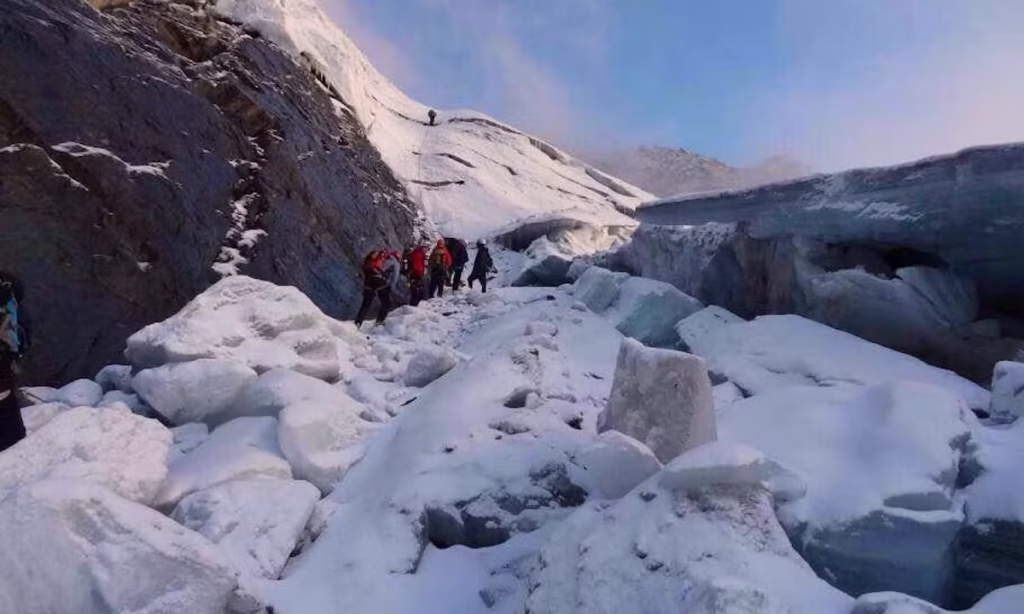
At Rwenzori Trekking Safaris, we take the cultural dimension of the Rwenzori experience seriously. Our guide teams are selected not only for their technical mountain competence but also for their ability and willingness to engage trekkers in genuine cultural exchange. We brief our clients on the Bakonzo community before departure, encourage meaningful interaction on the trail, and structure our tipping and wage practices to maximize the economic benefit that flows from international trekkers to the Bakonzo mountain workers who make the expedition possible.
Whether you are planning the introductory 3-day Mahoma Loop hike or the comprehensive 13-day six-peaks grand expedition, your experience will be guided, cooked, and carried by Bakonzo men and women whose relationship with this mountain is older and deeper than any expedition itinerary. Trek with that knowledge, and you will find that the mountain means more than any photograph or summit elevation figure can express.
Explore our full range of Rwenzori trekking itineraries, read our dedicated guide to how much to tip your Rwenzori guides and porters, and plan your visit using our month-by-month seasonal guide. When you are ready to meet the mountain and its people, contact our expedition team directly. We will help you design a Rwenzori experience that honours both the mountain and the community that has always been its guardian