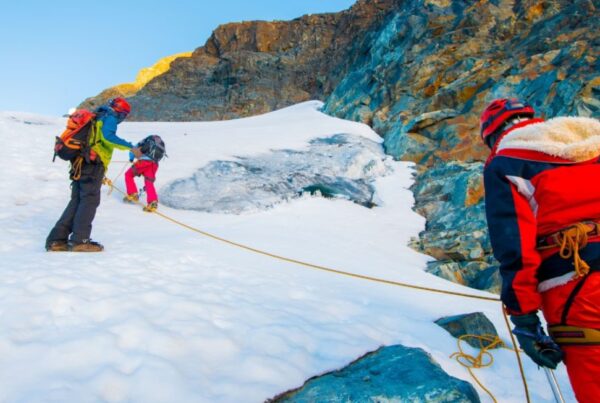

Scientific explanation of why Rwenzori glaciers are shrinking, what’s driving the melt, and what their disappearance means for Africa’s Mountains of the Moon.
The glaciers of the Rwenzori Mountains in Uganda are among the last remaining tropical glaciers on Earth. Scientific observations over the past century show that these ice bodies have been shrinking rapidly and consistently, with losses accelerating in recent decades. If current climatic trends continue, most and possibly all of the Rwenzori glaciers are likely to disappear within the coming decades.
This process is driven primarily by rising regional air temperatures, fluctuations in cloud cover and radiation balance, altered precipitation patterns, and the extreme sensitivity of small tropical glaciers to even minor climatic shifts. Unlike polar or mid-latitude glaciers, tropical glaciers exist near the threshold of survival, making them especially vulnerable.
The disappearance of the Rwenzori glaciers would not only mark the loss of a unique natural phenomenon but also alter local hydrology, ecosystems, mountaineering conditions, and the scientific value of the range as a climate archive.
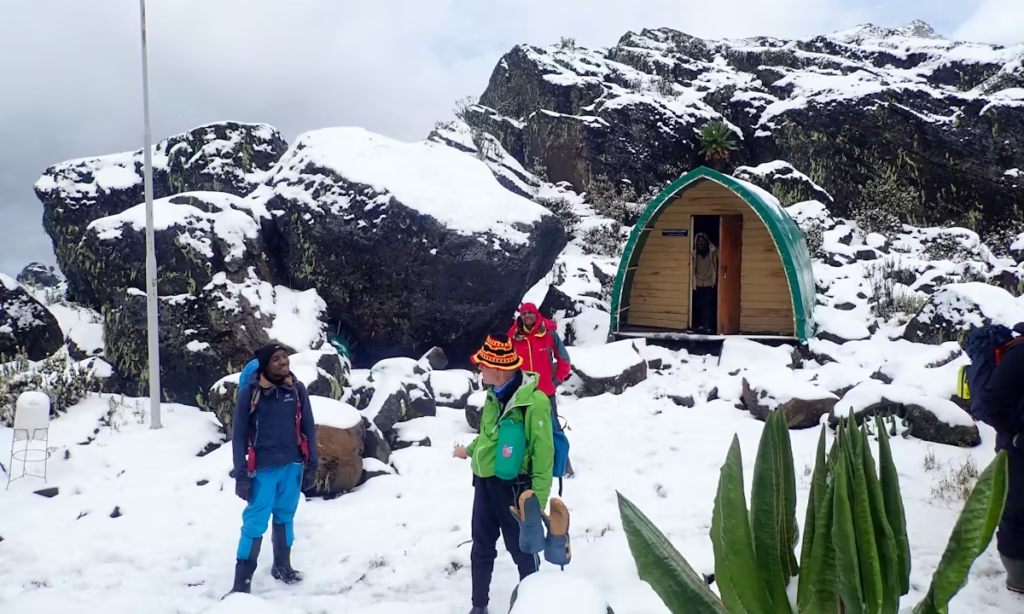
Snow time in the Mountains of the Moon
The likely disappearance of the Rwenzori glaciers within decades is not a sudden disaster but a slow, measurable transformation driven by global and regional climate change. These glaciers exist at the edge of climatic viability, and even modest warming has profound consequences.
Their retreat tells a clear story: tropical mountain environments are changing rapidly, and the signals are already visible. Whether viewed through a scientific, environmental, or cultural lens, the Rwenzori glaciers serve as both a record of the past and a warning for the future.
The Last Tropical Glaciers of Africa
The Rwenzori Mountains, straddling the border between Uganda and the Democratic Republic of Congo, host Africa’s highest and most enduring ice outside of Mount Kilimanjaro and Mount Kenya. Often referred to as the “Mountains of the Moon,” the range once supported extensive glaciers that fed rivers, shaped alpine landscapes, and puzzled early explorers who found ice near the equator.
Today, only small remnants of these glaciers remain, clinging to the highest peaks such as Mount Stanley, Mount Baker, and Mount Speke. Their continued existence has become uncertain, not because of sudden catastrophe, but due to a steady, measurable, and persistent retreat that has been documented for decades.
Understanding why the Rwenzori glaciers may vanish within decades requires understanding how tropical glaciers work, how climate change expresses itself in equatorial regions, and why small ice bodies respond so quickly to environmental change.
What Makes the Rwenzori Tropical Glaciers Different?
Tropical glaciers are fundamentally different from the massive ice sheets of Greenland or Antarctica. They exist in regions where seasonal temperature variation is small and where daily solar radiation is intense year-round. Only a delicate balance between the amount of snowfall and the melting and sublimation of ice allows them to survive.
In the tropics, glaciers are already near their melting point for much of the year. A small increase in average temperature, even fractions of a degree Celsius, can shift this balance decisively toward net ice loss. There is little buffer.
Radiation, not just air temperature, strongly influences tropical glaciers. Cloud cover, surface reflectivity, and atmospheric moisture play a major role in how much solar energy reaches the ice. When cloud patterns change or when darker debris accumulates on glacier surfaces, melting accelerates even if temperature changes appear modest.
This sensitivity explains why tropical glaciers worldwide, from the Andes to East Africa to Papua New Guinea, have shown some of the fastest retreat rates on the planet.
Historical Evidence of Glacier Retreat in the Rwenzori
The retreat of the Rwenzori glaciers is not speculative. It has been observed, photographed, mapped, and measured over more than a century.
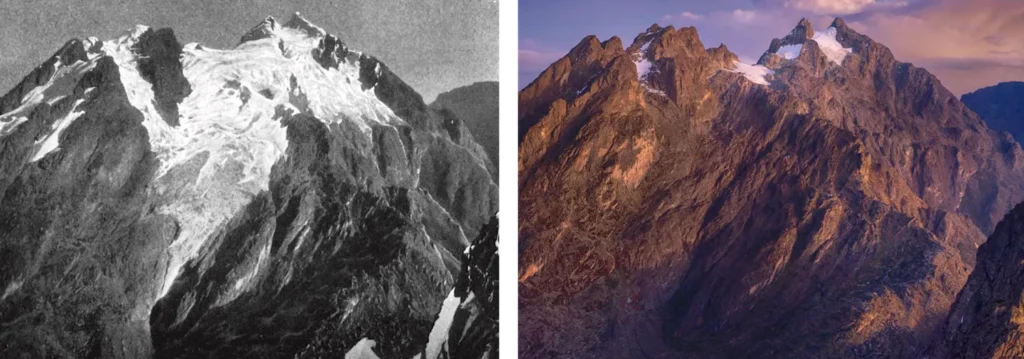
Early explorers in the late nineteenth and early twentieth centuries described extensive ice fields and valley glaciers descending far below the current ice margins. Aerial photographs and ground surveys from the mid-twentieth century already showed significant retreat compared to those early accounts.
By the late twentieth century, scientific measurements confirmed that the total glacierized area of the Rwenzori had declined dramatically. Research that looked at old maps, satellite images, and field measurements showed that more than half of the original ice coverage was lost. More recent observations indicate that this trend has continued, with some smaller glaciers fragmenting into isolated ice patches, and the only remaining glacier in the Rwenzori Mountains is now the Stanley Glacier on the way to Margherita.
The key point is that the disappearance has been consistent across decades and independent of short-term weather variability. This pattern is characteristic of a climate-driven process rather than a cyclical or local anomaly.
Why Decades, Not Centuries
Projections suggesting that the Rwenzori glaciers may vanish within decades are based on observed retreat rates combined with climate model projections, though it is not yet certain they will disappear completely. As the Rwenzori Trekking Safaris and our partners, we are implementing measures to prevent this by correcting past mistakes, such as planting more trees to increase precipitation in the region. While exact timelines vary between studies and depend on future emission scenarios, the direction is consistent.
The remaining glaciers are small, thin, and fragmented. Small glaciers respond faster to climatic forcing than large ones because they have less thermal inertia and less capacity to buffer short-term variability.
If current warming trends continue, even at moderate rates, the remaining ice bodies are unlikely to survive beyond the mid- to late twenty-first century. Some projections suggest disappearance within a few decades, while others allow for small remnants to persist slightly longer in shaded or sheltered locations, and based on the measures we are putting in place, the tropical glaciers might recover and thrive for centuries to come.
The uncertainty lies in the precise timing, not in the outcome.
What Happens When the Glaciers Disappear
The loss of the Rwenzori glaciers will not trigger catastrophic flooding or immediate water shortages, as these glaciers contribute a relatively small fraction of total river flow compared to rainfall. However, their disappearance will alter seasonal water regulation, particularly during dry periods.

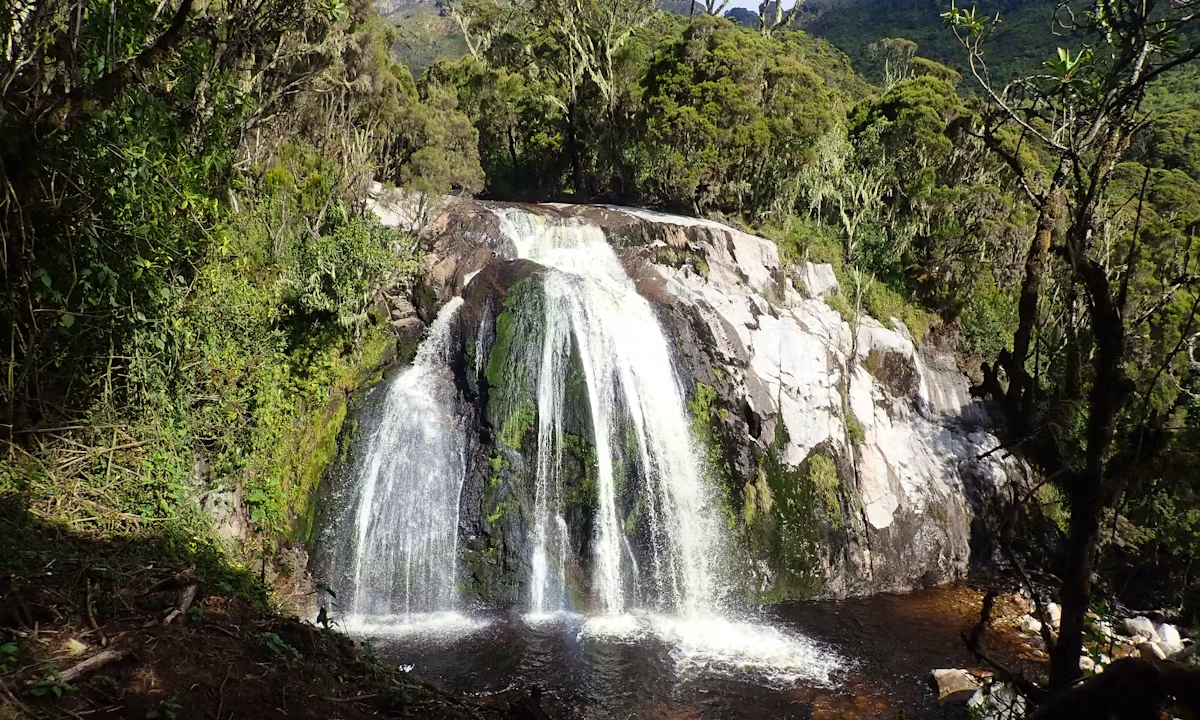
Waterfalls in the Rwenzori Mountains are fed partly by the melting glaciers
Ecologically, the loss of permanent ice will change alpine microclimates and affect specialized species adapted to cold, wet conditions. The visual and symbolic identity of the range will also change, affecting mountaineering, tourism, and cultural narratives tied to the “Mountains of the Moon.”
Scientifically, the glaciers represent valuable climate archives. Their disappearance would erase natural records of past atmospheric conditions preserved in ice layers, reducing future research opportunities.
Why the Rwenzori Matters Globally
The Rwenzori glaciers matter not because they are large, but because they are sensitive. They act as early indicators of climate change, responding rapidly to shifts that may take much longer to manifest in larger systems.
Their retreat mirrors patterns seen in tropical glaciers worldwide and provides a clear, visible signal of broader climate processes. In this sense, the Rwenzori is not an isolated case but part of a global pattern unfolding in real time. The Rwenzoris melting isn’t the only climate disaster; Antarctica has also seen it.
For scientists, the Rwenzori offers a natural laboratory. For local communities, it is a changing landscape. For the world, it is a reminder that climate change operates even in places once thought climatically stable.
What Uncertainty Remains
It is important to acknowledge uncertainty honestly. Climate systems are complex, and local factors can modify global trends. Short-term increases in snowfall or cooler periods could temporarily slow retreat or preserve isolated ice patches.
However, these factors are unlikely to reverse the long-term trajectory unless there is a sustained and significant change in global temperature trends not only in East Africa but worldwide. Current evidence does not support such a reversal.
FAQs about the Rwenzori Glaciers and Climate Change
Are the Rwenzori glaciers really disappearing?
Yes. Multiple independent observations over more than a century show consistent and significant glacier retreat in the Rwenzori Mountains.
How fast are the glaciers shrinking?
Exact rates vary by glacier and time, but overall losses have been substantial, with more than half of the original glacier area lost over the past century.
Is climate change the main cause?
Yes. Rising temperatures, altered radiation balance, and changing precipitation patterns linked to global climate change are the primary drivers.
Could the glaciers recover if the climate stabilizes?
Recovery is unlikely. The remaining glaciers are small and vulnerable, and recovery would require sustained cooling and increased snowfall over long periods of time, which is unlikely. But with this increased precipitation over the last two years, we believe we have to be optimistic.
When might the glaciers disappear completely?
Many projections suggest that most Rwenzori glaciers could vanish within the coming decades, possibly within the twenty-first century, depending on future climate trends.
Does glacier loss affect local water supplies?
The impact on total water supply is limited, but seasonal flow regulation and alpine ecosystems may be affected.
Are the Rwenzori glaciers protected?
They are located within a national park and World Heritage Site, but protection cannot shield them from global climate forces.