How technical is the climb to Margherita Peak? An expert route guide will cover glacier travel, crampons, fixed ropes, and the fitness and skills needed to summit safely.
Stand at the foot of the Rwenzori Mountains and look upward on one of the rare clear mornings when the cloud lifts, and you will catch a glimpse of them: white summits hanging above the equatorial forest like a rumor. The highest of those summits is Margherita Peak, at 5,109 meters, the crown of Mount Stanley and the third-highest point on the African continent. It is a mountain that draws serious trekkers and alpinists from across the world, people who have stood on Kilimanjaro, Mont Blanc, and peaks in the Andes and Himalayas, and it still surprises them. It may not be the hardest thing they’ve ever climbed, but it’s very different from what they expected, often involving special obstacles such as unpredictable weather, varying terrain, and the need for specific climbing skills.
The question I hear from prospective trekkers more than almost any other is this: how technical is it? It is exactly the right question to ask, and it deserves a thorough, honest answer. The term ‘technical’ encompasses a broad range, from a route requiring a moment of meticulous footwork to one requiring years of alpine preparation, and Margherita Peak occupies a specific and significant position within this spectrum. This guide helps you understand your equipment, preparation, and realistic chance of summit success.
What follows is the most complete, experience-based account of the Margherita Peak climb available anywhere online. It is written by guides who have stood on that summit many times, in all conditions, with trekkers of all backgrounds. It covers the full route from the national park entrance to the summit and back, the technical challenges at each stage, the equipment you will need, the skills you must have or develop, and the honest assessment of what separates trekkers who summit from those who do not. Read it carefully. It may be the most useful thing you read before booking your Rwenzori trek.
Margherita Peak in Context: Where It Sits in the World of Mountain Difficulty
Before we walk you through the route, it helps to calibrate Margherita Peak against the mountain difficulty framework that most international trekkers use as a reference. The standard grading system for mountaineering routes runs from F (facile, or easy) through PD (peu difficile), AD (assez difficile), D (difficile), TD (très difficile), and ED (extrêmement difficile). By this framework, the standard approach to Margherita Peak sits at approximately PD poco difficile, or mildly difficult in excellent conditions. That grading reflects the presence of glaciated terrain requiring crampons and ice axes, some sections of exposed mixed climbing, and the overall commitment of a multi-day approach at altitude. It is an intermediate mountain, suitable for neither beginners nor elite alpinists.
For trekkers accustomed to thinking in terms of trail grades rather than alpine grades, the best analogy is this: the approach to Margherita Peak on the standard Rwenzori itinerary is the equivalent of a challenging alpine introduction route, harder than anything you will find on Kilimanjaro’s standard routes, comparable to a basic alpine season in the Alps (Mont Blanc via the normal route, for instance), and significantly more accessible than serious technical routes in the Himalayas or Patagonia. The commitment and seriousness of the mountain come not just from the technical sections but from the multi-day approach through one of Africa’s most demanding environments, the altitude, and the Rwenzori’s characteristic wet and cold conditions.
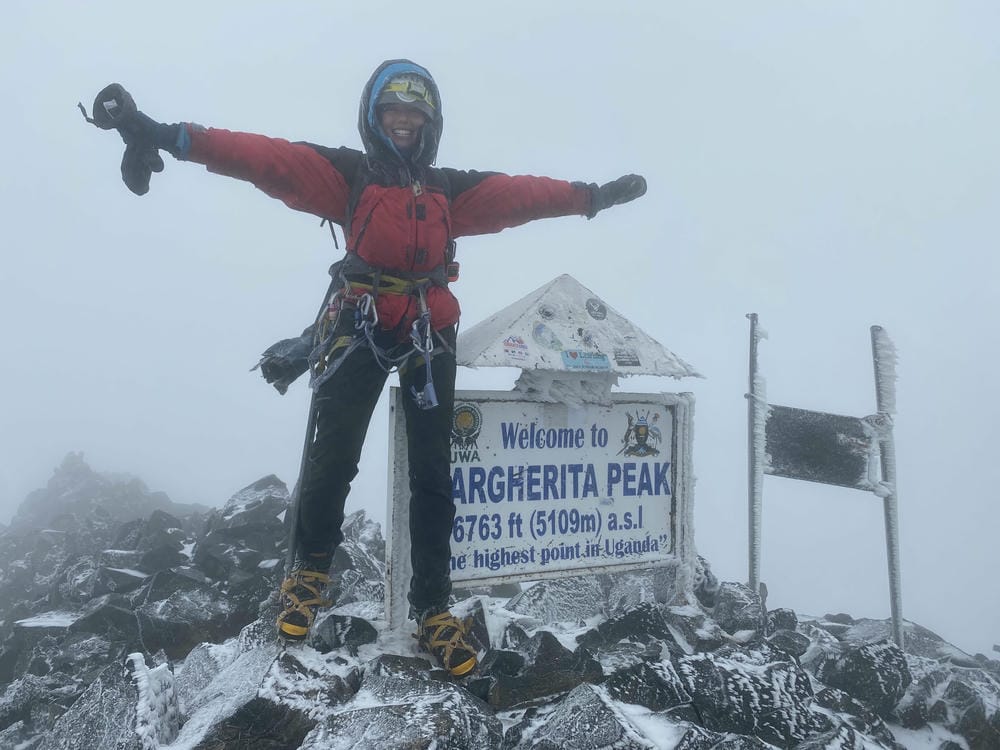
The key thing to hold onto as you read this guide is that Margherita Peak is achievable for non-specialist trekkers with the right preparation, the right equipment, and the right guide. It is a serious trekking objective, but a motivated, fit, experienced mountain person who prepares intelligently and approaches it with appropriate humility can achieve it.
The Full Route: Stage by Stage from the Trailhead to the Summit
Stage One: The Approach—Nyakalengija to the Lower Huts (Days 1–3)
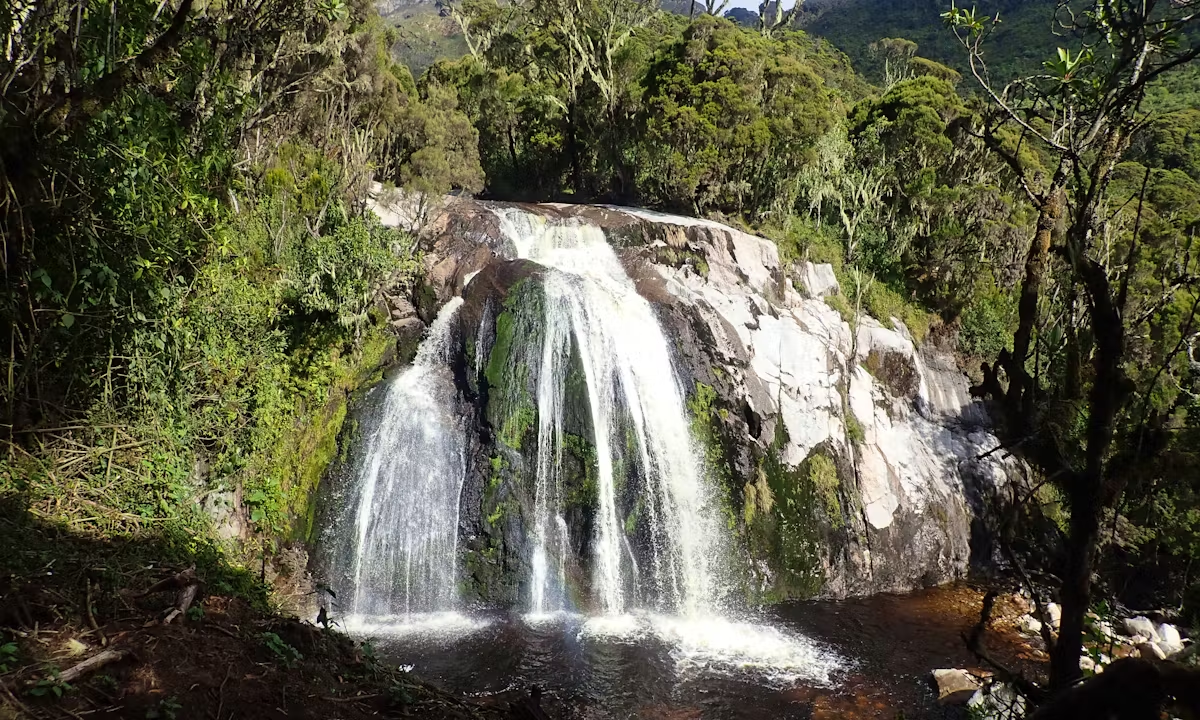
The Margherita summit attempt begins long before any technical terrain appears. The trailhead at Nyakalengija sits at approximately 1,646 meters, and the journey to the upper mountain starts with a multi-day traverse through the Rwenzori’s lower ecological zones. These days are non-technical in the mountaineering sense, but they are far from easy. The Central Circuit Trail forms the backbone of most Margherita approach itineraries, taking trekkers through dense montane rainforest, bamboo zones, and the remarkable giant heather moorland that the Rwenzori is famous for.
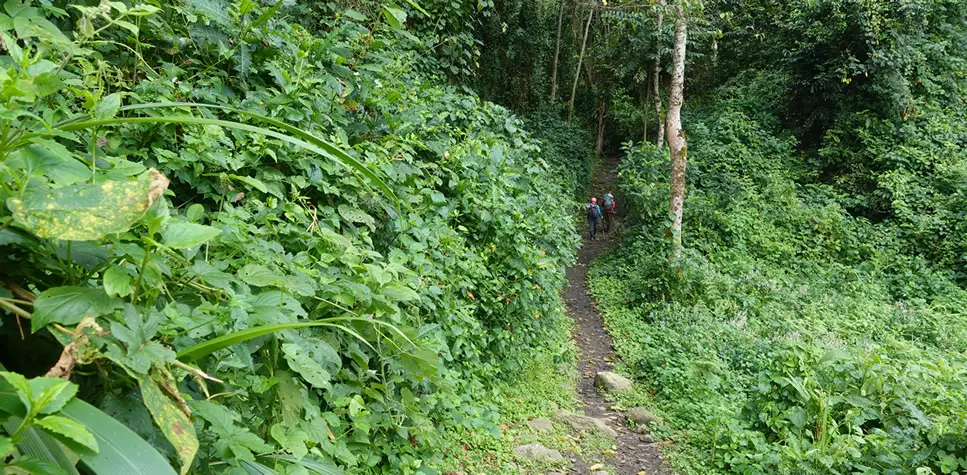
The trails in the lower zones are characterized by sustained steepness, heavy mud, waterlogged bog crossings on log bridges, and a root-tangled surface that demands constant attention. Daily elevation gains in the lower stages typically range from 700 to 1,000 meters, serious trekking by any standard. The non-technical nature of this terrain does not mean it is without risk: twisted ankles, falls on slippery roots, and the cumulative fatigue of consecutive days at altitude are all genuine concerns. These opening days also serve a critical acclimatization function, gradually introducing the body to elevation in preparation for what comes above 4,000 meters.
Trekkers on summit itineraries via the Kilembe Trail begin from the Kilembe Valley trailhead to the south, joining the upper mountain routes at altitude. The Kilembe approach has its own distinct character, in some sections more demanding and in others more open than the standard northern approach, and our guides can advise on the most appropriate approach route for your summit itinerary when you plan your trip.
Stage Two: The Upper Approach—Hut to Hut Above 3,800 Metres (Days 3–5)
As the route climbs above 3,800 meters, the vegetation gives way to the Afro-alpine zone, the ecological theater that most trekkers describe as the most visually surreal landscape they have ever seen. Giant groundsels stand four to six meters high against skies of cloud and ice; giant lobelias rise from the bog in candelabra shapes; the heather is swathed in layers of lichen that make the moorland look like something from another planet. At these elevations, the altitude starts to manifest itself: appetite decreases, sleep becomes lighter, and the familiar shortness of breath associated with genuine high-altitude trekking emerges.
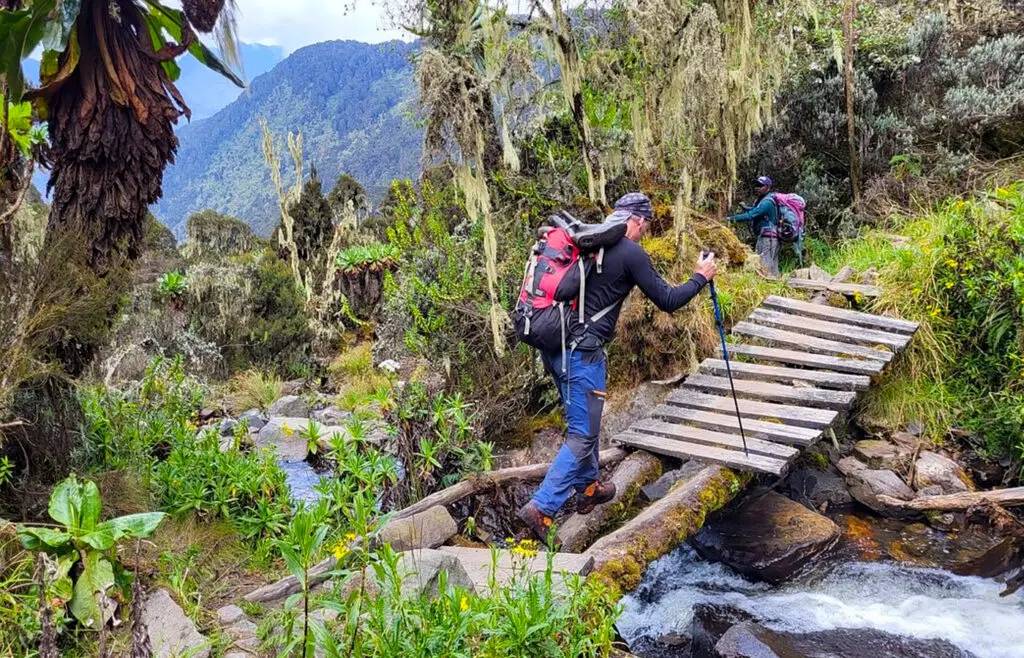
The upper approach passes through camps at John Matte Hut (3,414 m), Bujuku Hut (3,977 m), and Elena Hut (4,541 m). The section between Bujuku and Elena is where the terrain begins to transition from trekking to mountaineering. The approach to the base of the Stanley Glacier involves sections of rocky scrambling and, depending on conditions, early snowfield crossings that may require crampons and an ice axe even before the formal glacier begins. This zone is where trekkers encounter their first genuine high-alpine terrain, and where the importance of prior technical experience becomes apparent.
Elena Hut at 4,541 meters is the highest permanent sleeping hut on the standard Rwenzori summit route. From Elena, the summit is theoretically close in distance, but the terrain between Elena and Margherita is where all the mountain’s technical content concentrates, including steep ascents, icy sections, and potential crevasses that require climbers to use advanced mountaineering skills. The night before summit day at Elena, in the cold and often mist-wrapped silence of the upper Rwenzori, is when the reality of what lies ahead becomes fully concrete.
Stage Three: Summit Day—Elena Hut to Margherita Peak and Back
Summit day on Margherita typically begins in the small hours; our guides depart Elena Hut between 3:00 and 4:00 am under headlamp, moving in the cold darkness toward the glacier. The early start is deliberate: the Stanley Plateau, a flat area of land, is most stable in the pre-dawn hours before solar radiation, or sunlight, softens the snow and increases crevasse hazard, which refers to the risk of deep cracks forming in the glacier. It also maximizes the window for summit and return before afternoon cloud and weather build, which on the Rwenzori can arrive rapidly and with little warning.
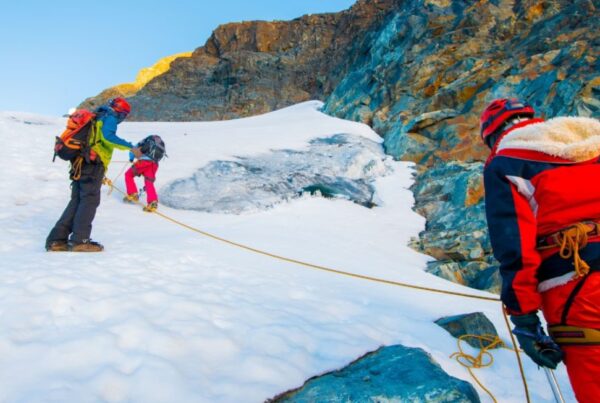
The first technical section begins almost immediately above Elena Hut, as the trail transitions from rock to the lower margin of the glacier. Here, crampons go on and the rope team is assembled. Our guides lead trekkers through a systematic crampon fitting and safety briefing at this point, confirming that every member of the team is correctly equipped and understands rope team protocols before the first steps onto ice. This process is not a formality. It is a genuine safety procedure, and guides will hold the team at this point if conditions, visibility, ice stability, or a team member’s physical state are not satisfactory for safe progression.
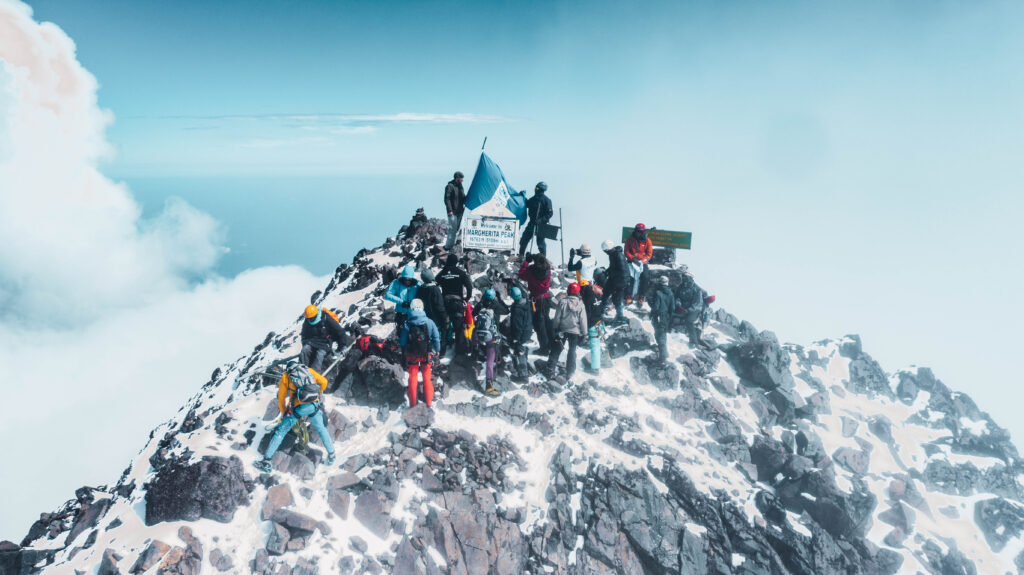
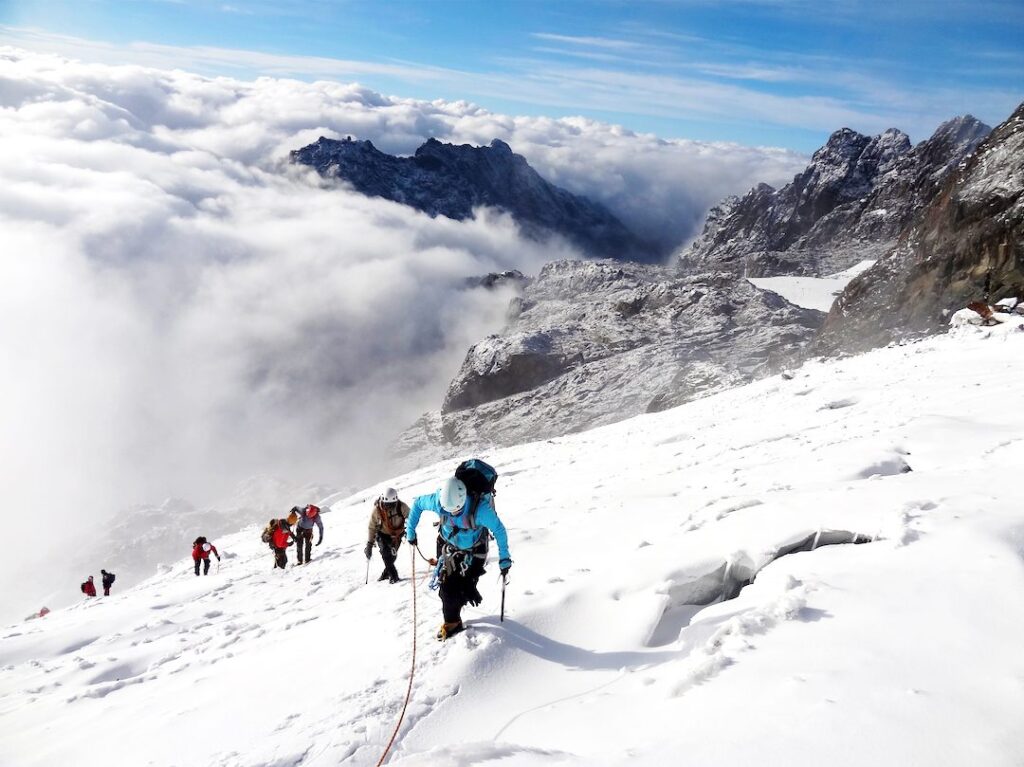
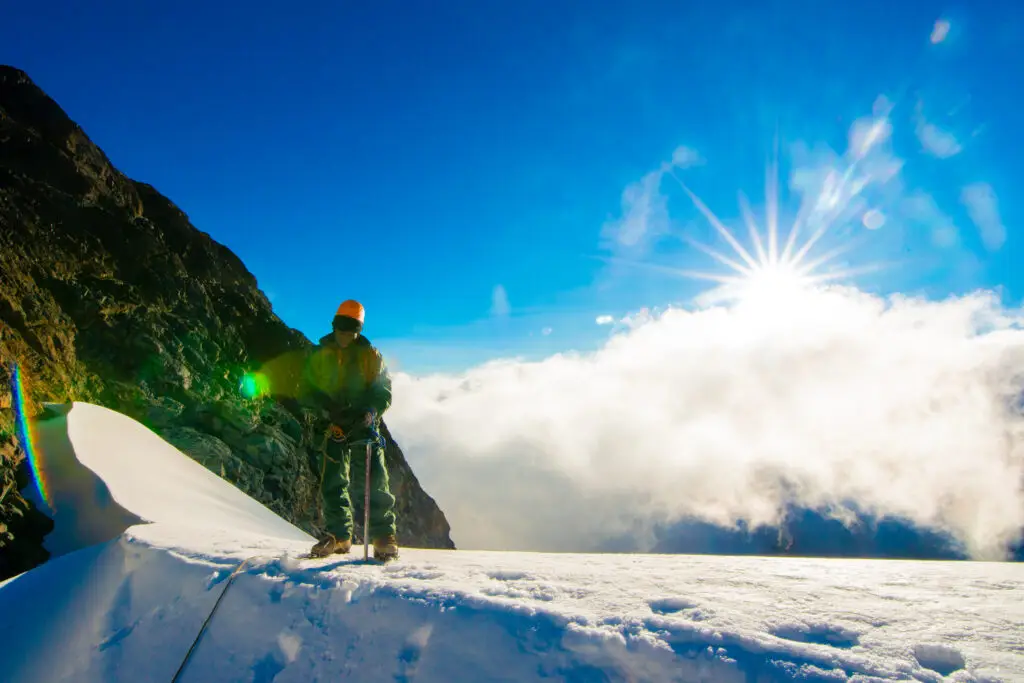
The glacier crossing section involves moving across the Stanley Plateau at an average gradient of approximately 25 to 35 degrees, with some steeper sections. The plateau is genuinely glaciated terrain: there are crevasse zones that vary in extent and visibility with the season, sections of dense blue ice exposed where snow cover has thinned due to glacial retreat, and areas of sun cup snow that require careful crampon technique. The guide leads the rope team on the safest available line, which changes throughout the season as conditions evolve. Trekkers are roped together in a team of three to four, with the guide at the front setting the pace and route.
Stage Four: The Summit Ridge and Final Approach
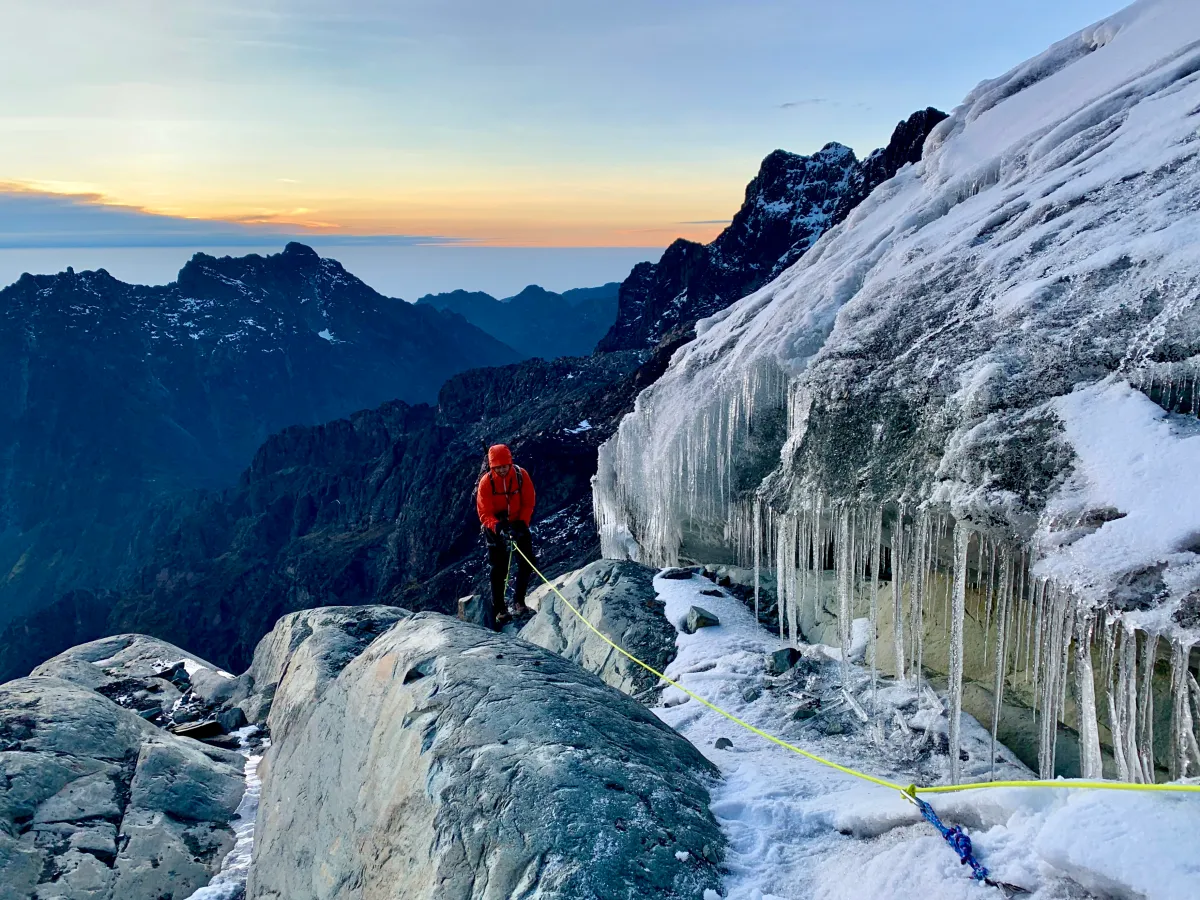
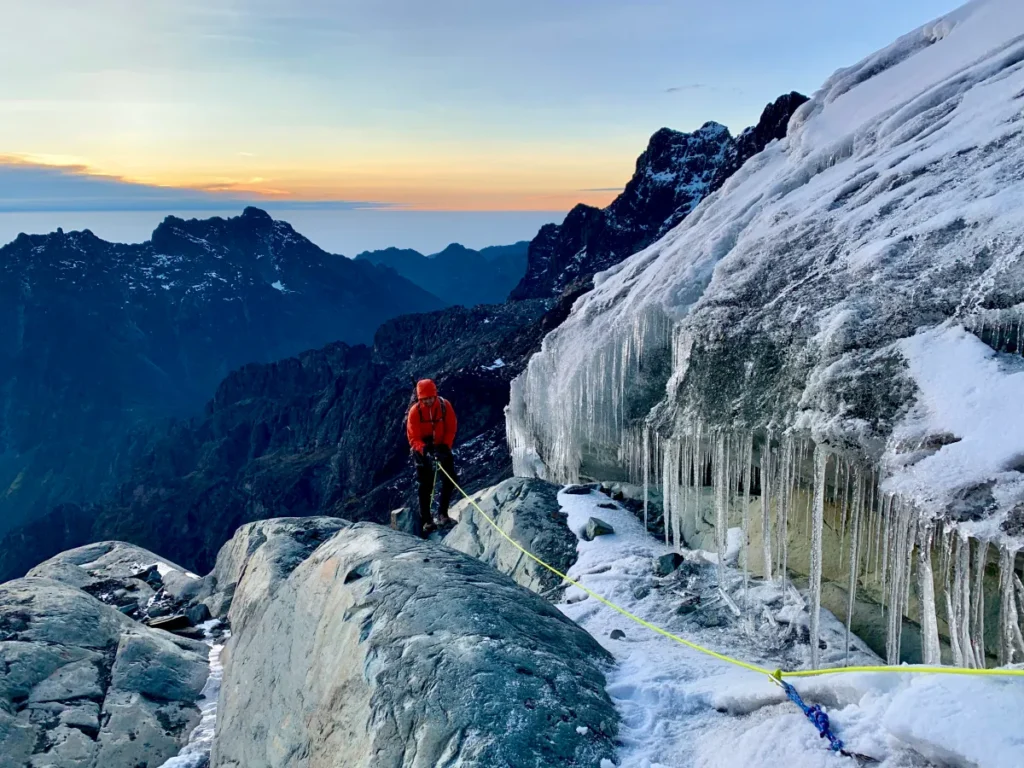
Above the glacier plateau, the route transitions to mixed terrain a combination of snow, ice, and exposed rock on the final approach to the Margherita summit ridge. This section includes the most technically demanding terrain of the climb: sections of steep snow at angles approaching 45 degrees, short sections of rock scrambling that require the use of hands and careful foot placement in crampons, and passages along an exposed ridge where the drop on both sides is significant. Fixed ropes are in place on the most exposed sections, and trekkers clip into these as they move through.
The use of fixed ropes, a fundamental safety system in alpine mountaineering, requires the trekker to manage a jumar or clip system while wearing gloves and crampons on mixed terrain. This is a skill that needs to be demonstrated competently before the summit day, and our guides walk every trekker through the technique on lower-angle terrain before the exposed sections are reached. The anxiety of the exposure, the cold, the altitude, and the accumulated physical effort of the preceding days all converge on this section of the climb, and the mental composure of each trekker matters as much here as their physical fitness.
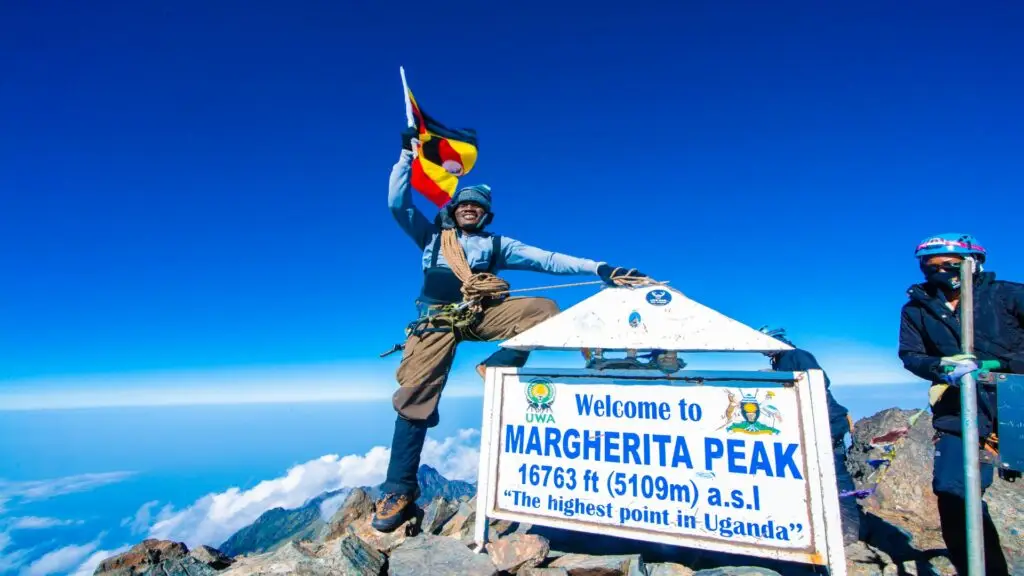
The summit of Margherita Peak is a small, exposed snow and rock platform at 5,109 meters, sitting on the border between Uganda and the Democratic Republic of Congo. On clear mornings, which are rare on the Rwenzori, the view from the summit takes in the entire range below, the plains of western Uganda to the east, and the Congo Basin stretching west into the haze, making them extraordinary. Most trekkers who reach Margherita report that the combination of physical achievement, technical accomplishment, altitude, and the sheer improbability of being on a glaciated summit at the equator produces an emotional response that is difficult to articulate and impossible to forget.
Technical Skills Required: An Honest Assessment
Crampon and Ice Axe Competence
The non-negotiable technical skill for Margherita Peak is a confident crampon technique on moderate-angle snow and ice. This means walking securely in 12-point crampons across a range of snow angles, using the flat-footing technique on lower-angle slopes and the front-pointing technique on steeper sections, and being able to manage the physical coordination of crampon movement without excessive fatigue or hesitation. An ice axe must be carried and used correctly as a balance tool on the ascent and as a self-arrest device in the event of a slip. Trekkers can learn to use crampons, but they must do so before summit day.
Glacier Travel and Crevasse Awareness
Moving as part of a roped team on glaciated terrain is a specific skill that requires understanding of rope management, team spacing, and the basic principles of crevasse zone navigation. Trekkers on our summit itineraries do not need to be expert glacier travelers; the guide leads all route-finding decisions and manages the rope, but they do need to understand and follow instructions regarding rope tension, step timing, and behavior if a team member breaks through a snow bridge. Our guides provide a comprehensive pre-glacier briefing, but prior experience of glacier travel makes this briefing more effective and the crossing itself significantly less stressful.
Fixed Rope and Exposed Terrain Movement
The final summit approaches involve moving on fixed ropes across exposed mixed terrain. The ability to clip and unclip a jumar or carabiner system while wearing gloves, managing an ice axe, and maintaining balance on uneven ground is a specific physical skill that benefits enormously from prior exposure. Trekkers who have previously experienced via ferrata, sport climbing, or any other use of fixed rope systems in an alpine context will find this section significantly more manageable than those who are encountering it for the first time. It is teachable, but the learning curve is steeper than ideal at 5,000 meters.
What You Do Not Need
It is equally important to be clear about what the standard Margherita route does not require. You do not need lead climbing ability or the skill to place protection. You do not need vertical ice climbing technique; the steep sections are short and fixed-roped rather than free climbed. You do not need advanced crevasse rescue skills.

And you do not need prior experience of genuinely serious alpine routes; a PD-grade objective, which refers to a “Peu Difficile” or “a little difficult” climb, is at the accessible end of the technical spectrum, meaning it is suitable for less experienced climbers. The Margherita climb rewards preparation and composure more than it demands elite technical ability, making it suitable for climbers who are physically fit and mentally prepared for the challenges ahead.
Physical Fitness Requirements for the Summit.
Technical skill operates within the context of physical condition, and it is impossible to separate the two on a climb of this magnitude, especially given the demanding nature of the terrain and the extended duration of the summit day, which requires both physical endurance and technical proficiency to navigate safely. The summit day on Margherita is typically eight to twelve hours round-trip from Elena Hut, at altitudes between 4,541 and 5,109 meters, on terrain that includes sustained uphill technical movement. Before this summit day, trekkers will have completed four to six consecutive days of strenuous trekking at progressively higher altitudes. The physical platform required for summit day is not built on that day; it is constructed in the months before departure.
Our recommendation for trekkers targeting Margherita is a minimum of four months of structured physical preparation. This should include weekly long-distance loaded hiking on hilly or mountainous terrain, progressive leg strength training (squats, lunges, step-ups, single-leg work), cardiovascular conditioning, and ideally one or more high-altitude acclimatization experiences above 3,500 meters before arrival on the Rwenzori. Trekkers who arrive physically underprepared for the lower mountain stages arrive at Elena Hut already depleted, and summit Day asks for resources that simply do not exist, leading to increased risk of injury and failure to reach the summit. Fitness preparation is not optional for Margherita Peak. It is the foundation on which everything else stands.
Altitude on Summit Day: What to Expect Above 4,500 Metres
At 4,541 meters, Elena Hut sits above the altitude threshold at which most non-acclimatized people experience significant physiological effects: reduced appetite, disturbed sleep, headaches, and a noticeable reduction in aerobic capacity. By the time trekkers reach Elena on a standard itinerary, they have been acclimatizing for five to seven days, and most have adapted meaningfully to the altitude. But the summit push from Elena to 5,109 meters adds another 568 meters of elevation, and the cumulative physiological burden of that ascent in the cold, on technical terrain, after a 3:00 am start is not trivial.
The most common physical experience reported by trekkers on Margherita summit day is a profound and specific exhaustion: every step above 4,800 meters feels disproportionately effortful, and the temptation to stop is constant. This is normal high-altitude physiology, not a sign of failure. The correct response is to slow down and breathe deliberately and rhythmically, with conscious attention to matching pace to respiratory capacity. Our guides set the pace on summit day based on the slowest member of the team, not the fastest. There is no advantage to rushing, and the consequences of arriving at the summit dangerously depleted are significant given the technical descent that follows.
Trekkers who experience moderate acute mountain sickness symptoms, persistent headaches, nausea, loss of coordination, or altered mental status on the approach to the summit will be turned around by our guides, regardless of how close they are. This decision is never taken lightly, and it is always made on the basis of objective safety assessment rather than personal preference. The mountain will be there again.
Current Glacier Conditions and Route Variability
The Rwenzori glaciers are retreating. This is documented scientific fact: the ice fields that covered the upper Rwenzori at the beginning of the twentieth century have shrunk dramatically, and the retreat continues. What this means practically for the Margherita summit route is that the extent and character of the glaciated sections vary from season to season and year to year. In high-snowfall years, the Stanley Plateau presents a substantial snowfield and the classic glacier crossing experience. In years of accelerated melt, the approach involves significantly more bare ice and rock, the crevasse zones shift, and some of the fixed rope sections may be in different positions as guides adapt the route to current conditions.
Our guides assess conditions before every summit departure and brief trekkers on the current route before leaving Elena Hut. The technical demands do not disappear as the glaciers retreat; in many ways, bare glacial ice is more demanding than consolidated snow cover, but the character of the challenge changes. Trekkers should arrive with full technical equipment regardless of what they have read about recent conditions and should be prepared mentally for a route that may differ in detail from accounts written in previous seasons. The mountain is dynamic. Our route management is equally dynamic.
Multi-Peak Rwenzori Expeditions: Technical Difficulty Across the Rwenzori Summits
Margherita Peak is the highest and most celebrated Rwenzori summit, but the range contains five other major massifs: Mount Speke, Mount Baker, Mount Emin, Mount Gessi, and Mount Luigi di Savoia, each with their summit objectives and technical characteristics. Experienced alpinists visiting the Rwenzori sometimes undertake multi-peak expeditions targeting several of these summits across an extended itinerary, which represents one of the most complete high-altitude mountaineering experiences available in Africa.

The technical grades across the Rwenzori summits vary. Vittorio Emanuele Peak on Mount Speke (4,890 m) and Edward Peak on Mount Baker (4,843 m) both involve glacier crossings and require similar technical equipment to Margherita, though at lower altitudes and with generally shorter summit days. The summits of Mounts Emin, Gessi, and Luigi di Savoia are less frequently climbed and involve more route-finding complexity due to lower traffic and less established fixed infrastructure. All of the glaciated summits require crampons, an ice axe, a harness, and a helmet as minimum equipment, and all are managed by our guides on the same rope-team protocols used for Margherita. Explore our full treks overview for more detail on multi-peak expedition options.
Frequently Asked Questions: How Technical Is Margherita Peak?
How technical is the climb to Margherita Peak?
The standard approach to Margherita Peak is graded approximately PD (peu difficile) in the alpine mountaineering scale, a mildly technical route involving glaciated terrain, crampon and ice axe movement on moderate snow slopes up to around 45 degrees, roped glacier crossing on the Stanley Plateau, and fixed rope use on the most exposed summit approaches. It is more technically demanding than any standard Kilimanjaro route and requires genuine mountaineering preparation and equipment. For well-prepared trekkers with prior alpine or glacier experience, the technical demands are manageable; for trekkers with no prior technical experience, targeted skills preparation before arrival is essential.
Do I need prior mountaineering experience to climb Margherita Peak?
Prior experience with crampons on snow or ice terrain is strongly recommended for the Margherita summit route, along with some exposure to roped glacier travel and fixed rope systems. Trekkers with no prior technical experience are not automatically excluded, but they should undertake a preparatory alpine skills course before their Rwenzori trip and discuss their background candidly with us when booking. The multi-day approach also demands solid multi-day high-altitude trekking experience; trekkers arriving at Margherita itineraries without prior high-altitude trekking experience are at a significant disadvantage both physically and in terms of altitude adaptation.
What technical equipment do I need for Margherita Peak?
The main technical gear needed for the Margherita summit route includes 12-point technical crampons that fit semi-rigid or rigid mountaineering boots, a general mountaineering ice axe that is 60–70 cm long for most trekkers, a sit harness for glacier roping and fixed line use, and a lightweight alpine climbing helmet for the final summit sections. In addition, trekkers need semi-rigid or rigid mountaineering boots compatible with technical crampons, warm insulated gloves suitable for glacier work, and appropriate thermal and waterproof layering for the cold and wet conditions of the upper mountain. Our team provides a full pre-departure equipment checklist and maintains a rental inventory for trekkers who do not own technical equipment.
How long does summit day on Margherita Peak take?
Summit day from Elena Hut (4,541 m) to Margherita Peak (5,109 m) and back typically takes eight to twelve hours, depending on conditions, team pace, and the extent of the technical sections encountered on the current route. Our guides depart Elena between 3:00 and 4:00 am to maximize the pre-dawn stable conditions on the glacier and to ensure sufficient time for a safe descent before afternoon weather deteriorates. The ascent to the summit typically takes five to seven hours, with the descent requiring three to five hours depending on conditions and the physical state of the team.
What is the success rate for reaching Margherita Peak?
Summit success rates on Margherita Peak are influenced by weather conditions, the trekker’s physical preparation and acclimatization, their prior technical experience, and the quality of their guide support. Trekkers on well-structured itineraries with specialist operators and appropriate prior preparation have a strong success rate significantly better than the typical success rate for summiting Kilimanjaro on short itineraries. The most common reasons for turning back are altitude sickness symptoms, insufficient physical reserves on summit day due to inadequate preparation, and weather conditions that make the technical sections unsafe. We design our team’s detailed pre-departure preparation advice and summit-day assessment protocols to maximize safe summit success.
Is there a risk of falling on the Margherita summit route?
The summit approach involves exposed terrain on which a fall could have serious consequences, which is precisely why technical equipment, roped travel on the glacier, and fixed lines on the most exposed sections are mandatory rather than optional. The primary risk management tools are correct crampons and ice axe technique, maintaining three points of contact on mixed terrain, staying clipped to fixed ropes on exposed sections, and moving at a pace that allows confident, deliberate foot placement at all times. Our guides maintain close supervision of all trekkers through the technical sections and will intervene immediately if a trekker’s movement pattern suggests fatigue or loss of control.
What are the fixed ropes on Margherita Peak like?
Fixed ropes are installed and maintained on the most exposed sections of the upper Margherita approach, primarily the steeper mixed snow and rock sections leading to the summit ridge. Our guide team inspects and updates these ropes before each trekking season and after significant weather events. Trekkers clip into the fixed ropes using a carabiner and short sling or a jumar device, providing a continuous safety backup while moving through the most exposed terrain. The fixed rope infrastructure on the Rwenzori is less extensive than on high-traffic alpine routes in Europe, but it covers the sections where the consequences of a fall are most serious, making it essential for climbers to be aware of their climbing skills and experience level before attempting routes like Margherita Peak.
Can I climb Margherita Peak if I have only done Kilimanjaro before?
The Kilimanjaro experience is a genuinely useful preparation for Margherita Peak; it provides altitude acclimatization experience, multi-day trekking conditioning, and familiarity with African mountain environments that transfers directly. However, Kilimanjaro’s standard routes do not include any technical glaciated terrain, and Kilimanjaro experience alone does not prepare you for the crampon, ice axe, and glacier travel sections of the Margherita route. We recommend that Kilimanjaro veterans targeting Margherita undertake a dedicated alpine skills course before their Rwenzori trip; a single week-long course on glaciated terrain in the Alps, Rockies, or equivalent provides the specific technical foundation that Kilimanjaro experience does not.
How cold is it on summit day at Margherita Peak?
Temperatures on Margherita summit day vary significantly with season and conditions, but trekkers should plan for temperatures between -5°C and -15°C at summit elevation, with wind chill potentially making it feel significantly colder on exposed sections of the ridge. The pre-dawn departure from Elena Hut is typically the coldest period of the day, with temperatures at camp already below freezing. Warm, windproof insulation from a down or synthetic puffer jacket, worn over a thermal mid-layer and base layer, is essential for the summit push, alongside technical layers. The Rwenzori’s characteristic moisture means that wet-cold rather than dry-cold is the dominant experience, and waterproof outer layers are as important as thermal ones.
What happens if conditions are unsafe on summit day?
On summit day, our guides make decisions based on current conditions, such as visibility, wind speed, precipitation, ice stability on the glacier, and the physical condition of each team member. If conditions are assessed as unsafe due to persistent whiteout, high winds on exposed sections, significant new snow loading on the glacier, or a team member presenting altitude sickness symptoms, the summit attempt is postponed or abandoned for that day. Where itinerary flexibility allows, we build in buffer days for exactly this purpose. Trekkers should be mentally prepared for the possibility of a weather-forced turnaround and should choose itineraries with sufficient duration to allow for at least one contingency summit day.
Plan Your Margherita Peak Expedition with the Specialists
Margherita Peak is one of Africa’s outstanding mountain objectives, a summit that combines the richness of the Rwenzori’s extraordinary lower mountain ecology with a genuine high-alpine technical challenge at the top. It is a climb that will test you physically, mentally, and technically and reward you with an experience that places you in a very select group: the relatively small number of people who have stood on the third highest point in Africa, on a glacier at the equator, on the summit of the Mountains of the Moon.
Our team at Rwenzori Trekking Safaris has the deep, specific knowledge that only comes from years of dedicated work on these particular mountains. We know the current glacier conditions. We know which approach lines are best in each season. We know how to prepare trekkers for exactly the technical demands they will face, and we know how to lead them safely through terrain that is unlike anything most people have experienced before. Every decision we make on route, on pace, and on turnaround is rooted in experience built specifically on the Rwenzori, not on mountains elsewhere in the world.
Explore the full details of our Margherita Peak expedition and our complete range of Rwenzori treks to find the itinerary that matches your ambitions and your experience level. And when you are ready to take the next step, we are ready to help you do so.
📩 Contact us via our website contact page or message us directly on WhatsApp. Please share your experience, timeline, and summit ambitions with us, and we will tailor the perfect expedition for you. The Mountains of the Moon are calling. Let us guide you to the top.