This guide provides a detailed overview of the wildlife of the Rwenzori Mountains, encompassing mammals, birds, endemic species, and their conservation status across all elevation zones. The Rwenzori Mountains, often called the Mountains of the Moon, form one of Africa’s most biologically unusual alpine systems. The Rwenzori Mountains rapidly transition from lowland rainforest to icy peaks exceeding 5,100 meters in height, resulting in various ecological zones within a small area, which supports a wide variety of plant and animal life, many of which are unique to this region.
This article synthesizes the most reliable available data on:
-
Verified mammal species of the Rwenzori range, including forest elephants, chimpanzees, montane antelopes, and small mammal endemics
-
Birdlife, including Albertine Rift endemics, Afroalpine specialists, and altitudinal migrants
-
Endemic and near-endemic species, especially small mammals, amphibians, and birds restricted to the Rwenzori–Albertine Rift system
-
Conservation status, threats, and management realities within Rwenzori Mountains National Park (Uganda) and adjacent protected areas
Where uncertainty exists, especially in older species inventories or under-surveyed taxa like bats, rodents, amphibians, and reptiles, this article flags those gaps explicitly rather than filling them with guesses. No numbers or claims are invented. The goal is reliability, not poetry.
For trekkers, this guide explains what wildlife you can realistically expect to see at different elevations and seasons. For researchers and journalists, it consolidates ecological facts into a citation-grade overview with references to authoritative source categories. For expedition planners, it highlights real-world constraints: visibility, human-wildlife conflict risk, biosecurity, and conservation regulations
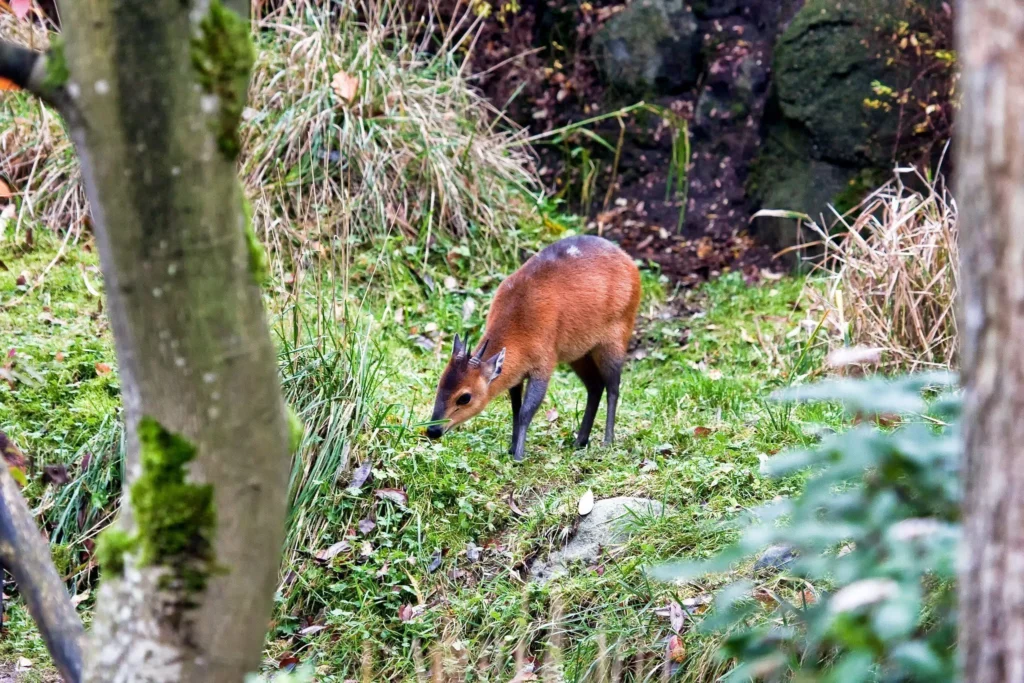
Rwenzori Forest Duiker
About the Rwenzori Mountains
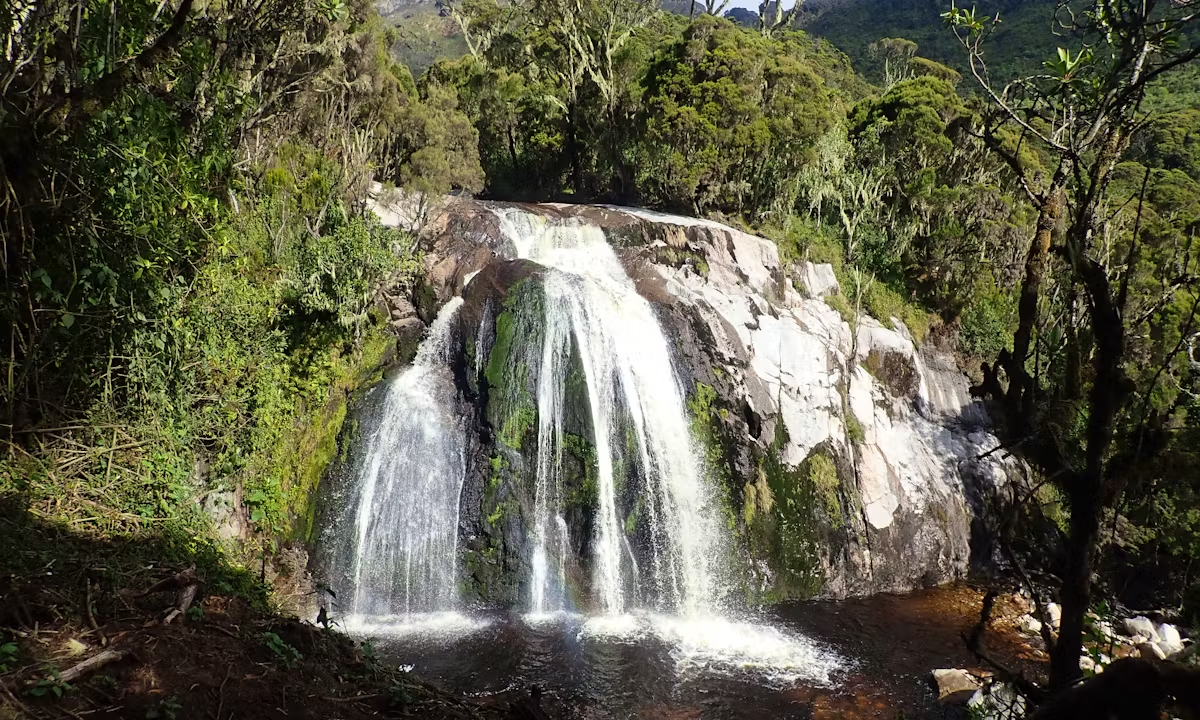
The Rwenzori Mountains form a fault-block range approximately 120 km long along the Uganda–DRC border, rising abruptly from surrounding plains at ~900 m to over 5,100 m at Mount Stanley (Margherita Peak). Unlike volcanic ranges such as Kilimanjaro or the Virungas, the Rwenzori are composed primarily of ancient metamorphic rock uplifted by tectonic activity within the Albertine Rift branch of the East African Rift system.
The Ugandan portion is protected as Rwenzori Mountains National Park (RMNP), a UNESCO World Heritage Site, while the Congolese slopes fall under Virunga National Park and adjacent reserves. Wildlife distributions ignore political boundaries, but management regimes differ.
The Rwenzori Mountains have one of the most unusual alpine ecosystems on Earth, biologically closer to Andean páramo or New Guinea montane systems than to most African mountains.
Mammals of the Rwenzori Mountains
The mammal population in the Rwenzori Mountains is lower than in lowland rainforests or savanna parks but ecologically distinctive. The fauna is dominated by:
-
Forest-adapted megafauna (forest elephants, buffalo)
-
Montane primates (Black & White colobus Monkeys)
-
Small-bodied endemics (rodents, shrews)
-
Cryptic forest carnivores
Systematic mammal surveys in the Rwenzori remain incomplete, especially for bats, rodents, and insectivores. Verified large and medium mammals are better documented, but population densities are difficult to estimate due to forested terrain and historical conflict impacts.
African Forest Elephant
Status: Present, low density
IUCN Status: Critically Endangered (forest elephant)
Elephants inhabit the lower and mid-elevation forests of the Rwenzori Mountains, particularly on the Congolese slopes and in less disturbed Ugandan valleys. The taxonomy of elephants in this region is unresolved: genetic evidence suggests that forest elephants (L. cyclotis) dominate closed-canopy habitats, but hybridization with savanna forms likely occurs. The forest elephants (L. cyclotis) dominate closed-canopy habitats, although hybridization with savanna forms likely occurs.
African Buffalo.
Status: Present, low density
IUCN Status: Near Threatened
Forest and montane buffalo occur in lower-altitude Rwenzori zones. Groups are typically small and secretive compared to savanna herds.
Risk note for trekkers: Buffalo in forested terrain are among Africa’s most dangerous mammals due to poor visibility and unpredictable charging behavior. Encounters are so rare on established trails but possible in lower zones; that’s the reason you are guided by 2 guides and a UWA ranger-armed guide.
Bushbuck
Status: Common in forest margins
Bushbuck are the most frequently encountered medium-to-large antelope in the Rwenzori foothills and forest edges. Taxonomy in East Africa is complex, with several cryptic species likely present.
Chimpanzee
Status: Present, localized
IUCN Status: Endangered
Chimpanzees inhabit lower montane and submontane forests, especially in areas contiguous with larger forest blocks outside the park. Trekkers rarely encounter them due to the steep terrain and avoidance behavior.
Rwenzori chimpanzees are part of the Eastern Chimpanzee subspecies, not the more widely publicized populations of Kibale or Budongo forests. No habituated trekking programs exist inside the Rwenzori Mountans.
Black-and-White Colobus
Status: Common in montane forest
Colobus monkeys are the most conspicuous primates in mid-elevation forests. Early morning trekking stages often feature the loud territorial calls of these monkeys.
L’Hoest’s Monkey.
Status: Present
IUCN Status: Vulnerable

A forest-dwelling guenon restricted largely to the Albertine Rift and adjacent highlands. They are often terrestrial, shy, and difficult to observe.
Blue Monkey
Status: Present
The species is commonly found in the canopies of montane forests. Alarm calls, rather than sightings, often detect the species.
African Giant Forest Hog
Status: Present, rare
Occurs in lower forest zones and bamboo belts. Extremely elusive; sightings are rare.
Leopard.
Status: Present, very low density
IUCN Status: Vulnerable
Leopards persist in very low numbers across the Rwenzori ecosystem, primarily in lower montane forests. They are nocturnal, cryptic, and rarely seen. Presence is inferred mainly through spoor, camera traps, and livestock depredation reports near park boundaries.
African Golden Cat
Status: Likely present
IUCN Status: Vulnerable
The African golden cat is a forest specialist endemic to equatorial Africa. It has been confirmed in Albertine Rift forests and likely occurs in Rwenzori montane forests, though verified records specific to RMNP are limited.
Civets and Genets
Likely species include:
-
African Civet
-
Large-spotted Genet
-
African Palm Civet
These nocturnal carnivores occupy lower to mid-elevation forests and forest edges.
Bats
The Rwenzori host a diverse bat assemblage, including fruit bats (Pteropodidae) and insectivorous families (Vespertilionidae, Molossidae, Hipposideridae). However, montane bat diversity remains poorly documented due to the logistical constraints of mistnetting and acoustic surveys in steep terrain.
Birds of the Rwenzori Mountains
The Rwenzori Mountains are home to over 200 different bird species, including many that are unique to the Albertine Rift, as well as birds that thrive in mountain forests and cold, high-altitude areas.
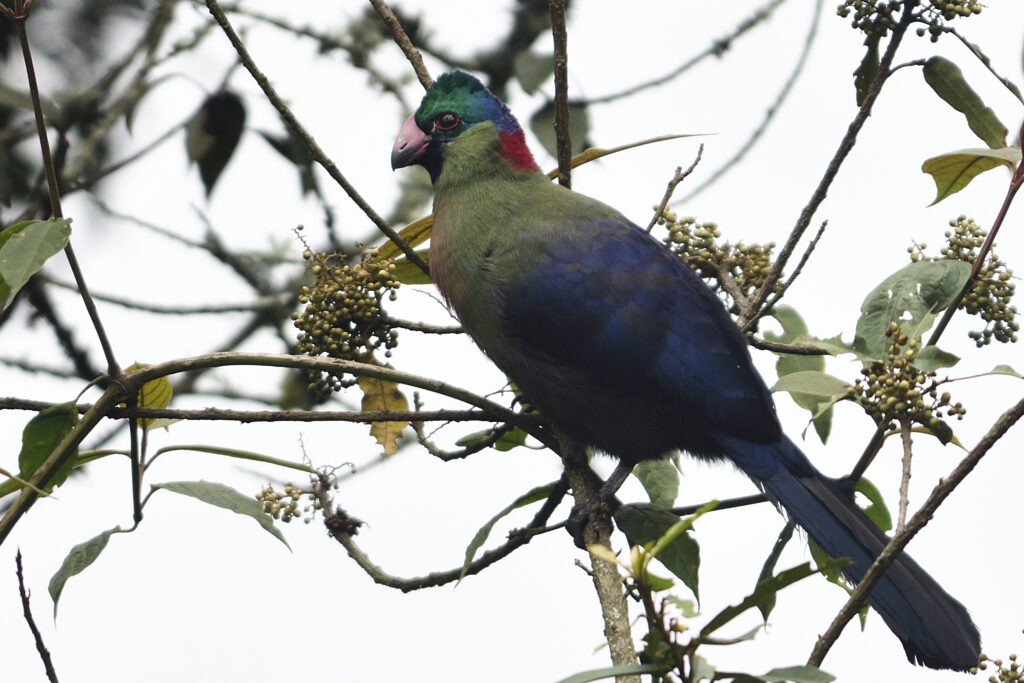
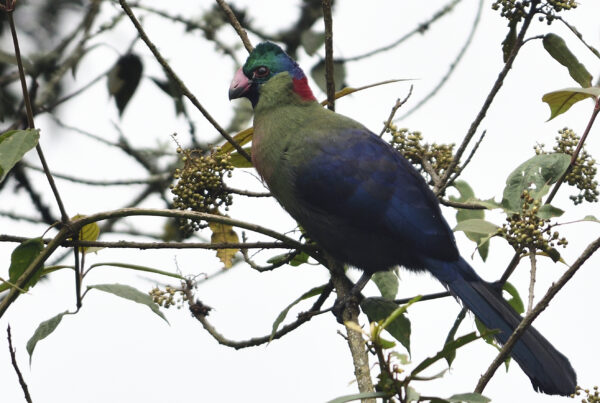
Rwenzori Turaco.
Birds are the most visible vertebrate fauna for trekkers, especially between 1,800 and 3,200 m, where forest structure supports high canopy and understory complexity.
Ornithological surveys in the Rwenzori are comparatively robust relative to mammal studies, though remote valleys remain under-sampled.
Albertine Rift Endemics and Near-Endemics
The Albertine Rift is one of Africa’s most important Endemic Bird Areas (EBAs). The Rwenzori Mountains host several species largely restricted to this region.
- Rwenzori Turaco
- Handsome Francolin
- Strange Weaver
- Rockefeller’s Sunbird
- Archer’s Robin-Chat
- Grauer’s Broadbill
Afroalpine Specialists
Above ~3,800 m, bird diversity drops sharply, but a few species are adapted to cold, wind, and low oxygen.
- Rwenzori Batis.
- Scarlet-tufted Malachite Sunbird
- Alpine Chat
Montane Forest and Bamboo Zone Assemblages
Representative species include:
-
Dusky Crimsonwing
-
Yellow-eyed Black Flycatcher
-
Cinnamon-chested Bee-eater
-
White-starred Robin
-
Mountain Yellow Warbler
These species form the ecological backbone of Rwenzori bird communities between ~1,800–3,200 m.
Reptiles, Amphibians, and Invertebrates.
Amphibians
The Albertine Rift is a key area for unique amphibians, and the Rwenzori Mountains play an important role, especially for mountain forest frogs in groups like Phrynobatrachus, Lept
Several species are either:
-
Rwenzori endemics
-
Shared only with nearby Virunga and Itombwe highlands
Precise species lists vary by taxonomic authority due to ongoing revisions and cryptic species complexes.
Reptiles
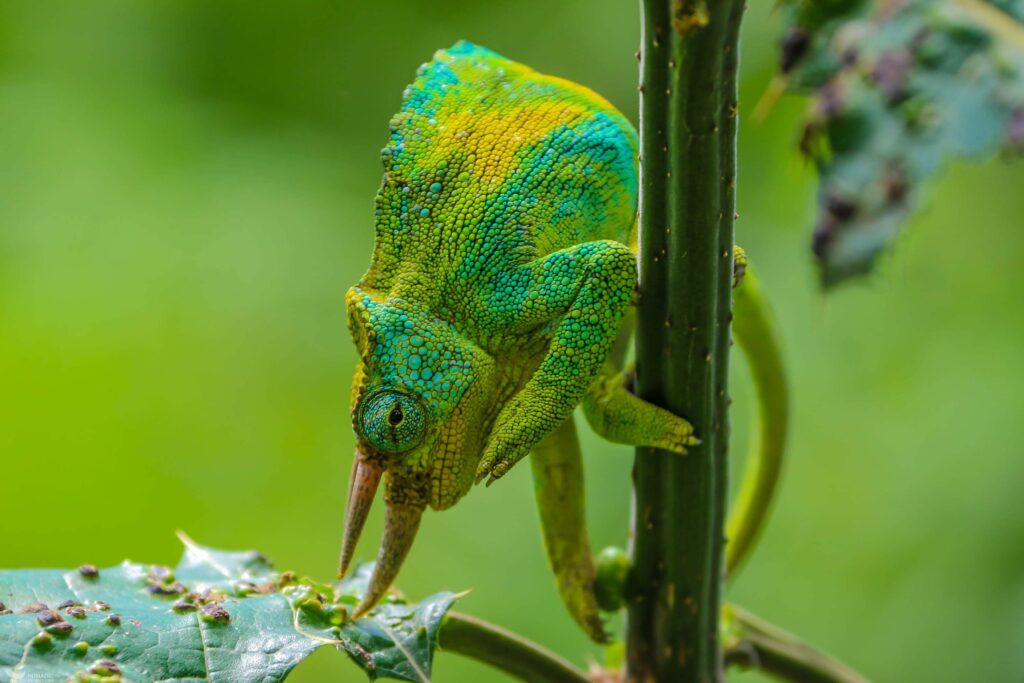
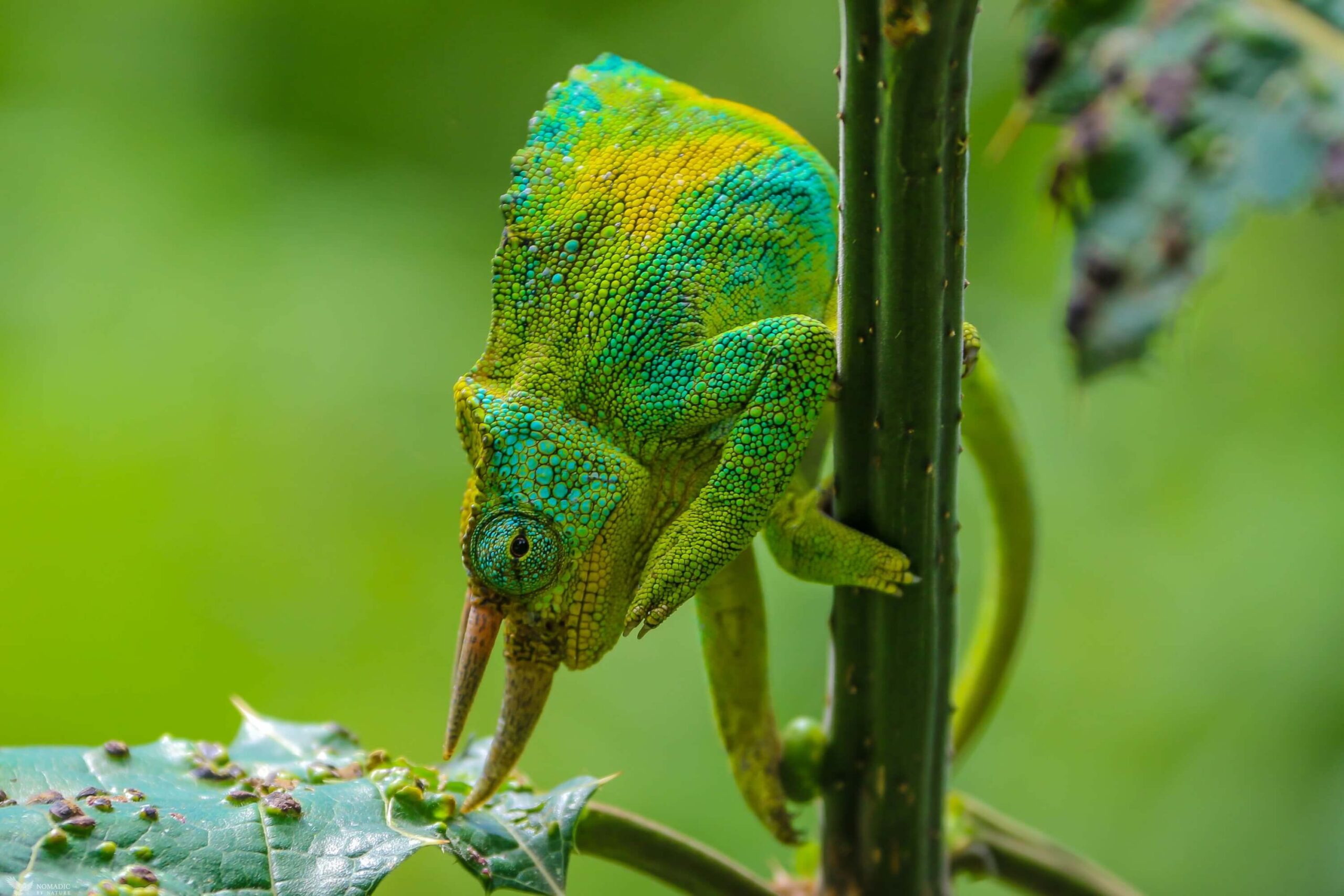
Reptile diversity is moderate and poorly surveyed at higher elevations. Forest snakes, skinks, and chameleons dominate lower montane zones. High Afroalpine zones support almost no reptilian fauna due to cold temperatures.
Invertebrates
The Rwenzori Mountains host extremely high invertebrate diversity, including:
-
Montane butterflies (Nymphalidae, Pieridae)
-
Endemic beetles and mollusks
-
Specialized alpine arthropods
Formal inventories are fragmentary, but invertebrate endemism is likely high, particularly among insects and gastropods.