Compare Kilimanjaro, Mount Kenya, and the Rwenzori Mountains by altitude sickness risk, terrain difficulty, vegetation zones, summit success rates, and trekking experience with expert insights to help you choose the right African mountain.
Africa’s three great high mountains, Mount Kilimanjaro (5,895 m), Mount Kenya (5,199 m), and the Rwenzori Mountains (up to 5,109 m), are often lumped together as “bucket-list climbs in Africa.” That grouping is convenient but misleading.
These mountains stress the human body in fundamentally different ways. They differ not just in height but also in altitude physiology, terrain complexity, ecosystem structure, weather behavior, technical demands, and summit success probabilities. Choosing between them is not a question of which is “better,” but which matches your body, goals, risk tolerance, and concept of adventure.
This article breaks them down across five decision-critical dimensions:
-
Altitude sickness risk and acclimatization dynamics
-
Vegetation zones and ecological transitions
-
Terrain difficulty and technical requirements
-
Summit success rates and real-world failure modes
-
Overall experience profile, who each mountain is actually for
By the end, you will not only understand how these mountains differ, but you’ll also know which one you should climb and why.

Mount Kilimanjaro Views from Kenya
1. Altitude and Altitude Sickness Risk: Height Matters Less Than Ascent Speed
Key elevations
-
Mount Kilimanjaro: 5,895 meters (19,341 ft)
-
Mount Kenya: 5,199 meters (17,057 ft)
-
Rwenzori Mountains (Margherita Peak): 5,109 meters (16,762 ft)
On paper, Kilimanjaro towers over the others. In the body, however, what matters more than maximum altitude is how fast you ascend and where you sleep because sleeping altitude determines oxygen saturation recovery, and recovery determines whether acclimatization succeeds or fails.
Why does Kilimanjaro cause more altitude sickness than Mount Kenya or Rwenzori?
Kilimanjaro’s trekking routes compress nearly 6 vertical kilometers into as little as 5 to 7 days, with large daily jumps in sleeping elevation. Many itineraries push trekkers from ~3,000 m to over 4,500 m in just two days. This climbing pattern makes it hard for the body to adjust, especially in how we breathe and produce red blood cells, especially when you compare it to the Rwenzori Mountains, which have both climbs and descents One night you sleep at an Altitude of 4000 m and the next day you are at 3,500 m.
As a result, Kilimanjaro consistently reports the highest incidence of acute mountain sickness (AMS) among Africa’s high mountains, despite not being technically difficult. Symptoms range from headaches and nausea to exhaustion and summit-night collapse.
Mount Kenya, by contrast, typically involves lower sleeping altitudes and more gradual elevation gain, especially on trekking routes to Point Lenana. The Rwenzori Mountains, despite being wet, cold, and physically brutal, generally allow slower ascents over longer itineraries, reducing acute hypoxic stress.
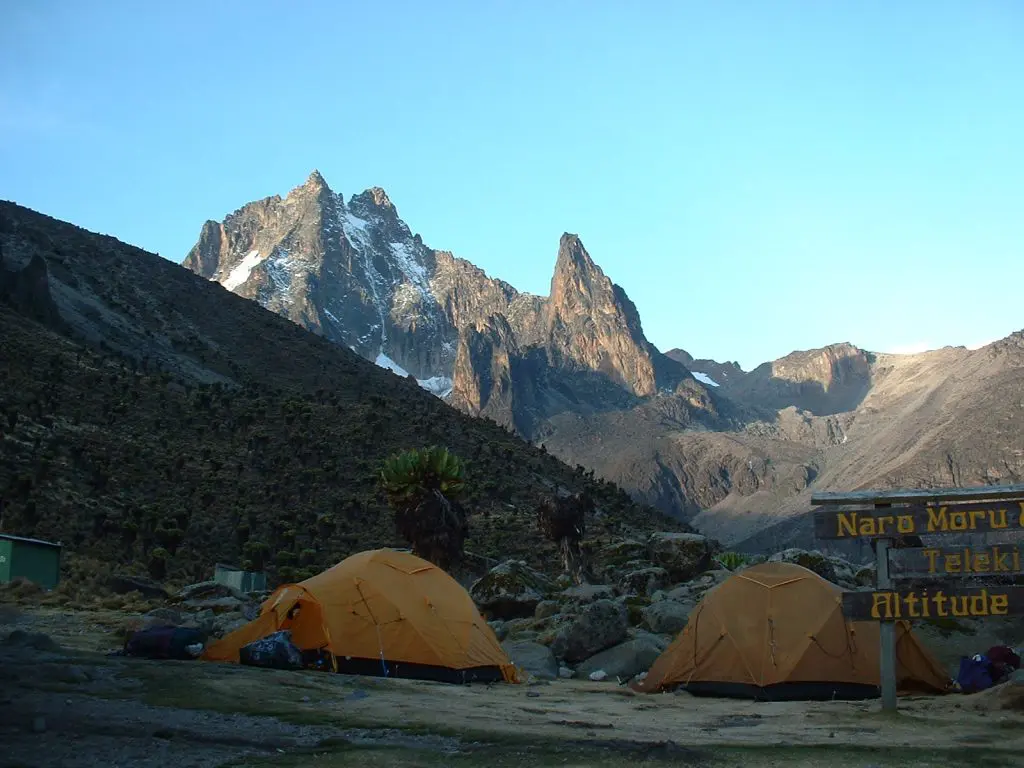
Point Lenana, Mount Kenya
Practical altitude risk comparison
Kilimanjaro is physiologically harder than both Mount Kenya and the Rwenzori Mountains, not because it’s higher, but because it forces the body to adapt too quickly.
2. Vegetation Zones and Ecosystems: Three Completely Different Biomes
All three mountains cross multiple ecological zones, but the structure, density, moisture regime, and biodiversity of those zones differ radically, and that affects not just scenery but also walking conditions, weather exposure, and fatigue.
Mount Kilimanjaro: Vertical climate bands on a dry volcanic cone
Kilimanjaro rises from cultivated farmland through montane forest, heath, alpine desert, and finally glaciated summit zones. The transitions are clean and vertical, but the upper mountain becomes increasingly arid, dusty, and barren.
Once above the heath zone, trekkers move through wide expanses of volcanic scree and cold desert. The experience is stark and expansive but visually monotonous compared to Kenya or Rwenzori.
Mount Kenya: Rugged alpine ecosystems with dramatic geology
Mount Kenya’s vegetation zones are more compressed but more topographically complex, shaped by deep valleys, volcanic spires, and steep ridgelines. Giant groundsels and lobelias dominate the Afro-alpine zone, while forests and bamboo belts are thick and biologically rich.
Because of Mount Kenya’s sharper relief, trekkers encounter dramatic scenery earlier in the climb, with cliffs, tarns, and rocky amphitheaters forming a distinctly alpine atmosphere long before summit day.
Rwenzori Mountains: One of Earth’s strangest high-altitude ecosystems
The Rwenzori Mountains, often called the “Mountains of the Moon,” contain perhaps the most alien alpine environment on the planet. Unlike Kilimanjaro’s dryness or Kenya’s crisp alpine air, Rwenzori is permanently wet.
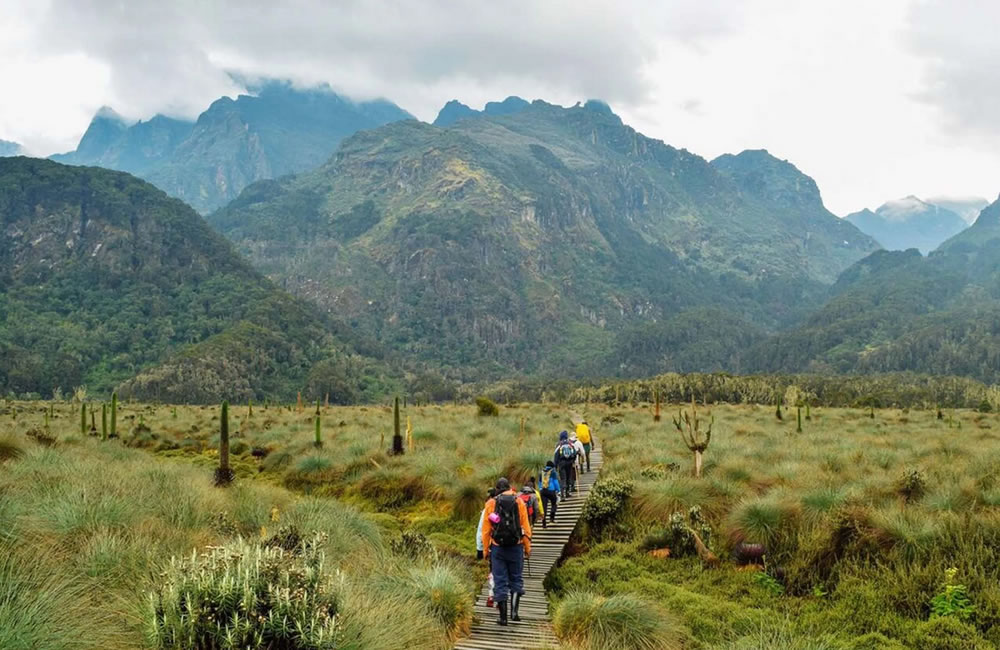
Rwenzori Wooden BoardWalks
Here, trekkers move through:
-
Moss-draped montane forests
-
Saturated bamboo zones
-
Giant lobelia and heather forests
-
Floating bogs and glacier-fed valleys
Instead of dry trails, you cross mud channels, wooden boardwalks, flooded valleys, and peat bogs at 4,000 meters. The result is not just scenic beauty but biomechanical strain: every step costs more energy.
Ecosystem experience comparison
Kilimanjaro feels planetary and vast.
Mount Kenya feels alpine and sculpted.
Rwenzori feels prehistoric, like walking inside a cloud forest that forgot it was at 4,000 meters.
3. Terrain Difficulty and Technical Demands: Three Different Kinds of “Hard”
“Difficulty” is often treated as a single variable. In reality, it decomposes into at least four dimensions:
-
Technical movement (hands, ropes, ice, exposure)
-
Terrain complexity (trail quality, obstacles, route-finding)
-
Environmental hostility (weather, cold, wetness, isolation)
-
Physiological strain (altitude stress, endurance load)
Each mountain loads these variables differently.
Mount Kilimanjaro: Physiologically difficult yet, technically easy
Kilimanjaro requires no technical climbing on standard routes. Trails are wide, navigation is straightforward, and weather windows are predictable. However, the altitude gradient is brutal, particularly on summit night, when trekkers attempt a 1,200–1,300 meter vertical ascent after sleeping above 4,500 meters.
Most failures on Kilimanjaro are not due to terrain but to hypoxia-induced exhaustion, nausea, headaches, or inability to maintain pace.
Mount Kenya: Technically moderate, physiologically moderate
Trekking routes to Point Lenana involve scrambling and steep sections but remain non-technical. However, climbing Batian or Nelion (the true summits) requires rock climbing skills, rope systems, and alpine competence.

Even on trekking routes, Mount Kenya demands better footwork, balance, and cold tolerance than Kilimanjaro but without Kilimanjaro’s extreme hypoxic stress.
Rwenzori Mountains: Environmentally and biomechanically extreme
Rwenzori rarely requires advanced technical climbing (except on glaciers and summit peaks like Margherita), but it is the most physically and psychologically demanding of the three.
Trails are muddy, submerged, or nonexistent. River crossings are frequent. The weather is wet, cold, and persistent. Loads feel heavier because every step sinks or slides. Days are long. Progress is slow. Dry gear is a luxury.
Failures on Rwenzori are usually due to:
-
Exhaustion
-
Hypothermia
-
Trail impassability after storms
-
Flooded valleys
-
Glacier conditions
This is not due to altitude sickness but rather to exhaustion.
Kilimanjaro challenges oxygen delivery.
Mount Kenya challenges movement skills.
Rwenzori challenges endurance, resilience, and morale.
4. Summit Success Rates: What Actually Happens in the Field
Summit success rates matter because they expose failure modes, the real reasons people turn back, and reveal how forgiving or unforgiving each mountain is.
Kilimanjaro summit success
-
Typical success rate: ~60–85%, depending on route and itinerary length
-
Primary failure cause: Acute mountain sickness and exhaustion
-
Strongest predictor of success: Number of acclimatization days
Short routes (5 days) see dramatically lower success rates than 7–8 day itineraries, even among fit trekkers. Fitness does not compensate for hypoxia.
Mount Kenya summit success
-
Point Lenana (trekking peak): 90%+ on standard routes
-
Batian & Nelion (technical peaks): Much lower, depending on climbing skill and weather
-
Primary failure cause: Weather or technical limits, not altitude
Mount Kenya’s lower summit altitude and more forgiving ascent profile produce high success rates for trekkers, though true summit climbs remain serious alpine objectives.
Rwenzori Mountains summit success
-
Margherita Peak (highest point): ~50–70%, highly weather-dependent
-
Primary failure causes: Terrain impassability, glacier conditions, exhaustion, storms
Rwenzori failures are usually gradual. Instead, teams slowly bleed time, energy, and morale until turning around becomes inevitable, often within sight of the summit.
Kilimanjaro failures are physiological.
Mount Kenya failures are technical.
Rwenzori failures are environmental.
5. Overall Experience: Which Mountain Is Actually Right for You?
These three mountains do not deliver the same psychological reward, even when summits are reached.
Choose Mount Kilimanjaro if:
-
You want to stand on Africa’s highest point
-
You prefer non-technical hiking
-
You have limited time
-
You want a structured, predictable experience
-
You tolerate altitude well or are willing to invest in longer itineraries
Kilimanjaro is best described as a high-altitude endurance test with a global recognition payoff.
Choose Mount Kenya if:
-
You want alpine scenery without extreme altitude stress
-
You enjoy scrambling, ridges, and rugged landscapes
-
You’re considering stepping into technical mountaineering later
-
You value geological drama over summit statistics
Mount Kenya is a mountaineer’s mountain, not a tourism mountain.
Choose the Rwenzori Mountains if:
-
You want true expedition-style trekking
-
You value wilderness, isolation, and ecological strangeness
-
You tolerate cold, wet, slow progress
-
You prioritize experience depth over summit bragging rights
Rwenzori is not a mountain climb. It’s a multi-day immersion into Earth’s most bizarre alpine biome with glaciers at the end.
Kilimanjaro is the tallest and most famous mountain, but it is also the most physically taxing.
Mount Kenya offers the most balanced alpine experience technical enough to feel real, but forgiving enough to succeed.
The Rwenzori Mountains are the hardest overall, not because of altitude or climbing difficulty, but because they grind you down slowly through terrain, weather, and fatigue, demanding resilience more than strength.
In simple terms:
-
Kilimanjaro tests oxygen delivery
-
Mount Kenya tests movement skill
-
Rwenzori tests human stubbornness
The mountain that suits you best is not the highest; it’s the one that matches your body, your psychology, and your definition of adventure.