Portal Peaks: Guide to the Three Gateway Peaks of the Rwenzori
Discover the Rwenzori Portal Peaks: Kinyangoma, Kalonge & Kalinda. Altitudes, hiking routes, why they’re called gateway peaks, and how to plan your trek.
The Portal Peaks occupy a unique position in Rwenzori Mountains geography and mythology. They are not the highest summits in the range; that distinction belongs to Margherita Peak on Mount Stanley, which stands at 5,109 metres and lies deep in the interior of the massif, invisible from the plains and accessible only after days of trekking. The Portal Peaks are the Rwenzori’s public face, the peaks that the outside world sees first and the summits whose silhouette has graced travellers’ accounts and explorers’ drawings since the nineteenth century. They are the gateway to one of Africa’s most extraordinary mountainscapes.
The Mountains That Watch Over the Plains
Stand in Kasese town on a rare, clear morning when the overnight rains have scrubbed the equatorial air and the haze has not yet gathered above the Rwenzori foothills. Look west. There, rising above the banana plantations and the red laterite roads, three rocky spires pierce the skyline in a row, unmistakably separate from the main cloud-wrapped massif behind them. They appear to frame something. They appear to invite you. They appear to guard something larger and older and more complex than anything visible from the roadside. These are the Portal Peaks of the Rwenzori Mountains: Kinyangoma, Kalonge, and Kalinda. For generations, travellers, explorers, and mountaineers have seen them as the first proof that the Mountains of the Moon are real.
This guide is written for the serious trekker who wants to understand these peaks fully, not just as photogenic foregrounds to a wider Rwenzori adventure, but as worthwhile summits in their own right, with their own histories, approaches, and rewards. By the end, you’ll know what Kinyangoma, Kalonge, and Kalinda are, where they are in relation to each other and the larger mountain, why they’re called Portal Peaks, and how to reach them. We will also point you, clearly and honestly, toward the itineraries and routes that make the portal peaks accessible to fit, determined trekkers without technical mountaineering experience.
What Are the Portal Peaks? Geography, Names, and Position
The Portal Peaks form a distinct subgroup at the northeastern extremity of the Rwenzori massif, positioned closer to the Uganda lowlands than any of the other major summits in the range. This proximity to the plains is precisely why they are so dramatically visible from below and precisely why they came to be called ‘portal peaks’ in the first place. Geographically, they function as an outlying buttress or advance guard of the main mountain, separated from the central high peaks by a complex system of ridges, valleys, and the upper reaches of the Mubuku River drainage.
Their position northeast of the main Rwenzori ridge means that, on clear days, they can be seen not only from Kasese and the surrounding Kasese District lowlands but also from as far as Queen Elizabeth National Park to the east, where their distinctive triple silhouette forms a noticeable feature on the western skyline above the Rwenzori foothills. For wildlife tourists on a launch safari in the Kazinga Channel or travellers driving north from Bwindi, the moment the Portal Peaks appear above the treeline is when the full scale of the Rwenzori range begins to register.
The peaks are known to the Bakonzo people, the indigenous community who have lived alongside the Rwenzori Mountains for centuries and who remain the mountains’ most knowledgeable human custodians, by names that predate any colonial or mountaineering designation. The western summit is Kinyangoma; the lower central peak is Kalonge; and the eastern summit, slightly set back and facing toward the plains, is Kalinda. These names carry the weight of a long-standing Bakonzo relationship with this landscape, and they are the names that your guides from the local community will use when pointing out the summits as you ascend the lower trails.
Portal Peaks Altitudes: How High Are Kinyangoma, Kalonge, and Kalinda?
The Portal Peaks are high mountains by any standard outside the Rwenzori itself, where they inevitably look modest in comparison to the glaciated summits of the inner massif. Kinyangoma, the highest of the three and the most prominent when viewed from the northeast, reaches approximately 4,627 metres above sea level. Kalinda, the eastern summit, is close behind, at approximately 4,518 meters. Kalonge, the middle peak and the most accessible of the three, sits at around 4,020 metres, making it the natural first target for trekkers attempting the portal cluster for the first time.
The summits of Kuhuma (4,134 m) and Rutara (4,050 m) are closely associated with the Portal Peaks complex and are the targets of our dedicated six-day Portal Peaks trekking itinerary. Kuhuma and Rutara are the easiest high points to reach in the portal peak cluster. You can get to them without needing ice axes and crampons, which are necessary for the main Rwenzori summits, and they offer stunning views of the mountain area that most trekkers below Margherita don’t see.
The table below provides a quick-reference summary of the portal peaks and their associated summits, including the most relevant trekking access for each.
Peak Name
Altitude
Bakonzo Name
Difficulty
Trek Access
Kinyangoma
~4,627 m
The Western Portal
Moderate-hard
Central Circuit Trail
Kalonge
~4,020 m
The Middle Portal
Moderate
Central Circuit / Bukurungu
Kalinda
~4,518 m
The Eastern Portal
Moderate-hard
Central Circuit Trail
Kuhuma
4,134 m
Northern Sub-peak
Moderate
6-Day Portal Peaks Trek
Rutara
4,050 m
Southern Sub-peak
Moderate
6-Day Portal Peaks Trek
Altitudes quoted for Kinyangoma, Kalonge, and Kalinda are derived from survey data and established mountaineering literature; minor variations appear in different sources as a function of measurement method and historical survey accuracy in this complex terrain. The figures for Kuhuma and Rutara are those used in current Uganda Wildlife Authority trail documentation and are considered reliable for planning purposes.
Why Are They Called Portal Peaks? The Story Behind the Name
The name Portal Peaks has both a functional and a poetic origin. Functionally, the three summits of Kinyangoma, Kalonge, and Kalinda stand at the threshold of the Rwenzori massif, forming a visual and literal gateway through which travellers have historically approached the mountains from the eastern lowlands. Early European explorers and mountaineers in the late nineteenth and early twentieth centuries passed beneath these peaks, following the routes established by the Bakonzo people, as the first unambiguous sign that they were entering a genuinely extraordinary alpine environment. The peaks marked the portal from the African plains into the alpine world above.
The three summits poetically create a distinctive triple-arched silhouette when viewed from directly below, evoking the idea of a magnificent gateway or arch. When the cloud sits at their level and the main massif is hidden behind them, the effect is of standing before the open doors of something vast and ancient. Nineteenth-century travellers freely described Rwenzori, and the portal peaks inspired some of the most dramatic prose in African exploration literature. Henry Morton Stanley, who named the Mountains of the Moon for the whole world after his 1889 expedition, described the northern peaks of Rwenzori in terms that left no doubt that he saw what subsequent generations would formalise as the Portal Peaks.
“Three bold and prominent peaks rise one above another, forming, as it were, the natural vestibule to the greater mountains beyond.” Early Rwenzori explorer, 1906
The name has since been formalised in the cartography of the Uganda Wildlife Authority and in the standard Rwenzori mountaineering literature, making Portal Peaks a universally recognised designation for this northeastern cluster. Within the national park documentation, the route targeting these peaks is officially registered as the Portal Peaks Trail, a subset of the broader Central Circuit infrastructure. For visitors planning their trip, Portal Peaks and the nearby mountains of Kinyangoma, Kalonge, and Kalinda are the same; they are viewed from the same path and share both their local Bakonzo names and their historical descriptions.
The Geology and Landscape of the Portal Peaks
The Rwenzori Mountains are not volcanic, a fact that surprises many first-time visitors who expect, by analogy with Kilimanjaroor Mount Kenya, a mountain built from lava flows and ash deposits. The Rwenzoris are instead an ancient horst block: a rigid section of Precambrian crystalline basement rocks that was forced upward by tectonic forces associated with the formation of the Western Rift Valley. The Portal Peaks, as part of this uplifted block, consist primarily of Precambrian metamorphic and igneous rocks – quartzites, gneisses, schists, and granites – that are among the oldest surface rocks in East Africa, in some cases more than 500 million years old. This geological character contributes to the portal peaks’ distinctive angular, jagged appearance, with sharp ridges and rocky summit towers that contrast with the more rounded profiles of younger volcanic mountains elsewhere in the region. The geology also explains the mountain’s extraordinary drainage: the Rwenzori’s ancient crystalline rocks create a sponge-like system of peat bogs and moss-saturated soils that retain rainfall and release it slowly into rivers, including the Mubuku, the Bujuku, and eventually the Nile. This hydrological richness is visible even at portal peak elevations, where the heather moorland is saturated and the trail conditions are characteristically wet and boggy – part of the Rwenzori experience that no amount of research quite prepares you for on your first day.
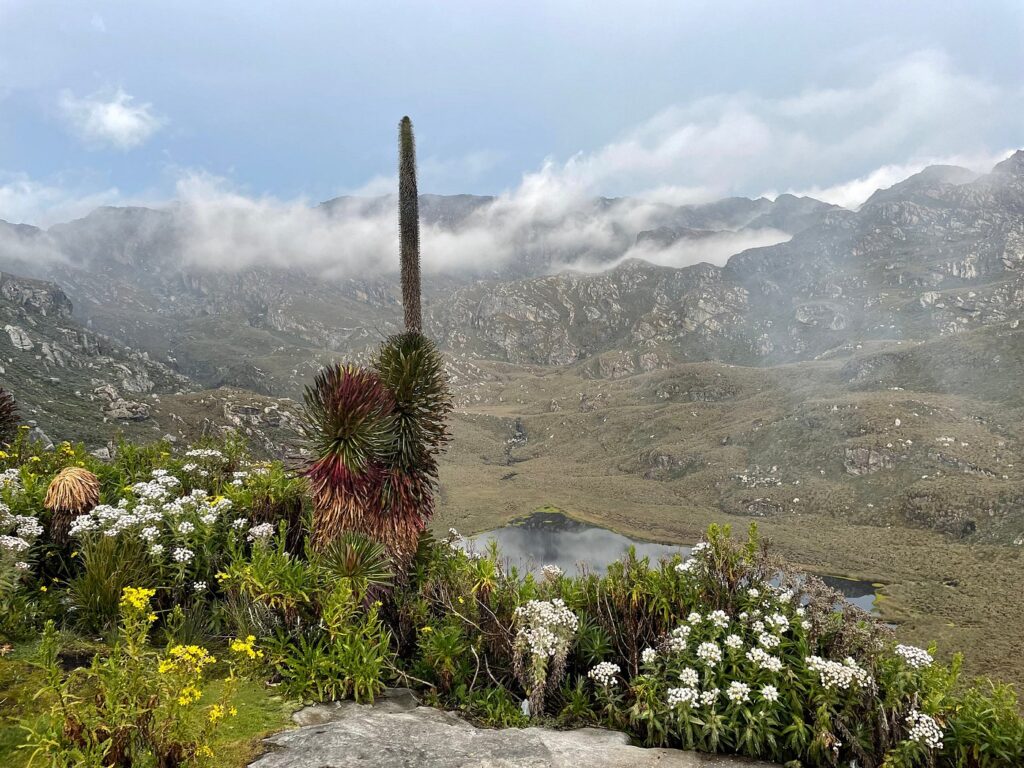
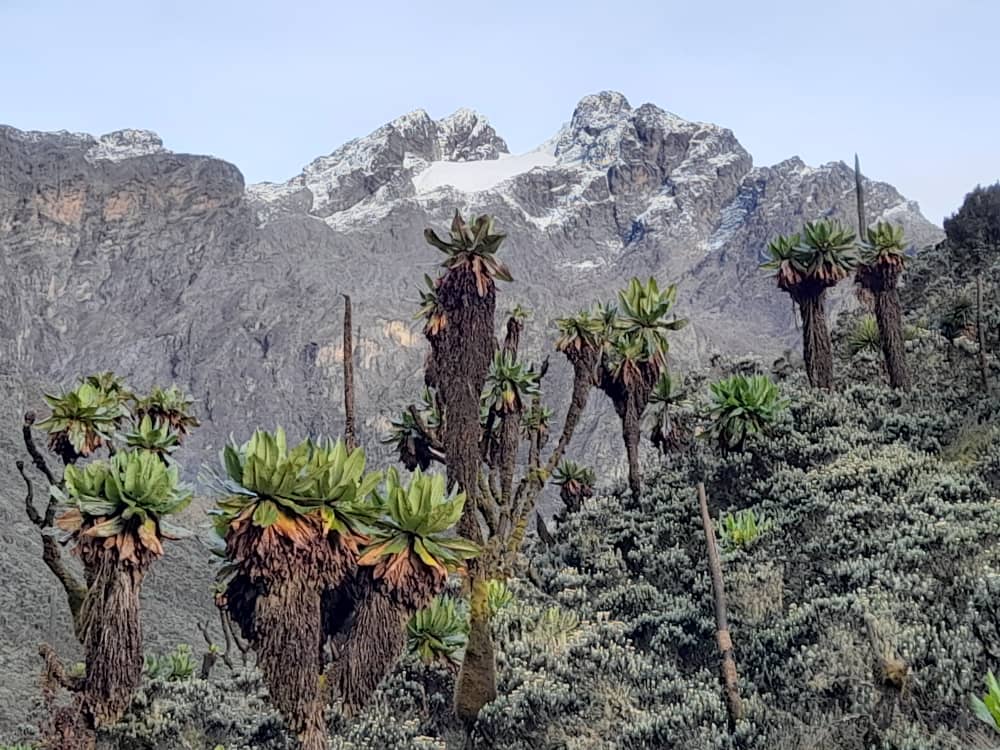
The Portal Peaks also stand at an important ecological boundary. Below them, the lower slopes carry the dense sub-montane rainforest and bamboo zones that define the Rwenzori’s extraordinary biodiversity. Above the Portal Peaks, when the weather is clear, you can see the unique giant heather and giant lobelia areas of the afro-alpine belt before reaching the snowy tops that make the mountain famous as one of Africa’s last snow-covered equatorial ranges. Standing on Kinyangoma or Kalonge, you are positioned precisely at the threshold of this ecological stacking, able to look down into tropical forest and up toward something approaching the alpine world of the Himalayas, all within a single glance.
Can You Actually Hike the Portal Peaks? Access, Difficulty, and What to Expect
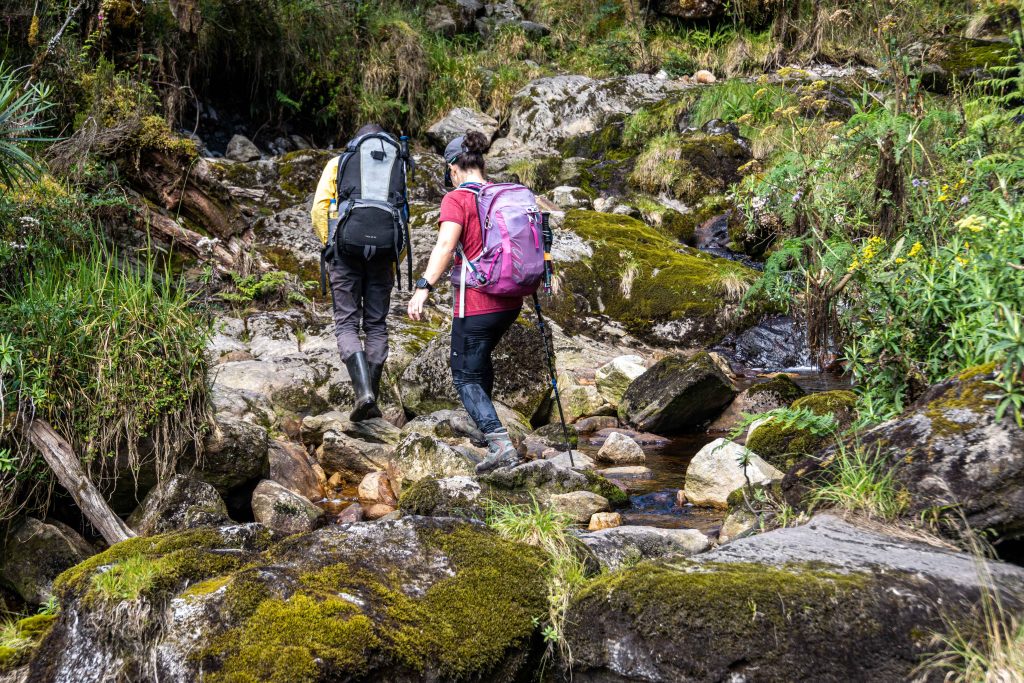
The answer is an unequivocal yes, and this distinction is important to establish clearly because the Portal Peaks are often described in travel writing as purely scenic features rather than as accessible trekking objectives. They are both. The summits of the portal cluster, and specifically Kuhuma Peak and Rutara Peak within that cluster, are reachable by fit, determined hikers without technical mountaineering skills. You do not need crampons, ice axes, or ropes to stand on these summits. You do not need glacier training or altitude acclimatisation protocols that are as demanding as those required for Margherita. You do need good physical fitness, the right footwear (mountain boots or sturdy rubber boots suitable for the Rwenzori’s notorious mud), and a respect for the altitude, the exposure, and the weather.
The final approaches to the higher Portal Peaks, particularly on the routes toward Kinyangoma and Kalinda, involve steep rocky scrambling on terrain that demands balance, confidence on exposed ground, and careful foot placement. These are not technical rock climbs in the mountaineering sense, but they are not casual walks either. Your guides will assess conditions and your group’s abilities on the morning of summit day and advise accordingly. Kalonge and Kuhuma offer more straightforward approaches and are the recommended first objectives for trekkers with limited high-altitude experience.
The Six-Day Portal Peaks Trek: Your Primary Route
The most direct and comprehensively structured approach to the Portal Peaks is our dedicated 6-Day Portal Peaks Trek via the Central Circuit Trail. This itinerary was specifically designed to give trekkers without previous Rwenzori experience a complete and satisfying high-altitude adventure that reaches genuine summit elevations above 4,100 metres without requiring the full technical commitment of a Margherita Peak ascent. It is the ideal gateway trek for first-time Rwenzori visitors and represents exactly what the Portal Peaks were always meant to be: an entrance, a threshold, and a genuinely worthwhile destination in themselves.
The six-day itinerary begins at Nyakalengija, the standard Central Circuit trailhead, at 1,640 metres in the Kasese District foothills and follows a day-by-day progression through the mountain’s vegetation zones. Day one covers approximately eight kilometres of a montane forest trail to Nyabitaba Camp at 2,650 metres, crossing the Kurt Schafer Bridge where the Bujuku and Mubuku rivers converge and entering the mountain’s atmospheric bamboo transition zone. The first morning on the trail is often when visitors encounter the Rwenzori turaco for the first time, that explosion of crimson and green in the forest canopy that announces unambiguously that you have entered something extraordinary.
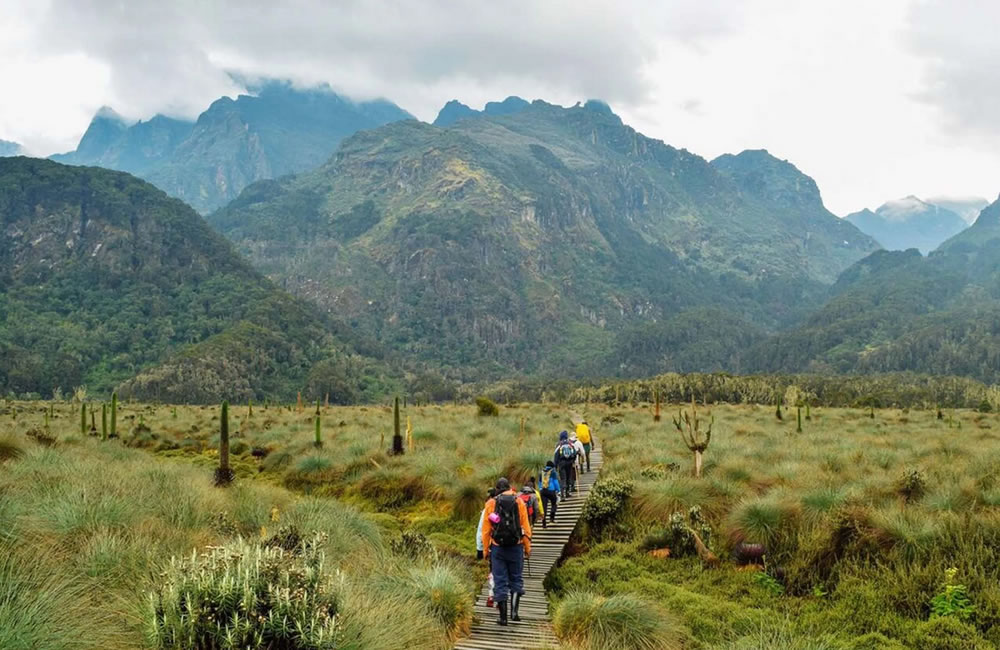
Day two pushes upward through the mountain forest and bamboo zone to John Matte Camp at 3,505 metres eleven kilometres of increasingly dramatic terrain, with views on clear sections toward the majestic peaks of the inner massif and the gradual emergence of the high heather moorland above the treeline. The camp at John Matte is positioned in one of the mountain’s most beautiful locations, above the bamboo and at the edge of the open heather zone, with the Bujuku River running cold and fast below the hut. This area is where the Rwenzori’s characteristic silence, broken only by the river, the wind in the heather, and the distant calls of forest birds below, becomes fully apparent for the first time.
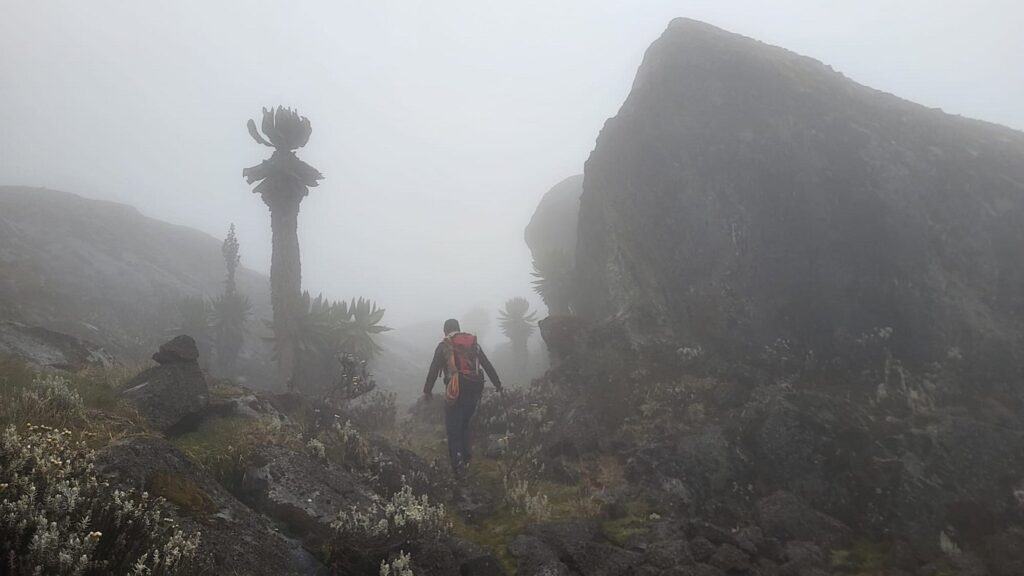
Day three is the approach day to the portal peak complex, ascending from John Matte through the heather and Rupenia zone to Bukurungu Rock Shelter, a natural camping position amid the high moorland that offers what many trekkers regard as the finest overnight campsite in the entire Rwenzori range. The rock shelter is positioned at a high elevation with open exposure to the massif’s interior peaks on clear evenings, and on favourable nights, the views in all directions, from the plains below to the snowfields above, are simply without parallel in the whole of equatorial Africa. The vegetation at this altitude includes the full display of Rwenzori giant heathers and the first of the giant lobelias, creating the otherworldly botanical landscape that has made the mountain famous.
Day four is a summit day. An early departure from Bukurungu, ranging from starlit brilliance to dense pre-dawn cloud, takes you up to the Portal Peaks themselves: Kuhuma at 4,134 metres and Rutara at 4,050 metres, via steep but non-technical rocky terrain. The final push to each summit requires both physical effort and the kind of composed focus that high-altitude trekking demands, but the reward is proportionate to the effort: a 360-degree panorama from above 4,000 metres, with the inner Rwenzori massif spread to the south and west, the Ugandan plains stretching east toward the Rift Valley escarpment, and, on exceptional days, Lake Edward visible in the valley below.
Days five and six are the return journey, retracing the approach route through the mountain’s zones to Nyakalengija. The descent, while physically demanding on the knees in the steeper sections, offers an entirely different experience than the ascent. You are moving faster, the views are reconfiguring around you, and the return through the forest feels like a reimmersion in the mountain’s lower world after the exposed grandeur of the heights.
The Central Circuit as a Portal Peaks Approach
The Portal Peaks are also accessible as a day objective or short diversion within the broader Central Circuit Trail itinerary, making them a natural addition to longer summit expeditions. Trekkers on our 7-day Central Circuit trek pass close to the Portal Peaks complex and can incorporate a visit to the Portal Peaks as a side objective on the approach days before the main summit push toward Margherita. This combination portal, Peaks Plus Margherita Summit, represents one of the most complete Rwenzori experiences available, covering the full range from the northeastern gateway summits to the glaciated high peaks of the main massif. If this is your ambition, speak with us when planning: we can build an itinerary that does justice to both objectives without the time pressure that sometimes forces compromises on standard itineraries.
The Bukurungu Trail: An Alternative Approach
The Bukurungu Trail, the Rwenzori’s wilderness route, established through a 2018 partnership between the Uganda Wildlife Authority and WWF, provides an alternative approach to the Portal Peaks complex from the west, traversing terrain that includes four of the range’s most beautiful alpine lakes: Irene, Mughuli, Bukurungu, and Bujuku. The Bukurungu approach has far fewer hikers than the Central Circuit and provides a truly unique wilderness experience that is more isolated and challenging, rewarding trekkers with a chance to explore untouched terrain. The Bukurungu Trail is one of the best ways to reach the portal peaks of the mountain for those who are fit and crave solitude.
Summit views on the Rwenzori are governed by the mountain’s weather. Clouds build rapidly through the morning hours and frequently obscure the highest peaks by mid-afternoon. But on those mornings when the weather cooperates and you stand above 4,000 metres in clear alpine air, the Portal Peaks offer a visual experience that ranks among the finest in all of equatorial Africa.
To the south and west, the full Rwenzori massif rises in successive layers of ridge, valley, and glaciated summit. Mount Stanley, the range’s highest peak, carrying the Margherita and Alexandra summits under their remnant glacier, is clearly visible as the dominant feature of the skyline on clear days. To its flanks, Mount Speke (4,890 m) and Mount Baker (4,843 m) provide the ridge definition of the main massif’s interior. Further south, on exceptionally clear mornings, Mount Emin, Mount Gessi, and Mount Luigi di Savoia are visible as part of the mountain’s enormous southern arc.
To the north and east, the view is the plains: the broad green lowlands of Kasese District, the blue shimmer of Lake George in the middle distance, and the flat savannah of Queen Elizabeth National Park stretching toward the Rift Valley escarpment. On exceptional days of clarity, Lake Edward is visible to the south. The contrast between this flat expanse and the vertical world you just climbed through is one of the Rwenzori’s defining experiences. You understand, from the summit of a portal peak, exactly why these mountains were described as appearing to rise from nowhere, as if conjured from the plains by the equatorial heat.
Below you to the north and east, the mountain’s forest zones are visible as a dense green carpet falling away toward the lowland farms and the Kasese town streets. On clear mornings, the smoke from cooking fires in the Bakonzo settlements below rises in thin columns against the forest edge. From the portal summits, you can see the entire vertical extent of the world you have walked through over the preceding days, from tropical Africa to something approaching the Himalayas, in a single glance. This compression of zones into a single view is one of the most powerful geographical experiences any mountain on this continent can offer.
The Bakonzo People and Their Relationship with the Portal Peaks
No understanding of the Portal Peaks is complete without understanding the Bakonzo, the indigenous people of the Rwenzori foothills, who have lived in a relationship with these mountains for centuries and who regarded Kinyangoma, Kalonge, and Kalinda not merely as geographical features but as presences with spiritual significance. The Bakonzo called the mountain range ‘Rwenzururu’, from which the modern name ‘Rwenzori’ derives, meaning approximately ‘the place from which rain comes’. The mountains were rainmakers in the Bakonzo worldview: the source of the water that sustained the farms, the forests, and the rivers of the whole surrounding region and, therefore, sacred in a deeply practical as well as spiritual sense.
The portal peaks occupied a particular position in this relationship, serving as the most visible and immediately imposing features of the Rwenzori when viewed from the lowlands. They were the mountains that the lowland communities saw every day—the summits whose cloud caps indicated coming rain and whose clear appearance signalled favourable weather for farming and travel. The names Kinyangoma, Kalonge, and Kalinda each carrying specific meanings in the Bakonzo language that describe the peaks’ character and position are testament to the depth of observation and intimacy with which the Bakonzo people knew this mountain landscape.
Today, the Bakonzo community remains central to the Rwenzori trekking experience. All mountain guides employed on the Rwenzori are Bakonzo locals trained by organisations including the Uganda Wildlife Authority, and specialists like ourselves at the Rwenzori Trekking Safaris to translate their deep indigenous knowledge into the language and framework of international mountain guiding. When your guide names Kinyangoma or Kalonge as the clouds part and the portal peaks emerge above you, you are hearing a name that has been spoken on this mountain for longer than any written record exists. That is not nothing. Ten percent of the proceeds from every trek booked through Rwenzori Trekking Safaris goes directly to supporting Bakonzo community development, orphans, schools, and local homes because the mountain and the community are inseparable, and responsible trekking means investing in both.
Planning Your Portal Peaks Trek: Practical Information
Getting to the Trailhead
All Portal Peaks approaches begin from Nyakalengija village, the Central Circuit trailhead in Kasese District. Kasese is approximately 420 kilometres from Kampala by road, a drive of five to six hours on the main western highway, or accessible by domestic flight from Entebbe International Airport in approximately one hour on AeroLink services. From Kasese town, Nyakalengija is around 22 kilometres away, a short drive of thirty to forty minutes on a road that deteriorates progressively closer to the mountain. Full details on logistics and getting to the starting point are available in our getting to the Rwenzori guide.
Best Time to Visit
You should attempt the Portal Peaks, like all Rwenzori trekking, during the two main dry season windows: December through February and June through August. During these periods, trail conditions are as excellent as the Rwenzori allows, which still means mud, wet rocks, and waterproof layers every day, but without the sustained heavy rainfall of the March-May and October-November wet seasons. For a full analysis of seasonal conditions, our best time to visit the Rwenzoris guide covers the nuances in detail. The portal peaks are accessible year-round with appropriate preparation, and some trekkers find the wet-season solitude and dramatically lush vegetation a genuine enhancement of the experience; just be prepared for consistently challenging trail conditions and limited summit visibility.
Fitness Requirements and Preparation
The Portal Peaks Trek is classified as a strenuous trek with high-altitude involvement, appropriate for fit adults without significant trekking experience but requiring excellent baseline cardiovascular fitness. If you can hike comfortably for six to eight hours over consecutive days on rough terrain, you have the physical foundation needed. The altitude reaching above 4,000 metres on summit day demands acclimatisation, and the six-day itinerary is structured to allow for this process through gradual daily elevation gain. Come with your cardiovascular conditioning prepared: regular running, hiking, cycling, or stair-climbing in the months before your departure will make a material difference to your experience on the mountain.
Equipment and Clothing
The Rwenzori’s weather system is unlike any other mountain on Earth: wet, unpredictable, and capable of producing multiple distinct weather conditions within a single day. Rubber boots are standard issue on the lower trails (and can be rented from Rwenzori Trekking Safaris at the trailhead), but mountain boots are recommended for summit day on the Portal Peaks given the rocky, exposed terrain above the heather zone. A full waterproof shell jacket and trousers are not optional; they are mandatory kit on every day of the trek. Thermal layers, gloves, and a warm hat are needed above 3,000 metres. Our Rwenzori trekking FAQs offer clear guidance on a detailed and specific equipment list tailored to the Rwenzori’s conditions across all our itineraries.
Accommodation on the Mountain
The Portal Peaks Trek uses a combination of mountain huts and wilderness camping. Nyabitaba and John Matte are established huts on the Central Circuit equipped with sleeping platforms, basic cooking facilities, and toilet facilities. The Bukurungu Rock Shelter, used on nights three and four of the six-day itinerary, is a natural rock overhang extended with weatherproof material, offering a more atmospheric and genuinely wild sleeping experience than the huts but less shelter in very heavy rain. Your trekking package includes all accommodation on the mountain, and our porters carry everything necessary for comfortable high-altitude camping. For details on accommodation both inside and outside the national park, see our Rwenzori accommodations guide.
Cost and What Is Included
Trekking fees on the Rwenzori include entrance fees to Uganda’s Wildlife Authority park, hut fees, the services of professional mountain guides and porters, all meals on the mountain, and the use of standard rubber mountain boots. The specific cost of the Portal Peaks Trek varies based on group size, duration, and the precise itinerary. For current pricing, see the cost of climbing the Rwenzori guide or contact our trekking team directly for a personalised quote based on your travel dates and group composition.
The Portal Peaks as Part of a Broader Rwenzori Journey
One of the decisions every serious Rwenzori trekker must make is whether to target the Portal Peaks as a standalone objective or as the opening chapter of a longer, more ambitious itinerary. Both approaches have genuine merit, and the right choice depends entirely on your available time, fitness level, and summit ambitions.
For hikers whose ultimate goal is Margherita Peak, Africa’s third-highest summit at 5,109 metres, the Portal Peaks can function as an ideal acclimatisation and orientation stage within a longer expedition. Our 9-Day Three-Peak Trek and 13-Day Six-Peaks Expedition both allow for portal peak visits during the early stages of the mountain approach, giving your body the altitude exposure it needs before the more demanding days on the inner massif while simultaneously ticking off some of the most iconic viewpoints on the entire range.
Many of our guests combine a Rwenzori trek with or without the portal peaks with Uganda’s broader wildlife and conservation attractions. The best option for these combinations is to go on a Rwenzori expedition along with gorilla trekking in Bwindi Impenetrable Forest, which offers a 12-to-19-day trip filled with amazing experiences: climbing mountains, seeing glaciers, spotting unique wildlife from the Albertine Rift, and having the incredible opportunity to sit with mountain gorillas. For travellers wanting a complete Uganda adventure that incorporates the Portal Peaks, Rwenzori’s inner massif, and the country’s finest wildlife experiences, our Uganda Safaris team can design an itinerary for any duration and ambition.
The Portal Peaks can also stand alone as a genuinely complete mountain adventure for visitors whose time is limited. Six days on the Rwenzori, standing above 4,000 metres, with the African plains spread below and the magnificent massif rising behind, is an experience that requires no comparison with any other summit to justify itself. Kinyangoma and Kalonge and Kalinda have been enough for generations of travellers. They can be enough for you.
Frequently Asked Questions About the Rwenzori Portal Peaks
What exactly are the Portal Peaks of the Rwenzori?
The Portal Peaks are a cluster of rocky summits at the northeastern end of the Rwenzori Mountains range in western Uganda. The three main peaks, Kinyangoma, Kalonge, and Kalinda, are the most visible summits of the Rwenzori from the surrounding Kasese District lowlands and from Queen Elizabeth National Park. They are called portal peaks because they form a visual gateway or threshold to the main Rwenzori massif behind them when viewed from the plains. They are distinct from the range’s highest summits, which lie deep in the mountain interior, but they are genuine high-altitude peaks in their own right, reaching approximately 4,627 metres at Kinyangoma. Two closely associated summits, Kuhuma Peak (4,134 m) and Rutara Peak (4,050 m), form the primary summit targets of the dedicated Portal Peaks trekking itinerary.
How high are Kinyangoma, Kalonge, and Kalinda?
Kinyangoma, the highest of the three principal portal peaks, reaches approximately 4,627 metres above sea level. Kalinda’s eastern peak stands at approximately 4,518 meters. Kalonge, the middle and most accessible peak, reaches around 4,020 metres. These heights make the Portal Peaks true high-altitude goals, much taller than Mont Blanc’s base and similar in height to some famous hiking peaks in the Alps and Pyrenees, even though they are lower than the main peaks in the Rwenzori, which reach 5,109 meters at Margherita. The associated peaks of Kuhuma (4,134 m) and Rutara (4,050 m) are the trekking targets of the six-day Portal Peaks itinerary and are the most practically accessible summits within this cluster.
Can a beginner hike the Portal Peaks, or is technical climbing required?
The Portal Peaks are accessible to fit, non-technical trekkers, and specifically the Kuhuma and Rutara summits within the cluster require no glacier travel, ice axes, crampons, or roped climbing of any kind. The approach follows established trails on the Central Circuit route through montane forest, bamboo, and heather zones, with the final summit day involving steep but non-technical rocky terrain that demands good balance and confident movement on exposed ground rather than any specialist mountaineering technique. What is required is excellent cardiovascular fitness; appropriate clothing and footwear for the altitude and the Rwenzori’s characteristically wet conditions; and a willingness to push through a summit day at elevations above 4,000 metres. The higher portal peaks, Kinyangoma and Kalinda, involve more exposed scrambling on their final approaches and are best approached with guide assessment of conditions and individual capability. The six-day itinerary is explicitly designed for fit beginners making their first Rwenzori trek.
Why are the Portal Peaks visible from the plains when the main Rwenzori summits are not?
The Portal Peaks are positioned at the northeastern extremity of the Rwenzori massif, significantly closer to the Uganda lowlands than the range’s main summits. This proximity, combined with their relatively free-standing topographic position at the edge of the massif rather than embedded in its interior, makes them visible from the Kasese plains and from Queen Elizabeth National Park on clear days. The main inner peaks, Mount Stanley, Mount Speke, Mount Baker, and the others, are set well back from the mountain’s northeastern margin and are additionally screened by the portal peaks themselves when viewed from the northeast. They are also almost permanently cloud-capped, as the mountain creates its own weather system from the moisture it extracts from passing air masses. The portal peaks catch clear morning light from the east before the cloud builds, while the inner summits are already hidden. This pattern portal peaks visibly in the morning, and the inner massif is invisible, giving the portal peaks their defining role as the public face of the Rwenzori.
How long does it take to trek to the Portal Peaks?
The standard Portal Peaks trekking itinerary takes six days in total, beginning and ending at the Nyakalengija trailhead. The breakdown is two days of approach trekking to Bukurungu Rock Shelter via Nyabitaba and John Matte camps, one day at high camp, a summit day on Kuhuma and Rutara, and two days of descent back to the trail head. The summit day itself involves an early start and approximately six to eight hours of ascent and descent to the portal peak summits, depending on conditions and pace. For trekkers wishing to visit the Portal Peaks as part of a longer Central Circuit expedition also targeting Margherita Peak, the total itinerary typically runs to nine to thirteen days depending on the route and number of additional summits included.
What can I see from the summit of the Portal Peaks?
On clear mornings, which occur most reliably in the June-August and December-February dry season windows, the summit views from the portal peaks are extraordinary. To the south and west, the main Rwenzori massif is visible in its full extent, with Mount Stanley’s glaciated Margherita and Alexandra summits forming the dominant skyline feature, flanked by the ridges of Mount Speke and Mount Baker. On exceptional days, Mount Emin, Mount Gessi, and Mount Luigi di Savoia are visible further south. To the north and east, the Uganda lowlands spread across the full sweep of the Kasese District toward Lake George, the Rwenzori foothills, and the flat plains of Queen Elizabeth National Park. Lake Edward is visible on the best days of clarity. The view encompasses the full ecological range of the mountain from tropical rainforest to glacial summit in a single panorama and represents one of the most geographically comprehensive views available anywhere in equatorial Africa.
Do I need a guide and permits to hike the Portal Peaks?
Yes, on both counts. The Portal Peaks are located within Rwenzori Mountains National Park, which is managed by the Uganda Wildlife Authority and requires paid park entrance fees and a registered guide for all visitors. Independent trekking without a guide is not permitted within the national park boundaries. This is both a legal requirement and a practical safeguard: the Rwenzori’s terrain, weather, and trail conditions are genuinely demanding, and local guides with intimate knowledge of the mountain’s moods and hazards are an essential component of any safe visit. All of the guides employed through Rwenzori Trekking Safaris are local Bakonzo community members with formal mountain guiding qualifications and years of experience on these specific trails. For trekkers planning group travel, our group hike program offers cost-sharing options that make guided Portal Peaks trekking accessible at competitive rates.
How does the Portal Peaks trek compare to the full Margherita Peak summit?
The Portal Peaks Trek and the Margherita Peak summit are different in difficulty, duration, technical requirements, and character, but they are not mutually exclusive, and for many trekkers the ideal Rwenzori experience includes both. The Portal Peaks Trek is shorter and non-technical and reaches its highest point at approximately 4,134 metres on Kuhuma Peak, a demanding and genuinely high-altitude experience but one that does not require glacier travel or specialised equipment. The Margherita ascent, conducted via the Central Circuit or Kilembe Trail over seven to twelve days, reaches 5,109 metres on a route that crosses permanent snow and ice and requires crampons, ice axes, ropes, and more extensive acclimatisation. The Portal Peaks are an excellent preparation for Margherita. Many trekkers choose to do the Portal Peaks first, assess their response to altitude, and then proceed to the inner massif with much greater confidence. If your ambition is Margherita and you have the time, do both.
The Portal Peaks Are Waiting. Let Us Take You There.
Kinyangoma, Kalonge, and Kalinda have stood at the threshold of the Rwenzori for longer than any written record can capture. They have watched every explorer, every missionary, every colonial administrator, and every modern trekker approach across the plains below and disappear into the mountain world beyond. Now it is your turn. Whether you are planning a dedicated six-day portal peaks introduction, a full summit attempt on Margherita Peak, or an ambitious multi-peak expedition across the 13-day six-peaks itinerary, the team at Rwenzori Trekking Safaris is here to make it happen.
If you need any clarification about a Rwenzori trek, contact one of our trekking experts to start planning your journey today.
A 10% percentage of your safari proceeds goes to supporting the local Bakonjo Communities (orphans, schools & homes)
Simply incredible
I have been very fortunate to go trekking and climbing in many incredible places around the world over the years, the Rwenzori mountains are one of the most incredible places I have ever visited. Rwenzori Trekking Safaris organized my trip to do the central circuit and summit Margherita peak. The guides, Josephat and Joackim, and porters were all friendly and helpful. The food was plentiful, but I suggest bringing some of your own day snacks you might like as well as rubber knee high boots, I suggest LaCrosse Burly Aero. I was able to complete the loop and peak in 4 days, but most people take 7-8 days I believe which is definitely recommended for acclimatization. There are new huts being built at Elena camp and Nyabitaba that cost a small amount extra, so ask about that too. Its a real adventure and in my experience way more rugged, beautiful, and less traveled than Kilimanjaro. The landscapes and unique plant life are like out of Jurassic Park.
Posted on Tripadvisor
Simon B
Verified
A wonderful experience in the Rwenzoris
We did the seven-day Central Circuit and had a wonderful experience. The landscapes were spectacular and really diverse. Also, the guides, porters and cooks were super friendly and helpful. Thank you very much!
Posted on Tripadvisor
Explorer43375006028
Verified
Magical mountain forest
We did the two day hike to Mahoma Lake, and it was beautiful. The guide was superfriendly, the coock made a great stew and the porters were really nice.
Posted on Tripadvisor
Dominic N
Verified
Forget Kilimanjaro, do this instead!
A beautiful and surreal 4 day hike in the Rwenzori mountains to Mutinda Lookout, made by the staff. Good food, good basic camp accommodation, excellent knowledge of the guides and lots of laughs. I did this trip solo and joined a welcoming group of 6. Pack for all weather, it gets particularly cold at night at Mutinda camp. Total cost was $635/2.2m UGX
Verified by Trustindex
Trustindex verified badge is the Universal Symbol of Trust. Only the greatest companies can get the verified badge who has a review score above 4.5, based on customer reviews over the past 12 months. Read more
Hi there, welcome. Need help planning a trek, safari, or adventure? Chat directly with a real expert and mountain guide for honest advice, clear answers, and practical recommendations. No guesswork, no pressure.