Is Rwenzori the highest mountain in Uganda? The Complete Answer, and Everything Else You Need to Know Before You Climb It.
Yes, Rwenzori’s Margherita Peak (5,109 m) is Uganda’s highest point and Africa’s 3rd-highest summit. Expert guides covering elevation, geology, peaks, routes, and how to climb them.
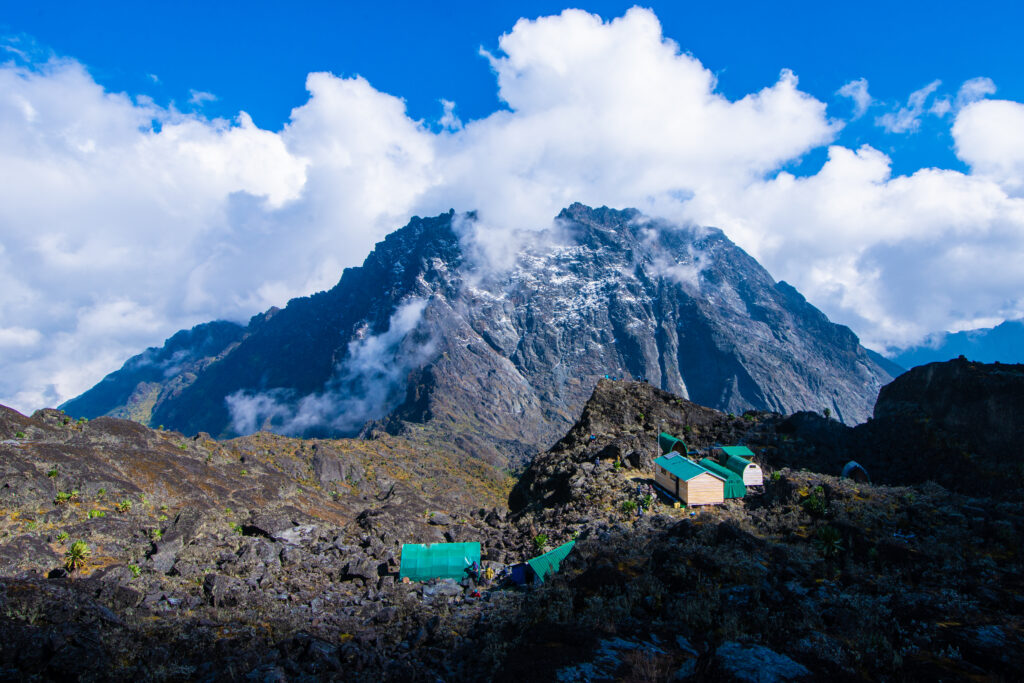
Yes. The Rwenzori Mountains are the highest mountain range in Uganda, and not by a small margin. The range’s summit, Margherita Peak on Mount Stanley, stands at 5,109 metres above sea level. That makes it not only Uganda’s highest point but also Africa’s third-highest summit, surpassed only by Kilimanjaro in Tanzania and Mount Kenya. On a continent of enormous mountains, the Rwenzori range stands in the first tier, and its highest peak stands above every point of land in five separate African nations.
That is the short answer. But if you have arrived at this question because you are trying to decide whether to come to the Rwenzori Mountains and whether they are worth the journey, what it actually feels like to stand on the roof of Uganda, and what the mountain demands of you in return for that privilege, then the short answer is only the beginning. The Rwenzori Mountains are not simply the highest point in Uganda. Before you go, learn about Africa’s stunning mountain range and what it means to hike through it.
This guide answers the elevation question completely, with precise figures and full geographical context. It then goes further into the geology, ecology, trekking routes, peaks, and experience of climbing Uganda’s highest mountain with expert guides who know every metre of it. If you are planning a custom Rwenzori hike, this is the foundation article. Read it in full, then get in touch with our team to start building your expedition.
The Direct Answer on How High Is the Rwenzori Mountain Range?
The Rwenzori Mountains are unequivocally Uganda’s highest mountain range. The range contains the ten highest peaks in Uganda, including all the country’s summits above 4,600 meters; its principal massif, Mount Stanley, holds Uganda’s three highest individual points. Here is the definitive elevation breakdown:
The Highest Point in Uganda
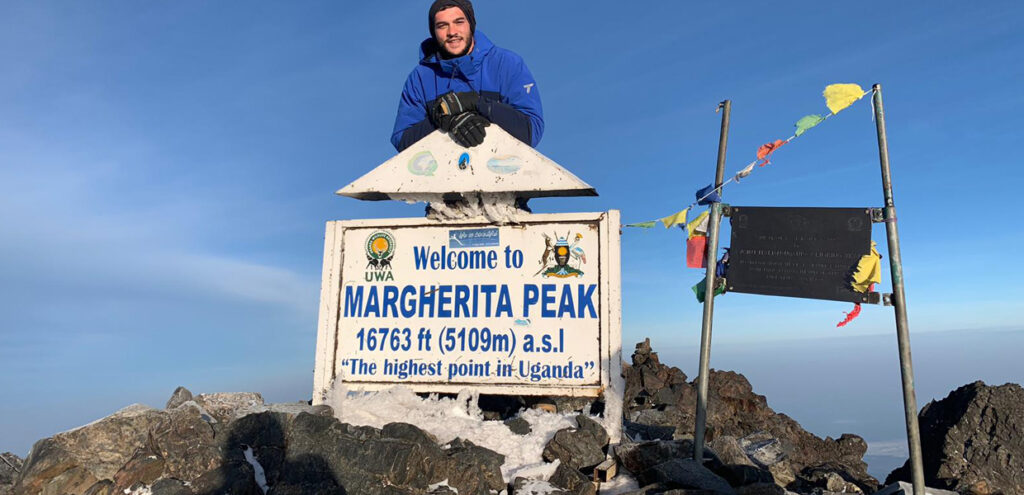
Margherita Peak, on Mount Stanley in the Rwenzori Mountains 5,109 metres (16,762 feet) above sea level. It sits on the Uganda Democratic Republic of Congo border and is simultaneously the highest point in both countries. It is Africa’s third-highest summit.
Mount Stanley is the largest and highest massif in the Rwenzori range, and it carries three distinct summits above 5,000 meters: Margherita, Alexandra, and Albert – which is a geological distinction shared by only a handful of mountain massifs anywhere in Africa. The fact that three separate points on the same mountain are all higher than the highest peak of the entire Virunga volcanic chain and all higher than Ethiopia’s Ras Dejen and the entirety of the Atlas Mountains illustrates a sense of the scale involved.
Below is a reference table showing the highest peaks in Uganda and how the Rwenzori range compares with the country’s other significant mountains:
Rank
Mountain / Peak
Elevation
Location
#1
Margherita Peak (Mount Stanley)
5,109 m / 16,762 ft
Rwenzori Mts — Uganda / DRC border
#2
Alexandra Peak (Mount Stanley)
5,091 m / 16,703 ft
Rwenzori Mts — Uganda / DRC border
#3
Albert Peak (Mount Stanley)
5,087 m / 16,690 ft
Rwenzori Mts — Uganda / DRC border
#4
Vittorio Emanuele (Mount Speke)
4,890 m / 16,043 ft
Rwenzori Mts — Uganda
#5
Edward Peak (Mount Baker)
4,843 m / 15,889 ft
Rwenzori Mts — Uganda
#6
Emin Peak (Mount Emin)
4,798 m / 15,741 ft
Rwenzori Mts — Uganda
#7
Iolanda Peak (Mount Gessi)
4,715 m / 15,469 ft
Rwenzori Mts — Uganda
#8
Sella Peak (Mount Luigi di Savoia)
4,627 m / 15,180 ft
Rwenzori Mts — Uganda
#9
Mount Elgon (highest point)
4,321 m / 14,177 ft
Eastern Uganda/Kenya border
#10
Muhavura Volcano (Virunga — Uganda side)
4,127 m / 13,540 ft
Southwestern Uganda/Rwanda border
What the table makes immediately clear is the dominance of the Rwenzori. The Rwenzori range contains all eight of Uganda’s highest points. Mount Elgon, the massive shield volcano on Uganda’s eastern border with Kenya, which is a significant and rewarding mountain in its own right, reaches 4,321 metres at its highest point, Wagagai Peak. That puts it nearly 800 metres below Margherita. And Uganda’s Virunga volcanoes, including Muhavura at 4,127 metres, sit a full kilometre below the Rwenzori’s summit. The Rwenzori does not merely hold the top spot in Uganda; it holds the top eight.
The Rwenzori in African and Global Context: Where Does It Stand?
Understanding the Rwenzori’s elevation becomes even more striking when you place it within the full African context. Africa is a continent of enormous mountains. Kilimanjaro’s Uhuru Peak is one of the Seven Summits, the highest point on each continent, and yet the Rwenzori range still occupies the third position on the continent’s hierarchy. That is a major distinction.
Rank
Mountain
Elevation
Country
#1
Kilimanjaro (Uhuru Peak)
5,895 m
Tanzania
#2
Mount Kenya (Batian Peak)
5,199 m
Kenya
#3
Margherita Peak (Rwenzori)
5,109 m
Uganda / DRC
#4
Mount Stanley — Alexandra Peak
5,091 m
Uganda / DRC
#5
Mount Stanley — Albert Peak
5,087 m
Uganda / DRC
#6
Mount Speke — Vittorio Emanuele
4,890 m
Uganda
#7
Mount Baker — Edward Peak
4,843 m
Uganda
#8
Ras Dejen (Simien Mts)
4,550 m
Ethiopia
#9
Mount Karisimbi
4,507 m
Rwanda / DRC
#10
Mount Elgon (Wagagai)
4,321 m
Uganda / Kenya
The Rwenzori’s position at third on the African list reflects something important: unlike most of Africa’s high mountains, which are single volcanic cones or shield volcanoes with a single dominant summit, the Rwenzori is a massif range, a complex of multiple mountains, each with multiple peaks, spread across an area roughly 120 kilometres long and 65 kilometres wide. This means that Africa’s third, fourth, fifth, sixth, and seventh highest individual summits are all in the Rwenzori range, all within the borders of Uganda and the DRC. No other mountain system on the continent concentrates this many high summits in a single range.
The comparison with Kilimanjaro is instructive for anyone planning an East African mountain expedition. Kilimanjaro is taller by 786 metres and is the most climbed high-altitude mountain in the world, with well over 50,000 ascents per year. The Rwenzori sees a fraction of that traffic, under 10,000 visitors annually, which means that the third-highest summit in Africa is also one of the continent’s least crowded major trekking destinations. Hikers who seek solitude, authentic wilderness, and an experience unspoiled by mass tourism find enormous significance in this comparison.
Why Are the Rwenzori Mountains So High? The Geology Behind Uganda’s Roof
Formed by Faulting, Not Fire
The geological story of the Rwenzori Mountains is one of the most distinctive in Africa, and it directly explains both the range’s extraordinary height and its radically different character from most other high African mountains. The upwelling and solidification of magma over millions of years built Kilimanjaro, Mount Kenya, and the Virunga chain, all volcanic mountains. The Rwenzori Mountains are not volcanic at all.
The Rwenzoris are what geologists call a ‘horst’, a block of ancient crystalline basement rock that was uplifted along fault lines associated with the formation of the western branch of the East African Rift Valley. As the African continental plate began rifting apart tens of millions of years ago, enormous parallel fault systems developed, and the block of rock between them was pushed upward while the surrounding terrain subsided. The Rwenzori block rose gradually and over immense geological time from the surrounding plains to its current extraordinary heights.
The rocks at the Rwenzori’s summit are among the oldest exposed at the surface anywhere in East Africa: ancient granites, gneisses, and amphibolites that formed deep in the Earth’s crust billions of years ago and have been carried to the sky by tectonic forces operating over millions of years. The rock beneath your feet on Margherita Peak is some of Africa’s oldest material.
The Glaciers That Cling to the Equator.
One of the most arresting facts about the Rwenzori Mountains is that they carry permanent glaciers on the equator. The range sits just 33 kilometres north of the equatorial line, in a geographic position where nobody would expect to detect ice, and yet the upper massifs of Mount Stanley, Mount Speke, and Mount Baker all carry genuine alpine glaciers, not merely remnant ice caps, but true moving glaciers, formed by the compaction of snow under its weight and shaped by gravity over centuries.
The combination of the range’s extraordinary height, which places the summits well above the permanent snow line even at equatorial latitudes, and the Rwenzori’s exceptional precipitation makes glacier formation possible. These are the last equatorial glaciers in Africa, shared only with Kilimanjaro and Mount Kenya, and they are retreating rapidly due to climate change. Glaciologists estimate the Rwenzori has lost more than 80% of its glacial area over the past century, and projections suggest the remaining glaciers may disappear within decades. The Rwenzori’s glaciers are, in this sense, a mountain experience with an expiry date that is drawing closer.
The Mountain the Rains Built
The Rwenzori’s height is not only a geological story; it is a meteorological one. The range intercepts enormous quantities of moisture-laden air moving westward from the Congo Basin and northward from the Indian Ocean, forcing that air upward and causing it to condense into the extraordinary precipitation that has given the Rwenzori its reputation as one of the wettest mountain ranges in Africa. Annual rainfall in the middle elevations exceeds 2,500 millimetres in most years, and the mountain generates its own weather systems that bear little relationship to conditions in the surrounding lowlands.
This wetness is not merely a practical consideration for trekkers; it is the reason the Rwenzori’s biodiversity is so extraordinary. The persistent moisture supports five distinct vegetation zones, from the equatorial rainforest of the lower slopes to the Afro-alpine moorland and glaciated peaks of the upper mountain, each zone supporting endemic plant species found nowhere else on earth. The Rwenzori’s height is tied to its ecological richness; the processes that made it biologically extraordinary also made it so high.
Uganda’s Highest Peaks: The Six Rwenzori Massifs in Detail
The Rwenzori range contains six major massifs, each named after a historical figure and each carrying multiple individual summits. Understanding the range’s structure, not just its single highest point but the full architecture of its peaks, is essential for any trekker planning an expedition here, because the mountain’s complexity is part of what makes it so extraordinary.
Mount Stanley: Uganda’s Summit (5,109m)
Mount Stanley is the highest massif in the Rwenzori range and the highest point in Uganda. Named after the explorer Sir Henry Morton Stanley, it carries three summits above 5,000 metres: Margherita at 5,109 metres (Uganda’s and Africa’s third-highest point), Alexandra at 5,091 metres, and Albert at 5,087 metres. The massif is dominated by the Stanley Plateau, a high-altitude glaciated expanse that connects the summits and across which summit bids are conducted after ascending from the Elena Hut. More detail on what it actually takes to reach the top of Mount Stanley is covered in our dedicated mountain guide.
Mount Speke: Uganda’s Second-Highest Massif (4,890m)
Named after Nile explorer John Hanning Speke, Mount Speke is the second-highest massif in the Rwenzori range, with its highest point, Vittorio Emanuele Peak, reaching 4,890 meters. The massif rises above the Bujuku Valley in one of the most dramatic settings in the range, and its summit offers views across the Stanley Plateau and down into the glacial valleys that define the central Rwenzori landscape. Mount Speke is included in our 9-day expedition covering Uganda’s three highest massifs.
Mount Baker: The Freshfield Pass Massif (4,843m)
Mount Baker is the third-highest Rwenzori massif, with Edward Peak at 4,843 metres as its summit. Accessed via the Scott Elliot Pass and the Freshfield Pass, two of the most scenic saddles in the range, Baker has a severely sculpted, architecturally complex quality that many trekkers find the most visually striking of all the Rwenzori massifs. Its upper ridge requires confident scrambling over bare rock at altitude, and it is the massif that most rewards a slow, attentive ascent.
Mount Emin, Mount Gessi, and Mount Luigi di Savoia
The three remaining major massifs, Mount Emin (4,798 m), Mount Gessi (4,715 m), and Mount Luigi di Savoia (4,627 m), sit in the northern and eastern portions of the range and see far fewer trekkers than the central massifs, which is precisely what makes them extraordinary for those who seek them out. Emin and Gessi in particular offer the most genuine sense of high-altitude solitude in the entire range. All six massifs are covered in the full 13-day expedition across the six peaks of the Rwenzori.
Why Uganda’s Highest Mountain Is Africa’s Most Underrated Climb
The Rwenzori Versus Kilimanjaro: An Honest Comparison
Trekkers often ask us how the Rwenzori compares to Kilimanjaro when choosing between East Africa’s major mountains. The honest answer is that they are so different in character, demand, and experience that comparing them is a little like comparing a cathedral and a glacier: both are magnificent, both are worth your time, and the one you prefer will tell you something about what kind of mountain experience you are actually seeking.
Kilimanjaro, at 5,895 metres, is taller. Its standard route, the Marangu or Lemosho trails, is better waymarked, more heavily visited, and supported by more extensive infrastructure. An experienced trekker in excellent health can reach Uhuru Peak without technical equipment or prior high-altitude experience, and the trail’s relative accessibility is both its greatest asset and, for those who value solitude, its greatest limitation. On peak dates in the dry season, hundreds of people reach the summit on the same day. The experience of standing on Africa’s highest point is real and genuinely moving, but it is shared.
The Rwenzori is different in almost every material respect. The trails are more technically demanding in their lower sections: the bog crossings, the root-covered forest paths, and the sustained difficulty of navigating wet terrain for multiple consecutive days. The summit push requires glacier travel with technical equipment. The weather is more unpredictable and more persistently wet. And the ecological complexity is greater: you move through five distinct vegetation zones, each with its own endemic species, on a mountain that has been shaped by geological processes that predate the volcanic events that created Kilimanjaro by hundreds of millions of years.
The reward for those additional demands is an experience of far greater intimacy and depth. On the Rwenzori, you will rarely see another trekking party on the trail. The mountain feels genuinely wild in a way that the most heavily visited African peaks simply do not. The guides who lead expeditions here are not following a worn groove; they are navigating a living landscape that demands their full expertise every day, and the relationship between guide and trekker on a Rwenzori expedition is consequently more collaborative, more personal, and more rewarding.
Why the Rwenzori Sees So Few Visitors for Its Height
The Rwenzori Mountains receive fewer than 10,000 visitors per year. For a range that contains Africa’s third, fourth, fifth, sixth, and seventh highest individual summits, that is a striking figure. Kilimanjaro, the continent’s highest point, sees more than 50,000 attempts per year. Even Mount Kenya, at the fifth-highest point on the continent, draws significantly more international attention than the Rwenzori.
The reasons are partly logistical: the Rwenzori requires a longer, more expensive expedition, more technical preparation, and a greater commitment of time and energy than the standard East African summit routes. But they are also partly a matter of reputation: the Rwenzori’s difficulty, its reputation for persistent wetness, and the relative obscurity of Uganda as a trekking destination in comparison with Tanzania and Kenya have kept visitor numbers low. For trekkers who value unspoiled wilderness and personal space on the mountain, that obscurity is the Rwenzori’s greatest gift. For trekkers who want to stand on Africa’s third-highest point and share that experience with very few other people, Uganda’s highest mountain is waiting with open arms and empty trails. We design all our available Rwenzori trekking itineraries with this aspect in mind.
How to Climb Uganda’s Highest Mountain: The Main Routes.
There are three primary routes to the high peaks of the Rwenzori range, and each offers a genuinely different experience of the mountain. The best route for you depends on your summit goals, your available time, and the kind of trekking experience you want. Our full routes and trails guide covers all the options in full detail.
The Central Circuit Trail: The Classic Route to the Summit
The Central Circuit Trail is the original and most comprehensive route through the Rwenzori range, beginning at the Nyakalengija trailhead near Ibanda village in Kasese District and looping through the mountain’s core via the Bujuku Valley, the Elena Hut, and the Stanley Plateau. It is the route that passes closest to all three of the range’s highest massifs, Stanley, Speke, and Baker, and can therefore be combined with summit bids on multiple peaks in a single expedition. For a full ascent to Margherita Peak, a 7-day Central Circuit itinerary is our standard recommendation, with 8–10 days providing the most comfortable acclimatisation.
The Kilembe Trail: The Southern Approach
The Kilembe Trailapproaches the range from the south, beginning at the old copper mining town of Kilembe and ascending via the Nyamwamba Valley to the high camps at Kalalama, Mutinda, Bugata, Hunwicks, and Margherita Camp. It is a longer, more demanding route than the Central Circuit, with more sustained elevation gain and more exposed high-altitude camps, but it rewards the effort with views and terrain that feel distinctly different from the northern approach. Our 8-day Kilembe Trail expedition to Margherita Peak is the benchmark itinerary for this route.
The Bukulungu Wilderness Trail: The Road Less Travelled
The Bukulungu Wilderness Trail is the newest and most remote of the Rwenzori’s main routes, established in 2018 through a partnership between the Uganda Wildlife Authority and WWF. It passes through four spectacular alpine lakes, Irene, Mughuli, Bukurungu, and Bujuku, and offers the most genuinely wild and isolated experience of the range. There are no established huts on this trail; trekkers camp under the sky in terrain that sees only a handful of expeditions per year. For trekkers seeking the most untouched version of Uganda’s highest mountain, this is the route.
What It Actually Takes to Climb Uganda’s Highest Mountain
Physical Demands and Fitness Requirements
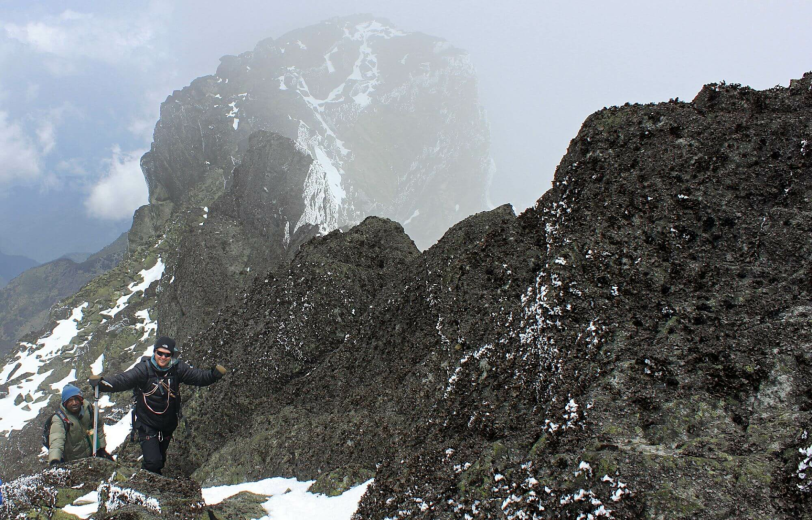
Reaching the summit of Margherita Peak, the top of Uganda’s highest mountain, is a genuine mountaineering achievement that demands serious physical preparation. The climb involves sustained daily walking for six to eight hours at increasing altitude, through terrain that ranges from rooted forest paths to glaciated summit approaches requiring crampons and an ice axe. It is not extreme alpinism, but it is demanding enough to differentiate itself clearly from the standard walk-up summit routes of more heavily touristed African mountains.
Good cardiovascular fitness, strong legs, and the mental resilience to continue through sustained physical discomfort in cold and wet conditions are all necessary. We recommend a minimum of three months of dedicated training before a Rwenzori summit attempt: regular hiking with a loaded pack, cardiovascular training, and, if possible, some exposure to altitudes above 3,000 metres. Our frequently asked questions page includes a section on fitness requirements and preparation in practical detail.
Altitude and Acclimatization
At 5,109 metres, Margherita Peak is high enough to produce altitude sickness in any trekker who ascends too quickly. Rwenzori’s terrain actually aids acclimatisation in ways that linear ascent mountains do not because the trails move up and down through valleys and saddles rather than ascending continuously; trekkers naturally “climb high and sleep low” in a pattern that allows the body to adjust progressively. Our itineraries build on this natural acclimatisation advantage with deliberately paced ascent profiles.
Our guides are trained in altitude emergency response, carry supplemental oxygen on summit expeditions, and will always decide to descend if a trekker’s symptoms warrant it. Summit ambition never compromises safety at altitude. Trekkers who arrive properly prepared and listen to their guides will find that acclimatisation to the Rwenzori is more manageable than its raw elevation might suggest.
Technical Requirements for the Summit
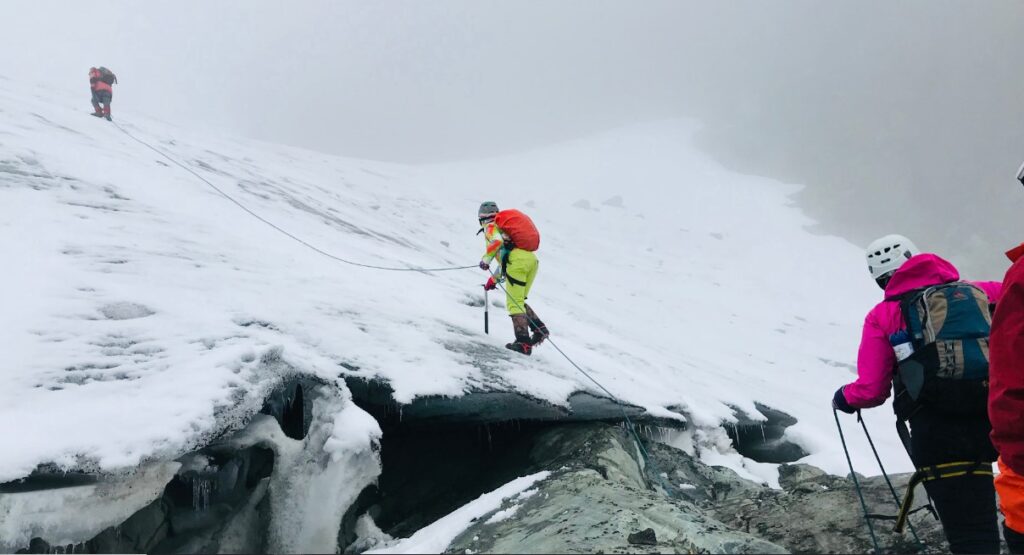
The glacier approach to Margherita Peak requires crampons, an ice axe, a harness, and roped movement under guide supervision. This is the single section of the standard Rwenzori itinerary that requires technical mountaineering equipment, and it is the section that most distinguishes a Rwenzori summit expedition from a standard trekking experience. The technical demands are real but not extreme for a properly supervised trekker. Our guides conduct this section with clients of many different experience levels, and the preparation and safety management we put in place make it accessible to non-specialist mountaineers who are fit, willing, and attentive to instruction.
Duration: How Long Does It Take?
Reaching the summit of Uganda’s highest mountain and descending safely requires a minimum of seven days on the mountain, and eight to ten days is the realistic optimal range for most trekkers. This time allows for adequate acclimatisation, weather-buffering days around the summit push, and enough recovery on the descent to avoid injury. Expeditions targeting multiple summits, such as the 13-day six-peaks expedition, require significantly longer. For trekkers who want to experience Uganda’s highest mountain without committing to a summit bid, shorter itineraries of three to six days explore the lower and mid-mountain zones, which are spectacular in their own right.
Getting to Uganda’s Highest Mountain.
Kasese District in western Uganda, approximately 380 kilometres from Kampala and 400 kilometres from Entebbe International Airport, provides access to the Rwenzori Mountains. Getting to the Rwenzori Mountains involves either a five-to-six-hour road journey from Entebbe via Kampala and Fort Portal, passing through some of Uganda’s most beautiful agricultural highland scenery, or a one-hour domestic flight from Entebbe to Kasese Airport on AeroLink.
Kasese is the gateway town for the Nyakalengija trailhead, the starting point of the Central Circuit, and sits within easy reach of the Kilembe trailhead to the south. The town has sufficient accommodation and services to serve as a pre-trek base, and our team provides logistics support from arrival in Kasese through to departure. Uganda requires a visa for most international visitors — check the current requirements for your nationality and apply online through Uganda’s e-Visa portal well in advance of travel. More practical planning guidance is on our Rwenzori Mountains National Park information page.
Beyond the Summit: Combining Uganda’s Highest Mountain with the Rest of the Country
Uganda’s highest mountain sits in one of the country’s most wildlife-rich regions, and the Rwenzori Mountains are an outstanding foundation for a broader Uganda safari. Within a few hours of the Kasese trailhead, trekkers have access to Queen Elizabeth National Park, home to tree-climbing lions, enormous elephant herds, and one of Africa’s most biodiverse channel boat safaris, and to Bwindi Impenetrable Forest, where permits for mountain gorilla trekking allow encounters with approximately half of the world’s remaining gorillas.
Frequently Asked Questions: Is Rwenzori the Highest Mountain in Uganda?
Is the Rwenzori the highest mountain in Uganda?
Yes. The Rwenzori Mountains are unequivocally Uganda’s highest mountain range. The range contains all of Uganda’s ten highest peaks. Its summit, Margherita Peak on Mount Stanley, stands at 5,109 metres above sea level and is simultaneously the highest point in Uganda, the highest point in the Democratic Republic of Congo, and Africa’s third-highest individual summit after Kilimanjaro (5,895 m) and Mount Kenya (5,199 m).
What is the highest peak in the Rwenzori Mountains?
The highest peak in the Rwenzori Mountains is Margherita Peak on Mount Stanley, at 5,109 metres (16,762 feet) above sea level. It was first summited in 1906 by the Duke of Abruzzi’s Italian expedition and is named after Queen Margherita of Italy. Mount Stanley also carries the second- and third-highest points in Uganda: Alexandra Peak (5,091 m) and Albert Peak (5,087 m).
What is the highest mountain in Uganda apart from the Rwenzori?
The second-highest mountain in Uganda, outside of the Rwenzori range, is Mount Elgon, a massive ancient shield volcano on Uganda’s eastern border with Kenya. It’s highest point, Wagagai Peak, stands at 4,321 meters. While the height makes it a significant mountain in its own right and a rewarding trekking destination (our team also operates Mount Elgon climbing expeditions), it is nearly 800 metres lower than Margherita Peak and does not carry permanent glaciers. Uganda’s Virunga volcanoes, including Muhavura at 4,127 metres, are the next significant summits after Elgon.
Are the Rwenzori Mountains taller than Kilimanjaro?
No. Kilimanjaro is Africa’s highest mountain at 5,895 metres (Uhuru Peak), which is 786 metres taller than the Rwenzori’s highest point, Margherita Peak, at 5,109 metres. The Rwenzori Range ranks third in Africa after Kilimanjaro (Tanzania) and Mount Kenya (5,199 m, Kenya). However, while Kilimanjaro has a single dominant summit, the Rwenzori range contains multiple massifs with many peaks above 4,600 metres, making it by far the most extensive high-altitude mountain system in Africa’s Great Lakes region.
How many peaks does the Rwenzori range have that are above 4,500 meters?
The Rwenzori range has six major massifs, all of which carry multiple summits above 4,500 metres. Mount Stanley has three summits above 5,000 metres (Margherita, Alexandra, and Albert) and additional subsidiary peaks. Mount Speke (Vittorio Emanuele, 4,890 m), Mount Baker (Edward Peak, 4,843 m), Mount Emin (4,798 m), Mount Gessi (4,715 m), and Mount Luigi di Savoia (Sella Peak, 4,627 m) are the other major massifs. In total, the range has more than twenty named summits, with the ten highest all exceeding 4,600 metres.
Is the Rwenzori Mountain range in Uganda or the DRC?
The Rwenzori mountain range straddles the border between Uganda and the Democratic Republic of Congo. The main peaks, including Uganda’s highest point, Margherita Peak, sit on or very close to this international border. The national park on the Uganda side is called Rwenzori Mountains National Park, a UNESCO World Heritage Site managed by the Uganda Wildlife Authority. The DRC side of the range falls within Virunga National Park. All standard commercial trekking routes to the summits operate exclusively on the Uganda side of the border.
Can tourists climb Uganda’s highest mountain, Margherita Peak?
Yes. Margherita Peak is open to guided trekking expeditions year-round, and every year trekkers from around the world reach its summit. Reaching the peak requires a minimum of seven days on the mountain, excellent physical fitness, willingness to use crampons and an ice axe on the glacier section, and the guidance of a licensed, experienced Rwenzori mountain guide. It is inaccessible to casual day-hikers, but it is well within the reach of any fit, well-prepared trekker who commits to a properly structured expedition.
How does the Rwenzori compare to Mount Elgon for trekking?
Mount Elgon and the Rwenzori Mountains are Uganda’s two most significant trekking mountains, but they offer entirely different experiences. Mount Elgon is a broad shield volcano with an enormous summit caldera—one of the largest ancient calderas in Africa and its trekking routes are less technically demanding than the Rwenzori, reaching around 4,300 metres without glacier travel. It is an excellent trekking mountain for visitors who want a high-altitude Uganda experience without the Rwenzori’s technical demands. The Rwenzori, at 5,109 meters, with its glaciated summits and five distinct vegetation zones, is the more ambitious and ecologically complex objective. Our Mount Elgon climbing guide covers the details of that route for those interested in comparing the two.
What is the best time of year to climb Uganda’s highest mountain?
The best time to climb the Rwenzori’s Margherita Peak is during Uganda’s two dry seasons: December to early March and June to early September. These months offer the most stable weather, driest trail conditions, and highest probability of a clear weather window for the glacier summit push. The Rwenzori generates its own weather systems regardless of the season, and rain is always possible, but the dry season months minimise the risks associated with poor weather on the upper mountain. Our best time to visit the Rwenzori guide provides detailed month-by-month conditions.
Are the Rwenzori Mountains a UNESCO World Heritage Site?
Yes. Rwenzori Mountains National Park was inscribed on the UNESCO World Heritage List in 1994 in recognition of its outstanding universal value as a natural landscape of exceptional biological diversity and geological significance. The park was also designated a Ramsar wetland site in 2008, recognising the importance of its glacier-fed rivers and wetlands for the surrounding ecosystem. The national park covers approximately 1,000 square kilometres and protects the Ugandan side of the mountain range, including all the major peaks and trekking routes.
How many people climb the Rwenzori Mountains each year?
Rwenzori Mountains National Park receives approximately 7,000 to 10,000 visitors annually, a fraction of the traffic that Uganda’s gorilla trekking destinations receive and far fewer than major East African peaks such as Kilimanjaro. This relatively low visitor number means that trekking Uganda’s highest mountains is a genuinely uncrowded, personalised experience—a significant contrast with the more heavily marketed East African summits. The low visitor number is not a reflection of the mountain’s quality, which is exceptional, but of its relative obscurity and the more demanding expedition profile required to climb it.
Does altitude sickness affect trekkers on the Rwenzori Mountains?
Yes, altitude sickness is a genuine risk for any trekker ascending above 3,500 metres, and the Rwenzori’s summit at 5,109 metres puts it well within the altitude band where AMS, HAPE, and HACE can all occur. Properly paced itineraries with adequate acclimatisation nights at key elevations significantly reduce this risk. Rwenzori’s landscape, which involves going up and down through valleys and ridges instead of just climbing straight up, helps with getting used to the altitude better than climbing single-cone volcano Our guides are trained in altitude emergency response and carry supplemental oxygen on all summit expeditions.
What is the cost of climbing Uganda’s highest mountain?
The cost of a Rwenzori summit expedition to Margherita Peak varies based on route, duration, group size, and services required. As a baseline, a full summit expedition should be budgeted at approximately $1,300 per person for the mountain component, increasing significantly for longer multi-peak expeditions or smaller groups. This typically includes guide fees, porters, meals on the mountain, park entry fees, accommodation in the mountain huts, and technical equipment support for the glacier section. A full breakdown of cost factors is available on our Rwenzori Mountains cost guide.
Are you ready to Stand on the Roof of Uganda? Start Your Conversation Here.
Uganda’s highest mountain is not a secret, but it remains one of Africa’s great unsung expeditions, a range of six major massifs, twenty-plus named peaks, permanent glaciers on the equator, five distinct vegetation zones, and an almost total absence of the crowds that have come to define the most famous African mountain routes. Trekkers who climb it come back with something that the other East African summits, extraordinary as they are, rarely produce: the sensation of having been on a mountain that was genuinely their own.
We have been guiding expeditions on the Rwenzori Mountains for over a decade. We know how to match an itinerary to a trekker’s actual fitness and ambition, how to build an acclimatisation profile that gives them the best chance of reaching the summit safely, and how to design a Rwenzori expedition that feels personalised rather than packaged. Whether your goal is Margherita Peak, a selection of the lower massifs, a forest and wildlife experience through the mountain’s lower zones, or a complete Uganda journey that combines the peaks with gorilla trekking and wildlife safari, the itinerary starts with a conversation.
Reach us through our contact page and tell us what you are planning. Tell us your timeline, your fitness level, whether you have been at altitude before, and what you most want from the experience. We will respond with an honest assessment and a personalised itinerary built around your specific goals—not a template, not a compromise. Browse our full Rwenzori trekking itineraries, explore the complete mountain guide, and when you are ready—the roof of Uganda is waiting.
ANY QUESTIONS?
If you need any clarification about a Rwenzori trek, contact one of our trekking experts to start planning your journey today.
A 10% percentage of your safari proceeds goes to supporting the local Bakonjo Communities (orphans, schools & homes)
Simply incredible
I have been very fortunate to go trekking and climbing in many incredible places around the world over the years, the Rwenzori mountains are one of the most incredible places I have ever visited. Rwenzori Trekking Safaris organized my trip to do the central circuit and summit Margherita peak. The guides, Josephat and Joackim, and porters were all friendly and helpful. The food was plentiful, but I suggest bringing some of your own day snacks you might like as well as rubber knee high boots, I suggest LaCrosse Burly Aero. I was able to complete the loop and peak in 4 days, but most people take 7-8 days I believe which is definitely recommended for acclimatization. There are new huts being built at Elena camp and Nyabitaba that cost a small amount extra, so ask about that too. Its a real adventure and in my experience way more rugged, beautiful, and less traveled than Kilimanjaro. The landscapes and unique plant life are like out of Jurassic Park.
Posted on Tripadvisor
Simon B
Verified
A wonderful experience in the Rwenzoris
We did the seven-day Central Circuit and had a wonderful experience. The landscapes were spectacular and really diverse. Also, the guides, porters and cooks were super friendly and helpful. Thank you very much!
Posted on Tripadvisor
Explorer43375006028
Verified
Magical mountain forest
We did the two day hike to Mahoma Lake, and it was beautiful. The guide was superfriendly, the coock made a great stew and the porters were really nice.
Posted on Tripadvisor
Dominic N
Verified
Forget Kilimanjaro, do this instead!
A beautiful and surreal 4 day hike in the Rwenzori mountains to Mutinda Lookout, made by the staff. Good food, good basic camp accommodation, excellent knowledge of the guides and lots of laughs. I did this trip solo and joined a welcoming group of 6. Pack for all weather, it gets particularly cold at night at Mutinda camp. Total cost was $635/2.2m UGX
Verified by Trustindex
Trustindex verified badge is the Universal Symbol of Trust. Only the greatest companies can get the verified badge who has a review score above 4.5, based on customer reviews over the past 12 months. Read more
Hi there, welcome. Need help planning a trek, safari, or adventure? Chat directly with a real expert and mountain guide for honest advice, clear answers, and practical recommendations. No guesswork, no pressure.