Discover the ultimate Rwenzori birdwatching guide: 217 species, 19 Albertine Rift endemics, the best trails, and expert tips to plan your Rwenzori trek.
There is a moment, somewhere above 2,400 meters on the Central Circuit Trail, when the bamboo closes over your head and the world goes hushed. Then it starts. A liquid, cascading call drops through the canopy like water through stone, and a flash of crimson and green ignites the shadows above you. The Rwenzori turaco. One of Africa’s most flamboyant birds is found on one of Africa’s most remote mountains, sitting directly on your path to Margherita Peak. That is the Rwenzori in a single instant.
The Rwenzori Mountains, the legendary Mountains of the Moon, a UNESCO World Heritage Site straddling the border of western Uganda and the Democratic Republic of the Congo, are one of the most important and least-visited birding destinations anywhere on Earth. With 217 different bird species, including 19 that are only found in the Albertine Rift, the Rwenzoris are a unique place that serious bird watchers come from far away to see. Unlike the crowded slopes of the Bwindi or the tourist highways of the Ngorongoro, the Rwenzori offers its birds in solitude, in a forest so dense and so alive that you feel the ecosystem breathing around you.
This guide was written by the trails themselves. At Rwenzori Trekking Safaris, we have spent years leading trekkers and naturalists through every vegetation zone these mountains contain, from the lowland rainforest just above Kasese all the way to the alien heather moorlands and ice-scoured ridges below Margherita. We know where the strange weaver nests in April. We know which stretch of the Kilembe Trail the African green broadbill haunts at first light. We know that the Rwenzori nightjar only calls when the cloud lifts off the heath and the temperature drops sharply after dusk. This guide places all of that hard-won knowledge in your hands.
Whether you are a dedicated lister planning to add double-digit endemics to your African life list, a trekker who wants to understand the extraordinary living world surrounding every step of a seven-day mountaineering expedition, or simply someone who wants to know what that bird was, the one with the scarlet wing panel and the absurd banana-yellow beak, you are in exactly the right place. Welcome to the most comprehensive Rwenzori birdwatching guide on the internet.
Why the Rwenzori Mountains Are Africa’s Most Important Mountain Birding Destination.
To understand why the Rwenzori matters to ornithologists, you need to understand the Albertine Rift. This is the western arm of the East African Rift System, the great geological wound that ripped through the continent millions of years ago and, in doing so, created isolated mountain archipelagos of extraordinary biological significance. Surrounded by lowland savannah and miombo woodland that birds simply cannot cross, the Albertine Rift highlands became evolutionary laboratories. Species differentiated in isolation over vast spans of time, producing forms found nowhere else on Earth. The Rwenzori sits at the heart of this process.
What makes the Rwenzori uniquely productive, even within the Albertine Rift, is the combination of extreme altitudinal range and persistent moisture. The mountains rise from approximately 1,600 metres at the park boundary to 5,109 metres at the summit of Mount Stanley, and they do so through five completely distinct vegetation zones, each with its bird community. At the same time, the Rwenzori receives rainfall almost year-round, making it one of the wettest places in Africa and producing the extraordinary density of vegetation that makes these forests so productive for bird life. Giant heathers grow to the size of English oaks. Senecio groundsels tower over your head like prehistoric trees. Giant lobelias line the valley floors like sentries. And in and around all of it, birds have evolved to fill every conceivable ecological niche.
The Albertine Rift holds more endemic species per square kilometre than almost anywhere else in Africa. The Rwenzori Mountains are its crown jewel.
The Rwenzori stands out from other renowned East African birding destinations. Bwindi Impenetrable Forest, famous for gorilla trekking, shares some Albertine endemics but lacks the dramatic altitudinal range that makes the Rwenzori so rich across zones. The Virunga Volcanoes offer fine high-altitude birding but are largely accessible only through the DRC or Rwanda’s less-stable border regions. The Rwenzori, which you can get to from Kasese in western Uganda and is overseen by the Uganda Wildlife Authority with strict conservation rules, provides birdwatchers a safe, guided, and legal way to explore the rich variety of wildlife in the
It is also, in a very real sense, an underbirded destination. Visitor numbers remain a fraction of what you find on Kilimanjaro or at the major East African safari parks. The Rwenzori Mountains National Park receives fewer than 8,000 visitors per year across all activities. For a birder, that quiet is itself a gift. You are not jostling with tour groups at dawn. You are not competing for sight lines in a crowd. You are alone with the forest, the guides, and the birds, and that intimacy changes how you see everything.
The 217 Species: What the Rwenzori’s Bird List Actually Means
A bird list of 217 species is impressive on its own terms, but the headline number only begins to describe why the Rwenzori matters. The critical figure is the composition of that list: 19 confirmed Albertine Rift endemic species, most of which are found nowhere on Earth outside the high-altitude forests of this western Ugandan mountain range and its immediately adjoining ranges in the DRC. These are not subspecies or regional variants; these are fully differentiated species with no viable alternative site. For a lister, this figure means the Rwenzori is a destination of genuine global significance. For a birder who simply loves exceptional encounters with extraordinary birds, it means an almost daily confrontation with the genuinely rare.
Beyond the endemics, the Rwenzori’s 217 species encompass a rich suite of East African montane specialists: trogons, broadbills, crimsonwings, sunbirds, francolins, and raptors that transform the birding across every elevation band. The lower forest zones hold species that overlap with those found in the forests of Bwindi and Kibale, including several Albertine near-endemics that extend just across the Rift. The mid-elevation bamboo zone hosts a specialist community of its own. The heath and moorland above the treeline support a surprisingly productive suite of Afro-alpine specialists adapted to cold, cloud, and wind. And the permanent snowfields and glaciers of Mount Stanley, Mount Speke, and Mount Baker create a high-altitude frontier that only a handful of species can brave and that provides some of the most extraordinary mountain backdrops in African ornithology.
The table below summarises the key species that any serious birdwatcher visiting Rwenzori should target, organised by conservation status and the trail or zone in which they are most reliably encountered.
Species
Status
Best Spot / Zone
Rwenzori Turaco
Albertine Endemic
Bamboo & montane forest – all trails
Handsome Francolin
Albertine Endemic
Forest undergrowth, mid-elevation
Rwenzori Nightjar
Albertine Endemic
Heather moorland, dusk & dawn
Strange Weaver
Albertine Endemic
Forest edge, Mahoma Loop
Archer’s Robin-Chat
Albertine Endemic
Dense understorey, Central Circuit
Rwenzori Batis
Albertine Endemic
Mixed forest canopy
White-starred Robin
Albertine Endemic
Bamboo transition zone
Lagden’s Bush-Shrike
Albertine Endemic
Montane forest interior
Grauer’s Broadbill
Albertine Endemic
Lower montane forest
Ruwenzori Double-collared Sunbird
Albertine Endemic
Alpine zone & giant lobelia fields
Shelley’s Crimsonwing
Albertine Endemic
Bamboo forest – Kilembe Trail
African Green Broadbill
Rare Albertine Endemic
Lower montane – Bukulungu Trail
Rwenzori Hill Babbler
Albertine Endemic
Mid-elevation forest
Blue-headed Sunbird
Albertine Endemic
Forest canopy, widespread
Short-tailed Warbler
Albertine Endemic
Dense bamboo
Collared Apalis
Albertine Endemic
Canopy & forest edge
Mountain Masked Apalis
Near-endemic
Mid-elevation scrub
Dusky Crimsonwing
Albertine Endemic
Bamboo – upper zones
Chapin’s Flycatcher
Albertine Endemic
Mature forest interior
Martial Eagle
Resident
Forest clearings & valleys
African Long-eared Owl
Rare resident
Heath zone at night
Verreaux’s Eagle-Owl
Resident
Lower forest, Sine Camp area
Bar-tailed Trogon
Resident
Montane forest, widespread
Black-and-white Casqued Hornbill
Resident
Lower montane forest canopy
This table is a starting point, not a ceiling. Every visit to the Rwenzori produces unexpected encounters: a rarely photographed Chapin’s flycatcher sitting in open view on a mossy branch, a squadron of bar-tailed trogons following a guide’s movement through the undergrowth, or a martial eagle banking enormously and silently over the Bujuku Valley in the late afternoon light. The Rwenzori rewards patience and presence, and it rewards guides who know what they are looking at.
Species in Depth: The Birds Every Visitor to the Rwenzori Must Know
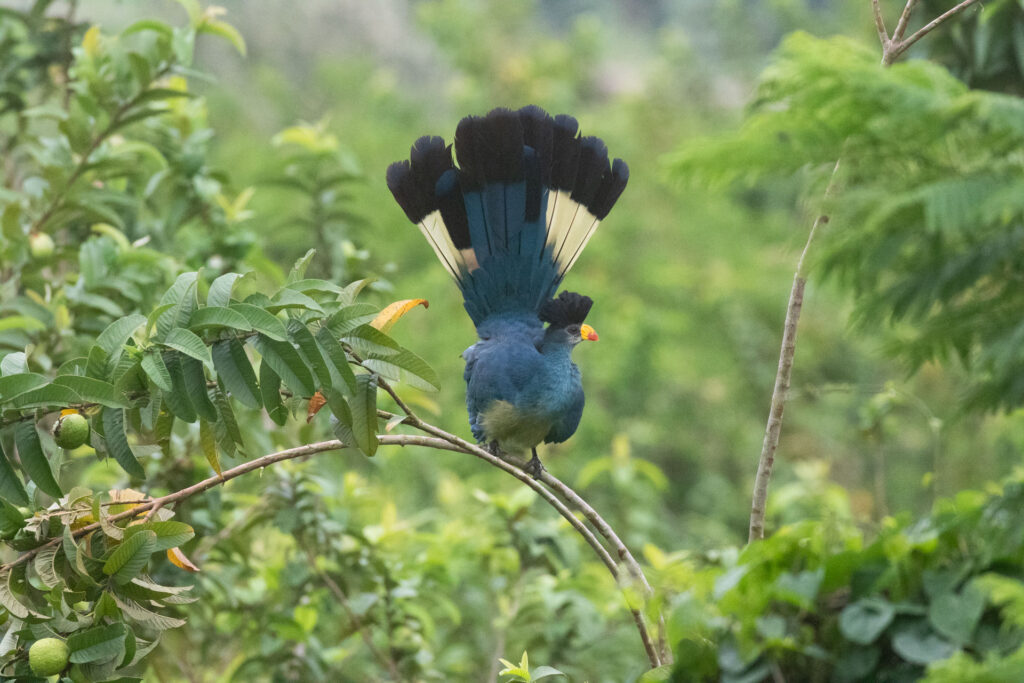
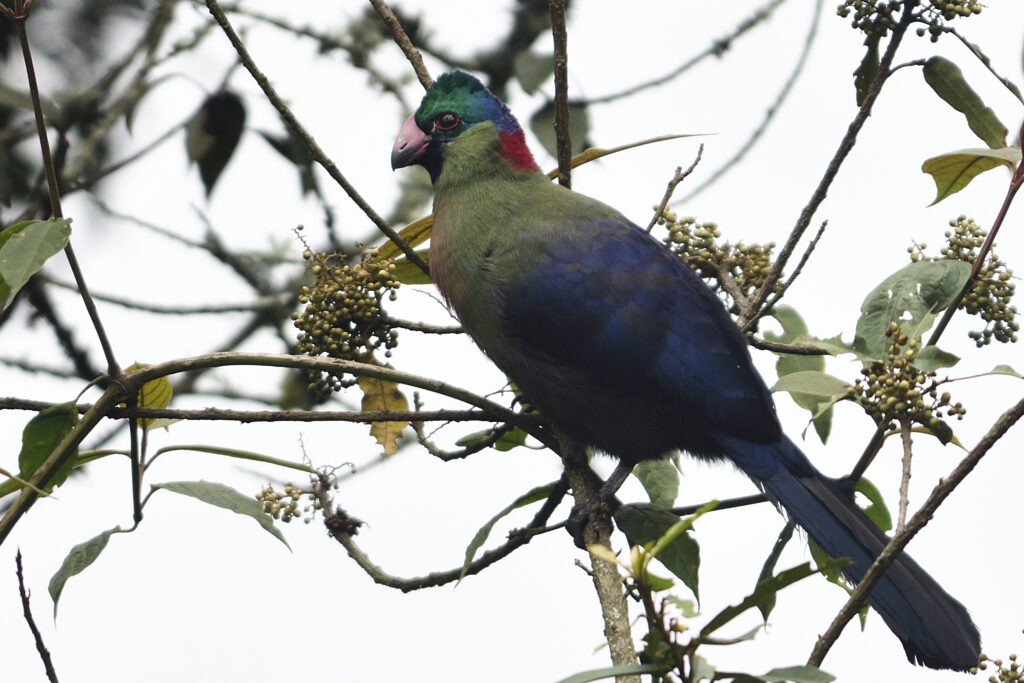
The Rwenzori Turaco (Ruwenzorornis johnstoni)
The turaco is the Rwenzori’s ambassador bird, the species that appears in every article, graces every field guide plate for the Albertine Rift, and produces the loudest gasp from every first-time visitor. It is a large, exuberant bird, roughly the size of a jackdaw but constructed as if by a committee that could not agree on restraint. The plumage runs to vivid greens and blues on the body, with brilliant crimson primary feathers that flash on every wingbeat. The head is crested, the bill is bright red, and the overall effect is of a creature that belongs in a Baroque painting rather than a montane forest. Despite this theatricality, the turaco can be surprisingly elusive in the canopy, moving with silent purpose through the upper branches and betraying its presence mainly through its loud, repetitive, descending call, a sound that becomes the soundtrack of the Rwenzori between 2,200 and 3,500 metres.
The species is an Albertine Rift endemic, found across the Rwenzori range and extending into the Virunga Volcanoes and a handful of sites in the eastern DRC. Within Uganda, the Rwenzori is the only reliable site. Turacos are most readily found on the lower and middle sections of all three major trails: the Central Circuit, the Kilembe Trail, and the Bukulungu Trail, especially in the transition zones between montane rainforest and bamboo. They respond readily to the playback of their own calls, though we at Rwenzori Trekking Safaris use this technique only sparingly and responsibly to minimise disturbances for nesting birds.
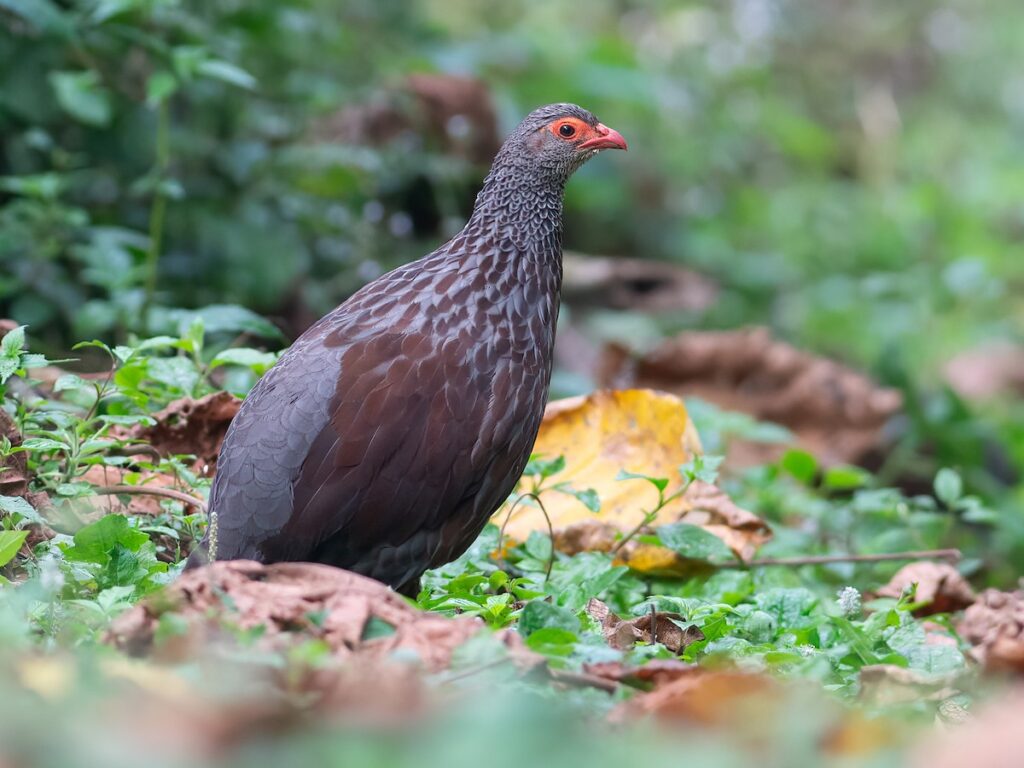
The Handsome Francolin (Pternistis nobilis)
The name is not an understatement. The handsome francolin is genuinely one of the most striking members of the francolin clan anywhere in Africa, a heavily barred, richly coloured gamebird with a bright red orbital ring that provides it with an expression of permanent attentiveness. Found in the dense undergrowth of mid-elevation montane forest, typically between 1,800 and 3,000 metres, it is an Albertine Rift endemic and one of the Rwenzori’s most sought-after species for listers unfamiliar with the region. It is also one of the hardest to see clearly. The handsome francolin is a forest-floor bird that runs rather than flies when alarmed, and it has a talent for being precisely where you are not looking. Your best opportunities come in the early morning hours, when small groups emerge onto trails and logging tracks to feed and in clearings near hut sites where vegetation is sparser. Patient, quiet, low-movement birding is non-negotiable.
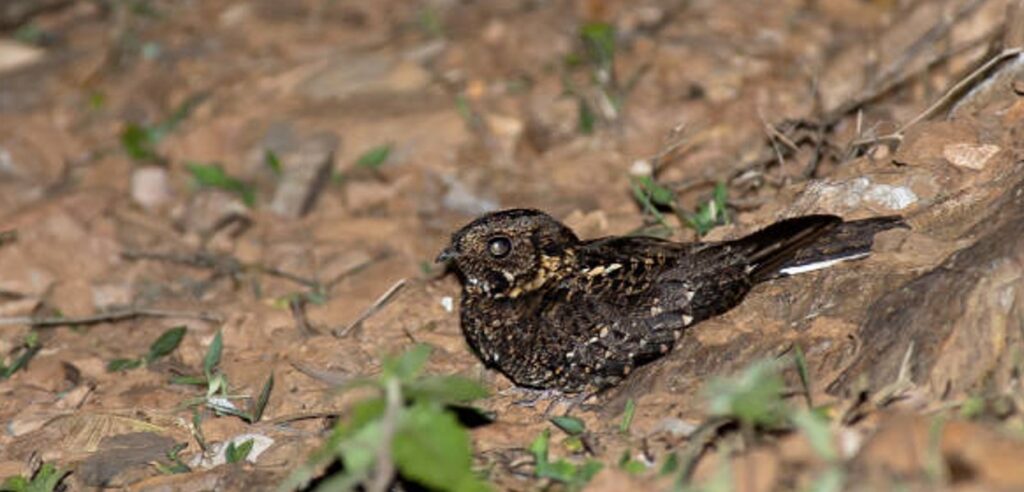
The Rwenzori Nightjar (Caprimulgus ruwenzorii)
This species is arguably the most atmospheric of all Rwenzori endemics. The nightjar is a bird of the dusk and pre-dawn hours, and encountering it requires both the willingness to be outside in the cold mountain dark and the situational awareness to stop and listen rather than rush back to the hut after dinner. The species inhabits open heather moorland and heath zones above the forest, typically between 3,000 and 4,000 metres, where it hunts moths and flying beetles against the deep blue of the mountain sky. Its call, a rapid churring that rises and falls in pitch, punctuated by sharp clicks, is one of the characteristic sounds of the Rwenzori at night, and once you have heard it, you will understand why local Bakonzo people considered the mountain a place of spirits and mystery. The nightjar is cryptically plumaged in brown and grey bark tones and is almost impossible to see unless caught in torchlight or silhouetted against a pale sky in flight. It is an experience as much as a sighting, and it is uniquely of the Rwenzori.
The Strange Weaver (Ploceus alienus)
Its name is borrowed directly from the Latin ‘alienus’, meaning ‘foreign’ or ‘strange’, and it is a fitting tribute to the Rwenzori’s habit of producing birds that feel slightly wrong in comparison to their relatives, as if evolution were being experimental. The strange weaver is an Albertine endemic found in the forest edge and secondary growth zones, typically at lower elevations than many of the mountain’s specialists, making it one of the more accessible endemics for visitors on shorter itineraries such as the 3-Day Mahoma Loop. It is a solidly built, olive-and-yellow weaver with a distinctive dark mask, and it often occurs in mixed-species foraging flocks alongside sunbirds and apalis warblers. Watch for it in the tangled undergrowth around forest clearings and stream margins.
Grauer’s Broadbill (Pseudocalyptomena graueri)
If the Rwenzori turaco is the mountain’s showbird, then Grauer’s broadbill is its ultimate treasure. A stocky, almost comically round-bodied bird with a broad, flattened bill and vivid turquoise-and-chestnut plumage, Grauer’s broadbill is one of the most restricted-range birds in Africa found only in a handful of highland forest sites across the Albertine Rift, including the lower slopes of the Rwenzori. It is an IUCN Vulnerable species, its population shrinking as lowland forests are cleared and montane habitat is degraded. On the Rwenzori, it inhabits the lower montane forest zone, typically below 2,000 metres, and is most reliably found on the approaches to the Bukulungu Trail and on the lower sections of the Kilembe route. An encounter with Grauer’s broadbill sitting motionless on a mossy perch like a jewel someone dropped in the undergrowth is the kind of moment that makes serious birders go silent and then immediately reach for the telephone to call their birding companions.
Of all the sunbird species recorded on the Rwenzori, and there are several, the Ruwenzori double-collared sunbird is the one that defines the high-altitude experience. The Ruwenzori double-collared sunbird, found above 2,800 metres and extending up to the giant lobelia and senecio zones above 4,000 metres, is a jewel-bright specialist of the afro-alpine habitat, hovering at lobelia flowers with a precision that seems effortless. The male’s plumage is extraordinary: a metallic green crown, an iridescent blue throat, a deep red breastband, and a yellow belly, all delivered in a bird not much larger than a wren. Encounters are almost guaranteed above John Matte Hut on the Central Circuit or on the upper reaches of the Kilembe Trail approaching Margherita Camp. The Rwenzori turaco is the bird that keeps you looking upward even when your lungs are working hard and your legs are protesting the gradient.
Birding Through the Vegetation Zones: A Naturalist’s Vertical Journey
One of the singular joys of birding on the Rwenzori is that a single trek covers more ecological ground than many a week-long safari across the savannah. From the submontane rainforest at the mountain’s base to the glacial ridges near the summit, every few hundred metres of elevation brings a new bird community, and the transitions between zones are often where the most productive birding of all takes place.
Zone 1: Sub-Montane Rainforest (1,600–2,200 m)
The approach to all major Rwenzori trailheads passes through sub-montane rainforest, and this region is where many visitors underestimate the birding because they are still thinking about logistics and kit. It is a mistake. The lower forest, particularly on the approaches to the 2-Day Sine Camp Trek via the Kilembe Trail and the initial sections of the Central Circuit from Nyakalengija, is exceptionally rich. Black-and-white casqued hornbills move through the canopy in loud, raucous groups. African green broadbills, potentially the most range-restricted bird on the Rwenzori, haunt the shadier gullies. The African long-tailed hawk and red-chested owlet are both possible. Blue monkeys frequently move through the canopy above you, shaking branches that scatter panicked mixed flocks of forest birds into temporary visibility. Walk slowly. Let the forest settle around you. Spend time at the forest edge near streams.
Zone 2: Montane Rainforest and Bamboo Transition (2,200–3,000 m)
This area is the engine room for Rwenzori birding. The mid-elevation montane forest, dense, dripping, hung with mosses and ferns, and threaded through with streams, is where the majority of the mountain’s Albertine endemics are most consistently found. Any morning walk through the bamboo transition practically guarantees a sighting of the Rwenzori turaco. Archer’s robin-chat calls from the shadowed understory. The white-starred robin flickers through the bamboo stems. Collared apalis, Rwenzori batis, and Rwenzori hill babbler move through in restless mixed-species flocks that demand your full attention. Shelley’s crimsonwing and short-tailed warbler require more patience and a willingness to stand very still at the bamboo margins. This zone corresponds roughly to the section of the Central Circuit between Nyabitaba Hut and John Matte Hut and the middle elevations of the Kilembe Trail between Sine Camp and Mutinda Camp.
Zone 3: Heath and Giant Heather Moorland (3,000–4,000 m)
Above the bamboo, the forest gives way abruptly to open moorland, characterised by giant heather trees. Erica arborea and Philippia species grow to extraordinary sizes and are draped in lichen beards that provide the landscape an otherworldly, fairytale quality. The birding changes character here: it is slower, more exposed, and more dependent on weather. When the morning cloud lifts and the sun breaks through, this zone erupts with activity. The Ruwenzori double-collared sunbird works the heather flowers. The Rwenzori nightjar roosts in the heather tussocks during the day, invisible until almost underfoot. Scarce swifts and alpine swifts slice overhead. African stonechat perches on heather tips, surveying the moorland. Watch the sky carefully; augur buzzards, mountain buzzards, and Verreaux’s eagles are all possible at these elevations. The 4-Day Mutinda Loop via the Kilembe Trail passes through this zone and gives birders real-time access at high elevation without requiring a full summit attempt.
Zone 4: Afro-Alpine and Giant Groundsel Zone (4,000–4,600 m)
Above 4,000 meters, Rwenzori produces its most surreal landscape. Giant Senecio groundsel tree-like plants with Dr. Seuss silhouettes and giant lobelias create a botanical world that has no parallel elsewhere in Africa or on Earth. The birding is sparser here but intensely atmospheric. The Ruwenzori double-collared sunbird reaches its highest densities near the lobelia fields, hovering in the cold air with apparent indifference to the altitude. Scarce montane raptors soar on thermals over the valley systems below. The alpine chat works on the rocky outcrops and shelter ledges near the highest huts. In the early morning, when the cloud is down and visibility is nil, the sound of alpine swifts cutting through the mist stays with you long after the mountain is gone.
Zone 5: Glacial and Nival Zone (4,600–5,109 m)
Above the tree line and entirely above the vegetation, the upper slopes of Mount Stanley, Mount Speke, and Mount Baker are dominated by rock, ice, and snow. This is not prime birding habitat in any conventional sense. But even here, the Rwenzori surprises. Alpine swifts are often observed flying high above the glaciers. The occasional moorland chat appears on rocky ledges at seemingly impossible altitudes. And most memorably, the view from the Margherita Peak summit at 5,109 metres looking down over the full length of the mountain, across the succession of zones from ice to forest to distant plain, creates an avian perspective that simply cannot be obtained any other way. You understand, from the summit, how this mountain works as a bird machine.
The Best Trails for Birdwatching on the Rwenzori
Every major trail on the Rwenzori offers exceptional birding, but they differ in their character, their elevation profiles, and the specific species communities they access. Understanding these differences allows you to choose a trek that aligns with your priorities, whether that is maximising endemic encounters, spending time in the lower forest for broadbills and francolins, or reaching the high heath for nightjars and sunbirds.
The Central Circuit Trail: The Classic Birding Trek
The Central Circuit Trail is the Rwenzori’s most celebrated route, and for birders it is also the most comprehensively rewarding. Beginning at Nyakalengija and looping through all five major vegetation zones over seven days, the Central Circuit gives you full immersion in the mountain’s biodiversity. The trail passes through the critical bamboo transition zone between Nyabitaba Hut and John Matte Hut, the most endemic-rich section of the entire mountain, and then rises through the extraordinary heath of the Bujuku Valley before reaching the snow and ice above Elena Hut. The diversity of zones crossed, combined with the relatively stable trail conditions and the well-maintained hut system, makes this trek the ideal choice for a dedicated birding expedition. Our 7-Day Central Circuit itinerary gives you full access to all these zones with appropriate pacing for birding stops. If you want the summit as well, our 9-day trek covering three Rwenzori peaks adds Mount Speke and Mount Baker to the itinerary, extending both the mountaineering and the birding.
The Kilembe Trail: The Birder’s Wild Card
The Kilembe Trail passes through some of the richest lower-elevation forest on the mountain, approaching the Rwenzori from the south via the former copper mining town of Kilembe. This is the trail most likely to produce encounters with Grauer’s broadbill and African green broadbill, two of the most range-restricted and globally rare birds on the Rwenzori. The approach to Sine Camp through sub-montane rainforest is outstanding in the first light of morning, and the climb towards Mutinda Camp takes you through pristine bamboo zones that feel entirely different in character from the Central Circuit’s equivalent section. The 8-Day Kilembe Trail trek provides the full altitudinal range and is our recommended option for birders who want both summiting potential and maximum diversity.
The Bukulungu Trail: Off the Beaten Path
The Bukurungu Trail is the Rwenzori’s wilderness route created through a collaboration between the Uganda Wildlife Authority and WWF in 2018 and still experiencing dramatically fewer visitors than either the Central Circuit or the Kilembe Trail. For birders, this low traffic density is a significant asset. The trail traverses minimally disturbed forest and heath terrain, passing through four alpine lakes: Irene, Mughuli, Bukurungu, and Bujuku. Species that are shy or wary on the busier trails may be encountered more calmly and closely here. The physical demands are greater than the other routes, but the rewards, both in terms of solitude and bird encounters, are commensurate with the effort.
The Mahoma Loop: The Perfect Birding Introduction
For visitors who have limited time or who want to experience Rwenzori birding without committing to a multi-day summit attempt, the 3-Day Mahoma Loop is an outstanding option. Starting from the Mihunga Gate, the trail winds through heather woodland, bamboo zones, and montane rainforest before arriving at the beautiful Lake Mahoma. The forest birding along this route is excellent, and the route is compact enough to allow slower, more deliberate birding without the altitude pressure of the higher trails. Strange weaver, Rwenzori turaco, handsome francolin, and several sunbird species are all reliably encountered. The Mahoma Loop serves as an ideal gateway for those experiencing the mountain’s birdlife for the first time or looking to combine it with a longer Uganda safari itinerary.
Best Time to Go Birdwatching on the Rwenzori
This region is where Rwenzori birdwatching diverges most sharply from conventional safari wisdom. The Rwenzori is a wet mountain – famously, perversely, and uncompromisingly wet. The mountains create their own weather, drawing moisture from Lake Edward and Lake George to the south and intercepting the trade winds from the Congo Basin to the west, and the result is a mountain that receives some of its rainfall every month of the year. Understanding how to work with this environment rather than against it is one of the key skills a Rwenzori birding guide develops over years on the trail. For general guidance on timing your visit, our best time to visit the Rwenzoris page covers the seasonal patterns in detail.
For birding specifically, the two driest windows, December through February and June through August, offer the best conditions for seeing birds, for obvious practical reasons. Less rain means clearer sight lines through the forest, drier trails that allow quieter movement, and more predictable morning activity patterns. Breeding activity peaks broadly in the December-March window for many resident species, which means territorial birds are more vocal and more responsive to guide calls. The June-August window coincides with the East African dry season and produces some of the most settled weather on the mountain.
That said, the Rwenzori’s endemic birds do not disappear in the wet months. The rains of March through May and November produce extraordinarily lush vegetation, and with it, extraordinarily active bird life. Fruiting and insect emergence are often highest during and after rain, driving feeding frenzies that can produce astonishing species diversity in a single morning. Visiting in the ‘shoulder’ months of October-November or March-April can mean fewer trekkers sharing the trails and a more intimate experience of the mountain’s natural rhythms, including some superb, atmospheric birding in the mist.
The single most important piece of birding timing advice we can give is this rule: begin your birding before breakfast. In every zone on the Rwenzori, the two hours after first light, typically between 6:30 and 8:30 a.m., are dramatically more productive than any other period of the day. This is when mixed-species flocks are most active, when francolins emerge onto the trails, and when the forest comes alive with movement and sound. If you don’t leave your hut at dawn, you’re missing the best birding, no matter the season.
Combining Birdwatching With Your Rwenzori Trek
One of the most compelling arguments for treating the Rwenzori as a birding destination rather than a purely mountaineering one is that the birds come free with the trek. Every trekker who walks the Central Circuit or the Kilembe Trail is already moving through one of Africa’s premier birding sites. The only difference is whether you know what you are looking at. At Rwenzori Trekking Safaris, all of our guides are trained in the mountain’s key bird species, and we actively incorporate birding stops and species briefings into every standard trekking itinerary. You do not need to book a specialist birding expedition (though we can certainly arrange one) to have a genuinely excellent Rwenzori birding experience.
For those who want to place birding at the centre of their Rwenzori experience, we offer fully customised itineraries that are structured around the best windows of birding time in each zone, typically spending longer in the middle elevations where endemic density is highest and incorporating early morning and dusk birding sessions as standard. Our 13-Day Rwenzori 6-Peaks Expedition covers the widest range of heights and the most types of birds of any trip we offer, including climbing Mount Gessi, Mount Emin, Mount Speke, Mount Baker, Mount Luigi di Savoia, and Mount Stanley while exploring all the different plant areas.
Many of our guests combine Rwenzori birding with broader Uganda safari experiences. Queen Elizabeth National Park, located just an hour’s drive from Kasese, holds an enormous and accessible bird list of over 600 species, including many savannah and wetland species that do not occur in the mountains at all. Combining a Rwenzori trek with a few days in Queen Elizabeth (or further afield in Bwindi or Kibale) creates an itinerary of extraordinary breadth: Albertine endemics on the mountain, shoebill on the Kazinga Channel, chimpanzees in the forest, and mountain gorillas in the impenetrable south. Our Uganda Safaris team can build this itinerary for you as a seamlessly joined journey.
What to Bring: Gear and Preparation for Rwenzori Birdwatching
The practical demands of birding on the Rwenzori are shaped by two factors that do not apply to most birding destinations: extreme altitude and persistent wet. Your gear decisions need to serve both the birding and the mountain, and there is no point in having a superb birding kit if you are too wet and cold to raise your binoculars.
Your binoculars are the single most important piece of birding equipment you will carry. In the dense, often dark forest of the lower and mid-elevation zones, you need high light-gathering capacity, a minimum 8×42 configuration, and ideally 10×42 for the more open heath zones where birds at a distance require greater magnification. Fully waterproof construction is not optional on the Rwenzori; it is mandatory. Your optics will be rained on, pressed against your face in drizzle and mist, and condensed in the temperature transitions between hut and mountain. Schmidt-Pechan prism designs with phase-corrected coatings perform best in low light. If you own excellent optics, bring them. If not, let us know in advance, and we can advise on rental arrangements at Kasese.
Your field guide should be Stevenson and Fanshawe’s Birds of East Africa (HarperCollins), supplemented by the plates covering Albertine endemics in Birds of Africa South of the Sahara (Sinclair and Ryan). The recently updated Birds of Uganda app (available for both Android and iOS) is an excellent digital supplement, particularly for vocalisation recordings, which are invaluable for identifying the many skulking understorey species that are heard far more often than they are seen. A waterproof cover for your field guide, or a dry bag, is essential.
For clothing, the standard Rwenzori trekking layering system, which includes a thermal base layer, insulating mid-layer, and waterproof shell, serves birding perfectly well. The key bird-specific additions are neutral colours in your outer layer (avoiding bright reds, blues, or oranges that may alarm birds at close range) and a pair of lightweight, quiet gaiters that allow you to move through bamboo and undergrowth without the rustling that betrays your approach. Soft-soled approach shoes or light hiking boots are better for quiet movement in the forest than stiff mountaineering boots, though you will need the latter for the upper mountain.
A small notebook for recording observations, a pocket torch for early morning starts and dusk sessions, and a rain cover for your daypack complete the birding kit. Please keep in mind that above 4,000 metres, hands and face need UV protection regardless of cloud cover, and that dehydration exacerbates altitude effects; keep drinking even when the cold suppresses your thirst response.
Birdwatching as Conservation: Why Your Visit Matters
The Rwenzori’s birds face real and documented threats. Deforestation on the lower slopes of the mountain, driven by agricultural expansion and charcoal production in the communities surrounding the national park, has already reduced the extent of the submontane forest that hosts some of the most range-restricted species, including Grauer’s broadbill and the African green broadbill. Climate change is accelerating glacial retreat on the mountain’s high peaks, and long-term monitoring data suggests that the afro-alpine vegetation zones are shifting upward in response to warming temperatures, squeezing the range available to high-altitude specialists. The mountain’s glaciers, a defining feature of the Rwenzori landscape for millennia, may be entirely absent within a generation. You can explore more about the mountain’s ecology and conservation context through our full Rwenzori Mountains guide.
This context makes responsible birding tourism genuinely important, not merely symbolically so. Every trekking fee paid to the Uganda Wildlife Authority contributes to the management and protection of the national park. A percentage of the proceeds from every trek booked through Rwenzori Trekking Safaris goes directly to supporting the local Bakonzo communities, the people who have lived alongside this mountain for generations, who know its birds, its plants, and its moods better than any visiting scientist, and whose economic engagement with the mountain as a tourism resource is the most effective possible incentive for its long-term conservation.
When you book a Rwenzori birding trek, you are not just ticking boxes on a life list. You are funding the ranger patrols that keep poachers off the mountain. You are supporting the local guide training programmes that turn young Bakonzo men and women into skilled naturalists who can lead international visitors with authority and pride. You are creating the economic conditions in which the forest and the birds in the forest are worth more alive than cleared. The Rwenzori’s birds need birders. In the truest sense, your binoculars are a conservation tool.
How many bird species can I expect to see on a typical Rwenzori trek?
On a standard seven-day trek such as the Central Circuit, an attentive birder with an experienced guide can expect to record between 80 and 120 species, depending on the season, weather conditions, and amount of time dedicated specifically to birding. Dedicated birding days at key sites within the forest zones, particularly around the huts at Nyabitaba and John Matte and in the bamboo transition sections, can dramatically increase daily totals. It is realistic to see 8 to 12 Albertine Rift endemic species on a well-planned seven-day itinerary, and this number rises significantly on longer treks covering multiple peaks and all vegetation zones. The 13-Day 6-Peaks Expedition, which traverses the full altitudinal range, routinely produces 15 or more endemics for attentive birders.
Do I need to be a serious birder to enjoy the birdwatching, or is it good for beginners too?
The Rwenzori’s birds are rewarding at every level of experience. A complete birding beginner will still encounter the Rwenzori turaco, one of the most spectacular birds in Africa, within the first few hours on the trail, and the rich diversity of the forest means that even casual observers will find themselves stopping regularly to marvel at something extraordinary. More experienced birders who are familiar with Albertine Rift target species will find the Rwenzori intensely satisfying; the chance to see multiple globally significant endemics in a single day is genuinely rare. We calibrate our guide’s birding focus to match the group’s level of interest, so you never feel pushed into deeper birding than you want, nor are birding moments rushed past if the group is keen to spend time looking properly.
What is the rarest bird I might see on the Rwenzori?
Grauer’s broadbill is arguably the rarest bird accessible to visitors on the Rwenzori. Classified as Vulnerable on the IUCN Red List, with a total global population estimated at fewer than 10,000 individuals distributed across a few mountain forest locations in the Albertine Rift, encountering this species requires being in the right zone (lower montane forest, typically below 2,000 metres) at the right time (early morning) with a guide who knows the territory. The African green broadbill runs it close. Chapin’s flycatcher, an Albertine endemic that was considered lost to science for several decades before being rediscovered in the 1990s, is another target that produces genuine excitement among experienced birders. On any given trek, a determined birder with a skilled guide has a reasonable chance of seeing at least one of these extraordinary species.
Can I combine Rwenzori birdwatching with gorilla trekking in Bwindi?
Yes, and it is one of the outstanding Uganda wildlife itineraries. Bwindi Impenetrable National Park, home to roughly half the world’s remaining mountain gorillas, is located about four to five hours’ drive south of the Rwenzori. The forest at Bwindi is home to its own suite of Albertine Rift endemics, many of which overlap with the Rwenzori’s species list. However, several of Bwindi’s key endemics, such as the African green broadbill and Shelley’s crimsonwing, also appear in the Rwenzori, and together the two areas produce an almost comprehensive Albertine endemic list for Uganda. Our team can structure a combined Rwenzori trek and gorilla trekking itinerary that works seamlessly as a single trip, typically requiring 14 to 19 days to do justice to both experiences.
Is a specialist birding guide available, or will a standard mountain guide do?
All of our guides at Rwenzori Trekking Safaris receive training in the mountain’s key bird species and are capable of reliably identifying the Albertine endemics and most of the widespread montane residents during a standard trek. For dedicated birding expeditions where species coverage is the primary goal, we can arrange specialist birding guides with deeper ornithological expertise, including knowledge of vocalisations, behaviours, and the most productive sites for difficult species. If you are planning a dedicated birding trip rather than a trekking-with-birding trip, please communicate this clearly when you get in touch so that we can match you with the most appropriate guiding team and design an itinerary that maximises your time in the most productive zones.
What time of year is best for seeing Albertine endemics specifically?
The Albertine endemics are resident species; they are present on the mountain year-round. However, they are most visible and vocally active during the dry season windows of December to February and June to August. The December-February period coincides with breeding activity for many resident species, which dramatically increases calling rates and territorial behaviour, making shy forest birds significantly easier to locate and observe. The June-August window offers the most settled weather and the clearest sighting conditions. That said, several of the montane endemics, including the Rwenzori nightjar and the handsome francolin, are actually easier to find in the cooler, damper conditions of the transitional months when vegetation is thicker and their preferred microhabitats are most productive.
Are there any venomous snakes or dangerous animals to worry about while birding?
The Rwenzori does host several snake species, including green mambas and forest cobras in the lower montane forest zones. However, encounters are rare; the combination of high altitude, cool temperatures, and dense undergrowth means that most reptiles are not frequently encountered by trekkers on the main trails, and nearly all snake incidents on the mountain involve the snake being disturbed by careless foot placement in dense undergrowth. Your guides are trained to watch for these situations. Other large mammals, such as buffalo, forest elephants, and the occasional leopard, are present in the lower forest zones and are respected rather than feared; your guides will advise on appropriate behaviour if any are encountered. The Rwenzori’s three-horned chameleon and several spectacular spider species will delight naturalist-minded visitors but present no safety concerns whatsoever.
How physically demanding is a Rwenzori birding trek compared to other mountain birding destinations?
The Rwenzori is a serious mountain. The trails are steep, the terrain is often muddy and technically demanding, and the altitude, particularly on summit days, approaches above 4,500 meters, which requires genuine physical preparation. This is not a leisurely forest walk. That said, the birding itself does not add significantly to the physical demands of the trek; it simply changes your pace and your attention. The most physically accessible birding experience on the mountain is the 3-Day Mahoma Loop, which stays below 3,000 meters and produces excellent, lower-zone birding with moderate physical demands. The full Central Circuit in 7 days requires excellent cardiovascular fitness and some prior trekking experience. Our FAQ page covers fitness requirements in detail, and we are always happy to advise which itinerary is the right match for your physical condition and birding ambitions.
Ready to hear the Rwenzori Turaco call your name?
The Rwenzori’s birds have been waiting in the bamboo and the heather for a very long time. They will be there when the cloud lifts and the morning light falls clean and golden across the mountain. The Rwenzori Trekking Safaris team of professional mountaineers and trained naturalists who have spent years on these trails is ready to take you to them.
If you need any clarification about a Rwenzori trek, contact one of our trekking experts to start planning your journey today.
A 10% percentage of your safari proceeds goes to supporting the local Bakonjo Communities (orphans, schools & homes)
Simply incredible
I have been very fortunate to go trekking and climbing in many incredible places around the world over the years, the Rwenzori mountains are one of the most incredible places I have ever visited. Rwenzori Trekking Safaris organized my trip to do the central circuit and summit Margherita peak. The guides, Josephat and Joackim, and porters were all friendly and helpful. The food was plentiful, but I suggest bringing some of your own day snacks you might like as well as rubber knee high boots, I suggest LaCrosse Burly Aero. I was able to complete the loop and peak in 4 days, but most people take 7-8 days I believe which is definitely recommended for acclimatization. There are new huts being built at Elena camp and Nyabitaba that cost a small amount extra, so ask about that too. Its a real adventure and in my experience way more rugged, beautiful, and less traveled than Kilimanjaro. The landscapes and unique plant life are like out of Jurassic Park.
Posted on Tripadvisor
Simon B
Verified
A wonderful experience in the Rwenzoris
We did the seven-day Central Circuit and had a wonderful experience. The landscapes were spectacular and really diverse. Also, the guides, porters and cooks were super friendly and helpful. Thank you very much!
Posted on Tripadvisor
Explorer43375006028
Verified
Magical mountain forest
We did the two day hike to Mahoma Lake, and it was beautiful. The guide was superfriendly, the coock made a great stew and the porters were really nice.
Posted on Tripadvisor
Dominic N
Verified
Forget Kilimanjaro, do this instead!
A beautiful and surreal 4 day hike in the Rwenzori mountains to Mutinda Lookout, made by the staff. Good food, good basic camp accommodation, excellent knowledge of the guides and lots of laughs. I did this trip solo and joined a welcoming group of 6. Pack for all weather, it gets particularly cold at night at Mutinda camp. Total cost was $635/2.2m UGX
Verified by Trustindex
Trustindex verified badge is the Universal Symbol of Trust. Only the greatest companies can get the verified badge who has a review score above 4.5, based on customer reviews over the past 12 months. Read more
Hi there, welcome. Need help planning a trek, safari, or adventure? Chat directly with a real expert and mountain guide for honest advice, clear answers, and practical recommendations. No guesswork, no pressure.