Are you considering trekking in the rainy season in the Rwenzori Mountains? Our expert guide covers wet season conditions by altitude, the best routes and itineraries, essential gear, safety advice, and the surprising advantages of trekking in April, May, or November. Plan your custom trek with Rwenzori Trekking Safaris.
There is a particular kind of trekker who emails us in January or February, a little embarrassed, with a question that goes something like this: “I know the rainy season isn’t ideal, but it’s the only window I have. Is it even worth attempting?” Almost every time, our answer surprises them. Not only is rainy season trekking on the Rwenzori Mountains possible, but for the right person, with the right preparation and the right guide beside them, it can be the single most extraordinary mountain experience they will ever have.
The Rwenzori is not a mountain that rewards the risk-averse. It is a mountain that rewards the genuinely curious, the trekker who wants an honest encounter with a wild, living, breathing landscape rather than a sanitized version of it. And the rainy season version of the Rwenzori is, in many respects, the mountain at its most honest. The waterfalls are in full, thunderous voice. The giant lobelias and groundsels of the Afro-alpine zone glisten in the mist with an almost hallucinatory intensity. The forests below are so green they seem to pulse. And the trails, while demanding, belong almost entirely to you. There are no lines at the huts. There is no foot traffic churning the bog ahead of your group. It’s just you, your guide, the rain, and one of the most extraordinary alpine environments on Earth.
But this experience has prerequisites. You need to understand what the rainy season actually means on a mountain that is wet, complex, and varied. You need to know how to prepare your body, your gear, and your expectations. You need a guide who has walked every meter of these trails in every condition, not someone who is learning the mountain alongside you. And you need a plan that is built for you specifically, not a fixed departure designed for someone else’s schedule and fitness level.
This guide covers everything from when the rainy seasons fall and how conditions change across the mountain’s ecological zones to which routes and trek lengths make the most sense when the rains are at their peak. If you are considering a custom Rwenzori trek in the wet season, read every word of what follows. Then get in touch with our team, and let us build you an itinerary that matches your window, your experience, and your ambition.
When Is the Rainy Season in the Rwenzori Mountains?
Understanding the Rwenzori’s Two Wet Seasons
The Rwenzori Mountains, unlike most mountain ranges on Earth, do not have a single rainy season. Sitting almost precisely on the Equator in western Uganda, the range is governed by a bimodal rainfall pattern that produces two distinct wet periods each year. Understanding the difference between them and how each affects conditions on the mountain is the first step towards planning a safe and rewarding wet season trek.
The first and more intense of the two wet seasons runs from March through May, coinciding with the East African long rains. During this period, rainfall on the lower slopes is frequent and often heavy, particularly in the afternoons and through the night. The upper mountain receives sustained precipitation that can last for days at a stretch. Trail surfaces in the forest zone become deeply rutted and slick with red laterite mud. The bogs in the heather and moorland zone above 2,500 meters are at their most waterlogged, and the rivers crossing the Central Circuit trail carry considerably more volume than in the dry season. This phase is the more challenging of the two wet windows, and it demands the most in terms of gear, fitness, and guide experience.
The second wet season runs from September through November, corresponding with East Africa’s short rains. This period tends to bring shorter, sharper rainfall events rather than the sustained, multi-day downpours of the long rains. Many experienced guides consider the shoulder months of September and early November to be among the most captivating times to trek the Rwenzori; conditions are wetter than the dry season peaks, but the vegetation is at its most alive, and the trails are rarely as deeply degraded as they can become in April and May. For trekkers with tight windows or limited flexibility, the short rainy season often offers the best balance of manageable conditions and genuine wilderness atmosphere.
It is also worth noting that the concept of a clean divide between wet and dry on the Rwenzori is somewhat theoretical. As we explain in our detailed article on whether it rains a lot in the Rwenzori Mountains, this range generates its microclimate year-round, and some form of precipitation is possible, often probable, on any given day in any season. What changes between the wet and dry windows are the frequency, intensity, and duration of rainfall events, not their complete presence or absence.
The Dry Season by Contrast
For context, the Rwenzori’s two drier windows fall between June and August (the primary dry season and the peak trekking window for most international visitors) and December through February (a secondary, somewhat shorter dry period). Both windows offer reduced rainfall intensity, firmer trail surfaces, and marginally higher chances of clear skies on the upper mountain. If your dates are completely flexible, either of these windows is the most straightforward entry point for a first Rwenzori trek. Our Routes & Dates page provides current availability across all trails and itineraries for any point in the year.
Is It Safe to Trek the Rwenzori in the Rainy Season?
Safety Is Not Binary; It Is a Function of Preparation
Most prospective wet-season trekkers genuinely seek an answer to this question, and the truthful response is complex. Rainy season trekking on the Rwenzori is not inherently unsafe, but it carries a meaningfully different risk profile from dry season trekking, and it demands a higher standard of preparation on every dimension.
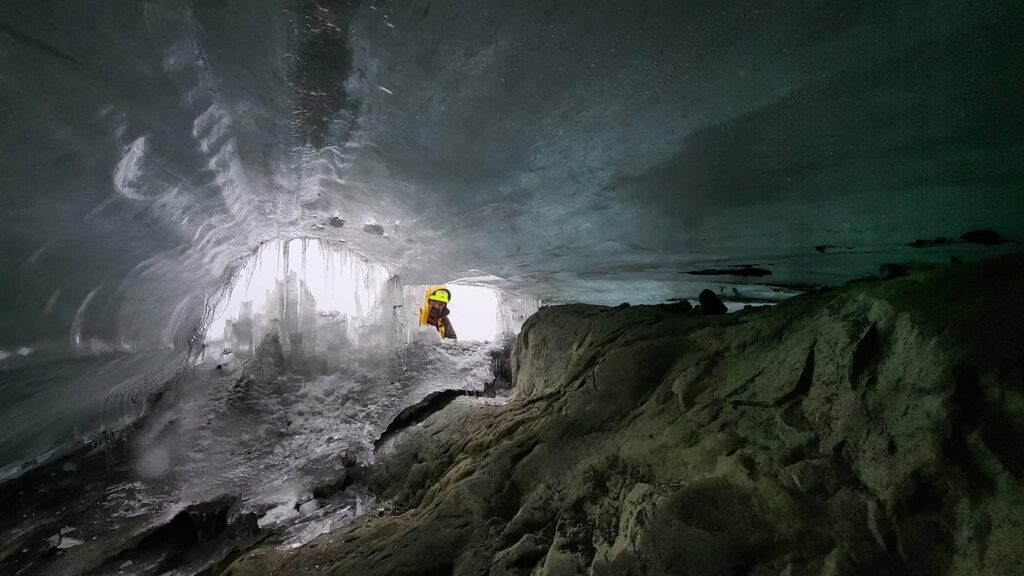
The primary safety considerations in wet season conditions are hypothermia, slips and falls on wet terrain, bog navigation errors, and the reduced reliability of river crossings on high-rainfall days. The most unexpected risk among these is hypothermia. The combination of cold, wind, and sustained wetness at altitude creates conditions in which body temperature can drop faster than most trekkers expect, particularly above 3,000 meters, where temperatures can fall well below 5°C even in the afternoon and drop to around or below freezing at night. Our complete medical guide to trekking the Rwenzori Mountains covers hypothermia, trench foot, altitude sickness, and the other health considerations of extended wet-weather trekking in full detail, and we strongly recommend reading it before planning any Rwenzori itinerary.
Slips and falls on the Rwenzori’s steep, wet terrain are a more immediate concern in the rainy season than at any other time. The combination of wet rock, saturated roots, and muddy trail surfaces demands constant concentration and confident footwork. Such an event is not a reason to stay home; it is a reason to invest in proper footwear, use trekking poles diligently, and ensure your guide is someone who knows where the trail surface is reliable and where it is not. Our post, titled “Is It Safe to Trek the Rwenzori Mountains?” gives a thorough breakdown of the safety considerations across all seasons and trail conditions.
In summary, you can safely trek the Rwenzori in the rainy season if you are physically prepared, properly equipped, and accompanied by an experienced local guide who is familiar with the mountain in all conditions. These are not small caveats. But they are entirely achievable with the right planning.
What Is the Rainy Season in Rwenzori Actually Like? Zone by Zone.
The Montane Forest Zone (1,600m – 2,500m)
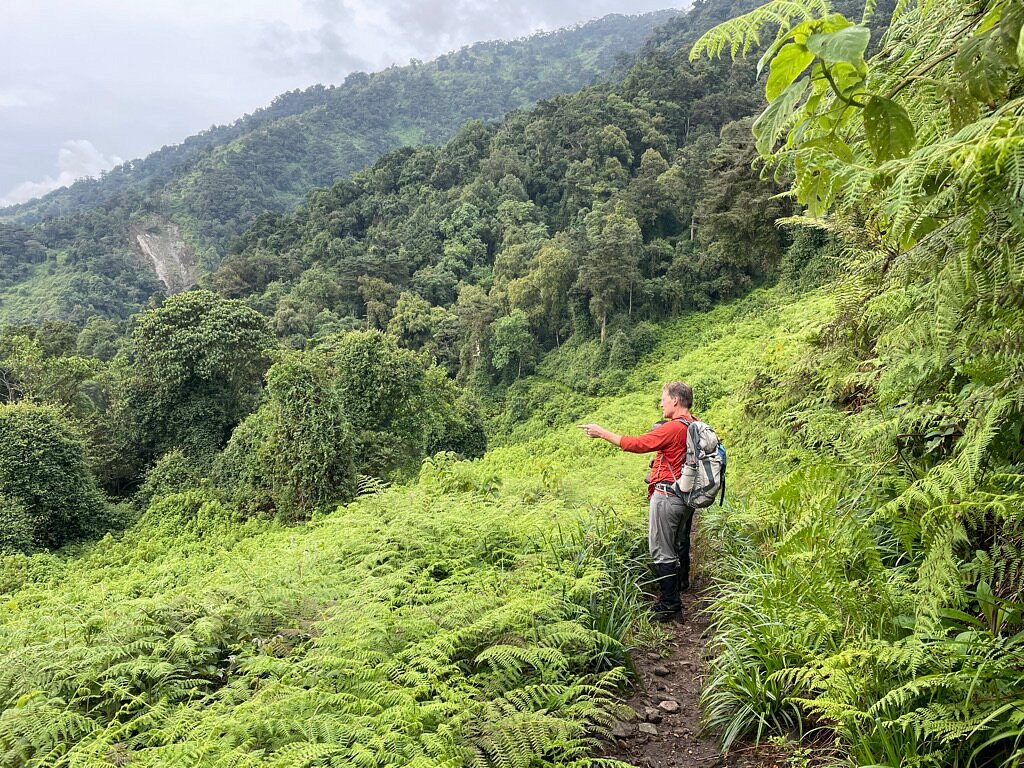
The rainy season montane forest is an experience that many trekkers describe as the most beautiful section of the entire mountain at any time of year, and it is the zone most dramatically transformed by wet season conditions. The waterfalls along the lower valley trails are in full, roaring flood. The canopy drips continuously, the mosses and ferns are saturated to a deep, electric green, and the forest floor is alive with the sound of water moving in every direction.
Trail surfaces in this zone can be genuinely difficult in the wet season. The red laterite mud becomes extremely slick when wet, and the roots crossing the path, which provide welcome grip in the dry season, become potential trip hazards when coated in moisture. Waterproof, ankle-supporting boots with a sturdy Vibram soles and full-length gaiters are essential from the first step. Trekking poles provide critical stability on descent.
For trekkers who want to experience the forest zone’s rainy season beauty without committing to a multi-day high-altitude push, several of our shorter treks operate entirely within this zone and are genuinely excellent in wet conditions. The 1-Day Nyabitaba Hike introduces the Central Circuit forest approach with a single uphill day to Nyabitaba Camp. The 2-Day Lake Mahoma Loop and 3-Day Mahoma Loop Hike both wind through spectacular crater lake country in the lower forest zone. The 4-Day Rwenzori Waterfalls Hike on the Kilembe Trail is, in particular, at its most spectacular in the rainy season; the cascade systems along this route are transformed from pleasant scenic features into genuinely awe-inspiring spectacles when the rains are running at full volume. The 2-Day Rwenzori Trek to Sine Camp and 3-Day Sine Camp & Samalira Falls Trek are two more options that work beautifully in wet conditions, keeping trekkers within the forest zone’s relative shelter.
The Heather and Moorland Zone (2,500m – 3,500m)
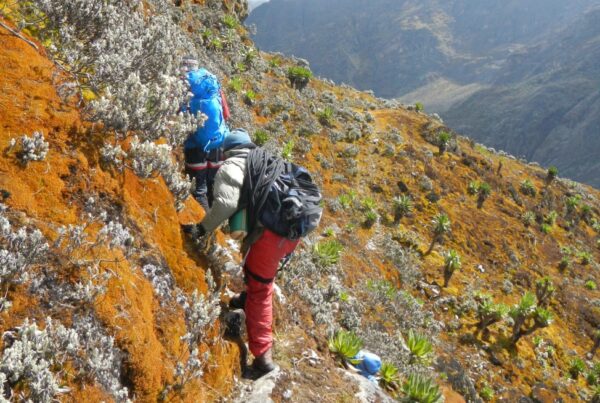
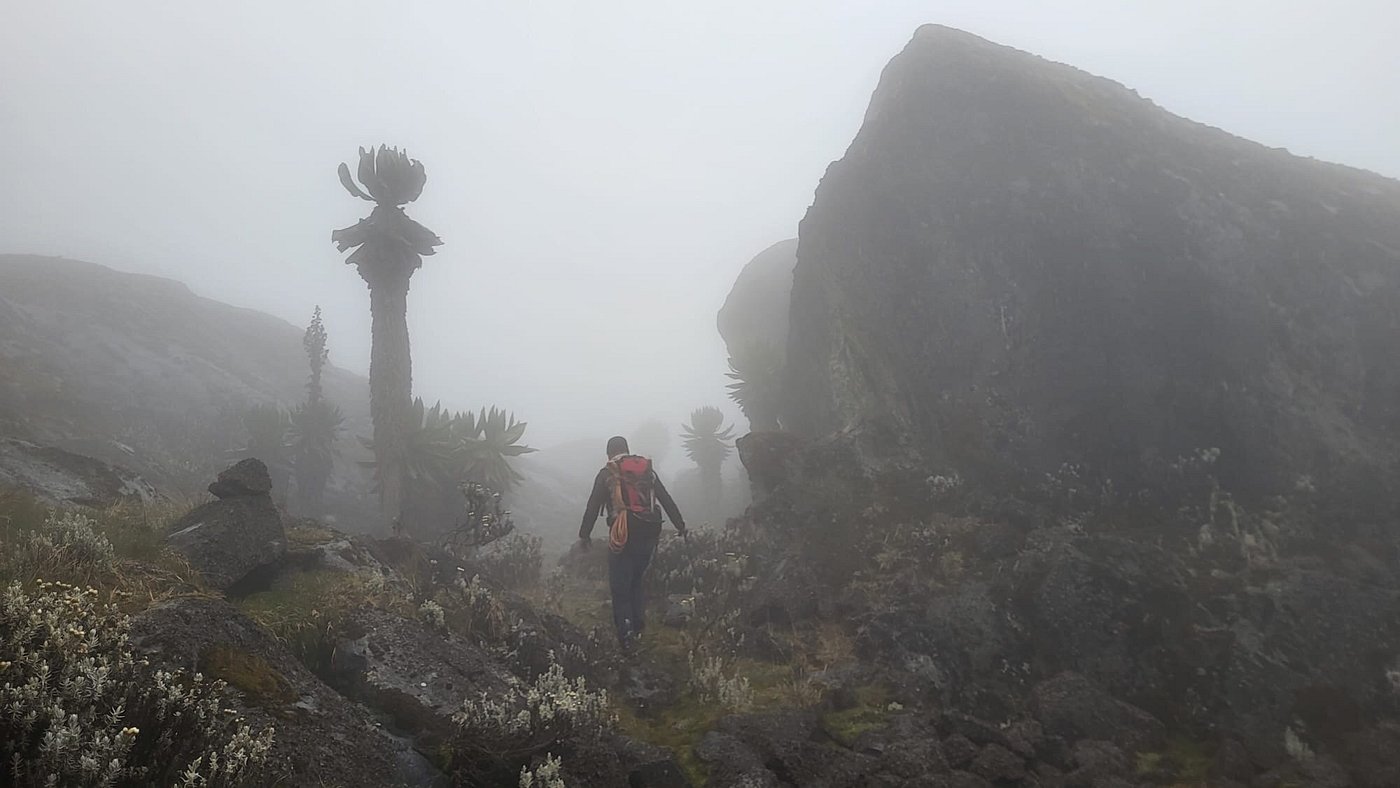
Above the treeline, the Rwenzori’s character makes the rainy season more difficult and intense. The giant heather trees, their twisted branches wrapped in thick moss and trailing lichen, are at their most atmospheric in mist and low cloud. The open moorland carries a haunted, otherworldly quality. In wet season conditions, visibility frequently drops to a few tens of meters, the air is saturated with fine mist even between rain showers, and the landscape takes on a silver-grey palette that is quite unlike anything the dry season offers.
This zone marks the beginning of the bogs, which reach their peak saturation during the rainy season. The Bigo Bog, which crosses the Central Circuit Trail at around 3,400 meters, can be a genuine physical challenge in wet conditions, soft enough to sink to the knee with a misplaced step, requiring careful attention to the firmer ground between the hummocks. An experienced guide is invaluable here, not because the route is unclear, but because knowing precisely where to place your foot in the bog comes from having crossed it dozens or hundreds of times in identical conditions. Temperature in this zone typically sits between 5°C and 15°C in the day, dropping sharply after dusk. Layers and fully waterproof outer shells are non-negotiable.
The Afro-Alpine Zone (3,500m – 4,500m)
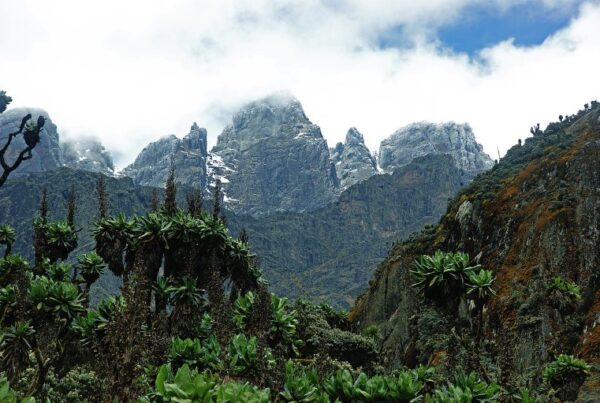
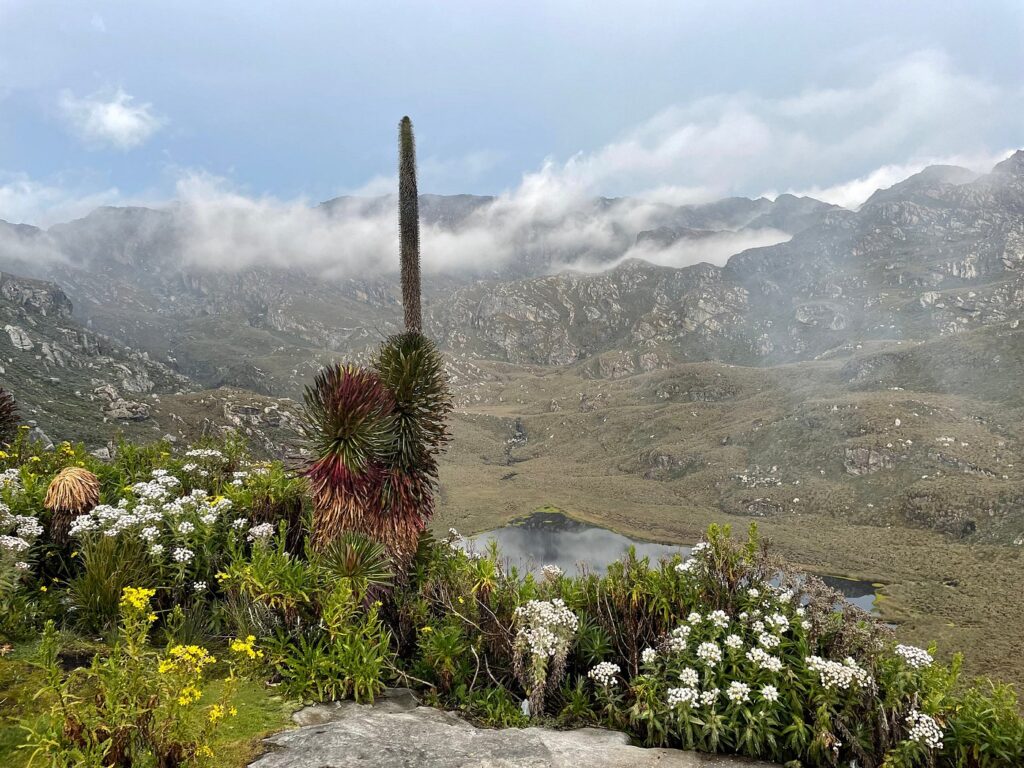
This is the zone where the rainy season in Rwenzori reaches the height of its visual drama. The giant groundsels (Senecio adnivalis) and giant lobelias (Lobelia wollastonii), which are key plants in the Rwenzori’s special Afro-alpine environment, are surrounded by mist and moisture during the rainy season, creating a dramatic scene with foggy valleys and rare The effect is genuinely surreal: a landscape that looks more like a painting of an alien world than a real mountain on Earth.
Rain in this zone arrives as cold, driving showers that can shift to sleet above 4,000 meters, particularly in the mornings and evenings. Wind becomes a meaningful factor for the first time, reducing the felt temperature substantially. Nights at camp are genuinely cold, frequently falling below freezing, and wet gear that has been worn all day must be managed carefully to prevent a cold, damp sleeping experience.
Our post on how to stay warm on the summit of Mount Rwenzori provides specific layering strategies and warmth management techniques that apply equally to the high moorland zone in wet conditions.
The Summit Zone (4,500m – 5,109m)
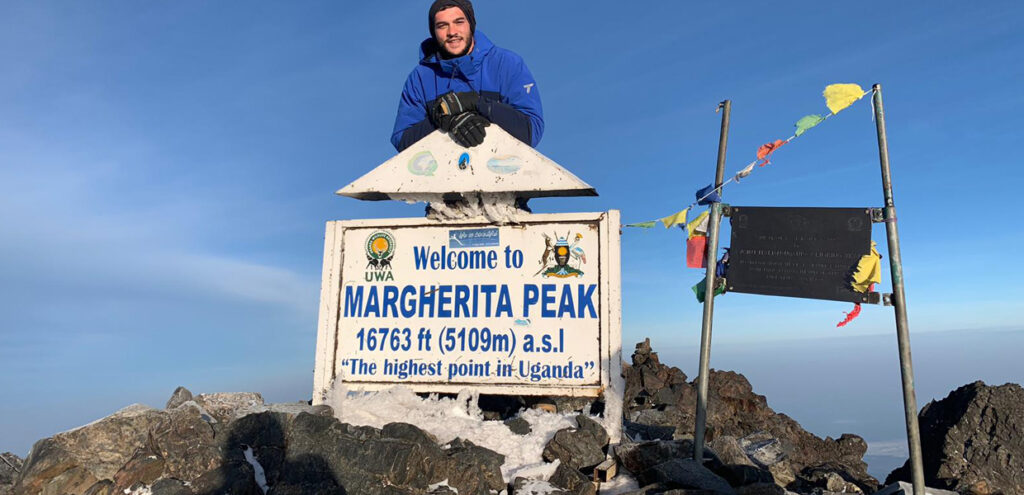
At the highest reaches of the Rwenzori approaching Margherita Peak on Mount Stanley, wet season conditions translate to increased snowfall on the summit ice fields, more frequent and sustained cloud cover, and a generally reduced window of clear sky for the final push. Summit success rates, which are never guaranteed on the Rwenzori in any season, are on average lower in the peak wet months of April and May than in the dry season. This disadvantage is not a reason to abandon a summit attempt during the rainy season; it is a reason to build flexibility into your itinerary, allow extra days at high altitude if your schedule permits, and trust a guide with genuine summit experience to read the conditions and advise you in real time.
Our post on what the success rate for summiting Margherita Peak actually is provides an honest, data-informed account of what to expect, and our post on how technical the climb to Margherita Peak is explains the summit approach in full.
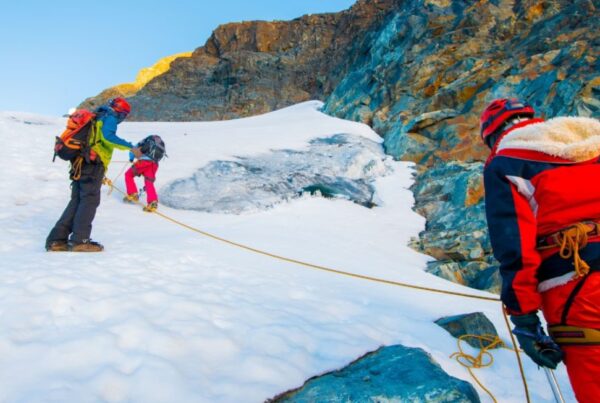
It is also worth knowing that even in the wet season, the summit zone requires basic technical equipment: crampons, an ice axe, and rope on the final ice section. Our gear guide, “Do I Need Crampons and Ropes for the Rwenzori?” outlines the specific equipment required and the services our team offers.
The Unexpected Advantages of Rainy Season Trekking
What the Wet Season Gives You That the Dry Season Cannot
Most discussions of rainy season trekking focus entirely on what you lose: predictable weather, firm trails, and summit views. Far fewer people talk honestly about what they gain. In our experience guiding clients through the Rwenzori in every season and every condition, the wet season offers a set of experiences that are simply not available in June or July, and for the right trekker they are worth every wet boot and muddy gaitered step.
It provides solitude and enhances the wilderness experience. The Rwenzori is never as crowded as Kilimanjaro, but during peak season the huts fill, the trails show regular foot traffic, and the mountain loses a fraction of its wild, untamed character. In the rainy season, particularly during April and May, you are unlikely to encounter any other trekking parties between the park gate and the high camps. The mountain belongs entirely to you, your guide, and your porters. Such an arrangement transforms the quality of the experience in ways that are difficult to fully express until you experience it: a profound silence on the moorland, a lack of performance, and an encounter with the mountain entirely according to its terms.
The full drama of the Rwenzori’s water systems unfolds before you. The Rwenzori Mountains are the source of a significant portion of the River Nile’s flow, and during the rainy season, this hydrological power is visible everywhere. Waterfalls that are modest trickles in July become thundering curtains of white water in April. The rivers crossing the valley floors run fast and full. The bogs pulsate with movement. The sound of water in all its forms, from the drip of a canopy to the roar of a cascade, is a constant, enveloping presence. Trekkers, moved by the relationship between mountains and water, find this mountain at its most compelling.
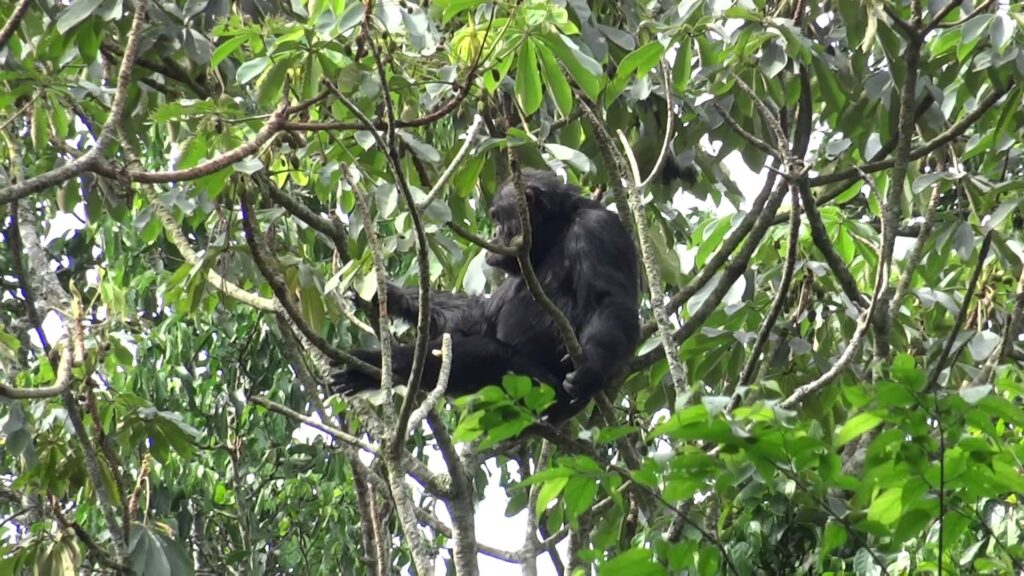
The intensity of wildlife and botanical diversity is unparalleled. The Rwenzori’s extraordinary endemic wildlife is, in many respects, more active and visible in the wet season than in the dry. The forest birds are highly active in the breeding season that overlaps with the rains. The forest mammals: chimpanzees audible in the canopy above the Diamond Trail, Rwenzori colobus monkeys in the upper forest, and L’Hoest’s monkeys picking their way through the undergrowth move with more energy in the cooler, wetter conditions. The afro-alpine flora is, quite simply, at its most spectacular when wet, each individual groundsel and lobelia rendered in crystalline detail by the moisture. Our comprehensive Rwenzori Mountains wildlife guide explains the full biodiversity of the mountain’s ecological zones in detail.
The rainy season offers lower costs and greater availability. The rainy season is, for practical purposes, the Rwenzori’s low season, and this has financial implications for trekkers. While our guide and porter rates reflect the expertise and effort required to manage wet season conditions, the overall cost of a Rwenzori trek in the rainy season is generally more accessible than in peak season. Hut availability is immediate. You can more easily assemble porter and guide teams. And for those combining the Rwenzori with other Uganda wildlife experiences, the rainy season aligns with the low-season discount periods for mountain gorilla permits and chimpanzee tracking. Our guides on Uganda low-season gorilla permits and Uganda low-season chimpanzee permits explain how to save $200 per permit by timing your visit to the April–May and November windows, which align precisely with the rainy season on the Rwenzori.
Which Routes Work Best in the Rainy Season?
Matching Route to Conditions
Not every Rwenzori route performs equally in wet season conditions. The choice of trail in the rainy season is one of the most important decisions in your planning process, and it is one where guide experience is invaluable. Here is how each of the mountain’s primary routes compares during the rainy season.
The Central Circuit Trail in the Rainy Season
The Central Circuit Trail remains the most manageable route for rainy season summit attempts, principally because its hut infrastructure provides reliable shelter at the end of each day. The trail itself is technically straightforward in terms of route-finding, which matters significantly when mist reduces visibility on the upper mountain. The key challenges are the Bigo Bog section and the river crossings on the lower trail, both of which are substantially more demanding in the wet season than the dry. With an experienced guide, both are manageable with appropriate footwear and care. Our 7-day Central Circuit trek is the itinerary we most frequently recommend for wet season summit aspirants, though we often suggest building in an extra day of buffer at the high camps to allow for a weather window on summit day.
The Kilembe Trail in the Rainy Season
The Kilembe Trail is a more demanding proposition in wet season conditions. Its steeper ascent profiles and more remote character make it less forgiving of slippery surfaces, and its drainage patterns mean that trail sections can accumulate standing water after sustained rain. That said, the Kilembe route’s waterfall systems are among the most spectacular on the entire mountain in the rainy season, a fact that makes it particularly attractive for lower-altitude trekkers pleased to stay within the forest and moorland zones. For those targeting the summit via Kilembe, our 8-day Kilembe Trail expedition includes the additional time required to manage wet season ascent rates carefully.
The Bukurungu Trail in the Rainy Season.
In the rainy season, the Bukurungu Trail is an option only for experienced wilderness hikers who are explicitly comfortable with remote, challenging conditions and have a strong guide with specific Bukurungu experience in the wet. Its spectacular glacial lakes and absence of other trekkers make it uniquely compelling, but its trail drainage, remoteness, and technical sections demand a higher baseline of experience than any other Rwenzori route in wet conditions.
The Diamond Trail in the Rainy Season
The Diamond Trail, operating in the lower montane forest zone and designed around chimpanzee watching and forest ecology, is arguably at its best in the rainy season. The forest canopy provides significant shelter from rainfall, the wildlife is highly active, and the trail’s lower altitude means cold is less of a concern. The Diamond Trail is a superb option for trekkers with limited days who visit during the wet season or for those looking to combine a lower-altitude Rwenzori forest experience with an extended Uganda safari.
Our Expert Guidance on Route Selection
If you are uncertain which route matches your fitness level, experience, and rainy season window, our detailed post, What Is the Best Route for Trekking the Rwenzori Mountains? provides an honest expert comparison. You can also check our Routes & Dates page for current availability and our FAQ page for the most common route and season planning questions we receive.
The Best Rainy Season Trek Lengths and Itineraries
Short Treks: High Value, Lower Risk, Maximum Atmosphere
For trekkers who want the rainy season Rwenzori experience without committing to a full multi-day summit push, our shorter forest and lower-mountain itineraries offer exceptional value in wet conditions. These treks operate entirely or primarily within the montane forest zone, where the rainy season scenery is at its most spectacular and the comfort gap between wet and dry conditions is smallest.
The 4-Day Rwenzori Waterfalls Hike on the Kilembe Trail is our most popular short wet season option; the cascade systems along this route are simply breathtaking when the rains are in full force, and the trek stays well within the forest zone where shelter and warmth are manageable. The 4-Day Rwenzori Trek to Mutinda Lookout reaches dramatic highland viewpoints from the Kilembe side while remaining in or just above the upper forest. The 2-Day Lake Mahoma Loop is ideal for trekkers with a single overnight option, combining a forest trail with the spectacular Mahoma crater lake. For the most compact introduction, the 1-Day Nyabitaba Hike on the Central Circuit is a physically rewarding single-day forest ascent that gives a genuine sense of the Rwenzori’s character in any weather condition.
Summit Itineraries in the Rainy Season
For trekkers committed to a summit attempt during the rainy season, the key principle is more days, not fewer. The most common mistake made by wet season summit aspirants is under-scheduling, arriving at the mountain with a compressed itinerary that leaves no room for a weather window delay on the final push. In the dry season, a tightly paced seven-day itinerary can be sufficient. In the rainy season, we strongly recommend at least eight days for Central Circuit summit attempts and suggest considering our 8-day 3-Peaks Trek or the 8-day Kilembe Trail expedition as the minimum comfortable frameworks for a serious wet season summit push.
For those with more time, and we always encourage more time on the Rwenzori rather than less, our 10-day 4-Peaks Trek covering Margherita, Speke, Weismann, and Baker builds in the most natural altitude acclimatization profile and the greatest flexibility for weather delays. And for those who genuinely want the definitive Rwenzori mountaineering experience regardless of season, our 13-day 6-Peaks Expedition across all six of the range’s major massifs Mount Stanley, Mount Speke, Mount Baker, Mount Emin, Mount Gessi, and Mount Luigi di Savoia is possible in the rainy season with appropriate experience and an expert team. All packages are detailed on our Treks page.
Who Is Rainy Season Trekking Right For?
The Profile of the Ideal Wet Season Rwenzori Trekker
Rainy season trekking on the Rwenzori is a worthy alternative for trekkers who couldn’t make it in June. It is a deliberate choice that suits a specific kind of adventurer, and recognizing whether you are that person is genuinely important before committing to a wet season trip.

The ideal wet-season Rwenzori trekker is someone who has previous multi-day hiking experience at altitude and is genuinely comfortable with sustained physical effort in cold, wet conditions. They understand that discomfort is part of the experience and are not seeking to minimize it but to manage it intelligently. They are drawn to the idea of having the mountain to themselves. They are curious about ecology and find the Rwenzori’s extreme botanical world as compelling as the summit view. And they are willing to invest in the gear and preparation that wet season trekking requires, rather than hoping adequate equipment will be available on arrival, because proper gear is essential for safety and comfort in the challenging conditions of the Rwenzori Mountains.
If you are a first-time high-altitude trekker, we would generally recommend beginning your Rwenzori experience in the dry season before returning for a wet season ascent. Our post Can Beginners Climb the Rwenzori Mountains? addresses first-timer suitability in full, and How Hard Is Trekking the Rwenzori Mountains? gives a candid account of the physical and psychological demands across all conditions. For shorter, lower-altitude options that work well as first Rwenzori experiences even in the wet season, our forest treks described above are absolutely achievable for motivated beginners with reasonable fitness. Our guide on whether you need to be very fit to climb the Rwenzori gives a realistic assessment of the fitness requirements at different trek levels.
Essential Gear for Rainy Season Trekking
No Piece of Kit Matters More Than Your Waterproofing
If there is a single principle that governs rainy season gear selection on the Rwenzori, it is this: assume you will be wet, and plan your entire kit around staying functional and warm despite that wetness. This is a fundamentally different gear philosophy from dry season trekking, where waterproofing is important but occasionally optional. In the rainy season, waterproofing is the non-negotiable foundation of everything else.

Your waterproof jacket must be fully seam-sealed and genuinely breathable; cheap, unventilated waterproofs will soak you from the inside with sweat as thoroughly as the rain soaks you from the outside and be fitted with a stiff-peaked hood that keeps driving rain off your face. Waterproof trousers, full-length gaiters, and waterproof gloves complete the outer shell. Base layers must be merino wool or high-quality synthetic fabrics; cotton is actively dangerous in sustained wet cold conditions, absorbing moisture, losing all insulating value, and accelerating hypothermia. Your mid-layer insulation should be synthetic rather than down in the wet season: down, which is made from the soft feathers of ducks or geese, collapses and loses its loft when wet, while synthetic insulation retains meaningful warmth even when damp.
Footwear deserves particular attention. The Rwenzori’s wet season terrain, which includes slick clay trails, saturated bog, and wet root systems, demands a boot with the highest possible level of waterproofing, a Vibram-class outsole with deep lugs for grip, and firm ankle support to manage the constant instability of uneven bog terrain. Gaiters should extend over the full calf. Trekking poles are not optional gear in the rainy season; they are foundational safety equipment on descent and bog crossings.
Your sleeping bag should be rated to at least -5°C and stored at all times in a waterproof compression sack inside a waterproof liner inside your pack. Dry layers for camp: a completely separate set of thermals, socks, and mid-layers kept sealed and dry throughout the hiking day transform the quality of your evenings and your recovery at altitude. Our post on how to stay warm on the summit of Mount Rwenzori covers the full layering system in detail, and our complete medical guide addresses the physiological management of cold and wet conditions, including the early signs of hypothermia and trench foot that every wet season trekker should know how to recognize.
Cost, Planning, and How Long It Takes
Budgeting for a Rainy Season Trek
The overall cost of a Rwenzori trek in the rainy season follows the same core structure as a dry season trip: park fees, guide and porter rates, hut accommodation, and equipment. Our complete cost breakdown for climbing the Rwenzori Mountains gives a thorough overview of all costs across different trek lengths and styles. In general, the rainy season does not dramatically change the per-day cost of the trek itself, but it often reduces ancillary travel costs by virtue of being Uganda’s low season; flights, accommodation in Kasese, and non-trekking elements of your trip tend to be more competitively priced.
The financial case for combining a wet season Rwenzori trek with gorilla or chimpanzee trekking is particularly compelling. The April–May and November low seasons offer discounts of $200 per permit for both mountain gorillas and chimpanzees, providing significant savings on a premium wildlife experience, and the logistics of combining these activities align naturally with a Rwenzori trip that departs from or returns through Kampala.
How many days does a rainy season trek take?
The honest answer is slightly more than a dry season hike of equivalent ambition. In terms of pure trek duration, our packages run from the single-day Nyabitaba Hike all the way to the 13-day 6-Peaks Expedition. For summit aspirants in the rainy season, we typically recommend adding one to two additional days compared to the dry season minimum, both to allow for slower daily progress on more demanding trail surfaces and to build in weather window flexibility near the summit. Our comprehensive post on how long it takes to climb the Rwenzori Mountains and how many days it takes to reach Margherita Peak gives detailed timeline guidance across different trek styles.
The Rwenzori in the Rainy Season: One More Reason Not to Wait
There is something else worth saying about rainy season trekking on the Rwenzori that does not fit neatly into any category: the mountain’s glaciers are disappearing. Our post, “Why the Rwenzori Glaciers Are Disappearing,” tells this story with the scientific detail it deserves, but the summary is stark. The Rwenzori’s equatorial ice fields have shrunk by more than 80 percent since the early twentieth century and may be entirely gone within the next ten to fifteen years.
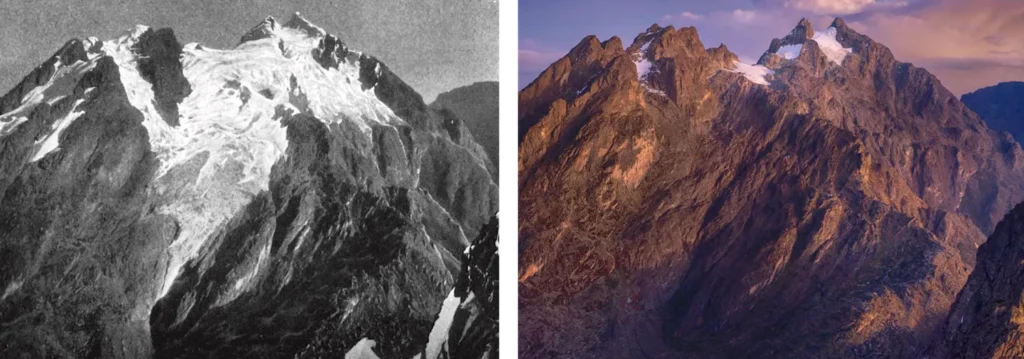
Every Rwenzori summit, in any season, carries the weight of that knowledge. The Rwenzori’s water cycle, which has been feeding those glaciers for millennia, exerts its most powerful influence during the rainy season. There is something meaningful about standing in the rain on the upper mountain, watching the mist pour off the Stanley massif, and understanding that you are witnessing a landscape in its final chapter.
If you want to know why this range has captured the imagination of geographers and explorers for two thousand years, the rainy season version of the Rwenzori makes the answer viscerally clear.
Frequently Asked Questions: Rainy Season Trekking on the Rwenzori
Can I reach Margherita Peak during the rainy season?
Yes, it is possible to summit Margherita Peak on Mount Stanley during the rainy season, but success rates are lower than in the dry season windows, and the experience is considerably more demanding due to slippery trails and reduced visibility caused by heavy rainfall. The key factors are guide experience, a flexible itinerary with buffer days built in, and high-quality gear. We recommend a minimum of eight days for any rainy season summit attempt and advise trekkers to read our posts on summit success rates and how technical the climb is before committing to a summit itinerary.
Which months are the wettest on the Rwenzori?
April and May are typically the wettest months, coinciding with East Africa’s long rains. October and early November are the next most active wet period. Within these windows, afternoon and overnight rainfall is most frequent and intense. The least wet period of the rainy season is typically late September and late October, when conditions are wet but tend toward shorter, sharper rain events rather than sustained multi-day downpours.
Are the mountain huts open during the rainy season?
Yes. The hut system on the Central Circuit Trail and Kilembe Trail operates year-round. The advantage of trekking in the rainy season is that hut availability is essentially unrestricted; you will rarely encounter other parties competing for sleeping space. Our team handles all hut bookings and park fees as part of your Rwenzori trekking package.
Will it be cold? How should I prepare for the temperature?
Indeed, the rainy season’s wetness significantly exacerbates the cold. At forest level, temperatures are tolerable (15°C–24°C), but above 3,000 meters, cold becomes a meaningful management challenge, particularly at night when temperatures can drop to or below freezing. We strongly recommend reading our complete medical guide before departure and following our layering guidance to stay warm on the summit. We cover proper gear selection in detail in our post on crampons and technical gear requirements.
Is the rainy season in Rwenzori suitable for beginners?
Shorter, lower-altitude rainy season treks such as the forest waterfall hikes on the Kilembe Trail or the Lake Mahoma routes are achievable for motivated beginners with adequate baseline fitness and appropriate gear. Full summit itineraries in the rainy season are not recommended for first-time high-altitude trekkers due to the challenging weather conditions and increased risk of altitude sickness, which can be particularly difficult for those without prior experience.
Our post Can Beginners Climb the Rwenzori Mountains? And our fitness guide will help you assess your readiness. Our team is also available for a direct, honest assessment; contact us, and we will tell you clearly what is realistic for your profile.
How is the wildlife viewing during the rainy season?
Wildlife viewing in the Rwenzori is genuinely excellent in the rainy season, particularly in the forest and lower moorland zones. The forest bird species are most vocal and active, chimpanzees are frequently audible and sometimes visible from the Diamond Trail, and the botanical spectacle of the Afro-alpine zone, including giant groundsels, lobelias, and mossy heathers, is at its most lush and vivid. Our detailed Rwenzori Mountains wildlife guide explains the full biodiversity of each ecological zone and what to look for in different seasons.
Our post, “Are There Gorillas in the Rwenzori Mountains?” directly answers the common question of whether gorillas live in the Rwenzori. But for those who want gorilla trekking as part of their Uganda trip, it can easily be combined via Bwindi Impenetrable National Park.
How does the rainy season’s Rwenzori trekking compare to Kilimanjaro?
The Rwenzori is generally considered harder than Kilimanjaro in any season, and the difficulty gap widens in the wet season. However, for trekkers who have completed Kilimanjaro and are looking for a more immersive, challenging, and less crowded African mountain experience, the rainy season in Rwenzori offers something uniquely compelling.
Our detailed comparison, Is the Rwenzori Harder Than Kilimanjaro?, and our broader three-peak comparison, Kilimanjaro vs Mount Kenya vs the Rwenzori Mountains, give thorough, honest assessments.
What is the best short trek for the rainy season?
The 4-Day Rwenzori Waterfalls Hike on the Kilembe Trail is our most recommended short trek for the rainy season. The cascade systems are at their spectacular peak in wet conditions, the trek stays in the forest zone, where conditions are most manageable, and the experience is genuinely extraordinary in any weather. The 2-Day Lake Mahoma Loop is an excellent option for trekkers with a single overnight. Browse all short options on our Treks page.
How should I plan my Uganda trip if I’m trekking the Rwenzori in the rainy season?
The rainy season aligns with Uganda’s low season for gorilla and chimpanzee trekking, which means it is the perfect time to combine the Rwenzori with discounted wildlife experiences. April, May, and November all qualify for the low-season permit rates. Our guides on gorilla permit pricing and chimpanzee permit pricing cover the details. Our team specializes in building integrated Uganda itineraries that combine the Rwenzori with the best of the country’s wider safari and wildlife experiences. Contact us to discuss how we can build yours.
Start Planning Your Rainy Season Trek
Solving the rain problem on the Rwenzori is not necessary. It is the mountain’s oldest and most fundamental feature, the force that built the bogs, fed the glaciers, grew the giant groundsels, and made this range one of the most ecologically extraordinary places on the face of the Earth. Trekking in it with open eyes, proper preparation, and an expert guide is making the best of a difficult situation. It is about experiencing the mountain as it truly is.
Our team at Rwenzori Trekking Safaris has guided trekkers through the Rwenzori in every season, every condition, and every ecological zone. We do not offer generic group departures or fixed itineraries that require you to adapt yourself to someone else’s plan. We tailor each trek to the individual participant, taking into account their experience, fitness level, goals, and tolerance for the unique delights of a truly wet mountain.
Whether you want a short forest adventure in the waterfall-heavy lower zones, a comfortable mid-mountain journey through the moorland and Afro-alpine zones, or a full summit push to Margherita Peak in the heart of the long rains, we will build you the right plan and put the right guide beside you to carry it out.
Ready to Trek the Rwenzori in the Rainy Season?
Please reach out to the Rwenzori Trekking Safaris team today and share your preferred dates, experience level, and what you hope to experience. We respond to every inquiry personally, usually within a few minutes, and we will give you an honest assessment of what your window allows and what it takes to make the most of it.
You can also explore our full trek catalogue, browse all routes and available dates, read our FAQs, learn about our guides and guiding philosophy, or dive deeper into the mountain itself through our Rwenzori Mountains overview and blog before reaching out. The mountain is waiting for rain and other weather.