Are you considering a trek through the Rwenzori Mountains? Learn exactly how much it rains, the best seasons to go, altitude-by-altitude weather breakdowns, essential gear, and expert insider tips from Rwenzori Trekking Safaris. Book your custom trek today.
There is a question that almost every trekker asks before setting foot on the Rwenzori Mountains, and it usually sounds something like this: “I’ve heard it rains constantly up there; should I even bother?” The answer, from someone who has guided hundreds of climbers through these ancient peaks, is both more nuanced and more exciting than a simple yes or no. Yes, the Rwenzori Mountains are wet. The Rwenzori Mountains are profoundly, gloriously, and ferociously wet. But that wetness is not a deterrent; it is the very force that sculpts the mountain’s extraordinary character, the reason its landscapes look like nothing else on Earth, and the source of the dramatic beauty that draws serious trekkers away from the well-trodden paths of Kilimanjaro and the Simien Mountains.
The Rwenzori Mountains, straddling the border between Uganda and the Democratic Republic of Congo, have been soaking adventurers to the bone and rewarding them with transcendent alpine experiences for well over a century. Known since antiquity as the Mountains of the Moon, a name given by the Greek geographer Ptolemy, who documented them around 150 AD, these peaks were once believed to be the mythical source of the River Nile. Today, they are known for something equally legendary among the world’s hiking community: their relentless, moody, theatrical rainfall.
But here is what separates a mediocre experience from an unforgettable one on the Rwenzori: it is not about avoiding the rain; it is about understanding it, preparing for it, and choosing the right guide to lead you through it. This is not a mountain for the traveler who wants a polished, generic group tour. This is a mountain for the curious, the committed, and those who hunger for a deeply personalized, expert-led experience in one of Africa’s last truly wild high-altitude environments.
This guide will help you plan a custom Rwenzori trek by explaining the mountain’s weather patterns and how to use them.
Understanding the Rwenzori’s Rainfall: Why These Mountains Are So Wet.
The Geography of Perpetual Rain
To understand why the Rwenzori Mountains receive so much rainfall, you have to understand their geography. Sitting almost precisely on the Equator between roughly 0°22’N and 0°23’S latitude, the Rwenzori range rises dramatically from the floor of the Western Rift Valley, with Margherita Peak on Mount Stanley reaching 5,109 meters above sea level. This positioning is not incidental. The mountains sit at the precise intersection of equatorial moisture-laden air masses sweeping in from the Congo Basin to the west and the drier continental air masses of East Africa to the east.
As these massive bodies of warm, humid air rise to meet the mountain’s flanks, they cool rapidly, condense, and fall as rain, mist, and sleet, and near the summit, as snow and ice. The Rwenzori is not merely a mountain that receives rainfall; it is effectively a cloud-manufacturing machine, a vertical weather generator that pulls moisture from one of the most humid regions on the planet and wrings it out across its slopes continuously, season after season, decade after decade.
The average annual precipitation on the lower slopes hovers around 2,500 to 3,000 millimeters per year. As you gain altitude in the afro-alpine zone above 3,500 meters, that figure can exceed 4,000 millimeters in a single year. To put that in perspective, London, a city famous for its grey, drizzly climate, receives an average of just 601 millimeters of rainfall annually. The Rwenzori receives six to seven times that amount, concentrated onto mountain slopes dense with giant lobelias and groundsels, over bottomless bogs and mossy forest floors that have been absorbing rainfall for thousands of years.
The Rwenzori Mountains create their own weather.
One of the most important things a prospective trekker must understand is that the Rwenzori does not simply respond to regional weather patterns; it generates its own localized microclimate. On any given day, the valleys at 1,000 meters might be bathed in brilliant sunshine while the high moorlands at 4,000 meters are lashed by cold rain and fog. Conditions can change within the space of an hour, sometimes within minutes. A clear morning summit attempt can dissolve into a total whiteout by 10am. On the other hand, numerous trekkers have experienced drenching rain on the approach trail, only to emerge into a pristine, golden afternoon light upon reaching the ridge.
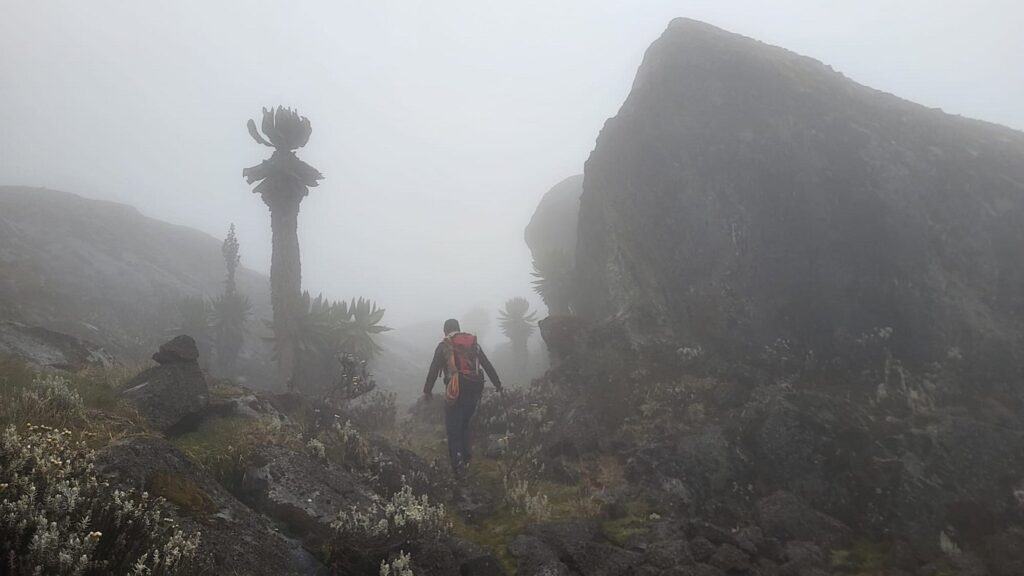
This unpredictability is not a flaw in the Rwenzori experience; it is the experience. The mountain’s character is defined by its moodiness, its sudden revelations of beauty, and its atmosphere of mystery. The ghostly giant heathers draped in lichen, the floating mists that turn the Bigo Bog into something from a dream, and the violent afternoon thunderstorms that roll up from the Congo Basin and electrify the sky over the ice fields these are the memories that trekkers carry for the rest of their lives. Our detailed Rwenzori Mountains overview explains more about the geology and ecology that make this weather system so unique.
When Does It Rain the Most? The Rwenzori’s Seasonal Patterns
Is there a dry season on the Rwenzori?
Technically, yes, though calling it a “dry season” requires some qualification, as it still experiences some rainfall during this time. The Rwenzori has two periods of relatively reduced rainfall that correspond broadly with East Africa’s dry seasons, and understanding these windows is essential for planning your trek. Our Routes & Dates provides current availability and recommended timing for each of the mountain’s primary trails.
The First Dry Window: December to February
The period from December through February is generally considered the drier of the Rwenzori’s two more settled seasons. Rainfall frequency drops compared to the peak wet months, and daytime temperatures on the lower slopes can be quite pleasant. The snowfields and glaciers on the upper mountain are more visible during this period, and summit success rates, meaning days on which Margherita Peak is at least partially clear, tend to be marginally better. However, trekkers should be prepared for cold nights at altitude, and precipitation never truly disappears on the Rwenzori, even during the driest months.
The Second Dry Window: June to August
Many experienced guides and veteran Rwenzori trekkers regard June through August as the single best period to attempt the mountain. The East African dry season is in full effect, temperatures are more consistent, and while rainfall remains a daily reality on the upper mountain, its intensity is typically reduced compared to the wet season months. Trail conditions, particularly through the infamous bog sections, are marginally firmer, and the window of clear weather at altitude is often wider in the afternoons. It is worth noting that June to August coincides with the peak of Uganda’s tourist season and gorilla trekking permits in Bwindi, so combining your Rwenzori trek with a broader Uganda safari during this window is particularly well-suited for international travelers.
The Wet Seasons: March to May and September to November
The two wet seasons, March through May and September through November, bring the Rwenzori’s rainfall to its most theatrical intensity. Trails through the montane forest zone become slippery rivers of red laterite mud. The bogs above the treeline turn from difficult to genuinely challenging, requiring careful foot placement with every step. Rain falls heavily most afternoons, and nights at altitude can be cold and wet even inside well-constructed huts.
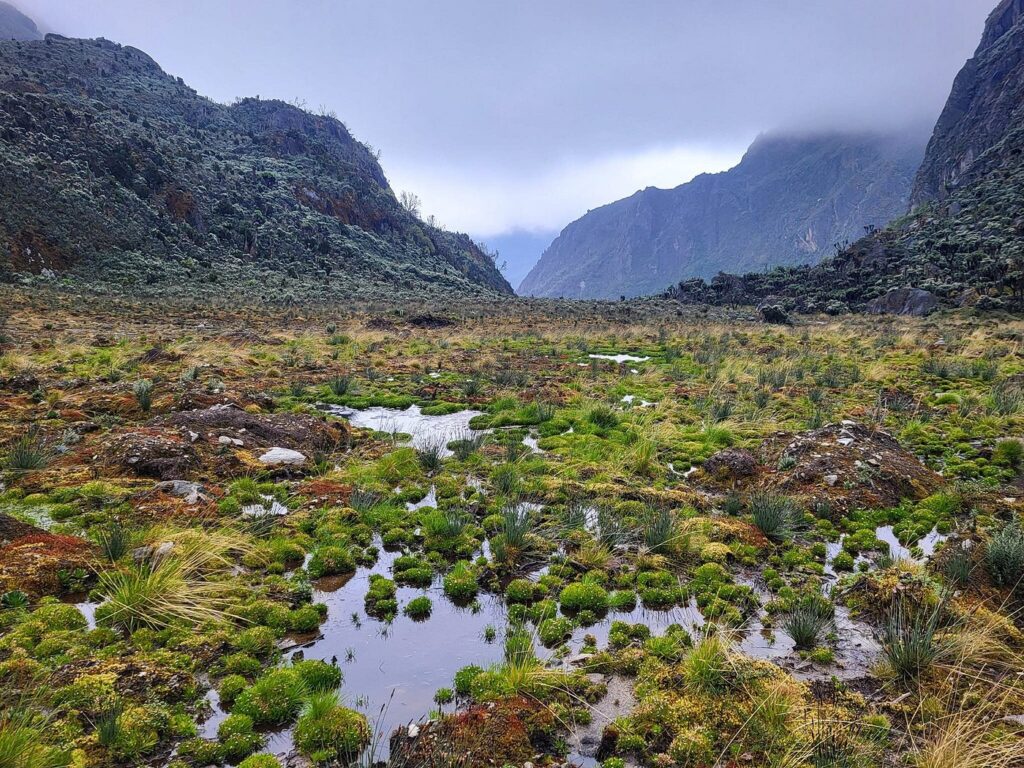
Many trekkers mistakenly believe that they should completely avoid the wet season. This is a misconception. For experienced trekkers with the right guide, the right gear, and the right mental attitude, the wet season in Rwenzori offers something that no other period can provide: an almost complete absence of other trekkers, a mountain that is vividly alive with rushing waterfalls and lush, saturated vegetation, and a sense of genuine wilderness that simply cannot be replicated in peak season. Our group hikes program operates year-round, but for wet season trekkers, we particularly recommend a private, customized itinerary. Speak to our team to discuss your options.
What the Rain Actually Feels Like: An Altitude-by-Altitude Breakdown
The Montane Forest Zone (1,600m – 2,500m)
Your trek through the Rwenzori begins in the montane forest zone, a dense, dripping world of giant ferns, tall trees festooned with orchids, and the constant background percussion of water in motion. Rain in this zone is warm by comparison with higher altitudes; temperatures typically range between 15°C and 24°C, and the canopy above provides intermittent shelter. However, the humidity is relentless, and even without active rainfall, moisture drips from every leaf and permeates the air. Waterproof gaiters are advisable from the very first step. The trail surfaces here can be deeply rutted and muddy, particularly in the wet season, and a knowledgeable local guide is invaluable for reading the conditions and knowing where the ground is safe to walk. Both the Central Circuit Trail and the Kilembe Trail begin with this forest ascent, though the vegetation profiles differ slightly between the two.
The Heather and Moorland Zone (2,500m – 3,500m)
Above the treeline, the character of the Rwenzori’s rainfall changes markedly. You come out from under the protective canopy and into open moorland where giant heather trees (Erica arborea) grow. These trees can grow to be more than six meters tall, and their gnarled branches are covered in thick mosses and trailing lichens. Rain here is colder and often accompanied by low clouds and mist. The temperature range in this zone sits between approximately 5°C and 15°C, dropping sharply after sunset. Afternoon rain showers are extremely common, often arriving with theatrical speed.
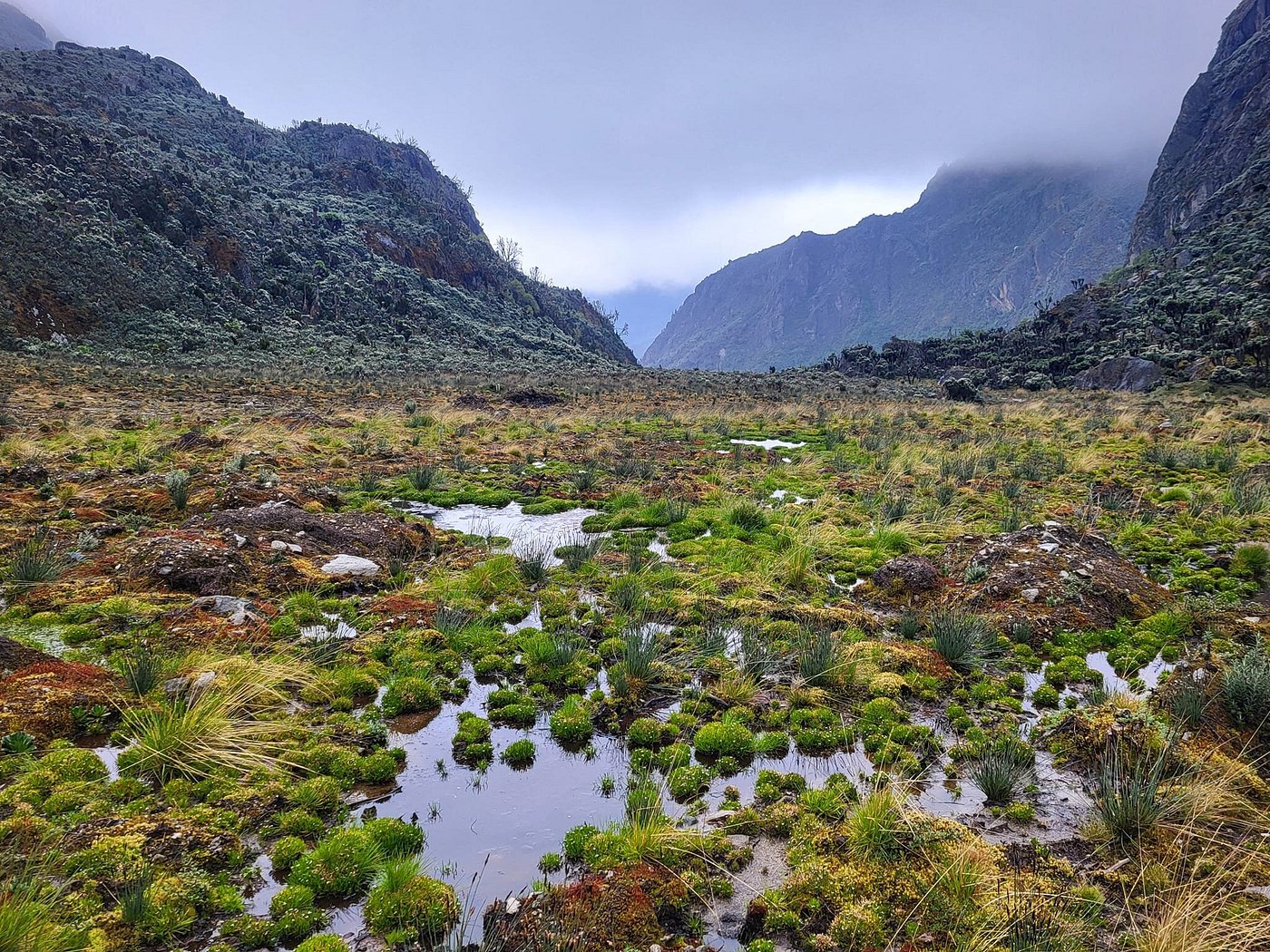
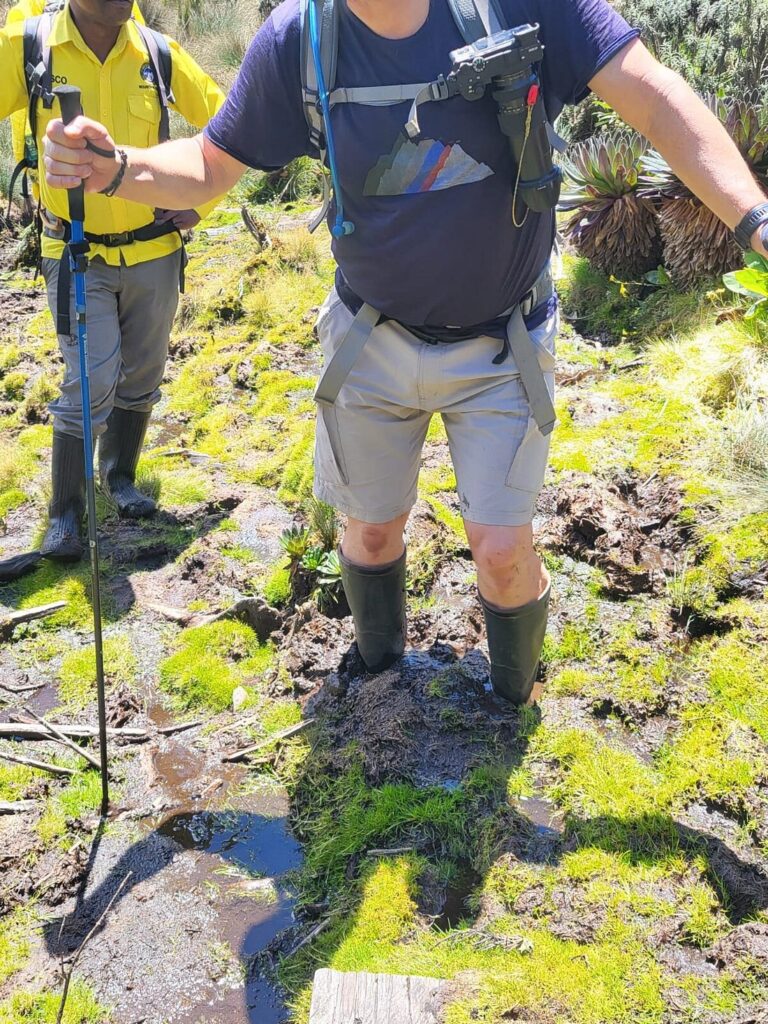
This location is also where the famous Rwenzori bogs begin vast, spongy peatlands that require careful navigation and are a characteristic feature of every route through the mountains, including the more remote Bukurungu Trail. A single misplaced step can sink you thigh-deep in cold, black bog water, and no amount of determination will keep you dry without waterproof trousers and sturdy gaiters.
The Afro-Alpine Zone (3,500m – 4,500m)
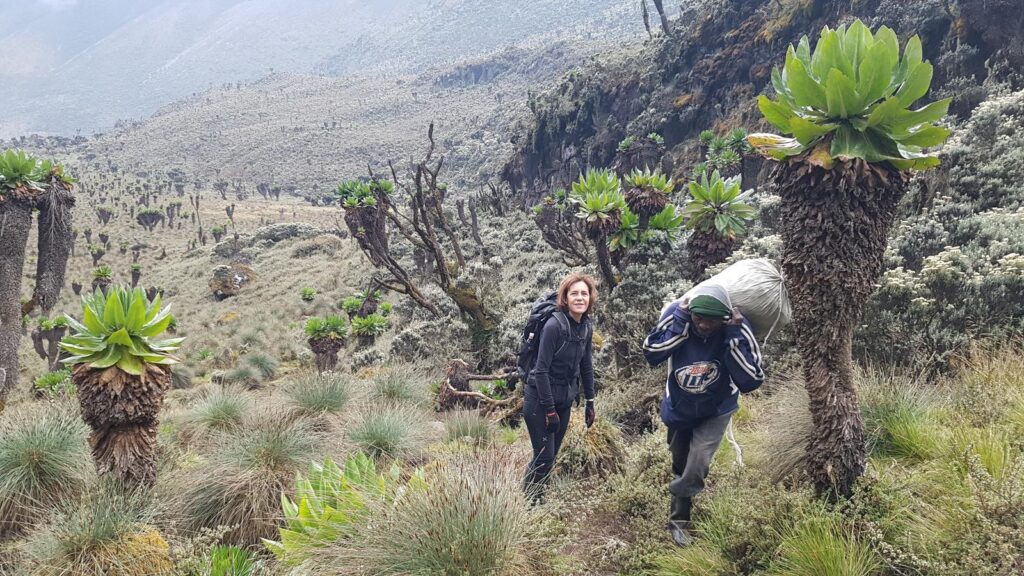
This is, arguably, the most visually astonishing rainfall environment on the entire mountain. Above 3,500 meters, the Rwenzori reveals its full botanical strangeness: giant groundsels (Senecio adnivalis) towering several meters above the ground, their cabbage-like rosettes wreathed in mist; giant lobelias (Lobelia wollastonii) standing like sentinels along the valley floors, their blue-green flower spikes pointing skyward into the clouds. Rain in this zone arrives as cold, driving showers that can shift to sleet or light snow above 4,000 meters. Wind becomes a significant factor for the first time. Nights are genuinely cold, often dropping to 0°C or below, and wet gear has very little opportunity to dry. The quality of your waterproof layers is not a luxury here; it is a survival consideration.
The Summit Zone (4,500m – 5,109m)
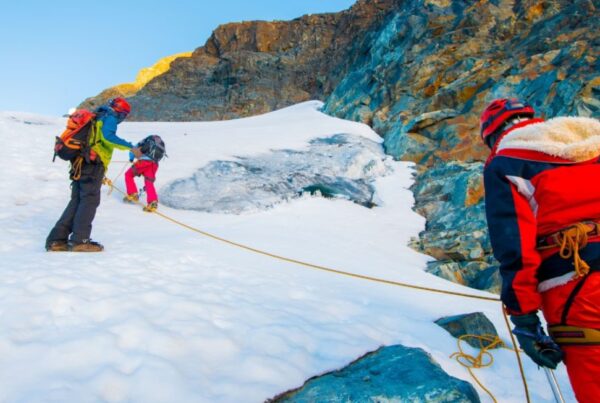
At the highest summit of the Rwenzori, rain becomes snow, ice, and unpredictable high-altitude weather systems that bear almost no resemblance to what you experienced on the lower mountain. The summit glaciers of Margherita Peak on Mount Stanley, now tragically retreating due to climate change, sit in a zone of permanent cold where precipitation takes every form imaginable. Clear summit mornings are possible, particularly in the drier windows, but they are never guaranteed. Reaching Margherita is less about picking a perfect weather day and more about placing yourself in position with enough flexibility in your itinerary to capitalize on a window when it arrives.
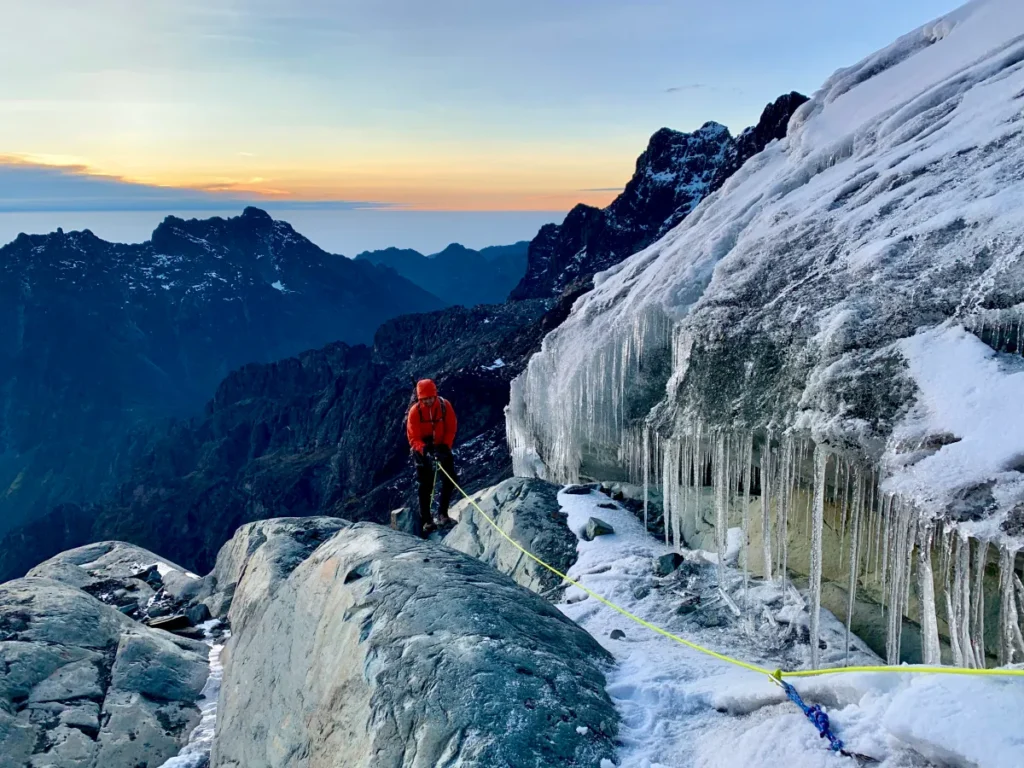
For a full technical breakdown of the summit approach, read our detailed post on how technical the climb to Margherita Peak really is.
What Kind of Trekker Is the Rwenzori Ideal For?
It Is Not a Mountain for Everyone and That Is Its Greatest Asset
Let us be direct: the Rwenzori Mountains are not Kilimanjaro. There are no crowds of trekkers stretching to the horizon in single file. There are no perfectly graded roads up to high camps. There are no trophy queues at the summit. The Rwenzori is a mountain for people who want something richer, more demanding, more intimate, and more genuinely wild than the well-packaged tick-box adventures that dominate the African trekking market.
If you want an honest, experienced comparison of the two mountains, our post Is the Rwenzori Harder Than Kilimanjaro? gives you a frank assessment based on real guiding experience.
The trekker who thrives on the Rwenzori is someone who does not need sunshine every day to feel rewarded. They are someone who finds beauty in difficulty, who can pull on a wet rain jacket at 4am, step out into cold mist, and feel grateful for being alive and in motion in such an extraordinary place. They are curious about ecology, fascinated by extreme botany, and moved by landscapes that look like they belong on another planet. They want a guide who knows them by name, understands their pace, knows their limitations, and adjusts the experience accordingly. Browse our full range of Rwenzori trekking packages to find the right fit, or explore our Rwenzori mountaineering program if a technical summit is your primary goal.
Fitness, Experience, and the Rain Factor
The rain on the Rwenzori is not the primary physical challenge of the mountain; rather, it is the terrain. The boggy ground, the steep ascents, and the altitude combine to make the Rwenzori objectively more technically demanding than many better-known African peaks. However, the rain meaningfully compounds every one of these challenges. Wet rock is slippery. Cold, wet clothing accelerates fatigue. Waterlogged boots add weight and reduce traction. Managing your body temperature in a constantly wet environment requires experience and good gear.
We always recommend that prospective trekkers have completed at least several multi-day hiking trips at altitude before attempting a full summit push. However, with the right guiding support, one can build fitness, source gear, and fill experience gaps, which can significantly enhance their chances of successfully summiting challenging peaks like the Rwenzori Mountains. Our post Can Beginners Climb the Rwenzori Mountains? addresses this question in full, including the realistic options available to first-timers. You can also check our FAQ page for the most common questions we receive about fitness and readiness, or contact us directly for a personalized assessment.
Choosing the Right Route in Wet Conditions
The Central Circuit Trail
The Central Circuit Trail is the most comprehensive and widely trekked route through the Rwenzori and the one most thoroughly suited to managing wet conditions with the support of established hut infrastructure. Starting from Nyakalengija, it loops through Nyabitaba, John Matte, Bujuku, Elena, and Kitandara camps before descending via Guy Yeoman. It passes through all five of the Rwenzori’s principal vegetation zones and gives trekkers the full arc of the rainfall experience, from humid forest dripping with epiphytes to the raw, windswept summit icefield. Our 7-day Rwenzori Central Circuit trek is the most popular itinerary for trekkers targeting Margherita Peak on this route.
The Kilembe Trail
The Kilembe Trail approaches the mountain from the south, starting near Kasese town, and is considered more physically demanding than the Central Circuit due to its steeper gradients and more remote character. In wet conditions, the Kilembe route’s steep ascents require particular care; trail surfaces can become genuinely slippery after rain, and route-finding in mist demands an experienced guide. For those with the fitness and appetite for a more challenging, less-travelled route, it is a profoundly rewarding experience. Our 8-day Kilembe Trail expedition provides the ideal framework for this ascent.
The Bukurungu Trail
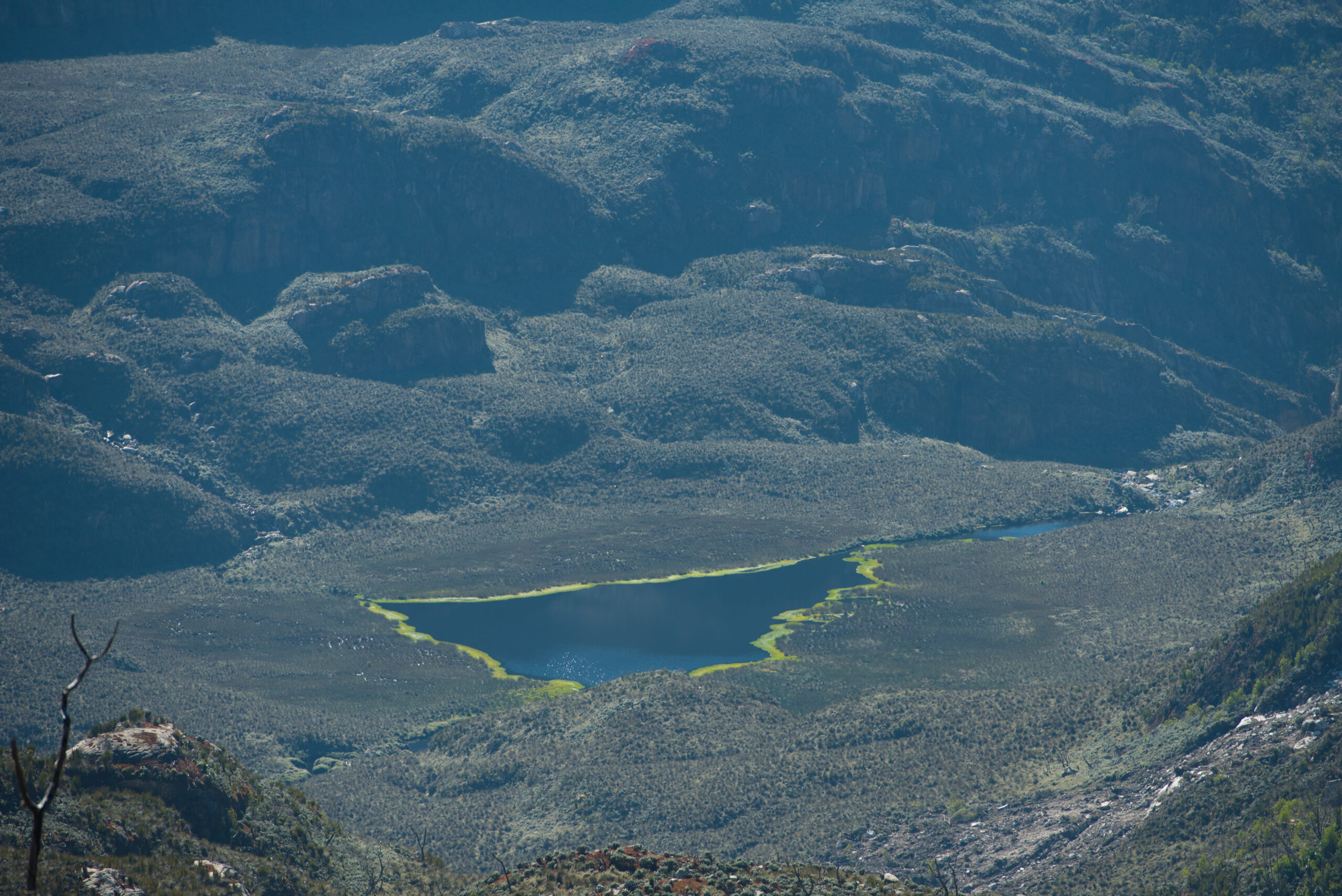
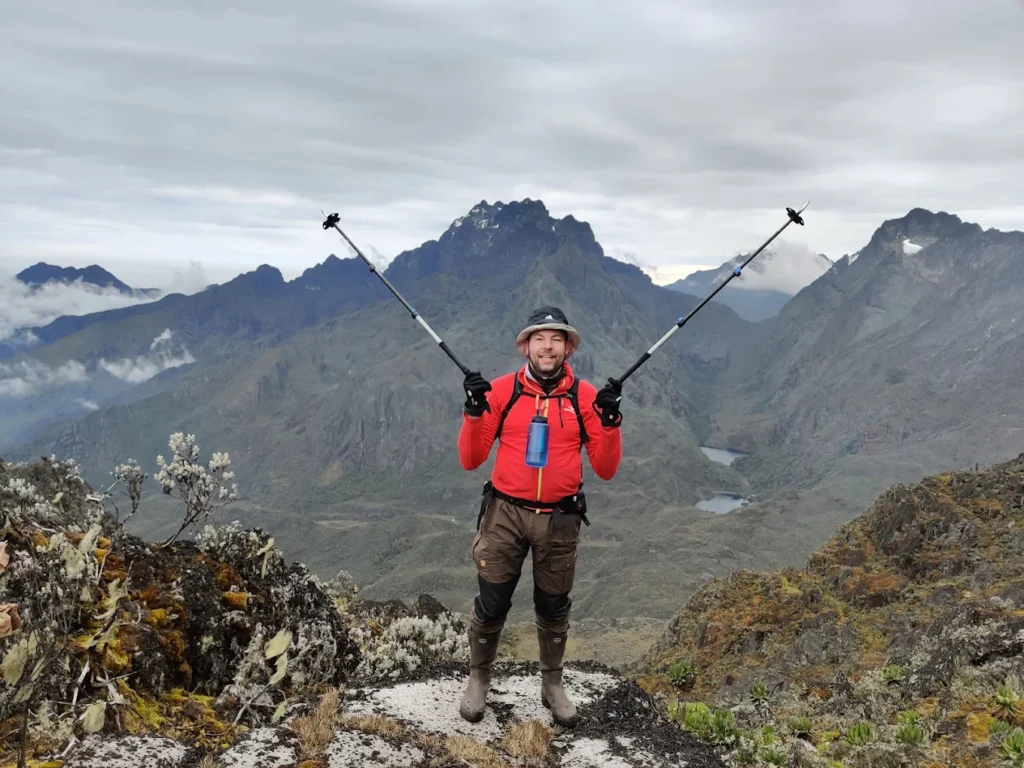
For trekkers who want the most wild and exploratory experience the Rwenzori has to offer, the Bukurungu Trail is in a category of its own. This route, suited for experienced adventurers comfortable with camping in genuinely remote, wet conditions, offers four spectacular glacial lakes and landscapes that see very few visitors in any season. Especially in the wet season, this trail demands robust waterproofing, strong navigation skills, and an experienced local guide with intimate knowledge of the terrain.
The Diamond Trail: A Lower-Altitude Option
The Diamond Trail is an excellent option for those wanting to experience the Rwenzori’s forest ecology and its chimpanzee population without committing to a multi-day high-altitude push. Operating in the lower montane forest zone, this trail is accessible in most weather conditions and can be combined with a summit trek or done as a standalone forest experience. It is also an ideal way to acclimatize and orient yourself before beginning a longer route.
Choosing the Right Route: An Expert Breakdown
If you are unsure which route suits your experience level, fitness, and weather window, our detailed blog post What Is the Best Route for Trekking the Rwenzori Mountains? walks through the honest tradeoffs between every route in the park, and our Routes & Dates page gives you up-to-date availability across all trails.
Essential Gear for Trekking in Rwenzori’s Rainfall.
Waterproofing Is Not Optional; It Is Your Primary Investment
Before going to the Rwenzori, buy the best waterproof gear you can afford. A high-quality waterproof and breathable jacket is the single most important piece of equipment you will carry. It should be seam-sealed, have a properly functioning hood, and cover your hips. Budget rain jackets are inadequate for sustained Rwenzori conditions.
Equally critical are waterproof trousers, waterproof gaiters (ideally full-length), and waterproof gloves. Your base layers should be moisture-wicking merino wool or synthetic, never cotton, which absorbs water and loses insulating properties when wet. Your sleeping bag should be rated comfortably below the overnight temperatures you expect to encounter and stored in a dry bag inside your pack at all times. Trekking poles, a pair, not a single optional one, transform the Rwenzori experience on wet, boggy ground.
Our post, Do I Need Crampons and Ropes for the Rwenzori?, provides a complete breakdown of the technical climbing equipment required for summit routes. covers exactly what to bring and when you will need it. Our guide, Is It Safe to Trek the Rwenzori Mountains?, delves deeply into safety in wet and icy conditions.
Huts, Camps, and Shelter on the Rwenzori
The Mountain Hut System
Unlike many high-altitude trekking destinations where camping in tents is the norm, the Rwenzori’s standard routes are supported by a network of mountain huts that make a significant difference to the quality of rest you can get in a wet environment. The huts on the Central Circuit Trail provide basic but functional shelter, sleeping platforms, cooking facilities, and crucially, a dry space in which to change your clothing and warm up at the end of the day.

The hut system is managed by the Uganda Wildlife Authority and is included in the standard trekking permit fees for the Rwenzori Mountains National Park, a UNESCO World Heritage Site and Ramsar Wetland of International Importance. Our team handles all park fees and hut bookings as part of your Rwenzori trekking package, ensuring a seamless experience from arrival to summit.
The Rain and the Rwenzori’s Ecological Magnificence
Why the Wetness Is the Point
It would be a mistake to view the Rwenzori’s rainfall as a journey to the landscapes. The rainfall is the landscape. Without the ceaseless precipitation, there would be no 10-meter giant groundsels standing in ghostly sentinel rows on the moorland ridges. There would be no mossy forests so lush that the ground itself seems to breathe. Bogs, those vast, unique peatland ecosystems that store thousands of years of carbon and support plant communities found nowhere else on Earth, would cease to exist. There would be no glaciers on the Equator.
The Rwenzori has a wide variety of plants and animals, including over 70 species that are found only there, like the Rwenzori three-horned chameleon, the Rwenzori red duiker, and the rare giant forest hog, all because the constant moisture has kept the area wet and stable for millions of years. Our expert guides are trained interpreters of this ecosystem, able to explain the botanical adaptations and conservation challenges across every peak on the range from Mount Stanley and Mount Speke to Mount Baker, Mount Emin, Mount Gessi, and Mount Luigi di Savoia. If you want to understand the full scope of what these peaks offer, our Rwenzori peaks overview is an excellent starting point.
Combining Your Rwenzori Trek with a Uganda Safari
Maximising Your Uganda Experience
The Rwenzori Mountains sit in the far southwest of Uganda, within comfortable driving distance of some of the country’s other world-class wildlife destinations. Many of our clients combine the Rwenzori with Uganda safari experiences that include mountain gorilla trekking; our guide to Uganda low-season gorilla permits explains how to save $200 during April, May, and November or chimpanzee tracking in Kibale National Park, covered in detail in our post on Uganda low-season chimpanzee permits. Queen Elizabeth National Park, which borders the Rwenzori to the south, can be seen clearly from the mountain’s lower slopes on clear days and is easily combined with a trekking itinerary. About our company: Rwenzori Trekking Safaris was built on the conviction that the best Uganda itineraries combine physical mountain adventure with the drama of Uganda’s wildlife, and we specialize in crafting seamless multi-destination journeys tailored to each client.
How to Start Planning Your Rwenzori Trek
Choosing the Right Package and Duration
Our most booked itinerary is the standard 7-day Central Circuit trek, which passes through all major ecological zones and positions trekkers for a Margherita summit attempt. The 8-day Kilembe Trail expedition offers a more challenging and remote alternative for experienced hikers, featuring rugged terrain, breathtaking views, and opportunities to encounter unique wildlife along the way. Our 13-day, 6-peak expedition across Mount Stanley, Speke, Baker, Emin, Gessi, and Luigi di Savoia is one of the most comprehensive mountaineering experiences in all of Africa for those who want to conquer every major peak. Our 6-day Weismann Peak hike offers the Rwenzori atmosphere in a shorter timeframe, reaching spectacular high-altitude scenery with a slightly lower summit commitment.
All packages are available on our Treks page and can be customized to your experience level, pace, and goals.
Booking Process and Lead Times
During the peak windows of June to August and December to February, we recommend booking three to six months in advance to secure your preferred guide and hut availability. For the wet season, lead times are more flexible, but early booking is always advisable. Our booking process begins with a real conversation, not a generic form. We want to understand your experience, your timeline, your goals, and your budget before building a personalized proposal. To begin that conversation, visit our Contact Us page or review our most frequently asked questions to get a head start.
Frequently Asked Questions About Rwenzori Mountain Rainfall and Weather
Does it rain every day on the Rwenzori?
On most of the mountain, most of the year, you should expect some form of precipitation every day. This is particularly true above 2,500 meters, where afternoon rain showers and nighttime mist are a near-constant feature. During the drier windows, June to August and December to February, the lower slopes may see dry mornings and occasional fully dry days, but trekkers should always be prepared for rain. The most experienced Rwenzori trekkers treat rainfall as a certainty and are pleasantly surprised by dry spells, rather than the reverse.
What is the best time of year to trek the Rwenzori Mountains?
June, July, and August constitute the most reliable trekking window. December through February offers a secondary dry window that is equally rewarding for many trekkers. That said, the Rwenzori can be trekked at any time of year by well-prepared visitors, and the wet season months offer a uniquely atmospheric and crowd-free experience. See our full Routes & Dates guide for month-by-month planning advice.
How cold does it get in the Rwenzori Mountains?
Temperatures vary dramatically by altitude. Lower forest slopes range from 15°C to 24°C. The heather and moorland zone between 2,500 and 3,500 meters sits at 5°C to 15°C, dropping well below this range at night. During the day, temperatures above 3,500 meters stay between 0°C and 10°C, and at night they drop below 0°C. Sub-zero temperatures are common near the summit at 5,000 meters, and wind chill can make the temperature feel much lower. Layering is essential throughout the trek.
Is the Rwenzori harder to trek than Kilimanjaro?
The Rwenzori is widely considered more technically demanding than Kilimanjaro’s standard routes due to the boggy terrain, dense vegetation, sustained wet conditions, and steeper technical sections. Margherita Peak at 5,109 meters is slightly lower than Uhuru at 5,895 meters, making altitude sickness somewhat less of a concern, though it remains a concern above 4,000 meters. For a full, honest comparison, read our expert breakdown: Is the Rwenzori Harder Than Kilimanjaro?
Can I trek the Rwenzori as a beginner?
The Rwenzori is not recommended for trekkers with no prior hiking experience. However, moderately fit trekkers who have completed multi-day hikes and are committed to proper preparation can achieve a successful trek with expert guiding support. Our post Can Beginners Climb the Rwenzori Mountains? addresses this subject in full, including the realistic options available to first-timers. Our team is also available to provide an honest, personalized fitness assessment via the Contact Us page.
Will I see wildlife on the Rwenzori despite the rain?
Absolutely. Chimpanzees are sometimes heard and seen in the lower forest zones; the Diamond Trail is the best route for this. The lower trails regularly encounter Colobus monkeys, L’Hoest’s monkeys, and the endemic Rwenzori red duiker. A remarkable diversity of birds inhabits every ecological zone from forest to summit. And the plant life, the giant groundsels and lobelias of the upper mountain, is often the single most memorable wildlife encounter on the entire trek.
How many days does a Rwenzori trek take?
Our trek offerings range from the 6-day Weismann Peak hike to the 7-day Central Circuit, the 8-day Kilembe Trail, and the ambitious 13-day, 6-peak expedition. Browse all options on our Treks page.
What is the summit success rate for Margherita Peak?
Weather windows, guide experience, and trekker fitness strongly influence summit success on the Rwenzori. Our dedicated post, What Is the Success Rate for Summiting Margherita Peak?, gives a detailed, data-informed answer. In general, trekkers with experienced local guides, excellent fitness, and flexible itineraries have significantly higher success rates than those on fixed-pace group departures.
Do I need crampons and ropes for the Rwenzori?
On routes that include the Margherita summit, basic technical equipment is required in the summit zone, where permanent ice and snow are present regardless of season. Check out our comprehensive gear guide, “Do I Need Crampons and Ropes for the Rwenzori?” to understand the specific equipment required and the resources our team offers. For a broader discussion of safety in wet mountain conditions, read our post Is It Safe to Trek the Rwenzori Mountains?
Are the Rwenzori glaciers still there?
The Rwenzori’s equatorial glaciers are disappearing. Climate scientists estimate they have shrunk by more than 80 percent since the early 20th century, and current projections suggest they may be gone within the next decade. Trekking to see glaciers on the Equator is not merely a personal adventure—it is witnessing a piece of Earth’s climate history in its final chapter. This urgency adds a dimension to a Margherita Peak summit attempt that very few other treks in the world can match.
How does Rwenzori rainfall compare to other African trekking destinations?
The Rwenzori is substantially wetter than virtually every other major trekking destination in Africa. Kilimanjaro’s dry seasons are genuinely dry. The Simien Mountains see significant periods of sunny, settled weather. The Rwenzori falls into a distinct category; its structural moisture, a result of its equatorial position and geographic alignment, creates a unique ecosystem characterized by lush vegetation and diverse wildlife that stands in stark contrast to the drier regions of Africa. If you are coming for a dry, sunny African trekking holiday, the Rwenzori is the wrong mountain. If you are coming because you want something rawer, wilder, and more intensely atmospheric than anything else on the continent, the Rwenzori Mountains will exceed every expectation.
A Final Word from the Mountain
Long before modern Gore-Tex existed, the Rwenzori had soaked travelers, and it will continue to do so centuries after we forget about today’s waterproofs. The rain is not the enemy of the experience; it is the architect of it. Rainfall has shaped, maintained, and made possible every bizarre, beautiful, alien landscape that sets the Rwenzori apart from any other mountain on Earth.
Our team at Rwenzori Trekking Safaris has spent years on this mountain in every season, every condition, and every zone. We know which mornings are most likely to offer views of Margherita Peak. We know which trail sections demand caution after heavy rain, particularly those that become slippery or prone to flooding, which can pose risks to hikers’ safety. We know how to keep you warm, safe, dry enough, and genuinely thrilled from your first day in the forest to your final descent. We do not run generic group treks; we build personalized journeys for the hiker who wants to genuinely know a mountain, not just summit it.
Are you ready to Start Planning Your Rwenzori Trek?
The Rwenzori Mountains are waiting. The rain is falling, the giant lobelias are shrouded in mist, and Margherita Peak remains above the clouds, as it has always been and will remain for a brief period.
Do not put this experience off. The glaciers will not wait, and neither will this once-in-a-lifetime experience.
Contact the Rwenzori Trekking Safaris team today to begin planning your custom Rwenzori trek. Please share your preferred dates, experience level, and what you are seeking, and we will create an itinerary worthy of the Mountains of the Moon for you. You can also learn more about our team and guiding philosophy, explore our full trek catalogue, review our hiking routes and dates, or browse our blog for more expert guides before reaching out.