
Accommodations Inside and Outside the Rwenzori Mountains: The Complete Lodging Guide.
Everything you need to know about accommodation inside and outside the Rwenzori Mountains: mountain huts on the Central Circuit, Kilembe Trail fixed camps, Bukurungu wilderness camping, and Kasese lodging options. Expert guide by Rwenzori Trekking Safaris, Uganda
One of the most practical questions any serious Rwenzori trekker needs to answer before they book flights, pack bags, and commit to the mountain is this: where exactly will I sleep? The accommodation picture in and around the Rwenzori Mountains is more varied and nuanced than it seems. There are mountain huts at altitude with bunk beds and communal kitchens. There are fixed camps with solar power. There are wilderness camping spots where your only shelter is the tent above your head. There are guesthouses and lodges in Kasese town where you recover your strength before or after the climb. And, for those combining the Rwenzoris with a wider Uganda safari, there are world-class lodges and camps elsewhere in the country.
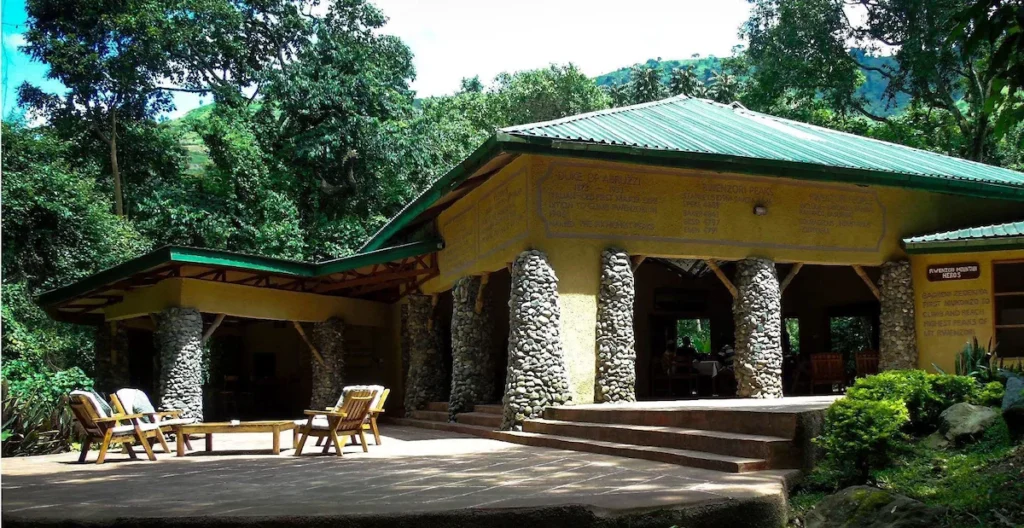
Understanding how all of these options fit together, including which camps are on which route, at what altitude, and with what facilities, is essential planning knowledge for any Rwenzori expedition; this knowledge takes real time on the mountain to accumulate. I have guided Rwenzori treks across all three primary routes for over a decade, and in that time I have slept in every camp and hut the mountain offers, in every season, under every conceivable weather condition. This guide shares what I know, plainly and comprehensively, so that you can plan your accommodation with the same confidence you bring to choosing your summit.
Understanding the Rwenzori Accommodation System
The Rwenzori Mountains National Park has three primary trekking routes: the Central Circuit Trail, the Kilembe Trail, and the Bukurungu Wilderness Camping Trail, and each has a distinct accommodation model built into its design. The Central Circuit uses a system of established mountain huts with dormitory-style bunk beds. The Kilembe Trail has a series of fixed camps with varying facilities, including some with solar power for device charging. The Bukurungu Trail, true to its wilderness character, is a pure ground-camping route with no built accommodation of any kind.
Regardless of route, accommodation in the mountain is included in the trekking package; trekkers do not source or pay for their mountain sleeping arrangements separately from their guided expedition. What varies is the character of the experience: the level of infrastructure, the quality of the facilities, and the degree of separation from civilization that each night’s sleep represents, which can range from basic camping on the Bukurungu Trail to more developed accommodations in the Mountain Huts on the Central Circuit Trail. All of it is meaningful. All of it is part of what makes a Rwenzori expedition unlike any other mountain experience in Africa.
Mountain Huts on the Central Circuit Trail
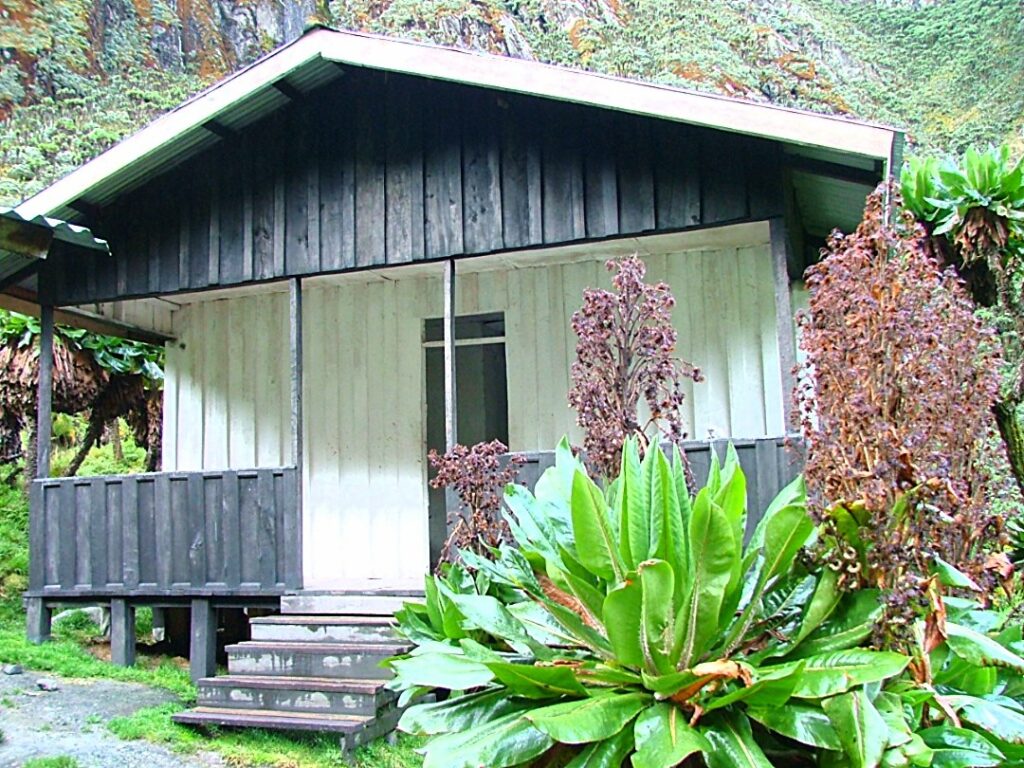
The Central Circuit Trail is the most established trekking route in the Rwenzori range, and its accommodation reflects that maturity. A series of mountain huts solid wooden structures with bunk-bed sleeping arrangements, communal cooking areas, and basic toilet facilities are positioned at intervals that correspond to a day’s walk, making the Central Circuit the most logistically comfortable full-mountain option available.
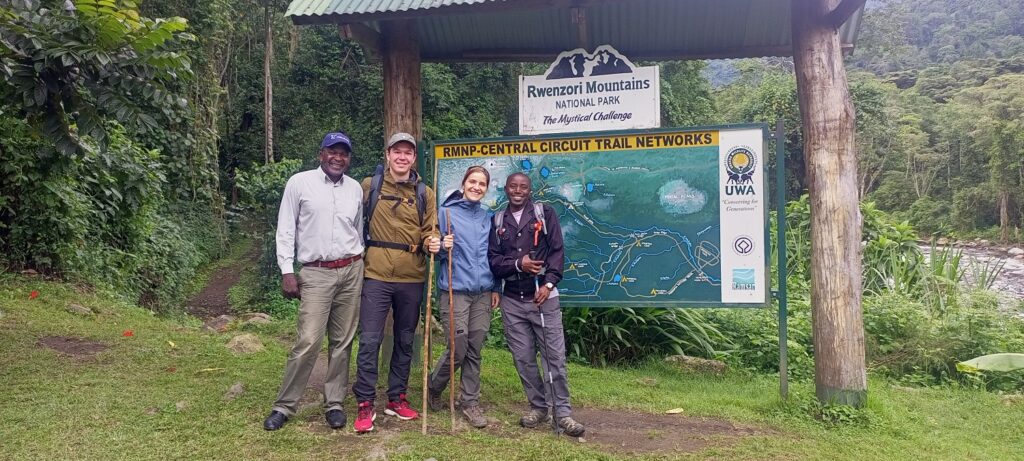
Sleeping in a hut rather than a tent matters enormously in the Rwenzoris, where the mountain’s legendary moisture and nighttime cold at altitude can make tent camping a genuinely demanding experience without expert preparation.
Nyabitaba Camp (2,650m)
Nyabitaba Camp is the first overnight stop on the Central Circuit Trail, reached after approximately four to five hours of walking from the Nyakalengija trailhead through the dense Albertine Rift montane forest. Sitting at 2,650 meters on a ridge above the confluence of the Mubuku and Bujuku rivers, Nyabitaba is a decompression point: the place where the mountain begins to feel real, where the sounds of the lower world fall away, and where the stars, when the cloud breaks, appear with a clarity that reminds you how far you have come from the lowlands.
The hut here sleeps multiple trekkers in bunk-bed style and has basic cooking and washing facilities. It is the most frequently visited of the mountain camps and the standard first night for trekkers on the 7-day Central Circuit itinerary.
John Matte Camp (3,414m)
John Matte Camp is named after one of the earliest and most respected Rwenzori guides, a man whose knowledge of the mountain shaped the early development of trekking in the range. Located at 3,414 meters in a beautiful valley above the treeline, John Matte sits on the boundary between the heather and moorland zones, the point where the vegetation begins its most dramatic transformation into the alien Afro-alpine landscape above. The hut here provides bunk-bed sleeping for trekking parties and a cooking area for guide and porter teams. Evenings at John Matte, when the cloud wraps close around the hut and the giant heathers are reduced to dark silhouettes against the mist, have a quality of deep mountain atmosphere that is difficult to describe to someone who has not experienced it.
Bujuku Camp (3,977m)
Bujuku Camp is, for many trekkers, the emotional centerpiece of the Central Circuit. At 3,977 meters, it sits at the edge of Lake Bujuku, the largest and most dramatic of the Rwenzori alpine lakes, with the peaks of Mount Stanley, Mount Speke, and Mount Baker rising on three sides.
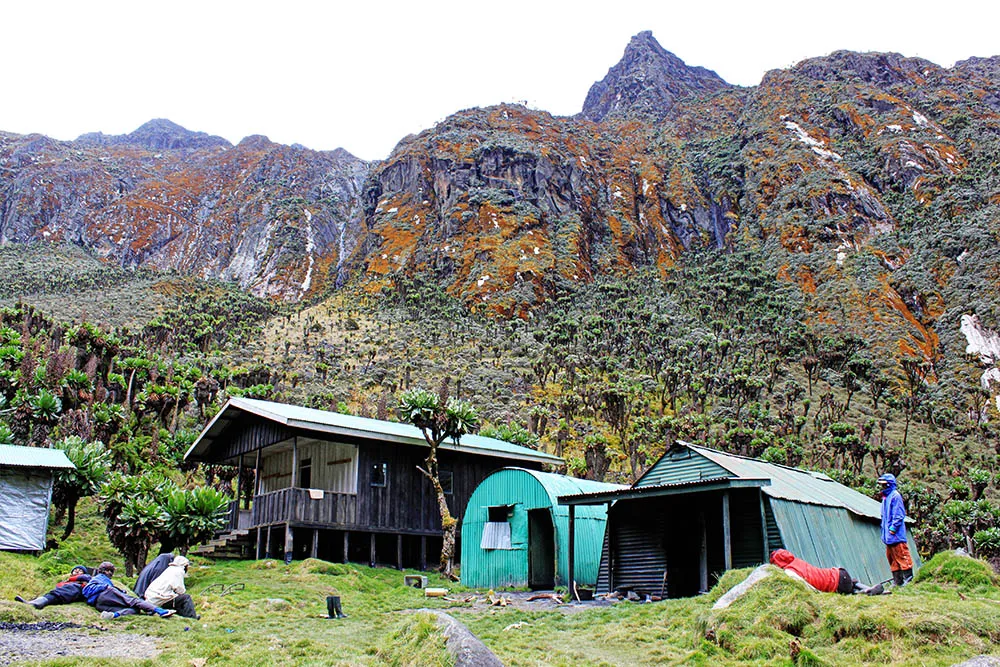
Waking at Bujuku on a clear morning when the lake surface is still and the glaciers of the Stanley Massif catch the first light above is one of the defining moments of a Rwenzori expedition. The camp hut sleeps trekking parties in a bunk-bed arrangement and is a critical acclimatization stop before the high-altitude camps above.
Elena Camp (4,541m)
Elena Camp is the highest overnight stop on the Central Circuit Trail and the primary base camp for the final push to Margherita Peak (5,109 m).
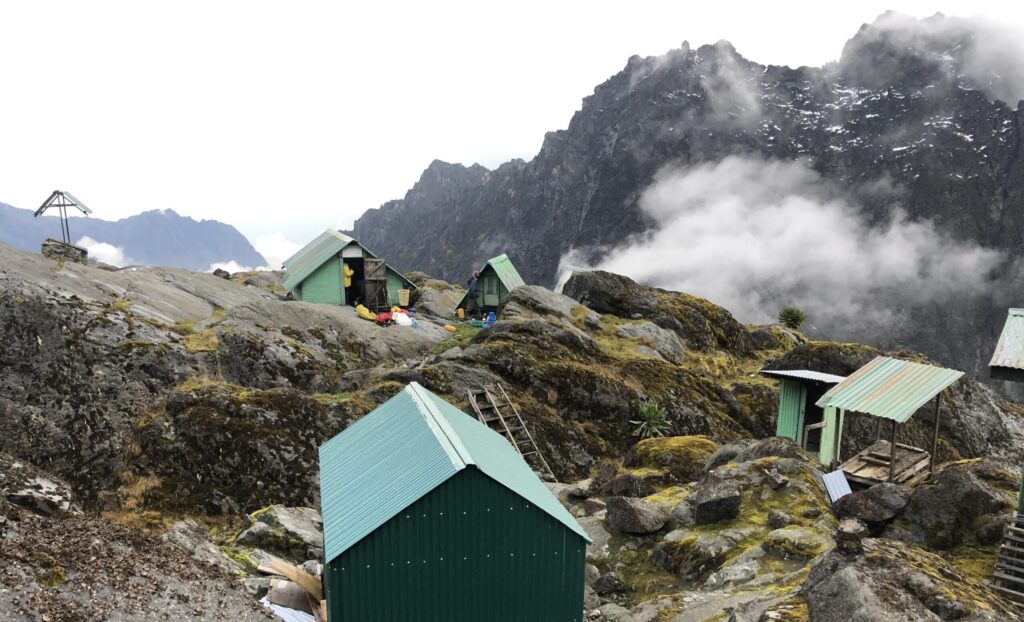
At 4,541 meters, it sits directly beneath the Elena Glacier, and the experience of spending a night here at an altitude where the air is noticeably thin and the nighttime temperatures fall well below freezing is an integral part of what makes the Margherita summit climb a true mountaineering achievement rather than a long walk. The hut at Elena is basic by design: its purpose is to get trekkers sheltered, warm, and rested for an early summit departure, typically between midnight and 02:00 on summit day. What it lacks in comfort it compensates for in altitude drama.
Kitandara Camp (4,027 m)
Kitandara Camp is positioned beside the twin Kitandara Lakes, two glacially carved tarns connected by a short valley corridor, and it is consistently rated by our guides as among the most beautiful overnight locations in the entire Rwenzori range.
The evening light on the Kitandara Lakes, when the mountain above is in shadow but the water still holds the last of the sky’s color, has inspired more than one trekker to extend their stay here simply to watch what happens to the light. Located at 4,027 meters, Kitandara is also a critical acclimatization stop on the 7-day Central Circuit route and the overnight destination for trekkers descending from the Elena-Margherita summit push.
Guy Yeoman Camp (3,261 m)
Guy Yeoman Camp is the final overnight stop on the Central Circuit before the descent back to the Mihunga gate, sitting at 3,261 meters in the moorland-heather transition zone.
Named after a former park warden whose conservation work in the Rwenzori Range was significant in the early years of national park management, the Guy Yeoman hut is a welcome waypoint on the long descent, offering trekkers a chance to consolidate the experience of the mountain before returning to the noise and warmth of the outside world.
Fixed Camps on the Kilembe Trail.
The Kilembe Trail, which was officially developed in 2011 by Rwenzori Trekking Services and entered near Kasese town on the mountain’s southern flanks, has its own series of purpose-built fixed camps. These camps differ from the Central Circuit huts in one important practical respect: several of the Kilembe Trail camps have solar panels, providing electricity for lighting and device charging at high altitude, a facility that the Central Circuit huts currently lack. The camps are well-maintained, managed by the Uganda Wildlife Authority, and positioned to support both the short-form itineraries and the full 8-day Margherita summit expeditions that are the Kilembe Trail’s flagship experience.
Sine Camp (2,540 m)
Sine Camp is the first overnight stop on the Kilembe Trail, reached after a walk of approximately three to four hours from the Kilembe trailhead through the rich montane forest that characterizes the lower slopes of the mountain’s southern approaches.
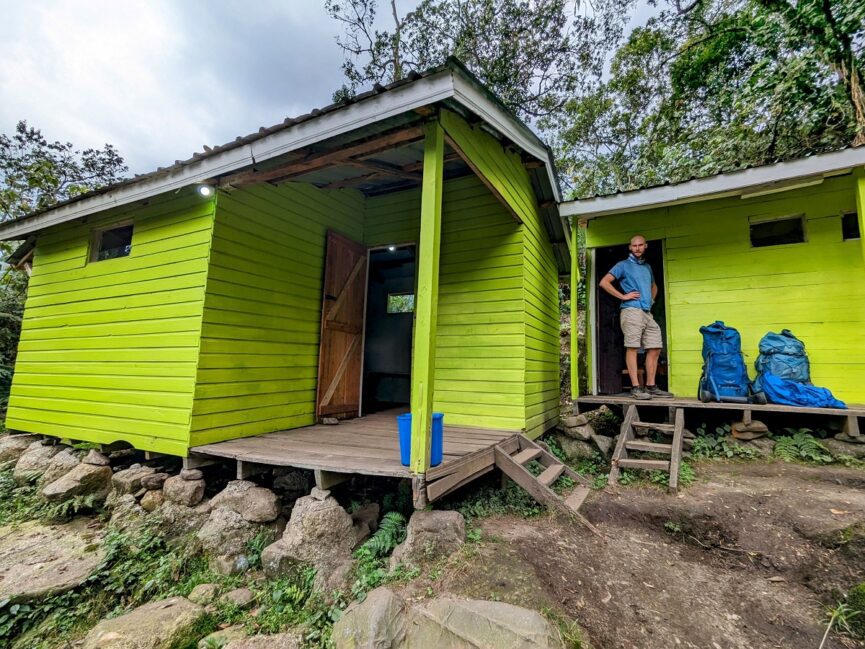
At 2,540 meters, it sits at the upper edge of the forest zone, and the surrounding vegetation, dense, moss-draped, and alive with the calls of Albertine Rift-endemic birds, makes for an outstanding first-night environment. Sine Camp is also the turnaround point for the 2-day Sine Camp trek, one of the most accessible short Kilembe Trail itineraries and an excellent introduction to the Rwenzori forest environment.
Mutinda Camp (3,700 m)
Mutinda Camp at 3,700 meters is one of the most spectacular overnight locations on the entire Kilembe Trail, and the 4-day Mutinda Loop itinerary is specifically designed to allow trekkers to spend a meaningful amount of time at this altitude before descending. The camp occupies a commanding position with views across the high moorland that extend, on clear days, to the distant plains of the western Ugandan plateau.
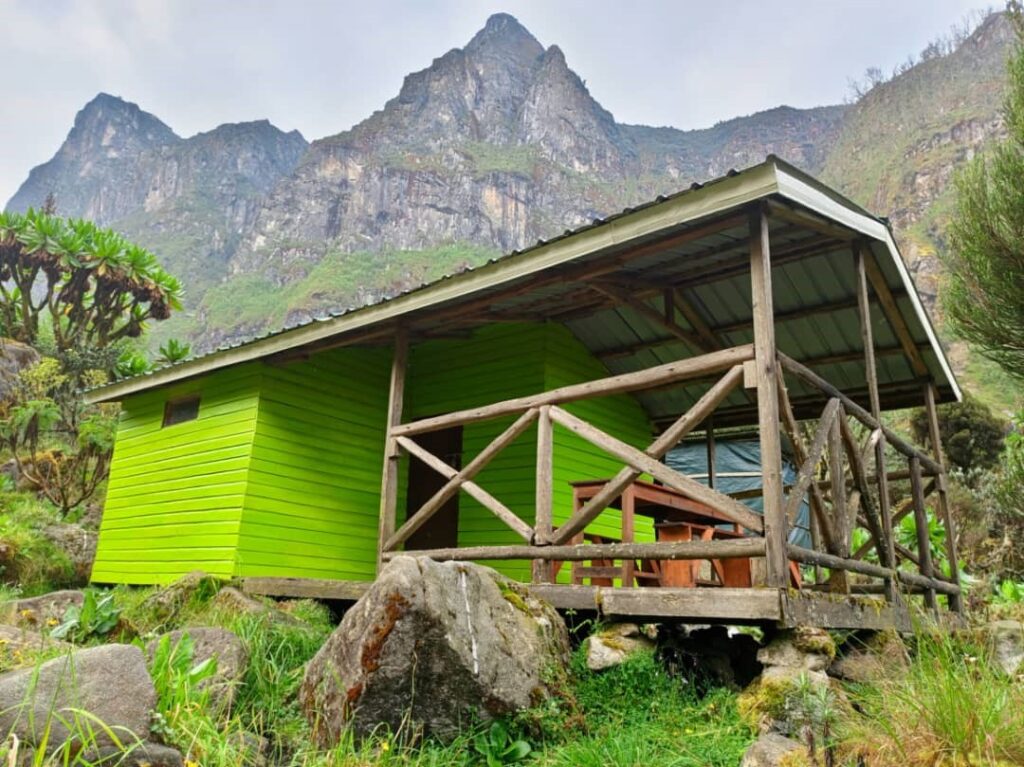
It is equipped with solar power for lighting, and the surrounding Afro-alpine vegetation, giant lobelias, and groundsels at scale in every direction give the camp an otherworldly character that is among the most photographed scenes on any Rwenzori itinerary.
Kalalama, Bugata, and Hunwicks Camps
Between Sine and Mutinda, and continuing above Mutinda toward the glacier approaches, the Kilembe Trail offers a series of intermediate camps, Kalalama, Bugata, and Hunwicks, each positioned at a different altitude band and offering its own distinctive environment. These camps are all well-maintained and in good condition, and they provide the gradual altitude gain management that makes the Kilembe Trail’s longer itineraries both safe and physiologically sound. Our guides select the specific camp sequence for each trekking party based on the chosen itinerary, the party’s acclimatization progress, and current mountain conditions.
Margherita Camp (4,540 m)
Margherita Camp sits at 4,540 meters on the Kilembe Trail’s upper reaches, serving the same function as Elena Camp on the Central Circuit: it is the last base before the glacier crossing to Margherita Peak (5,109 m). Like Elena, its facilities are appropriately minimal; the goal here is warmth, rest, and readiness for an early summit departure.
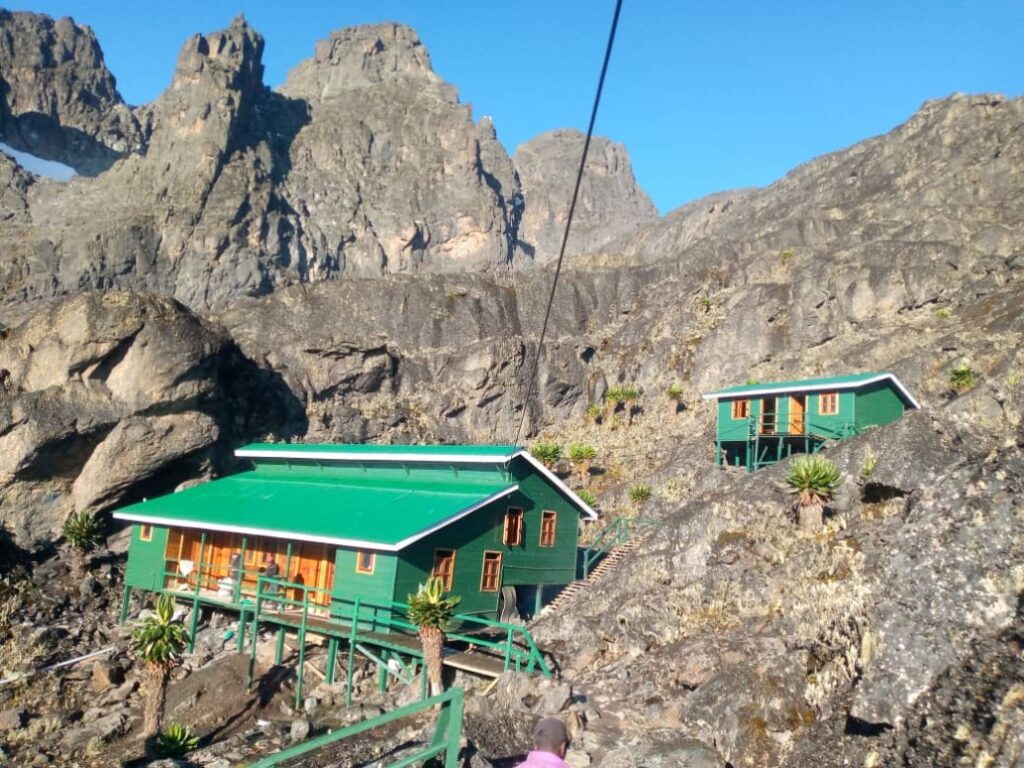
The approach to Margherita Camp from Hunwicks involves some of the most dramatic terrain on the entire Kilembe route, and arriving at the camp after the long, high-altitude approach gives a powerful sense of the scale and altitude of the undertaking.
Wilderness Camping on the Bukurungu Trail
The Bukurungu Wilderness Camping Trail operates on a completely different accommodation model from the other two routes. Established in 2018 through a partnership between the Uganda Wildlife Authority and WWF, the Bukurungu Trail is designed as a pure wilderness camping experience. There are no huts. No bunk beds. No solar panels. What the Uganda Wildlife Authority has provided is a series of well-positioned, clearly designated ground camping spots at intervals along the route safe, maintained clearings where expedition tents can be pitched on ground that has been prepared and managed for the purpose.
Rwenzori Trekking Safaris provides all camping equipment for Bukurungu expeditions as standard. This includes high-quality mountain tents, insulated sleeping mats, sleeping bag hire for those who need it, and full kitchen equipment for our cook teams. The wilderness character of the Bukurungu camps is part of the trail’s identity. Trekkers who choose this route do so precisely because they want an unmediated encounter with the Rwenzori high country, sleeping under canvas with the mountain’s sounds and weather as their immediate environment. Notable camping locations include sites near Lake Irene, Lake Mughuli, Lake Bukurungu, and the Bujuku Valley, where the Bukurungu Trail intersects with the Central Circuit at the Bigo Swamp.
Accommodation Before and After Your Trek: Kasese Town and Its Surroundings
Every Rwenzori trekking itinerary begins and ends outside the park, and virtually all trekkers spend at least one night and often two in or near Kasese town, the principal gateway to the Rwenzori Mountains, located approximately 30 kilometers from the Central Circuit trailhead at Nyakalengija and a similar distance from the Kilembe Trail entrance. Choosing the right pre- and post-trek accommodation in Kasese is not a minor logistical detail. After seven to ten days on the mountain, the quality of a bed, a hot shower, and a proper meal has an importance that is difficult to overstate.
Kasese Town: Budget and Mid-Range Guesthouses
Kasese town offers a range of guesthouses and small hotels suited to trekkers arriving from or departing from the mountains. The town is the commercial center of the Kasese district and has developed a modest but functional hospitality infrastructure around its role as the Rwenzori gateway. Mid-range guesthouses in Kasese typically offer en-suite rooms with hot water, reliable WiFi, and restaurants serving both Ugandan and international food the basics that a trekker returning from altitude needs before a long journey home. Our team at Rwenzori Trekking Safaris works with a curated selection of Kasese accommodations that meet our standards for cleanliness, safety, and service, and we can arrange pre- and post-trek lodging as part of any expedition package.
Equator Snow Lodge and Proximity Lodges
Several lodges on the outskirts of the Kasese district, positioned in the foothills and on the lower mountain approaches, offer a more atmospheric alternative to the town’s guesthouses.
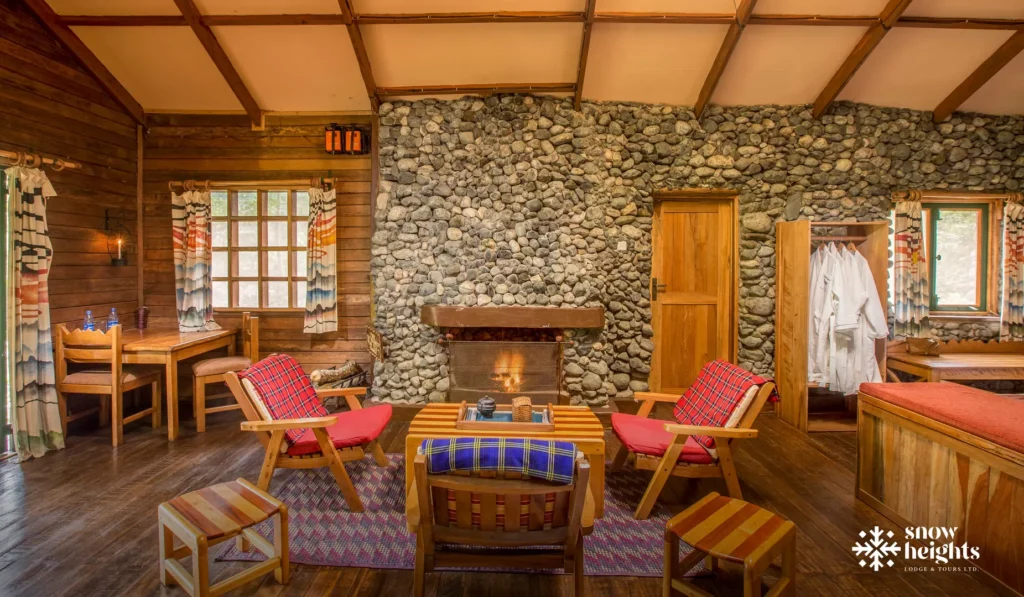
These properties sit within sight of the Rwenzori peaks and provide a transitional environment that is neither the full wilderness of the mountain nor the urban noise of the town that many trekkers find ideal for psychological preparation before an expedition or decompression after one. Views of the Portal Peaks from certain hillside lodges on a clear morning are among the finest Rwenzori panoramas visible from any sleeping facility outside the park.
Margherita Hotel, Kasese
The Margherita Hotel in Kasese has long served as the default accommodation for trekking groups departing for or returning from the Rwenzori Mountains, and while it has evolved over the years alongside the development of the trekking industry, it remains a reliable and well-located option for those who want a familiar, centrally positioned base in town. It is within easy reach of the town’s restaurants and markets and straightforward to reach from the Kasese district road network that connects the town to both Nyakalengija and Kilembe.
Accommodation for the Wider Uganda Safari Experience
For trekkers who are combining a Rwenzori expedition with a broader Uganda safari, gorilla trekking in Bwindi Impenetrable Forest, a wildlife drive in Queen Elizabeth National Park, or a Nile adventure at Murchison Falls, accommodation planning extends well beyond the Kasese region. Uganda has developed an impressive range of safari lodges and camps in the past decade, with options at every price point from basic tented camps to genuinely world-class luxury lodges.
Queen Elizabeth National Park, which borders the Rwenzori Mountains National Park to the south, is home to several excellent lodges positioned for both wildlife viewing and Rwenzori scenery, including the famous Mweya Safari Lodge on the Kazinga Channel. Bwindi Impenetrable Forest, the primary gorilla trekking destination, has a growing collection of high-quality lodges in both budget and luxury categories clustered around the main gorilla sector entry points.
Our team at Rwenzori Trekking Safaris coordinates accommodation across all of these destinations as part of the bespoke Uganda itineraries we build for our clients, ensuring that the logistical thread of the trip is seamless from Entebbe arrival to final departure.
What to Expect: Comfort, Facilities, and Realistic Standards
I want to address this directly, because I believe honesty serves you better than polished marketing language: accommodation in the Rwenzori Mountains, whether in the Central Circuit huts, the Kilembe Trail fixed camps, or the Bukurungu wilderness spots, is functional, not luxurious. It is clean, it is safe, it is maintained to the standards required for a high-altitude mountain environment, and it provides what trekkers genuinely need: shelter from the elements, a dry place to sleep, and facilities for basic hygiene. It does not provide what you would expect from a hotel.
This is not a failing. It is the mountain’s character, and it is entirely consistent with what the Rwenzori trekking experience is. The trekkers who find the mountain huts romantic, and many do, are responding to something real: there is a quality to sleeping in a wooden hut at 3,977 meters beside Lake Bujuku, with the sound of the mountain’s rivers in the darkness below and the occasional clearing of clouds that reveals an improbable ceiling of stars, that no lodge can replicate. The simplicity is part of what makes the experience profound.
Sleeping bags rated to at least -5°C are essential for all altitude camps. Our guides will advise on specific sleeping bag requirements based on the season of your trek and the altitude of the camps in your chosen itinerary. All mountain huts and fixed camps are equipped with mattresses—trekkers do not need to carry their own sleeping mat for Central Circuit or Kilembe Trail expeditions. On the Bukurungu Trail, sleeping mats are provided by our expedition team as part of the standard equipment package.
Frequently Asked Questions: Rwenzori Mountain Accommodation
What accommodation is available inside the Rwenzori Mountains?
Inside the Rwenzori Mountains National Park, accommodation varies by trekking route. The Central Circuit Trail features a series of established wooden mountain huts with bunk-bed sleeping at camps including Nyabitaba (2,650 m), John Matte (3,414 m), Bujuku (3,977 m), Elena (4,541 m), Kitandara (4,027 m), and Guy Yeoman (3,261 m). The Kilembe Trail has fixed camps at Sine Camp (2,540 m), Kalalama, Bugata, Mutinda (3,700 m), Hunwicks, and Margherita Camp (4,540 m), several of which have solar-powered lighting and charging facilities. The Bukurungu Trail is a pure wilderness camping route with no built accommodation, designated ground camping spots managed by the Uganda Wildlife Authority, with all tent equipment provided by our expedition team.
Do I need to bring my own sleeping bag for a Rwenzori trek?
Yes. A sleeping bag rated to at least -5°C is essential for any Rwenzori trek that includes overnight stays above 3,500 meters. Night temperatures at Elena Camp (4,541 m) and Margherita Camp (4,540 m) regularly fall below freezing, and even the lower camps, such as Bujuku (3,977 m), can experience cold nights. Sleeping bags are not typically provided by the mountain accommodation itself. Trekkers booking with Rwenzori Trekking Safaris can hire sleeping bags as part of their equipment package if required, and our pre-departure gear briefing covers sleeping bag requirements in detail for each specific itinerary and season.
Are there any lodges with mountain views near the Rwenzori Mountains?
Yes. Several lodges and guesthouses in the Kasese district area offer views of the Rwenzori Mountains and Portal Peaks, particularly from properties positioned in the foothills above Kasese town. These provide a more atmospheric alternative to town-center guesthouses for trekkers who want to experience the mountains from a comfortable base before or after their expedition. Additionally, Queen Elizabeth National Park, which borders the Rwenzori range to the south, has several quality lodges, including Mweya Safari Lodge on the Kazinga Channel, where the distant snowcaps of the Rwenzori peaks are visible on clear days. Our team can recommend and book accommodation at any point along your Uganda itinerary.
Is accommodation included in a Rwenzori trek package?
Yes. All mountain accommodation, whether huts on the Central Circuit, fixed camps on the Kilembe Trail, or tent camping on the Bukurungu Trail, is included in the standard Rwenzori trekking packages offered by Rwenzori Trekking Safaris. Park fees, camping fees, guide fees, meals on the mountain, and porter services are all part of the package. Pre-trek and post-trek accommodation in Kasese can be arranged and added to the package on request. Trekkers should note that accommodation before arrival at the trailhead and after departure from the park gate is not automatically included in the mountain package price but can be seamlessly coordinated by our team.
What is the accommodation like on the Kilembe Trail compared to the Central Circuit?
Both trails offer fixed, managed accommodation rather than wild camping, but with meaningful differences. The Central Circuit Trail uses established wooden huts at a series of named camps, with no solar electricity at most camps. The Kilembe Trail camps are newer, developed from 2011 onwards, and several are equipped with solar panels for lighting and device charging, including Mutinda Camp and the higher-altitude facilities. Both trail systems use mattresses in their sleeping facilities, so trekkers do not need to carry sleeping mats for either route. The choice between the two often comes down to trail character and summit approach rather than accommodation quality, though the Kilembe Trail’s solar-equipped camps are a practical advantage for longer multi-day expeditions.
Can I book accommodation in Kasese as part of my Rwenzori trek package?
Absolutely. Rwenzori Trekking Safaris routinely arranges pre- and post-trek accommodation in Kasese and the surrounding Kasese District as part of our comprehensive expedition packages. We work with a curated selection of guesthouses, hotels, and lodges that meet our standards for cleanliness, safety, and service, and we can match the accommodation to your budget, preferences, and travel style. For trekkers arriving from Entebbe or Kampala, we also coordinate airport transfers, road transport to Kasese, and onward travel arrangements for any Uganda safari extensions. Contact our team via the inquiry page and tell us your full travel window; we will handle the logistics from arrival to departure.
Plan Every Night of Your Rwenzori Expedition With Expert Guidance
Accommodation on a Rwenzori trek is not a footnote to the expedition—it is part of the experience itself. The huts and camps of these mountains carry their own stories, their own atmosphere, and their own role in the physical and psychological arc of a mountain journey. Knowing which camp to aim for, how to sleep well at altitude, and where to recover in comfort before and after the trek is knowledge that makes the difference between an expedition that works and one that doesn’t.
At Rwenzori Trekking Safaris, we manage every aspect of your accommodation from the moment you land in Uganda to the morning you depart. Our packages include all mountain accommodation, all park and camping fees, expert guides, trained porters, and meals on the mountain. Pre- and post-trek lodging in Kasese, transfers, and Uganda safari accommodation for any extensions can all be added at the planning stage.
Explore our full range of Rwenzori trekking itineraries and browse our hiking trails and routes to identify the accommodation model that suits your ambitions and comfort level. Then reach out to our team directly through the Rwenzori Trekking Safaris contact page. Tell us your dates, your route preference, your budget, and your expectations, and we will build you an expedition plan, camp by camp and night by night, that leaves nothing to chance. The Mountains of the Moon are waiting, and so are the beds.



