
Summit Mount Stanley (5,109m), Speke (4,890m) & Baker (4,843m) on one epic 8-day Rwenzori expedition. Expert guides, glaciers & afro-alpine. Book Uganda’s best multi-peak trek.
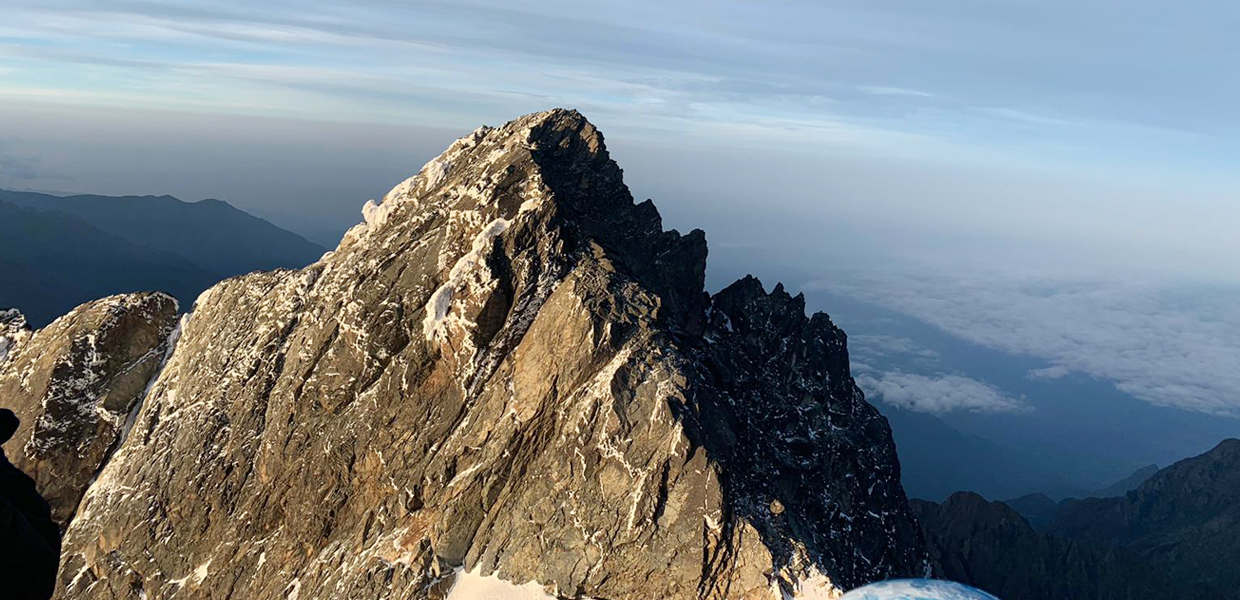
8-Day Rwenzori 3-Peaks Trek: Stanley, Speke & Baker
8-Day Rwenzori 3-Peaks Trek: Summit Mount Stanley (5,109 m) • Mount Speke (4,890 m) • Mount Baker (4,843 m)
Three of Africa’s most coveted summits. Eight days across the Central Circuit’s full alpine arc from equatorial forest to glaciers at 5,109 metres. Uganda’s ultimate multi-peak trekking expedition.
Conquer three iconic Rwenzori peaks in 8 days. On this challenging and scenic trek through forests, glaciers, and alpine valleys, you will summit Mount Stanley, Speke, and Baker. Our 8-day Rwenzori trek of Mount Speke, Mount Stanley, and Baker is a one-of-a-kind adventure of its own.
The 8-day 3 Peaks hiking itinerary promises you a visit to the major peaks of the Rwenzori Mountains, as well as some of Africa’s highest peaks in ranking. As you traverse the lush forests and bamboo, moving toward the rugged terrain of the rocky bouldering peaks, prepare to enjoy an experience that goes beyond the ordinary. You will cross countless streams and major rivers in the Rwenzori Mountains, encountering glacial lakes among the many other unique features the mountains have to offer.
With Mount Speke being the first peak, you will continue and conquer Mount Stanley Margherita Peak and thereafter descend to Kitandara Camp, where you will embark on the summit of Mount Baker. Each day and each summit is totally unique, offering breathtaking landscapes and rugged terrains as well as incredible views of sunsets and sunrises. It’s a journey that calls out for passionate hikers to join and discover the hidden sacred mystery of the Rwenzori mountains.
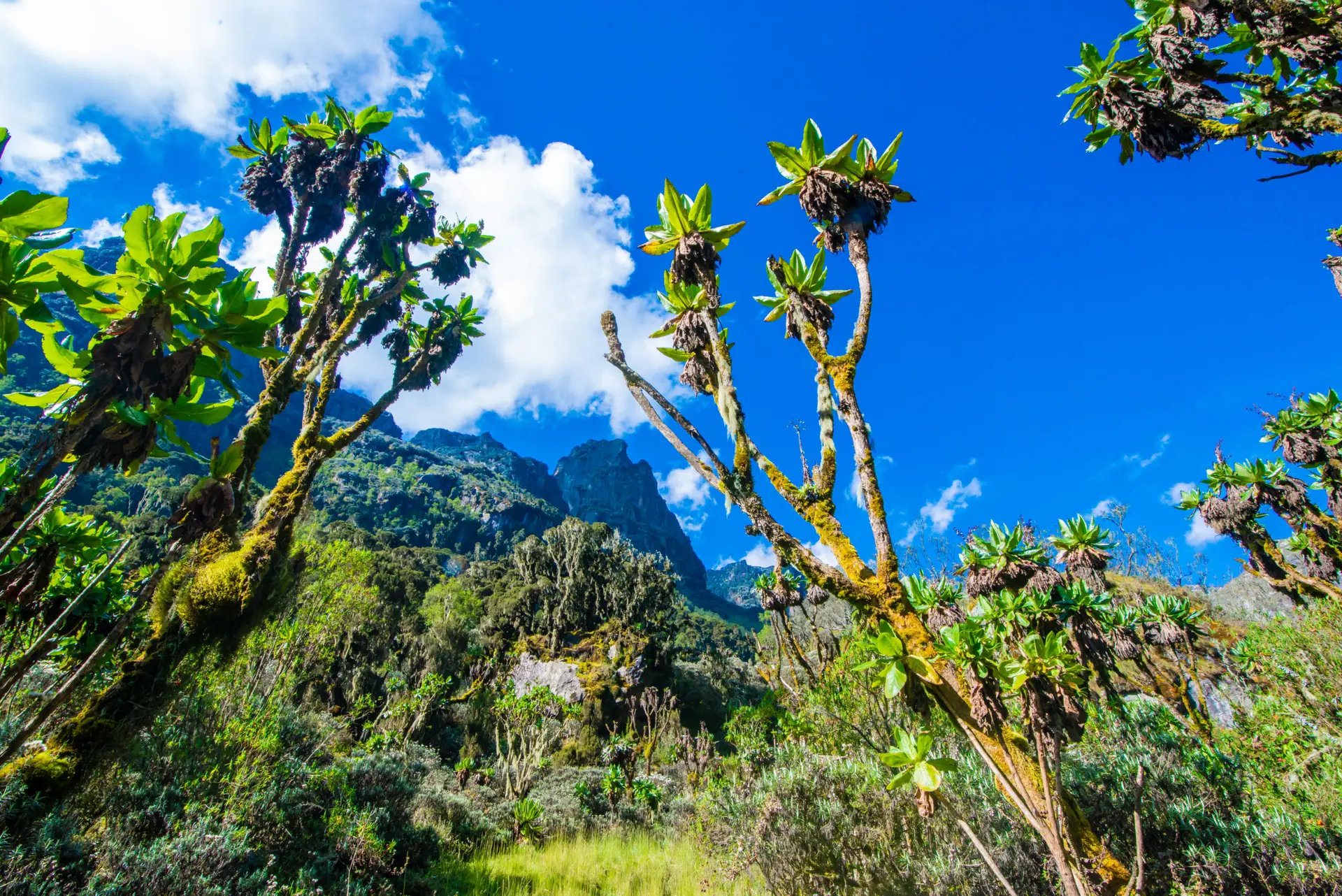
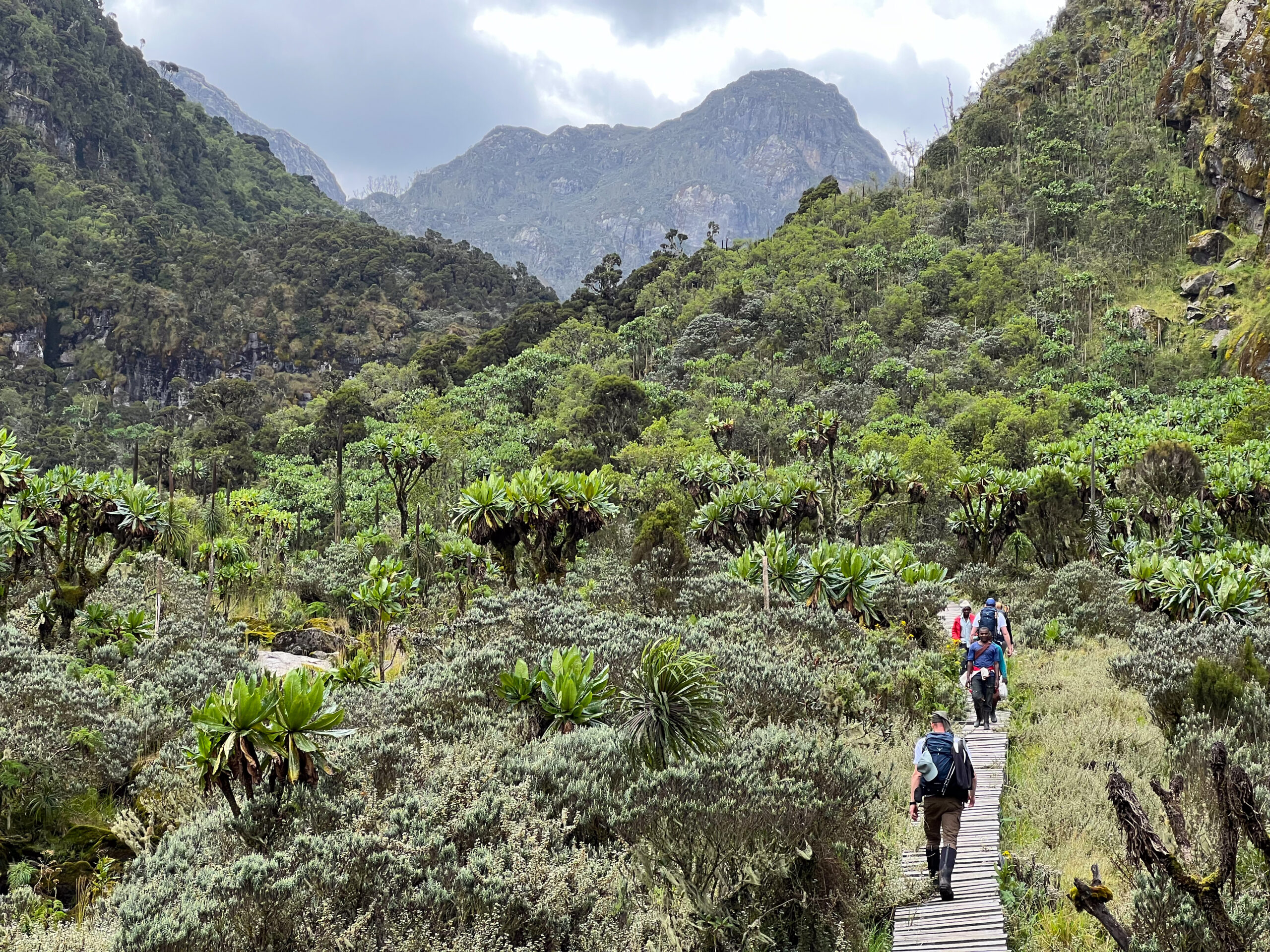
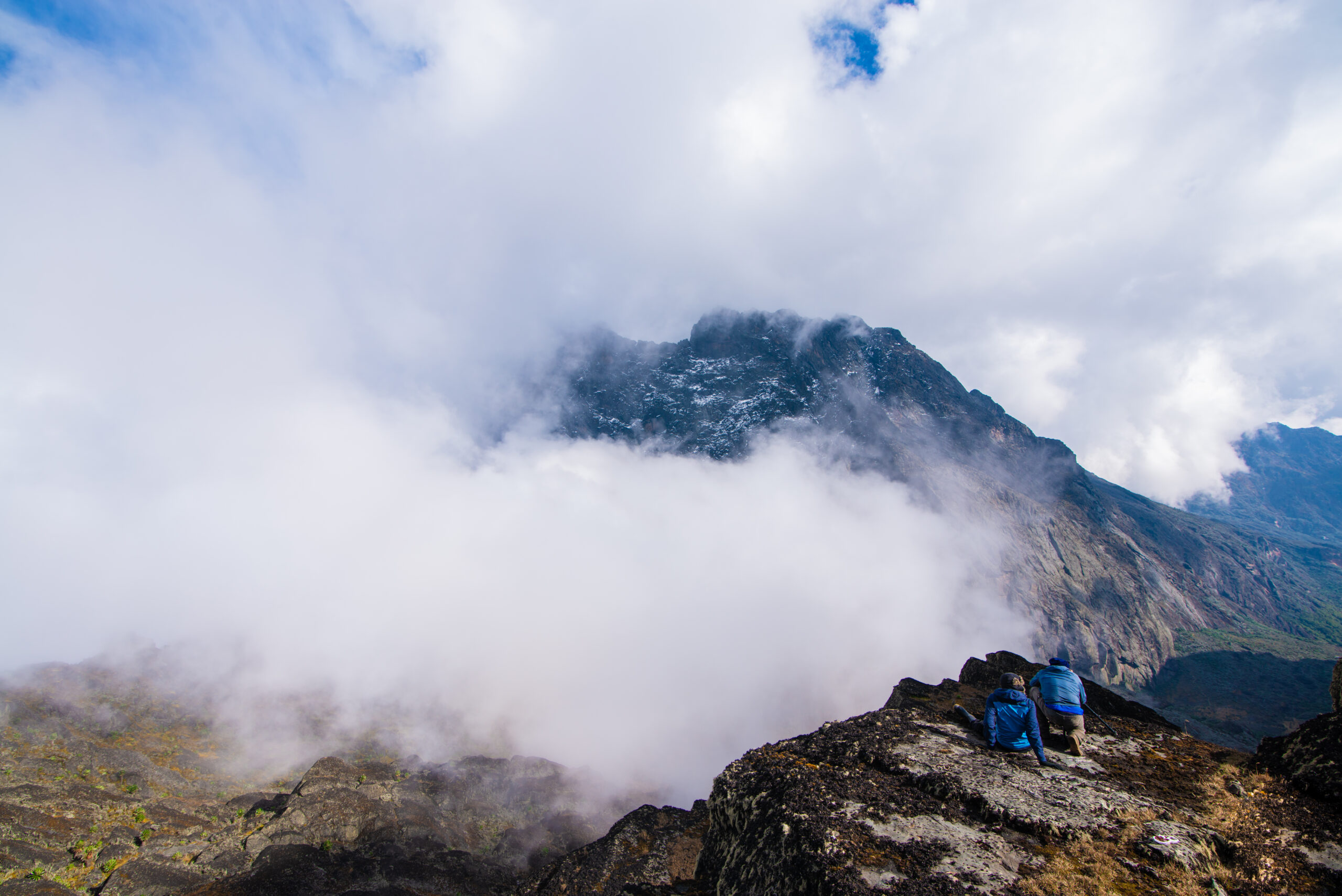
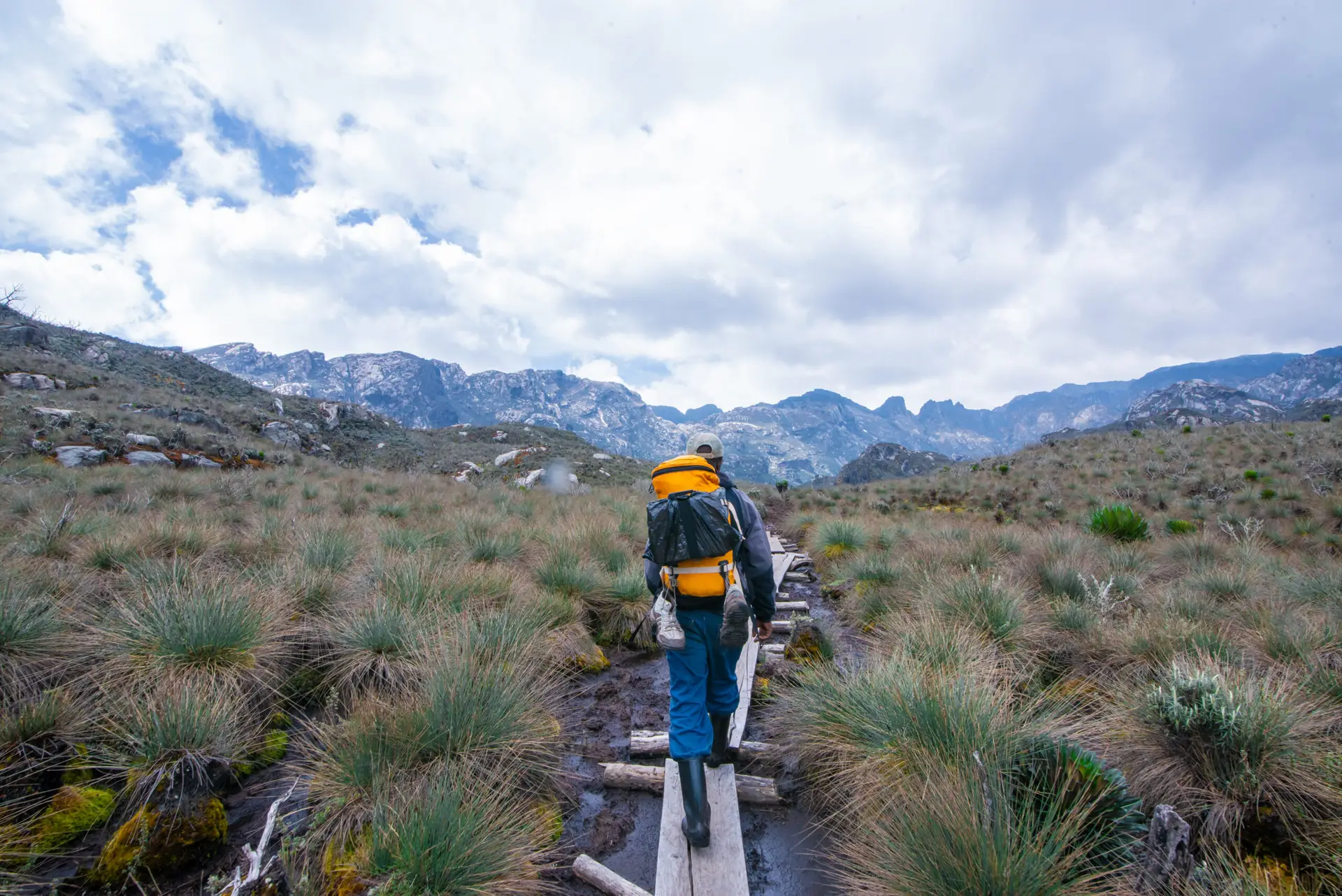
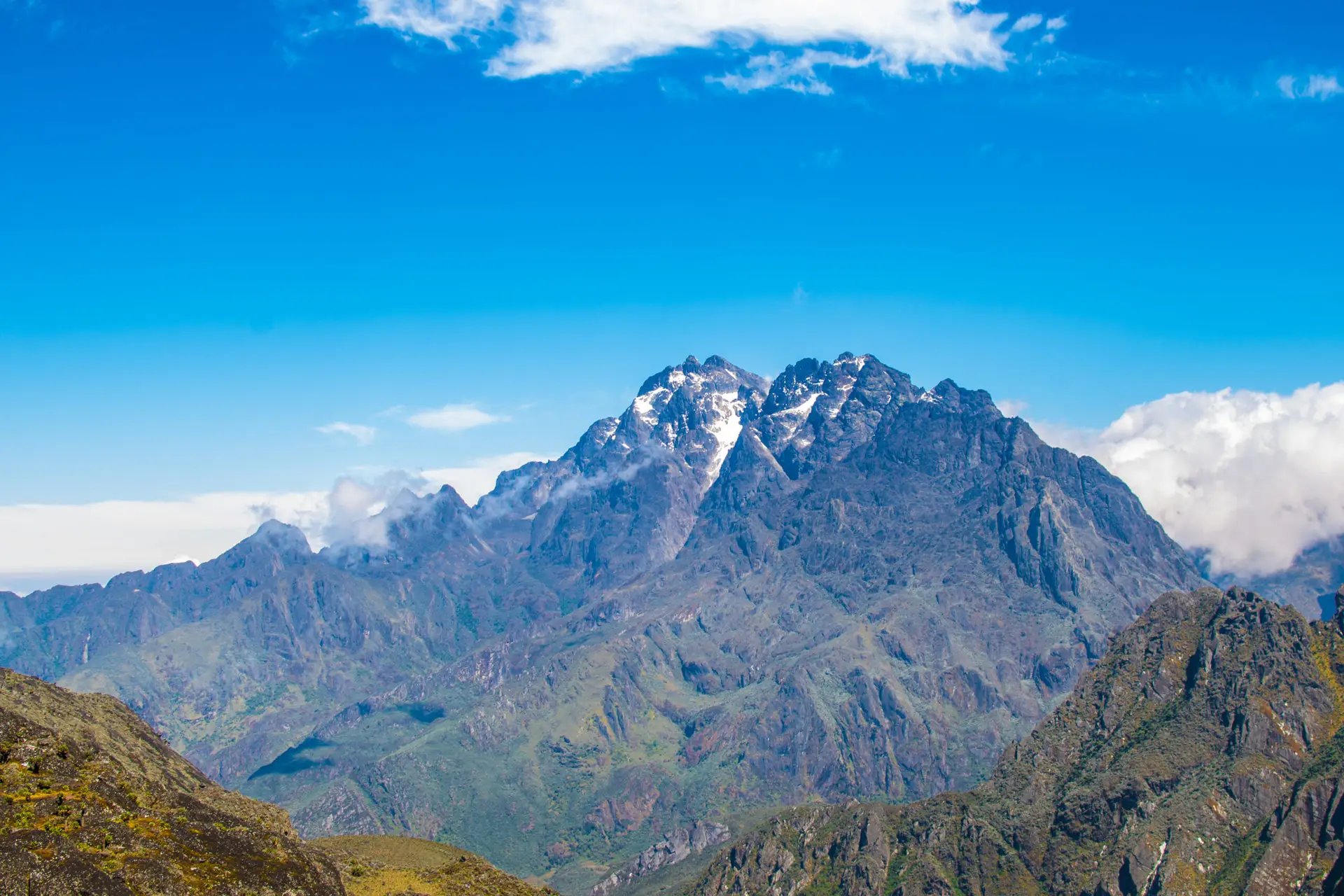
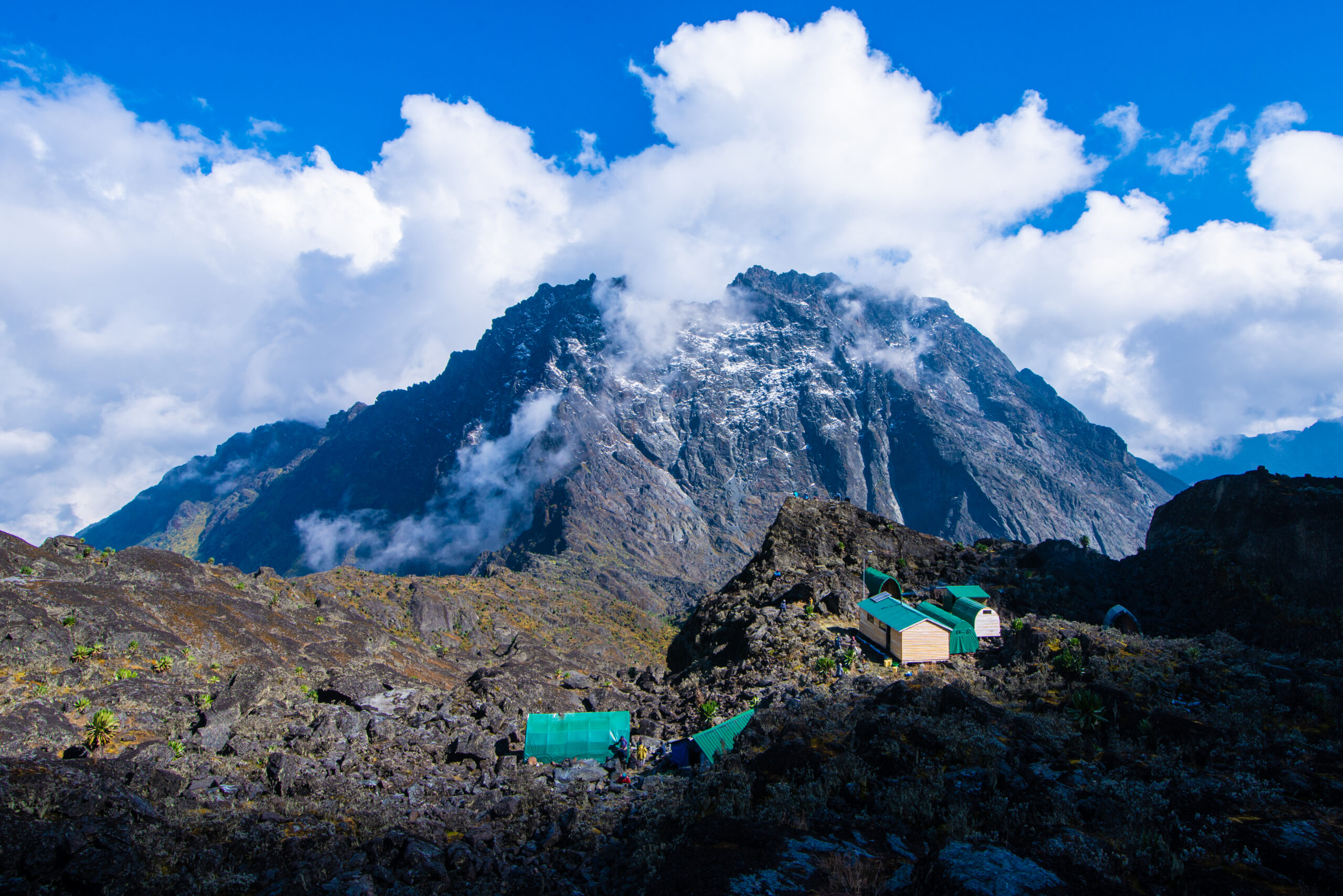
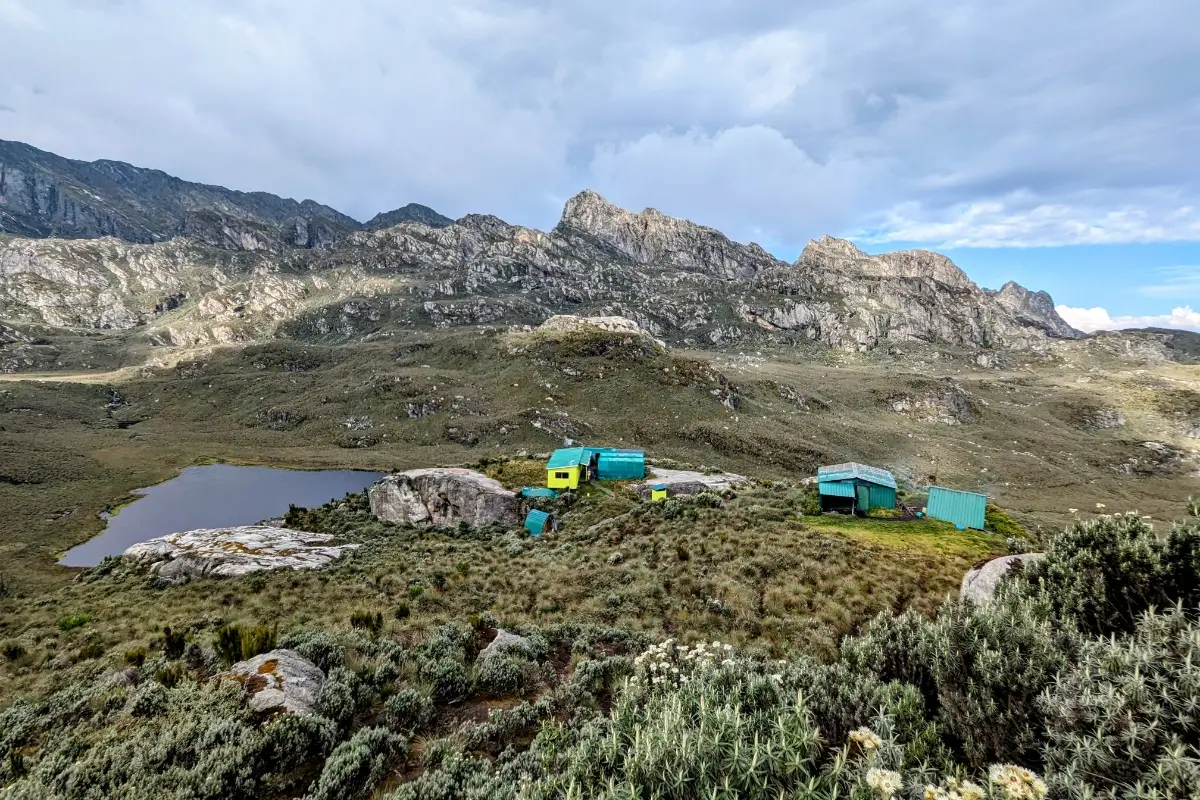
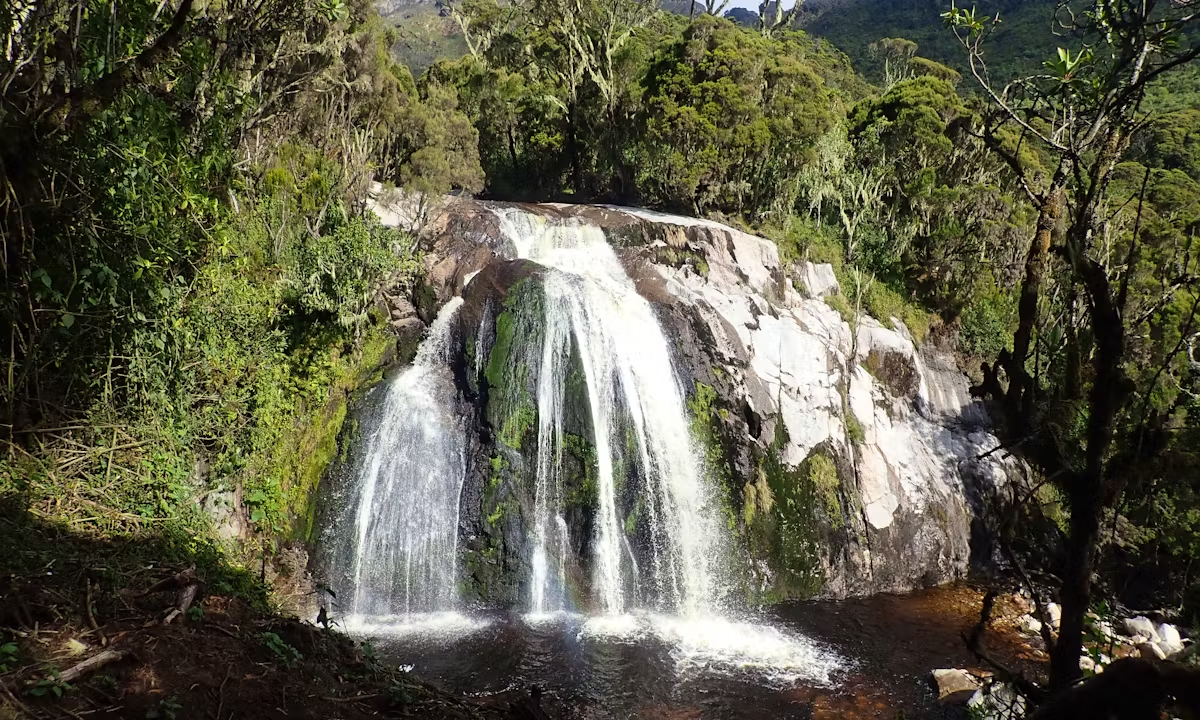
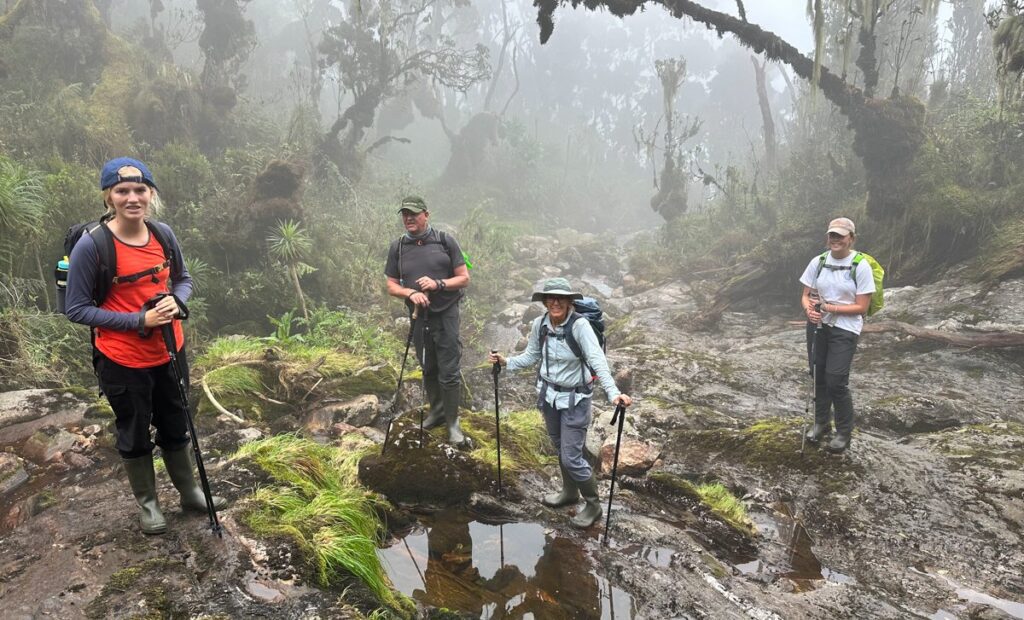
This 3-peak Rwenzori trek to Mt. Speke (Vittorio Emanuele Peak), Mt. Stanley (Margherita Peak), & Mt. Baker (Edward Peak) crosses the Mubuku River over Kurt Shafer Bridge to John Matte Camp, which presents impressive views of Margherita & Alexandria peaks.
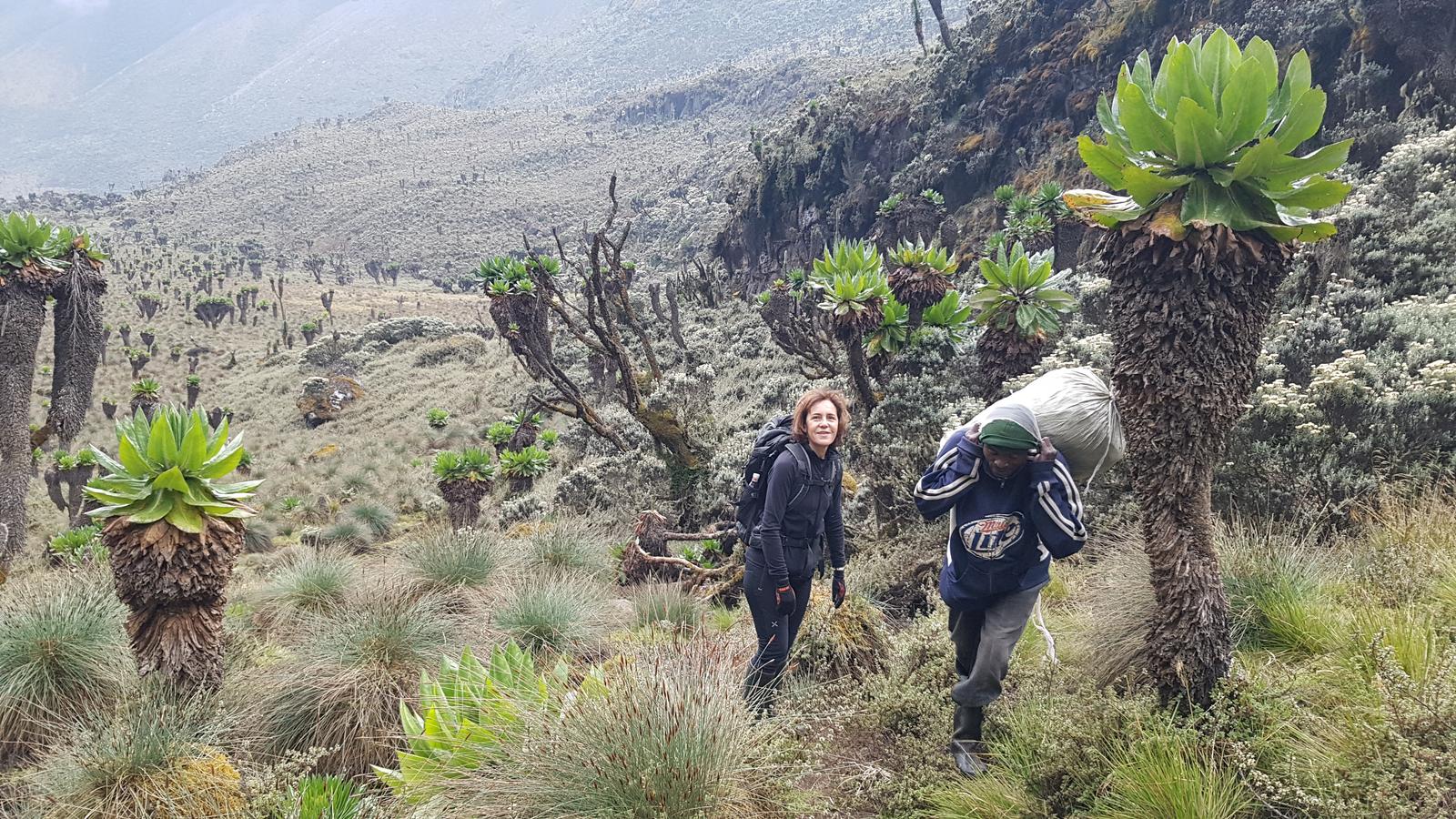
The journey continues through stunning terrains adorned with towering giant lobelia, passing by the serene Lake Bujuku to reach Bujuku Camp, the launch point for the ascent to Mount Speke. This challenging trek leads adventurers to the summit of Vittorio Emanuele Peak at 4520 m. Following this, hikers will descend back to the camp before embarking on the next ascent to Margherita Peak, which stands at 5,109 m. After conquering Margherita, the path slopes down to Kitandara Lakes Camp, setting the stage for the final trek up Mount Baker.
Three Peaks. One Expedition. Africa’s Rwenzori.
| PEAK 1: Mount Stanley / Margherita | 5,109 m: Africa’s 3rd highest point glacier traverse to the summit |
| PEAK 2: Mount Speke / Vittorio Emanuele | 4,890 m: Rwenzori’s 2nd highest massif rocky summit approach from Bujuku |
| PEAK 3: Mount Baker / Edward Peak | 4,843 m Freshfield Pass approach exposed ridge scramble above 4,600m |
Trek at a Glance: 8-Day Rwenzori 3-Peaks Trek
| Duration | 8 Days / 7 Nights |
| Total Distance | Approx. 65–70 km (full Central Circuit with summit detours) |
| Peak 1 — Mount Stanley | 5,109 m Margherita Peak (Africa’s 3rd highest) |
| Peak 2 — Mount Speke | 4,890 m Vittorio Emanuele Peak |
| Peak 3 — Mount Baker | 4,843 m Edward Peak |
| Starting Elevation | 1,646m (Nyakalengija Trailhead) |
| Difficulty | Very Strenuous glacier travel, 5,109m altitude, technical scrambling |
| Start & End Point | Nyakalengija Trailhead, near Ibanda / Kasese, western Uganda |
| Trek Route | Central Circuit Trail, Rwenzori Mountains National Park |
| Best Seasons | June–August (long dry) & December–February (short dry) |
| Accommodation | Rustic trail huts at all camps, including Elena Hut for summit base |
| Glacier Gear Required | Yes crampons, ice axe, and harness for Margherita Peak |
| Price | USD 1,850 per person (8 days) |
| Operator | Rwenzori Trekking Safaris, Uganda |
Why the 8-Day Rwenzori 3-Peaks Trek Is the Ultimate Rwenzori Expedition.
There are multi-peak expeditions, and then there is this trek. The 8-Day Rwenzori 3-Peaks Trek places three of the most demanding and rewarding high-altitude summits in Africa into a single, eight-day circuit across the Central Circuit Trail, a route that threads every ecological zone of the Rwenzori Mountains from equatorial forest to active glacier. Summit Mount Stanley at 5,109 m, Africa’s third highest point and the site of one of the continent’s last equatorial glaciers, then traverse back to claim Mount Speke at 4,890 m and Mount Baker at 4,843 m before completing the circuit. These are not consolation peaks. Each summit demands its own approach and its own technical challenge and delivers its own panoramic reward.
The brilliance of this 8-day itinerary is how efficiently it traverses the range. The Central Circuit already passes through the base zone of all three peaks: Stanley’s Elena Glacier via Elena Camp (4,541m), Speke’s Vittorio Emanuele via a spur from the Bujuku Valley; and Baker’s Edward Peak via the Freshfield Pass approach. By building summit days into the circuit’s natural pace, trekkers achieve three peaks at 4,800m+ and 5,109m without adding unnecessary days or backtracking. This is efficient, professional expedition planning, and it reflects the deep mountain knowledge of our Bakonzo guides, who have shepherded trekkers to all three summits hundreds of times.
With fewer than 1,000 trekkers visiting the entire Rwenzori range each year, completing a successful 3-peaks traverse puts you in an extraordinarily small circle of mountaineers worldwide. For context: Kilimanjaro receives over 50,000 trekkers annually. The Rwenzori’s UNESCO World Heritage status, difficult logistics, and the tough terrain limit visitor numbers, helping to keep the mountain’s silence and wildness. Standing on Margherita Peak at 5,109m, with the glaciated summit ridge behind you and the Afro-alpine world spreading to the horizon in every direction, you will see no other trekkers. The summit is yours alone.
For trekkers who want to extend to five or six peaks, our 10-Day 4 Peaks Trek adds Weismann Peak, and the 13-Day 6 Peaks Grand Expedition covers all six major Rwenzori massifs. For trekkers considering which Rwenzori route best suits their objectives, our Central Circuit vs Kilembe Trail comparison is the definitive guide to route selection.
Full Day-by-Day Itinerary: 8-Day Rwenzori 3-Peaks Trek
Day 1: Nyakalengija (1,615m) → Nyabitaba Camp (2,651m)
Elevation: 1,646 m → 2,652 m | Distance: ~8 km | Hiking Time: 4–5 hours
Your 8-Day Rwenzori 3-Peaks Trek begins at Nyakalengija (1,646m), the Central Circuit trailhead 22km northeast of Kasese. After UWA registration and a full pre-departure briefing from your lead guide, the trail enters the national park within minutes. The Nyakalengija trailhead is the last flat ground you will see for eight days. Savor it briefly, then set your pace for the long climb through the lower montane forest.
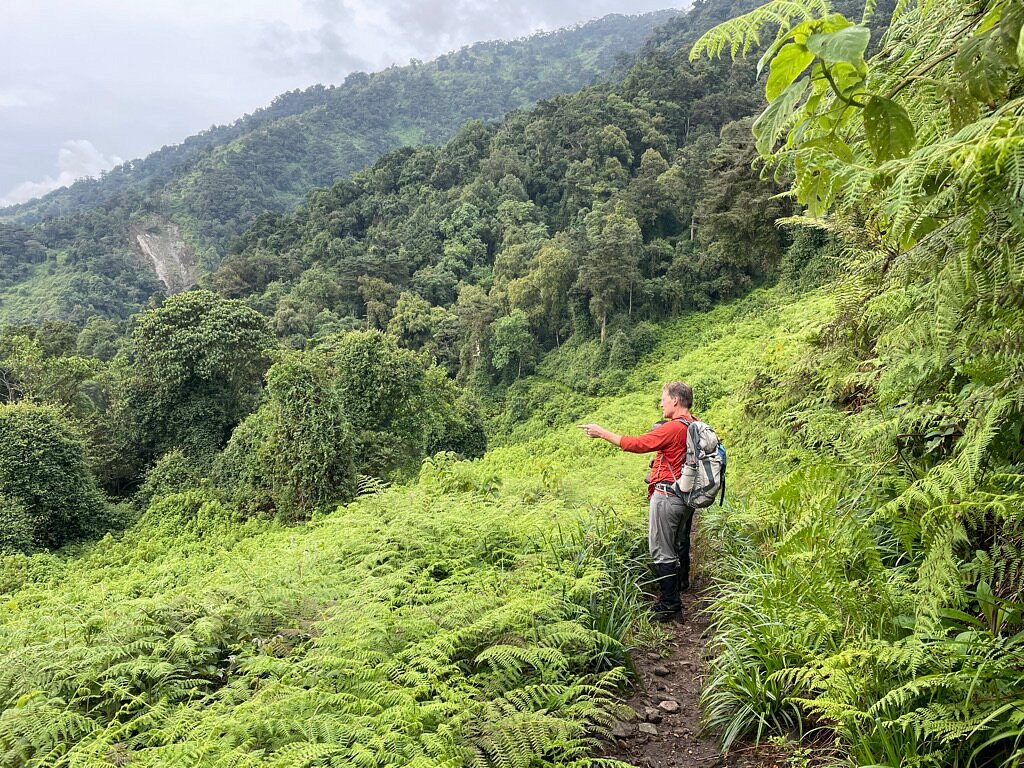
The forest on Day 1 is immediately extraordinary. Podocarpus milanjianus and Hagenia abyssinica form a closed canopy overhead; the understory is thick with flowering Impatiens and Mimulopsis species. Colobus monkeys crash through the upper canopy; red-tailed monkeys track your progress with quiet curiosity. The Rwenzori turaco, a bird so spectacularly colored it appears almost artificial, calls from the forest edge. The trail climbs steadily, crosses the Mubuku River on a log bridge at mid-elevation, and arrives at Nyabitaba in the late afternoon. Consult our Rwenzori wildlife guide for a complete species listing by zone.
Nyabitaba Camp, at 2,652 m, is a ridge-top camp with the first open views of the expedition, the Mubuku Valley below, the Albertine Rift stretching west, and somewhere above the clouds, the peaks you will be standing on in four days’ time. A hot dinner, your guide’s route briefing, and early rest. Eight days ahead.
Highlights: Mubuku River crossing, colobus monkeys, Rwenzori turaco, first ridge views across the Albertine Rift
Sleep: Nyabitaba Camp (2,652 m) shared hut dormitory, foam mattresses, toilet block
Day 2: Nyabitaba Camp → John Matte Camp (3,505m)
Elevation: 2,652 m → 3,414 m | Distance: ~8 km | Hiking Time: 5–7 hours
Day 2 climbs from the montane forest through the bamboo zone and into the lower reaches of the giant heather world, three ecosystems in a single day. The botanical progression is one of the Rwenzori’s defining pleasures, described in full in our guide to the vegetation zones of the Rwenzori. The Bujuku River crossing after Nyabitaba is the day’s first navigational challenge; log bridges span the flow but can be slippery in wet conditions.

The bamboo section (approx. 2,500 m–2,800 m) is brief but atmospheric, with towering Arundinaria alpina forming a vaulted ceiling over the narrow trail. Above the bamboo, Erica arborea and Erica trimera begin their transformation into the giant heather tunnels that will define the next several days. By the time you approach John Matte Camp, the heathers are already 5–6 metres tall and every branch is laced with Usnea lichen. Hypericum trees punctuate the heather, their yellow flowers incongruously cheerful in the mist.
John Matte Camp, at 3,414 m, is the expedition’s first authentic high-altitude camp. On clear evenings, the snowfield on Mount Stanley’s upper flanks is visible above the heather canopy, the first evidence of the summit world you are heading toward. Tonight: proper acclimatization food, 3+ liters of water, and full sleep. Tomorrow takes you to Lake Bujuku.
Highlights: Bamboo zone crossing, giant heather tunnels, first Mount Stanley snowline views from camp in clear weather
Sleep: John Matte Camp (3,414 m) hut accommodation, shared facilities, cook shelter
Day 3: John Matte Camp → Bujuku Camp (3,962m)
Elevation: 3,414 m → 3,977 m | Distance: ~7 km | Hiking Time: 5–6 hours
Day 3 offers the 8-day trek’s most intense botanical experience: the full Afro-alpine zone, where giant groundsels (Senecio adnivalis) and giant lobelias (Lobelia wollastonii) appear from the mist in shapes so strange they look more like something from a science fiction landscape than a real mountain. These are not unusual plants scaled up; they are entirely separate evolutionary lineages that converged on a similar strategy: tall growth and a closed rosette that protects the vital growing tip from night frosts. Nowhere else in Africa will you walk through this kind of flora at this density.
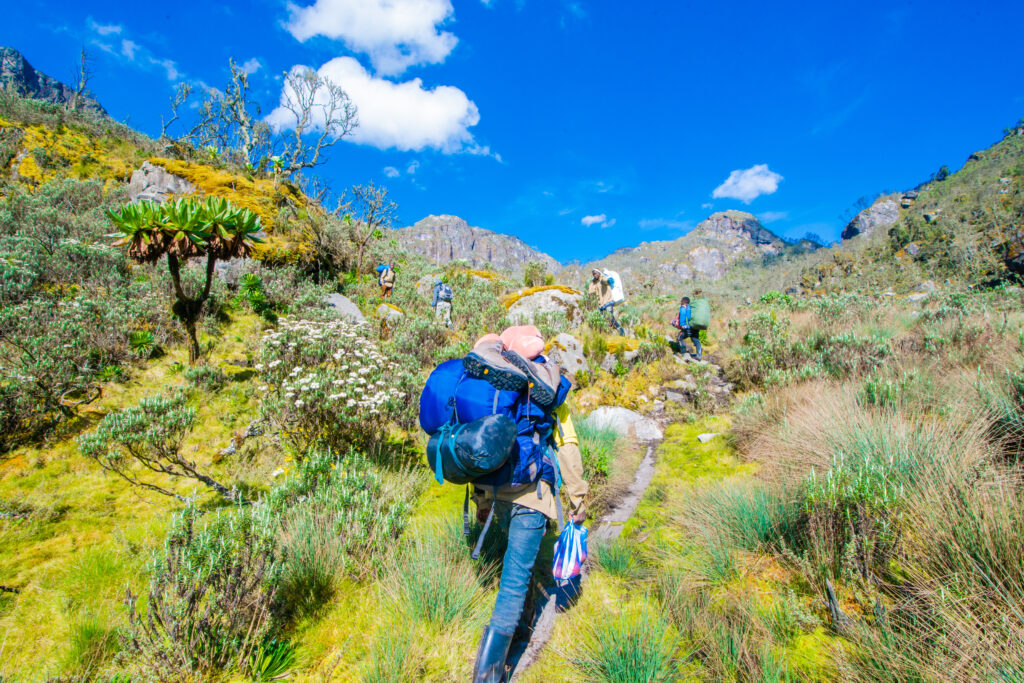
The trail crests into the Lake Bujuku basin (3,977 m), a landscape that renders first-time visitors briefly speechless. The glacial tarn reflects the slopes of Mount Stanley to the northwest and Mount Speke to the north, the two summits you will reach on Days 5 and 6. This is the moment the expedition becomes viscerally real: the peaks you have been climbing toward are suddenly visible overhead, vast and specific. Tomorrow you go higher.
Bujuku Camp, at 3,977 m, is the highest standard camp on the Central Circuit. Altitude effects are very real here; headaches, disturbed sleep, and reduced appetite are common and normal. Eat what you can, drink plenty of water, and sleep as much as possible. Your guide will check in on your acclimatization this evening.
Highlights: Giant groundsel and lobelia zone, Lake Bujuku reflection of Mount Stanley and Speke, first sight of Elena Glacier above
Sleep: Bujuku Camp (3,977 m) trail huts; sleeping bag rated -10°C essential from tonight onward
Day 4: Bujuku → Elena Camp (Acclimatisation & Stanley Summit Prep)
Elevation: 3,977 m → 4,541 m | Distance: ~4 km | Hiking Time: 3–4 hours
Day 4 is a short but crucial day: the ascent from Bujuku to Elena Camp (4,541m) below the Elena Glacier, followed by an afternoon of rest, gear check, and final preparation for the Margherita Peak summit attempt on Day 5. The trail to Elena climbs steeply on the southern slopes of the Stanley massif through the upper Afro-alpine zone, where vegetation is increasingly sparse and the rock takes on the character of a true high-altitude environment. You are now well above the permanent snowline of most East African mountains.
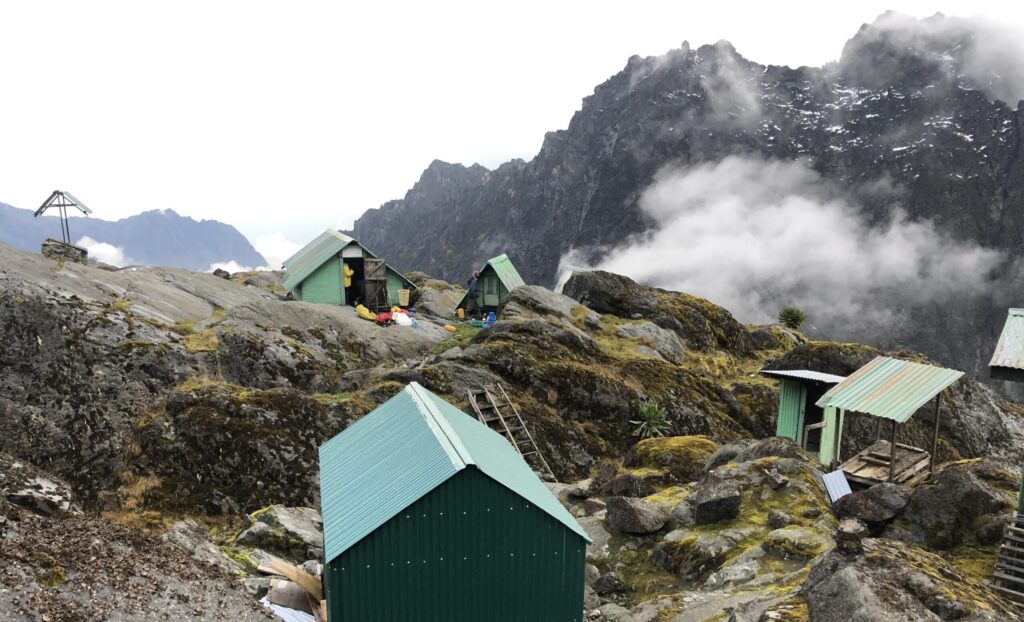
Elena Camp is positioned on a rocky bench below the glacier wall, making it one of the most dramatically placed camps in African mountaineering. From the hut doorstep, the Elena Glacier rises directly above; on clear afternoons, the blue-white ice of the Stanley Plateau is visible above the glacier snout. This is the point at which glacier gear is distributed, crampons are fitted, and ice axe technique is reviewed with your guide. The ascent to Margherita requires crossing the Elena Glacier, approximately 2–3 hours of roped glacier travel in addition to the approach. Read more about the disappearing Rwenzori glaciers to understand what you are crossing and why they will vanish in decades.
Dinner at Elena Camp, at 4,541m is a subdued, purposeful affair. Appetite is often reduced significantly at this altitude; eat what you can, drink copiously, and sleep as early as possible. Departure for Margherita is between 5:00 and 6:00 AM, depending on conditions. Set your gear out tonight.
Highlights: Elena Glacier first sight, glacier gear fitting and briefing, Stanley Plateau visible above camp, panoramic Bujuku Valley views on ascent
Sleep: Elena Camp (4,541m) summit base; sleeping bag rated -15°C recommended; extra insulation layers out
Day 5: SUMMIT DAY 1; Margherita Peak, Mount Stanley (5,109m) → Bujuku Camp
Elevation: 4,541 m → 5,109 m → 3,977 m | Distance: ~12 km total | Hiking Time: 8–11 hours
This trek is the highest day of your life. Departure from Elena Camp in darkness at 5:00–6:00 AM, crampons on, ice axe in hand, roped in teams of 3–4 with your guide. The initial approach to the Elena Glacier takes 30–45 minutes on rocky moraine; once on the glacier, the world becomes ice, wind, and the slow, deliberate rhythm of crampon placement.
The Elena Glacier route to Margherita Peak (5,109m) the highest point on Mount Stanley and Africa’s third highest summit, follows the Stanley Plateau across the glacier to the summit ridge. The crevasse field on the lower glacier requires experienced route-finding; your guide has made the glacier crossing dozens of times and navigates it efficiently. Above the plateau, the final approach to Margherita involves a short but exposed rocky section that rewards careful footwork. And then the summit.
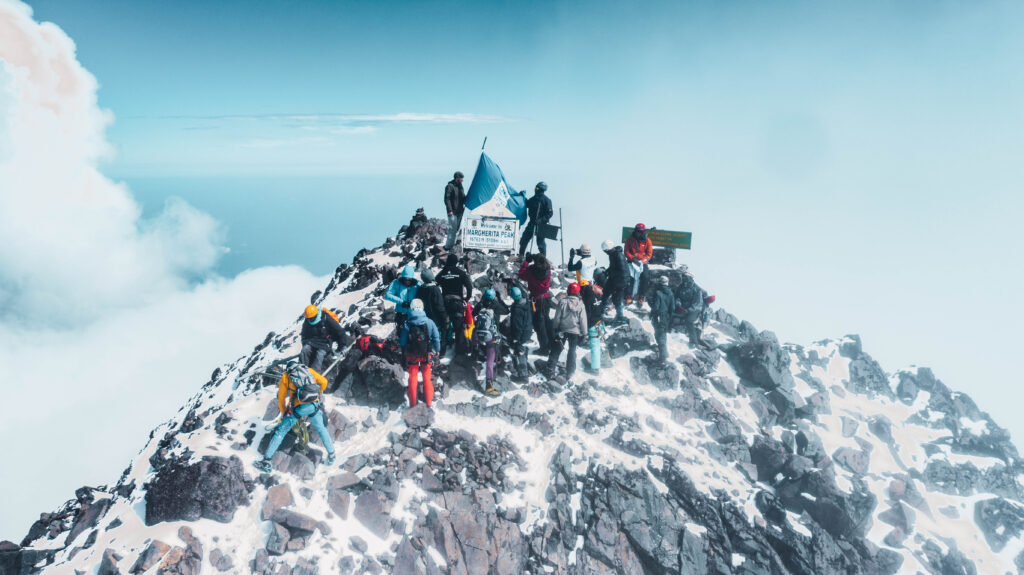
At 5,109m, the view from Margherita Peak encompasses the full arc of the Rwenzori Mountains below you: the Lake Bujuku basin, 1,100 metres below; the Kitandara Lakes in the far southwest; the DR Congo hills visible on the western horizon; the plains of the Albertine Rift stretching to the east. To the northwest, the adjacent Albert and Alexandra peaks are visible on the Stanley massif. You are standing on Africa’s third highest point, at the equator, on a glacier that scientists predict will entirely disappear by 2050. Time on this summit, however brief the cold allows, is unlike any other summit moment on earth.
Descend from Margherita via the same glacier route back to Elena Camp, then continue descending to Bujuku Camp (3,977 m) for the night. The total descent from the summit to Bujuku is over 1,100 metres. Expect to arrive at Bujuku by mid-to-late afternoon. A full hot meal and early sleep are essential; Peak 2 is tomorrow morning.
Summit 1: Margherita Peak, Mount Stanley 5,109 m | Africa’s 3rd highest | Glacier traverse via Elena Glacier
Sleep: Bujuku Camp (3,977 m) recovery sleep after summit; post-summit fatigue is significant at this altitude
Day 6: SUMMIT DAY 2; Vittorio Emanuele Peak, Mount Speke (4,890m) → John Matte Camp
Elevation: 3,977 m → 4,890 m → 3,414 m | Distance: ~14 km | Hiking Time: 9–11 hours
Day 6 is the expedition’s most physically demanding day: a second summit push the morning after Margherita Peak, followed by a descent to John Matte Camp. The 8-Day 3-Peaks Trek is explicitly designed for trekkers who have the fitness to handle this kind of back-to-back summit schedule. It is not for the faint-hearted, but it is achievable with proper training and acclimatization.
The approach to Vittorio Emanuele Peak on Mount Speke (4,890m) leaves Bujuku in the early morning and climbs the northern spur of the Speke massif via the Stuhlmann Pass approach. The route crosses open Afroalpine terrain before entering the rockier upper section above 4,500m. Mount Speke’s summit involves sustained scrambling on good granite, technically less committed than the Elena Glacier on Stanley but more exposed in terms of rocky ridge walking. The summit of Vittorio Emanuele at 4,890m delivers extraordinary views southward across Lake Bujuku and the basin you have spent three nights beside and northward toward the DRC border escarpment.
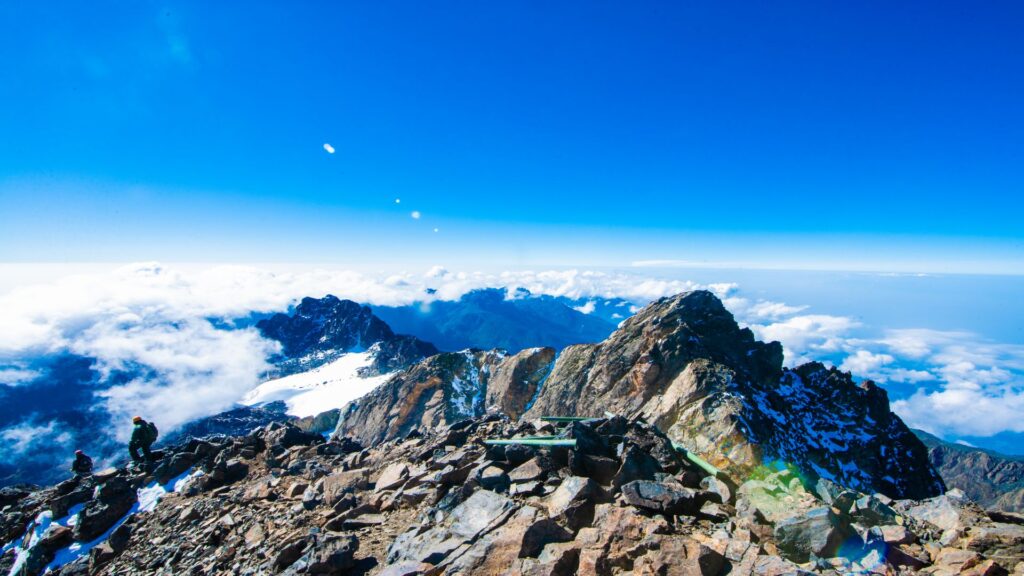
After summiting Speke, the route descends back through the Bujuku Valley and continues to John Matte Camp (3,414m) for the night. This is a long descent day, approximately 9–11 hours of total movement, including the summit, and John Matte’s lower elevation provides a meaningful physiological recovery night before Peak 3 the following day. Eat well, rest fully, and let the altitude reduction do its work.
Summit 2: Vittorio Emanuele Peak, Mount Speke 4,890 m | Rocky north spur approach from Bujuku Valley
Sleep: John Matte Camp (3,414 m) lower elevation recovery; warmer and physiologically restorative after back-to-back summits
Day 7: SUMMIT DAY 3; Edward Peak, Mount Baker (4,843m) → Guy Yeoman Camp
Elevation: 3,414 m → 4,843 m → 3,261 m | Distance: ~15 km | Hiking Time: 9–12 hours
The third and final summit day of the 8-Day Rwenzori 3-Peaks Trek. From John Matte Camp, the route climbs to Edward Peak on Mount Baker (4,843 m) via the Freshfield Pass approach, a different character entirely from the Speke or Stanley ascents. The Freshfield Pass route traverses the southern Bujuku ridge and climbs through the eastern flank of the Baker massif, gaining the summit ridge above 4,600m via sustained rocky scrambling on good, grippy rock.
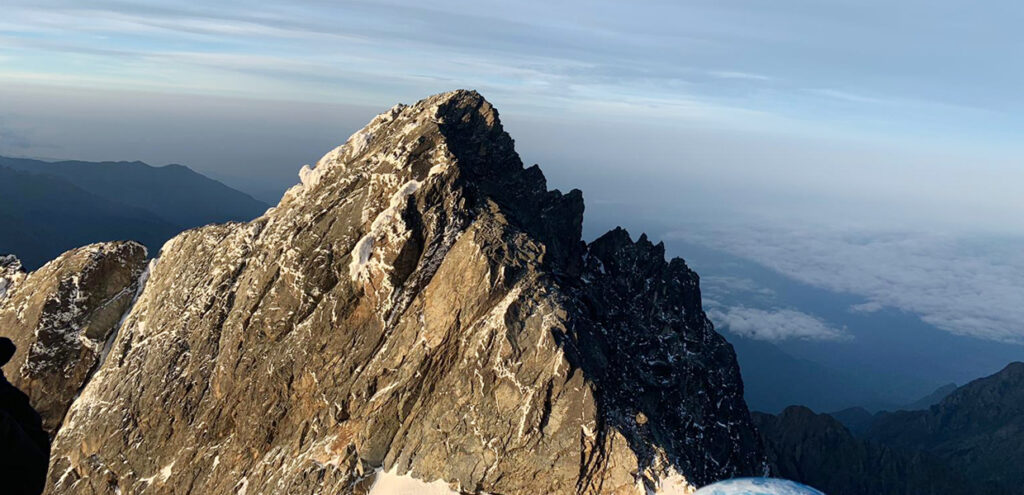
Mount Baker’s Edward Peak, at 4,843 m is the third highest point in the Rwenzori. The summit experience here is in some ways the most intimate of the three peaks: there is no glacier, no roped team movement, just a trekker, their guide, and a long exposed ridge of ancient crystalline rock with the full Rwenzori panorama in every direction. To the north, Margherita Peak and Speke are visible summits you stood on yesterday and the day before. The emotional resonance of that view is something guides report seeing in trekkers’ faces without exception.
After summiting Baker, the route descends via the Guy Yeoman trail to Guy Yeoman Camp (3,261 m), the final night of the expedition. Guy Yeoman provides a lower-elevation recovery camp with a warmer, more sheltered atmosphere than any camp above it. This evening is the appropriate moment for your team debrief, the distribution of tips to your guide and porter team, and the quiet satisfaction of knowing that three of Africa’s magnificent summits are behind you.
Summit 3: Edward Peak, Mount Baker 4,843 m | Freshfield Pass approach: rocky ridge scramble; no glacier gear required
Sleep: Guy Yeoman Camp (3,261 m) final expedition night; warmer temperatures, team debrief evening
Day 8: Guy Yeoman Camp → Nyakalengija Trailhead; Final Descent
Elevation: 3,261 m → 1,646 m | Distance: ~9 km | Hiking Time: 5–6 hours
The final descent from Guy Yeoman to Nyakalengija drops nearly 1,600 metres through the vegetation zones in reverse: heather to bamboo to montane forest. Your legs, after seven days of high-altitude effort and three summit pushes, will feel this descent in the quads and knees. Trekking poles are essential. The pace is relaxed; there is no urgency. The forest welcomes you back the monkeys, the birds, the thickening air, and the rising temperature are all markers of the world you are returning to.
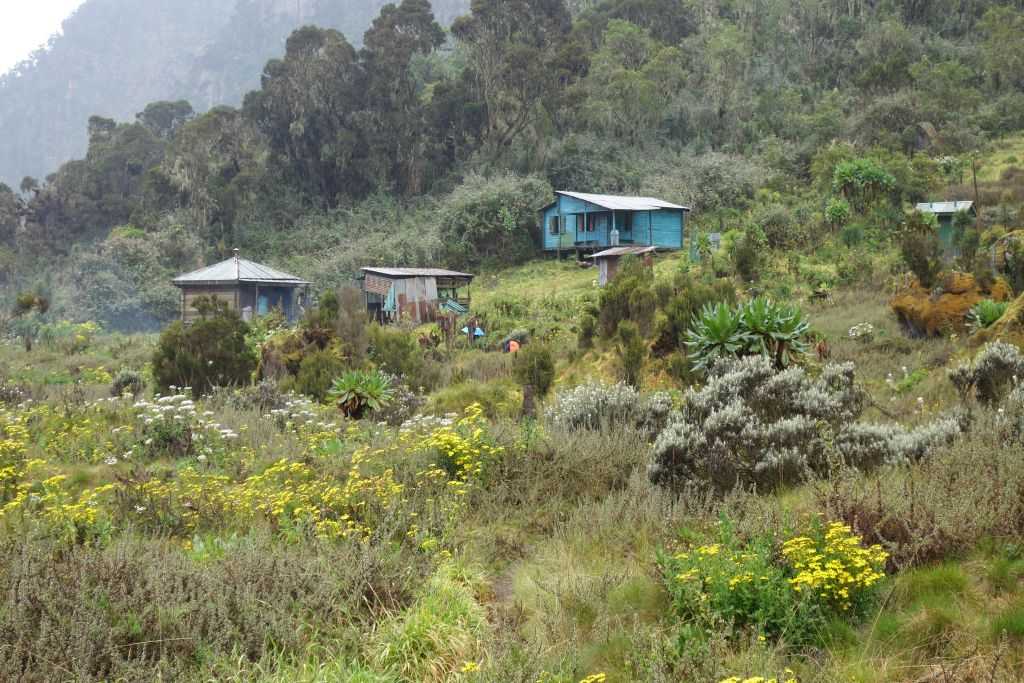
At the Nyakalengija gate, your lead guide presents your 3-Peaks Completion Certificate issued by Rwenzori Trekking Safaris to document your summits of Stanley (5,109 m), Speke (4,890 m), and Baker (4,843 m). You are transferred back to Kasese for a hot shower, cold drinks, and the considerable satisfaction of having completed one of Africa’s most rigorous multi-peak expeditions. For the next expedition, whether the 10-Day 4 Peaks Trek or the full 13-Day 6 Peaks Grand Expedition, the planning starts here.
Highlights: Forest re-entry through full botanical sequence, Mubuku River final crossing, 3-Peaks Completion Certificate at Nyakalengija
End point: Nyakalengija Trailhead (1,646 m); vehicle transfer to Kasese included
Elevation Profile Summary: 8-Day Rwenzori 3-Peaks Trek
The 8-Day 3-Peaks Trek features three distinct summit arcs from a Central Circuit base, with the maximum summit elevation at Margherita Peak (5,109 m) on Day 5. Total cumulative elevation gain across all eight days is approximately 5,600m, with an approximate 5,600m of descent.
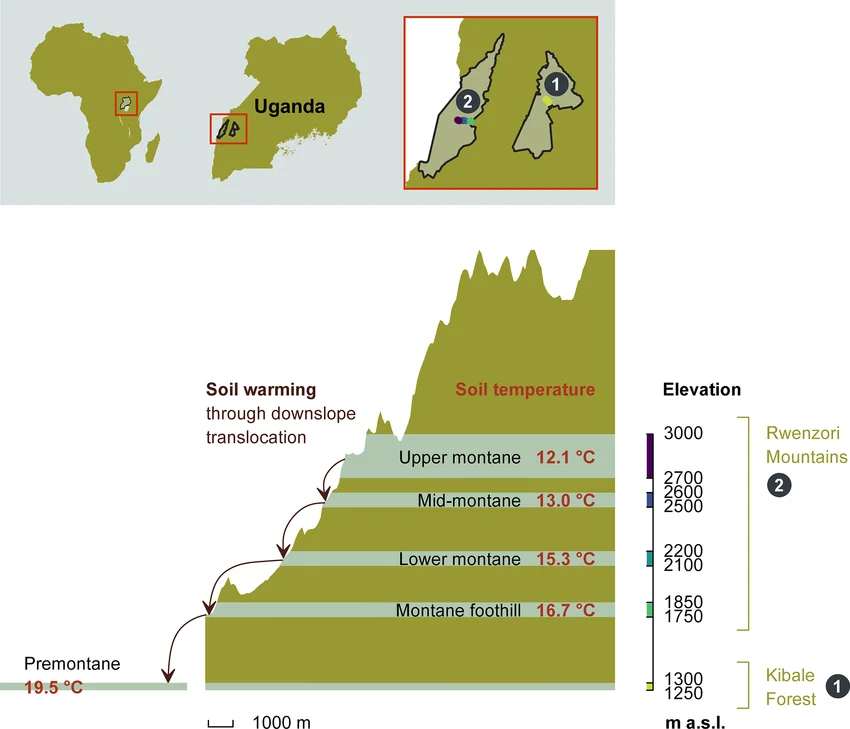
Day 1: 1,646 m → 2,652 m | +1,006 m | Sustained forest ascent.
Day 2: 2,652 m → 3,414 m | +762 m | Bamboo and giant heather transition.
Day 3: 3,414 m → 3,977 m | +563 m | Afro-alpine entry, Lake Bujuku basin.
Day 4: 3,977 m → 4,541 m | +564 m | Elena Camp acclimatization approach: short but at high altitude.
Day 5 (Stanley): 4,541 m → 5,109 m → 3,977 m | +568 m up / -1,132 m down | Longest altitude day: glacier traverse.
Day 6 (Speke): 3,977 m → 4,890 m → 3,414 m | +913 m up / -1,476 m down | Back-to-back summit; physically the hardest day.
Day 7 (Baker): 3,414 m → 4,843 m → 3,261 m | +1,429 m up / -1,582 m down | Third summit; descent to Guy Yeoman.
Day 8: 3,261m → 1,646m | -1,615 m | Long forest descent; poles are essential.
Camps & Accommodation: 8-Day Rwenzori 3-Peaks Trek
Nyabitaba Camp, 2,652 m (Night 1)
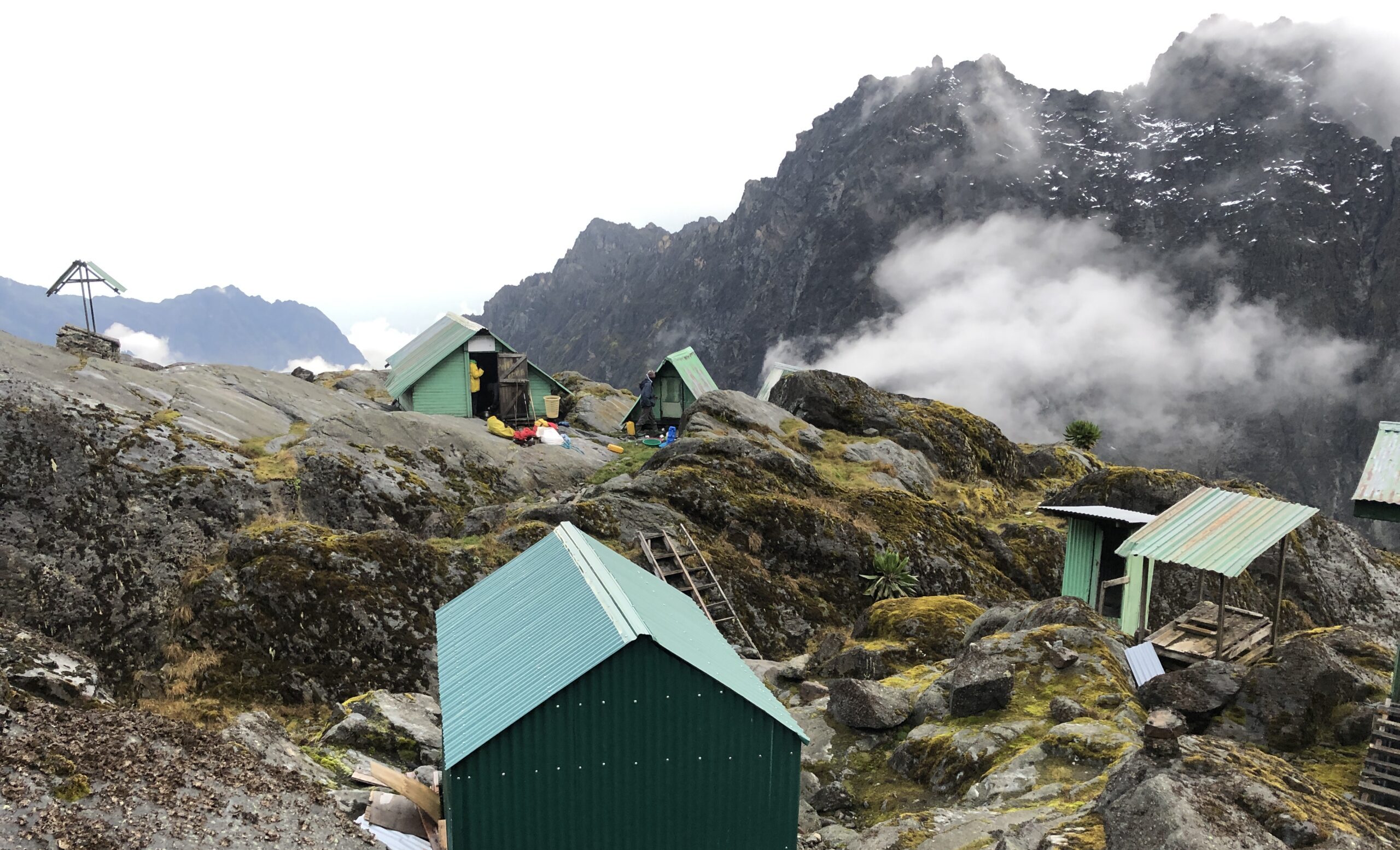
First camp on the Central Circuit, perched on a wide forested ridge above the Mubuku Valley with the first open views toward the Albertine Rift. Wooden huts with foam mattresses, a toilet block, and a cooking shelter. Temperatures are 12–18°C; a light fleece is sufficient. This site is the most accessible camp on the circuit and sees the highest foot traffic.
John Matte Camp, 3,414 m (Nights 2 & 6)
The giant heather camp is set in a clearing with views of Mount Stanley on clear evenings. Nights 2 and 6 are spent here, the second after a post-summit recovery from Speke. The camp’s lower altitude relative to Bujuku makes it a key physiological recovery point between summit days. Temperatures are 5–10°C at night; mid-layer insulation is required.
Bujuku Camp, 3,977 m (Nights 3 & 5)
The hub of the 3 Peaks expedition. Nights 3 and 5 were both at Bujuku before Elena/Stanley and after descending from Margherita Peak. The site is positioned at the edge of Lake Bujuku, below Mount Stanley. At nearly 4,000m, acclimatization is genuine; a -10°C sleeping bag is strongly recommended. The camp huts have seen generations of expeditions and carry the weight of Rwenzori climbing history.
Elena Camp, 4,541 m (Night 4)
This is the highest sleeping point of the expedition and the base camp for the Margherita Peak summit. Positioned on a rocky ledge below the Elena Glacier, one of Africa’s last equatorial ice masses. The views from this camp are unmatched on the entire circuit. At 4,541m, most trekkers find their sleep disrupted; they should eat well, dress warmly, and lay out their summit kit before sleeping. A sleeping bag rated to -15°C and a liner are strongly recommended.
Guy Yeoman Camp, 3,261 m (Night 7)
Final night of the expedition and post-summit debrief camp. Lower elevation means meaningfully warmer temperatures (8–14°C at night) and improved sleep after the altitude-intensive summit days. It is named for a surveyor from the early Rwenzori exploration era. Many trekkers report their best sleep of the entire expedition here; the altitude has been broken, the summits are done, and the mountain has done its work.
Flora & Wildlife on the 8-Day Rwenzori 3-Peaks Trek
The 8-Day 3-Peaks Trek passes through all five Rwenzori vegetation zones across eight days, the most complete ecological transect available on any single Rwenzori itinerary. Our vegetation zones guide and wildlife guide provide complete species lists for each zone.
Montane Forest (1,646m–2,500m): Colobus monkeys, red-tailed monkeys, L’Hoest’s monkeys, three-horned chameleons, and forest duiker. Rwenzori turaco, African green broadbill, and multiple sunbird species. Days 1 and 8.
Bamboo Zone (2,500 m–2,800 m): Elephant and buffalo habitat corridor. Arundinaria alpina bamboo. Day 2.
Giant Heather Zone (2,800 m–3,500 m): Erica arborea and Erica trimera, up to 8 m tall, draped in Usnea lichen. Ground orchids, handsome spurfowl, and Rwenzori-specific bird species. Days 2, 3, 7, and 8.
Afro-alpine Zone (3,500 m–4,500 m): Giant groundsels (Senecio adnivalis) and giant lobelias (Lobelia wollastonii). Rwenzori otters at Lake Bujuku and Kitandara. Klipspringer on rocky outcrops. Days 3–7.
Nival Zone (4,500m+): Bare rock, scree, glacial ice, and polished glacier surfaces. On Day 5, we will see the Elena Glacier, one of Africa’s last equatorial glaciers, which scientists predict will entirely disappear by 2050. You can read more about how the glacier is retreating.
Physical Difficulty & Fitness Requirements for the 8-Day Rwenzori 3-Peaks Trek
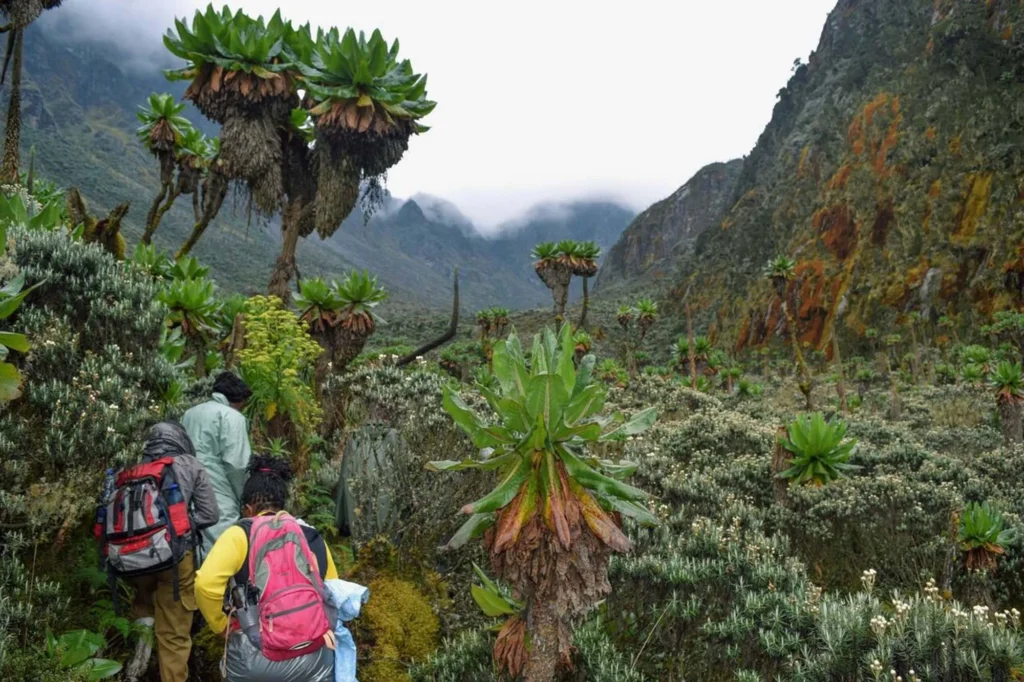
The 8-Day Rwenzori 3-Peaks Trek is rated Very Strenuous, the highest difficulty category on our rating scale. It demands the kind of physical preparation and mental resilience associated with genuine high-altitude mountaineering, not simply trekking. The specific challenges are three summit pushes across four consecutive days (Days 5, 6, and 7); one night at 4,541m above sea level; a glacier crossing with crampons and ice axe on Day 5; sustained rocky scrambling to 4,843m and 4,890m on Days 6 and 7; and a total cumulative elevation gain of approximately 5,600m.
The minimum fitness requirement is the ability to complete a consecutive multi-day mountain trek at altitude without significant recovery time between days. Trekkers who have successfully completed Kilimanjaro via a 7-day route, multi-day alpine huts circuits above 3,500m, or comparable high-altitude expeditions are well-positioned for this trek. Prior glacier-travel experience helps, but you don’t need it; the Elena Camp briefing on Day 4 covers glacier technique.
Training: Begin 10–14 weeks before departure. Weighted uphill hiking (12–15kg, 4+ hours per session), cardiovascular training 5 days per week, and multi-day overnight treks with consecutive summit days if possible. Altitude sickness management: our itinerary is carefully paced for acclimatization, but three nights above 3,900m and a summit at 5,109m put the trek solidly in territory where Diamox is worth discussing with your physician. Our guides carry and are trained to administer emergency altitude medications. For older trekkers, our guide to Rwenzori trekking over 50 addresses specific considerations.
Best Time to Attempt the 8-Day Rwenzori 3-Peaks Trek

June to August (Long Dry Season) Strongly Recommended: The optimal window for all three summits. Stanley’s Elena Glacier is at its most stable; Speke and Baker’s rocky ridges are dry; views from all summits are most likely to clear. The vast majority of successful 3-peaks traverses occur during this window. Book 4–6 months in advance.
December to February (Short Dry Season) Excellent: December and January are highly reliable and often produce better summit views than the dry season proper. The short rains preceding this window can leave more ice on the glacier approaches; bring crampons regardless.
March to May & September to November (Wet Seasons): We do not recommend attempting the 3-peaks during the wet season, as it significantly increases the risk of glacier crevasse exposure on Stanley, makes the rocky ridges of Speke and Baker dangerous in wet conditions, and adds deep mud to the lower trail. We do not recommend the 3-peaks attempt during these months. Single-peak or non-summit circuit treks remain possible with appropriate experience.
What’s Included & What’s Not Included
Included
- UWA Entry Permit 8 days of park access fees (USD 360 per person)
- Professional Lead Guide: UWA-certified, experienced glacier guide for Stanley summit day
- Assistant Guide: second guide for summit days to maintain 1:2 guide-to-trekker ratio on glacier
- Glacier Equipment crampons, ice axe, and harness provided for all trekkers (helmet available on request)
- Dedicated Porter Team: one porter per trekker; 15kg main luggage limit
- Camp Cook & Full Board all meals Days 1–8 including high-energy summit-day breakfast
- 7 Nights Camp Hut Accommodation Nyabitaba, John Matte (×2), Bujuku (×2), Elena, Guy Yeoman
- Emergency First Aid Kit pulse oximeter, Diamox, altitude medications, wound care
- 3-Peaks Completion Certificate documenting all three summits, issued at Nyakalengija
- Kasese ↔ Nyakalengija Transfers Day 1 and Day 8 included
Not Included
- Personal Technical Gear: mountaineering boots, gaiters, sleeping bag rated -15°C, trekking poles
- International & Domestic Transport to Kasese arrangeable on request
- Travel Insurance with Emergency Evacuation Cover mandatory; helicopter coverage to 5,200m required
- Gratuities guide: USD 100–120; porter: USD 60–80; cook: USD 60; assistant guide: USD 60–80
- Personal Snacks & Alcoholic Beverages
Packing & Gear List for the 8-Day Rwenzori 3-Peaks Trek
See our complete Rwenzori packing guide, boots and footwear guide, and staying warm at the Rwenzori summit for comprehensive guidance. Below is the essential summit-specific list.
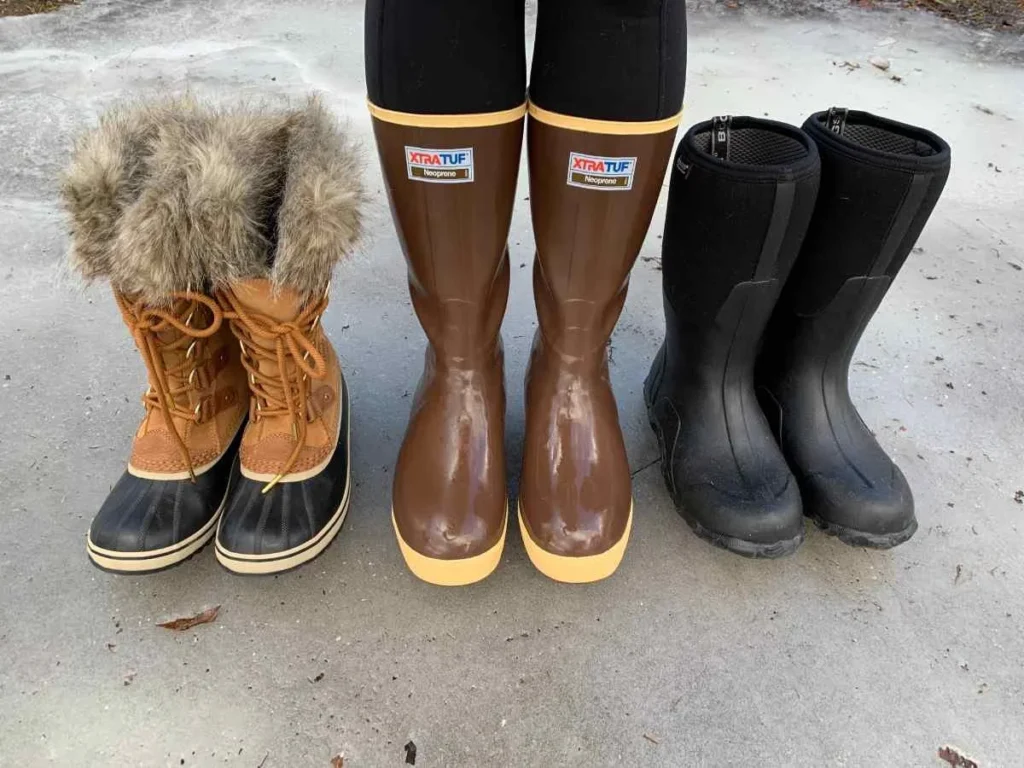
Critical Footwear
- Stiff-soled mountaineering boots compatible with step-in crampons; ankle support essential for rocky ridges
- Crampons provided; bring your own if you have fitted and tested personal crampons
- Gaiters essential from John Matte upward; waterproof lower-leg protection
- Rubber gumboots available to hire in Kasese; recommended for Days 1, 2, 8 in wet conditions
Clothing & Layering System
Consult our layering and warmth guide for detailed summit-specific advice.
- Merino wool thermal base layers top and bottom; bring 2 sets
- 600-fill down jacket primary insulation from Elena Camp upward (-20°C wind-chill on Stanley summit)
- Heavyweight fleece secondary mid-layer; worn under shell jacket on glacier
- Waterproof hard-shell jacket fully taped seams; worn on all exposed sections and summit days
- Waterproof shell trousers worn from John Matté upward; waterproof zip closures ideal
- Insulated summit gloves + liner gloves: two glove systems for glacier; insulated outer + precise-grip liner
- Balaclava + neoprene face mask Margherita summit wind is severe; full face protection recommended
- Glacier goggles (UV400) mandatory on Elena Glacier; UV intensity on snow at 5,000m is extreme
- 4+ pairs of merino wool socks (no cotton at altitude)
Sleep System
- Sleeping bag rated -15°C comfort rating; Elena Camp sees -8°C to -12°C regularly
- Sleeping bag liner adds 5°C of warmth and protects camp bedding throughout
Technical & Safety
- Crampons provided; confirm fitting at pre-trek briefing
- Ice axe provided; technique briefing included at Elena Camp
- Harness provided; roped glacier travel is standard protocol on Elena Glacier
- Helmet available on request; recommended for Day 7 Baker ridge scramble
- Trekking poles stowed for summit scrambles; essential for Days 7–8 descent
Permits, Park Fees & Cost Breakdown
| UWA Entry Permit | USD 45 per person per day × 8 days = USD 360 |
| UWA Hut Accommodation | USD 30 per person per night × 7 nights = USD 210 |
| Lead Guide + Assistant Guide | Included in package |
| Glacier Equipment (crampons, ice axe, harness) | Included in package |
| Porter Team (1 per trekker, 15kg) | Included in package |
| Camp Cook and Full Board Meals | Included in package |
| Trailhead Transfers | Included in package |
| Emergency First Aid Kit | Included in package |
| Recommended Gratuities (total team) | USD 380–520 for a solo trekker; scales with group |
| Total UWA Fees Per Person | USD 570 (entry + accommodation) is fully included in the package. |
The per-person cost reduces significantly in groups of 4+. Solo trekkers are welcome. For a full cost breakdown including flights, gear, and logistics, see our complete Rwenzori cost guide.
Getting to Nyakalengija: Transport & Arrival Logistics
The Nyakalengija Trailhead is 22km northeast of Kasese town. See our Kasese gateway guide and our getting to the Rwenzori guide for complete transportation logistics.
From Kampala
385km, 5–6 hours by private vehicle. Daily bus services (Gateway, Link). We recommend a private 4WD for trekking groups with technical equipment for approx. USD 120–150 one-way, arranged through us.
From Entebbe International Airport
420km, 5.5–7 hours. Plan to stay overnight in Kampala or Entebbe after international arrival; budget a full travel day between landing and the trek start date. International trekkers arriving the evening before departure day should arrange an early Kasese transfer and Nyakalengija briefing before the Day 1 trail start.
Kasese to Nyakalengija
22km, 35–45 minutes by vehicle. Transfer is included in all 8-day packages on Days 1 and 8. UWA permit verification, gear inspection, and porter briefing all take place at the gate before the trail begins.
Book Your Trek
Respond within Minutes
From
$1,850
per person
- Duration 8 Days / 7 Nights
- Group Size 1–12 people
- Start Point Nyakalengija
- Departures Year-round
- Summits Margherita/Edward/Vittorio Emanuele Peaks/
No booking fee. Free cancellation up to 30 days before departure. We respond within Minutes.
Our Popular Rwenzori Treks
Magheritah Peak (8 Days Kilembe Trail)
$1705 Per Person
Mutinda LookOut (4 Days)
$645 Per Person
Short Magherita Hike (5 Days Central Circuit)
$1200 Per Person
Rwenzori Hike (7 Days Central Circuit)
$1400 Per Person
The most popular single-summit Rwenzori itinerary.
The most popular single-summit Rwenzori itinerary.
Frequently Asked Questions: 8-Day Rwenzori 3-Peaks Trek
How difficult is the 8-Day Rwenzori 3-Peaks Trek compared to climbing Kilimanjaro?
The 8-Day Rwenzori 3-Peaks Trek is significantly more demanding than a standard Kilimanjaro climb on almost every metric. The three key differentiators are: (1) glacier travel with crampons and an ice axe on Mount Stanley’s Elena Glacier, which is not involved in Kilimanjaro’s Uhuru summit; (2) three consecutive summit days on Days 5, 6, and 7, each above 4,800m; and (3) the Rwenzori’s consistently wet, rooted, and technically demanding trail terrain, which is harder underfoot than Kilimanjaro’s dry volcanic soil. A successful 7-day Kilimanjaro climb via the Lemosho or Machame route is a reasonable but not sufficient preparation benchmark; the 3-peaks trek demands a significant additional fitness and technical base. Our Rwenzori vs. Kilimanjaro comparison provides a comprehensive analysis.
Do I need glacier climbing experience for the 8-Day 3-Peaks Trek?
You do not need prior glacier experience, but you do need prior high-altitude hiking experience and excellent physical fitness. A full glacier technique briefing, crampon fitting and walking technique, ice axe self-arrest, and roped team movement are conducted at Elena Camp on Day 4 before the Margherita summit attempt on Day 5. Our guides are experienced glacier specialists who have made the Elena Glacier crossing hundreds of times and will rope you in as a team. Trekkers who have done any prior crampon practice or winter mountaineering will find Day 5 more comfortable, but it is not a prerequisite.
What is the success rate for all three summits on the 8-Day Trek?
The summit success rate for all three peaks on this itinerary depends strongly on the season and individual fitness. In the June–August and December–February dry seasons, trekkers with appropriate fitness complete all three summits at a high rate with our experienced guides. The most common variable is weather; on Margherita Peak, afternoon cloud buildup occasionally forces a turnaround on the glacier if visibility deteriorates significantly. Our guides make safety-first summit decisions on the day. The Speke and Baker summits have a higher completion rate, as they do not involve glacier travel and are less weather-sensitive.
What glacier equipment is provided, and do I need to bring my own?
Rwenzori Trekking Safaris provides crampons, an ice axe, and a harness for all trekkers on the 8-Day 3-Peaks Trek as part of the package. Helmet is available on request. The glacier equipment is fitted and tested at Elena Camp on Day 4. If you have personal crampons that already fit your mountaineering boots, you are welcome to bring them. A fitted crampon is always preferable to a camp-fitted one. Otherwise, the provided equipment is appropriate for the Elena Glacier route and well-maintained.
How much does the 8-Day Rwenzori 3-Peaks Trek cost in total?
The UWA park fees for the 8-day trek are USD 570 per person (USD 360 entry and USD 210 accommodation), fully included in the Rwenzori Trekking Safaris package price. Additional costs to budget for include recommended gratuities for the guide team (USD 380–520 for a solo trekker, scaling with group size); personal gear purchase or rental; travel insurance with helicopter evacuation cover to 5,200m, and transport to/from Kasese. Contact us for current full package pricing by group size. Groups of 4+ receive the most favorable rates.
What altitude sickness risks should I expect, and how are they managed?
The 8-Day 3-Peaks Trek involves one night at 4,541m (Elena Camp) and a summit at 5,109m (Margherita Peak) altitudes, where serious altitude illness is a genuine risk for susceptible individuals. The itinerary is paced to maximize acclimatization: the two-step camp progression (Bujuku at 3,977 m, then Elena at 4,541m) mirrors international altitude medicine guidelines. Our guides monitor all trekkers daily with pulse oximeters, are trained in HACE and HAPE recognition, and carry emergency medications. Consult your physician about Diamox before departure. Any trekker who shows signs of serious altitude illness will immediately receive guidance to a lower elevation; our guides make conservative and experienced decisions. It is the right decision, and the Rwenzori awaits a return visit.
Can I do the 3-Peaks Trek if I have not previously trekked at altitude?
The 8-Day Rwenzori 3-Peaks Trek is not appropriate for trekkers without prior high-altitude experience. The combination of a glacier crossing, three summit days in four days, and a maximum elevation of 5,109m requires a solid base of experience above 3,500m. First-time high-altitude trekkers should read our beginner’s guide to Rwenzori climbing and consider starting with our 7-Day Margherita Peak Climb as a first Rwenzori summit expedition. The 3-peak trek is best attempted on a second or third visit to the Rwenzori.
Is the 8-Day 3-Peaks Trek the same route as the standard 7-Day Margherita Peak Climb?
The 8-Day 3-Peaks Trek shares the Central Circuit base with the 7-Day Margherita Peak Climb but adds two additional summit days (Speke on Day 6, Baker on Day 7) and extends the total duration by one day. The 7-Day Margherita climb focuses exclusively on Margherita Peak and completes a full circuit without the Speke and Baker detours. For trekkers who want Stanley only, the 7-Day Margherita Peak Climb is the appropriate choice. For those committed to three summits, the 8-day itinerary is the most efficient way to achieve them.
What food is provided during the 8-day expedition?
Full board meals are provided throughout all 8 days: breakfast, trail lunch/snacks, and a hot three-course dinner daily. On summit days (Days 5, 6, and 7), a high-energy pre-dawn breakfast is provided before early departure: porridge, eggs, bread, and high-calorie additions. At Elena Camp (4,541m), altitude typically reduces appetite significantly; eat what you can and prioritize hydration. On the descent days, the appetite typically returns strongly. Dietary requirements, including vegetarian, vegan, and gluten-free, can all be accommodated with advance notice at booking.
How many people typically join the 8-Day 3-Peaks Trek, and will I be alone on the summits?
The 8-Day 3-Peaks Trek can be booked as a private expedition (solo or group) or as part of a small shared departure. Given the Rwenzori receives fewer than 1,000 trekkers per year across all routes, it is extremely common to spend summit days, including Margherita Peak at 5,109m without encountering any other groups. This extreme exclusivity is one of the defining characteristics of Rwenzori trekking and a direct contrast to the crowded summit queues of Kilimanjaro or Mont Blanc. On the Elena Glacier, you will move as a roped team with your guide and your group only.
Three Summits. One Expedition. No Crowds.
The Rwenzori 3-Peak Trek is one of the most exclusive high-altitude multi-summit expeditions on the African continent. Stanley, Speke, and Baker were completed in eight days, with fewer than a handful of groups attempting this trek in a given season. Limited departures fill quickly in the dry-season windows. Please start your planning conversation today.
Email: rwenzoritrekkingsafaris@gmail.com
WhatsApp / Phone: +256 773256104