The 5 Tallest Mountains in Uganda: A Complete Guide for Serious Trekkers.
Discover the five tallest mountains in Uganda, all in the Rwenzori range. An expert guide covering Mount Stanley, Speke, Baker, Emin, and Gessi: heights, trekking routes, difficulties, the best time to visit, and how to plan a personalized expedition to Uganda’s highest peaks.
Most people who search for the tallest mountains in Uganda are doing one of two things: satisfying their curiosity after reading about African geography or quietly planning a more ambitious expedition into one of the least-visited high-altitude ranges on the continent. If you are in the second category, you have found the right resource. Because every single one of the five tallest mountains in Uganda rises from the same extraordinary range, the Rwenzori Mountains, and each one represents a distinct trekking objective, a different personality, a different level of commitment, and a different story to bring home.
This guide is written by people who have stood on these summits, navigated these ridgelines in cloud and rain, and watched the glaciers catch the first morning light above the equator. By the time you finish reading, you will understand not just which mountains rank where, but also what each one demands, what each one rewards, who belongs on each route, and how to start planning a trek that fits your specific ambitions rather than a generic package that was built for someone else.
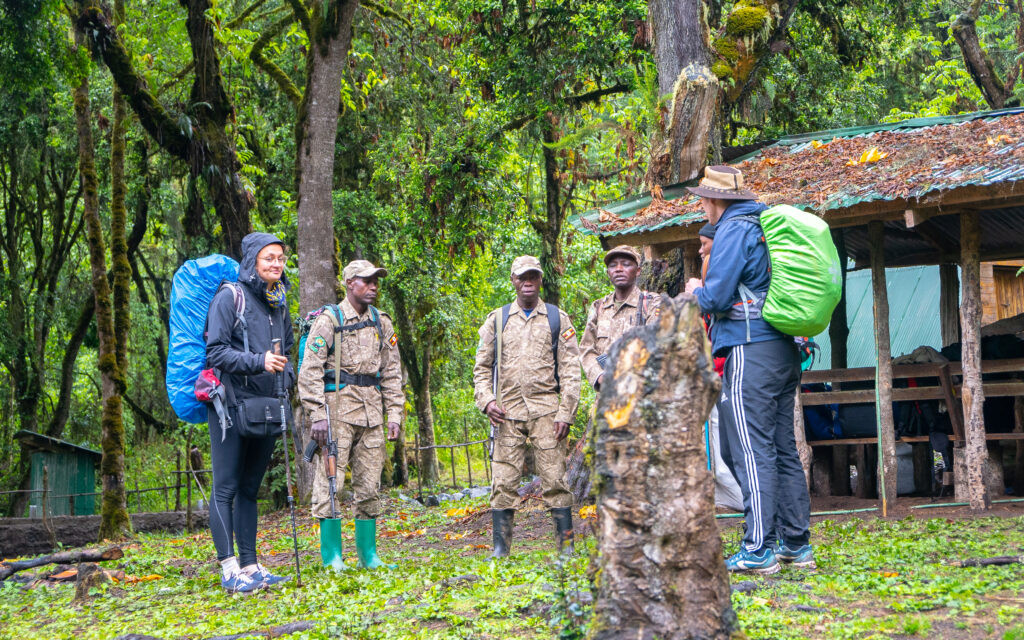
Every one of Uganda’s five highest peaks rises from the Rwenzori Mountains, a range so remote, so biodiverse, and so geologically extraordinary that it has been called the last great secret of African mountaineering.
What are the 5 tallest mountains in Uganda?
Uganda’s five highest mountains are, in descending order of elevation, Mount Stanley (5,109 m), Mount Speke (4,890 m), Mount Baker (4,843 m), Mount Emin (4,798 m), and Mount Gessi (4,715 m). All five are located within the Rwenzori Mountains, the ancient crystalline massif that straddles the border between western Uganda and the Democratic Republic of Congo in the Albertine Rift Valley. No other mountain range in Uganda comes close to Mount Elgon. Uganda’s most famous mountain outside the Rwenzoris, Mount Elgon, peaks at 4,321 meters and does not appear in the top five.
The Rwenzoris are not a volcanic range like Kilimanjaro or the Virungas. They are a horst, a block of some of the oldest rock on the African continent, pushed skyward by tectonic forces along the western branch of the East African Rift System over millions of years. That origin shapes everything about the trekking experience: the chaotic ridgelines, the deep river-carved valleys, the extraordinary diversity of terrain, and the sheer navigational complexity that makes local guide knowledge not a luxury but an absolute necessity. If you want to understand the full geological and ecological character of this range before you arrive, the complete Rwenzori Mountains is the place to start.
#1 Mount Stanley: 5,109m | Rwenzori Mountains, Uganda DRC Border
Mount Stanley: Uganda’s Highest Peak and Africa’s Third Summit.
There is no ambiguity about what Mount Stanley is. It is Uganda’s highest point, the highest mountain in the Rwenzori range, and the third-highest mountain in Africa after Kilimanjaro (5,895 m) and Mount Kenya (5,199 m). Its crown, Margherita Peak, stands at 5,109 meters above sea level and is perpetually glaciated, one of the few remaining equatorial glaciers on Earth, and one that is retreating measurably every decade.
The massif contains multiple named summits of significance. Alexandra Peak rises to 5,091 meters, Albert Peak to 5,087 meters, and a cluster of lower but still striking summits Savoia, Elena, Moebius, and Philip complete the upper architecture of the mountain. The result is not a single-pointed summit but a complex glaciated fortress, and the approach to Margherita from the Elena Glacier involves genuine technical glacier travel: crampons, ice axes, fixed ropes at the steepest sections, and a crossing of exposed snowfields that can shift conditions overnight.

Mount Stanley is named after Sir Henry Morton Stanley, the Welsh-American explorer whose 1887–1889 Emin Pasha Relief Expedition passed through the region and became the first documented European encounter with the Rwenzori range as a coherent massif. Stanley himself saw the peaks only briefly through cloud, but his accounts brought them to international attention and set the stage for the Duke of Abruzzi’s landmark 1906 mountaineering expedition that made the first successful ascents of the major summits. The full story of that discovery and the mythology surrounding it is explored in depth in our piece on why the Rwenzori is called the Mountains of the Moon.
What Trekking Mount Stanley Actually Involves
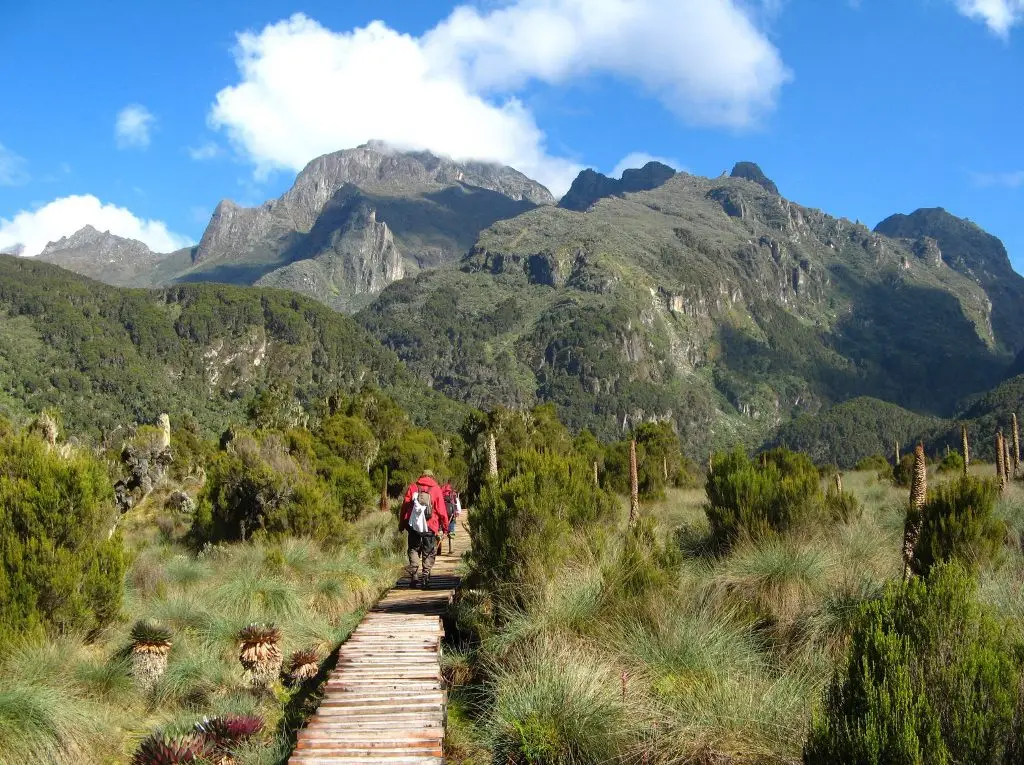
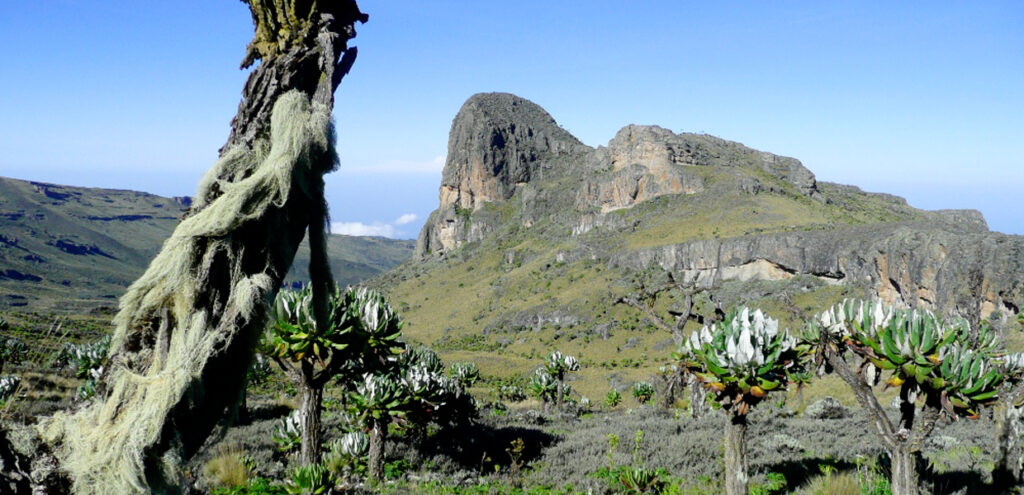
The vast majority of expeditions to Margherita Peak approach via the Central Circuit Trail, which begins at Nyakalengija gate and climbs through the full sequence of vegetation zones: tropical rainforest, bamboo, giant heather, and Afro-alpine moorland with its prehistoric lobelias and groundsels, to the Elena hut at 4,541 meters. From Elena, the summit push crosses the glaciated upper face of Stanley in conditions that demand respect and proper preparation regardless of experience level.
The standard itinerary for this approach is seven days, building in sufficient acclimatization time through the middle altitude camps at John Matte (3,505 m) and Bujuku (3,962 m). That timing matters: rushing the acclimatization phase is the single most common reason expeditions fall short of the summit. The 7-Day Central Circuit itinerary to Margherita is our most requested route for first-time Stanley summiteers, and it is paced specifically to give your body time to adapt. The alternative approach via the Kilembe Trail takes eight days and opens the southern approach to the mountain through a more remote and visually dramatic sequence of camps.
The question most frequently asked about this summit is whether it is technically demanding enough to require prior glacier experience. The honest answer is that it sits in a category beyond standard high-altitude trekking but below serious technical alpinism, a category that we examine in full in our Margherita Peak technical guide. With experienced guides providing on-the-mountain instruction and managing all rope and crampon work, most physically prepared trekkers with no prior glacier experience can summit successfully. The key word in that sentence is “prepared.”
Who Mount Stanley Is For
Mount Stanley is the objective for the trekker who wants Africa’s third-highest summit, not just altitude, but a complete expedition that takes them from tropical forest to permanent ice over the course of a week. The ideal Stanley client is physically very fit, mentally resilient, genuinely comfortable in wet and cold conditions, and willing to engage with a mountain on its terms rather than demanding certainty from the process. This summit doesn’t reward impatience, and no two visits are alike. That variability is part of what makes it one of the most memorable objectives in African mountaineering.
#2 Mount Speke : 4,890m | Rwenzori Mountains, Uganda-DRC Border.
Mount Speke, The Dramatic Ridge Above Bujuku
At 4,890 meters, Mount Speke is Uganda’s second-highest mountain and one of the most visually commanding peaks in the entire Rwenzori range. Its highest point, Vittoria Emanuele Peak, was first summited during the Duke of Abruzzi’s 1906 expedition and named after the reigning Italian king, a reminder of how thoroughly European imperial ambition marked every major geographical feature in this corner of Africa during the colonial era.
The mountain itself is named after John Hanning Speke, the British explorer who became the first European to identify Lake Victoria as the source of the Nile in 1858. Speke never saw the Rwenzori Mountains; the naming was a posthumous tribute by the expedition that finally brought the range to the world’s full attention. There is a certain poetry in the association of the mountain named after the man who unlocked the Nile’s source, standing above the rivers that feed that same system.
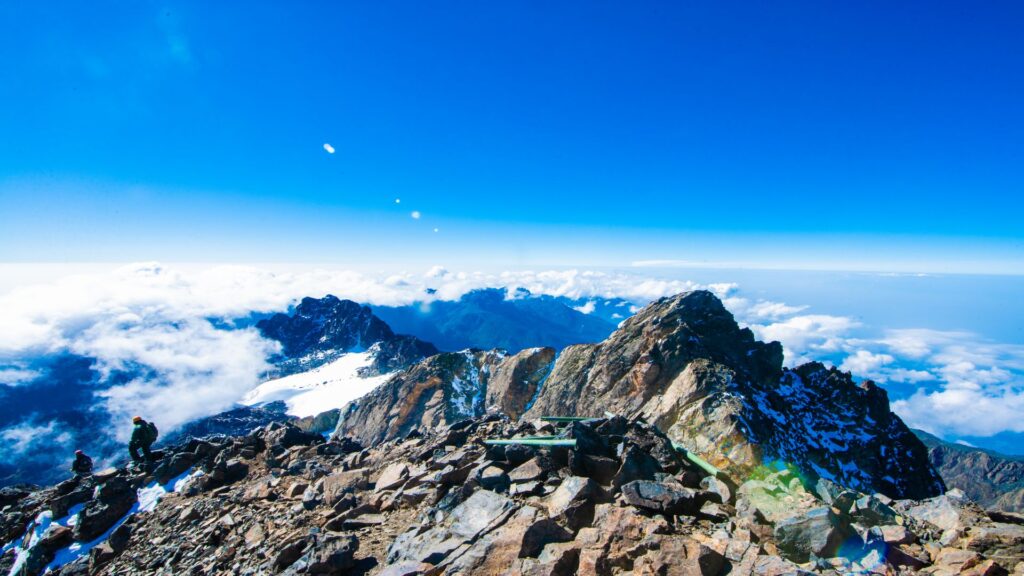
From the Bujuku Valley on the Central Circuit, Mount Speke presents a wall of rock and snow that stops trekkers mid-stride. The ridgelines are severe, the upper sections carry permanent snow, and the approach to Vittoria Emanuele Peak involves a sustained climb that is less technically demanding than Margherita but still firmly in the realm of serious high-altitude mountaineering. The dedicated 5-Day Mount Speke Trek approaches the summit as a standalone objective, while the 8-Day Three-Peaks Expedition strings Speke together with Stanley and Baker in a single continuous traverse, one of the most satisfying extended itineraries in the park.
Who Is Mount Speke For?
Mount Speke is ideal for trekkers seeking a serious summit in the Rwenzoris without the full glacier commitment required for Margherita Peak, as well as for mountaineers on longer expeditions who want to include Speke as one of several objectives. It is also an outstanding choice for experienced high-altitude hikers looking for a Rwenzori summit that sees significantly fewer visitors than Stanley and therefore delivers a greater sense of genuine remoteness. If solitude and a summit story that surprises people are among your criteria, Speke delivers both.
#3 Mount Baker: 4,843m | Rwenzori Mountains, Uganda-DRC Border
Mount Baker, The Western Wall Above the Kitandara Lakes
Uganda’s third-highest mountain, Mount Baker, reaches 4,843 meters at its highest point, Edward Peak. Named after the English explorer Samuel White Baker, the first European to identify Lake Albert as the Nile’s second major source, the mountain forms a dramatic backdrop to the Kitandara Lakes, the twin high-altitude lakes at 4,023 meters that represent one of the most beautiful camps in the entire park.
Baker is in many ways the aesthetic heart of the Rwenzori range. The approach from the Kitandara camp across a ridge that drops sharply on both sides into deep glacially carved valleys is among the most photogenic stretches of any mountain route in Africa. The upper ridgeline of Baker, with its rock towers and residual snow, catches the morning light in a way that even experienced mountaineers find arresting. The mountain sits squarely on the Central Circuit, making it accessible on both the standard seven-day itinerary and on extended expeditions that add it as a dedicated summit.
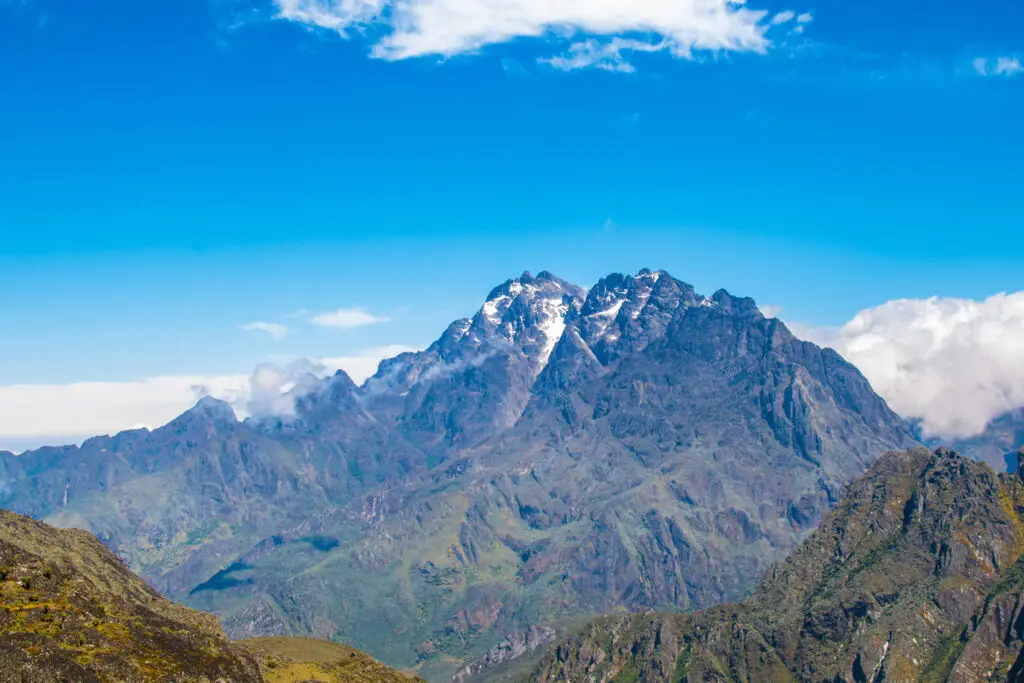
The 7-Day Baker and Weismann Peak Expedition via the Kilembe Trail pairs Baker’s summit with Weismann Peak on Mount Luigi di Savoia, creating a journey that crosses two distinct mountain characters in a single itinerary. Baker’s technical demands are broadly comparable to Speke’s serious terrain, which rewards preparation and experience but is within reach of a determined and physically prepared trekker working with skilled guides.
Who Is Mount Baker For?
Baker is the mountain for the trekker who wants an upper-tier summit with outstanding scenery at every stage of the approach. The Kitandara camp approach is one of the best mountain walks in Africa regardless of whether you summit. Standing at those lakes with the western face of Baker reflected in the water is an experience that justifies the trip independently of what happens above. It is also a natural second or third peak for those doing the multi-peak 10-day or 13-day expeditions that traverse the full Rwenzori range.
#4 Mount Emin: 4,798m | Rwenzori Mountains, Northern Massif.
Mount Emin, Uganda’s Forgotten Fourth Summit
At 4,798 meters, Mount Emin is Uganda’s fourth-highest mountain and, by any measure, the least-visited major summit in the range. It sits in the northern quarter of the massif, away from the main Central Circuit loop, and reaching it requires either a purpose-built approach or an extended expedition that pushes beyond where most trekking parties turn back. This is precisely what makes it extraordinary for the right kind of trekker.
The mountain is named after Emin Pasha, Eduard Schnitzer, a German physician and naturalist who became governor of Equatoria Province in the Egyptian Sudan and was one of the most significant European figures in the late nineteenth-century exploration and administration of Central Africa. Emin Pasha was the man Stanley came to “rescue” on the very expedition that brought the Rwenzori range to European knowledge. Ironically, the mountain bearing his name is now one of the most remote and rarely visited in a range that was itself largely unknown to the outside world until that rescue mission.
Reaching Emin’s summit involves a route through terrain that sees genuine wilderness trails less worn, vegetation zones less frequently crossed, and a silence on the mountain that differs palpably from the more-travelled approaches to Stanley and Baker. The 7-Day Mount Emin Trek is designed specifically around this objective, and the guides who lead it know the northern massif’s navigation challenges in a way that no amount of GPS technology can fully substitute for. Emin can also be combined with its neighbor Gessi in the 13-Day Six-Peaks Grand Traverse that represents the most comprehensive single-expedition engagement with the Rwenzori range available.
Who Mount Emin Is For
Mount Emin is for climbers who judge an expedition partly by how rare the footprints are. If your dream is a summit where you genuinely cannot predict what you will find, where the route requires active interpretation rather than following worn trail markers, and where the summit story is one that almost no one at home will be able to contextualize, Emin is your mountain. This is not a peak for beginners but for the experienced high-altitude trekker looking for something that still genuinely feels like an adventure rather than a managed experience.
#5 Mount Gessi: 4,715m | Rwenzori Mountains, Northern Massif
Mount Gessi, The Northern Sentinel
Rounding out Uganda’s five highest mountains is Mount Gessi at 4,715 meters, a peak named after Romolo Gessi, an Italian soldier, explorer, and administrator who played a central role in Central African exploration and governance in the 1870s and 1880s. Like Emin, Gessi sits in the northern massif and is among the least-visited summits in the park, reached by an approach that takes trekkers through terrain that feels legitimately remote even by Rwenzori standards.
Gessi is a two-summited massif; Iolanda Peak at 4,715 meters is the higher, with Bottego Peak close behind, and the traverse between them offers one of the most striking ridge walks in the entire range. The mountain feels different from Stanley and Speke in character: quieter, more enclosed, with the vegetation pressed closer to the trail and the bird calls more insistent in the absence of human noise. Whether it is the altitude, the isolation, or simply the accumulated effect of knowing that almost no one you know has been here, Gessi carries a quality of genuine wildness that the more accessible peaks can only approximate.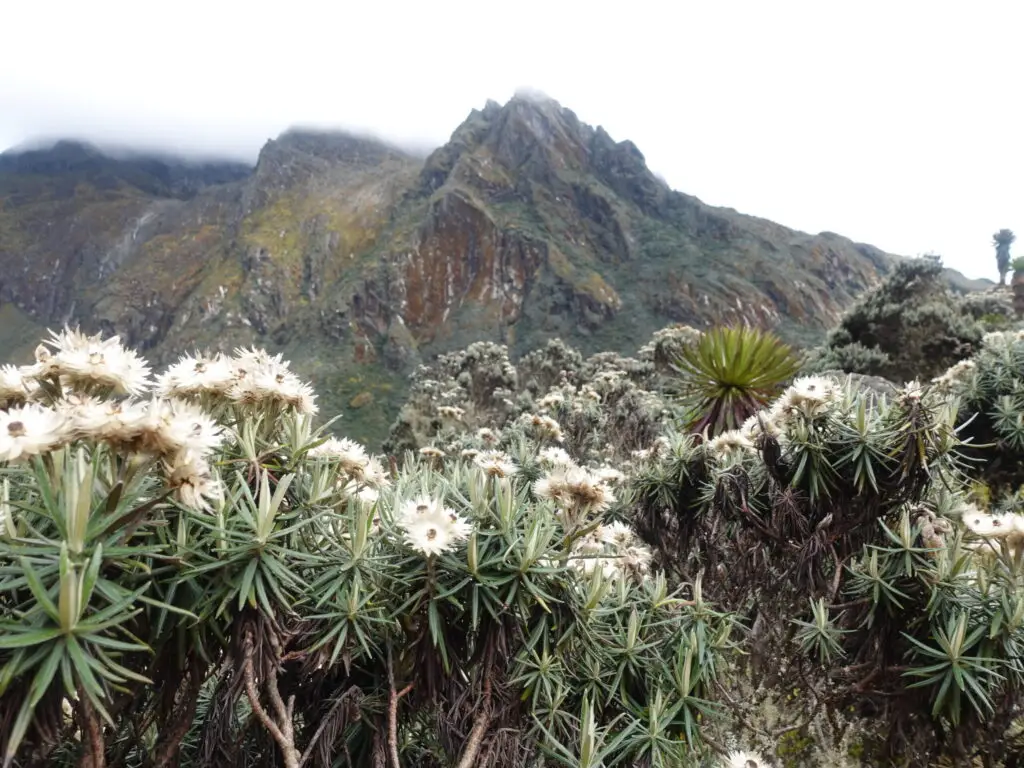
The 7-Day Mount Gessi Trek is the dedicated itinerary for this summit, and it is one of the most rewarding routes we offer for trekkers who prioritize solitude and discovery over summit prestige. Like Emin, Gessi features in the 18-Day All Eight Peaks Expedition, the ultimate Rwenzori traverse that takes in every major summit in the range.
Who Is Mount Gessi For?
Mount Gessi is the mountain for the experienced trekker who wants a Rwenzori summit that almost no one has heard of, through terrain that almost no one has walked. The climb is tough; the northern routes require a lot of hard work and navigating tricky terrain, which is harder than the Central Circuit, but reaching the top offers a truly unique experience. If you have done the big African names and are looking for what comes next, Gessi is a compelling answer.
What About Mount Elgon? Uganda’s Mountains Beyond the Rwenzoris
A question that regularly appears alongside searches for Uganda’s tallest mountains is where Mount Elgon fits in. At 4,321 meters, Elgon is Uganda’s highest point outside the Rwenzori range and the sixth-tallest peak in the country overall. It sits on the border between eastern Uganda and Kenya, and its vast ancient caldera, one of the largest in the world at roughly 40 kilometers across, makes it a dramatically different trekking experience from the Rwenzori peaks.
Elgon is a shield volcano, built by successive lava flows over millions of years, and its profile, ecology, and trekking character have almost nothing in common with the ancient crystalline horst of the Rwenzoris. It is a worthwhile destination in its own right, particularly for the birding and the extraordinary bamboo forest, but it does not appear in Uganda’s top five by elevation and does not involve the glacier travel or technical altitude demands of the Rwenzori summits. The Rwenzori range is the ultimate choice for trekkers seeking Uganda’s highest terrain, and the five mountains featured in this guide collectively offer some of the most remarkable high-altitude trekking experiences in Africa.
A useful reference point for calibrating the Rwenzori experience against other East African trekking options is our detailed comparison of Kilimanjaro, Mount Kenya, and the Rwenzori Mountains, which provides a scientific and practical analysis of what distinguishes each range in terms of altitude, difficulty, vegetation, and summit success rates.
What Kind of Trekker Are Uganda’s Highest Mountains For?
This is the question that matters more than any ranking, and it is worth answering directly. Uganda’s five highest mountains, all in the Rwenzori range, are not for the tourist who wants a comfortable sightseeing experience at altitude. They are for people who want a genuine mountain and who understand the difference between walking up a well-managed tourist route and engaging with terrain that will demand everything they have on a given day.
That said, the range of itineraries available across the Rwenzoris means there is a meaningful distinction between, say, a first-time visitor doing the 3-day Mahoma Loop through forest and moorland and a seasoned mountaineer doing the full 13-day Six-Peaks Expedition across all five of Uganda’s highest summits. The common thread is a genuine engagement with wild terrain: the bogs, the cold, the mist, the mud, the physical effort sustained over multiple days, and a respect for what these mountains actually are rather than what you might wish them to be.
For those wondering whether their fitness level is adequate, the detailed answer is in our guide to whether you need to be very fit to climb the Rwenzori Mountains. The short version: significant aerobic fitness is required for any multi-day expedition, and the sustained, repetitive nature of mountain hiking means that gym fitness and trail fitness are not the same thing. Time on your feet before you arrive makes a measurable difference to how you experience these mountains.
First-time visitors often ask whether the Rwenzori is appropriate for their experience level. The answer depends entirely on which objective they are pursuing and how honest they are being about their current capabilities, a question we explore in depth in our guide on whether beginners can climb the Rwenzori Mountains.
Planning a Trek to Uganda’s Tallest Mountains: Everything You Need to Know
Getting to the Rwenzori Mountains
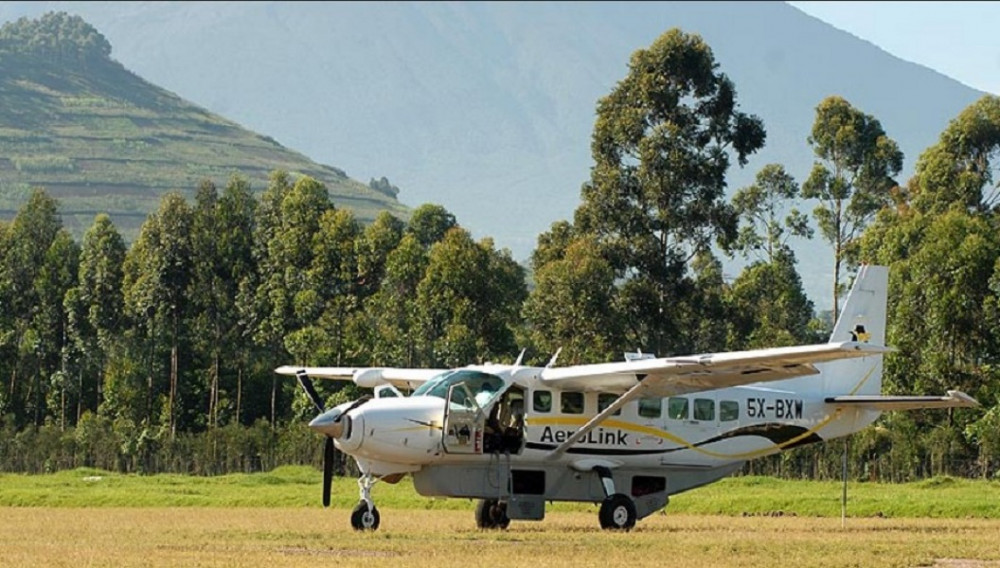
Kasese, the district capital in western Uganda and the gateway to the Rwenzori range, provides access to all five of Uganda’s highest mountains. You can reach Kasese by domestic flight from Entebbe International Airport in approximately one hour. AeroLink operates scheduled services on this route or by private road transfer in five to seven hours, passing through Fort Portal and the western highlands. The road route is an experience in itself, crossing through some of Uganda’s most productive agricultural land before the mountains rise ahead like a wall at the end of the world.
The main park gate for the Central Circuit is at Nyakalengija, 22 kilometers from Kasese town. The Kilembe Trail begins at the old Kilembe copper mines, even closer to Kasese. All logistics transfer, guide assignment, porter allocation, gear check, and park fee payment are handled at these entry points, and the paperwork and preparation that precede entry to the mountain are one of the processes your trekking operator should manage on your behalf.
How Long Do You Need?
The duration of a meaningful Rwenzori expedition depends on your specific objectives. The three-day Mahoma Loop gives you the forest and moorland experience without summit ambitions. A week is the minimum for a serious summit attempt on Stanley, Speke, or Baker. Emin and Gessi require purpose-built multi-day approaches, and the full six-peak traverse needs thirteen days. For a detailed breakdown of timing at each level of ambition, our guide on how long it takes to climb the Rwenzori Mountains covers every combination.
When to Go
The Rwenzori Mountains are trekable year-round, but the two dry season windows, December to February and June to August, offer the most stable conditions for summit expeditions. January and July are generally considered the optimal months for summit probability and trail conditions. The Rwenzoris are one of Africa’s wettest ranges, and the weather will test your gear and mindset any month. The critical gear variables of waterproofing, insulation, and footwear remain non-negotiable in every season.
For trekkers whose dates fall in the wet season months of April, May, October, or November, the experience is still extraordinary and still achievable with proper preparation. Our guide to trekking the Rwenzori in the rainy season gives an honest account of what those conditions actually involve and how to manage them.
Gear and Physical Preparation
Gear on the Rwenzoris is a matter of genuine consequence, not a tickbox exercise. Waterproofing, layering for cold and wet conditions above 4,000 meters, and footwear that can handle both deep bog and technical rock are the three categories that matter most. The full layering system for the summit zone, where temperatures regularly drop below minus five Celsius at night, is covered in detail in our guide to staying warm on the Rwenzori summit. For the glacier approach to Margherita specifically, technical equipment including crampons, an ice axe, a harness, and a helmet is mandatory; all of this can be rented locally if you prefer not to travel with it. The detailed breakdown of what to bring versus what to hire is in our guide on whether you need to bring your own climbing gear for a Rwenzori Trek.
Health and Medical Considerations
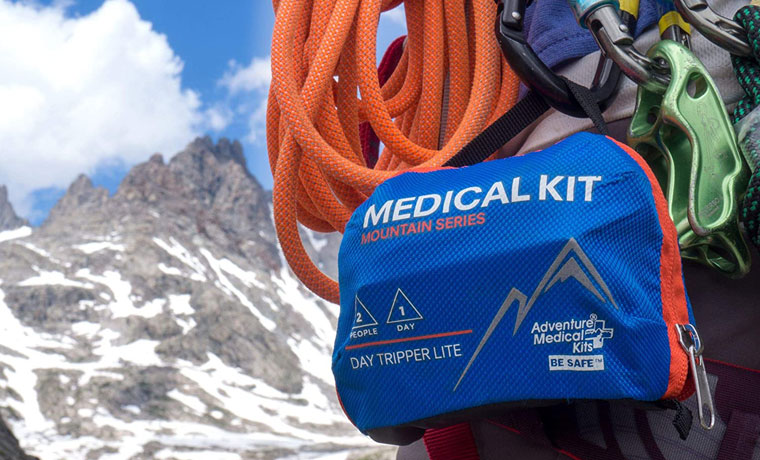
Altitude sickness is the primary medical risk for trekkers on Uganda’s highest mountains. All properly designed itineraries incorporate the standard preventive approach of paced ascent, adequate hydration, and immediate descent at the onset of serious symptoms. Hypothermia and trench foot are the other conditions most commonly encountered on extended expeditions in wet conditions, and both are manageable with the right gear and informed guides. The complete medical guide to trekking the Rwenzori Mountains covers altitude sickness, hypothermia, trench foot, equatorial UV exposure, and everything else a responsible expedition member should understand before leaving home.
What Does It Cost?
The cost of trekking Uganda’s tallest mountains varies by route length, group size, summit objective, and the level of service included. Short, three- to four-day experiences start at around $580 per person. Summit expeditions to Mount Stanley typically range from $1,300 to $1,750 depending on the route and duration. Longer trips that include climbing multiple peaks, like Emin, Gessi, and the northern summits, require a bigger budget because they are more complicated to organize. A detailed cost breakdown across all itinerary types is available in our full guide to the cost of climbing the Rwenzori Mountains.
Combining Uganda’s Mountains with a Wildlife Safari
The Rwenzori Mountains sit in the most wildlife-dense region in Uganda. Queen Elizabeth National Park, home to tree-climbing lions, hippos, elephants, and over 600 bird species, begins directly south of Kasese. Bwindi Impenetrable National Park, where roughly half the world’s remaining mountain gorillas live, is a four-to-five-hour drive from the trailhead. The 12-day Rwenzori and Gorilla Trek combination is the most logical pairing; a summit week followed by a gorilla tracking permit in Bwindi creates a Uganda itinerary that is genuinely impossible to replicate anywhere else on Earth. For a full Uganda experience built around the mountains, the 19-Day Grand Uganda Adventure adds chimpanzee tracking in Kibale, game drives in Queen Elizabeth, and white-water rafting on the Nile.
Browse all Uganda safari options to find the combination that makes sense for your dates and interests.
What You Will See on Uganda’s Highest Mountains.
One of the most underestimated aspects of trekking Uganda’s highest mountains is the extraordinary wildlife encountered at every altitude. The Rwenzori Mountains National Park falls within the Albertine Rift, the most biodiverse region in Africa, and the endemic species list for the range is extraordinary. The complete Rwenzori Mountains wildlife guide covers the full inventory of mammals, birds, and endemic species, but several highlights deserve mention here.
The Rwenzori turaco, with its crimson primary flight feathers and extraordinary green-and-red crest, is one of the most spectacular birds in Africa and a near-certain sighting on any trek through the lower forest zone. At least twelve other Albertine Rift endemic bird species are present in the park, making the Rwenzoris among the most significant birding destinations on the continent. The three-horned chameleon (Trioceros johnstoni), a Rwenzori endemic that looks genuinely prehistoric, is another encounter that stops trekkers mid-stride.
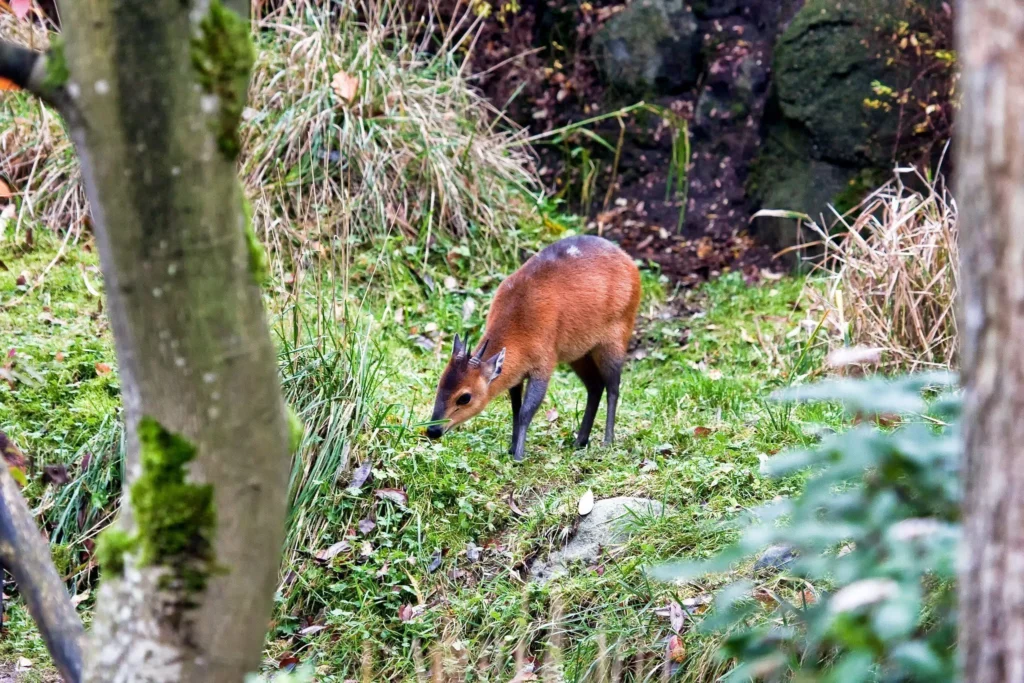
Mammals include the African golden cat, forest elephants (evidenced more often by trail signs and broken bamboo than by direct sighting), giant forest hogs, and chimpanzees in the lower montane forest. At altitude, the insect fauna is remarkable in its own right: Afro-alpine invertebrates that have evolved specialized cold-tolerance strategies over millennia, and giant earthworms that emerge from the boggy soil in ways that confirm you are in an environment unlike anything else in Africa.
Trekkers who have read broadly about Ugandan wildlife often ask, are there gorillas in the Rwenzori Mountains? The answer is no, gorillas are not present in the Rwenzori range, though the mountains lie within reach of Bwindi and Mgahinga, where gorilla trekking is available as an extension of any Rwenzori expedition.
Frequently Asked Questions About Uganda’s 5 Tallest Mountains.
What are the 5 tallest mountains in Uganda?
The five tallest mountains in Uganda are, in order: Mount Stanley (5,109 m), Mount Speke (4,890 m), Mount Baker (4,843 m), Mount Emin (4,798 m), and Mount Gessi (4,715 m). All five are located in the Rwenzori Mountains in western Uganda, along the border with the Democratic Republic of Congo. Uganda’s sixth-highest peak is Mount Luigi di Savoia (4,627 m), also in the Rwenzoris, followed by Mount Elgon (4,321 m) on the Uganda-Kenya border.
Can you climb all five of Uganda’s tallest mountains on one expedition?
Yes. The 13-Day Six-Peaks Expedition covers Mount Stanley, Speke, Baker, Emin, Gessi, and Luigi di Savoia in a single continuous traverse, making it one of the most comprehensive high-altitude expeditions available in Africa. The 18-Day All Eight Peaks route extends the course to every named major summit in the Rwenzori range. Both require serious physical preparation and a substantial time commitment, but for the mountaineer who wants to stand on every major Ugandan summit in a single journey, they are the definitive options.
Is Mount Stanley or Kilimanjaro harder to climb?
Different factors contribute to their difficulty, and a direct comparison hinges on the chosen route for Kilimanjaro. Kilimanjaro’s standard routes (Marangu, Machame) are generally less technically demanding and better serviced than the Rwenzori approach to Margherita Peak, which involves genuine glacier travel with crampons and ice axes.
The Rwenzori also presents significantly more challenging terrain in the lower and middle zones; the mud, bogs, and root-covered trails are harder on the body than Kilimanjaro’s volcanic scree paths. The full evidence-based comparison is available in our analysis of whether the Rwenzori is harder than Kilimanjaro.
Where are Uganda’s tallest mountains located?
The Rwenzori Mountains range in western Uganda, within the Rwenzori Mountains National Park in Kasese District, is home to Uganda’s five highest mountains. The park straddles the border between Uganda and the Democratic Republic of Congo, and the highest summits, including Margherita Peak on Mount Stanley, technically sit on or near the international boundary. Access for trekking is from the Ugandan side, with the main entry points at Nyakalengija (for the Central Circuit) and Kilembe (for the Kilembe Trail).
Are Uganda’s highest mountains safe to climb?
Yes, when approached with professional guides and proper preparation. The mandatory guide system in Rwenzori Mountains National Park ensures that every trekking party is accompanied by registered guides trained in mountain safety, altitude illness recognition, and emergency response. With the right team and honest self-assessment of fitness and experience, you can manage the primary risks of altitude sickness, hypothermia, and terrain injuries. The detailed safety picture, including what the emergency evacuation arrangements look like, is covered in our guide to whether it is safe to trek the Rwenzori Mountains.
What is the best time of year to climb Uganda’s highest mountains?
We generally recommend summit expeditions to Uganda’s highest peaks during the two primary dry season windows, December to February and June to August. January and July are typically the most stable months for upper-altitude conditions. That said, the Rwenzori Mountains are trekable and rewarding in every season, and wet-season trekking is absolutely possible with appropriate gear and expectations. The mountains have their own weather regardless of what the calendar says.
Do you need a visa to climb Uganda’s tallest mountains?
Yes. Uganda requires a valid visa for most nationalities, which can be obtained through the Uganda e-Visa online portal before travel or on arrival at Entebbe International Airport. The e-Visa is recommended; it is faster, more reliable, and reduces the risk of delays at the border. Your passport must be valid for at least six months beyond your travel dates. Park entry fees for Rwenzori Mountains National Park are paid separately at the park gate and are mandatory for all trekkers.
What is Uganda’s highest mountain?
Uganda’s highest mountain is Margherita Peak on Mount Stanley, at 5,109 meters above sea level. Margherita is also Africa’s third-highest point overall, after Uhuru Peak on Kilimanjaro (5,895 m) in Tanzania and Batian on Mount Kenya (5,199 m) in Kenya. It sits in the Rwenzori Mountains National Park and is perpetually glaciated, requiring technical glacier equipment for the summit approach.
How difficult is trekking Uganda’s top 5 mountains?
Difficulty varies significantly by peak. Mount Stanley is the most demanding, with glacier travel required for the summit. Mount Speke and Baker are serious high-altitude objectives but somewhat less technically complex. Mount Emin and Gessi add the difficulty of greater remoteness and less-established trail infrastructure. Across all five, the Rwenzori terrain sustained bog, steep root-covered trails, and wet conditions, which is harder than most high-altitude trekkers expect. The comprehensive difficulty guide for Rwenzori trekking gives a full breakdown of what each zone of the mountain actually involves.
Start Planning Your Personalised Trek to Uganda’s Highest Mountains
The five tallest mountains in Uganda are not destinations that reward passive research indefinitely. At some point, the planning becomes the trek, and the only way to find out what these mountains are really like is to be on them, watching the mist roll down the heather forest at dusk, feeling the Elena Glacier under your crampons, and standing on a summit that most people in your life cannot locate on a map.

Every expedition we design at Rwenzori Trekking Safaris is built around a specific person with specific objectives, specific dates, and a specific idea of what a wonderful mountain experience looks like. We do not start with a fixed itinerary and then sell it to you. We start with a conversation about what you are actually trying to do, and we build from there. Whether that means a seven-day summit push to Margherita, a thirteen-day traverse of all five of Uganda’s highest peaks, or a carefully designed first-timer introduction that puts you in the Afro-alpine zone without the glacier commitment, the route should fit you, not the other way around.
Reach out to us through our contact page, browse the full range of Rwenzori trekking itineraries, or read through our frequently asked questions if you are still building the picture. When you are ready to have a real conversation about your mountain, tell us your dates, your experience level, and what you are hoping to find up there. We will tell you honestly what is possible and what it will take. Uganda’s highest mountains are waiting, exactly as they have been since Ptolemy first imagined them wreathed in mist above the heart of Africa. Let’s get you there.



