
Discover exactly how cold Margherita Peak (5,109 m) gets, from summit temperatures of -15°C to zone-by-zone breakdowns, wind chill risks, frostbite, hypothermia, and expert cold-weather gear advice. Plan your personalized Rwenzori trek.
Most people hear the word “equatorial” and picture heat, a shimmer of savannah, humid lowland forest, and the lush warmth of tropical Africa. And for the first day of any approach to the Rwenzori Mountains, that impression is not entirely wrong. The trailhead at Nyakalengija sits at around 1,600 meters in a warm, dripping forest that belongs in every sense to equatorial Uganda. But as you gain altitude over the following days, something remarkable happens. The tropics peel away layer by layer, the forest giving way to giant heather, the heather giving way to otherworldly Afro-alpine moorland, and eventually the moorland surrendering to permanent ice and snow at a latitude where such things should have no right to exist.
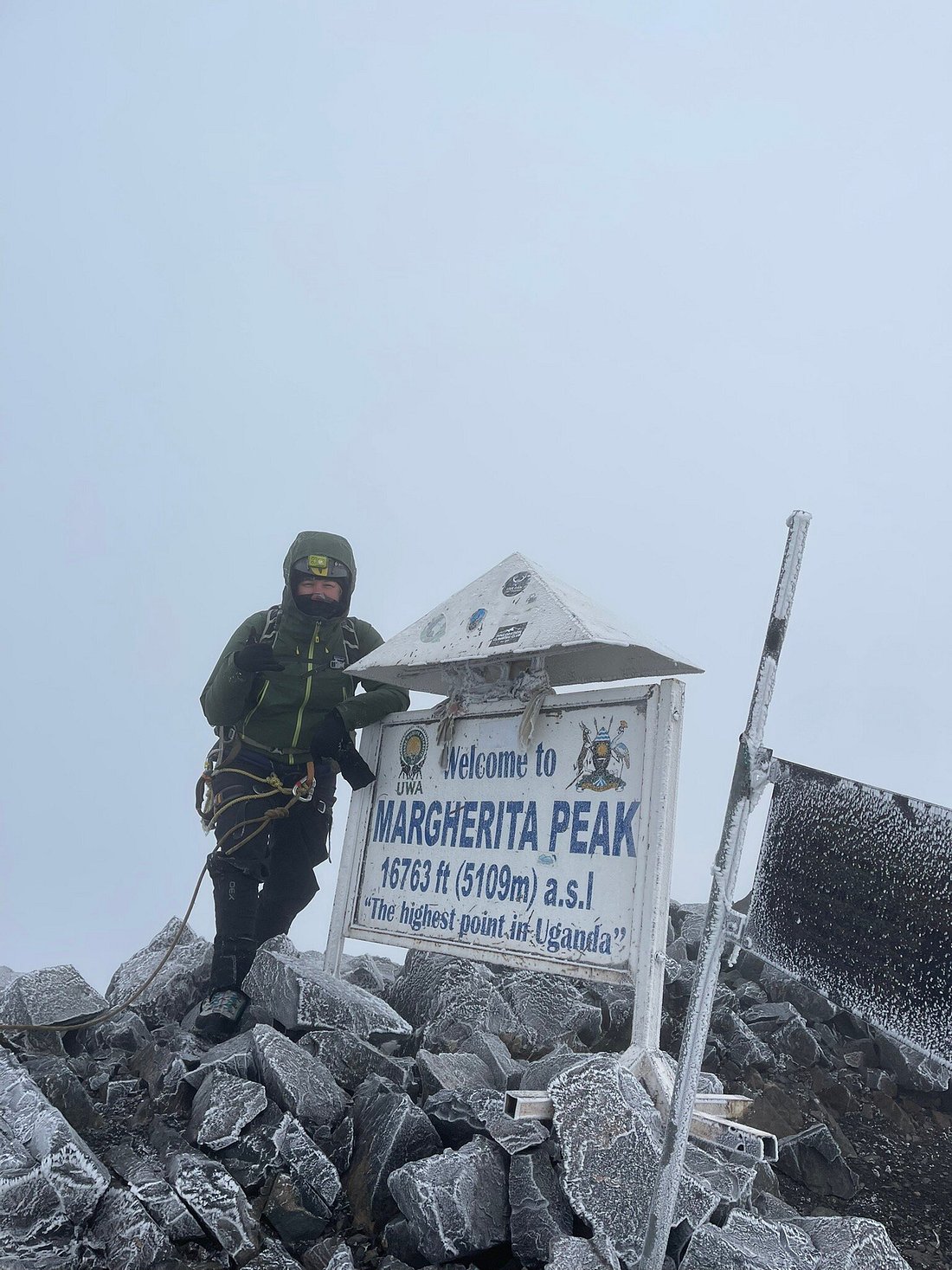
By the time you stand on Margherita Peak, Africa’s third-highest summit at 5,109 meters above sea level and almost exactly on the equator, the ambient temperature can range from -5°C to -15°C, depending on the time of day, the season, and whether the wind has picked up off the Stanley ice fields. With wind chill factored in, conditions can feel considerably colder than the thermometer suggests. You left the tropics at the trailhead. You have arrived, five days later, in a world of ice, mist, crampons, and a cold so specific and insistent that it demands to be understood and prepared for, not merely anticipated and hoped away.
Underestimating the cold here can have serious consequences. It is a mountain where underestimating the cold can end your summit attempt, compromise your safety, and, in extreme cases, put you at genuine medical risk. The purpose of this guide is to give you everything you need to understand temperature on Margherita Peak and across the full vertical range of the Rwenzori zone by zone, season by season, and scenario by scenario so that you arrive at the trailhead not just hopeful but genuinely prepared.
If you want a personalized trek designed around your specific experience, fitness level, and timing, not a generic group departure, our team at Rwenzori Trekking Safaris is ready to build it for you. But first, let the mountain teach you what it expects.
Why Is Margherita Peak So Cold? The Science Behind Equatorial Alpine Cold.
Altitude, Lapse Rate, and the Surprising Physics of Equatorial Mountains.
The cold on Margherita Peak surprises most trekkers because it contrasts so dramatically with conditions at the base of the same mountain, even though they know high mountains are cold. The Rwenzori’s vertical temperature gradient is one of the steepest of any mountain range in Africa, and understanding why helps you prepare much more effectively than simply packing warm clothes and hoping for the best.
The fundamental driver of temperature change with altitude is the atmospheric lapse rate, the rate at which air temperature drops as you climb. In the tropics, the standard environmental lapse rate runs at approximately 6.5°C per thousand meters of altitude gain under clear sky conditions. On a mountain as tall and as moisture-laden as the Rwenzori, the moist adiabatic lapse rate applies much of the time in the lower and middle zones, running at around 4°C to 6°C per thousand meters. By the time you have climbed from the park gate at 1,600 meters to the summit at 5,109 meters, a vertical gain of approximately 3,500 meters, you have experienced a theoretical temperature drop of between 14°C and 23°C from base conditions alone.
But the Rwenzori’s cold is not simply a function of altitude. It is made worse by three things that are specific to this mountain’s geography: the constant cloud cover and mist, which block sunlight and stop the warming that hikers on drier mountains depend on; the ongoing rain, which cools the body more effectively than dry air; and its location near the equator, which means that while the summit temperatures are similar to those of other high mountains, there are no seasonal changes to provide a break from the cold. The Rwenzori’s summit is cold on the first of January and cold on the first of July. The variation between the coldest and warmest months is far narrower than on any extratropical mountain of comparable height.
The Role of Wind Chill at High Altitude
Temperature readings alone do not capture the full experience of cold on the upper Rwenzori. Wind chill, the acceleration of heat loss from the body’s surface caused by moving air, is a critical variable on the exposed ridges and glacier approaches above 4,500 meters, and it can make already cold air feel dramatically more punishing. A measured temperature of -5°C in calm conditions translates to a felt temperature of approximately -13°C in a 30 km/h wind. At -10°C with a 40 km/hr wind, conditions that are not unusual on the Stanley massif on summit day, the felt temperature approaches -22°C. At these levels, exposed skin can sustain frostbite within minutes, and even properly dressed trekkers experience rapid heat loss if their outer layers are not fully closed and sealed.
Wind on the upper Rwenzori arrives without announcement. The mountain’s position at the convergence of large equatorial air masses means that conditions can shift from still to seriously windy within minutes, particularly as afternoon storm systems build over the Congo Basin to the west and sweep across the upper mountain. Our guides watch cloud formation and wind direction from the high camps with the attention of sailors reading weather at sea. Such variability is one of the many reasons that experience and local knowledge are irreplaceable on Margherita and why self-guided summit attempts are not permitted within the national park.
Temperature by Zone: What to Expect at Every Stage of the Climb.
The Montane Forest Zone (1,600m – 2,500m)
The Rwenzori forest zone is tropical, warm, humid, and perpetually dripping, filled with the deep green color of equatorial vegetation at its most exuberant. Daytime temperatures in this zone typically range between 15°C and 24°C, making conditions feel warm and occasionally uncomfortably muggy in the sheltered valleys. At night, temperatures in the forest camp huts drop to around 12°C to 16°C, cool enough to appreciate a light thermal layer, but far from cold in any alpine sense.

The challenge in this zone is not cold in itself but the combination of warmth, high humidity, and sustained rainfall. Sweating heavily while hiking in this zone and then stopping for a break without adding an insulating layer can cause a surprisingly rapid drop in core temperature, a phenomenon that experienced guides call “the forest chill” and that our complete medical guide to trekking the Rwenzori Mountains covers in detail. The forest zone also introduces the essential habit of keeping dry base layers sealed and separate from trekking layers, a discipline that becomes a genuine health matter higher up the mountain. If you are planning a lower-altitude forest introduction before committing to a full summit itinerary, the 1-Day Nyabitaba Hike or the 2-Day Lake Mahoma Loop offer an excellent feel for the mountain’s character without the summit cold.
The Heather and Bamboo Zone (2,500m – 3,200m)
As the trail climbs above 2,500 meters and the canopy gives way to open bamboo and then giant heather, the temperature character of the Rwenzori begins to shift noticeably. Daytime temperatures in this zone typically range from 8°C to 15°C, still bearable in dry conditions with a mid-layer, but significantly colder when rain is falling, as it frequently is. The heather zone is where most trekkers first realize that the Rwenzori’s cold is a wet cold, not the clean, dry bite of a high-altitude continental mountain, but the penetrating, moisture-carrying cold of an environment where rain and mist are constant companions.
Overnight temperatures in the heather zone huts drop to between 4°C and 9°C. A proper sleeping bag rated to at least 0°C is essential from this point upward, and a dry insulating layer kept specifically for camp use becomes a genuine comfort and health consideration. Trekkers who have been hiking in wet outer shells all day and fail to change into dry layers at camp are significantly increasing their hypothermia risk at these elevations.
The Moorland and Bog Zone (3,200m – 3,800m)
The moorland zone, home to the famous Bigo Bog, the Freshfield Pass, and the gradually widening panoramas that first reveal the upper massifs of the range, is where cold starts to become a continuous, managed presence rather than an intermittent discomfort. Daytime temperatures here typically range between 3°C and 10°C, with the higher end of that range only achievable on clear, sunny mornings that the Rwenzori offers sparingly. Afternoon temperatures drop quickly as clouds build, and the combination of wind exposure on the open moorland and wet clothing from the bog crossings makes this zone one where hypothermia risk is real for underprepared trekkers.

Nights at moorland-level camps, like John Matte Hut at 3,414 meters, for instance, regularly drop to between 0°C and 4°C inside the huts and well below freezing outside. Trekkers who arrive here in cotton clothing or with sleeping bags rated only to +5°C are in a genuinely uncomfortable and potentially dangerous situation.
Our post on how to stay warm on the summit of Mount Rwenzori covers the full layering system for this zone and above in practical detail.
The Afro-Alpine Zone (3,800m – 4,500m)
The afro-alpine zone is the Rwenzori at its most otherworldly, a landscape of giant groundsels, towering lobelias, glacial lakes in volcanic blue and slate grey, and an overwhelming sense of vertical exposure. It is also where the mountain’s cold begins to feel genuinely serious. Daytime temperatures in this zone range between -2°C and 8°C, and even on the clearest days, direct solar radiation at this altitude is often blocked by cloud, preventing the warming effect that trekkers on drier mountains use to restore their body temperature between exertions.
Overnight temperatures in the Afro-alpine zone huts, Bujuku Hut at 3,977 meters and Elena Hut at 4,541 meters, range from approximately -4°C to +2°C, and on colder nights, water left outside freezes solid by morning. Wind in this zone begins to carry genuine chill, and the combination of altitude fatigue and cold creates the conditions for significant lapses in judgment regarding clothing and warmth management. Elena Hut, the standard staging camp for summit day, is the coldest shelter on the Central Circuit and regularly sees overnight temperatures of -5°C or below in the dry season. Trekkers must arrive at Elena Hut with every component of their cold-weather system functional and fully accessible: a sleeping bag with a liner, dry thermals, a quality insulated jacket, and a warm hat and gloves within easy reach in their pack.
Understanding the Rwenzori’s vegetation zones and the unique ecology of this altitude band is also one of the great rewards of the Afro-alpine approach. The giant groundsels and lobelias are not merely scenic backdrops; they are extraordinary evolutionary responses to precisely this combination of cold, wet, and high solar radiation. Your guide will be able to explain them in a way that transforms the experience from a scenic hike into a genuine ecological education.
The Glacier and Summit Zone (4,500m – 5,109m)
This is where the Rwenzori’s cold becomes unambiguous. From Elena Hut upward to the summit of Margherita Peak, you are in permanent glacier and snow territory, a zone that exists on the Equator only because of the Rwenzori’s exceptional height, its moisture supply, and its persistent cloud cover. At these elevations, daytime temperatures on the summit approach and at the summit itself typically range between -5°C and -15°C, with an average summit temperature during the prime trekking window of approximately -7°C to -10°C on calm, clear mornings.
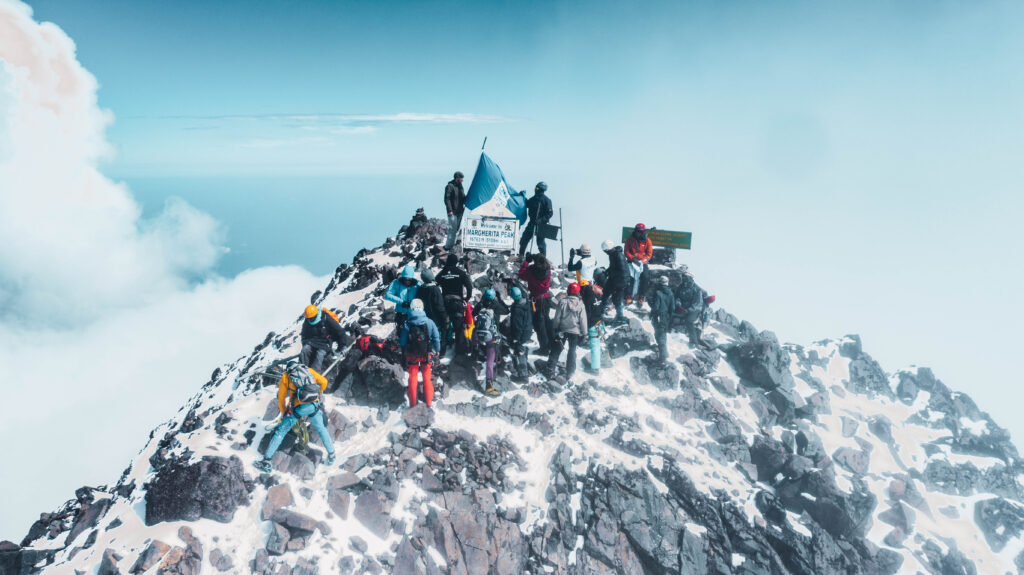
Those are air temperatures measured in still conditions. In practice, wind speeds on summit days of the Stanley massif regularly reach 20 to 40 km/h, and gusts above 50 km/h are not unusual. With a 40 km/h wind at -10°C, the felt temperature drops to approximately -22°C. At these wind chill values, exposed skin on the face around your goggles, a gap at your wrist between glove and sleeve, and a chin not covered by your balaclava become susceptible to frostbite within ten minutes. This value is not a theoretical risk management consideration. It is a description of conditions that our guides manage actively, every summit day, on every expedition.
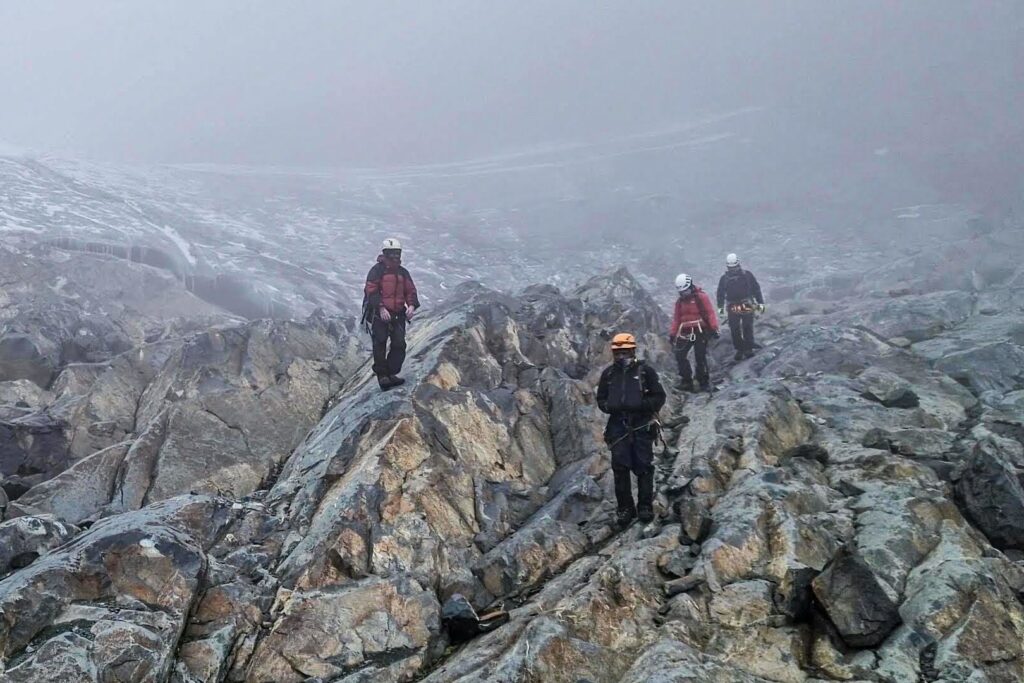
Summit attempts on Margherita Peak begin between 2:00am and 4:00am from Elena Hut, which means the initial section of the climb is conducted in overnight temperatures that are typically the lowest of the day. As you move up the rock slabs and approach the glacier, your body is generating heat through exertion, but the moment you stop moving at a rope anchor, during a crampon adjustment, while a team member negotiates a technical section, the cold arrives with immediate force. One of the most crucial practical skills on summit day is managing your core temperature through continuous, disciplined layering adjustments, a skill your guide will actively coach you through rather than relying on chance.
Cold-Weather Medical Risks on Margherita Peak.
Hypothermia: The Most Serious Cold Risk on the Rwenzori.
Hypothermia, the dangerous reduction of core body temperature below 35°C, is the primary cold-weather medical concern on the Rwenzori and specifically on the summit approaches above 4,000 meters. The sustained wetness makes the Rwenzori particularly conducive to hypothermia risk, compared with other high mountains at similar temperatures. Cold is significantly more dangerous when wet, because water conducts heat away from the body approximately 25 times more efficiently than air at the same temperature. A trekker who arrives at Elena Hut with wet base layers, inadequate insulation, and a damp sleeping bag is operating in conditions that would concern any experienced high-altitude guide regardless of how warm the thermometer reads.
The early symptoms of hypothermia: shivering, mild confusion, slow speech, and poor coordination are easy to miss or attribute to altitude fatigue in the early stages. Your guide and fellow trekkers play a genuinely important role in monitoring each other for these signs, and our complete medical guide to trekking the Rwenzori Mountains covers hypothermia recognition, first response, and prevention in full clinical detail. Every trekker considering a Margherita summit should read it before departure.
Frostbite and Frostnip
Frostbite, the freezing of skin and underlying tissue, becomes a realistic risk on the summit approach and summit of Margherita Peak in windy conditions. The extremities are most vulnerable: fingers, toes, nose, ears, and cheeks. Frostnip, the milder precursor condition in which skin becomes numb and pale but has not yet frozen, is more commonly encountered and is reversible with prompt warming. Full frostbite, in which tissue actually freezes, requires medical treatment and can cause permanent damage.
The prevention strategy is straightforward: no skin exposed to wind above 4,500 meters. A balaclava or neck gaiter covering the lower face, well-fitting waterproof gloves with a liner glove underneath, and boot insulation adequate for sub-zero glacier conditions are the non-negotiable protections. Our post on whether you need crampons and ropes for the Rwenzori covers the full technical and cold-weather equipment requirements for the summit zone.
Altitude Sickness at Cold Altitude
Cold and altitude interact in ways that compound the effects of each. Acute Mountain Sickness (AMS), the headache, nausea, fatigue, and sleep disruption that can affect trekkers above 2,500 meters, impairs both physical performance and the decision-making required to manage cold effectively. A trekker experiencing AMS is more likely to move slowly (generating less metabolic heat), less likely to notice their own deteriorating condition, and less capable of making the independent judgments required to add or remove layers appropriately. This is a strong argument for a properly paced acclimatization profile on any Margherita summit itinerary, not merely for summit success, but for basic cold safety at altitude. Our post on how many days it takes to reach Margherita Peak explains the acclimatization logic behind our recommended itinerary structures.
Trench Foot
Trench foot is a genuine risk on any multi-day Rwenzori trek, and new arrivals almost universally underestimate this risk, which involves the maceration and breakdown of foot tissue caused by prolonged exposure to cold, wet conditions. Unlike frostbite, trench foot does not require freezing temperatures; it develops in cold, wet conditions above approximately 5°C over a period of hours to days. The Rwenzori’s persistent moisture makes the lower trail zones a prime environment for trench foot development, and the risk extends all the way to the summit through the continuous wetness of the Afro-alpine and glacier zones. Comprehensive foot care, regular sock changes, foot inspection, and thorough drying at camp each evening are covered in our medical guide and should be treated with the same seriousness as any other medical preparation.
What to Wear: Building a Cold-Weather System for Margherita Peak
The Layering Philosophy
Managing cold on a summit like Margherita Peak is not about putting on the thickest possible garment and hoping it is enough. It involves creating a flexible system of layers that can adjust to different weather conditions experienced throughout a single day on the summit, starting from the -8°C at Elena Hut, through the hard work on the glacier that produces a lot of body heat even in frigid weather, to the windy summit, and then back down as the lower mountain warms up in the afternoon. The three-layer system base, mid, and shell is the foundation, but the execution of that system in Rwenzori conditions requires specific choices at each layer.
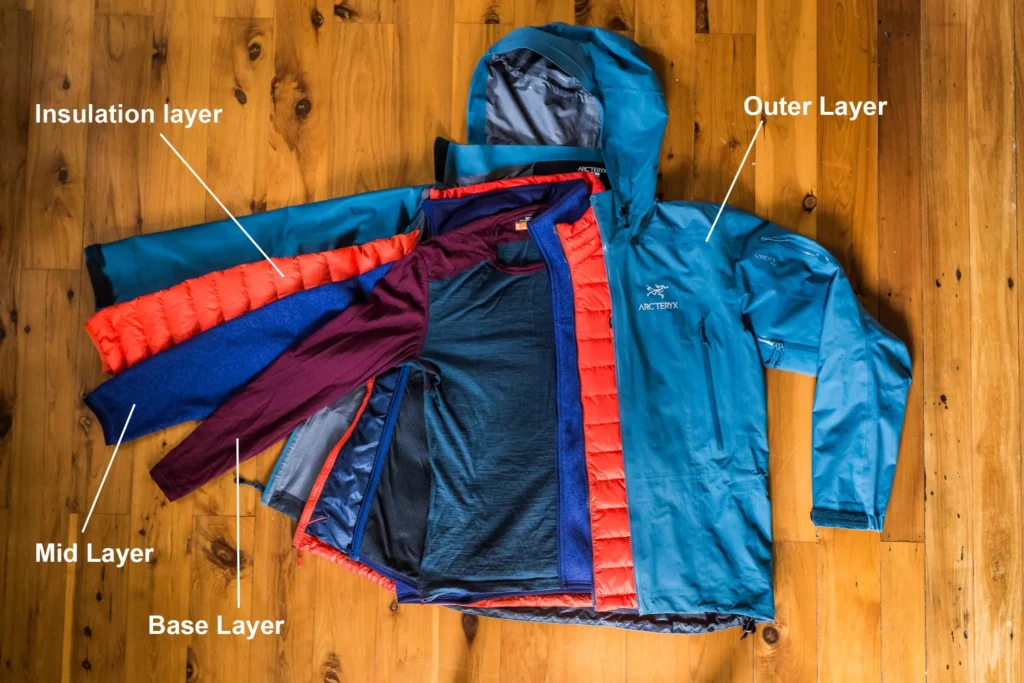
The base layer must be a high-quality merino wool or technical synthetic fabric. Cotton base layers are not merely suboptimal on Margherita Peak; they are a medical hazard. Cotton absorbs and retains moisture, loses all insulating value when wet, and accelerates convective heat loss with devastating efficiency in cold, wet conditions. Every trekker who arrives at the Rwenzori trailhead in cotton base layers should consider replacing them before the trek begins.
The mid-layer for the summit zone should be a synthetic insulated jacket rather than a down garment. Down insulation, while supremely warm in dry conditions, collapses and loses the vast majority of its thermal efficiency when wet. The Rwenzori’s persistent moisture makes down unreliable from the heather zone upward. High-quality synthetic insulation like PrimaLoft, Thermolite, or an equivalent maintains meaningful warmth even when damp, which is a non-negotiable attribute in this environment. A fleece mid-layer is an acceptable second option for the approach stages but should be augmented by a synthetic insulated jacket for summit day. Our guide on how to stay warm on the summit of Mount Rwenzori covers specific product categories and system configurations in practical detail.
The outer shell must be a fully waterproof and breathable hardshell jacket with sealed seams, a stiff-peaked hood, and wrist closures that seal properly against a glove. A softshell jacket is inadequate for summit conditions. The shell serves two functions simultaneously: it keeps precipitation and wind off the mid-layers beneath, and it contains body heat during exertion. Waterproof trousers with full-length zips that allow them to be put on over cramponed boots are the summit-appropriate standard.
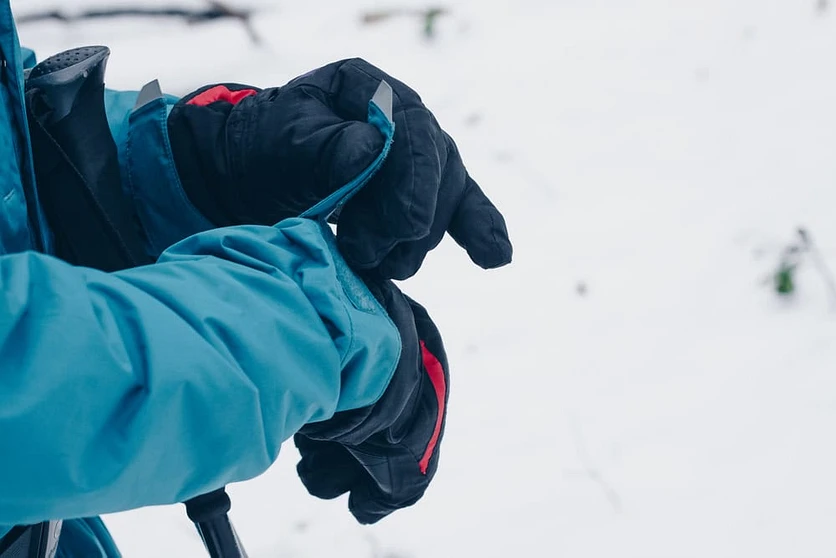
Gloves require a layered approach of their own. A lightweight liner glove worn inside a waterproof, insulated outer glove provides both dexterity for technical sections and warmth protection during exposure. Carrying a spare pair of liner gloves in an accessible pocket is important; wet liner gloves lose their thermal value quickly, and replacing them mid-summit with dry spares is a simple intervention that makes a significant comfort difference.
Footwear on summit day requires waterproof, stiff-soled boots that can accept crampons, ideally with a boot insulation rating adequate for sub-zero temperatures. Neoprene or thick wool sock liners provide an additional thermal layer inside the boot. Gaiters that prevent ice, snow, and meltwater from entering over the boot top are essential. The Kilembe Trail and Central Circuit Trail both require waterproof boots with good ankle support for the lower trail sections, transitioning to crampon-compatible stiff-soled boots for the summit approach.
Head and face protection at the summit zone should include a balaclava covering the full lower face, goggles or glacier glasses (UV exposure at 5,000 meters is extreme even on overcast days), a warm hat, and optionally a neck gaiter for additional chin protection. Ear protection is often the first thing trekkers forget and the first thing they regret when the wind picks up on the upper glacier.
Cold and the Summit Approach: What a Real Summit Day Looks Like
From Elena Hut to Margherita: A Step-by-Step Temperature Experience.
Understanding how cold it is on a summit day not just what the thermometer reads, but what it feels like as you move through the climb is one of the most practically useful things you can know before arriving at Elena Hut. Here is what a typical summit day looks and feels like from a temperature management perspective.
You wake at Elena Hut between 1:00am and 3:00am to the sound of the guide tapping on the door. The hut is cold, typically between -3°C and -5°C inside, and your first act is to dress in the dark in full summit layers before leaving the warmth of your sleeping bag. The temptation is to leave the insulated jacket unzipped because you know you will warm up once you start moving. Resist it. The first thirty minutes of movement in the dark on cold rock slabs in sub-zero air is the moment of greatest cold exposure before the exertion heat kicks in.
As you begin climbing the rock slabs above Elena Hut, your body temperature rises with the exertion. Many trekkers overheat at this stage and need to open their outer shell to vent heat; this is correct and expected, and managing it proactively prevents the sweat accumulation that becomes dangerous once movement stops. The glacier crossing, which begins at approximately 4,700 meters, is where conditions change again: exposed ice reflects cold back at you from below, the wind accelerates down the glacier surface, and stopping to allow a team member to pass or negotiate a technical section means an immediate chill. With the shell closed, gloves on, and balaclava up, every stop requires a rapid cold management decision.
On the summit ridge and at the summit itself, the cold is at its most complete. The elevation, the exposure, and the frequent wind combine to create conditions that demand full thermal protection even during brief pauses. Time at the summit is typically limited to ten to twenty minutes enough for photographs, a moment of genuine awe, and the realization that you are standing on glacial ice exactly on the Equator before descent begins. The descent is, counterintuitively, where many trekkers get coldest: fatigue reduces metabolic heat generation, concentration on technical footing leaves less mental space for monitoring clothing status, and the afternoon cloud that builds during descent brings additional wind and precipitation. Your guide’s role in monitoring your warmth and energy levels during descent is as important as any technical guidance they provide on the ascent.
Seasonal Variations in Summit Cold
When Is Margherita Peak Coldest?
The Rwenzori’s equatorial position means that seasonal temperature variation at the summit is considerably smaller than on extra-tropical mountains at comparable altitudes. The difference between the warmest and coldest summit temperatures across the year is typically less than 8°C, far narrower than the seasonal range in, say, the Alps or the Himalayas. That said, meaningful seasonal patterns do exist and are worth understanding for planning purposes.
The dry season windows of June to August and December to February are the primary recommended trekking periods. During these windows, precipitation intensity is reduced, which means that while summit temperatures remain cold (-5°C to -12°C on a typical summit morning), the wind chill from storm-driven rain and mist is less severe, and the additional cooling from wet clothing and equipment is reduced. Clear sky periods are more frequent, allowing solar radiation to play a modest warming role on the approach and reducing the severity of the cold experience on days with favorable weather.
The wet season windows of March to May and September to November bring increased precipitation intensity, more frequent storm events on the upper mountain, and a higher probability of the conditions that combine cold with sustained wetness, the most dangerous combination on Margherita. Summit temperatures during these periods are not dramatically lower than in the dry season, but the effective cold experience is significantly worse because of the moisture factor. Our detailed article on trekking the Rwenzori in the rainy season covers this question comprehensively, and our article on whether it rains a lot in the Rwenzori Mountains explains the seasonal rainfall patterns that underlie these temperature dynamics.
For planning purposes, we summarize the recommended trekking windows and current route availability on our Routes & Dates page.
Night vs. Day Temperature Extremes.
One temperature pattern that consistently surprises trekkers at Elena Hut is the magnitude of the diurnal temperature swing, which is the difference between the coldest part of the night and the warmest part of the day at the same location. At 4,541 meters, Elena Hut can experience overnight temperatures of -8°C followed by midday temperatures of +5°C to +8°C on a clear day, a swing of 13°C or more within a twelve-hour period. This swing is more extreme than at comparable altitudes on continental mountains because of the Rwenzori’s equatorial position, which provides intense solar radiation during clear daytime periods but no moderating oceanic influence at night.
The practical implication is that the morning departure from Elena Hut, which is the beginning of summit day, coincides precisely with the coldest period of the entire expedition. This is not coincidental; starting early is essential for reaching the glacier before it softens and for returning to Elena before the afternoon storm systems build. But it does mean that summit day begins in the worst cold conditions of the entire trek, when trekkers are simultaneously at their highest altitude, their most fatigued from previous days, and their most exposed to temperature. This convergence of factors is why physical preparation, gear quality, and guide experience all matter so disproportionately on summit day. Our blog article on how technically demanding the climb to Margherita Peak is explains the full summit day demands in detail.
How Cold Interacts with Altitude: Special Considerations for Margherita
The Compounding Effect of Hypoxia and Cold
At 5,109 meters, the air pressure on the summit of Margherita Peak is approximately 54% of sea-level pressure, meaning that every breath you take delivers roughly half the oxygen you would receive at sea level. The physiological consequences of this include reduced aerobic capacity, impaired fine motor control, slowed cognitive processing, and a reduction in metabolic heat generation capacity; the body simply cannot generate heat as efficiently in hypoxic conditions as it can at sea level. This issue is a critical consideration for cold management, because the body’s primary defense against cold is metabolic heat generation, and that defense is already operating at reduced efficiency before any weather-driven challenge begins.
The interaction between altitude and cold is the reason that acclimatization pace matters so much on the Rwenzori. A trekker who has rushed their acclimatization and arrives at Elena Hut with the beginnings of AMS will be shivering more at -5°C than a well-acclimatized trekker at the same temperature, producing less metabolic heat, and making worse decisions about their clothing and warmth management. The relationship between acclimatization quality and cold safety is not merely a theoretical linkage; it is something our guides observe and actively manage on every expedition. Our post on whether you need to be very fit to climb the Rwenzori and how hard trekking the Rwenzori actually is helps set accurate expectations for the physical demands that interact with cold at altitude.
The Disappearing Glaciers Cold in a Changing Context
It would be incomplete to discuss the cold of Margherita Peak without acknowledging the profound changes happening to the ice and snow that define it. The Rwenzori’s glaciers are disappearing; they are the source of that summit cold, the visual centerpiece of the climb, and one of the most astonishing meteorological phenomena in Africa. We talk about why the Rwenzori glaciers are disappearing, explaining the range has lost more than 80% of its ice coverage since the late nineteenth century, and current projections suggest the glaciers may be entirely gone within the next ten to fifteen years.
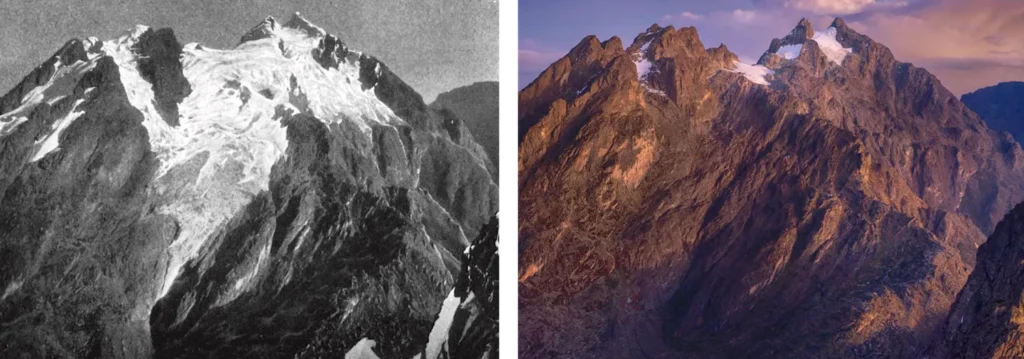
The implications for the summit experience are already visible: the glacier crossing that was once a central feature of every summit approach is shorter and in places more technically complex as the ice retreats and rock beneath is exposed. But the summit itself remains cold. Margherita Peak’s temperature is driven primarily by its altitude, not its glaciation, and the mountain will be cold at 5,109 meters long after the last glacier is gone. What is changing is the visual drama of the summit zone and the urgency of the ascent for those who want to stand on equatorial glacial ice. If that is your motivation, as it is for many trekkers, you should not delay your Rwenzori trek. You can still see and touch the remaining glaciers on Margherita today. That may not be true for much longer.
Which Trek Is Right for You? Matching Ambition to Cold Tolerance and Experience
Summit Treks for the Cold-Ready Trekker
If you have read this far and feel genuinely prepared not just intellectually aware but viscerally ready for what the cold on Margherita Peak demands, then the question is simply which itinerary best matches your available time, experience, and goals.
The 7-Day Central Circuit Trek is our most popular Margherita summit itinerary, a full loop through all five ecological zones with a logical acclimatization profile and an Elena Hut staging night before the summit push. For a slightly faster approach with the same summit objective, our 6-Day Margherita Summit Trek compresses the lower mountain days. For the most committed alpinists, our 8-Day 3-Peaks Trek, adding Mount Speke and Mount Baker to the Stanley summit, extends the high-altitude cold exposure across a multi-peak itinerary that is one of the most demanding and rewarding experiences in African mountaineering. For those who want the definitive Rwenzori experience spanning all six peaks Mount Stanley, Mount Speke, Mount Baker, Mount Emin, Mount Gessi, and Mount Luigi di Savoia our 13-Day 6-Peaks Expedition is the gold standard. A detailed breakdown of the time required to reach the summit from the trailhead is in our post, “How Long It Takes to Climb the Rwenzori Mountains.”
Mid-Mountain Treks for Those Building toward the Summit.
If the cold statistics above have made you think you would like to experience the Rwenzori first at a lower altitude before committing to a Margherita summit, this is a perfectly sensible position and one we actively encourage for trekkers who want to build confidence and acclimatization progressively. Our 5-Day Bujuku Hike reaches the Bujuku Valley at 3,977 meters, high enough to experience the full Afro-alpine environment, the cold nights at altitude, and the early cold of the upper moorland, without the technical summit demands. The 5-Day Mount Speke Trek and the 6-Day Weismann Peak Expedition on the Kilembe Trail both reach significant high-altitude summits without the full glacier technical requirements of Margherita, providing excellent progression steps.
The Cost of Getting It Right
Understanding that cold preparation requires investment in gear, in time for physical preparation, and in the quality of the guiding service you choose is part of taking the mountain seriously. Our complete cost breakdown for climbing the Rwenzori Mountains gives a thorough overview of what a summit expedition costs and where that investment goes. The guide, porter, and equipment quality components of that cost are not places to economize. They are the components that keep you safe and warm at -10°C at 5,000 meters when everything else about the day is demanding your full attention.
If you want to compare the Rwenzori’s cold experience with that of other major African summit options, read our comparison articles, Is the Rwenzori Harder Than Kilimanjaro? and our three-way comparison, Kilimanjaro vs Mount Kenya vs the Rwenzori Mountains, which gives detailed contextual analysis. Both Mount Kilimanjaro and Mount Kenya provide additional context for those building their African mountaineering itinerary across multiple summits.
Frequently Asked Questions about How Cold Does It Get on Margherita Peak?
How cold is it at the summit of Margherita Peak?
On a typical summit morning during the dry season (June–August or December–February), air temperatures at the summit of Margherita Peak range between -5°C and -15°C. With wind chill, which is frequently significant on the exposed Stanley massif, felt temperatures can drop to -20°C or below. Summit attempts begin before dawn from Elena Hut, which means the initial glacier approach is conducted in the coldest conditions of the day, typically between -8°C and -12°C before wind chill is applied. At Elena Hut (4,541 m), the standard pre-summit staging camp, night temperatures regularly drop to -5°C or below.
Is it colder on the Rwenzori than on Kilimanjaro?
At equivalent altitudes, the Rwenzori is typically colder in practice than Kilimanjaro, even though Kilimanjaro’s Uhuru Peak (5,895 m) is higher than Margherita (5,109 m). The reason is moisture. Kilimanjaro is a drier mountain, particularly in its approach zones, and dry cold is considerably more comfortable than the wet cold of the Rwenzori, where persistent rain, mist, and wet clothing significantly increase heat loss. A trekker at 4,500 meters on Kilimanjaro in -5°C dry air will feel warmer than a trekker at 4,500 meters on the Rwenzori in -5°C air with wet outer layers.
What temperature should my sleeping bag be rated to for a Margherita summit?
We recommend a sleeping bag with a comfort rating of at least -10°C, not a limit rating, for the Elena Hut camp (4,541 m) and the overnight stay at Bujuku Hut (3,977 m). A sleeping bag with a -10°C comfort rating will keep most trekkers genuinely comfortable in the overnight conditions encountered at these elevations. A bag rated to -5°C is a minimum and will feel cold on colder nights. A bag liner adds approximately 3°C to 5°C of warmth and is a recommended supplementary item. Dry storage of the sleeping bag in a waterproof compression sack inside your pack at all times is essential on the Rwenzori.
What is the warmest it gets at the Margherita Peak summit?
Under the best possible conditions, such as a calm, clear mid-morning during the dry season, air temperatures at the summit of Margherita Peak can reach approximately -2°C to 0°C. These conditions are relatively rare and do not persist long before afternoon cloud and wind arrive. Most trekkers experience summit temperatures between -5°C and -12°C, so it is prudent to plan for conditions toward the colder end of that range.
Can you get frostbite on Margherita Peak?
Yes. Frostbite is a realistic risk on the exposed glacier sections and summit of Margherita Peak in windy conditions. The fingers, toes, nose, and ears are most vulnerable. Frostnip, a milder, reversible precursor condition, is more commonly encountered, especially in individuals who do not manage their body temperature effectively during the climb. Full frostbite prevention requires no exposed skin above 4,500 meters, properly rated gloves with liner gloves underneath, insulated boots with waterproof gaiters, and a balaclava covering the lower face. Our guides monitor trekkers continuously for early signs of cold injury on summit day.
How do I manage body temperature during the summit climb?
Temperature management on summit day is dynamic rather than static; you dress and undress according to exertion level rather than wearing a fixed configuration throughout. The general rule is full layers for stationary cold exposure (leaving huts, anchor stops), a partially vented shell during sustained uphill exertion (to prevent sweat accumulation), and a fully closed shell plus additional insulation at the summit and during descent. Our post on how to stay warm on the summit of Mount Rwenzori covers this system in practical step-by-step detail, and our complete medical guide covers the physiology of cold management at altitude.
Does it snow on Margherita Peak year-round?
Yes. The summit of Margherita Peak sits above the permanent snowline year-round, though the extent of glacier coverage changes seasonally and is overall in significant long-term decline. In any season, the glacier crossing on the summit approach involves permanent ice and snow that requires crampons. Snowfall on the summit zone can occur in any month. The reasons for the Rwenzori glaciers’ disappearance explain the climate dynamics driving long-term glacial retreat, while the summit remains cold and glacier-crossed for the foreseeable future.
What is the temperature at base camp (Elena Hut) on the night before summit day?
Elena Hut at 4,541 meters sees overnight temperatures ranging from approximately -8°C on the coldest dry season nights to around 0°C on milder evenings during the wet season. The average is typically around -3°C to -5°C. This means that every trekker arriving at Elena Hut needs a fully functional cold-weather sleeping system, dry insulating layers for camp use, and both the physical reserves and the mental composure to dress, pack, and move in sub-zero darkness before summit departure.
Is a guided trek necessary for managing the cold on Margherita Peak?
Not only is a guided trek necessary, but it is also legally required within the Rwenzori Mountains National Park. Beyond the regulatory requirement, an experienced guide’s role in cold and safety management on Margherita Peak is substantive: they monitor trekker condition continuously, make real-time decisions about pace and weather, manage rope systems on the glacier, and can recognize and respond to cold injury and altitude sickness symptoms early. The value of a guide on this mountain is not primarily navigational; it is physiological and meteorological. Our About Us page explains our guides’ experience, training, and approach to personalized trek management.
How does the cold on the Rwenzori compare to other major mountain treks globally?
In terms of measured temperature, Margherita Peak’s summit cold (-5°C to -15°C) is comparable to the high camps of Mont Blanc and the lower Himalayan passes. What distinguishes the Rwenzori cold from most other high-mountain environments is the sustained moisture. The Rwenzori is arguably the world’s wettest high-altitude trekking environment, and wet cold is significantly more physiologically demanding than dry cold at the same measured temperature. By contrast, Kilimanjaro, the Andes, and most Himalayan approach treks are considerably drier and allow the body’s natural heat management systems to function more efficiently. The Rwenzori’s cold demands more deliberate preparation than almost any other mountain at a comparable measured temperature.
A Personal Word from the Mountain
There is a moment on summit day on Margherita, usually somewhere above the glacier crossing, when the pre-dawn stars are still faintly visible and the mist below the Stanley massif is beginning to catch the first grey light when the cold stops being a problem to be managed and becomes part of the experience itself. You are not cold in spite of standing on the Equator. You are cold because you are on a mountain so high and wet that it has kept ice and snow in tropical Africa for millennia. The cold is not incidental. It is evidence of something extraordinary.
Understanding what that cold will ask of you physically, technically, and in terms of preparation is the first step toward having the summit experience you came for, rather than a cold, exhausted retreat from somewhere below it. Our guides have been on this mountain in every condition, in every season, and with trekkers of every experience level. We know how to prepare you, pace you, equip you, and read the mountain during the day. What we cannot do is replace the preparation you do before you arrive, such as training your physical fitness, researching the route, and gathering the necessary gear. So start now.
Ready to Plan Your Margherita Peak Expedition?
The cold on Margherita Peak is real, demanding, and entirely conquerable for the trekker who takes it seriously. If you are ready to start planning, whether that means a first conversation about fitness and timing or a detailed discussion of the specific itinerary and gear list for your summit push, our team is ready to help.
Please reach out to Rwenzori Trekking Safaris at your earliest convenience to share your preferred dates, experience level, and desired level of ambition. We will build you a personalized expedition plan, not a generic group departure, but a trek designed around you, your pace, and your goals on Africa’s third-highest summit.
You can also explore our full trek catalogue, browse our hiking routes and dates, review the Margherita Peak summit guide, check our FAQs, read our expert blog, or explore our Rwenzori mountaineering program before reaching out. The mountain will still be cold when you arrive. We will make sure you are ready for it.


