What is the difference between the Central Circuit and the Kilembe Trail? This is a full expert guide covering management, camps, duration, difficulty, and which route is right for you.
I have guided both routes more times than I can count. I have watched the sun rise over the Stanley Glacier from Elena Hut and from Margherita Camp. I have walked out of the mountains through the bamboo at Nyakalengija and through the forest cascades above Kilembe. They are the same mountains, and they are completely different journeys. Choosing between them is not a question of which is better; it is a question of which one is right for you.
When trekkers begin researching the Rwenzori Mountains, the Mountains of the Moon, Uganda’s magnificent UNESCO World Heritage alpine range, two routes come up in almost every conversation: the Central Circuit Trail and the Kilembe Trail. Both reach Margherita Peak on Mount Stanley, the third-highest summit in Africa, at 5,109 metres. Both pass through the Rwenzori’s extraordinary sequence of tropical vegetation zones. Both are, by any objective measure, among the finest mountain trekking experiences in East Africa.
But they are not the same route, and the differences between them matter enormously when it comes to planning a real expedition. They operate under different management authorities with entirely separate infrastructures. They begin and end at different trailheads on opposite sides of the range. They follow different valleys, cross different passes, and offer entirely different characters of mountain experience. They have different histories, different camp sequences, different price points, and different suitability profiles for different types of trekker.
This article gives you the complete, authoritative picture of both routes, drawn directly from operational experience on the mountain, not from speculation or conflated itineraries. By the end, you’ll know what each route offers, how they differ, and which one to take to the Rwenzori Mountains.
The Fundamental Difference: Two Trails, Two Management Authorities, Two Sides of the Mountain
The single most important thing to understand about the Central Circuit Trail and the Kilembe Trail is this: they are governed by two entirely separate management entities with separate operations, separate infrastructure, separate guide teams, and separate permit systems. There are not two itineraries offered by the same organisation. Mixing elements of the two routes, such as taking the Kilembe approach but exiting via the Central Circuit’s northern camps, is not a creative hybrid. It is a logistical impossibility that reflects a fundamental misunderstanding of how these routes work.
The Central Circuit Trail is managed by Rwenzori Mountaineering Services (RMS), a community-owned organisation with decades of operational history on the northern side of the range. The Kilembe Trail is managed by Rwenzori Trekking Services (RTS), which officially launched the southern circuit in 2011 and has since developed its own complete infrastructure of camps, huts, and guide teams. The two organisations operate separately from each other in terms of their infrastructure and logistics. When you book a Kilembe Trail expedition through Rwenzori Trekking Safaris, you are accessing RTS-managed territory. You are entering RMS-managed territory when you reserve the Central Circuit. The two systems do not overlap.
This distinction is not bureaucratic trivia; it is operationally critical. A trekker who sets off on the Kilembe Trail expecting to exit via Nyabitaba Hut or Nyakalengija will find themselves in the wrong operational territory with the wrong logistics, the wrong guide, and potentially no support infrastructure at all. The routes must be treated as what they are: separate, self-contained mountain experiences.
Central Circuit vs. Kilembe Trail: The Key Differences at a Glance
Before going deep into the character of each route, the table below captures the core structural differences between the two trails. The operational specifications of each route, as run by their respective management authorities, directly inform every figure and fact in this table.
| Feature | Central Circuit Trail | Kilembe Trail |
| Managing Authority | Rwenzori Mountaineering Services (RMS) — community-owned | Rwenzori Trekking Services (RTS) |
| Trailhead Location | Nyakalengija / Mihunga Gate, northern side (1,600m) | Kilembe town, southern side (1,450m) |
| Route Format | Full loop — starts and ends at Nyakalengija | Full loop — starts and ends at Kilembe |
| Standard Duration | 7 days (5–9 day options available) | 8 days (2–18 day options available) |
| Total Distance | ~58 km | ~80–85 km |
| Highest Pass | Scott-Elliot Pass (4,372m) | Oliver’s Pass (4,505m) |
| Summit Camp | Elena Hut (4,541m) | Margherita Camp (4,485m) |
| Key Landmark | Bigo Bogs & Lake Bujuku | Bamwanjara Pass & Lake Kitandara |
| Hut Infrastructure | Established since 1950s; functional | Built from 2011; newer, better-maintained |
| Crowd Level | More established; higher footfall | Less crowded; more remote feel |
| History | Traced to early 1900s; formalised in the 1950s | Officially launched 2011 by RTS; historical origin 1895 (Prof. Scott Elliot) |
| Standard Cost | From $1,400 per person | From $1,705 per person |
| Best For | First-timers; classic Rwenzori experience; multi-peak via northern valleys | Experienced trekkers; scenic southern approach; newer infrastructure |
The Central Circuit Trail: Africa’s Most Established High-Mountain Loop
The Central Circuit Trail is the original Rwenzori trekking route, with origins traced to the early 1900s when the first explorers and hunters began mapping routes through the dense highland forests. The route that put the Mountains of the Moon on the world’s expedition map has been the definitive Rwenzori experience for generations of climbers and trekkers. It begins and ends at Nyakalengija, also called Mihunga Gate, at 1,600 metres on the northern edge of the national park, roughly 22 kilometres from Kasese.
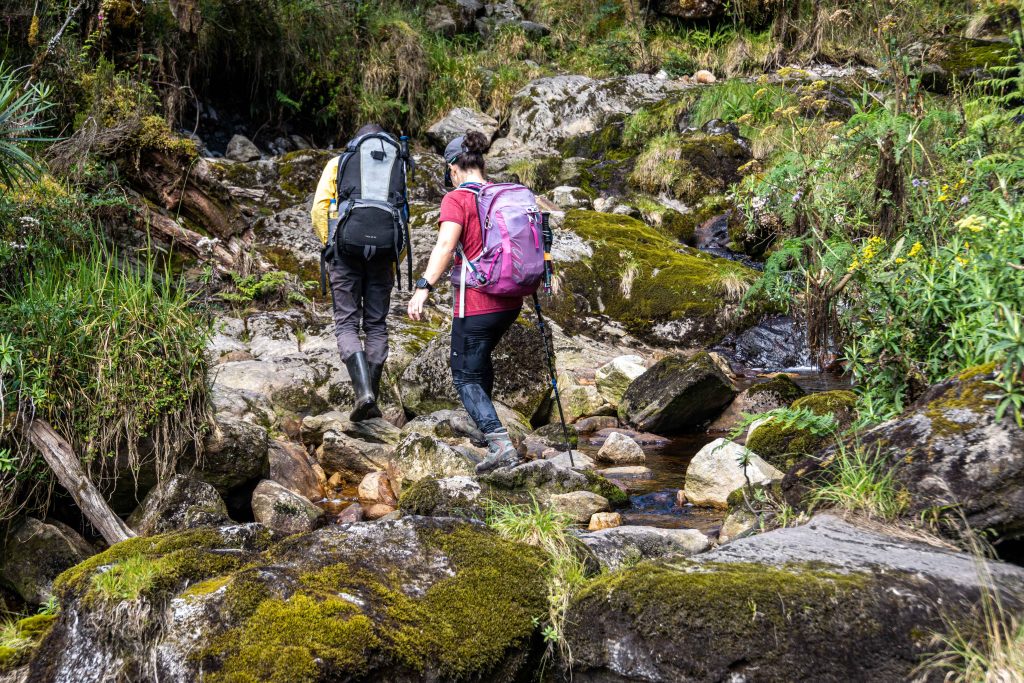
The standard Central Circuit itinerary runs seven days, covering approximately 58 kilometres through five ecological zones. The camp sequence moves from north to south through the mountain’s interior before looping back: Nyabitaba Hut at 2,650 metres, John Matte Hut at 3,380 metres, Bujuku Hut at 3,960 metres, Elena Hut at 4,541 metres for the summit push, then the descent via Kitandara Lakes at 4,023 metres, Guy Yeoman Hut at 3,505 metres, and back to Nyakalengija. Every camp in this sequence is RMS infrastructure.
| Day | Camp/Waypoint | Altitude |
| Day 1 | Nyakalengija (Mihunga Gate) → Nyabitaba Hut | 1,600 m → 2,650 m |
| Day 2 | Nyabitaba Hut → John Matte Hut | 2,650 m → 3,380 m |
| Day 3 | John Matte Hut → Bujuku Hut | 3,380 m → 3,960 m |
| Day 4 | Bujuku Hut → Elena Hut | 3,960 m → 4,541 m |
| Day 5 | Summit Margherita Peak → Descend to Kitandara Hut | 5,109 m → 4,023 m |
| Day 6 | Kitandara Hut → Guy Yeoman Hut via Freshfield Pass | 4,023 m → 3,505 m |
| Day 7 | Guy Yeoman → Nyabitaba → Nyakalengija (exit) | 3,505 m → 1,600 m |
The Character of the Central Circuit
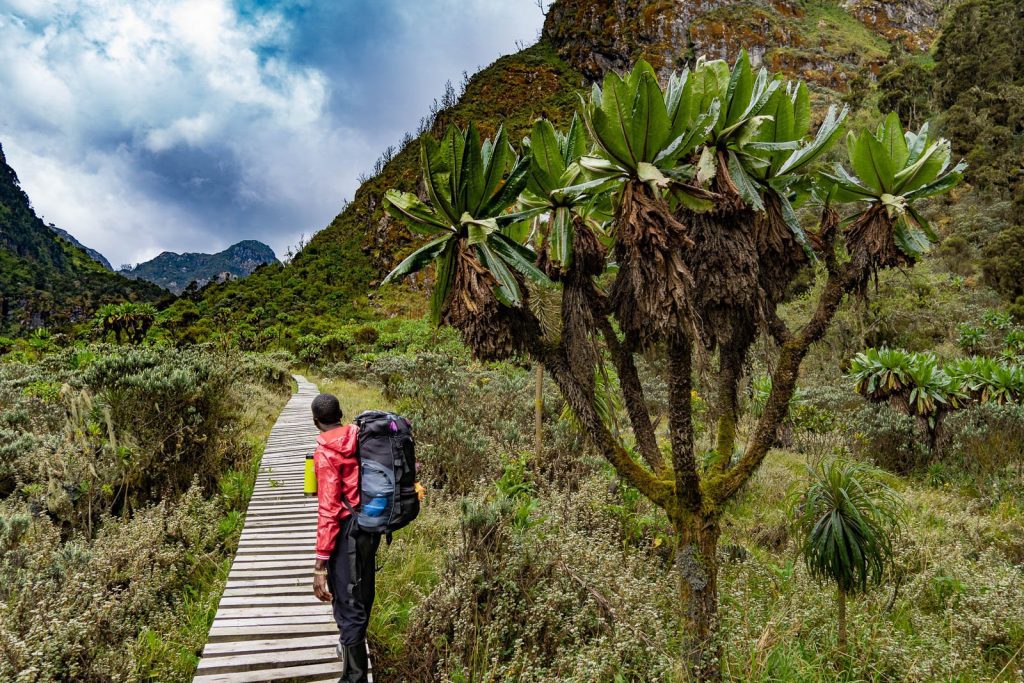
What defines the Central Circuit experientially is its movement through the northern heart of the Rwenzori. From Nyabitaba, the trail crosses the Kurt Shafer Bridge at the confluence of the Bujuku and Mubuku rivers, a landmark that has greeted trekkers for decades, before climbing through mountain forest, bamboo, and into the heather zones. The famous Bigo Bogs, which once required trekkers to leap precariously between grass tussocks, are now much easier to cross on boardwalks installed by RMS, which maintain the surreal quality of the landscape.

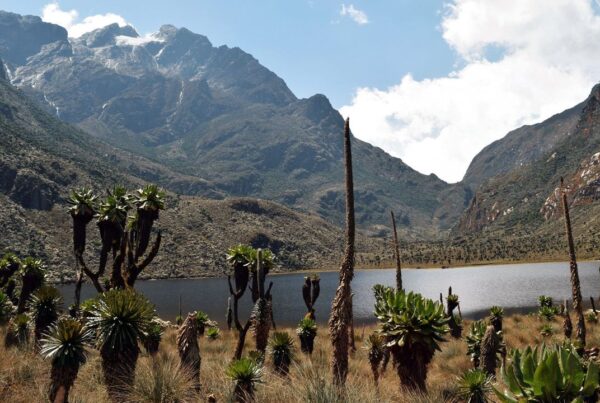
Lake Bujuku, which you can see as you get closer to Bujuku Hut, is one of the most iconic views in the Rwenzori: a dark glacial lake framed by the ridges of Mount Stanley, Mount Baker, and Mount Speke, with the Margherita Glacier visible between Alexandra and Margherita peaks. The sense of being enclosed within the mountain, surrounded by peaks on three sides with the valleys falling away behind, is a Central Circuit signature that the southern approach of the Kilembe Trail does not replicate.
Elena Hut, at 4,541 metres, is the summit staging camp on the Central Circuit, perched on the rocky southern shoulder of Mount Stanley. At this altitude, the cold is serious, and the views, when the clouds permit, are extraordinary. The summit day follows the same Stanley Plateau glacier and upper ridge to Margherita as all approaches, with crampons, ice axes, and roped teams required from Elena. The descent then takes trekkers southwestward via Scott-Elliot Pass to the Kitandara Lakes, one of the most celebrated visual moments of the entire route, and back north through Freshfield Pass to Guy Yeoman before the final exit to Nyakalengija.
The History and Heritage of the Central Circuit
The Central Circuit carries the weight of the Rwenzori’s mountaineering history. The route passes the rock shelter at Bujangolo, used as a base camp by the Duke of Abruzzi during his famous 1906 expedition that produced the first ascent of Margherita Peak. Decades of mountaineers, scientists, and explorers have walked the same valley floors that today’s trekkers traverse. For many trekkers, particularly those with a profound interest in the history of African exploration and mountaineering, this heritage is part of the appeal. The Central Circuit is the route that named this range’s peaks, established its reputation, and drew the world’s attention to the Mountains of the Moon.
The Kilembe Trail: Uganda’s Most Scenic Southern Approach.
The Kilembe Trail, also called the Southern Circuit, was officially launched in 2011 by Rwenzori Trekking Services, though its historical lineage traces to 1895 and Professor Scott Elliott’s pioneering expedition into southern Rwenzori (the Scott Elliott Pass, crossed on Day 5 of the trail, is named in his honour). It begins and ends at Kilembe town, at 1,450 metres on the southern slopes of the range. The full eight-day itinerary covers approximately 80–85 kilometres and represents the most comprehensive single-route mountain experience currently available on the Kilembe Trail.
The camp sequence on the Kilembe Trail runs: Sine Camp (2,596 m), Kalalama Camp (3,147 m), Mutinda Camp (3,588 m), Bugata Camp (4,062 m), Hunwick’s Camp (3,974 m), Margherita Camp (4,485 m) for the summit push, and then Kiharo Camp (3,460 m) on the descent before returning to Kilembe. Every camp on this sequence is RTS infrastructure, and none of them appear on the Central Circuit.
| Day | Camp/Waypoint | Altitude |
| Day 1 | Kilembe Trailhead → Sine Camp | 1,450 m → 2,596 m |
| Day 2 | Sine Camp → Kalalama Camp → Mutinda Camp | 2,596 m → 3,588 m |
| Day 3 | Mutinda Camp → Bugata Camp | 3,588 m → 4,062 m |
| Day 4 | Bugata Camp → Bamwanjara Pass → Hunwick’s Camp | 4,062 m → (4,450 m) → 3,974 m |
| Day 5 | Hunwick’s Camp → Lake Kitandara → Margherita Camp | 3,974 m → 4,485 m |
| Day 6 | Summit Margherita Peak (5,109m) → Descend to Hunwick’s Camp | 5,109 m → 3,874 m |
| Day 7 | Hunwick’s Camp → Oliver’s Pass → Kiharo Camp | 3,874 m → (4,505 m) → 3,460 m |
| Day 8 | Kiharo Camp → Kilembe Trailhead → Transfer to Kasese | 3,460 m → 1,450 m |
The Character of the Kilembe Trail
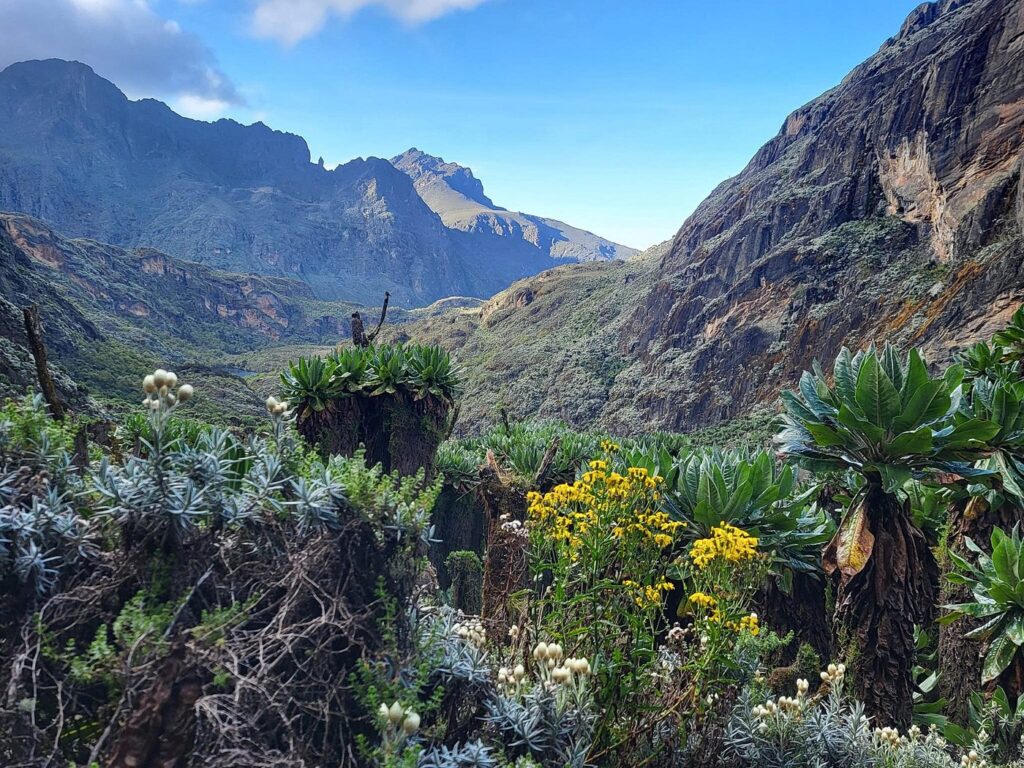
The Kilembe Trail’s defining quality is the drama of its southern approach. The climb from Kilembe goes up through all five types of plants found in the Rwenzori mountains in one continuous stretch: Afro-Montane Forest, Bamboo-Mimulopsis, Heather-Rapanea, Afroalpine, and Nival, and the changes between each type are more dramatic and striking. The giant heather forest around Mutinda Camp, draped in metres of old men’s beard lichen, is one of the most otherworldly sections of any mountain trail in Africa.
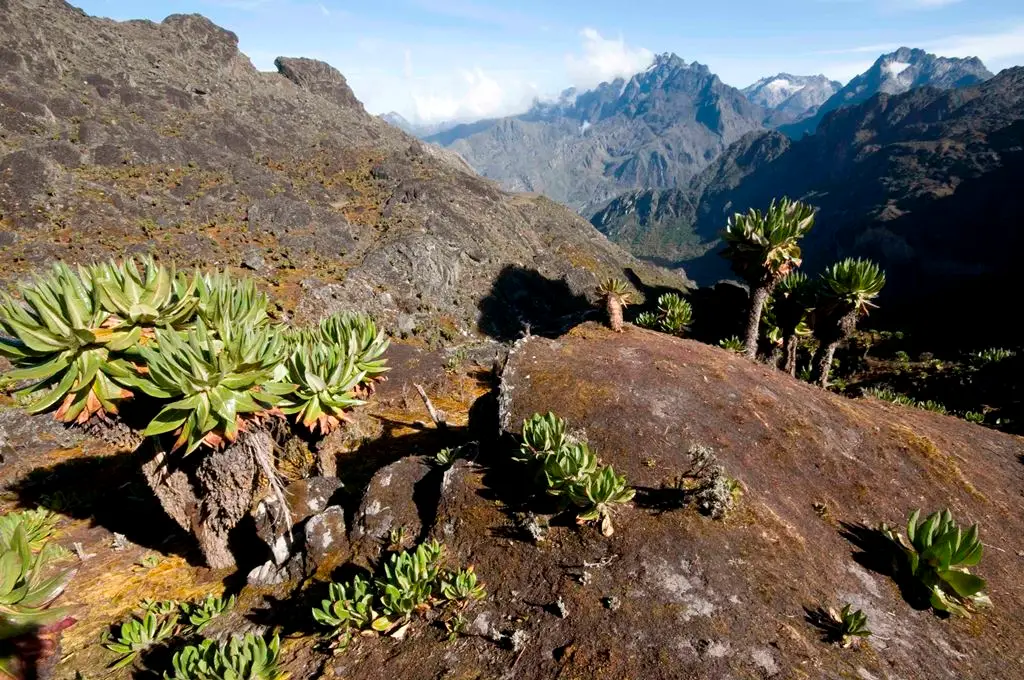
Bamwanjara Pass at 4,450 metres, reached on Day 4, is the outstanding visual revelation of the Kilembe Trail: the pass opens up simultaneous sight lines to Mount Stanley, Mount Baker, and Weismann’s Peak that stop experienced trekkers in their tracks regardless of how many times they have seen it. Hunwick’s Camp, perched on a valley edge with McConnell’s Prong and the Three Peaks directly above, has a sense of exposure and scale that is uniquely Kilembe Trail in character.
The descent from the summit via Oliver’s Pass at 4,505 metres, the highest pass on the entire trail, and down through the Nyamwamba Valley to Kiharo Camp is a route of remarkable wilderness quality. The confluence of the Nyamwamba and Kilembe rivers, whose combined waters flow downstream through Kasese to Lake George in Queen Elizabeth National Park, gives the descent a powerful sense of geographical continuity: you are not just descending a mountain; you are tracing a watershed that connects the high glaciers to the East African savannah below.
The Infrastructure Advantage of the Kilembe Trail
Because the Kilembe Trail is a more recently developed and actively managed circuit, its hut infrastructure is newer and better maintained than much of the Central Circuit’s equivalent facilities. Rwenzori Trekking Services has built purpose-designed mountain huts at each camp since the trail’s 2011 launch, and ongoing maintenance is a consistent operational priority. Trekkers who have walked both routes frequently comment on the superior condition of the Kilembe Trail camps, a detail that matters more than it might seem after four or five nights at altitude in a wet mountain environment.
The Seven Critical Differences, Examined in Depth.
1. Trailhead, Entry Point, and Logistics
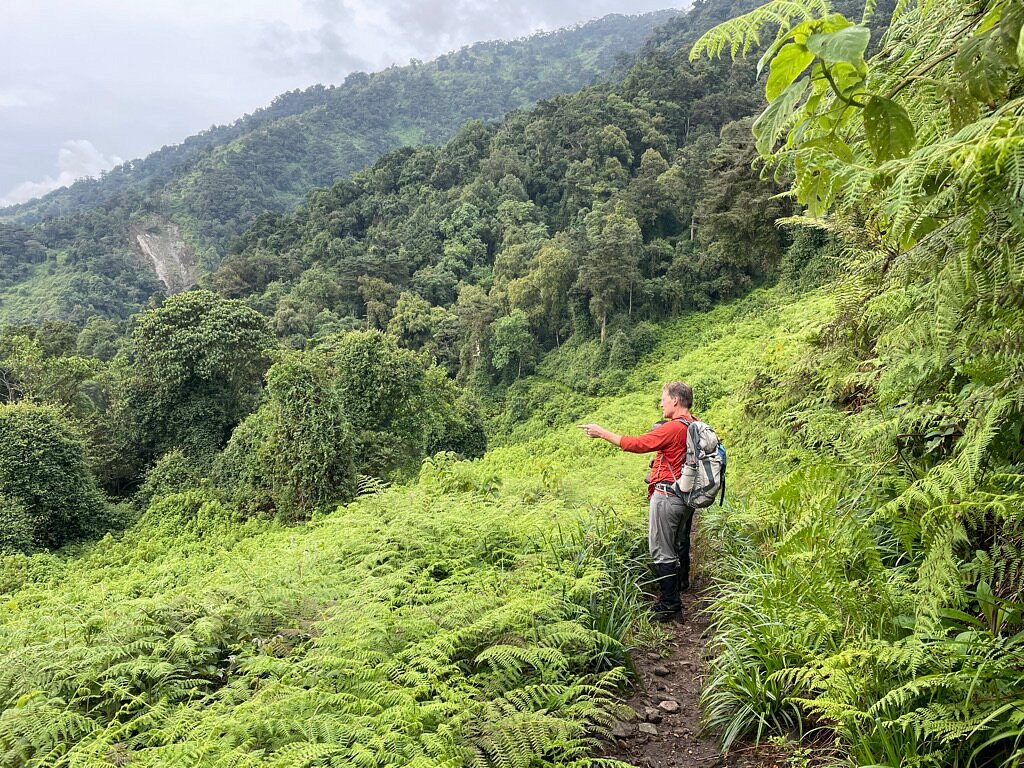
The Central Circuit begins at Nyakalengija, on the northern side of Rwenzori, a 22-kilometer drive from Kasese. Briefings and registration take place at the RMS headquarters at the park gate. The Kilembe Trail begins at the trailhead on the southern side, approximately 12 kilometres from Kasese, and briefings are conducted at the RTS base. Both are full loops; you begin and end at the same trailhead, so no shuttle transfers between different sites are required on either route. This is a significant logistical advantage of the loop format shared by both trails, and it removes the complexity of point-to-point vehicle arrangements.
2. Duration and Itinerary Options
The Central Circuit’s standard itinerary is seven days for a Margherita summit, with options ranging from five to nine days depending on objectives and acclimatisation needs. The 7-day Central Circuit is the most popular single-route itinerary on the northern side. The Kilembe Trail’s standard summit itinerary is eight days, with shorter options including the 4-day Mutinda Lookout trek and the 2-day Sine Camp introduction. The extra day on the standard Kilembe itinerary reflects the longer total distance of the southern circuit and the more gradual acclimatisation profile of the Bugata-Hunwick’s-Margherita Camp sequence.
3. The Approach to the High Peaks
Both trails ultimately reach the same summit, Margherita Peak, at 5,109 metres on Mount Stanley, via glacier travel from their respective staging camps. But the approach to those staging camps is fundamentally different. The Central Circuit approaches Margherita from the northeast, ascending through the Bujuku valley to Elena Hut on the rocky northeastern shoulder of Stanley. The Kilembe Trail approaches from the southwest, ascending via Hunwick’s Camp and the Scott Elliott’s Pass ridge to Margherita Camp, which sits tucked between giant boulders on the southern approach to the Stanley Plateau.
The summit-day route from both camps converges on the Stanley Plateau Glacier, so from a technical standpoint, the glacier section is broadly similar, regardless of approach. What differs is the panorama on the approach: the Central Circuit offers direct views into the Bujuku valley with Mount Baker and Mount Speke framed together, while the Kilembe Trail’s approach gives a south-westerly perspective across the Nyamwamba basin with the Congo basin visible in the far distance on clear days.
4. Difficulty, Terrain, and Physical Demands
Both trails are serious mountain undertakings that demand genuine physical fitness and multi-day trekking experience. Neither is suitable for beginners, and both require glacier travel with crampons and ice axes for a Margherita summit. The question of which is harder has no universally correct answer; it depends on the trekker, the season, and the specific conditions encountered.
The Central Circuit is longer in days, and the Bigo Bogs, even with boardwalks, present a uniquely demanding navigational environment in wet conditions. The terrain from John Matte to Elena Hut involves sustained altitude gain over three consecutive days that can compound fatigue. The Kilembe Trail’s approach is steeper in sections, particularly the Namusangi Valley on Day 3 and the climb to Bamwanjara Pass on Day 4, and its total distance is greater. Rwenzori Trekking Services itself describes the Kilembe Trail as the most challenging route in the Rwenzori, a description grounded in the steepness of its approach profile rather than its technical summit demands, which are comparable to those of the Central Circuit.
5. Crowd Levels and Wilderness Character
The Central Circuit is the older and better-known route, and it receives the majority of Rwenzori trekking traffic. This is not a criticism; it reflects decades of reputation and the genuine quality of the route. But for hikers who prioritise solitude, a stronger sense of expedition, and fewer encounters with other groups on the trail, the Kilembe Trail’s relative youth as an official route and its lesser-trafficked camps make it a compelling alternative. On many Kilembe Trail expeditions, you will encounter no other groups for days at a time. That quality of mountain solitude is difficult to price, and for certain trekkers it is the deciding factor.
6. Key Visual Highlights and Signature Experiences
Each route has visual highlights that the other does not replicate. The Central Circuit offers Lake Bujuku and the Bigo Bogs; the bog boardwalk section is genuinely unique and has no equivalent on the Kilembe Trail. The Kurt Shafer Bridge and the rock shelter at Bujangolo (the Duke of Abruzzi’s 1906 base camp) give the Central Circuit a weight of mountaineering history that the Kilembe Trail does not match in age. The approach to Elena Hut, with both Mount Baker and Mount Speke visible, is a scene specific to the northern route.
The Kilembe Trail counters with Bamwanjara Pass, arguably the single most dramatic panoramic viewpoint of any Rwenzori trail, and the waterfall-threaded descent through the Nyamwamba Valley, which has no Central Circuit equivalent. The Kilembe approach to Mutinda through the giant heather zone is more extended and more surreal than the heather sections of the Central Circuit. And Oliver’s Pass at 4,505 metres, reached on the descent, is the highest pass crossed by any standard Rwenzori itinerary on either trail.
7. Cost
The standard 7-day Central Circuit is priced from $1,400 per person for a fully guided, all-inclusive expedition. The standard eight-day Kilembe Trail is priced at $1,705 per person. The price difference reflects the additional day, the longer total distance, the higher RTS permit and operational expenses, and the newer hut infrastructure on the southern circuit. Both packages are fully all-inclusive, including guides, porters, all meals, technical equipment, and park fees, and neither includes international flights, travel insurance, or pre/post-trek accommodation. The cost difference of approximately $300 is modest in the context of an international expedition and should not be the primary deciding factor in route selection.
What About the Summit? Does the Route Change the Margherita Climb?
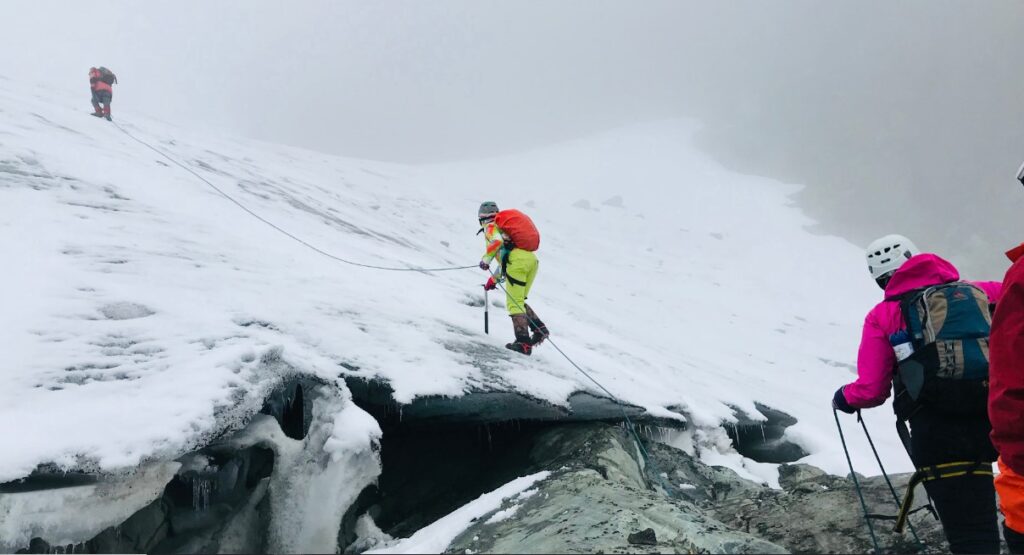
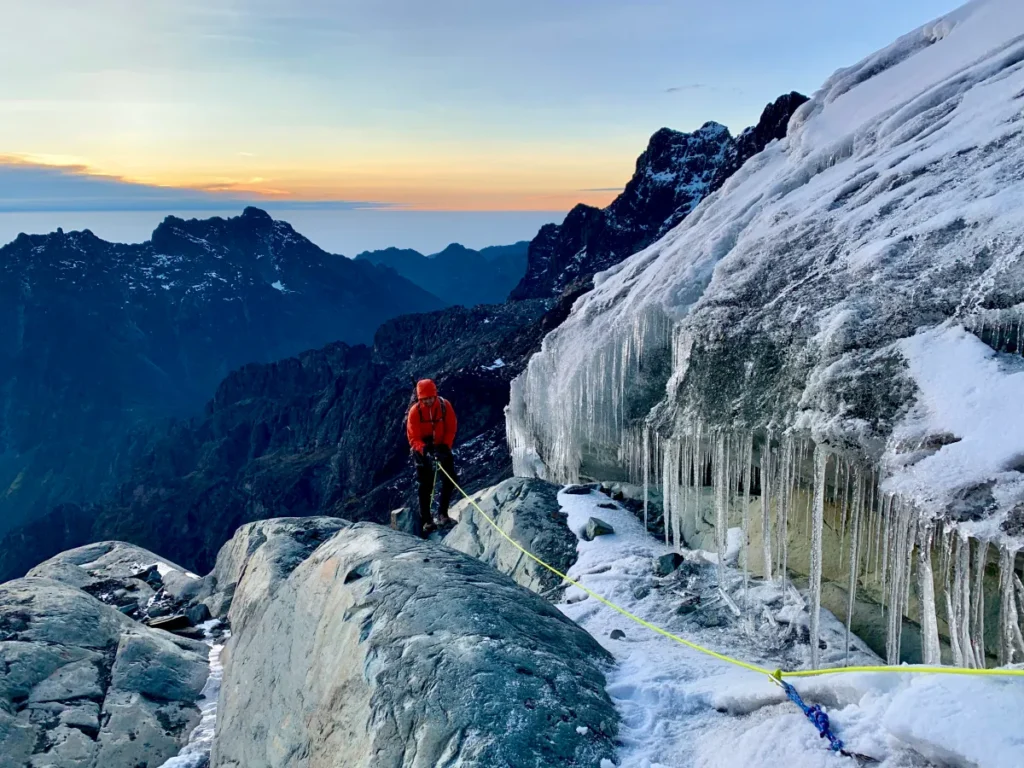
Both routes converge on the Stanley Plateau Glacier for the summit push to Margherita Peak at 5,109 metres. The glacier travel itself, including crampons, ice axes, roped teams, and technical movement on sections of ice that have steepened as the glacier has retreated due to climate change, is comparable from either staging camp. The Uganda Wildlife Authority has installed a new glacier bridge and fixed climbing lines on the critical crevasse section, improving safety on the upper mountain for trekkers on both routes.
Summit day on the Central Circuit departs from Elena Hut (4,541 m) at approximately 2:00 AM. Summit day on the Kilembe Trail departs from Margherita Camp (4,485 m) at approximately 2:30 AM. Both follow a strict turnaround time, typically 10:00 AM, to ensure descent is completed before afternoon weather builds from the Congo Basin. The summit experience, once you are standing on Margherita at 5,109 metres, is identical: the third-highest point in Africa and the highest in both Uganda and the DRC, with the whole range and the Congo basin stretching away in every direction.
For trekkers who are specifically focused on summit success rates, the acclimatisation profiles of the two routes differ in ways worth considering. The Kilembe Trail’s gradual ascent through Mutinda (3,588 m), Bugata (4,062 m), Hunwick (3,974 m), and Margherita Camp (4,485 m) provides a well-spaced, incremental acclimatisation ladder that many guides consider optimal for Margherita’s attempts. The Central Circuit’s Elena Hut staging, reached after three consecutive days of significant altitude gain, is also well-designed for acclimatisation but involves reaching 4,541 metres with one less intermediate step.
Multi-Peak Expeditions: Which Route Reaches Which Summits?
The Rwenzori Mountains are exceptional among African ranges in that they offer multiple glaciated summits above 4,600 meters in a compact geographical area. Both the Central Circuit and the Kilembe Trail can serve as approaches to these summits, but they access different peaks more naturally depending on their routing.
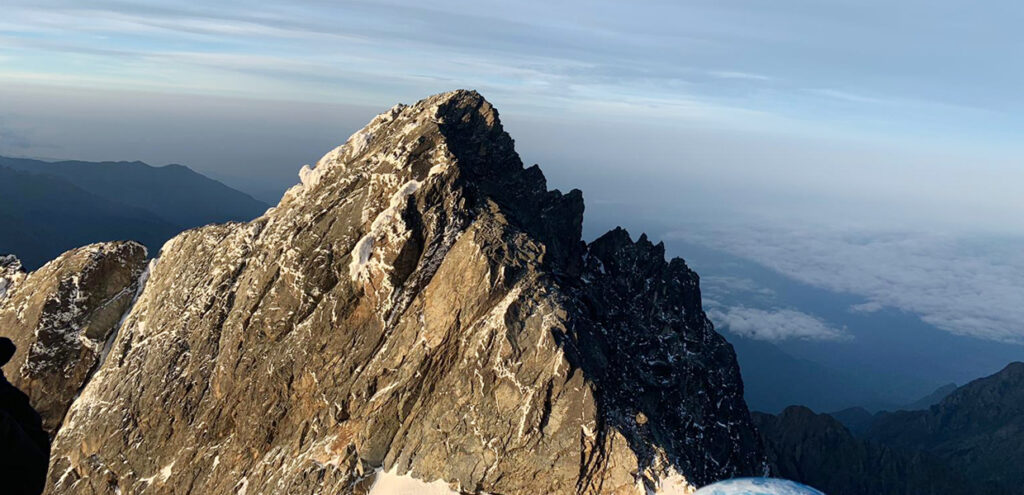
The Central Circuit’s positioning in the northern Bujuku valley makes it the most natural approach to Mount Speke (Victoria Emmanuel, 4,890 m) and the standard route for the 9-day three-peaks expedition covering Mount Stanley, Mount Speke, and Mount Baker (Edward Peak, 4,843 m). The 13-day six-peaks expedition covering Mount Stanley, Speke, Baker, Mount Luigi di Savoia, Mount Emin, and Mount Gessi uses the Central Circuit as its backbone, given the proximity of those eastern peaks to the northern approach valleys.
The Kilembe Trail, with its southern approach through the Nyamwamba basin, is the most natural route to Cheptegei Peak (4,907 m) and Weismann’s Peak, and the Bamwanjara Pass section provides excellent access to Mount Baker from the west. For trekkers primarily targeting Margherita with a secondary interest in Baker or Weismann’s Peak, the Kilembe Trail’s positioning makes it a strong choice. Both trails are also part of the extraordinary 18-day all-eight-peaks expedition that covers the full crown of the Rwenzori.
Which Route Is Right for You? A Candid Guide’s Assessment
Every guide who has walked both routes extensively will eventually develop a personal preference, and if you ask ours honestly, the Kilembe Trail edges ahead on scenic drama and wilderness quality, while the Central Circuit wins on historical weight and accessibility for first-time Rwenzori visitors. But neither answer is universally correct, and the right choice depends entirely on who you are as a trekker.
Choose the Central Circuit if you are visiting the Rwenzori for the first time and want the classic, historically rich experience on a well-established route with decades of trekking heritage. Choose it if your primary summit objective is Margherita and you also want access to Mount Speke and the Bujuku valley landscapes, or if you are planning a multi-peak expedition that includes the eastern summits of Luigi di Savoia, Emin, and Gessi. Choose it if you prefer the slightly shorter standard itinerary and the comfort of a more established route structure.
Choose the Kilembe Trail if you are an experienced multi-day trekker seeking a more demanding, less-travelled route with newer hut infrastructure and a more dramatic visual approach to the high peaks. Choose it if the Bamwanjara Pass panorama, the Nyamwamba Valley descent, and the frontier quality of a southern-approach expedition are priorities for your experience. Choose it if you want to stand on Oliver’s Pass, the highest pass on any standard Rwenzori itinerary, and look back across a landscape that hardly any people in the world have seen.
And choose both, over two separate expeditions, if the Rwenzori, as it tends to do, gets under your skin the first time and refuses to let go. These mountains reward return visits, and every guide who knows the range well will tell you that a second expedition on the other route always reveals something the first one kept hidden.
Beyond the Central Circuit and Kilembe: Other Rwenzori Routes
For completeness, the Rwenzori Mountains also offer several other trekking routes that sit entirely outside the Central Circuit/Kilembe Trail comparison.
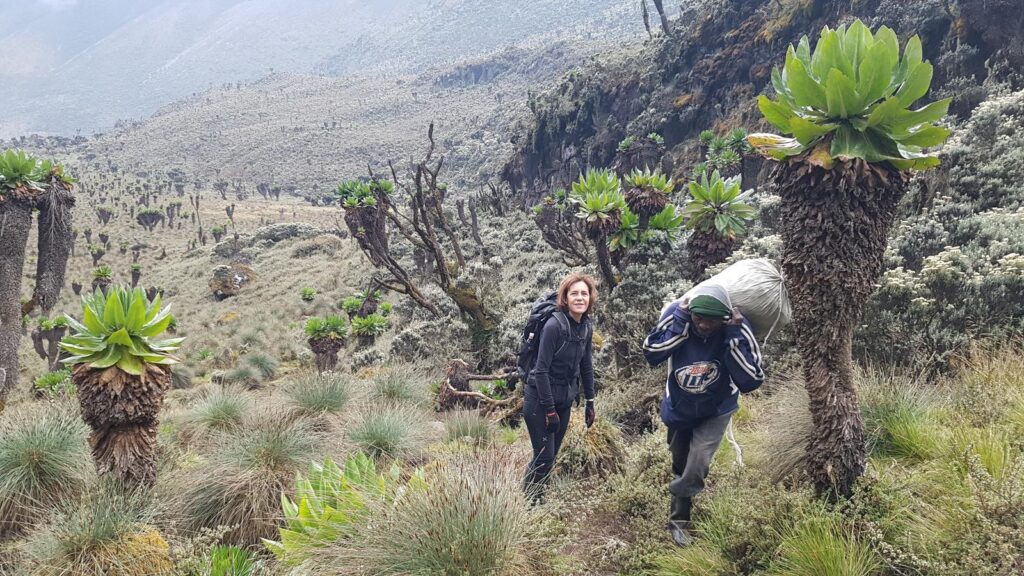
The Bukurungu Trail, developed after both the Central Circuit and Kilembe Trail, is designed for trekkers who love wild, unmanicured terrain, passing four magnificent Rwenzori lakes on a route that offers exceptional scenery with a distinctly different character from either of the main trails. The Mahoma Loop is a three-day circuit through the lower montane forest and crater lakes that serves as an outstanding brief introduction to the Rwenzori’s ecology for trekkers with limited time. Both are managed through Rwenzori Trekking Safaris, and both offer experiences that stand entirely on their merits.
Frequently Asked Questions: Central Circuit vs. Kilembe Trail.
What is the difference between the Central Circuit and the Kilembe Trail?
The Central Circuit Trail and the Kilembe Trail are two entirely separate trekking routes in Rwenzori Mountains National Park, managed by different organisations and operating on opposite sides of the mountain range. The Central Circuit is managed by Rwenzori Mountaineering Services (RMS), and it begins and ends at Nyakalengija on the northern side of the range, covering approximately 58 kilometres in seven days. The Kilembe Trail is managed by Rwenzori Trekking Services (RTS), officially launched in 2011, and begins and ends at Kilembe on the southern side, covering approximately 80 to 85 kilometres in eight days. Both trails reach Margherita Peak (5,109 m) on Mount Stanley, but they follow different valleys, cross different passes, use different camp sequences, and have entirely separate infrastructure. They cannot be mixed or combined in a single itinerary.
Which is harder, the Central Circuit or the Kilembe Trail?
Rwenzori Trekking Services officially classifies the Kilembe Trail as the most challenging route in the Rwenzori Mountains, and that assessment is broadly accurate in terms of the steepness and physical demands of the southern approach. The Namusangi Valley on Day 3 and the Bamwanjara Pass section on Day 4 involve demanding ascents, and the total distance of 80 to 85 kilometres over eight days is greater than the Central Circuit’s 58 kilometres over seven days. The Central Circuit presents its challenges in the Bigo Bogs and the sustained three-day altitude gain from Nyabitaba to Elena Hut. Both trails require genuine cardiovascular fitness, multi-day hiking experience, and glacier travel with crampons and ice axes for the Margherita summit. For most trekkers, the Kilembe Trail represents a marginally higher physical demand on the approach; the technical summit demands are comparable between the two routes.
Can you combine the Kilembe Trail and the Central Circuit into one route?
No. The Kilembe Trail and the Central Circuit are managed by two separate organisations: Rwenzori Trekking Services (RTS) and Rwenzori Mountaineering Services (RMS), respectively, with entirely separate camp infrastructure, guide teams, and permit systems. The camps on one trail are exclusive to that trail, and the logistics of the two systems are separate. An itinerary that begins on the Kilembe Trail and exits via Nyabitaba Hut or Nyakalengija (Central Circuit territory) would be operationally impossible within the current management framework. Both trails must be treated as self-contained expeditions, each completing a full loop back to its trailhead.
Which route has better huts and mountain accommodation?
The Kilembe Trail’s huts are generally newer and better maintained than the Central Circuit’s equivalent facilities, reflecting the more recent development of the southern circuit by Rwenzori Trekking Services from 2011 onwards. RTS has invested in purpose-built wooden mountain huts at each camp, Sine Camp, Mutinda, Bugata, Hunwick’s Camp, Margherita Camp, and Kiharo Camp, that provide reliable shelter and basic amenities to a higher standard than some of the older RMS huts on the Central Circuit. The Central Circuit’s huts are functional and adequate, with decades of operational use behind them, but trekkers who have completed both routes frequently comment on the newer infrastructure of the Kilembe Trail as a notable advantage.
Which route do you recommend for a first-time Rwenzori trekker?
For a first-time Rwenzori visitor, the Central Circuit Trail is the more accessible starting point. It is the historically established route, its seven-day itinerary is one day shorter than the standard Kilembe Trail, its camp infrastructure is well-documented, and the northern approach via Nyakalengija gives a classic introduction to the range’s ecology and character. The Kilembe Trail is the stronger choice for experienced trekkers who have prior multi-day high-altitude experience and are seeking a more demanding, less-trafficked route with newer huts. That said, both routes produce extraordinary trekking experiences. If you have the fitness and experience for the Kilembe Trail and want to attempt Margherita Peak with the most dramatic possible approach, there is a strong case for starting there rather than on the Central Circuit.
How long is the Central Circuit Trail?
The Central Circuit Trail covers approximately 58 kilometres of on-trail distance and is typically completed in seven days for a standard itinerary that includes a Margherita Peak summit attempt. Shorter options of five to six days exist for experienced trekkers, and extended nine-day itineraries are available for multi-peak expeditions covering Mount Stanley, Mount Speke, and Mount Baker. The trail begins and ends at Nyakalengija (Mihunga Gate), at 1,600 meters above sea level on the northern side of Rwenzori Mountains National Park.
Does the Kilembe Trail reach the same summit as the Central Circuit?
Yes. Both the Kilembe Trail and the Central Circuit Trail reach Margherita Peak on Mount Stanley at 5,109 metres, the highest point in Uganda, the highest in the Democratic Republic of Congo, and the third-highest summit in Africa. The routes approach the Stanley Plateau Glacier from different staging camps, Elena Hut (4,541 m) on the Central Circuit and Margherita Camp (4,485 m) on the Kilembe Trail, but both involve glacier travel using crampons, ice axes, and roped teams to reach the summit. The summit experience and views from Margherita are the same no matter the route.
What are Rwenzori Trekking Safaris’ top-rated Kilembe Trail itineraries?
Rwenzori Trekking Safaris offers a full range of Kilembe Trail itineraries through their partnership with Rwenzori Trekking Services. The standard 8-day Margherita summit expedition is the most popular, covering the full circuit from Kilembe with six nights in mountain camps and a guided glacier ascent to 5,109 metres. Shorter options include the 4-day Mutinda Lookout trek, which reaches 3,975 metres in the Afroalpine zone, and the 2-day Sine Camp introduction trek at 2,596 metres. Extended multi-peak options include the 8-day Cheptegei Peak expedition and the 10-day Mount Stanley and Mount Baker double summit. All itineraries begin and end at Kilembe and are fully guided by certified RTS mountain guides.
Ready to Choose Your Route? Let’s Build Your Rwenzori Expedition.
The difference between the Central Circuit and the Kilembe Trail is not the difference between a good choice and a bad one. Both routes lead to Margherita Peak. Both traverse the extraordinary ecology of the Mountains of the Moon. Both will change the way you think about what African mountains can be. The real question is which version of that experience best matches who you are as a trekker, and we are ready to discuss it.
At Rwenzori Trekking Safaris, we operate guided expeditions on both the Central Circuit and the Kilembe Trail, working with the qualified, community-based guide teams of both Rwenzori Mountaineering Services and Rwenzori Trekking Services. We have the operational knowledge to advise you honestly on which route suits your fitness level, your time window, your summit objectives, and your idea of what a great mountain expedition should feel like.
Contact us to start planning. Tell us your travel dates, your mountain experience, and your ambitions for the trip. We will create the right expedition for the Mountains of the Moon, whether you want to see the Central Circuit’s history, the Kilembe Trail’s frontier drama, or both on separate trips.