
Is the Rwenzori harder than Kilimanjaro? Specialist mountain guides provide an honest, expert comparison of terrain, weather, altitude, and difficulty.
I have been asked this question at every trekking trade show I have attended, in every pre-departure briefing I have delivered, and in hundreds of planning emails from trekkers who have already stood on Kilimanjaro’s Uhuru Peak and are now turning their eyes to the mountains that Ptolemy called the Mountains of the Moon. Is the Rwenzori harder than Kilimanjaro?
It is a genuinely intriguing question, and it deserves a truly honest answer, an answer that avoids both the promotional hedging of operators with a commercial interest and the oversimplification that conflates two profoundly different experiences.
For most trekkers, the Rwenzori offers a more sustained, technically complex, and physically demanding experience, with the exception of Kilimanjaro’s altitude ceiling, which at 5,895 meters on Uhuru Peak surpasses anything on the Rwenzori’s standard trekking routes. But altitude is just one of the Rwenzori’s many challenges.

This article works through the comparison systematically and honestly, covering terrain, weather, physical demand, technical requirements, altitude, route quality, infrastructure, and the sheer psychological weight of the two experiences. It also tells you what most comparison articles cannot: what it feels like to guide people on both mountains and what the real differentiators are for trekkers. Whether you are choosing between the two, planning to do both, or simply researching Rwenzori with Kilimanjaro experience already in your logbook, this publication is the resource you need.
Two Great African Mountains: Understanding What You Are Comparing.
Kilimanjaro and the Rwenzori are both extraordinary achievements of African geology, both capable of reducing experienced trekkers to a state of profound humility, and both worthy of the enormous reputations they carry in the global trekking community. But they are built differently, shaped by different forces, and they present different challenges in almost every category, such as altitude, climate, and terrain, which can significantly affect the trekking experience.
Kilimanjaro, in northern Tanzania, is a stratovolcano, a symmetrical cone rising in relative isolation from the surrounding plains to 5,895 meters at Uhuru Peak. It is Africa’s highest mountain and one of the Seven Summits. Its trail infrastructure is mature and heavily trafficked, with established routes, designated campsites, and a well-developed logistics network. Its primary challenge is altitude: the summit sits almost 6,000 meters above sea level, and the standard routes ascend fast enough that acute mountain sickness is the dominant risk and the dominant reason most trekkers fail to reach the top.
The Rwenzori Mountains, by contrast, are a fault-block range straddling the Uganda-DRC border, ancient, complex, and shaped not by volcanic fire but by the slow heave of tectonic forces over hundreds of millions of years. The range’s highest point, Margherita Peak on Mount Stanley, sits at 5,109 meters, lower than Uhuru but still well above the altitude threshold where mountain sickness is a serious concern. The Rwenzori is a UNESCO World Heritage Site, recognized for its outstanding universal value, and it contains some of the most biodiverse and visually surreal terrain on the planet: giant groundsels, lobelias the size of trees, permanent equatorial glaciers, and mist so constant it has become part of the mountain’s identity. These are not holiday hiking mountains. They are genuinely serious wilderness environments that test trekkers in ways that are qualitatively different from Kilimanjaro and, in most respects, more complex, particularly due to the challenging terrain, unpredictable weather, and the need for specialized skills in navigation and survival.
Terrain: Where the Rwenzori Leaves Kilimanjaro Behind
The Rwenzori is the harder mountain, according to guides who have worked on both. Kilimanjaro’s routes, the Machame, Lemosho, Marangu, and others, are well-maintained trail systems that ascend through a predictable sequence of vegetation zones before emerging onto the open volcanic cone for the summit push. The trails are clear, the gradient is managed, and the surface, while dusty on the ascent and loose on the summit ridge, is fundamentally straightforward to walk on.

The Rwenzori trails offer a unique experience. The Central Circuit Trail, the range’s signature multi-day route, passes through lower montane forest, bamboo forest, giant heather moorland, Afro-alpine bog, and glaciated high-alpine terrain, and at every one of those transitions, the surface underfoot demands attention, balance, and careful foot placement. The lower sections of virtually every Rwenzori trail are characterized by deep, tenacious mud; waterlogged bog; tangled root systems that cross the trail at ankle height; and the constant presence of water in forms ranging from mist to full downpour. The trails in the heather zone require scrambling over and between giant heather trunks that grow across the path at unpredictable heights and angles. Above the heather, the afro-alpine bog section, unique to equatorial African mountains and particularly pronounced on the Rwenzori, presents a landscape of tussocked grass, unstable ground, and hidden water channels that demand constant vigilance.
None of this scenery is insurmountable. But it is categorically more demanding, more technical in the trail-craft sense, and more physically exhausting than anything you will encounter on Kilimanjaro’s standard routes. Trekkers who arrive on the Rwenzori expecting Kilimanjaro-style trail walking are routinely surprised by the sustained physical and attentional effort the terrain requires.
The Mud Question
No comparison of the Rwenzori and Kilimanjaro is complete without an honest reckoning with the Rwenzori’s mud. The range receives more precipitation than almost any other high-altitude environment in Africa over 3,000 mm annually in the upper zones, delivered year-round with only modest seasonal variation. The result is that the trails, particularly in the lower and middle zones, are almost permanently waterlogged.

The mud on the Rwenzori is not the thin dusty-to-muddy transition you encounter on Kilimanjaro after rain. It is deep, structural, organic mud that can swallow a boot to the calf and transforms trail sections that look straightforward on a map into multi-hour physical challenges. Full gaiters, which are entirely optional on Kilimanjaro, are essentially mandatory on the Rwenzori from day one.
Weather: The Rwenzori’s Defining Advantage in Difficulty
Kilimanjaro is a dry mountain relative to its altitude. The standard trekking routes on the southern and western aspects receive significant rainfall in the montane forest zones, but above 3,000 meters, the weather becomes progressively drier, and summit days on most routes are attempted in cold but typically clear conditions. The summit ridge itself, above 5,000 meters, is cold and can be windy, but precipitation at summit altitude is usually in the form of occasional snow rather than sustained rain.
The Rwenzori is the opposite of this. It is arguably the wettest high-altitude environment in Africa, and precipitation is not a seasonal event; it is a baseline condition. Rain can fall at any elevation, at any time of year, and on any day of a multi-day trek. The upper camps regularly experience mist, drizzle, and sustained rain even in the drier months of June through August and December through February. At summit altitudes, temperatures can drop well below freezing at any time, and the combination of moisture and cold creates a hypothermia risk that Kilimanjaro, with its drier summit environment, simply does not present to the same degree.
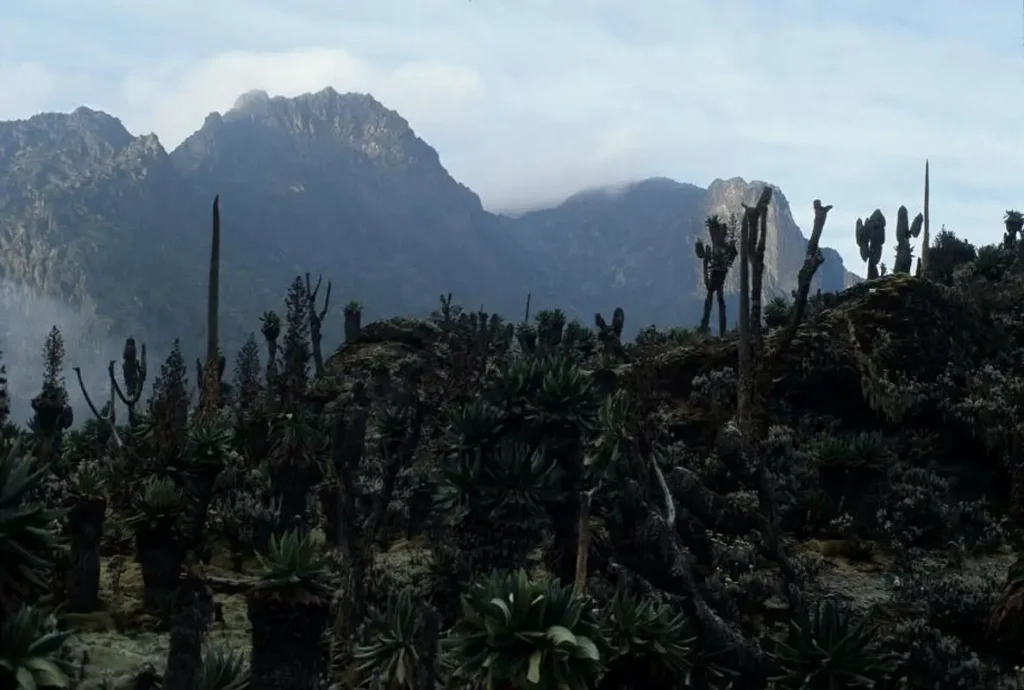
We should not underestimate the psychological weight of this phenomenon. Trekking on Kilimanjaro, even in challenging conditions, offers periods of clear weather, expansive views, and the particular encouragement that comes from being able to see where you are going and how far you have come. The Rwenzori regularly withholds these rewards: days of zero visibility, trails submerged in cloud, and the sustained effort of moving through a world that is uniformly grey and wet are part of the experience. The trekkers who thrive on the Rwenzori are the ones who find beauty in the mist and satisfaction in movement regardless of conditions. Those who require clear summits and mountain panoramas for motivation may find the Rwenzori’s weather more psychologically demanding than Kilimanjaro’s altitude.
Altitude: The One Category Where Kilimanjaro Raises the Stakes
Kilimanjaro’s summit at 5,895 meters is significantly higher than Margherita Peak at 5,109 meters, a difference of 786 meters that is physiologically meaningful. At Kilimanjaro’s summit altitude, oxygen availability is roughly 47% of sea level. At Margherita Peak, the figure is closer to 53%. For trekkers susceptible to acute mountain sickness, this difference is real: Kilimanjaro has a summit success rate of around 65% overall across all routes, and altitude-related illness is the primary reason for the remaining 35% of unsuccessful attempts.
The Rwenzori’s altitude profile is somewhat more forgiving for acclimatization because the standard multi-day itineraries allow for a gradual, built-in ascent profile. The Central Circuit Trail and the Kilembe Trail both ascend over multiple days, sleeping at progressively higher altitudes in a way that allows the body to adapt. This structured acclimatization is one reason that altitude-related evacuation rates on the Rwenzori’s standard routes are low relative to the mountain’s overall reputation for difficulty.

For Margherita Peak summit attempts, the altitude component is serious and demands genuine respect. Trekkers who have previously experienced AMS on Kilimanjaro should discuss their history candidly with our team before booking a Margherita summit itinerary. However, the summit success rate on guided Rwenzori summit attempts is higher, in our experience, than on Kilimanjaro’s faster-ascending routes precisely because the approach is more gradual and the acclimatization more thorough.
Altitude Illness Risk: A Direct Comparison
On Kilimanjaro’s standard seven-day routes, trekkers go from roughly 1,800 meters at the gate to 5,895 meters on summit day, a net gain of over 4,000 meters in seven days, with the summit push beginning at midnight and covering the most significant altitude gain in a single overnight push. This is a demanding acclimatization profile, and it is the primary reason altitude illness is so prevalent on Kilimanjaro. On the Rwenzori, our guides monitor oxygen saturation daily using pulse oximeters, which are devices that measure the amount of oxygen in a person’s blood, and the Lake Louise AMS (Acute Mountain Sickness) scoring protocol is applied every morning. Any trekker showing moderate symptoms is held at camp. This prevention-first approach, combined with the Rwenzori’s more gradual ascent profile, means that, for most trekkers, the altitude component of the Rwenzori is better managed than on a comparable Kilimanjaro itinerary, which often features a steeper ascent that can lead to more severe altitude sickness among trekkers.
Physical Demand: Duration, Load, and the Daily Grind
Typically, trekkers complete Kilimanjaro’s standard routes in five to eight days. The daily walking hours, even on more demanding routes like the Lemosho, are generally in the range of four to seven hours, and the trails, while ascending steadily, are managed in a gradient and largely clear of technical obstacles. Porters carry heavy loads, which means trekkers are moving with relatively light daypacks. The dominant physical challenge is altitude, not the sustained muscular demand of difficult trail walking.
A standard Central Circuit Trek on the Rwenzori runs six to nine days, with daily walking sections that can range from four to ten hours depending on the stage and current trail conditions. The physical demand is not just the distance and elevation gain; it is the constant, active engagement required to move safely across difficult terrain. Every step on the Rwenzori’s boggy sections, every scramble through the heather zone, and every stream crossing in wet conditions requires active decision-making and balance management that a well-maintained trail on Kilimanjaro simply does not. At the end of a full day on the Rwenzori, most trekkers report a level of physical exhaustion that goes beyond what they experienced on Kilimanjaro, not because the altitude is higher, but because the terrain demands more from the body from first step to last.
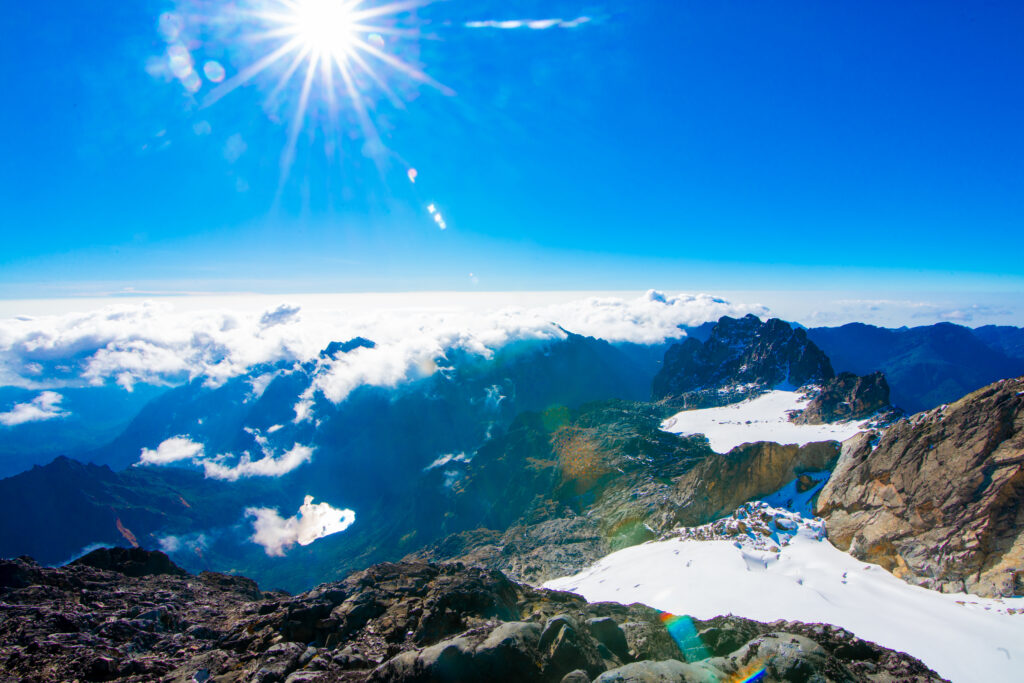
Explore our full treks overview to understand the specific daily stage demands across the different Rwenzori routes and find the itinerary that best matches your fitness level and ambitions.
Technical Requirements: The Rwenzori Asks More of You
Kilimanjaro, on its standard routes, is a non-technical trek. No crampons, ice axe, or ropes are required, and no prior mountaineering experience is necessary. This is one of the primary reasons it is the most attempted high mountain in the world; its accessibility to trekkers without technical skills, combined with its iconic status as Africa’s highest peak, creates a globally compelling proposition.

The Rwenzori’s non-technical routes, the Central Circuit, the Kilembe Trail, the Mahoma Loop, and the Bukulungu Trail, are also non-technical in the mountaineering sense. But the trail craft required to move safely and efficiently on Rwenzori terrain is meaningfully higher than on Kilimanjaro’s routes. The ability to read a wet, rooted, boggy trail surface; to use trekking poles effectively for balance rather than just pace support; and to manage your energy and nutrition over long and physically demanding days—these are skills that matter more on the Rwenzori than on Kilimanjaro.
Trekkers aiming for Margherita Peak face a significantly higher technical bar. Full 12-point crampons, an ice axe, a harness, a helmet, and at minimum some prior experience on glaciated terrain are required. Kilimanjaro’s highest routes, including the Western Breach and the Breach Wall, do require some technical skill, but the standard summit routes on Kilimanjaro require none. The Margherita summit is simply a more technical objective than Uhuru Peak and the Rwenzori’s range of peaks beyond Margherita. Mount Speke, Mount Baker, Mount Emin, Mount Gessi, and Mount Luigi di Savoia. adds a multi-summit complexity that has no direct equivalent in the Kilimanjaro experience.
Infrastructure, Crowds, and the Quality of the Experience
Kilimanjaro receives upwards of 50,000 trekkers per year. Its trails are heavily trafficked, its campsites are busy and sometimes congested, and the overall experience, particularly on the most popular routes like the Machame, can feel more like a managed tourist procession than a genuine wilderness adventure. The infrastructure is excellent: clear trails, designated campsites, favorable porter regulations, and a well-developed rescue and evacuation system. However, the density of trekkers on the mountain at any given time somewhat compromises the experience’s wildness.
The Rwenzori receives a small fraction of Kilimanjaro’s visitor numbers. On most days on the Central Circuit or the Kilembe Trail, trekkers will encounter no other groups at all, or at most one or two others sharing a hut at the evening camp. The mountain hut system that accommodates Rwenzori trekkers at each camp provides genuine shelter from the elements and meaningful comfort in the Rwenzori’s persistent wet conditions, while the low visitor numbers preserve an authentic wilderness atmosphere that is increasingly rare on the world’s iconic trekking routes. The Rwenzori is not a mountain you share with a crowd. It is a mountain you earn through sustained effort in genuine wilderness conditions, and the solitude is part of what makes it special.

This solitude also means that the Rwenzori’s rescue and emergency response infrastructure is less developed than Kilimanjaro’s. There is no helicopter evacuation service routinely available, and the nearest significant medical facilities are in Kasese, an hour’s drive from the main trailhead. This reinforces the importance of prevention-first safety management and the value of a specialist operator who knows the mountain deeply and carries comprehensive emergency equipment on every trek.
Who Should Do the Rwenzori, and Who Should Do Kilimanjaro?
This is not a question with a prescriptive answer; both mountains are extraordinary, and many serious trekkers will eventually do both. But there are genuine differences in who thrives on each mountain, and honest advice on this saves trekkers from choosing a mountain that will not match what they are looking for, such as the varying levels of difficulty, required experience, and the type of trekking experience they desire.
Kilimanjaro is the right choice if your primary motivation is altitude achievement, standing as high as Africa’s highest point, and if you want a well-supported, clearly structured trekking experience on a mountain with excellent infrastructure and global name recognition. It is also a better fit for trekkers who have limited prior trekking experience and want a significant but non-technical mountain challenge to build on. Kilimanjaro is, genuinely, one of the world’s outstanding trekking experiences, and nothing in this comparison should diminish that.
The Rwenzori is the right choice if you are drawn to genuine wilderness, if you want a mountain that will test you across multiple dimensions of difficulty rather than primarily one, if botanical and ecological richness are part of your motivation, and if you have the physical conditioning and mental resilience for a sustained, demanding, and sometimes uncomfortable experience. It is a better fit for trekkers who have already done Kilimanjaro and are looking for something that challenges them differently and more profoundly. It is also, despite being technically lower than Kilimanjaro, a better fit for trekkers with some prior mountaineering experience who want to use those skills on routes that require them.
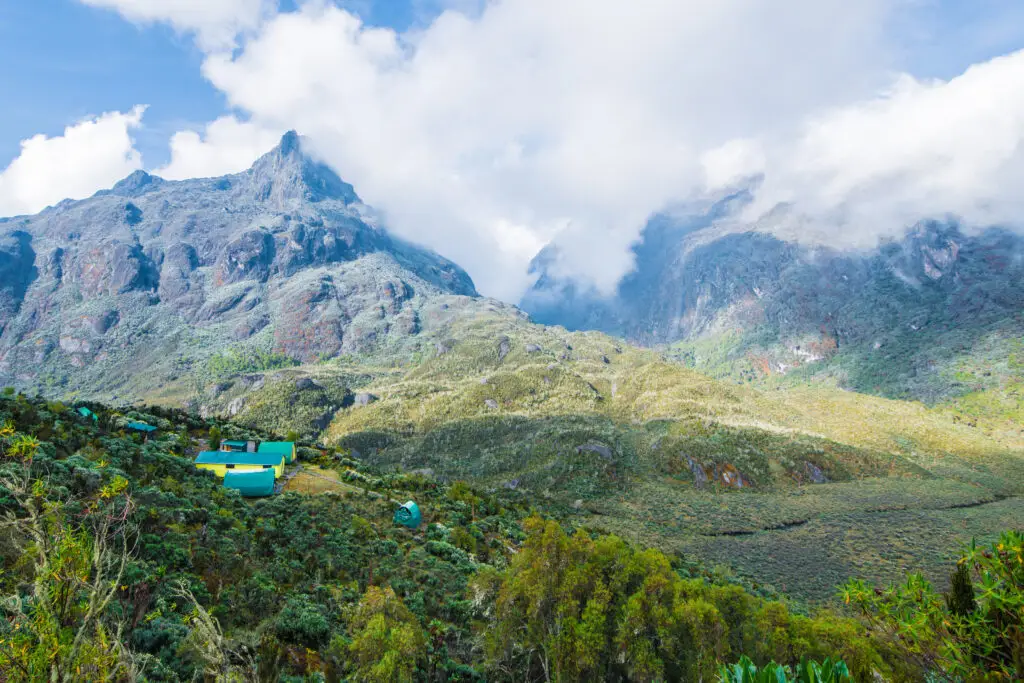
The experienced trekker who asks us directly which mountain is harder will almost always receive the same honest answer: in terms of sustained total difficulty, the Rwenzori. But “harder” doesn’t mean “better.” The right mountain is the one that matches your goals, prep, and desired experience.
Frequently Asked Questions: Rwenzori vs Kilimanjaro.
Is the Rwenzori harder than Kilimanjaro?
For most trekkers, the Rwenzori presents a more sustained and multi-dimensionally demanding experience than Kilimanjaro, primarily because of its terrain complexity, persistent wet conditions, and the technical trail craft required on its routes.
Kilimanjaro’s primary challenge is altitude; at 5,895 meters, its summit is significantly higher than Margherita Peak at 5,109 meters, and altitude sickness is the dominant risk and the main reason trekkers fail to summit. On the Rwenzori, the challenges are distributed across terrain, weather, physical endurance, and, on summit routes, technical mountaineering skills, creating a more complex and generally harder overall experience.
Which is higher, Kilimanjaro or the Rwenzori?
Uhuru Peak on Kilimanjaro is 5,895 meters high, while Margherita Peak on the Rwenzori’s Mount Stanley is only 5,109 meters high. This is a difference of 786 meters. This altitude gap is physiologically meaningful and contributes to Kilimanjaro’s higher rates of altitude-related illness and lower overall summit success rates on faster-ascending routes.
However, altitude is only one dimension of mountain difficulty, and the Rwenzori’s terrain, weather, and technical requirements mean that it presents a harder overall challenge across most other categories.
Which mountain has better weather for trekking?
Kilimanjaro has considerably more predictable and consistently drier trekking conditions, particularly on the summit approach and summit day, which typically occur in cold but clear conditions above the cloud layer. The Rwenzori is one of the wettest high-altitude environments in Africa, receiving precipitation year-round and presenting mist, rain, and cloud as baseline conditions rather than exceptions.
The Rwenzori has two main drier seasons, December to February and June to August, but no time of year guarantees dry conditions, and the persistent moisture is part of what makes the Rwenzori simultaneously more demanding and more ecologically extraordinary than Kilimanjaro.
Do I need prior experience to trek the Rwenzori vs. Kilimanjaro?
Both Kilimanjaro and the Rwenzori’s non-technical routes are accessible to trekkers without prior mountaineering experience, provided they have solid fitness and appropriate preparation. Kilimanjaro requires no technical skills on its standard routes, and its well-maintained trails reduce the trail-craft demands on trekkers.
The Rwenzori’s non-technical routes require no mountaineering skills but do require a higher level of general trekking competence and physical conditioning due to the demanding terrain. For Margherita Peak on the Rwenzori, prior crampon and glacier experience is strongly recommended, a bar that has no equivalent on Kilimanjaro’s standard routes.
Which mountain is better for first-time high-altitude trekkers?
Kilimanjaro is generally the better choice for first-time high-altitude trekkers, primarily because its trail infrastructure is more developed, its routes are better maintained, and its difficulty is concentrated in one primary dimension, altitude, which is easier to prepare for and manage than the Rwenzori’s multi-dimensional challenges.
The Rwenzori is better suited to trekkers who have prior experience at altitude, are comfortable with genuinely difficult and unpredictable conditions, and have the physical conditioning to sustain effort over multiple consecutive demanding days. Many trekkers do Kilimanjaro first and the Rwenzori as a next step, and this sequencing makes a great deal of sense.
How do the summit success rates compare between Rwenzori and Kilimanjaro?
Kilimanjaro’s overall summit success rate across all routes is approximately 65%, with faster-ascending routes like the five-day Marangu having significantly lower success rates due to insufficient acclimatization time. The Rwenzori’s success rate for summiting Margherita Peak on properly guided itineraries with appropriate acclimatization is high in our experience, higher than on Kilimanjaro’s shorter routes, because the approach is more gradual and the altitude differential is smaller.
The Rwenzori’s higher overall attrition rates come from physical difficulty and conditions rather than altitude failure, which means that physically fit, well-prepared trekkers tend to complete their chosen route successfully.
How long does it take to trek the Rwenzori compared to Kilimanjaro?
Kilimanjaro’s standard trekking routes range from five to nine days depending on the route chosen, with the most popular options, Machame and Lemosho, taking seven and eight days, respectively. The Rwenzori’s Central Circuit Trail is typically completed in six to nine days, and the Kilembe Trail in a comparable timeframe. Margherita Peak summit itineraries on the Rwenzori typically run eight to twelve days to allow for proper acclimatization and technical preparation.
Both mountains offer shorter introductory options for trekkers with limited time, though the Rwenzori’s more remote and demanding character means that shorter itineraries involve more of a compromise in experience quality; therefore, trekkers should carefully consider their physical fitness and time constraints when planning to do both Kilimanjaro and the Rwenzori on the same Africa trip.
Can I do both Kilimanjaro and the Rwenzori on the same Africa trip?
Combining Kilimanjaro and the Rwenzori on a single Africa trip is absolutely possible and is something a number of our clients have done. Tanzania and Uganda are relatively close geographically, and the combination of Africa’s highest peak with Africa’s most biodiverse and technically complex mountain range makes for an extraordinary back-to-back experience. The main practical consideration is timing: completing both mountains in sequence requires adequate recovery time between treks, and attempting the Rwenzori immediately after Kilimanjaro without a rest period is not advisable given the physical demands of both. A trip of three to four weeks with proper rest built in between the two mountains is the format we recommend.
Contact us via our contact page to discuss combined itinerary planning.
Is the Rwenzori more expensive than Kilimanjaro?
The Rwenzori is generally comparable in overall cost to Kilimanjaro’s mid-to-upper-tier guided options and, in some itinerary formats, slightly more expensive due to the specialist nature of the guiding, the lower volume of trekkers (which means fewer economies of scale in logistics), and the more demanding equipment and support requirements on technical routes. Kilimanjaro’s higher trekker volume creates a more competitive market and a wider range of price points, including budget options that do not have direct equivalents on the Rwenzori.
Both mountains should be booked with reputable specialist operators; the consequences of cutting costs on guiding and logistics are more severe on the Rwenzori than on Kilimanjaro given the more remote and demanding environment.
What is the main reason trekkers prefer the Rwenzori over Kilimanjaro?
Trekkers who choose the Rwenzori over Kilimanjaro most commonly cite three reasons: the extraordinary ecological and botanical richness of the range, the genuine wilderness character and solitude of the trekking experience, and the desire for a more technically and physically challenging objective.
The Rwenzori’s afro-alpine flora giant groundsels, arborescent lobelias, and heather forests of surreal scale is unlike anything encountered on Kilimanjaro or anywhere else on Earth, and many trekkers describe it as one of the most visually memorable environments they have ever moved through. The combination of serious challenge, profound beauty, and genuine remoteness makes the Rwenzori a deeply compelling alternative for trekkers ready to step beyond Kilimanjaro.
Ready to Discover Africa’s Most Extraordinary Mountain?
Kilimanjaro is one of the world’s outstanding trekking achievements. But the Rwenzori Mountains are in a category of their own, a UNESCO World Heritage wilderness of unmatched ecological richness, relentless physical challenge, and a beauty that belongs entirely to itself. Whether you are stepping onto African high-altitude terrain for the first time, returning after a Kilimanjaro expedition, or planning a double-mountain adventure that takes in both ranges, our team at Rwenzori Trekking Safaris is here to help you plan it right.

We guide exclusively on the Rwenzori. On every route we offer, we know every trail section, every weather pattern, and every camp. From the lower forest loops to the glaciated summit of Margherita Peak, we will design an itinerary matched to your fitness, your experience, and your ambitions, and we will back it with the guiding expertise that makes the difference between a safe, memorable experience and a difficult one.
📩 Get in touch via our contact page or message us directly on WhatsApp. Please share your past experiences, current situation, and future goals with us, and we’ll proceed from there. The Mountains of the Moon are waiting.


