Everything you need to know about waterproof gear for the Rwenzori Mountains: shells, boots, gaiters, gloves, and more. Zone-by-zone expert guidance from Rwenzori Trekking Safaris, Uganda’s specialist mountain guides.
Let’s answer the question in the title immediately and without qualification: yes, you urgently require waterproof gear for the Rwenzori Mountains. But if that were all there was to say, this would be a brief guide. The more useful question, the one that actually determines whether you have a safe, enjoyable experience or a miserable, potentially dangerous one, is not whether you need waterproof gear, but which waterproof gear you need, why each piece matters, and how to build a system that works across the Rwenzori’s extraordinary range of conditions.
The Rwenzori Mountains sit on the equator. Depending on the zone and season, they are among Africa’s wettest and coldest areas. That combination of tropical latitude, extreme precipitation, and high-altitude cold reaching above 5,000 meters creates a mountain environment that is unlike almost anything else a trekker will encounter. The gear mistakes that cause problems on the Rwenzori are not the dramatic ones. They are the quiet ones: the waterproof jacket that was only water-resistant, the boots with taped seams that were never tested in sustained rain, the gaiters that were short enough to let bog water seep in over the top. These failures compound over the first two days of a seven-day trek, turning what could have been an unforgettable experience into a significantly more challenging one.
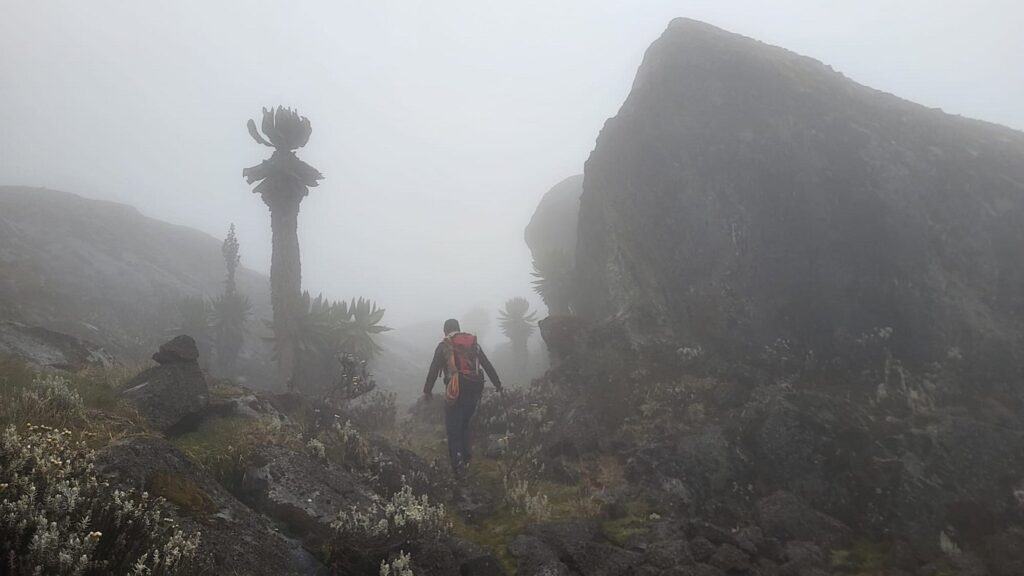
This guide is not written for the trekker who will settle for a generic packing list and hope for the best. It is written for the trekker who wants to understand what this mountain actually demands and who wants their waterproof system to be a source of confidence rather than an ongoing problem from the moment they step onto the trail.
Why the Rwenzori Is Uniquely Demanding on Waterproof Gear
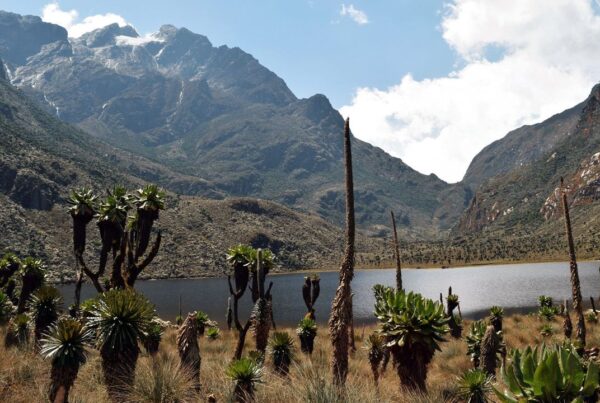
Most mountains that carry a reputation for being wet are wet in a straightforward way: it rains frequently, gear gets damp, and you dry out at camp. The Rwenzori operates on a different scale. Annual precipitation in the upper forest zones can exceed 3,000 millimeters. The range captures moisture from both the Atlantic and Indian Oceans, sitting in a geographic position that makes it one of the great rainfall traps of the African continent. The cloud forest that covers its lower slopes is perpetually saturated. The moorland bogs between 3,000 and 4,200 meters are not seasonal wet patches but permanent, deep, waterlogged terrain that trekkers move through for days at a stretch.
Rain on the Rwenzori is not always a dramatic downpour. Often it is a sustained, quiet, relentless moisture delivery that soaks through inadequate gear so gradually that trekkers do not realize how wet they are until they stop moving and the cold arrives. The cloud in the upper forest zone deposits water on vegetation and gear simply by being there, without any actual rainfall. Condensation inside inadequate shells adds moisture from the inside at the same time that rain adds it from the outside. On the lower mountain during heavy rain, the trail surface transforms into a moving film of water over roots, clay, and rock.
Understanding these factors is the foundation of excellent waterproof gear selection for the Rwenzori. Everything else follows after it. Whether you are planning the 3-day Mahoma Loop through the lower forest, the classic 7-day Central Circuit to Margherita Peak, or an extended multi-peak expedition across all six major summits, the waterproof system you carry is the most consequential gear decision you will make for this mountain.
The Rwenzori’s Waterproof Gear Requirements, Layer by Layer
The Waterproof Shell Jacket: Where Most Trekkers Get It Wrong
There is a pervasive misunderstanding among trekkers new to serious mountain environments about what “waterproof” actually means on a garment label. The outdoor clothing market includes a spectrum of products, from genuinely waterproof technical shells to lightly water-resistant softshells, but the terms used to describe them water-resistant, weather-resistant, weatherproof, and waterproof are inconsistent or regulated. On the Rwenzori, this ambiguity has real consequences.
A genuine waterproof shell jacket for the Rwenzori must meet three specific criteria. First, it must have a waterproof and breathable membrane: Gore-Tex, eVent, or an equivalent technology from a reputable manufacturer. These membranes are microporous laminates that block liquid water from entering from the outside while allowing water vapor sweat to escape from the inside. This breathability is not a comfort luxury on the Rwenzori; it is a functional necessity, because the mountain’s high humidity and sustained uphill exertion will generate significant perspiration that, if trapped inside a non-breathable shell, will make you as wet from the inside as the rain makes you from the outside.
Second, the jacket must have fully taped or welded seams. It seems the stitched joints between panels of fabric are the primary failure points of any waterproof garment under sustained rainfall. The needle holes from stitching are large enough to admit water under pressure, and without seam tape bonded over every seam on the inside of the jacket, moisture will eventually penetrate these points regardless of how good the face fabric is. “Critically seam-taped” jackets, which tape only the shoulder and hood seams, are inadequate for the Rwenzori. You need a jacket that is fully seam-taped across every panel join.
Third, the jacket needs a functional hood that fits properly over a hat or over a helmet if you are on a summit route and that provides meaningful rain protection for your face. A hood that collapses in wind or that cannot be adjusted to stay in place when you turn your head is not a functional piece of kit in Rwenzori conditions. Look for hoods with a wired peak, peripheral adjustment, and a rear drawcord that cinches the hood to your head independently of the jacket’s main closure system.
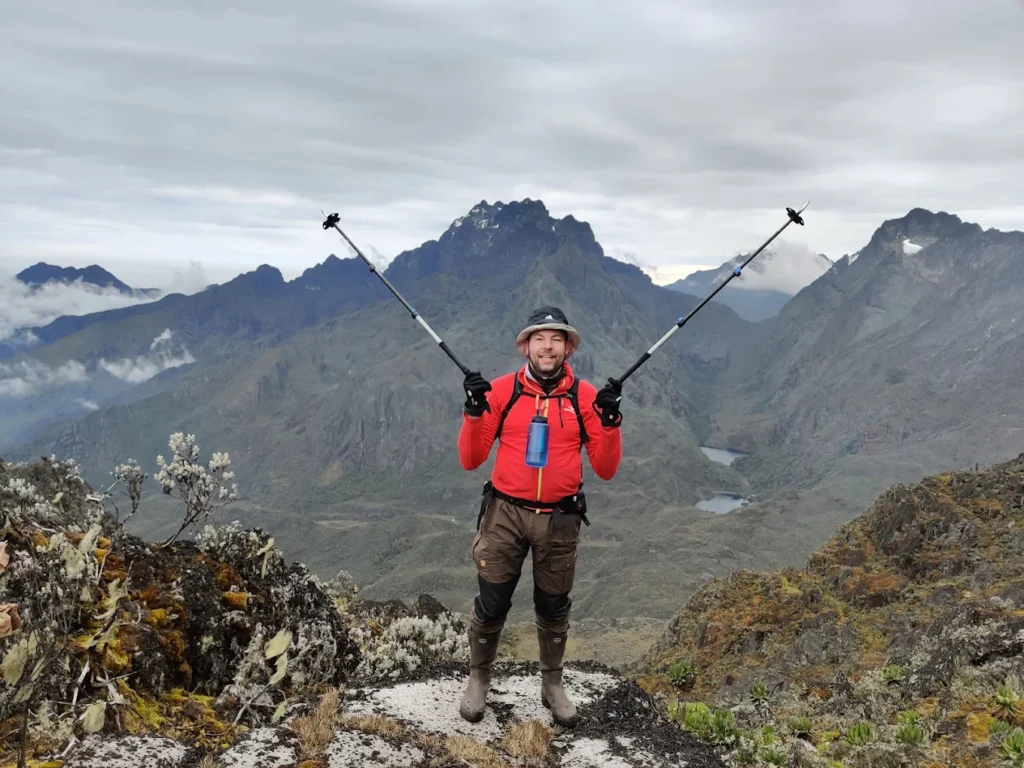
Beyond these three criteria, articulated patterning that allows freedom of movement on steep terrain is genuinely useful, underarm ventilation zips are a significant practical benefit given the heat and humidity of the lower mountain sections, and internal cuff adjustment cords or Velcro keep sleeves sealed against rain running down your forearm into your gloves. These are not premium extras; they are functional features that matter when the mountain is doing its worst.
Waterproof Trousers: Non-Negotiable and Daily Use
If the waterproof shell jacket is the item that gets the most attention in pre-trek gear discussions, waterproof trousers are the item that gets the least, and the asymmetry is not justified by their relative importance. On the Rwenzori, waterproof trousers are daily-use essential equipment, not an emergency backup that lives at the bottom of your pack. They go on when the rain starts, which in Rwenzori is frequent, and they stay on.
The same standards apply to waterproof trousers as to your jacket: a waterproof and breathable membrane, fully taped seams, and a fit that works with your hiking. The practical specifications that matter most for Rwenzori use are side-zip openings long enough to open over your boots without removing them (essential when rain arrives suddenly and you need to pull them on quickly over footwear that is already muddy), a waist and hip fit that is compatible with a harness if you are on a technical summit itinerary, and reinforced seat and knee panels that can withstand the sustained abrasion of trail use across multiple consecutive days.
Lightweight, packable waterproof trousers designed for urban use or light hiking are generally not adequate for sustained Rwenzori use. They tend to have lower waterproof ratings, thinner face fabrics that abrade quickly on dense vegetation, and seam taping that may not hold up across a week or more of continuous field use. Mid-weight technical hiking trousers from a reputable manufacturer are the right specification.
Waterproof Boots: The Foundation That Everything Else Rests On
Boot selection for the Rwenzori is a complete subject covered in our piece on what climbing gear to bring for a Rwenzori trek, but the waterproof aspect of that decision is worth addressing here. The surface of the Rwenzori trail for most treks consists of wet clay, roots, waterlogged bog, and saturated organic matter. Within the first hour of walking in boots that are not genuinely waterproof, your feet will be wet. The Rwenzori will stay wet for the rest of the day and most days after.
The difference between genuinely waterproof boots and water-resistant boots on this mountain is therefore not a question of comfort; it is a question of how many hours into the trek your feet stop being functional. Cold, wet feet at altitude create a cascade of problems: blister development accelerates dramatically on wet skin, thermoregulation is impaired, and in the upper camps where temperatures drop below freezing, wet feet inside a sleeping bag create conditions for cold injury that genuinely waterproof boots would have prevented.
The requirements for Rwenzori boots on easy paths are clear: they need a full Gore-Tex or similar waterproof lining, a sturdy build that supports the ankles, and a Vibram or similar sole designed for wet ground instead of dry rock. For technical summit routes that need crampons, the boot must also fit 12-point crampons and be rated B2 or B3 according to European standards, meaning it should be a semi-rigid to fully rigid mountaineering boot. The waterproofing standard for these technical boots is equally non-negotiable; cold and wet feet on the glacier approach are not just miserable, they are dangerous.

One critical note: waterproof membrane boots require waterproof boot care. The DWR (Durable Water Repellent) treatment on the outer face fabric of waterproof boots deteriorates with use and washing. When such an event happens, the outer fabric becomes saturated with water, a condition called “wetting out,” and while the underlying membrane still blocks liquid water from entering, the waterlogged face fabric conducts cold into the boot and adds significant weight. Reapply DWR treatment to your boots before your trek, and bring a small tube or spray for reapplication during longer expeditions.
Gaiters: The Missing Piece in Most Trekkers’ Waterproof Systems
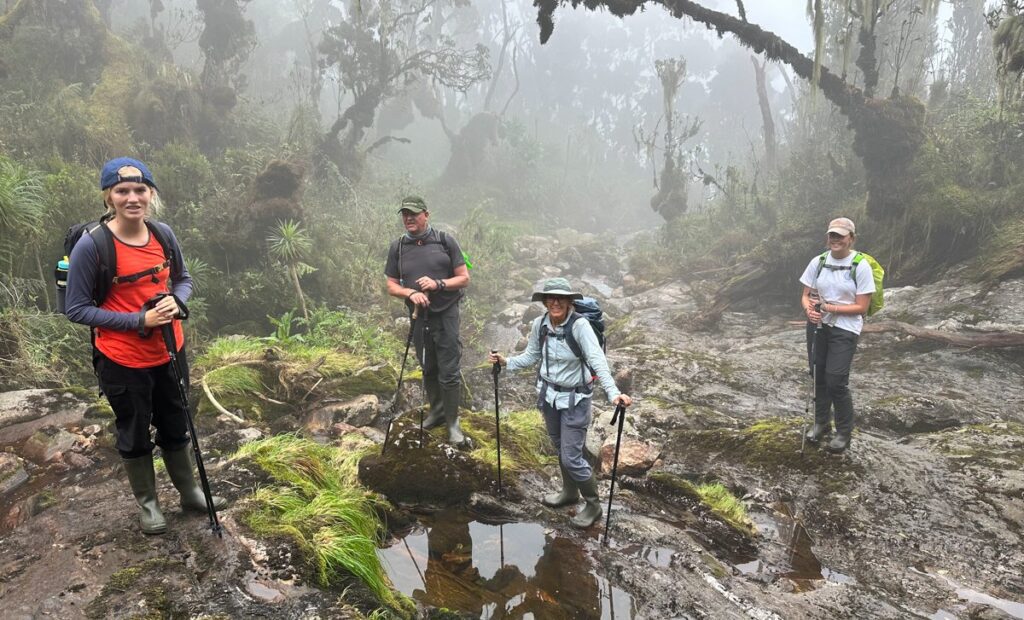
Gaiters are the waterproof gear item that most trekkers either forget entirely or bring in the wrong specification, and it is the failure mode that causes the most widespread wet-boot problems on the Rwenzori beyond the boots themselves. The bog can be knee-deep on the moorland and Afro-alpine sections of the mountain, which occupy the trail surface from approximately 3,000 meters to 4,200 meters and encompass a major portion of every classic multi-day Rwenzori route. Without gaiters that extend from the knee to the boot and seal reliably against the boot’s welt, bog water comes over the top of the boot with every step through deep sections.
The right type of gaiters are full-length waterproof ones that go from just below the knee to the bottom of the boot, with a strong way to attach them to the boot, usually including a wire bail that fits under the boot, a hook for the laces, and a Velcro or zip closure in the front. The fabric should be a waterproof and breathable construction rather than simply a coated nylon, because gaiters on the Rwenzori are on your legs for most of the hiking day, and non-breathable gaiters create significant condensation on the inside.
Short ankle gaiters of the type designed for trail running or dry-condition hiking to exclude grit and pebbles from boots provide essentially no protection against the Rwenzori’s bog terrain. They are shorter than the depth of waterlogged sections the trail regularly passes through, and their attachment systems are generally not designed for the sustained wet conditions that full-length gaiters manage routinely.
Waterproof Pack Protection: Keeping the Rest of Your Gear Dry
Your waterproof shell keeps you dry. Your waterproof pack system keeps everything else dry. On the Rwenzori, pack waterproofing is as important as personal waterproofing because your main pack holds your sleeping bag, spare base layers, insulation layers, and any other items that need to stay dry at camp throughout the trekking day.
The system we recommend is a belt-and-braces approach: a pack-specific rain cover fitted over your main rucksack as the first line of defense against rain, combined with internal dry bags and roll-top waterproof bags in various sizes that house your critical dry items inside the pack. The rain cover manages the bulk of rain ingress and keeps the pack itself from becoming waterlogged and heavy. The internal dry bags provide a secondary barrier for your most important items: sleeping bag, spare base layers, insulation layers, and electronic devices. Items that can tolerate getting damp, like trail food, camp shoes, and trekking pole bags, can live in the main compartment outside the dry bags.
Some trekkers use a single large pack liner, a waterproof bag that lines the entire interior of the pack, as an alternative to multiple smaller dry bags. This is effective but less flexible than the dry bag system, because it requires unpacking the entire liner to access anything inside it. For shorter treks, the pack liner is simpler. Individual dry bags organized by category (sleep system, clothing, and electronics) are more practical for longer expeditions when you need to access different items at various points throughout the day.
The Specific Waterproof Challenges of Each Mountain Zone
The Rainforest Zone (1,650m to 2,500m): Volume and Vegetation
The first stage of any Rwenzori trek passes through one of the densest rainforests in East Africa. Volume and vegetation dominate the waterproof challenge here. Rainfall in the forest zone can be extremely heavy, arriving in tropical downpours that test even the best-rated shells. Simultaneously, the vegetation on either side of the trail is constantly saturated, and passing through it at any pace deposits water on your clothing and gear continuously regardless of whether it is actively raining. Branches at shoulder height drench your jacket. Leaves at knee height saturate your trousers. Even on a day without recorded rainfall, a morning walk through the Rwenzori forest in the wet season will soak unprotected clothing to the skin within minutes.

The waterproof priorities in this zone are your jacket, your trousers, and your boots. Gaiters become useful from the moment the trail enters the first waterlogged sections, which often begins within the first few hours of walking from the trailhead. Your pack cover should be on from the start of each day in this zone, not deployed reactively when you can already see rain falling.
The Bamboo and Heather Zones (2,500m to 3,500m): Sustained Drizzle and Dropping Temperatures
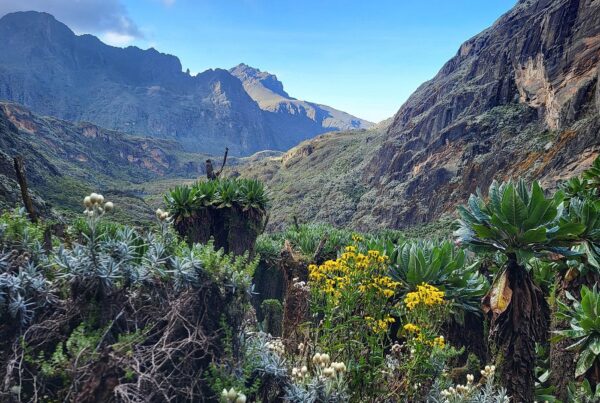
Above the rainforest, the character of the moisture changes. Heavy tropical downpours give way to cooler, more sustained drizzle and the constant moisture delivery of cloud forest. This zone is where the Rwenzori’s famous “persistent mist” operates, and it is where the combination of wet and cold begins to test clothing more seriously than the warm rainforest below. Your shell needs to be performing at its best here, because the sustained low-intensity moisture exposure over multiple hours is the condition that finds the failure points in inadequate waterproofing more reliably than any downpour.
The bamboo zone is also where the trail surface becomes its most technically demanding from a footing perspective: polished bamboo culms, wet clay slopes, and sections of trail that are essentially small watercourses. Your waterproof boots are doing serious work in this zone, and their grip and waterproof integrity are both under sustained pressure. Full gaiters should be on from the start of each day once you enter the bamboo zone, even if the morning looks dry.
The Afro-Alpine Moorland (3,500m to 4,200m): The Bog Zone
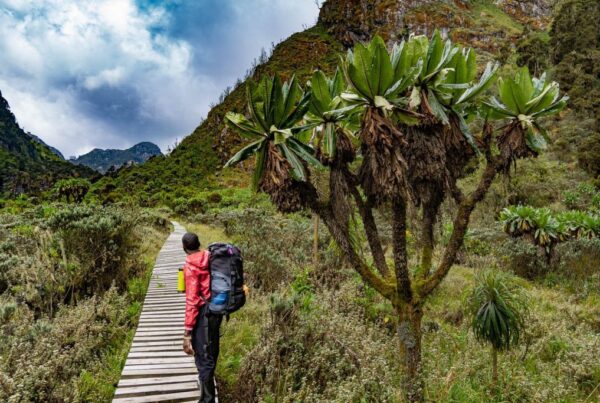
The moorland section of the Rwenzori is, from a waterproof gear perspective, the most unforgiving zone on the mountain for boots and gaiters specifically. The Afro-alpine bog terrain that dominates the trail surface through this zone consists of a waterlogged peat and organic matter substrate, which is the product of the Rwenzori’s extraordinary rainfall combined with the retention capacity of its ancient soils, and can be thigh-deep in places after heavy rain. Standard sections are knee-deep to boot-top depth even in the drier seasons. Walking through this terrain without full-length gaiters and genuinely waterproof boots is not a question of whether your feet become wet; it is a question of how long it takes.
The same moisture delivery systems that operate in the bamboo zone continue through the moorland, with the added dimension of significantly lower temperatures. By the time you reach the upper moorland camps, Bujuku Hut on the Central Circuit and Bugata and Hunwick’s camps on the Kilembe Trail, nighttime temperatures are approaching or below freezing, and wet clothing in this context is a cold injury risk rather than merely a discomfort. You must maintain the waterproof integrity of your shell, trousers, and boots throughout this entire zone.
The High Alpine Zone (4,200m and Above): Cold, Wind, and Ice
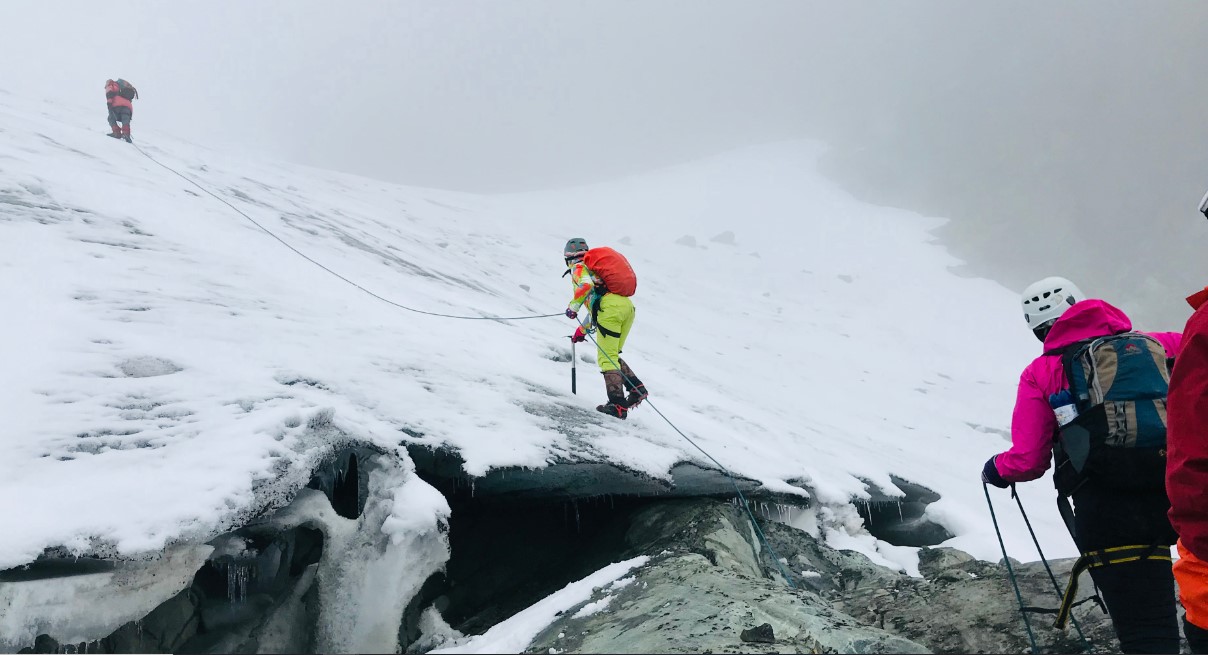
Above the moorland, the mountain enters its high alpine personality, and the nature of the waterproof challenge changes once more. On the approach to Margherita Peak on Mount Stanley or to the glaciated upper ridges of Mount Speke, Mount Baker, and the range’s other major peaks, precipitation arrives as snow, freezing rain, and ice rather than liquid water. Wind becomes a significant amplifier of cold. At this high altitude, there is less moisture compared to the forest and moorland areas, but if that moisture gets into your insulation layers, either from outside through a damaged shell or from inside due to poor breathability, it can cause much bigger problems.
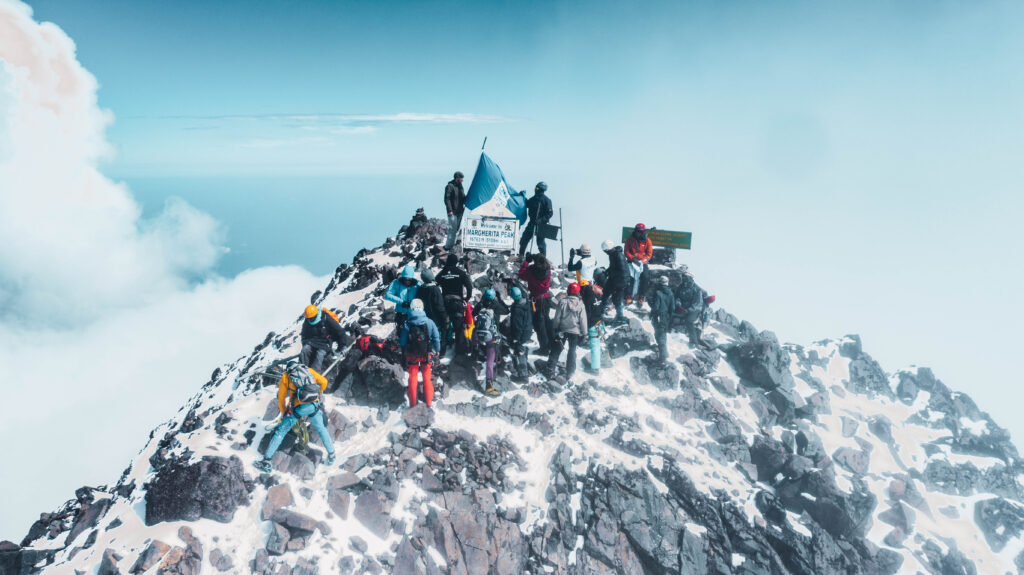
In the high alpine zone, your waterproof shell is working alongside your insulation layers rather than independently of them. The shell blocks wind and precipitation, the insulation retains body heat, and the breathable membrane manages the moisture gradient between your warm body and the cold outside air. If the shell stops working properly at high altitude, like if the seam tape comes loose, a zipper breaks, or the hood gets blown away by the wind, you can quickly become cold and wet, and it’s difficult to fix that without going down the mountain.
Waterproof gloves and a waterproof outer layer for your head, whether a waterproof hat, balaclava, or the hood of your shell, become genuinely important at this altitude in a way they are not on the lower mountain. Cold hands and a cold head are not minor discomforts at 4,500 meters; they are early signs of thermoregulatory stress that experienced guides take seriously.
Waterproof Gear Quality: Where to Invest and Why the Specification Matters
The outdoor gear market spans an enormous price range for waterproof products, and the temptation to buy a cheaper waterproof jacket or boots “just to see how the Rwenzori goes” is understandable but carries real risk. The difference in prices for waterproof gear shows real differences in how well they work, including the quality of the membrane, how breathable they are, how durable the outer fabric is, and how well On a weekend walk in the hills, an entry-level waterproof jacket will likely perform adequately. On a seven-to-thirteen-day mountain trek in one of the wettest environments on Earth, the limitations of budget waterproof gear are exposed thoroughly.
The minimum specification for a Rwenzori waterproof jacket is a 3-layer construction with a waterproof and breathable membrane, a 20,000 mm or higher waterproof rating, and a breathability rating of at least 15,000 g/m²/24h. The waterproof rating indicates how much water pressure the fabric can resist before leaking; 20,000 mm is adequate for sustained heavy rainfall. The breathability rating indicates how much water vapor can pass outward through the fabric; higher is better in the Rwenzori’s high-humidity, high-exertion conditions. Jackets rated at 5,000 mm or 10,000 mm waterproof with low breathability ratings common at the budget end of the market will either fail under sustained Rwenzori rain, trap sweat inside at intolerable levels, or both.
The same principle applies to boots and gaiters. The waterproof layer in a boot usually lasts longer than the one in a jacket because the boot’s leather or synthetic material protects it, but how well it sticks to the boot and how long the water-repellent coating lasts can differ a lot depending on the price. Budget waterproof hiking boots from unlicensed Gore-Tex alternatives frequently begin to wet out within the first few days of Rwenzori use. For a mountain where your boots are on your feet for eight to ten hours of wet-terrain hiking per day across multiple consecutive days, this failure timeline is too short to be acceptable.
What You Must Bring and What We Can Provide
One of the most common questions trekkers ask is how much gear they need to bring to Uganda and how much they can buy there. The honest answer, for waterproof clothing specifically, is that it needs to come with you from home.
Local rentals cannot replicate the fit of deeply personal items like waterproof shells, trousers, boots, and gaiters, whose performance depends on fit. A waterproof jacket that does not sit correctly at the wrists, waist, and hood will admit water at exactly those points regardless of its technical specification. Boots that have not been worn and broken in before your trek will develop pressure points and blisters on the Rwenzori’s demanding terrain that brand-new rental boots simply cannot avoid. These are the items you need to own, try on, test in real rain, and confirm as fit-for-purpose before you get on a plane.
Where we can genuinely help is on the technical summit equipment side. Crampons, ice axes, harnesses, and helmets the gear required for reaching Margherita Peak and the other glaciated summits of Mount Stanley, Mount Speke, and Mount Baker are available for rental through our offices at the start of your trek. We inspect and maintain this equipment before each use, conduct a fitting session with you before you head up the mountain, and advise on fit and function based on your specific itinerary. Rental equipment needs to be arranged in advance through our booking process rather than assumed to be available on the day; contact us through our planning and booking page to confirm availability and specifications for your dates.
If you are unsure whether the waterproof gear you already own is adequate for the Rwenzori, the most useful thing you can do is describe it to us specifically: the manufacturer, the model, the membrane specification, the seam tape coverage, and how old it is. We can tell you whether it meets the bar for your route or whether specific items need upgrading before you travel. This is a conversation we have with trekkers regularly and one we take seriously, because arriving with inadequate waterproof gear is one of the most common and entirely avoidable causes of a difficult Rwenzori experience.
Maintaining Your Waterproof Gear During the Trek
Even excellent waterproof gear requires active maintenance to perform at its best across a multi-day Rwenzori trek, and there are specific things you can do during the trek to extend the effective performance of your shell jacket and trousers.
The most important maintenance task is reactivating the DWR treatment on your shell’s face fabric when you notice it beginning to wet out. Wetting out, where the outer fabric darkens and appears saturated with water rather than beading and shedding it, does not mean your waterproof membrane has failed, but it does mean the face fabric is absorbing water and becoming heavier and colder. At camp, after a dry evening, hang your jacket near any available warmth source. In the absence of heat, simply wearing the jacket for thirty minutes will allow body heat to reactivate the DWR (Durable Water Repellent) partially, which helps restore its water-shedding properties. Carrying a small tube of DWR spray on longer expeditions enables you to reapply treatment at intermediate camps before the coating further deteriorates.
Zip maintenance matters more than most trekkers expect. The waterproof zips on high-quality shell jackets typically have covered or gasketed zips on the main front opening and chest pockets that seal against water ingress mechanically and rely on that mechanical contact being maintained. Dirt and grit in the zip teeth prevent a clean seal. At camp, rinse visible debris from zips and run the slider back and forth a few times to work it out. A small amount of zip lubricant, carried as a standard item in your kit bag, keeps the slider moving smoothly and the seal maintained across the full length of the zip.
For boots, the nightly camp routine is simple but important: remove the insoles and prop the boots open near whatever warmth is available to allow as much drying as possible overnight. The Rwenzori’s humidity means complete drying overnight is unlikely, but partial drying significantly improves comfort and reduces the maceration of foot skin that leads to blisters. Wet insoles removed and replaced with the dry pair from your pack make a practical difference in foot comfort across consecutive wet days.
Who This Trek Is Built For, and What Waterproof Preparation Signals
The Rwenzori is not a mountain for everyone, and the rigor of its waterproof gear requirements is one of the clearest signals of that fact. It is a mountain for trekkers who are comfortable with sustained environmental challenges, who take their preparation seriously, and who are drawn to a wilderness experience that has not been smoothed into a managed tourist product. The trekkers who thrive on the Rwenzori are those who arrive having actually thought through every item in their pack, who can explain why they chose the specific jacket they packed and what its seam tape coverage is, who have worn their boots on three full-day walks in rain and confirmed the waterproofing holds, and who understand that the gaiters are not optional.
If you are the kind of trekker who has previously completed routes like Scotland’s Cape Wrath Trail or the Tour du Mont Blanc in genuinely wet conditions, or who has trekked in Patagonia or the Norwegian mountains, the Rwenzori’s waterproof demands will feel familiar in approach if not identical in specifics. If you are new to multi-day mountain travel but are drawn to an experience that is significantly wilder and more challenging than the Kilimanjaro group circuit, our comparison of whether the Rwenzori is harder than Kilimanjaro provides context to help you prepare honestly.
For trekkers on their first African mountain experience, the guide on whether beginners can successfully trek the Rwenzori addresses the full preparation picture. Waterproof gear is a part of that preparation, and it is the part that most reliably separates trekkers who arrive ready from those who do not. Getting the waterproofing right is not the hardest part of preparing for the Rwenzori; physical fitness and altitude preparation are arguably more important, but it is the part where the consequences of getting it wrong are most immediately and continuously felt from the first day on the trail.
How to Start Planning Your Trek Around the Right Gear.
Gear planning for the Rwenzori works best when it starts with your route, not with a generic shopping list. The waterproof demands of a 3-day forest walk on the Mahoma Trail are real but significantly less extensive than those of an 8-day Kilembe Trail trek to Margherita or a 10-day four-peaks expedition. The altitude range of your route determines how many different waterproof challenges you are preparing for. A trek that stays in the forest and lower moorland requires excellent boots, a shell jacket, shell trousers, and gaiters but does not require summit-day waterproof gloves and a balaclava. A summit trek requires all of it.
Browse the full range of Rwenzori trekking itineraries to identify which route best fits your objective and timeline, then bring that specific itinerary into the conversation when you get in touch with us. We will give you a route-specific waterproof gear assessment, not a generic list, but a specific evaluation of what your chosen itinerary actually demands from your waterproofing. The trails and routes overview gives the altitude profiles and terrain descriptions that directly determine the intensity of the waterproof challenge at each stage.
The ideal time to have this conversation is eight to twelve weeks before your planned departure, which gives you enough time to source or upgrade any items that need to change, break in new boots properly, and test your waterproof system in real conditions before you arrive in Uganda. Trekkers who contact us six weeks or more before their trek consistently arrive better prepared than those who reach out at the last minute. The mountains are not going anywhere, but your preparation timeline is finite.
Frequently Asked Questions: Waterproof Gear for the Rwenzori Mountains
Do I need waterproof gear for the Rwenzori Mountains?
Yes, unequivocally. The Rwenzori Mountains receive some of the highest annual rainfall of any mountain range in Africa, with precipitation in the upper forest zones reaching 3,000 millimeters or more per year. Rain, mist, and cloud moisture are present nearly every day at most altitudes throughout much of the year. Every trekker on any Rwenzori route of any duration needs a fully waterproof shell jacket, waterproof shell trousers, genuinely waterproof boots with a Gore-Tex or equivalent membrane lining, and full-length waterproof gaiters. These are non-negotiable items for any Rwenzori trek, not optional upgrades for challenging conditions.
What is the difference between waterproof and water-resistant gear, and does it matter on the Rwenzori?
The difference matters enormously for Rwenzori. Water-resistant gear has a special coating that helps it repel light rain for a little while, but it will eventually soak through, especially in heavy rain or as the coating wears off. Waterproof gear has a special layer that stops water from getting in while still letting sweat escape. On the Rwenzori, where rainfall can be sustained for hours and where the trail environment deposits water on clothing continuously through vegetation contact, water-resistant gear without a waterproof membrane will fail to keep you dry within the first day of trekking.
What waterproof rating do I need for a Rwenzori jacket?
For the Rwenzori, we recommend a minimum waterproof rating of 20,000 mm hydrostatic head, which is the standard measure of how much water pressure a fabric can resist before allowing penetration. This rating corresponds to a genuinely high-performance waterproof membrane such as Gore-Tex Pro, eVent DVstorm, or equivalent technologies from reputable manufacturers. Jackets rated at 5,000 mm or 10,000 mm, which are marketed as waterproof but are positioned at the budget end of the market, may resist occasional rain adequately but are likely to allow water ingress under the sustained pressure of heavy Rwenzori rainfall. A breathability rating of 15,000 g/m²/24h or higher is equally important in the Rwenzori’s hot and humid lower zones, where perspiration management is as essential as rain exclusion.
Do I need waterproof gloves for the Rwenzori?
For the lower and mid-mountain sections of the Rwenzori, waterproof over-gloves or waterproof mittens are useful but not critical; a pair of fleece liner gloves will manage the conditions in the forest and bamboo zones adequately on most days. For the upper mountain above 4,000 meters and specifically for summit day on Margherita Peak and the other glaciated summits, waterproof outer gloves or mittens are essential. At altitude in wind and precipitation, cold hands caused by inadequate glove waterproofing progress rapidly from discomfort to a genuine safety issue. A two-piece system of fleece liner gloves for the mid-mountain and a waterproof over-glove for the upper mountain is the practical approach that covers all conditions.
Are gaiters waterproof, and do I need them for the Rwenzori?
Full-length gaiters are required for any Rwenzori trek that enters the moorland and Afro-alpine bog zones, which includes every multi-day trek of three or more days on any of the standard routes. Gaiters for the Rwenzori should be of a waterproof and breathable construction similar to your shell jacket with a full-length opening from knee to boot and a secure boot attachment system with a crampon-compatible wire bail under the sole. Short ankle gaiters are inadequate; the Rwenzori’s bog sections are deeper than the protection short gaiters provide. Without full-length gaiters, bog water enters over the top of the boot in every deep section of the trail, soaking boots and lower legs that otherwise might have stayed dry through the bog terrain.
Can I rent waterproof gear at the start of my Rwenzori trek?
Waterproof clothing shells, trousers, boots, and gaiters should be brought from home rather than rented locally. The performance of waterproof clothing is dependent on fit, and fit cannot be adequately replicated by rental equipment sized for the average person rather than for your specific body. Additionally, waterproof boots need to be broken in before trekking; new boots rented at the trailhead will develop blisters on the first day regardless of their waterproof quality.
At Rwenzori Trekking Safaris, we maintain a rental inventory of technical climbing equipment, including crampons, ice axes, harnesses, and helmets, which are available to trekkers who do not own this equipment or prefer not to travel with it. These items can be arranged through our booking process in advance of your trek.
How do I know if my existing waterproof jacket is good enough for the Rwenzori?
The key questions to ask about your existing waterproof jacket are: Does it have a named waterproof and breathable membrane (Gore-Tex, eVent, or equivalent)? Are all of the seams taped all the way around, not just the shoulder and main seams? What is the waterproof rating (look for 20,000 mm or higher)? Does the hood fit over a hat and adjust to stay in place in wind? How old is it, and has the DWR (Durable Water Repellent) treatment been refreshed recently? If you cannot answer these questions from the jacket’s technical specification sheet, or if the jacket is described in marketing terms rather than technical ratings, it is likely not adequate for the Rwenzori. Contact us with the specific manufacturer and model, and we can advise directly.
Does the time of year affect how much waterproof gear I need for the Rwenzori?
The Rwenzori receives significant rainfall throughout the year, and the waterproof gear requirements described in this guide apply year-round. The drier seasons, December to March and June to September, offer more frequent periods of clear weather and reduced rainfall intensity, but they do not eliminate rain, and on the Rwenzori, “reduced” rainfall compared to the peak wet season is still sufficient to require full waterproof gear from day one. Trekkers arriving in the dry season should not interpret the relative dryness of conditions in Kasese town or at the lower trailhead as an indication of conditions higher on the mountain, where cloud and precipitation operate independently of valley conditions.
What is the best waterproof boot for the Rwenzori?
For non-technical routes on the Central Circuit and Kilembe Trail, the best waterproof boot for the Rwenzori is a mid-to-heavyweight hiking boot with a full Gore-Tex or equivalent membrane lining, a Vibram or equivalent outsole with deep lugs designed for wet organic terrain, and genuine ankle support from a mid- or high-cut construction. The boot must be broken in before your trek. For technical summit routes that need crampons, like Margherita Peak and other icy peaks, you need a semi-rigid to rigid mountaineering boot rated B2 or B3 according to European standards, and it must also be fully waterproof for the lower approach sections. Many summit trekkers bring two pairs of boots: standard trekking boots for the approach trails and technical mountaineering boots for the upper glacier sections.
What happens if my waterproof gear fails on the Rwenzori?
A waterproof gear failure on the Rwenzori, a seam tape failure in your jacket, a boot membrane saturated with water, or gaiters that cannot keep bog water out does not necessarily end a trek, but it does change the character of everything that follows it significantly. Wet clothing in the lower forest and bamboo zones is uncomfortable and accelerates blister development. Wet clothing and wet boots in the upper mountain camps, where temperatures are at or below freezing overnight, create conditions for cold injury and hypothermia that require active management by the guide team. In serious cases, a gear failure at altitude may require an early descent. This danger is not a risk that adequate waterproof gear eliminates entirely; the mountain can overwhelm even excellent equipment in extreme conditions, but it is a risk that inadequate waterproof gear makes significantly and unnecessarily more likely.
Plan Your Rwenzori Trek With the Team That Knows This Mountain
The Rwenzori Mountains are one of the finest trekking experiences on Earth precisely because they demand something real from you. They are not a managed tourist attraction with guardrails at the difficult points. They are a genuine African mountain wilderness, wild and wet and extraordinary, and the trekkers who come away from them with the experience of a lifetime are the ones who came prepared to meet the mountain on its own terms.

Waterproof gear is where that preparation begins. But it is only the beginning. The route you choose, the acclimatization time built into your itinerary, the fitness preparation you do in the months before you travel, and the knowledge and experience of the guide team walking with you on the mountain—all of this matters as much as the jacket you pack. What we offer at Rwenzori Trekking Safaris is a personalized approach to all of it: not a group departure with a standard itinerary, but a trek designed around you, your objectives, and your preparation level.
Contact us and tell us your travel dates, experience, and gear. We will give you the most honest, most specific, and most practically useful planning guidance available for the Rwenzori Mountains, including a direct assessment of your waterproof system and exactly what, if anything, needs to change before you arrive. The mountain is extraordinary. Let us help you meet it properly