The Diamond Trail in the Rwenzori Mountains: Your Complete Guide to Rwenzori’s Primate Trekking Trail.
Discover the Diamond Trail in the Rwenzori Mountains, Uganda’s best primate trekking route. Expert guide to chimpanzees, endemic birds, trail logistics & itinerary options
Most conversations about the Rwenzori Mountains begin and end with a single image: the glaciated summit of Margherita Peak, rising 5,109 metres above sea level, cloaked in mist, its flanks draped in ancient ice. Margherita is one of Africa’s finest summits, and the trekking routes to it are among the continent’s most extraordinary mountain experiences. But there is a dimension of the Rwenzori Mountains that even experienced trekkers sometimes overlook entirely: the living, breathing, incredibly biodiverse forest world that cloaks the lower slopes and the trail that takes you right into the heart of it.
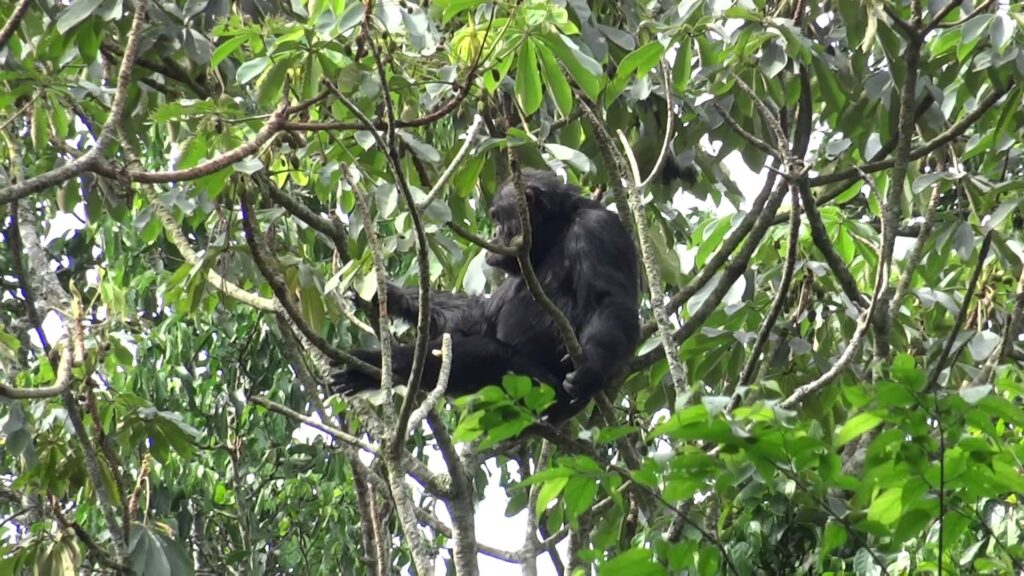
That trail is the Diamond Trail.
If you are planning a Rwenzori expedition and have even a passing interest in primates, birds, or the kind of immersive equatorial forest experience that you simply cannot get on the higher mountain routes, the Diamond Trail is the piece of your itinerary you did not know you were missing. This is the trail where chimpanzees crash through the canopy above your head. Where the Rwenzori turaco, a bird of such extraordinary colour that it looks invented, calls from the trees. Where the forest is so densely alive that every pause in the path reveals something new. And where the Mountains of the Moon live up to their most mysterious name before you ever set a crampon on a glacier.
This guide covers everything: what the Diamond Trail is, where it goes, what you will encounter on it, how it fits into a broader Rwenzori itinerary, and why, if you care about experiencing this mountain range in its full, extraordinary complexity, you should be planning time on this trail. Whether the Diamond Trail is your primary objective or a brilliant addition to a 7-day Central Circuit summit expedition, this is the guide that answers every question. Contact our team when you are ready to start planning; we will build your itinerary around the experience you actually want.
Diamond Trail. Quick-Reference Facts
Diamond Trail, At a Glance.
|
| Trail Type |
Wildlife & Primate Watching / Forest Trekking |
| Location |
Rwenzori Mountains National Park, Kasese District, Uganda |
| Elevation Range |
~1,600 m – ~2,600m above sea level |
| Duration |
1 to 3 days (flexible, can be integrated into longer treks) |
| Difficulty |
Moderate, forest terrain, manageable for most fit trekkers |
| Primary Draw |
Chimpanzee tracking, primate watching, endemic birdlife |
| Primates Present |
Chimpanzees, colobus monkeys, L’Hoest’s monkeys, blue monkeys |
| Key Birds |
Rwenzori Turaco, handsome francolin, and Rwenzori batis are endemic species |
| Best Pairing |
Before or after a summit bid on Margherita Peak |
| Start Point |
Nyakalengija or Kilembe trailheads, Kasese |
| Guide Required |
Yes, mandatory inside Rwenzori Mountains National Park |
| Best Season |
Year-round; dry seasons (Dec–Mar, Jun–Sep) preferred |
CTA Banner Widget — Rwenzori Trekking Safaris
Ready to stand on Margherita Peak?
Spaces Fill Quickly — Secure Your Dates Now
What’s the Diamond Trail in the Rwenzori Mountains?
The Diamond Trail is a designated trekking route within Rwenzori Mountains National Park that runs through the park’s lower montane forest zone, focusing on the richest primate and birdlife habitat in the range. It is the third major trail in the Rwenzori mountains, behind the Central Circuit Trail and the Kilembe Trail in terms of visitor numbers, and it has a distinctly different purpose and character from both of those routes.
Where the Central Circuit and Kilembe Trail are fundamentally summit routes designed to take trekkers through the vegetation zones and up to the glaciated peaks, the Diamond Trail is a wildlife-first route. It was established specifically to give trekkers direct access to the habituated primate communities and endemic bird species that live in the forest at the mountain’s lower elevations, between approximately 1,600 and 2,600 metres above sea level. It’s not a consolation prize for those who don’t reach the peaks, but it’s not a summit route. It is a world-class experience for wildlife trekking in its own right, within one of Africa’s most extraordinary protected landscapes.
The trail gets its name from the way it cuts through the mountain’s forested lower zones with the precision and clarity of a diamond – a single-minded focus on the forest’s most spectacular inhabitants. Within Rwenzori Mountains National Park, the Diamond Trail is recognised as the best trail to spot chimps in the entire range, and it is the route our team recommends to anyone whose encounter with wild chimpanzees in their natural forest habitat ranks among their priorities in Uganda.
The Terrain and Landscape of the Diamond Trail
Entering the Montane Forest
The Diamond Trail begins at the mountain’s edge, typically accessed from the Nyakalengija or Kilembe trailheads in Kasese District, and descends immediately into the full sensory richness of the Rwenzori montane forest. This is the oldest, deepest, and most biologically complex zone of the range, and it is the zone that sustains the largest and most diverse animal communities on the mountain.
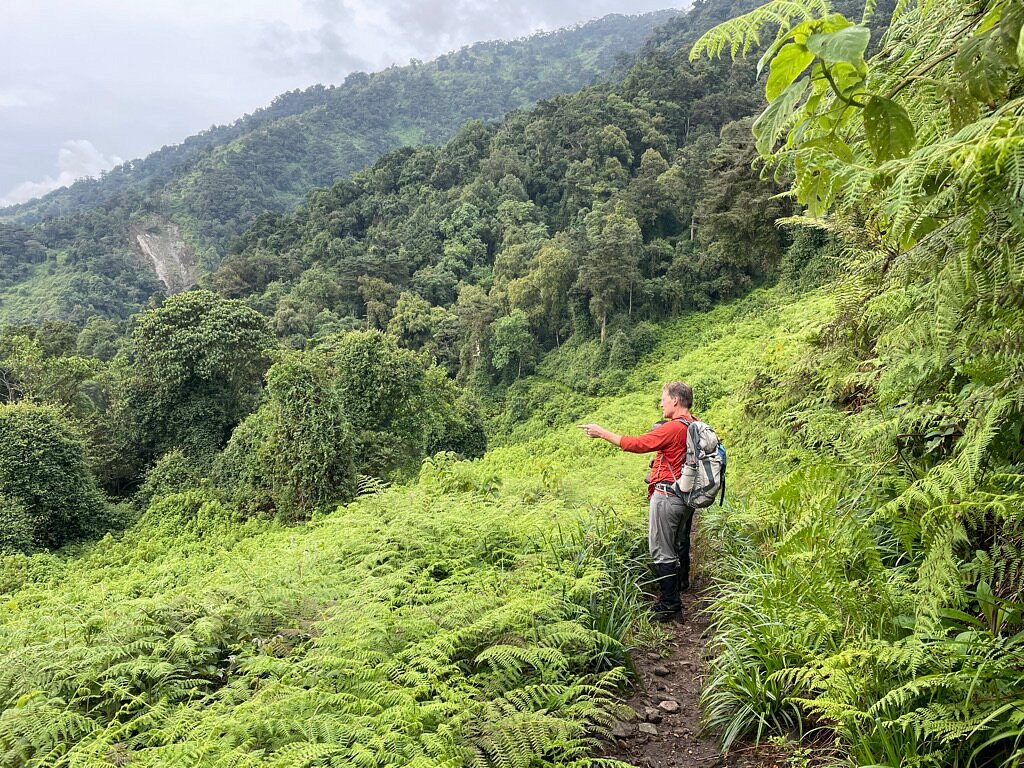
The forest here is not the kind of open, easy-walking rainforest that exists in the imagination. They are genuinely ancient trees of enormous girth whose root systems create the entire topography of the path, their trunks draped in epiphytic ferns, their canopy filtering light into something green and diffuse. The forest floor is damp in most seasons, crossed by clear-water streams that are tributaries of the Mubuku and Mahoma rivers flowing down from the peaks above. The air is cool and holds a quality of stillness that makes every sound – a branch cracking, a bird calling, a rustle in the undergrowth – feel significant.
This is the zone of giant elephant grass at its margins, dense bamboo in transition areas, and extraordinary tree diversity that has made Rwenzori Mountains National Park a globally recognised hotspot for Albertine Rift biodiversity. The park protects over 1,000 plant species, many of them endemic to the Albertine Rift, and in the forest zone through which the Diamond Trail passes, you encounter this botanical complexity at its most intimate and immersive.
The Path Itself
The Diamond Trail is classified as moderate in difficulty, significantly less demanding than the upper sections of the Central Circuit or Kilembe Trail, but not a gentle stroll. The forest paths involve root crossings, stream fords, occasional steep sections on slippery slopes, and the constant need for attentive footwork. Trekking poles help, waterproof boots are essential, and a willingness to move at the forest’s pace, slowly and quietly, with attention focused outward rather than inward, is the disposition that gets rewarded.
Unlike the upper mountain routes with their established hut system and clearly delineated elevation gain, the Diamond Trail is a forest experience where the journey is non-linear in spirit even when the path itself is defined. You might spend an hour covering five hundred metres because a habituated chimpanzee group has settled in the canopy above you, and your guide knows that this is precisely where you should be. This is not a trail where speed is a virtue. It is a trail where patience is the skill that matters most. Our team of experienced guides understands these concepts completely, and the Diamond Trail itineraries we build are designed to give the forest and its residents the time they deserve.
Wildlife on the Diamond Trail: What You Will Encounter
Chimpanzees: The Trail’s Central Draw.
The chimpanzees of Rwenzori Mountains National Park are the primary reason the Diamond Trail exists, and an encounter with them in this setting is genuinely unlike anything offered by better-known chimpanzee destinations. Unlike the famous Kibale Forest, where chimpanzees are exceptional in their own right, the ones encountered on the Diamond Trail are wild primates moving through the actual high-altitude equatorial forest of a UNESCO World Heritage Site, but they are part of a dedicated habituated-troop tourism program. The context is different. The feeling is different. You are in their world, on their mountain, and that distinction is felt in every minute of the experience.
The Rwenzori chimpanzee communities occupy the forested lower zones of the mountain, moving between fruiting trees and water sources in group patterns that experienced guides trace through sound, sign, and accumulated knowledge built over years on the trail. When you encounter them with a skilled guide, the probability is high; you will typically observe them at close range in the canopy, completely at ease with the presence of a small, quiet human group below. The sounds are extraordinary: the low calls and mutual grooming of a group at rest, the sudden whooping and branch-crashing of a feeding frenzy, and the thump of a large male descending to the ground to assert his presence.
This is not a guaranteed encounter; wild primates move on their schedule, and honest guides will never promise what the forest decides. But our guides know these forests in a way that only years of daily presence can produce, and they bring their full expertise to every Diamond Trail expedition to maximise the quality of your primate encounter time.
The Full Primate Community
Chimpanzees are the star of the Diamond Trail, but they are far from the only primates you will encounter. The Rwenzori montane forest supports a rich community of primate species, each occupying a slightly different niche in the forest’s vertical structure.
Black-and-white colobus monkeys are among the most visually striking of the forest’s residents, their long white capes rippling through the canopy as they leap between trees with an ease that seems to defy physics. L’Hoest’s monkeys, closely associated with the montane forests of the Albertine Rift, move in family groups through the understory; their dark faces and white-bearded chins create a distinctive, almost patrician appearance. People commonly encounter blue monkeys at close range, especially in areas where fruiting trees are active, as they are more tolerant of human presence than many other species.
The diversity of these encounters – multiple species, multiple forest layers, and multiple behavioural contexts – makes the Diamond Trail a genuinely world-class trekking experience for primates and one that can stand alongside the famous primate destinations of East Africa. The difference is that here, the primate experience is framed by one of the most extraordinary mountain landscapes on the continent, which adds a dimension that purely forest-based primate destinations simply cannot offer.
Birdlife: An Endemic Treasure Trove
For birdwatchers, the Diamond Trail is not a secondary attraction to the chimpanzee experience; it is a primary destination in its own right. The Rwenzori Mountains are one of Africa’s most important birding destinations, supporting an extraordinary concentration of endemic and near-endemic species that occur nowhere else on Earth. Many of these species most reliably inhabit the forested zone through which the Diamond Trail passes.
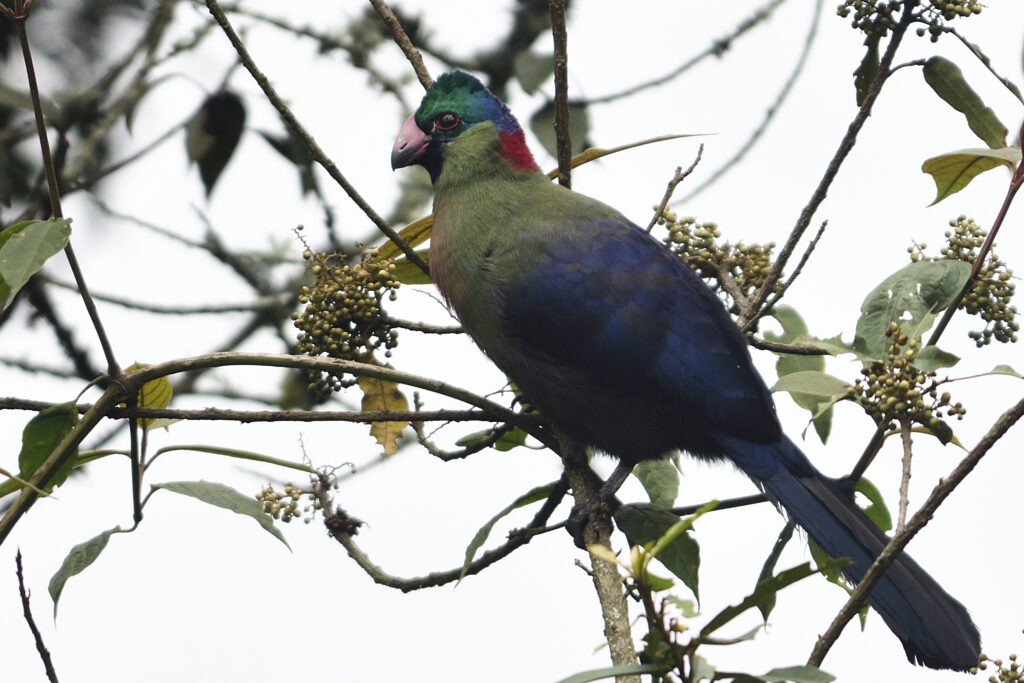
The Rwenzori turaco is perhaps the range’s most iconic bird, a large, crested, iridescent-green frugivore with crimson flight feathers that flash brilliantly in flight. When one launches from a branch above the trail, the combination of colour, size, and the distinctive loud call it emits makes a reaction of pure, involuntary delight almost universal among first-time observers. This is a bird that should be on every serious birdwatcher’s African list, and the Diamond Trail puts you in its forest.
In addition to the turaco, the lower forest area is home to the beautiful francolin, a ground bird with intricate feathers; the Rwenzori batis; the long-eared owl; the cinnamon-chested bee-eater; Archer’s robin-chat; the unusual weaver; and many other bird species found only in experienced birding guides. They can add significant depth to a Diamond Trail day for those who come with binoculars and field guides, and we can incorporate a specialist birding focus into any itinerary on request.
Other Wildlife and Forest Inhabitants
The Diamond Trail’s forest is also home to forest elephants, which move through the lower montane zone in small groups that are rarely encountered directly on the trail, but whose presence – the enormous footprints in the mud, the fresh browse, and the lingering smell of a group that passed recently – is a constant reminder that this is a genuinely wild place. Guides monitor elephant movement patterns and are experienced in adjusting the trail approach based on where elephant groups are active.
The three-horned chameleon, one of the Rwenzori’s most celebrated and widely photographed residents, is encountered regularly in the heath zone transition at the upper margin of the Diamond Trail’s range. This extraordinary reptile, unique to the Albertine Rift region, moves with a characteristic slowness through the branches at the forest’s edge, and a close sighting of one feels like a genuine gift from the mountain. Forest duikers move quietly through the understorey; hyraxes call from rock outcrops at dusk and dawn; and the forest’s night shift of owls, civets, and small cats comes to life after the trail party has retreated to camp.
CTA Banner Widget — Rwenzori Trekking Safaris
Ready to stand on Margherita Peak?
Spaces Fill Quickly — Secure Your Dates Now
How to Trek the Diamond Trail: Duration, Logistics, and Itinerary Options
The Diamond Trail as a Standalone Experience
For trekkers whose primary objective is the primate and wildlife experience, the Diamond Trail can be trekked as a standalone one-to-three-day route that does not involve the altitude or technical demands of the upper mountain zones. A single full day on the trail, entering the forest at dawn when primate activity is highest, spending the morning tracking and observing, and returning to the trailhead by mid-afternoon is the minimum unit of experience that does the trail justice. Two or three days, with an overnight in or near the forest zone, allows for morning and evening wildlife activity windows and produces a significantly richer encounter.
For this standalone version of the Diamond Trail, the fitness requirements are genuinely accessible to most visitors. Although the terrain is forested and occasionally uneven, the elevation gain is modest, and wildlife observation, rather than summit ambition, sets the pace. If you are visiting Uganda primarily for wildlife and want a mountain primate experience without committing to a week-long trekking expedition, this is the itinerary we would recommend.
Pairing the Diamond Trail with a Summit Expedition
When incorporated into a broader Rwenzori expedition, the Diamond Trail reaches its fullest potential. Adding one or two Diamond Trail days either before or after a summit bid on Mount Stanley’s Margherita Peak transforms a mountain trekking trip into a complete Rwenzori experience from the forest floor to the glaciated summit and back. The two experiences complement each other in a way that amplifies both: the forest’s richness makes the transition to the alpine zone feel even more dramatic, and returning to the forest after days on the upper mountain, with the smell of earth and vegetation replacing rock and ice, is a re-entry into the living world that trekkers consistently describe as one of the most emotionally resonant moments of their entire trip.
Our 8-day Kilembe Trail expedition and the 7-day Central Circuit are both excellent foundations for a Diamond Trail addition. Adding two days to either route, one for the Diamond Trail before entering the mountain and one for recovery and forest time on descent, creates a 9- or 10-day Rwenzori itinerary that is genuinely comprehensive. For trekkers who want to include three peaks as well, our 9-day expedition covering Stanley, Speke, and Baker can be extended with Diamond Trail time at either end.
Timing on the Diamond Trail: Before or After the Summit?
Whether to walk the Diamond Trail before or after a summit bid presents both a practical answer and an experiential one. Before the summit, the Diamond Trail functions as a gentle introduction to the mountain’s lower world, a way of arriving at the Rwenzori experience gradually, allowing the forest to orient you to the scale and the wildness of the range before the demands of the upper mountain take over. It also provides a day of light physical activity before the more rigorous ascent begins, which is valuable for trekkers arriving from lower elevations.
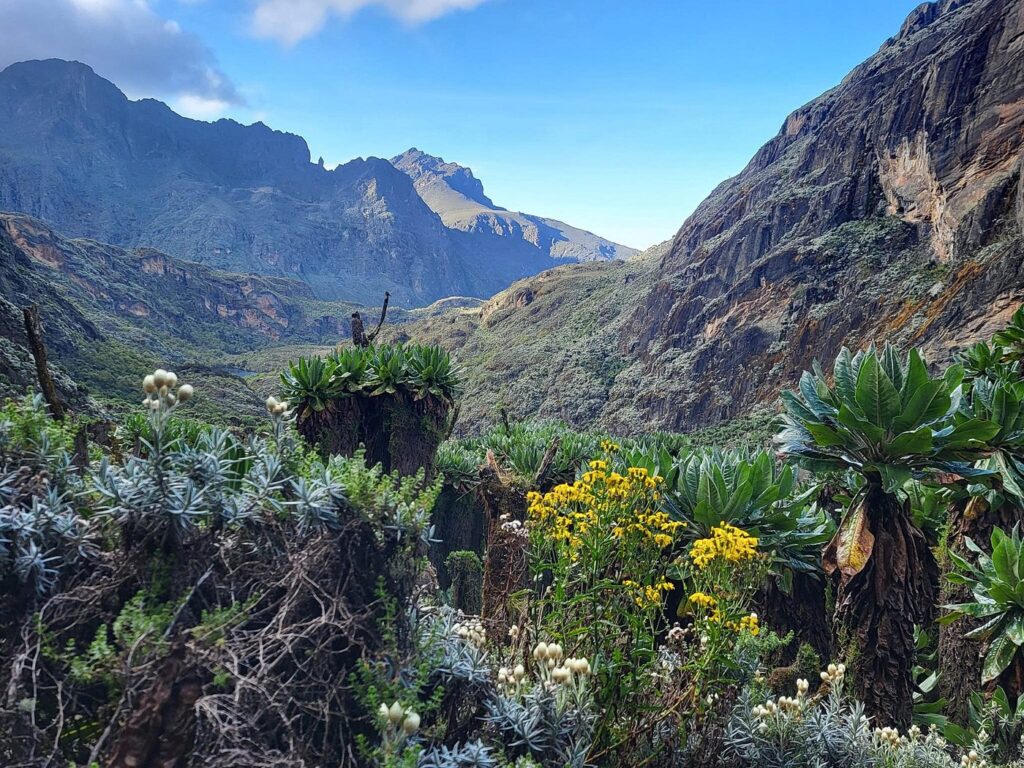
After the summit, the Diamond Trail serves as a reward. You have earned the forest by having been above it, and returning to its warmth and richness after days on cold, exposed ridges and glaciated terrain produces a particular quality of gratitude and presence that is difficult to manufacture in any other way. Many trekkers who have done the Diamond Trail at this end of their expedition describe the experience as unexpectedly emotional, a sense of being welcomed back by the mountain’s living world after the starkness of the summit zone.
Both timings work. Some trekkers spend a day in the woods at the start and end of their trip, with the summit in between. If your schedule allows for this, we recommend it enthusiastically.
The Diamond Trail and the Broader Rwenzori Trail Network.
The Diamond Trail connects naturally with the wider trail network of Rwenzori Mountains National Park. It shares terrain with the lower sections of both the Central Circuit, which begins at Nyakalengija and passes through exactly the forest zone the Diamond Trail explores, and the Kilembe Trail, which enters the montane forest from the south. The Mahoma Trail and the 2-day Sine Camp Trek also go through some of the same areas, and for hikers who want to really explore the lower forest zone, combining the Diamond Trail with one of these shorter routes gives a richer experience of the mountain’s most diverse area.
For those planning a complete tour of the Rwenzori’s wildlife and landscapes, including all peaks, trails, and zones, our 13-day, 6-peak expedition provides the most comprehensive framework, with the Diamond Trail able to be included in the itinerary’s opening or closing days to complete the picture.
The Diamond Trail as Part of a Wider Uganda Primate Safari
The Diamond Trail is particularly compelling in the context of a broader Uganda safari because it naturally slots into an itinerary that also includes Uganda’s other world-class primate experiences. Western Uganda is the continent’s most concentrated primate-watching region, and the Diamond Trail’s chimpanzee experience is a meaningful and distinctive addition to what is already an extraordinary portfolio.
Kibale Forest National Park, approximately two hours north of the Rwenzori trailheads, is Uganda’s premier chimpanzee tracking destination, home to a large population of habituated chimpanzees in a dedicated, extensively managed programme. Bwindi Impenetrable Forest, two to three hours south, needs no introduction: it is one of the planet’s most celebrated gorilla trekking destinations and the home of approximately half of the world’s remaining mountain gorillas. Queen Elizabeth National Park lies immediately to the east, offering tree-climbing lions, enormous hippo populations, and one of Africa’s most species-rich channel boat safaris.
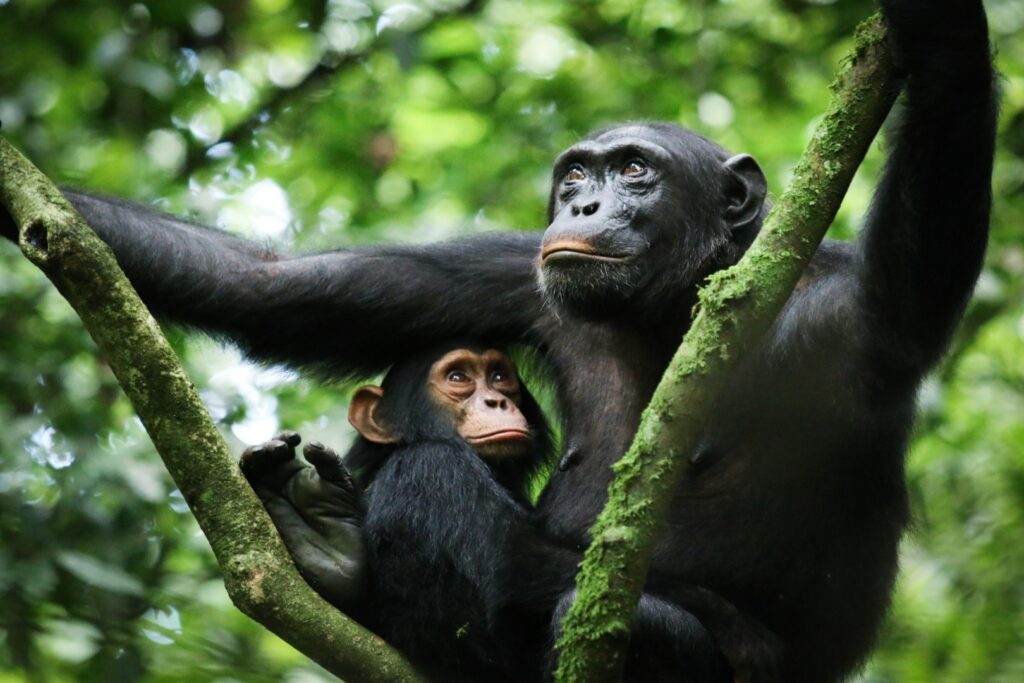
A Rwenzori expedition that incorporates the Diamond Trail, followed by gorilla trekking at Bwindi and chimpanzee tracking in Kibale, represents the full arc of Uganda’s primate safari experience, and it is an itinerary we have built for many visitors over the years. Our 12-day Rwenzori and gorilla trekking expedition provides an excellent base structure for this kind of trip, and for those who want the complete experience – Rwenzori, gorillas, chimpanzees, Big Five safaris, and Nile rafting – our 19-day ultimate Uganda expedition covers the full range in a single remarkable journey.
The key thing to understand about the Diamond Trail in this wider context is that it does not duplicate the Kibale chimpanzee experience; it complements it. The chimpanzees you encounter in the Rwenzori Montane Forest are not in a managed habitat program; they are wild primates moving through a UNESCO World Heritage Site at an altitude on a mountain that is one of Africa’s geological wonders. The feeling of that encounter is different, and for trekkers who care about context and meaning as well as the encounter itself, both experiences earn their place in the itinerary.
Practical Information for the Diamond Trail
Getting to the Trailhead
The Diamond Trail is accessed from Kasese District in western Uganda, the same gateway town that serves the Rwenzori Mountains National Park for all major trekking routes. From Entebbe International Airport, the drive to Kasese takes approximately five to six hours via Kampala, passing through Fort Portal and the Toro Kingdom’s scenic highlands. Domestic flights from Entebbe to Kasese on AeroLink offer a one-hour alternative for trekkers on tight schedules. Our Getting to the Rwenzori Mountains guide provides comprehensive information on how to reach the mountain.
Permits and Park Fees
All trekking within Rwenzori Mountains National Park, including the Diamond Trail, requires payment of the park entry fees set by the Uganda Wildlife Authority and engagement of a licensed guide. These fees are factored into all itineraries and packages offered by our team. Solo trekking without a guide is not permitted inside the park, both for the protection of trekkers and the conservation of the park’s ecosystems.
What to Wear and Pack
The Diamond Trail’s elevation range of roughly 1,600 to 2,600 metres means the weather is warm or cool rather than cold, but the forest is consistently damp, and the trails can be muddy in all seasons. Sturdy waterproof hiking boots with good ankle support are essential. A waterproof jacket should be within reach at all times. Lightweight, breathable layers are appropriate for the main walking conditions, with a mid-layer for early mornings and later afternoons when the temperature drops noticeably.

Insect repellent is useful in the forest zone. Long sleeves and trousers provide both insect protection and protection against the forest’s resident nettles and thorny undergrowth. Binoculars are strongly recommended; they transform the birdwatching experience and allow for closer observation of primates at canopy height without disturbing them. A camera with a telephoto or zoom lens is the standard tool for wildlife photography in forest conditions. Our full packing guidance for all Rwenzori elevations is outlined on the Rwenzori Mountains information page.
Accommodation
For Diamond Trail days that are incorporated into a broader Rwenzori expedition, accommodation follows the patterns of the main route huts or tented camps at the lower mountain stations. For standalone Diamond Trail visits, accommodation options in Kasese and the Rwenzori foothills range from comfortable guesthouses to more characterful lodges with mountain views. Our complete Rwenzori accommodation guide covers all options inside and outside the park, from pre-trek nights in Kasese to the mountain huts on the Central Circuit and Kilembe routes.
Best Time to Visit
The Diamond Trail can be walked year-round, but the dry seasons, December to early March and June to early September, provide the most comfortable conditions, with drier forest paths and better visibility for wildlife observation. The best time to visit the Rwenzori Mountains guide covers seasonal conditions in detail. One important note: chimpanzee activity on the Diamond Trail is not dramatically more or less accessible by season; primates are resident year-round. What changes is trail comfort and visibility, not wildlife presence.
Why the Diamond Trail Is Unlike Any Other Wildlife Trail in East Africa.
There are chimpanzee tracking experiences across East Africa, and several of them are genuinely excellent. But the Diamond Trail occupies a unique position in the East African wildlife trekking landscape for reasons that go beyond its primate encounters, and those reasons deserve to be stated plainly.
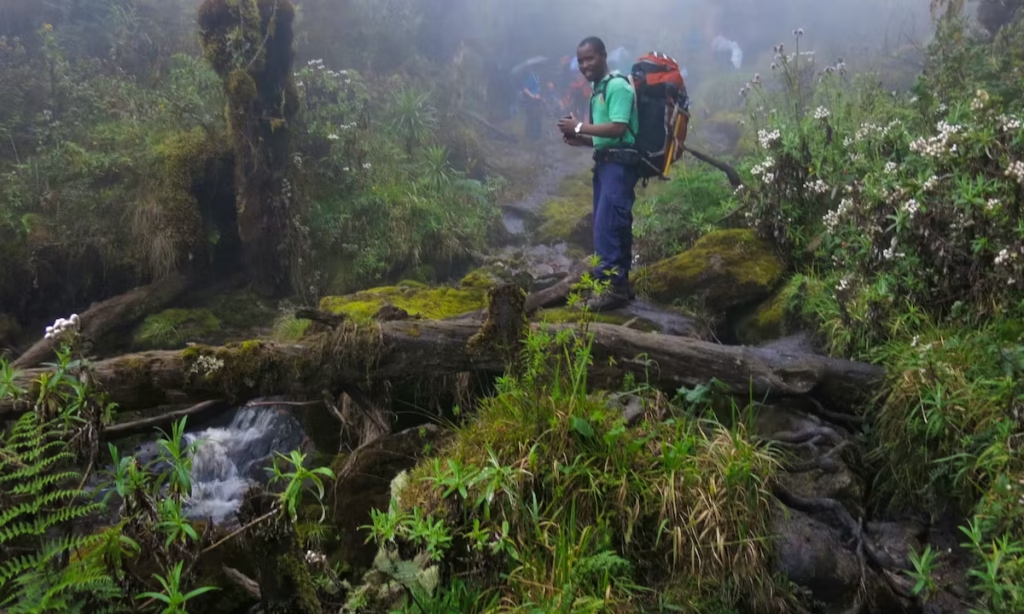
First, the setting. You are not trekking through a lowland forest reserve or a managed habituation zone on flat ground. You are in a UNESCO World Heritage Site at altitude, on the lower flanks of the third-highest mountain range in Africa, in a forest that has existed in essentially its current form for thousands of years. The biological complexity around you – including endemic plants, Albertine Rift birds, and ancient trees – is not mere backdrop scenery; it is the reason for the UNESCO designation and the context for your wildlife encounters.
Second, the integration. The Diamond Trail is not a standalone attraction bolted onto a mountain visit for commercial reasons. It is a natural extension of the Rwenzori trekking experience, occupying the altitudinal zone that summit routes pass through but spend little time in. Walking it properly slowly, with an expert guide, with genuine attention to the forest gives you the Rwenzori’s full vertical range, from forest floor to glacier, as a coherent experience rather than a series of separate objectives.
Third, the rarity. The Rwenzori montane forest is one of the least-visited biodiverse ecosystems in Africa. The mountain does not receive the visitor numbers of Kilimanjaro or Bwindi; the Diamond Trail sees a fraction of the foot traffic of Kibale. You walk in genuine solitude through a forest of global ecological significance, guided by someone who has spent years learning its rhythms. That combination of exceptional wildlife, exceptional landscape, and the kind of quiet that lets you actually be present in the experience is increasingly rare in modern African wildlife tourism.
CTA Banner Widget — Rwenzori Trekking Safaris
Ready to stand on Margherita Peak?
Spaces Fill Quickly — Secure Your Dates Now
Frequently Asked Questions About the Diamond Trail in the Rwenzori Mountains
What is the Diamond Trail in the Rwenzori Mountains?
The Diamond Trail is a designated trekking route within Rwenzori Mountains National Park that passes through the lower montane forest zone of the Rwenzori Mountains, specifically designed for primate watching and birding. It is the third major trail in the Rwenzori trail system and is recognised as the best route within the national park for chimpanzee watching. The trail operates at elevations between approximately 1,600 and 2,600 meters and can be trekked as a standalone experience or integrated into a broader mountain expedition.
Are there chimpanzees on the Diamond Trail?
Yes. The Diamond Trail runs through the montane forest habitat that is home to the chimpanzee communities living within Rwenzori Mountains National Park. These are wild chimpanzees, not managed habituation programmes, moving freely through the national park’s protected forest. Experienced guides who know the trail and the chimpanzees’ movement patterns significantly increase the probability of a high-quality encounter, though as with all wild animal experiences, sightings cannot be guaranteed on any given day.
How long does the Diamond Trail take to complete?
The Diamond Trail can be completed in a single full day for a focused wildlife-watching experience, though two to three days allows for morning and evening activity windows that produce significantly richer encounters. As a standalone trip, one to three days is the standard range. When incorporated into a summit expedition, Diamond Trail days are typically added either before or after the main route and can be as few as one or as many as three, depending on the trekker’s interests and itinerary length.
How does the Diamond Trail differ from chimpanzee tracking in Kibale Forest?
Both experiences involve tracking wild chimpanzees in Ugandan forests, but the context, setting, and character are genuinely different. Kibale Forest National Park operates a well-managed, habituated chimpanzee program in a lowland forest reserve with high visitor numbers and established tourism infrastructure. The Diamond Trail operates in the montane forest of a UNESCO World Heritage mountain range, at altitude, with minimal visitor foot traffic and wild rather than habituated primates. The Rwenzori setting adds the context of one of Africa’s most biologically unique mountain ranges, and the low visitor numbers mean a more intimate and solitary experience. For trekkers who value context and setting alongside the encounter itself, the Diamond Trail offers something distinct from and complementary to the Kibale experience.
Is the Diamond Trail suitable for beginners?
Yes. The Diamond Trail’s elevation range and terrain are significantly more accessible than the upper mountain routes on the Central Circuit or Kilembe Trail. It does not involve glacier travel, technical equipment, or the sustained altitude gain that characterises a Margherita summit bid. Good base fitness and appropriate footwear are required; the forest trails are rooted, occasionally steep, and consistently damp, but the Diamond Trail is within reach of most trekkers with a reasonable level of fitness. It is an excellent introduction to the Rwenzori Mountains for visitors who want to experience the range without committing to a full summit expedition.
What birds can you see on the Diamond Trail?
The Diamond Trail passes through habitat that supports many of the Rwenzori’s endemic and near-endemic bird species. Important birds you can see include the Rwenzori turaco, handsome francolin, Rwenzori batis, long-eared owl, cinnamon-chested bee-eater, and Archer’s robin-chat. The Rwenzori turaco, a large, brilliantly coloured frugivore with crimson flight feathers, is one of Africa’s most sought-after forest birds and is consistently encountered on the Diamond Trail. For dedicated birdwatchers, we can arrange specialist birding guides to accompany the trekking team.
Can the Diamond Trail be combined with gorilla trekking in Uganda?
Absolutely, and this combination is one of the most rewarding itinerary structures we offer. Bwindi Impenetrable Forest, Uganda’s top spot for gorilla trekking, is approximately two to three hours’ drive south of the Rwenzori trailheads. A trip that incorporates the Diamond Trail chimpanzee experience within the Rwenzori range and a gorilla trekking permit at Bwindi delivers the full range of Uganda’s outstanding ape encounters in a single journey. Our 12-day Rwenzori and gorilla trekking expedition is built around exactly this combination, and our team can adjust the itinerary to include Diamond Trail time for trekkers who prioritise the primate forest experience.
Do I need a guide to walk the Diamond Trail?
Yes. All trekking within Rwenzori Mountains National Park, including the Diamond Trail, is conducted with a licensed guide; this is a legal requirement under Uganda Wildlife Authority regulations. Beyond the regulatory requirement, the guide is essential to the Diamond Trail experience: tracking chimpanzee groups through forest requires skills built over years, and the identification and interpretation of the trail’s birds and wildlife adds immeasurably to the depth of the experience. We train our guides for Diamond Trail expeditions in wildlife tracking, primate behaviour, ornithology, and the ecological context of the Rwenzori montane forest.
What is the elevation of the Diamond Trail?
The Diamond Trail operates in the lower montane forest zone of Rwenzori Mountains National Park, spanning approximately 1,600 to 2,600 meters above sea level. This elevation range is well below the altitude sickness threshold and does not include the acclimatisation considerations required for the upper mountain roads. It is, however, high enough to feel genuinely mountainous; the air is cool and clear, the views up toward the peaks are extraordinary, and the forest’s character is distinctly different from lowland equatorial rainforest.
What is the best time of year to do the Diamond Trail?
The Diamond Trail can be walked year-round. The dry seasons, December to early March and June to early September, provide the most comfortable underfoot conditions and tend to offer better visibility for wildlife observation. However, chimpanzee and primate activity is not significantly affected by the season, and some hikers find the wet-season forests particularly beautiful – lush, vivid, and alive with sound and movement in a way that the drier months cannot quite replicate. For full seasonal guidance, our Best Time to Visit the Rwenzori Mountains page covers conditions month by month.
How does the Diamond Trail compare to the Central Circuit and Kilembe Trail?
The Central Circuit Trail and Kilembe Trail are summit routes that pass through the montane forest at their lower sections but are fundamentally designed to take trekkers to the glaciated peaks of the range. The Diamond Trail is a wildlife-first route that stays within the forest zone and maximises the primate and birding experience. It is less physically demanding than either summit route, more focused on wildlife encounters than altitude gain, and shorter in typical duration. It is the trail for trekkers whose primary motivation is the Rwenzori’s living world rather than its peaks, and it is the perfect complement to a summit expedition for those who want both.
Is the Diamond Trail a loop or a point-to-point route?
The Diamond Trail’s precise configuration varies based on itinerary design and the specific wildlife-tracking approach used on any given day. Forest wildlife trails are inherently flexible in their routing; the path adjusts based on where animal groups are located and what the guide’s tracking information indicates. Unlike a fixed summit route with defined waypoints, the Diamond Trail is a guided wildlife experience within a defined forest zone, and its daily path reflects the forest’s conditions. Our team plans the specific daily route based on recent wildlife intelligence, tracker reports, and the current locations of chimpanzee and primate groups within the park.
Are there other wildlife trails in the Rwenzori Mountains?
Yes. The Rwenzori Mountains National Park trail network includes the Central Circuit Trail, Kilembe Trail, and Bukulungu Wilderness Trail for summit and high-altitude routes; the Diamond Trail for primate and wildlife trekking; the Mahoma Trail for a scenic forest loop to glacial Lake Mahoma; and various day-walk options in the foothills. Each trail has a different character and focus, and most trekkers who spend a week or more in the range find that visiting multiple trails produces the most complete and satisfying understanding of the mountain’s extraordinary diversity.
Plan Your Diamond Trail Trek. Start the Conversation Today.
The Diamond Trail is one of those trekking experiences that surprises people, even experienced Africa travellers who arrive expecting a secondary attraction and leave describing it as one of the most alive, most present, most genuinely wild things they have ever done. A chimpanzee group at close range in the Rwenzori montane forest. A Rwenzori turaco launches from a branch in a flash of green and crimson above your head. In the early morning, the forest sounds come alive as the mountain wakes up and every species announces its presence simultaneously. These are not minor experiences.
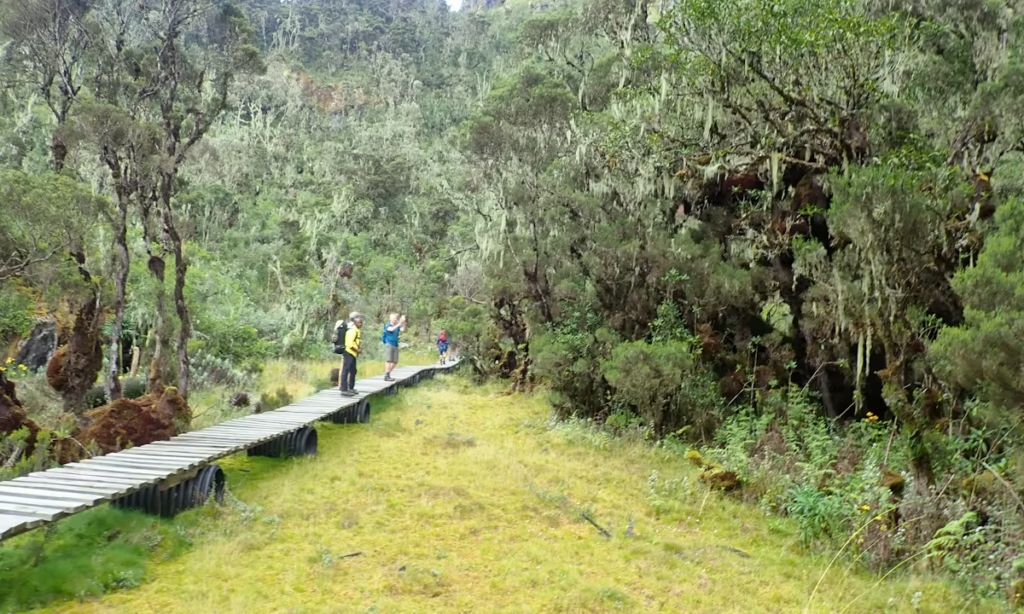
We have been taking trekkers onto this mountain for over a decade. We know the Diamond Trail the way guides know forests; they have walked through every condition and every season, which means we know when to move quickly and when to stop, which clearings tend to hold primate groups in the mid-morning, which trees are fruiting right now and drawing birds and monkeys, and how to give you the maximum quality of encounter in the time your itinerary allows. If you want a Diamond Trail experience that is genuinely built around your interests, whether that is focused chimpanzee tracking, dedicated birding, a forest introduction before a summit bid, or a full primate safari combined with gorilla trekking and a broader Uganda wildlife adventure, this trip is a conversation we would very much like to have.
Get in touch with our team through the contact page and tell us what you are planning. Be specific about your interests: primates, birds, summit peaks, safari combinations, and the number of days you have. We will be honest with you about what is achievable in your timeframe and will design an itinerary that reflects your actual priorities rather than a template designed for someone else.
You can also explore our full range of Rwenzori trekking itineraries, read the complete Rwenzori Mountains guide, browse all available routes and trails, or visit our frequently asked questions page for practical trekking information. The forest is waiting, the chimpanzees are in the canopy, and the mountain is exactly as extraordinary as the name Mountains of the Moon implies. Come and see it for yourself.