Chimpanzee tracking permits in Uganda are now just $200 (FNR) during the low season of April, May & November 2026. Official UWA (Uganda Wildlife Authority) rates for Kibale National Park (NP) and Kyambura Gorge are now available. Book before the 2027 price increase. Rwenzori Trekking Safaris provides expert guides for your trip.
If you have ever sat quietly at the edge of a forest canopy and heard chimpanzees calling that cascade of whoops and screams that builds from a single voice into a full community chorus, echoing off the trees until the forest itself seems to be speaking, then you understand why chimpanzee tracking in Uganda is not a secondary attraction. Chimpanzee tracking is more than just a means to kill time before encountering the gorillas. For a growing number of wildlife travelers, a morning in the company of Uganda’s wild chimpanzees is the experience that stays with them longest, the one they find hardest to translate for the people back home, and the one they return to Uganda to do again.
The Uganda Wildlife Authority officially formalized in February 2026 what has long been an open secret among experienced Uganda safari guides: the months of April, May, and November not only offer a more intimate, less crowded chimpanzee trekking experience, but are now officially less expensive. The UWA has introduced discounted rates for chimpanzee tracking permits for these months, reducing the foreign non-resident price to USD 200, a significant step down from the USD 300 rate that will apply at Kibale National Park from January 2027.
This is your comprehensive expert guide to Uganda’s low-season chimpanzee permits. We will cover the official rates, the locations where chimpanzee tracking is available, what these months are actually like in the field, how the new booking rules work, and why this is one of the most underrated and genuinely extraordinary wildlife experiences available anywhere in Africa. If you are planning a Uganda safari and have not yet placed chimpanzee trekking at the center of your itinerary, this article will change your mind.
What Are Uganda’s Low-Seasonal Chimpanzee Permits?
A chimpanzee tracking permit is the official authorization issued by the Uganda Wildlife Authority that allows you to enter a designated chimpanzee zone within one of Uganda’s national parks and spend time, typically one hour, with a habituated wild chimpanzee community. Like gorilla permits, chimpanzee permits are strictly limited in number, tied to specific habituated communities, and available only through licensed operators registered with the Uganda Tourism Board. They represent a conservation levy that directly funds the management and protection of Uganda’s primate habitats.
Low-season chimpanzee permits are a discounted category of these permits, applicable during the months of April, May, and November. These months align with Uganda’s two wetter seasons, when rainfall is more frequent across the country. The discounts reflect historically lower visitor volumes during these months, and UWA’s February 2026 announcement formalizes them as an official incentive to distribute tourism across the year, a conservation-minded policy that benefits both travelers and the parks.
Uganda offers chimpanzee trekking at two principal locations: Kibale National Park, which is widely regarded as the premier chimpanzee destination in Africa, and Kyambura Gorge in Queen Elizabeth National Park, a dramatically different environment that offers a more intimate and challenging encounter. Both locations operate under the UWA low-season permit structure, and both deserve a place in any serious Uganda safari itinerary.
Official Low Season Chimpanzee Permit Rates 2026
The following rates are effective immediately following the UWA announcement of 26th February 2026 and apply during the months of April, May, and November:
| Activity/Location | Low Season FNR (USD) | Low Season FR (USD) | Peak Rate from Jan 2027 (FNR) |
| Chimpanzee Tracking. Kibale NP/KNP (Apr, May, Nov) | $200 | $150 | $300 |
| Chimpanzee Tracking. Kyambura Gorge, QENP (Apr, May, Nov) | $200 | $150 | $200 |
| Chimpanzee Habituation. Kibale NP (All year) | $400 | $300 | $400 (2027 tariff) |
FNR denotes Foreign Non-Resident international visitors holding non-East African passports. FR denotes Foreign Resident international passport holders residing within Uganda or in EAC member states. It is important to note that permits for chimpanzee habituation experiences, which allow an extended four-to-six-hour session with researchers, are not discounted during the low season. The rates shown for habituation above reflect the current standard tariff, which will be revised in January 2027.
Kibale National Park: Africa’s Primate Capital.
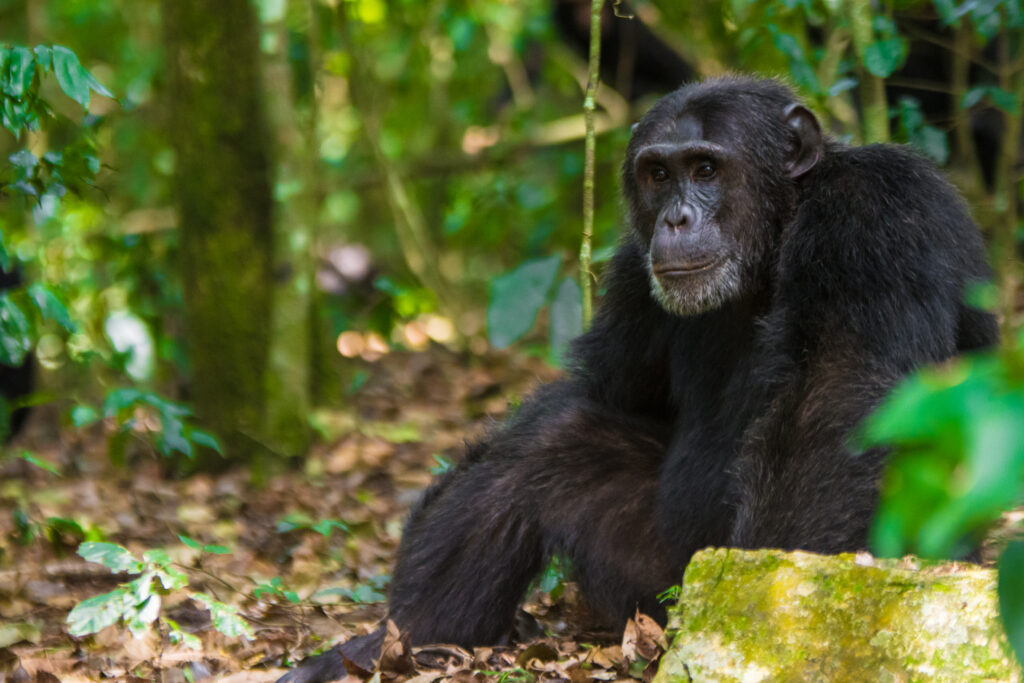
Ask any primatologist, any serious wildlife filmmaker, or any guide who has spent real time with wild chimpanzees across East and Central Africa, and the answer about Kibale National Park is consistent: this is the benchmark. Kibale, a 795-square-kilometer tract of tropical forest in western Uganda’s Fort Portal region, is home to approximately 1,500 chimpanzees, one of the highest densities of this species anywhere on earth. Several of Kibale’s chimpanzee communities have been habituated to human presence over decades of patient research work, making the encounters here among the most reliably intimate available on the continent.
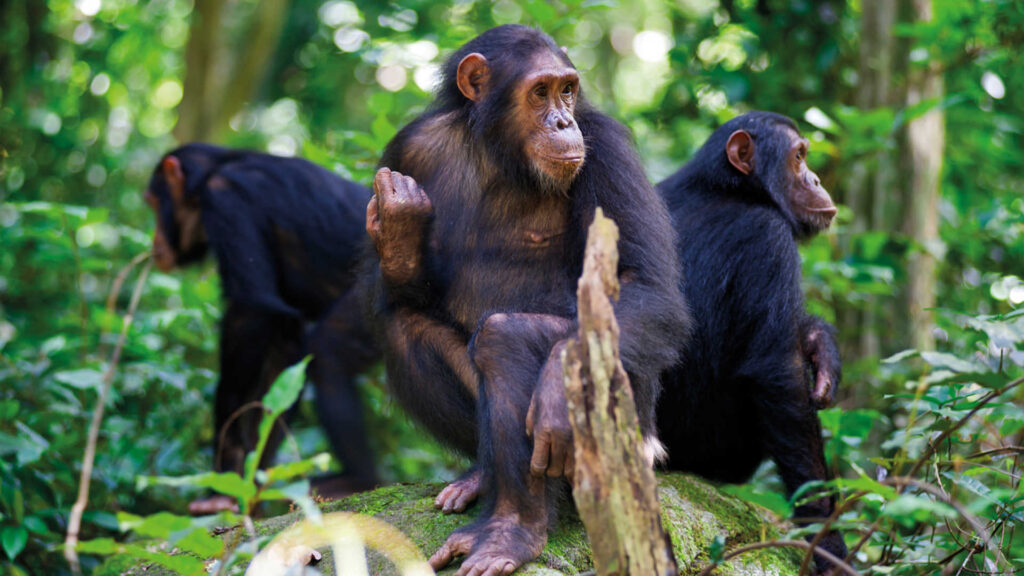
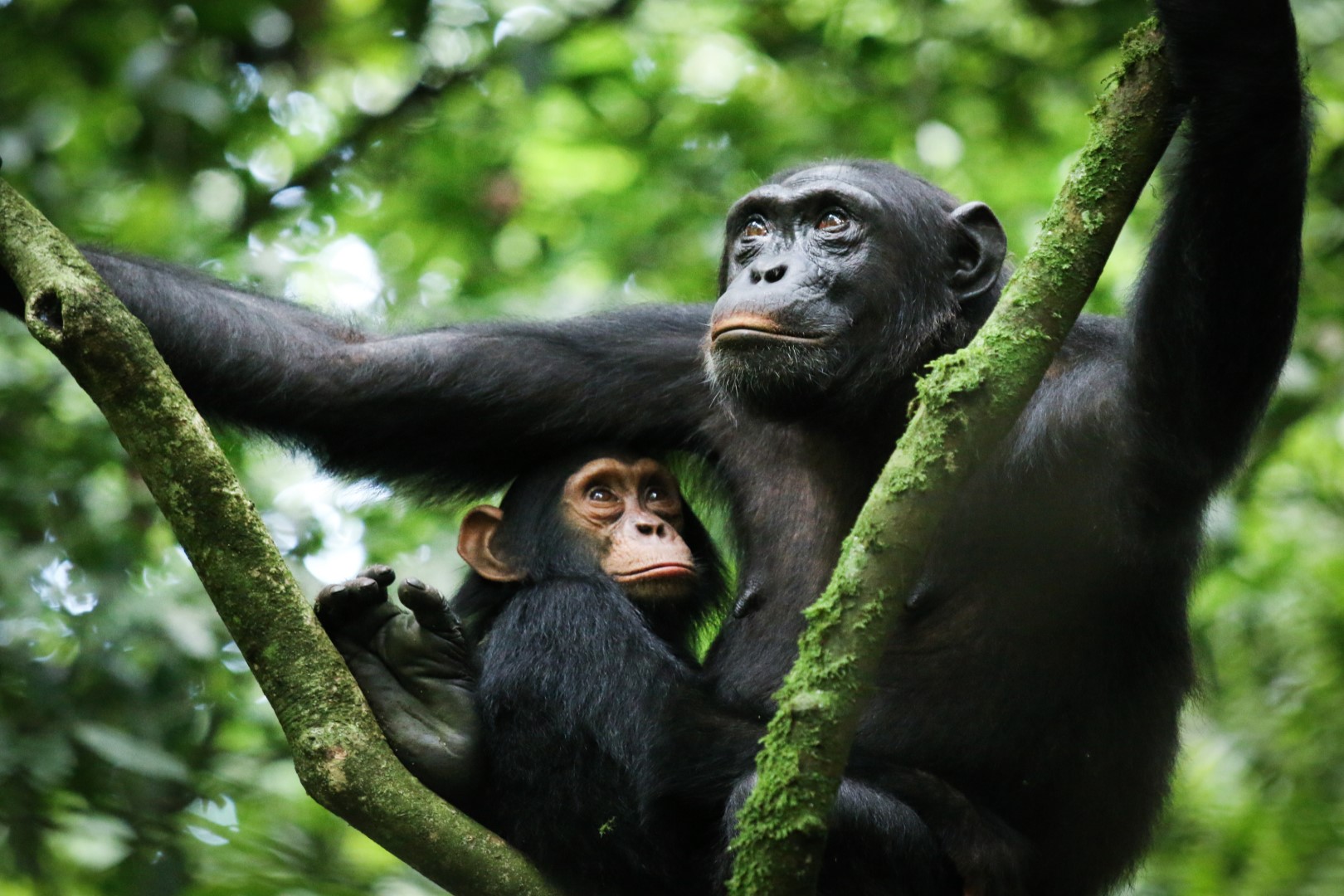
Standard chimpanzee tracking primarily uses the Kanyanchu community, a large, well-studied, and extraordinarily revealing group to observe. These are not animals performing for an audience. They are going about their lives foraging, socializing, grooming, disciplining juveniles, competing for status, and calling to members of their community across long forest distances. A habituated chimpanzee will glance at you the way a city dweller glances at a passing stranger: a brief, unsentimental acknowledgment, and then back to the more important business at hand. Such behavior is precisely what makes the encounter so affecting. You are not the center of their world. You are simply there, and they are comfortable with that.
The Chimpanzee Trekking Experience at Kibale
Kibale chimpanzee treks operate on two sessions daily: a morning trek departing at 8:00 AM and an afternoon trek departing at 2:00 PM. The morning session is widely considered the superior experience, as chimpanzees are most active in the early hours, more likely to be moving, foraging, and vocalizing at full volume. Afternoon treks can be equally rewarding, particularly in the cooler months when the chimps remain active later into the day, but if you have a choice, book the morning.
Permit holders gather at the Kanyanchu visitor center for a briefing before heading into the forest with UWA ranger-guides. Trackers who have been in the forest since first light will have already located the community’s approximate position. The walk to the chimps can take anywhere from twenty minutes to two hours depending on where the community has ranged overnight. The terrain at Kibale is relatively gentle compared to Bwindi, with well-maintained forest trails, mostly flat ground, and a forest canopy that opens into patches of secondary growth and swamp forest. In the wet season, some sections become muddy, and waterproof boots are advisable, but Kibale is genuinely accessible to a wide range of fitness levels.
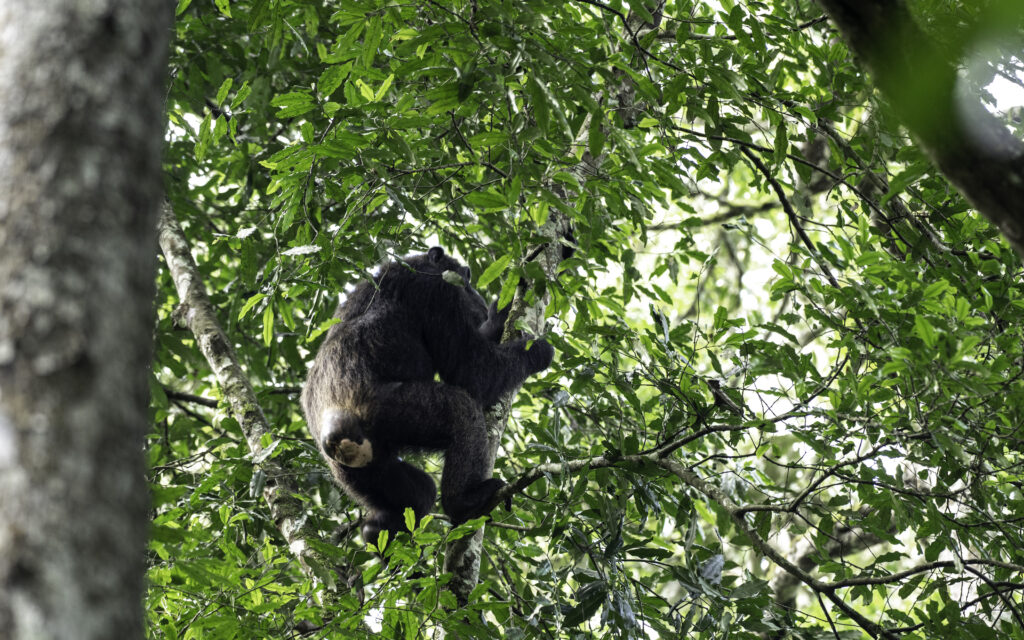
When you arrive at the community, the hour begins. Watching chimpanzees in the wild demands a different kind of attention than watching large mammals on an open savannah. You are looking up as much as ahead, tracking movement through the canopy, following sound as much as sight. A silverback chimpanzee moving through the mid-canopy is surprisingly quiet until it makes a sound. The moments of dramatic territorial display, a swift predatory chase, and a confrontation between adult males arrive without announcement and end as quickly as they begin. Between those moments, their kind of profundity lies in the rhythm of the forest, the sounds of the community communicating across distance, and the sight of a mother with an infant clinging to her back as she moves through dappled light.
Kyambura Gorge: Uganda’s Underground Chimpanzee World
The second chimpanzee tracking location in Uganda’s official permit system is Kyambura Gorge in Queen Elizabeth National Park, and it is unlike anything else in primate tourism anywhere in Africa. Kyambura (pronounced ‘Cham-ba’) is a river gorge that slices down through the open savannah of Queen Elizabeth National Park, dropping some hundred meters from the plateau grassland into a sunken rainforest corridor that runs along the Kyambura River. From above, on the edge of the gorge, you can look out across the savannah and spot buffalo, elephants, and Uganda kob in the grasslands. Then you descend into the gorge and enter an entirely different dense, cool, ancient-feeling forest, threaded through with river channels and ficus trees draped in lianas.
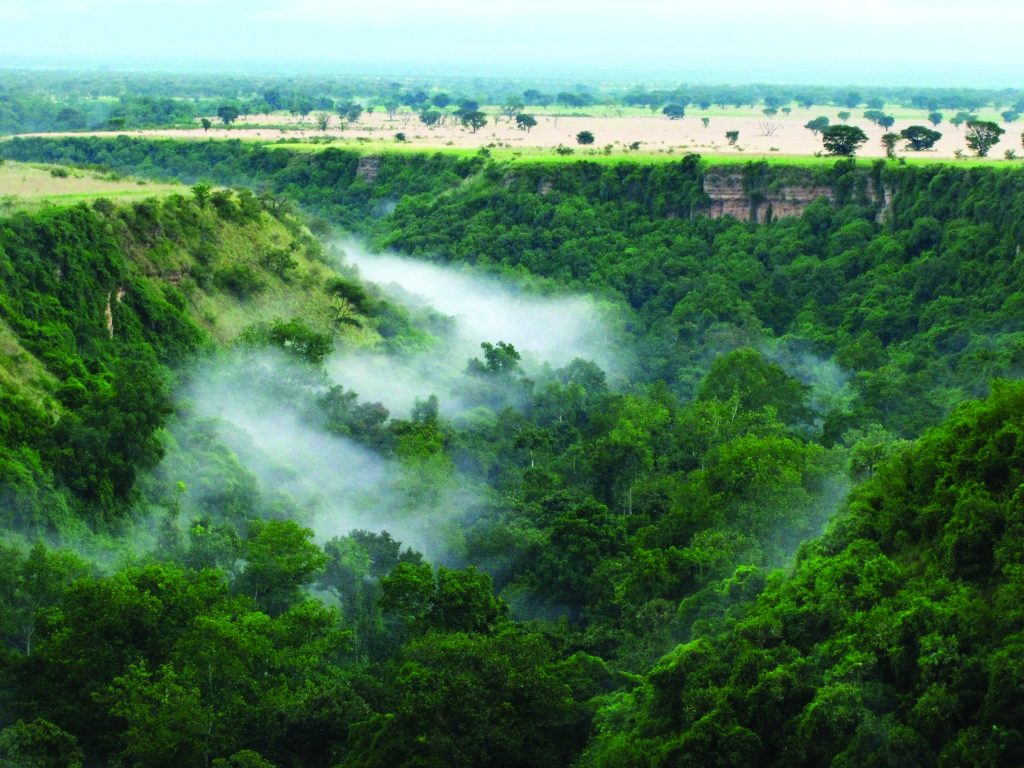
Kyambura is home to a small chimpanzee community, one of the smallest habituated groups in Uganda, and tracking them in this narrow forest corridor is an intensely intimate experience. Because the gorge confines the chimps’ ranging to a linear strip of forest, encounters tend to be more predictable than at Kibale, and the ratio of guide to visitor is typically higher. The dramatic topography means you are scrambling down ropes and over roots to reach the forest floor, which adds a sense of genuine expedition to the morning. The hike is not a gentle stroll. But the reward of a chimpanzee encounter set against the surreal backdrop of sunken rainforest surrounded by open African savannah is entirely unlike anything you will experience at Kibale.
Kyambura’s low-season permit rate matches the standard Kibale rate of $200 for FNR (Forest National Reserve), making it an exceptional value proposition for travelers combining their Queen Elizabeth National Park game drive with a morning in the gorge. Visiting Kyambura does not require a separate day or significant detour; the gorge is accessible from the main Mweya Peninsula lodge area within forty-five minutes, and for many travelers it becomes the unexpected highlight of their Queen Elizabeth safari.
The Case for Chimpanzee Trekking in April, May, and November
For too long, people have treated Uganda’s low season as a logistical inconvenience rather than a travel opportunity. Part of this perception comes from travelers whose experience of African rain is based on savannah parks, where heavy rainfall does genuinely inhibit game viewing from vehicle tracks. Uganda’s tropical forests operate on entirely different terms. Rain here is typically heavy for an hour or two, often in the afternoon, and then clears. The mornings, precisely when chimpanzee tracking occurs, are frequently crisp, fresh, and dramatically lit, particularly in the highland and mid-altitude forest zones.
The Forest at Its Most Alive
During and immediately after rain, Kibale National Park’s forest is extraordinarily beautiful. The canopy is saturated green. Birdlife, which is exceptional in Kibale year-round with over 370 species, including eight of Uganda’s twelve Albertine Rift endemics, is particularly vocal and active in the hours after rain as birds take advantage of the flush of insects. The ground is soft, the mushrooms are spectacular, and the smell of the forest after rainfall is something that, once encountered, becomes a sense memory that brings the whole experience back in an instant.
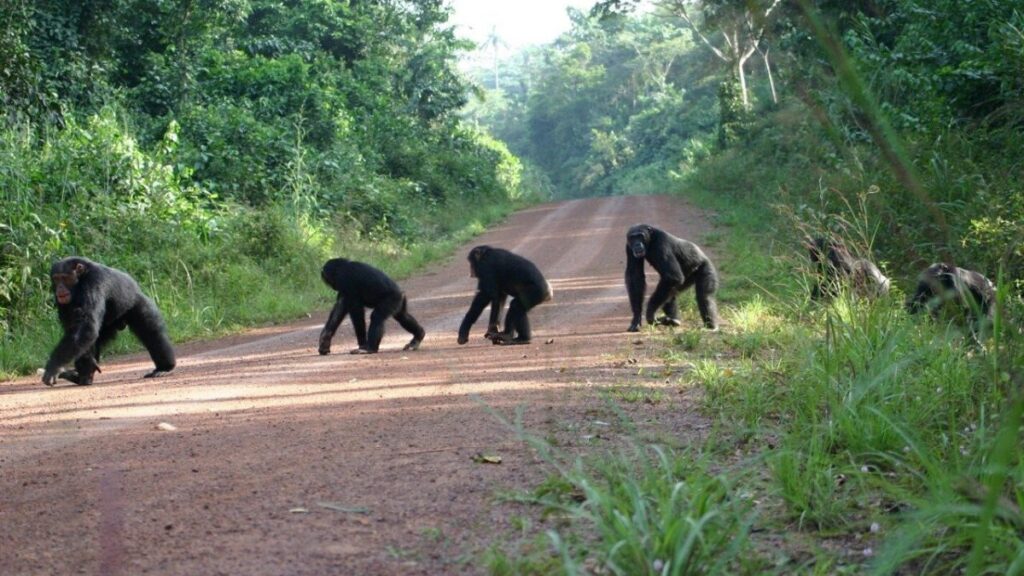
Chimpanzees in the wet season are, if anything, more fascinating to observe than in the dry months. Food is more abundant, meaning less competition and more relaxed social behavior. The community moves more freely, and the calls, particularly the long-range pant-hoots that carry across the forest in the morning, are more frequent. For photographers, the quality of light in the lowland tropical forest after rain, particularly in the early morning, is exceptional.
Lower Visitor Numbers, Deeper Immersion
Kibale National Park in July receives its highest annual visitor volumes. The briefing area at Kanyanchu can hold dozens of waiting trekkers. In April or May, it holds a handful. The difference this makes to the quality of your experience is substantial and difficult to overstate. With fewer people at the briefing, your guide spends more time with your small group. On the trail, there is no sense of following a tourist convoy. In the presence of the chimpanzees, the atmosphere is quieter, more respectful, and more absorbed. The primates, accustomed to human presence, behave as they would on any other morning. And you, without the distraction of a large group around you, are simply more present.
Financial Savings That Make a Real Difference
A Uganda safari involving gorilla trekking and chimpanzee tracking represents a meaningful investment even at standard rates. The combination of a low-season gorilla permit (USD 600 FNR) and a low-season chimpanzee permit (USD 200 FNR) represents a total permit saving of USD 300 compared to the January 2027 peak tariff of USD 800 and USD 300, respectively. For two travelers, that saving approaches USD 600 on permits alone before factoring in the lodge and ground operator discounts that typically accompany the low season. This saving is real money that can be redirected into an extra night at a premier property, an additional activity, or simply a more financially comfortable journey.
Combining Chimpanzee and Gorilla Trekking in a Low-Season Uganda Safari.
The most coherent and rewarding way to experience Uganda’s low-season primate offers is within a combined safari itinerary that brings together gorilla trekking in Bwindi with chimpanzee tracking at Kibale, linked by the spectacular landscapes of western Uganda’s Queen Elizabeth National Park. This classic western Uganda circuit Entebbe, Fort Portal, Kibale, Queen Elizabeth, Bwindi, and Return covers some of the most biologically diverse and scenically remarkable landscapes on the African continent, and it can be done comprehensively in seven to ten days.
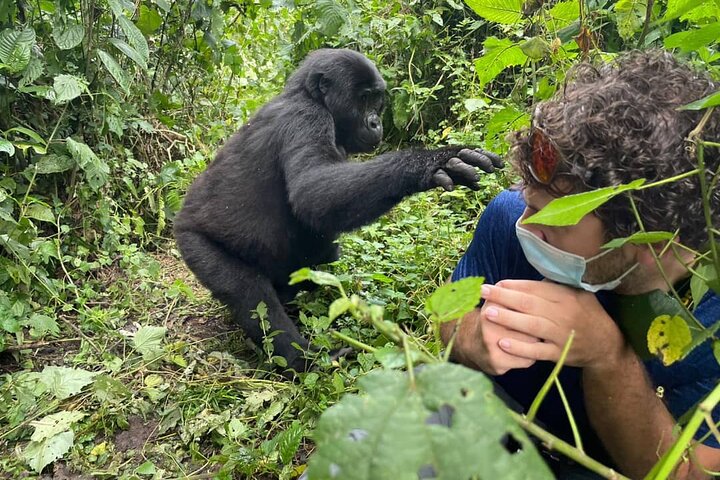
A typical low-season combined itinerary might run as follows: arrival in Entebbe, overnight at a lakeside lodge, morning transfer to Fort Portal with afternoon at a crater lake or tea estate, two nights at Kibale National Park for morning chimpanzee tracking and an optional afternoon habituation experience or guided forest walk, transfer south through Queen Elizabeth National Park for two nights with full-day game drives and a Kyambura Gorge morning, then southwest to Bwindi for two nights and your gorilla trekking day, with return to Entebbe. Throughout this itinerary, the combination of April, May, or November timing means smaller groups, lower permit costs, competitive lodge rates, and a version of Uganda that has more space and silence in it than the peak season equivalent.
You can explore our complete Uganda primate safaris by visiting our Uganda safari packages page at rwenzoritrekkingsafaris.com, or reach out to our team to discuss a custom itinerary built around your specific travel dates, group size, and interests.
Understanding the New UWA Booking Policy: What Changed in March 2026
The Uganda Wildlife Authority’s February 2026 announcement was not only about new low-season rates. It also confirmed a significant change to the mechanism by which all UWA permits, including chimpanzee permits, are booked. Effective 1st March 2026, the seven-day reservation window that previously allowed operators to hold permits without payment has been permanently suspended. All permits must now be purchased in full at the time of booking, with no hold or unpaid reservation status available.
For travelers, this change is overwhelmingly positive. The old system created a shadow market of held inventory that could give misleading availability signals and disadvantage operators who did not block permits speculatively. The new system is completely transparent: if a date and community are shown as available when you inquire, that availability is real. When you pay, your permit is confirmed immediately and will not be cancelled due to a reservation expiry timer. Your chimpanzee tracking date is locked in at the moment of payment.
As with low-season gorilla permits, low-season chimpanzee permits cannot be rescheduled once purchased. Travellers should ensure their itinerary is confirmed before committing to a low-season permit date, and we strongly recommend comprehensive travel insurance for all Uganda safari bookings.
Planning Your Chimpanzee Safari: Practical Considerations.
A successful chimpanzee tracking experience at either Kibale or Kyambura requires some advance preparation beyond simply securing the permit. Physical fitness is a factor, though less demanding than gorilla trekking; in Bwindi, Kibale’s forest trails are relatively accessible, while Kyambura’s gorge descent requires reasonable agility. Dress for tropical forest conditions: long trousers, long-sleeved shirts, and sturdy closed-toe footwear are essential. In the low season, lightweight waterproof outer layers are advisable for the brief but sometimes intense mid-morning showers that characterize April and May.
Photography at Kibale requires patience and adaptability. The forest canopy is dense, and chimpanzees move quickly and unpredictably. A versatile zoom lens in the 100–400 mm range gives you options at both close quarters and for canopy work. In the low season, the dappled light after rain can be extraordinary for photography, but autofocus performance in dark forest conditions matters more here than in any other primate tracking context. At Rwenzori Trekking Safaris, our guides have extensive experience in positioning guests for optimal photographic opportunities and can provide guidance on timing and technique during the trek.
Accommodation near Kibale ranges from excellent budget and mid-range options in the Fort Portal area to some of East Africa’s finest forest lodges adjacent to the park boundary. During the low season, many properties offer competitive rates and excellent availability. We work with a curated selection of lodges at different price points and can match accommodation to your budget and preferences as part of a comprehensive itinerary proposal.
Chimpanzee Conservation: The Deeper Significance of Your Permit
Every chimpanzee tracking permit purchased through the Uganda Wildlife Authority contributes directly to the funding of Uganda’s national park system, including the ranger networks, research programs, and community liaison activities that make primate habituation possible in the first place. When you pay for a chimpanzee permit, you are not paying for a tourist product. You are making a direct financial contribution to the conservation of one of our closest evolutionary relatives in one of the most biologically significant forest landscapes remaining in Africa.
Common chimpanzees (Pan troglodytes) share approximately 98.7 percent of their DNA with humans, and the parallels in social structure, communication, tool use, and emotional life are striking and sometimes unsettling in the best possible way. Uganda’s Kibale population is one of the most intensively studied chimpanzee communities in the world, and the research conducted here over decades has fundamentally reshaped our understanding of chimpanzee culture, cognition, and intergroup conflict. The habituated communities at Kibale and Kyambura are living subjects of ongoing scientific work, and the revenue from tourism permits is a foundational component of the funding model that keeps that work possible.
Viewed from this perspective, UWA’s introduction of low-season rates serves as both a conservation strategy and a commercial one. More visits distributed across more of the year mean more consistent revenue for park management, less overcrowding pressure on the habituated communities during peak periods, and a broader global base of people who have experienced Uganda’s primates firsthand and carry a stake in their future.
Frequently Asked Questions About Uganda Low Season Chimpanzee Permits
How much does a Uganda chimpanzee tracking permit cost in the low season?
During the official low season months of April, May, and November, chimpanzee tracking permits in Uganda cost USD 200 for foreign non-residents (FNR) and USD 150 for foreign residents (FR). This applies to both Kibale National Park and Kyambura Gorge in Queen Elizabeth National Park. The Uganda Wildlife Authority announced these rates with immediate effect in February 2026. Starting on January 1, 2027, Kibale NP’s peak season rate will rise to USD 300 (FNR, or Foreign Non-Resident).
Where can I track chimpanzees in Uganda?
Uganda’s two principal chimpanzee tracking destinations are Kibale National Park in the Fort Portal region of western Uganda and Kyambura Gorge within Queen Elizabeth National Park. Kibale offers the highest chimpanzee density and the most well-established habituated community in the country. Kyambura offers a dramatically different experience tracking chimpanzees in a sunken forest gorge set within open savannah. Both locations operate under UWA (Uganda Wildlife Authority) permit requirements and offer low-season discounted rates in April, May, and November.
What is the difference between chimpanzee tracking and chimpanzee habituation in Uganda?
Standard chimpanzee tracking grants one hour with a fully habituated chimpanzee community. Chimpanzee habituation experiences, available at Kibale National Park, allow visitors to join UWA researchers for an extended session, typically four to six hours, with a community that is still being habituated to human presence. Habituation permits are not included in the low season discount, and they maintain their standard rate. Habituation is recommended for return visitors or those with a specific interest in primate behavior, cognition, or conservation research.
Can I track both chimpanzees and gorillas on the same Uganda safari?
Yes, and this is precisely what most experienced Uganda safari planners recommend. The classic western Uganda circuit combines chimpanzee tracking at Kibale National Park with gorilla trekking at Bwindi Impenetrable National Park, typically with Queen Elizabeth National Park game drives and a Kyambura Gorge session in between. This itinerary can be completed in seven to ten days and represents one of the most extraordinary primate experiences available anywhere on earth. In the low season, both permits are discounted, making the combined itinerary exceptionally good value.
Are low-season chimpanzee permits reschedulable?
No. The Uganda Wildlife Authority has confirmed that low-season permits, including chimpanzee tracking permits, cannot be rescheduled once purchased. The low season rate applies only to the specific date booked. Travellers should ensure their travel arrangements are fully confirmed before purchasing a low-season permit, and comprehensive travel insurance is strongly recommended.
What changed about UWA permit booking in March 2026?
Effective 1st March 2026, UWA suspended the previous seven-day reservation window that allowed operators to hold permits without upfront payment. All chimpanzee and gorilla permits now require full payment at the time of booking, ensuring immediate confirmation. This change improves permit availability transparency and eliminates speculative inventory holding by operators, which in turn enhances the overall experience for trekkers by ensuring that permits are readily available and accurately reflect current availability.
Is chimpanzee trekking safe during Uganda’s rainy season?
Yes. Chimpanzee trekking at Kibale National Park and Kyambura Gorge operates throughout the year, including the wetter months of April, May, and November. UWA rangers’ guides are experienced in managing treks in wet conditions. Rainfall typically concentrates in the afternoon hours, well after the morning trek session concludes, and Kibale’s forest trails remain navigable year-round. Appropriate waterproof clothing and sturdy footwear are recommended.
How long does a chimpanzee trek take at Kibale?
The chimpanzee tracking briefing at Kanyanchu Visitor Centre begins at 8:00 AM for the morning session and 2:00 PM for the afternoon session. The walk to the habituated community typically takes between thirty minutes and two hours, depending on where the chimpanzees have ranged. Once the group locates the community, they spend one hour there before returning to the visitor center. Most participants complete the full morning experience, including briefing, trek, and return, in four to five hours.
What should I bring for a chimpanzee trek in Uganda?
Essential kit for a chimpanzee trek includes sturdy, closed-toe hiking footwear (waterproof recommended in low season), long trousers and a long-sleeved shirt (for vegetation protection), a lightweight waterproof layer, insect repellent, sunscreen, a small daypack with drinking water and snacks, and your camera equipment. Binoculars are strongly recommended for canopy observation. Your permit confirmation should be carried on your person and presented at the briefing desk.
Do I need a tour operator to book chimpanzee permits in Uganda?
Yes. Chimpanzee tracking permits in Uganda must be booked through a licensed tour operator authorized by the Uganda Wildlife Authority. Rwenzori Trekking Safaris is fully licensed and UWA-authorized, enabling direct permit purchasing at gazetted rates with immediate confirmation under the new payment policy.
Is Kibale National Park accessible year-round?
Yes. Kibale National Park is accessible and fully operational throughout the year, including during the low-season months of April, May, and November. The approach roads from Fort Portal are well-maintained. Lodges adjacent to the park remain open year-round. The park’s forest tracks may be muddier in the wet season, but chimpanzee trekking operations are unaffected. In low season, the reduced visitor numbers make the park experience more personal and tranquil.
How does Kyambura Gorge compare to Kibale for chimpanzee trekking?
Kibale and Kyambura offer fundamentally different experiences. Kibale provides more reliable encounters with a larger, well-established community in classic tropical forest terrain; it is the definitive chimpanzee destination. Kyambura offers a smaller, more intimate community in a spectacular and unusual landscape, where the combination of open savannah above and sunken rainforest below creates an encounter unlike anything else in primate tracking. Ideally, travelers with time to visit both should do so; the two experiences are entirely complementary.
Start Planning Your Low-Season Chimpanzee Safari.
Uganda’s wild chimpanzees have been waiting in Kibale’s ancient forest and Kyambura’s sunken gorge for far longer than any tourism program has existed. They were here before the trails, visitor centers, and permits. With the ongoing support of Uganda’s conservation system, their presence will persist long after our departure. That long perspective is part of what makes an encounter with them so affecting; you are in the presence of a lineage that is simultaneously deeply familiar and entirely other, a mirror of human society that reflects things both flattering and uncomfortable.
The Uganda Wildlife Authority’s introduction of low-season chimpanzee permit rates at USD 200 for foreign non-residents is a meaningful invitation to experience this encounter in one of the most beautiful, least crowded, and most financially accessible windows the calendar offers. Combined with the discounted low-season gorilla permit rates announced simultaneously and with the transparency improvements brought by the new immediate-payment booking policy, this is an exceptional moment to plan a Uganda primate safari.
At Rwenzori Trekking Safaris, we have guided travelers to Uganda’s forests for years. We know Kibale in every season. We know Kyambura in every weather. We know which sectors of Bwindi suit which travel styles, which lodges deliver on their promises, and how to build an itinerary that maximizes your time in the field without leaving you exhausted. Our dedication lies in tailoring your Uganda safari to align with your unique dates, budget, interests, and travel style.
Please reach out to our trekking experts and share your travel details with us. Please tell us your group size, whether this is your first trip to Uganda, your preferred dates, and what you want to do. We will respond promptly with a tailored proposal, confirmed permit availability, and honest advice from people who live and work in these forests.
The morning trek is waiting. The forest is already awake. Let us take you there.